Munich Personal RePEc Archive
Interdomain routing and games
Levin, Hagay and Schapira, Michael and Zohar, Aviv
The Hebrew University of Jerusalem
30 January 2008
Online at
https://mpra.ub.uni-muenchen.de/8476/
Interdomain Routing and Games
Hagay Levin∗ Michael Schapira† Aviv Zohar‡
Abstract
We present a game-theoretic model that captures many of the intricacies of interdomain routing in today’s Internet. In this model, the strategic agents are source nodes located on a network, who aim to send traffic to a unique destination node. The interaction between the agents is dynamic and complex – asynchronous, sequential, and based on partial informa-tion. Best-reply dynamics in this model capture crucial aspects of the only interdomain routing protocol de facto, namely the Border Gateway Protocol (BGP).
We study complexity and incentive-related issues in this model. Our main results are showing that in realistic and well-studied settings, BGP is incentive-compatible. I.e., not only does myopic behaviour of all players converge to a “stable” routing outcome, but no player has motivation to unilaterally deviate from the protocol. Moreover, we show that evencoalitions of players ofany size cannot improve their routing outcomes by collaborating. Unlike the vast majority of works in mechanism design, our results do not require any monetary transfers (to or by the agents).
∗The Department of Economics, The Hebrew University of Jerusalem, Israel. [email protected].
†The School of Computer Science and Engineering, The Hebrew University of Jerusalem, Israel.
[email protected]. Supported by grants from the Israel Science Foundation and the USA-Israel Bi-national Science Foundation.
‡The School of Computer Science and Engineering, The Hebrew University of Jerusalem, Israel. [email protected].
1
Introduction
The Internet is composed of smaller networks called Autonomous Systems (ASes). The task of ensuring connectivity between ASes is called interdomain routing. Since not all ASes are directly connected, packets often have to traverse several ASes. The packets’ routes are established via complex interactions between ASes that enable them to express preferences over routes, and are affected by the nature of the network (message delays, malfunctions, etc.). The only interdomain routing protocolde facto is the Border Gateway Protocol (BGP). ASes are owned by selfish, often competing, economic entities (Microsoft, AT&T, etc.), and cannot be expected to adhere to BGP without proper incentives. It is therefore natural to consider interdomain routing from a game-theoretic point of view.
Routing Games. The first contribution of this paper is the presentation of a game-theoretic model of interdomain routing that captures many of its intricacies (e.g., the asynchronous nature of the network). In our model (as in [17, 16]), the network is defined by an undirected graph
G= (N, L). The set of nodes N represents the ASes, and consists of n source-nodes 1, ..., n (the players), and a unique destination-node d. The set of edges L represents physical communication links between the nodes. Each source nodeihas a valuation functionvi that expresses a full-order of strict preferences over simple routes from itod.
The model consists of two games: At the heart of the model is the sequential, asynchronous, and private-informationConvergence Game, which is meant to model interdomain routing dynamics. Best-reply dynamics in the Convergence Game model crucial features of BGP dynamics, in which each AS is instructed to continuously execute the following actions:
• Receive update messages from neighbouring nodes announcing their routes to the destination.
• Choose a single neighbouring node, whose route you prefer most (givenvi), to send traffic to.
• Announce your new route to all neighbouring nodes.
We also define aOne-Round Game, which will function as an analytic tool. TheOne-Round Gamecan be regarded as the full-information non-sequential game underlying theConvergence Game. Pure Nash equilibria in the One-Round Game correspond to “stable solutions” in net-working literature [17, 16], and are the “sinks” to which best-reply dynamics (BGP) can “converge”. We study several complexity and strategic problems in this model. Most importantly, we address the issue of incentive-compatibility of best-reply dynamics in the Convergence Game. We provide realistic settings in which the execution of reply dynamics (BGP) is in the best-interest of the players (ASes). We also address the following questions: How hard it is to establish whether a pure Nash exists in the One-Round Game (the nonexistence of a pure Nash implies that best-reply dynamics will go on indefinitely)? How hard is it to get good approximations to the optimal social welfare?
Existence of Pure Nash Equilibria. Griffin and Wilfong have shown that determining whether a pure Nash equilibrium in the One-Round Game (stable solution) exists is NP-hard [17]. We prove that this result extends to the communication model.
Theorem: Determining whether a pure Nash equilibrium in theOne-Round Gameexists requires exponential communication (inn) between the source-nodes.
converges (see, e.g., [16, 27, 14, 13, 15, 5, 26, 4]). The most general condition known to guarantee this is “No Dispute Wheel”, proposed by Griffin Shepherd and Wilfong [16]. No Dispute Wheel guarantees aunique pure Nash in theOne-Round Game, and convergence of best-reply dynamics to it in the Convergence Game. No Dispute Wheel allows nodes to have significantly more expressive and realistic preferences than than always preferring shorter routes to longer ones. In particular, a special case of No Dispute Wheel is the celebratedGao-Rexford setting [14, 13] that is said to depict the commercial structure that underlies the Internet [21] (see Section 2 for an explanation about No Dispute Wheel and interesting special cases).
Feigenbaum, Papadimitriou, Sami, and Shenker [7] initiated an economic, or mechanism design, approach to interdomain routing. While BGP was designed to guarantee connectivity between trusted and obedient parties, in the age of commercial Internet these are no longer valid assump-tions (ASes are owned by different economic entities with very different, and often contradicting, commercial interests). Identifying realistic settings in which BGP is incentive-compatible has be-come the paradigmatic problem in Distributed Algorithmic Mechanism Design [8, 12, 24], and the subject of many works [25, 6, 10, 9, 3, 11, 23, 18].
Recently, a step in this direction was taken in [9, 11]. It was shown that if No Dispute Wheel and an additional condition named Policy Consistency hold then BGP is incentive-compatible in ex-post Nash. Informally, policy consistency means thatno two neighbouring nodes disagree over which of any two routes is preferable. This is obviously a very severe restriction that does not necessarily hold in practice. We take a significant step forward by removing it (in particular, we allow the Gao-Rexford setting for which Policy Consistency does not hold).
Unfortunately, we prove that best-reply dynamics are not incentive-compatible if Policy Con-sistency does not hold. This is true even if No Dispute Wheel holds, and can be shown to hold even in the natural Gao-Rexford commercial setting.
Theorem: Best-reply dynamics are not incentive-compatible in ex-post Nash even if the No Dispute Wheel condition holds.
However, there is still hope for BGP. We consider a property called“Route Verification”. Route Verification means that a node can verify whether a route announced by a neighbouring node is indeed available to that neighbouring node (and if not simply ignore that route announcement). Unlike Policy Consistency, Route Verification does not restrict the preferences of ASes, but is achieved by modifying BGP (e.g., this can be achieved via cryptographic signatures). Achieving Route Verification in the Internet is an important agenda in security research1. Security researchers
seek ways to implement Route Verification that are not only theoretically sound, but also reasonable to deploy in the Internet (see [2]).
We note, that even if announcements of non-available routes are prevented by Route Verification, nodes still have many other forms of manipulation available to them: Pretending to have different preferences (“lying”), conveying inconsistent information (e.g., displaying inconsistent preferences over routes), denying routes from neighbours, and more. Hence, it still needs to be shown that Route Verification guarantees immunity of best-reply dynamics (BGP) toallforms of manipulation.
Our main result is the following:
Theorem: Best-reply dynamics are incentive-compatible in (subgame-perfect) ex-post Nash if No Dispute Wheel and Route Verification hold.
We stress that this result is achievedwithout any monetary transfers between nodes (as in [11],
1
and unlike most prior works on interdomain routing, and in mechanism design in general).
Our result highlights an interesting connection between the two current research agendas that address the problem of disobedience and lack of trust in interdomain routing – security research and Distributed Algorithmic Mechanism Design. One of the implications of this result is that one can achieve incentive-compatibility in realistic settings (e.g., networks for which the Gao-Rexford constraints and Route Verification hold). This should further motivate security research, as it provides a strong strategic justification for modifications of BGP that guarantee Route Verification via cryptographic and other means (e.g., Secure BGP [2]).
In [11] the notion of collusion-proofness in ex-post Nash is defined. Informally, collusion-proofness in ex-post Nash means that agroup of agents cannot collaborate to improve the outcome of any player in the group without strictly harming another player in the group. This means that the group as a whole has no interest to deviate from a strategy profile (at least one member will be harmed by doing so). The previous theorem can actually be strengthened to the following one:
Theorem: Best-reply dynamics are collusion-proof in (subgame perfect) ex-post Nash if No Dispute Wheel and Route Verification hold.
In particular, this holds even for the coalition that contains all nodes. This implies that, if No Dispute Wheel holds, BGP is actually socially just in the following sense (also observed in [3]):
Corollary: If No Dispute Wheel holds, the unique Nash equilibrium in the One-Round Game
(to which best-reply dynamics always converge) is Pareto optimal.
Maximizing Social Welfare. Finally, we turn our attention to the objective of maximizing the social-welfare, that has also been studied in the context of interdomain routing (see [10]). Maximizing the social welfare means finding a tree rooted in d,T =R1, ..., Rn, in which node iis assigned route Ri, such that Σivi(Ri) is maximized. In [9] it is shown that if No Dispute Wheel and Policy Consistency hold then BGP converges to a stable solution that also maximizes the social welfare. In contrast, we show that the removal of Policy Consistency can be disastrous in terms of welfare maximization. We do so by presenting two complementary bounds, one in the computational complexity model, and one in the communication complexity model.
Theorem: Obtaining an approximation of O(n12−ǫ) to the social welfare is impossible unless P =
N P. Obtaining an approximation ofO(n1−ǫ) to the social welfare is impossible unless P =ZP P. This holds for any ǫ >0 and even if No Dispute Wheel holds.
Theorem: Obtaining an approximation of O(n1−ǫ) to the social welfare requires exponential com-munication (in n). This holds for any ǫ >0 and even if No Dispute Wheel holds.
These two bounds actually hold even in the Gao-Rexford setting. These results should be compared with the previously known lower bound of Ω(n12−ǫ) [10] (dependent on P 6= ZP P)
for the case of general valuation functions. They show that even narrow conditions that ensure existence of pure Nash in the One-Round Game, and convergence of best-reply dynamics in the Convergence Game, might be very far from guaranteeing a good social welfare. A trivial matching upper bound ofn exists even for general valuation functions.
1.1 Organization of the Paper
Game. In Section 4 we present lower bounds on social-welfare maximization. In Section 5 we discuss the open questions.
2
Routing Games
Here we define the game-theoretic model, and begin exploring the two games it contains.
2.1 Two Routing Games
In our model, the network is defined by an undirected graph G= (N, L). N consists ofn source-nodes 1, ..., n (the players), and a unique destination-node d.2 Each source node ihas a valuation
functionvithat assigns a non-negative value to everypossiblesimple route fromitod(i.e., to every simple route in the complete graph over the nodes ofG).3 We make the standard assumption [16]
that players have strict preferences: For any nodei, and every two routesP, Qfrom itodthat do not have the same first link, it holds thatvi(P)6=vi(Q). The model consists of two routing games:
2.1.1 A benchmark - the One-Round Game:
The One-Round Game is a full-information game in which a strategy of a node iis a choice of an outgoing edge (i’s choice of an AS to forward traffic to). The payoff of node i for a strategy profile isvi(R) if the strategies induce a route R fromitod, and 0 otherwise.
2.1.2 The Convergence Game:
TheConvergence Gameis a multi-round game with an infinite number of rounds. In each round one or more players (nodes) are chosen to participate by a scheduler. The scheduler models the asynchronous nature of the Internet, and decides which players participate in each round of the game. The schedule chosen must allow every player to play in an infinite number of rounds (the scheduler cannot deny a node from playing indefinitely). In each round of the game, a player i
chosen to play can perform the following actions:
• Receive update messages from neighbouring nodes. Each update message announces a simple route from the sending neighbouring node to the destination.
• Choose a single outgoing edge (i, j) ∈ L (representing a choice of a neighbouring node to forward traffic to), or∅ (not to forward traffic at all).
• Announce simple routes (fromitod) toi’s neighbouring nodes.
The scheduler decides in which round sent route announcements reach their destinations or if they will be dropped. It can arbitrarily delay update messages, but cannot indefinitely prevent update messages of a node from reaching its neighbour (see [16] for a formal model).
Astrategy of a player in theConvergence Gamespecifies his actions in every round in which that player is chosen to participate. Best-reply dynamics is the strategy-profile in which every player continuously performs the following actions: Receive the most recent route announcements from all neighbours. Choose the neighbour with the most preferred simple route to d(according to yourvi). Announce this route to all neighbours.
2The reason for this is that in today’s Internet, routes for each destination AS are computed independently.
3
If from some round onwards i’s assigned route is constant then i’s payoff is its value for that route. Otherwise,i’s payoff is 0. More formally, the payoff of playeriisvi(R) ifR is a simple route fromitodand from some round onwards, for every link (r, s) onR,ralways choosess. Otherwise,
i’s payoff is 0. (All of our results hold even if when i’s route “oscillates” i’s payoff is set to be i’s value for the highest valued route it is assigned an infinite number of times.).
2.2 Stable Solutions and Pure Nash Equilibria
Pure Nash equilibria in theOne-Round Gameare known in networking literature as stable solu-tions. It is not hard to verify that each such stable solution forms a tree rooted ind. An important requirement from BGP is that it always converge to such a stable solution. However, this is not guaranteed in general, and definitely will not happen if a pure Nash does not exist. Griffin and Wilfong have shown that determining whether a pure Nash equilibrium in theOne-Round Game
exists is NP-hard [17]. We strengthen this result by extending it to the communication model. The use of communication complexity for analyzing uncoupled Nash equilibrium procedures was recently presented in [19]. Our result can be seen as continuing this line of research.
Theorem 2.1 Determining whether a pure Nash equilibrium in the One-Round Game exists requires exponential communication (in n).
Proof: We shall prove a reduction from the communicationSet Disjointenessproblem (studied in [1]). In this problem, there are n communication parties. Each party i holds a subset Ai of
{1, ..., K}. The goal is to distinguish between the two following extreme subcases:
• TiAi 6=∅
• For every i6=j Ai∩Aj =∅
It is known [1] that in order to distinguish between these two subcases the parties must exchange Ω(K) bits. We set K = 2n2. The reduction to the problem of determining whether a pure Nash
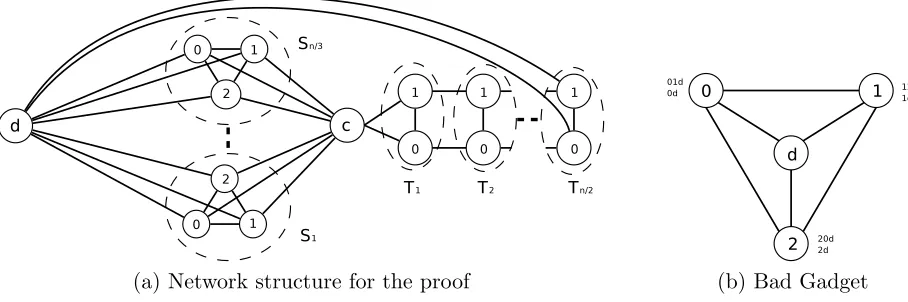
in the One-Round Game exists is as follows: Consider a network with 2n+ 1 source nodes and a unique destination noded. The set of nodesN consists of 3 disjoint subsets: nsending nodes, a connecting node c, andn transit nodes. Each partyi∈[n] in the Set Disjointenessproblem is associated with a sending node si.
The transit nodes are divided into n
2 pairs T1, ..., Tn2. Each such pair of nodes Tr contains a
specific node we shall call a 0-node and another node we shall call a 1-node. All sending nodes are connected to the connecting node, which, in turn, is connected to both nodes inT1. For every
r = 1, ...,n2 −1, each 0-node in Tr is connected to the 1-node in Tr, and to the 0-node in Tr+1.
Similarly, each 1-node in Tr is connected to the 0-node in Tr, and to the 1-node in Tr+1. Both
nodes inTn
2 are connected to each other and directly tod. We divide the sending nodes into groups
of size 3, S1, ..., Sn
3. For every Sr, the 3 nodes in Sr are connected to each other and to d. See a
description of the network in Figure 1a.
We must now define the valuation functions of the different nodes. Let us start with the transit nodes: A 0-node inTr u has a value of 12 for any route to din which the next-hop node afteru is
the 1-node in Tr, and a value of 14 for routes in which the next-hop node afteru is the 0-node in
Tr+1 (and very low values for all other routes tod, without ties). Similarly, a 1-node inTr u has a value of 1
2 for any route to din which the next-hop node afteruis the 0-node inTr, and a value of 1
(a) Network structure for the proof (b) Bad Gadget
Figure 1: Network constructions used in the proof of Theorem 2.1
other routes to d, without ties). Both nodes in Tn
2 prefer going through each other (a value of
1 2)
than directly to d(a value of 14).
Fix a specific triplet of nodes Sr and let 0,1,2 be those nodes. Each nodei= 0,1,2 will assign a value of 1
2 to the route (i, i+ 1 (mod3), d) and 1
4 to all other simple routes todthat only include
nodes in Sr. This construction of Sr is known as Bad Gadget [17], and appears in Figure 1b.
Bad Gadgetis an example of a small network in which no pure Nash equilibrium exists.
There are 2n2 possible routes from c to d that go through the transit nodes and correspond
to strings in {0,1}n. In each such route, for every pair T
r either the 0-node forwards traffic to the 1-node or vice versa. Fix an arbitrary order on these routesR1, ..., R2n
2. Each source nodesi
assigns a value close to 1 (no ties) to a route (si, c)Ra iff a∈Ai. si assigns values very close 0 to all unmentioned routes (without ties).
The reader can verify that if there is some a ∈ TiAi then assigning every node i the route (si, c)Ra is a pure Nash equilibrium (and, in fact, a unique pure Nash equilibrium). If, on the other hand, for everyi6=j Ai∩Aj =∅, then there is no pure Nash (because of the Bad Gadget construction for any tripleSr).
Hence, we have a network with O(n) nodes, in which determining whether a Nash equilibrium exists is equivalent to solving the Set Disjointenessproblem withn players (each player i sim-ulates node si), each holding a subset of 1, . . . ,2n2. It therefore requires at least Ω(2
n
2) bits of
communication. This concludes the proof of the theorem.
Remark 2.2 The reader might be bothered by the fact that nodes are required to have preferences over very long routes (linear inn, that is, the number of all ASes in the entire Internet). We note that similar constructions in which the lengths of routes are asymptotically bigger than logn also lead to non-polynomial communication lower bounds.
2.3 BGP Convergence and Best-Reply Dynamics
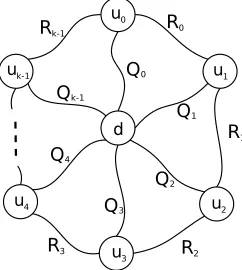
No Dispute Wheel is the widest condition known, to date, to guarantee BGP convergence to a stable solution. In our terms, this translates to convergence of best-reply dynamics in theConvergence Game. A Dispute Wheel, defined by Griffin et al. [16], is an abstract mathematical structure that can be induced by the network topology and the valuation functions. Formally, a dispute wheel is defined as the 3-tuple (U,R,Q) where U = (u0, u1, . . . , uk−1) is a sequence of k nodes in the
G(indices for these nodes and routes should be considered modulok). We shall call u0, ...uk−1 the
pivot-nodes. It must hold that:
[image:9.595.245.366.112.247.2]Each node ui would rather route clockwise through nodeui+1 than through the path Qi Figure 2: A Dispute Wheel
• Each routeQi starts at ui and ends at the destination node d.
• Each routeRi starts at node ui and ends at node ui+1.
• vi(Qi)≤vi(RiQi+1) (whereRiQi+1 is the concatenation of the routesRi and Qi+1)
The term “Dispute Wheel” is due to the resemblance of its form to that of a wheel. Figure 2 depicts such a structure. It is known that No Dispute Wheel guarantees that there is a unique stable solution [16].
No Dispute Wheel is known to hold for several interesting special cases. One special case is Metric-Based Routing (defined in [9]) which is a generalization of Shortest-Path Routing.
In practice, there is no objective metric according to which all route choices are made. ASes’ preferences are influenced by many economic, and other, considerations, like the business relation-ships between them. The Gao-Rexford setting [14] (see Appendix A) is said to accurately depict the underlying commercial structure of today’s Internet [21], and is a special case of No Dispute Wheel [13]. In this setting, neighbouring ASes have one of two business relationships, based on long-term contracts: A Customer-Provider relationship (one AS purchases connectivity from an-other), orPeering (two ASes carry each other’s transit traffic for free). These business relationships induce natural constraints (e.g., an AS cannot be an indirect customer of itself), formalized by Gao and Rexford.
3
Best-Reply Dynamics and Incentives
In this section we discuss several results regarding the incentive-compatibility of best-reply dynamics in theConvergence Game. We first prove the following theorem:
Theorem 3.1 Best-reply dynamics is not incentive-compatible in ex-post Nash even if the No Dispute Wheel condition holds.
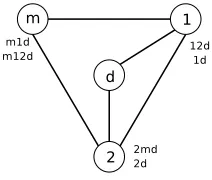
preferred than the lower route). It is easy to show that the valuation functions and topology of the network do not induce a Dispute Wheel (because route 2md does not actually exist). Hence, there is a unique pure Nash in theOne-Round Game, and best-reply dynamics always converges to this Nash in theConvergence Game. The unique Nash is assigning 12d,2d, m12dto 1,2, m, respectively. However, if m announces to 2 repeatedly that its route is md then it is easy to see that best-reply dynamics will always assign 1 the direct route tod, 1d, thus enablingm to get its most preferred route m1d. Hence, deviating from best-reply dynamics is beneficial.
Figure 3: Best-Reply Dynamics is Not Incentive-Compatible
We note, that it is possible to define business relationships between the nodes in this example that are consistent with the Gao-Rexford constraints.
However, as we have said before, this situation can be rectified if Route Verification holds.
Theorem 3.2 If No Dispute Wheel and Route Verification hold, then best-reply dynamics is incentive-compatible in (subgame perfect) ex-post Nash
Proof: Consider a network graph G = (N, L) for which No Dispute Wheel holds. There is a unique stable solutionT to which best-reply dynamics is bound to converge in the Convergence Game. We denote the route of every source node r inT by Tr.
Assume, by contradiction, that some manipulating node rm manages to reach a different out-come M by unilaterally deviating from the best-reply dynamics, and gains by doing so. We shall show that this implies the existence of a Dispute Wheel. The proof shall proceed in steps, pointing out a sequence of routes in the graph that will eventually form a Dispute Wheel.
We define the route Mr to be the route node r believes it is assigned in M. That is, it could be that the manipulator tricked nodes that send traffic through it inM to believe that their traffic is forwarded along a route not used in practice. We note, that it could be the case that node rm intentionally causes a protocol divergence that does not affect it, in order to improve its routing outcome (the choices of other nodes cause remote persistent route oscillations). If this is the case then the routeMr of a noder that is affected by this divergence, will simply ber’s most preferred route, out of the routes assigned tor in the oscillation.
Since we assumed thatrm gained from its manipulation, we deduce:
vrm(Trm)< vrm(Mrm) (1)
Because rm strictly prefers Mrm toTrm, but did not choose it in the routing tree T, we must
conclude that the route Mrm is not available torm inT. This means that there must exist some
noder (other thanrm) that is on the route Mrm that does not have the same route inM as it has
inT. Letr1 be the node on the pathMrm that is closest to don Mrm, such thatMr1 6=Tr1.
By definition, all nodes that followr1 on the routeMrm have exactly the same routes inT and
we must conclude that:
vr1(Mr1)< vr1(Tr1)
4 (2)
We can now proceed to the next step in the proof. Since Tr1 is preferred by r1, and was not
chosen byr1 in the routing treeM, it must be that it was not an available option. Therefore, there
is some noder on the routeTr1, that is not r1, such thatTr 6=Mr. We selectr2 to be the noder
closest todon the pathTr1 for whichTr 6=Mr. As before, all nodes closer todthanr2 on the route
Tr1 send traffic along identical routes in bothT and M. Hence, the routeTr2 must be available to
r2 even in M. The fact that it was not chosen in M implies thatr2 prefers Mr2 over it. Thus, we
have that:
vr2(Tr2)< vr2(Mr2) (3)
We can continue these steps, alternating between the routing trees T and M and creating a sequence of nodes as follows:
• r0 =rm
forn= 0,1,2, . . . we perform the following steps:
• M step: Let r2n+1 be the node r on the route Mr2n such that Mr 6= Tr, and r is closest
among all such nodes todon Mr2n.
• T step: Let r2n+2 be the node r on the route Tr2n+1 such that Mr 6= Tr, and r is closest
among all such nodes todon Tr2n+1.
Note, that the destination node d cannot appear in this sequence because the route Ld = Td
is the empty set. Due to our construction, and to arguments similar to the ones presented before, the preferences over routes are as follows:
fori= 0,2,4, . . . vri(Tri)< vri(Mri) (4)
fori= 1,3,5, . . . vri(Mri)< vri(Tri) (5)
Since there is only a finite number of nodes, at some point a node will appear in this sequence for the second time. We denote the first node that appears two times in the sequence by u0. Let
u0, ..., uk−1, u0 be the subsequence ofr0, r1, ...that begins in the first appearance ofu0 and ends in
its second appearance. We shall examine two distinct cased.
CASE I: The manipulatorrm does not appear in the subsequenceu0, ..., uk−1, u0.
Proposition 3.3 If for all i∈ {0, ..., k−1} rm 6=ui (the manipulator is not one of the nodes in the subsequence) then k must be even.
Proof: Ifkis odd, then it must be thatuk−1andu0 (in its second appearance in the subsequence)
were both selected in M steps, or were both selected in T steps. However, if this is the case we reach a contradiction as both nodes were supposed to be the noder closest todon a certain route, such thatTr6=Mr. Since uk−1 6=u0 this cannot be.
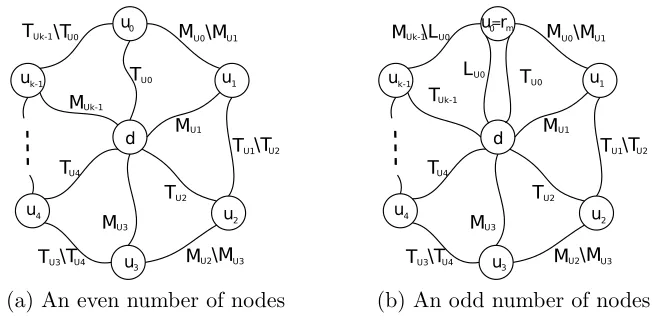
If k is even then the subsequence of nodes u0, ..., uk−1, u0, along with the Tui and Mui route,
and the preferences over these routes (expressed before) form a dispute wheel (as in Figure 4a).
4The reason that the inequality is strict is that, as defined in the problem definition, equality exists only if the
two routes go through the same neighbouring node. This cannot be the case asMr
CASE II: The manipulator rm appears in the subsequence (that is, u0 =rm). We now need to handle two subcases: The subcase in which k is even and the subcase in which k is odd. If k is even then the second appearance of the manipulator (u0) in the subsequence is due to aT step. If
so, a dispute wheel is formed, as in the example in Figure 45.
We are left with the subcase in which k is odd. In this case the second appearance of rm was chosen in anM step. If so, it must be that Muk−1 (that goes through rm) is not used in practice
(otherwise, both uk−1 and that the second appearance of rm = u0 was chosen in M steps, and
arguments similar to those of Proposition 3.3 would result in a contradiction). This must be the result of a manipulation by rm. Let Lrm be the false route reported by the manipulator to the
node that comes before it on Muk−1. Recall that the manipulator can only announce a route Lrm
that exists and is available to it inM. Recall, that the second appearance of the manipulator was chosen due to anM step. Therefore, all nodes that follow it onMuk−1 (which are the same nodes
as in Lrm are assigned the same routes in T and M. Hence, Lrm was available to rm in T. It
must be that vrm(Lrm) ≤ vrm(Trm), for otherwise rm would have chosenLrm as its route in T (a
contradiction to the stability ofT). We know thatvrm(Trm)≤vrm(Mrm) because we assumed that
the manipulation performed byrm was beneficial to it. We get:
vrm(Lrm)≤vrm(Trm)≤vrm(Mrm) (6)
Thus, we form a dispute wheel with Lrm as shown in Figure 4b.
[image:12.595.142.471.347.507.2](a) An even number of nodes (b) An odd number of nodes
Figure 4: The Dispute wheels constructed during the proof of Theorem 3.2.
With a similar (more complex) construction, Theorem 3.2 can be strengthened as follows:
Theorem 3.4 If No Dispute Wheel and Route Verification hold, then the best-reply dynamics is collusion-proof in (subgame perfect) ex-post Nash.
Proof: [Sketch] We shall assume, by contradiction, that a group of manipulators colludes in an interdomain routing instance with no dispute wheel in order to improve their routing outcomes. We define Tr and Mr as in the proof of Theorem 3.2. We assume, by contradiction, that all manipulators are not harmed by this manipulation:
∀v∈M anipulators vr(Tr)≤vr(Mr) (7)
5
We shall arrive at a contradiction by showing the existence of a dispute-wheel in a similar manner to that demonstrated in the proof of Theorem 3.2.
We begin the construction by selecting one of the manipulators that strictly gained from the collusion. We shall denote this manipulator byrm (it must be thatTrm6=Mrm). We then construct
a sequence of nodes in a way similar to that explained in the proof of Theorem 3.2:
• r0 =rm
• M step: For a nodern which is a manipulator we definern+1 to be the node r on the route
Mrn, such thatMr 6=Tr, and r is the closest to don Mrn among all such nodes.
• T step: For a node rn that is not a manipulator, and was chosen in anM step, we define
rn+1 to be the noder on the routeTrn, such thatMr 6=Tr, and r is the closest to don Trn
among all such nodes.
• M step: For a nodernthat is not a manipulator, and was chosen in aT step, we definern+1
to be the noder onMrn, such thatMr =6 Tr, andr is the closest todonMrn among all such
nodes.
We define a subsequence of nodesu0, ...uk−1, u0 as in the proof of Theorem 3.2. We now handle
two cases. The first case is that no manipulator appears in u0, ..., uk−1, u0. The handling of this
case is precisely the same as in the proof of Theorem 3.2 (Case I).
The other case, is that at least one of the nodes in u0, ..., uk−1, u0 is a manipulator. First, we
prove the following proposition:
Proposition 3.5 There is noi∈ {0, ..., k−1} such that both ui and ui+1 (modulo k) are
manip-ulators (no two manipmanip-ulators come one after the other in the subsequenceu0, ...uk−1, u0).
Proof: By contradiction, let ui and ui+1 be two consecutive manipulators. ui+1 was chosen in
an M step. ui+1 is therefore the node r closest to d on Mui such that Mr 6= Tr. Hence, Mui+1
must be available to ui+1 in both M and T. We know that vui+1(Tui+1) ≤vui+1(Mui+1), as ui+1
is a manipulator. Since ui+1 chose Tui+1 over Mui+1 in T it must also be that vui+1(Tui+1) ≥
vui+1(Mui+1). We conclude that vui+1(Tui+1) = vui+1(Mui+1). However, equality of the values of
routes assigned by ui+1 is only possible if ui+1 forwards traffic to the same node in both routes.
Since both routes are available in T, this means that Tui+1 =Mui+1. This contradicts the reason
for which ui+1 was selected (Mui+1 6=Tui+1).
The handling of the case in which at least one of the nodes in u0, ..., uk−1, u0 is a manipulator,
is very similar to CASE II in the proof of Theorem 3.2. The tricky part of the proof arises when a manipulator is selected in an M step. Due to Proposition 3.5, it must be that the node that precedes this appearance of the manipulator in the subsequence is not a manipulator. Such an event can be handled as the subcase in whichk is odd in CASE II (in the proof of Theorem 3.2).
4
Maximizing Social Welfare
Theorem 4.1 Obtaining an approximation of O(n12−ǫ) to the social welfare is impossible unless
P =N P. Obtaining an approximation of O(n1−ǫ) to the social welfare is impossible unless P =
ZP P. This holds for anyǫ >0 and even in the Gao-Rexford setting.
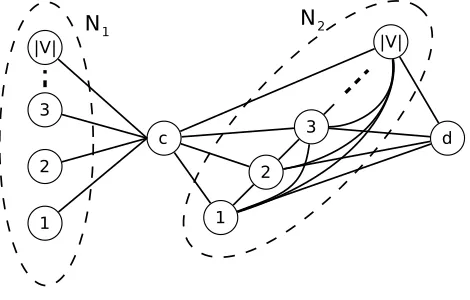
Proof: Our proof will be by reduction fromClique. Assume a graphG=< V, E >, we construct a network with N nodes and L links. In this network, N consists of 2|V|+ 1 source-nodes and a unique destination node d. The source nodes are divided into 3 disjoint sets: Two sets N1,N2,
such that|N1|=|N2|=|V|and aconnection node c. We associate a nodev(N1)∈N1 and a node
v(N2) ∈N2 with every node v ∈ V. All nodes in N1 are connected to the connection node. All
[image:14.595.190.425.218.368.2]nodes inN2 are connected to each other, to the connection node, and to d. See Figure 5.
Figure 5: The network used in the proof of Theorem 4.1
All nodes inN2, andc, have valuation functions that assigns a value close to 0 to all routes (no
ties). Fix some orderO on the nodes in N2. A nodev(N1)∈N1 assigns a value close to 1 (no ties)
to a route R iff: (v(N1), c) is the first link inR. The order of appearance of the nodes from N2 in
R is consistent withO. V(N2) is onR. For every nodeu(N2)6=v(N2)∈N2 on R there is an edge
(v, u) inG.
The reader can verify that every clique in Gcorresponds to a routing tree with a social welfare that equals the size of the clique (assign every node in N1 that is in the clique the route that
goes through cand then the all the nodes in N2 that are associated with nodes in the clique). In
addition, the social welfare of every routing tree corresponds to a clique in the original graph G
(the route fromctodthroughN2 determines the identity of the clique). The theorem follows from
the known inapproximability results forClique[20].
We note, that this result can be made to hold in the Gao-Rexford setting by defining business relation ships as follows: c is a customer of all nodes in N1. For every two nodes r, s ∈N2, such
thats comes afterr inO,sisr’s customer. dis a customer of all nodes in N2.
Theorem 4.2 Obtaining an approximation of O(n1−ǫ) to the social welfare requires exponential communication (in n). This holds for any ǫ >0 and even in the Gao-Rexford setting.
Proof: The proof is similar to the proof of Theorem 2.1, and is by reduction from Set Dis-jointeness. There are n parties, and each party i holds a subset Ai of 1, ..., K. The goal is to distinguish between the two following extreme subcases:
• For every i6=j Ai∩Aj =∅
In order to distinguish between these two subcases the parties must exchange Ω(K) bits. We set K= 2n2.
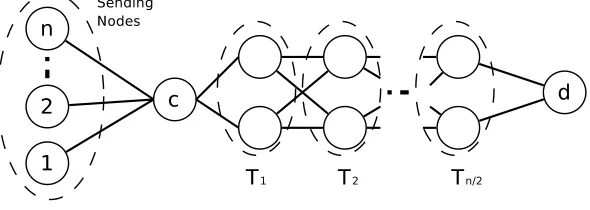
Now, consider a network with 2n+ 1 source nodes and a unique destination noded. The set of nodesN consists of 3 disjoint subsets: n sending nodes, a connecting node c, andn transit nodes. Each partyi∈[n] in the Set Disjointenessproblem is associated with a sending node si.
The transit nodes are divided into n
2 pairs T1, ..., Tn2. All sending nodes are connected to the
connecting node, which, in turn, is connected to both nodes inT1. For everyr= 1, ...,n2 −1, each
node in Tr is connected to both nodes in Tr+1. Both nodes in Tn
2 are connected directly to d. See
[image:15.595.160.455.235.340.2]a description of the network in Figure 6.
Figure 6: The network used in the proof of Theorem 4.2
All transit nodes and the connecting node have a value close to 0 (no ties) for all routes. There are 2n2 possible routes from c to d that go through the transit nodes. Fix an arbitrary order on
these routes R1, ..., R2n
2. The valuation function of each si assigns a value close to 1 (no ties) to
a route (si, c)Ra iff a∈Ai. It assigns a value close to 0 to all other routes (no ties). The reader can verify that there is a route assignment with a social welfare-value close to n if there is some
a ∈ TiAi 6= ∅ (assign every node i the route (si, c)Rj). If, on the other hand, for every i 6= j
Ai∩Aj =∅, then any route assignment cannot have a social-welfare value better than 1 +ǫ. Hence, we have a network with O(n) nodes, in which determining whether the social-welfare is n or 1 is equivalent to solving the Set Disjointeness problem with n players (each player i
simulates node si), each holding a subset of 1, ...,2n2. It therefore requires at least Ω(2
n
2) bits of
communication. This concludes the proof of the theorem.
This result too can be made to hold for the Gao-Rexford setting if we define business relation-ships as follows: For every i= 2, ..,n2, the nodes in Ti are customers of the nodes inTi−1. d is a
customer of the nodes in Tn
2, the nodes inT1 are customers ofc, andc is a customer of all nodes
inN1.
A trivial upper bound ofncan be achieved by finding the node with the highest value for some route, assigning that route to that node (thus getting an n-approximation), and then assigning routes to all other nodes in a way that forms a tree rooted ind.
5
Open Questions
• What more general conditions than No Dispute Wheel and Route Verification guarantee incentive-compatible convergence of best-reply dynamics?
• Can we enforce No Dispute Wheel in an incentive-compatible manner? (We present a special case in which this is achieved via filtering in [22]).
• Identify realistic interdomain routing settings in which one can obtain a good approximation to the social-welfare.
Acknowledgements
We thank Sharon Goldberg and Noam Nisan for significant contributions to this paper. We also thank Shahar Dobzinski, Joan Feigenbaum, Felix Fischer, Aaron Jaggard, Ehud Kalai, Ahuva Mu’alem, Motty Perry, Vijay Ramachandran, Jeff Rosenschein, Rahul Sami, and Scott Shenker for helpful discussions.
References
[1] N. Alon, Y. Matias, and M. Szegedy. Jounal of computer and system sciences. The space complexity of approximating the frequency moment, (58(1)):137–137, 1999.
[2] Kevin Butler, Toni Farley, Patrick Mcdaniel, and J. Rexford. A survey of BGP security issues and solutions. Technical report, AT&T Labs - Research, Florham Park, NJ, February 2004.
[3] Ronny R. Dakdouk, Semih Salihoglu, Hao Wang, Haiyong Xie, and Yang Richard Yang. Inter-domain routing as social choice. InProceedings of Incentive-Based Computing (IBC), Lisboa, Portugal, July 2006.
[4] Alex Fabrikant and Christos Papadimitriou. The complexity of game dynamics: BGP oscilla-tions, sink equlibria, and beyond. InProceedings of SODA 2008.
[5] Nick Feamster, Ramesh Johari, and Hari Balakrishnan. Implications of autonomy for the expressiveness of policy routing. In SIGCOMM ’05: Proceedings of the 2005 conference on Applications, technologies, architectures, and protocols for computer communications, New York, NY, USA, 2005. ACM Press.
[6] Joan Feigenbaum, David R. Karger, Vahab S. Mirrokni, and Rahul Sami. Subjective-cost policy routing. In Xiaotie Deng and Yinyu Ye, editors, First Workshop on Internet and Network Economics, volume 3828 ofLecture Notes in Computer Science, pages 174–183, Berlin, 2005. Springer.
[7] Joan Feigenbaum, Christos H. Papadimitriou, Rahul Sami, and Scott Shenker. A BGP-based mechanism for lowest-cost routing. Distributed Computing, 18(1):61–72, 2005.
[8] Joan Feigenbaum, Christos H. Papadimitriou, and Scott Shenker. Sharing the cost of multicast transmissions. Journal of Computer System Sciences, 63(1):21–41, 2001.
[10] Joan Feigenbaum, Rahul Sami, and Scott Shenker. Mechanism design for policy routing. Distributed Computing, 18(4):293–305, 2006.
[11] Joan Feigenbaum, Michael Schapira, and Scott Shenker. Distributed Algorithmic Mechanism Design: A chapter in the upcoming book “Algorithmic Game Theory”. Cambridge University Press.
[12] Joan Feigenbaum and Scott Shenker. Distributed algorithmic mechanism design: recent results and future directions. In6th International Workshop on Discrete Algorithms and Methods for Mobile Computing and Communications, pages 1–13, New York, 2002. ACM.
[13] Lixin Gao, Timothy G. Griffin, and Jennifer Rexford. Inherently safe backup routing with BGP. In20th INFOCOM, pages 547–556, Pistacaway, 2001. IEEE.
[14] Lixin Gao and Jennifer Rexford. Stable Internet routing without global coordination. IEEE/ACM Transactions on Networking, 9(6):681–692, 2001.
[15] Timothy G. Griffin, Aaron D. Jaggard, and Vijay Ramachandran. Design principles of policy languages for path vector protocols. InSIGCOMM ’03: Proceedings of the 2003 conference on Applications, technologies, architectures, and protocols for computer communications, pages 61–72, New York, 2003. ACM.
[16] Timothy G. Griffin, F. Bruce Shepherd, and Gordon Wilfong. Policy disputes in path-vector protocols. In 7th International Conference on Network Protocols, pages 21–30, Los Alamitos, 1999. IEEE Computer Society.
[17] Timothy G. Griffin and Gordon Wilfong. An analysis of BGP convergence properties. In Proceedings of SIGCOMM 1999.
[18] Alex Hall, Evdokia Nikolova, and Christos Papadimitriou. Incentive-compatible interdomain routing with linear utilities. InProceedings of WINE 2007.
[19] Sergiu Hart and Yishay Mansour. The communication complexity of uncoupled nash equilib-rium procedures. InProceedings of STOC 2007.
[20] Johan Hastad. Some optimal inapproximability results. Journal of the ACM, (48):798–859, 201.
[21] Geoff Huston. Interconnection, peering, and settlements. InInternet Global Summit (INET). The Internet Society, 1999.
[22] Hagay Levin, Michael Schapira, and Aviv Zohar. The strategic justification for BGP. A technical report, Leibniz Institute, The Hebrew University of Jerusalem.
[23] Ahuva Mu’alem and Michael Schapira. Setting lower bounds on truthfulness. InSODA 2007.
[24] Noam Nisan and Amir Ronen. Algorithmic mechanism design.Games and Economic Behavior, 35(1):166–196, 2001.
[25] David C. Parkes and Jeffrey Shneidman. Specification faithfulness in networks with rational nodes. In23rd Symposium on Principles of Distributed Computing, pages 88–97, New York.
[27] Kannan Varadhan, Ramesh Govindan, and Deborah Estrin. Persistent route oscillations in inter-domain routing. Computer Networks, 32(1):1–16, March 2000.
A
The Gao-Rexford Framework
Studies of the commercial Internet [21] suggest two types of business relationships that character-ize AS inter-connections: Pairs of neighbouring ASes have either acustomer-provider or a peering relationship. Customer ASes pay their provider ASes for connectivity – access to Internet desti-nations through the provider’s links and advertisement of customer destidesti-nations to the rest of the Internet. Peers are ASes that find it mutually advantageous to exchange traffic for free among their respective customers, e.g., to shortcut routes through providers. An AS can be in many different relationships simultaneously: It can be a customer of one or more ASes, a provider to others, and a peer to yet other ASes. These agreements are assumed to be longer-term contracts that are formed because of various factors, e.g., the traffic pattern between two nodes.
In a seminal paper Gao and Rexford [14] suggest constraints on routing policies that are natu-rally induced by the business relationships between ASes.
No customer-provider cycles: Let GCP be the directed graph with the same set of nodes asG
and with a directed edge from every customer to its direct provider. We require that there be no directed cycles in this graph. This requirement has a natural economic justification as it means that no AS is indirectly its own provider.
Prefer customers to peers and peers to providers: customer route is a route in which the next-hop AS (the first AS to which packets are forwarded on that route) is a customer. Provider and peer routes are defined similarly. We require that nodes always prefer customer routes over peer routes, which are in turn preferred to provider routes. This constraint is on the valuation functions of the nodes – it demands every node assign customer routes higher values than peer routes, which should be valued higher than provider routes.