Discriminative Learning over Constrained Latent Representations
Ming-Wei Chang and Dan Goldwasser and Dan Roth and Vivek Srikumar
University of Illinois at Urbana Champaign Urbana, IL 61801
{mchang,goldwas1,danr,vsrikum2}@uiuc.edu
Abstract
This paper proposes a general learning frame-work for a class of problems that require learn-ing over latent intermediate representations. Many natural language processing (NLP) de-cision problems are defined over an expressive intermediate representation that is not explicit in the input, leaving the algorithm with both the task of recovering a good intermediate rep-resentation and learning to classify correctly. Most current systems separate the learning problem into two stages by solving the first step of recovering the intermediate representa-tion heuristically and using it to learn the final classifier. This paper develops a novel joint learning algorithm for both tasks, that uses the final prediction to guide the selection of the best intermediate representation. We evalu-ate our algorithm on three different NLP tasks – transliteration, paraphrase identification and textual entailment – and show that our joint method significantly improves performance. 1 Introduction
Many NLP tasks can be phrased as decision prob-lems over complex linguistic structures. Successful learning depends on correctly encoding these (of-ten la(of-tent) structures as features for the learning sys-tem. Tasks such as transliteration discovery (Kle-mentiev and Roth, 2008), recognizing textual en-tailment (RTE) (Dagan et al., 2006) and paraphrase identification (Dolan et al., 2004) are a few proto-typical examples. However, the input to such prob-lems does not specify the latent structures and the problem is defined in terms of surface forms only. Most current solutions transform the raw input into
a meaningful intermediate representation1, and then encode its structural properties as features for the learning algorithm.
Consider the RTE task of identifying whether the meaning of a short text snippet (called the hypoth-esis) can be inferred from that of another snippet (called thetext). A common solution (MacCartney et al., 2008; Roth et al., 2009) is to begin by defining an alignment over the corresponding entities, pred-icates and their arguments as an intermediate rep-resentation. A classifier is then trained using fea-tures extracted from the intermediate representation. The idea of using a intermediate representation also occurs frequently in other NLP tasks (Bergsma and Kondrak, 2007; Qiu et al., 2006).
While the importance of finding a good inter-mediate representation is clear, emphasis is typi-cally placed on the later stage of extracting features over this intermediate representation, thus separat-ing learnseparat-ing into two stages – specifying the la-tent representation, and then extracting features for learning. The latent representation is obtained by an inference process using predefined models or well-designed heuristics. While these approaches often perform well, they ignore a useful resource when generating the latent structure – the labeled data for the final learning task. As we will show in this pa-per, this results in degraded performance for the ac-tual classification task at hand. Several works have considered this issue (McCallum et al., 2005; Gold-wasser and Roth, 2008b; Chang et al., 2009; Das and Smith, 2009); however, they provide solutions
1
In this paper, the phrases “intermediate representation” and “latent representation” are used interchangeably.
that do not easily generalize to new tasks.
In this paper, we propose a unified solution to the problem of learning to make the classification deci-sionjointly with determining the intermediate rep-resentation. OurLearning Constrained Latent Rep-resentations (LCLR) frameworkis guided by the in-tuition that there isnointrinsically good intermedi-ate representation, but rather that a representation is good only to the extent to which it improves perfor-mance on the final classification task. In the rest of this section we discuss the properties of our frame-work and highlight its contributions.
Learning over Latent Representations This pa-per formulates the problem oflearning over latent representationsand presents a novel and general so-lution applicable to a wide range of NLP applica-tions. We analyze the properties of our learning solution, thus allowing new research to take advan-tage of a well understood learning and optimization framework rather than an ad-hoc solution. We show the generality of our framework by successfully ap-plying it to three domains: transliteration, RTE and paraphrase identification.
Joint Learning Algorithm In contrast to most existing approaches that employ domain specific heuristics to construct intermediate representations to learn the final classifier, our algorithm learns to construct the optimal intermediate representation to support the learning problem. Learning to represent is a difficult structured learning problem however, unlike other works that use labeled data at the in-termediate level, our algorithm only uses the binary supervision supplied for the final learning problem.
Flexible Inference Successful learning depends on constraining the intermediate representation with task-specific knowledge. Our framework uses the declarative Integer Linear Programming (ILP) infer-ence formulation, which makes it easy to define the intermediate representation and to inject knowledge in the form ofconstraints. While ILP has been ap-plied to structured output learning, to the best of our knowledge, this is the first work that makes use of ILP in formalizing the general problem of learning intermediate representations.
2 Preliminaries
We introduce notation using the Paraphrase Iden-tification task as a running example. This is the
bi-nary classification task of identifying whether one sentence is a paraphrase of another. A paraphrase pair from the MSR Paraphrase corpus (Quirk et al., 2004) is shown in Figure 1. In order to identify that the sentences paraphrase each other , we need to align constituents of these sentences. One possi-ble alignment is shown in the figure, in which the dotted edges correspond to the aligned constituents. An alignment can be specified using binary variables corresponding to every edge between constituents, indicating whether the edge is included in the align-ment. Different activations of these variables induce the space ofintermediate representations.
The notification was first reported Friday by MSNBC.
MSNBC.com first reported the CIA request on Friday.
Figure 1: The dotted lines represent a possible intermediate representation for the paraphrase identification task. Since dif-ferent representation choices will impact the binary identifica-tion decision directly, our approach chooses the representaidentifica-tion that facilitates the binary learning task.
To formalize this setting, let x denote the input to a decision function, which maps x to {−1,1}. We consider problems where this decision depends on an intermediate representation (for example, the collection of all dotted edges in Figure 1), which can be represented by a binary vectorh.
In the literature, a common approach is to sepa-rate the problem into two stages. First, a genera-tion stage predictshfor eachxusing a pre-defined model or a heuristic. This is followed by a learn-ing stage, in which the classifier is trained uslearn-ingh. In our example, if the generation stage predicts the alignment shown, then the learning stage would use the features computed based on the alignments. For-mally, the two-stage approach uses a pre-defined in-ference procedure that finds an intermediate repre-sentationh0. Using featuresΦ(x,h0)and a learned weight vectorθ, the example is classified as positive ifθTΦ(x,h0)≥0.
the existence of a “correct” latent representation and, second, that the model or heuristic used to generate it is the correct one for the learning problem at hand.
3 Joint Learning with an Intermediate Representation
In contrast to two-stage approaches, we use the annotated data for the final classification task to learn a suitable intermediate representation which, in turn, helps the final classification.
Choosing a good representation is an optimization problem that selects which of the elements (features) of the representation best contribute to success-ful classification given some legitimacy constraints; therefore, we (1) set up the optimization framework that finds legitimate representations (Section 3.1), and (2) learn an objective function for this optimiza-tion problem, such that it makes the best final deci-sion (Section 3.2.)
3.1 Inference
Our goal is to correctly predict the final label rather than matching a “gold” intermediate repre-sentation. In our framework, attempting to learn the final decision drives both the selection of the inter-mediate representation and the final predictions.
For eachx, letΓ(x)be the set of all substructures of all possible intermediate representations. In Fig-ure 1, this could be the set of all alignment edges connecting the constituents of the sentences. Given a vocabulary of such structures of sizeN, we denote intermediate representations byh∈ {0,1}N, which
“select” the components of the vocabulary that con-stitute the intermediate representation. We define
φs(x) to be a feature vector over the substructure
s, which is used to describe the characteristics ofs, and define a weight vectoruover these features.
LetCdenote the set of feasible intermediate repre-sentationsh, specified by means of linear constraints overh. WhileΓ(x)might be large, the set of those elements inh that are active can be constrained by controllingC. After we have learned a weight vec-toruthat scores intermediate representations for the final classification task, we define our decision func-tion as
fu(x) = max h∈C u
T X
s∈Γ(x)
hsφs(x), (1)
and classify the input as positive iffu(x)≥0.
In Eq. (1), uTφs(x) is the score associated with
the substructures, andfu(x)is the score for the
en-tire intermediate representation. Therefore, our de-cision functionfu(x)≥0makes use of the
interme-diate representation and its score to classify the in-put. An input is labeled as positive if its underlying intermediate structure allows it to cross the decision threshold. The intermediate representation is cho-sen to maximize the overall score of the input. This design is especially beneficial for many phenomena in NLP, where only positive examples have a mean-ingful underlying structure. In our paraphrase iden-tification example, good alignments generally exist only for positive examples.
One unique feature of our framework is that we treat Eq. (1) as an Integer Linear Programming (ILP) instance. A concrete instantiation of this set-ting to the paraphrase identification problem, along with the actual ILP formulation is shown in Section 4.
3.2 Learning
We now present an algorithm that learns the weight vector u. For a loss function ` : R → R,
the goal of learning is to solve the following opti-mization problem:
min
u
λ
2kuk
2+X
i
`(−yifu(xi)) (2)
Here,λis the regularization parameter. Substituting Eq. (1) into Eq. (2), we get
min
u
λ
2kuk 2+X
i
`
−yimax
h∈C u
TX
s∈Γ(x)
hsφs(xi)
(3)
Note that there is a maximization term inside the global minimization problem, making Eq. (3) a non-convex problem. The minimization drivesutowards smaller empirical loss while the maximization uses uto find the best representation for each example.
Algorithm 1 LCLR:The algorithm that optimizes (3) 1: initialize:u←u0
2: repeat
3: for allpositive examples(xi, yi= 1)do
4: Findh∗i ←arg maxh∈C
P
s
hsuTφs(xi)
5: end for
6: Updateuby solving
min
u
λ
2kuk
2+ X
i:yi=1
`(−uT X
s
h∗i,sφs(xi))
+ X
i:yi=−1
`(max
h∈C u
TX
s
hsφs(xi)) (4)
7: untilconvergence 8: returnu
that for positive examples in Eq. (4), we use the in-termediate representationsh∗from line 4.
Algorithm 1 satisfies the following property:
Theorem 1 If the loss function ` is a non-decreasing function, then the objective function value of Eq.(3) is guaranteed to decrease in every iteration of Algorithm 1. Moreover, if the loss func-tion is also convex, then Eq. (4)in Algorithm 1 is convex.
Due to the space limitation, we omit the proof. Theoretically, we can use any loss function that satisfies the conditions of the theorem. In the exper-iments in this paper, we use the squared-hinge loss function:`(−yfu(x)) = max(0,1−yfu(x))2.
Recall that Eq. (4) is not the traditional SVM or logistic regression formulation. This is because in-side the inner loop, the best representation for each negative example must be found. Therefore, we need to perform inference for every negative exam-ple when updating the weight vector solution. In-stead of solving a difficult non-convex optimization problem (Eq. (3)), LCLR iteratively solves a series of easier problems (Eq. (4)). This is especially true for our loss function because Eq. (4) is convex and can be solved efficiently.
We use a cutting plane algorithm to solve Eq. (4). A similar idea has been proposed in (Joachims et al., 2009). The algorithm for solving Eq. (4) is presented as Algorithm 2. This algorithm uses a “cache”Hj
to store all intermediate representations for negative examples that have been seen in previous iterations
Algorithm 2 Cutting plane algorithm to optimize Eq. (4)
1: for each negative examplexj,Hj ← ∅
2: repeat
3: foreach negative examplexjdo
4: Findh∗j ←arg maxh∈CPshsuTφs(xj)
5: Hj ←Hj∪ {h∗j}
6: end for 7: Solve
min
u
λ
2kuk
2+ X
i:yi=1
`(−uTX
s
h∗i,sφs(xi))
+ X
i:yi=−1
`(max
h∈Hju
TX
s
hsφs(xi)) (5)
8: untilno new element is added to anyHj
9: returnu
(lines 3-6)2. The difference between Eq. (5) in line 7 of Algorithm 2 and Eq. (4) is that in Eq. (5), we do not search over the entire space of intermediate rep-resentations. The search space for the minimization problem Eq. (5) is restricted to the cacheHj.
There-fore, instead of solving the minimization problem Eq. (4), we can now solve several simpler problems shown in Eq. (5). The algorithm is guaranteed to stop (line 8) because the space of intermediate rep-resentations is finite. Furthermore, in practice, the algorithm needs to consider only a small subset of “hard” examples before it converges.
Inspired by (Hsieh et al., 2008), we apply an effi-cient coordinate descent algorithm for thedual for-mulation of (5) which is guaranteed to find its global minimum. Due to space considerations, we do not present the derivation of dual formulation and the details of the optimization algorithm.
4 Encoding with ILP: A Paraphrase Identification Example
In this section, we define the latent representation for the paraphrase identification task. Unlike the ear-lier example, where we considered the alignment of lexical items, we describe a more complex interme-diate representation by aligning graphs created using semantic resources.
An input example is represented as two acyclic
2
graphs, G1 and G2, corresponding to the first and second input sentences. Each vertex in the graph contains word information (lemma and part-of-speech) and the edges denote dependency rela-tions, generated by the Stanford parser (Klein and Manning, 2003). The intermediate representation for this task can now be defined as an alignment be-tween the graphs, which captures lexical and syntac-tic correlations between the sentences.
We useV(G)andE(G)to denote the set of ver-tices and edges in G respectively, and define four hidden variable types to encode vertex and edge mappings betweenG1andG2.
• The word-mapping variables, denoted by
hv1,v2, define possible pairings of vertices,
wherev1∈V(G1)andv2 ∈V(G2).
• The edge-mapping variables, denoted by
he1,e2, define possible pairings of the graphs
edges, wheree1∈E(G1)ande2 ∈E(G2). • Theword-deletionvariableshv1,∗(orh∗,v2)
al-low for verticesv1 ∈ V(G1)(orv2 ∈ V(G2)) to be deleted. This accounts for omission of words (like function words).
• Theedge-deletionvariables,he1,∗(orh∗,e2)
al-low for deletion of edges fromG1(orG2). Our inference problem is to find the optimal set of hidden variable activations, restricted according to the following set of linear constraints
• Each vertex inG1(orG2) can either be mapped to a single vertex inG2 (orG1) or marked as deleted. In terms of the word-mapping and
word-deletionvariables, we have
∀v1∈V(G1);hv1,∗+
X
v2∈V(G2)
hv1,v2 = 1 (6)
∀v2∈V(G2);h∗,v2 +
X
v1∈V(G1)
hv1,v2 = 1 (7)
• Each edge inG1 (orG2) can either be mapped to a single edge in G2 (or G1) or marked as deleted. In terms of the edge-mapping and
edge-deletionvariables, we have
∀e1 ∈E(G1);he1,∗+
X
e2∈E(G2)
he1,e2 = 1 (8)
∀e2 ∈E(G2);h∗,e2 +
X
e1∈E(G1)
he1,e2 = 1 (9)
• The edge mappings can be active if, and only if, the corresponding node mappings are ac-tive. Suppose e1 = (v1, v01) ∈ E(G1) and
e2 = (v2, v02)∈E(G2), wherev1, v10 ∈V(G1) andv2, v20 ∈V(G2). Then, we have
hv1,v2+hv0
1,v20 −he1,e2 ≤1 (10)
hv1,v2 ≥he1,e2;hv01,v02 ≥he1,e2 (11)
These constraints define the feasible set for the ference problem specified in Equation (1). This in-ference problem can be formulated as an ILP prob-lem with the objective function from Equation (1):
max
h
X
s
hsuTφs(x)
subject to (6)-(11); ∀s;hs∈ {0,1} (12)
This example demonstrates the use of integer linear programming to define intermediate representations incorporating domain intuition.
5 Experiments
We applied our framework to three different NLP tasks: transliteration discovery (Klementiev and Roth, 2008), RTE (Dagan et al., 2006), and para-phrase identification (Dolan et al., 2004).
Our experiments are designed to answer the fol-lowing research question: “Given a binary classifi-cation problem defined over latent representations, will the joint LCLR algorithm perform better than a two-stage approach?” To ensure a fair comparison, both systems use the same feature functions and def-inition of intermediate representation. We use the same ILP formulation in both configurations, with a single exception – the objective function parameters: the two stage approach uses a task-specific heuristic, while LCLR learns it iteratively.
The ILP formulation results in very strong two stage systems. For example, in the paraphrase iden-tification task, even our two stage system is the cur-rent state-of-the-art performance. In these settings, the improvement obtained by our joint approach is non-trivial and can be clearly attributed to the su-periority of the joint learning algorithm. Interest-ingly, we find that our more general approach is bet-ter than specially designed joint approaches (Gold-wasser and Roth, 2008b; Das and Smith, 2009).
stage approach as the starting point for the joint ap-proach. The algorithm terminates when the relative improvement of the objective is smaller than10−5.
5.1 Transliteration Discovery
Transliteration discovery is the problem of iden-tifying if a word pair, possibly written using two different character sets, refers to the same underly-ing entity. The intermediate representation consists of all possible character mappings between the two character sets. Identifying this mapping is not easy, as most writing systems do not perfectly align pho-netically and orthographically; rather, this mapping can be context-dependent and ambiguous.
For an input pair of words (w1,w2), the interme-diate structurehis a mapping between their charac-ters, with the latent variablehij indicating if theith
character inw1is aligned to thejthcharacter inw2. The feature vector associated with the variable hij
contains unigram character mapping, bigram char-acter mapping (by considering surrounding charac-ters). We adopt the one-to-one mapping and non-crossingconstraint used in (Chang et al., 2009).
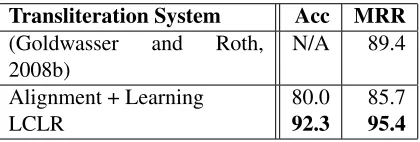
We evaluated our system using the English-Hebrew corpus (Goldwasser and Roth, 2008a), which consists of 250 positive transliteration pairs for training, and 300 pairs for testing. As negative examples for training, we sample 10% from random pairings of words from the positive data. We report two evaluation measurements – (1) the Mean Recip-rocal Rank (MRR), which is the average of the mul-tiplicative inverse of the rank of the correct answer, and (2) the accuracy (Acc), which is the percentage of the top rank candidates being correct.
We initialized the two stage inference process as detailed in (Chang et al., 2009) using a Romaniza-tion table to assign uniform weights to prominent character mappings. This initialization procedure resembles the approach used in (Bergsma and Kon-drak, 2007). An alignment is first built by solving the constrained optimization problem. Then, a sup-port vector machine with squared-hinge loss func-tion is used to train a classifier using features ex-tracted from the alignment. We refer to this two stage approach asAlignment+Learning.
The results summarized in Table 1 show the sig-nificant improvement obtained by the joint approach (95.4% MRR) compared to the two stage approach
Transliteration System Acc MRR
(Goldwasser and Roth, 2008b)
N/A 89.4
Alignment + Learning 80.0 85.7
[image:6.612.323.533.59.130.2]LCLR 92.3 95.4
Table 1:Experimental results for transliteration. We compare atwo-stagesystem: “Alignment+Learning” with LCLR, our jointalgorithm. Both “Alignment+Learning” and LCLR use the same features and the same intermediate representation def-inition.
(85.7%). Moreover, LCLR outperforms the joint system introduced in (Goldwasser and Roth, 2008b).
5.2 Textual Entailment
Recognizing Textual Entailment (RTE) is an im-portant textual inference task of predicting if a given
textsnippet, entails the meaning of another (the hy-pothesis). In many current RTE systems, the entail-ment decision depends on successfully aligning the constituents of the text and hypothesis, accounting for the internal linguistic structure of the input.
The raw input – the text and hypothesis – are represented as directed acyclic graphs, where ver-tices correspond to words. Directed edges link verbs to the head words of semantic role labeling argu-ments produced by (Punyakanok et al., 2008). All other words are connected by dependency edges. The intermediate representation is an alignment be-tween the nodes and edges of the graphs. We used three hidden variable types from Section 4 – word-mapping,word-deletionandedge-mapping, along with the associated constraints as defined earlier. Since the text is typically much longer than the hy-pothesis, we create word-deletion latent variables (and features) only for the hypothesis.
The second column of Table 2 lists the resources used to generate features corresponding to each hid-den variable type. For word-mapping variables, the features include a WordNet based metric (WNSim), indicators for the POS tags and negation identifiers. We used the state-of-the-art coreference resolution system of (Bengtson and Roth, 2008) to identify the canonical entities for pronouns and extract features accordingly. For word deletion, we use only the POS tags of the corresponding tokens (generated by the LBJ POS tagger3) to generate features. For edge
3
Hidden RTE Paraphrase Variable features features word-mapping WordNet, POS,
Coref, Neg
WordNet, POS, NE, ED word-deletion POS POS, NE edge-mapping NODE-INFO NODE-INFO,
[image:7.612.335.517.57.195.2]DEP edge-deletion N/A DEP
Table 2:Summary of latent variables and feature resources for the entailment and paraphrase identification tasks. See Section 4 for an explanation of the hidden variable types. The linguistic resources used to generate features are abbreviated as follows – POS: Part of speech, Coref: Canonical coreferent entities; NE: Named Entity, ED: Edit distance, Neg: Negation markers, DEP: Dependency labels, NODE-INFO: corresponding node align-ment resources, N/A: Hidden variable not used.
Entailment System Acc
Median of TAC 2009 systems 61.5 Alignment + Learning 65.0
LCLR 66.8
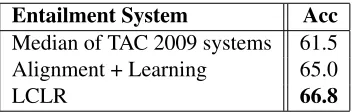
Table 3: Experimental results for recognizing textual entail-ment. The first row is the median of best performing systems of all teams that participated in the RTE5 challenge (Bentivogli et al., 2009). Alignment + Learningis our two-stage system im-plementation, and LCLR is our joint learning algorithm. Details about these systems are provided in the text.
mapping variables, we include the features of the corresponding word mapping variables, scaled by the word similarity of the words forming the edge.
We evaluated our system using the RTE-5 data (Bentivogli et al., 2009), consisting of 600 sen-tence pairs for training and testing respectively, in which positive and negative examples are equally distributed. In these experiments the joint LCLR al-gorithm converged after 5 iterations.
For the two stage system, we used WN-Sim to score alignments during inference. The word-based scores influence the edge variables via the constraints. This two-stage system (the Alignment+Learning system) is significantly better than the median performance of the RTE-5 submis-sions. Using LCLR further improves the result by al-most 2%, a substantial improvement in this domain.
5.3 Paraphrase Identification
Our final task is Paraphrase Identification, dis-cussed in detail at Section 4. We use all the four hidden variable types described in that section. The features used are similar to those described earlier
Paraphrase System Acc
Experiments using(Dolan et al., 2004) (Qiu et al., 2006) 72.00 (Das and Smith, 2009) 73.86 (Wan et al., 2006) 75.60 Alignment + Learning 76.23
LCLR 76.41
Experiments usingExtended data set
Alignment + Learning 72.00
[image:7.612.80.291.59.150.2]LCLR 72.75
Table 4:Experimental Result For Paraphrasing Identification. Our joint LCLR approach achieves the best results compared to several previously published systems, and our own two stage system implementation (Alignment + Learning). We evaluated the systems performance across two datasets: (Dolan et al., 2004) dataset and the Extended dataset, see the text for details. Note that LCLR outperforms (Das and Smith, 2009), which is a specifically designed joint approach for this task.
for the RTE system and are summarized in Table 2. We used the MSR paraphrase dataset of (Dolan et al., 2004) for empirical evaluation. Additionally, we generated a second corpus (called theExtended dataset) by sampling 500 sentence pairs from the MSR dataset for training and using the entire test collection of the original dataset. In the Extended dataset, for every sentence pair, we extended the longer sentence by concatenating it with itself. This results in a more difficult inference problem because it allows more mappings between words. Note that the performance on the original dataset sets the ceil-ing on the second one.
The results are summarized in Table 4. The first part of the table compares the LCLR system with a two stage system (Alignment + Learning) and three published results that use the MSR dataset. (We only list single systems in the table4) Inter-estingly, although still outperformed by our joint LCLR algorithm, the two stage system is able per-form significantly better than existing systems for that dataset (Qiu et al., 2006; Das and Smith, 2009; Wan et al., 2006). We attribute this improvement, consistent across both the ILP based systems, to the intermediate representation we defined.
We hypothesize that the similarity in performance between the joint LCLR algorithm and the two stage
4
[image:7.612.98.276.254.310.2](Alignment + Learning) systems is due to the limited intermediate representation space for input pairs in this dataset. We evaluated these systems on the more difficultExtendeddataset. Results indeed show that the margin between the two systems increases as the inference problem becomes harder.
6 Related Work
Recent NLP research has largely focused on two-stage approaches. Examples include RTE (Zanzotto and Moschitti, 2006; MacCartney et al., 2008; Roth et al., 2009); string matching (Bergsma and Kon-drak, 2007); transliteration (Klementiev and Roth, 2008); and paraphrase identification (Qiu et al., 2006; Wan et al., 2006).
(MacCartney et al., 2008) considered construct-ing a latent representation to be an independent task and used manually labeledalignmentdata (Brockett, 2007) to tune the inference procedure parameters. While this method identifies alignments well, it does not improve entailment decisions. This strengthens our intuition that the latent representation should be guided by the final task.
There are several exceptions to the two-stage ap-proach in the NLP community (Haghighi et al., 2005; McCallum et al., 2005; Goldwasser and Roth, 2008b; Das and Smith, 2009); however, the interme-diate representation and the inference for construct-ing it are closely coupled with the application task. In contrast, LCLR provides a general formulation that allows the use of expressive constraints, mak-ing it applicable to many NLP tasks.
Unlike other latent variable SVM frameworks (Felzenszwalb et al., 2009; Yu and Joachims, 2009) which often use task-specific inference procedure, LCLR utilizes the declarative inference framework that allows usingconstraintsover intermediate rep-resentation and provides a general platform for a wide range of NLP tasks.
The optimization procedure in this work and (Felzenszwalb et al., 2009) are quite different. We use the coordinate descent and cutting-plane methods ensuring we have fewer parameters and the inference procedure can be easily parallelized. Our procedure also allows different loss functions. (Cherry and Quirk, 2008) adopts the Latent SVM al-gorithm to define a language model. Unfortunately, their implementation is not guaranteed to converge.
In CRF-like models with latent variables
(McCal-lum et al., 2005), the decision function marginal-izes over the all hidden states when presented with an input example. Unfortunately, the computational cost of applying their framework is prohibitive with constrained latent representations. In contrast, our framework requires only thebesthidden representa-tion instead of marginalizing over all possible repre-sentations, thus reducing the computational effort.
7 Conclusion
We consider the problem of learning over an inter-mediate representation. We assume the existence of a latent structure in the input, relevant to the learn-ing problem, but not accessible to the learnlearn-ing algo-rithm. Many NLP tasks fall into these settings and each can consider a different hidden input structure. We propose a unifying thread for the different prob-lems and present a novel framework for Learning over Constrained Latent Representations (LCLR). Our framework can be applied to many different la-tent representations such as parse trees, orthographic mapping and tree alignments. Our approach con-trasts with existing work in which learning is done over a fixed representation, as we advocate jointly
learning it with the final task.
We successfully apply the proposed framework to three learning tasks – Transliteration, Textual En-tailment and Paraphrase Identification. Our joint LCLR algorithm achieves superior performance in all three tasks. We attribute the performance im-provement to our novel training algorithm and flex-ible inference procedure, allowing us to encode do-main knowledge. This presents an interesting line of future work in which more linguistic intuitions can be encoded into the learning problem. For these rea-sons, we believe that our framework provides an im-portant step forward in understanding the problem of learning over hidden structured inputs.
Acknowledgment We thank James Clarke and Mark Sam-mons for their insightful comments. This research was partly sponsored
by the Army Research Laboratory (ARL) (accomplished under
Cooper-ative Agreement Number W911NF-09-2-0053) and by Air Force
Re-search Laboratory (AFRL) under prime contract no.
FA8750-09-C-0181. Any opinions, findings, and conclusion or recommendations
ex-pressed in this material are those of the author(s) and do not necessarily
References
E. Bengtson and D. Roth. 2008. Understanding the value of features for coreference resolution. InEMNLP. L. Bentivogli, I. Dagan, H. T. Dang, D. Giampiccolo, and
B. Magnini. 2009. The fifth PASCAL recognizing textual entailment challenge. In Proc. of TAC Work-shop.
S. Bergsma and G. Kondrak. 2007. Alignment-based discriminative string similarity. InACL.
C. Brockett. 2007. Aligning the RTE 2006 corpus. In Technical Report MSR-TR-2007-77, Microsoft Re-search.
M. Chang, D. Goldwasser, D. Roth, and Y. Tu. 2009. Unsupervised constraint driven learning for transliter-ation discovery. InNAACL.
C. Cherry and C. Quirk. 2008. Discriminative, syntactic language modeling through latent svms. In Proc. of the Eighth Conference of AMTA.
I. Dagan, O. Glickman, and B. Magnini, editors. 2006.
The PASCAL Recognising Textual Entailment Chal-lenge.
D. Das and N. A. Smith. 2009. Paraphrase identifica-tion as probabilistic quasi-synchronous recogniidentifica-tion. In
ACL.
W. Dolan, C. Quirk, and C. Brockett. 2004. Unsuper-vised construction of large paraphrase corpora: Ex-ploiting massively parallel news sources. InCOLING. P. F. Felzenszwalb, R. B. Girshick, D. McAllester, and D. Ramanan. 2009. Object detection with discrimina-tively trained part based models. IEEE Transactions on Pattern Analysis and Machine Intelligence. D. Goldwasser and D. Roth. 2008a. Active sample
se-lection for named entity transliteration. InACL. Short Paper.
D. Goldwasser and D. Roth. 2008b. Transliteration as constrained optimization. InEMNLP.
A. Haghighi, A. Ng, and C. Manning. 2005. Robust textual inference via graph matching. InHLT-EMNLP. C.-J. Hsieh, K.-W. Chang, C.-J. Lin, S. S. Keerthi, and S. Sundararajan. 2008. A dual coordinate descent method for large-scale linear svm. InICML.
T. Joachims, T. Finley, and Chun-Nam Yu. 2009. Cutting-plane training of structural svms. Machine Learning.
D. Klein and C. D. Manning. 2003. Fast exact inference with a factored model for natural language parsing. In
NIPS.
A. Klementiev and D. Roth. 2008. Named entity translit-eration and discovery in multilingual corpora. In Cyril Goutte, Nicola Cancedda, Marc Dymetman, and George Foster, editors,Learning Machine Translation.
B. MacCartney, M. Galley, and C. D. Manning. 2008. A phrase-based alignment model for natural language inference. InEMNLP.
A. McCallum, K. Bellare, and F. Pereira. 2005. A condi-tional random field for discriminatively-trained finite-state string edit distance. InUAI.
V. Punyakanok, D. Roth, and W. Yih. 2008. The impor-tance of syntactic parsing and inference in semantic role labeling.Computational Linguistics.
L. Qiu, M.-Y. Kan, and T.-S. Chua. 2006. Paraphrase recognition via dissimilarity significance classifica-tion. InEMNLP.
C. Quirk, C. Brockett, and W. Dolan. 2004. Monolin-gual machine translation for paraphrase generation. In
EMNLP.
D. Roth, M. Sammons, and V.G. Vydiswaran. 2009. A framework for entailed relation recognition. InACL. S. Wan, M. Dras, R. Dale, and C. Paris. 2006. Using
dependency-based features to take the ¨para-farce¨out of paraphrase. InProc. of the Australasian Language Technology Workshop (ALTW).
C. Yu and T. Joachims. 2009. Learning structural svms with latent variables. InICML.