item and our policy information available from the repository home page for further information.
Author(s):Adnan, A.; Arunachalam, Subramaniam; Cazan, A.; Arreymbi,
Johnnes.; Webb, P.A.
Title:Developing an outsourcing questionnaire: validation study
Year of publication:2008
Citation: Adnan, A.; Arunachalam, S., Cazan, A., Arreymbi, J., Webb, P.A. (2008)
‘Developing an outsourcing questionnaire: validation study’ Proceedings of Advances in Computing and Technology, (AC&T) The School of Computing and Technology 3rd Annual Conference, University of East London, pp.108-118
Link to published version:
DEVELOPING AN OUTSOURCING QUESTIONNAIRE:
VALIDATION STUDY
A. Adnan, S. Arunachalam, A. Cazan, J. Arreymbi & P. A. Webb
School of Computing & Technology University of East London, UK
([email protected], [email protected] ,[email protected])
Abstract: Most developed countries have witnessed a sharp increase in outsourcing operations. These operations range from the service sector to manufacturing of various components such as automotive components. However, many organisations practicing outsourcing are failing to achieve their objectives for a number of reasons. In depth literature search has revealed that weaknesses in outsourcing operations are due to a large number of defects in aspects ranging from ‘order request’ to ‘invoice payment confirmation’. Analysis has shown that lack of quality in the outsourcing system is the predominant reason for weaknesses in the outsourcing operations. During the literature review, it was established that most of the data available on outsourcing was related to non-UK companies. In view of this information, it is crucial to develop a questionnaire to acquire information related to outsourcing from UK based companies. The Questionnaire is used to find out if any other newly generated problems are contributing to the poor quality of the outsourcing system resulting in failure. This paper presents an overview of outsourcing weaknesses/defects acquired through the literature search and a step by step process preparing a questionnaire to investigate the weaknesses in the outsourcing system and operations. The questionnaire is designed with a rational to measure the frequency of the quality defects in the outsourcing system. As such they are best aimed at collecting data to improve the framework.
Keywords: Outsourcing, Questionnaire, Outsourcing defect, Outsourcing weakness
Purpose of Questionnaire
Analys e the Ques tionnaire Pre -tes t Que s tionnaire Improve Ques tionnaire Finalis e Que s tio nnaire Questionnaire Language
Type of Questions
Questionnaire Size Response Choice
Sequence of Questions
Arc hite cture of Ques tionnaire
[image:2.595.114.482.485.667.2]Aims & Objectives of Research
Outsourcee Outsourcer
Delivery System
Communication System Cost In Time Delivery
Quality
Manufacturing & Management Tools
Technologies & Techniques
Competition
Availability of Suppliers political Elements Enviornmental Elements Ecological Elements Social Elements
[image:3.595.87.512.114.590.2]...Questions issues? ....delay in Delivery? ...communication problem? ....incomplete delivery? ....delivery matching? ...invoice matching? ...order size change? ...
Total Quality Management, Total Quality Control, Zero Defect Programme, Kaizen, ISO, Pull System, Statistical Process Control, Plant within Plant, Cellular Layout, TPM, LM,
Bench Marking, Employee Empowerment, In-house Training Programme, Job rotation
Questionnaire Construction
Numeric Control, Computerised Numeric Control, Distributed Numeric Control, Group Technology, Industrial Robots, Flexible Manufacturing Systems, Computer Integrated Manufacturing, Automated Storage and Retrieval, Automated Material Handling, Automated
Delivery System, Material Requirement Planning, Material Requirement Planning II
1.0 Introduction
The definition of outsourcing is transferring in-house activities to an outside organisation without compromising its functional integrity. The shift has contributed significant transitional changes on various aspects such as economic growth, international trade and the composition of the workforce and the trend of education (Koong et al. 2007).
Hassanain et al. (2005) mentioned
Outsourcing as an attractive strategic tool and Cardinali (2001) described it as a key tool to re-engineer.
Hoecht et al. (2006) highlighted the significant increase in risks when companies move from traditional outsourcing to strategic outsourcing. Harland et al. (2005) feared a rise in international exploitation and shifts in power structure. Tafti (2005) criticised outsourcing for not taking proactive measures to safeguard information assets and suggested and stressed continuously monitored data transmission. Outsourcing can be an excellent way to improve processes but at the same time, if improperly used, may cost companies their skills and knowledge that are difficult to recover (Franceschini et al. 2003).
During the literature review, it was found out that most of the data available on outsourcing was related to non-UK companies. For designing the questionnaire
the priority and importance of each of the attributes are taken into account. This paper presents an overview of a step by step process for preparing a questionnaire to investigate the weaknesses in the outsourcing system and operations for UK based automotive component manufacturing small and medium sized enterprises (SMEs). The questionnaire is fabricated with a rational to measure the frequency of the quality defects in outsourcing systems. The questionnaire is focused on acquiring valuable data from UK based manufacturers that will be used to improve the outsourcing framework.
2.0 Questionnaire
A questionnaire provides an empirical investigation, valuable results and data related to defects and weaknesses of the outsourcing system. It also facilitates in identifying the strongest and weakest points in the outsourcing system. The identification of weak and strong points helps to improve the system. A questionnaire is also an instrument of research as well as a tool for data collection.
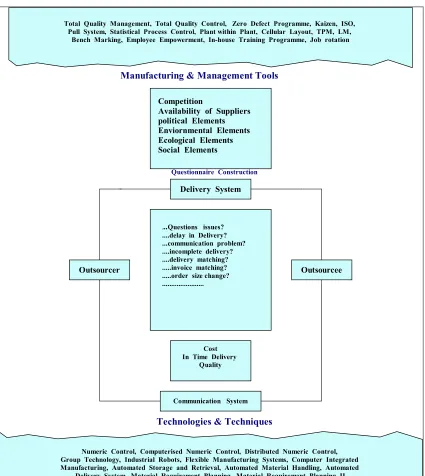
Robson (2002) explained that a survey questionnaire is carried out as part of non-experimental fixed design. In order to develop a questionnaire on outsourcing, the attributes which affect the quality of outsourcing operations must be identified. Figure 2 lists outsourcing attributes considered in questionnaire construction. As such, they are best aimed at collecting data to validate that the outsourcing defect categories experienced by UK based companies are similar to those of the literature review. The outsourcing questionnaire is designed to produce quantitative data; it is interpreted in subsequent analysis for comparison. In designing a questionnaire the priority and importance of each attribute is taken into account.
2.1 Purpose of Questionnaire
Synodinos (2002) argued that the purpose of the questionnaire is gathering data that evaluates quality, to drive and measure change. The questionnaire should have the pragmatic capacity to gather information relatively quickly which can be used as a basis for the contribution of a critical self scrutiny (Yorke 1995). Another purpose of the questionnaire is to find out if any other newly generated problems are contributing to the poor quality of the outsourcing system resulting in failure. The overall aim of the
questionnaire based investigation is to develop a framework to improve outsourcing operations by improving the quality of the outsourcing system. Due to the availability of the limited information and statistical data on UK based automotive component manufacturing SME’s, the development of a questionnaire is essential. To summarise, the ultimate purpose of the questionnaire is to assess the extent of quality problems related to outsourcing systems and to measure the frequency of quality defects.
2.2 Questionnaire Management
outsourcing. An E-mail survey facilitates ease of administration while maintaining a professional image.
It is required to have exceedingly clear and unambiguous overall and question-specific instructions to minimise the time and effort imposed on the organisation being investigated.
An E-mail questionnaire can be completed at the respondent’s convenience and can be returned without any additional mailing cost. The questionnaire is structured to fit the method of questionnaire management.
A questionnaire is required to investigate weaknesses in the outsourcing operations and may be focused on collecting quantitative or qualitative data for analysis. The questions are divided into four categories; contextual, diagnostic, evaluative and strategic.
The questions are written in simple English to avoid ambiguity. Also to clarify the context of the questions, the essences of the whole study is explained concisely in a cover letter preceding the questionnaire.
2.3 Questionnaire Design / Architecture
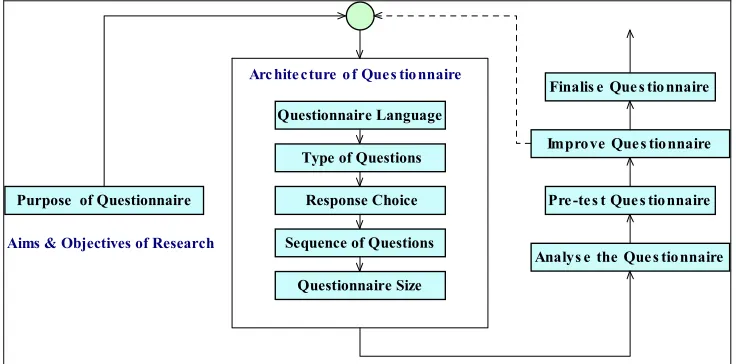
The questionnaire is designed to gather responses in an unbiased manner from UK based SMEs, so only British Cultural aspects are considered in this regard. Figure 1
highlights the factors involved in questionnaire construction process. This section discusses the issues related to the step by step design of questionnaires. The questionnaire has four parts. Part 1 comprises thirty-five questions designed to acquire information about defects in outsourcing due to elements of the outsourcing system. Part 2 is composed of sixteen questions related to management and manufacturing tools. Similarly part 3 comprises questions regarding modern technologies and techniques and part 4 comprises of five questions to assess the educational and training activities in place.
2.4 Questionnaire Language (wording)
The questionnaire wording has pronounced effects on the results. A minute difference in wording produces quite different responses. The psychological effect has to be considered by building tact into the questions. Apart from this aspect, to avoid problems, it is self evident that the questions should only relate to easily accessible information and not be unnecessarily detailed.
Intrusive and multiple meaning words are avoided. Simple structure and familiar words are used.
The questions are focused on communication rather than grammar and style. All assumptions are stated explicitly and phrases are written in specific rather than indefinite terms. Neutral wording is used at all times and ‘leading’ questions avoided, so that the respondent is not biased in any way. The questions are formulated in a way that each question focuses on one issue or part of it.
2.5 Questionnaire Response Choice
Taking into account the response format, the questions are categorised as open-ended or closed-ended. In close-ended questions, the respondent selects one or more applicable answers from given choices.
In contrast, for open-ended questions the respondents structure their own answers without the influence of provided choices. The questionnaire under review is structured using close-ended questions; such a fixed response questionnaire minimises the complexity and guides the respondent to contribute positively. Before constructing the questionnaire, extensive search was carried out on the topic and also the art of configuring the questionnaire. It was not surprising that close-ended questions are relatively less complicated to code and analyse.
The responses are necessarily exhaustive and exclusive. It is ensured that all possible response options are covered without overlap and without overwhelming the respondents with too many alternatives. Some of the substantive choices consist of value ranges. The response alternatives are determined by the questionnaire administration method and the question types.
Between ten and fifteen answers per question is recommended. The variables, i.e., the set of possible answers, can be categorised in several ways such as randomly, alphabetically or in sequence, to suit the particular situation. Part 1 consists of fifteen questions having a Boolean choice (Yes/No) or selection from two provided choices, five questions having a choice of three options and fourteen questions having a choice of four possible answers, and finally one question is formulated on a Likert scale of five.
2.6 Question Arrangement / Sequence
In order to eliminate context confusion, the complex issues are broken down into simple scenarios and then single questions are used to measure the issue. The question sequence effects are not ubiquitous and the question order should be carefully planned in the fabrication of the survey tool. Flow charts are used to sequence the questions. The questionnaire consists of three parts: ‘introduction’, ‘main body’ and ‘characteristics of respondents / organisations’. The introduction provides a brief description of the study.
Screening questions are also included at the end of the introduction to select the respondent by satisfying the selection criteria. Alternatively, this is included in the cover letter. The main body of the questionnaire contains topical questions. Sequencing the questions appropriately streamlines the questionnaire administration and minimises ambiguity.
The questions are arranged sequentially in order to seek a very well organised story. The questions are not only arranged logically but asked in a non-threatening manner. Similar questions are grouped together within the topics and ordered from the general to the specific.
The last section related to respondent / organisational characteristics, requests the most sensitive information. Here, the questions are organised from the least to the most sensitive. The questions are designed in a style such that they are applicable to most organisations manufacturing automotive components.
The first section of the questionnaire commences by enquiring whether organisations practice part or full outsourcing of its manufacturing activities. Then the organisation’s preferences regarding cost, in-time delivery and quality of the outsourced product is enquired.
The next question investigates the reasons for delay in processing the order, the elements of outsourcing responsible for the delay and the duration of the delay. Questions are then asked which identify percentage contributions to causes of the delay ranging from communication errors to incorrect invoice matching, including aspects of the delivery system.
The next set of questions was constructed to find out causes of commercially sensitive information leakage and the suspect involved in giving away classified information.
The second section of questions is designed to find out the extent (Likert Scale of four) to which the outsourcing participants are using manufacturing and management tools.
The third section of the questionnaire is designed to assess the technological capability and techniques applied in processing that indirectly translate the quality of the outsourcing operation. The last section of the questionnaire is designed to know about the education and training programmes, and whether the participants are involved in personnel development.
2.7 Questionnaire Pre-testing & Improving
In order to pre-test the questionnaire, the content is analysed in the context of particular outsourcing systems regarding its ability to identify quality defects.
The questionnaire sequence and layout is checked by comparison with the flow chart used to generate it. Such Pre-testing is also used to refine the questionnaire and is considered as an iterative improvement process.
During this pre-testing, the questionnaire is restructured as necessary. It is self evident that a poorly constructed questionnaire could
lead to failure of an outsourcing system due to action taken upon advice based on the answers to the questionnaire.
This could be a consequence of insufficient pre-testing. During pre-testing some difficulties and errors can be uncovered and the questionnaire subsequently corrected and restructured. Pre-testing of the questionnaire costs time and effort but is essential for correction and extremely useful for improvement.
2.8 Data Collection
For data collection, automotive component manufacturing companies practicing outsourcing are selected using the Kampass and Fame search engine at the City Business School Library, Moorgate. The Questionnaire Survey was electronically mailed to over six hundred addresses and more than ten personal contacts were used. From the electronic mail, however, the response was not encouraging. Most of the useful responses were acquired through direct and indirect personal contacts. The questionnaire focused on all the four aforementioned elements of the outsourcing system.
2.9 Discussion & Validation
predominant reason for weaknesses in outsourcing operations. It was found out that most of the data available on outsourcing was related to non-UK companies. In view of this information, the data collected through the questionnaire is compared with the data acquired through the literature review and found identical from a ‘quality’ aspect.
The questionnaire was constructed to identify the elements of outsourcing system and analyse the causes contributing to poor quality in depth. The survey data collected through the questionnaire is input to the ‘SPSS’ package for statistical analysis. This comprises linear and time-series regression. Descriptive reports were also prepared. The analysis results are used to improve the framework.
The general method presented in this paper to construct a questionnaire is applicable to any other field but, of course, the detailed contents are relevant only to outsourcing studies. In the questionnaire construction, influences of external factors are considered. The positive comparison data acquired through the questionnaire and the literature review validates the objectives of the research. In addition to the validation, extra information has been identified that will be used to improve the framework further.
3.0 Conclusions
In view of the similarities identified between the ‘quality’ data obtained from UK based automotive component manufacturing companies practicing outsourcing and ‘quality’ data obtained from literature review for similar companies abroad, developing an outsourcing questionnaire based on this literature review is valid. Important issues have been addressed to aid in designing a questionnaire, ranging from the language of the questionnaire to the cultural issues. This paper provides guidelines for constructing an easily understandable, systematically sequenced well phrased questionnaire in the context of outsourcing.
4.0 References
Cardinali, R. (2001), ‘Does the future of military logistics lie in outsourcing and privatization? Accountants – the new gatekeepers of war-time operations’, Work Study, Vol.50.No.3.pp.105-110.
Franceschini, F., Galetto, M., Pignatelli, A., Varetto, M. (2003), ‘Outsourcing: guidelines for a structured approach’,
Harland, C., Kinight, L., Lamminh, R., Walker, H. (2005), ‘Outsourcing: assessing the risks and benefits for organisations, sectors and nations’, International Journal of
Hassanain, M.A., Al-Saadi, S. (2005), ‘A framework model for outsourcing asset
management services’, Facilities,
Vol.23.No.1/2 2005.pp.73-81.
Hoecht, A., Trott, P. (2006), ‘Outsourcing, information leakage and the risk of losing technology-based competencies’, European Business Review, Vol.18.No.5 2006.pp.395-412.
Jonas, G.D.S, Kikuo, N., Tadashi, O.(2002), ‘Evaluation of TQM in Japanese industries and validation of a self-assessment
questionnaire’, The TQM Magazine,
Vol.14.No.5.pp.318-328.
Koong, K.S, Liu, L.C., Wang, Y.J. (2007), ‘Taxonomy development and assessment of global information technology outsourcing decisions’, Industrial Management & Data Systems, Vol.107.No.3 1007.pp.397-414.
Oppenheim, A.N. 1992, Questionnaire
Design, Interviewing and Attitude Measurement, New Edition, Biddles Ltd, Guildford and King’s Lynn, UK.
Rees, C.J., Metcalfe, B.(2003), ‘The faking of personality questionnaire results: who’s kidding whom?’, Journal of Managerial Psychology, Vol.18.No.2.pp.156-165.
Robson, C.2002, Real World Research, Second Edition, Blackwell Publishing, Oxford, UK.
Rowbotham, F.E., Barnes, D.(2004), ‘A questionnaire operationalising Hayes and Wheelwright’s four-stage concept’, Journal of Manufacturing Technology Management, Vol.15.No.7 2004.pp.651-661.
Sapsford, R. 1999, Survey Research, First publication, Sage Publications Ltd, London, UK.
Spicer, D.P., Sadler-Smith, E.(2005), ‘An examination of the general decision making style questionnaire in two UK samples’,
Journal of Managerial Psychology, Vol.20.No.2.pp.137-149.
Sudman, S., Bradburn, N.M. 1983, Asking Questions a practical guide to questionnaire design, Jossey-Bass Limited, London, UK.
Synodinos, N.E. (2002), ‘The “art” of questionnaire construction: some important considerations for manufacturing studies’,
Tafti, M.H.A. (2005), ‘Risks factors associated with offshore IT outsourcing’,
Industrial Management & Data Systems, Vol.105.No.5.pp.549-560.