0095-1137/11/$12.00 doi:10.1128/JCM.00883-11
Copyright © 2011, American Society for Microbiology. All Rights Reserved.
High-Resolution Genotyping of
Chlamydia trachomatis
by Use of a
Novel Multilocus Typing DNA Microarray
䌤
†
Linus Christerson,
1Anke Ruettger,
2Kirsten Gravningen,
3Ralf Ehricht,
4Konrad Sachse,
2and Bjo
¨rn Herrmann
1*
Section of Clinical Bacteriology, Department of Medical Sciences, Uppsala University, Uppsala, Sweden1; Friedrich-Loeffler-Institut
(Federal Research Institute for Animal Health), Institute of Molecular Pathogenesis, Jena, Germany2; Department of
Microbiology and Infection Control, University Hospital of North Norway, Tromsø,
Norway3; and Alere Technologies GmbH, Jena, Germany4
Received 2 May 2011/Returned for modification 31 May 2011/Accepted 10 June 2011
Typing ofChlamydia trachomatisis important to understanding its epidemiology. Currently used methods
such as DNA sequencing of the ompA gene and multilocus sequence typing (MLST) either offer limited
epidemiological resolution or are laborious and expensive, or both. DNA microarray technology using the ArrayStrip format is an affordable alternative for genotyping. In this study, we developed a new multilocus typing (MLT) DNA microarray, based on the target regions of a high-resolution MLST system as well as software for easy analysis. Validation of the array was done by typing 80 previously MLST-typed clinical specimens from unselected adolescents in school. The MLT array showed 100% specificity and provided
2.4-times-higher resolution thanompA sequencing, separating the commonly predominating ompAE/Bour
genotype into 7 MLT array genotypes. The MLT array reproduced epidemiological findings revealed by the MLST system and showed sufficient sensitivity to work with clinical specimens. Compared to MLST analysis, the expenses needed for testing a sample with the MLT array are considerably lower. Moreover, testing can be completed within 1 working day rather than 3 or 4 days, with data analysis not requiring highly specialized
personnel. The present MLT array represents a powerful alternative inC. trachomatisgenotyping.
Urogenital infection withChlamydia trachomatis is one of the most common sexually transmitted infections worldwide (28).C. trachomatis also causes lymphogranuloma venereum (LGV), which is a less common but more severe sexually trans-mitted disease, and trachoma, which is a major cause of pre-ventable blindness in the developing world. Severe sequelae from urogenital chlamydia include ectopic pregnancies and infertility (9). In spite of testing, treatment, partner notifica-tion, and counseling, huge public health efforts have not been able to control urogenital chlamydia. Current knowledge about the role of repeated infections and transmission in sexual net-works is still limited and needs to be extended to achieve a reduction in the number of infections.
In this context, it is important to have adequate tools for genotyping to understand the epidemiology ofC. trachomatis. Such tools should preferably be highly affordable, fast, and easy to use and need to have enough resolution to discriminate among closely related clinical strains to allow outbreak tracing and epidemiological surveillance.
Traditional typing ofC. trachomatiswas done by serotyping of the major outer membrane protein (MOMP), which is a time-consuming process requiring several passages in eukary-otic cell culture and large panels of antibodies. Later on, typing included PCR to amplify the ompA gene, which encodes
MOMP, followed by restriction fragment length polymorphism analysis or DNA sequencing. However, neither MOMP nor
ompA sequencing provides sufficient epidemiological resolu-tion (21). In Sweden, for example, almost half of all urogenital chlamydia infections are of serotype E, and within this sero-type, theompAE/Bour genotype predominates (14, 17).
Multilocus sequence typing (MLST) relies on PCR amplifi-cation and DNA sequencing of several genomic loci. There are three such systems described forC. trachomatis. Two of them are based on housekeeping genes, have a resolution similar to that of ompA sequencing, and are suitable for evolutionary studies (4, 20). The third system was developed by Klint et al. (15) and is intended for short-term clinical epidemiology and outbreak investigations. The latter system is based on five highly variable but stable genomic loci (hctB, CT058, CT144, CT172, andpbpB), which give the system up to 5-fold-higher resolution than that ofompAsequencing (15; K. Gravningen, L. Christerson, A. S. Furberg, G. S. Simonsen, K. O¨ dman, A. Ståhlsten, and B. Herrmann, submitted for publication). Since its creation in 2006, the system has been applied to a variety of clinical specimens, including urogenital chlamydia (3, 11, 13), LGV (2), and trachoma (10). There is also a multilocus vari-able-number tandem repeat (VNTR) analysis (MLVA) system (22) which offers a resolution similar to that of the MLST system by Klint et al. (12, 15). MLST and MLVA, however, are laborious techniques requiring several days of work until final results can be achieved.
Diagnostic DNA microarray technology has emerged as an alternative in microbial genotyping. While most of the com-mercially available equipment is still too expensive for smaller laboratories, the ArrayStrip platform represents an
easy-to-* Corresponding author. Mailing address: Section of Clinical Bac-teriology, Department of Medical Sciences, Uppsala University, S-751 85 Uppsala, Sweden. Phone: 46(0)18-6113952. Fax: 46(0)18-559157. E-mail: [email protected].
† Supplemental material for this article may be found at http://jcm .asm.org/.
䌤Published ahead of print on 22 June 2011.
2838
on May 16, 2020 by guest
http://jcm.asm.org/
handle and affordable solution. It features microarrays im-planted on the bottoms of standard 8-well microtiter strips and allows high throughput, as 96 samples can be analyzed in par-allel. All steps of the hybridization reaction can be conducted in the vessel carrying the array, without the need for a separate hybridization chamber or other expensive laboratory equip-ment. It has been shown that specific hybridization patterns can be obtained from a single PCR-amplifiable target copy (5). This technology helps to avoid extensive sequencing and has been used in both research and different routine diagnostic applications (1, 19, 26).
The aim of the current study was to develop a multilocus typing (MLT) DNA microarray forC. trachomatisbased on the target regions of the MLST system by Klint et al. (15) and to validate it using previously MLST-typed clinical specimens.
MATERIALS AND METHODS
Specimens.Reference strains (n⫽18) and clinical specimens (n⫽109) for optimization and for the database came from heterosexual populations in dif-ferent countries in Europe, from men who have sex with men (MSM) in Europe and North America, and from trachoma cases in the Gambia and Senegal. Clinical specimens for evaluation of the optimized array came from Finnmark in Norway (n⫽ 80) and were collected from adolescents in school but were otherwise unselected (Gravningen et al., submitted). All specimens were previ-ously MLST genotyped.
DNA extraction.DNA was extracted from culture, urine, or rectal specimens using a MagAttract DNA mini-M48 kit (Qiagen, Hilden, Germany) on a BioRobot M48 workstation (Qiagen), according to the manufacturer’s instructions.
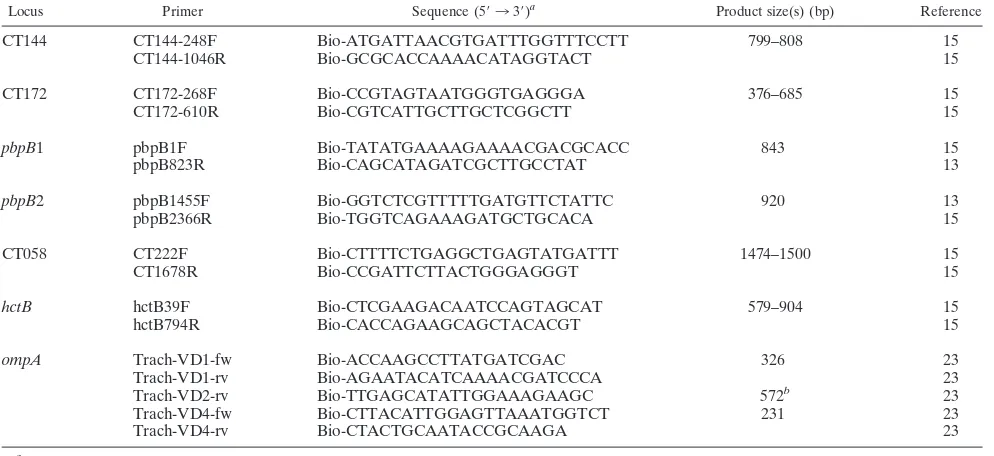
Multiplex biotinylation PCR.Amplification of the five MLST regions and ompAwas conducted in three separate reactions using the Qiagen multiplex PCR kit (Qiagen, Hilden, Germany) and 5⬘-biotinylated primers (Table 1). All reac-tion mixes included 10l Qiagen multiplex mastermix and 2l DNA template. Reaction mixture 1 contained 1l of a 10M solution (final in-tube concen-tration of 0.5M) of each forward and reverse primer for CT144, CT172,pbpB1, andpbpB2. Reaction mixture 2 contained 1l each of the CT058 primers (same concentration as above). Reaction mixture 3 contained 1l each ofhctBprimers and Trach-VD4-fw/rv, as well as 3l of primer Trach-VD1-fw, 1l of
Trach-VD1-rv, and 2l of Trach-VD2-rv. All three reactions used the same PCR cycling conditions, as follows: initial denaturation at 95°C for 15 min, 40 cycles of denaturation at 94°C for 30 s, annealing at 50°C for 90 s, and elongation at 72°C for 90 s, with a final elongation at 72°C for 10 min, followed by cooling at 4°C. PCR products were analyzed using gel electrophoresis and a 1.5% agarose gel containing ethidium bromide and visualized on a UV transilluminator (G:Box imager and GeneSnap software obtained from Syngene, Cambridge, United Kingdom). After amplification, reaction mixtures 1 to 3 were combined into a final PCR product mixture, of which 3l was used per hybridization reaction.
Probe and MLT array design.The design of oligonucleotide probes was based on data generated with the MLST system by April 2009. At that time, the database (http://mlstdb.bmc.uu.se/) included 385 specimens: 16 reference strains; 287 urogenital specimens from heterosexuals, mainly from Sweden (n⫽177) and the Netherlands (n⫽70), and from MSM (n⫽38); 30 trachoma specimens from the Gambia and Senegal; and 52 LGV specimens from Europe (n⫽42) and the United States (n⫽10). In total, 153 unique sequence variants had been iden-tified for the five MLST regions.
The probe design was done using BioEdit 7.0.9 (Ibis Therapeutics, Carlsbad, CA), Microsoft Office Excel 2003 together with Visual Basic for Applications 6.3 (Microsoft, Redmond, WA), and Basic Local Alignment Search Tool (BLAST) analysis. All together, the final version of the array harbored 271 probes: 35 for thehctBlocus, 58 for CT058, 39 for CT144, 16 for CT172, 62 forpbpB, and 61 forompA. TheompAprobes were designed previously using a different process (23).
The probes were spotted onto microarray chips as previously described (24) and assembled in an 8-well microtiter strip format called ArrayStrip (Alere Technologies GmbH, Jena, Germany). Out of the 271 probes, 124 were spotted 3-fold, and 147, as well as biotinylated oligonucleotide staining controls, were spotted 2-fold, thus bringing the total number of active spots to 668.
ArrayStrip hybridization.Hybridization was conducted using the hybridiza-tion kit (Alere Technologies) by following the instruchybridiza-tions of the manufacturer, as described previously (23). Briefly, 3l of the final PCR product mixture was used, the hybridization buffer was modified by adding 10% (vol/vol) dimethyl sulfoxide (DMSO; Roth, Karlsruhe, Germany), and all washing and hybridiza-tion steps were performed at 45°C, using a heatable horizontal tube shaker (BioShake iQ; Quantifoil Instruments, Jena, Germany). Hybridization signals were measured using an ArrayMate transmission reader (Alere Technologies).
[image:2.585.41.538.82.310.2]Processing of ArrayStrip hybridization data.The hybridization data were processed using the Iconoclust software, version 3.3 (Alere Technologies). Nor-malized signal intensities were calculated automatically by the software as de-scribed previously (23), subsequently transferred into Microsoft Office Excel
TABLE 1. Primers used in the MLT array
Locus Primer Sequence (5⬘33⬘)a
Product size(s) (bp) Reference
CT144 CT144-248F Bio-ATGATTAACGTGATTTGGTTTCCTT 799–808 15
CT144-1046R Bio-GCGCACCAAAACATAGGTACT 15
CT172 CT172-268F Bio-CCGTAGTAATGGGTGAGGGA 376–685 15
CT172-610R Bio-CGTCATTGCTTGCTCGGCTT 15
pbpB1 pbpB1F Bio-TATATGAAAAGAAAACGACGCACC 843 15
pbpB823R Bio-CAGCATAGATCGCTTGCCTAT 13
pbpB2 pbpB1455F Bio-GGTCTCGTTTTTGATGTTCTATTC 920 13
pbpB2366R Bio-TGGTCAGAAAGATGCTGCACA 15
CT058 CT222F Bio-CTTTTCTGAGGCTGAGTATGATTT 1474–1500 15
CT1678R Bio-CCGATTCTTACTGGGAGGGT 15
hctB hctB39F Bio-CTCGAAGACAATCCAGTAGCAT 579–904 15
hctB794R Bio-CACCAGAAGCAGCTACACGT 15
ompA Trach-VD1-fw Bio-ACCAAGCCTTATGATCGAC 326 23
Trach-VD1-rv Bio-AGAATACATCAAAACGATCCCA 23
Trach-VD2-rv Bio-TTGAGCATATTGGAAAGAAGC 572b 23
Trach-VD4-fw Bio-CTTACATTGGAGTTAAATGGTCT 231 23
Trach-VD4-rv Bio-CTACTGCAATACCGCAAGA 23
aBio, biotin.
bWith primers Trach-VD1-fw and Trach-VD2-rv.
on May 16, 2020 by guest
http://jcm.asm.org/
2003 (Microsoft), and analyzed using the newly developed MLT Line software, version 2.0. The software was written in Visual Basic for Applications 6.3 (Mi-crosoft) and integrated into Excel. More detailed information about the software can be found in Appendix S1 in the supplemental material.
RESULTS
Probe design. Whenin silicowork on probe selection was
conducted, 153 sequence variants of the five MLST regions were known, based on all available sequences from our data-base (http://mlstdb.bmc.uu.se/). A total of 210 probes were defined (see Table S1 in the supplemental material) to identify these variants (for details, see Appendix S1 in the supplemen-tal material). The probes were designed to minimize the mean variation in the melting temperatures (Tm), resulting in a mean
Tmof 57.8°C (minimum, 56.5°C; maximum, 59.1°C). The av-erage length was 25 nucleotides (nt) (minimum, 17 nt; maxi-mum, 36 nt), and the average GC content was 43% (minimaxi-mum, 23%; maximum, 68%). Self-annealing was kept as low as pos-sible, and all probes were checked against all 153 sequence variants to ensure specificity and avoid cross-reactions.
TheompAprobes had been designed previously (23). How-ever, moreompAsequences had been published in GenBank since the time of that study, so thein silicoanalysis had to be updated. This resulted in 86 uniqueompA variants covering the VD1 to VD4 regions (by July 2010), compared to 54 in the previous study. This set of probes could theoretically discrim-inate among 67 variants.
Optimization.The approach consisted of identifying
exper-imental conditions leading to hybridization patterns that came as close to the theoretically expected ones as possible, i.e., representing hybridization at high stringency. In total, 68 ex-periments were conducted to find the following optimal hy-bridization conditions: a temperature of hyhy-bridization and wash steps of 45°C, a 10% (vol/vol) DMSO content in hybrid-ization buffer, and an amount of 3l of PCR product in the hybridization mix. To verify reproducibility, the experiments were conducted in duplicate in two different laboratories.
Building the database.To test the MLT array, 18 type and
reference strains representing the MOMP-based serovars ofC.
trachomatiswere examined. Initial results showed
discrepan-cies between the empirical data and the theoretical binding patterns (data not shown). Therefore, an additional panel of 109 specimens representing the majority of the variation ob-served in the MLST system was tested. Together with the 18
ompAreference strains, these 127 specimens were analyzed in 139 experiments, which were entered into a database and used to adapt the theoretical binding patterns. For a few sequence variants for which strains were not available, the binding pat-terns were manually corrected in accordance with the empiri-cal data from similar strains. This procedure solved most spec-ificity problems in all but the CT172 region, which therefore was excluded from further analysis.
The experiments in the database were processed in a se-quential manner, in which one experiment at a time was re-moved from the database and then analyzed so as not to affect its own analysis. The 139 experiments could be divided into 31
ompAgenotypes, 80 MLST genotypes, and 63 MLT array ge-notypes, giving the MLT array 2.0-times-higher resolution than
ompAsequencing. Three of the experiments were incorrectly
genotyped, resulting in a specificity of 98%. These three ex-periments were redone, resulting in one of them being cor-rectly genotyped and two being marked as having inconclusive results by the MLT Line software.
Validation of clinical specimens. The MLT array was
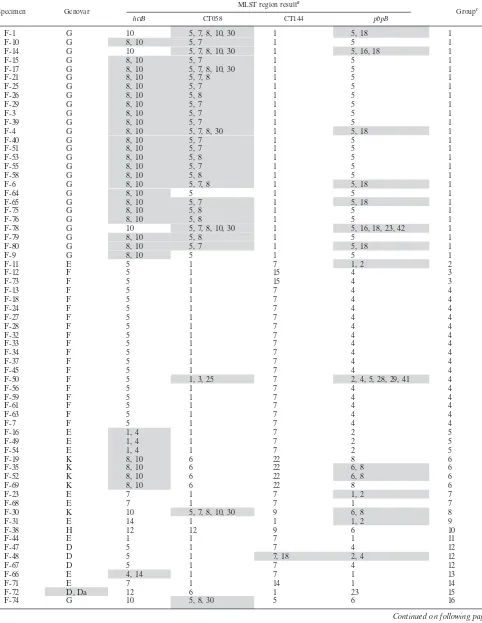
ap-plied to 80 specimens from Finnmark in Norway. In the first run, 16 out of 80 specimens (20%) were marked by the MLT Line software as having inconclusive results. These 16 speci-mens were reanalyzed, in multiplex or simplex reactions, after which only 2 specimens (2.5%) remained inconclusive. The remaining 78 specimens could be divided into 7ompA geno-types, 19 MLST genogeno-types, and 17 MLT array genotypes (Ta-ble 2). This gave the MLT array 2.4-times-higher resolution thanompAsequencing. TheompAE/Bour genotype (n⫽20) could be separated into 7 MLT array genotypes. Specimen F-31 was correctly identified as having a genotype unique to the new variant C. trachomatis (nvCT). Specimen F-74 was correctly identified as having a genotype previously found only among men who have sex with men (MSM). None of the 78 specimens were incorrectly genotyped, yielding a specificity of 100%.
Software.The newly developed MLT Line software, used for
analysis, was integrated with Excel (Microsoft) for ease of use. The software was tested to work with Excel 2003, 2007, and 2010. The software (http://mlstdb.bmc.uu.se/) includes a data-base with 217 array experiments from specimens with known MLST genotypes. Analysis is done by simply pasting the nor-malized hybridization signal intensities into Excel and then clicking a button. The data are processed with MLT Line and then automatically stored and displayed in a separate Excel file.
DISCUSSION
Up until recently, genotyping ofC. trachomatiswas entirely based on analysis of ompA, which provided only a limited insight into the genetic variability of naturally occurring clinical strains (2, 13). More recent genotyping methods based on several genomic loci are expensive and time-consuming (15, 22), while the resolution of some of them is not significantly higher than that forompAalone (4, 20).
ArrayStrip and ArrayTube DNA microarrays have been suc-cessfully used in a number of applications, including detection and extensive genotyping ofStaphylococcus aureus(18),
Chla-mydiaceae spp. (24),Chlamydia psittaci (25),Escherichia coli
(8),Burkholderiaspp. (27), and avian influenza viruses (6, 7).
The ArrayStrip platform has proved economical while allowing high throughput and has been shown to be suitable for routine diagnosis (1, 19) because of its rapidity, robustness, and high sensitivity (5).
In the present study, we wanted to improve the methodology
ofC. trachomatisgenotyping by using the ArrayStrip
technol-ogy. The aim was to develop a MLT DNA microarray based on the high-resolution MLST system by Klint et al. (15) and to validate it by typing a panel of clinical specimens.
Initial experiments showed that using theoretical binding patterns resulted in too-low specificity. In particular, the CT172 region contains a single nucleotide repeat, and the probes covering this repeat were too unstable to achieve ade-quate specificity. As most of the variation in CT172 is confined
on May 16, 2020 by guest
http://jcm.asm.org/
TABLE 2. MLT array results of 80 specimens from Finnmark in Norwayb
Specimen Genovar MLST region result
a
Groupc
hctB CT058 CT144 pbpB
F-1 G 10 5, 7, 8, 10, 30 1 5, 18 1
F-10 G 8, 10 5, 7 1 5 1
F-14 G 10 5, 7, 8, 10, 30 1 5, 16, 18 1
F-15 G 8, 10 5, 7 1 5 1
F-17 G 8, 10 5, 7, 8, 10, 30 1 5 1
F-21 G 8, 10 5, 7, 8 1 5 1
F-25 G 8, 10 5, 7 1 5 1
F-26 G 8, 10 5, 8 1 5 1
F-29 G 8, 10 5, 7 1 5 1
F-3 G 8, 10 5, 7 1 5 1
F-39 G 8, 10 5, 7 1 5 1
F-4 G 8, 10 5, 7, 8, 30 1 5, 18 1
F-40 G 8, 10 5, 7 1 5 1
F-51 G 8, 10 5, 7 1 5 1
F-53 G 8, 10 5, 8 1 5 1
F-55 G 8, 10 5, 7 1 5 1
F-58 G 8, 10 5, 8 1 5 1
F-6 G 8, 10 5, 7, 8 1 5, 18 1
F-64 G 8, 10 5 1 5 1
F-65 G 8, 10 5, 7 1 5, 18 1
F-75 G 8, 10 5, 8 1 5 1
F-76 G 8, 10 5, 8 1 5 1
F-78 G 10 5, 7, 8, 10, 30 1 5, 16, 18, 23, 42 1
F-79 G 8, 10 5, 8 1 5 1
F-80 G 8, 10 5, 7 1 5, 18 1
F-9 G 8, 10 5 1 5 1
F-11 E 5 1 7 1, 2 2
F-12 F 5 1 15 4 3
F-73 F 5 1 15 4 3
F-13 F 5 1 7 4 4
F-18 F 5 1 7 4 4
F-24 F 5 1 7 4 4
F-27 F 5 1 7 4 4
F-28 F 5 1 7 4 4
F-32 F 5 1 7 4 4
F-33 F 5 1 7 4 4
F-34 F 5 1 7 4 4
F-37 F 5 1 7 4 4
F-45 F 5 1 7 4 4
F-50 F 5 1, 3, 25 7 2, 4, 5, 28, 29, 41 4
F-56 F 5 1 7 4 4
F-59 F 5 1 7 4 4
F-61 F 5 1 7 4 4
F-63 F 5 1 7 4 4
F-7 F 5 1 7 4 4
F-16 E 1, 4 1 7 2 5
F-49 E 1, 4 1 7 2 5
F-54 E 1, 4 1 7 2 5
F-19 K 8, 10 6 22 8 6
F-35 K 8, 10 6 22 6, 8 6
F-52 K 8, 10 6 22 6, 8 6
F-69 K 8, 10 6 22 8 6
F-23 E 7 1 7 1, 2 7
F-68 E 7 1 7 1 7
F-30 K 10 5, 7, 8, 10, 30 9 6, 8 8
F-31 E 14 1 1 1, 2 9
F-38 H 12 12 9 6 10
F-44 E 1 1 7 1 11
F-47 D 5 1 7 4 12
F-48 D 5 1 7, 18 2, 4 12
F-67 D 5 1 7 4 12
F-66 E 4, 14 1 7 1 13
F-71 E 7 1 14 1 14
F-72 D, Da 12 6 1 23 15
F-74 G 10 5, 8, 30 5 6 16
Continued on following page
on May 16, 2020 by guest
http://jcm.asm.org/
to this repeat, this locus was therefore excluded from the MLT array. Furthermore, thehctBgene contains one to four repet-itive elements, each 108 nucleotides long, which in turn are comprised of smaller repetitive units (16). Such a repetitive structure causes problems with a probe-based system because there is no possibility of counting the number of elements or deducing their order. Finally, the possible locations of probes were constricted due to the nature of the MLST regions, where most of the strain discrimination comes from single-nucleotide polymorphisms. This led to nonoptimal probe design and re-sulted in the failure of several probes.
These three major constraints prevented the use of theoret-ical hybridization patterns as references, as done previously (23), and they provide an explanation for the 11 to 21% loss in resolution compared with that of the MLST system. The spec-ificity problem was solved by excluding the CT172 locus and creating a database from empirical hybridization data.
The MLT array achieved 100% specificity and 2.4-times-higher resolution thanompAsequencing when applied to the 80 clinical specimens from Finnmark in Norway. The MLT array provided more resolution, especially within the com-monly predominatingompAE/Bour genotype.
Interestingly, 1 of the 80 specimens was identified as having a genotype previously found only among men who have sex
with men (MSM). In accordance with the results, the male patient reported having sex with men. Another specimen was identified as having a genotype unique to the new variantC.
trachomatis(nvCT). The nvCT was detected in 2006 in Sweden
and has since then spread quickly within the country (11). Identification of the MSM genotype and the nvCT was not possible using ompA genotyping, which illustrates the MLT array’s capability to reveal additional epidemiological details. A total of 2 (2.5%) of the 80 specimens could not be PCR amplified and genotyped with the MLT array, even though they had been successfully MLST genotyped. This might be explained by DNA degradation caused by additional freeze-thawing following a delayed transport. As the present 80 spec-imens were collected from adolescents in school but otherwise were unselected, the findings of this study show that the MLT array is sensitive enough to work on clinical specimens.
Analysis of a further 127 specimens in 139 hybridization experiments resulted in 98% specificity, which is sufficient for strain discrimination in most applications.
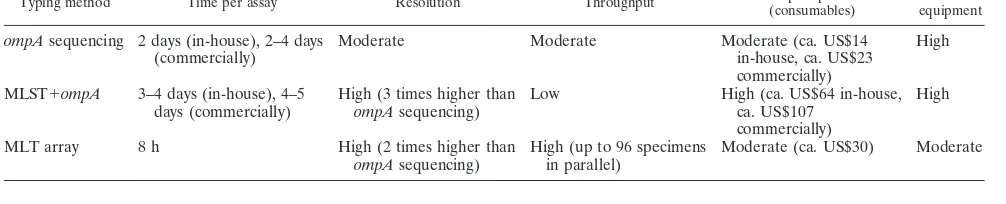
This MLT array can now be used in studies in which rapid genotyping ofC. trachomatisis needed to achieve epidemio-logical information. The MLT array is a powerful alternative to
ompA sequencing and MLST analysis (Table 3). The MLT array provides⬎2-fold-higher resolution thanompA
sequenc-TABLE 2—Continued
Specimen Genovar MLST region result
a
Groupc
hctB CT058 CT144 pbpB
F-77 G 8, 10 36 22 6 17
F-5 E 1, 4 1 7 1 11 or 13
F-57 E 1, 4 1 7 1 11 or 13
F-70 E 1, 4 1 7 1 11 or 13
F-20 F 5 1 7, 14, 15, 18 4 3 or 4
F-60 F 5 1 7, 15, 18 4 3 or 4
F-42 E 1 1 7 1, 2 5 or 11
F-46 E 1 1 7 1, 2, 29 5 or 11
F-8 E 1 1 7 1, 2 5 or 11
F-2 E 1, 4 1 7 1, 2 5, 11, or 13
F-22 E 1, 4 1 7 1, 2 5, 11, or 13
F-41 E 1, 4 1 7 1, 2, 29 5, 11, or 13
F-43 E 1, 4, 14 1 7 1, 2 5, 11, or 13
F-36 — — — — — N/A
F-62 G 8, 10 — — — N/A
a
The numbers refer to MLT array genotypes.
b
Gray shading indicates closely related genotypes that have been clustered together due to the highly stringent settings in the MLT Line software. —, no signals or inconclusive results.
c
[image:5.585.45.542.81.253.2]The group numbers are automatically generated and show the minimum resolution, i.e., the minimum number of genotypes into which the specimens can be divided. If specimens belong to different groups, they have different genotypes. N/A, not applicable.
TABLE 3. Comparison of the MLT array toompAsequencing and MLST analysis
Typing method Time per assay Resolution Throughput Cost per specimen
(consumables)
Cost of equipment
ompAsequencing 2 days (in-house), 2–4 days (commercially)
Moderate Moderate Moderate (ca. US$14
in-house, ca. US$23 commercially)
High
MLST⫹ompA 3–4 days (in-house), 4–5 days (commercially)
High (3 times higher than
ompAsequencing)
Low High (ca. US$64 in-house,
ca. US$107 commercially)
High
MLT array 8 h High (2 times higher than
ompAsequencing)
High (up to 96 specimens in parallel)
Moderate (ca. US$30) Moderate
on May 16, 2020 by guest
http://jcm.asm.org/
[image:5.585.40.543.624.726.2]ing and attains about 79 to 90% of the resolution of MLST. Analysis can be performed within a single working day, com-pared to 3 or 4 days for MLST. The hybridization can be conducted at high throughput with up to 96 samples in parallel. Including the cost of equipment, the MLT array analysis is considerably cheaper thanompAsequencing and MLST anal-ysis. Processing of the measured hybridization data and assign-ment of genotypes is easily done. In contrast, DNA sequencing must be followed by thorough data analysis, requiring exten-sive expertise of laboratory staff.
In conclusion, the MLT array developed here represents a considerable improvement to previous methods ofC.
tracho-matisgenotyping.
ACKNOWLEDGMENTS
This study was supported by local funds from Uppsala University Hospital and by grant 01 KI 0720 from the German Federal Ministry for Education and Research (BMBF).
We thank Peter Slickers (Alere Technologies) for teaching L.C. how to design probes and Ines Engelmann (Alere Technologies) for help with the optimization.
REFERENCES
1.Borel, N., et al.2008. Direct identification ofChlamydiaefrom clinical sam-ples using a DNA microarray assay: a validation study. Mol. Cell. Probes
22:55–64.
2.Christerson, L., et al.2010. Typing of lymphogranuloma venereum Chla-mydia trachomatisstrains. Emerg. Infect. Dis.16:1777–1779.
3.Christerson, L., H. J. de Vries, M. Klint, B. Herrmann, and S. A. Morre.
2011. Multilocus sequence typing of urogenitalChlamydia trachomatisfrom patients with different degrees of clinical symptoms. Sex Transm. Dis.38:
490–494.
4.Dean, D., et al.2009. Predicting phenotype and emerging strains among Chlamydia trachomatisinfections. Emerg. Infect. Dis.15:1385–1394. 5.Ehricht, R., P. Slickers, S. Goellner, H. Hotzel, and K. Sachse.2006.
Opti-mized DNA microarray assay allows detection and genotyping of single PCR-amplifiable target copies. Mol. Cell. Probes20:60–63.
6.Gall, A., et al.2009. Rapid and highly sensitive neuraminidase subtyping of avian influenza viruses by use of a diagnostic DNA microarray. J. Clin. Microbiol.47:2985–2988.
7.Gall, A., et al.2009. Rapid haemagglutinin subtyping and pathotyping of avian influenza viruses by a DNA microarray. J. Virol. Methods160:200–205. 8.Geue, L., et al.2010. Rapid microarray-based genotyping of enterohemor-rhagicEscherichia coliserotype O156:H25/H-/Hnt isolates from cattle and clonal relationship analysis. Appl. Environ. Microbiol.76:5510–5519. 9.Haggerty, C. L., et al.2010. Risk of sequelae afterChlamydia trachomatis
genital infection in women. J. Infect. Dis.201(Suppl. 2):S134–S155. 10.Harding-Esch, E. M., et al.2010. Multi-locus sequence typing: a useful tool
for trachoma molecular epidemiology, p. 55–58.InA. Stary, G. I. et al. (ed.),
Chlamydial infections. Proceedings of the 12th International Symposium on Human Chlamydial Infections, Salzburg, Austria.
11.Herrmann, B., et al.2008. Emergence and spread ofChlamydia trachomatis variant, Sweden. Emerg. Infect. Dis.14:1462–1465.
12.Ikryannikova, L. N., M. M. Shkarupeta, E. A. Shitikov, E. N. Il’ina, and V. M. Govorun.2010. Comparative evaluation of new typing schemes for urogenitalChlamydia trachomatisisolates. FEMS Immunol. Med. Microbiol.
59:188–196.
13.Jurstrand, M., et al.2010. Characterisation ofChlamydia trachomatis by ompAsequencing and multilocus sequence typing in a Swedish county before and after identification of the new variant. Sex Transm. Infect.86:56–60. 14.Jurstrand, M., et al.2001. Characterization ofChlamydia trachomatis omp1
genotypes among sexually transmitted disease patients in Sweden. J. Clin. Microbiol.39:3915–3919.
15.Klint, M., et al.2007. High-resolution genotyping ofChlamydia trachomatis strains by multilocus sequence analysis. J. Clin. Microbiol.45:1410–1414. 16.Klint, M., et al.2010. Mosaic structure of intragenic repetitive elements in
histone H1-like protein Hc2 varies within serovars ofChlamydia trachomatis. BMC Microbiol.10:81.
17.Lysen, M., et al.2004. Characterization ofompAgenotypes by sequence analysis of DNA from all detected cases ofChlamydia trachomatisinfections during 1 year of contact tracing in a Swedish County. J. Clin. Microbiol.
42:1641–1647.
18.Monecke, S., et al.2007. Comparative genomics and DNA array-based geno-typing of pandemicStaphylococcus aureusstrains encoding Panton-Valentine leukocidin. Clin. Microbiol. Infect.13:236–249.
19.Monecke, S., P. Slickers, and R. Ehricht.2008. Assignment of Staphylococ-cus aureusisolates to clonal complexes based on microarray analysis and pattern recognition. FEMS Immunol. Med. Microbiol.53:237–251. 20.Pannekoek, Y., et al.2008. Multi locus sequence typing ofChlamydiales:
clonal groupings within the obligate intracellular bacteriaChlamydia tracho-matis. BMC Microbiol.8:42.
21.Pedersen, L. N., B. Herrmann, and J. K. Moller.2009. TypingChlamydia trachomatis: from egg yolk to nanotechnology. FEMS Immunol. Med. Mi-crobiol.55:120–130.
22.Pedersen, L. N., L. Podenphant, and J. K. Moller.2008. Highly discrimina-tive genotyping ofChlamydia trachomatisusingomp1and a set of variable number tandem repeats. Clin. Microbiol. Infect.14:644–652.
23.Ruettger, A., et al.2011. Genotyping ofChlamydia trachomatisstrains from culture and clinical samples using anompA-based DNA microarray assay. Mol. Cell. Probes25:19–27.
24.Sachse, K., H. Hotzel, P. Slickers, T. Ellinger, and R. Ehricht.2005. DNA microarray-based detection and identification ofChlamydiaand Chlamydo-philaspp. Mol. Cell. Probes19:41–50.
25.Sachse, K., et al.2008. Genotyping ofChlamydophila psittaciusing a new DNA microarray assay based on sequence analysis ofompAgenes. BMC Microbiol.8:63.
26.Sachse, K., et al.2009. DNA microarray-based genotyping ofChlamydophila psittacistrains from culture and clinical samples. Vet. Microbiol.135:22–30. 27.Schmoock, G., et al.2009. DNA microarray-based detection and identifica-tion ofBurkholderia mallei, Burkholderia pseudomallei andBurkholderia spp. Mol. Cell. Probes23:178–187.
28.World Health Organization.2001. Global prevalence and incidence of selected curable sexually transmitted infections: overview and estimates. WHO/ HIV_AIDS/2001.02 and WHO/CDS/CSR/EDC/2001.10. World Health Orga-nization, Geneva, Switzerland.