Specialization in Information Technologies for Enterprise Management
Masters Dissertation
A Model of Quality Service Management for Information Systems
Author: João Pimentel Peixoto Coentro
Supervisor: Doctor Américo Lopes de Azevedo
21/11/2007
I would like to express my gratitude to all those who gave me the possibility to complete this thesis. I want to thank Indra Sistemas Portugal for giving me permission to commence this thesis in the first instance, to do the necessary research work and to use company’s data as a case study. I have furthermore to thank the GIAF Division’s Director, Dr. Vasco Cação who gave and confirmed his permission and encouraged me to go ahead with my dissertation.
I am deeply indebted to my supervisor Prof. Dr. Américo Lopes de Azevedo from the Faculty of Engineering of the University of Porto whose help, stimulating suggestions and encouragement helped me in all the time of research for and writing of this dissertation.
To my former colleagues from the curricular part of the Master’s degree program, I want to thank them for all their help, support, interest and valuable hints. Especially I am obliged to mention Ricardo Almeida, Pedro Duarte Silva, Pedro Rendeiro and Margarida Fachada. I also want to thank my girlfriend Inês for her patient love and comprehension.
I am bound to thank my good friends Nuno Mendes, Sérgio Paiva, Nuno Dias, Dalila Monteiro, Mário Bastos, Francisco Souza-Soares, Nuno Campo, Sara Silva, Teresa Leão and Nuno Fernandes for their stimulating support.
Especially, I would like to give my special thanks to my brother Nuno and my Mum and Dad for all their assistance and support which enabled me to complete this work.
Index
Resumo... viii Abstract ... x 1. Introduction ... 1 1.1 Context ... 1 1.2 Problem... 1 1.3 Methodology... 2 1.4 Dissertation Structure ... 4 2. IT Frameworks ... 72.1 Capability Maturity Model Integration (CMMI) ... 7
2.1.1 CMMI Levels... 9
2.1.2 CMMI Appraisals (SCAMPI)... 13
2.2 ISO/IEC15504 Software Process Improvement and Capability dEtermination (SPICE) . 17 2.3 Information Technology Infrastructure Library (ITIL) ... 23
2.3.1 ITIL Service Support... 25
2.3.2 ITIL Service Delivery... 32
2.3.3 ITIL Evolution... 40
2.4 CobiT - Control Objectives for Information and related Technology ... 42
3. Problem Description... 48
3.1 Product and Services GIAF ... 48
3.2 Process As-Is ... 51
3.3 Metrics and Characteristics ... 54
4. Proposed Solution ... 56
4.1 Process To-Be... 56
4.2 Planned Process Workflow... 58
5. Prototype Implementation ... 61
5.1 The Support Platform ... 61
5.1.1 Service Support Platform - Client’s Side... 62
5.1.2 Service Support Platform - Support Team’s Side... 67
6. Evaluation ... 77
6.1 Evaluation Key Questions ... 77
6.1.1 Goals-Based Evaluation... 79
6.1.2 Process-Based Evaluation... 80
7. Conclusions and further Developments ... 82
References ... 86
Glossary / Acronyms... 91
ANNEX - Detailed IT Frameworks ... 1
A.1 Capability Maturity Model Integration (CMMI) ... 2
A.1.1 CMMI Origins... 3
A.1.2 CMMI Levels... 4
A.1.3 CMMI Appraisals (SCAMPI)... 9
A.2 Personal Software Process (PSP)... 13
A.2.1 PSP Origins... 13
A.2.2 PSP Maturity Levels... 14
A.3 ISO/IEC15504 Software Process Improvement and Capability dEtermination (SPICE). 17 A.4 Information Technology Infrastructure Library (ITIL) ... 23
A.4.1 ITIL Origins... 23
A.4.2 ITIL Service Support... 25
A.4.3 ITIL Service Delivery... 32
A.4.4 ITIL Evolution... 41
A.5 ISO/IEC 20000 Information Technology - Service Management ... 44
A.6 ISO/IEC 12207 Information Technology - Software Life Cycle Processes ... 47
A.7 ISO/IEC 9126-1 Software Engineering - Product Quality / ISO/IEC 14598 Information Technology - Software Product Evaluation Æ ISO/IEC 25000: SQuaRE... 50
A.8 ISO/IEC 27001 Information Technology - Security Techniques - Information Security Management Systems - Requirements / ISO/IEC 17799 Information Technology - Security Techniques - Code of Practice for Information Security Management ... 56
A.9 CobiT - Control Objectives for Information and related Technology ... 59
Index of Figures
Figure 1 - CMMI Continuous and Staged Representations ... 10
Figure 2 - ISO/IEC 15504 Process Assessment Relationship ... 18
Figure 3 - ISO/IEC 15504 Normative Elements ... 19
Figure 4 - ITIL Service Support coverage... 24
Figure 5 - ITIL Service Delivery coverage ... 24
Figure 6 - ITIL Availability Metrics ... 33
Figure 7 - ITIL package Version 3... 41
Figure 8 - CobiT’s Maturity Models graphic representation... 45
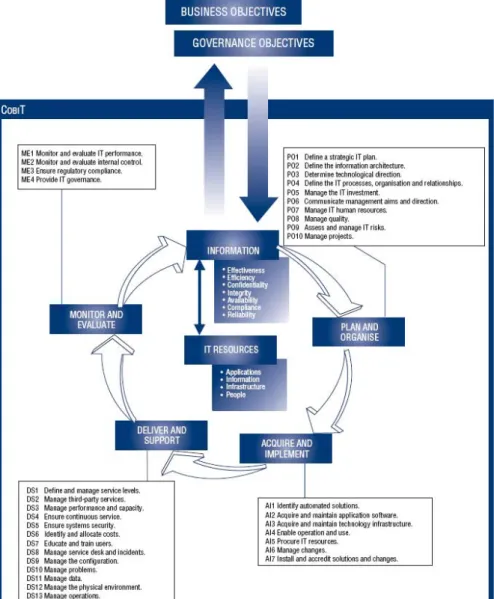
Figure 9 - Overall CobiT’s Framework... 46
Figure 10 - GIAF Product offering ... 51
Figure 11 - Service Support Process As-Is... 53
Figure 12 - Service Support Process To-Be ... 57
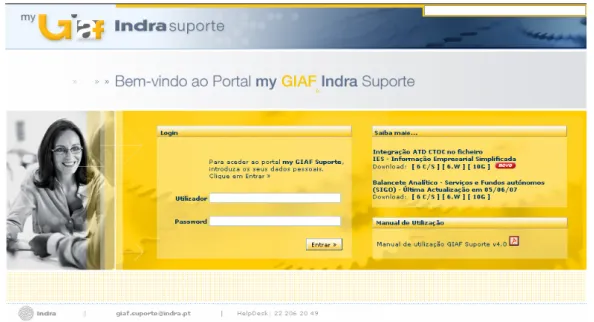
Figure 13 - Service Support Platform - Portal... 61
Figure 14 - Service Support Platform - Messages... 63
Figure 15 - Service Support Platform - Inserting a Request for Change... 64
Figure 16 - Service Support Platform - User Preferences ... 66
Figure 17 - Service Support Platform- Support User Panel ... 68
Figure 18 - Service Support Platform - Request Consultation ... 69
Figure 19 - Service Support Platform - Request for Change assignment... 70
Figure 20 - Service Support Platform - Suggestion Box... 71
Figure 21 - Service Support Platform - Request for Change Statistics ... 72
Figure 22 - Service Support Platform - Clients Creation/Consultation... 73
Figure 23 - Service Support Platform - Users Creation/Consultation ... 74
Figure 24 - Service Support Platform - Database Table Diagram... 75
Index of Tables
Table 1 - CMMI Capability and Maturity Levels ... 11
Table 2 - ISO/IEC 15504 Process Attributes ratings for Capability Levels... 22
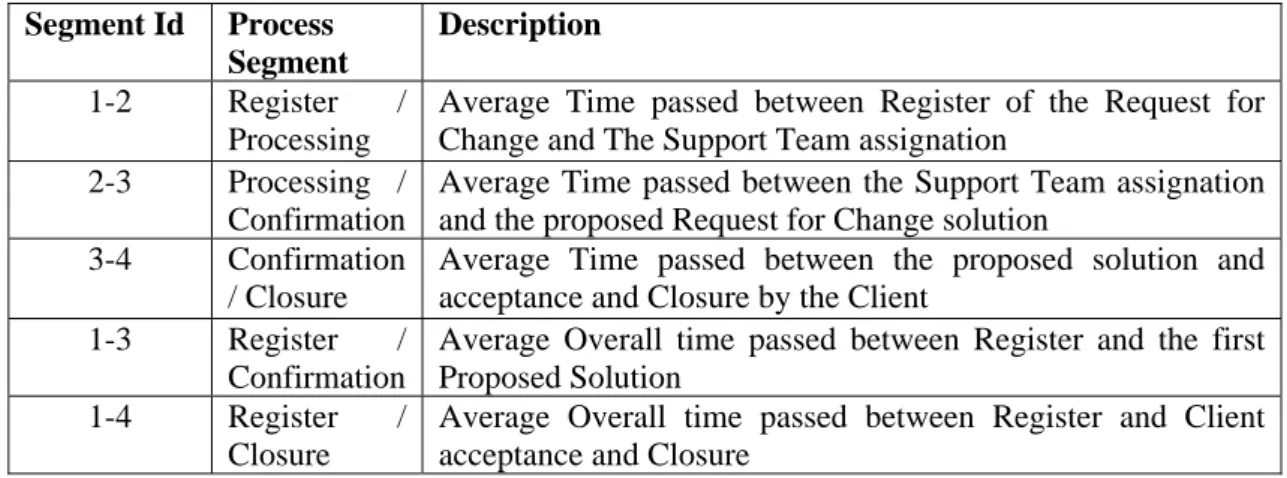
Table 3 - Service Support Platform - Process Segment metrics... 54
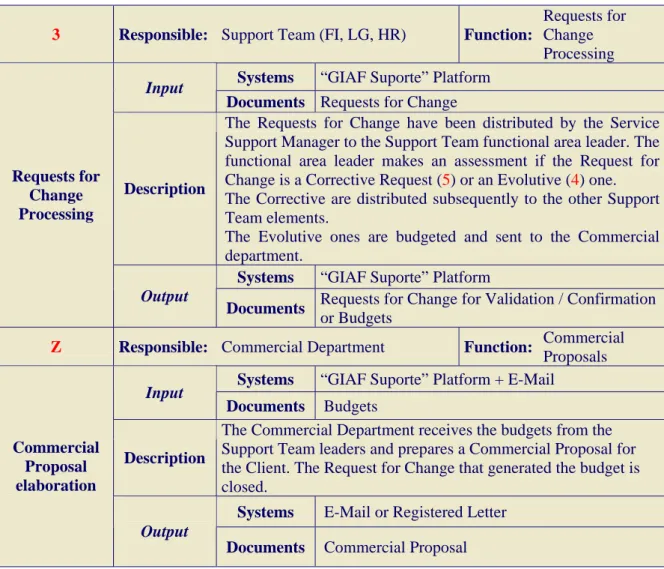
Table 4 - Service Support Planned Process To-Be Workflow ... 60
João Pimentel Peixoto Coentro
Mestrando na FEUP - [email protected]
Resumo
No contexto actual de competitividade das empresas, torna-se essencial para a sobrevivência das mesmas a aplicação de metodologias que contribuam para o incremento dos níveis de eficiência e eficácia dos processos internos. Nas empresas das áreas das tecnologias de informação (TI) e em particular na área de desenvolvimento e manutenção de Software, muitas vezes são negligenciados os processos de gestão interna quer de desenvolvimento quer de manutenção das aplicações ao longo do seu ciclo de vida.
Para endereçar estas questões de primordial importância na indústria das TI, têm vindo a ser desenvolvidos alguns Frameworks e referenciais normativos que permitem implementar soluções para gestão da qualidade de serviço das TI e das respectivas infra-estruturas. Esta Dissertação propõe-se aprofundar e estudar a aplicação das diferentes Frameworks e Normativos no âmbito da Qualidade no Processo de Desenvolvimento e Manutenção de Software, e no Serviço e Gestão das Infra-estruturas de apoio, procedendo ao enquadramento das mesmas nos problemas decorrentes nesta área. Alguns dos Frameworks e Normativos a serem estudados, incluem: CMMI, Personal Software Process (PSP), ISO/IEC15504 (SPICE), ITIL, ISSO/IEC 20000, ISO/IEC 12207, ISO/IEC 9126, ISO 14598, ISSO/IEC 27001, ISO/IEC 17799 e CobiT.
Após a descrição de cada uma das normas, com os seus pontos fortes e fracos, será feita uma caracterização e levantamento de funcionalidades para uma solução tecnológica de suporte com recurso a estas metodologias, bem como se efectuará a aplicação prática destas metodologias num caso de estudo real, no qual serão identificadas métricas e características no âmbito dos
processos de desenvolvimento de tal ferramenta de suporte, sendo elaborado um Modelo de Gestão da Qualidade do Serviço utilizando estes Frameworks e Normativos no desenvolvimento e implementação de um Sistema de Informação.
Palavras-Chave
CMMI, Personal Software Process (PSP), ISO/IEC15504 (SPICE), ITIL, ISO/IEC 12207, ISO/IEC 9126, ISO 14598, ISO/IEC 17799, ISO/IEC 20000, ISO/IEC 27001, CobiT, IT Frameworks.
João Pimentel Peixoto Coentro MSc in FEUP - [email protected]
Abstract
In today’s companies, it is essential for their survival the application of methodologies that increment the levels of efficiency and effectiveness of their internal processes. In Information Technology (IT) companies and in particular, IT companies that develop and maintain their own Software programs, many times their internal management processes are neglected when developing and maintaining their applications, throughout the application’s lifecycle.
To address these questions of primordial importance for IT companies, a set of Frameworks and Standards have been developed, trying to drive solutions for the management of Service Quality in IT and their infrastructure. This Dissertation proposes to study the application of the different Frameworks and Standards related to Quality in the process of development and maintenance of computer Software, as well as Service and Management of their Infrastructures, referring to the recurring problems in this area. Some of the Frameworks and Standards to be studied here are: CMMI, Personal Software Process (PSP), ISO/IEC15504 (SPICE), ITIL, ISO/IEC 20000, ISO/IEC 12207, ISO/IEC 9126, ISO 14598, ISO/IEC 27001, ISO/IEC 17799 and CobiT.
After describing each of these Standards and Frameworks, with their pros and cons, it will be made a characterization and evaluation of functionalities for a technological offer supporting these methodologies, as well as a practical application of these methodologies in a real case study, in which there will be identified metrics and characteristics regarding the development processes of such Support tool. A Model of Quality Service Management using these Standards and Frameworks in the development and implementing of an Information System will also be proposed and implemented.
FEUP xi
Keywords
CMMI, Personal Software Process (PSP), ISO/IEC15504 (SPICE), ITIL, ISO/IEC 12207, ISO/IEC 9126, ISO 14598, ISO/IEC 17799, ISO/IEC 20000, ISO/IEC 27001, CobiT, IT Frameworks.
1. Introduction
1.1 Context
In order to understand the existence of so many Standards and Frameworks in this specific area of IT, we first must identify the recurring problems in IT development and the Quality flaws that arise from problems in the early stages of the development processes, which will be reflected in the final product. A good way to start is to study the existing Standards and Frameworks, which will permit to address problems that many times are not visible to the manager, alerting the manager to their awareness and impact to the final product.
Some of the most common errors in IT development and management can be mitigated applying these standards. Problems derived from insufficient testing, unavailable or incomplete product documentation, absence of planning the sequencing of operations, no time management techniques for the programmers and their teams, considering product packaging and product support and so many other issues that should be considered for product Quality improvement and how Quality is perceived by the client.
The IT manager must understand how these Standards and Frameworks overlap and complement with each other, in order to take advantage of their guidelines and solve the problems they are trying to address.
1.2 Problem
The working environment for the case study is an ERP developing department, with the present solution for Client Support consisting in an ad-hoc Client support E-mail, with no control over resolution time, occurring lost requests for change, redundancy of e-mail reading (all product
areas had to read all e-mails, because not all e-mails had a clear indication of what area the problem referred to). This represented a terrible inefficiency in valuable support team’s time.
The absence of a standard point of entry, with a set of required characteristics (form fields) when outlining a request also leaded to incomplete requests, which implied a reply answer from the support team demanding a more detailed request for change.
The objective consists in establishing a robust and consistent Support platform in an IT department. The case study presented illustrates a web support platform developed considering the Frameworks’ and Standards’ best practices. A more detailed description of the problem will be detailed in Chapter 3.
1.3 Methodology
The approach taken during the execution of this Dissertation was focused in assimilate and gather all the pertinent and actualized information regarding the state of the art of Quality Service Management. This approach resembles the Action Research methodology [48, Page 2], as it is “grounded in practical action, aimed at solving an immediate problem situation while carefully informing theory”.
This methodology ideal domain considers an environment [48, page 7] where the “researcher is actively involved”; “the knowledge obtained can be immediately applied” and “the research is a process linking theory and practice”. All these 3 premises are present. The Action Research has 5 identifiable phases:
Diagnosing Action planning Action taking
Evaluating
Specifying learning
After a thorough diagnosing of the several existing Standards and Frameworks, a group of these Standards and Frameworks were selected (the Action planning phase) and included in this Dissertation. Some may argue this selection, but I believe the selected Standards and Frameworks cover a wide area of information for those who have interest in this very interesting area of IT.
The different Standards and Frameworks are presented in a top-down approach, considering the related and more detailed associated Frameworks next to the preceding and more generic Framework. An example may be CMMI - Capability Maturity Model Integration as a more “Top” approach, and ISO 15504 SPICE as a more detailed associated Framework. (This structured approach is better reflected in the Annex).
All of these Standards and Frameworks overlap and complement each other. By presenting all of these Frameworks and Standards together, will permit the reader to have a clearer view of what exists and what can be useful in each situation or business goal.
After having described and consolidated the included Frameworks, the sum up of those guidelines and best practices will be applied to a real case study (the Action taking phase), clearly identifying which Framework or Standard (or both) is being used in the specific process.
The first step is drawing the As-Is Process for the analyzed problem, permitting a clear view of the status of the process and visually identifying how the process should be implemented, permitting a To-Be schema. Using the core Frameworks and Standards as good practices references, a new Client support process will be designed.
The second step is the operational implementation of the new process design into a functional platform. The full integration/implementation of the core Frameworks and Standards is not an objective in the development and implementation of the To-Be Support Platform we will use as a case study.
Finally, an assertion (the Evaluation phase) of the obtained results is executed and the reuse of this information is applied as feedback for process reengineering and process improvement (the Specifying learning phase).
1.4 Dissertation Structure
The dissertation follows a logic sequence in the presentation of the Frameworks and Standards. A related Framework or Standard will be presented next to the main Framework that preceded it. In Chapter 2 (IT Frameworks), a description of the main goals and approaches taken by each of the Standards and IT Frameworks will be presented.
IT Frameworks like CMMI, ITIL or CobiT that are focused on internal process improvements will be detailed and how these frameworks integrate with some of the most recognized ISO Standards, like ISO/IEC 15504 (SPICE), ISO 20000, ISO 9126, ISO 12207 or ISO/IEC 17799.
Chapter 2 begins to describe CMMI - Capability Maturity Model Integration, one of the world’s most recognised IT Framework. CMMI focuses in providing a structured approach for the software development, defining a support structure in which a software project can be organized and developed. The described CMMI will be CMMI for Development version 1.2, the first constellation of CMMI. A description of CMMI origins, CMMI levels, as well as CMMI requirements for appraisals like SCAMPI is presented.
ISO/IEC15504 Software Process Improvement and Capability dEtermination (SPICE) follows, as the ISO’s (which is prominently a European organization) offer of a Process Improvement standard, which is aligned with CMMI (an American Framework). ISO/IEC15504 is an approach for the assessment of processes, aligned with the capability levels (continual approach) presented by CMMI. It is used usually as a benchmark tool as it permits to quantify business processes.
Next Information Technology Infrastructure Library (ITIL) is presented, as it is an essential Framework that describes a set of processes for the management of IT. Because it is a framework, ITIL does not describe in great detail how any particular process should be implemented. ITIL comprises a set of several books, but the scope of this dissertation will focus only on the Service Support and Service Delivery books. A description of ITIL origins and what is expected to happen in ITIL is also presented.
Finally, the last Framework to be presented is CobiT - Control Objectives for Information and related Technology. CobiT is a business focused, process-oriented, controls-based and measurement-driven Framework. It provides essentially a set of control objectives, following the principle of providing the information that the enterprise requires to achieve its objectives. CobiT is commonly associated with internal control and audit firms, as it is aligned with the 2002’s Sarbanes-Oxley act (SOX).
In Chapter 3, a description of the problem and the needs that need to be fulfilled are presented. The Product and Services GIAF, the Process layout As-Is, the goals to be achieved and the metrics used to quantify the success of a Client Support Process. The Request for Change characteristics are also detailed for the Request for Change template, by integrating the Support Team’s feedback for their needs in terms of Request for Change information, as well as embedding the good practices of the mentioned Frameworks.
In Chapter 4, a proposed solution and process redesign (Process layout To-Be) is detailed. This Client Support Process will be redesigned and used as a use-case, fitting good practices of parts of some of the core Frameworks and Standards presented in Chapter 2. The ITIL/CMMI/CobiT frameworks will be fitted for the specific problem, accordingly. The Process Improvement approach ISO/IEC 15504 SPICE will also have a strong presence, especially with the involvement and feedback from Clients (stakeholders).
In Chapter 5, a Prototype Implementation for the Support Platform is detailed, separated in two different perspectives:
Service Support Platform - Client’s Side
Service Support Platform - Support Team’s Side
Alongside with the description of the Support Platform, the several embedded Frameworks and Standards are indicated where their use is appropriate. In Chapter 6, a critic Evaluation using a structured approach through the answering of key questions and the answering of specific questions for both a Goals-oriented Evaluation as well as a Process-oriented Evaluation of the new Support Platform.
In Chapter 7, Conclusions and further Developments, the operational and process gains are discussed, as the results and the number of Requests for Change gain critical mass for a thorough and significant analysis. As the information consolidates and feedback from Clients and Users is obtained, the opportunity arises for the reuse of this knowledge. It will be presented how the results can be used to continuously improve the Support Platform and subsequently the Service Support process.
At the end of the Dissertation, a References listing, a Glossary/Acronyms and an Annex, which contains all of the detailed Frameworks and associated Standards that were studied for this dissertation are presented.
2. IT Frameworks
A good way to start is to know the different Standards and Frameworks that exist and are available to the IT manager, knowing what good advices and practices they have to offer, so that the IT manager can perform the best possible decisions based on the appropriate best practices. In this Chapter, a description of several main Standards and Frameworks will be presented and resumed. They will be presented in a top down approach, meaning that a generic Framework will be followed by the more detailed associated Framework, and then again by a more generic (not directly related) Framework.
This chapter will present the structure of the main IT Frameworks, like CMMI, ITIL, CobiT, ISO 15504 (SPICE), as well as some IT Standards, like ISO/IEC 12207, ISO/IEC 9126, ISO 20000, ISO 14598 and ISO/IEC 17799.
The analysis of the Frameworks begins with Capability Maturity Model Integration (CMMI), which is a commonly recognised standard focused in process improvement, based in two different approaches, continual or staged process improvements.
Let’s begin with one of the main Frameworks recognised throughout the world as one of the milestones in IT management and process improvement, CMMI - Capability Maturity Model Integration.
2.1 Capability Maturity Model Integration (CMMI)
CMMI (Capability Maturity Model Integration) is a Framework. A Framework, by definition is “a structure supporting or containing something”. In software development, a Framework is a
defined support structure in which another software project can be organized and developed. CMMI considered 4 different models directed to different domains, supporting the process improvements of those specific areas. The models were:
CMMI-SE (Systems Engineering) CMMI-SW (Software Engineering)
CMMI-IPPD (Integrated Product and Process Development) CMMI-SS (Supplier Sourcing)
CMMI has evolved and is currently undergoing a different structural approach. CMMI now includes the concept of CMMI "constellations." A constellation is a set of CMMI components designed to meet the needs of a specific area of interest. A constellation can produce one or more related CMMI models and related appraisal and training materials. CMMI for Development is the first of these constellations [1].
The prior CMMI-SE/SW (Systems Engineering and Software Engineering) Version 1.1 as well as CMMI-IPPD (Integrated Product and Process Development) are now superseded to Version 1.2 CMMI for Development (CMMI-DEV), to truly reflect the comprehensive integration of these bodies of knowledge and the application of the model within the organizations. CMMI-SS (Supplier Sourcing) was removed.
There are still available some CMM models, like P-CMM (People CMM) and SA-CMM (Software Acquisition CMM). P-CMM (People CMM) shares the same philosophy as the CMMI-SW, but applied to Human Resources in order to continuously improve the ability of software organizations to attract, develop, motivate, organize, and retain the talent needed to steadily improve their software development capability. SA-CMM (Software Acquisition), aims to organizations that acquire solutions such as hardware, software, services, and systems. This Dissertation will only focus in the CMMI models.
FEUP 9 2.1.1 CMMI Levels
As it is described in CMMI-DEV [6, Part 1, Chapter 3], CMMI supports two improvement paths. One path enables organizations to incrementally improve processes corresponding to an individual Process area (or process areas) selected by the organization. The other path enables organizations to improve a set of related processes by incrementally addressing successive sets of process areas.
1
These two improvement paths are associated with two representations:
Continuous representation, for which CMMI uses the term “capability level.” Staged representation, for which CMMI uses the term “maturity level.”
The concept of levels is the same on both representations.
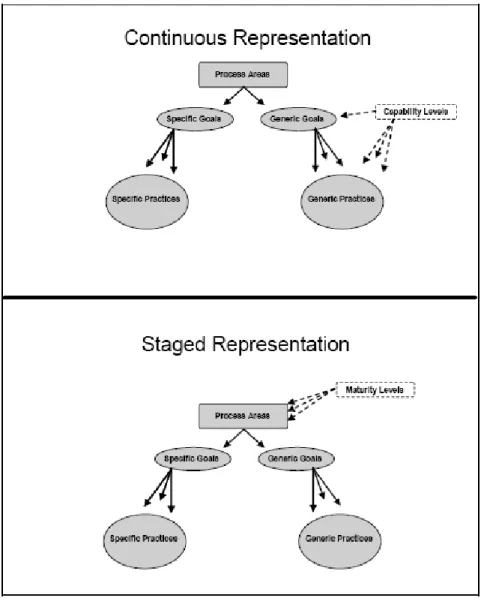
Levels are used in CMMI to describe an evolutionary path recommended for an organization that wants to improve the processes it uses to develop and maintain its products and services. Levels can also be the outcome of the rating activity of appraisals. The most used method to grant a CMMI level to an organization is through SCAMPI (Standard CMMI Appraisal Method for Process Improvement). Figure 1 illustrates the difference between stage and continuous representations.
1
Process area is a cluster of related best practices in an area, which when implemented collectively, satisfy a set of goals considered important for making significant improvement in that area [6, Preface].
Source: CMMI-DEV Version 1.2 Part 1, Chapter 3
Figure 1 - CMMI Continuous and Staged Representations
The capability/maturity dimensions of CMMI are used for benchmarking and appraisal activities, as well as guidance to an organization’s improvement efforts.
Capability levels, which belong to a continuous representation, apply to an organization’s process improvement achievement in individual process areas. These levels are a mean for
incrementally improving the processes corresponding to a given process area. There are six capability levels, numbered 0 through 5.
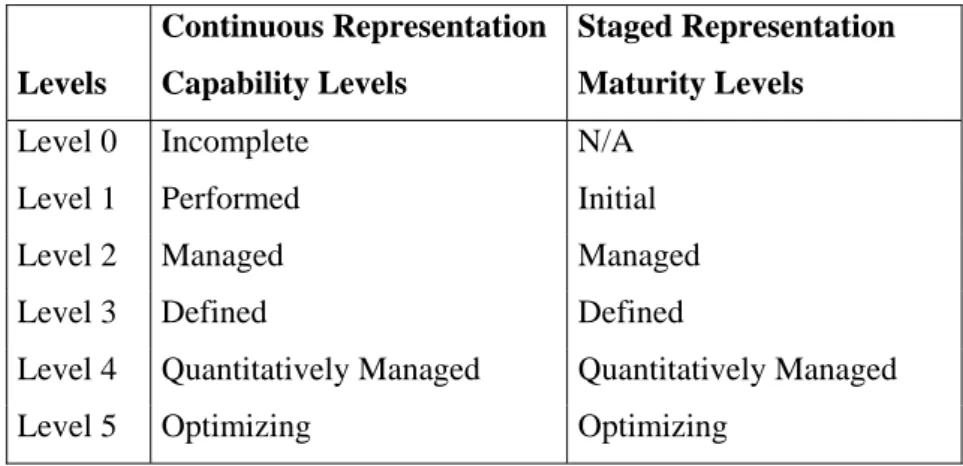
Maturity levels, which belong to a staged representation, apply to an organization’s process improvement achievement across multiple process areas. These levels are a means of predicting the general outcomes of the next project undertaken. There are five maturity levels, numbered 1 through 5. Table 1 illustrates the alignment between the two representations.
Levels
Continuous Representation Capability Levels
Staged Representation Maturity Levels
Level 0 Incomplete N/A
Level 1 Performed Initial
Level 2 Managed Managed
Level 3 Defined Defined
Level 4 Quantitatively Managed Quantitatively Managed Level 5 Optimizing Optimizing
Source: CMMI-DEV Version 1.2 Part 1, Chapter 3 Table 1 - CMMI Capability and Maturity Levels
Each level has a set of specific practices/recommendations that should be implemented in order to achieve the desired level. Level 2 through 5 represent the same on both representations. A short description of the continuous representation follows:
Capability Level 0: Incomplete
An “incomplete process” is a process that either is not performed or partially performed.
Capability Level 1: Performed
A performed process is a process that satisfies the specific goals of the process area. But they can be lost over time if they are not institutionalized.
Capability Level 2: Managed
A managed process is a performed process that has the basic infrastructure in place to support the process. It is monitored, controlled, and reviewed and evaluated.
Capability Level 3: Defined
A defined process is a managed process that is tailored from the organization’s set of standard processes. A critical distinction between capability levels 2 and 3 is the scope of standards, process descriptions, and procedures. Process descriptions and procedures are tailored from the organization’s set of standard processes to suit a particular project or organizational unit.
Capability Level 4: Quantitatively Managed
A quantitatively managed process is a defined process that is controlled using statistical and other quantitative techniques. Quantitative objectives for quality and process performance are established and used as criteria in managing the process.
Capability Level 5: Optimizing
An optimizing process is a quantitatively managed process that is improved based on an understanding of the common causes of variation inherent in the process. The focus of an optimizing process is on continually improving the range of process performance through both incremental and innovative improvements.
A short description of the staged representation levels follows:
Maturity Level 1: Initial
At maturity level 1, processes are usually ad hoc and chaotic. The organization usually does not provide a stable environment to support the processes. Success in these organizations depends on the competence and heroics of the people in the organization and not on the use of proven processes.
Maturity Level 2: Managed
At maturity level 2, the projects of the organization have ensured that processes are planned and executed in accordance with policy.
Maturity Level 3: Defined
At maturity level 3, processes are well characterized and understood, and are described in standards, procedures, tools, and methods.
Maturity Level 4: Quantitatively Managed
At maturity level 4, the organization and projects establish quantitative objectives for quality and process performance and use them as criteria in managing processes.
Maturity Level 5: Optimizing
At maturity level 5, an organization continually improves its processes based on a quantitative understanding of the common causes of variation inherent in processes.
As referred early, levels 2 through 5 represent the same on both representations. All these descriptions of the levels are more detailed in CMMI-DEV version 1.2 [6, Part1, Chapter 3].
2.1.2 CMMI Appraisals (SCAMPI)
The Standard CMMI Appraisal Method for Process Improvement (SCAMPI) appraisal methods are the generally accepted methods used for conducting appraisals using CMMI models [8]. The SCAMPI family of appraisals includes Class A, B, and C appraisal methods. SCAMPI A is the most rigorous method and the only method that can result in a rating. SCAMPI B provides options in model scope, but the characterization of practices is fixed to one scale and is performed on implemented practices. SCAMPI C provides a wide range of options, including
characterization of planned approaches to process implementation according to a scale defined by the user [6, Part 1, Chapter 5].
Appraisals of organizations using a CMMI model must conform to the requirements defined in the Appraisal Requirements for CMMI (ARC) v 1.2 document [7]. In short, this ARC document details step by step sets of activities to achieve the selected goals. ARC permits setting the frame of activities to define the responsibilities of the sponsor and the team leader, as well as point the method to document, plan and prepare for the appraisal. It also sets the requirements of the appraisal to collect, consolidate and validate data. How to set the rating, and finally, reporting the results.
But lets detail further what is SCAMPI A. SCAMPI A satisfies the Appraisal Requirements for CMMI (ARC) v1.2 and is a Class A appraisal method. The SCAMPI A method has the following primary objectives:
Provide a common, integrated appraisal method capable of supporting appraisals in the context of internal process improvement, supplier selection, and process monitoring
Provide an efficient appraisal method capable of being implemented within reasonable performance constraints
As an ARC Class A method, SCAMPI A is a benchmarking-oriented method suitable for generating ratings. SCAMPI A appraisals can be performed in three modes of usage:
Internal Process Improvement Supplier Selection
Process Monitoring
While many of the SCAMPI A features are common across all usage modes (e.g., identification of strengths, weaknesses, and ratings), there are differences in motivation and intent that can result in some expected method differences in these usage modes. Performing appraisals efficiently involves minimizing the use of resources and the impact on appraisal teams and appraised organizations, while maintaining the essential method characteristics that ensure the high degree of accuracy required for an effective benchmarking, regardless of the mode of usage [8, Chapter 1, Page 17].
The first thing to do in SCAMPI is to prepare and plan for appraisal. The team leader and the appraisal sponsor should analyze the requirements. The team leader will collect information and help the appraisal sponsor match appraisal objectives with their business objectives. The next step is to document the results of appraisal planning including the requirements, agreements, estimates, risks, method tailoring, and practical considerations.
The business needs for process improvement drive the requirements for the conduct of any given appraisal and generally include one or more of three closely related factors:
Reducing costs Improving quality
Decreasing time to market
The appraisal team leader must establish high-level cost and schedule constraints to determine which process areas and organizational entities are to be included to ensure feasibility. The appraisal team leader is also responsible for keeping the appraisal sponsor informed of risk management activities so that, if needed, timely sponsor intervention is possible to ensure the achievement of appraisal objectives.
After appraisal requirements have been documented, constraints are understood and the appraisal plan is defined, the team must be selected and prepared. The minimum acceptable
team size for a SCAMPI A appraisal is four people (including the appraisal team leader). All team members must have previously completed the SEI-licensed Introduction to CMMI course.
After the team is selected and all the data collection is planned, the appraisal may now be conducted and the model practices implemented. The findings will be validated and the appraisal output results generated. With this output, the capability (or maturity) level attained for each process area within the scope of the appraisal will be depicted.
The appraisal results will be delivered to the sponsor and to the appraised organizational unit. The appraisal results are intended to support decision making, and should be delivered in a way that promotes appropriate actions. Whether the appraisal was conducted for internal process improvement, supplier selection, or process monitoring purposes, the delivery of results (ADS – Appraisal Disclosure Statement) should facilitate the actions that will be driven by the information and utilized for subsequent reports and follow-up actions.
In short, what are the benefits of using CMMI? The answer is that CMMI best practices improve organizations by enabling to do the following:
More explicitly link their management and engineering activities to their business objectives
Expand their visibility into their product life cycle and engineering activities to ensure that their products and services meet customer expectations
Incorporate lessons learned from additional areas of best practice, like risk management
Implement more robust high-maturity practices and levels
Address additional organizational functions critical to their products and services More fully comply with relevant ISO standards, like ISO/IEC 15504 (SPICE)
A more detailed explanation of CMMI is presented in Annex A.1, as well as a derivation of the SW-CMM is available in Annex A.2, applicable to small programming teams or individual programmers to accomplish continuous improvements called Personal Software Process.
In the next subsection, the CMMI’s associated ISO standard, ISO/IEC 15504 (SPICE) will be presented.
2.2 ISO/IEC15504 Software Process Improvement and Capability
dEtermination (SPICE)
ISO (the International Organization for Standardization) and IEC (the International Electrotechnical Commission) form the specialized system for worldwide standardization. ISO/IEC 15504 SPICE (Software Process Improvement and Capability dEtermination) is a framework that provides a structured approach for the assessment of processes. ISO/IEC 15504 consists of the following parts, under the general title Information Technology - Process Assessment:
Part 1: Concepts and vocabulary [16], provides a general introduction to the concepts of process assessment and a glossary
Part 2: Performing an assessment [17, 17a], sets out the minimum requirements for performing an assessment that ensure consistency and repeatability of the ratings Part 3: Guidance on performing an assessment [18], provides guidance for
interpreting the requirements for performing an assessment
Part 4: Guidance on use for process improvement and process capability determination [19], identifies process assessment as an activity that can be performed either as part of a process improvement initiative or as part of a capability determination approach
Part 5: An exemplar Process Assessment Model [20], contains an exemplar Process Assessment Model
ISO/IEC 15504 integrates smoothly in the continuous approach made by CMMI-DEV Version 1.2, but proper harmonization work should be considered [17b]. This permits a synchronized process assessment (ISO/IEC 15504) with the CMMI appraisals structure, like SCAMPI. A schematic of process assessment relationship follows in Figure 2.
Source: ISO/IEC 15504 - Part 1 [16]
Figure 2 - ISO/IEC 15504 Process Assessment Relationship
In Part 2 of ISO/IEC 15504, the measurement framework is detailed on how to perform an assessment. The requirements for the Processes Reference and Assessment Models are set, and finally, the conformity of the process assessment is verified.
Process assessment, as defined in ISO/IEC 15504, is based on a two dimensional model containing a process dimension and a capability dimension. The process dimension is provided by an external Process Reference Model, which defines a set of processes characterized by statements of process purpose and process outcomes. The capability dimension consists of a measurement framework comprising six process capability levels and their associated process attributes [17, Introduction].
As referred, the ISO/IEC 15504 capability dimension and the process capability levels match the continuous representation we have seen in CMMI-DEV [6]. These two dimensions, provided by the Process Reference Model and the Measurement Framework will give origin to the Process Assessment Model, used as reference to the Assessment Process.
The Assessment Process contains at least five specified activities: planning, data collection, data validation, process attribute rating, and reporting. An assessment is carried out by assessing selected processes (using Process reference models) against the Process Assessment Model chosen for the assessment [16]. Figure 3 gives a schematic view of ISO/IEC 15504 normative elements.
Source: ISO/IEC 15504 - Part 2 [17]
Figure 3 - ISO/IEC 15504 Normative Elements
The sponsor will have the responsibilities and the authority to make sure that the adequate resources and competencies are made available in order to perform a conformant assessment. The assessment results will normally be used as a basis for developing an improvement plan or determining capability and associated risks as appropriate.
The competent assessor is responsible for ensuring that the assessment achieves its purpose and that it is conformant with the requirements of ISO/IEC 15504 Part 2. It is therefore imperative that the competent assessor selects an appropriate documented assessment process based on the Process Assessment Model(s). The rating activities are performed solely by the competent assessor and assessors [18].
The initial assessment input must include at a minimum, an assessment purpose; the identity of the sponsor of the assessment and the sponsor’s relationship to the organizational unit being assessed; the assessment scope, approach and constraints; a criteria for competence of the assessor who is responsible for the assessment; clear role definitions for the assessment team; and additional information to support process improvements and capability determination [18].
The output information which is pertinent to the assessment and will support understanding of the output assessment shall be compiled and included in the assessment record for retention by the sponsor. The assessment output is intended to support understanding of the assessment results and facilitate activities such as benchmarking and third party verification (ex: by comparing Capability levels).
Each capability level has a set of process attributes that are evaluated and rated when an assessment process is performed and a capability is determined. The higher the level, more processes must be achieved. The set of processes to be evaluated are set in the scope of the assessment. Each process is rated following these values:
N - Not achieved (0 to 15 % achievement)
P - Partially achieved (15 % to 50 % achievement) L - Largely achieved (50 % to 85 % achievement) F - Fully achieved (85 % to 100 % achievement)
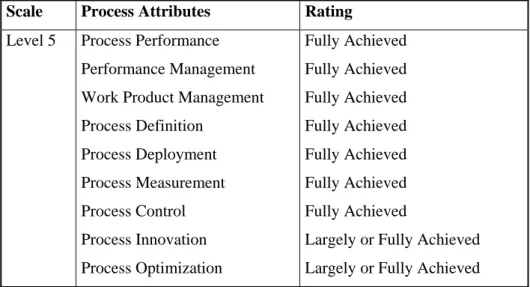
Table 2 will give an easy understanding of which processes must be satisfied for each capability level. The key idea is simple. All of the process attributes at lower levels must be rated as “Fully Achieved” while those at the level can be rated as “Largely Achieved” or “Fully Achieved”.
Scale Process Attributes Rating Level 0 Process Performance Partially Achieved Level 1 Process Performance Largely or Fully Achieved Level 2 Process Performance
Performance Management Work Product Management
Fully Achieved
Largely or Fully Achieved Largely or Fully Achieved Level 3 Process Performance
Performance Management Work Product Management Process Definition
Process Deployment
Fully Achieved Fully Achieved Fully Achieved
Largely or Fully Achieved Largely or Fully Achieved Level 4 Process Performance
Performance Management Work Product Management Process Definition Process Deployment Process Measurement Process Control Fully Achieved Fully Achieved Fully Achieved Fully Achieved Fully Achieved
Largely or Fully Achieved Largely or Fully Achieved
FEUP 22 Scale Process Attributes Rating
Level 5 Process Performance Performance Management Work Product Management Process Definition Process Deployment Process Measurement Process Control Process Innovation Process Optimization Fully Achieved Fully Achieved Fully Achieved Fully Achieved Fully Achieved Fully Achieved Fully Achieved
Largely or Fully Achieved Largely or Fully Achieved Source: ISO/IEC 15504 - Part 3 [18]
Table 2 - ISO/IEC 15504 Process Attributes ratings for Capability Levels
An assessment process must be exemplarily documented so that all of the comprising activities can be detailed and replicated. Data required for evaluating the processes within the scope of the assessment must be collected in a systematic manner. The strategy and techniques for the selection, collection, analysis of data and justification of the ratings must be explicitly identified and demonstrable by the assessment team. Each process identified in the assessment scope is assessed on the basis of objective evidence [18].
This data collection and detailing will permit an easier data validation and process attribute rating (the activities seen on the Assessment Process), leading to the final Assessment Process activity, the Reporting. The Reporting must document that the assessment was performed according to the requirements, and for each assessor, records to prove their participation should be included. The sponsor approves those records and provides feedback from the assessment as a means to improve the assessment process.
In the following section, another essential and worldwide recognised Framework will be presented, the Information Technology Infrastructure Library (ITIL).
2.3 Information Technology Infrastructure Library (ITIL)
Information Technology Infrastructure Library (ITIL) has been around for 20 years, but interest has only increased in the last six years. ITIL is becoming the next big thing in Information Technology. This section will describe the origin of ITIL, who controls the ITIL contents and what is the key message to learn from this Framework. Throughout this section, it will be important to remember that ITIL describes a framework of processes for the management of IT. Because it is a framework, ITIL does not describe in great detail how any particular process should be implemented.
Version 2 of ITIL was initially released in mid 2000. The present day version 2 contains just 10 books, as pieces of a puzzle that complement (and overlap) each other:
Service Support Service Delivery
Business Perspective (Volumes I & II) ICT Infrastructure Management Applications Management Security Management Planning and Implementation Software Asset Management ITIL - Small Scale Implementation
Two of these books, Service Support and Service Delivery, are the heart of ITIL and the focus of the present drive for ITIL adoption. Only these two books will be detailed in this Dissertation. Service Support covers a set of core processes (Figure 4), more focused on Customer satisfaction and problem resolutions. They will be detailed in sub-section 2.4.1.
Source: ITIL Service Support Version 2 [21] Figure 4 - ITIL Service Support coverage
Service Delivery covers a different array of core processes (Figure 5), more focused on level of service. These processes will be detailed in sub-section 2.4.2.
Source: ITIL Service Delivery Version 2 [22] Figure 5 - ITIL Service Delivery coverage
2.3.1 ITIL Service Support
ITIL Service Support, also known as the blue book, defines a set of core processes to be addressed. Each one of these processes has their specific goal. These processes are centred on the relationships between the IT organisation and their Customers. Service Delivery is partially concerned with setting up agreements and monitoring the targets within these agreements. Meanwhile, on the operational level, the Service Support processes can be viewed as delivering service as laid down in these agreements [22]. This ITIL book addresses the following processes: Configuration Management Service Desk Incident Management Problem Management Change Management Release Management
Service Support refers to the need for Configuration management, Change management, Incident Management, Problem Management and Release Management processes to be integrated. For example, the process of releasing components to the live environment (the domain of Release Management) is also an issue for Configuration Management and Change Management whilst the Service Desk is primarily responsible for liaison between IT providers and the Users of services [21, Chapter 2]. Let us begin with the first Process, Configuration Management.
Configuration Management
Configuration Management intends to provide information on the IT infrastructure to all other processes and IT Management, enabling control of the infrastructure by monitoring and
maintaining information on all the resources needed to deliver services, as well as Configuration Items (CIs) status, history and relationships. In ITIL Service Support Version 2 [21], Configuration Management is defined as “The process of identifying and defining Configuration Items in a system, recording and reporting the status of Configuration Items and Requests for Change, and verifying the completeness and correctness of Configuration Items”. To accomplish these objectives, a set of tasks must be executed and registered. The essential tasks referred in this process are:
Identification and naming Management information Verification
Control
Status Accounting
All these tasks permit a well defined Configuration Item and must be registered in a Configuration Management Database (CMDB), a database which contains all relevant details of each Configuration Item (CI) and details of the important relationships between CIs. A Configuration Item is an item needed to deliver a service, uniquely identifiable, that can be subject to change and so it can be managed. A Configuration Item must have a category, defined relationships, a set of attributes and a status.
Service Desk
The Service Desk is the single point of contact between service providers and the users, on a day-to-day basis. It is also a focal point for reporting incidents and making service requests. As such, the Service Desk has an obligation to keep users informed of service events, actions and opportunities that are likely to impact their ability to pursue their day-to-day activities [21]. Service Desk intends to be the primary point of call for all questions, requests, complaints and
remarks, as well as restore the service as quickly as possible in order to support business activities.
All incidents (defined as an unexpected disruption to agreed service) life-cycle should be managed by Service Desk by coordinating a resolution and generating all associated incident reports and communications, in order to promote an effective, reusable and permanent resolution. Priority is determined by business impact and urgency. The correct assessment of priorities enables the deployment of manpower and other resources to the best interest of the customer (ex: Escalating an incident up in the management chain or horizontally to a different specialist group).
Incident Management
Incident Management tries to ensure that the best possible levels of service quality and availability are maintained according to Service Level Agreements (SLAs), restoring normal service as quickly as possible whilst minimizing the adverse impact on business operations. One possible solution is providing a Work-Around, avoiding an Incident or a Problem. Service requests, although not being a failure in the IT infrastructure, are treated as Incidents.
Problems are considered as all the unknown root cause of one or more incidents. Known error is considered as condition that exists after the successful diagnosis of the root cause of a problem when it is confirmed that a Configuration Item (CI) is at fault. If not properly controlled, a change may introduce new incidents, so a way of tracking back is required. It is therefore recommended that the incident records should be held on the same Configuration Management Database (CMDB) as the Problem, Known error and Change records.
The Incident life-cycle has 4 steps:
Accept service event, register and consult the CMDB
Classification Solve
Closure
Incident Management implies proactive reporting and daily reviews of individual Incident and Problem status against service levels. Weekly and monthly management reviews should be a standard procedure.
Problem Management
The Problem Management process requires the accurate and comprehensive recording of Incidents (in the CMDB) in order to identify effectively and efficiently the cause of the incidents and trends. Problem Management intends to stabilize IT services by preventing incidents and problems through the removal of the root causes. Problem Management is dedicated in preventing the recurrence of incidents related to errors and minimizing the consequences derived from those incidents.
Through the inputs present in the Configuration Management Database (Incident details, configuration details and defined workarounds), the desired outputs can be defined and detailed. Requests for change are often. Problem management process updates problem records including workarounds and/or solutions for known errors, integrating those solutions with the Incident Management process, as well as making these solutions available to the Service Desk.
Problem Control makes the identification, classification, assigns resources and investigates in order to establish known errors. The identified errors are controlled and recorded in the CMDB. The error is assessed and a resolution (normally a Request for Change - RfC) is proposed. Reporting is also a key element in Problem Management.
Change Management
Changes arise as a result of Problems, but many Changes can come from proactively seeking business benefits such as reducing costs or improving services [21, Chapter 8.1]. Change Management objective is to implement approved changes efficiently, cost-effectively and with minimal risk to the existing and to the new IT infrastructure. Only approved changes are made, risk and cost minimized.
It is generally accepted that Change Management and Configuration management are best planned and implemented concurrently. Changes undergo a Change Advisory Board (CAB), which is a group of people who can give expert advice to Change Management on the implementation of Changes. This Board is likely to be made up of representatives from all areas within IT and representatives from business units [21].
Change Management is also responsible by Filtering Changes and managing the Change Process and Changes, while chairing the CAB and reviewing management information. The Change Management process has defined 3 categories of impact of Changes, which defines a different approval workflow. The categories are:
Category 1 - Little impact on current services. The Change Manager is entitled to authorize the Request for Change
Category 2 - Clear impact on services. The Request for Change must be discussed in the Change Advisory Board. The Change Manager requests advice on authorization and planning
Category 3 - Significant impact on the services and the business. Considerable manpower and/or resources needed. The Request for Change will have to be submitted to the board level (CAB/EC – Change Advisory Board / Executive Committee)
All changes must have a back out plan always possible and a priority setting defined. The Change Management process has 4 priority levels:
Urgent - Change necessary now (otherwise severe business impact) High - Change needed as soon as possible (potentially damaging)
Medium - Change will solve irritating errors or missing functionality (can be scheduled)
Low - Change leads to minor improvements
The Change Management Process has the following steps:
Request for a Change
Registration and Classification in the CMDB Monitoring and Planning
Approval (CAB / EC) Building & Testing
Authorize Implementation (CAB / EC) Implementation
Evaluation (PIR - Process Implementation Review)
Changes can be scheduled, following a defined Forward Schedule of Changes (FSC), that contains details of all the Changes approved for implementation and their proposed implementation dates.
Release Management
Release Management takes a holistic view of a Change to an IT service and should ensure that all aspects of a Release, both technical and-non-technical, are considered together [21, Chapter 9.1]. Release Management tries to safeguard all software and related items and ensure that only
tested / corrected version of authorized software/hardware is in use. The motto is “Right software and Hardware at the right time and the right place”.
In order to accomplish this goal, a set of tasks must be executed. The release policies must be clearly defined and a Definitive Software Library (DSL) and a Definitive Hardware Storage (DHS) created. A Definitive Software Library stores reliable versions of software in a single logical location. However, software may be physically stored at different locations (Ex: Licenses and CDs in a vault). A Definitive Hardware Storage is an area set aside for the secure storage of definitive hardware spares.
Release Management is responsible for the distribution of Software and the associated Configuration Items (CIs), managing and overseeing the build of software releases. Software audits are also under the scope of Release Management process, using the information in the CMDB. Releases are also done under the control of the Change Management process. Release Management is the only process which creates its own policy. There are several Release Policies:
Release Unit
Full / Package / Delta Releases Numbering
Frequency
Emergency Change
Back out plans should always be considered. The Release Management process is oriented to a more operational Software control and distribution. It works closely with two other processes; Change Management (control perspective) and Configuration Management (control and administration).
2.3.2 ITIL Service Delivery
ITIL Service Delivery is also known as the red book. As said before, Service Delivery is partially concerned with setting up agreements and monitoring the targets within these agreements. ITIL Service Delivery intends to integrate a set of processes oriented in the maintenance of agreed levels of service. It comprises 5 core processes:
Availability Management
IT Services Continuity Management Capacity Management
IT Financial Management Service Level Management
Lets further detail on what each of this processes are focused and how they integrate and complement with each other.
Availability Management
Availability Management is concerned with the design, implementation, measurement and management of IT services to ensure the stated business requirements for availability are consistently met [22, Chapter 2.5]. Availability Management predicts, plans for and manages the availability of services by ensuring that all services are underpinned by sufficient, reliable and properly maintained CIs, and where CIs are not supported internally there are appropriate contractual agreements with third party suppliers to ensure the services. Changes are proposed to prevent future loss of service availability so that IT organizations can be certain of delivering the levels of availability agreed with customers in SLAs.
All aspects of availability are considered and managed in this process (Reliability, Maintainability, Redundancy and Serviceability). Maintainability is considered as Maintenance
done internally and Serviceability as Maintenance done by external entities. Availability Information is stored in an Availability Database (ADB). This information is used to create the Availability Plan. SLAs provide an input to this process.
An IT service is considered not available to a customer if the functions that customer requires at a particular location cannot be used although the agreed conditions under which the IT service is supplied are being met. In order to clearly quantify availability of services, the following metrics are used:
MTTR: Mean Time to Repair (Downtime) - Time period that elapses between the detection of an Incident and it’s Restoration. Includes: Incident, Detection, Diagnosis, Repair, Recovery and Restoration
MTTF: Mean Time To Failure (Uptime) - Time period that elapses between Restoration and a new Incident
MTBF: Mean Time Between Failures - Time period that elapses between two incidents. (MTTR + MTTF)
For an easier understanding, Figure 6 follows.
Failure 1 Restoration 1 Failure 2 Restoration 2
MTTR MTTF
MTBF
Figure 6 - ITIL Availability Metrics
In this manner, levels of availability can be clearly agreed with customers in Service Level Agreements (SLAs).
IT Services Continuity Management
IT Service Continuity Management is concerned with managing an organisation’s ability to continue to provide a pre-determined and agreed level of IT Services to support the minimum business requirements following an interruption to the business [22, Chapter 2.4]. Due to increasing Business dependency on IT, IT Service Continuity Management plans ahead in order to reduce costs and time of recovery, adding value to the customer and guaranteeing survival of the Business.
The planning consists mainly in a Business Impact Analysis, analysing Risks through the value of assets, threats and vulnerabilities. Risk Management acts through the use of countermeasures and planning for potential disasters. Risk Analysis has strong influence on the Computer Risk Analysis and Management Methodology (CRAMM), which is based on the ISO/IEC 17799.
This analysis permits the elaboration of a Contingency Plan, which assists in a fast, controlled recovery. Wide but controlled access to the Contents of the plan should be given, including Administration, Infrastructure and staff. Options of course (including Cold & Hot Start) must be clearly defined and tested regularly, without impacting the live service.
A Cold start or gradual recovery is applicable to organisations that do not need immediate restoration of business processes and can function for a period of up to 72 hours, or longer, without a re-establishment of full IT facilities. This may include the provision of empty accommodation fully equipped with power, environmental controls and local network cabling infrastructure, telecommunications connections, and available in a disaster situation for an organisation to install its own computer equipment.
A Hot Start (or immediate recovery) option provide for the immediate restoration of services following any irrecoverable incident. Hot stand-by typically referred to availability of services
within a short timescale such as 2 or 4 hours whereas immediate recovery implies the instant availability of services.
A contingency plan has 7 Sections:
Administration The IT Infrastructure
IT Infrastructure management & Operating procedures Personnel
Security
Contingency site Return to normal
Every contingency plan should be tested under realistic circumstances and reviewed initially every 6 to 12 months and after each disaster. The action should protect any live services first. Changes to the plan must pass the Change Advisory Board (CAB).
Capacity Management
Capacity Management tries do find the correct balance between the right, cost justifiable, capacity of IT resources such that the Service Levels agreed with the business are achieved at the right time. It comprises three sub-processes [22, Chapter 6.2]:
Business Capacity Management - The focus of this sub-process is ensuring that the future business requirements for IT Services are considered, planned and implemented in a timely fashion
Service Capacity Management - The focus of this sub-process is the management of the performance of the live, operational IT Services used by the Customers
Resource Capacity Management - The focus in this sub-process is the management of the individual components of the IT Infrastructure
Each of the sub-processes carry out many of the same activities, but each sub-process has a very different focus. Business Capacity Management is focused on the current and future business requirements, while Service Capacity Management is focused on the delivery of the existing services that support the business and Resource Capacity Management is focused on the technology that underpins all the service provision [22, Chapter 6.2].
A corporate Capacity Management process ensures that the entire organisation’s Capacity requirements are catered for. Success in Capacity Management is dependent on a number of factors [22, Chapter 6.6]:
Accurate business forecasts
Knowledge of IT strategy and plans, and that the plans are accurate An understanding of current and future technologies
An ability to demonstrate cost-effectiveness
Interaction with other effective Service Management processes
An ability to plan and implement the appropriate IT Capacity to match business needs
These factors are aligned with a set of core management activities, which are:
Predicting Customer demands of Resources Demand Management
Workload Management Performance Management Capacity Planning
Defining Thresholds and Monitoring
Performance Management data populates the Capacity Database (CDB), which contains all metrics and useful information used to create a Capacity Management Plan. Application Sizing estimates the resource requirements to support a proposed application change to ensure that it meets its required service levels. This information is obtained through modelling and simulations:
Trend Analysis Analytical Modelling Simulation Modelling Baseline Models
Modelling permits to answer the “What If…” questions. Data for Modelling usually comes from the Capacity Database (CDB).
IT Financial Management
IT Financial Management is the sound stewardship of the monetary resources of the organization. It supports the organization in planning and executing its business objectives and requires consistent application throughout the organization to achieve maximum efficiency and minimum conflict [22, Chapter 5.1.2]. Financial Management has 3 main processes:
Budgeting: The process of predicting and controlling the spending of money within the enterprise and consists of periodic negotiation cycle to set budgets (usually annual) and the day-to-day monitoring of the current budgets. Has key influence on strategic and tactical plans.
IT Accounting: The set of processes that enable the IT organization to fully account for the way its money is spent (particularly the ability to identify costs by customer, by service, by activity).
Charging: The set of processes required to bill a customer for the services applied to them. To achieve this requires sound IT Accounting, to a level of detail determined by the requirements of the analysis, billing, and reporting procedures.
Costing is a must in ITIL. There are different costing types, like fixed (unaffected by the level of usage); variable (varying according to the level of usage); direct (usage specific to one service); indirect or overhead (usage not specific to one service); Capital (not diminished by usage) and revenue or running (diminish with usage). Input cost units recommended by ITIL:
Equipment Cost Units (ECU) Organization Cost Units (OCU) Transfer Cost Units (TCU)
Accommodation (buildings) Cost Units (ACU) Software Cost Units (SCU)
IT Financial Management must define charging and pricing policies, in close communication with the Financial Department. It can define a No Charging policy (IT treated as support centre); a Notional Charging (IT treated as cost centre) or Actual Charging (money is actually transferred between bank accounts). When charging, a pricing policy must also be defined. A Recovery of Costs policy means IT is treated as a service centre; a Cost Price Plus policy means IT is treated as a profit centre (but with small margins) and Market Prices policy means IT is treated as a profit centre.
Support and Cost centres use “soft charging” in which no money changes hands. Service and profit centres usually use “hard costing” in which money is transferred between bank accounts. Profit centres focus on the value of the IT service to the customer, because since there is a real money exchange, quality of service tends to be evaluated in a more thorough manner by the Customer.
Service Level Management
The goal for Service Level Management (SLM) is to maintain and improve IT Service quality, through a constant cycle of agreeing, monitoring and reporting upon IT Service achievements and instigation of actions to eradicate poor service - in line with business or cost justification. Through these methods, a better relationship between IT and its Customers can be developed [22, Chapter 4.1.2].
A set of tasks must be executed in order to correctly perform a quality Service Level Management. A Service Catalogue should be created. A Service Catalogue should list all of the services being provided, a summary of their characteristics (specification sheet) and details of the Customers and maintainers of each item. Service Level Requirements must be established, serving as a pro-forma that can be used as a starting point for all Service Level Agreements (SLAs).
Customer Relationship Management should incorporate Service Improvement Programs, so that Service Quality Plans can be specified (following the defined SLAs for that Customer) and monitored, reviewed and reported to management.
Ideally contracts are based on targets in the Service Level Agreement (SLA). Service Level Agreements must set minimum requirements in a clear and concise manner. They should always include defined: Period Service Description Throughput Availability Response Times Signature FEUP 39
Other possible clauses that should be considered when defining a SLA are: Contingency arrangements Review procedures Change procedures Support services Customer responsibilities Housekeeping
Inputs and Outputs Changes
As said before, SLAs must be monitored and reviewed regularly in order to monitor if service is being delivered to specification and review if service specification is still appropriate.
2.3.3 ITIL Evolution
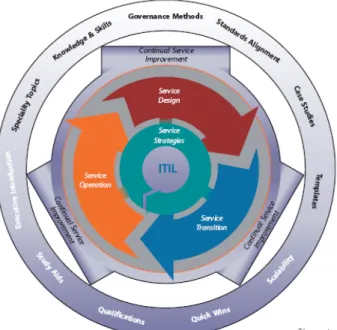
The current IT Infrastructure Library (ITIL), version 2, was released in 2000. It is a process-based practice of 10 books and the globally accepted best practice framework for ITSMF (IT Service Management Forum). With the expected 2007 ITIL Version 3, ITIL Version 3 becomes a service lifecycle-based practice incorporating the best of V1 and V2 and tested current best practice. Five lifecycle titles will form the core of ITIL practice, instead of Version’s 2 two core books, Service Delivery and Service Support [25, 25a, 25b, 25c]:
Service Strategy Service Design Service Transition Service Operation