USER GUIDE
For Research Use Only. Not for human or animal therapeutic or
Path-ID™ Multiplex One-Step RT-PCR Kit
TaqMan
®
probe-based multiplex one-step real-time RT-PCR
detection of RNA targets
Catalog Numbers 4428206, 4428207, 4440022
Publication Part Number 4440907 Rev. C Revision Date May 2012
For Research Use Only. Not for human or animal therapeutic or diagnostic use. COPYRIGHT
The information in this guide is subject to change without notice.
DISCLAIMERS
LIFE TECHNOLOGIES CORPORATION AND/OR ITS AFFILIATE(S) DISCLAIM ALL WARRANTIES WITH RESPECT TO THIS DOCUMENT, EXPRESSED OR IMPLIED, INCLUDING BUT NOT LIMITED TO THOSE OF MERCHANTABILITY, FITNESS FOR A PARTICULAR PURPOSE, OR NON-INFRINGEMENT. TO THE EXTENT ALLOWED BY LAW, IN NO EVENT SHALL LIFE TECHNOLOGIES AND/OR ITS AFFILIATE(S) BE LIABLE, WHETHER IN CONTRACT, TORT, WARRANTY, OR UNDER ANY STATUTE OR ON ANY OTHER BASIS FOR SPECIAL, INCIDENTAL, INDIRECT, PUNITIVE, MULTIPLE OR CONSEQUENTIAL DAMAGES IN CONNECTION WITH OR ARISING FROM THIS DOCUMENT, INCLUDING BUT NOT LIMITED TO THE USE THEREOF.
TRADEMARKS
The trademarks mentioned herein are the property of Life Technologies Corporation and/or their affiliates or their respective owners. TaqMan® and AmpliTaq Gold® are registered trademarks of Roche Molecular Systems, Inc., used under permission and license.
Limited Use Label License: Research Use Only
The purchase of this product conveys to the purchaser the limited, non-transferable right to use the product only to perform internal research for the sole benefit of the purchaser. No right to resell this product or any of its components is conveyed expressly, by implication, or by estoppel. This product is for internal research purposes only and is not for use in commercial applications of any kind, including, without limitation, quality control and commercial services such as reporting the results of purchaser’s activities for a fee or other form of consideration. For information on obtaining additional rights, please contact [email protected].
Contents
Chapter
Path-ID™ Multiplex One-Step RT-PCR Kit . . . 5
Product information . . . 5
Materials and equipment required . . . 7
Procedure . . . 9
Troubleshooting . . . 10
Appendix
Safety . . . 11
Chemical safety . . . 12
Chemical alerts . . . 12
Documentation and Support . . . 13
Obtaining SDSs . . . 13
Obtaining Certificates of Analysis . . . 13
Obtaining support . . . . 13
4 Path-ID™ Multiplex One-Step RT-PCR Kit Protocol
Protocol
Path-ID™ Multiplex One-Step RT-PCR Kit
Product information
IMPORTANT! Before using this product, read and understand the information in the “Safety” appendix in this document.
Purpose of the product The Path-ID™ Multiplex One-Step RT-PCR Kit is designed for multiplex, quantitative, reverse transcription PCR (qRT-PCR). It is optimized for the amplification of up to four targets simultaneously using your RNA samples and TaqMan® primer/probe sets. Reactions are run using a single-tube, one-step
procedure to reverse-transcribe the RNA and amplify your targets. The kit contains a Multiplex Enzyme Mix with ArrayScript™ reverse transcriptase and
AmpliTaq Gold® DNA Polymerase, and a buffer mix. Reactions are run and detected in a thermal cycler capable of real-time detection of amplification products to yield quantitative data.
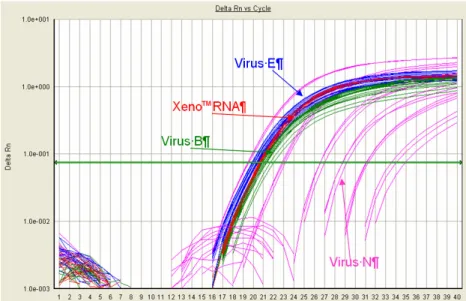
Figure 1 shows amplification plots from reactions that included four targets using the Path-ID™ Multiplex One-Step RT-PCR Kit. Three of the targets in the
experiment were held constant, but the fourth was serially diluted to show the dynamic range of multiplex target detection with the kit.
Figure 1 Four-plex amplification of control RNAs using the Path-ID™
6 Path-ID™ Multiplex One-Step RT-PCR Kit Protocol
Path-ID™ Multiplex One-Step RT-PCR Kit
Product information
Xeno™ RNA Control and control RNAs for virus B, virus E, and virus N were
amplified in a multiplex RT-PCR using the Path-ID™ Multiplex One-Step RT-PCR
Kit on an Applied Biosystems® 7500 Real-Time PCR System. This experiment
included a sample set with fixed amounts of three of the targets and a serial dilution series of the virus N control RNA. Note that virus N was detected even in four-plex reactions containing only 400 copies (~33 CT).
Kit contents
Storage • Store the kit at 10°C to 30°C in a non-frost-free freezer.
• You can store the Nuclease-free Water at 10°C to 30°C, 2°C to 8°C, or at room temperature.
Component Cat. no. 4428206
100 reactions
Cat. no. 4428207 500 reactions
Cat. no. 4440022 1000 reactions
Multiplex RT-PCR Buffer 1.375 mL 7 mL 14 mL Multiplex Enzyme Mix 280 L 1.4 mL 2 × 1.4 mL Nuclease-free Water 1.75 mL 25 mL 25 mL
Path-ID™ Multiplex One-Step RT-PCR Kit
Materials and equipment required
Materials and equipment required
RNA sample(s) It is important to use pure RNA that is free of RT-PCR inhibitors in the procedure. We recommend the MagMAX™ RNA Isolation Kit appropriate for your sample type; go to www.lifetechnologies.com, then search for MagMAX.
When isolating viral RNA from cell-free sample sources such as serum, use MagMAX™ Viral RNA Isolation Kits, which include carrier RNA to maximize
viral RNA recovery.
PCR primer/TaqMan® probe mixture
You can use any licensed PCR primer/TaqMan® probe mixture compatible with
your real-time PCR instrument and designed for one-step RT-PCR with the kit. Optimization of PCR primer and probe concentrations is critical for multiplex reactions. In reactions with targets of different abundance, it is necessary to limit the PCR primer concentrations of highly abundant targets so that less abundant targets can effectively compete for the amplification reagents. The concentration of primers and probes may require optimization, but the concentrations shown in the following table typically work well.
Note: The Reverse Transcriptase enzyme contained in this kit is produced using an E. coli expression vector containing a proprietary version of the MMLV pol gene (GenBank accession no. J02255) expressed from pET-24(+). It is possible that a minimal amount of the expression vector could be carried over into the final mastermix formulation. If you are targeting MMLV, a related virus, or any of the plasmid sequence, we recommend designing primer sequences not contained in the expression vector.
Real-time PCR systems and accessories
The Path-ID™ Multiplex One-Step RT-PCR Kit is compatible with the following
Applied ® systems:
• 7500 Real-Time PCR System • 7500 Fast Real-Time PCR System
• 7900HT Real-Time PCR System (96-well and 384-well sample block) • 7900HT Fast Real-Time PCR System (96-well and 384-well sample block) • StepOne™ Real-Time PCR System
• StepOnePlus™ Real-Time PCR System
You need the following accessories:
Component Final concentration in
the reaction
25✕primer/probe mix‡
‡ Use 1 µL per 25-µL RT-PCR of a PCR primer/TaqMan® probe mixture prepared at these
concentrations.
Forward PCR primer 400 nM 10 M Reverse PCR primer 400 nM 10 M TaqMan® probe 120 nM 3 M
8 Path-ID™ Multiplex One-Step RT-PCR Kit Protocol
Path-ID™ Multiplex One-Step RT-PCR Kit
Materials and equipment required
• Reaction plates and covers appropriate for your real-time PCR system. See the Plastic Consumables Compatibility Chart: go to
www.lifetechnologies.com, then select Products and ServicesReal-Time PCRPCR tubes, Plates & Accessories.
• Nuclease-free pipettes and tips.
Path-ID™ Multiplex One-Step RT-PCR Kit
Procedure
Procedure
For the following hazards, see the complete safety alert descriptions in “Chemical safety” on page 12.
CAUTION! CHEMICAL HAZARD. Multiplex RT-PCR Buffer.
CAUTION! CHEMICAL HAZARD. Multiplex Enzyme Mix.
Program the real-time PCR instrument
Use the thermal cycling conditions shown in the following table.
• ROX™ passive reference dye is included in the Multiplex RT-PCR Buffer.
• For real-time PCR instruments capable of Fast thermal cycling, set the mode to Standard.
• The suggested reaction volume is 25L.
Prepare the reactions 1. Prepare the RT-PCR master mix(es) on ice (see the required volumes in the following table):
• Prepare 5–10% extra master mix.
• Include duplicate no template controls (NTCs or negative controls) using Nuclease-free Water in place of sample.
2. Add the RT-PCR master mix to a reaction plate or tubes. 3. Add sample to each reaction.
Perform thermal cycling and analyze the data
Follow the instructions for your real-time PCR instrument for multiplex reactions.
Step Stage Reps Temp Time
Reverse transcription 1 1 48°C 10 min RT inactivation/
initial denaturation
2 1 95°C 10 min Amplification 3 40 95°C 15 sec 60°C 45 sec‡
‡ For long targets, the extension time may need to be >45 seconds.
Component Volume (L)
RT-PCR master mix
Multiplex RT-PCR Buffer 12.5 Forward and reverse PCR primers __ TaqMan® probes __
Multiplex Enzyme Mix 2.5 RNA sample (Nuclease-free Water for NTCs) __ Total volume per reaction 25.0
10 Path-ID™ Multiplex One-Step RT-PCR Kit Protocol
Path-ID™ Multiplex One-Step RT-PCR Kit
Troubleshooting
Troubleshooting
Observation Possible Cause Solution
No signal from samples expected to be positive
RNA sample contains PCR inhibitors
• Use less starting sample as input for your RNA isolation procedure.
• Increase the number or stringency of washes during RNA isolation.
• Use less RNA sample in the qRT-PCR. See the solution to “Low signal from samples expected to be positive”.
Low signal from samples expected to be positive
RNA sample contains low level of PCR inhibitors
Samples containing minimal amounts of inhibitors may yield successful qRT-PCR reactions if less RNA sample (and therefore less inhibitor) is added to the reaction. For example:
• Reduce the sample volume to 1 to 2L, then add Nuclease-free Water to bring the reaction to the proper volume.
-Or-• Dilute the RNA sample 1:10 using the solution used to elute the nucleic acid at the end of the nucleic acid isolation procedure, then use the diluted RNA in the qRT-PCR reaction.
-Or-• Dilute the RNA sample 1:10 using 10 mM Tris-HCl pH 8, 0.1 mM EDTA, then use the diluted RNA in the qRT-PCR reaction.
Signal detected in no template control (NTC)
PCR contamination • Repeat the qRT-PCR reaction with fresh reagents and decontaminated pipettors.
• Set up and run the qRT-PCR reaction in an area that is isolated from areas used for nucleic acid isolation and PCR product analysis.
Note: The Reverse Transcriptase enzyme contained in this kit is produced using an E. coli expression vector containing a proprietary version of the MMLV pol gene (GenBank accession no. J02255) expressed from pET-24(+). It is possible that a minimal amount of the expression vector could be carried over into the final mastermix formulation. If you are targeting MMLV, a related virus, or any of the plasmid sequence, we recommend designing primer sequences not contained in the expression vector.
APPENDIX
Safety
WARNING! GENERAL SAFETY. Using this product in a manner not specified in the user documentation may result in personal injury or damage to the instrument or device. Ensure that anyone using this product has received instructions in general safety practices for laboratories and the safety information provided in this document.
• Before using an instrument or device, read and understand the safety information provided in the user documentation provided by the manufacturer of the instrument or device.
• Before handling chemicals, read and understand all applicable Safety Data Sheets (SDSs) and use appropriate personal protective equipment (gloves, gowns, eye protection, etc). To obtain SDSs, see the “Documentation and Support” section in this document.
12 Path-ID™ Multiplex One-Step RT-PCR Kit Protocol
Appendix Safety
Chemical safety
Chemical safety
WARNING! GENERAL CHEMICAL HANDLING. To minimize hazards, ensure laboratory personnel read and practice the general safety guidelines for chemical usage, storage, and waste provided below, and consult the relevant SDS for specific precautions and instructions:
• Read and understand the Safety Data Sheets (SDSs) provided by the chemical manufacturer before you store, handle, or work with any chemicals or hazardous materials. To obtain SDSs, see the “Documentation and Support” section in this document.
• Minimize contact with chemicals. Wear appropriate personal protective equipment when handling chemicals (for example, safety glasses, gloves, or protective clothing).
• Minimize the inhalation of chemicals. Do not leave chemical containers open. Use only with adequate ventilation (for example, fume hood).
• Check regularly for chemical leaks or spills. If a leak or spill occurs, follow the manufacturer's cleanup procedures as recommended in the SDS.
• Handle chemical wastes in a fume hood.
• Ensure use of primary and secondary waste containers. (A primary waste container holds the immediate waste. A secondary container contains spills or leaks from the primary container. Both containers must be compatible with the waste material and meet federal, state, and local requirements for container storage.)
• After emptying a waste container, seal it with the cap provided.
• Characterize (by analysis if necessary) the waste generated by the particular applications, reagents, and substrates used in your laboratory.
• Ensure that the waste is stored, transferred, transported, and disposed of according to all local, state/provincial, and/or national regulations.
• IMPORTANT! Radioactive or biohazardous materials may require special handling, and disposal limitations may apply
Chemical alerts
Specific
chemical alerts
CAUTION! CHEMICAL HAZARD. Multiplex RT-PCR Buffer may cause eye, skin, and respiratory tract irritation. Read the MSDS, and follow the handling instructions. Wear appropriate protective eyewear, clothing, and gloves.
CAUTION! CHEMICAL HAZARD. Multiplex Enzyme Mix may cause eye, skin, and respiratory tract irritation. Read the MSDS, and follow the handling instructions. Wear appropriate protective eyewear, clothing, and gloves.
Documentation and Support
Obtaining SDSs
Safety Data Sheets (SDSs) are available from www.lifetechnologies.com/support
Note: For the SDSs of chemicals not distributed by Life Technologies Corporation, contact the chemical manufacturer.
Obtaining Certificates of Analysis
The Certificate of Analysis provides detailed quality control and product qualification
information for each product. Certificates of Analysis are available on our website. Go
to www.lifetechnologies.com/support and search for the Certificate of Analysis by
product lot number, which is printed on the box.
Obtaining support
For the latest services and support information for all locations, go to:
www.lifetechnologies.com/support
At the website, you can:
• Access worldwide telephone and fax numbers to contact Technical Support and Sales facilities
• Search through frequently asked questions (FAQs) • Submit a question directly to Technical Support
• Search for user documents, SDSs, vector maps and sequences, application notes, formulations, handbooks, certificates of analysis, citations, and other product support documents
• Obtain information about customer training • Download software updates and patches
Limited Product Warranty
Life Technologies Corporation and/or its affiliate(s) warrant their products as set forth in the Life Technologies' General Terms and Conditions of Sale found on Life Technologies Corporations’ website at www.lifetechnologies.com/termsandconditions. If you have any questions, please contact Life Technologies Corporation at www.lifetechnologies.com/ support.
14 Path-ID™ Multiplex One-Step RT-PCR Kit Protocol
Documentation and Support
Headquarters
5791 Van Allen Way | Carlsbad, CA 92008 USA | Phone +1 760 603 7200 | Toll Free in USA 800 955 6288
For support visit www.lifetechnologies.com/support or email [email protected] www.lifetechnologies.com