Title: Problem gambling and the five-factor model of personality: A large population-based
study.
Authors: Geir Scott Brunborg1,2,Daniel Hanss1,3,Rune Aune Mentzoni1, 5,Helge Molde4, &
Ståle Pallesen1
Affiliations:
1Department of Psychosocial Science, University of Bergen, Norway
2Department of Alcohol, Drug and Tobacco Research, Norwegian Institute of Public Health,
Norway
3Fachbereich Gesellschaftswissenschaften und Soziale Arbeit, Hochschule Darmstadt
University of Applied Sciences, Germany
4Department of Clinical Psychology, University of Bergen, Norway
5KoRus-Øst, Innlandet Hospital Trust, Norway
Corresponding author: Geir Scott Brunborg
Address: Department of Psychosocial Science, University of Bergen, PO. Box. 7807, 5020
Bergen, Norway
Email: [email protected]
Tel. +4741104842
Running head: Personality and gambling problems
Word count: 3493
Abstract
Aims
Knowledge of the personality characteristics of individuals who develop gambling problems
is important for designing targeted prevention efforts. Previous studies of the relationship
between the five-factor model of personality and gambling problems were based on small
samples not representative of the general population. We estimated differences in
Neuroticism, Extroversion, Intellect, Agreeableness and Conscientiousness between
non-problem gamblers and individuals with low, moderate and severe gambling non-problems.
Design: Cross-sectional survey
Setting: Norway
Participants: 10 081 (51.5% female) individuals aged 16 to 74 years (mean age 46.5 years).
Measures: The Problem Gambling Severity Index, The Mini-International Personality Item
Pool, and demographic variables. Differences between groups of gamblers were analyzed by
ordinary least squares regression models separately for each personality trait adjusting for
gender, age, cohabitation, level of education and work status.
Results
Gamblers with low level, moderate level and severe level of problems differed significantly
from non-problem gamblers in Neuroticism (b = 0.16, 0.34 and 0.66 respectively, all p < .001) and Conscientiousness (b = -0.13, -0.27, and -0.44 respectively, all p < .001). Moderate and severe problem gamblers differed from non-problem gamblers in Agreeableness (b = -0.21, p < .001 and b = -0.20, p = .028 respectively). In addition, gambling problems were
much more prevalent among men than women, and more prevalent among those who live
alone, individuals without tertiary education, and among those who are unemployed or on
disability pension.
Conclusions
Higher level of problem gambling severity appears to be associated with higher scores on
Problem gambling involves persistent and maladaptive gambling behavior, and it is
included in the DSM 5 as Gambling Disorder (1). The prevalence of problem gambling varies
with geographical location, type of population and with assessment method. Problem
gambling is associated with particular game characteristics (2, 3), and it is more prevalent in
places where more such games are available (4, 5). For one commonly used instrument for
assessment of gambling problems, the Problem Gambling Severity Index (PGSI) (6), Stucki
and Rihs-Middel (7) reported that the weighted mean prevalence rate in the World was 2.4%
for moderate problems, and 0.8% for severe problems (also known as problem gambling and
pathological gambling). Knowledge of risk-factors for development of gambling problems is
vital for targeted prevention. If some groups of individuals are at greater risk, it may be
efficient to aim prevention efforts (e.g. school programs, media campaigns and legislation)
specifically at such groups. Research has shown that problem gambling is more common
among men than women, among young people, and among individuals with lower
socio-economic status (8-15). With such knowledge, prevention efforts may be targeted for instance
at young males from low socio-economic areas, and targeted prevention may be more
effective than prevention efforts targeting the whole population (16).
Problem gambling is also associated with individual factors such as cognitive
distortions (17), reinforcement sensitivity and learning (18-20), and motivational factors such
as intentions, attitudes and knowledge (21). Several theories suggest that individuals high in
Neuroticism (negative emotionality and emotional instability) and with low
Conscientiousness (being reliable and organized) have greater risk of developing gambling
problems (4, 22). If this is the case, there are clear implications for prevention and treatment.
Preventive efforts can be targeted especially at individuals with high Neuroticism and low
Conscientiousness. Also, interventions aiming at modifying these personality traits may alter
from focusing on underlying dispositions in treatment of problem gamblers. However, studies
that use large samples representative of the general population are needed to reveal the
relationship between personality factors and gambling problems, which is the main
contribution of the current study.
Several small scale studies have investigated the role of the factors included in the
five-factor model of personality (also known as the Big 5), which is probably the most studied
framework for describing personality (but see (23, 24) for criticism of the model). According
to the model, personality can be described as consisting of five domains: Neuroticism
(emotional instability), Extroversion (sociability and assertiveness), Intellect (openness and
imagination), Agreeableness (being warm, kind and trusting), and Conscientiousness (being
reliable and organized) (25). The most consistent finding has been elevated scores on
Neuroticism and lower scores on Conscientiousness in pathological gamblers (severe problem
gamblers who may need treatment for gambling disorder) compared to non-problem gamblers
(26-28). Neuroticism may be linked to gambling problems in that individuals who frequently
experience negative emotions gamble in order to alter their mood and to escape from negative
emotions (4, 22, 29). Conscientiousness is assumed to be linked to gambling problems
because individuals low in Conscientiousness may have difficulties resisting urges, especially
during positive or negative mood states (30).
The relationships between Intellect, Agreeableness and gambling problems have
shown less consistent results. Two studies have reported low Intellect in individuals with
gambling problems (28, 31), while other studies have not (26, 27, 32). Also, two studies have
reported a relationship between low Agreeableness and gambling problems (31, 32), while
other studies have not (26-28). None of these studies reported a relationship between
Extroversion and gambling problems. Studies have also investigated the personality traits
Multidimensional Personality Questionnaire (33). Negative emotionality has been found to
correlate positively with degree of gambling problems (31). In addition, one study found that
high scores on Negative emotionality and low scores on Constraint at age 18 years was
associated with problem gambling at age 21 years (34). This is relevant for the current
investigation as Negative emotionality has been found to be strongly related to Neuroticism,
while Constraint is moderately related to Conscientiousness (35).
An important question is whether certain personality predispositions increase the risk
of developing gambling problems, or if a reversed causal direction is present. A meta-analysis
of test-retest correlations of personality traits over the life course found that personality traits
were quite stable in adolescence and early adulthood, and became even more stable in mid-
and late adulthood (36). A recent study also found strong consistency in personality type
(combination of several traits) membership over four years (37). This supports the idea of a
causal relationship where Neuroticism and Conscientiousness, and possibly other personality
factors, make people vulnerable to developing gambling problems. Still, research has shown
that personality traits can change over time due to negative life events (38). Therefore, it is
possible that experiencing gambling problems can lead to, for instance, increased Neuroticism
and decreased Agreeableness.
All previous studies of the relationship between the five personality traits and
gambling problems have been based on small samples. Large samples are needed to reduce
statistical uncertainty, especially for low prevalence phenomena such as severe problem
gambling. Comparing individuals who are in treatment with a control group probably inflates
the difference in personality between the two groups. Hence, the results cannot be generalized
to problem gamblers who are not in treatment, gamblers with sub-clinical gambling problems,
or to non-problem gamblers in general. Including individuals with low and moderate level of
between personality and gambling problems. Against this backdrop, we used data from a
large-scale study (N > 10 000) to estimate the relationship between problem gambling status and the five personality factors (Neuroticism, Extroversion, Intellect, Agreeableness and
Conscientiousness). Based on previous studies, we hypothesized that higher level of gambling
problems would be associated with higher scores on Neuroticism and lower scores on
Conscientiousness. We also explored whether level of gambling problems would beassociated
with increased or decreased levels of Extroversion, Intellect and Agreeableness. As both
personality and gambling problems may be dependent on demographic factors, we controlled
for possible confounding by including gender, age, cohabitation, level of education and work
status in the analyses.
Methods Data
The data was collected for a project concerning gambling in the general adult
population of Norway (39). A random sample of 24 000 residents aged 16 to 74 years was
drawn from the Norwegian Population Registry. A large sample was needed to reduce
statistical uncertainty, especially for low prevalence phenomena such as severe problem
gambling. An information letter and a questionnaire were sent out by postal mail in August of
2013. The questionnaire consisted of five pages with a maximum of 105 question-items (some
respondents could skip some questions) and took ten to fifteen minutes to complete.
Respondents could choose between completing a paper and pencil questionnaire and a
questionnaire online (a subsample of 4 000 were only offered a paper and pencil
questionnaire). As an incentive to complete the questionnaire, 200 gift cards each with a value
of 500 NOK (about € 50) were drawn among those who completed the survey. One or two
first or second month, respectively. The gross sample was reduced to 23 124 individuals
because of wrong addresses, death or inability to answer due to sickness and disabilities.
Completed questionnaires were received by 10 081 persons. Hence, the response rate was
43.6%. The Regional Committees for Medical and Health Research Ethics in Western
Norway approved the study (no. 2013/120).
Measures
The Problem Gambling Severity Index (PGSI). The PGSI (6) consists of nine items
that are used to assess problem gambling. It was designed for general population studies, and
can be used to categorize individuals into several problem gambling categories. Studies have
shown that the measure has high internal consistency and test-retest reliability, it has a high
degree of overlap with other problem gambling measures, it is correlated with measures of
gambling frequency and faulty gambling-related cognitions, and its factor structure is
invariant across gender, age groups, income groups and gamblers with different game
preferences (6, 40, 41). The Norwegian translation of the PGSI used in the current study has
not been subject to such validation study. Example items are “In the last 12 months…”
“…have you bet more than you could really afford to lose?”, “…have you felt that you might
have a problem with gambling?”, and “…has your gambling caused any financial problems
for you or your household”. Respondents indicate agreement on a scale ranging from “never”
(coded 0) to “always” (coded 3). Internal consistency (Cronbach’s alpha) for the items was
.90. The responses are usually summarized to an index that ranges from 0 to 27. Respondents
with a score of zero were categorized as “non-problem gamblers”, those with a score of 1 to 2
were categorized as “low level of problems”, those with a score of 3 to 7 were categorized as
“moderate problems”, whereas those with scores 8 and above were categorized as “severe
instructed to complete the PGSI. Those who had not gambled in the last 12 months were
included in the non-problem gamblers category.
Mini-International Personality Item Pool (MINI-IPIP). The MINI-IPIP (42) measures
the five-factor model of personality (Neuroticism, Extroversion, Intellect, Agreeableness and
Conscientiousness) and consists of 20 questions, for example “I have frequent mood swings”
(N) “I am the life of the party” (E), “I have a vivid imagination”(I), “I sympathize with other’s
feelings” (A), and “I get chores done right away” (C). The measure is suitable for
epidemiological studies as it is fairly short, but still long enough to get an appropriate number
of indicators for each factor. Responses are made on a scale ranging from “very inaccurate”
(coded 1) to “very accurate” (coded 5). There are four items for each sub-scale. Internal
consistencies (Cronbach’s alpha) for the five sub-scales in the current study were Neuroticism
= 0.67; Extroversion = 0.78; Intellect = 0.67; Agreeableness = 0.71; and Conscientiousness =
0.67.
Demographic variables
Respondents indicated their gender (coded 0 = female, 1 = male), age in years, and
whether they were cohabiting/married versus single/separated/divorced/widowed (coded 0 =
cohabiting, 1 = not cohabiting). They also indicated their level of education as “not completed
elementary school”, “elementary school”, “high school”, “occupational education”,
“college/university up to 4 years”, “college/university 5 to 6 years” and “phd/doctoral
degree”. The responses were dichotomized into 1 = tertiary education (“college/university up
to 4 years”, “college/university 5 to 6 years” and “phd/doctoral degree”), and less than tertiary
education = 0. Respondents also indicated whether they worked full time (coded 1) or part
time (coded 2), were students (coded 3), worked at home/retired (coded 4), or were
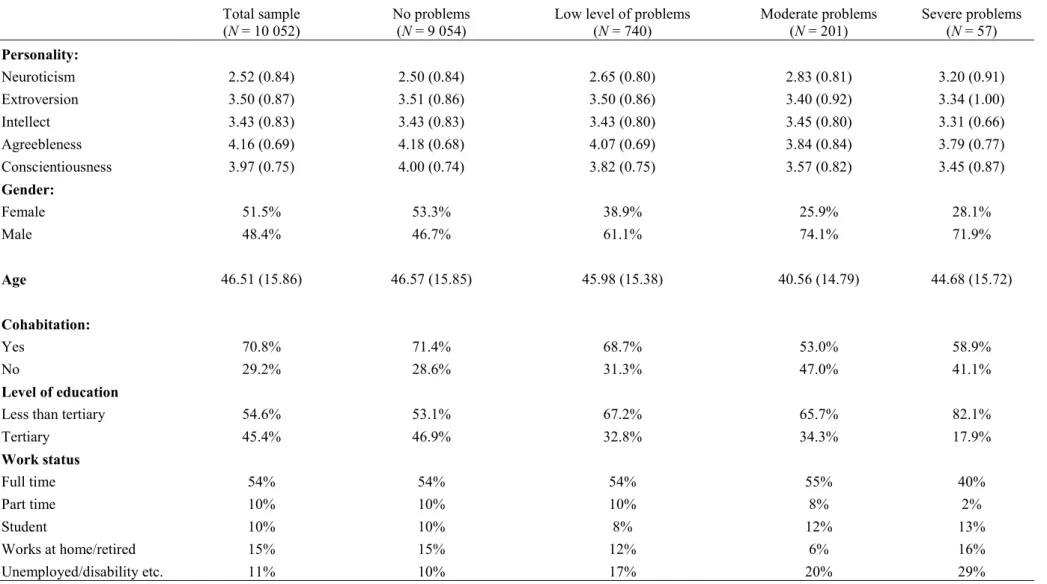
Descriptive statistics for the study variables are shown in Table 1.
Analysis
Separate ordinary least squares regression models were computed to assess the
differences in each of the five personality factors between the PGSI categories (low level of
problems, moderate problems and severe problems), and the “non-problem” category serving
as the reference group. Gender, age, cohabitation, level of education, and work status were
also included to adjust the estimates for possible confounding. Age in ten-year increments
was entered as a continuous variable, work status was included as a categorical variable with
full time work as the reference category, and gender, cohabitation, and level of education
were entered as dichotomous variables.
To estimate the prevalence of problem gambling in the Norwegian population, inverse
probability weights were used in order to adjust for selection bias caused by differences in
response rates between different gender and age groups. The distribution of the Norwegian
population in five-year age groups for both genders, and the 19 Norwegian counties was
obtained from Statistics Norway. The sample was weighted in order to match the gender, age
and county distribution of the Norwegian population. Weights were not used in the regression
analysis.
Results
Prevalence of gambling problems using the PGSI categories
The number of respondents in each problem gambling category is shown in Table 1.
After applying inverse probability weights, the prevalence in the Norwegian adult population
2.6) for moderate problems and 0.6% (95% CI: 0.5, 0.8) for severe problems. Descriptive
statistics for these three groups are also shown in Table 1. Men were overrepresented in all
three problem gambler categories. On average, gamblers with moderate problems were about
five years younger than the non-problem gamblers, but gamblers with low level of problems
and severe problems were about the same age on average as the non-problem gamblers. A
higher proportion of gamblers with moderate or severe problems lived alone compared to the
non-problem gamblers. Also, the proportions with tertiary level of education were smaller in
all the problem gambling groups. Finally, the unemployment/disability-rate increased with
greater gambling problems.
Personality traits associated with gambling problems
The estimates from the regression models are shown in Table 2. In the adjusted model,
level of Neuroticism was higher with increased severity of gambling problems. Level of
Extroversion and Intellect were only weakly, and not statistically significantly, related to
gambling problem status. Level of Agreeableness was lower in the moderate and severe
problems categories compared to the non-problem gamblers, but the low level of problems
category was only negligibly different from non-problem gamblers. Conscientiousness was
lower with greater problem gambling severity. The relationship between personality trait and
gambling problems was stronger for Neuroticism than for Conscientiousness, and smaller yet
for Agreeableness.
Compared to women, men scored lower on Neuroticism, Extroversion, Agreeableness
and Conscientiousness, but slightly higher on Intellect. Older age was associated with lower
scores on Neuroticism, Extroversion, Intellect and Conscientiousness, however age was not
significantly associated with Agreeableness. Living alone was associated with slightly lower
level of education was associated with slightly lower Neuroticism scores, and with higher
scores on Extroversion, Intellect and Agreeableness. The differences between students and
those who worked full time were quite small. Full time workers scored lower on Neuroticism
and higher on Conscientiousness compared to the other work status groups.
Discussion
As proposed in theoretical work (4, 22), we found that problem gambling was
associated with higher scores on Neuroticism and lower scores on Conscientiousness. This is
consistent with findings from previous smaller scale studies (26-28, 31, 32). It has been
suggested that some people gamble in order to relieve emotional problems (4, 29), and
problem gambling probably also causes emotional problems, especially in emotionally
vulnerable people. Conscientiousness involves the ability to resist urges and impulses (25). It
is therefore not surprising that low Conscientiousness is associated with gambling problems.
A large population-based sample reduces selection bias and decreases statistical uncertainty,
therefore, the current study provides an important contribution to the field. Our results
showed that the strength of the associations, for both Neuroticism and Conscientiousness,
increased with greater problem severity, which to our knowledge has not been reported
previously. This is an important contribution as a dose-response relationship is an important
indicator of association between variables (43).
Our study is also important because the results indicate that gambling problems are
associated with lower level of Agreeableness, which has previously only been found in two
studies (31, 32). Problem gambling has been linked to psychopathy and criminal behavior,
which suggests that less agreeable persons may be drawn to gambling and develop gambling
with high scores on Agreeableness normally are motivated to avoid, hence high score on
Agreeableness may as such be a protective factor for development of addictions (45).
An important implication of our study is that it may be more effective to target
prevention efforts at individuals with high scores on Neuroticism and low scores on
Conscientiousness and Agreeableness rather than at the whole population. For instance,
personality screening of young people may help to identify whom may benefit from learning
effective coping skills. Designing effective targeted prevention for gambling problems should
be a focus for future research. Although some have proved effective for tobacco-, alcohol-
and substance use (46), more work is needed to design effective targeted prevention for
gambling problems (47). Since the personality profiles associated with development of
gambling problems are similar to those associated with development of tobacco-, alcohol- and
substance use (34), a focus on gambling problems may be included with targeted efforts to
prevent tobacco- and substance use (47). Also, treatment professionals may benefit from
knowing that problem gamblers are likely to differ from the average person in terms of
personality. Better clinical results may be achieved by focusing on the underlying personality
dispositions, for instance by attempting to reduce negative emotions and increase
conscientiousness.
In our study, the estimated prevalence was 7.6% for low level of problems, 2.3% for
moderate problems and 0.6% for severe problems. This is lower than previous Norwegian
prevalence studies, suggesting a downward trend in gambling problems in Norway, probably
due to more strict regulations (see (48) for an overview of gambling regulations in Norway
and previous prevalence estimates). Our study indicates that the prevalence of problem
Gambling problems at all levels were much higher for men compared to women.
Young age, living alone, low level of education and unemployment was also associated with
higher prevalence of gambling problems. This is in line with previous findings (8-15), and is
important knowledge that can be used in targeting prevention efforts at high risk groups, and
for designing treatment programs and protocols.
Limitations and suggestions for future research
Since the study was cross sectional, causal claims based on the results should be made
carefully. A relationship in which personality is a cause of gambling problems is theoretically
plausible because personality appears to be quite stable over time (37). However, since
personality may change as a result of negative life events (38), it is also possible that
gambling problems can cause high neuroticism and low conscientiousness and agreeableness.
A transactional relationship is also conceivable where personality causes gambling problems,
which in turn modulates personality. Experimental studies that manipulate the personality of
individuals or that induce gambling problems are both unpractical and unethical. Longitudinal
studies of personality and gambling problems would be a welcome addition to the field, as
they permit investigation of directionality. Such studies could also investigate if the
longitudinal associations are different for different types of gambling. Future studies should
investigate if sub-groups of gamblers (e.g. treatment seeking vs. not treatment seeking,
gamblers with vs. without comorbidity) differ in terms of personality traits. It would also be
of interest in future studies to investigate whether personality traits consistently predict
different types of addictions, or if such associations are more specific.
Criticism against the five-factor model of personality has been raised (23, 24). Some
argue for the existence of a General Factor of Personality reflecting a mix of different traits
this trait relates to gambling behavior. We did not consider the role of mental health and
substance use in the current study because such information was not collected. It would be
interesting to investigate whether substance use and mental health may moderate or mediate
the relationship between personality and gambling.
Considering the problem with decreasing response rates in surveys, the response rate
of 43.6% obtained in the current study could be regarded as acceptable (50). Reasons for
non-response are difficult to ascertain, but lack of time, lack of interest in the survey topic, and
difficulties in reaching certain groups (e.g. young people, individuals with no fixed address,
those who work off-shore) are good candidates. It may also be the case that individuals with
gambling problems do not wish to take part in, or will conceal their problems in a population
survey (51). This would have led to deflated estimates of problem gambling in the current
study. To reduce the effect of different response rates in different gender and age groups, we
used inverse probability weights for the prevalence estimation. The Norwegian translation of
the PGSI has not been subject to validation studies, therefore such studies would be an asset
to researchers who analyze Norwegian data. Moreover, the PGSI has received criticism,
especially regarding lack of validity for the low-risk and moderate risk categories (52).
We used the MINI-IPIP, a short version of the International Personality Item Pool (53)
to measure the five personality factors. Abbreviated scales are associated with weaker
psychometric properties (54), which is reflected in the relatively low Cronbach’s alpha for
some of the factors. Hence our estimates may have been affected by measurement error, and
should thus be replicated in studies that use the unabbreviated version.
Conclusion
This large population-based study found that gambling problems were associated with
addition, gambling problems were much more prevalent among men than women, and more
prevalent among those who live alone, those with low level of education and those who are
unemployed or on disability pension. Knowledge of such individual characteristics is
References
1. American Psychiatric Association. Diagnostic and statistical manual of mental disorders. 5th ed. Washinton, DC: Author; 2013.
2. Mentzoni RA, Laberg JC, Brunborg GS, Molde H, Pallesen S. Tempo in electronic gaming machines affects behavior among at-risk gamblers. Journal of Behavioral Addictions. 2012;1:135-9. 3. Mentzoni RA, Laberg JC, Brunborg GS, Molde H, Pallesen S. Type of soundtrack affects behavoir in gambling. Journal of Behavioral Addictions. 2014;3:102-6.
4. Blaszczynski A, Nower L. A pathways model of problem and pathological gambling. Addiction. 2002;97:487-99.
5. Schüll ND. Addiction by design: Machine gambling in Las Vegas: Princeton University Press; 2012.
6. Ferris J, Wynne H. The canadian problem gambling index: Final report. Ottawa, ON: Canadian Centre on Substance Abuse, 2001.
7. Stucki S, Rihs-Middel M. Prevalence of adult problem and pathological gambling between 2000 and 2005: An update. Journal of Gambling Studies. 2007;23:245-57.
8. Afifi TO, Cox BJ, Martens PJ, Sareen J, Enns MW. Demographic and social variables associated with problem gambling among men and women in Canada. Psychiatry Research. 2010;178:395-400. 9. Bondolfi G, Osiek C, Ferrero F. Prevalence estimates of pathological gambling in Switzerland. Acta Psychiatrica Scandinavica. 2000;101:473-5.
10. Volberg RA, Abbott MW, Rönneberg S, Munch IME. Prevalence and risks of pathological gambling in Sweden. Acta Psychiatrica Scandinavica. 2001;104:250-6.
11. Johansson A, Grant JE, Kim SW, Odlaug BL, Götestam KG. Risk factors for problematic gambling: A critical literature review. Journal of Gambling Studies. 2009;25:67-92.
12. Kessler RC, Hwang I, LaBrie RA, Petukhova M, Sampson N, Winters KC, et al. DSM-IV pathological gambling in the National Commorbidity Survey Replication. 2008;38:351-60.
13. Toneatto T, Nguyen L. Individual characteristics and problem gambling behavior. In: Smitth G, Hodgins DC, Williams RJ, editors. Research and measurement issues in gambling studies. San Diego, CA: Academic Press; 2007.
14. Blanco C, Hasin DS, Petry N, Stinson FS, Grant BF. Sex differences in subclinical and DSM-IV pathological gambling: Results from the National Epidemiologic Survey on Alcohol and RElated Conditions. Psychological Medicine. 2006;36:943-53.
15. Welte J, Barnes G, Tidwell M, Hoffmanm J. The prevalence of problem gambling among U.S. adolescents and young adults: Results from a national survey. Journal of Gambling Studies.
2008;24:199-233.
16. Gottfredson DC, Wilson DB. Characteristics of effective school-based substance abuse prevention. Prevention Science. 2003;4:27-38.
17. Myrseth H, Brunborg GS, Eidem M. Differences in cognitive distortions between pathological and non-pathological with preferences for chance or skill games. Journal of Gambling Studies. 2010;26:561-9.
18. Brunborg GS, Johnsen BH, Mentzoni RA, Molde H, Pallesen S. Individual differences in evaluative conditioning and reinforcement sensitivity affect bet-sizes during gambling. Personality and Individual Differences. 2011;50:729-34.
19. Brunborg GS, Johnsen BH, Mentzoni RA, Myrseth H, Molde H, Lorvik IM, et al. Diminished aversive classical conditioning in pathological gamblers. Addiction. 2012;107:1660-6.
20. Brunborg GS, Johnsen BH, Pallesen S, Molde H, Mentzoni RA, Myrseth H. The relationship between aversive conditioning and risk-avoidance in gambling. Journal of Gambling Studies. 2010;26:545-59.
21. Hanss D, Mentzoni RA, Blaszczynski A, Molde H, Torsheim T, Pallesen S. Prevalence and correlates of problem gambling in a representative sample of Norwegian 17-year-olds. Journal of Gambling Studies. 2014;Online first.
22. Jacobs DF. A general theory of addictions: A new theoretical model. Journal of gambling behavior. 1986;2(1):15-31.
23. Block J. A contrarian view of the five-factor approach to personality description. Psychological Bulletin. 1995;117:187-215.
24. Block J. The five-factor framing of personality and beyond: Some ruminations. Psychological Inquiry: An international journal for the advancement of psychological theory. 2010;21:2-25. 25. Costa PT, McCrae RR. Revised NEO personality inventory (NEO-PI-R) and NEO five-factor inventory (NEO-FFI) professional manual. Odessa, FL: Psychological Assessment Resources, 1992. 26. Bagby RM, Vachon DD, Bulmash EL, Toneatto T, Quilty LC, Costa PT. Pathological gambling and the five-factor model of personality. Personality and Individual Differences. 2007;43:873-80. 27. Kaare PR, Mottus R, Konstabel K. Pathological gambling in Estonia: Relationships with personality, self-esteem, emotional states and cognitive ability. Journal of Gambling Studies. 2009;25:377-90.
28. Myrseth H, Pallesen S, Molde H, Johnsen BH, Lorvik IM. Personality factors as predictors of pathological gambling. Personality and Individual Differences. 2009;47:933-7.
29. Raylu N, Oei TPS. Pathological gambling: A comprehensive review. Clinical Psychology Review. 2002;22:1009-61.
30. Cyders MA, Smith GT. Emotion-based dispositions to rash action: positive and negative urgency. Psychological bulletin. 2008;134(6):807.
31. Miller JD, MacKillop J, Fortune EE, Maples J, Lance CE, Campbell WK, et al. Personality correlates of pathological gambling derived from Big Three and Big Five personality models. Psychiatry Research. 2013;206:50-5.
32. MacLaren VV, Best LA, Dixon MJ, Harrigan KA. Problem gambling and the five factor model in university students. Personality and Individual Differences. 2011;50:335-8.
33. Patrick CJ, Curtin JJ, Tellegen A. Development and validation of a brief form of the Multidimensional Personality Questionnaire. Psychological assessment. 2002;14(2):150.
34. Slutske WS, Caspi A, Moffitt TE, Poulton R. Personality and problem gambling: A prospective study of a birth cohort of young adults. Archives of General Psychiatry. 2005;62(7):769-75.
35. Miller JD, MacKillop J, Fortune EE, Maples J, Lance CE, Campbell WK, et al. Personality correlates of pathological gambling derived from Big Three and Big Five personalitymodels. Psychiatry research. 2013;206(1):50-5.
36. Roberts BW, DelVecchio WF. The rank-order consistency of personality traits from childhood to old age: A quantitative review of longitudinal studies. Psychological Bulletin. 2000;126:3-25. 37. Specht J, Luhmann M, Geiser C. On the consistency of personality types across adulthood: Latent profile analyses in two large-scale panel studies. Journal of personality and social psychology. 2014;107(3):540.
38. Specht J, Egloff B, Schmukle SC. Stability and change of personality across the life course: the impact of age and major life events on mean-level and rank-order stability of the Big Five. Journal of personality and social psychology. 2011;101(4):862.
39. Pallesen S, Hanss D, Mentzoni RA, Molde H, Morken AM. Omfang av penge- og
dataspillproblemer i Norge 2013 [Prevalence of gambling and video game problems in Norway 2013]. Univeristy of Bergen: Department of Psychosocial Science: 2014.
40. Holtgraves T. Evaluating the problem gambling severity index. Journal of Gambling Studies. 2009;25:105-20.
41. Miller NV, Currie SR, Hodgins DC, Casey D. Validation of the problem gambling severity index using confirmatory factor analysis and rasch modelling. International Journal of Methods in
Psychiatric Research. 2013;22:245-55.
42. Donnellan MB, Oswald FL, Baird BM, Lucas RE. The mini-IPIP scales: Tiny-yet-effective measures of the Big Five factors of personality. Psychological Assessement. 2006;18:192-203.
43. Rothman KJ, Greenland S, Lash TL. Modern Epidemiology. Philadelphia: Lippincott Williams & Wilkins; 2008.
44. Pastwa-Wojciechowska B. The relationship of pathological gambling to criminality behavior in a sample of Polish male offenders. Medical Science Monitor. 2011;11:CR669-CR75.
45. Andreassen CS, Griffiths MD, Gjertsen SR, Krossbakken E, Kvam S, Pallesen S. The relationship between behavioral addictions and the five-factor model of personality. Journal of Behavioral
Addictions. 2013;2:90-9.
46. Caulkins JP, Pacula RL, Paddock S, Chiesa J. School-based drug prevention: What kind of drug use does it prevent? Santa Monica, CA: RAND; 2002.
47. Allami Y, Vitaro F. Pathways model to problem gamling: Clinical implications for treatment andprevention among adolescents. Canadian Journal of Addiction. 2015;6:13-8.
48. Rossow IM, Hansen MB. Gambling and gambling policy in Norway - an exceptional case. Addiction. manuscript under review.
49. Van der Linden D, Bakker AB, Serlie AW. The general factor of personality in selection and assessment samples. Personality and Individual Differences. 2011;51:641-5.
50. Morton SMB, Bandara DK, Robinson EM, Carr PEA. In the 21st Century, what is an acceptable response rate? Australia and New Zealand Journal of Public Health. 2012;36:106-8.
51. Productivity Commission. Gambling, Report no. 50. Canberra: 2010.
52. Currie SR, Hodgins DC, Casey D. Validity of the Problem Gambling Severity Index interpretive categories. Journal of Gambling Studies. 2013;29:311-27.
53. Goldberg LR. A broad-bandwidt, public domain, personality inventory measuring the lower-level facets of several five-factor models. In: Mervielde I, Deary I, De Fruyt F, Ostendorf F, editors. Personalit psychology in Europe. 7. Tilburg, The Netherlands: Tilburg University Press; 1999. p. 7-28. 54. Baldasaro RE, Shanahan MJ, Bauer DJ. Psychometric properties of the Mini-IPIP in a large, nationally representative sample of young adults. Journal of Personality Assessment. 2013;95:74-84.
Table 1. Descriptive statistics (mean (SD) / proportion) for the study variables for the total sample, and within each problem gambling category. Total sample
(N = 10 052) No problems (N = 9 054) Low level of problems (N = 740) Moderate problems (N = 201) Severe problems (N = 57)
Personality: Neuroticism 2.52 (0.84) 2.50 (0.84) 2.65 (0.80) 2.83 (0.81) 3.20 (0.91) Extroversion 3.50 (0.87) 3.51 (0.86) 3.50 (0.86) 3.40 (0.92) 3.34 (1.00) Intellect 3.43 (0.83) 3.43 (0.83) 3.43 (0.80) 3.45 (0.80) 3.31 (0.66) Agreebleness 4.16 (0.69) 4.18 (0.68) 4.07 (0.69) 3.84 (0.84) 3.79 (0.77) Conscientiousness 3.97 (0.75) 4.00 (0.74) 3.82 (0.75) 3.57 (0.82) 3.45 (0.87) Gender: Female 51.5% 53.3% 38.9% 25.9% 28.1% Male 48.4% 46.7% 61.1% 74.1% 71.9% Age 46.51 (15.86) 46.57 (15.85) 45.98 (15.38) 40.56 (14.79) 44.68 (15.72) Cohabitation: Yes 70.8% 71.4% 68.7% 53.0% 58.9% No 29.2% 28.6% 31.3% 47.0% 41.1% Level of education
Less than tertiary 54.6% 53.1% 67.2% 65.7% 82.1%
Tertiary 45.4% 46.9% 32.8% 34.3% 17.9% Work status Full time 54% 54% 54% 55% 40% Part time 10% 10% 10% 8% 2% Student 10% 10% 8% 12% 13% Works at home/retired 15% 15% 12% 6% 16% Unemployed/disability etc. 11% 10% 17% 20% 29%
Table 2. The five personality factors regressed separately on level of gambling problems and demographic covariates.
Neuroticism Extroversion Intellect Agreeableness Conscientiousness
b (95% CI) P b (95% CI) P b (95% CI) P b (95% CI) P b (95% CI) P
Unadjusted model
Gambling problem status:
No problems reference reference reference reference reference
Low level of problems 0.15 (0.09. 0.22) <.001 -0.00 (-0.07, 0.06) .893 0.00 (-0.06, 0.07) .941 -0.11 (-0.16, -0.05) <.001 -0.19 (-0.24, -0.13) <.001 Moderate problems 0.33 (0.21, 0.45) <.001 -0.11 (-0.23, 0.02) .088 0.02 (-0.10, 0.13) .799 -0.34 (-0.44, -0.24) <.001 -0.43 (-0.53, -0.32) <.001 Severe problems 0.70 (0.47, 0.93) <.001 -0.17 (-0.40, 0.07) .165 -0.12 (-0.35, 0.10) .282 -0.39 (-0.57, -0.20) <.001 -0.56 (-0.76, -0.35) <.001
Adjusted model
Gambling problem status:
No problems reference reference reference reference reference
Low level of problems 0.16 (0.10, 0.23) <.001 0.03 (-0.04, 0.09) .436 0.01 (-0.05, 0.08) .620 -0.02 (-0.07, 0.03) .388 -0.13 (-0.19, -0.08) <.001 Moderate problems 0.34 (0.22, 0.45) <.001 -0.06 (-0.19, 0.06) .312 -0.06 (-0.17, 0.06) .319 -0.21 (-0.31, -0.12) <.001 -0.28 (-0.38, -0.17) <.001 Severe problems 0.66 (0.43, 0.89) <.001 -0.06 (-0.30, 0.18) .618 -0.10 (-0.32, 0.13) .408 -0.20 (-0.38, -0.02) .028 -0.44 (-0.64, -0.23) <.001 Gender:
Female reference reference reference reference reference
Male -0.26 (-0.29, -0.22) <.001 -0.13 (-0.17, -0.09) <.001 0.17 (0.13, 0.20) <.001 -0.41 (-0.43, -0.38) <.001 -0.28 (-0.31, -0.25) <.001 Age* -0.07 (-0.09, -0.06) <.001 -0.06 (-0.07,-0.04) <.001 -0.08 (-0.09, -0.07) <.001 -0.00 (-0.02, 0.01) .496 0.08 (0.06, 0.09) <.001 Cohabitation:
Yes reference reference reference reference reference
No -0.07 (-0.11, -0.03) .001 -0.04 (-0.08, 0.00) .078 0.10 (0.06, 0.14) <.001 0.01 (-0.02, 0.04) .533 -0.09 (-0.12, -0.05) <.001 Level of education:
Less than tertiary reference reference reference reference reference
Tertiary -0.10 (-0.14, -0.07) <.001 0.13 (0.10, 0.17) <.001 0.37 (0.33, 0.40) <.001 0.17 (0.15, 0.20) <.001 0.03 (-0.00, 0.06) .069 Work status:
Full time reference reference reference reference reference
Part time 0.11 (0.05, 0.17) <.001 -0.10 (-0.16, -0.04) .001 0.01 (-0.04, 0.07) .628 0.07 (0.03, 0.12) .002 -0.06 (-0.11, -0.01) .027 Student 0.01 (-0.06, 0.07) .884 -0.03 (-0.10, 0.05) .467 0.09 (0.03, 0.16) .006 0.11 (0.05, 0.16) <.001 -0.12 (-0.18, -0.06) <.001 Works at home/retired 0.17 (0.11, 0.22) <.001 -0.06 (-0.13, -0.00) .041 -0.02 (-0.08, 0.03) .423 -0.07 (-0.12, -0.03) .002 -0.20 (-0.25, -0.15) <.001 Unemployed/disability etc. 0.40 (0.34, 0.46) <.001 -0.16 (-0.22, -0.10) <.001 0.04 (-0.02, 0.09) .178 -0.02 (-0.06, 0.03) .397 -0.21 (-0.26, -0.16) <.001