Computations: Algorithms and
Applications
Ijeoma Jane-Frances Anarado
Communication and Information Systems Research Group Department of Electronic and Electrical Engineering
University College London
A thesis submitted for the degree of Doctor of Philosophy
I declare that the work presented in this thesis and the thesis itself was composed and originated by myself in the Department of Electronic and Electrical Engineering, University College London. The work of other persons is appropriately acknowledged.
I would like to express my warmest gratitude to everyone who contributed to the success of my PhD program and the completion of this thesis. To God, the Father Almighty, whose grace kept me going through the long, gloomy, as well as the sunny days of this journey. Many thanks to the members of the Newman House Catholic Chaplaincy and my local parishes of St. John Vianney West Green and Sacred Heart Parish Hol-loway, for providing an atmosphere of worship, communion, community service and support for international students like me.
To the Federal Government of Nigeria, for funding my PhD studies and to my colleagues at the University of Nigeria, Nsukka, for encouraging me to take this big step.
To my supervisor, Dr. Yiannis Andreopoulos, for being a great mentor and counsellor to me. I cannot thank you enough for nurturing, teach-ing and most especially, for believteach-ing in me so much. I have learned a lot from you through these years and I can only hope to be as support-ive to my students as you have been to me. To my ‘assistant supervisor’ and colleague, Russell, thanks so much for your time, guidance and as-sistance. In addition, a note of thanks to the supportive academics and staff of the EE department at UCL, for constantly providing learning and networking opportunities for students.
A very big thank you to my family and friends who patiently and lovingly listened to my endless rants, while supporting and encouraging. Your love and prayers kept me going. Special gratitude to my greatest fan and husband, Chidoo, for cheering me up daily from over four thousand miles away these four years.
To all my colleagues in the CISG group and the PRESSID team, thank you for sharing all the "wonderful" PhD tales and reminding me that I was not alone in the valley.
Finally, to my examiners, Prof. Dimitrios Nikolopoulos and Prof. An-dreas Demosthenous, as well as the anonymous reviewers of my papers, your constructive criticisms of my work and helpful suggestions have con-tributed immensely to this final product. Thank you very much.
computing clusters become highly heterogenous, studies begin to predict that, rather than being exceptions, data corruptions in memory and pro-cessor failures are likely to become more prevalent. It has therefore be-come imperative to improve the reliability of systems in the face of in-creasing soft error probabilities in memory and computing logic units of silicon CMOS integrated chips.
This thesis introduces a new class of algorithms for fault tolerance in compute-intensive linear and sesquilinear (“one-and-half-linear”) data com-putations on integer data inputs within high-performance computing sys-tems. The key difference between the proposed algorithms and existing fault tolerance methods is the elimination of the traditional requirement for additional hardware resources for system reliability.
The first contribution of this thesis is in the detection of hardware-induced errors in integer matrix products. The proposed method of numerical packing for detecting a single error within a quadruple of matrix out-puts is described in Chapter 2. The chapter includes analytic calcula-tions of the proposed method’s computational complexity and reliability. Experimental results show that the proposed algorithm incurs compara-ble execution time overhead to existing algorithms for the detection and correction of a limited number of errors within generic matrix multiplica-tion (GEMM) outputs. On the other hand, numerical packing becomes substantially more efficient in the mitigation of multiple errors. The achieved execution time gain of numerical packing is further analyzed with respect to its energy saving equivalent, thus paving the way for a new class of silent data corruption (SDC) mitigation method for integer matrix products that are fast, energy efficient, and highly reliable.
A further advancement of the proposed numerical packing approach for the mitigation of core/processor failures in computing clusters (a.k.a., fail-stop failures) is described in Chapter 3 . The key advantage of this new packing approach is the ability to tolerate processor failures for all classes of sum-of-product computations. Because multimedia applications run-ning on cloud computing platforms are now required to mitigate an in-creasing number of failures and outages at runtime, we analyze the ef-ficiency of numerical packing within an image retrieval framework de-ployed over a cluster of AWS EC2 spot (i.e., low-cost albeit terminable) instances. Our results show that more than 70% reduction of cost can
Finally, beyond numerical packing, we present a second approach for reli-ability in the case of linear and sesquilinear integer data computations by generalizing the recently-proposed concept of numerical entanglement. The proposed approach is capable of recovering from multiple fail-stop failures in a parallel/distributed computing environment. We present theoretical analysis of the computational and bit-width requirements of the proposed method in comparison to existing methods of checksum gen-eration and processing. Our experiments with integer matrix products show that the proposed approach incurs 1.72%−37.23%reduction in pro-cessing throughput in comparison to failure-intolerant propro-cessing while allowing for the mitigation of multiple fail-stop failures without the use of additional computing resources.
los, Y. “Highly-Reliable Integer Matrix Multiplication via Numeri-cal Packing”. IEEE 19th International On-Line Testing Symposium (IOLTS), 2013 (pp. 19-24).
2. Anarado, I., & Andreopoulos, Y. “Mitigation of Fail-Stop Failures In Integer Matrix Products Via Numerical Packing”. IEEE 21st Inter-national On-Line Testing Symposium (IOLTS), 2015 (pp 101 - 107). 3. Anarado, I., & Andreopoulos, Y. “Core Failure Mitigation In Inte-ger Sum-of-Product Computations On Cloud Computing Systems ”. IEEE Transactions on Multimedia , vol.18, no.4, pp.789–801, 2016. 4. Anarado, I., Anam, M. A., Verdicchio, F., & Andreopoulos, Y.
“Miti-gating Silent Data Corruptions In Integer Matrix Products: Toward Reliable Multimedia Computing On Unreliable Hardware ”. IEEE Transactions on Circuits and Systems for Video Technology, 2016.
To appear
5. Anam, M. A., Anarado, I., & Andreopoulos, Y. “Generalized Nu-merical Entanglement For Fail-Stop Failure Mitigation In Linear, Sesquilinear And Bijective Operations On Integer Data Streams ”. IEEE Transactions on Emerging Topics in Computing, 2016. To ap-pear
List of Figures xi
List of Tables xv
1 Introduction and Literature Review 1
1.1 Literature Review . . . 8
1.1.1 Soft Errors and Silent Data Corruption . . . 9
1.1.2 Hard Error Models: The Case of Fail-Stop Systems . 11 1.1.3 Algorithm Based Methods for Fault Tolerance in Data Computations . . . 14
1.1.4 Fault tolerance for Error Tolerant Systems . . . 20
1.2 Thesis Objective . . . 21
1.3 Thesis Structure . . . 22
2 Numerical Packing for Fault-tolerance in GEMM 24 2.1 Structure of Generic Matrix Multiplication (GEMM) Routine 25 2.2 Numerical Packing: A New Numerical Representation Method for Information Redundancy . . . 27
2.2.1 Numerical Packing for GEMM . . . 29
Packed GEMM computations . . . 34
Unpacking of the Results . . . 36
Error Detection by Post-Entanglement followed by Row-Column ABFT Checksum Validation . 39 2.3 Discussion . . . 41
2.3.1 Dynamic Range Aspects of ABFT in GEMM . . . 41
2.3.2 Theoretical Analysis of Computational Complexity . 43 2.3.3 Reliability Aspects . . . 52
2.4 Experimental Results . . . 63
2.4.1 SDC Injection Technique . . . 65
2.4.2 Results under SDCs . . . 66
2.5 Application in Energy-aware Computing Systems under Volt-age Scaling for Visual Descriptor Matching in ImVolt-age and Video Retrieval . . . 73
2.5.1 Effect of SDCs on the Results of an Image or Video Retrieval Task . . . 74
2.5.2 Application in Energy-aware Computing Systems un-der Voltage Scaling Incurring High SDC Rates in Data Cache Memory . . . 76
2.5.3 Application Context . . . 77
2.5.4 System Description and SDC Injection . . . 77
2.5.5 Energy Consumption Results . . . 78
3 Numerical Packing: A Checksum-less Method for Fail-Stop
Failure Mitigation 83
3.1 Introduction . . . 83 3.2 Proposed Algorithm Design . . . 86 3.2.1 Proposed Packing Method for Failure-tolerant GEMM 87 3.2.2 Packed GEMM Computations . . . 89 3.2.3 Unpacking of the Results . . . 90 3.2.4 Proposed Approach for One-dimensional Convolution 91 3.2.5 Summary of Key Results . . . 93 3.3 Experimental Results on a Shared-memory 18-core AWS
EC2 Instance . . . 102 3.3.1 Execution Time Comparison for Failure Mitigation
in Parallel GEMM Computations . . . 102 3.3.2 Execution Time Comparison for Failure Mitigation
in Parallel Cross-correlation Computations . . . 105 3.4 Image Retrieval Based on Terminatable AWS EC2 Spot
In-stances . . . 107 3.4.1 Application Description . . . 107 3.4.2 System Description: StarCluster Comprising AWS
EC2 Instances . . . 108 3.4.3 Experiment Description and Results . . . 111 3.5 Conclusions . . . 112
4 Numerical Entanglement for Multiple Core Failure
Mitiga-tion. 114
4.1 Overview of Numerical Entanglement . . . 116 4.1.1 Input Data Entanglement for linear processing . . . 117
4.2 Generalized Numerical Entanglement for Multiple Failure Recovery. . . 122 4.2.1 Generalized Numerical Entanglement in Groups of
Five Inputs(L=5, F =2) . . . 125 Entanglement . . . 125 Disentanglement . . . 128 4.2.2 Generalized Numerical Entanglement for Two
Fail-Stop Failure Mitigating(L≥5, F =2) . . . 133 4.2.3 Generalized Entanglement in Groups ofLInputs(L≥
3, F ≤ ⌊L2−1⌋) . . . 143 4.3 Complexity in LS Operations with Numerical Entanglements151 4.4 Experimental Validation . . . 157 4.5 Numerical Entanglement for SDC Detection . . . 161 4.6 Conclusions . . . 163
5 Conclusions and Future Work 165
1.1 (a) Schematic of CMOS inverter (b) Voltage transfer char-acteristics of a CMOS inverter for different supply volt-ages [1];(c) Supply voltage deviation and equivalent output voltage response due to circuit noise. . . 3 1.2 ABFT within a single subblock of GEMM via checksum
vec-tors . . . 16 1.3 Errors in ABFT that require row and column
recomputa-tion (rollback ABFT [2]). . . 16 2.1 Top-level processing of GEMM R=A×B, highlighting the
input subblocks used for the computation of the subblock resultR2,1 . . . 26
2.2 Bit layout of signed inputs packed within a 16-bit integer data representation via arithmetic shifting using a packing factor, k=5. MSB/LSB shows the most/least significant bit locations. . . 28 2.3 (a)–(c) Conventional integer subblock multiplication for the
case of a 2×1 by 1×2 vector product. (d)–(g) Packing for the same product with packing coefficient k=10. The parti-tioning within the rectangles shows the location (shifts by k bits) of inputs/outputs when packed within a single num-ber. . . 31 2.4 Illustration of highly-reliable integer subblock
multiplica-tion via numerical packing for the case of a 2×1 by 1×2 vector product with packing coefficient k = 10. The parti-tioning within the rectangles shows the location (shifts by k or2k bits) of inputs/outputs when packed within a single number. . . 35
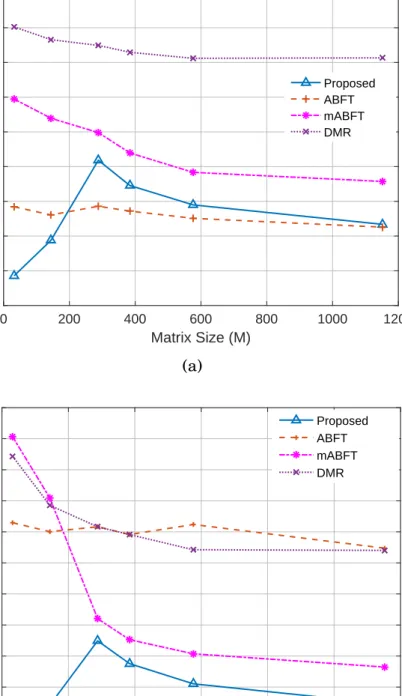
mABFT and DMR for error detection and correction in com-parison to conventional fault intolerant GEMM for: (a) no detected error and (b) One-row error as obtained using KULFI [3] for fault injection. . . 45 2.6 Simplest error distribution patterns undetectable by the
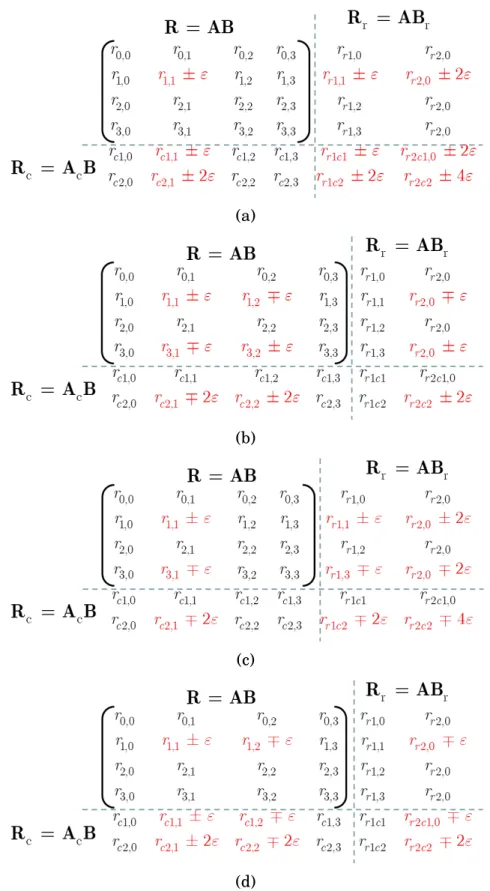
traditional ABFT for a 4×4matrix output,R=AB . . . 57 2.7 Simplest error distribution patterns undetectable by the
partition and weighted mABFT approach of [4–8] using a partition size, P =4 . . . 60 2.8 Execution time percentile overhead of numerical packing,
ABFT, mABFT and DMR for (a) GEMM computation only; (b) pre-processing, GEMM computation, error check and post-processing in the absence of errors. . . 67 2.9 Execution time percentile overhead of the numerical
pack-ing, ABFT, mABFT and DMR for error detection and cor-rection for: (a) single error injection and (b) One-row error injection using the KULFI fault injection. . . 68 2.10 Indicative image matches (from the Holidays dataset [9])
in VLAD-based image retrieval when using the query im-age on the left for (a) an error free case; (b) a single-row erroneous case. . . 75 3.1 Illustration of failure mitigation in integer matrix product
for the elementary case of three1×1-by-1×2matrix products in an integer representation withk=15. Assuming that the PU that computeŝr2 failed, the results of the other two PUs
(̂r0 and ̂r1) are used to produce all three outputs ̃r0, ̃r1 and
̃
r2 after unpacking. The partitioning within the rectangles
shows the location (shifts by k or2k bits) of inputs/outputs when packed within a single number. . . 87 3.2 Peak performance achieved by each method in the utilized
distributed computing environment forL=16. . . 104 3.3 AWS EC2 m3.xlarge spot instance type pricing history for
06/Dec/2015–13/Dec/2015 [availability-zone: us-east-1e, product-description: Linux/UNIX (AWS VPC)]. . . 110
4.1 Illustration of L numerically entangled outputs after inte-ger LS processing for the mitigation of F =1 failures. The solid arrows indicate maximum bit-width for each output rl,[n]0≤l<L,0≤n<N. . . 119
4.2 Illustration of L numerically packed outputs after integer LS processing for the mitigation of F =1failures. The solid arrows indicate the maximum attainable dynamic range of each outputrl[n]0≤l<L. . . 120
4.3 Illustration of entanglement of five outputs after integer linear processing: (a) second tier of superimposed outputs; (b) first tier of superimposed outputs, showing the original output valuesr0[n], . . . , r4[n]that are entangled within,0≤
n<Nout. . . 127
4.4 Illustration of entanglement of seven outputs with two fail-ures after integer linear processing: (a) second tier of su-perimposed outputs showing the worst case failure loca-tions; (b) derivation of the first set of temporary variables,
̂
rtemp(1) [n], using the consecutive from (a) to obtain two phys-ically separable integer values, 0≤n <Nout. The maximum
bit-width requirement for this tier of numerical entangle-ment is also highlighted. . . 140 4.5 Illustration of first tier of numerical entanglement of seven
outputs after integer linear processing: (a) outputs derived using the three consecutive nodes from the first stage of disentanglement; (b) derivation of the second set of ̂rtemp[n]
values using the consecutive from (a) to obtain two physi-cally separable integer values, 0 ≤n <Nout. The maximum
bit-width requirement for this tier of numerical entangle-ment is also highlighted. . . 141 4.6 Maximum bitwidth supported for data outputs undergoing
LS operation using 32-bit integer representation and miti-gating up to F fail-stop failures for Ldata streams (or pro-cessing nodes). The checksum implementation uses check-sum weights as proposed in [5] [4], i.e., w1 = [1,1,⋯,1]T,
extraction and failure recovery versus the arithmetic oper-ations ofLconcurrentN×N-by-N×N GEMM computations for: (a) N = 500; and (b) N =2000. L is the number of pro-cessing nodes and F the number of fail-stop failures that can be mitigated. . . 154 4.8 Ratios of arithmetic operations for numerical entanglement,
extraction and failure recovery versus the arithmetic opera-tions ofLconcurrent convolution computations with kernel length, N = 500 for: (a) time-domain convolution; and (b) frequency-domain convolution. Lis the number of process-ing nodes andF the number of fail-stop failures that can be mitigated. . . 155 4.9 Ratio of arithmetic operations for checksum generation and
recovery versus the arithmetic operations of generic matrix multiplication, with Lthe number of computing nodes and F the number of fail-stop failures that can be mitigated. . 157 4.10 Throughput results for the N ×N-by-N ×N GEMM
com-putation for mitigating F = {1,2,3} PU failures in L = 7 PUs. Failure-intolerant computation using Intel MKL 11.0 is used as a benchmark. Throughput axis is shown on a logarithmic scale. . . 159 4.11 Throughput results for the N ×N-by-N ×N GEMM
com-putation for mitigating F = {1,2,3} PU failures in L = 11 PUs. Failure-intolerant computation using Intel MKL 11.0 is used as a benchmark. Throughput axis is shown on a logarithmic scale. . . 160
2.1 Average number of discrepancies in the VLAD matches un-der one row of computed similarity measures being affected by SDCs. . . 75 2.2 Average CPU energy (mJ) and percentile comparison against
the fault-intolerant (conventional) sGEMM operating atVsafeV
for GEMM computations for matching a bunch of N = 576 and N =1152images against a database of images consist-ing of M =576 and M =1152 images respectively. For each case, each image is represented by an N-element VLAD. . 79 2.3 Summary of features of different methods for SDC
mitiga-tion in integer matrix products. . . 79 3.1 Giga-operations per output [and percentile overhead in
parison to the failure-intolerant (conventional) GEMM com-putation] for N ×N-by-N ×N GEMM products when miti-gatingF =4failures in an L=16core computing platform.
. . . 101 3.2 Average execution time results (in milliseconds) and
per-centile overhead in comparison to the failure-intolerant (con-ventional) GEMM computation when mitigating F =4(one quadcore) failures inL=16GEMM computations. . . 103 3.3 Execution time (in milliseconds) and percentile difference
in comparison to the conventional failure-intolerant pro-cessing for recovery after a quadcore processor failure in a music retrieval system. . . 106
percentile difference in comparison to the conventional failure-intolerant processing for recovery after a quadcore instance failure in VLAD-based image retrieval. . . 112 4.1 Summary of features of different methods forK-failure
mit-igation withinLstreams under aw-bit representation. . . 125 4.2 Examples of bitwidth supported for the output data under
w = 32bit integer representation and: (i) the proposed ap-proach; (ii)checksum-based failure mitigation. Any F fail-ures inLstreams (or F SDCs in eachL-tuple{r0, . . . , rL−1})
can be mitigated (or detected) under both frameworks, with the checksum-based method requiring F additional streams. 145 4.3 Average execution (in microseconds) and percentile
com-parisons against the fault-intolerant (conventional) Intel MKL sGEMMfor a single error detection within L
ABFT Algorithm Based Fault Tolerance
ATLAS Automatically Tuned Linear Algebra Software AWS Amazon Web Services
BER Backward Error Recovery
CMOS Complimentary Metal-Oxide Semiconductor DARPA Defense Advance Research Projects Agency dGEMM Double-precision Generic Matrix Multiplication DMR Dual Modular Redundancy
DVFS Dynamic voltage and frequency scaling EC2 Elastic Compute Cloud
ECC Error Correcting Code FER Forward Error Recovery GEMM Generic Matrix Multiplication gotoBLAS Basic Linear Algebra Subprograms
(designed by Kazushige Goto) HPC High Performance Computing IUD Independent Uniformly Distributed
KULFI Kontrollable Utah Low-Level Virtual Machine Fault Injector LLVM Low-Level Virtual Machine
PU Processing unit
SDC Silent Data Corruption SET Single Event Transient SEU Single Event Upset
sGEMM Single-precision Generic Matrix Multiplication SIMD Single Input Multiple Data
Notational Conventions
Symbol Definition
A,a,A[m, n], am,n boldface uppercase and lowercase letters
indicate matrices and vectors, respectively; the corresponding italicized letters indicate individual elements.
Atop the submatrix ofA∈RL×L comprising all rows
andonly columns with index range between
{0, . . . ,⌊L2⌋ −1}
Abot the submatrix ofA∈RL×L comprising all rows
andonly columns with index range between
{⌊L
2⌋, . . . , L−1}
⌈a⌋ roundsa to the nearest integer
⌊a⌋ largest integer that is smaller or equal to a (floor operation)
a≫b shiftsabybbits to the right discarding the least-significant bits
a≪b shiftsabybbits to the left discarding the most-significant bits
Sb{a} =⎧⎪⎪⎨⎪⎪
⎩
a≪b, b≥0
a≫ (−b), b<0 generalization for left and right bit shifting
a←b assigns valueb toa
̂a packed/entangled element (equivalently for vectors and matrices)
̃a recovered element after
unpacking/entanglement (equivalently for vectors and matrices)
Pr{event} indicates the probability of occurrence of event "event"
Introduction and Literature
Review
The exponential growth in the sophistication and processing power of computer chips, brought about by miniaturization and increase in CMOS integration density, has been the driving force in technological advance-ments in the past decades. In addition, today, computing clusters and virtualization provide for significant parallelism possibilities in compari-son to conventional desktop multicore systems. These systems, together with the corresponding parallel algorithms that run on them, find nu-merous applications in multimedia processing systems, especially with the increase in the availability of large datasets and the requirement for real-time data processing. However, despite the throughput acceleration offered by multi-core and multi-processor systems, modern computing clusters are now beginning to exhibit unreliable operation even under nominal conditions [10, 11]. This is as a result of the radiation and
ther-lead to the so-called soft errors or silent data corruption (SDC) in mem-ory and logic. An example of the sensitivity of silicon electronics to circuit noise as a result of downscaling is illustrated in Fig. 1.1. The figure shows a basic CMOS inverter circuit, together with its DC characteristics at dif-ferent supply voltage levels. It is straightforward to observe the increased susceptibility of this circuit to voltage deviations/current pulses (circuit noise) as the supply voltage is scaled to near-threshold levels [14]. More explicitly, Fig. 1.1(c) illustrates a circuit level voltage deviation masked by the inverter when operated atVDD =3V andVDD=5V. However, when
operated at VDD =1V and the amplitude of the deviation is greater than
Vth1, the logic state of the inverter output is reversed. The propagation
and manifestation of such flips within data input/output or control logic can lead to degraded outputs or even complete system malfunction (e.g. infinite loops).
Thus, future CMOS technologies now require increased levels of resilience to transient arithmetic, memory or logic faults caused by process varia-tions and other soft errors (e.g., caused by particle strikes, circuit over-clocking or voltage scaling) [15, 16] .
Beyond externally-induced errors, soft errors may arise due to self-induced changes in a computing system. For instance, one of the major bottle-necks in the increase of CMOS integration density is increased power dissipation [14]. In a bid to reduce the increases in power incurred by the increase in number of transistors per chip, voltage scaling is becoming
(a) 0 2 3 4 5 Input Voltage (V) 0 1 2 3 Output Voltage (V) V th3 Vth5 Vth1 (b) (c)
Figure 1.1: (a) Schematic of CMOS inverter (b) Voltage transfer charac-teristics of a CMOS inverter for different supply voltages [1];(c) Supply voltage deviation and equivalent output voltage response due to circuit noise.
its detriment is that it raises the need for strong error detection and cor-rection mechanisms, especially for soft errors occurring on data cache memories [17, 18] that remain undetected because they do not lead to a system halt or crash.
Furthermore, the proliferation of high-end distributed computing plat-forms with thousands of processing nodes imply that the overall mean time to failure (MTTF) estimates of such systems continue to decrease, with the highest root causes of failures being hardware and software ab-normalities [19]. Schroeder et. al. [20] show that the failure rate of a system is indeed proportional to the number of processors that consti-tute the system. Presently, a plethora of high performance computing (HPC) failure logs report average typical MTTF of popular HPC systems to be in the order of days or even hours [19–21]. Therefore, to ensure long running scientific and data processing algorithms, fault tolerance is unar-guably indispensable both now and for the future especially as we move to the exascale computing era with MTTF estimates in the order of tens of minutes [22]. Similarly, cloud computing clusters today provide for sig-nificant parallelism possibilities at the cost of decreased MTTF character-istics in comparison to conventional desktop multicore systems [23, 24]. For example, high-performance clusters can now be deployed using Ama-zon Web Services Elastic Compute Cloud (AWS EC2) spot instances with substantially-reduced billing cost [25]. However, AWS reserves the right to terminate EC2 spot instances at any moment with little or no prior
solely dedicated to the cluster under consideration. More broadly, other types of disruptions, such as vibration, power, or network-induced per-formance degradations, are also frequently reported in large computing clusters [24, 26]. Such interruptions tend to result in substantial reduc-tion in processing throughput and are therefore extremely detrimental in the performance of high-volume, low-latency, multimedia applications on cloud computing clusters [27, 28].
System reliability has thus become a challenge of increasing importance for prevalent applications in mobile, desktop and high-performance sys-tems, such as: webpage or multimedia retrieval [29, 30], relevance rank-ing (e.g., identifyrank-ing webpage significance via Google’s PageRank algo-rithm [31]), object or face recognition in video for machine learning and security applications [32, 33], etc. The algorithmic part within all these systems is based on [34]: power iterations, backpropagation training, transform decompositions, covariance matrix calculations, block Lanc-zos iterations, etc, and the input data comprise real numbers (image/au-dio samples, document/webpage features, etc). Within all these algo-rithms, the compute- and memory-intensive parts comprise linear and sesquilinear operations on real number inputs using integer or floating number representations. Specifically, it is well known that large sum-of-product computations, i.e., inner and outer products, generic matrix mul-tiplication (GEMM) [11,35–40], and multidimensional convolution/cross-correlation (CONV) operations [41, 42] are the building block of most
optimized single/double-precision floating-point libraries [e.g.,sGEMMand dGEMMroutines of a mathematics kernel library (MKL)] [35,36,43].
There-fore, ensuring the robustness of these operations to processing unit fail-ures and SDCs at critical processing stages is of paramount importance for large-scale multimedia application deployment in cloud computing clusters exhibiting low MTTF characteristics.
In this thesis, we present a set of algorithms for the mitigation of fail-stop (core/processor failures) and fail-continue (SDC) failures devoid of the traditional requirement for additional computing resources for im-proving overall system reliability. In the proposed numerical-packing based and numerical-entanglement based algorithms for fault tolerance, bits within the numerical representation of data inputs are harnessed for system reliability purposes. Thus, the proposed algorithms trade off output dynamic range of application data for increased levels of re-silience. For example, it will be shown in this thesis that the structure of the generic matrix multiply routine (GEMM), which forms the core compute-intensive unit of several signal processing algorithms allows for a methodical interleaving of several data elements within a single num-ber representation in such a way as to ensure precise extraction of the constituent units after processing. Specifically, through packing pairs of input matrix rows and kernel matrix columns using low-overhead inte-ger bit-shift operations, we are able to pinpoint the local set (usually four matrix outputs) of erroneous matrix outputs, thereby offering low-cost
data for our fault tolerance method is up to two orders of magnitude less that the ensuing GEMM computation when no SDCs are detected, while performing substantially better than existing checksum methods for mul-tiple error cases.
An alternative packing method capable of recovering data under fail-stop failures (or detecting SDCs in the absence of failures) is described in Chapter 3. The proposed method systematically packs/encodes both input and kernel matrix data elements before parallel processing within anL−core/processor/node computing cluster, such that a limited number of processing units (PUs1),N (N <L), is sufficient for producing all L
pro-cessed results at the output. Signal processing algorithms that support efficient packing and reliable recovery via the proposed method include all sum-of-product computations such as GEMM, multi-dimensional con-volution/ cross-correlation (CONV) and Kronecker products. Experiments within shared and distributed memory computing clusters highlight the efficiency of the proposed algorithm when taking into account the cost of data communication accrued for data transfer required for pre- and post-processing of the proposed algorithm.
Finally, in order to simultaneously tolerate a higher number of fail-stop failures within the class of linear and sesquilinear integer processing
rou-1In this work, a processing unit (PU) refers to an individual unit of a
parallel/dis-tributed computing platform, performing a fraction of the workload and with indepen-dent failure characteristics. Therefore, a thread in a single core CPU, or a node with multiple processors within a HPC system is referred to as a PU, provided the system can continue operation even in the event of a PU failure.
tines, we introduce an asymmetric packing method that unlike the pre-vious proposals, allows for the overlap of data elements within the en-closing representation. Our method extends the previous proposal from Anam and Andreopoulos [44] and, because it allows for the superposition of multiple elements, it has been termed as generalized numerical entan-glement. By simplifying the exposition and derivations to the case of data stream entanglement, we show for the first time, the possibility of recov-ering the set ofLdata streams when up toF streams are lost(L≥2F +1) without the use of checksum data groups.
The derivations of this work thus pave the way for a new class of al-gorithms that provide an application level power-aware fault tolerance mechanism. These derivations are in line with the recommendations from researchers including DARPA [18], for a robust cross-layer fault tolerance model, capable of alleviating the rising energy costs that are synonymous with hardware redundancy models. [18, 45, 46].
1.1 Literature Review
We start our review of literature in the field of fault tolerance by dis-cussing the evolution of soft errors in semiconductor devices as well as its propagation across components of the system stack in order to pro-duce visible erroneous or catastrophic results. In section 1.1.2, the fail-stop failure model is described with emphasis on likely failure causation, while also highlighting the limitations of existing mitigation methods. Since the proposals of this work target fault tolerance on the application
which form the basis of comparative analysis carried out in the later part of this work. We conclude this chapter by discussing the importance of SDC detection and correction within error tolerant applications.
1.1.1 Soft Errors and Silent Data Corruption
Soft errors are random, non-destructive short lived disturbances in semi-conductor devices, usually caused by electrical noise, fluctuations in sig-nal voltage, inductive coupling effects, particle strikes, clock skew ef-fects, CMOS process variations and other external factors beyond the system designer’s control [47]. For example, when charged particles (typ-ically stemming from radioactive materials in chip packaging), cosmic rays and other high energy particles interact with semiconductor mem-ory elements [48, 49], single or multiple bits of the stored value at the memory location are flipped. When these flips go undetected, subsequent computations with these erroneous data elements are likely to propagate silently to the application layer thereby producing erroneous outputs or degrading system performance (cf. Fig.1 of [50]) and in severe cases, fail-ures. Thus, although a soft error may not be damaging to the device in itself, its proliferation as silent data corruption (a.k.a, fail continue failures) poses great reliability challenges for end users. Previously, it was assumed that soft errors were specifically problematic only for space and aviation-based electronic devices since they are continuously exposed to high energy particles (e.g. neutrons from cosmic rays) that generate electron-hole pairs when they come in contact with semiconductor
de-vices [51–53]. These electron-hole pairs result in the appearance of large number of charges such that when a given critical threshold is exceeded, the operating circuit responds by erroneously flipping the state of a logic or memory at the location of the high energy particle impact [48, 51, 54]. However, the impact of soft errors has been amplified with the emergence of deep sub-micron semiconductor electronics that increase the sensitiv-ity of terrestrial-level devices to radiation and thermal noise by reduc-ing the critical charge required to upset a logic/memory state [51, 53]. More specifically, by dynamically reducing the operating voltage of tran-sistors as obtained in the dynamic voltage and frequency scaling (DVFS) technology, the critical charge threshold of transistors is further reduced thereby increasing the susceptibility of processors to the effect of soft er-rors [55, 56]. These erroneous responses of a system to non-idealities that do not necessarily cause a system failure but may propagate unno-ticed through applications depending on time and location of the flip are known as soft-errors, transient faults, single event transients (SET) or single event upsets (SEU). Specifically, SEUs refer to soft errors arising from glitches in sequential logic cells (e.g memory cells, flip-flops) while SETs are used to refer to abnormalities arising from combinational logic circuits that are propagated to sequential logic elements [57, 58].
Existing soft error mitigation techniques for both sequential and combi-national logic units at the lower level of the system abstraction layer in-clude: (i)circuit-level methods such as hardware replication based radia-tion hardening techniques [59–61], voltage and current monitoring tech-niques [62–64] and selective concurrent error detection designs [58, 65];
[66], Hamming code [67], variants of error correcting codes (ECC) [17,68, 69] and arithmetic codes for combinational logic units [70–72]. Though an efficient implementation of some of these techniques for protection of memory cells have been shown to reduce SRAM soft error rates (cf. Fig-ure 7 of [54] and FigFig-ure 9 of [12]), increasing combinational logic SER along with the complex corruption patterns (e.g., burst errors and multi-bit upsets) found in aggressively-scaled systems require increasingly- so-phisticated fault tolerance methods. These methods are known to in-cur substantial area, performance and power overheads [12, 54, 73–75]. This is why the Exascale Study Group [18] put forward that mitigation of SDC bursts should also be based on fault-tolerant software/algorith-mic designs rather than solely depending on expensive circuit-level tech-niques [18]. This has led to a growing number of research proposals for developing cross-layer system reliability designs [46, 76–78], which en-sure that systems remain reliable under unreliable hardware.
1.1.2 Hard Error Models: The Case of Fail-Stop
Sys-tems
Beyond non-persistent/transient soft errors, system errors can be further classified based on the duration of their occurrence into: (i): intermittent errors, which are characterized by the re-occurrence of a fault at a certain frequency and(ii): hard errors that tend to be permanent and can only be mitigated by a reconfiguration (sometimes involving removal and repair)
of the affected component of the system [70, 79]. Hard errors can arise from manufacturing irregularities, circuit aging, power failure, software failure or human error [80]. In this work, we focus on a class of hard error causing failures known as stop failures as opposed to byzantine fail-ures (i.e., permanent failfail-ures that remain undetected). That is, fail-stop failures comprise a class of system failures that assumes that the overall system is aware of the failure/removal of a subsystem [81,82]. Therefore, fail-stop failures within processing units are analogous to erasure chan-nels in communication networks [83]. Within HPC environments, exist-ing parallel computexist-ing frameworks like fault-tolerant Message Passexist-ing Interface (FT-MPI) [84] and Parallel Virtual Machine (PVM) [85], depend on a scheduled “alive” response from participating nodes within the net-work, without which the node is flagged as failed. In order to recover lost data on the failed node(s), failure mitigation techniques are employed to either recompute the lost data, or recover the data using error recovery algorithms similar to forward error correction codes in communication networks [83].
Recovery from fail-stop failures in parallel compute-intensive routines is currently achieved viaroll-backorroll-forwardmethods. Roll-back meth-ods are based on periodic checkpointing and recomputation if failures are detected. The vast majority of roll-back methods comprise backward er-ror recovery (BER), where system states are stored periodically and com-putations are restarted from the last stored state when a failure happens in the computing environment [23, 82, 86–88] . Several advances in this area including Plank et. al.’s diskless checkpointing [89], Oliner et. al.’s
et. al. [91] aim at improving the efficiency of checkpointing intervals and reducing the significant communication overhead that characterize checkpoint and restart systems. However, recent BER studies show that, depending on the desired level of resilience to core failures, substantial resources may be spent on checkpointing, system state storage/recovery, and recomputation. This has been identified as a major challenge for fu-ture exascale systems [23,92], which calls for alternative methods of fault tolerance with reduced storage and communication requirements [18]. Above all, the need for increased processing throughput requires failure mitigation techniques devoid of expensive re-computation of failed pro-cesses [86]. Forward error recovery (FER) techniques are therefore an alternative to BER that ensure continuous processing even in the face of failures.
From a system perspective, module replication is perhaps the de facto FER method for highly reliable systems as employed for example in mis-sion critical systems [93] and HPC systems with very long continuous operational lifetime [94]. However, the two- or three-fold increase in resources required to maintain the minimum form of redundancy is of-ten unacceptable in practical deployments [95]. Specifically, the power requirements in order to achieve reliability by replication have been a problem of growing concern. This is why there is an increasing number of calls for more energy aware fault tolerant systems that are algorithm specific [18] and also for increased research in the area of cross-layer ap-proaches for reliability [46].
Roll forward methods, similar to error correction codes for robust data communication, have been employed for error detection, correction and failure recovery in data processing tasks [96–99]. The key considera-tion in the design of FER codes for data processing applicaconsidera-tions is the requirement to maintain the encoding relationship throughout the data processing cycle [100]. However, because different arithmetic algorithms modify data differently, the major limitation of existing encoding-based fault tolerance techniques is their algorithm-specificity. Nevertheless, the low-cost computational overhead offered by algorithm-based FER meth-ods make them suitable especially for real-time and power-aware sys-tems. In addition, because low-level fault tolerance techniques may not be sufficient for SDC detection and correction for increasing error rates [18], these application level techniques can seamlessly be deployed on top of existing robust circuit-level designs for increased system resilience [18,46]. We describe existing algorithm-based methods for fault tolerance in the section that follows.
1.1.3 Algorithm Based Methods for Fault Tolerance in
Data Computations
Pioneering works in this area emerged in the early 80’s by Huang and Abraham2 [7, 101, 102], who coined the term Algorithm Based Fault
Tol-erance (ABFT) that would then become the building block for advanced
2In this work, Algorithm Based Fault Tolerance (ABFT) refers to Huang and
Abra-ham’s original proposal [101], while mABFT is used to refer to various modifications and extensions, i.e., including the use of weighted checksums and subblock partitioning.
“checksum” data elements specifically tailored to the algorithm under consideration for the reliable detection (and possibly correction) of up to a limited number of SDCs [4,6,96,97,101,103,104]. Huang and Abraham’s proposal for improving the reliability of matrix product, addition, scalar multiplication, transpose and LU decomposition generates checksum el-ements via a linear combination of input matrix elel-ements in such a way that the preserved checksum relationship after computation can be used for error detection and correction. For example, in order to reliably com-pute anM×K-by-K×N matrix productR=A×B, a column checksumac
and a row checksumbr are generated by:
ac = wTcsA
br = Bwrs
(1.1)
where wcs ∈ RM and wrs ∈ RN are unit column weight vectors. By
ap-pending the checksum vectors to their corresponding input matrices and performing the GEMM computation as illustrated in Figure 1.2, [101] show that the checksum relationship is preserved after computation and can thus be used for error detection and correction. Specifically: (i) the sum of each row and each column of R(which is contained within Rf) is
validated against the corresponding checksum elements of rr and rc; (ii)
the sum of the checksum vectors themselves is validated against rrc. If
these validations fail for a certain row and column, the index of this row and column indicates the location of the SDC withinRf.
Figure 1.2: ABFT within a single subblock of GEMM via checksum vec-tors
Figure 1.3: Errors in ABFT that require row and column recomputation (rollback ABFT [2]).
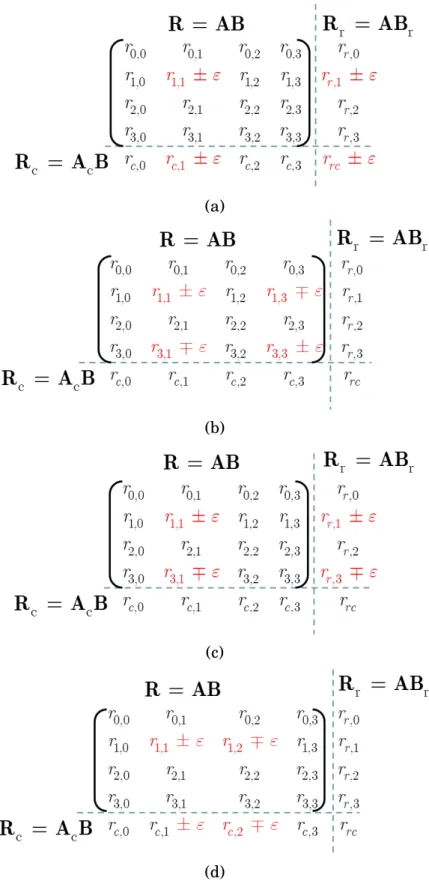
to pinpoint the exact locations of SDCs in the event of multiple SDC oc-currence. This is often mitigated by row/column recomputation, which is termed “rollback ABFT” [2]. For example, given the ±ε and δ error pat-tern shown in Figure 1.3, ABFT flags locations r3,1 and r3,3 as erroneous,
while two other erroneous locations,r1,1 andr1,3 go undetected due to the
cancellation effect of the given error pattern. Therefore, when multiple SDCs are detected, the only reliable method for recovery via ABFT is to recompute (i.e., “rollback”) the entirety of the rows and columns that have been detected as erroneous. If a substantial number of SDCs is detected, this will result in entire GEMM subblock recomputation, i.e., complete execution rollback, incurring significant execution time penalty.
use of additional checksums, constructed with specific weight vectors with improved reliability at the cost of output dynamic range of matrix outputs and computation complexity. Jou, Anfisonet. al.[7,105] extended ABFT with the introduction of d checksum rows and columns, d> 1. All checksum elements beyond the first one are generated via inner prod-ucts of rows and columns with specially-constructed weight vectors. It is then shown that, under suitable choice of weight vectors, this extension can guarantee the detection of up to d SDCs and correction of up to ⌊d
2⌋
SDCs [6, 7, 105] per row and column of a subblock product. This comes at the cost of increasing the size of the checksum matrices by dtimes. In more detail, the first checksum of each column of Aand row of B is the one of the original ABFT; we denote this as the unweighted checksum,
ac1 and br1, respectively. For an mABFT approach with d=2, the second
checksum of each column of A and row ofB (denoted by ac2 and br2,
re-spectively) isthe inner product of the column ofA(resp. inner product of the rowofB). Jou and Abraham [7] proposed the column and row weight vectorswcexpand wrexp given by:
wT
cexp = [20 21 . . . 2M−1]
wT
rexp = [20 21 . . . 2N−1]
. (1.2)
However, due to the exponential increase of the dynamic range of ac2and
br2, the use of wexp will cause overflow problems under 32-bit or 64-bit
integer representations. Such an mABFT approach is therefore mostly of theoretical interest, rather than of practical relevance to conventional
numerical representations used in programmable processors.
As a remedy to the dynamic range expansion caused by the weight vector of (1.2), Rexford and Jha [6] proposed the further partitioning of input subblocks into smaller blocks. Complementary to this approach, Luk et. al.[4, 5] proposed the weights:
wT
clinear = [1 2 . . . M]
wT
rlinear = [1 2 . . . N]
(1.3)
instead of the exponential weights of 1.2, in order to allow for quadratic increase of dynamic range inac2and br2 and quartic increase of dynamic
range for the second row-column checksum element, rr2c2. Specifically,
the quartic increase in the latter is by factor(∑M
m=1m) ⋅ (∑Nn=1n), or
(log2(M+M2) +log
2(N+N2) −1)bits. Their work shows that, under the
use of the linear weights of (1.3) and for d=2, up to two SDCs per row or column of the outputM×N matrix can be reliably detected and up to one SDC can be reliably corrected.
Beyond SDC mitigation for matrix products, algorithm-based techniques have also been developed for fault tolerance in compute-intensive rou-tines as well as a FER method for fail stop failures. These methods ei-ther employ the use of checksums as proposed by Huang and Abraham, or exploit the properties of the algorithm for error detection. For example, Hoemmen and Heroux [106] as well as Chen [107] show that algorithmic properties such as convergence time and vector orthogonality can be em-ployed within iterative methods for SDC detection. On the other hand, the use of checksums have been applied to several linear algebra and
matrix factorization [8,108], fast Fourier transforms (FFT) [109,110] and sparse matrix-vector-matrix multiplication [11].
For these checksum-based methods, the overarching concept is the pro-duction of checksum rows and columns (or entire checksum matrices) so that the performed computation can be applied to the checksum elements alongside the input matrices or vectors. These additional elements can then be used for FER/SDC detection and correction by solving a system of linear equations if failures are detected. Therefore, most existing algo-rithm level approaches incur overhead due to the storage and processing of the checksum vectors or matrices. Moreover, the requirement of ad-ditional computing nodes for checksum processing in FER decreases the achievable peak performance, as less nodes are dedicated to actual input-data computations. For example, in order to mitigate a single process fail-ure during parallel GEMM computation on an L2 process grid, Bosilca
et. al. [96] and Chen and Dongarra [100], show that 2L−1 processing nodes must be reserved for checksum storage and processing. The impli-cation of this setup was that for a single fail-stop failure mitigation, 25% of processing throughput must be sacrificed when running on an 8− by-8 process grid. Improved throughput values are recorded for increasing process grid sizes. Similar results recorded in [111] show that in compar-ison to a fault-intolerant GEMM computation on a graphics processing unit (GPU), ABFT-protected GEMM incurs 11% ∼ 125% execution time overhead for square matrix sizes ranging from 4096∼32. Finally, Pilla et al [112] reports a41%average execution time overhead for detecting
radi-ation induced errors in a GPU performing 1D FFT computradi-ations. These results show that most existing checksum based methods only become efficient at large matrix/vector computations as well as for failure miti-gation within larger cluster sizes.
Overall, for failure resilience in compute-intensive routines like GEMM and CONV, roll-forward methods are preferable to roll-back methods, as they achieve higher throughput and can immediately mitigate the effect of failures without service interruption [82, 95, 100, 113, 114].
1.1.4 Fault tolerance for Error Tolerant Systems
One of the proposals of this thesis focuses on SDC mitigation for inte-ger matrix products, which are often encountered in multimedia appli-cations where low precision processing may be sufficient for the desired throughput/processing results (a.k.a error tolerant systems) [40]. Thus, the question of the need for detecting and correcting errors in systems that can inherently tolerant errors often arises in the community. In-deed, detecting SDCs in error-tolerant multimedia applications like im-age/video rendering or pixel-level processing is of limited interest. How-ever, it has been shown in [115–117] that there is need to differentiate between “critical/perceptible” and “uncritical/imperceptible” soft errors in various applications. The former category comprising applications that process compacted data (or data that is subsequently used as inputs for further processing). For example, many video retrieval, video database and video editing applications exhibit critical dependency on the
accu-descriptor data or compact projections [9, 118]. In such cases, mitiga-tion of soft errors is imperative, especially when outputs from such sec-tions are reused for subsequent computasec-tions and processing, e.g., the generation and presentation of a ranked list of results based on sorting and thresholding of the GEMM outputs. Therefore, despite the error-tolerance of pixel-based video processing applications, the sensitivity of non-pixel based processing in video systems stresses the need for error tolerance in these applications, especially since video retrieval and video database applications are now gaining significant traction.
1.2 Thesis Objective
In this thesis, our aim is to introduce a new class of low-complexity, al-gorithm and application-specific fault tolerant methods. The proposed designs are expected to be deployable either as a stand-alone reliability mechanism, or as a component within existing fault tolerant system de-signs within a cross-layer resilience framework [18, 46, 78]. Importantly, by reducing/eliminating all forms of physical or temporal redundancy synonymous with generic fault tolerant designs [89, 95], the proposals of this thesis are expected to incur lower implementation overhead, re-duced resource utilization and increased processing throughput. For ex-ample, because the GEMM performed within multimedia processing [32] and linear system solutions [34] have different precision and through-put requirements, a generic replication or checksum-based fault tolerant
GEMM may degrade the performance requirements of such applications. Therefore, by focusing on the class of error-tolerant applications where reduced precision processing is acceptable, our goal is to design relia-bility solutions that are fast, energy efficient and tailored for increased processing throughput.
1.3 Thesis Structure
The remaining parts of this thesis consists of four chapters. In Chapter 2, we introduce the concept of numerical packing as proposed in previous work for throughput acceleration and show how a redesign of the GEMM algorithm introduces reliability at a reduced cost. Furthermore, the the-oretical complexity and reliability aspects of numerical packing for SDC detection and correction are investigated in comparison to existing meth-ods of checksum generation and modular redundancy. We also analyze in this chapter, the execution time and energy consumption overhead of SDC mitigation methods via an SDC-injection campaign experiment us-ing an open source low-level virtual machine (LLVM) based fault injection tool, the Kontrollable Utah LLVM Fault Injector (KULFI) [3, 119].
In Chapter 3, we present a numerical packing based single core/pro-cessor failure FER algorithm for sum-of-product computations. Given that our algorithm can only be used for integer data computations, we focus on large-scale, low-latency, multimedia applications that require high-throughput integer-to-integer sum-of-product computations [40]. To
head in terms of arithmetic operations in comparison to the equivalent checksum-based method. We also present experimental results on (i)an 18-core, shared-memory, AWS EC2 instance3, and(ii)a StarCluster [120]
of AWS EC2 spot instances that are terminated and migrated to AWS EC2 on-demand instances for the duration that the spot price exceeds a predetermined threshold. For the former, we demonstrate that the pro-posed method achieves substantially-higher peak performance against the equivalent FER method based on checksums, both under failure-free and failure-occurring conditions. For the latter, we show that our ap-proach provides for substantial reduction in deployment cost, especially in comparison to the failure-intolerant approach that cannot use spot in-stances.
In order to generalize our FER methods to recover from multiple failures, we propose a new FER method for linear and sesquilinear operations per-formed in integer data streams in Chapter 4. We present generalization for the mitigation ofKfailures whenLdata streams (also processing core data) are “entangled” together and show that the proposed algorithm can also be used for SDC detection and correction in the absence of failures. Finally, we conclude this thesis in Chapter 5 while outlining possible fu-ture research directions based on the proposals of this work.
3This is a c4.8xlarge AWS EC2 instance composed of multiple dual-nanocore
Numerical Packing for
Fault-tolerance in GEMM
T
HEgeneric matrix multiply (GEMM) routine comprises the compute and memory-intensive part of many information retrieval, rele-vance ranking and object recognition systems that process integer inputs. Because of the prevalence of GEMM in these prominent applications, en-suring its robustness to transient hardware faults is of paramount im-portance for highly-reliable systems. Mitigation techniques for SDCs are especially important for matrix products performed during descrip-tor matching, power iterations, backpropagation, transform decomposi-tions, random projecdecomposi-tions, kernel methods, covariance matrix calcula-tions and block Lanczos iteracalcula-tions within information retrieval, object detection and tracking, machine learning, and classification applications [9,32,39,118,121–125]. This is because: (i)matrix-product computations comprise the bulk of processing in such applications; (ii)subsequentpro-ing and clusterpro-ing operations [9, 116, 117, 126] and any undetected SDCs in the matrix-product stage can have severe repercussions in the final results. Many such matrix products utilize integer inputs and are typ-ically performed with an integer generic matrix multiply (GEMM) rou-tine, or the single- or double-precision floating-point GEMM (sGEMM or dGEMM) routines of a high-performance mathematics kernel library (MKL) [35, 36]. Thus, ensuring that integer matrix products remain reli-able against SDCs is of paramount importance for such multimedia sys-tems.
In Section 2.1, we summarize the operation of high-performance GEMM routine highlighting existing optimization techniques available on mod-ern processors. We describe the proposed algorithm of numerical packing in Section 2.2, including the requirement of a low-cost checksum inner-product computation for increased reliability. Section 2.3 provides dis-cussion on dynamic range, computational complexity and reliability of existing SDC mitigation techniques. We make some concluding remarks in Section 2.6.
2.1 Structure of Generic Matrix
Multiplica-tion (GEMM) Routine
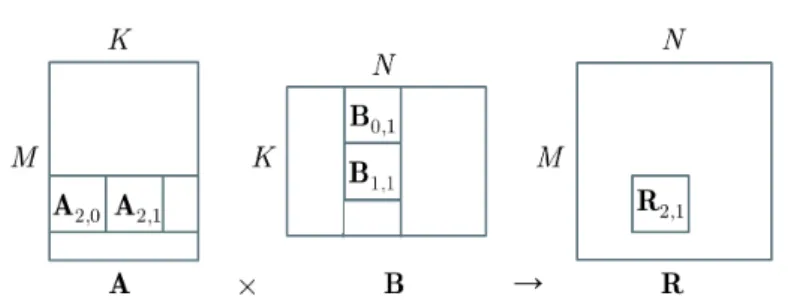
Consider the GEMM design depicted in Figure 2.1, which follows the gen-eral structure found in optimized linear algebra kernels [36] (e.g Intel
Figure 2.1: Top-level processing of GEMM R = A×B, highlighting the input subblocks used for the computation of the subblock result R2,1
MKL, ATLAS, gotoBLAS). The application calls GEMM for an M ×K by K×N matrix multiplication, which is further subdivided intoT×T “inner-kernel” matrix products. For our approach, T is specified by (k∈N⋆):
T =2k×SIMDbits
brepr (2.1)
with: SIMDbits the number of bits of each SIMD register (SIMDbits =256
in this work); brepr ∈ {32,64}the number of bits for floating-point or
inte-ger representations. The inner-kernel result R2,1 of the example shown
in Figure 2.1 comprises the sum of multiple subblock multiplications
A2,tBt,1: R2,1= K T−1 ∑ t=0 A 2,tBt,1. (2.2)
If the matrices’ dimensions are not multiples of T, some “cleanup” code [36] is applied at the borders to complete the inner-kernel results of the overall matrix multiplication. This separation into top-level processing and subblock-level processing is done for efficient cache utilization. Specif-ically, during the initial data access of GEMM for top-level processing, data in matrix A and B is reordered into block major format: for each T×T pair of subblocksAi,tandBt,j multiplied to produce inner-kernel
re-sultRi,j,0≤t<KT ,0≤i< MT ,0≤j <NT, the input data within Ai,t andBt,j is
reordered in rowwise and columnwise raster manner, respectively. Thus, sequential data accesses are performed during each subblock matrix mul-tiplication and this enables the use of SIMD instructions, thereby leading to significant acceleration. A detailed exposition on matrix ordering for GEMM and available optimizations can be found in [127].
From this description it is evident that the top-level processing simply administers the computation (and, optionally, error detection) at the sub-block level and the core operations are performed within each subsub-block independently, before being aggregated to produce the final results.
2.2 Numerical Packing: A New Numerical
Rep-resentation Method for Information
Re-dundancy
The concept of numerical packed processing is based on the fact that multiple low precision data inputs can be stacked within a single input, in such a way as to ensure simultaneous and accelerated data process-ing [42, 128, 129]. Packed processprocess-ing algorithms for throughput accelera-tion in convoluaccelera-tion [128] show acceleraaccelera-tion gains between 27% and158% in comparison to conventional processing, with acceleration for matrix product [129], block matching [130] and cross correlation [42,130] follow-ing similar trends.
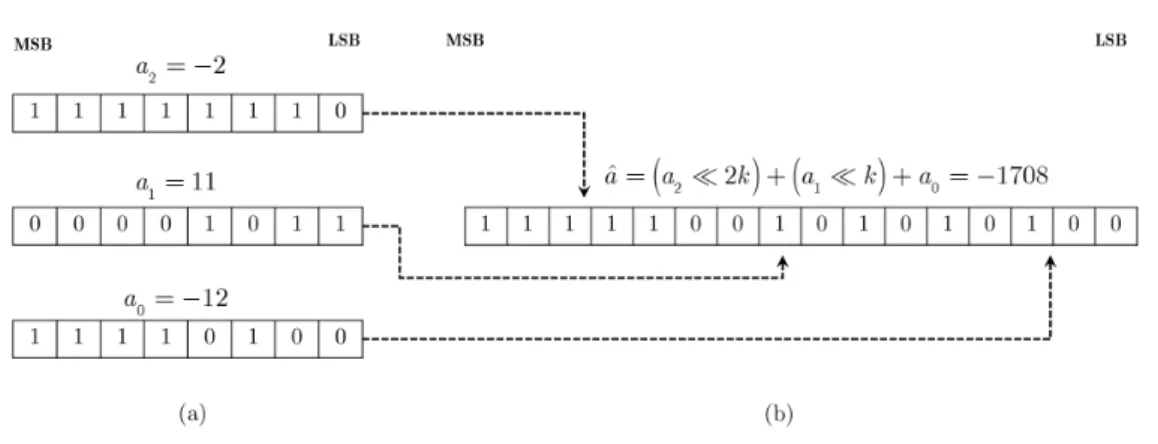
Figure 2.2: Bit layout of signed inputs packed within a 16-bit integer data representation via arithmetic shifting using a packing factor, k =5. MSB/LSB shows the most/least significant bit locations.
Since the proposed method is built upon the concept of numerical pack-ing, we briefly summarize this idea within integer data representation. Consider three integer inputs, a0, a1, a2, that must be processed with an
integer kernel, such that the range of output values, r0, r1, r2 is within
[−16,16].Conventional implementation on general purpose processors us-ing, for example, the C programming language, would represent each ai
(and the corresponding output ri) using 8-bit signed char
representa-tion. We show in Fig. 2.2(a), the two’s complement integer representation of these inputs,a0, a1, a2.
In order to achieve packed processing, we define a packing factor, k given by:
k>log2(max∀
i ∣ri∣) +1 (2.3)
N k≤W (2.4)
whereN is the number of inputs packed within one number representa-tion, andW the data bitwidth used for packed processing.
The packing factor of (2.3) and (2.4) ensure that the total number of bits do not exceed the available bitwidth of the utilized integer representa-tion. Though the packed representation of Fig. 2.2(b) depicts an overlap especially for negative input values, we show in the sections that follow, that all output values are indeed extractable using basic arithmetic oper-ations.
Packed processing is achieved via arithmetic shift and summation opera-tions. Specifically, the packed input̂ais computed by:
̂ a= N−1 ∑ i=0 ai≪ (i⋅k) (2.5)
Kernel processing can subsequently be carried out using ̂a in place of ai (0≤i<N),provided the constraints of (2.3) and (2.4) are maintained.
The inverse operation (unpacking) is performed on the packed output,
̂
r using the reverse bitshift operations and conditional subtractions of previously-extracted results that depend on the sign of the extracted in-formation (cf. Section III of [131]).
We now focus on the numerical packing construct for GEMM computation and its utilization for fault tolerance in GEMM.
2.2.1 Numerical Packing for GEMM
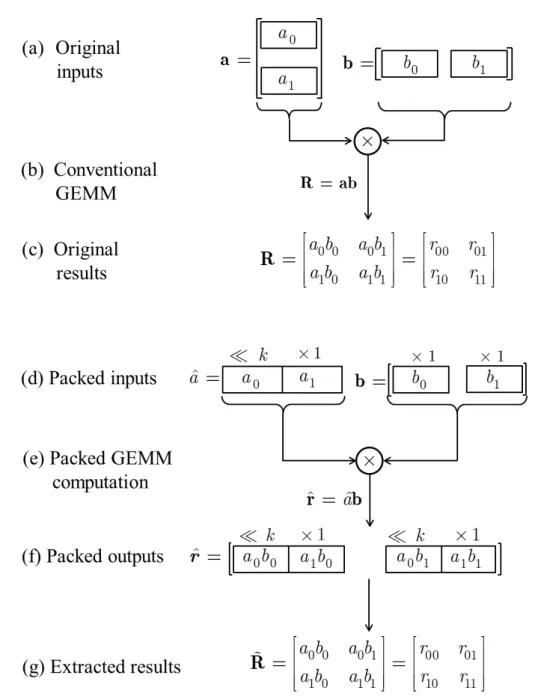
To facilitate the exposition, we shall be referring to the illustrations of Figure 2.3(d)–(g) and Figure 2.4, which present the steps of the described methods for the elementary case of a 2×2 matrix produced via a2×1by
1×2 vector product. In addition, the conventional (fault-intolerant) ap-proach is illustrated in Figure 2.3(a)–(c). Finally, beyond this elementary case, our analytic exposition will be based on the general case of a T ×T subblock product.
In packing for integer subblock multiplication R = AB, only one input subblock is packed, i.e., either A or B (asymmetric packing). This se-lection does not affect the performance in the case of GEMM, as both subblocks have been reordered in block-major format. Assuming A is chosen, the packing process creates block  with T
2 ×T coefficients given
by (∀m, n∶ 0≤m, n<T, m̂ = ⌊m2⌋):
̂am,n̂ = Sk{a2m,n̂ } +a2m̂+1,n (2.6)
wherekis the utilized packing coefficient,k∈N⋆, andSk{a}is the left bit
shift operator defined in the notational conventions table of pg. xix. The utilized value forkdepends on the maximum possible value of the matrix product, as it will be elaborated in the following. An illustration of the packing of (2.6) for the two elements of a 2×1vectorais given in Figure 2.3(d), i.e., forn= ̂m=0.
Notice that (2.6) operates along the columns of  in order to pack rows 2m̂ and 2m̂ +1together. This means that, in order to use integer SIMD instructions for accelerated computation of (2.6), we can group SIMDbits
brepr
consecutive elements of each row and apply each arithmetic shift and add operation of (2.6) to them using appropriate SIMD instructions. Once (2.6) is completed, processing occurs via R̂ = ̂AB(∀m, n∶ 0≤m, n<T, m̂ =
Figure 2.3: (a)–(c) Conventional integer subblock multiplication for the case of a2×1by1×2vector product. (d)–(g) Packing for the same product with packing coefficient k = 10. The partitioning within the rectangles shows the location (shifts bykbits) of inputs/outputs when packed within a single number.
⌊m 2⌋): ̂ rm,n̂ = T−1 ∑ j=0 ̂ am,ĵ bj,n (2.7) = (Sk{T∑−1 j=0 a2m,ĵ bj,n}) + T−1 ∑ j=0 a2m̂+1,jbj,n
The packed output of (2.7) contains both rows of the results, ̂r2m,n̂ and ̂
r2m̂+1,n, packed together. An example is shown in Figure 2.3(f) for n = ̂
m = 0. Importantly, if they do not overlap in the packed representation and the numerical representation used can accommodate both packed outputs, both rows can be computed concurrently via (2.7). For the packed processing of two inputs shown in (2.6) and (2.7), these two conditions are met when the packing coefficient satisfies the below constraint [41, 129, 130]:
• For 32/64-bit integer representation: k >log2(max∀m,n∣rm,n∣) +1and
2k≤W, withW ∈ {32,64}.
Any high-performance T
2 ×T byT ×T subblock code for 32/64-bit GEMM
(integer or floating-point) can be used for the computation of (2.7). Fol-lowing the completion of the processing, unpacking of the results can be performed by the following process [41,129,130] (∀m, n∶ 0≤m, n<T, m̂ =
⌊m
2⌋).
The first output,̃r2m,n̂ , which is packed at the most significant bits of̂rm,n̂ ,
is extracted by:
̃
The extracted output is then removed from ̂rm,n̂ : ̃
r2m̂+1,n = ̂rm,n̂ − Sk{̃r2m,n}̂ , (2.9)
The result is then converted into its signed representation. Specifically, if̃r2m̂+1,n≥2k−1, theñr2m̂+1,n ← (̃r2m̂+1,n−2k).
Finally if ̃r2m̂+1,n <0, then the result extracted from the most-significant
bits must be incremented by one, i.e.: ̃r2m,n̂ ← (̃r2m,n̂ +1).
2.2.2 Proposed Fault-tolerant Packing
We utilize the packing concept in order to provide highly-reliable integer matrix products within each GEMM call. Our method uses standard 64-bit integer representations and off-the-shelf GEMM subblock kernels to process 32-bit inputs, as detailed in the following1.
Packing Process
The proposed approach performs two packingsof matrix Ainto Âi and ̂
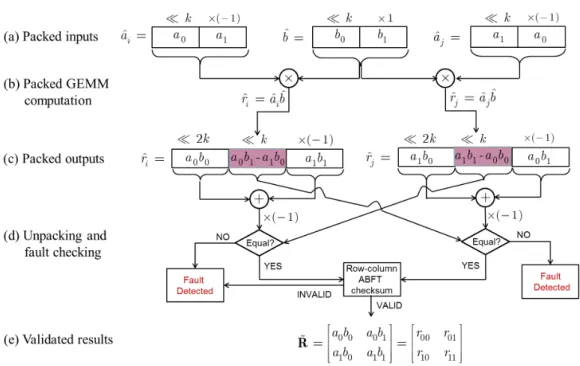
Aj and one packing ofBintoB̂, as shown in the example of Figure 2.4(a).
The figure illustrates only the case of an elementary 2×1by 1×2vector product with k = 10 and, due to the small input vector dimensions, the packed matrices are in fact scalarŝai,̂aj and̂b. For the general case of a
T×T byT×T subblock product, the process is identical for all other pairs
1In general, double bit-width representation is required by the proposed method in
of inputs within A and B and is expressed by (∀m, n ∶ 0 ≤ m, n <T, m̂ = ⌊m 2⌋ ̂n= ⌊ n 2⌋): ̂ai,m,n̂ = Sk{a2m,n̂ } −a2m̂+1,n (2.10) ̂ aj,m,n̂ = Sk{a2m̂+1,n} −a2m,n̂ (2.11) ̂bm,̂n= Sk{bm,2̂n} +bm,2̂n+1 (2.12)
Each packing “stacks” two inputs together in a single 64-bit integer num-ber (assuming 32-bit inputs) and can be done during initial reading and reordering of each subblock in GEMM [36, 129]. Notice that, in com-parison to conventional packing presented in the previous section [and illustrated in Figure 2.3(d)–(g)]:
• (2.10) and (2.11) invert the sign of the elements of A that are left shifted byk-bits;
• A is packed twice with reverse “ordering”, as shown in (2.10) and (2.11);
• Bis packed as well.
This setup enables packed processing to be used for error detection.
Packed GEMM computations
Two (T
2 ×T) × (T ×
T
2) subblock multiplications ensue via the use of two
standard subblock GEMM calls (using either 64-bit integer or 64-bit float-ing point representation), producfloat-ing all required results, as well as a
Figure 2.4: Illustration of highly-reliable integer subblock multiplication via numerical packing for the case of a 2×1 by1×2vector product with packing coefficient k =10. The partitioning within the rectangles shows the location (shifts byk or2k bits) of inputs/outputs when packed within a single number.
number of “entangled” results within the numerical representation of the packed outputs. An example for the two packed products of elementary 2×1by1×2vectors is shown in Figure 2.4(b)–(c). For the general case of anT×T byT×T subblock product, the elements packed withinR̂iandR̂j
are expressed mathematically by (∀m, n∶ 0≤m, n<T, m̂ = ⌊m 2⌋, ̂n= ⌊ n 2⌋): ̂ ri,m,̂̂n = T−1 ∑ t=0 ̂ ai,m,t̂ ̂bt,̂n = S2k{ T−1 ∑ t=0 a2m,t̂ bt,2̂n} − Sk{ T−1 ∑ t=0 a2m̂+1,tbt,2̂n} +Sk{ T−1 ∑ t=0 a2m,t̂ bt,2̂n+1} − T−1 ∑ t=0 a2m̂+1,tbt,2̂n+1 = S2k{̃r2m,̂2̂n} + Sk{̃r2m,̂2̂n+1− ̃r2m̂+1,2̂n} −̃r2m̂+1,2̂n+1 (2.13) ̂ rj,m,̂̂n = T−1 ∑ t=0̂ aj,m,t̂ ̂bt,̂n = S2k{ T−1 ∑ t=0 a2m̂+1,tbt,2̂n} − Sk{ T−1 ∑ t=0 a2m,t̂ bt,2̂n} + Sk{T∑−1 t=0 a2m̂+1,tbt,2̂n+1} − T−1 ∑ t=0 a2m,t̂ bt,2̂n+1 = S2k{̃r2m̂+1,2̂n} + Sk{̃r2m̂+1,2̂n+1− ̃r2m,̂2̂n} −̃r2m,̂2̂n+1 (2.14)
Unpacking of the Results
Subsequently, unpacking occurs within each element of R̂i andR̂j based
on the process presented below, which extends the unpacking of the previ-ous section in order to handle the three packed results within each output
̂
ri,m,̂̂nand̂rj,m,̂̂n, illustrated in Figure 2.4(d).
We extract the components packed within̂ri following the unpacking
pro-cess described in the previous subsection, withε˜(k0,k1),(k2,k3)indicating the
![Figure 1.1: (a) Schematic of CMOS inverter (b) Voltage transfer charac- charac-teristics of a CMOS inverter for different supply voltages [1];(c) Supply voltage deviation and equivalent output voltage response due to circuit noise.](https://thumb-us.123doks.com/thumbv2/123dok_us/9322279.2810776/23.892.171.739.317.855/schematic-inverter-voltage-transfer-teristics-different-deviation-equivalent.webp)
![Figure 1.3: Errors in ABFT that require row and column recomputation (rollback ABFT [2]).](https://thumb-us.123doks.com/thumbv2/123dok_us/9322279.2810776/36.892.214.690.402.584/figure-errors-abft-require-column-recomputation-rollback-abft.webp)
![Figure 2.5: Theoretical percentile complexity of numerical packing, ABFT, mABFT and DMR for error detection and correction in compar-ison to conventional fault intolerant GEMM for: (a) no detected error and (b) One-row error as obtained using KULFI [3] fo](https://thumb-us.123doks.com/thumbv2/123dok_us/9322279.2810776/65.892.279.666.198.520/theoretical-percentile-complexity-numerical-detection-correction-conventional-intolerant.webp)