Randomized and Efficient Time Synchronization in
Dynamic Wireless Sensor Networks: A
Gossip-Consensus-Based Approach
Nan Xiong1, Minrui Fei1* and Taicheng Yang2
1 Shanghai Key Laboratory of Power Station Automation Technology, School of Mechatronics Engineering
and Automation, Shanghai University, Shanghai 200072, China; [email protected] (N.X.)
2 Department of Engineering and Design, University of Sussex, Brighton BN1 9QT, U.K.;
[email protected] (T.Y.)
* Correspondence: [email protected] (M.F.); Tel.: +86-021-5633-1934
Academic Editor: name
Version August 4, 2018 submitted to Complexity;
Abstract: This paper proposes novel randomized gossip-consensus-based sync (RGCS) algorithms
1
to realize efficient time correction in dynamic wireless sensor networks (WSNs). First, the unreliable
2
links are described by stochastic connections, reflecting the characteristic of changing connectivity
3
gleaned from dynamic WSNs. Secondly, based on the mutual drift estimation, each pair of activated
4
nodes fully adjusts clock rate and offset to achieve network-wide time synchronization by drawing
5
upon the gossip consensus approach. The converge-to-max criterion is introduced to achieve a much
6
faster convergence speed. The theoretical results on the probabilistic synchronization performance
7
of the RGCS are presented. Thirdly, a Revised-RGCS is developed to counteract the negative impact
8
of bounded delays, because the uncertain delays are always present in practice and would lead to
9
a large deterioration of algorithm performances. Finally, extensive simulations are performed on
10
the MATLAB and OMNeT++ platform for performance evaluation. Simulation results demonstrate
11
that the proposed algorithms are not only efficient for synchronization issues required for dynamic
12
topology changes but also give a better performance in term of converging speed, collision rate, and
13
the robustness of resisting delay, and outperform other existing protocols.
14
Keywords:wireless sensor networks; consensus time synchronization; gossip algorithms; changing
15
connectivity; fast convergence; collisions; bounded delays;
16
1. Introduction 17
Ad hoc Wireless Sensor Networks (WSNs) without pre-existing infrastructures are composed of
18
autonomous sensors [1], and the sensors are a variety of low cost, low power, sensing devices, which
19
work cooperatively through ad hoc wireless communications. In WSNs, many kinds of missions [2,3],
20
such as transmission scheduling, event sequencing, information fusion, and distributed filtering, rely
21
heavily on a consistent notion of time to keep running. For instance, Internet of Things’ perception
22
layer provides a ubiquitous access to the network, in which the multiple terminals collaborate closely
23
with each other, and accurate synchronized clocks determine whether a multi-terminal cooperation is
24
accomplished or not. Therefore, timing protocols, which should concern with topologies, time-delays,
25
low power consumption, etc., is the premise of dealing with services of ad hoc WSNs.
26
Two configurations of timing protocols are available: hierarchical and distributed. Cluster-based
27
and tree-based protocols would both fall into the hierarchical configuration, because they perform a
28
special operation; that is, some designated nodes are elected to be the reference (such as cluster head,
29
root, master). The typical hierarchical timing protocols include the one-way message dissemination
30
schemes [4], two-way message exchange schemes [5], flooding schemes [6], Pairwise Broadcast
31
Synchronization (PBS) [7], and Reference Broadcast Synchronization (RBS) [8]. Based on the message
32
passing and filter methods, most of the works have build an estimation and tracking framework for
33
the time synchronization problem, but these prototypes are not purely decentralized in nature. The
34
hierarchy structure of network consists in the logical master-slave relationship which is maintained
35
by actual infrastructure. The timing messages in this structure are delivered from top to bottom, while
36
each node is labeled an equal identity tag in distributed configuration. In the absence of pre-existing
37
infrastructure, the distributed configuration is obviously more suitable to WSNs.
38
Recently, based on distributed consensus algorithms [9,10] of multi-agent networks, consensus
39
based approaches for designing distributed timing protocols [11–21] have received a lot of attention in
40
WSNs. These protocols utilize local information to achieve global synchronization and easily adopt to
41
WSNs’ distributed sensor property with computational lightness. However, the common drawbacks
42
of existing consensus based timing protocols are as follows:
43
(1) The changing connectivity is rarely considered [17]. In dynamic WSNs, it is not possible to
44
deterministically forecast the activating timeslot of sensors due to the uncertainties of nodes, such
45
as uncontrollable mobility, sleep scheduling, heterogeneous nodes with various coverage levels, etc.
46
Radio signal fading caused by environmental turbulence can also severely corrupt the performance of
47
wireless links. The nodes in the design of the consensus based timing protocols sequentially update
48
their own clocks whenever they receive a timing message from a geographical neighbor [11]. Because
49
the logical rate represents the slope of the linear logical clock model, each nodeiis required to build a
50
fixed link with a same neighboring node in order to collect timing messages and estimate the relative
51
drift. In the MTS [12], the authors assume that a largerBis used to keep link(i,j)constant during a
52
time interval[kB,(k+1)B]. Although it enables the MTS to behave robustly to work against topology
53
changes, in highly dynamic topology this assumption will be unrealistic. This is because at a timeslot
54
t1, nodeican exchange timing messages with a neighbor only once to obtain clock reading. At next
55
timeslott2, the link(i,j)will lost the connection. More generally, any pair of nodes "gossip" only once
56
in one timeslot. Thus, the randomly changing connectivity between adjacent nodes renders efficient
57
relative drift estimation challenging. This problem will directly affect the implementation of logical
58
clock rate and offset compensation, and become more paramount as the change of connected relation
59
of WSNs gets faster. On this issue the existing consensus based timing protocols can be classified into
60
two categories: 1) deterministic synchronization, which relies on a fixed link, such as [11–18]; and 2)
61
randomized synchronization, such as [19–21]. Brown et al. [19] investigated the transient consensus
62
behavior of the Random Pairwise Consensus Synchronization (RPCS) algorithm. It is a pity that the
63
reciprocal delay model is supposed to be symmetric. Strom et al. [20] proposed a randomized method
64
to deal with the random access problem. The method proposed therein combines partial-update rule
65
with complete-update rule. However, the partial-update rule is capable of compensating the offset in
66
non-deterministic instants which results in incompletely compensating the clock rate. Bolognani et
67
al. [21] proposed a randomized linear algorithm for the second-order consensus timing protocol. This
68
algorithm is based on the average-value-based criterion, which have a slow speed of convergence.
69
(2) The speed of convergence may be relatively slow. A major concern is the lower convergence
70
speed which increases the message complexity and consumes the limited power of the sensor nodes.
71
However, many protocols [11,13–16,19–21] are proposed based on the average-value-based criterion,
72
which need more iterations to achieve acceptable synchronization error.
73
(3) The delay model is unrealistic. Several protocols suppose the uplink delay and the downlink
74
delay among two nodes are symmetric [13,19] or obey a statistical delay model [12,14], such as normal
75
distribution, Gaussian distribution, etc. Worse still, the uncertainty regarding the delay is associated
76
with the influence of exterior environment.
77
(4) The common broadcast period would give rise to the timing message collision as pointed out
78
in publications [11,18,20], but without being handled. The existing consensus based timing protocols
79
employ a deterministic communication protocol, in which each node is allowed to communicate with
80
its neighboring nodes that are within its range in each deterministic timeslot. Due to the hidden node
problem [24], the collisions become too serious to be further ignored since a exposed node receives
82
multiple timing messages from hidden nodes with common broadcast period during a same timeslot.
83
The critical fact that the real-world delays would change irregularly, and the more iterations and
84
the collisions would waste energy, has a negative effect on synchronization performances.
85
Inspired by the rumor spreading of human groups and the way how epidemics spread, gossip
86
algorithm [25,26] has been widely investigated in the information theory community for information
87
dissemination. In the context of the multi-agent networks, randomized gossip algorithm is attractive
88
for solving the distributed and stochastic consensus problems [27–29] due to its randomized behavior
89
and asynchronous processing. Faced with the dynamic topology issue, the gossip consensus provides
90
less conservatism and higher efficiency than the existing consensus approach. So they are perceived
91
as uniquely suited for the inherent dynamics of ad hoc WSNs whose topology is randomly connected.
92
The gossip consensus approach contains two dimensions: gossip interaction and gossip update. The
93
gossip interaction mode is particularly well suited for applications into wireless peer-to-peer and ad
94
hoc sensor networks, where a random pair of nodes is active at each iteration and out-sync itself is a
95
prior fact. In addition, randomized gossiping may allow communication asynchronously at random
96
times to lower the probability of message collisions. The gossip update policy is that each node has to
97
share its output with one of neighboring nodes. That being said, privacy issues could easily apply to
98
a node who participating in such updating. On the contrary, the existing consensus approach allow
99
a node to share its output with multiple nodes, so privacy issues could discourage some nodes from
100
participating in such updating. Therefore, under a more practical delay model, it is of great interest
101
to study randomized gossip algorithm for achieving the generalized consensus timing protocol that
102
has faster convergence speed and lower collision rate in dynamic WSNs.
103
Motivated by these, this paper presents an innovative randomized and efficient timing protocol
104
for dynamic WSNs, including the mutual drift estimation, the clock rate and offset compensation.
105
The key novelty of the contribution lies in randomized algorithm for the extension of the generalized
106
consensus based timing protocol which implements probabilistic synchronization using randomized
107
gossip-type interactions and updates. To achieve this goal, for the first time, we design the idea of the
108
randomized activation of the synchronization links based on the pre-programmed Poisson process
109
to activate a pair of nodes, and use the gossip-consensus-based approach with the converge-to-max
110
criterion to fully adjust the clock rate and offset of random pairwise nodes. Moveover, by exploiting
111
a least square based low-pass filter, a revised version is improved to cope with the bounded delays.
112
The major contributions of this paper are summarized below:
113
• We first ignore the time-delays and propose a novel Randomized Gossip-Consensus-based time
114
Synchronization (RGCS) protocol by incorporating the idea of randomized gossip algorithm into
115
the consensus based timing protocol. Compared to traditional mechanisms, the gossip consensus
116
is achievable in a fully decentralized, randomized and asynchronous fashion, even in highly
117
dynamic WSNs. The converge-to-max criterion is introduced to achieve finite-time convergence,
118
since the gossip consensus is a not fast convergence algorithm. Then we prove that the expected
119
logical clocks are synchronized with probability one (w.p.1), and provide a lower bound of fast
120
finite-time convergence. In addition, we develop Multi-RGCS protocol based on the principle of
121
the Edge-Coloring (EC) technique to save finite-convergence time.
122
• We consider the case where the delay obeys a realistic bounded model compared to the particular
123
distribution communication delay model, and further propose a Revised-RGCS protocol to work
124
against the uncertain bounded time-delays. The filter proposed therein is competent to deal with
125
practical delays which could be a basic constraint in drift estimation issue over real-world WSNs.
126
• We conduct performance evaluations of the proposed protocols through extensive simulation
127
experiments using the MATLAB and OMNeT++. Simulation results demonstrate that RGCS fully
128
adjusts logical rate and offset to achieve network-wide synchronization for randomly connected
129
WSNs, and Revised-RGCS gives a better performance in terms of collision rate, converging speed,
130
and the robustness of resisting delays compared to other existing protocols.
The rest of this paper is organized as follows. In section 2, we review the related literatures and
132
state the novelty with respect to the previous works. Section 3 formulates the time synchronization
133
problem. Section 4 elaborates the proposed RGCS, Multi-RGCS, and Revised-RGCS. The simulation
134
results are given in Section 5. Section 6 concludes the paper.
135
2. Related Work 136
In the absence of pre-existing infrastructures, distributed configuration is a promising paradigm
137
for distributed WSNs. Within this context, tremendous research efforts have already been devoted
138
to distributed timing protocols. Based on belief propagation, a fully distributed timing protocol [30]
139
developing from the two-way sender-receiver synchronization scheme was used for joint estimation
140
of rate and offset. Distributed asynchronous Clock Synchronization (DCS) [31] protocol was proposed
141
for delay-tolerant networks. DCS can achieve global time synchronization among mobile nodes over
142
intermittent connections with long delays, but the rate and offset are adjusted separately. Ahmed et al.
143
[32] considered unreliable links to build asynchronous framework, but it is the same as RFA without
144
rate compensation. An On-demand Time Synchronization Protocol (AOTSP) [33] was proposed with
145
the advantages of weak spatial accumulative effect, low communication cost, and high scalability.
146
However, AOTSP suffers from temporal accumulative effect on account of exchanging timestamps.
147
In recent years, distributed consensus concept [9,10] has become a hot topic in the distributed
148
time calibration research. Distributed timing protocol based on the idea of the consensus algorithm
149
was originally achieved with the Average TimeSynch (ATS) [11] protocol which fully compensates
150
clock rate and offset. To accelerate convergence speed, the Maximum Time Synchronization (MTS)
151
[12] protocol was developed by which the system trajectories of rate and offset are updated to achieve
152
maximum-value under normal distribution delay model, and Saiah et al. [14] proposed Consensus
153
based Multi-hop Time Synchronization (CMTS) protocol under Gaussian delay model. Panigrahi
154
et al. [13] proposed a multi-objective evolutionary strategy based topological optimization for the
155
consensus timing protocol to deal with a trade-off between the minimizing of delays and the selection
156
of sync initiating nodes, but the delays are assumed to be symmetric. The other improved protocols
157
include the Robust-ATS (RoATS) [15] and Least Square estimation based Time Synchronization (LSTS)
158
[16] aiming at the delays. Recent works contributed by Tian et al. [17] presented a very generalized
159
model of Consensus Based Time Synchronization (CBTS) algorithm without topological conditions.
160
However, the RoATS, LSTS, and CBTS designed for distributed WSNs with delays are static scenarios
161
and ignore the changing connectivity of dynamic WSNs. Brown et al. [19] investigated the transient
162
consensus behavior of clock parameters in the Random Pairwise Consensus Synchronization (RPCS).
163
Similar to DCS, RPCS adjusts rate and offset separately. He and Dong et al. investigated consensus
164
timing protocol under message manipulation attacks [22] and sybil attacks [23], respectively. In order
165
to address topology change issue, the MTS protocol suppose that link(i,j)should be keep constant
166
within a time widthB, however in highly dynamic topology, this assumption is unrealistic. Strom
167
et al. proposed Random Broadcast based Distributed time Synchronization (RBDS) [20] protocol
168
based on random access mechanism, which combines partial-update rule with complete-update rule.
169
However, the partial-update rule is capable of compensating the offset in non-deterministic timeslot
170
which results in incompletely adjusting the drift. Based on the gossip consensus, we relax the basic
171
condition of the MTS (i.e., compared with the MTS, we don’t need link(i,j)keep constant during a
172
width of time[kB,(k+1)B]to collect the clock states more than once) and also enable complete-rate
173
and complete-offset compensation.
174
There has been a surge of activity in ad hoc WSNs using the idea of gossip protocols. Specific to
175
time synchronization, Marechal et al. [34] proposed a distributed gossip protocol for only adjusting
176
natural clock drifts. Ruggero et al. proposed a Proportional Integral (PI) synchronization controller
177
[35] with gossip communication mode for time synchronization. The PI controller proposed therein
178
takes advantage of the asynchronism of pairwise-exchange communication. Coupling-based internal
179
Clock Synchronization (CCS) [36] which combines gossip paradigm with a nature-inspired approach
was proposed to cope with disturbance. The logical clock in the CCS is equal to the hardware clock
181
plus an adjustment. This is a special case of our logical clock model which has both multiplicative and
182
additive compensation. Joerg et al. [37] proposed a hybrid protocol for distributed microphones over
183
a wireless network, in which integrated the two-way message exchange mechanism with gossiping
184
technique. The idea of gossiping used therein mainly seeks a virtual master clock. Based on broadcast
185
gossiping, Stankovic et al. [38] proposed two instrumental variable type distributed recursions for
186
estimating parameters of calibration functions with a general noise assumption. A concern regarding
187
distributed recursion is their excessive use of communication, while the nodes of randomly connected
188
networks can only communicate with its immediate neighbor in an opportunistic manner.
189
In summary, some of the above algorithms only compensate offset or rate [29,32,34], and other
190
algorithms compensate offset and rate separately [4,19,31,37]. Several algorithms reconstruct clock
191
parameters and perform reverse reconstruction to align absolute time, so they usually introduce more
192
computational complexity [4,32,37]. The distributed nature of the consensus based timing protocols is
193
superior to other timing protocols, but the message collision rate is relatively high. In particular, node
194
iannounces a timing message when the hardware clockτior logical clockTi is such that there exists
195
an integerΨsatisfyingτi(t) = nΨorTi(t) = nΨ+ϕi,n = 1, 2, 3, ...,N. There is a high probability
196
of a timing message collision event in algorithmic mechanisms when the hardware parameters or
197
biasϕare closely for at least two unidentified and hidden nodes [11,12,18,20,23]. In addition, many
198
algorithms [11,13–16,18–21,34] are still average-value-based algorithms, which have a slow speed of
199
convergence. Worse still, under significant clock drifting, the average information will remove after
200
few iterations with a slow speed of convergence. Hence, taking the above reasons into consideration,
201
energy-efficient time synchronization for dynamic WSNs may not be achieved by these consensus
202
based timing protocols. The major advantage of the gossip idea is that the iterative dynamics appear
203
as randomized and asynchronous evolution, so that it is quite convenient for asynchronous network
204
and topological changes. Nevertheless, the main drawbacks of the aforesaid gossip-based protocols
205
have been analyzed from the compensation quantity, the excessive use of communication, etc.
206
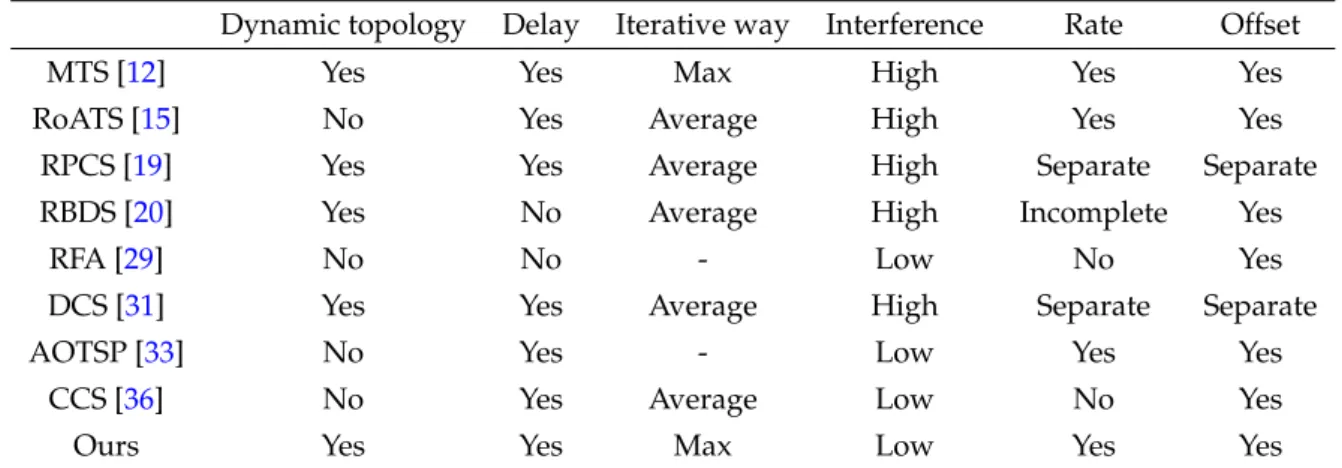
Table 1.The comparison of representative distributed timing protocols
Dynamic topology Delay Iterative way Interference Rate Offset
MTS [12] Yes Yes Max High Yes Yes
RoATS [15] No Yes Average High Yes Yes
RPCS [19] Yes Yes Average High Separate Separate
RBDS [20] Yes No Average High Incomplete Yes
RFA [29] No No - Low No Yes
DCS [31] Yes Yes Average High Separate Separate
AOTSP [33] No Yes - Low Yes Yes
CCS [36] No Yes Average Low No Yes
Ours Yes Yes Max Low Yes Yes
So, taking a hybrid approach, we first proposed RGCS algorithm without considering the delays,
207
which combines the advantage of randomized gossip algorithm and consensus based timesync. The
208
algorithm fully adjusts rate and offset, and also fits into the dynamic topology of randomly connected
209
WSNs with lower collision. The converge-to-max criterion was introduced to choose the coefficients
210
properly in order to enable fast convergence. A Revised-RGCS algorithm was developed by adopting
211
the least square based low-pass filter to counteract the impact of bounded delays. Summing up the
212
works for comparison in this section, the features of representative distributed timing protocols are
213
summarized in Table 1. Our time synchronization properties include:
• Rate and offset synchronization. Each clock rate and offset should be fully adjusted to achieve a
215
common virtual clock.
216
• Compatible with dynamic topology changes. A time synchronization protocol has to explore the
217
changing connectivity to design compensation rules.
218
• Energy-efficient. The number of message collisions should be small. Synchronization should be
219
finished within a limited time, since the gossip consensus is a not fast converging algorithm.
220
• Robustness against bounded time-delays. The bounded convergence should be guaranteed even
221
when bounded uncertain delays are present.
222
3. Problem Formulation 223
SupposeNsensor nodes of a WSN indexed byi = 1, 2, ...,N. Owing to the node dormancy or
224
death and random failure of links, a successful contact between a pair of nodesiandjdepends on the
225
probability distribution of the setup of stochastic links. Thus, the topology of dynamic ad hoc WSNs
226
is modeled as a time-varying graphG(t) = (V,E(t)). V is the set of vertices, and the existence of
227
stochastic linksE(t) ={eij(t)|i,j∈ V}is determined independently. The set of nodei’s neighbors is
228
denoted byNi = {j ∈ V,eij ∈ E(t)}. We use a notation(ij)to indicateeijwhich means nodeiandj
229
happen to link together, and the undirected random graph is bidirectional.
230
Definition 1. A synchronization link(ij)oreijmeans that an arbitrary random nodeiis coupled
231
with its geographical neighborj∈ Nionce to perform synchronous operation. Specifically, triggering
232
nodeisends a beacon to choose the triggered neighborjand confirm the ID of the synchronization
233
linkeij, then they swap timing messages with each other. Due to the randomized activation of nodes,
234
we need neighbor discovery protocol for nodes to discover each other when they are neighbors.
235
Fortunately, a simple and useful neighbor discovery protocol can be used as in [39].
236
Assumption 1. When nodei(i∈ V)is activated at timet, the cardinality|Ni(t)| ≥1.
237
Assumption 2. The delays of thelth uplink and downlink communication between nodeiand
238
jis denoted bydijanddji. They are unequal and bounded by upper boundD; that is, 0< dij < D,
239
dij̸=dji.
240
The oscillator generates the standard unit of frequencyΩ. The clock provides its readingτ(t)of
241
the elapsed absolute timetby accumulating the number of impulsive signalsτ(t) = κ∫tt
0Ω(ϵ)dϵ+ 242
τ(t0), whereκis a oscillator frequency correction. The oscillation frequency is nearly invariable in a
243
short time horizon, so the clock reading of theith node possesses linear dynamic behavior such as
244
τi(t) =ait+bi, (1)
whereai,biis the hardware clock rate and offset, respectively. aidetermines the timing rate of clock
245
andbirepresents the difference of nodes’ clock reading. The logical clock is a linear affine function of
246
τi(t).αi(t)is a multiplicative compensation andβi(t)is an additive compensation, as follows
247
Ti(t) =αi(t)τi(t) +βi(t) =αi˜ (t)t+βi˜ (t), (2) where ˜αi(t) =aiαi(t), ˜βi(t) =αi(t)bi+βi(t)are called the logical rate and offset, respectively. So, we
248
have available quantityτi(t), and two variablesαi(t),βi(t)to be designed.
249
The objective is to design a randomized communication protocol and a gossip-consensus-based
250
approach for coupled nodesi,j ∈ V announcing its timing messages and adjusting the logical rate
251
and offset, such that the logical clocksTi(i∈ V)is synchronized in the probability sense, as follows
252
∀i,j∈ V,∃Pr{lim
t→∞[Ti(t)−Tj(t)] =0}=1. (3)
Finally, notation Pr,o,Odenote probability, infinitesimal of higher order and infinitesimal of the
253
same order, respectively.
4. RGCS, Multi-RGCS, and Revised-RGCS Algorithms 255
4.1. RGCS Algorithm
256
4.1.1. Randomized Communication Protocol
257
!
!"#$!%!& '(!#))*!#+),+-.*/ 0*#)1"-!! '(!#))*!*.,+-.*/"
"
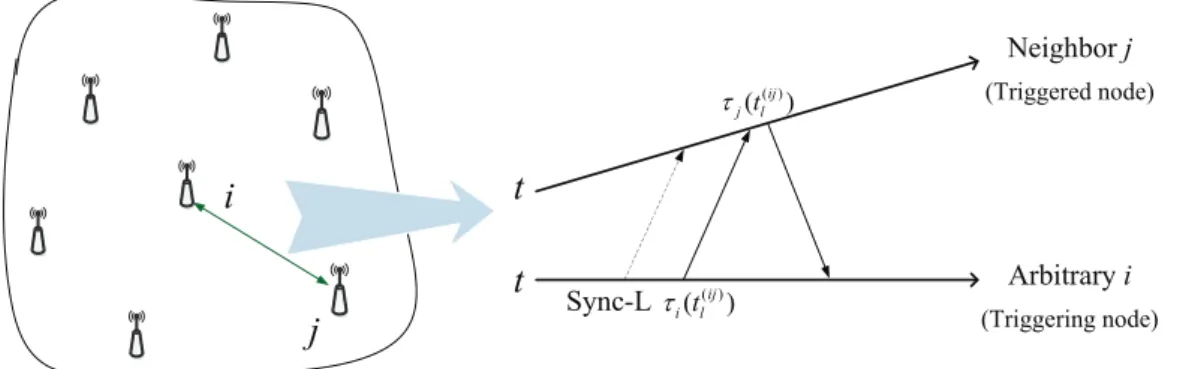
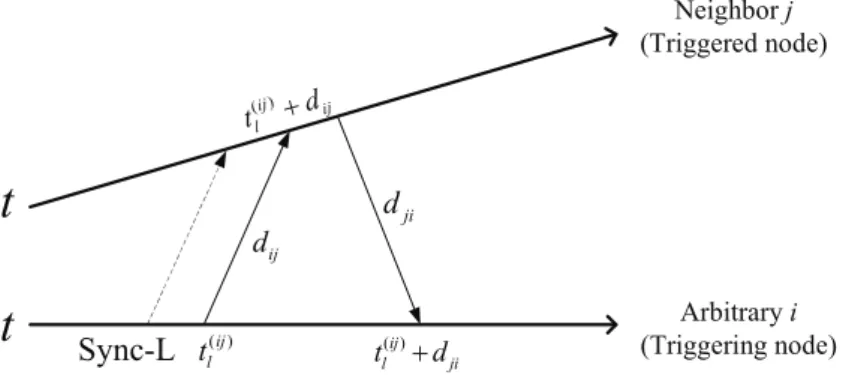
2&+345 ' / ' !/ # " ' / ' !/ ! "#Figure 1.The Sync-L beacon and timing message exchanges in a dynamic wireless sensor network.
A randomly connected ad hoc WSN is specifically characterized in that the nodes are randomly
258
activating and sleeping, and the RGCS algorithm is supposed to run independently in each individual
259
node. Firstly, the Poisson process is configured to each node in order to generate the Synchronization
260
Links (Sync-L) beacon which is sent to a node of its neighborhood by exploiting the broadcast nature
261
of wireless communications. Thus, the randomized activation ofeij(i,j∈ V)satisfies Poisson process
262
with the constant intensityλij such that Pr{t(ij)(l+σ)−t(ij)(σ) = n} = (λijl)n/n!eλijl,n = 0, 1..., 263
for∀l,σ ≥ 0. Some special circumstances are as follows, ifλij = 0, it means linkeijis not activated
264
forever; ifλij =∞, it means linkeijis activated infinitely in a given time interval. The Sync-L beacon
265
between nodei and jis confirmed, which is referred to the stochastic link activation event. Once
266
the randomized activation of linkeij takes place, by using the Media Access Control (MAC) layer
267
time stamps, triggering nodei pushes a multivariable message[αi(t(lij)),βi(tl(ij)),τi(t(lij))]to node j.
268
After that, the triggered nodejpulls a multivariable message[αj(t(lij)),βj(tl(ij)),τj(t(lij))]to nodei. The
269
overall procedure is illustrated in Figure 1.
270
Thus, accordingly, the set of activated synchronization links{∪iN=1,j=1eij(t)}are an identically
271
and independently distributed (i.i.d) Poisson distribution. Suppose that functionF(N)represents
272
the amount of synchronization links of an underlying graph. When it is a complete graph, we can
273
maximizeF(N)asN(N−1)/2. Clearly, the set{∪∞l=0∪Ni=1,j=1tl(ij)|eij ∈ E(t)}satisfies global Poisson
274
distribution with the intensityF(N)λ, because all intensities have the same value. Each global gossip
275
instant corresponds to an updating event. We denote∆(l,(ij))as the inter-time between consecutive
276
gossip instants for global Poisson process, and{∆(l,(ij))}l∈N,(ij)∈E(t)is an i.i.d process with moments
277
{
E[∆(l,(ij)] = F(1N)λ. E[∆2(l,(ij)] = (F(N2)λ)2.
(4)
The intensityλincreased, whereas∆(l,(ij))continuously decreased. The physical significance
278
ofλijrepresents the intermittent of activation events of linkeij, and the mathematical meaning ofλij
279
represents the mean value of the occurrence of the activation events per unit time. In many scenarios,
280
environmental-temperature variations will be slow to change around nodes. Hence, we can do that
281
by increasing intensityλijto enlarge the frequency of a link activation event in order to work against
282
slowly changing drifts.
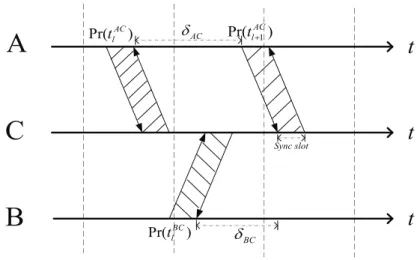
As shown in Figure 2, we illustrate how the proposed mechanism works under the hidden node
284
problem. Node A is visible from node B, and node C is visible from node B too. However, node A
285
and node B cannot sense with each other, because they are out of communication zone of each other.
286
In the deterministic communication protocol (such as ATS, MTS, RoATS, etc.), each node transmits its
287
timing messages periodically with a common period based on its own clock on chip. If node A and B
288
have small difference in term of the hardware rate and offset, they will announce timing messages to
289
node C simultaneously. Thus, the collisions will occur endlessly. In our proposed mechanism, each
290
node announces a timing message asynchronously based on its pre-programmed Poisson process,
291
and random pairwise nodes delivery timing messages in the uplink and downlink successively. So
292
node A randomly gossip, then a sync timeslot is established between node A and C with probability
293
Pr(tAC
l ). The sync timeslot between node B and C is established with probability Pr(tlBC). The Poisson
294
intervalsδAC,δBCare independent of each other. If the transmission delay is negligible, the width of
295
the sync timeslot can be narrow such that the probability of collisions will further down. Hence, with
296
an appropriateλ, the probability of collisions is lower than that in the deterministic communication.
297
!
"#$ !"% # "#$ $"% #&
"#$ '% $" # $" ! !"!
%&'()*#+Figure 2.Illustration of the proposed randomized communication under the hidden node scene.
To defend against message manipulation attacks, secure consensus timing protocols should
298
contain detecting and excluding outliers mechanism for the logical clock checking and hardware clock
299
checking. From the analysis of logical clock checking mechanism in literature [22], we know that the
300
bounded communication cycle which determined by{Ψ|τi(t) =NΨ,N=1, 2, ...,Ψ>0}is a pivotal
301
parameter of the secure protocols. However, the authors supposeΨ is invariable under malicious
302
modification with the purpose of preventing the attack nodes using outdated receiving information
303
to cheat, i.e., it makes nodes to collect messages from neighboring nodes within a constant duration.
304
The proposed gossip interaction mode which has less conservatism to topology changes can remove
305
this limitation properly. Also,Ψis the key parameter which contributes to represent the conforming
306
relationship of Definition 1 in literature [23] to defend against sybil attack, and RGCS is robust to the
307
distortion of bounded communication cycle.
308
4.1.2. Gossip Consensus Approach for Clock Rate and Offset Compensation
309
Let∆S(iij)be the difference of hardware clock readingsτiof triggering nodeiin gossip instantt(lij)
310
andt(l−ij)1, namely∆S(iij)=τi(t(lij))−τi(t(l−ij)1). The main idea of the updating rule is to utilize the gossip
311
consensus approach based on the interchange of the gossiping neighbors’ messages. Triggered node
312
jupdates its logical rate ˜αj(t)and offset ˜βj(t)by averaging them with the estimates of its gossiping
313
neighbors, namely ˜αj(t(l+ij)1) = (1−ρ1)αj˜ (t˜kj) +ρ1αi˜ (t(lij)). Each node consists of estimating the logical
314
rate with respect to virtual consensus rate, and local nodejstores a new compensationαj. Then by
315
dividingajat both sides of above equation, we have
αj(t(l+ij)1) = (1−ρ1)αj(t˜ j
k) +ρ1(ai/aj)αi(t( ij)
l ). (5)
whereρ1 ∈ (0, 1]. The constantρ1defines the degree of change of compensationαin gossip instant
317
t(l+ij)1. Ifρ1is set to a small value, the average information will remove in few updates. Additionally,
318
due to the discrete observations of the relative drift, we can increaseρ1to guarantee stationarity of the
319
estimatedα. Based on the above analysis, the converge-to-max criterion is applied to ˜tkj. The time, ˜tkj
320
indicates the previous gossip instant of arbitrary edges who contain nodejjust before activated edge
321
eij’slth gossip instant. Equation (5) counts the absolute time on two scales, i.e., updating usage round
322
and communication round, to avoid confusion between the updating iteration and the gossiping
323
communication. Scrupulously, ˜tjkis given as follows
324
˜
tkj =max{t(sjp),t(rqj)|t(sjp)<tl(ij),t(rqj)<t(lij);p,q=1, ...,n;s,r=1, 2, ...}. (6) When the Sync-Leijis activated in the next gossip instantt(lij), nodeiuseτi(t(l−ij)1)which be stored
325
in flash memory of sensors to compute the number of drift, namely the relative driftαji(t(lij))for node
326 jis computed by 327 ai/aj =αji(tl(ij)) =∆S(iij)/∆S (ij) j . (7)
During all iterations, each nodei’s storage isO(|Ni|)for all possible synchronization links. It implies
328
that, even though the size of the network node increases, the storage complexities of the RGCS per
329
node per iteration will not grow. This property ensures the scalability of the algorithm.
330
Substituting equation (7) into equation (5) yields the update equation of compensatingαj. Again,
331
based on the converge-to-max criterion, we design the rate compensation iteration rule of random
332
pairwise nodes. In this rule, the rate compensations of triggering nodei, triggered nodej, and silent
333
nodes evolve as follows
334
αj(t(l+ij)1) =max{αj(˜tjk),αji(t(lij))αi(t(lij))}, αi(t(l+ij)1) =max{αi(t˜i
k),αij(t
(ij)
l )αj(t
(ij)
l )}, αsilent(t(l+ij)1) =αsilent(t˜silentk ),
(8)
which means that random pairwise nodesiandjreach maximum logical clock together at a random
335
gossip instantt(l+ij)1, and other nodes are silent. In equation (8), nodeiandjsequentially iterate its own
336
estimated logical clock only once per gossiping interaction. Observing that whether ˜tikand ˜tkj will be
337
different or same depends on the contiguous activation of the Sync-L of global Poisson process.
338
After the rate compensation is applied, the random pairwise nodes compute the instantaneous
339
estimated logical clock differenceTi(t(lij))−Tj(t(lij))and try to adjust its offsetβin order to reduce the
340
difference. Once again, the gossip consensus approach and the converge-to-max criterion are applied
341
to local nodei,j, and silent nodes for attaining offset compensations, as follows
342 βj(t(l+ij)1) =βj(˜t j k) +ρ2(Ti(tl(ij))−Tj(t(lij))), βi(t(l+ij)1) =βi(t˜ik) +ρ2(Tj(t (ij) l )−Ti(t (ij) l )), βsilent(t(l+ij)1) =βsilent(t˜silentk ),
(9) whereρ2=1 andTi(t( ij) l ) =αi(t (ij) l )τi(t (ij) l ) +βi(t (ij)
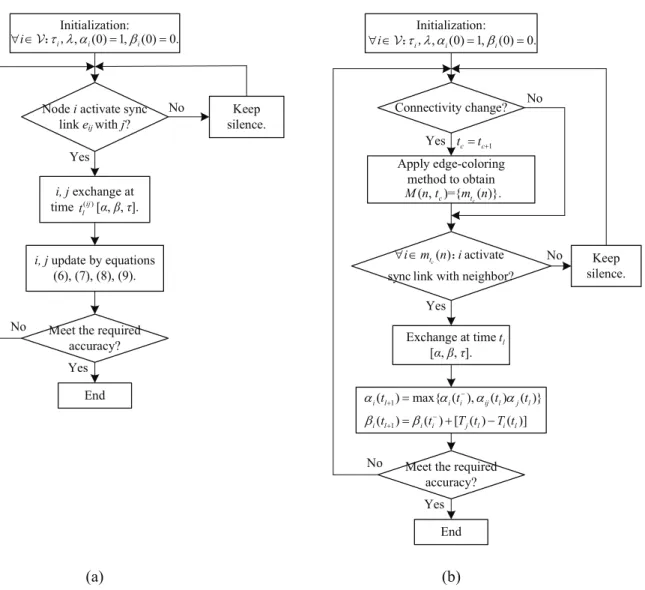
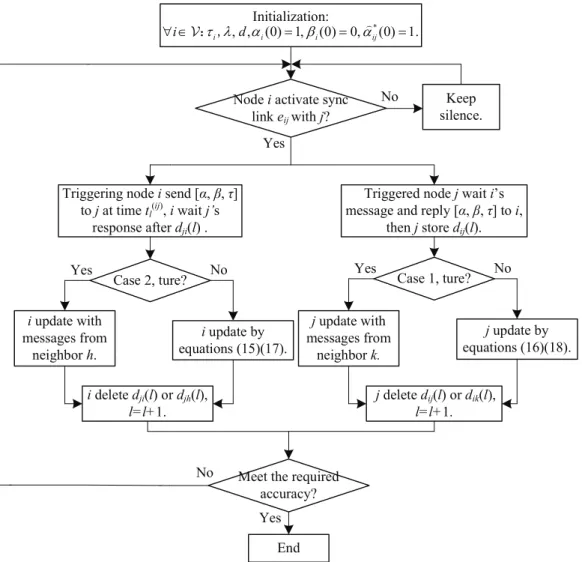
l ). The flowchart of RGCS algorithm is shown in
343
Figure 3(a), and the basic procedures are described as follows. Step 1. Randomly initialize each local
344
clockτi. Step 2. Judge whether arbitrary nodeiactivate its a neighbor or not, or is activated by its a
345
neighbor or not. Step 3. Perform update equations (6), (7), (8), and (9). Step 4. Judge whether to meet
346
the sync accuracy or not. Otherwise, return to Step 2.
!"#"$%"&$#"'!() *'+,) !$-#".$#,)/0!-) %"!1)" #!2"#3)#4 $ #,5-3$!6,)$#) #"7,)))))))8%9&9)':; $ #<=+$#,)>0),?<$#"'!/) @AB9)@CB9)@DB9)@EB; F,,#)#3,)G,?<"G,+) $--<G$-04 H!+ I,,=) /"%,!-,; J,/ J,/ *' *' 9 @KB L9 @KB K; ! " # $ % ! ! & & @ B # ( ) !"#"$%"&$#"'!() H5-3$!6,)$#)#"7,))) 8%9&9)':; F,,#)#3,)G,?<"G,+) $--<G$-04 H!+ I,,=) /"%,!-,; J,/ J,/ *' *' ( ) M'!!,-#"."#0)-3$!6,4 N==%0),+6,O-'%'G"!6) 7,#3'+)#')'>#$"!) L * * ) &)' J,/ *' @ 9) BPQ @ BR; * * ) + , ) - , @ B $-#".$#,) /0!-)%"!1)2"#3)!,"63>'G4 * ) - , ! $ % !
@$B
@>B
L L @ B 7$5Q @ B9 @ B @ BR @ B @ B 8 @ B @ B: ( # ( # ( ( # ( ( ) ) ) ) ) ) . ) . ) " " " " # # ( ' ( ' & & ' ( 9 @KB L9 @KB K; ! " # $ % ! ! & &Figure 3. Flowchart of the proposed algorithms. (a) Randomized Gossip-Consensus-based time Synchronization (RGCS). (b) Multi-RGCS.
4.1.3. Convergence of RGCS
348
Substituting equation (2) into (3) yields an intuitive translation of the time synchronization issue:
349 Pr{limt→∞αi˜ (t) =av}=1,∀i∈ V, Pr{limt→∞βi˜(t) =bv}=1,∀i∈ V, Pr[αi˜ (t)−αj˜ (t)] =o(1/t),∀i,j∈ V, (10)
whereavandbvare the parameters of consistent virtual clock. Equations (10) show that whether the
350
clocks achieve synchronization or not depends not only on the convergence of logical rate and offset,
351
but also on the convergence speed of the logical rate errors Pr[αi˜ (t)−αj˜ (t)], because errors will tend
352
to diverge if the convergence speed to zero of Pr[αi˜ (t)−αj˜ (t)]is slower than 1/t.
353
Theorem 1. Consider the rate and offset update equations given by Equation (6), (7), (8), (9), and
354
there exist two variables∆>0 andl>0 such that the union graphG(t(lij),∆(l,(ij))) =∪ij∪lG(t(lij))
355
for∀eij∈ E(t)is connected with probability one. Then, equations (10) hold true.
356
Proof. Firstly, two functionVv(t)and|Vv(t)|are introduced, whereVv(t)is the set of nodes whose
357
logical rate and offset are equal toav andbvin instant t, and|Vv(t)|is the cardinality of set Vv(t).
Defineamax = max{ai},∀i ∈ V, let nodevbe the node whose clock rate is equal toamax. According
359
to the initial sets, there is at least one node in network whose logic clock rate and offset equal toav
360
andbvin initial instant, i.e.,Vv(t)̸=⊘,|Vv(t)| ≥1. With loss of generality, assume nodejhas larger
361
logical rate. If the linkeijis activated at gossip timet(lij), nodeiwill update its logical clock such that
362
aiαi=ajαj,αibi+βi =αjbj+βj. Thus, the logical rate of each node is less than or equal toamaxduring
363
the iteration of RGCS. For a pair of nodesiandj,i,j∈ Vv, there hasaiαi =amax,αibi+βi =βvand
364
ajαj = amax,αjbj+βi = βv. Thus, we can infer thataiαi orajαj≥ akαkholds for∀k ∈ V. Therefore,
365
a pair of nodesiand jinVvwill no longer update its logical clock and maintain its logical rate and
366
offset during the latter iterations, which means that|Vv(t)|is nondecreasing.
367
The complement of a setVvis defined asV − Vv, which means that the set of nodes are not inVv.
368
If nodekis not in the setVv, then nodekis inV − Vv. Since all nodes’ logical rate is less than or equal
369
toamax during the iteration of RGCS, so we haveakαk <avfor∀k∈ V − Vv. Thus, if nodei ∈ Vvis
370
coupled with nodekby Sync-L, then it follows form equation (8) and (9) that nodekwill update its
371
logical clock such thatakαk = av,αkbk+βk = βv. Then, one obtains that|Vv(t+)| =|Vv(t)|+1 and
372
|V − Vv(t+)|=|V − Vv(t)| −1, wheret+is the finish time of the iteration. Hence,|Vv(t)|will strictly
373
increase when nodei∈ Vvis coupled with nodej∈ V − Vv.
374
If|Vv(t)|=Nin instantt, it implies that Pr{limt→∞αi˜ (t) =ac}=1, Pr{limt→∞βi˜(t) =bc}=1,
375
for∀i ∈ V. Otherwise, we have|Vv(t)|< N. Since graphG(t(lij),∆(l,(ij)))is jointly connected with
376
probability one, there is at least one linkeikfori ∈ Vvandk ∈ V − Vv, which means that there has
377
λik > 0. The probability of the event that linkeikis activated satisfies 1−e−λik(t
′−t
). Therefore, we 378
have the probability of|Vv(t)| ≥ |Vv(t)|+1 being equal to 1−e−λik(t
′−t
). Thus,|V
v(t)|will strictly
379
increase with probability one whent→∞. Hence, we have Pr{limt→∞|Vv(t)|=n}=1 which yields
380
Pr{limt→∞αi˜ (t) = ac} = 1, Pr{limt→∞βi˜ (t) = bc} = 1, for ∀i ∈ V. Then, Pr[aiαi(t)−ajαj(t)]can
381
approximate to zero whent→∞. Clearly, limt→∞Pr[aiαi(t)−ajαj(t)]/(1/t) =0, Pr[αi˜ (t)−αj˜ (t)] =
382
o(1/t)thus satisfied. The Theorem 1 thus proved.
383
In practice, considering the thrift energy to bigger extent, finite-time convergence of algorithms
384
is very important in WSNs. Next, we will give the lower bound of the probability for the finite-time
385
convergence of RGCS. For nodei,j, let’s assumeWijrepresents the time cost for a link activation event.
386
Thenuij,Uij =
∫t
0uij(s)dsis the probability density function and probability distribution function of
387
Wij, respectively.
388
Theorem 2. Suppose the union graphG(t(lij),∆(l,(ij))) = ∪ij∪lG(t(lij))for∀eij ∈ E(t)is connected
389
with probability one. Then, we have Pr{Ti(t) =τv(t),i∈ V} ≥∏i∈VUvi(t).
390
Proof. From the proof of Theorem 1, we can conclude that node iin V − Vv will become a node
391
inVv after the linkevi is activated. WhenTi(t) = τv(t), there has Pr{Ti(t) = τv(t)} = Uvi(t),i ∈
392
V. ∏i∈VPr{Ti(t) = τv(t)} ≤ Pr{Ti(t) = τv(t),i ∈ V}which yields Pr{Ti(t) = τv(t),i ∈ V} ≥
393
∏i∈VUvi(t). The Theorem 2 thus proved.
394
4.2. Multi-RGCS Algorithm
395
Obviously, RGCS is obtained by the single-gossiping rule. Under this scenario, other silent nodes
396
are situated in wait state, while only one synchronization link is activated in a timeslot. We expect that
397
more coupling nodes are able to exchange and update states in a timeslot, or more than a neighboring
398
node can overhear triggering node’s messages (i.e. broadcast gossip manner). Based on their positive
399
effect on the performance of the convergence rate, the Multi-gossiping version of RGCS (Multi-RGCS)
400
is topic which is worth exploring. In fact, we can assume that more than two nodes(i,j, ...)wake up in
401
tl simultaneously with probabilityP(tl)>0. So the single-gossiping version corresponds to specific
402
implementation of above assumption in which if and only if two nodesiandjwake up.
403
Different from the foregoing single-gossiping, Multi-RGCS requires an additional precondition
404
that the synchronization links can not have public vertex in the same slot. In other words, we need
to seek a multi-gossip sequenceM(n,tc) = {mtc(n)},nis the color number,tcis the switching time. 406
So, the synchronization links are dyed different colors, and those links who have the same color are
407
categorized as the groupmtc(n). This problem could be investigated by the idea of the Edge-Coloring
408
(EC) [40]. The EC aims at an assignment of one color to each synchronization link such that no two
409
synchronization links on the same node are assigned the same color. Here, we give a straightforward
410
EC algorithm to realize Multi-RGCS as in Figure 3(b). Thereinto, the key procedures of obtaining the
411
multi-gossip sequence are summarized as follows. Fortcdo Step 1. Generate a spanning treeHof
412
graphG(tc); Step 2. Randomly pick a single edge inH, find a non-adjacent edge to the former, find a
413
nonstaining edge for coloring the third color, until it can not find any nonstaining edge. Step 3. The
414
edges of different colors constitute the multi-gossip sequenceM(n,tc) ={mtc(1),mtc(2), ...,mtc(n)}.
415
The probability characteristics of the set{tl,l = 1, 2, ...}is similar to the set{
∪∞ l=0 ∪N i=1,j=1t (ij) l }, and 416
the physical meaning oft−i refers to the previous gossip instant of any synchronization link involving
417
nodei. In Multi-RGCS, several nodes are involved in multi synchronization linksmtc(n)to increase
418
the synchronization traffic and enhance the convergence speed.
419
4.3. Revised-RGCS Algorithm
420
In RGCS, we suppose that the delays is negligible. However, by considering various disturbance,
421
which act as additive noise model (such as the delay), the actual timestamp is truly noisy, and the
422
delay distribution is unknown. To deal with this issue, we proposed a least square estimation based
423
low-pass filter against bounded delays (Assumption 2). As shown in Figure 4, the time-delay of the
424
lth communication between nodeiandjis denoted bydij(i →j, namelydijinfluences∆S(jij)). dijis
425
bounded by upper boundD; that is, 0<dij <D.dji(j→i, namelydjiinfluences∆S(iij)) is the same
426
definition asdij, but may be unequal.
427 !"#$!%!& '(!#))*!#+),+-.*/ 0*#)1"-!! '(!#))*!*.,+-.*/
"
"
2&+345
' / ! # " ' / ! # ! " $ ' / ! # ! " $ ! $ ! $Figure 4.Illustration of gossip-consensus-based time synchronization with bounded delays.
Due to the symmetry, the following process takes the case ofdij. Based on the definition of the
428
relative drift anddij, we have a longspan estimator ˆαij(l)forαij(l)as follows
429 ˆ αij(l) = τj(t (ij) l +dij(l))−τj(t (ij) 0 +dij(0)) τi(t(lij))−τi(t(0ij)) = aj(∑ lδij(l) +d ij(l)−dij(0)) ai∑lδij = αij(1+ξˆ(l)), (11) where ˆξ(l) = dij(l)−dij(0) ∑lδ
ij ,δijis the inter-time between consecutive gossip instants for linkeij. Sincedij 430 is bounded byD, we have|ξˆ(l)| ≤ D ∑lδ ij. Hence, we know ˆξ (l)decays in a rate ofO(1/δ). 431
Let ˆα∗ij(l)be the optimal estimator for ˆαij(l), and denoteel =αijˆ (l)τi(t( ij) l )−αˆ∗ij(l)τi(t (ij) l ). A least 432
square principle asJ=∑ll=1e2l is employed. For calculating the recursion of ˆα∗ij(l), we apply a partial
433
derivative for ˆα∗ij(l), namely
434
∂J
∂αˆ∗ij(l) =0, (12)
which yields a optimal estimator as follow
435 ˆ αij∗(l) = (1−γ∗(l))αˆ∗ij(l−1) +γ∗(l) τj(t(lij))−τj(t(0ij)) τi(t(lij))−τi(t(0ij)) , (13)
where the weighting parameter γ∗(l) = δ2(1)+(δ2(1)+δδ22((12)+))+δ2...(2+()+δ...2(+1δ)+2(δl)2(2)+...+δ2(l)) and ˆα∗ij(0) = 1.
436
Substituting equation (11) into (13) yields
437
ˆ
α∗ij(l) =αij(1+ξˆ∗(l)), (14) where ˆξ∗(l) = δ(1)+(δδ((11)+()+δδ((21))+)+δ...(2+())2δ+(1...)++(δ(δ2(1)+)+...δ+(2δ)+(l))(...+dijδ((ll)))−d2 ij(0)). Then by boundeddij, and we notice 438
that, the denominator of ˆξ∗(l)isδ’s quadratic term after accumulating, and the numerator of ˆξ∗(l)is
439
δ’s first degree term. It implies that the decay rate of ˆξ∗(l)is alsoO(1/δ). This decay rate ensures
440
that the proposed least square estimation based low-pass filter avoids the divergence condition of
441
Pr[αi˜ (t)−αj˜ (t)]. Hence, we can utilize αˆ ∗
ij(l)
(δ(1)+δ(1)+δ(2)+...+δ(l))1/2 to replaceαij(t
ij
l)and modify the rate
442
updating rule of triggering nodeiof equations (6), there is
443 αi(t(l+ij)1) = (1− ρ1 (δ(1) +δ(1) +δ(2) +...+δ(l))1/2)αi(˜t i k) + ρ1αˆ∗ij(l)αj(t (ij) l ) (δ(1) +δ(1) +δ(2) +...+δ(l))1/2. (15) The criterion for selecting the appropriate weighting parameter(δ(1) +δ(1) +δ(2) +...+δ(l))−1/2is
444
based on a piece-wise constant function, and it is chosen to be a decreasing factor, which contributes to
445
restraining the negative effect of additive noise in stochastic approximation. Actually, the weighting
446
parameter in this paper is a special case of the standard conditions in stochastic approximation
447
methods:Σ∞l (δ(1) +δ(1) +δ(2) +...+δ(l))−1/2=∞andΣ∞l (δ(1) +δ(1) +δ(2) +...+δ(l))−1<∞.
448
Sinceαij(t(lij))is an estimation of inverse relative driftαji(t(lij)), the rate updating rule of triggered
449 nodejis 450 αj(t(l+ij)1) = (1− 1−ρ1 (δ(1) +δ(1) +δ(2) +...+δ(l))1/2)αj(t˜ j k) + (1−ρ1)αi(t(lij)) ˆ α∗ ij(l)(δ(1) +δ(1) +δ(2) +...+δ(l))1/2 . (16) Then, the clock offset compensations of local nodei,jis updated as follows
451
βi(t(l+ij)1) =βi(t˜ik) +ρ2(Tj(tl(ij))−Ti(tl(ij)+dji(l))). (17) βj(t(l+ij)1) =βj(t˜jk) +ρ2(Ti(t
(ij)
l )−Tj(t
(ij)
l +dij(l))). (18) The delays also have impact on ˜ti
k. The issue is caused by the fact that nodejwould not instantly
452
receive its gossiping neighbor’s states due to uncertain delay, and if delaydij satisfy following two
453
conditions: (i) delaydijgreater than inter-time∆; (ii) nodejjoins next gossip averaging; ˜tikwill change
454
and need to be modified. Whend(ij) ̸= d(ji), we call asymmetric gossip, and that is a common case.
To clearly explain how delay influence the local updating equations, we might as well suppose link
456
eijis activating. After∆, there are three possibilities of adjacent Sync-L:eik,ejh,ekh,∀k,h∈ V, if:
457
Case 1,dij ≥ ∆(l,(ik)) +n∆(l,(kh)),n= 0, 1, ..., then equations (16), (18) utilize ˆα∗ik(l)and ˜tik =
458
max{t(sik),tr(ki)|s,r = 1, 2, ...}. Case 2, dji ≥ ∆(l,(jh)) +n∆(l,(kh)),n = 0, 1, ..., then equations (15),
459
(17) utilize ˆα∗jh(l)and ˜tjh=max{ts(jh),t(rhj)|s,r=1, 2, ...}.
460
The discriminant of Case 1 and Case 2 is easy to implement, because the comparison between
461
the length of delay and the interval time of node activation depends on the local nodes themselves.
462
The delays make Revised-RGCS slightly complex, but it will not damage the convergence. However,
463
we should point out that the update of the logical rate is based on the longspan neighboring states
464
τj(t(lij))−τj(t(0ij)), so the nodes should set up a cached memory for forming buffer queue of the timing
465
messages. Summarize the above process, a flow diagram of the Revised-RGCS algorithm is described
466 in Figure 5. 467 !"#"$%"&$#"'!() *$+,)-.)#/0,1 !/23$#,)4"#5) 6,++$7,+)80'6) !,"759'0)": ;,,#)#5,)0,</"0,3) $==/0$=>1 ?!3 @,,2) +"%,!=,: A,+ A,+ B' B' C
. .$ DEF G. DEF E. #DEF G:
! " $ # " % $ & ! ! $ B'3,) !$=#"H$#,)+>!=) %"!I)% #!4"#5)#1 J0"77,0"!7)!'3, !+,!3)K&.'.)(L #'#$#)#"6,))*D #F. 4$"##++) 0,+2'!+,)$8#,0$# D*F : A,+ B' /23$#,)9>) ,</$#"'!+)DGMFDGNF: !3,%,#,)$# D*F)'0)$#"D*F.) *,*-G: J0"77,0,3)!'3,)#4$"#)O+) 6,++$7, $!3 0,2%>)K&.'.)(L #' .) #5,!#!+#'0,)$ #D*F: *$+,)G.)#/0,1 #/23$#,)4"#5) 6,++$7,+)80'6) !,"759'0)./ A,+ B' #/23$#,)9>) ,</$#"'!+)DGPFDGQF: #!3,%,#,)$ #D*F)'0)$ .D*F.) *,*-G:
Figure 5.Flowchart of Revised-RGCS algorithm.
5. Simulation Studies 468
To verify the superiority of novel proposed algorithms, we carried out comparative simulations
469
for RGCS and Multi-RGCS with delay-free case in the Matlab R2010b. Then, using the OMNeT++ 5.1
470
simulator, a more realistic simulator for WSNs, we verified the Revised-RGCS algorithm with delays.
5.1. Delay-Free Case
472
As shown in Table 1, DCS and RPCS are two appropriate reference algorithms, so we compared
473
the performances of RGCS with them. All of them have been investigated numerically for emulating a
474
randomly connected ad hoc WSN. The important parameter setting is described as follows. The local
475
hardware rate is chosen from [0.999, 1.0001], and the local offset is chosen from [0, 0.002]. αi(0) =1
476
and βi(0) = 0. The number of nodes is 9, and the number of local nodes that can be accessed by
477
other nodes is 3. The initial synchronization period is 10 s. The threshold of successful Sync-L is
478
characterize by a Poisson process with intensityλ, and the intensity reflects the connection strength
479
between individual nodes. The average number of Sync-L per time interval is 10. It is feasible that
480
the joint topologies of simulation model of dynamic WSN are connected with probability one. The
481
time unit is one second. The required accuracy is±1 millisecond. Because there are no reference
482
nodes and random initial parameters, we employed a metric to evaluate the synchronization error of
483
the algorithms: the maximum difference of the parameters between any two nodes in overall WSN
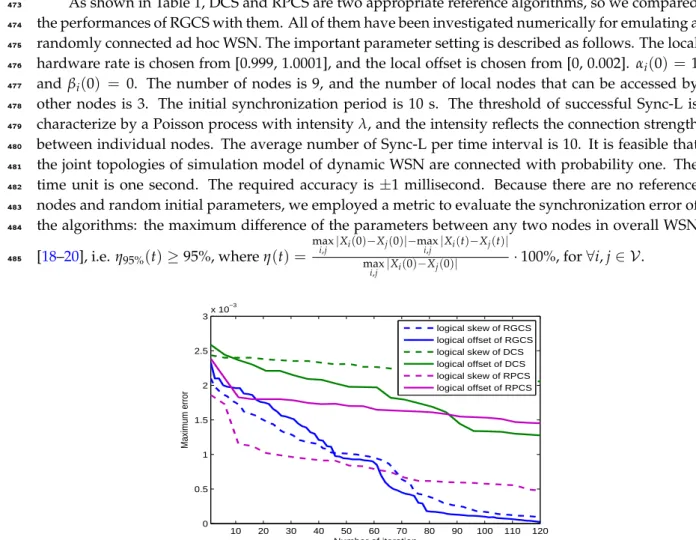
484 [18–20], i.e.η95%(t)≥95%, whereη(t) = max i,j |Xi(0)−Xj(0)|−maxi,j |Xi(t)−Xj(t)| max i,j |Xi(0)−Xj(0)| ·100%, for∀i,j∈ V. 485 10 20 30 40 50 60 70 80 90 100 110 120 0 0.5 1 1.5 2 2.5 3x 10 −3 Number of iteration Maximum error logical skew of RGCS logical offset of RGCS logical skew of DCS logical offset of DCS logical skew of RPCS logical offset of RPCS
Figure 6.Comparison of maximum error of rate ˜αi(t)and offset ˜βi(t)between RGCS algorithm and
the reference algorithms.
Figure 6 shows the maximum error of logical rate ˜αi(t)and offset ˜βi(t)under RGCS and DCS.
486
In our algorithm, logical rate and offset synchronization can be achieved simultaneously. So, RGCS
487
designed for randomly connected WSNs is an asynchronous and distributed configuration, and can
488
make a complete compensation for the rate and offset. Due to the dense node density, DCS can not
489
achieve rate compensation and offset compensation simultaneously. Because DCS devised for sparse
490
node density to tolerate long delays leads to the synchronous mode for the update of the rate and
491
offset. At the beginning of the compensation in RPCS, the rate of the rate compensation is faster than
492
that in RGCS, because RPCS employs a standard frequency estimation technique to obtain an estimate
493
of the pairwise drift. However, the descending rate of the offset compensation is relative slow, and
494
the logical clockTi(t)could not be synchronized without the backward jumps phenomenon.
495
Figure 7 shows the maximum error ofTi(t)of RGCS underλ = 1, 5, 10, from which it can be
496
observed that it takes less time withλ=10 to reach synchronization. This is because a larger intensity
497
of Poisson process can decrease inter-time∆(l,(ij))between consecutive gossip instants for any links.
498
The results in Figure 6 validate the theoretical features of equation (3). So the descent velocity of the
499
maximum error of logical clocks withλ=10 becomes more remarkable.
500
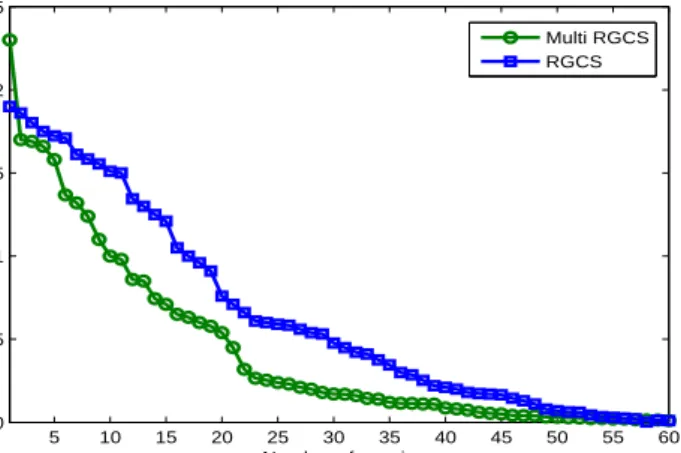
Figure 8 shows the comparative simulation results with regard to single RGCS and Multi-RGCS.
501
The green line represents the convergence of logical clocks in Multi RGCS. Falling speed of green line
502
is faster than blue line (single RGCS), because more clocks exchange their states and come close to
0 50 100 150 200 250 0 0.5 1 1.5 2 2.5 3 3.5x 10 −3
Sampling point of absolute time
Maximum error of logical clock (average value for 100 rounds)
λ=1 λ=5 λ=10
Figure 7.Comparison of maximum errors of logical clocksTi(t)of RGCS under differentλ(the same
initialization values of clocks for comparing intuitively).
5 10 15 20 25 30 35 40 45 50 55 60 0 0.5 1 1.5 2 2.5x 10 −3 Number of gossip
Maximum error of logical clocks
Multi RGCS RGCS
Figure 8.Comparison of maximum errors ofTi(t)between single RGCS and Multi-RGCS.
the maximum-value at each gossip instant. Then, Figure 9 shows the relationship between different
504
coloring edge’s number ranging fromn= 5 ton = 12 and 95th percentile of synchronization errors.
505
The performance degrades as more coloring number increase, however it exhibits a approximative
506
linear dependence, thus it refers to the amount of gossip as a function of the coloring numbern. So
507
we can involve this feature to suppress drift for different synchronization accuracies.
508
Based on the above simulation results and discussions, it can be seen that the paper has proposed
509
a RGCS algorithm with superior performances compared to existing methods in term of dynamic
510
adaptability and faster convergence speed. A edge-coloring algorithm can be applied to constitute a
511
spanning tree so that Multi RGCS has faster convergence speed than that in RGCS.
512
5.2. Bounded Delay Case
513
OMNeT++ is an extensible, modular, component-based C++ simulation library and framework,
514
primarily for building network simulators. Based on MiXiM framework and Network Description
515
(NED) files, we implement an ad hoc WSN on the OMNeT++ 5.1.1, and then run the Revised-RGCS
516
algorithm on it. It has been simulated for WSNs ofN= 9 clocks placed on a field of size 100m×100m.
517
Moving sensors indexed by bidimensional coordinate XY, namely node11, node12, node13, node21,
518
node22, node23, node31, node32 and node33. For those mobile nodes, we used the Random Walk
519
module to locate the coordinate position of the node. In this module, each node was made to move