DOI 10.1007/s00213-005-2180-z
ORIGINAL INVESTIGATION
Serge H. Ahmed . George F. Koob
Transition to drug addiction: a negative reinforcement model
based on an allostatic decrease in reward function
Received: 28 August 2004 / Accepted: 9 January 2005 / Published online: 25 February 2005 #Springer-Verlag 2005
Abstract Rationale: The transition from initial drug use to drug addiction has been proposed to result from an allostatic decrease in reward function driven by an over-activation of brain antireward processes. Objectives: How decreased reward function explains compulsive drug use is not entirely clear at present, and is still a subject for debate. Methods: We present a quantitative model of cocaine self-administration that integrates pharmacokinetic, pharmaco-dynamic, and motivational factors to address this question. The model assumes that reward system responsivity is a homeostatically regulated process where the desired level of responsivity (called the reward set point) is initially dif-ferent from the baseline level. The reduction or correction of this difference or error in reward function would drive cocaine self-administration. Results: Theoretical data ob-tained by computer simulation fit the experimental data obtained in animals self-administering cocaine (i.e., the within-session pattern of self-injections, the shape and curvature of the dose-injection function, the nonlinear relationship be-tween drug intake and regulated drug effects). Important-ly, simulation of an allostatic decrease in reward system responsivity exacerbates the initial error that drives self-administration, thereby increasing both the intake of, and the motivation for, the drug. This allostatic change mani-fests as a vertical shift in the dose-injection function similar
to that seen in animals with escalating cocaine self-admin-istration. Conclusions: The present model provides a sat-isfactory explanation of escalated drug intake and suggests a novel negative reinforcement view of addiction based on an allostatic decrease in reward function.
Keywords Reward . Reinforcement . Self-administration . Self-medication . Self-regulation . Dopamine . Cocaine . Laboratory environment
Introduction
Escalation of drug consumption marks the transition from drug use to drug addiction. This process of escalation is exceptionally well illustrated in an old clinical study by Abraham Wikler (1952). An abstinent subject with a his-tory of opiate use was given ad libitum access to intrave-nous morphine during a period of 4 months. His morphine intake dramatically escalated between days from an initial level of 60 mg day−1to a final level of more than 1,000 mg day−1. Escalation of drug use in response to increased drug availability occurs also with stimulant drugs (Siegel1984; White1988; Gawin and Ellinwood1989; Ferri et al.2001). A paradoxical aspect of the transition to escalated levels of drug intake is that drug users spend progressively more time and effort (i.e., increased motivation) trying to obtain drug hedonic effects, although they complain that these effects continually diminish with repeated experience (i.e., toler-ance). Different neurobiological hypotheses have recently emerged as an attempt to solve this long-standing paradox with the hope to explain drug addiction (e.g., Robinson and Berridge1993; Koob and Le Moal1997). Until recently, however, it has proven difficult to test these various hy-potheses, partly because there has been no adequate model for studying drug intake escalation in the laboratory.
Based on previous work using unlimited access to drug self-administration (Deneau et al. 1969; Johanson et al.
1976; Bozarth and Wise 1985), we and others recently
developed an animal model of the development of com-pulsive drug use (Ahmed and Koob1998,1999; Mantsch This is publication number 14156-NP from The Scripps Research
Institute. This work was presented at the annual meeting of the Society for Neuroscience, November 2001, in San Diego, CA. S. H. Ahmed (*)
Laboratoire de Neuropsychobiologie des Désadaptations, University Victor-Segalen Bordeaux2, CNRS-UMR 5541, 33076 Bordeaux, France e-mail: [email protected] Tel.: +33-557-571566 Fax: +33-556-900278 S. H. Ahmed . G. F. Koob Department of Neuropharmacology, The Scripps Research Institute, La Jolla, CA, 92103, USA
et al.2001; Paterson and Markou2003; Vanderschuren and Everitt 2004). Differential access to intravenous self-administration of cocaine produces two patterns of drug intake. With 1 h of access per session (short access or ShA), drug intake remains low and stable over time. In contrast, with 6 h of access per session (long access or LgA), drug intake gradually escalates to increasingly higher levels of intake. Similar results were obtained in rats self-adminis-tering heroin (Ahmed et al.2000). The difference between stable and escalating patterns of drug consumption has been hypothesized to model the difference drawn by clinicians between controlled and compulsive drug use (Ahmed and
Koob1998). This hypothesis is supported by a recent series
of experiments showing that rats with escalated levels of cocaine intake (LgA rats) can be considered as genuine cocaine-addicted individuals compared to rats with stable cocaine intake (ShA rats). First, LgA rats persist longer than ShA rats in seeking the drug despite the fact that their be-havior is not rewarded (Ahmed et al.2000). Second, LgA rats are more motivated than ShA rats to obtain the drug, as measured under a progressive ratio schedule of cocaine self-administration (Paterson and Markou 2003). Third, LgA rats take increased risks to obtain the drug after ex-posure to prolonged access to cocaine self-administration (Vanderschuren and Everitt2004). Finally, the prevalence of relapses to cocaine seeking after extinction is consider-ably higher in LgA rats (about 80%) than in ShA rats (less than 20%) (Ahmed and Cador, personal communication).
Several different mechanisms have been proposed to explain the transition from controlled to compulsive drug use in animals with extended access to the drug, including tolerance to the rewarding effects of cocaine and sensiti-zation to its incentive-motivational properties (Zernig et al. 2004and associated commentaries). According to the he-donic allostasis hypothesis of drug addiction (Koob and Le
Moal 1997, 2001), which is a modification of Solomon
and Corbit’s (1974) classical opponent-process theory of motivation, the precipitation of compulsive drug use by increased drug availability would result from a chronic decrease in reward system responsivity that is produced by an overactivation of brain antireward processes. Structur-ally, the brain reward system is hypothesized to be mainly the neural circuitry involving the extended amygdala and its connections with the lateral hypothalamus (Koob and Le Moal2001; Heimer2003). Functionally, this system is hypothesized to assign positive or negative affective va-lences to sensory stimuli depending on the current state and past experience of the subject. The responsivity of the reward system to the environment would be homeostat-ically regulated by pro- and antireward neuromodulatory inputs which counterbalance each other to maintain reward responsivity within a narrow range (Koob1996). The most studied proreward neuromodulatory input arises from mid-brain dopamine cells. Antireward neuromodulators have been considerably less studied but may include corticotro-pin-releasing factor (CRF), a major stress neuropeptide, and probably dynorphin, an endogenous agonist of κ-opioid receptors (Koob and Le Moal2001).
By acting on dopamine transmission, cocaine is hypoth-esized to boost reward system responsivity outside the nor-mal range, thereby increasing the hedonic impact of sensory stimuli.1 This abnormal facilitation of brain reward func-tion, however, would be followed rapidly by an opposing reaction (Solomon and Corbit’s b-process) that tends to slowly return the system to the initial level of hedonic re-sponsivity (Koob1996). Under increasingly frequent drug demand, such as in animals with prolonged access to co-caine, the counterreaction fails to return the system within the normal range of functioning before drug-taking begins again, thereby gradually decreasing brain reward function (residual hysteresis) (Koob and Le Moal2001). This sta-bilized new level of reward system responsivity represents an allostatic decrease in reward function (Koob and Le
Moal1997,2001).
Evidence for brain reward homeostasis is provided by previous studies that measured directly the responsiveness of well-identified brain reward circuits by assessing the circuits’electrical thresholds by means of the intracranial self-stimulation (ICSS) procedure (Kornetsky and Esposito
1979; Markou and Koob1992). Under baseline conditions,
ICSS reward thresholds are very stable over a long period of time, supporting the hypothesis that brain reward systems are under homeostatic control (Markou and
Koob1992). However, during withdrawal from a single,
prolonged exposure to various drugs of abuse, ICSS thresholds increase above baseline and then slowly return to baseline levels hours afterward (Leith and Barrett 1976; Markou and Koob1991; Schulteis et al.1994,1995; Wise and Munn 1995; Epping-Jordan et al. 1998). This after-reaction is opposite in direction to the well-documented low-ering effects of drugs of abuse on ICSS thresholds (Gardner and Lowinson 1993; Wise 1996) and is associated with a dysphoric-like effect in both animals (Ettenberg et al.
1999) and humans (Van Dyke and Byck1982). These
ob-servations demonstrate that the acute reward-facilitating effects of the drug are effectively counterbalanced by an opposing after-reaction that is slow to decay.
More recently, we observed that this transient counter-reaction fails to return to normal between days in animals allowed extended access to cocaine self-administration, thereby producing a progressive and persistent elevation in 1This reward-facilitating effect may suffice to explain the mood-elevating or euphoric effect of cocaine which is consistent with imaging studies of brain dopamine in humans (Volkow et al.2004). Thus, cocaine would not activate directly the reward system but would via dopamine facilitate its activation by sensory stimuli (see also Gallistel1986). This dopamine reward-modulation hypothesis of cocaine action is consistent with the general role of dopamine in regulating functionally specialized forebrain modules (Le Moal and Simon1991). It is also supported by data showing that stimulant drugs potentiate operant responding for unconditioned sensory stimuli, such as discrete light cues (Berlyne1969; Gomer and Jakubczak 1974), and for classically conditioned sensory stimuli (Hill1970; Robbins 1976; Robbins and Koob1978; Dickinson et al.2000). Finally, this hypothesis is more directly supported by the well-documented low-ering effect of cocaine on the threshold for brain reward stimulation (Esposito et al.1978; Kornetsky and Esposito1981; Bauco and Wise 1997).
reward thresholds (i.e., decreased reward system respon-sivity; Ahmed et al.2002). The establishment of this new level of reward system responsivity precedes and is highly correlated with escalation of cocaine use. No change in reward thresholds is observed in animals with limited ac-cess to the drug. This chronic elevation in brain reward threshold is hypothesized to reflect the chronic overac-tivation of brain neurotransmitter systems that functionally antagonize brain reward systems (Koob and Le Moal2001). Reduction of this chronic overactivation by drug taking would add a novel source of negative reinforcement, there-by further increasing the motivation to take cocaine (Koob 1996).
In addition, an allostatic decrease in reward function produces tolerance to the rewarding effect of cocaine. Due to the persistent elevation in basal reward threshold, co-caine fails to lower thresholds—and thus facilitate reward function—to the same level as prior to escalation (Ahmed et al.2002). As a result, more cocaine doses are needed to maintain the same level of reward facilitation. Similar base-line shifts were also observed to explain tolerance to the discrimative cues of amphetamine (Barret et al.2004) and to the analgesic effects of heroin (Celerier et al. 2001) Because the chronic elevation in baseline reward threshold
is hypothesized to result from an overactivation of brain antireward systems, we call this adaptive mechanism be-tween-system tolerance as opposed to within-system tol-erance (Koob and Bloom 1988; see also Tabakoff and Hoffman 1992). The latter within-system tolerance does not involve activation of opponent processes but adapta-tions of the primary drug response mechanism within the reward system itself. Theoretically, within-system toler-ance should manifest as a decrease in the net effect of cocaine, without any alteration in baseline reward function. This phenomenon was not observed in rats with escalating cocaine use, however (see Fig. 2 in Ahmed et al. 2002). Thus, an allostatic decrease in reward function appears to provide a satisfactory and parsimonious explanation of between-system tolerance to, and increased motivation for, the rewarding effect of cocaine associated with escalated levels of consumption.
In this work we present a model that integrates pharma-cokinetic, pharmacodynamic, and motivational variables to test more quantitatively the effects of an allostatic decrease in reward function on intravenous cocaine self-administra-tion. The model assumes that reward system responsivity is a homeostatically regulated process where the desired level of responsivity (called the reward set point) is initially
Brain concentration (nM) 101 102 103 104 105 R ew ar d th re sh ol d 0 25 50 75 100 T50 T0 Emax model Reward threshold Drug delivery Set point (TS)
+
-k21 k12 k el Blood Brain P K m o d el P D m o d el E rr o r = T0 -TS Baseline (T0) Sensor ControllerFig. 1 Diagram of the closed loop system controlling the
intrave-nous administration of cocaine. The system senses its output (i.e., baseline reward threshold, notedT0) and compares it with the input signal (i.e., the set point or ideal threshold,TS). The input–output difference is the error signal (T0−TS), which is used by the controller to turn on the drug delivery device. The drug delivery device
ad-ministers the drug directly into the bloodstream each time baseline reward threshold is above the ideal threshold (T0−Ts>0). Cocaine pharmacokinetics (PK model) is simulated in a two-compartment open model with zero-order drug input (i.e., instantaneous absorp-tion). Cocaine effect on reward threshold is simulated by using a classical inhibitoryEmaxmodel (PD model)
different from the baseline level. The reduction or correc-tion of this error in reward funccorrec-tion would drive cocaine self-administration (Fig.1). Although the postulation of a preexisting hedonic deficit is speculative, it is consis-tent with several behavioral observations and suggests a novel negative reinforcement view of cocaine addiction (see
Discussion below). In addition, the notion that drug
self-administration reflects reward self-regulation is supported by behavioral, pharmacological, neurochemical, and neu-rophysiological data (Yokel and Pickens 1974; Pettit and Justice1989; Wise et al.1995; Peoples et al.1998; Chang et al.1998; Ahmed and Koob1999; Tsibulsky and Norman
1999; Lau and Sun2002; Panlilio et al.2003; for an
excel-lent review on drug intake regulation, see Lynch and Carroll 2001).
Materials and methods Scope of the model
It is important to note at the outset that the model elab-orated here has several limitations. First, the domain of application of the model is strictly limited to situations where cocaine is the only observable source of reward available to the individual, such as in a typical continuous schedule of drug reinforcement in the laboratory. Such con-ditions of drug availability are admittedly artificial. Never-theless, they uniquely allow the study of how the individual freely regulates drug intake without external restrictions imposed by intermittent schedules of reinforcement (Ahmed and Koob1999). Second, the model provides a quantitative framework to study how an allostatic decrease in reward system responsivity affects intravenous cocaine self-ad-ministration. The model is not designed to explain how reward system responsivity progressively decreases with repeated prolonged access to the drug. Instead, the model seeks to simulate the end result of the allostatic process, as seen in animals after escalation of cocaine intake (Ahmed et al.2002). Finally, the model applies to well-trained ani-mals that already acquired the operant behavior that leads to the delivery of cocaine. The model is not necessarily relevant to the associative learning mechanisms respon-sible for acquisition of the self-administration behavior. Design and simulation of reward threshold regulation The regulation of reward threshold through cocaine self-administration can be modeled by a classical closed loop system (e.g., Houk1988) that includes an input process, an output process, a sensor, a comparator, a controller, and a drug delivery device (Fig.1). The input signal is the control signal that corresponds to the ideal threshold (noted Ts). The output of the system is the controlled variable and corresponds to baseline reward threshold (notedT0). It is measured by the sensor and compared to the reward set point. The difference between the input signal and the output signal represents the error signal (T0−Ts). The error
is used by the controller to turn on the drug delivery device. Basically, baseline reward threshold is measured at every time step (temporal resolution set at 1 s) and a bolus in-travenous injection is programmed to occur each timeT0is above Ts. Compared to classical proportional or integral control systems, this regulatory process is imperfect. In-deed, the system has a limited control on the effect pro-duced by cocaine. The system can only control the time of drug delivery but has no influence on the subsequent time-course of cocaine concentration and effect. This situation is identical to that of a laboratory animal self-administering cocaine.
Pharmacokinetic/pharmacodynamic modeling
The time-dependent variation in the reward threshold-lowering effect of cocaine following an intravenous bolus injection is modeled using two components: a pharmaco-kinetic component that describes the concentration–time course resulting from a dose injection and a pharmacody-namic component that describes the concentration–effect relationship (Fig. 1). Both components are integrated so that the output of the pharmacokinetic component vides the input to the pharmacodynamic component to pro-duce the effect–time course resulting from repeated doses (Fig.1).
Pharmacokinetic componentThe time-course of drug con-centration in the brain is modeled using the classical com-partment approach of pharmacokinetics (Welling 1986). More specifically, the kinetics of brain cocaine are derived from a two-compartment open model composed of a central or blood compartment and a peripheral or brain compart-ment (Fig.1). The drug is first introduced into the blood via an intravenous injection and distributes between blood and brain. The drug is hypothesized to be exclusively eliminated from blood, which is a good approximation of what happens after an intravenous injection of cocaine. In addition, for simplicity, the movement of the drug into the central com-partment is considered instantaneous which is a reasonable simulation of the rapid and short intravenous injection gen-erally used in cocaine self-administration.
The time-course of brain cocaine concentration follow-ing an intravenous bolus injection is computed with the following equation (for more mathematical details, see Welling1986): C¼DK e"!t "e""t ! " withK ¼ k12 Vbð""!Þ (1)
wheretis the time since the injection occurred (modeled here using a discrete time scale),D is the unit dose,Vbis the apparent volume of distribution in the brain,αandβ are aggregate rate constants obtained from compartment rate constantskel,k12, andk21(Fig.1). The mathematical expressions forαandβ can be found in Welling (1986). kel is the rate constant for elimination from blood by
metabolism and excretion.k12andk21are the distribution rate constants from blood to brain and from brain to blood, respectively (for more details, see Welling1986). After a single intravenous injection, brain drug concentration rap-idly increases, reaches a peak, and then declines toward zero. This theoretical time-course was shown to fit the ob-served kinetics of brain cocaine after an intravenous bolus injection (Pan et al.1991). The cumulative drug concen-tration obtained after repeated doses is computed by suc-cessively adding the concentration–time courses produced by successive injections. It is the cumulative drug concen-tration at any given time step that provides the input to the pharmacodynamic component of the model (Fig.1). Pharmacodynamic component The decrease in reward threshold produced by cocaine (i.e., facilitation of reward system responsivity) is simulated using the classical inhib-itoryEmaxmodel (Meibohm and Derendorf1997). Accord-ingly, the lowering effect of cocaine on reward threshold is hypothesized to increase in a nonproportional manner with concentration until a maximum effect is attained (see
Fig.1). This assumption corresponds to observed dose–
ef-fect functions for cocaine-induced lowering of ICSS thresh-olds (Bauco and Wise1997). In addition, as it is used here, theEmaxmodel assumes that the effect of cocaine on brain reward threshold is instantaneous. This simplification ob-viously ignores the time taken by the following sequence of molecular events: (1) inhibition of dopamine uptake by cocaine and resulting increase in extracellular dopamine concentration; (2) increased stimulation of dopamine re-ceptors and resulting increase in corresponding intracellu-lar signaling pathways; (3) subsequent facilitation of brain reward circuits via decreased reward thresholds.
Never-theless, because this time-dependent transduction process is probably relatively short, it is not expected to dramat-ically affect the main outcomes of the present study. In humans, the rush is reported to occur a few seconds after an intravenous injection of cocaine (Zernig et al.2003). The Emaxmodel is written as follows:
T¼T0"TTmaxC
50þC
(2) where T represents the threshold-lowering effect of co-caine below baseline threshold,T0, and depends onTmax, the maximum effect;Cis the cumulative concentration of the drug in the brain; andT50is the concentration of the drug that produces half of the maximal effect (index of drug potency). For simplicity, we will consider that the maximum effect of cocaine decreases reward threshold to zero (Fig.1). As a result, Eq.2simplifies to the following equation:
T¼T0 1"T C
50þC
# $
(3) Selection of pharmacokinetic/pharmacodynamic param-etersTo constrain simulations, the control values of phar-macokinetic (kel, k12, and k21), pharmacodynamic (T50), and motivational parameters (TS) were adjusted so that the theoretical dose-injection functions for self-administration fit the data obtained in rats tested under a fixed-ratio 1 schedule of reinforcement with no time-out after injections (to be reported separately in Zittel and Ahmed, unpublished results). The values of pharmacokinetic parameters were fur-ther constrained by approximating them to the estimations Brain concentration Time (s) 0 600 1200 1800 2400 3000 3600 Brain concentration (nM) 0 100 200 300 400 500 Reward responsivity 0 600 1200 1800 2400 3000 3600 Reward threshold 0 50 75 100 125
A
B
Fig. 2 Simulation of cocaine-induced reward facilitation. aTime
course of brain cocaine concentrations.b Time course of cocaine effects on reward threshold. Unit doses are varied over a range of 7.8125–1,000 μg in eight incremental steps, with each dose ad-ministered at time step 600. The values of pharmacokinetic param-eters are: apparent volume of distribution (Vb), 1.8 units; elimination rate constant (kel), 0.01 s−1; blood–brain distribution rate constants,
0.0054 (k12) and 0.004 s−1(k21); and aggregate rate constants, 0.0171 (α) and 0.0023 s−1(β). The pharmacodynamic parameter,T50, is set at 588.6 nM. Baseline threshold (T0) is arbitrarily set at 100 units. Time is modeled using a discrete time scale with one time step=1 s. See Materials and methodsfor the selection of the values of pharmaco-kinetic and pharmacodynamic parameters
reported in Pan et al. (1991, Table 2). The values of phar-macokinetic, pharmacodynamic, and motivational parameters are indicated in the legend of Figs.2and3.
Results
Simulation of the effects of cocaine on brain reward threshold
The time-course of cocaine concentration within the brain compartment following an intravenous injection is illus-trated in Fig. 2a. As expected, simulated brain concen-tration of cocaine rapidly attains a peak and then slowly decreases toward zero. Increasing the dose induces a higher peak concentration but has no effect on the time to peak
concentration. These theoretical results approximate the empirical findings of a recent intracerebral microdialysis study (Ahmed et al.2003). The resulting time-course of cocaine effect on reward threshold parallels the time-course of brain concentration (Fig.2b). Reward threshold is rapidly lowered below baseline, reaches a minimum, and then progressively returns to its initial value. This effect was dose-dependent: increasing the dose induces a greater lower-ing effect but does not affect the time of the peak effect. Simulation of the dynamics of cocaine
self-administration
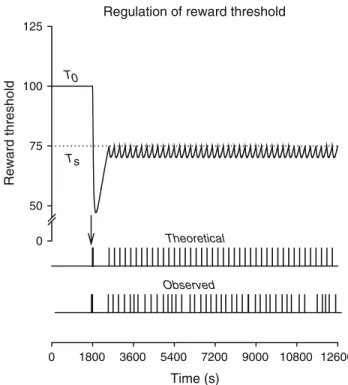
The simulation of cocaine self-administration is obtained by executing the set point program (Fig.1). Basically, the program simulates the effect of the available unit dose of cocaine (i.e., 250 μg) each time the actual threshold is above the ideal threshold. The resulting theoretical pattern of self-administration is almost indistinguishable—both quantitatively and qualitatively—from self-administration patterns seen in laboratory rats with access to the same unit dose of cocaine (Fig.3). As with observed patterns, the the-oretical pattern is divided in two successive phases: a loading phase during which injections are taken at the highest rate possible, and a maintenance phase during which self-injec-tions are regularly spaced by a much longer interval. In addi-tion, as with observed patterns, these two phases are separated by a relatively long postloading pause during which no in-jection is taken.
The temporal distribution of injections may be com-pletely explained by the interplay between the requirement to maintain the threshold below the ideal threshold and the time-dependent profile of drug effects. The first injection is triggered by the initial error (T0−Ts>0). The ensuing drug loading results from the fact that the first dose is not sufficient to lower the threshold to the set point. Injections are therefore cumulated at the highest rate possible until the set point is achieved. Due to drug distribution time, however, reward threshold continues to be lowered below the ideal threshold after loading which produces a transient postloading overshoot. The time required for the threshold to increase from this relatively low level back to the set point corresponds to the duration of the postloading pause. After the postloading pause, injections are taken every time the threshold increases above the ideal threshold, which explains the behavioral regularity observed during the maintenance phase (Fig.3).
Quantitative analysis of the dose-injection function The close correspondence between theoretical and observed patterns of self-administration supports the hypothesis that drug-taking by laboratory animals is determined by a set point-based mechanism and justifies the use of the model to Regulation of reward threshold
Reward threshold 0 50 75 100 125 Theoretical 0 1800 3600 5400 7200 9000 10800 12600 Observed Time (s) Ts T0
Fig. 3 Simulation of intravenous cocaine self-administration. The
top curverepresents the threshold-lowering effect of cocaine resulting
from the theoretical pattern of self-injections shown in thebottom
panel. The horizontal dotted line represents the ideal threshold
(TS=75) which is initially below baseline threshold (T0=100). In event records shown on thebottom panel, thehorizontal axisdepicts a 3-h session (10,800 time steps), andvertical barsrepresent intravenous cocaine injections (unit dose=250μg). Thevertical arrowindicates the loading phase at the start of the programmed session at time step 1,800. Observed data were obtained in a typical male Wistar rat self-administering intravenous cocaine (unit dose=250 μg) under a continuous schedule of reinforcement with no time-out after in-jections (for other details, see Ahmed and Koob1999). The values of pharmacokinetic and pharmacodynamic parameters used in this simulation are identical to those defined in Fig.2. Finally, to account for the delay between error detection and end of drug delivery, a short refractory period of 4 s is imposed between injections. This delay corresponds to the duration of drug delivery in our experiments (Ahmed and Koob1999)
assess the role of both pharmacodynamic and motivational factors in escalated levels of drug use. We first analyzed the significance of the relationship between the dose available per injection (unit dose) and the rate of injections. According to the set point model, new injections occur when drug concentration produced by previous injections falls below the ideal concentration that maintains the threshold equal toTS(notedCS). Given that this phenomenon is periodic (Fig.3) and occurs at the end of each interinjection interval, I, we can write:
CS ¼ðDKþCSÞ!e"!I"e""I" (4)
whereDis the unit dose andα,β, andKare aggregate rate constants obtained from compartment rate constants kel, k12, andk21(seeMaterials and methodsand Fig.1). The second exponent in the right side of Eq.4only contributes to the rising component of the concentration–time course in the brain (Fig.2a) and therefore does not influence the duration of drug effects above the set point. Ignoring it, one can write:
CS ¼ðDKþCSÞe"!I
Appropriate algebraic transformations give the following pharmacokinetic expression forCs:
CS ¼ e!IK
"1
# $
D (5)
Similarly, because Cs defines the concentration that maintains the threshold at the ideal level,Ts, we can write:
TS ¼T0 1"
CS
T50þCS
# $
(6) Appropriate algebraic transformations give the following pharmacodynamic expression forCS:
CS ¼T50ðTT0"TSÞ
S (7)
The core feature of Eq.7is the error (T0−TS) that drives the self-administration behavior of the system (see above and Fig.1). Combining Eq.5with Eq.7, we can write the following equality: K e!I"1 # $ D¼T50ðTT0"TSÞ S
Appropriate algebraic transformations give the following expression for the interinjection interval,I:
I ¼1 !ln 1þ KTS T50ðT0"TSÞ # $ D # $ (8)
Since the rate of injections,R, is the inverse ofI, we can write: R¼ ! ln 1þ KTs T50ðT0"TsÞ % & D % & (9)
This complex function relates the rate of injections, R, with the unit dose available,D, and depends on pharma-cokinetic (β, K), pharmacodynamic (T50), and motiva-tional parameters (the initial error“T0−TS”that drives the behavior of the system).
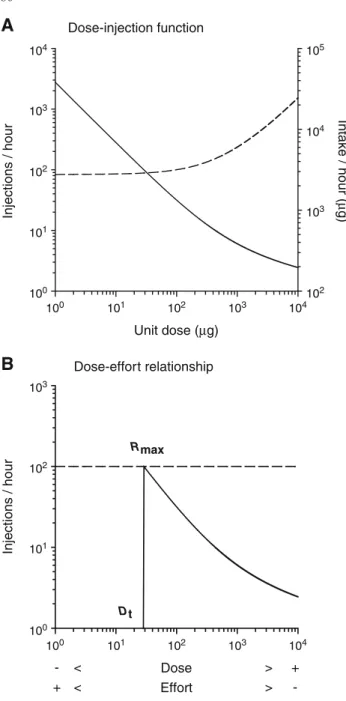
In agreement with observed data, the function shows that the rate of injections is inversely related to the unit dose (Fig.4a). Precisely, the rate of injections initially decreases in proportion with increasing doses up to a certain dose after which the rate of injections decreases more slowly than the dose increases. The nonlinearity of the dose-injection func-tion results from the nonlinear time-course of brain drug concentration (Fig.2a and Eq.1inMaterials and methods). As a result, drug intake (rate of injections×unit dose) initially remains relatively constant with increasing dose but then increases with continued increase in dose (Fig.4a). These findings show that the system maintains the same level of reward facilitation by adjusting the rate of injec-tions to the dose, despite increased drug intake from the highest doses. Varying the unit dose can therefore be considered as equivalent, although inversely, to varying the level of behavioral work: the lower the unit dose, the higher the behavioral effort or cost necessary to maintain the same level of reward facilitation (for a similar argument, see Bickel et al.1990). It follows that, by continually decreas-ing the dose, the dose-injection function should “break down” at a certain dose, below which the corresponding behavioral rate exceeds the maximum rate acceptable, notedRmax(Fig.4b). Below the threshold dose (henceforth Dt), the maximum rate is insufficient to maintain reward threshold at the ideal level and, as a result, responding for the drug eventually will undergo behavioral extinction. Such analysis predicts that the dose-injection function for cocaine self-administration should be discontinuous at the threshold dose: belowDt, the rate of injections should be equal to the control operant level, notedR0(i.e., the level of behavioral responding unrelated to drug reinforcement), and indepen-dent of the dose (i.e., constant); above Dt, the rate of in-jections should decrease fromRmaxwith increasing dose, as expressed in Eq.9(Fig.4b).
The maximum rate of behavior is a measure of the motivation for maintaining reward threshold at the ideal level. Classically, motivational strength is thought to be determined conjointly by the current need state and the magnitude of the expected outcome effect (Hull 1950; Hodos1961; Hodos and Kalman1963; Reilly1999). In the present case, because the expected outcome effect remains constant across doses (i.e., ideal threshold),Rmaxshould be influenced only by the initial error that drives the behavior
of the system. Therefore, a simple, though provisional, formula for computingRmaxcan be written as follows:
Rmax¼R0þ#ðT0"TSÞ (10)
whereρis a scaling factor that converts the error into the maximum rate of behavior. For simplicity,R0is arbitrarily set at 0 in the following analysis. Since the function relating Rmaxto the error is probably not linear, Eq. 10should be considered as preliminary.
Given that the rate of injections,R, is equal toRmaxwhen the dose is equal toDt, we can write the following equality:
! ln 1þ KTs T50ðT0"TsÞ % & Dt % &¼#ðT0"TsÞ
Appropriate algebraic transformations give the following expression forDt: Dt¼T50ðTKTS"T0Þ S e ! #ðT0"TSÞ % & "1 ! (11) KnowingDt, we can now define the two domains of the dose-injection function: D2 ½0;Dt½; R¼R0 D2 ½Dt;þ1½; R¼ ! ln 1þ T KTS 50ðT0"TSÞ % & D % & 8 < :
This system of equations was used to compute the effects of changes in pharmacodynamic and motivational factors on the dose-injection function (see below).
Simulation of allostatic changes in reward function Allostatic changes in reward function are simulated by entering different values ofT0 which are hypothesized to correspond to the different levels of activation of brain antireward processes. The resulting consequences on the reward-facilitating effect of a cocaine bolus and on the dose-injection function for cocaine self-administration are compared to the effects produced by simulations of within-system adaptations. Within-within-system adaptations were simu-lated by changing the drug response mechanism (i.e.,T50). Effects of simulated allostatic changes in reward function on the reward-facilitating effect of a cocaine bolus and on the corresponding rate of injectionsVariations in baseline reward threshold produce between-system tolerance to the reward-facilitating effect of cocaine (Fig. 5a). More spe-cifically, elevating baseline threshold (i.e., decreasing re-ward system responsivity) displaces the threshold-lowering effect of cocaine upward and thus reduces its ability to attain the ideal threshold. As a result, the rate of injections in-creases to maintain reward threshold at the set point (Fig.6). Dose-injection function Unit dose (µg) Injections / hour 104 103 102 101 100 103 102 101 100 100 101 102 103 104 100 101 102 103 104 105 104 103 102 Intake / hour ( µ g) Dose-effort relationship - < Dose > + + < Effort > -Injections / hour Rmax Dt
A
B
Fig. 4 Simulated dose-injection function for cocaine
self-adminis-tration.aUnit doses tested are varied over a range of 1–10,000μg in steps of 1. For comparison, the largest range tested in our self-admin-istration experiments is 7.8–1,000μg. Thedashed lineindicates the amount of drug intake per hour (i.e., rate of injections×unit dose). The values of pharmacokinetic and pharmacodynamic parameters are identical to those defined in Fig.2.bEquivalency between unit dose and behavioral work. Varying the dose is equivalent, but inversely, to varying the level of behavioral work required to maintain the same level of reward facilitation, as determined by the reward set point. The behavioral dimension of work is representedbelowthe pharmacolog-ical dimension of the dose and is inversely related to the dose. The
horizontal dashed lineindicates the maximum rate of injections
ac-ceptable (Rmax) to maintain cocaine-induced reward facilitation at the desired level. The values of pharmacokinetic and pharmacodynamic parameters are identical to those defined in Fig.2. The value ofρis arbitrarily set at 1/900 s−1(or 4 responses/h)
Since elevations in baseline threshold are hypothesized to result from an overactivation of antireward processes, we call this phenomenonbetween-system tolerance. Con-versely, lowering baseline threshold (i.e., increasing reward system responsivity) shifts the threshold-lowering effect of cocaine downward which augments its ability to attain the set point (Fig.5a), a phenomenon termedbetween-system sensitization. As a result, the rate of injections decreases to maintain reward threshold at the set point (not shown). Note that between-system tolerance has no effect on the net
threshold-lowering effect of cocaine, as measured by the area under the time–effect curve, a result that reproduces data observed in animals with escalating cocaine use (Ahmed et al.2002).
In contrast, simulations of within-system adaptations by modifying the drug response mechanism produce changes in the net threshold-lowering effect of cocaine (Fig. 5b). Specifically, simulating within-system tolerance by increas-ing T50 decreases the net threshold-lowering effect of a cocaine bolus (i.e., decreased area under the time–effect Reward allostasis Time (s) 0 600 1200 1800 2400 3000 3600 Reward threshold 0 50 75 100 125 Ts T0 Ts T0 Variations in T50 0 600 1200 1800 2400 3000 3600 0 50 75 100 125
A
B
Fig. 5 Reward threshold-lowering effect of 1 unit dose of cocaine.
a Effects of allostatic changes in reward function. b Effects of within-session tolerance (or sensitization). In both panels, thesolid line indicates the control curve, the dashed lines the effects of changing baseline reward threshold (T0) or cocaine potency (T50), and thedotted linethe ideal threshold (TS).T0is varied over a range of 80–120 units (only these two extremes are shown here; see text
for explanation). The highest baseline threshold value approximates the value seen in rats after escalation of cocaine self-administration (Ahmed et al.2002).T50is varied over a much wider range of 118– 2,943 units (only these two extremes are shown here). The control values of pharmacokinetic and pharmacodynamic parameters are identical to those defined in Fig.2
Before allostasis Reward threshold 0 50 75 100 125 Time (s) 0 1800 3600 5400 7200 Ts T0 After allostasis 0 1800 3600 5400 7200 Ts T'0
Fig. 6 Effects of allostatic
changes in reward function on within-session self-administra-tion of cocaine. An allostatic decrease in reward function is simulated by increasing the value of baseline reward threshold. The magnitude of the increase (+20%) approximates that observed in rats after esca-lation of cocaine self-adminis-tration (see Ahmed et al.2002). For other details, see legend of Fig.3
curve) and thus its ability to approach the ideal threshold (Fig.5b). As a consequence, the rate of cocaine injections is expected to augment to maintain reward threshold at the set point (see below). Conversely, simulating within-system sensitization by decreasingT50increases the net threshold-lowering effect of cocaine (i.e., increased area under the time–effect curve) and thus its ability to attain the reward set point (Fig.5b). As a consequence, it is predicted that fewer doses are needed to maintain reward threshold at the set point (see below).
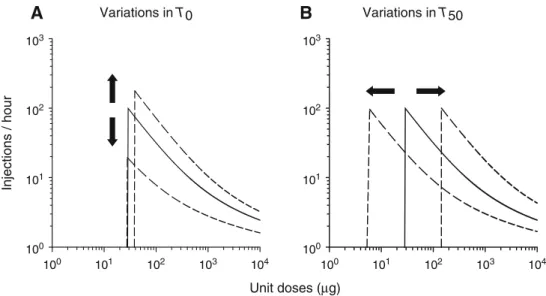
Effects of simulated allostatic changes in reward function on the dose-injection function for cocaine self-adminis-trationShifts in the dose-injection function were computed using the system of equations defined above. Simulation of allostatic changes produces vertical shifts of the dose-in-jection function, with no change or very small changes in the threshold dose (Fig.7a). Specifically, elevating baseline threshold increases the error between baseline and ideal thresholds (T0−Ts), thereby producing both an overall in-crease in the rate of self-administration (due to between-system tolerance; see above) and an increase in the response peak,Rmax(due to increased motivation to take the drug). Over a range of doses, these two phenomena manifest as an upward shift of the dose-injection function, with a small increase in the threshold dose (Fig. 7a). In contrast, low-ering baseline threshold decreases the error between base-line and ideal threshold, thereby producing both an overall decrease in the rate of self-administration (due to between-system sensitization; see above) and a decrease inRmax(due to decreased motivation). Over a range of doses, these phenomena combine to shift the dose-injection function
downward, with no notable change in the threshold dose (Fig.7a).
In contrast, simulating within-system adaptations to co-caine produces horizontal shifts of the dose-injection func-tion but no vertical shifts (Fig.7b). Specifically, simulating within-system tolerance by increasingT50produces an over-all increase in the rate of self-administration, as expected (see above), but has no effect onRmax(no change in motivation). As a result, the dose-injection function breaks down at a higher threshold dose and is therefore shifted to the right (Fig. 7b). Inversely, simulating within-system sensitiza-tion by decreasingT50produces an overall decrease in the rate of self-administration, as predicted (see above), but does not affectRmax. As a consequence, the dose-injection function breaks down at a lower threshold dose and is therefore shifted to the left (Fig.7b).
Discussion
The present model satisfactorily reproduces several features of intravenous cocaine self-administration as observed in laboratory animals, including (1) the within-session dy-namics of cocaine self-administration and (2) the discontin-uous function relating the dose to the rate of injections. In this model, a vertical upward shift in the dose-injection function similar to that seen in rats with escalated levels of cocaine intake is produced by simulating an allostatic decrease in reward system responsivity. This postescalation vertical shift reflects both a decrease in the effects of cocaine (as reflected by increased consumption) and an increase in the motivation to take the drug (as reflected by increased peak of the dose-Unit doses (µg) Injections / hour 103 102 101 100 100 101 102 103 104 100 101 102 103 104 103 102 101 100 Variations in T50
A
Variations in T0B
Fig. 7 Effects of allostatic changes in reward function on the
dose-injection function.aEffects of allostatic changes.bEffects of within-system tolerance (or sensitization). In both panels, the solid line
represents the control curve and the dashed lines the effects of changing baseline threshold (T0) or drug response mechanism (T50).
T0is varied over a range of 80–120 units (only these two extremes are shown here; see text for explanation). The highest baseline threshold value approximates the value seen in rats after escalation of cocaine
self-administration (Ahmed et al.2002).T50is varied over a much wider range of 118–2,943 units (only these two extremes are shown here).Arrowsindicate the main direction of the shift produced by decreases (downwardorleftward arrow) and increases (upwardor
rightward arrow) inT0orT50from control values. The control values
of pharmacokinetic and pharmacodynamic parameters are identical to those defined in the legend of Fig.2. For other details, see legend of Fig.4
injection curve). In comparison, simulations of within-sys-tem tolerance or sensitization produce horizontal shifts of the dose-injection function to the right or to the left, without influencing the level of motivation (no change in the peak of the dose-injection curve). These different theoretical results are discussed separately below.
Modeling the dynamics of intravenous cocaine self-administration
Simulated and observed within-session patterns of cocaine self-administration in nonescalated laboratory animals are almost indistinguishable. As in real patterns of self-ad-ministration, the theoretical distribution of injections is char-acterized by two successive phases, a loading phase and a maintenance phase, each separated by a relatively long post-loading pause. As demonstrated here, these behavioral dynam-ics result entirely from the goal of the system: take multiple doses of cocaine to reduce the initial error between baseline and ideal reward thresholds. This cumulative process initially leads to an overshoot that marks the end of the loading behavior and the duration of which corresponds to the post-loading pause. The overshoot results from the fact that the system has no control on the time-course of cocaine con-centration and effect after each drug delivery. In theory, however, the system could achieve the desired threshold without overshooting by refraining from loading and thus spacing out the first few injections more. This strategy, however, requires that the system anticipates the time-course of the threshold-lowering effect of cocaine after each dose and uses this information to compute the appropriate delay between injections. Obviously, such a process would consider-ably retard the achievement of the desired level of reward system responsivity. The fact that cocaine loading is the ob-served behavior strongly suggests that animals behave as the computer model predicts: they rapidly take multiple cocaine doses to attain as quickly as possible the reward set point, thereby exposing themselves to overshooting of the drug’s effect. Future studies are needed to assess the magnitude of the postloading overshoot on brain reward function in ani-mals self-administering cocaine.
During the maintenance phase, theoretical injections are extremely regular and, as a result, the interinjection interval is constant. Each injection is programmed when baseline reward threshold increases above the reward set point. In contrast, in a rat self-administering cocaine, injections are somewhat less regularly distributed, and the interinjection interval varies between injections (Pickens and Thompson
1968; Wilson et al. 1971; Caine and Koob 1993; Panlilio
et al. 2003). The source of this variation is not known. Within the present framework, several factors can be envi-sioned to contribute to the observed variability of drug self-administration, including both internal and external factors (e.g., unwanted fluctuations in the drug delivery device). Perhaps the most intriguing potential source of variation resides in brain reward systems. The level of neural activity of these systems may fluctuate over time in a way that interferes with the constancy of the interinjection intervals.
Many physiological systems are known to be intrinsically “noisy” (e.g., the cardiovascular system), a property sup-posed as essential for adaptation to the environment (Glass
2001; Goldberger et al.2002). Future studies aimed at
min-imizing external sources of variation are needed to estimate the exact contribution of internal fluctuations to the vari-ability of cocaine self-administration.
Predicting the function relating the dose with the rate of injections
The present model provides a good approximation of the within-session dynamics of cocaine self-administration and can therefore be used to begin to elucidate the nature of the relationship between the drug unit dose and the rate of injections. The model predicts that the individual dose-injection function should be discontinuous at a certain thresh-old dose: below the threshthresh-old dose, the rate of injections is equivalent to the control operant level and independent from the dose; above the threshold dose, the rate of injections is high and decreases with increasing doses to maintain the same level of reward facilitation. As shown here, the threshold dose defines the maximum level of work,Rmax, the individual will produce to maintain reward system responsivity at or above the reward set point. Below the threshold dose, the rate of behavior necessary to maintain reward system responsivity at the ideal level exceeds the maximum rate, thereby precipitat-ing behavioral extinction. This phenomenon explains why the dose-injection function is discontinuous at the threshold dose. Such a discontinuity in the dose-injection function has been observed several times in the past, but its behavioral significance has often been overlooked (e.g., Yokel and Pickens 1973; Downs and Woods 1974; Harrigan and Downs1978; Caine and Koob1995). In a more recent sys-tematic study, cocaine-trained rats (n=17) were tested with a large range of cocaine unit doses (7.8–1,000μg) under a continuous schedule of reinforcement (Zittel and Ahmed, unpublished results). In all rats, the observed dose-injection function was discontinuous at a certain dose, as predicted in the present study. Below the threshold dose, the rate of in-jections was low and independent from the dose of cocaine. Above the threshold dose, the rate of injections varied in-versely with the dose. As a result, estimated brain con-centrations of cocaine remained far below the threshold dose, and high and almost constant above the threshold dose, as predicted by a set point-based mechanism. Although the dose-injection function was discontinuous in all rats, the threshold dose considerably varied between individ-uals. As a result, aggregating data across all rats resulted in a smoothed U-inverted function. The ascending limb of this inverted U was short and characterized by high inter-individual variation. Such an aggregate U-inverted function has often been reported in the literature (Mello and Negus
1996). As illustrated here, however, the aggregate
dose-injection function (which is continuous) is different from theindividualdose-injection function (which is discontin-uous) and from this respect may not constitute a reliable
representation of the endogenous processes regulating the self-administration behavior of an individual.
Along the descending limb, cocaine intake (i.e., rate of injections×unit dose) is initially relatively stable with creasing doses and then starts to increase with further in-creases in the unit dose. This dose-dependent increase of drug intake has often been observed in previous studies and is generally considered as evidence against the notion of reward regulation. As demonstrated here, however, the in-crease in intake at the highest dose is entirely predicted— not contradicted—by the set point-based mechanism of regulation. This increase simply results from the nonlinear time-course of drug concentration and effect. Specifically, at the highest doses, the duration of the effect of cocaine below the ideal threshold increases more slowly than the unit dose. As a result, the rate of injections decreases more slowly than the unit dose increases, thereby producing an automatic increase in drug intake. Following a different theoretical approach, Tsibulsky and Norman (1999) were the first to demonstrate this important pharmacokinetic result. Thus, drug intake per se is not the regulated variable and can only be regarded as an imperfect index of regulation of brain drug concentration and effect during cocaine self-administration. A more appropriate approach for future studies will involve the direct measurement of brain cocaine concentrations that precede self-injections during the main-tenance phase of cocaine self-administration.
Simulating the effects of allostatic changes in reward function on the dose-injection function
It now clearly appears that the descending limb of the dose-injection function for cocaine self-administration reflects behavioral regulation of reward function. In this self-reg-ulating system, it is the ability of cocaine to reduce the error between baseline and ideal reward thresholds that defines the magnitude of its rewarding effect and inversely the rate of cocaine injections: the higher this ability, the lower the rate of self-injections. Within this self-regulatory framework, the rewarding effect of a given dose of cocaine and thus the corresponding rate of injections can be altered by several different mechanisms, including between-sys-tem adaptations and within-sysbetween-sys-tem adaptations (Koob and Bloom 1988; Koob and Le Moal 2001). Over a range of doses, these different mechanisms produce different effects on the dose-injection function for cocaine self-administra-tion. Allostatic changes in reward function produce vertical shifts, while within-system adaptations produce horizontal shifts. This differential effect on the dose-injection function results from the fact that the level of motivation—which is indexed byRmax—can be influenced only by variations in baseline reward function in the present model. Classically, the level of motivation is thought to be influenced by the magnitude of the reinforcer and by the current physiolog-ical state of the organism (Hull1950; Hodos1961; Hodos and Kalman1963; Reilly1999). As shown here, variations in the reinforcer magnitude cannot explain the variations in motivation during cocaine self-administration. Indeed, the
reinforcer is the ideal level of reward facilitation produced by the drug which remains constant along the descending limb of the dose-injection function. Thus, the only re-maining variable susceptible to influenceRmaxis the initial difference, or error, between baseline and ideal reward thresholds that drives the self-administration behavior of the system. Here we show that simulating the decrease in baseline reward function seen in animals with escalating cocaine use—a manipulation that increases the error— produces both tolerance to (i.e., between-system tolerance) and increased motivation for the rewarding effect of co-caine (i.e., increasedRmax). Over a range of doses, these two phenomena manifest as an upward shift of the dose-injection function, with a relatively small increase in the threshold dose. This theoretical shift satisfactorily repro-duces the vertical shift of the dose-injection function seen in rats after escalation of cocaine self-administration (Ahmed and Koob1998,1999; Mantsch et al.2004).
In contrast, simulating within-system tolerance to the rewarding effect of cocaine by modifying the drug response mechanism has no effect on the level of motivation (no change inRmax). Over a range of doses, this phenomenon manifests as a rightward shift of the dose-injection function. Conversely, simulating within-system sensitization to the rewarding effect of cocaine has no effect on the level of motivation. Over a range of doses, this phenomenon man-ifests as a leftward shift of the dose-injection function. None of these horizontal shifts reproduce the postescala-tion vertical shift observed in rats self-administering co-caine. These results suggest that an allostatic decrease in reward function provides a better fit with observed data than classical explanations based on within-system tolerance. There is, however, one minor discrepancy between the the-oretical effects of an allostatic decrease in reward function and observed data. Simulation of decreased reward func-tion slightly increases the threshold dose, an effect not seen in rats after escalation of cocaine self-administration (Ahmed and Koob1998). This discrepancy suggests that either the present model needs to be improved and/or the dose resolution employed in previous experiments was not sufficient to detect the predicted change. Future theoretical and empirical studies are needed to address this issue.
According to the reward allostasis hypothesis of drug addiction, decreased baseline reward function results from the temporal summation of the counterreaction that follows the abnormal facilitation of reward system responsivity produced by the drug (Koob and Le Moal2001). As recently shown, this temporal summation only occurs in animals with repeated prolonged access to cocaine self-administra-tion, not in animals with restricted access to the drug (Ahmed et al. 2002). This selective phenomenon would explain why only animals with prolonged access to the drug escalate their intake of cocaine. The cause of the differential effect of restricted versus prolonged access to cocaine self-administration on brain reward function is not entirely clear at present, however. One possibility is that the time con-stants of reward opponent processes are influenced by the duration of exposure to cocaine self-administration. This suggestion is supported by a recent study showing that the
postcocaine elevation in reward threshold appears earlier and persists longer with increasing duration of access to cocaine self-administration (Kenny et al. 2003). This in-creased persistence would favor the temporal summation of reward opponent reactions across successive sessions of cocaine self-administration, thereby explaining the gradual and selective decrease in reward function seen in animals with long access to the drug (Ahmed et al.2002). This inter-pretation predicts that increasing the time interval between prolonged sessions of cocaine self-administration should retard, or even prevent, escalation of cocaine intake. Addi-tional studies are needed to better characterize the dynamics of the temporal summation of antireward processes that is hypothesized to cause an allostatic decrease in reward func-tion and increased cocaine self-administrafunc-tion.
In previous publications, we hypothesized that the post-escalation vertical shift in the dose-injection function for cocaine self-administration results from a change in reward set point (notedTsin the present model) (Ahmed and Koob
1998, 1999). Subsequent empirical studies have revealed
that escalation in cocaine intake is correlated with a dra-matic elevation in basal reward thresholds (Ahmed et al. 2002). This observation explains why only the effects of a shift in baseline reward threshold were explored in the pres-ent study. Nevertheless, a shift in set point continues to rep-resent a theoretically plausible mechanism that could also contribute to drug intake escalation. To determine whether a change in reward set point also contributes to escalated levels of cocaine intake, it will be necessary to measure brain reward thresholds during the maintenance of cocaine self-administration, a technical effort not yet feasible at present. Allostatic decrease in reward function
versus sensitization
We have shown that an allostatic decrease in reward func-tion provides a satisfactory and parsimonious explanafunc-tion of escalated levels of cocaine self-administration and as-sociated vertical shifts in the dose-injection function. In comparison, sensitization accounts of drug addiction fail to explain the same observations. At least two types of drug sensitization processes can be distinguished according to the nature of the sensitized effects: reward-sensitization refers to an increase in the rewarding effect of cocaine with repeated exposures, while incentive-sensitization refers to an increase in the incentive-motivational effect of the drug (Robinson and Berridge 1993, 2000; O’Brien 2001). As shown in the present study, reward-sensitization produces a decrease, not an increase, in the rate of cocaine injections and shifts the dose-injection function to the left, not upward as observed in animals with escalating drug use. Incentive-sensitization also fails to explain escalation of cocaine intake, albeit for different reasons. In the model advanced by Robinson and Berridge (1993; see also Vezina2004), no causal or logical connection exists between variations in the incentive effect of cocaine and variations in cocaine intake. As a result, the incentive-sensitization model fails to explain what determines the level of cocaine intake of a given
in-dividual anda fortiorihow this level changes in response to increased drug availability. These theoretical weaknesses are not surprising. The incentive-sensitization model was originally extrapolated from psychomotor data, not from self-administration data (Robinson and Berridge1993). Fi-nally, data exist that are not consistent with an incentive-sensitization model of drug intake escalation. There is no apparent sensitization to the effect of cocaine on nucleus accumbens dopamine in animals with escalated levels of cocaine intake (Ahmed et al.2003). Nucleus accumbens dopamine was hypothesized to play a key role in incentive-motivation (Berridge and Robinson 1998). In fact, the transition to escalated levels of cocaine consumption is not associated with an exacerbated behavioral sensitiza-tion to the drug (Ben-Shahar et al.2004), as postulated by Robinson and Berridge (1993). This conclusion is con-firmed by a more recent, systematic study in which rats were challenged with different intravenous doses of co-caine (0.125–1 mg) in the environment where they had escalated their cocaine intake. Regardless of the dose tested, rats with escalated cocaine use were as sensitive to the stimulant effects of cocaine than rats with stable cocaine intake (Ahmed and Cador, personal communication). Note that there was no difference in stereotypies-induced de-crease in locomotion in this study. This latter observation strongly suggests that the vertical shift in the dose-injection function seen in animals with escalated cocaine use is unlikely to be the result of an increased behavioral sensi-tization to the drug. Thus, although there is no doubt that sensitization to the stimulant effects of cocaine develops with initial or restricted exposures to cocaine, there is as yet no evidence that it plays a critical role in the development of compulsive drug use.
The puzzle of initial drug demand
An allostatic decrease in reward function provides a rea-sonably satisfactory account of drug intake escalation but does not explain what initially drives the development of regular drug use. According to the present model, drug use depends on the initial difference or error between baseline and desired reward thresholds. The reduction or correction of this error in reward function by taking cocaine is pos-tulated to drive the behavior of the system. Two classical theories can be used to better define this concept: the posi-tive and negaposi-tive reinforcement theories of drug addiction. According to the first theory, individuals initially take drugs to experience abnormally high sensations of pleasure (Wise and Bozarth 1987). In this theoretical framework, the re-ward set point would correspond to the level of rere-ward system responsivity that leads to maximal rewarding stim-ulation from the environment. This theory is principally based on the fact thatnaive and apparently normalanimals readily learn to self-administer a variety of drugs of abuse. No preexisting need is postulated to explain the initiation of drug self-administration behavior in laboratory animals. It is often hypothesized, however, that after initiation, a source of negative reinforcement adds to the initial source of
pos-itive reinforcement to maintain the drug habit. In contrast, according to the novel negative reinforcement view of ad-diction considered here, negative reinforcement would play a major role during both the initiation and maintenance of cocaine self-administration. Laboratory animals would take drugs not to experience abnormal levels of pleasure per se but to correct a preexisting hedonic deficit (Alexander and Hadaway 1982). In this framework, the reward set point corresponds to the minimum level of reward system re-sponsivity that relieves the preexisting deficit. Removal of this preexisting deficit removes the need to take drugs. This self-medication view of cocaine self-administration is con-sistent with several clinically derived accounts of the de-velopment of drug addiction (Hull1981; Khantzian1997). In humans, preexisting hedonic deficits are thought to result from complex interactions between genetics, developmen-tal history, and the current situation of the individual (Glantz and Pickens1992; Altman et al.1996; Koob and Le Moal
2001; Higgins et al. 2004). In experimental animals, the
hedonic deficit is hypothesized to result, though not ex-clusively, from the laboratory environment in which ani-mals are raised and tested for drug self-administration. These necessarily artificial conditions include a history of lim-ited natural rewards during development, a lack of con-trol over environmental contingencies (which is known to cause stress; Maier1991), and a lack of current alternative, species-specific sources of reward (Mason et al. 2001; Wurbel2001). Under these conditions, brain reward cir-cuits are unlikely to develop normally and should become dysfunctional in adults. In this light, laboratory animals probably represent more of a model of the human sub-population at risk to develop cocaine use and addiction than a model of the general pop ulation, as commonly as-sumed. This interpretation is consistent with the large prev-alence of cocaine addiction in rats with extended access to the drug (Bozarth and Wise1985; Vanderschuren and Everitt 2004; Ahmed and Cador, personal communication).
The notion that laboratory animals use cocaine to alleviate a preexisting hedonic deficit predicts that animals raised under seminatural conditions in the laboratory should have lower reward thresholds and thus should be less prone to self-administer drugs and escalate drug intake compared to animals of the same strain raised under standard labo-ratory conditions. Admittedly, it is difficult to conduct ex-periments to directly test this prediction. Nevertheless, this prediction is supported by important experiments showing that social and/or physical enrichment of the home envi-ronment during development or availability of alternative rewards during testing reduce the acquisition and mainte-nance of drug self-administration in both rodents and monkeys (Schenk et al.1987; Carroll et al.1989; Nader and Woolverton1991,1992; Carroll and Lac1993; Howes et al.
2000; Bardo et al.2001; Green et al. 2002; Negus2003).
For instance, Bardo and coworkers have recently shown that enriching the home environment with novel objects and activities can reduce the self-administration of stimulant drugs in rats (Bardo et al.2001; Green et al.2002).
Interestingly, the postulation of an early hedonic deficit as the basis for initial drug use in both vulnerable humans
and laboratory animals provides a unitary framework for conceptualizing the transition from drug use to drug ad-diction as a continuum of increased negative reinforce-ment. Individuals would first engage in repeated drug use to ameliorate acquired and/or inherited hedonic deficits. Then, due to their powerful pharmacological actions, drugs would exacerbate the initial deficit by further decreasing reward system responsivity (through an allostatic decrease in reward function). Decreased reward system responsivity will, in turn, reduce the impact of natural rewards on brain reward systems and thus increase the motivation to take drugs as an attempt to recover initial reward system re-sponsivity (Ahmed et al. 2002). Recent brain imaging studies in cocaine addicts strongly suggest that this spiraling decrease in brain reward function probably occurs during the transition to cocaine addiction (Volkow et al. 1997,
2004; Garavan et al.2000). This process may explain why
drug addicts progressively neglect alternative sources of reward in favor of drug use (Jaffe1992) and why it is nec-essary to continually provide abstinent volunteers with es-calating amounts of alternative rewards to motivate them to remain abstinent (Higgins et al.2004).
Limitations to the present model
The present model was specifically designed to simulate cocaine self-administration under a schedule of continuous reinforcement whereby each response is followed by drug delivery. It does not explain behavior under intermittent schedules of drug reinforcement, which are thought to better model drug availability conditions in humans (Everitt et al. 2001; Falk1983). By definition, intermittent sched-ules of reinforcement impose a delay between the initiation of responding and the delivery of a drug injection, either directly by increasing the interinjection interval (i.e., in-terval schedules) or indirectly by increasing the response requirement (i.e., ratio schedules). As a result, these sched-ules limit the rate of self-administration to some fixed range and therefore induce high rates of behavior between drug injections. Thus, in contrast to a continuous schedule of drug reinforcement, under intermittent schedules, the dependent variable is not the rate of injections, but either the inter-injection rate of responses or the final response requirement attained before the subject stops responding for the drug (as measured in progressive-ratio schedules). In short, under schedules of intermittent drug reinforcement, responding reflects drug-seeking behavior, not drug-taking behavior, as measured in a schedule of continuous reinforcement (a dis-sociation between drug seeking and drug taking behaviors is shown in Olmstead et al. 2000). Failure to consider these differences may explain some confusion and misunderstand-ing in the literature (e.g., Zernig et al. 2004and associated commentaries). Dose–behavior curves generated under in-termittent schedules of reinforcement are often S-shaped and sometimes partially inverted U-shaped, with the ascending limb typically covering the largest and most meaningful range of doses (Griffiths et al.1979; Spealman and Kelleher