BIROn - Birkbeck Institutional Research Online
Chandna, Swati and Maugis, P.-A. (2020) Nonparametric regression for
multiple heterogeneous networks. Working Paper. Birkbeck, University of
London, London, UK. (Unpublished)
Downloaded from:
Usage Guidelines:
Please refer to usage guidelines at
or alternatively
Nonparametric regression for multiple
heterogeneous networks
Swati Chandna
Department of Economics, Mathematics and Statistics,
Birkbeck, University of London, UK
and
Pierre-Andre Maugis
Department of Statistical Science,
University College London, UK
Abstract
We study nonparametric methods for the setting where multiple distinct networks are observed on the same set of nodes. Such samples may arise in the form of replicated networks drawn from a common distribution, or in the form of heterogeneous networks, with the network generating process varying from one network to another, e.g. dynamic and cross-sectional networks. Nonparametric methods for undirected networks have focused on estimation of the graphon model. While the graphon model accounts for nodal heterogeneity, it does not account for network heterogeneity, a feature specific to applications where multiple networks
are observed. To address this setting of multiple networks, we propose amulti-graphonmodel
which allows node-level as well as network-level heterogeneity. We show how information from multiple networks can be leveraged to enable estimation of the multi-graphon via standard nonparametric regression techniques, e.g. kernel regression, orthogonal series estimation. We study theoretical properties of the proposed estimator establishing recovery of the latent nodal positions up to negligible error, and convergence of the multi-graphon estimator to the normal distribution. Finite sample performance are investigated in a simulation study and application to two real-world networks—a dynamic contact network of ants and a collection of structural brain networks from different subjects—illustrate the utility of our approach.
Keywords: graphon, dynamic networks, cross-sectional networks, longitudinal networks, nonpara-metric regression, generalized linear model
1
Introduction
Network data is commonly observed in a variety of real-world applications ranging from social networks observing interactions between pairs of individuals to biological networks such as protein-protein interactions. This has led to a growing interest on probabilistic models for network data which not only offer a generative mechanism capturing empirically observed network effects, but are also easily estimable using existing statistical approaches. We study the setting where multiple distinct networks on the same set of nodes are observed. These may correspond to a collection of networks over an ordered set such as time (e.g., dynamic networks), or an unordered set such as networks from different subjects observed at a fixed point in time (cross-sectional networks). Given such datasets it is natural to ask: how does the structure in networks change or evolve within the collection?
A nonparametric approach to modeling undirected network data is achieved by the graphon model [2,10,11,18, 33], estimation of which has received a lot of attention (e.g. [13,30,31,38– 40, 48, 51, 55]). However, this has mostly focused on estimation in the setting where only a single network is observed. Nonparametric modeling and estimation for multiple networks, in
general assumed to be non-identically distributed, has largely been ignored. In many applications observing multiple networks, estimation under the general assumption of non-identically distributed networks seems natural. For example, consider a network of individuals with edges determined by similarity in political views, observed at multiple time points. Then in addition to a baseline model where political views are determined by a signature specific to each individual, a second source of variability arises from change in opinions over time as new information becomes available. Without incorporating the second source of time-specific variability, we would average out important features which possibly characterise and differentiate interaction behavior at different time points. With this view, we propose a natural extension of the standard graphon model to incorporate network heterogeneity in addition to nodal heterogeneity via a multi-graphon function. Further, we show how information from multiple networks on the same set of nodes can be leveraged to enable estimation via standard nonparametric regression techniques for both replicated (i.i.d networks) and heterogeneous (independent but non-identically distributed) collection of networks.
The data consists of a collection of mdistinct undirected networks without self-loops, on the same set of nnodes, represented using adjacency matricesA1, . . . , Am. These networks may be
binary with each Al ∈ {0,1} n×n
, and Aijl = 1 =Ajil, i6=j indicating the presence of an edge
between nodesi and j in the lth network; or weighted withAijl =Ajil recording the count of
interactions between nodesiandj in thelth network. Given a single undirected binary network
G, it is standard to assume that fori≤j,Gij are independent Bernoulli(Pij) trials, wherePij are
edge probabilities determined by an underlying two dimensional functionf, known as the graphon, e.g. [56]. For a non-identically distributed collection of networks,A1, . . . , Am,we consider a natural
extension of this model whereAijl, i≤j are independent Bernoulli(Pijl) trials, withPijl denoting edge-probability for node pair (i, j) in thelth network. We achieve this via a three-dimensional bounded measurable functionf : [0,1]3→[0,1], we calledmulti-graphon, where the third dimension allows for network-specific effects via network positions z1, . . . , zm and thus different interaction
probabilities in different networks. Further, the multi-graphon function by design is such that averaging over network-specific effects brings us back to the standard graphon model for replicated networks i.e.,Aijlas independent Bernoulli(Pij) trials wherePijis now determined by the flattened
multi-graphon ¯f where ¯f(x, y) =R
[0,1]f(x, y;z)dz. Change in interactions over distinct networks
may arise as a result of a series of small changes occurring between consecutively observed networks or as a result of ‘jumps’ (for example withf as a stepfunction inz). In this paper, we focus on estimation of the multi-graphon array [fijl,(i, j, l)∈[n]×[n]×[m]] for heterogeneous networks
assumed to be generated from smooth kernelsf and hence of a ‘slowly-varying’ type.
A key challenge in graphon estimation using standard nonparametric regression is the latency of nodal positions corresponding to the observed response of pairwise interactions. This has led to a variety of contributions focusing on histogram approximations to the graphon function, and more specifically, graphon matrix estimation (e.g. [1,13,15,31,38–40,48,51,55,56]). One of the main objectives in these methods is suitable identification of neighborhoods, either combinatorially (e.g. [38,51]); through assumptions like strict monotonicity of the degree sequence [15]; or through a construction of distances between node pairs ([1,39,56]), each approach allowing a locally-averaged estimator. The method of [56] is particularly attractive as it allows neighbors to vary from node to node resulting in a local moving average estimator. Given the adaptive neighborhood choice, it is closer to a Nadaraya-Watson type estimator with uniform weighting in each neighborhood, than a standard histogram with fixed neighborhoods. While this offers a significant improvement over local-constant or histogram estimators, in general, it lacks the flexibility and advantages offered by the vast literature on standard nonparametric methods [20,45,50] (with different smoothing techniques : local vs global, automatic smoothing parameter selection, direct implementation, to name a few). Further, with the exception of [1], these methods are designed for graphon estimation from a single network. The method of [1] provides a blockmodel approximation to graphon function using multiple i.i.d. networks and thus corresponds to the special case of replicated networks.
We propose a two step multi-graphon estimator where the first step uses the similarity of interactions between node pairs to construct an embedding of nodes in the Euclidean space, and the second step achieves estimation via nonparametric regression using estimated nodal positions
from the first step as design points. Intuitively, embedding of nodes in the first step is based on the idea that for a smooth collection of networks, nodes ‘closer’ to each other, must connect ‘similarly’. This leads to a concept of distances between pairs of nodes, first studied in [1] to cluster nodes into a fixed number of blocks, leading to a histogram approximation to graphon. Similar distance-based approaches have subsequently been used for adaptive neighborhood selection [56], and more recently by [39] to allow estimation via fused lasso. Unlike these existing approaches, we study the use of pairwise distance comparisons of the form dist(i, j)<dist(p, q),∀{i, j, p, q} ∈ {1, . . . , n}to identify nodal positions ˆx1,xˆ2, . . . ,xˆn ∈(0,1) via the ordinal embedding approach of [46]. Using classical Fr´echet bounds, we show that our pairwise nodal distance estimates concentrate jointly at exponential rates. Further using results related to the “broken stick” theorem, we prove that our maximal error in latent position estimate isO(logn/n). Leveraging this result, we find that our proposed method achieves, in a range of data sampling regimes — this in terms of number of network observations, number of nodes they contain, and average network density — the optimal convergence rate of an oracle estimator that observes the true latent positions.
In the special case of replicated networks arising from a common distribution, we are concerned with estimation of the standard two-dimensional graphon model and hence nonparametric regression is achieved easily using the estimated nodal positions. In the case of heterogeneous networks observed over time, it is assumed that network positions correspond to equi-spaced time points i.e.,
zl=tl, wheretl=l/m, l∈[m], and our model reduces to the dynamic graphon model of [40]. For
heterogeneous cross-sectional networks, estimation of multi-graphon relies on the availability of network-level covariates which are modeled as noisy measurements of unobserved network positions. Intuitively, this is motivated from the empirical observation that networks with similar traits (such as age or creativity scores of subjects in brain networks) often interact in ways similar to each other [5,49], and following related work such as [21] modeling dependence between node covariates and unobserved node positions; covariates to explain link homophily [54].
Finite sample performance studied via Monte Carlo simulations demonstrate that our method is comparable to existing methods for the case of replicated networks but performs significantly better when heterogeneous collection of networks are observed. Useful insights on the performance of our two-step approach are offered by comparisons with oracle versions of our estimator obtained using knowledge of the true node and network positions. This offers a benchmark for comparison under a fixed choice of smoothing technique. Further, we find that even with moderately informative network-level covariates (signal-to-noise ratio of one), the proposed estimator leads to significant improvements over existing methods in most cases.
We illustrate the usefulness of our approach using two real-world data sets: a contact network of ants observed over a period of 41 days [36], and human connectome networks from multiple subjects [29,42]. Our results reveal interesting insights on the division of labor among ant workers over time and on the link between brain region interactions and creativity levels. The multi-graphon model leads to newer insights which are lost when estimation is performed under the simplified assumption of replicated networks. Our multi-graphon estimates for the dynamic ant contact network suggest that changes in intensity of interaction between ant workers over time is possibly linked to changes in occupation of ant workers as they age (e.g., with younger nurse ants becoming cleaners over time). Multi-graphon estimates for the connectome networks revealed that intensities of interactions between certain brain region pairs may significantly increase and subsequently decrease (or vice versa) with increase in creativity scores, suggesting that high level analyses achieved via clustering of brain networks into low and high creativity groups (e.g. [19]), must be fine tuned to achieve a more accurate account of changes in brain region interactions with increase in creativity levels. An application of the estimated multi-graphon model to resampling brain networks shows that our estimated model captures the well-known small-world behavior of high creativity brains.
2
Model Elicitation
A probabilistic generative mechanism for a collection ofmheterogenous undirected networks, each on nnodes, represented via adjacencies A1, . . . , Am, where each Al ∈ {0,1}
n×n
, l= 1, . . . , m is elicited via a multi-graphon defined below.
Definition 1 (Multi-graphon). We call multi-graphon a function f : [0,1]3 → [0,1], such that
for any given z ∈ [0,1], f(x, y;z) is a graphon in the conventional sense, i.e., integrable and
f(x, y;z) =f(y, x;z).
Definition 2 (Generalized random graph model G(n, m, ρnf)). Let (x1, . . . , xn) be a random
vector sampled from a distribution Px supported on [0,1] n
. Further, let (z1, . . . , zm) denote a
random vector sampled from a distribution Pz supported on [0,1] m
. Given a multi-graphon f, conditional on the sampled positions xi, xj, zl, we model Aijl ∈ {0,1} for all {i, j} ⊂ [n]×[n],
l∈[m], as independent Bernoulli trials with
Aijl|xi, xj, zl∼Bernoulli Pijl
,
where Pijl = ρnf(xi, xj;zl), and ρn ∈ (0,1), a decreasing function of n, determines the global
sparsity of networks (e.g. [8,9,38]).
For identifiability of ρn, it is assumed that
R
[0,1]2f(u, v;z)dudv = 1 for any z∈[0,1]. Then,
clearly, for a binary networkE(Aijl) =P(Aijl= 1) =ρn, andρn may be estimated as the average
proportion of non-zero edges in each network, i.e., ˆ ρn = Pm l=1 P i≤jAijl m n2 .
A significant proportion of the literature on dynamic (or multi-graph) network models are extensions of single network models augmented with a Markovian assumption to describe network evolution over time [32,34]. Other related work includes latent space approaches modeling node and network dynamics through a single latent variable [22, 43, 44, 53]. On the other hand, our model assumes a common latent nodal space and a separate network-specific latent variable which allows varying interaction probabilities across network samples for any given pair of nodes. This feature allows a simple but flexible approach to capturing network-specific effects in a collection of slowly-varying networks, and has been studied in the context of multi-graph SBM [25,27] and more recently [4].
Remark 1. Following the Bernoulli model for Aijl given above, weighted edges between nodesi
and j in thelth network are conditionally independent Binomial random variables with success probabilitiesPijl.
Definition 3 (Flattenedf). For a multi-graphon f, the flattened multi-graphon denoted as f¯, is
such that f¯(u, v)7→R
[0,1]f(u, v;z)dz.
Note that the flattened multi-graphon ¯f is a graphon function. Following the literature on graphons and graphon estimation (e.g. [30,38]), we assumePxandPz to be i.i.d. uniform denoted
asU[0,1].
3
Latent position estimation via embedding
The main goal of this section is to show how latent nodal positions can be inferred consistently using a pairwise distance measure together with the ordinal embedding approach of [46]. We begin with the construction of a distance between pairs of nodes under the generalized random graph model with a smooth multi-graphonf. Subsequently, inProposition 1 we show that this distance can be estimated consistently from adjacenciesA1, . . . , Am∼G(n, m, ρnf). Further, we
note that this distance, a semi-metric, corresponds to a metric on the purified graphon space. An important consequence of this fact is that nodal positions (or neighborhoods, e.g. [1]) obtained via this distance correspond to positions of nodes in the purified graphon space.
3.1
Distance between node pairs
The concept of a distance between nodes of a network follows naturally for smooth multi-graphons: for node pairs (i, j) closer to each other i.e., ifxi is close toxj, then for mostvand z, f(xi, v, z)
andf(xj, v, z) should also be close (e.g. [1]). With this idea, thel2distance between multi-graphon
planes atxi andxj may be used to quantify distance between nodesiand j as
distij(f) = Z [0,1]2 f(xi, v;z)−f(xj, v;z) 2 dvdz. (3.1)
However, as we want to focus on the distance between vertices, which under the generalized random graph model (seeDefinition 2) can be recovered through the flattened graphon ¯f, it is sufficient to consider the distance based on the flattened graphon ¯f, i.e.,
distij( ¯f) = Z [0,1] ¯ f(xi, v)−f¯(xj, v) 2 dv. (3.2)
This distance can be estimated exactly using the adjacenciesA1, . . . , Amalone viaAlgorithm 1
given below, which is a generalization of the algorithm in [1] (seeSection 3.1.1), to allow robust estimation for networks, which may not necessarily be dense.
Algorithm 1: Matrix distance estimator.
Input:A collection ofn×nadjacenciesA1, . . . , Am
Output:Ann×nmatrix [distdij(A)]i,j measuring distances between node pairs
1 WithS any (bm/2c)-subset of [m], set ˆr∈Rn×n such that∀i, j∈[n], ˆ rij= n−21 P k∈[n]\{i,j} 1 |S| P l∈SAikl 1 m−|S| P l∈[m]\SAkjl ; 2 Setdistdij(A) = (ˆrii+ ˆrjj −rˆij−rˆji)+/ρˆ 2 n ∀i, j∈[n];
Proposition 1(Consistency). For{i, j} ⊂[n], if(A,·)∼G(n, m, ρnf)|xi, xjand:= (ρ
2
nm
2
n)−1=
o(1), then using Algorithm 1, and asymptotically innandm,
d distij(A) = distij( ¯f) +ιij, whereEιij = 0andιij =Op( √ ). 3.1.1 Sparsity
FromProposition 1it is evident that we must haveρ2nm2n→ ∞fordist(d A) to be consistent. For
mslowly increasing, this requires nρn=ω(√n); i.e., the average degree growing at least as fast as√n. Put another way, it requires the number of paths of length two between any two nodes to behave like a Poisson(ρ2nm
2
n), and we need the meanρ2nm
2
nto be large enough to carry a Normal approximation. It follows that we are assuming that the total number of paths of length two between any pair of nodes across network replicates is in general larger than 20. This assumption could be unrealistic for some sparse networks . In case the assumption cannot be met we suggest the following modification toAlgorithm 1: instead of counting paths of length 2 between nodesi
andj to define ˆr in Step 1., use paths of length 2e, for integere >1; i.e., set
ˆ r(ije)= 1 n−2 X k∈[n]\{i,j} 1 |S| X l∈S Aeikl ! 1 m− |S| X l∈[m]\S Aekjl .
Then, it is possible to first show with a direct walk counting argument that, (see e.g. [7])
Aeikl= #{paths of length ebetweeni andkinA··l}+Op (nρn)−1
Then, by the exact same steps as in the proof of Proposition 1, we obtain that with ¯f(e)(u, v) = R [0,1]ef(u, y1;z)f(y1, y2;z)· · ·f(ye−1, v;z)dy1dy2· · ·dye−1dz, d dist(ije)(A) = Z [0,1] ¯ f(e)(xi, z)−f¯ (e) (xj, z) 2 dz+Op (nρn) −1 + (m2ρ2nln 2e−1 )−1.
This reduces the density requirement to, nρn = ω(2√en), for m finite, at the cost of a coarser
distance. There is also a computational cost. Indeed, while both the space and computational complexity ofAlgorithm 1areO(n2m), the modified version above has the same space complexity, but computation areO(nςm) (withς the complexity of the matrix product.)
3.1.2 Pure graphons
A characterization of the distance given by3.2follows through its association with a metric induced by ¯f. WithD a distribution of latent nodal positions on [0,1] andf a graphon, let
dist ( ¯f , D);xi, xj :=Eu∼D h ¯ f(xi, u)−f¯(u, xj) 2i ,
Then, dist(( ¯f , D);·,·) is a semi-metric on (0,1) [33, Section 13]. For example, in our case, noting that ¯f : (0,1)2→(0,1) is a positive symmetric operator, and assuming ¯f to be of finite rankr >0, we may write ¯f(u, v) =P
p≤rλpϕp(u)ϕp(v) where the ϕp form an orthogonal basis; i.e., for all
p, q,R
ϕp(u)ϕq(u)du=1{p=q}. Then, writingϕ(u) =
p
λpϕp(u)
p∈[r], and settingD= U[0,1]
the uniform distribution on [0,1], we observe that dist ( ¯f , D);u, v
=kϕ(u)−ϕ(v)k22,
thereby proving that dist(( ¯f ,U);u, v) is the Euclidean distance between the images ofu and v
projected by ϕ. However, by [33, Subsection 13.3], dist(( ¯f , D);·,·) can be transformed into a metric via purification of ¯f. Specifically, for a graphon ¯f, there exist maps ψ : [0,1] →J and
¯
f∗:J2→[0,1] such that:
1. ¯f∗(ψ(u), ψ(v)) = ¯f(u, v) almost everywhere for i.i.d. u, v ∼D, and 2. dist ( ¯f∗, ψ(D));·,·
is a metric onJ,
and ¯f∗ is referred to as thepurified graphon corresponding to ¯f. In [33, Section 13], arguments are presented motivating the assumption that graphons, except some pathological cases, can be purified in such a way thatJ is of dimension one.
3.2
Node embedding
As discussed above, our goal is to obtain nodal positions satisfying distance comparisons implied bydist(d A). While we could, for instance use the Gram operator, the quality of the estimate would
only scale, at best, with√, as seen inProposition 1. We note that this rate can be significantly improved through ordinal embedding [3,46]. To justify the use of ordinal embedding we must first show that our distance estimator will order the distances appropriately with high probability. This is the case in our setting, as shown below inProposition 2. We establish consistency of our nodal position estimator (up to a similarity transformation) inTheorem 1.
Proposition 2. For{i, j, p, q} ⊂[n], if(A,·)∼G(n, m, ρf)|xi, xj, xp, xq and:= ((ρ
2
nm
2
n)−1=
o(1/logn), then using Algorithm 1there existsc >0 such that forn andmlarge enough
P d distij(A)−distdpq(A) E h d distij(A)−distdpq(A) i >0 ≥1−e −c/ .
Then, by the Fr´echet inequality, asymptotically innandm, P ∀{i, j, p, q} ⊂[n], d distij(A)−distdpq(A) E h d distij(A)−distdpq(A) i >0 ≥1−n 4 e−c/→1.
From the characterization of distance via the purified graphon, it follows that using ordinal embedding ondist(d A) will yield an estimate of the the latent positions under the purified graphon
(theψ(xi)s). Theorem1shows that this estimate is consistent, up to similarity transform, with an error bounded by logn/n.
Theorem 1. Ordinal embedding with dist(d A) produces consistent (up to similarity transform)
estimators of the latent vertex location under the purified graphon, with a maximal error of order logn/n.
Indeed, ordinal embedding positions converge at the same rate that the latent positions cover the latent space [3, Theorem. 3]. Since the latent space is (0,1) and the latent positions are i.i.d. U(0,1), we achieve a rate of logn/n by the broken stick theorem (see details inAppendix A).
4
Multi-graphon estimation
The algorithm for multi-graphon estimation based on embedding nodal positions is included below.
Theorem 2shows that the resulting multi-graphon estimator is consistent for a family of piecewise
Lipschitz graphon functions. Further, our estimator achieves the optimal rate of √n+m, as if the latent positions were observed. Given ann×nmatrixG, let vec{G}denote vectorization of
Ginto ann2 length column vector obtained by stacking the transposed rows ofG, on top of one another.
Algorithm 2: Multi-graphon estimator.
Input:Adjacency matricesA1, . . . , Am, eachn×n, observed at time pointst1, . . . , tm
(dynamic networks), or with network-level covariates ˇz1, . . . ,zˇm, each ˇzl∈[0,1] (for cross-sectional networks)
Output:{fˆijl; (i, j, l)∈[n]×[n]×[m]}
1 Use Algorithm1. to constructdist(d A)∈R
n×n
;
2 Usedist(d A) to obtain nodal position estimates ˆx1, . . . ,xˆn via ordinal embedding [46];
3 Perform smoothing via standard approaches such as kernel regression, regression splines, to estimate ˆPijl=g(E(y|xˆi,xˆj,z˜l)) withy= [vec{Aijl}](i,j,l)as the n2mlength response vector corresponding to node-network positions [ˆxi,xˆj,z˜l]i,j,l,(i, j, l)∈[n]×[n]×[m],
where ˜zl=tl for dynamic networks and ˜zl= ˇzl for cross-sectional networks, andg
denotes a link function (e.g. logit for binary networks); 4 Set ˆfijl= ˆρ−1n Pˆijl, i, j∈[n], l∈[m] ;
Theorem 2. Fix a smooth multi-graphon function f. Assume that we observezˇl, noisy
measure-ments of the true network positionszl, such that ˇzl−zl has finite second moments. CallD the
joint distribution of a pair of latent xi’s and zˇk. Seth: [0,1]
4
→R such thathis symmetric in
its first two arguments, linear in the fourth, and that hand its first derivatives are finite almost everywhere. Then, if:= (ρ2nm
2
n)−1 =o(1/logn) and m=o (n/logn)2
, asymptotically in n andm, √ n+m 1 n2m X i,j,l h xˆi,xˆj,zˇl, Aijl −E(u,v,s)∼Dh u, v, s, f(u, v;s) ! →Normal 0,Σ . (4.1)
Theorem 2shows that in the setting we consider (in effect, independent observations from a smooth multi-graphon with (ρ2nn)
−1/2
mn2), estimation of the latent nodal positions comes at negligible accuracy cost. Indeed, the rate of convergence we obtain is√n+m, which is the same rate as the optimal rate we could obtain if the latent position were observed [23]. This naturally raises the question of what concretely this regime encompasses, and its limits.
The first case to consider is when m remains small, which corresponds most closely to the setting where only a single adjacency matrix is observed. Then, our assumption translates into an assumption on the density of the network — specificallyρn1/
√
n— which will be unrealistic in some settings; e.g., social network observations tend to be much sparser in practice, with ρn
in the range of 1/n to logn/n [6]. However, other applications, such as connectome networks could accommodate such a density regime [35]. This point puts into perspective Section 3.1.1, which allows to relax the assumption forTheorem 2 in this setting toρn1/k
√
nfor anyk, at a computational and bias cost.
Next, consider the case where network densityρnis in the range of 1/nto logn/n, as has been observed in many settings [6]. Then our assumption translates to mn, which is demanding, especially when n is large. Here we note that while m n is indeed demanding, it is not unreasonable in the sense thatTheorem 2provides local graph statistics, specifically point-wise estimate of all edges probabilities, and it could easily incorporate node specific covariates. If the goal of estimation was instead to evaluate global estimates, say averaged across nodes or edges such as motif counts [35], then the assumption could be relaxed.
Based on the results and remarks included above, we provide the recommended estimation approach when (n, m, ρn) lie outside the regime of Theorem 2:
1. Ifmn2, then one should perform n2regressions, one for each pair of vertices, where the response variable are the observed edges between the selected vertices. Thus, for each fixed node pair (p, q)∈[n]×[n],ypq= [vec{Apql}]las the lengthmresponse vector corresponding to
[˜zl]l, l∈[m]. The achieved rate will match ours in that regime, namely √
m, but will be much lighter computationally, and fully parallelizable. Intuitively, the idea is to borrow information from ‘neighboring’ networks (in time or with similar traits) rather than neighboring nodes due tombeing much larger thann2.
2. Ifm(nρ2n)
−1/2
, then one should estimate a graphon ˆffor each observed network separately (using an existing approach for single networks, e.g. [38,56]), and subsequently performn2
local regressions, one for each pair of vertices with the estimated edge intensities as response i.e., ypq= [vec{fˆpql}]land network level covariates [˜zl]l, l∈[m] as regressors.
This follows fromSection 3.1.1, and the achieved rate will depend on the smoothness of the multi-graphon, but the said rate will be affected by the sparsityρn; e.g., a graphon estimate with√nblocks (a standard choice for number of blocks [38]), will converge at most at rate
q
nρ2n [51], much slower than the rate under the (n, m, ρn) regime of Theorem 2. Note
that Section 3.1.1allows forTheorem 2to apply to cases wheremnkρkn+1 for somek.
Therefore, we conclude thatTheorem 2yields optimal rates for local graph statistics in the regimes it applies to.
Remark 2. In the special case of replicated or i.i.d networks, we are concerned with estimation of a common network generating process or the standard two-dimensional graphon [ ¯f(xi, xj); (i, j)∈
[n]×[n]]. Using the aggregated adjacency ¯A=Pm
l=1A.../mand the estimated nodal positions
as above, we arrive at a special case of Theorem 2 given by Theorem 3 in Appendix A, which shows that local regression withy= [vec{A¯ij}]i,j as the lengthn
2
response vector with estimated nodal positions [ˆxi,xˆj]i,j as the regressors, leads to a graphon estimator which enjoys the same
properties as the multi-graphon estimator.
Further, our algorithm for multi-graphon estimation with kernel regression using a uniform kernel in Step 3. may be viewed as an extension to the neighborhood smoothing approach of [56] (designed for single networks) to the setting of multiple networks, with neighborhood identification
based on ordinal embedding. In general, our approach has the key advantage of enabling standard nonparametric regression techniques due to the availability of nodal position estimates.
5
Finite sample performance
We conducted simulations to study finite sample performance of the proposed two-step multi-graphon estimator for a synthetic collection of m networks, each on n nodes, generated using functionsf with different degrees of smoothness and in general, with network-specific variability. Consider the following three multi-graphon functions:
1. f1(x, y;z) = (xy+βz 2
)/(0.25 +βz2)
2. f2(x, y;z) = (exp(−|x−y|/2) +βz)/(0.8522 +βz)
3. f3(x, y;z) =razIa=b+rabzIa6=b, where a=dkxeand b =dkye, k= 2 (number of blocks),
andraz = 0.7−0.0938βz,rabz = 0.3 +βxyz,
where in each example, settingβ >0 allows for heterogeneity across network samplesA1, . . . , Am
through the network specific positionsz1, . . . , zm, whereasβ= 0 implies a replicated network sample
whereAl, for eachl∈[m] arises from a common distribution specified byf(x, y). Givenfj, j=
1,2,3, heterogeneous networks were generated usingβ= 0.35,0.5,0.6, respectively. Intuitively, our choice ofβ’s is such that it prevents the extremely smooth product kernel (f1) from approaching a
constant with increasingz, and on the other hand, allows the discrete-blockmodel (f3) to gain some
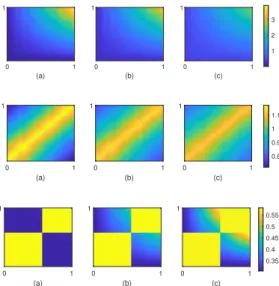
smoothness across blocks with increasingz. The structures implied by multi-graphonsf1, f2, f3
with increasing network positions, precisely, (a) z = 0.05, (b) z = 0.5, and (c) z = 0.95, are displayed inFig. 1.
The first multi-graphon f1 determines links between pairs of nodes based on the product of node-specific factors (x, y) and with additive network-specific effects via z, implying a smooth surface. The smooth structure off1appears ideal for nonparametric regression, however, this may also lead to a high variance in nodal position estimates due to similar distances between subsets of nodes. This example is designed to understand the trade-off between these two aspects. The second graphonf2has aRobinsonianform (e.g., Hubert et al. (1998)) with a peak on the diagonal
and decreasing intensity as one moves away from the diagonal on either side. The third graphonf3
is a simple stochastic blockmodel withk= 2 blocks in the case of replicated networks i.e.,β= 0. Clearly, the probability of interaction between nodes across blocks is determined via rabz with
the network-specific factor z interacting with node-specific positions (x, y). Thus, across-block probabilities increase non-uniformly across nodes, whereas, within-block probabilities determined viaraz (no interaction term) decrease uniformly across all nodes within the two blocks.
Given (n, m, ρnf), a generalized random graph sample comprising adjacenciesA1, . . . , Amis
simulated via independent Bernoulli trials followingDefinition 2. We use uniformly distributed latent nodal and network positions i.e.,x1, . . . , xn
i.i.d
∼ U(0,1), andz1, . . . , zm
i.i.d
∼ U(0,1). Further, network-level covariates ˇzl, l ∈ [m] are sampled as noisy measurements of the corresponding
unobserved network-specific positionszl, l∈[m], i.e.,
ˇ
zl=zl+l, where l∼N(0, σ2). (5.1)
Clearly, the quality of network-specific covariates ˇz as measurements of the unobserved latent positions zis a function of the noise varianceσ2. Sincez∼U(0,1) in our simulation set-up, we choseσ= 0.28 implying a signal-to-noise ratio (SNR) of≈1. An SNR of unity implies that the ‘signal’ (covariate) is only as strong as noise and thus allows us to examine the performance and robustness of our method in settings where the observed covariates may not be ideal measurements of the true latent network-specific positions.
We compare the performance of our two step multi-graphon estimator with competing methods of SBA [1], SAS [15], USVT [16] and NBS [56]. The algorithm of SBA achieves graphon estimation from a sample of multiple i.i.d. networks and hence corresponds to our case of replicated networks
0 1 (a) 1 0 1 (b) 1 0 1 (c) 1 1 2 3 0 1 (a) 1 0 1 (b) 1 0 1 (c) 1 0.8 0.9 1 1.1 0 1 (a) 1 0 1 (b) 1 0 1 (c) 1 0.35 0.4 0.45 0.5 0.55
Figure 1: Synthetic multi-graphon functionsf1 (top row),f2 (middle row), andf3 (bottom row), with increasing network positionsz across columns: (a)f(., .;z= 0.05), (b)f(., .;z= 0.5), and (c)
f(., .;z= 0.95). Heren= 150, m= 100.
(β= 0). In order to compare with SAS, USVT and NBS, designed to work with a single adjacency matrix, we report results obtained using the aggregated adjacency ¯A =Pm
l=1A..l/m. As far as
we are aware, no competing methods exist for nonparametric estimation of the heterogeneous network generating process given a collection of independent, non-identically distributed networks. Noting this, we report comparisons of estimates obtained with our approach under oracle settings described below.
The simulations are conducted with a view to understand the performance of our approach for a given choice of nonparametric regression in Step 3. ofAlgorithm 2. This may not always lead to the smallest possible MSE using our method but shall give us a view of the general finite sample performance. We report results obtained with orthogonal series estimation with thin plate regression splines as basis functions [52]. This was implemented in Rusingbam in packagegam. In general, our approach can be easily implemented inR using other smoothing techniques e.g., the Nadaraya Watson estimator which may be implemented usingkernreg in packagegplm.
5.1
Replicated networks (β
= 0
)
A comparison of our approach with existing methods based on MSE averaged over 50 replications are reported in Table1; visual comparisons from a single run are displayed inFig. 2. To interpret performance of our two-step estimator, we consider an oracle setting where the oracle informs order-statistics of the true latent node-specific positions (rather than the exact nodal positions). This information is used to directly construct oracle nodal position estimates denoted as ˆx∗(i)=i/(n+
1) [17, 38], using which nonparametric regression is performed following Step 3. ofAlgorithm 2. We refer to this as the oracle graphon estimator. Note that our oracle set-up does not assume the nodal positions to be known and is designed to be closer to the actual set-up involving unobserved design points.
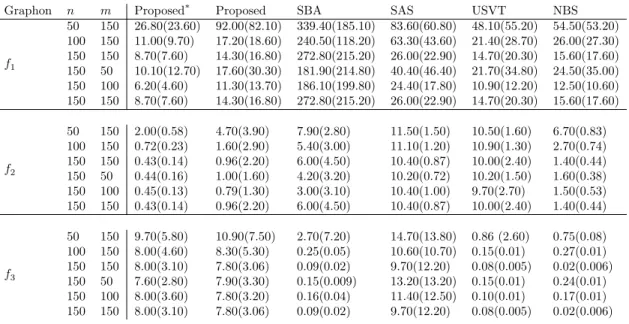
First, comparing MSEs for estimates from the proposed method under the non-oracle setting (‘Proposed’) with the oracle setting (‘Proposed∗’), we note significant differences between the two forf1, and negligible difference for f3,across all sample sizes (n, m), n >50. This indicates that
the first step of latent position estimation performs poorly forf1and extremely well forf3. This is
what we expect due to the smooth structure off1leading to subsets of nodes with similar distances
and hence resulting in latent position estimates with high variance. The discrete structure off3,on the other hand, allows clearer separation between node pairs corresponding to the two blocks due
Table 1: Mean squared error (±std. dev.) comparisons of graphon estimates, all multiplied by 103, averaged over 50 replications. Proposed∗ (proposed under oracle), SBA of [1], SAS of [15], USVT of [16] and NBS of [56].
Graphon n m Proposed∗ Proposed SBA SAS USVT NBS
f1 50 150 26.80(23.60) 92.00(82.10) 339.40(185.10) 83.60(60.80) 48.10(55.20) 54.50(53.20) 100 150 11.00(9.70) 17.20(18.60) 240.50(118.20) 63.30(43.60) 21.40(28.70) 26.00(27.30) 150 150 8.70(7.60) 14.30(16.80) 272.80(215.20) 26.00(22.90) 14.70(20.30) 15.60(17.60) 150 50 10.10(12.70) 17.60(30.30) 181.90(214.80) 40.40(46.40) 21.70(34.80) 24.50(35.00) 150 100 6.20(4.60) 11.30(13.70) 186.10(199.80) 24.40(17.80) 10.90(12.20) 12.50(10.60) 150 150 8.70(7.60) 14.30(16.80) 272.80(215.20) 26.00(22.90) 14.70(20.30) 15.60(17.60) f2 50 150 2.00(0.58) 4.70(3.90) 7.90(2.80) 11.50(1.50) 10.50(1.60) 6.70(0.83) 100 150 0.72(0.23) 1.60(2.90) 5.40(3.00) 11.10(1.20) 10.90(1.30) 2.70(0.74) 150 150 0.43(0.14) 0.96(2.20) 6.00(4.50) 10.40(0.87) 10.00(2.40) 1.40(0.44) 150 50 0.44(0.16) 1.00(1.60) 4.20(3.20) 10.20(0.72) 10.20(1.50) 1.60(0.38) 150 100 0.45(0.13) 0.79(1.30) 3.00(3.10) 10.40(1.00) 9.70(2.70) 1.50(0.53) 150 150 0.43(0.14) 0.96(2.20) 6.00(4.50) 10.40(0.87) 10.00(2.40) 1.40(0.44) f3 50 150 9.70(5.80) 10.90(7.50) 2.70(7.20) 14.70(13.80) 0.86 (2.60) 0.75(0.08) 100 150 8.00(4.60) 8.30(5.30) 0.25(0.05) 10.60(10.70) 0.15(0.01) 0.27(0.01) 150 150 8.00(3.10) 7.80(3.06) 0.09(0.02) 9.70(12.20) 0.08(0.005) 0.02(0.006) 150 50 7.60(2.80) 7.90(3.30) 0.15(0.009) 13.20(13.20) 0.15(0.01) 0.24(0.01) 150 100 8.00(3.60) 7.80(3.20) 0.16(0.04) 11.40(12.50) 0.10(0.01) 0.17(0.01) 150 150 8.00(3.10) 7.80(3.06) 0.09(0.02) 9.70(12.20) 0.08(0.005) 0.02(0.006)
to significantly different distances, implying robust latent position estimates (as far as blockmodel estimation is concerned). Similarly, comparing oracle and non-oracle MSEs forf2 indicate that
latent position estimation works reasonably well for these networks.
In comparison to existing approaches, our actual proposed estimator (non-oracle) leads to the smallest MSE forf1 in all cases except whenn= 50. A significant reduction in the MSE off1is
observed asnis increased fromn= 50 ton= 100, suggesting thatn= 50 nodes are insufficient to perform reliable estimation forf1.Forf2, our approach consistently leads to the smallest MSE
with NBS leading to the second best performance. The relatively higher variance of estimates from our approach is due to high variance in nodal position estimation across replications. As discussed earlier, this is due to the smooth structure of f2 (interestingly, heterogeneity across networks reduces the variance in nodal position estimates significantly forf1 andf2: see results reported
inSection 5.2). In practice, we recommend re-running the first ordinal embedding step a few times
and subsequently selecting the nodal embedding with the lowest stress [46], as this resulted in a reduced overall variance of estimates from the proposed method. Forf3, SBA, USVT and NBS
lead to the best results with SAS leading to the highest MSE. The relatively higher MSEs from our approach forf3 is due to the choice of nonparametric regression, precisely splines as basis
functions which are clearly not ideal for estimation of a discrete blockmodel. This is evident from MSEs under the oracle setting, which are also high and comparable to MSEs under the actual non-oracle setting.
We observe that MSEs decrease with increase in nfor fixedm= 150 in all cases, however, this is not necessarily the case with increase inmand n= 150 fixed, for f1 and f2. This appears to
be an artefact of estimation being performed with a different number of adjacencies (preciselym) aggregated in each case, generated from functions with high degree of smoothness (f1and f2).
5.2
Heterogeneous networks (β >
0
)
We report simulation results for the general setting of cross-sectional networks observed with network-level covariates ˇz1, . . . ,zˇm. Two oracle settings are considered: (i) oracle 1
0
True 0 1 (a) 1 Proposed 0 1 (b) 1 SBA 0 1 (c) 1 NBS 0 1 (d) 1 1 2 3 0 1 (a) 1 0 1 (b) 1 0 1 (c) 1 0 1 (d) 1 0.8 0.9 1 1.1 0 1 (a) 1 0 1 (b) 1 0 1 (c) 1 0 1 (d) 1 0.3 0.4 0.5 0.6
Figure 2: A comparison of estimated graphon matrices for f1, f2, f3 with β = 0 (replicated networks), in rows 1,2,3, respectively, where (a) true graphonf, (b) proposed methodology, (c) SBA of [1] and (d) NBS of [56]. Heren= 150 and m= 100.
order statistics (i) of the true node-specific positionsi, i.e., such thatx(1) ≤x(2). . .≤x(n),and the
true network-specific positionsz1, . . . , zm, and (ii) oracle 2
0
which again informs order statistics of the true node-specific positions exactly as oracle 10, however, gives no information on the network specific positions. Under both oracles ˆx∗(i)=i/(n+ 1),∀i∈[n] provide oracle estimates of nodal
positions, and our algorithm for multi-graphon estimation reduces to nonparametric regression using ˆx∗(1), . . . ,xˆ
∗
(n), and with the exact network positionsz1, . . . , zmunder oracle 1
0
, whereas with network-level covariate measurements ˇz1, . . . ,zˇm under oracle 2
0
. Thus, oracle 10 indicates the best case performance which could be achieved for finite samples if the true set of neighboring nodes were observed, however with imperfect nodal locations ˆx∗(i). Oracle 2
0
indicates the increase in error (over oracle 10) resulting from the use of network-level covariates ˇzl instead of the true network positionszl.
A comparison of our multi-graphon estimates with existing methods using MSE averaged over 50 replications is displayed inTable 2; visual comparisons of estimates from the proposed method, SBA and NBS are displayed in Fig. 3. Unlike f3, for f1 and f2, the estimated nodal positions
implied the same structure as of the true [f(x(i), x(j);zl)]i,j,l suggesting that the purified flattened
graphon ¯f∗in these cases is identical to the actual flattened graphon ¯f. Intuitively, this is what we expect given the smooth structure off1,f2, and the mixed structure off3. To allow comparisons
forf3, we plot our proposed estimate of f3 with rows and columns permuted to match the true
node ordering, i.e. [f3(x(i), x(j);zl)]i,j,l.
Table 2reports MSEs of the multi-graphon array averaged separately for networks generated
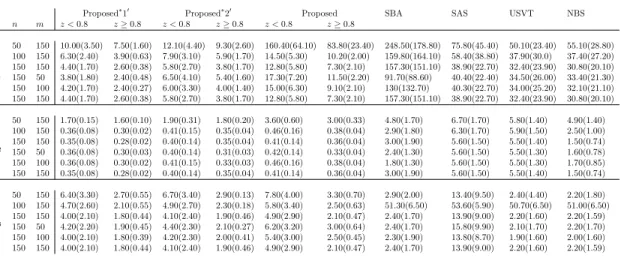
with weak and strong network-specific effects, precisely,{l∈[m] :zl<0.8}and{l∈[m] :zl≥0.8}, respectively. From this table, we note the relatively higher MSEs of estimates under oracle 20 in comparison to oracle 10. This increase in MSE results from the use of covariates employed as noisy measurements for unobserved network positions, as expected. Further, comparing MSEs of oracle 20 estimates with actual non-oracle estimates acrossf1, f2andf3, it is apparent thatf1suffers the
most due to relatively poor estimation of latent nodal positions. As discussed earlier, this is due to it’s extremely smooth structure. Further, we see that our method leads to notably lower MSE for
f1in all cases except whenn= 50. Due the smooth structure off1,n= 50 nodes prove insufficient
for nodal position estimation resulting in a higher MSE. Forf2, our method consistently leads
to the smallest MSE, with SBA and NBS leading to the second best performance. For f3, our
proposed estimator is comparable to the best performing approaches of USVT, NBS and SBA for networks with stronger network-specific effects (higher values ofz) but has a relatively higher MSE otherwise. This is due to the fact thatf3is simply a discrete block model for smaller values
True 0 1 (a) 1 Proposed 0 1 (b) 1 SBA 0 1 (c) 1 NBS 0 1 (d) 1 1 2 3 0 1 (a) 1 0 1 (b) 1 0 1 (c) 1 0 1 (d) 1 0.8 0.9 1 1.1 0 1 (a) 1 0 1 (b) 1 0 1 (c) 1 0 1 (d) 1 0.35 0.4 0.45 0.5 0.55
Figure 3: Estimated multi-graphon matrices for f1 (row 1), f2 (row 2), and f3 (row 3) with
β >0 (heterogeneous networks) at a fixed network positionz=c, where (a) true multi-graphon
f(., .;z =c), (b) proposed methodology, (c) SBA of [1] and (d) NBS of [56]. Heren= 150 and
m= 100.
ofz and thus estimation with splines as basis functions even with the true nodal locations does not lead to improved estimation. This is apparent from the MSEs corresponding to the oracle settings of the proposed method which also have higher MSEs for smaller values ofz. Noting the good performance of NBS forf3, we recommend using our approach with kernel regression (e.g. with a uniform kernel) rather than splines, for multi-graphon estimation of networks with discrete structure.
6
Two data examples
We illustrate the performance of the proposed multi-graphon estimator using two publicly available data sets: (i) a dynamic contact network of ants [36], and (ii) a human connectome dataset named Templeton-114 [29,42].
6.1
Dynamic contact network of ants
With a view to understand division of labor among ant workers, movements in six colonies of the antCamponotus fellahwere tracked over a period of 41 days with network interactions between any two ant workers (nodes) determined by their physical proximity (see SI [36] for more details). We illustrate our methodology using data from colony 3 which has the maximum number of overlapping ant workers (precisely n = 96) over the duration of m = 41 days. This leads to 41 adjacency matrices, each of size 96×96, i.e.,{Aijt, i, j∈[n]×[n], t∈[m]} withAijt denoting the count of interactions between ants iand j on day t. Using behavioral signatures of ant workers such as visits to the brood, foraging trips and visits to the rubbish pile, each ant worker is also recorded to be a nurse (N), or a forager (F) or a cleaner (C), respectively, across four consecutive time periods, each of approximately 10 days [36].
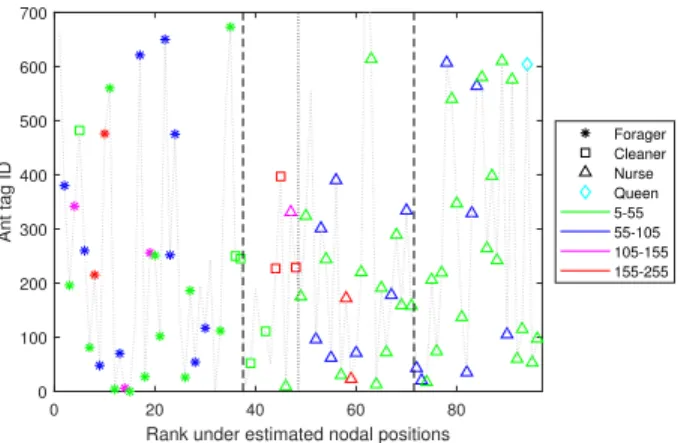
Fig. 4displays a rearrangement of the ant workers (nodes) sorted by increasing nodal positions
(x-axis) estimated following the proposedAlgorithm 2, against their original ant indices as recorded in the data set. Ant worker attributes such as their majority occupation (over the four time periods) and age group are also displayed (see legend in Fig. 4). The dotted line in the middle, plotted for reference, divides the set of nodes into two equal groups on each side. We note a clear spatial segregation with the forager ants (‘∗’) always positioned to the left of the dotted line and a majority of the nurse ants (‘4’) positioned to the right of the dotted line; cleaner ants (‘’) are clearly
Table 2: Mean squared error (±std. dev.) comparisons of (multi-)graphon estimates off1, f2, f3
withβ >0, all multiplied by 103, averaged over 50 replications. Proposed∗(proposed under oracles
10 and 20 ), SBA of [1], SAS of [15], USVT of [16] and NBS of [56]. MSE for multi-graphon estimates from the proposed method are averaged for{f..l, zl<0.8} and{f..l, zl≥0.8}.
Proposed∗10 Proposed∗20 Proposed SBA SAS USVT NBS
f n m z <0.8 z≥0.8 z <0.8 z≥0.8 z <0.8 z≥0.8 f1 50 150 10.00(3.50) 7.50(1.60) 12.10(4.40) 9.30(2.60) 160.40(64.10) 83.80(23.40) 248.50(178.80) 75.80(45.40) 50.10(23.40) 55.10(28.80) 100 150 6.30(2.40) 3.90(0.63) 7.90(3.10) 5.90(1.70) 14.50(5.30) 10.20(2.00) 159.80(164.10) 58.40(38.80) 37.90(30.0) 37.40(27.20) 150 150 4.40(1.70) 2.60(0.38) 5.80(2.70) 3.80(1.70) 12.80(5.80) 7.30(2.10) 157.30(151.10) 38.90(22.70) 32.40(23.90) 30.80(20.10) 150 50 3.80(1.80) 2.40(0.48) 6.50(4.10) 5.40(1.60) 17.30(7.20) 11.50(2.20) 91.70(88.60) 40.40(22.40) 34.50(26.00) 33.40(21.30) 150 100 4.20(1.70) 2.40(0.27) 6.00(3.30) 4.00(1.40) 15.00(6.30) 9.10(2.10) 130(132.70) 40.30(22.70) 34.00(25.20) 32.10(21.10) 150 150 4.40(1.70) 2.60(0.38) 5.80(2.70) 3.80(1.70) 12.80(5.80) 7.30(2.10) 157.30(151.10) 38.90(22.70) 32.40(23.90) 30.80(20.10) f2 50 150 1.70(0.15) 1.60(0.10) 1.90(0.31) 1.80(0.20) 3.60(0.60) 3.00(0.33) 4.80(1.70) 6.70(1.70) 5.80(1.40) 4.90(1.40) 100 150 0.36(0.08) 0.30(0.02) 0.41(0.15) 0.35(0.04) 0.46(0.16) 0.38(0.04) 2.90(1.80) 6.30(1.70) 5.90(1.50) 2.50(1.00) 150 150 0.35(0.08) 0.28(0.02) 0.40(0.14) 0.35(0.04) 0.41(0.14) 0.36(0.04) 3.00(1.90) 5.60(1.50) 5.50(1.40) 1.50(0.74) 150 50 0.36(0.08) 0.30(0.03) 0.40(0.14) 0.31(0.03) 0.42(0.14) 0.33(0.04) 2.40(1.30) 5.60(1.50) 5.50(1.30) 1.60(0.78) 150 100 0.36(0.08) 0.30(0.02) 0.41(0.15) 0.33(0.03) 0.46(0.16) 0.38(0.04) 1.80(1.30) 5.60(1.50) 5.50(1.30) 1.70(0.85) 150 150 0.35(0.08) 0.28(0.02) 0.40(0.14) 0.35(0.04) 0.41(0.14) 0.36(0.04) 3.00(1.90) 5.60(1.50) 5.50(1.40) 1.50(0.74) f3 50 150 6.40(3.30) 2.70(0.55) 6.70(3.40) 2.90(0.13) 7.80(4.00) 3.30(0.70) 2.90(2.00) 13.40(9.50) 2.40(4.40) 2.20(1.80) 100 150 4.70(2.60) 2.10(0.55) 4.90(2.70) 2.30(0.18) 5.80(3.40) 2.50(0.63) 51.30(6.50) 53.60(5.90) 50.70(6.50) 51.00(6.50) 150 150 4.00(2.10) 1.80(0.44) 4.10(2.40) 1.90(0.46) 4.90(2.90) 2.10(0.47) 2.40(1.70) 13.90(9.00) 2.20(1.60) 2.20(1.59) 150 50 4.20(2.20) 1.90(0.45) 4.40(2.30) 2.10(0.27) 6.20(3.20) 3.00(0.64) 2.40(1.70) 15.80(9.90) 2.10(1.70) 2.20(1.70) 150 100 4.00(2.10) 1.80(0.39) 4.20(2.30) 2.00(0.41) 5.40(3.00) 2.50(0.45) 2.30(1.90) 13.80(8.70) 1.90(1.60) 2.00(1.60) 150 150 4.00(2.10) 1.80(0.44) 4.10(2.40) 1.90(0.46) 4.90(2.90) 2.10(0.47) 2.40(1.70) 13.90(9.00) 2.20(1.60) 2.20(1.59)
positioned in between these two larger occupational groups. This suggests that ant workers with the same occupation were estimated to be closer to each other than ants with different occupations via the distance estimation approach. Such a spatial segregation is clearly not implied by the age attribute, as ants from the same age group are not always positioned closer to each other. Further, we note that the queen ant (‘’) is estimated to be spatially closer to the group of nurses (‘4’) and is positioned far from cleaner and forager groups. This is in agreement with the well-known behavior of queen ants who are solely responsible for reproduction.
We first study comparisons for graphon estimates obtained under the assumption of an i.i.d (or replicated) collection of networks over time. The result from our approach and comparisons with existing techniques applied to the aggregated adjacency ¯Aare displayed inFig. 5, where for convenience of comparisons, rearranged matrix estimates of SBA, SAS and NBS, with nodes sorted by increasing nodal positions estimated from our approach, are shown. We see a good agreement between the proposed estimator and all other methods except SAS, with high intensity regions at the edges of the main diagonal (corresponding to subgroups of forager and nurse nodes); and relatively low intensity of connection along the off-diagonal.
Existing studies on organizational behavior of ants such as [36, 37] and references therein, suggest that the assumption of identically distributed networks over time is unrealistic for such ant interaction data. Our multi-graphon estimates displayed inFig. 6indicate that this is indeed the case as newer structural features become apparent when estimation is performed without assuming identically distributed networks over time. Fig. 6shows how the network structure changes over the duration of 41 days with a significant decrease in intensity of interactions towards the end of the period, particularly, beyond day 37. More precisely, notably high intensity of interactions are observed until day 33 of the experiment for a small proportion of nurse ant workers (top right corner of multi-graphon estimates), and forager ant workers (bottom left corner of multi-graphon estimates), beyond which intensity of interactions in these regions begins to decrease. In fact, the highest intensity of interaction by the end of the experiment is between cleaners and a small subset of forager and nurse ants: precisely the set of ant workers positioned within the dashed lines displayed inFig. 4.
Estimates of pairwise intensity of interactions for four pairs of ants and the corresponding 95% confidence intervals over time, obtained via subsampling bootstrap are displayed in Fig. 7. Significant differences in interaction behavior over time periods are easily identified for all pairs of ants except the forager-cleaner (F-C) ant pair (560,52) (or (15,44) in the estimated ordering),
0 20 40 60 80
Rank under estimated nodal positions
0 100 200 300 400 500 600 700 Ant tag ID Forager Cleaner Nurse Queen 5-55 55-105 105-155 155-255
Figure 4: Ant tag ids (y-axis) against their ranks (x-axis) based on the estimated nodal positions. The dotted line in the middle is plotted for reference; dashed lines are used to interpret results (details in text). See legend for occupation and age group of each ant.
Proposed 0 0.5 1 (a) 0.5 1 SBA 0 0.5 1 (b) 0.5 1 Histogram 0 0.5 1 (c) 0.5 1 SAS 0 0.5 1 (d) 0.5 1 NBS 0 0.5 1 (e) 0.5 1 0.8 1 1.2
Figure 5: Graphon estimates ˆf1/4 for contact network of ants, assuming i.i.d networks over time, where: (a) the proposed methodology, (b) SBA of [1], (c) network histogram of [38], (d) SAS of [15], and (e) NBS of [56]. For comparison, estimates from SBA, SAS, and NBS were re-arranged to correspond to increasing nodal position estimates from our algorithm. The power root stabilizes the variance of the intensity displayed using the color spectrum and is solely for ease of visualization.
where confidence bars overlap across all days. For example, for the forager-forager (F-F) ant pair (48,560) displayed in the second subplot, the estimated intensity of interaction over the first 10 days is significantly lower in comparison with intensity over days 20−30, decreasing again beyond day 36. It is interesting to note that the intensity of interaction between the nurse-cleaner (N-C) pair (159,52) over days 36−41 is significantly higher than the intensity over days 25−31, suggesting a change in behavior somewhere between these two time periods. Noting the occupation of the nurse ant worker 159, we find that it is recorded to be a nurse in the first three periods of data collection (precisely, days 1−31) and a cleaner for the last period spanning days 32−41. This could be a possible explanation for the significant increase in intensity between the N-C pair (159,52) with days 32−35 corresponding to a transition period for a change in occupation from a nurse to a cleaner.
6.2
Human connectome data
This data set comprises of structural brain networks on n= 116 brain regions, known as regions of interest (ROIs), observed form= 256 subjects. For each subjectl∈[m], the existence of an edge between brain regionsi∈[n] andj∈[n] is determined from multimodal magnetic resonance imaging data [29], and corresponds to the presence of atleast one white matter fiber connecting the two regions, (see [24,42] for details). The brain regions considered in this data set are given by the Automated Anatomical Labeling (AAL 116) cortical atlas [47]. This data set also includes
0 0.5 1 day 1 0.5 1 0 0.5 1 day 5 0.5 1 0 0.5 1 day 9 0.5 1 0 0.5 1 day 13 0.5 1 0 0.5 1 day 17 0.5 1 0 0.5 1 day 21 0.5 1 0 0.5 1 day 25 0.5 1 0 0.5 1 day 29 0.5 1 0 0.5 1 day 33 0.5 1 0 0.5 1 day 37 0.5 1 0 0.5 1 day 39 0.5 1 0 0.5 1 day 41 0.5 1 0.7 0.8 0.9 1 1.1 1.2
Figure 6: Multi-graphon matrix estimates ˆf1/4(., ., tl), tl=l/41, l∈[41] using the proposed method
for daylshown along the x-axis. The power root stabilizes the variance of the intensity displayed using the color spectrum and is solely for ease of visualization.
0 10 20 30 40 day 0 1 2 3 Ant pair (159,20) 0 10 20 30 40 day 0 2 4 6 Ant pair (48,560) 0 10 20 30 40 day 0 0.5 1 1.5 2 Ant pair (560,52) 0 10 20 30 40 day 0 0.5 1 1.5 Ant pair (159,52)
Figure 7: 95% confidence intervals for estimated intensity of pairwise interactions between ant pairs over time with original ant tag ids and occupations given by: first row, left: (159,20), N-N; first row, right: (48,560), F-F; second row, left: (560,52), F-C; second row, right (159,52), N-C.
a creativity score for each subject, measured via the composite creativity index (CCI) of [28]. The CCI scores are informed by ranks assigned to the creative products of each subject by three independent judges.
Fig. 8displays brain regions sorted by increasing nodal embedding position estimates (x-axis)
from our proposed algorithm against their actual AAL116 indices (y-axis). The membership of each brain region in one of the two hemispheres–left or right, and one of the eight lobes– Frontal, Insular, Limbic, Occipital, Parietal, SCGM, Temporal, Cerebellum, is also displayed (see legend). The dotted line in the middle, plotted for reference, divides the set of nodes into two equal groups
0 20 40 60 80 100 120 Rank under estimated nodal positions
0 20 40 60 80 100 120
Brain regions (AAL 116)
Left Right Frontal Insula Limbic Occipital Parietal SCGM Temporal Cerebellum
Figure 8: Brain regions (indices from AAL116 atlas, y-axis) against their ranks (x-axis) based on the estimated nodal positions. The dotted line in the middle is plotted for reference (see text).
on each side. Noting the hemisphere (and lobe) membership of nodes on the left and right side of the dotted line inFig. 8, we observe that ROIs belonging to the left and right hemispheres, lie to the left and right of the dotted line respectively, for members of all lobes except Limbic () and Cerebellum (∗). Since ROIs belonging to the left and right hemispheres, lie to the left of the origin (negative x-axis) and right of the origin (positive x-axis) in the standard MNI space, respectively,
it suggests that nodal positions estimated via our algorithm, for a majority of brain regions are coarsely aligned with their actual spatial coordinates along the first dimension (or x-coordinates). Further we see that nodes from the Limbic lobe are embedded such that its members from the left (right) hemisphere are positioned to the right (left) of the dotted line (centre), whereas for nodes from the Cerebellum lobe, left and right hemisphere members are mixed on either side of the dotted line.
A comparison of our graphon estimate under the replicated network assumption with estimates from SBA of [1], network histogram of [38], SAS of [15], USVT of [16], and NBS of [56], is displayed
inFig. 9. Clearly, network structure is only apparent from the proposed estimate and network
histogram of [38], a graphon function estimator. The lack of structural visibility in estimates from all other methods is due to the absence of a meaningful ordering on the set of nodes, typically achieved using node-specific covariates which are not observed in this dataset. To allow comparison, re-arranged matrix estimates of SBA, SAS, USVT, and NBS with nodes sorted by increasing nodal position estimates from our algorithm, are displayed inFig. 10. Overall, at a coarse level we see a good agreement between estimates from all methods except SAS. Our estimator clearly indicates assortative community-like behavior for nodes positioned at the two extremes, precisely, nodes with estimated indices 1−35 and 81−116 (x-axis of Fig. 8). We see a very high intensity of interaction for nodes within these two groups and very low intensity of interaction across the two groups, and clearly, a relatively weaker community structure for nodes positioned in the middle (node indices 48−74).
Assuming the collection of networks from subjects to be non-identically distributed Fig. 11
displays multi-graphon estimates obtained with network-level covariates ˇzl as the normalized
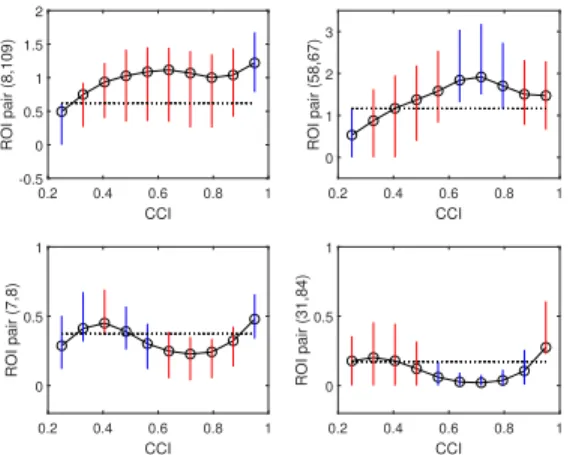
(max norm) CCI score of subject l∈[m]. From these plots it is evident that network structure changes as we go from subjects expressing low creativity to high creativity, e.g., with significantly different intensities of interactions along the main diagonal with increasing CCI. For a closer inspectionFig. 12displays 95% confidence intervals and estimates of pairwise intensity of interaction for four different ROI pairs, as a function of CCI scores. An immediate observation is that we may not always observe (a significant) increase in intensity of interaction with increase in creativity levels measured via CCI. This is visible fromFig. 12 where red bars indicate similar intensities
with increase in CCI in subplots (a), (b), (d) and a significant decrease in intensity with increase in CCI in subplot (c). Secondly, these plots suggest that the CCI score threshold for partitioning network samples into ‘low’ and ‘high’ creativity groups (e.g. [19]) may vary depending on the ROI pairs of interest. Based on these findings, in practice, we recommend fixing the set of ROIs of interest to the practitioner, to infer a meaningful grouping of network samples before performing tasks such as identifying a subset of edges which provide evidence of change across low and high creativity groups or classification into categories constructed artificially from continuous-valued information, for example as considered in [19]. This is crucial as otherwise aggregated behavior of each partition may not be representative of the actual behavior due to significant differences within the chosen subset of network samples, resulting in misleading conclusions.
Proposed (a) 0 0.5 1 0.5 1 SBA (b) 0 0.5 1 0.5 1 Histogram (c) 0 0.5 1 0.5 1 SAS (d) 0 0.5 1 0.5 1 USVT (e) 0 0.5 1 0.5 1 NBS (f) 0 0.5 1 0.5 1 0 1 2 3 4
Figure 9: Graphon matrix estimates ˆf1/2 for connectome data, assuming i.i.d networks over subjects, where: (a) the proposed methodology, (b) SBA of [1], (c) network histogram of [38], (d) SAS of [15], (e) USVT of [16] and (f) NBS of [56].
SBA (b) 0 0.5 1 0.5 1 SAS (d) 0 0.5 1 0.5 1 USVT (e) 0 0.5 1 0.5 1 NBS (f) 0 0.5 1 0.5 1 0 1 2 3 4
Figure 10: Re-arranged graphon matrix estimates (from above) (b) SBA (d) SAS (e) USVT and (f) NBS, with nodes sorted by increasing nodal positions estimated from our algorithm.
6.2.1 Application to resampling networks
Network summary statistics such as triangle frequency, average path length, transitivity, network edge density are of great practical interest and have been studied in the context of brain network organisation and creativity, for example as in [12, 19, 35]. According to [12], structural brain networks of highly creative individuals are found to exhibit small-world phenomenon with high triangle frequency, low average path length, high edge density, and high transitivity. To check if the small-world behavior for high creativity individuals suggested by previous studies, is a feature implied by our multi-graphon estimate, we study network summaries for samplesAgenerated using the estimated multi-graphon ˆf. For a given normalized creativity score ˇz ∈(0,1),we generated
B networksA1(ˇz), . . . , AB(ˇz), each of size n×n(n= 116), as independent Bernoulli trials where,
Aij(ˇz)∼Bernoulli( ˆρnfˆ(ˆxi,xˆj; ˇz)), for (i, j)∈[n]×[n]. Subsequently, the four network statistics
–triangle frequency, average path length, transitivity, and network edge density were computed for
eachA1(ˇz), . . . , AB(ˇz). Fig. 13 displays the corresponding 95% confidence intervals for these four
network statistics with increasing creativity scores, obtained using B = 10000 networks. From these plots, differences in network statistics across creativity levels are apparent. Further, we see that triangle frequency, edge density, and transitivity are significantly higher, whereas average path length, is significantly lower for subjects with high creativity in comparison to those with low creativity, confirming the small-world phenomenon for high creativity brains [12].
0 0.5 1 CCI=1.56 0.5 1 0 0.5 1 CCI=1.89 0.5 1 0 0.5 1 CCI=2.11 0.5 1 0 0.5 1 CCI=2.33 0.5 1 0 0.5 1 CCI=2.56 0.5 1 0 0.5 1 CCI=2.78 0.5 1 0 0.5 1 CCI=3 0.5 1 0 0.5 1 CCI=3.22 0.5 1 0 0.5 1 CCI=3.44 0.5 1 0 0.5 1 CCI=3.67 0.5 1 0 0.5 1 CCI=3.89 0.5 1 0 0.5 1 CCI=4.22 0.5 1 0 0.5 1 1.5 2 2.5 3 3.5 4
Figure 11: Multi-graphon matrix estimates ˆf1/2(:,:, zl) using the proposed method for increasing
CCI scores shown along the x-axis. The power root stabilizes the variance of the intensity displayed using the color spectrum and is solely for ease of visualization.
0.2 0.4 0.6 0.8 1 CCI 0 1 2 3 ROI pair (58,67) 0.2 0.4 0.6 0.8 1 CCI -0.5 0 0.5 1 1.5 2 ROI pair (8,109) 0.2 0.4 0.6 0.8 1 CCI 0 0.5 1 ROI pair (7,8) 0.2 0.4 0.6 0.8 1 CCI 0 0.5 1 ROI pair (31,84)
Figure 12: Multi-graphon estimates ˆf1/2 and 95% confidence intervals for node pairs (indices correspond to AAL116 atlas) with increasing CCI scores. First row, left: (8,109) ≡ ( Frontal Mid.(R), Vermis12), first row, right: (58,67) ≡ (Postcentral(R), Precuneus(L)), second row, left: (7,8) ≡(Frontal Mid(L) , Frontal Mid(R)) and second row, right: (31,84) ≡ (Cingulum Ant.(L),Temporal Pole Sup(R)). The red bars are used to visualize changes (or no change) in intensity with increasing CCI (see text for details).
7
Conclusion
By establishing regimes under which ordinal embedding allows consistent estimation of latent nodal positions in the purified graphon space, we have shown how standard smoothing techniques (kernel methods, regression splines and others) can be employed for estimation of the network generating process. We achieved this for a collection of networks on the same set of nodes, which are commonly observed in many applications. With these results, estimation of the multi-graphon model from a set of networks observed over time simply reduced to nonparametric regression with estimated nodal positions and equi-spaced time points. For cross-sectional networks, the same
0.2 0.4 0.6 0.8 1 CCI 0 5000 10000 triangle count 0.2 0.4 0.6 0.8 1 CCI 1.8 2 2.2
avg. path length
0.2 0.4 0.6 0.8 1 CCI 0.2 0.3 0.4 0.5 transitivty 0.2 0.4 0.6 0.8 1 CCI 0.1 0.15 0.2 0.25 0.3 network density
Figure 13: 95% bootstrap confidence intervals for different network summary statistics (y-axis) as a function of CCI scores. These were obtained via networks resampled using our estimated multi-graphon withB= 10000 bootstrap replications for each CCI score.
was achieved using network-level covariates as measurements for unobserved network-positions. In applications where repeated measurements on each of themnetworks are available, one may follow the approach outlined in this paper to likewise define pairwise distance between networks to allow estimation of latent network-positions.
Further, our approach may be used as a building block to study richer models describing network effects through the multi-graphon function. For example, with the multi-graphon function modeled as the sum of a standard two-dimensional graphon function and with either p scalar functions of pcovariates as in an additive model [26] or with a simple linear combination of p covariates implying a partially linear model [14]. These models shall allow one to integrate more than a single network-level covariate to explain variability across networks without having to deal with the curse of dimensionality via the multi-graphon function. Modeling and estimation techniques developed in this paper may be extended to longitudinal networks to simultaneously estimate structural variability across both the subject and time axes, as we intend to do in future work.
8
Acknowledgements
The authors thank Dr. Joshua T. Vogelstein and Eric Bridgeford at John Hopkins University for sharing the human connectome data. We are also grateful to Professor Carey Priebe for helpful discussions.
A
Proofs
To prove the main results inTheorems 1and2we first consider the following result on consistency of pairwise distance estimates. We show that under the null ofDefinition 2the estimator produced
byAlgorithm 1is a consistent estimator of dist( ¯f) given byEquation (3.2).
Proof of Proposition 1. SetU ∼U[0,1]. The proof proceeds by computing the variances. Note here that while we could have proceed like [1, Theorem 1.] (i.e., via Bernstein’s inequality) we found that inefficient when aiming to account for sparsity and varied speed for the growth ofmrelative ton. To do so, we first consider the ˆsik=Pl∈SAikl/|S|, for fixedi, k. There, we see that conditionally on
xi, xk, (Aikl)lis i.i.d. Bernoulli ρnf(xi, xk;U)
, so that ˆsik∼Binomial(|S|, ρnEUf(xi, xk;U))/|S|
withU the uniform distribution on [0,1]. Therefore, we have that conditionally onxi, xk0, xk
Var ˆsik=ρnf¯(xi, xk)(1−ρnf¯(xi, xk))/|S|= Θ ρn m Cov(ˆsik,sˆik0) =E(ˆsiksˆik0)−EˆsikEsˆik0 = 1 |S|2 X l,l0∈S EAiklAik0l0−ρ 2 nf¯(xi, xk) ¯f(xi, x 0 k) = 1 |S|2 X l6=l0∈S EAiklEAik0l0+ X l∈S EAiklAik0l −ρ 2 nf¯(xi, xk) ¯f(xi, x 0 k) =|S|(|S| −1)ρ 2 nf¯(xi, xk) ¯f(xi, x 0 k) +|S|ρ 2 nEUf(xi, xk;U)f(xi, xk0;U) |S|2 −ρ 2 nf¯(xi, xk) ¯f(xi, x 0 k) = Θ ρ 2 n m ! Then, as ˆrij ∼(P k∈[n]\{i,j}ˆsiksˆ 0 jk)/(n−2), with s 0
jk an independent copy of sjk, for any k ∈
[n]\ {i, j}and conditionally onxi, xj, using the law of total variance:
Eˆrij =ρ 2 n Z [0,1] ¯ f(xi, t) ¯f(xj, t)dt, Var ˆrij = Var(ˆsikˆs 0 jk) + (n−2) Cov(ˆsikˆs 0 jk,sˆik0sˆ 0 jk0) /(n−2) = EVar(ˆsiksˆ 0 jk|xk) + Var(ρ 2 nf¯(xi, xk) ¯f(xj, xk)) /(n−2) +O(ρ4n/m 2 ) = E[Var(ˆsik|xk) Var(ˆs0jk|xk)] +ρ 4 nVar( ¯f(xi, xk) ¯f(xj, xk)) /(n−2) +O(ρ4n/m 2 ) = O(ρ2n/m 2 ) +O(ρ4n) /(n−2) +O(ρ4n/m 2 ) =O ρ4n(n −1 +m−2+ (ρ2nm 2 n)−1).
Similar computation lead to ˆρn/ρn= 1 +Op (nm)
−1/2
. Then, as all variables are positive, we may call upon Markov’s inequality, to obtain,
ˆ rij/ρˆ 2 n= Z [0,1] ¯ f(xi, t) ¯f(xj, t)dt+ι 0 ij,
where Eι0ij = 0 amdι0ij=Op(√). Therefore,
(ˆrii+ ˆrjj −rˆij−rˆji)/ρˆ 2 n = Z [0,1] ¯ f(xi, t) 2 dt+ Z [0,1] ¯ f(xj, t) 2 dt −2 Z [0,1] ¯ f(xi, t) ¯f(xj, t)dt+ (ι0ii+ι0jj−ι0ij−ι0ji) = Z [0,1] ¯ f(xi, t)−f¯(xj, t) 2 dt+ιij, where Eιij = 0 andιij=Op( √
), which is the sought after result. Proof of Proposition 2. First we note that
[ distij(A)−dist\pq(A) E h [ distij(A)−dist\pq(A) i = 1 + ιij−ιpq E h [ distij(A)−dist\pq(A) i.
Thus, upper boundingP−(ιij−ιpq)>E[dist[ij(A)−dist\pq(A)]
will yield the result. To produce this upper bound we will use Bernstein’s equality. First, recalling the notation of the proof
ofProposition 1, we have that
ιij−ιpq= 1 +O(1/n) n−2 X k∈[n]\{i,j,p,q} ˆ siksˆ 0 jk−ˆspksˆ 0 qk−E[ˆsiksˆ 0 jk−sˆpksˆ 0 qk] /ρˆ2n,
![Figure 2: A comparison of estimated graphon matrices for f 1 , f 2 , f 3 with β = 0 (replicated networks), in rows 1, 2, 3, respectively, where (a) true graphon f , (b) proposed methodology, (c) SBA of [1] and (d) NBS of [56]](https://thumb-us.123doks.com/thumbv2/123dok_us/10060415.2905725/13.918.311.626.157.423/comparison-estimated-matrices-replicated-networks-respectively-proposed-methodology.webp)
![Figure 3: Estimated multi-graphon matrices for f 1 (row 1), f 2 (row 2), and f 3 (row 3) with β > 0 (heterogeneous networks) at a fixed network position z = c, where (a) true multi-graphon f (., .; z = c), (b) proposed methodology, (c) SBA of [1] and (d](https://thumb-us.123doks.com/thumbv2/123dok_us/10060415.2905725/14.918.311.626.158.425/figure-estimated-matrices-heterogeneous-networks-position-proposed-methodology.webp)
![Figure 6: Multi-graphon matrix estimates ˆ f 1/4 (., ., t l ), t l = l/41, l ∈ [41] using the proposed method for day l shown along the x-axis](https://thumb-us.123doks.com/thumbv2/123dok_us/10060415.2905725/17.918.317.611.185.504/figure-multi-graphon-matrix-estimates-using-proposed-method.webp)

![Figure 9: Graphon matrix estimates ˆ f 1/2 for connectome data, assuming i.i.d networks over subjects, where: (a) the proposed methodology, (b) SBA of [1], (c) network histogram of [38], (d) SAS of [15], (e) USVT of [16] and (f) NBS of [56].](https://thumb-us.123doks.com/thumbv2/123dok_us/10060415.2905725/19.918.211.726.360.471/graphon-estimates-connectome-assuming-networks-subjects-methodology-histogram.webp)