Calhoun: The NPS Institutional Archive
Reports and Technical Reports All Technical Reports Collection
2009-02-01
The Evolving Private Military Sector:
Toward a Framework for Effective DoD Contracting
Nicholas Dew
Approved for public release, distribution is unlimited.
Prepared for: Naval Postgraduate School, Monterey, California 93943
NPS-CM-09-003
^`nrfpfqflk=oÉëÉ~êÅÜ=
péçåëçêÉÇ=oÉéçêí=pÉêáÉë=
=
The Evolving Private Military Sector:
Toward a Framework for Effective DoD Contracting 10 February 2009
by
Dr. Nicholas Dew, Assistant Professor, and Dr. Ira Lewis, Associate Professor Graduate School of Business & Public Policy
The research presented in this report was supported by the Acquisition Chair of the Graduate School of Business & Public Policy at the Naval Postgraduate School.
To request Defense Acquisition Research or to become a research sponsor, please contact:
NPS Acquisition Research Program
Attn: James B. Greene, RADM, USN, (Ret) Acquisition Chair
Graduate School of Business and Public Policy Naval Postgraduate School
555 Dyer Road, Room 332 Monterey, CA 93943-5103 Tel: (831) 656-2092
Fax: (831) 656-2253
e-mail: [email protected]
Copies of the Acquisition Sponsored Research Reports may be printed from our
Abstract
In this paper, we outline an analysis of DoD (US Department of Defense) contracting of private military firms (PMFs) in an expeditionary context. The paper makes two contributions to research on this topic. First, we outline a general model of how DoD acquisition skills and organization integration capabilities affect the contribution of PMFs to mission performance. Second, we address risk
management in PMF contracting by outlining a spectrum of control mechanisms. As PMF management is clearly not the sole job of the acquisition community, we argue that DoD policy-makers should rethink how the department might change itself in order to integrate PMF services more effectively and efficiently.
Keywords: acquisition, contracting, private military firms, private security companies, resource-based view, US Department of Defense.
Acknowledgements
The authors greatly appreciate the support provided by the Acquisition Chair, RADM (Ret) Jim Greene, USN, as well as Prof. Keith Snider, Principal Investigator for the Acquisition Research Program, and Karey Shaffer, Program Manager for the ARP. We also thank the members of the General Dynamics editorial staff for their diligent assistance.
We would also like to thank Deborah Avant of the University of California, Irvine for her valuable advice on the private military industry.
About the Authors
Nick Dew is an Assistant Professor of Strategic Management at the Naval
Postgraduate School, Monterey, CA. His research focuses on entrepreneurial cognition and industry evolution. His work has been published in several academic journals, including the Journal of Marketing, Strategic Management Journal, the Journal of Business Venturing, the Journal of Economic Behavior and Organization
and Organization Studies. Nick has been a recipient of the Louis D. Liskin award for
teaching excellence at NPS’ business school.
Nick Dew
Assistant Professor
Graduate School of Business and Public Policy Naval Postgraduate School
Monterey, CA 93943-5197 Tel: (831) 656-3622 E-mail: [email protected]
Ira Lewis is Associate Professor of Logistics at the Naval Postgraduate
School, Monterey, CA. His interests include transportation, public policy, and comparative defense acquisition and industrial policy.
Ira Lewis
Associate Professor
Graduate School of Business and Public Policy Naval Postgraduate School
Monterey, CA 93943-5197 Tel: (831) 656-2464 E-mail: [email protected]
= = =
^Åèìáëáíáçå=oÉëÉ~êÅÜ=mêçÖê~ã=
= = = ^Åèìáëáíáçå=oÉëÉ~êÅÜ=mêçÖê~ã= NPS-CM-09-003
^`nrfpfqflk=oÉëÉ~êÅÜ=
péçåëçêÉÇ=oÉéçêí=pÉêáÉë=
=
The Evolving Private Military Sector:
Toward a Framework for Effective DoD Contracting 10 February 2009
by
Dr. Nicholas Dew, Assistant Professor, and Dr. Ira Lewis, Associate Professor Graduate School of Business & Public Policy
Naval Postgraduate School
Disclaimer: The views represented in this report are those of the author and do not reflect the official policy position of the Navy, the Department of Defense, or the Federal Government.
= = =
^Åèìáëáíáçå=oÉëÉ~êÅÜ=mêçÖê~ã=
Table of Contents
Introduction ... 1
The Gansler Commission as Context ... 5
Toward A Framework for PMF Contracting ... 11
The Challenge of DoD Organizational Integration Of PMFs ... 15
Co-specialization of Resources... 19
The Contribution of the Gansler Commission... 23
Managing the Downside Risks of PMFs ... 27
Conclusion ... 35
= =
^Åèìáëáíáçå=oÉëÉ~êÅÜ=mêçÖê~ã=
Introduction
Spending on contracted services by the US Department of Defense (DoD) has exceeded that on goods and supplies since the end of the Cold War (Camm, Blickstein & Ventnor, 2004). As the DoD’s services acquisition volume continues to increase in scope and dollars, the Department must ensure effective acquisition planning, adequate requirements definition, sufficient price evaluation, and proper contractor oversight (Gansler & Lucyshyn, 2005). However, the DoD’s performance in managing this increasing volume and dollar value of service contracts has
received significant criticism. Most notably, the DoD’s reduced and aging acquisition workforce, trained mostly in obtaining goods and supplies, is straining under the unique requirements associated with service contracting. Service activities cannot be inventoried, require customer contact and joint production, and have customer-specific inputs.
Moreover, program managers observe intangibility in varying degrees; such a subjective measurement makes evaluating the quality and performance of a service operation difficult (Apte, Ferrer, Lewis & Rendon, 2006). Additionally, contracting for services rather than goods requires significantly more involvement from the end-customer in terms of market research, requirements definition, contractor selection, monitoring, and evaluation (Melese, Franck, Angelis & Dillard, 2007). The cutbacks of the 1990s hit the contracting workforce particularly hard; in addition, the steady growth in outsourcing of services has put additional strain on both the contracting workforce as well as the end-customer staff, who often serve as subject-matter experts or technical authorities throughout the contracting process.
In the above context, the increasing volume of PMF (private military firm)1
contracting poses particular challenges for the DoD. The requirement for contracts
1 We use the definition by Singer (2003) of PMFs, to include PSCs (private security firms) engaged in protection, training and advisory activities, as well as firms providing support services in deployed
with these firms often results in chaotic deployment situations—with combat
effectiveness and mission accomplishment taking priority over effective procurement practices or compliance with legal or regulatory requirements. The variety of
services provided by PMFs can include:
Static security—security for housing areas and work sites, including
US military installations;
Personal security details—security for high-ranking US officials and
[Department of State] Chief of Mission personnel;
Security escorts—security for US government employees, contractor
employees, or others as they move through Iraq;
Convoy security—security for vehicles and their occupants as they
make their way into Iraq or within Iraq; and
Security advice and planning. (GAO, 2008, July 31, p.7)
It is often especially difficult for DoD personnel, whether they are members of the acquisition workforce or subject-matter experts, to monitor and evaluate PMF performance in the field. Indeed, it has been suggested that this inability to evaluate leads to problematic situations—for instance, to a lack of market contestability, such that the contractor can take advantage of the government’s inability to monitor or replace the contractor (Melese et al., 2007). Clearly, if the current practice of
employing PMFs in a wide variety of roles continues in the future, then these present difficulties will only become more relevant and important (Carafano, 2008; Fainaru, 2008). The challenges remain salient as the US continues to deploy contractors alongside its troops:
[Senate Armed Services] Committee members also asked [Secretary of Defense Robert] Gates how the department will handle contractors as the military presence shifts from Iraq to Afghanistan. He conceded that the use of contractors "grew willy-nilly" in Iraq after 2003 and was not accompanied by the necessary oversight capacity. He assured lawmakers that leaders are
environments—such as logistics, base operations and information technology services (KBR being an example of a support services firm).
applying contracting lessons from Iraq to the developing approach to
Afghanistan. The department nonetheless must do some soul-searching on the role of contractors in combat environments, Gates said. (Newell, 2009, January 27).
In this paper, we endeavor to grapple with the issues posed by PMF
contracting from a general management perspective.2 We develop a framework that
may aid defense professionals in thinking about the larger organizational issues involved in contracting for PMF services. Based on this framework, we then provide several recommendations for DoD service contracting policy and practices that might enable the DoD to more effectively deal with PMFs and to obtain better value and better compliance with public policy.
We make two broad claims, which can be summarized as follows:
First, PMF contracting has for too long been framed as an issue that
only the acquisition community needs to address more effectively. An alternative perspective is to see PMF contracting as a
whole-organization issue. As suggested by the report of the Commission on Army Acquisition and Program Management in Expeditionary
Operations (2007),3 the reality is that contractors make up more than 50% of deployed personnel in Iraq (about 11,000 of whom are
employed by firms under contract with the US government (GAO, 2008, July 31)). Indeed, it seems likely that this ratio will be a feature of US military expeditions for the foreseeable future. It is essential that the DoD begins to change its mental models, doctrine and policy, structures and processes, to integrate PMFs more effectively.
Specifically, policy-makers must recognize that how the DoD manages its contracts affects the value it can generate from having PMFs on its team. Therefore, instead of asking how the contracting process can be used to make “them” (PMFs) more effective given what “we” do, the DoD needs to ask how it might change its policies and activities in ways that enable PMFs to make a more valuable contribution to the overall mission.
2 By general management, we mean that we will draw on a range of concepts from organizational theory and strategic management.
3 This document is often referred to as the “Gansler Commission” report after the chairman of the Commission, Dr. Jacques S. Gansler. We will adopt the same practice in this paper.
Second, as highlighted by the Gansler Commission, there is a selective and specific list of issues that the acquisition community needs to address in order to enable more effective PMF contracting. Our contribution is to highlight how these changes need to be seen in the context of the above remarks regarding the broader organizational integration of PMFs. Most importantly, this means that the contracting community is disabled from working more effectively whenever PMF contracting problems are simply tossed over the fence to them. The contracting community will be more effective when its work is done in the context of broader organizational integration of PMFs.
The paper proceeds as follows. We begin by reviewing some recent findings on PMF contracting (with an emphasis on the Army’s Gansler Commission) and by laying out a general concept for the use of PMFs in DoD contingency operations. We then continue by reviewing the implications of this approach for the acquisition community and, in particular, address risk management in PMF contracting. Finally, we conclude with a synopsis of the major points we make in the study.
The Gansler Commission as Context
While there have been many public reports on the widespread use of PMFs and their conduct over the past few years, the Gansler Commission report is unique in providing an impactful assessment of the implications of this phenomenon for DoD acquisition communities. There have been hundreds of studies of different aspects of DoD acquisition challenges over the past twenty years—not including the regular reporting carried out by Congressional committees, the Government Accountability Office, Congressional Budget Office, the Congressional Research Service, the DoD, defense component and Department of State (DoS) Inspectors General, and the Special Inspectors General for Iraq Reconstruction and for Afghanistan
Reconstruction. Additionally, major studies include those of the Assessment Panel of the Defense Acquisition Performance Assessment Project (2006), the Defense Acquisition Structures and Capabilities Review (2007), and the Commercial Activities Panel (2002).
The Gansler report is comprehensive in its coverage of the issues involved and relates several somber messages about the mundane realities of contracting for services in an expeditionary environment. It is reasonable to state that the threat to the combat performance of the US military, the significant waste of public funds, and the many needless deaths that have resulted from the increase in the use of PMFs in Iraq are the result of some unforeseeable and unmanageable issues within the DoD; however, they are also the direct responsibility of DoD leaders at many levels who felt that acting responsibly or insisting on the rule of law would threaten their careers.
The use of PMFs has a long history, which usually is thought to begin with the end of the Cold War and which has been exhaustively documented by the reports described above that preceded the Gansler Commission. The expansion of the defense sector into large-scale contracting of services, which began with the downsizing of the military and DoD civil service in the 1990s under the Army’s
Logistics Civil Augmentation Program (LOGCAP), was at best a partial success. In the Balkan conflicts of this period, the DoD systematically demonstrated major weaknesses in LOGCAP contracting for even basic support such as facilities,
laundry, construction, and food services. Contract oversight was lacking; the quality of services provided varied enormously, and there was little interest in improving the quality of the acquisition workforce that was being downsized along with the rest of the DoD. There was, and perhaps continues to be, a discomfort with the paradox that outsourcing actually increases the need for in-house personnel and training (GAO, 1997).
The invasion of Iraq in 2003 led to a major need for contracting of both the mundane support services typical of the Balkan conflicts and of PMFs to, in fact, replace military personnel. After such a change, the quality of contracting or of the resulting services could hardly be expected to improve. The GAO commented with respect to what have should been, by that point, an effective and efficient LOGCAP program for basic contract services:
However, at the DoD level, no one is responsible for overall leadership in using the contract and, while AMC [Army Materiel Command, the sponsor of LOGCAP] has sought to influence the way in which the other components carry out their roles, it does not have command authority over the other components and thus its influence is limited. For example, AMC knew that planning for the use of LOGCAP for Operation Iraqi Freedom was not comprehensive but lacked the command authority to direct better planning. AMC officials believe that training will resolve these problems over time. However, given the importance of LOGCAP to supporting military operations and the billions of dollars being spent on LOGCAP activities, we believe that more immediate and direct oversight is needed. (GAO, 2005, Highlights page) If basic services continued to be a challenge, the expansion to what
eventually became a total force (made up of approximately one contractor for every member of the military coalition) could not be expected to work well. Not only is it a truism that services are far more complex and time-consuming to manage than goods, but it is also the case that the closer those “services” approach the application of force or weaponry against people or territory (what the military
sometimes call “kinetic operations”), the closer the DoD gets to a virtual explosion of contracting workload, contractor liaison and evaluation, legal requirements, media attention, diplomatic issues, and human rights matters that all quickly garner international scrutiny.
As we have stated, a military that had barely digested the contracting-out of food services in Bosnia now had “contractors” providing “services” in Iraq; such services included the right to self-defense using firearms—from pistols up to .50 caliber machine guns—that could be directed at any person considered a threat without any risk of accountability. One cannot just blame the downsized acquisition community for this situation, but military commanders and their political supervisors for acquiescing to a loss of the chain of the command that the US Constitution was designed to prevent. What needed to be done in hours—such as creating,
modifying or immediately terminating a contract—was work that DoD culture viewed as a go-slow, legally and bureaucratically complex process governed by hundreds of regulations that were difficult to implement even under ideal conditions within a relatively comfortable office environment in the US
The Gansler Commission was quite clear that what had been created was a new, integrated, military/contractor force that the DoD and, to a certain extent, the Department of State (DoS) were certainly accountable for but were not leading or even attempting to manage. Even at the time of this writing, while there is a
statutory basis for holding accountable PMFs hired by the DoD, those hired by other US government agencies (including the DoS) are subject only to host country and international law. The sketchy nature of this legal framework has been effectively described by the US Government Accountability Office (GAO):
Various laws exist to hold PSC employees accountable for criminal acts committed in a wartime environment beyond the borders of the United States. These laws include US criminal laws that may be applied extraterritorially, the Military Extraterritorial Jurisdiction Act (MEJA), the Uniform Code of Military Justice (UCMJ), international law, as well as Iraqi laws. Whether a particular law provides extra-territorial jurisdiction over a criminal act by a PSC
nature and location of the alleged crime, the nature of the contractor’s
employment, and the nationality of the accused. For example, an employee of a DOD contractor, whether a US citizen or Third Country National, who
commits a felony while accompanying the Armed Forces in Iraq during a contingency operation may be charged under the UCMJ or MEJA. With regard to other than DOD contractor employees, a panel of State Department representatives reporting on protective services in Iraq concluded in October 2007 that the legal framework for holding non-Department of Defense
contractor employees accountable under US law is inadequate. Congress is presently considering legislation that would clarify and extend US criminal jurisdiction over individuals employed under a contract awarded by any US department or agency where contract performance is located in the area of a contingency operation. In addition to US law, the legal framework for holding PSCs accountable includes applicable international law and Iraqi law. Also, contract provisions serve to regulate contractor behavior. (GAO, 2008, July 31, p. 3)
Further highlighting the importance of an appropriate legal framework, the Gansler Commission emphasized how contracting provides the critical link in monitoring performance, and how good contract management practices are essential to mission performance:
Contracting is the nexus between our warfighters’ requirements and the contractors that fulfill those requirements—whether for food service,
interpreters, communications operations, equipment repair, new or modified equipment, or other supplies and services indispensable to warfighting
operations. In support of critical military operations, contractor personnel must provide timely services and equipment to the warfighter; and the Army
contracting community must acquire those services and equipment
effectively, efficiently, and legally; while operating in a dangerous, fast-paced environment. Over half of the personnel currently in Iraq and Afghanistan are contract employees. This puts Army contracting (writing, negotiating,
monitoring, and achieving accountability and enforcement of the contracts), along with modern (information-based) logistics support, squarely at the forefront of our challenges in supporting expeditionary operations. It also invokes command-level issues: Commanders must have timely situational awareness of contracts and contractor personnel and assets on the
battlefield, to properly plan, synchronize operations, and manage the supply chain.
The Army currently lacks the leadership and personnel (military and civilian) to provide sufficient contracting support to either expeditionary or peacetime operations. The Army’s difficulty in adjusting to the singular problems of Kuwait, Iraq, and Afghanistan is in large part due to the fact that there are no
Generals assigned to contracting responsibilities. This is a decade-old blight: the cutbacks began in 1991, and no General Officers have held an Army contracting position since 1998. In a military environment (especially in an expeditionary environment), the number and level of the Generals associated with a discipline reflects its importance. A General is held accountable for his or her leadership. Today, the Secretary of the Army cannot replace a General and obtain a new start for Army contracting—the Army has no Generals doing contracting. (Commission on Army Acquisition on and Program Management in Expeditionary Operations, 2007, pp. 3-4)
The above language is unusually direct for any report commissioned by the DoD. Yet, the findings and recommendations of Gansler and his fellow
commissioners have been largely implemented—and within barely a year—by the Army at least, as we discuss further below. However, the DoD still needs to develop true expertise at managing PMFs given their potential for lethal use of force. As others have argued, if the DoD does not manage PMFs in a consistently exemplary and totally legal manner, then the Executive Branch will be undermining democracy by condoning illegal violence as a bureaucratic inconvenience (Singer, 2007).
In its report quoted above, the GAO further emphasized the inadequate legal framework for regulating PMFs. Such a deficiency, when combined with the major management inadequacies highlighted by the Gansler Commission, creates an impossible challenge. The last sentence of the GAO quotation above is particularly insightful: due to lack of laws, it is expected that as a final resort, contract provisions can be used to “regulate contractor behavior.” With the initiation of a gradual
withdrawal of Multinational Force troops from Iraq, the US has signed a Status of Forces Agreement (SOFA) with the Iraqi government to cover the jurisdiction over US government and contractor personnel. The status of PMFs under the new SOFA “remains unresolved” (US Department of State, 2008).
Toward a Framework for PMF Contracting
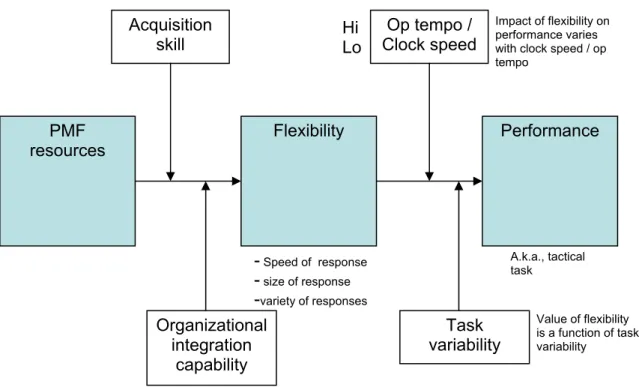
The Gansler report is helpful in identifying the core issues in PMF contracting that need to be incorporated into a coherent framework. In Figure 1 below, we propose a conceptual framework that guides our discussion in the rest of this section.4
Figure 1. How PMF Resources Fit into the Mission
In this figure, we seek to relate—at a broad conceptual level—the role of PMF resources in mission accomplishment. Following the insights of the Gansler
Commission, we propose that PMFs facilitate mission success by enabling a more
4 We build this figure in part based on the recent article by Nadkarni and Narayanan (2007) on clock speed in strategic thinking, and in part from more traditional organizational and strategic management work on contingency theory by Lawrence and Lorsch (1986).
Flexibility PMF resources Op tempo / Clock speed Performance Acquisition skill Organizational integration capability A.k.a., tactical task - Speed of response - size of response -variety of responses Hi Lo Impact of flexibility on performance varies with clock speed / op tempo Task variability Value of flexibility is a function of task variability
flexible response to the military tasks that need to be accomplished. When there is a premium on flexibility, PMFs may play a useful role in getting military results. Figure 1 is comprised as follows:
Performance in the diagram is a pseudonym for whatever military
goals DoD leadership defines as important.
Flexibility is defined as the ability to continually change organizational
actions, asset deployments and investments (Nadkarni & Narayanan, 2007). Flexible organizations exhibit diversity and rapid shifts in their actions and responses. Flexibility has three dimensions.
o First, speed of response,
o Second, variability in the size of response, and,
o Third, variety in the type of response.
PMF resources refer to the portfolio of service contractors the DoD
employs to support its expeditionary missions.
Op tempo/clock speed is a relative measure of the pace of change in
a deployed situation. It reflects both the pace of change in:
o Exogenous variables, such as the security situation in Iraq,
which might be improving quickly or slowly relative to other war zones; and, in
o Endogenous variables, such as organizational change (turnover
of combatant commanders, etc.).
Either type of change affects op tempo. We would expect that this variable moderates the relationship between flexibility and performance, with flexibility being more valuable when clock speed is higher.
Task variability is a relative measure of the changeability of task
requirements. Much recent military literature has been concerned with describing the changing nature of the recent military task at hand— perhaps none so powerfully as by van Creveld (1991) in his book, The Transformation of War. Again, we expect that task variability
moderates the relationship between flexibility and performance, with flexibility being more valuable when variability is higher.
Acquisition skill is defined as the DoD’s capability in contracting for PMFs. At a practical level, it concerns issues such as the
prequalification of contractors, the organizational knowledge of the portfolio, and the availability of boutique contractor offerings. We expect that acquisition skill moderates the effectiveness with which PMF services may contribute to flexibility and, therefore, to
performance—with a more skilled acquisition ability leading to higher flexibility. For example, prequalification and knowledge may both contribute to a more flexible military response by enabling a wider variety of resources to be offered faster.
Organization integration capability is defined here as ability of the
DoD to seamlessly combine and amalgamate PMF resources to form a total expeditionary force. An example of such capability would be the development of organizational structures and processes (i.e.,
command-and-control systems) that allocate, coordinate, and assimilate contractor manpower effectively.5 We expect that organization integration capability also moderates the relationship between PMF resources and flexibility (thus, ultimately, task
performance—whatever that may be), with better integration capability yielding a more flexible expeditionary system.
The framework thus described is conventional in the sense that it builds on well-established strategic management and organizational theory (Mintzberg, 2008; Jones, 2006). Its usefulness, therefore, does not lie in its surprising features or in its radicalness—for we make no claims that the set of relationships outlined here is earth-shattering. Rather, its usefulness lies in establishing a set of relationships in an explicit way and, thus posed, in a way that encourages testing by both
commonsense experience and by quantitative research.
5 According to a GAO (2008, October 1) report, DoD, State and USAID [US Agency for International Development] systems used merely for tracking the presence of contractors in Iraq and Afghanistan have been inadequate. The report states that:
Complete and reliable data were not available for GAO to determine the total number of contractor personnel who worked on DOD, State, and USAID contracts in Iraq and Afghanistan […]. DOD did not routinely evaluate the data for accuracy […]. Neither State nor USAID had systems in place during our review period to track the number of contractor personnel. As a result, they could not provide complete personnel data […]. According to DOD and State officials, information on killed and wounded contractor personnel was not systematically tracked, which left them unable to provide reliable or complete data. (Highlights page)
Next, we turn to considering further the organizational integration of DoD elements and PMF services together as a single system of resources.
The Challenge of DoD Organizational Integration of
PMFs
One important contribution made by the strategic management field to the understanding of how organizations function is its focus on the underlying resources that enable performance. This is referred to as the RBV (resource-based view) of the firm (Barney, 1991). In this section of the paper, we pick up several threads of RBV reasoning and use them to clarify the nature of some of the DoD’s challenges in contracting PMFs.
Perhaps the key conceptual move that the RBV makes is to examine organizations with a different unit of analysis than other approaches. Instead of seeing contracting organizations (e.g., DoD) and contractors (e.g., DynCorp), we are encouraged to move away from these distinctions and focus instead on the
underlying resources that are at work. Each organization is considered to be a bundle of resources amalgamated together and interacting with each other in a variety of ways.
Some resources might be individuals endowed with human capital, such as acquisition officers with certain skills, training and abilities. Other resources might be organization-level, some of them visible patterns of interaction, routines and rules that the organization uses to enable it to go about its business. Some organization-level resources might be less tangible, such as the culture and norms about “the way things get done around here” that, nonetheless, contribute to the functioning of the organization. Some resources are to be found in networks of organizations, joint ventures and alliance arrangements (Powell, Koput & Smith-Doerr, 1996). Note also that from the RBV, most of the value associated with resources derives from the information and knowledge embedded within them. For example, in a study of biotechnology networks by Powell, Koput and Smith-Doerr (1996), the network of relationships between biotechnology organizations was the resource that generated critical new learning, knowledge and cutting-edge research and development.
Looking at tha situation this way, one might argue that the key challenge for any organization is how to assemble a total bundle of resources that enables certain jobs to get done. After all, the impact of resources ultimately occurs at a group level—it is the collection of resources acting together that has an impact. At this level of abstraction, the question of which resources belong to which organization is subordinated to the prior task of assembling a bundle, system or ecology of
resources together that will have a capability for performing specified tasks adequately.
Accordingly, based on Figure 1, we would predict that (all other things being equal) the general availability of PMF resources would improve DoD mission performance by adding flexibility to DoD capability. This flexibility might be derived from the speed in which resources can be made available, from accessing capacity, and from the wide selection of resources available. Therefore, in principle, PMF resources add to DoD capability, all other things being equal. Two observations are important here:
First, the task of assembling resources is a dynamic one. As the
technologies used in warfare become more complex, there is an ongoing process of specialization and, therefore, a re-division of labor resources and development of new organizational resources (van Creveld, 1991; van Creveld, 2006). Thus, an important characteristic of the resource pool is that it is an ever-expanding and increasingly complex ecology of niches. This is true for technology when it is considered as electronics but is also true for technology when it manifests itself as new practices, such as new ways of organizing. These are all constantly specializing and expanding—which arguably makes the task of contracting more difficult over time since the value of specialist knowledge is often hard to understand from the outside, i.e., without having specialist knowledge.
Second, it is extremely important to focus not just on the tangible
resources that can be observed, but also on the intangibles. This is the lesson of the biotech networks referred to above: the maze of interstices, gaps and relationships between players are less visible, but—as an element of collective activity, the system, the ecology—they are just as important as the more easily observed elements. Whereas the DoD’s resource ecology for goods (such weapon systems, parts, or
supplies) has a long history, is rich and well developed, its resource ecology for services is (arguably) somewhat less understood and developed. Yet, the lesson of other systems is that the task of integrating all the resources together is an important activity in itself, and arguably one that is much too important to be shoved aside as a “mere” contracting issue. Instead, we have to pay careful attention to how contractor and DoD resources work together in this complicated linked ecology of resources.6
Though for any specific task there are usually many good arguments for why the task should be performed by either a contractor or a government employee, a less well-developed issue concerns the synergy between making and buying
services. Yet, the resource-based perspective we use here highlights this largely unnoticed issue. When we view an organization more broadly as an ecology (or integrated system) of interacting resources, we can see that making and buying are not discrete choices. Instead, there is a third logic: that the distinct choice to make and buy has its own reasoning (Parmigiani, 2007).
An obvious example of this is the way both making and buying a resource creates the option of substituting or switching out resources for one another, which adds flexibility to organizational arrangements, in the spirit of Figure 1. This
flexibility can be especially valuable when employed resources are more flexible/general purpose than contracted resources. In this case, backfilling an employed resource can increase DoD capability for performing its mission.
In her comprehensive study of making and buying, Parmigiani found statistical support for some value of flexibility from simultaneously making and contracting. This insight points to the possible value of having a network of pre-qualified PMFs on hand (the value residing in the network, of course) that can provide direct support by performing specific tasks, and/or indirect support by backfilling DoD employees that can be released for other tasks. An example of this
6 Of course, as in any ecology, there are arguments and contests about jurisdictions, i.e., who is qualified to do what work—PMFs or the DoD? These issues constantly flare up in the PMF sector, usually for good reasons, some of which we explore later in this paper.
logic might apply to convoy-protection duties in Iraq, which have sometimes been staffed by military personnel and sometimes by contractors; the latter option then releases member of the military for higher-value duties.
Parmigiani determined that a second reason why organizations generally engage in both making and buying was better economics. This may be the result of leveraging efficiencies of scale for both in-house and contracted resources. In the case of PMFs, the argument would be that the DoD operates at a large scale that is very inefficient for some aspects of a deployment; in contrast, PMFs may operate at a smaller scale that is more “right-sized” for certain mission requirements.
Therefore, making and buying might leverage synergy between large and small resources. One example that highlights this point is the early days of US operations in Afghanistan in the fall of 2001, which involved small-scale PMF support.
A third reason for making and buying that was supported in Parmigiani’s study and is relevant to the DoD is mutual learning opportunities. There are doubtless some specialties in which both the DoD and PMFs have expertise—for example, activities such as de-mining. In these activities, organizations can take advantage of their own expertise by performing activities themselves, but also may learn from contractors’ expertise by buying-in their services. Thus, in some
situations, there may be bilateral benefits from both making and buying, and in the best-case scenario, there is a beneficial learning spiral from this interaction.
Co-specialization of Resources
Beyond the make-and-buy issue, a further aspect of the organizational integration of PMFs that a resource-based perspective highlights is the
co-specializationof resources (Lippman & Rumelt, 2003). A recurring point is that PMFs generate incentives for military personnel and civil servants with highly specialized skills to retire from government service, and proffer their abilities under private contracts priced much higher than their former DoD pay. Less noticed, this issue points to important issues regarding the co-specialization of resources. First, resources—say skills in underwater demolition—have value from being included in a coalition of resources that are in use and demanded. On their own, any individual resource will have some value; but this value is increased enormously when operating as part of a system of complementary resources. (In the case of our underwater demolition expert, this might be other specialists with complementary skills that operate as a team, but it would also have to include the necessary
hardware for performing tasks, and an entire supporting infrastructure of operations and training behind that.) The next point to appreciate is that the variability between employed and contractor salaries is predicted by strategic management theory, which highlights that when resources are co-specialized, payoffs can vary enormously depending on bargaining dynamics (Lippman & Rumelt, 2003). Sometimes one player (say the DoD) may be allowed to claim most of the value; sometimes a different player (say, a skilled individual) may be able to claim most of the value. Theory suggests that who is allowed to claim value is underdetermined.
The first key point (regarding DoD integration of PMFs) that emerges from an understanding of PMFs as part of a co-specialized system is that what the DoD does affects the value PMFs can bring to the table. The essence of co-specialization is that the resources involved in producing an effect need each other. How they do as
a coalition depends on how they interact. DoD decision-makers are used to approaching PMF contracting from the perspective of identifying their needs, and
then contracting for those. However, how the Department organizes itself affects the value-added it can receive from having PMFs as part of its team. This means that PMFs are held hostage by DoD strategy, behavior, policy, organizational structures, etc., which all affect the efficiency and effectiveness of PMFs.
If, as emphasized by the Gansler Commission, the 50/50 split between
contractors and DoD personnel is here to stay, there is a considerable need for DoD policy-makers to move from thinking about how they have worked with PMFs in the past, to thinking about how they can best work to generate value from the PMFs in the next campaign—even if that means challenging some sacred cows regarding how the Department organizes itself. The DoD needs to investigate what might be done differently in order to make the PMFs it uses more valuable in performing the mission. Perhaps seeing a need to understand this issue in depth, Congress created the Commission on Wartime Contracting, currently scheduled to submit its final report by June 2010 (Newell, 2009, February 2; Special Inspector General for Iraq Reconstruction, 2009)
Co-specialization also has important implications for the acquisition function in the DoD. In order for PMFs to add value to the mission, its services need to be acquired at the right price. This would be easy if the defense market was quasi-perfect or ideal-quasi-perfect, i.e., many buyers and sellers of commodity goods. In this situation, buyers (i.e., the DoD) are merely price-takers. However, this is not the reality of the kinds of services the DoD buys from “body shops.” The resources in question are imperfectly mobile, and reputation, speed and secrecy all matter in the buying process. For these reasons, many contracts are sole-source or limited-competition contracts. Furthermore, many resources are co-specialized with DoD resources or other contractor resources; therefore, the division of value is
indeterminate. The result of these factors is that DoD contracting often occurs in very imperfect market conditions, often on a negotiated basis.
In situations with these characteristics, acquisition skills really matter, both at the individual and organizational level. Prior strategic management research has
already established that pricing capability is an important strategic resource (Dhutta, Zbaracki & Bergen, 2003). The other side of this coin is acquiring resources at the right prices which, by symmetry, is also an important organizational capability. An organization’s ability to obtain contracted services (sometimes referred to as being a “knowledgeable client”) depends on two kinds of resources: some that are individual in nature (i.e., human capital—having competent, well-trained professionals doing the work), and some are organizational in nature (i.e., developing a successful set of policies, routines and incentives that work together in a coherent fashion). An
organization has a superior contracting capability when these resources enable it to be highly effective in its contracting activities given its environmental context (i.e., the law, regulatory framework and norms deemed appropriate). When the context changes, we should expect adjustment processes will come into play. However, as highlighted by Argote and Greve, “Because routines are so central to organizational functioning, large-scale replacement of routines is a complex endeavor that is done at different speeds depending on the group level of agreement with the new realities and encouragement of experimentation” (2007).
By 2007, the Army recognized that its organizational functioning in the expeditionary environments of Iraq and Afghanistan was less than desirable. That Service’s efforts to improve the situation are described in the next section.
The Contribution of the Gansler Commission
Within the Army, one of the Gansler Commission’s unique contributions was the authors’ insistence on examining real behavior and attitudes within the context of a very complex group of competing organizational hierarchies, some of which were outside the Army. These realities drove the recommendations. For example, the report firmly addresses the need for military officers and DoD civil servants to have a General leading their occupational community (in this case contracting). The Army leadership reacted quickly to this recommendation, appointing an Acting
Commander of the new Army Contracting Command (ACC). This command had previously been the civilian-led Army Contracting Agency, an organization with little authority in Army circles. Additionally, long-overdue measures to reduce financial penalties incurred by deployed civilian contracting officers and to improve their pay and benefits were also taken; these measures were particularly important given the significant experience of many of these individuals (Bokinsky, 2009).
These changes were made within four months of the release of the Gansler Commission report, which is impressive by DoD standards. The purpose-designed organizational structure gives some idea of the Army’s initial commitment to
implement the Gansler Commission recommendations:
The ACC will be a two-star level command, with two one-star subordinate commands, including an expeditionary command, which will be able to deploy when and at the level needed and increase the Army's oversight of
contracting in theater.
It will consist of 171 contingency contracting teams of two officers and two NCOs each, which will be modular and able to go where needed. The expeditionary command will also have 18 battalions of eight to nine people each and seven brigades. Each brigade will have a Criminal Investigative Division agent and an auditor.
“The whole idea is that the next time we go into a fight, we'll be prepared,” [Army Materiel Command Director of Contracting Jeffery] Parsons said. “There's going to be organization. There's going to be individuals responsible and accountable for providing that contracting support. The teams deploy. If
the fight's going to be a little longer, a battalion deploys. If it's going to be of longer duration, the brigade deploys.” (Lorge, 2008)
In contrast to its attention to detail regarding the ACC’s organization, the Gansler Commission report was almost completely silent on the subject of the contribution of the Defense Contract Management Agency (DCMA) to expeditionary operations. The DCMA is an independent agency whose civilian head reports to the Under Secretary of Defense (Acquisition, Technology, and Logistics). While the various DoD components’ Procuring Contracting Officers (PCOs) issue contracts, actual contract administration is performed by Administering Contracting Officers (ACOs). As part of the DCMA’s creation, all ACOs were absorbed into DCMA.
However, the DCMA’s mandate does not include administering contracts in-theater unless they were issued within the United States, such as contracts issued under the Army’s LOGCAP. In effect, this leaves Army PCOs (and anyone else who can be found) to actually administer the vast majority of contracts issued in Kuwait, Iraq or Afghanistan.
However, even LOGCAP contracting in Iraq administered by the DCMA has created problems due to the lack of adequate monitoring by any DoD organization— with PMFs occasionally emerging as subcontractors in what appear to be benign support agreements. For example, KBR received a LOGCAP contract to provide food services in 2004, and then hired Blackwater as a sub-sub-subcontractor to provide security for the movement of truckloads of food and restaurant equipment, billing the Army $19.6 million for Blackwater’s services. The Army refused to pay, stating that KBR’s LOGCAP contract was exclusively for food services, and that the firm was contractually bound to use military convoys. KBR then brought the case before the Armed Services Board of Contract Appeals, with no decision expected until 2010 (Price, 2009).
Accordingly, all in-theater resources are devoted to contract award, while post-award contract administration (such as the monitoring of PMFs) is neglected. The Gansler Commission does break its silence on the DCMA by recommending
adding 583 billets to that agency’s staff for Army support. However, there are probably few illusions about implementation of this measure, as it would require legislation and would impose a deployment orientation on the DCMA, which has traditionally operated in a purely static manner (Commission on Army Acquisition and Program Management in Expeditionary Operations, 2007, pp. 39-40, 50, 56).
While the Gansler report has led to impressive and rapid changes in the Army’s organizational structure for contracting, the changes in organizational routines and processes brought about by the creation of ACC are limited by the scope of ACC’s mandate within any expeditionary operation. The difficult issue of in-theater management of contracts was mentioned above; there are also
challenges with coordination with other federal agencies (such as DoS and the US Agency for International Development), the short-term nature of funding for contracts that makes repeated re-approvals necessary, and the extent to which the Office of the Secretary of Defense (OSD) will actually support the Army in its efforts to reform contracting. So far, much remains to be done outside the confines of the ACC. As stated previously in the quotation from Argote and Greve (2007), “large-scale replacement of routines is a complex endeavor that is done at different speeds.” Discussing the specific issue of DoD-wide oversight of PMFs7, the GAO
stated:
In the short term, DOD has increased the number of oversight personnel in Iraq by shifting existing oversight personnel from other locations into Iraq. However, without developing and implementing a strategy for providing and sustaining an increased number of personnel dedicated to oversight of PSCs, it is not clear whether DOD can sustain this increase because of the limited number of oversight personnel in the workforce. Moreover, while DOD has provided some training on PSCs for units deploying, the training has not been updated to reflect the changes made by DOD since September 2007 to
increase oversight. As a result, military units may be unaware of their
7 Referred to by the GAO as PSCs (private security companies). For more information on this difference in terminology, see note 1 above.
expanded oversight and investigative responsibilities. (GAO, 2008, July 31, Highlights page)
Issuing a contract for PMF services is the beginning of the development of a network of complex relationships that will evolve throughout the life of the contract; yet, such contracts are awarded without reference to the adequacy of resources for implementation.
After the shooting deaths of 17 Iraqi civilians by Blackwater contractors in Baghdad’s Nisour Square in 2007, serious questions were raised about the rise of a new mercenary army (Carstens, Cohen & Kűpçű, 2008: 8). This led to an
inescapable reality: the Iraqi public is opposed to any use of PMFs, and Blackwater had its license to operate revoked by the Iraqi government in January 2009.
Meanwhile, US prosecutors are preparing to try five former Blackwater employees for the Nisour Square incident (US Department of State, 2008; Morin, 2009).
In the above context, it is not evident how, if at all, the risk associated with the employment of PMFs can be managed by the DoD. We will discuss this issue in the next section.
Managing the Risks of PMFs
Since managing the potential risks of employing PMFs is an important part of managing these contractors in a deployed situation, in this section, we pay special attention to this issue. By downside risks, we mean the potential for unwelcome spillover effects or negative externalities resulting from PMF actions. As cases in Iraq have shown, these may have broad political ramifications—an example being the popular outcry following the Nisour Square incident. In addition, spillover effects also have narrower military ramifications, an example being the killing of 4
Blackwater contractors in March 2004 in Fallujah, which forced the hand of coalition forces in the city to engage in large-scale direct military action there
(GlobalSecurity.org, 2009). The implication of these, as well as many other
examples, is that the DoD must take seriously the risks involved in using PMFs as armed forces (Avant, 2005).
How can the resource-based perspective we have outlined in this paper help us better understand the nature of this control issue, and what should be done about it? Our first key point emerges from our prior work on the evolution of the PMF sector; it is that the large-scale deployment of PMFs is, indeed, a relatively new phenomenon. The average age of firms in the sector is only around 13 years, and there has been a large burst in the founding of new firms in the US This increase started in the mid-1990s and accelerated with the conflict in Iraq (Dew & Hudgens, 2008). As we highlighted in our opening remarks in this paper, the task set involved in running these contracts effectively—including with an eye to their downside risks—is more complex and difficult than contracting for goods or even other services, even under ideal conditions. The general economic research on factors that generate contract management difficulties is very clear that contracting-out is hazardous when the contracted activities are characterized by performance uncertainty. This hazard is made worse when performance monitoring is more difficult (costly).
In the case of PMF contracting in a war zone, the monitoring problems in part stem from the physical dangers involved in engaging in direct monitoring activities. Moreover, contracting mechanisms have to be robust enough to withstand two kinds of hazards: first, that those contractors may behave opportunistically; and second, that physical dangers may induce contractors to shun the terms of contract, even without opportunism. Indeed, one of the distinctive facets of PMF work is that it ranges in personal danger. There is almost always some element of danger (even training involves accidents) and, at the limit, regular fatalities. As explained by the GAO in a review of contractor deaths up until April 2008:
Based on data provided by [the US Department of] Labor, there were 455 reports received of contractors killed in Iraq and Afghanistan during the period of our review and 15,787 reports of injuries. However, there may be additional contractor deaths or injuries that were not reported to Labor. (GAO, 2008, October 1, pp. 7-8)
The new nature of the work involved in managing PMFs is clear once we put it in the context of our discussion above regarding the dynamics of assembling resources. The task of developing the requisite resources for efficiently and
effectively managing the large-scale use of PMFs will take time. A considerable part of the resources involved consists of organizational knowledge, i.e., expertise. This knowledge does not just drop out of the air: it must be painstakingly acquired, often the hard way: by making mistakes and by learning to fix them. New organizational skills are rarely accumulated quickly because the processes involved—such as trial and error, experimental, selection and replication—have to be accumulated by experience, and are subject to time diseconomies (i.e., going faster is inefficient). Despite already mastering a wide range of acquisition skills, the DoD may just be at the front end of building the particular and specialist skills and expertise required to handle PMF deployments on a large scale. The above suggests two key insights:
1. Despite the urgency and unpredictable emergence of crises, the DoD’s
acquisition community should be expected to take some time to build a capability in managing the downside risks of large-scale deployments of PMFs.
2. The full costs of managing PMFs on such a scale are often overlooked because decision-makers do not take into account the costs of building an organizational capability for managing contractors.
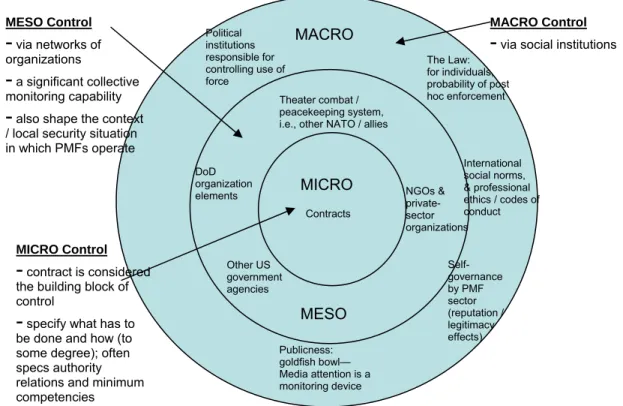
Of course, another key question is what kinds of resources does the DoD need to assemble in order to manage PMFs more effectively? Here again, a resource-based perspective suggests answers different from those commonly considered appropriate. The starting point for considering this different view is to realize that PMF risk management is a multidimensional job, as we illustrate in Figure 2 below.
Figure 2. PMF Risk Mitigation:
Leveraging the Entire Spectrum of Control Systems
The figure highlights three levels of mechanisms for the management of PMFs. The first set of mechanisms are at the micro level: contracts. Economic analyses of contracting relationships focus on key aspects of contracts. Here, the prognosis is first to get the contractual structure right and second, to match it with appropriate governance mechanisms. Done right, at least acceptable performance
MACRO MICRO MESO DoD organization elements Theater combat / peacekeeping system, i.e., other NATO / allies
NGOs & private- sector organizations Other US government agencies MESO Control
-
via networks of organizations-
a significant collective monitoring capability-
also shape the context / local security situation in which PMFs operateMACRO Control
-
via social institutionsPublicness: goldfish bowl— Media attention is a monitoring device International social norms, & professional ethics / codes of conduct Self- governance by PMF sector (reputation / legitimacy effects) The Law: for individuals, probability of post hoc enforcement MICRO Control
-
contract is considered the building block of control-
specify what has to be done and how (to some degree); often specs authority relations and minimum competencies Contracts Political institutions responsible for controlling use of forceshould follow. For example, Franck and Melese (2008) have emphasized the importance of adoption of a holistic perspective when widening the scope of outsourcing to include services:
The lesson is that transaction cost considerations need to be added to the current exclusive focus on production costs …. This also suggests that more attention be granted to: the Statement of Work (for goods) or Performance Work Statement (for services); the clear definition of terms of the contract— including appropriate incentives; an understanding of the complete costs of the transaction; and the careful design of governance mechanisms to maximize potential benefits from the outsourcing relationship.
In addition to the contract, the outer layer of the control mechanisms
highlighted in Figure 2 is the set of macro social control mechanisms that facilitate the management of PMFs. These social control mechanisms are best exemplified in the work of Deborah Avant (2005), whose research focuses on the diffusion of
control in the market for PMF services. Avant highlights both the limits of contracts and several problems that arise from the sheer number of players (both on the buying and selling side) involved in the PMF sector. She argues that broader social institutions, therefore, play an important role in regulating the sector, which might have the potential to instill some order in the geopolitical system.
Beyond these two sets of control mechanisms, we highlight a third intermediate (meso) layer which has been less examined—the organizational network for controlling PMFs. Many organizational players interface with—and are potentially engaged in managing—PMFs. A resource-based perspective suggests that in order to manage such PMFs effectively, we need to think in terms of a broad-based network of organizations that collectively represent a capability for monitoring and managing contractors in conflict zones. Earlier in this paper, we suggested that one of the lessons that has emerged in studies of organizational networks is that the critical resources involved in creating and applying knowledge sometimes reside in the broader network rather than in any individual organization. This places the capability for monitoring and managing PMFs in an intangible resource: the maze of relationships, gaps and interstices, between organizations.
Therefore, the resource for managing downside risk in PMFs can be found in the ecology of linked organizational players operating in a conflict zone. Avant (2005, p. 241) refers to this ecology as networked governance and
inter-organizational administration of PMFs. This network resource complements the other resources—contract and social institutions—that form a part of Figure 2. Together, these three sets of mechanisms form a system for managing contractors on the battlefield that provides a spectrum of control options.
The forgoing analysis suggests that the DoD might place more emphasis on network relationships in order to improve PMF control. If PMF management could be improved just by managing contracts better, then those managerial activities would fall to the contracting officer job. The answer would be for government to improve the contracting process, and in particular (per the Gansler report) to
improve contract monitoring processes and evaluation. However, the argument we have presented here suggests that “fixing” contract management is only one
problem the DoD might address. In fact, we believe there are limits on what the DoD can expect the contracting process and its officers/staffers to be able to accomplish by attending to contracts alone. It would be more useful to view
potential PMF contributions in the context of the control mechanisms highlighted in Figure 2. While the elements of social control are either in the realm of law-makers or are subject to broader social forces, DoD decision-makers still have the ability to improve PMF management by working at the inter-organizational (meso) level, i.e., by leveraging and building the organizational network.
Based on our analysis, we believe DoD policy-makers should consider two modest recommendations. First, a central theme of the Gansler report is the need for training and awareness among DoD field commanders regarding their role in managing the PMFs operating in their areas of responsibility. We would actually broaden this to include training and awareness for the network of partner
organizations at work in a particular combat zone. In short, we think a shift in perspective is required, that would raise the awareness of military and civil service
professionals (in non-acquisition functions) of their critical, though indirect role to play in managing the contractor force.
The second recommendation also involves a cultural change. We suggest that inter-organizational processes be established for proactively collecting feedback on several aspects of PMF performance. The current system, as we see it, appears to be driven by exception reporting and whistle-blowing. In this system, non-DoD organizational actors and other stakeholders are not necessarily solicited for useful information, but often on an adversarial basis.
As highlighted in a recent GAO report (2008, October 1), even assembling information on the presence of contractors and contractor fatalities has proven challenging. Networks flourish on information, and policy-makers need to get information moving in the PMF management network. What is needed is a much more open-system approach to gathering information on PMF activities—one that facilitates and encourages monitoring by the whole range of organizational actors, and collects positive as well as negative incident reports. A range of technological options might be considered here, but we also emphasize that leveraging and
building an inter-organizational capability for PMF monitoring will involve many “soft” processes and activities, as well as hard technological capability.
Our third and final recommendation concerns the organizational skill set that the DoD needs to build in order to be successful at leveraging the
inter-organizational network discussed above. Nurturing networks is a different business than running a hierarchical organization because the principles on which networks operate are different. It is not our intention here to add to the important discussion on the role of networks in contemporary warfare (Arquilla & Ronfeldt, 2002; Arquilla & Borer, 2007). However, we do believe that in addition to building the direct
acquisition skills necessary to successfully manage PMFs in conflict zones, the DoD must also put effort into building a set of indirect skills that will help the acquisition community progress and improve.
Networking and partnering skills may have great value in this context.
Therefore, with the arrival of the 50/50 DoD/contractor reality, the time has come for the DoD acquisition community to recognize that network-related skills should be developed in a proactive way. In a 50/50 world, the DoD needs a somewhat
different skill set if it is to efficiently and effectively manage the PMFs that are part of its overall mission.
Conclusion
This paper has proposed that the resource-based view of the firm—with its emphasis on examining organizations from the perspective of their inherent resources, processes and routines—may be helpful in understanding the rapid growth of the use of private military firms by the DoD. Our review has also suggested that a more holistic approach to the use of PMFs may help the DoD increase its available resources and, therefore, improve its overall performance. However, the lack of investment in contracting as the critical enabler for the use of PMFs may have significantly affected military capabilities. Also, the US government appears to lack an appropriate framework of control—ranging from legislation and political decision-making at the macro level to adequate supervision of PMFs within the expeditionary environment at the micro level. The expeditionary environment, which often involves coalitions, the conscious choice of small units and
counterinsurgency tactics, may lead to increased use of PMFs.
Between these macro and micro perspectives, we find, in some cases,
structures and routines that have sometimes shifted in the direction of establishing a more effective control system, such as the rapid creation of Army Contracting
Command following the report of the Gansler Commission. In other cases, organizations such as the Defense Contract Management Agency have generally failed to contribute to the collective monitoring capability that supports the risk-mitigation resources that must be in place when the decision is made to engage PMFs as a supplement to government resources.
Our examination of the use of PMFs by the DoD has, in our view,
demonstrated the applicability of the resource-based view of the firm in that we have moved beyond the more established (a) descriptive/organizational and (b)
economics-based research approaches to establish a generalized perspective that assesses inherent resources, processes and routines.
We would suggest that further research focus on extending the resource-based view into more specific aspects of contracting for PMFs—particularly given the critical need for sound insights that will help determine both an appropriate legal framework and risk-mitigation strategy that will support the inevitable incorporation of these firms into US and coalition forces.