Coverage Criteria for Testing Web Applications
Sreedevi Sampath, Emily Gibson, Sara Sprenkle, Lori Pollock
Department of Computer and Information Sciences University of Delaware
Newark, DE 19716
{
sampath, gibson, sprenkle, pollock
}@cis.udel.edu
ABSTRACT
As web applications evolve and their usage increases, their complexity also increases, thus creating a great demand for techniques and tools to ensure well-tested, reliable applica-tions. While program-based coverage and fault detection capability can be used to measure the quality of test suites, the dynamic characteristics of web applications motivate ad-ditional criteria to complement these traad-ditional test
ade-quacy criteria. This paper presents noveldynamiccoverage
criteria customized for web applications—criteria intended for testing at a page level. Based on a changing universe of test requirements, as indicated by evolving usage of the application, our criteria avoid the difficulties of building an accurate static model of a web application’s structure. We define a class of dynamic coverage criteria, present the sub-sumption relation among them, and describe two case stud-ies to demonstrate their usefulness. Among other possible uses, the proposed criteria can be used to compare the qual-ity of test suites, to select test cases, and to examine how usage of a web application changes over time. The proposed criteria complement traditional program coverage and fault detection capability criteria.
1.
INTRODUCTION
The increasing reliance on web applications for global busi-ness and consumer activities necessitates tools and method-ology for systematic testing and validation. Both program-based and functional testing techniques, which use user ses-sions gathered in the field, have been developed for web ap-plications [4, 22, 16, 15]. Tools for validating non-functional requirements (e.g., markup text validators, link checkers, load testers, and compatibility testers) have also been de-veloped [23]. Similar to traditional testing methodology, the
qualityof test suites for web applications can be measured in terms of program-based coverage criteria and fault de-tection capability. However, web applications exhibit char-acteristics different from conventional software, motivating the development of additional criteria.
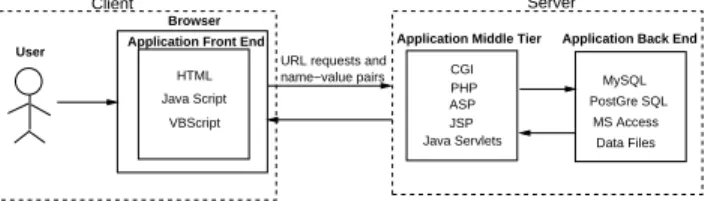
Broadly defined, a web-based software system consists of a set of web pages and components that interact to form a system (structured as in Figure 1) which executes using web server(s), network, HTTP, and a browser, and in which user input affects the state of the system. A web page can be eitherstatic, in which case the content is fixed, ordynamic,
CGI PHP ASP JSP Java Servlets MySQL PostGre SQL MS Access Data Files name−value pairs Client Server Browser VBScript Java Script HTML
Application Front End User
URL requests and
Application Middle Tier Application Back End
Figure 1: Structure of a Web Application
such that its contents may depend on user input. User input to a web application consists of both navigational requests and data provided often through forms, which eventually affect the state of the underlying code on the server. The input field names and their values, calledname-value pairs, become part of the request parsed by scripts or the applica-tion server. A database is often queried in response to a re-quest, resulting sometimes in dynamically generated HTML code (i.e., a new web page), which is displayed to the user.
An existing tool for instrumenting code and computing pro-gram (e.g., method or statement) coverage can be utilized to judge the adequacy of test suites for web applications. The most commonly used program-based coverage criteria are based on constructing a flow-graph model of program structure. Two main groups of structural test adequacy cri-teria, control-flow anddata-flowcriteria, can be expressed in terms of the abstract model [26].
The difficulty in statically modeling and analyzing a web application limits this approach. The major challenges in statically modeling web applications are
1. Control flow dependence on individual usage
pat-terns and location. In general, statically determining the application’s control flow is difficult because the control flow is highly dependent on user input and sometimes in terms of trends in user behavior over time or user location. For
example, Amazon.com displays web pages to users tailored
to the users’ interests, collected over time. BBC.com deliv-ers different news content depending on the user’s location. Not knowing which page an application is likely to display hinders statically modeling the control flow with accuracy and efficiency.
2. Browser interactions. Besides hyperlinks coded into
a displayed page, browser interactions can alter an applica-tion’s control flow. For example, from almost any page in
the application, the user can change the next viewed page by clicking the browser’s back or forward buttons or by entering a URL to visit an application page directly. Considering all the possible browser interactions at every page in the appli-cation will lead to a very large, impractical representation of the application. A test suite based on a fairly accurate control-flow representation of a web application and ade-quate according to a criterion—even as commonly used in conventional software as all-branches—contains an impracti-cal number of test cases. Ignoring browser interactions can lead to an inaccurate static model and subsequently poor testing and limited knowledge of the application’s potential execution behavior. Since a user can enter a web application at any point by a browser action, representing and testing all potential control flow in a web application is similar to the problem of testing the infinite event sequences in GUIs [14].
3. Numerous technologies, languages, and unknown
components. Web applications may have a number of
characteristics, including integration of numerous technolo-gies; modularization into reusable components that may be constructed by third parties; dynamically generated pages with dynamic content; and typically extend an application framework. The lack of information about reused compo-nents and libraries causes imprecision in the static analy-sis and modeling. In addition, the integration of different technologies and languages makes the analysis and model-ing over components complex.
To enable practical analysis of a web application’s structure in the presence of these challenges, the analysis typically ig-nores browser interactions, does not consider dynamic user location and behaviors, and models only parts of the appli-cation. Test criteria based on these static models can thus lead to inadequate test suites with respect to established cri-teria because the model lacks the program structures that should be satisfied to meet the criteria.
In this paper, we proposea novel strategy for assessing qual-ity of a web application’s test suites. We define the notion of adynamic test criterion, which we informally define as a criterion based on a changing universe of test re-quirements, as indicated by evolving usage of the ap-plication. In contrast, we refer to the traditional notion of program-based test data adequacy criteria asstatic test cri-teriabecause they are based on models of a program’s static structure. A static test criterion can be used as a stopping rule that determines when sufficient testing has been done and also as a measure of test quality by associating a degree of adequacy with each test suite. Among other possible uses, our proposed dynamic criteria can be used to provide more information about a test suite to the tester, compare the quality of test suites, to select test cases, and to examine how usage of a web application changes over time. In addition, the dynamic approach avoids the challenges of building an accurate static model of a web application’s structure. How-ever, dynamic criteria cannot be used to judge the adequacy of a single test suite with respect to how it satisfies a criteria; the universe of possible points to be covered is with respect to dynamic information about the application’s execution— for some set of inputs, not with respect to static program structure—which is fixed with respect to usage. Thus, the proposed notion of dynamic criteria complements the use of
static program coverage criteria.
The proposed coverage criteria are customized for web applications—criteria intended for testing at a page level. Test cases to satisfy the criteria are collected through log-ging user sessions. The proposed coverage criteria are mo-tivated by (1) evidence that user-session-based testing is complementary to white-box testing techniques that were derived from testing conventional software operating under more traditional paradigms [4], (2) the difficulty of static modeling of web applications, and (3) observed usefulness of criteria based on observed user behavior. The key insight is to develop criteria based on coverage in terms of user ses-sion elements—URLs (web pages), names, and name-value pairs. The important contributions of this paper include (a)Defining a class ofdynamic coverage criteriafor web ap-plications to complement traditionalstatic coverage criteria
(b)Presenting a subsumption hierarchy specifying the
rela-tion between individual proposed criteria
(c)A case study demonstrating the usefulness of user-session-based coverage information for longitudinal study of a web application’s changing usage profiles
(d)A case study demonstrating the usefulness of dynamic
user-session-based coverage criteria for test suite selection by correlating coverage in terms of user session elements and program code
Section 2 describes the state of the art in modeling web ap-plications and the existing coverage criteria proposed specif-ically for web applications. In Section 3, we present an overview of dynamic coverage criteria for testing web ap-plications and describe various apap-plications of the criteria. In Sections 4 and 5, we formally define a set of dynamic coverage criteria based on user session elements, and prove the subsumption relation between them. In Section 6 we present two case studies that investigate the usefulness of these dynamic coverage criteria. We conclude and present future work in Section 7.
2.
STATE OF THE ART
2.1
Current Models and Coverage Criteria
Static models and test criteria for web applications have been proposed by Ricca and Tonella [18], Kung et al. [11], Di Lucca et al. [13] and Andrews et al. [1].
Ricca and Tonella [18] developed a high level UML-based representation for web applications. In [25], Tonella et al. extend the model to include server pages; however, separate entities of a server page are created for each possible out-come. Also for increased analysis accuracy, every possible outcome of each dynamic and server page is represented as a separate entity. Unrolling each outcome of the server and dynamic pages can quickly lead to an impractical model. To model the flow between dynamic pages, model construction requires advance knowledge of the input values and any state information maintained by the application. It appears that
the control flow withinserver pages is not considered, and
the browser interactions are not modeled. The absence of modeling these features will lead to inaccurate control and data flow analysis. To our knowledge, the cost effectiveness of the proposed models has not been thoroughly evaluated.
cov-erage criteria derived from traditional program-based crite-ria, but expressed over the UML-based representation. The proposed criteria areweb page, hyperlink, definition-use, all-uses, and all-paths. The definition-use and all-uses criteria are considered only for data flow in the HTML pages. The data and control flow within the server pages are not cap-tured by the model and thus it is not clear how to generate test cases to satisfy the data flow criteria.
Liu et al. [11] and Kung et al. [10] proposed multiple mod-els, each targeted at capturing a different tier in web ap-plications; they also suggested that data flow analysis can be performed at multiple levels. Though the models capture the interaction between different components of a web appli-cation, it is not clear if the models have been implemented and experimentally evaluated. We believe that as the data flow analysis progresses from the lower (function) level to higher (application) levels, in the presence of multiple mod-els to represent the control flow, the modmod-els can easily be-come impractical in size and complexity for a medium-sized dynamic web application.
Di Lucca et al. [13] developed a web application UML-based model and a set of tools for the evaluation and automation of testing web applications. They consider single pages of the application as components to be tested at the unit level. They developed functional testing techniques based on de-cision tables, which help in generating test cases. However, their approach to generating test input is not automated. Di Lucca et al. [12] developed a statechart model of browser interactions and suggested integrating it with existing ap-proaches to testing web applications. They also suggested that coverage criteria for browser interactions are similar to existing criteria for object-oriented systems. The model does not handle cookies or client-side scripts, and they do not discuss the practical effectiveness.
Andrews et al. [1] proposed an approach to modeling web applications with finite state machines and use coverage cri-teria based on FSM test sequences. It is not clear if the model or testing strategy have been evaluated.
3.
THE NOTION OF DYNAMIC CRITERIA
3.1
An Overview
Test data adequacy criteria can be classified by the source of the information used to specify the test requirements. The
common classes arespecification-based, where requirements
are expressed in terms of identified features or requirements
of the software, andprogram-based, which are based on the
program under test to determine how well the program code has been exercised [26]. We call thesestaticcriteria as they do not change with different user profiles of the software. Because a model constructed and used for static coverage criteria is constructed from analyzing the application code, the model is fixed if the application code does not change. Thus, the universe of requirements that a test suite is ex-pected to satisfy remains constant.
In contrast, our notion of dynamic coverage criteria
pro-posed for web applications is based on theusageof the
ap-plication. Random testing and statistical testing are exam-ples of testing based on prospective usage of software [26]; however, explicit usage-based web application criteria have
not been previously defined, and few, if any, defined for con-ventional software. Our proposed dynamic criteria defines pages as a web application’s basic building blocks. Thus, the dynamic coverage criteria test control- and data-flow in a web application at a page level. As with all dynamic approaches, the universe of requirements that a test suite is expected to satisfy changes as the suite of user sessions defining the requirements changes.
Our approach to testing based on dynamic coverage criteria takes user sessions automatically logged by a web server and formulated into test cases without employing a static appli-cation model. A user session is a sequence of URLs and name-value pairs, and we view the user session as represen-tative of a use case [8] of the application. URLs are a unique characteristic of web applications that relate to server pages and their program code in the middle-tier of the application.
3.2
Applications of Dynamic Criteria
This section describes a number of different uses of dynamic coverage criteria for web application testing.
3.2.1
Assessing Quality of a Test Suite
Current program coverage analysis tools take as input a pro-gram under test and a test suite and provide a report that describes the program (e.g., method, statement, branch) coverage associated with executing the program code on the given test suite. For web applications, such a coverage tool can be augmented to present the tester with additional in-formation about how the test suite also provides coverage for various dynamic coverage criteria. For example, we have built a tool that analyzes user sessions. This tool could present the tester with information about the additional consecutive URL pairs that a test suite contains—beyond those that a static application model depicts. These ad-ditional URL pairs demonstrate to the tester how browser actions have caused certain actions in the test case execu-tion. Thus, valuable dynamic information about test cases can be expressed in terms of dynamic coverage criteria that a tester can quantify and use during testing.
3.2.2
Additional Criteria for Test Suite Comparison
The dynamic coverage criteria can be used to compare web application test suites as an additional criteria. For example,
if two test suites,T1andT2, are both statement-coverage
adequate, the two suites can be further distinguished by
how they satisfy our dynamic coverage criteria. IfT1
sat-isfies more of our dynamic coverage criteria thanT2, then
T1is a better test suite for testing the application because it satisfies both the static, statement-coverage criterion and
our dynamic coverage criteria, i.e., T1 represents
applica-tion usage better thanT2.
3.2.3
Longitudinal Analysis for Focused Testing
Since the dynamic coverage criteria are based on application usage, they can be exploited as a measurement for longitudi-nal usage studies. El-Ramly et al. [3] study usage patterns in web applications and use pattern mining as a dynamic recommendation and adaptive mechanism. Their motiva-tion was to provide users who follow frequently occurring navigation paths with recommendations at run-time. They have also applied pattern mining techniques to recover the
application’s functional requirements with changes in usage scenarios. We believe a study of how test suites collected from different time periods satisfy dynamic coverage criteria can provide the tester with insight about changes in appli-cation usage over time. In particular, differences in criteria points satisfied by a test suite in one time period as com-pared to a test suite of another time period can indicate how usage changed from one period to another. Depending on the usage the tester wants to test, the tester can use the criteria as a metric to choose test suites.
3.2.4
Test Case Selection
As standalone criteria. Similar to static coverage crite-ria that are used as an explicit specification for test case selection [26], dynamic coverage criteria can guide test case selection. For test case selection, the original test suite dic-tates the universe for the dynamic coverage criteria. The quality of reduced test suites are then judged by how well they satisfy the established dynamic coverage criteria rela-tive to the original test suite.
In our previous work [20], we presented a test case selec-tion technique based on clustering by concept analysis fol-lowing a simple dynamic coverage criterion. We have also performed studies [24] that showed how to use a dynamic coverage criterion of single URLs to perform test case se-lection by four different techniques. We compared three requirements-based techniques, Random, Greedy and Har-rold et al.’s technique [7], against our test case selection technique based on clustering by concept analysis.
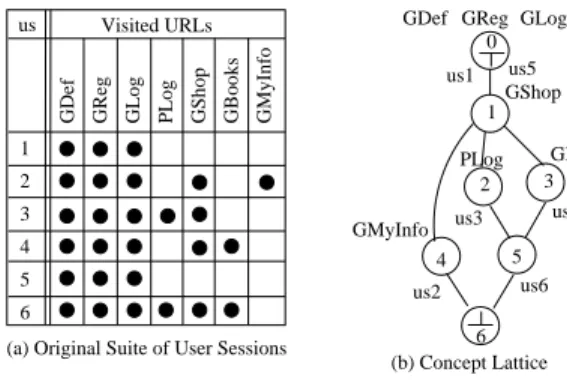
Concept analysis is a mathematical technique for clustering objects that have common discrete attributes [2]. To apply concept analysis to user sessions of a web application, we define the objects ,O, to represent the information uniquely identifying user sessions (i.e., test cases) and attributes,A, to represent the URLs according to certain criteria. Concept analysis builds a lattice where each node of the lattice is a
tuple (Oi, Ai) such that all the objects in Oi ⊆ O share
all and only the attributes inAi ⊆Aand vice versa. The
edges of the lattice denote the partial ordering between the concept nodes. Figure 2(b) shows the sparse concept lattice for Figure 2(a)’s user sessions, when the criteria is single
URLs. For example in Figure 2(b), node 3’s objects are
the sessionsus4, us6, and the attribute set isGDef, GReg, GLog, GShop, GBooks(from the full lattice representation).
We developed a heuristic based on the concept lattice for selecting a subset of user sessions to be maintained as the current test suite [20]. Our heuristic for test case selection seeks to identify the smallest set of user sessions that satisfies a criterionCa, as determined by the original test suite, while representing the original test suite’s use cases. The selected test suite contains a user session from the bottom node,⊥1
, and a user session from each concept node that is one level
up the lattice from ⊥ (also called next-to-bottom nodes).
These nodes contain objects that have the largest number of shared attributes, and the union of the attribute sets covers Ca. Thus, test suite selection through our heuristic exploits the concept lattice’s hierarchical clustering properties. In
1The⊥contains the sessions that are adequate to a certain criteria. 0 6 (b) Concept Lattice us2 us6 us4 GBooks PLog GMyInfo
GDef GReg GLog us5 us1 GShop us3 1 2 3 4 5
GReg GLog PLog GShop GBooks GMyInfo
GDef 1 2 3 4 5 6
(a) Original Suite of User Sessions Visited URLs us
Figure 2: Example
Figure 2(b), thenext-to-bottom nodes arenode 4 andnode
5 and on applying the heuristic, the selected test suite for single URLs criteria is{us2, us6}.
Though using concept analysis to select the test suite may not result in the minimum test suite for a given criterion, we believe our selection technique maintains the original suite’s use case representation in the selected test suite [20]. Our previous papers [20] contain details on the theory behind ap-plying concept analysis and the test-suite-selection heuristic.
Hybrid approaches. Sant et al. [22] generated an
appli-cation model from user sessions and performed statistical analysis on the model to generate new test cases. Elbaum et al. [4] proposed a hybrid approach to test case generation, where they augment the generated model by applying Ricca et al’s. [18] approach with user session data. We propose a hybrid approach that selects a test suite to satisfy our dy-namic criteria. Then, a simple, high-level application model can be constructed that generates new test cases to satisfy additional static criteria (from the model), which were not satisfied by our dynamic criteria. Using a hybrid approach that generates test cases from a simple, high-level model of the web application with the test suite selected from user sessions according to our dynamic coverage criteria would reap the benefits of both approaches.
4.
DEFINING COVERAGE CRITERIA
In this section we define novel dynamic coverage criteria for testing web applications. Test cases for web applications can be generated from user sessions or other static model-based techniques. In this paper we consider test cases as gener-ated from user sessions and we will use the terms test cases and user sessions interchangeably. The coverage criteria we define can be used on test cases generated from static or dynamic context.
A URL u consists of a base address and possible
name-value pairs (input field names and their name-values) as per the RFC definitionhprotocoli://hhosti [:hporti ] [hpathi [?
hqueryi]] [17]. Atest caset, or user session, is an ordered sequence of URLshu′
1, u′2, ..., u′ni. We definetsetas the set
of unique URLs occurring in t. We say that a test case t
of lengthncontainsa subsequencesx=hui, ui+1, ..., ui+xi
if the subsequence sx occurs in t where 1 ≤ i ≤ n−x.
We define two functions for a URLusuch thatstripn,v(u)
(a) O = {us1, us2} (f) base U2 <GDef, GReg>, <GReg, GReg>, <GReg, GLog>, { = 1 2 3 4 5 6 <PLog, GShop>, <GShop, GMyInfo>, <GMyInfo, GMyInfo>} (b) 1 2 3 4 GDef, < GReg, > GLog GReg?name=xxx&password=yyy&[email protected],
Test case, t1 (User session us1)
7 6 5<PLog?name=xxx&password=yyy GShop?book_id=3&book_category=testing&price_range=200 GMyInfo GMyInfo?name=xxx&password=yyy&[email protected] > 8
Test case, t2 (User session us2)
1 2 3 4 5 6 GDef, GReg, GLog, PLog, GShop, GMyInfo (c) U base = } { GDef, GMyInfo, GLog, GReg, GReg?name&password&email, PLog?name&password, GShop?book_id&book_category&price_range, GMyInfo?name&password&email 1 2 3 4 5 6 7 8 (d) Uname } = { 1 2 3 4 5 6 7 (g) <GDef, GReg> <GReg, GReg> <GReg?name&password&email, GLog> Uname2 = { <PLog?name&password, GShop> <GShop?book_id&book_category&price_range, GShop> <GMyInfo, GMyInfo> <GMyInfo?name&password&email> } 1 2 3 4 5 6 7 8 GShop?book_id=3&book_category=testing&price_range=200, GMyInfo?name=xxx?password=yyy&[email protected] } GReg?name=xxx&password=yyy&[email protected], PLog?name=xxx&password=yyy, (e) U GDef, GMyInfo, GLog, GReg, { name,value=
Figure 3: Example User Session for Different Criteria
and stripv(u) removes the value entries for u, if present, leaving the base URL and names intact. For a web appli-cationW, we define theoriginal suiteOas the set of test casestcollected duringW’s usage over a specified time. For
our purposes, Orepresents the set of user sessions for
ap-plicationW. Each such user session is a sequence of URLs
requested by a user. Atest suite T is a set of test cases
{t1, t2, ..., tn}, whereti∈O, for the applicationW.
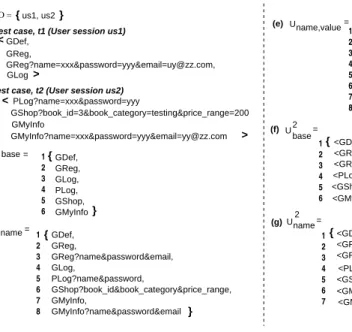
Figure 3(a) showsOfor a web applicationW to contain the
set of user sessions {us1,us2}. Thus forW, the test suite Tis the set of test cases {us1, us2}. Figure 3(b) shows the
sequence of requested URLs in test casesus1andus22
.
Uname,value ={u1, u2, ..., un}is the set of URLs such that for every test casetinO, if URLu∈tset, thenu∈Uname,value.
Note that a URL u′ of U
name,value may not have
name-value pairs ifu′occurred without name-value pairs in some
test case ofO. Figure 3(e) illustratesUname,value. Uname = {u1, u2, ..., um} is the set of URLs obtained by apply-ing stripv(u) to every URL u in Uname,value. Ubase =
{u1, u2, ..., up}is the set of URLs obtained by applying stripn,v(u) to every URL u in Uname,value. Figure 3(c)
and 3(d) show the setsUbaseand Uname for the example
test suite.
Note that the sets Ubase, Uname, and Uname,value, only
contain those URLs found inO. For example, ifOcontains
URLshttp://mysite.com?name1=helloand
http://mysite.com?name2=goodbye, Uname,value does not containhttp://mysite.com?name1=hello&name2=goodbye.
We defineU2
name,valueas the set of all possible size 2 subse-quences of URLshui, stripn,v(ui+1)i, where the subsequence
hui, ui+1ioccurs in a test case ofO. In addition, for any test caset=hu1i ∈Owhere|t|<2,U
2
name,valuealso contains the sequencehu1i. U
2
name,value also contains hui+1i to ensure 2
Line numbers shown in the figure are for ease of reference.
the names and values of the last URL are maintained. We strip off all names and values of the last URL in a sequence because we are interested in variable names and values re-sponsible for altering control flow from one URL to another and at the same time contain the user session elements rep-resented in the universe.
Similarly, Uk
name,value is the set of (1) all possible subse-quences of sizek,hu1, u2,...,stripn,v(uk)i, where 1≤k≤p,
p is the length of the longest test case inO, and the
sub-sequencehu1,u2,..., uki occurs in a test case ofO; (2) all
huki, with names and values intact; (3) for any test case t=hu1,u2,...,uii ∈Owhere |t|< k,U
k
name,valuecontains the sequencehu1, u2,...,stripn,v(ui)iand the subsequence
huii.
Similarly, we can define Uk
name = hstripv(u1), stripv(u2), ..., stripn,v(uk)i ∪ hstripv(uk)i ∪ for any test case t ∈ O such that |t|< k, the sequence hstripv(u1), stripv(u2),..., stripn,v(ui)i ∪ huii; andUk
base=hstripn,v(u1),stripn,v(u2), ...,stripn,v(uk)i ∪for any test caset∈Owhere|t|< k, the sequencehstripn,v(u1), stripn,v(u2), ..., stripn,v(ui)i.
Fig-ures 3(f) and (g) show the setsU2
base and U
2
name, respec-tively.
Our criteria are defined for a triple (W, O, T), where the original suiteOrepresents the universe of test cases
contain-ing all requested URLs for applicationW, and test suiteT
⊆O. We presently define six basic coverage criteria for web
applications: single URLs,URL seq2,URL seqk,URL names,
URL seq2 names,URL seqk names,URL names values, URL seq2 names values, andURL seqk names values.
4.1
Single URLs
The single URLs coverage criterion requires all URLs in
Ubase to be covered at least once by the test suite. URLs
are a unique attribute of web applications and we believe URLs to be similar to basic blocks in traditional programs.
We assert that a relation exists between a test suite that covers all the URLs in a web application and its program coverage and fault detection capabilities.
Definition of Satisfaction: A triple (W,O,T) satisfies single URLsiff for all URLsu∈Ubase,∃a test caset∈T that contains a URLu′ such thatstripn,v(u′)=u.
For example in Figure 3, a test suite satisfyingsingle URLs would contain all the elements ofUbase(Figure 3(c)).
4.2
URL seq2
The second coverage criterion we propose seeks to capture control flow between URLs during application usage by in-cluding URL subsequences of size 2.
Definition of Satisfaction: A triple (W, O, T) satis-fies URL seq2 iff for all sequences hu1, u2i ∈ U
2
base, ∃ a
test caset∈Tcontaining a subsequencehu′
1, u′2isuch that
hstripn,v(u′
1), stripn,v(u′2)i=hu1, u2i.
For example in Figure 3, we would expect a test suite sat-isfyingURL seq2 to contain all the elements ofU2
base (Fig-ure 3(f)). Similarly, we can define theURL seqkcriterion:
Definition of Satisfaction: A triple (W,O,T) satisfies URL seqkiff for all sequenceshu1, u2, ..., uki ∈U
k
base,∃a test caset∈Tcontaining a subsequencehu′
1, u′2, ..., u′kisuch that
hstripn,v(u′
1), stripn,v(u′2), ..., stripn,v(u′k)i=hu1, u2, ..., uki. A test suite satisfying sequence-based criteria intuitively tries to capture control flow occurring during actual appli-cation usage. As the length of the sequence increases, more control flow between URLs is captured.
4.3
URL names
TheURL names coverage criterion incorporates data names (variable names) associated with each URL.
Definition of Satisfaction: A triple (W,O,T) satisfies URL namesiff for all URLsu∈Uname,∃a test caset∈T containing a URLu′ such thatstripv(u′)=u.
For example in Figure 3, the test suite satisfyingURL names
would contain all the elements ofUname (Figure 3(d)).
4.4
URL seq2 names
Next we defineURL seq2 names, which seeks to capture names
of variables that alter URL control flow in the web applica-tion. A test suite satisfying sequence-based criteria with names intuitively tries to capture control flow dependent on names associated with a URL during actual application us-age.
Definition of Satisfaction: A triple (W,O,T) satisfies URL seq2 namesiff for all sequences, hu1, u2i ∈ U
2
names, ∃
a test caset∈ Tcontaining a subsequencehu′
1, u′2i, where
hstripv(u′
1), stripn,v(u′2)i=hu1, u2i.
Note we strip names and values from the last URL (u2)
because we are interested in variable names responsible for altering control flow fromu1tou2. For example in Figure 3,
a test suite satisfyingURL seq2 nameswould contain all the elements of U2
name (Figure 3(g)). Similarly, we can define
theURL seqk namescriterion:
Definition of Satisfaction: A triple (W, O, T)
satis-fies URL seqk names iff for all sequences, hu1, u2, ..., uki ∈ Uk
names,∃a test caset∈Tcontaining a subsequence hu′
1, u′
2, ..., u′ki, where hstripv(u1′), stripv(u′2), ..., stripn,v(u′k)i=
hu1, u2, ..., uki.
4.5
URL names values
The URL names values coverage criterion captures all the information traveling on a URL to determine the coverage of a test suite.
Definition of Satisfaction: A triple (W,O,T) satisfies URL names valuesiff for all URLs,u∈Uname,value,∃a test
caset∈Tthat contains a URLu′ such thatu′=u.
For example in Figure 3, a test suite satisfying
URL names valueswould contain all elements ofUname,value (Figure 3(e)). We believe a test set satisfyingURL names values captures names and values of variables responsible for the dynamic behavior of a web application.
4.6
URL seq2 names values
TheURL seq2 names valuescriterion requires test sets ad-equate in terms of URLs, names, and values.
Definition of Satisfaction: A triple (W,O,T) satisfies URL seq2 names valuescriteria iff for all sequences of URLs,
hu1, u2i ∈U 2
name,value,∃a test caset∈Tthat contains the sequencehu′
1, u′2isuch thathu′1, stripv(u′2)i=hu1, u2i.
We believe a test set satisfyingURL seq2 names valueswill
strive to capture control flow as well as the names and val-ues of variables responsible for changing URL control flow. Similar to our other criteria associated with sequences, we
can define theURL seqk names valuescriterion:
Definition of Satisfaction: A triple (W,O,T) satisfies URL seqk names values iff for all sequences of URLs, hu1, u2,..., uki ∈U
k
name,value ∃a test caset∈Tthat contains the sequencehu′
1, u′2, ..., u′kisuch thathu′1, u′2, ..., stripv(u′k)i =hu1, u2,..., uki.
The coverage criteria we define exhibit a strict
subsump-tion relasubsump-tionship. In the next secsubsump-tion, we present proofs in support of the subsumption relations.
5.
SUBSUMPTION RELATION
A test coverage criterionCasubsumes coverage criterionCb
(Ca−→Cb) iff every triple (W,O,T) that satisfiesCaalso
satisfies Cb; where W is the web application, Orepresents
the universe of requested URLs for W, and test suite T
⊆ O. Figure 4 presents the subsumption hierarchy of the coverage criteria we presented in Section 4. The edges are labeled with the theorem number that proves the relation.
Lemma 1: If test caset∈Tcontains a sequencesk=hu1, u2,...,uki ∈U
k
name,value, thentalso containshstripv(u1), stripv(u2), ..., stripn,v(uk)i ∈ U
k
1 1 1 1 2 2 1 2 3 3 3 1 URL_seqk_names_values URL_seq2_names_values URL_seqk_names
URL_seqk URL_seq2_names URL_names_values
URL_names URL_seq2
single_URL
Figure 4: Subsumption Relation Between Criteria
stripn,v(u2), ..., stripn,v(uk)i ∈ U k
base, where 1 ≤ k ≤p
andpis the longest test case inO. The proof is straightfor-ward and not shown here due to space constraints.
Theorem 1:
URL seqk names values−→URL seq(k-1) names values Proof: By definition, a test suite,Tk satisfying
URL seqk names valuescontains all test cases of length< k and all subsequences of lengthkfor test cases of length≥k. A test suite,Tk−1satisfyingURL seq(k-1) names valuesby definition contains all test cases of length< k−1 and all sub-sequences of lengthk−1 for test cases of length≥k−1. Let sk−1=hu1, u2, ...,uk−1i ∈U
k−1
name,value. If|sk−1|< k−1, thensk−1 is in a test case of length < k−1 < k and by definition of satisfyingURL seqk names values,Tkcontains sk−1. Otherwise,sk−1 must be part of some subsequence of lengthk,hux,u1,u2,...,uk−1iorhu1,u2,..., uk−1,uxi in
some test case of length≥k. Since Tk contains all
subse-quences of lengthkfor test cases of length≥k, by definition URL seqk names values−→URL seq(k-1) names values.
To establish thestrict subsumption relation, we now show
thatURL seq(k-1) names valuesdoes not subsume URL seqk names values. Consider the suite O={t1, t2, t3} wheret1=hu1, u2, u3i,t2=hu2, u1, u2i, andt3=hu1, u2, u1i. Letk= 3 andT={t1, t2}. ThenU
2
name,value={hu1, u2i,
hu2, u3i,hu2, u1i}andU 3
name,value={hu1, u2, u3i,hu2, u1, u2i,
hu1, u2, u1i}. Therefore Tsatisfies URL seq2 names values
but not URL seq3 names values because the subsequence
hu1, u2, u1idoes not appear in any test case inT.
Similar proofs can be derived for the subsumption
relation-shipsURL seqk names−→URL seq(k-1) names−→... −→
URL seq2 names,URL seq2 names values−→
URL names values,URL seqk−→URL seq(k-1)−→... −→
URL seq2,URL seq2 names−→URL names, andURL seq2−→
single URLs.
Theorem 2: URL seqk names values−→URL seqk names
Proof: Suppose this does not hold. Then ∃ a test suite
T ⊆ O for W that satisfies URL seqk names values but
not URL seqk names. Thus there exists at least one size k subsequence of URLs, sk=hu1,u2, ...,uki ∈ U
k
name and
no test case inTcontains the subsequencerk=hu′
1,u′2,..., u′
ki ∈U k
names,values such that hstripv(u′1), stripv(u′2), ..., stripn,v(u′
k)i=sk. SinceTsatisfiesURL seqk names values,
let tbe the test case∈T that contains rk. By Lemma 1,
talso contains the subsequencehstripv(u′
1),stripv(u′2), ..., stripn,v(u′
k)i=sk. Therefore T satisfies URL seqk names, a
App # US Tot URLs Largest US Avg US (# URLs) (# URLs) Book 125 3640 160 29 CPM1 261 3881 152 15 CPM2 130 2005 152 15 CPM3 131 1876 97 14 CPM4 66 1469 152 22 CPM5 65 539 34 8 CPM6 65 729 95 11 CPM7 65 1144 97 17 Table 1: User Session Characteristics
contradiction.
To show thestrictsubsumption relation, we now show that
URL seqk namesdoes not subsumeURL seqk names values. Consider the suite O={t1, t2} where t1 = hu1, u1?n1=v1, u2i
3
andt2=hu1,u1?n1=v2,u2i. Letk= 3 andT={t1}. U3
name={hu1,u1?n1,u2i}andU 3
name,value={hu1,u1?n1=v1, u2i,hu1,u1?n1=v2,u2i}. ThenTsatisfiesURL seq3 names
but not URL seq3 names values because no test case in T
contains the subsequencehu1,u1?n1=v2,u2i.
Similar proofs can be derived for URL seq2 names values
−→URL seq2 namesandURL names values−→URL names.
Theorem 3: URL seqk names−→URL seqk
Proof: Suppose this does not hold. Then∃a test suiteT
⊆OforW that satisfiesURL seqk namesbut notURL seqk.
Thus there exists at least one size k subsequence of URLs, sk=hu1, u2, ..., uki ∈ U
k
base and no test case in T
con-tains the subsequence rk=hu′
1, u′2, ..., u′ki ∈ U k
names,values such thathstripn,v(u′
1), stripn,v(u′2), ..., stripn,v(u′k)i=sk.
Since T satisfies URL seqk names, let t be the test case ∈
T that containsrk. By Lemma 1,t also contains the
sub-sequence hstripn,v(u′
1), stripn,v(u′2), ..., stripn,v(u′k)i=sk. ThereforeTsatisfiesURL seqk, a contradiction.
To show thestrictsubsumption relation, we now show that
URL seqk does not subsumeURL seqk names. Consider the suite O={t1, t2}where t1 =hu1, u1?n1=v1, u2i and t2 =
hu1, u1?n2=v2,u2i. Letk= 3 andT={t1}. U 3 base={hu1, u1, u2i} and U 3 name = {hu1, u1?n1, u2i,hu1, u1?n2, u2i}.
ThenTsatisfiesURL seq3 but notURL seq3 namesbecause
no test case inTcontains the subsequencehu1,u1?n2,u2i.
Similar proofs can be derived forURL seq2 names−→URL seq2
andURL names−→single URLs.
6.
CASE STUDIES
6.1
Subject Web Applications
For our empirical case studies, we used two subject pro-grams: an open-source, e-commerce bookstore (Book) [6] (no. Classes: 11, no. Methods: 385, NCLOC: 7791, no. Seeded Faults: 40) and a course project manager (CPM) (no. Classes: 75, no. Methods: 172, NCLOC: 9300, no. Faults: 86), developed and first deployed at Duke Univer-sity in 2001.
The bookstore allows users to register, login, browse for books, search for books by keyword, rate books, add books 3
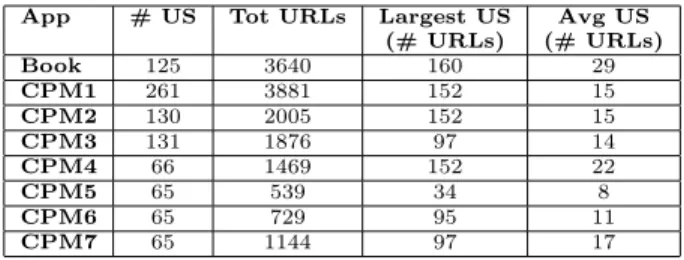
to a shopping cart, modify personal information, and logout. Since our interest was in testing user functionality, we did not include the administration code in our experiments. The bookstore uses JSP for its front-end and a MySQL database backend. To collect 125 user sessions for bookstore, we sent email to local newsgroups and posted advertisements in the university’s classifieds web page asking for volunteer users. We removed image requests and requests that attempt to access any administration-related pages. URLs in the user sessions thus mapped directly to the 11 classes/JSP files of bookstore. Table 1 presents the characteristics of the col-lected user sessions.
In CPM, course instructors login and creategraderaccounts
for teaching assistants. Instructors and teaching assistants set upgroupaccounts for students, assign grades, and create schedules for demonstration time slots for students. CPM also sends emails to notify users about account creation, grade postings, and changes to reserved time slots. Users interact with an HTML application interface generated by Java servlets and JSPs. CPM manages its state in a file-based datastore. We collected 261 user sessions from in-structors, teaching assistants, and students using CPM dur-ing the 2004-05 academic year at the University of Delaware. The URLs in the user sessions mapped to the application’s 60 servlet classes and to its HTML and JSP pages.
For the fault detection experiments, graduate and under-graduate students familiar with JSP/Java servlets/HTML manually seeded realistic faults in bookstore and CPM. In general, the seeded faults inserted errors into the applica-tion’s control flow, the generated UI web pages, and/or the datastore interactions.
6.2
Case Study 1: Longitudinal Analysis
Research Questions.
Question 1. How can we compare application usage under
different test suites using our dynamic coverage criteria?
Question 2. How can this comparison be used to help a
tester select between two test suites?
Variables and Measurements. The independent
vari-ables in our study are the test suites and the coverage
cri-teria. Thedependent variablesare the percent frequency of
URLs in the test suites being compared.
Experimental Setup. The framework for collecting user
sessions is similar to what we used in previous papers [19, 20]. We separated CPM’s test suites according to the semester in which they were recorded. We compared two test suites from the summer (58 user sessions) and the fall semesters (145 user sessions) with respect to two of our criteriaURL seq2 andURL names values.
Data and Analysis. Figure 5 shows the usage of the
ap-plication as depicted by two test suites that satisfyURL seq2 andURL names valuescriteria. For each test suite, we com-pute the ratio between the number of times a URL appears in each test suite and the total number of URL accesses in the suite and present the results in percentages. In both figures, the x-axis represents the percent frequency of URLs in the test suite from summer 2004, and the y-axis repre-sents the percent frequency from fall 2004. Each point in
the graph is a URL according to the application’s respec-tive criteria. We divide the figure into quadrants: URLs in Quadrants I and III indicate that application usage re-mained similar over time while URLs in Quadrants II and IV mean application usage changed.
Figure 5(a) suggests that the users across two semesters fol-lowed fairly similar paths in terms of size 2 sequences of URLs because only a few URLs are in Quadrants II and IV. Since most of the frequency values for URLs are low in Figure 5(b), it suggests that the user community (as identi-fied by their name-value pairs) changed over the semesters, except for a few outliers. Using these graphs, testers can visualize the change in an application’s operational profile and decide how to focus the testing effort.
6.3
Case Study 2: Test Case Selection
Using our concept analysis based approach to test case se-lection, we examined the following questions with respect to single URLs,URL seq2,URL names,URL names values, and URL seq2 namescriteria.
Research Questions.
Question 1. How does program coverage and fault
detec-tion effectiveness of a test suite that satisfies our dynamic coverage criteria vary?
Question 2. How do the time and space costs compare for reducing a test suite that satisfies the coverage criteria?
Variables and Measurements. The independent
vari-ables in our study are the user sessions, coverage criteria, test case selection heuristic, and subject web applications. Thedependent variables are program coverage, fault detec-tion effectiveness, test suite size, and cost of test selecdetec-tion.
Experimental Setup. The experimental setup for
con-cept analysis-based reduction, program coverage, and fault detection studies are similar to the setup described in our previous papers [20, 19]. We collected 261 sessions for CPM over three academic semesters. In this study, we used the original bookstore and CPM sessions and divided the orig-inal 261 CPM sessions into six test suites to analyze the variation in effectiveness according to the different dynamic coverage criteria. Table 1 lists the test suites’ characteris-tics.
Data and Analysis.
Effectiveness of Test Suite Selection. Figure 6 presents the percent reduction from applying the different criteria on the original suite. In our results we abbreviate the
cri-teria single URLsas s1, URL seq2 as s2,URL names as n,
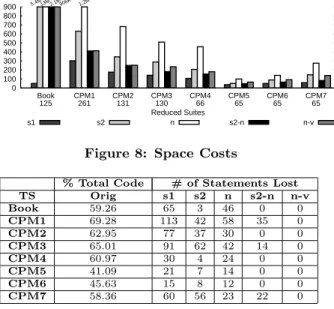
URL names valuesasn-vandURL seq2 namesass2-n. Fig-ure 6 shows that as the complexity of the criteria increases, the percent reduction decreases. Tables 2 and 3 present the statement coverage and fault detection effectiveness of the reduced test suites. We present only statement coverage in Table 2 because method coverage remained constant across the different criteria. The loss in statements shown in Ta-ble 2 indicates the potential to cover more statements with increased criteria complexity until coverage equals the orig-inal suite’s. In Table 3, we present fault detection results for the two test suites that showed the most variance across criteria. A summary of the fault detection results of the test suites not shown in Table 3 is as follows: the original suite
0 2 4 6 8 10 12 14 0 2 4 6 8 10 12 14
Percent Frequency of URLs in Fall04 Test Suite
Percent Frequency of URLs in Summer04 Test Suite
Q I Q II Q III Q IV 0 2 4 6 8 10 12 14 0 2 4 6 8 10 12 14
Percent Frequency of URLs in Fall04 Test Suite
Percent Frequency of URLs in Summer04 Test Suite
Q I Q II Q III Q IV 0 2 4 6 8 10 12 14 0 2 4 6 8 10 12 14
Percent Frequency of URLs in Fall04 Test Suite
Percent Frequency of URLs in Summer04 Test Suite
Q I Q II Q III Q IV 0 2 4 6 8 10 12 14 0 2 4 6 8 10 12 14
Percent Frequency of URLs in Fall04 Test Suite
Percent Frequency of URLs in Summer04 Test Suite
Q I Q II
Q III Q IV
(a)URL seq2 (b)URL names values
Figure 5: Comparing Test Suites to Understand Application Usage.
0 10 20 30 40 50 60 70 80 90 100 CPM7 65 CPM6 65 CPM5 65 CPM4 66 CPM3 130 CPM2 131 CPM1 261 Book 125
Percent of Original Test Cases
Reduced Suites
s1 s2 n s2-n n-v
Figure 6: Reduction in Test Suite Size
0 1 2 3 4 5 6 CPM7 65 CPM6 65 CPM5 65 CPM4 66 CPM3 130 CPM2 131 CPM1 261 Book 125 Time (s) Reduced Suites 43.8s 67s 7.75s s1 s2 n s2-n n-v
Figure 7: Time Costs
forCPM1detects 79 of the 86 seeded faults,CPM2detects
79,CPM3detects 78, CPM4 detects 79,CPM6 detects
46, andCPM7 detects 78 faults. When the dynamic
cov-erage criteria are applied to these test suites, each reduced suite detected the same number of faults as the original. We speculate that the trends in fault detection capabilities are not conspicuous from our results because of how we seeded
the faults. BookandCPM5show an increase in fault
de-tection with increased criteria complexity, suggesting that user sessions selected for more complex criteria covered code that were populated with more faults.
Time and Space Costs in Selecting Test Suites. Figures 7 and 8 present the time for concept analysis to se-lect test cases and the space requirements of the concept lattice. As the complexity of the coverage criteria increases, the time and space to select the test suite also increases. In most cases the time and space requirements follow the trend,
0 100 200 300 400 500 600 700 800 900 CPM7 65 CPM6 65 CPM5 65 CPM4 66 CPM3 130 CPM2 131 CPM1 261 Book 125 Space (K) Reduced Suites 5.4M13M 2.1M906K 1.2M s1 s2 n s2-n n-v
Figure 8: Space Costs
% Total Code # of Statements Lost TS Orig s1 s2 n s2-n n-v Book 59.26 65 3 46 0 0 CPM1 69.28 113 42 58 35 0 CPM2 62.95 77 37 30 0 0 CPM3 65.01 91 62 42 14 0 CPM4 60.97 30 4 24 0 0 CPM5 41.09 21 7 14 0 0 CPM6 45.63 15 8 12 0 0 CPM7 58.36 60 56 23 22 0
Table 2: Statement Coverage Loss
s1≤s2≤n, ands2-n≤n-v. It is interesting to note that
the time and space requirements forBook withURL names
criteria are greater thanURL names valuescriteria. We
be-lieve the original test suite has many more use cases when
it satisfies URL names criterion than URL names values
cri-terion. As a result, clustering by concept analysis creates a bigger lattice to represent the varied use cases.
single URLs’s large percent reduction coupled with its high program coverage and fault detection effectiveness and low
cost suggest thatsingle URLscriterion may be an effective
criterion for user-session-based testing of web applications.
6.4
Analysis Summary
Comparing To Understand Application Usage. We
believe that by comparing test suites, a tester can study the usage profile of an application. The tester can examine dif-ferent test suites that satisfy dynamic coverage criteria and
TS Orig s1 s2 n s2-n n-v Book 36 33 35 34 36 36
CPM5 32 27 27 27 32 32 Table 3: Number of Faults Detected
channel the testing effort. Test suites can also be compared to determine if, in addition to being adequate according to a program-coverage-based metric, the suites also satisfy our coverage criteria. We believe that a test suite adequate ac-cording to a program-based criterion and satisfying most of our coverage criteria is a good candidate for testing a web application.
Test Case Selection.The results presented in Figures 6, 7, 8 and Tables 2, 3 relate a test suite selected to satisfy a dy-namic coverage criterion to other test criteria such as pro-gram coverage, fault detection, and cost effectiveness. We observe that as the complexity of the criteria increases, the reduction achieved decreases. Though the loss in statement coverage is relatively small across criteria, we believe that faults may exist in these statements that a complex
crite-ria such as URL seq2 names is more likely to detect than
single URLs. We make similar observations regarding the costs of reducing the test suite (Figures 7 and 8): as the cri-teria complexity increases, the time and space requirements increase. Our results show that a tradeoff exists between the reduced test suite size and the effectiveness of the test suite. Although the variance in effectiveness was not promi-nent for our subject applications, we believe distinct trends can be observed for larger, more dynamic web applications.
6.5
Threats to Validity
The main construct threat to validity of dynamic coverage criteria is that the universe of requirements is constantly changing, and the test suites are not guaranteed to cover all the requirements that may exist in a static model of the application. In our experiments, internal threats to valid-ity arise from the lack of a large number of user sessions that constitute the requirements universe. Our applications may not be complex enough to show large differences in program coverage and fault detection when comparing the dynamic coverage criteria. Though we tried to model the seeded faults as closely as possible to naturally occurring faults, some of the seeded faults may not be accurate rep-resentations of natural faults, leading to an external threat to validity. The obvious conclusion threat to validity is that we conducted our experiments two applications and it might not be fair to generalize our results to all web applications.
7.
CONCLUSIONS AND FUTURE WORK
In this paper, we defined the notion of dynamic coverage criteria for testing web applications at a page level. We presented various uses of the criteria and evaluated their applicability in two case studies—we studied the change in operational profile of the application and test case selection using the criteria and concept analysis. Our results indicate that dynamic coverage criteria are relevant to web applica-tions, due to dynamic nature of the applicaapplica-tions, and that with an increase in complexity of the criteria, more state-ment coverage is achieved. The tradeoff however is the test suite size and the time and space requirements to generate the test suite. In the future we plan to apply our criteria to other web applications and investigate additional uses.
Acknowledgments.We thank Andrew Danner from Duke
University for his helpful suggestions on Sections 4 and 5.
8.
REFERENCES
[1] A. Andrews, J. Offutt, and R. Alexander. Incremental concept formation algorithms based on Galois (concept) lattices.Soft and Sys Modeling (to appear), 2004. [2] G. Birkhoff.Lattice Theory, volume 5. American
Mathematical Soc. Colloq Pubs, 1940.
[3] M. El-Ramly and E. Stroulia. Analysis of web-usage behavior for focused web sites: A case study.Journal of
Soft Maint and Evol: Research and Pract, 2004.
[4] S. Elbaum, S. Karre, and G. Rothermel. Improving web application testing with user session data. InInt Conf on
Soft Eng, 2003.
[5] P. G. Frankl and E. J. Weyuker. An applicable family of data flow testing criteria.IEEE Trans on Soft Eng, 14(10):1483–1498, Oct 1998.
[6] Open source web applications with source code.
hhttp://www.gotocode.comi, 2003.
[7] M. J. Harrold, R. Gupta, and M. L. Soffa. A methodology for controlling the size of a test suite.ACM Trans on Soft
Eng and Meth, 2(3):270–285, Jul 1993.
[8] I. Jacobson. The use-case construct in object-oriented software engineering. In J. M. Carroll, editor,
Scenario-based Design: Envisioning Work and Technology
in System Development, 1995.
[9] G. M. Kapfhammer and M. L. Soffa. A family of test adequacy criteria for database-driven applications. In
ESEC/FSE-11, pp. 98–107. ACM Press, 2003.
[10] D. C. Kung, C.-H. Liu, and P. Hsia. An object-oriented web test model for testing web applications. In
Asia-Pacific Conf on Qual Soft, pp. 111–120, 2000.
[11] C.-H. Liu, D. C. Kung, and P. Hsia. Object-based data flow testing of web applications. InAsia-Pacific Conf on
Qual Soft, 2000.
[12] G. A. D. Lucca and M. D. Penta. Considering browser interaction in web application testing. InInt Work on Web
Site Evol, Sept 2003.
[13] G. D. Lucca, A. Fasolino, F. Faralli, and U. D. Carlini. Testing web applications. InInt Conf on Soft Maint, 2002. [14] A. M. Memon, M. L. Soffa, and M. E. Pollack. Coverage
criteria for GUI testing. InESEC/FSE-9, pp. 256–267. ACM Press, 2001.
[15] Parasoft WebKing.hhttp://www.parsoft.comi, 2004. [16] Rational Robot.h
http://www-306.ibm.com/software/awdtools/tester/roboti, 2003.
[17] RFC 1738: Uniform resource locators (url).
hftp://ftp.isi.edu/in-notes/rfc1738.txti, 1994. [18] F. Ricca and P. Tonella. Analysis and testing of web
applications. InInt Conf on Soft Eng, 2001. [19] S. Sampath, V. Mihaylov, A. Souter, & L. Pollock.
Composing a framework to automate testing of operational web-based software. InInt Conf on Soft Maint, Sep 2004. [20] S. Sampath, V. Mihaylov, A. Souter, & L. Pollock. A
scalable approach to user-session based testing of web applications through concept analysis. InAuto Soft Eng Conf, Sep 2004.
[21] S. Sampath, S. Sprenkle, E. Gibson, L. Pollock, and A. Souter. Analyzing clusters of web application user sessions. InInt Work on Dyn Anal, May 2005.
[22] J. Sant, A. Souter, and L. Greenwald. An exploration of statistical models of automated test case generation. InInt
Work on Dyn Anal, May 2005.
[23] Web site test tools and site management tools.
hhttp://www.softwareqatest.com/qatweb1.htmli, 2003. [24] S. Sprenkle, S. Sampath, E. Gibson, L. Pollock, and
A. Souter. An empirical comparison of test suite reduction techniques for user-session-based testing of web
applications. Tech Report 2005-09, U of Delaware, 2005. [25] P. Tonella, F. Ricca, E. Pianta, and C. Girardi. Evaluation
methods for web application clustering. InInt Work on
Web Site Evol, Sep 2003.
[26] H. Zhu, P. A. V. Hall, and J. H. R. May. Software unit test coverage and adequacy. 29(4), Dec 1997.