The Most Probable Database Problem
Eric Gribkoff
University of Washington
[email protected]
Guy Van den Broeck
KU Leuven, UCLA[email protected]
Dan Suciu
University of Washington[email protected]
ABSTRACT
This paper proposes a novel inference task for probabilis-tic databases: the most probable database (MPD) problem. The MPD is the most probable deterministic database where a given query or constraint is true. We highlight two distinc-tive applications, in database repair of key and dependency constraints, and in finding most probable explanations in statistical relational learning. The MPD problem raises new theoretical questions, such as the possibility of a dichotomy theorem for MPD, classifying queries as being either PTIME or NP-hard. We show that such a dichotomy would diverge from dichotomies for other inference tasks. We then prove a dichotomy for queries that represent unary functional de-pendency constraints. Finally, we discuss symmetric proba-bilities and the opportunities for lifted inference.
Keywords
probabilistic databases, statistical relational learning, prob-abilistic inference, complexity
1.
INTRODUCTION
Probabilistic databases are motivated by the need to store large-scale uncertain data, and query it efficiently [34]. A tuple-independent probabilistic databasePDB associates a probability with each tuple, and each tuple represents an independent random variable. Every probabilistic database thus induces a probability distribution PrPDB(.) over
deter-ministic databases. Typical database queries involve com-puting certain marginal probabilities of this distribution. In this paper, we consider an entirely different task. Given a probabilistic databasePDB, and a logical constraint or queryQ, themost probable database(MPD) is the determin-istic databaseDBthat satisfiesQand maximizes PrPDB(DB).
The MPD problem is related to themost probable expla-nation(MPE) task in probabilistic graphical models [12, 24] and statistical relational learning [18]. It is perhaps the most prominent reasoning task used in practical applications, for
Permission to make digital or hard copies of all or part of this work for personal or classroom use is granted without fee provided that copies are not made or distributed for profit or commercial advantage and that copies bear this notice and the full citation on the first page. To copy otherwise, to republish, to post on servers or to redistribute to lists, requires prior specific permission and/or a fee.
Copyright 20XX ACM X-XXXXX-XX-X/XX/XX ...$15.00.
solving prediction problems. Examples include image seg-mentation with probabilistic graphical models and collective classification with Markov logic [31]. We show that MPE problems can be reduced to the MPD task, and illustrate this on an example in Markov logic. Moreover, we show that data repair and cleaning problems [5, 16] on probabilis-tic databases are natural instances of the general MPD task. In particular, we highlight applications to key and functional dependency repair.
The main contribution of this paper is a series of com-putational complexity results for the MPD task. We state the problem of a dichotomy for classes of MPD problems, and whether there could exist an algorithm that classifies MPD queries as being PTIME or NP-hard in the size of the database. We seek to understand the relative complexity of the MPD task, compared to traditional probabilistic query processing (marginal probabilities), and the Boolean satis-fiability task. We show that a dichotomy for MPD would need to be different in the queries it classifies as tractable and intractable. We further show a first MPD dichotomy on the class of functional dependency constraints between single attributes. This dichotomy generalizes complexity re-sults for finding minimal repairs [23, 7, 10], and upgrades these to the probabilistic setting. Finally, we briefly discuss MPD with symmetric probabilities, which make the prob-lem more tractable, by allowing more opportunities for lifted inference [30].
2.
PROBLEM STATEMENT
This section introduces the MPD task and its variations. We begin with some necessary background and notation.
2.1
Background and Notation
Throughout this paper, we will work with the relational fragment of first-order logic, which we now briefly review. An atomP(t1, . . . , tn) consists of predicateP/n of arity n
followed bynarguments, which are eitherconstants or log-ical variables {x, y, . . .}. A vector of logical variables is de-noted ¯xor ¯y. Aliteralis an atom or its negation. Aformula
combines atoms with logical connectives and quantifiers ∃
and∀. Aclauseis a universally quantified disjunction of lit-erals. Aunit clausehas length one. ACNF is a conjunction of clauses. Semantics are defined in the usual way [26]. An interpretation, or database,DB that satisfies sentenceQis denoted DB |= Q. We also assume familiarity with ba-sic notions of computational complexity [4], including the complexity classes PTIME, NP and #P.
In proposing the most probable database problem, we are inspired by the most probable explanation (MPE) inference task that is well-known in the probabilistic graphical model literature [12, 24], where it is also called maximum a posteri-ori (MAP) inference. Take for example a Bayesian network
B, modeling a distribution PrB(X) over random variablesX.
For any assignmenteto variables E⊆X, called evidence, the MPE is
MPE(e) = arg max
y
PrB(y|e) = arg max
y
PrB(y,e),
whereyis an assignment to the variablesY=X\E. The MPE problem does not directly translate to tuple-independent probabilistic databases in a meaningful way. A probabilistic database PDB also induces a distribution PrPDB(.) over deterministic databases. However, this
dis-tribution completely factorizes, which trivializes the above equation: we can simply optimize all tuples independently. The MPE task has therefore received little attention for probabilistic database querying, as also observed by [35].
To make MPE meaningful, one has to either extend the probabilistic database model with complex correlations [21, 17], or generalize the notion of evidence to induce correla-tions. This is precisely what the following achieves.
Definition 1. Suppose we have a probabilistic database
PDB representing the distribution PrPDB(.). Given a
sen-tenceQ in relational logic, called the query or constraints, themost probable database (MPD) is defined as
MPD(Q) = arg max
DB|=Q
PrPDB(DB).
Correlations are now induced by the complex logical struc-ture ofQ. To connect to the probabilistic graphical model world, it may thus be fruitful to think ofQas representing a probability distribution PrQ(.), to think of the probabilistic databasePDBas soft evidence [12], and of the MPD task as finding arg maxDBPrQ(DB|PDB). This switches the roles of the inputs to the MPE task, but is entirely equivalent.
Another benefit of introducing the MPD task as a first-class citizen is that it clearly separates the structureQof the reasoning task from its parametrization and domain. That permits us to separately analyze query and data complexity, which will help us in Section 4 to show theoretical properties.
2.3
Special Cases
There are three notable special cases of MPD, depending on the assumptions about the probabilistic database.
Asymmetric MPD This is the most general setting, where
the probabilistic database can contain arbitrary tuple probabilities. It is the focus of this paper.
Symmetric MPD This is the special case where each
ta-ble contains all possita-ble tuples, and the probability of all tuples in the same table is identical. While some-what contrived, we will see that this is the type of MPD problem obtained when translating statistical re-lational models to probabilistic databases. It is there-fore of independent theoretical interest.
Semi-Symmetric MPD This setting is obtained when we
translate MPE problems on statistical relational mod-els to MPD. The database consists of only
determinis-tic tables with 0/1 probabilities, and entirely symmet-ric probabilistic tables, where all tuples have identical probabilities, and no tuples are omitted. It has many applications in statistical relational learning [18].
3.
APPLICATIONS
We now highlight two applications of MPD, one in proba-bilistic databases, and one in statistical relational learning.
3.1
Probabilistic Database Repair
In many settings, data must be incorporated from numer-ous sources, potentially leading to violations of key or other data constraints. The database community has taken two different approaches to violations of constraints. The prac-tical approach is to do data cleaning: fix the database until it satisfies the constraint [5, 16]. A different approach was taken by the theory community [3], which has advocated keeping the constraint violations in the data and instead computing query answers that are present in every repair. While several notions of “repairs” have been proposed in the literature, they usually tend to be defined as maximal sub-sets of the database that satisfy the constraints.
As the first application of MPD, we propose to perform
probabilistic database repair. Given a probabilistic database that expresses the confidence we have in the correctness of each tuple, we can compute the most probable database that adheres to the data constraints Q. MPD thus provides a principled probabilistic framework for repair.
Next, we illustrate this approach by showing examples of individual data constraints, and how they are represented in a logical sentenceQ. When multiple such constraints are involved in a data repair task,Qis simply a conjunction of individual constraints.
Key The most basic constraint type is the key constraint. If the first attribute is a key in tableR, thenQis
∀x,y,¯ y¯0, R(x,y¯)∧R(x,y¯0)⇒(¯y= ¯y0).
Functional Dependency For the functional dependency
repair task on relation R, when x 7→ y is a single functional dependency from the first attribute to the second,Qhas the form
∀x, y, y0,z,¯z¯0, R(x, y,z¯)∧R(x, y0,z¯0)⇒(y=y0). More generally, functional dependencies exist between sets of attributes. Conditional functional dependencies replace some logical variables above by constants. The existence of a functional dependency depends on the values of certain attributes [6].
Inclusion Dependency To encode aninclusion dependency,
Qhas the form
∀¯x,y,¯[R(¯x,y¯)⇒ ∃¯z, S(¯x,z¯)].
Generalized Constraint We can represent expressive
gen-eralized constraints[1], whereQhas the form
∀x,¯ [∃y, φ¯ (¯x,y¯)⇒ ∃z, ψ¯ (¯x,z¯)] andφandψare themselves logical formulas.
3.2
Statistical Relational MPE
As our second application, we show how MPE inference in statistical relational models [18] can be reduced to MPD in-ference. Several such models, including parfactor graphs [30], Markov logic networks (MLNs) [31] and probabilistic logic programs [13], can be reduced to a weighted first-order model counting representation [38, 19, 37], whose weights can sub-sequently be normalized to obtain a probabilistic database and query. We refer to the literature for the details, and here show the process for the following example MLN.
2 Prof(x)∧Advises(x, y)⇒Student(y)
It states that the probability of a world increases by a factor e2with every pair of peoplex, yfor which the formula holds. Our reduction to MPD consists of a formulaQequal to
∀x,∀y,F(x, y)⇔[Prof(x)∧Advises(x, y)⇒Student(y)] and probabilistic database PDB that assigns probabilities e2/(1 +e2) to all tuples in tableF, and probability 0.5 to all tuples in tablesProf,Advises, andStudent. The solution to this symmetric MPD problem is the most probable state of the MLN model.
We have so far assumed that the MPE evidenceeis empty. In practice, however,etypically consists of a full determin-istic database for a subset of the tables. For example, when classifying people as students or professors, we would be given the fullAdvisestable to base our predictions on. This evidence is set by replacing the symmetricAdvisestable in our MPD encodings by this deterministic table, thus obtain-ing a semi-symmetric MPD problem. The solution of that problem is the MPE state for the given evidence.
A General Algorithm for MPD.
There exists a reduction from MPD to MPE that – in theory – can be used to solve MPD problems using exist-ing algorithms. For any MPD problem, we can construct a Markov logic network whose MPE state is the MPD. The structure of this MLN is a function of both the probabilis-tic database and the query. It contains a set of hard clauses that representQ. Such clauses have infinite weight and must always be satisfied in a possible world. For every database tuplet with probability p, the MLN additionally contains the unit clausetwith weight log(p/(1−p)). Several algo-rithms have been proposed to (approximately) solve MPE problems, using local search [22, 31] and cutting plane in-ference [32, 29]. Even though these algorithms have become very efficient, many of them were not designed to operate at the scale of probabilistic databases and handle the large number of unit clauses in the reduction sketched above.
4.
COMPLEXITY QUESTIONS
The introduction of the MPD problem and its variants raises several new complexity questions, which we will now investigate. We pose the problem of a dichotomy for MPD, and provide some evidence that such a dichotomy would be novel and interesting. We then focus on a small but non-trivial class of functional dependency MPD problems and prove a dichotomy. Finally, we discuss complexity questions related to (semi-)symmetric MPD.
4.1
The Quest for an MPD Dichotomy
The typical inference task in probabilistic databases is to compute the probability of a query. A sharp dichotomy the-orem exists for this task [11], stating that the probability of any union of conjunctive (UCQ) queries (corresponding to a monotone DNF constraint) can either be computed in time polynomial in the size of the database, or is #P-hard. Moreover, [11] present an algorithm that efficiently computes PTIME queries and reports failure on #P-hard queries.
A compelling open complexity question is whether there exists a dichotomy for the MPD task on an large class of queries; for example UCQ queries. Such a dichotomy would state that all MPD queries are either NP-hard or PTIME in the size of the database. A second open problem is to find analgorithm that can perfectly classify queries as such.
One may wonder why we pose the dichotomy for MPD as a new problem, and if we have any reason to expect the MPD dichotomy to be syntactically different from existing dichotomies. We will now show evidence that a dichotomy for MPD would be different from the dichotomy for com-puting query probabilities [11]. We also show evidence that it would be different from a dichotomy for the satisfiability task (cf. Schaefer’s dichotomy theorem [33]).
4.1.1
A Separation from Query Probability
Let us consider the following query, encoding a bidirec-tional funcbidirec-tional dependency, with bothx7→yandy7→x.
Qmatch=
"
∀x, y , y0, R(x, y)∧R(x , y0)⇒(y=y0)
∀x, x0, y , R(x, y)∧R(x0, y)⇒(x=x0)
#
This query represents abipartite matching, that is, it allows for edgesR(x, y) to exist betweenxandy, but no two edges can share the same nodexory. We now have the following.
Theorem 1. The MPD for Qmatch can be computed in
time polynomial in the size of the database, yet computing the probability ofQmatch is #P-hard.
Proof. We will show that computing the probability of
Qmatch is #P-hard by reduction from counting the number
of (imperfect) matchings in a bipartite graph, which is #P-complete [36]. For a given bipartite graphGwithmedges, set the probability of R(x, y) to 0.5 when G has an edge betweenx andy, and set it to 0 otherwise. Each possible world now has probability 0.5mwhen it encodes a subgraph of G, and probability 0 otherwise. All words that satisfy Q encode a matching of G. Hence, we can compute the number of bipartite matchings forGas 2m·Pr(Q
match), and
computing Pr(Qmatch) is #P-hard.
We will show that computing the MPD for queryQmatch
is tractable with any probabilistic database. The proof is by reduction to the maximum weighted bipartite matching problem, which is also known as the assignment problem, and can be solved in polynomial time using the Hungarian algorithm [25]. Given an arbitrary probabilistic database, observe that we can set all probabilities less than 0.5 to 0 without changing the MPD forQmatch. In their most likely
state, these atoms are false, and they do not make Qmatch
unsatisfied. Observe also that optimizing the probability of a database is equivalent to optimizing its log-probability. Each tuple with associated probabilitypadds log(p/(1−p)) to the log-probability of a database. We can maximize the log-probability by constructing a weighted bipartite graph as
follows. Add an edge betweenxand yiff the probabilistic database has tupleR(x, y) with probabilitypxy >0.5. The weight associated with each edge is log(pxy/(1−pxy)). The maximum weighted matching of this graph has precisely one edge for every tuple in the MPD. The weight of that match-ing is the log-probability of the MPD.
4.1.2
A Separation from Query Satisfiability
Horn clauses have at most one positive literal. For exam-ple, let us consider the following two Horn clauses.
Qhorn =
"
∀x, y, ¬P(x)∨ ¬P(y)∨ ¬R1(x, y)
∀x, y, ¬P(x)∨ P(y)∨ ¬R2(x, y) #
This CNF gives the following separation.
Theorem 2. Computing the MPD for Qhorn is NP-hard
in the size of the database, yet deciding its satisfiability (i.e., whetherPr(MPD(Qhorn))>0) is done in polynomial time.
Proof. We show that satisfiability ofQhorn can be
de-cided in polynomial time by reduction to Horn clause satis-fiability, which can be checked in polynomial time [15]. The theory in this reduction consists of Qhorn and unit clauses
for the database tuples with probability zero and one. We show that computing the MPD ofQhornis NP-hard by
reduction from the MAX-SAT problem on quadratic Horn clauses (at most two literals per clause), which is NP-complete [20]. Quadratic Horn clauses all have the form (¬x∨ ¬y), (¬x∨y), x, or ¬x. The reduction sets the probability of P(x) to 0.9 when there is a clause x, to 0.1 when there is a clause¬x, and to 0.5 otherwise. It sets the probabil-ity ofR1(x, y) to 0.9 when there is a clause (¬x∨ ¬y), to
0 otherwise. Set the probability of R2(x, y) to 0.9 when
there is a clause (¬x∨y) and to 0 otherwise. Letkbe the number of tuples with probability 0.5, and n the number of MAX-SAT clauses. The MAX-SAT problem now has a satisfiable set ofmclauses iff there is a database with prob-ability 0.5k·0.9m·0.1n−m that satisfiesQhorn. The largest
possiblem maps to the probability of the MPD forQhorn,
which is therefore NP-hard to compute.
4.2
Unary Functional Dependency Dichotomy
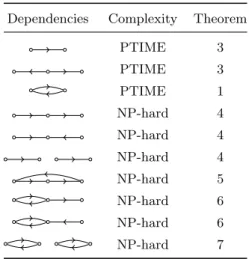
We prove a dichotomy for unary functional dependencies on a single relationR. These have the form x7→¯y, where xis a single attribute ofR and ¯yis a set of attributes. Our dichotomy results are summarized in Table 1.
4.2.1
The Tractable Cases
Theorem 1 shows that the MPD for two FDsx7→y, y7→x is computable in PTIME. The following theorem establishes the second tractable case:
Theorem 3. The MPD of a key or single functional
de-pendency repair constraint can be computed in time polyno-mial in the size of the database.
Proof. Remove all tuples with probability less than 0.5. For the key repair MPD task, group tuples by their key value. The MPD task then reduces to selecting the most probable tuple in each group. For the FD ¯x 7→ y¯ MPD task, group tuples by their value for ¯x and select within each group the most probable set of tuples with identical values for ¯y.
Dependencies Complexity Theorem
PTIME 3 PTIME 3 PTIME 1 NP-hard 4 NP-hard 4 NP-hard 4 NP-hard 5 NP-hard 6 NP-hard 6 NP-hard 7
Table 1: Individual complexity results for unary
functional dependencies, represented by arrows.
4.2.2
The Intractable Base Cases
We prove that computing the most probable database with functional dependenciesx7→z, y7→zis NP-hard by re-duction from the MAX-2-SAT problem. The same construc-tion, with slight modifications, suffices to show NP-hardness forx7→y7→z andx7→y, z7→w. Theorem 4. LetQn= " ∀x, y, y0, z, z0 R(x, y, z)∧R(x, y0, z0)⇒(z=z0) ∀x, x0, y, z, z0 R(x, y, z)∧R(x0, y, z0)⇒(z=z0) #
Then computing the MPD for Qn is NP-hard in the size
of the database.
Proof. Given a set V = {v1, . . . , vk} of Boolean vari-ables, let Φ be a formula overV in conjunctive normal form with two variables per clause (2-CNF). Φ =c1∧c2· · · ∧cm,
whereci=`vi1∨`vi2 and`v=vor ¯v, depending on whether
v appears positive or negated. The NP-hard MAX-2-SAT problem is to determine the maximum number of clauses of Φ which can be simultaneously satisfied.
Construct a database with a single relationR(x, y, z). For each clauseci=`vi1 ∨`vi2 in Φ, add the tuples (i, vi1, `vi1)
and (i, vi2, `vi2) toR. Set the probability of all such tuples
top >0.5.
Finding the MPDDB for this database consists of choos-ing a world containchoos-ing the maximum number of tuples. The FDx7→z, encoded byQn, ensures that at most one tuple per clause of Φ is included in DB. The FD y7→z ensures that every variableviin positionyeither maps to literal`vi
or`v¯i but not both.
Together, these imply that the MPDDB corresponds to an assignmentθ:V → {0,1}k
satisfying at leastn=|DB|
clauses. Suppose there exists an assignment θ0 such that more than nclauses are satisfied. Thenθ0 gives us a set of more thanntuples that can be included in a worldDB0such that|DB|> nandDB|=Qn, contradicting the assumption that DB was an MPD. Thus, the number of tuples inDB
is equal to the MAX-2-SAT solution for Φ. It follows that computing the MPDDB with the functional dependencies x7→zandy7→zis NP-hard.
The same encoding works for the functional dependencies x7→ y 7→ z. To encodex 7→y, z 7→w, note that we can encode in the database the equivalencey=z, and the NP-hardness result follows by reduction fromx7→y7→z.
Theorem 5. Computing the MPD with the functional
de-pendenciesx7→yandy7→z andz7→xis NP-hard in the size of the database.
Proof. (Sketch) By reduction from the 3-dimensional
matching problem. Turn every hyperedge (x, y, z) into a tuple (ax, by, cz) with probability>0.5. No two tuples can be chosen that have either x,y, orz in common, and the most probable database is the largest 3-dimensional match-ing.
Theorem 6. Computing the MPD for the functional
de-pendencies (a) x 7→ y, y 7→ x, z 7→ x or (b) x 7→ y, y 7→
x, x7→z is NP-hard in the size of the database.
Proof. (Sketch) By reduction from MAX-2-SAT,
simi-larly to Theorem 4. For (a),z is a greatest attribute (or-dered by implication). Letzencode the clausesci,xencode the literals andyencode the variables. Then each variable must map to one literal, and each clause can be made true only once. For (b),zis a least attribute, and we letzencode the literals, andx, yencode clauses and variables.
4.2.3
The Full Dichotomy
We prove that computing the MPD for any set Σ of unary functional dependencies is either in PTIME or NP-hard.
Given a relationRand a set of unary functional dependen-cies Σ, astrongly connected component (SCC) is a maximal subsetS of the attributes of R such that ∀a ∈ S, a 7→S. For two SCCsS andS0, the functional dependencyS7→S0 defines an order relationS > S0. An SCCY isbetweentwo SCCsX, Z ifX > Y > ZorZ > Y > X holds.
Our result shows that the tractable sets of unary FDs are exactly those described in Section 4.2.1. The proof of the dichotomy relies on the following lemma.
Lemma 1. LetSdenote the set of SCCs of relationRand
unary functional dependenciesΣ. For Z⊆S s.t∀P, Q∈Z,
there does not existP0∈Ss.t. P > P0> Q, letR[Z]denote
the projection ofRto attributes inZ andΣ[Z]denote the re-striction ofΣto functional dependencies over the attributes of Z. If computing the MPD over R[Z],Σ[Z] is NP-hard, then computing the MPD overR,Σis also NP-hard.
Proof. LetA={s∈S|s > Z},B={s∈S|s6> Z}.
Let every tuple inRhave a distinct value on each attribute inA. Thus, any FDa7→a0 is satisfied for any set of tuples inR. Likewise, let every tuple inR have the same value on each attribute inB. The result of this construction is that every FD, save for those entirely over the attributes of Z, is satisfied for any set of tuples fromR. This shows that computing the MPD overR,Σ in PTIME implies the ability to compute the MPD overR[Z],Σ[Z] in PTIME, from which the claim follows.
Theorem 7. Given a relationRand a set of unary
func-tional dependenciesΣ, computing the MPD is either PTIME or NP-hard.
Proof. The proof is a case analysis of the SCCs in R,
Σ, making using of Lemma 1 and the above tractable and intractable sets of FDs.
Case 1: There exists an SCCZ with at least three at-tributes. Then computing the MPD is NP-hard, by Lemma 1 and the reduction of Theorem 5.
Case 2: There exists at least two SCCs with two at-tributes,Z andZ0. Then computing the MPD is NP-hard: equate one attribute ofZwith an attribute ofZ0(this is im-posed at the database level). ThenZ andZ0 form an SCC and we proceed as for Case 1.
Case 3: There exists an SCCZ with two attributes and another FD, which necessarily goes from one SCCP to an-other SCC Q. One of the following must hold: (a)Z =P andZ > Q. ChooseQs.t. there does not exist an SCC be-tweenZandQ. (b)Z =QandP > Z. ChooseP s.t. there does not exist an SCC betweenP andZ. (c)Z6=P, Z6=Q. ChooseP, Qs.t. there does not exist an SCC betweenP, Q and equateP and Z. In (a)-(c), Lemma 1 applies and, by reduction from Theorem 6, computing the MPD is NP-hard.
Case 4: There exists an SCCZ with two attributes and no other FDs. Then computing the MPD is in PTIME by Theorem 1.
Case 5: There exists at least two FDs beginning at dis-tinct SCCs Z,Z0. Then computing the MPD is NP-hard, as we can chooseZ, Z0 s.t. Lemma 1 and the reduction of Theorem 4 apply.
Case 6: There exists a single attribute SCCZ s.t. every FD is of the formZ7→P, for any number of SCCsP. Then computing the MPD is in PTIME by Theorem 3.
Note that our hardness results hold even in the determin-istic setting, where the problem is to find a maximum size consistent repair. Some (not all) of the intractable cases of Section 4 were previously identified [23, 7, 10], but these works focused only on showing the existence of at least one hard set of FDs. To the best of our knowledge, Theorem 7 represents the first complete characterization of the com-plexity of repairing sets of unary functional dependencies.
4.3
Symmetric MPD
Our analysis so far has exclusively considered the asym-metric MPD problem. However, it is well-known in the lifted inference literature that exploiting symmetries can make otherwise intractable inference problems efficient to com-pute [30, 38, 19, 28]. For example, symmetry arguments have been used to show that MPE queries can be evalu-ated in time polynomial in the domain and evidence size for monadic MLNs [28], where all predicates have arity one. Semi-symmetric MPD is therefore also PTIME whenQ rep-resents such a monadic MLN, that is, when it has the form F(¯x) ⇔φ(¯x), whereφ is a formula in monadic logic. It is an open question whether there are MPD queries that are tractable in the symmetric or semi-symmetric setting, but intractable in the asymmetric setting.
Finally, we note that the reduction from MPD to MPE that was proposed in Section 3.2 converts a symmetric MPD problem into an MLN with symmetries. Several lifted MPE algorithms have been proposed that exploit these symme-tries [14, 2, 9, 27], and even support limited asymmetry [8]. They are known to give exponential speedups, but a precise characterization of their complexity is an open problem.
5.
CONCLUSIONS
We have introduced the most probable database problem, and shown its applications in probabilistic data repair and
statistical relational learning. We briefly showed a general algorithm for MPD, by reduction to MPE in Markov logic. As our main contribution, we investigated the complexity of MPD. We showed a dichotomy for unary functional depen-dencies, classifying them as PTIME or NP-hard in the size of the database, as well as evidence that a more general di-chotomy would be different for the MPD, query probability, and satisfiability tasks.
6.
ACKNOWLEDGMENTS
This work was partially supported by ONR grant #N00014-12-1-0423, NSF grants IIS-1115188 and IIS-1118122, and the Research Foundation-Flanders (FWO-Vlaanderen).
7.
REFERENCES
[1] S. Abiteboul, R. Hull, and V. Vianu.Foundations of databases, volume 8. Addison-Wesley Reading, 1995. [2] U. Apsel and R. I. Brafman. Exploiting uniform
assignments in first-order mpe.Proceedings of UAI, 2012.
[3] M. Arenas, L. Bertossi, and J. Chomicki. Consistent query answers in inconsistent databases. In
Proceedings of the eighteenth ACM
SIGMOD-SIGACT-SIGART symposium on Principles of database systems, pages 68–79. ACM, 1999. [4] S. Arora and B. Barak.Computational complexity: a
modern approach. Cambridge University Press, 2009. [5] L. Bertossi. Database repairing and consistent query answering.Synthesis Lectures on Data Management, 3(5):1–121, 2011.
[6] P. Bohannon, W. Fan, F. Geerts, X. Jia, and A. Kementsietsidis. Conditional functional dependencies for data cleaning. InICDE, pages 746–755, 2007.
[7] P. Bohannon, M. Flaster, W. Fan, and R. Rastogi. A cost-based model and effective heuristic for repairing constraints by value modification. InSIGMOD Conference, pages 143–154, 2005.
[8] H. B. Bui, T. N. Huynh, and R. de Salvo Braz. Exact lifted inference with distinct soft evidence on every object. InAAAI, 2012.
[9] H. H. Bui, T. N. Huynh, and S. Riedel. Automorphism groups of graphical models and lifted variational inference.arXiv preprint arXiv:1207.4814, 2012. [10] J. Chomicki and J. Marcinkowski. Minimal-change
integrity maintenance using tuple deletions.Inf. Comput., 197(1-2):90–121, 2005.
[11] N. Dalvi and D. Suciu. The dichotomy of probabilistic inference for unions of conjunctive queries.Journal of the ACM (JACM), 59(6):30, 2012.
[12] A. Darwiche.Modeling and reasoning with Bayesian networks. Cambridge University Press, 2009. [13] L. De Raedt, P. Frasconi, K. Kersting, and
S. Muggleton, editors.Probabilistic inductive logic programming: theory and applications.
Springer-Verlag, Berlin, Heidelberg, 2008.
[14] R. de Salvo Braz, E. Amir, and D. Roth. Mpe and partial inversion in lifted probabilistic variable elimination. InAAAI, volume 6, pages 1123–1130, 2006.
[15] W. F. Dowling and J. H. Gallier. Linear-time
algorithms for testing the satisfiability of propositional horn formulae.The Journal of Logic Programming, 1(3):267–284, 1984.
[16] W. Fan and F. Geerts. Foundations of data quality management.Synthesis Lectures on Data
Management, 4(5):1–217, 2012.
[17] D. Fierens, G. Van den Broeck, J. Renkens,
D. Shterionov, B. Gutmann, I. Thon, G. Janssens, and L. De Raedt. Inference and learning in probabilistic logic programs using weighted Boolean formulas.
Theory and Practice of Logic Programming, 2013. [18] L. Getoor and B. Taskar, editors.An Introduction to
Statistical Relational Learning. MIT Press, 2007. [19] V. Gogate and P. Domingos. Probabilistic theorem
proving. InProceedings of UAI, pages 256–265, 2011. [20] B. Jaumard and B. Simeone. On the complexity of the
maximum satisfiability problem for horn formulas.
Information Processing Letters, 26(1):1–4, 1987. [21] A. Jha and D. Suciu. Probabilistic databases with
markoviews.Proceedings of the VLDB Endowment, 5(11):1160–1171, 2012.
[22] H. Kautz, B. Selman, and Y. Jiang. A general
stochastic approach to solving problems with hard and soft constraints.The Satisfiability Problem: Theory and Applications, 17:573–586, 1997.
[23] S. Kolahi and L. V. S. Lakshmanan. On approximating optimum repairs for functional dependency violations. InICDT, pages 53–62, 2009. [24] D. Koller and N. Friedman.Probabilistic graphical
models: principles and techniques. MIT press, 2009. [25] H. W. Kuhn. The hungarian method for the
assignment problem.Naval research logistics quarterly, 2(1-2):83–97, 1955.
[26] L. Libkin.Elements of Finite Model Theory. Springer, 2004.
[27] M. Mladenov, B. Ahmadi, and K. Kersting. Lifted linear programming. InProceedings of AISTATS, pages 788–797, 2012.
[28] M. Niepert and G. Van den Broeck. Tractability through exchangeability: A new perspective on efficient probabilistic inference.arXiv preprint arXiv:1401.1247, 2014.
[29] J. Noessner, M. Niepert, and H. Stuckenschmidt. Rockit: Exploiting parallelism and symmetry for map inference in statistical relational models. In
Proceedings of the Conference on Artificial Intelligence (AAAI), 2013.
[30] D. Poole. First-order probabilistic inference. InIJCAI, volume 3, pages 985–991. Citeseer, 2003.
[31] M. Richardson and P. Domingos. Markov logic networks.Machine learning, 62(1-2):107–136, 2006. [32] S. Riedel. Improving the accuracy and efficiency of map inference for markov logic.Proceedings of UAI, 2008.
[33] T. J. Schaefer. The complexity of satisfiability problems. InSTOC, volume 78, pages 216–226, 1978. [34] D. Suciu, D. Olteanu, C. R´e, and C. Koch.
Probabilistic databases.Synthesis Lectures on Data Management, 3(2):1–180, 2011.
I. Miliaraki. 10 years of probabilistic querying–what next? InAdvances in Databases and Information Systems, pages 1–13. Springer, 2013.
[36] L. G. Valiant. The complexity of enumeration and reliability problems.SIAM Journal on Computing, 8(3):410–421, 1979.
[37] G. Van den Broeck, W. Meert, and A. Darwiche. Skolemization for weighted first-order model counting. InProceedings of KR, 2014.
[38] G. Van den Broeck, N. Taghipour, W. Meert, J. Davis, and L. De Raedt. Lifted probabilistic inference by first-order knowledge compilation. In