[email protected] Corresponding author:
*
Optimal Long-Term Hydro Generation Scheduling of Small
Hydropower Plant (SHP) using Metaheuristic Algorithm in
Himreen Lake Dam
Ali Thaeer Hammid1, 2, *, Mohd Herwan Sulaiman1
1Faculty of Electrical & Electronics Engineering, University Malaysia Pahang, 26600 Pekan, Malaysia
2Department of Computer Engineering Techniques, Al Yarmouk University College, 32001 Ba’aqubah, Diyala, Iraq
Abstract. This study focuses on the improvement of optimization model by applying particle swarm optimization and firefly algorithm methods to get a stable power production utility at its maximum level. Furthermore, it investigates on the minimization of utility loss in power production from the hydropower system, which is done by optimizing the variables of operation control in the hydropower plant at Lake Himreen - Diyala Dam. The variables mentioned are net turbine head, the rate of water flow and power production which had been gathered in the data during a research throughout a 10-year period. The results obtained from these two methods, namely Firefly Algorithm (FA) and Particle Swarm Optimization, (PSO) are compared. The inferences for general comparisons are created through several behavior
indicators. The behavior indicators illustrate that FA’s performance is better than PSO’s
performance, in some fields. At the end, the results show the strength of FA, as well as its efficiency and superiority.
1 Introduction
Hydropower golden age was set in the first half of the 20th century before oil control gained its dominance in the provision of energy. Several growth republics gradually began to get rid of traditional energy sources that existed in oil, coal, and natural gas [1-3]. In the present, as power demand keeps growing all day, more generation resources and various grid constructions are needed. While the network load is increasing, the generators that are attached to a hydro-turbine begin to be sluggish. This condition leads to the change of the output through the reduction of electrical power frequency. Consequently, the entire system of the hydro-turbine would collapse; this situation is called blackout or cas-caded failure [4]. Usually, the observations made on the reliability of generation systems regard the resource of energy for the power production as continuously available. This indicates that, in general, even one cause of the power production deficit leads to the destruction of electricity generation in power plants. During hydropower production, when the reservoir is sufficient to generate the energy, the abundance of power production adheres to the rule of the rate of water flow, hence, this model of hydro-turbine is right [5].
The objective of this project is to employ both of Firefly Algorithm (FA) and Particle Swarm Optimization (PSO) into the hydropower plant located in Lake Himreen dam. This action is performed in order to create an effective solution to optimization power problem, as well as an actual solution to operational problems, which is suitable for both cases of irrigation provider and hydropower generation. Moreover, the objective of the mathematical function is to specify the maximum or the minimum values, which may be subjected to restrictions on its variables due to the diversity of real-life applications [6]. Additionally, the objective of power system production is to find out its restrictions and to perform an optimization by controlling specific variables of the power system. The test outcomes of both algorithm methods are obtained. Then, a comparison is made between the validation results of FA method and the validation results of PSO methods in order to display the possibilities and the superior points of the proposed algorithm. Firefly Algorithm (FA) would provide the solution to power system problems, which offers some superiority points and improved behavior to general results [7].
2 Small Hydropower Plants (SHP)
The hydro-turbine obtains mechanic hydropower and mechanically changes it into rotation power. Then, the turbine is connected to an electric power generator. Actually, the turbine efficiency depends on the turbine's power, its type, fluid percentage, etc. Kaplan turbine is observed to ensure that its efficiency reaches the maximum rate of water flow. Its efficiency will prove the appeal of this kind of turbine for a river with a variant in the management of the water flow rate [8, 9]. The unit of the power generator in a hydropower plant relies on four factors, which are gravity acceleration, the flow rate of water, the height of the water drop, and the general efficiency, as illustrated in Eq. (1)
(1)
Where, P = generated power (KW); g= gravity acceleration (m2/s); Q = water flow rate (m3/s); H = Net head of Turbine (m); η = efficiency of hydropower plant.
3.1 Particle Swarm Optimization (PSO)
PSO mimics the action of bird grouping. Assume the general strategy; bird grouping is randomly looking for unknown regions as places for eating. However, there is only one area for eating left in the chosen regions. Even so, all of the birds could not pinpoint the location of the eating area. They only recognize the distance between the eating areas through the iteration on the distance amount.
3.2 PSO Operation
PSO is created by using a collection of particles which are as solutions. Afterwards, this operation looks for the ideal situation by performing updates on the power generators. During the update process, each particle targets for the best or superior values during every iteration. The first value is the best solution and it is known as fitness. Then, the fitness value
is kept, and labeled as “p-best”. The other best value is erased after the particle swarm optimizer is obtained by any of the
particles within the population. The best value is a global best, and labeled as “g-best”. Every particle within the
population participates in this operation because it lives next to or beside the location of the operation. The best value is
the local or personal best, labeled as “p-best”. When two of the best values are discovered, the particle performs updates
on its velocity (vi) and positions (xi), as illustrated mathematically in Eq. (2) and Eq. (3) [10]. 1 1 2 1 1 ( – ) ( – ) (2) (3) t t t t i i i i i t t t i i i
v wv c rand pbest x c rand gbest x
x X V
vit is velocity particle, while i is at iteration t and it should be placed in field Eq. (4).
min i max (4) V V V
xti is the present location of particle i at iteration t. Meanwhile, pbesti represents p-best in proxy i at iteration t,
and gbestrepresents the best solution under this limit. Generally, the inertia’s weight (w) is fixed depending on the formula
in Eq. (5). max min max max -- W W (5) W W ITER
According to the formula above, w is the factor of inertia’s weight. Wmax is the highest amount of weighting factor, while Wmin is the lowest amount of weighting factor. ITERmax is the highest iterations number, and ITER is the current iteration number [11].
4.1 Fireflies' behavior and operation
Firefly Algorithm (FA) is an empirical algorithm, inspired from the flashing of light from fireflies. This algorithm was established by Xin-She Yang, at Cambridge University in 2007. A lot of fireflies create frequent light flashes and have a various light flashing dynamic. Firefly Algorithm is an effective local survey, in which the brightness of light flashes is related to its objective function. Parameters of fireflies' algorithm, such as the constancy of attractiveness and randomization, perform an essential task in specifying the optimum solution in the survey [12]. These parameters are significantly necessary for the computation of the convergence rapidity and FA algorithm’s performance. FA has three main concepts that have been pursued from the fireflies’ activities amongst one another.
In general, all fireflies are unisexual. They will move individually towards fireflies which are brighter and more attractive, without relying on their sexual role.
The grade of a firefly’s attractiveness has a direct proportion to the brightness of its light. The brightness may be reduced due to an increase of the distance between fireflies. This is because their lights are absorbed by the air formed within the distance. It moves around randomly when it doesn't come across one that is brighter or more attractive.
Therefore, the objective function is specified by the firefly's brightness or the intensity of the firefly’s light [13].
4.2 Mathematical Model of Fireflies Algorithm (FA) Optimization
In a condition which displays the barriers of the highest FA optimization, the brightness (I) of a firefly is determined by
two particular positions (x) which are marked as ‘I (x) α f (x)’. This is because the distance between fireflies and their level of attractiveness (β) are proportional to each other. This depends on the distance of fireflies (rij) from the earth and the fireflies' variations (jth). Light intensity reduces with the increase of space between the fireflies because the light is absorbed into the environment. Thus, ‘β’ changes with absorption rate, which inversely depends on the square law, as
illustrated in Eq. (6): 2 ( ) Is (6) I r r
I(r) represents the light intensity within a space (r), and it has the same light intensity in the source space [14, 15]. Since a firefly’s attractiveness is directly proportional to the light intensity, it is recognized and distinguishable
Where, P = generated power (KW); g= gravity acceleration (m2/s); Q = water flow rate (m3/s); H = Net head of Turbine (m); η = efficiency of hydropower plant.
3.1 Particle Swarm Optimization (PSO)
PSO mimics the action of bird grouping. Assume the general strategy; bird grouping is randomly looking for unknown regions as places for eating. However, there is only one area for eating left in the chosen regions. Even so, all of the birds could not pinpoint the location of the eating area. They only recognize the distance between the eating areas through the iteration on the distance amount.
3.2 PSO Operation
PSO is created by using a collection of particles which are as solutions. Afterwards, this operation looks for the ideal situation by performing updates on the power generators. During the update process, each particle targets for the best or superior values during every iteration. The first value is the best solution and it is known as fitness. Then, the fitness value
is kept, and labeled as “p-best”. The other best value is erased after the particle swarm optimizer is obtained by any of the
particles within the population. The best value is a global best, and labeled as “g-best”. Every particle within the
population participates in this operation because it lives next to or beside the location of the operation. The best value is
the local or personal best, labeled as “p-best”. When two of the best values are discovered, the particle performs updates
on its velocity (vi) and positions (xi), as illustrated mathematically in Eq. (2) and Eq. (3) [10]. 1 1 2 1 1 ( – ) ( – ) (2) (3) t t t t i i i i i t t t i i i
v wv c rand pbest x c rand gbest x
x X V
vit is velocity particle, while i is at iteration t and it should be placed in field Eq. (4).
min i max (4) V V V
xti is the present location of particle i at iteration t. Meanwhile, pbesti represents p-best in proxy i at iteration t,
and gbestrepresents the best solution under this limit. Generally, the inertia’s weight (w) is fixed depending on the formula
in Eq. (5). max min max max -- W W (5) W W ITER
According to the formula above, w is the factor of inertia’s weight. Wmax is the highest amount of weighting factor, while Wmin is the lowest amount of weighting factor. ITERmax is the highest iterations number, and ITER is the current iteration number [11].
4.1 Fireflies' behavior and operation
Firefly Algorithm (FA) is an empirical algorithm, inspired from the flashing of light from fireflies. This algorithm was established by Xin-She Yang, at Cambridge University in 2007. A lot of fireflies create frequent light flashes and have a various light flashing dynamic. Firefly Algorithm is an effective local survey, in which the brightness of light flashes is related to its objective function. Parameters of fireflies' algorithm, such as the constancy of attractiveness and randomization, perform an essential task in specifying the optimum solution in the survey [12]. These parameters are significantly necessary for the computation of the convergence rapidity and FA algorithm’s performance. FA has three main concepts that have been pursued from the fireflies’ activities amongst one another.
In general, all fireflies are unisexual. They will move individually towards fireflies which are brighter and more attractive, without relying on their sexual role.
The grade of a firefly’s attractiveness has a direct proportion to the brightness of its light. The brightness may be reduced due to an increase of the distance between fireflies. This is because their lights are absorbed by the air formed within the distance. It moves around randomly when it doesn't come across one that is brighter or more attractive.
Therefore, the objective function is specified by the firefly's brightness or the intensity of the firefly’s light [13].
4.2 Mathematical Model of Fireflies Algorithm (FA) Optimization
In a condition which displays the barriers of the highest FA optimization, the brightness (I) of a firefly is determined by
two particular positions (x) which are marked as ‘I (x) α f (x)’. This is because the distance between fireflies and their level of attractiveness (β) are proportional to each other. This depends on the distance of fireflies (rij) from the earth and the fireflies' variations (jth). Light intensity reduces with the increase of space between the fireflies because the light is absorbed into the environment. Thus, ‘β’ changes with absorption rate, which inversely depends on the square law, as
illustrated in Eq. (6): 2 ( ) Is (6) I r r
I(r) represents the light intensity within a space (r), and it has the same light intensity in the source space [14, 15]. Since a firefly’s attractiveness is directly proportional to the light intensity, it is recognized and distinguishable
amongst neighboring fireflies. Therefore, the relation between the level of firefly’s attractiveness (β) and the size of space
(r) is illustrated in Eq. (7):
2
0e r 7
β0 represents a firefly's attractiveness level at r = 0. γ represents the constancy of environmental absorption,
which the regulates the rate of light intensity reduction. The motion of the firefly which is attracted to the brighter firefly
‘j’ is labeled as ‘i’, as illustrated in Eq. (8):
2 1 0 rij( ) (8) t t t t t i i j i t i X X e X X
The creation of the second part of the formula above is due to the Firefly's attraction towards the brighter firefly.
Meanwhile, randomization (αt) is included in the last third part of this formula. This symbol represents the parameter of
randomization, and (εti) is the symbol of the dispersed vector numbers, achieved from the regular supply and delivery
made at specific time ‘t’ [16]. For both fireflies ‘i’ and ‘j’, the space (r) between them is calculated, as illustrated in Eq.
(9):
2 , , 1 - - (9) d ij i k j k i j k r x x x x
‘rij’ refers to the space between fireflies ‘i’ and ‘j’, and they are placed at ‘xi’ and ‘xj’ respectively. This space is
known as the Cartesian space. Meanwhile, ‘Xi,K’ is the kth element of the three-dimensional axis ‘xi’ created by firefly
‘ith’ under 2-D condition [17]. When most of the generation is almost finished, the fireflies are classified depending on
their brightness, and the superior firefly group is discovered from each category. Finally, the fireflies start moving according to their groups. Additionally, the intensity of brightness of all fireflies is recently improved with the information provided in fitness function for each group. Moreover, when the procedures are performed on the groups, the firefly with the maximum level of brightness indicates the highest value of fitness. This is established as the optimal solution to optimization problems [18].
5 Results and discussion
In this study, only the constrained generated power was checked and taken into account, according to the main restrictions. There were various limitations on the operation of the power generator, on both maximum and minimum level. An observation was also conducted on two input parameters. This refers to the rate of water flow, ranging from 8 m3/s to 175 m3/s, and the net head of turbine, ranging from 14.17 to 29.84 meters. Moreover, based on the observation, the amount of power output production barely reached 44000 KW. Sometimes, the amount of power production dropped to zero and there was a wide variation of power production
Since the creation of FA and PSO depends on their historical data, the input and output data collected during this study were analyzed statistically. These two methods were built to be specialized in 4 inputs and 1 output, which originated from fitness function. Clearly, the evaluation of the plant behavior was based on some of the main variables. From the past up until now, there has been no rule for selecting the superior techniques from Swarm Intelligence (SI). The correct way of selecting the superior techniques is through trial and error. Therefore, the execution of each model will be checked so that the structure of its right behavior will be clearly seen. In this study, there were some attempts of optimizing power production using the R2015a version (The Mathworks Inc.) of the MATLAB software package. The FA and PSO techniques were modeled to accomplish the superior fitness level of fitness function, which was identified by Eq. (1)
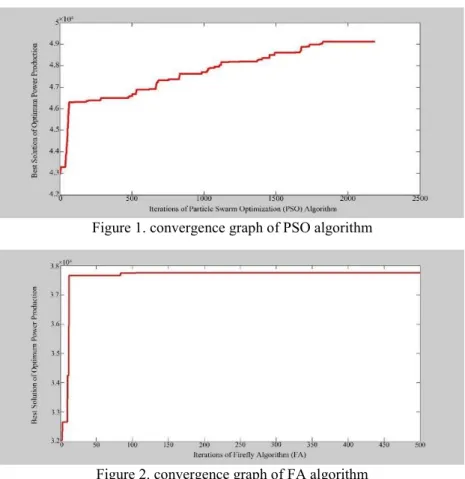
The well-known optimization methods such as Particle Swarm Optimization (PSO) as well as another one is a Firefly Algorithm (FA) have also been considered here in the similar difficult so as to make a comparison between results with the two both diverse optimization methods to solve optimum power production problem. 500 is maximum iterations have been considered for FA. 3000 is maximum iterations have been considered for PSO. From power generated function that applied on PSO and Firefly algorithms, PSO is starting the power generation which has ranged from 41000 kW up to 49000 kW as illustrated in Figure 1. And the FA is starting the power generation which also has a range from 37600 kW up to 37700 kW as illustrated in Figure 2. In PSO method, the approximate maximum best fitness and approximate minimum best fitness were 49010 and 42737 respectively which equals to power generation function. In FA algorithm, the exact maximum best fitness and exact minimum best fitness were 37746 and 36676 respectively which equals to power generation function.
Figure 1. convergence graph of PSO algorithm
Figure 2. convergence graph of FA algorithm
In the main case, the best result achieved when 500 iterations are done by using the FA optimization method has been made a comparison with the PSO other optimization methods. Results in Table 2, illustrates that all power production rearranging in a founded solution of FA is less than the results obtained by basing solution of PSO. Moreover, the mathematical test function or fitness function value is the best solution that has been done from the power generation equation as illustrated in Eq. (1). Since it includes power sensitivity analysis in algorithms selection function, it covers all over probabilities and it contains all function parameters
It is clear that has the FA generated values of the fitness function included the lower standard deviation than the dependency runs compared of the PSO. Furthermore, the best values or maximum values of fitness functions for entire check test problems completely which is obtained by the FA are nearby the global optimal values, Thus FA might exactly get to the global optimal value of the power generation function in the check test table. Both of two algorithms have been shown for a similar number of population which is 3570. In the case of fitness function (power function), FA almost gets to the optimum point and it does not exceed the optimum point as illustrated in Figure 2. While, PSO is exceeding the observed maximum point, but in a much too long time as illustrated in Figure 1.
The performance of the FA convergence method which is illustrated in Figure 2 can be actually realized that throughout the algorithm the fitness value converges after 100 iterations turn out to be steady. On the contrary, the performance of the PSO convergence method which is illustrated in Figure 1 cannot realize any period for steady case due to increasing values throughout all periods of iteration the algorithm. As a result, a comparison must be getting into the relationship between the suitable convergence and computational time. Thus, there is a far away convergence of PSO method which may be a reason to obstruct the fitness function and lead it in local values. It can be prevented by swarm size increment but, the computation time will be greater than before also.
So as to estimate the algorithm accomplishment and illustration the advantage and efficiency of both suggested algorithm, the total execution and ran both of them are 10 times. Now, 'step numbers' means a whole number of time steps of optimization algorithm and 'iteration number' period is employed for getting sequentially earlier estimates the solution of our own specified problem.
6
Conclusions
In this research, a successful execution of Firefly Algorithm (FA) and Particle Swarm Optimization (PSO) has been accomplished on nonlinear power function. With this, the stability of power production utility at its maximum level was obtained, and the loss of power production in the hydropower system was minimized by optimizing the control of operation variables in the hydropower plant at Himreen Lake Dam - Diyala. The analysis of the daily data set was influenced by the net turbine head and rate of water flow. These elements of the hydropower plant functioned as the input and the power was produced as the output. The daily data set was modeled based on the actual observed daily data throughout 2005–2015. Thus, the experimental results were indicated by the compression FA with PSO, which is
Figure 1. convergence graph of PSO algorithm
Figure 2. convergence graph of FA algorithm
In the main case, the best result achieved when 500 iterations are done by using the FA optimization method has been made a comparison with the PSO other optimization methods. Results in Table 2, illustrates that all power production rearranging in a founded solution of FA is less than the results obtained by basing solution of PSO. Moreover, the mathematical test function or fitness function value is the best solution that has been done from the power generation equation as illustrated in Eq. (1). Since it includes power sensitivity analysis in algorithms selection function, it covers all over probabilities and it contains all function parameters
It is clear that has the FA generated values of the fitness function included the lower standard deviation than the dependency runs compared of the PSO. Furthermore, the best values or maximum values of fitness functions for entire check test problems completely which is obtained by the FA are nearby the global optimal values, Thus FA might exactly get to the global optimal value of the power generation function in the check test table. Both of two algorithms have been shown for a similar number of population which is 3570. In the case of fitness function (power function), FA almost gets to the optimum point and it does not exceed the optimum point as illustrated in Figure 2. While, PSO is exceeding the observed maximum point, but in a much too long time as illustrated in Figure 1.
The performance of the FA convergence method which is illustrated in Figure 2 can be actually realized that throughout the algorithm the fitness value converges after 100 iterations turn out to be steady. On the contrary, the performance of the PSO convergence method which is illustrated in Figure 1 cannot realize any period for steady case due to increasing values throughout all periods of iteration the algorithm. As a result, a comparison must be getting into the relationship between the suitable convergence and computational time. Thus, there is a far away convergence of PSO method which may be a reason to obstruct the fitness function and lead it in local values. It can be prevented by swarm size increment but, the computation time will be greater than before also.
So as to estimate the algorithm accomplishment and illustration the advantage and efficiency of both suggested algorithm, the total execution and ran both of them are 10 times. Now, 'step numbers' means a whole number of time steps of optimization algorithm and 'iteration number' period is employed for getting sequentially earlier estimates the solution of our own specified problem.
6
Conclusions
In this research, a successful execution of Firefly Algorithm (FA) and Particle Swarm Optimization (PSO) has been accomplished on nonlinear power function. With this, the stability of power production utility at its maximum level was obtained, and the loss of power production in the hydropower system was minimized by optimizing the control of operation variables in the hydropower plant at Himreen Lake Dam - Diyala. The analysis of the daily data set was influenced by the net turbine head and rate of water flow. These elements of the hydropower plant functioned as the input and the power was produced as the output. The daily data set was modeled based on the actual observed daily data throughout 2005–2015. Thus, the experimental results were indicated by the compression FA with PSO, which is
discovered, the better for this proposed work specifically. It's owing to the benefits of the meta-heuristic process of FA which is comprehensively cleaning the searching area to discover the optimal solution for combinatorial optimization correctly. The FA is not only containing the improvement operation related to the present area, but it's containing the enhancement amongst its specific another area from the earlier steps. Moreover, FA is a stochastic algorithm which depends on attracting and Light intensity of common performance of fireflies and its function has a unique behavior to solve the certain restricted of optimization problems.
References
1. A.T. Hammid. Applications of Tuning Control Actions for the Efficient Load/frequency Control in Steam Turbine. International Journal of Current Engineering and Technology, (2013). 3(5): p. 1895-1898.
2. A.T. Hammid, et al., Load Frequency Control for Hydropower Plants using PID Controller. Journal of Telecommunication, Electronic and Computer Engineering (JTEC), (2016). 8(10): p. 47-51.
3. A.T. Hammid, A.K. Bhardwaj, and S. Prakash., Design Remote Power Control I/O Data Acquisition System and Control on Home Automation. IJECCE, (2013). 4(2): p. 528-535.
4. A.T. Hammid, M.H.B Sulaiman, and A.N. Abdalla., Prediction of small hydropower plant power production in Himreen Lake dam (HLD) using artificial neural network. Alexandria Engineering Journal, (2017).
5. S.H. Kiran, D.S. Sekhar, and C. Subramani., Performance of two modified optimization techniques for power system voltage stability problems. Alexandria Engineering Journal, (2016). 55(3): p. 2525-2530.
6. M. Shalini, et al., Multi-objective parametric optimization of nano powder mixed electrical discharge machining of AlSiCp using response surface methodology and particle swarm optimization. Alexandria Engineering Journal, (2017).
7. M.S.R. Naidu, P.R. Kumar, and C. K, Shannon and Fuzzy entropy based evolutionary image thresholding for image segmentation. Alexandria Engineering Journal, (2017).
8. S.S. Nanivadekar and U.D. Kolekar., An approach involving dynamic group search optimization for allocating resources in OFDM-based cognitive radio system. Alexandria Engineering Journal, (2016).
9. L. Baohong, et al., Study on the optimal hydropower generation of Zhelin reservoir. Journal of Hydro-environment Research, (2013). 7(4): p. 270-278.
10. L. Peng, et al., Short-term hydro generation scheduling of Xiluodu and Xiangjiaba cascade hydropower stations using improved binary-real coded bee colony optimization algorithm. Energy Conversion and Management, (2015). 91(Supplement C): p. 19-31.
11. M.R. Ahmadi, et al., Comment on ‘Differential evolution technique-based short-term economic generation scheduling of hydrothermal systems’ by K.K. Mandal, N. Chakraborty Electric Power Systems Research 78 (2008) 1972–1979. Electric Power Systems Research, (2017). 147(Supplement C): p. 310-312.
12. Tedjani, M., et al., Dynamical modeling of Li-ion batteries for electric vehicle applications based on hybrid Particle Swarm–Nelder–Mead (PSO–NM) optimization algorithm. Electric Power Systems Research, (2016). 131(Supplement C): p. 195-204.
13. M. Li, et al., Short-term hydro generation scheduling of Three Gorges–Gezhouba cascaded hydropower plants using hybrid MACS-ADE approach. Energy Conversion and Management, (2013). 76(Supplement C): p. 260-273.
14. H. Wang, et al., A hybrid multi-objective firefly algorithm for big data optimization. Applied Soft Computing, (2017).
15. Y. Zhang, S. Xian-fang, and G. Dun-wei., A return-cost-based binary firefly algorithm for feature selection. Information Sciences, (2017). 418(Supplement C): p. 561-574.
16. H. Wang, et al., Firefly algorithm with neighborhood attraction. Information Sciences, (2017). 382(Supplement C): p. 374-387.
17. D. Sánchez, P. Melin, and O. Castillo, Optimization of modular granular neural networks using a firefly algorithm for human recognition. Engineering Applications of Artificial Intelligence, (2017). 64(Supplement C): p. 172-186.
18. H. Wang, et al., A hybrid multi-objective firefly algorithm for big data optimization. Applied Soft Computing, (2017).