Yi Wang
Arizona State University
School of Computing, Informatics, and Decision Systems Engineering Fulton Schools of Engineering, Arizona State University
P.O. Box 878809, Tempe, AZ 85287-8809, United States [email protected]
Abstract
We present an ongoing research on a probabilistic extension of action languageBC+. Just like BC+ is defined as a high-level notation of answer set programs for describing transition systems, the proposed language, which we callpBC+, is defined as a high-level notation of LPMLNprograms – a probabilistic extension of answer set programs.
As preliminary results accomplished, we illustrate how probabilistic reasoning about trans-ition systems, such as prediction, postdiction, and planning problems, as well as probabilistic diagnosis for dynamic domains, can be modeled inpBC+ and computed using an implementa-tion of LPMLN.
For future work, we plan to develop a compiler that automatically translatespBC+ descrip-tion into LPMLNprograms, as well as parameter learning in probabilistic action domains through LPMLNweight learning. We will work on defining useful extensions ofpBC+ to facilitate hypo-thetical/counterfactual reasoning. We will also find real-world applications, possibly in robotic domains, to empirically study the performance of this approach to probabilistic reasoning in action domains.
2012 ACM Subject Classification Computing methodologies→Knowledge representation and reasoning
Keywords and phrases action language, probabilistic reasoning, LPMLN Digital Object Identifier 10.4230/OASIcs.ICLP.2018.15
Acknowledgements We are grateful to the anonymous referees for their useful comments. This work was partially supported by the National Science Foundation under Grant IIS-1526301.
1
Introduction and Problem Description
Action languages, such as A [9], B [10], C [12], C+ [11], and BC [15], are formalisms for describing actions and their effects. Many of these languages can be viewed as high-level notations of answer set programs structured to represent transition systems. The expressive possibility of action languages, such as indirect effects, triggered actions, and additive fluents, has been one of the main research topics. Most of the extensions accounting for that are logic-oriented, and less attention has been paid to probabilistic reasoning, with a few exceptions such as [6, 8], let alone automating such probabilistic reasoning and learning parameters of an action description.
Action languageBC+ [2], one of the most recent additions to the family of action languages, is no exception. While the language is highly expressive to embed other action languages, such as C+ [11] and BC [14], it does not have a natural way to express the likelihood of histories (i.e., a sequence of transitions).
IExample 1. Consider an extension of the robot example from [13]: A robot and a book that can be picked up are located in a building with 2 roomsr1andr2. The robot can move to rooms, pick up the book and put down the book. There is 0.1 chance that it fails when it tries to enter a room, a 0.2 chance that the robot drops the book when it has the book, and 0.3 chance that the robot fails when it tries to pick up the book. The robot, as well as the book, was initially atr1. It executed the following actions to deliver the book fromr1tor2: pick up the book; go tor2; put down the book. However, after the execution, it observes that the book is not atr2. What was the problem?
To answer the above query, an action language needs the capabilities of not only probab-ilistic reasoning, but also abductive reasoning in a probabprobab-ilistic setting. In my research, we are working on a probabilistic extension ofBC+, which we call pBC+, with the expressivity to answer queries such as the one in Example 1. Just likeBC+ is defined as a high-level notation of answer set programs for describing transition systems, pBC+ is defined as a high-level notation of LPMLN programs – a probabilistic extension of answer set programs. LanguagepBC+ inherits expressive logical modeling capabilities ofBC+ but also allows us to assign a probability to a sequence of transitions so that we may distinguish more probable histories.
In this paper, as preliminary results accomplished, we will show how probabilistic reasoning about transition systems, such as prediction, postdiction, and planning problems, can be modeled inpBC+ and computed using an implementation of LPMLN[16]. Further, we will show that it can be used for probabilistic abductive reasoning about dynamic domains, where the likelihood of the abductive explanation is derived from the parameters manually specified or automatically learned from the data.
For future work, we plan to develop a compiler that automatically translates pBC+ description into LPMLN programs, as well as parameter learning in probabilistic action domains through LPMLNweight learning. We will work on defining useful extensions ofpBC+ to facilitate hypothetical/counterfactual reasoning. We will also find real-world applications, possibly in robotic domains, to empirically study the performance of this approach to probabilistic reasoning in action domains.
This paper will give a summary of my research onpBC+, including the background and some review of existing literature (Section 2), goal of the research (Section 3), the current status of the research (Section 4), preliminary results accomplished (Section 5) as well as issues and expected achievements (Section 6).
2
Background and Overview of Existing Literature
2.1
Probabilistic Reasoning and Diagnosis in the Context of Action
Languages
There are various formalisms for reasoning in probabilistic action domains. PC+ [8] is a generalization of the action languageC+ that allows for expressing probabilistic information. PC+ expresses probabilistic transition of states through so-calledcontext variables, which are exogenous variables associated with predefined probability distributions. PC+ allows for expressing qualitative and quantitative uncertainty about actions by referring to the sequence of “belief” states – possible sets of states together with probabilistic information. On the other hand, the semantics is highly complex and there is no implementation ofPC+ as far as we know.
[20] defined a probabilistic action language called N B, which is an extension of the (deterministic) action language B. N Bcan be translated into P-log [4] and since there exists a system for computing P-log, reasoning inN B action descriptions can be automated. Like PC+, probabilistic transitions are expressed through dynamic causal laws with random variables associated with predefined probability distribution. InN B, however, these random variables are hidden from the action description and are only visible in the translated P-log representation. In order to translateN B into executable low-level logic programming languages, some semantical assumptions have to be made inN B, such as all actions have to be always executable and nondeterminism can only be caused by random variables.
Probabilistic action domains, especially in terms of probabilistic effects of actions, can be formalized as Markov Decision Process (MDP). The language proposed in [6] aims at facilitating elaboration tolerant representations of MDPs. The syntax is similar to N B andPC+. The semantics is more complex as it allows preconditions of actions and imposes less semantical assumption. The concept of unknown variables associated with probability distributions is similar to random variables inN B. There is, as far as we know, no implementation of the language. There is no discussion about probabilistic diagnosis in the context of the language. PPDDL [19] is a probabilistic extension of the planning definition language PDDL. LikeN B, the nondeterminism that PPDDL considers is only the probabilistic effect of actions. The semantics of PDDL is defined in terms of MDP. There are also probabilistic extensions of the Event Calculus such as [7] and [18].
In the above formalisms, the problem of probabilistic diagnosis is only discussed in [20]. [3] and [5] studied the problem of diagnosis. However, they are focused on diagnosis in deterministic and static domains. [13] has proposed a method for diagnosis in action domains with situation calculus. Again, the diagnosis considered there does not involve any probabilistic measure.
2.2
Review: Language LP
MLNWe review the definition of LPMLN from [17]. An LPMLN program is a finite set of weighted rules w:Rwhere R is a rule andwis a real number (in which case, the weighted rule is calledsoft) or αfor denoting the infinite weight (in which case, the weighted rule is called hard). An LPMLNprogram is called ground if its rules contain no variables. We assume a finite Herbrand Universe so that the ground program is finite. Each ground instance of a non-ground rule receives the same weight as the original non-ground formula.
For any ground LPMLN program Π and any interpretation I, Π denotes the usual (unweighted) ASP program obtained from Π by dropping the weights, ΠI denotes the set of
w:Rin Π such thatI|=R, and SM[Π] denotes the set{I|I is a stable model of ΠI}. The unnormalized weight of an interpretationI under Π is defined as
WΠ(I) = exp P w:R∈ΠI w ! ifI∈SM[Π]; 0 otherwise.
Thenormalized weight (a.k.a. probability) of an interpretationI under Π is defined as PΠ(I) = lim α→∞ WΠ(I) P J∈SM[Π] WΠ(J) .
InterpretationIis called a(probabilistic) stable modelof Π ifPΠ(I)6= 0. The most probable stable models of Π are the stable models with the highest probability.
2.3
Review: Multi-Valued Probabilistic Programs
Multi-valued probabilistic programs [17] are a simple fragment of LPMLN that allows us to represent probability more naturally.
We assume that the propositional signatureσis constructed from “constants” and their “values.” A constant c is a symbol that is associated with a finite setDom(c), called the domain. The signatureσis constructed from a finite set of constants, consisting of atoms c=v 1for every constant cand every elementvin Dom(c). If the domain ofc is{f,t}then we say thatc isBoolean, and abbreviatec=tas candc=fas∼c.
We assume that constants are divided intoprobabilisticconstants andnon-probabilistic constants. A multi-valued probabilistic programΠis a tuplehPF,Πi, where
PF containsprobabilistic constant declarationsof the following form:
p1:: c=v1| · · · |pn :: c=vn (1)
one for each probabilistic constant c, where {v1, . . . , vn} = Dom(c), vi 6= vj, 0 ≤
p1, . . . , pn ≤1 andP n
i=1pi = 1. We useMΠ(c=vi) to denotepi. In other words,PF
describes the probability distribution over each “random variable”c. Π is a set of rules such that the head contains no probabilistic constants.
The semantics of such a programΠis defined as a shorthand for LPMLN programT(Π) of the same signature as follows.
For each probabilistic constant declaration (1),T(Π) contains, for eachi= 1, . . . , n, (i) ln(pi) :c=vi if 0< pi<1; (ii)α: c=vi ifpi= 1; (iii)α: ⊥ ←c=vi ifpi= 0.
For each ruleHead ←Body in Π,T(Π) contains α: Head←Body. For each constantc,T(Π) contains the uniqueness of value constraints
α: ⊥ ←c=v1∧c=v2 (2)
for allv1, v2∈Dom(c) such thatv16=v2, and the existence of value constraint α: ⊥ ← ¬ W
v∈Dom(c)
c=v . (3)
In the presence of the constraints (2) and (3), assumingT(Π) has at least one (probabil-istic) stable model that satisfies all the hard rules, a (probabil(probabil-istic) stable modelI satisfies c=v for exactly one valuev, so we may identifyIwith the value assignment that assignsv toc.
3
Goal of the Research
The following are our research objectives.
Designing Probabilistic Action Language on the Foundation of LPMLN. We design the syntax and semantics of the languagepBC+ to allow for commonsense reasoning, probabilistic inference and statistical learning. Furthermore, we study the theoretical properties of the action language to establish its relation with probabilistic transition systems.
1 Note that here “=” is just a part of the symbol for propositional atoms, and is not equality in first-order logic.
Defining the Extension of the Action Language to Explain the Reason of Failure in Dynamic Domains. We extend the probabilistic action language to account for diagnostic reasoning when the observation conflicts with the way the system is supposed to behave. This will be in contrast with diagnostic reasoning in other action languages, which is logical and does not distinguish which diagnosis is more probable.
Extending the Action Language For Hypothetical/Counterfactual Reasoning.
We extend the probabilistic action language to answer queries involving hypothetical/-counterfactual reasoning, where the diagnosis or observation is given, we are interested in how the outcome would have been affected if some action happened instead.
Implementing a Compiler that Automatically Translates pBC+ Descriptions to LPMLN Programs. SincepBC+ can be executable through translation to LPMLN, it is desirable to have a compiler that automates this translation. We plan to develop such a compiler.
Empirically Studying the Performance ofpBC+with Real-World Applications.
After we have the implementation for inference and learning onpBC+ action descriptions, we will applypBC+ on reasoning and learning tasks in real-world applications, possibly robotic domains.
4
Current Status of the Research
This research is at its starting phase. In our recent paper accepted by ICLP 2018, we have defined the syntax and semantics ofpBC+, and experimented with several examples through manual translation to LPMLN. We have also defined the extension that allows diagnostic reasoning in probabilistic action domains.
Currently we are investigating on parameter learning ofpBC+ through LPMLN weight learning. We are developing a prototype system for LPMLN weight learning, and several examples of parameter learning ofpBC+ descriptions are part of the benchmarks we use for the prototype system.
5
Preliminary Results Accomplished
In this section, we will present the syntax and semantics ofpBC+, and illustrate how various reasoning tasks involving probabilistic inference can be automated in this language, through translation to LPMLN.
5.1
Syntax of
p
BC
+
We assume a propositional signature σas defined in Section 2.3. We further assume that the signature of an action description is divided into four groups: fluent constants,action constants,pf (probability fact) constants andinitpf (initial probability fact) constants. Fluent constants are further divided intoregular andstatically determined. The domain of every action constant is Boolean. Afluent formulais a formula such that all constants occurring in it are fluent constants.
The following definition of pBC+ is based on the definition ofBC+ language. A static lawis an expression of the form
causedF ifG (4)
Afluent dynamic law is an expression of the form
causedF ifGafterH (5)
whereF andGare fluent formulas andH is a formula, provided thatF does not contain statically determined constants andH does not contain initpf constants.
Apf constant declaration is an expression of the form
causedpf ={v1:p1, . . . , vn:pn} (6)
wherepf is a pf constant with domain{v1, . . . , vn}, 0< pi<1 for eachi∈ {1, . . . , n}2, and
p1+· · ·+pn = 1. In other words, (6) describes the probability distribution ofpf.
An initpf constant declaration is an expression of the form (6) where pf is an initpf constant.
Aninitial static law is an expression of the form
initiallyF ifG (7)
whereF is a fluent formula andGis a formula that contains neither action constant nor pf constant.
A causal law is a static law, a fluent dynamic law, a pf constant declaration, an initpf constant declaration, or an initial static law. Anaction description is a finite set of causal laws.
We useσf lto denote the set of fluent constants,σact to denote the set of action constants, σpf to denote the set of pf constants, andσinitpf to denote the set of initpf constants inD.
For any signatureσ0 and anyi∈ {0, . . . , m}, we usei:σ0 to denote the set{i:a|a∈σ0}. Byi:F we denote the result of inserting i: in front of every occurrence of every constant in formulaF. This notation is straightforwardly extended whenF is a set of formulas.
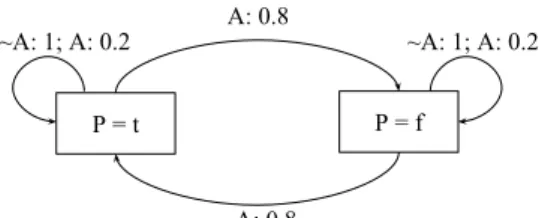
IExample 2. The following is an action description in pBC+ for the transition system
shown in Figure 1, P is a Boolean regular fluent constant, and A is an action constant. ActionA toggles the value ofP with probability 0.8. Initially,P is true with probability 0.6 and false with probability 0.4. We call this action descriptionPSD. (xis a schematic variable that ranges over{t,f}.)
causedP if>after ∼P∧A∧Pf, caused ∼P if>afterP∧A∧Pf, caused {P}chif>afterP, caused {∼P}chif>after ∼P, causedPf ={t: 0.8,f: 0.2}, causedInit_P ={t: 0.6,f: 0.4}, initiallyP =xifInit_P =x.
({P}ch is a choice formula standing forP∨ ¬P.)
5.2
Semantics of
p
BC
+
Given a non-negative integermdenoting the maximum length of histories, the semantics of an action descriptionDinpBC+ is defined by a reduction to multi-valued probabilistic programT r(D, m), which is the union of two subprogramsDmandDinit as defined below.
2 We require 0< p
i<1 for eachi∈ {1, . . . , n}for the sake of simplicity. On the other hand, ifpi= 0 or
pi= 1 for somei, that means eithervican be removed from the domain ofpfor there is not really a
P = t P = f A: 0.8
A: 0.8
~A: 1; A: 0.2 ~A: 1; A: 0.2
Figure 1A transition system with probabilistic transitions.
For an action description D of a signature σ, we define a sequence of multi-valued probabilistic program D0, D1, . . . , Dm so that the stable models of Dm can be identified
with the paths in the transition system described byD. The signatureσmofDm consists of
atoms of the formi:c=v such that
for each fluent constantc ofD, i∈ {0, . . . , m} andv∈Dom(c),
for each action constant or pf constant cofD,i∈ {0, . . . , m−1} andv∈Dom(c). We useσx
m, wherex∈ {act, f l, pf}, to denote the subset ofσm {i:c=v|i:c=v∈σmandc∈σx}.
We define Dm to be the multi-valued probabilistic program hP F,Πi, where Π is the
conjunction of
i:F ←i:G (8)
for every static law (4) inDand everyi∈ {0, . . . , m};
i+1 :F ←(i+1 :G)∧(i:H) (9)
for every fluent dynamic law (5) inD and everyi∈ {0, . . . , m−1};
{0 :c=v}ch (10)
for every regular fluent constantc and everyv∈Dom(c);
{i:c=t}ch, {i:c=f}ch (11)
for every action constant c; andP F consists of
p1:: i:pf=v1| · · · |pn:: i:pf =vn (12)
(i= 0, . . . , m−1) for each pf constant declaration (6) inD that describes the probability distribution ofpf.
In addition, we define the programDinit, whose signature is 0 :σinitpf ∪0 :σf l. Dinit is
the multi-valued probabilistic program Dinit=hP Finit,Πiniti
where Πinit consists of the rule ⊥ ← ¬(0 :F)∧0 :G
for each initial static law (7), andP Finit consists of p1:: 0 :c=v1| · · · |pn:: 0 :c=vn
for each initpf constant declaration (6).
We defineT r(D, m) to be the union of the two multi-valued probabilistic program hP F ∪P Finit,Π∪Πiniti.
I Example 3. For the action description PSD in Example 2, PSDinit is the following
multi-valued probabilistic program (x∈ {t,f}): 0.6 :: 0 :Init_P | 0.4 :: 0 :∼Init_P ⊥ ← ¬(0 :P=x)∧0 :Init_P=x.
andPSDmis the following multi-valued probabilistic program (iis a schematic variable that
ranges over{1, . . . , m−1}): 0.8 :: i:P f | 0.2 :: i:∼P f i+1 :P←i:∼P∧i:A∧i:P f i+1 :∼P ←i:P∧i:A∧i:P f {i+1 :P}ch←i:P {i+1 :∼P}ch←i:∼P {i:A}ch {i:∼A}ch {0 :P}ch {0 :∼P}ch
5.3
p
BC
+
Action Descriptions and Probabilistic Reasoning
In this section, we illustrate how the probabilistic extension of the reasoning tasks discussed in [11], i.e., prediction, postdiction and planning, can be represented inpBC+ and automatically computed usinglpmln2asp[16]. Consider the following probabilistic variation of the well-known Yale Shooting Problem: There are two (deaf) turkeys: a fat turkey and a slim turkey. Shooting at a turkey may fail to kill the turkey. Normally, shooting at the slim turkey has 0.6 chance to kill it, and shooting at the fat turkey has 0.9 chance. However, when a turkey is dead, the other turkey becomes alert, which decreases the success probability of shooting. For the slim turkey, the probability drops to 0.3, whereas for the fat turkey, the probability drops to 0.7.
The example can be modeled inpBC+ as follows: Notation: trange over{SlimTurkey,FatTurkey}.
Regular fluent constants: Domains:
Alive(t), Loaded Boolean
Statically determined fluent constants: Domains:
Alert(t) Boolean
Action constants: Domains:
Load , Fire(t) Boolean
Pf constants: Domains:
Pf_Killed(t), Pf_Killed_Allert(t) Boolean InitPf constants:
Init_Alive(t), Init_Loaded Boolean
causedLoaded if>afterLoad
causedPf_Killed(SlimTurkey) ={t: 0.6,f: 0.4}
causedPf_Killed_Alert(SlimTurkey) ={t: 0.3,f: 0.7}
causedPf_Killed_Alert(FatTurkey) ={t: 0.7,f: 0.3}
caused ∼Alive(t)if>afterLoaded∧Fire(t)∧ ∼Alert(t)∧Pf_Killed(t)
caused ∼Alive(t)if>afterLoaded∧Fire(t)∧Alert(t)∧Pf_Killed_Alert(t)
caused ∼Loadedif>afterFire(t)
default ∼Alert(t)
causedAlert(t1)if ∼Alive(t2)∧Alive(t1)∧t16=t2
caused{Alive(t)}chif>afterAlive(t),
caused{Loaded}ch if>after Loaded
caused{∼Alive(t)}chif>after ∼Alive(t)
caused{∼Loaded}chif >after ∼Loaded
caused⊥after a1∧a2
causedInit_Alive(t) ={t: 0.5,f: 0.5} initiallyAlive(t) =bifInit_Alive(t) =b
causedInit_Loaded={t: 0.5,f: 0.5} initiallyLoaded=b ifInit_Loaded=b We translate the action description into an LPMLN program and use lpmln2asp to answer various queries about transition systems, such as prediction, postdiction and planning queries.
Prediction. For a prediction query, we are given a sequence of actions and observations
that occurred in the past, and we are interested in the probability of a certain proposition describing the result of the history, or the most probable result of the history. Formally, we are interested in the conditional probabilityP rT r(D,m)(Result|Act, Obs) or the MAP inference argmax
Result
P rT r(D,m)(Result|Act, Obs), where Resultis a proposition describing a possible outcome,Actis a set of facts of the formi:aori:∼afora∈σact, andObsis a set
of facts of the form i:c=vforc∈σf l andv∈Dom(c).
For example, in the Yale shooting example, such a query could be “Given that only the fat turkey is alive and the gun is loaded at the beginning, what is the probability that the fat turkey died after shooting is executed?”. To answer this query, we manually translate the action description above into the input language oflpmln2aspand add the following action and observation as constraints:
:- not alive("slimTurkey", "f", 0). :- not alive("fatTurkey", "t", 0). :- not loaded("t", 0). :- not fire("fatTurkey", "t", 0).
Executing the command
lpmln2asp -i yale-shooting.lpmln -q alive
yields
alive(’fatTurkey’, ’f’, 1) 0.700000449318
Postdiction. In the case of postdiction, we infer a condition about the initial state given the
history. Formally, we are interested in the conditional probabilityP rT r(D,m)(Initial_State| Act, Obs) or the MAP inference argmax
Initial_State
P rT r(D,m)(Initial_State | Act, Obs), where Initial_Stateis a proposition about the initial state;Act andObsare defined as above.
For example, in the Yale shooting example, such a query could be “Given that the slim turkey was alive and the gun was loaded at the beginning, the person shot at the slim turkey and it died, what is the probability that the fat turkey was alive at the beginning?”
lpmln2asp -i yale-shooting.lpmln -q alive
yields
alive(’fatTurkey’, ’t’, 1) 0.666661211973
Planning. In this case, we are interested in a sequence of actions that would result in the
highest probability of a certain goal. Formally, we are interested in argmax
Act
P rT r(D,m)(Goal|Initial_State, Act)
whereGoalis a condition for a goal state, andActis a sequence of actionsa∈σact specifying actions executed at each timestep.
For example, in the Yale shooting example, such query can be “given that both the turkeys are alive and the gun is not loaded at the beginning, generate a plan that gives best chance to kill both the turkeys with 4 actions”.
Formalizing the query and executing the command
lpmln2asp -i yale-shooting.lpmln
finds the most probable stable model, which yields
load("t",0) fire("slimTurkey","t",1) load("t",2) fire("fatTurkey","t",3)
which suggests to first kill the slim turkey and then the fat turkey.
5.4
Extending
p
BC
+
to Allow Diagnosis
We define the following new constructs to allow probabilistic diagnosis in action domains. Note that these constructs are simply syntactic sugar that does not change the actual expressivity of the language.
We introduce a subclass of regular fluent constants calledabnormal fluents.
When the action domain contains at least one abnormal fluent, we introduce a special statically determined fluent constantabwith Boolean domain, and we add
default ∼ab.
We introduce the expression
caused_abF ifGafter H
where F andGare fluent formulas andH is a formula, provided thatF does not contain statically determined constants andH does not contain initpf constants. This expression is treated as an abbreviation of
causedF ifab∧Gafter H.
Once we have defined abnormalities and how they affect the system, we can use
causedab
to enable taking abnormalities into account in reasoning.
We can answer the query in Example 1 by modeling the action domain with this extension. Due to lack of space, we skip the details.
6
Open Issues and Expected Achievements
The main open issue is that we do not have a compiler that automates the translation from pBC+ to LPMLN. As illustrated in Section 5.3, the action language pBC+ can be executable through translation to LPMLN. It is desirable to have a compiler that automates this translation, so that the user can directly writepBC+ descriptions and does not need to worry about the translation detail. We plan to develop a compiler that translates action descriptions inpBC+ into LPMLN programs automatically.
The interface and usage of the compiler will be similar to the system cplus2asp[1], which translates the action languageC+ to ASP.
Other future works include extending pBC+ for hypothetical/counterfactual reasoning, exploring parameter learning in the setting of probabilistic action language, and empirically studying the performance of pBC+ with weal-world applications.
References
1 Joseph Babb and Joohyung Lee. Cplus 2ASP: Computing Action LanguageC+ in Answer Set Programming. InLPNMR, 2013.
2 Joseph Babb and Joohyung Lee. Action languageBC+.Journal of Logic and Computation, page exv062, 2015. doi:10.1093/logcom/exv062.
3 Marcello Balduccini and Michael Gelfond. Diagnostic reasoning with A-Prolog. Theory and Practice of Logic Programming, 3:425–461, 2003.
4 Chitta Baral, Michael Gelfond, and Nelson Rushton. Probabilistic Reasoning With Answer Sets. InLogic Programming and Nonmonotonic Reasoning, pages 21–33, Berlin, Heidelberg, 2004. Springer Berlin Heidelberg.
5 Chitta Baral, Sheila Mcilraith, and Tran Son. Formulating Diagnostic Problem Solving Using an Action Language With Narratives and Sensing. InKR 2000, Principles of Know-ledge Representation and Reasoning Proceedings of the Seventh International Conference, Breckenridge, Colorado, USA, April 11-15, 2000., pages 311–322, April 2000.
6 Chitta Baral, Nam Tran, and Le-Chi Tuan. Reasoning about actions in a probabilistic setting. InProceedings of the AAAI Conference on Artificial Intelligence (AAAI), pages 507–512, 2002.
7 Fabio Aurelio D’Asaro, Antonis Bikakis, Luke Dickens, and Rob Miller. Foundations for a Probabilistic Event Calculus. CoRR, abs/1703.06815, 2017. arXiv:1703.06815.
8 Thomas Eiter and Thomas Lukasiewicz. Probabilistic Reasoning about Actions in Non-monotonic Causal Theories. InProceedings Nineteenth Conference on Uncertainty in Arti-ficial Intelligence (UAI-2003), pages 192–199. Morgan Kaufmann Publishers, 2003. 9 Michael Gelfond and Vladimir Lifschitz. Representing action and change by logic programs.
Journal of Logic Programming, 17:301–322, 1993.
10 Michael Gelfond and Vladimir Lifschitz. Action languages. Electronic Transactions on Artificial Intelligence, 3:195–210, 1998. URL:http://www.ep.liu.se/ea/cis/1998/016/. 11 Enrico Giunchiglia, Joohyung Lee, Vladimir Lifschitz, Norman McCain, and Hudson
Turner. Nonmonotonic causal theories. Artificial Intelligence, 153(1–2):49–104, 2004. 12 Enrico Giunchiglia and Vladimir Lifschitz. An action language based on causal explanation:
Preliminary report. InProceedings of National Conference on Artificial Intelligence (AAAI), pages 623–630. AAAI Press, 1998.
13 Gero Iwan. History-based diagnosis templates in the framework of the situation calculus. AI Communications, 15(1):31–45, 2002.
14 Joohyung Lee, Vladimir Lifschitz, and Fangkai Yang. Action LanguageBC: Preliminary Report. InProceedings of International Joint Conference on Artificial Intelligence (IJCAI), 2013.
15 Joohyung Lee and Yunsong Meng. Answer Set Programming Modulo Theories and Reas-oning about Continuous Changes. In Proceedings of International Joint Conference on Artificial Intelligence (IJCAI), 2013.
16 Joohyung Lee, Samidh Talsania, and Yi Wang. Computing LPMLN using ASP
and MLN solvers. Theory and Practice of Logic Programming, 2017. doi:10.1017/ S1471068417000400.
17 Joohyung Lee and Yi Wang. Weighted Rules under the Stable Model Semantics. In Proceedings of International Conference on Principles of Knowledge Representation and Reasoning (KR), pages 145–154, 2016.
18 Anastasios Skarlatidis, Georgios Paliouras, George A Vouros, and Alexander Artikis. Prob-abilistic event calculus based on markov logic networks. InRule-Based Modeling and Com-puting on the Semantic Web, pages 155–170. Springer, 2011.
19 Håkan LS Younes and Michael L Littman. PPDDL1. 0: An extension to PDDL for ex-pressing planning domains with probabilistic effects, 2004.
20 Weijun Zhu. PLOG: Its Algorithms and Applications. PhD thesis, Texas Tech University, 2012.