Worcester Polytechnic Institute
Digital WPI
Major Qualifying Projects (All Years) Major Qualifying Projects
October 2008
The Disney Alternate Reality Game
Daniel Wayne TennantWorcester Polytechnic Institute Joseph W. Strong Worcester Polytechnic Institute Julia Josefina Berg Worcester Polytechnic Institute
Follow this and additional works at:https://digitalcommons.wpi.edu/mqp-all
This Unrestricted is brought to you for free and open access by the Major Qualifying Projects at Digital WPI. It has been accepted for inclusion in Major Qualifying Projects (All Years) by an authorized administrator of Digital WPI. For more information, please [email protected]. Repository Citation
Tennant, D. W., Strong, J. W., & Berg, J. J. (2008).The Disney Alternate Reality Game. Retrieved from https://digitalcommons.wpi.edu/mqp-all/589
Project Number: DMO-3208
The Disney Alternate Reality Game
A Major Qualifying Project Report submitted to the Faculty of the Worcester Polytechnic Institute
in partial fulfillment of the requirements for the Degree of Bachelor of Science
in cooperation with
Walt Disney Imagineering, Glendale, CA on October 27, 2008
Submitted By: Submitted To:
Julia Berg Trish Cerrone, Sponsor Liaison
Joseph Strong Project Advisor:
TC Table of Contents TC Table of Contents ... ii TF Table of Figures ... v TA Table of Authors ... vi AB Abstract ... ix S Executive Summary ... x 1 Introduction ... 1
2 Prep Phase: Early Design and Pre-Planning ... 4
2.1 Game Design Parameters ... 4
2.2 Research and Preparation ... 5
2.3 Documenting DCA ... 7
3 Development Phase: The Narrative ... 10
3.1 Early Concepts and Pitches ... 10
3.2 Evolution of the Narrative ... 13
3.3 Writing the Dialogue ... 15
4 Development Phase: The Website ... 16
4.1 Building the Interface ... 16
4.2 Building the Website ... 22
5 Development Phase: The Puzzles ... 27
5.1 The Online Experience ... 27
5.2 The In-Park Experience ... 35
6 Conclusions and Recommendations ... 43
6.1 What Went Right ... 43
6.2 What Went Wrong ... 44
6.3 The Next Step ... 45
AC Acknowledgements ... 48
R References ... 49
GL Glossary ... 51
A Appendix A: About Walt Disney Imagineering ... 53
B Appendix B: What is an Alternate Reality Game? ... 54
C Appendix C: Narrative – Initial Concept Pitches ... 55
D Appendix D: Narrative – Muppet Dialogue ... 57
E Appendix E: Narrative – In-Park SMS Reference Sheet ... 65
F Appendix F: Game Design Document ... 67
G Appendix G: Online Experience Document ... 70
H Appendix H: In-Park Experience Document ... 89
I Appendix I: Database Design Document ... 92
K Appendix K: Puzzle Pitch: Gonzo’s Great Escape ... 97
L Appendix L: Online Experience Reward: Kermit’s Letter ... 98
M Appendix M: PowerPoint: ARG Overview ... 100
N Appendix N: PowerPoint: Art and Gameplay Overview ... 110
TF Table of Figures
Figure 1.1 View of entrance, Disney’s California Adventure ...2
Figure 2.1 Example puzzle-related theming, DCA Condor Flats ...8
Figure 4.1 Early home page concept sketch ...17
Figure 4.2 Early bulletin board concept sketch ...18
Figure 4.3 Home page digital mockup, cluttered ...19
Figure 4.4 Home page map, final ...20
Figure 4.5 Mockup puzzle page with themed interface ...21
Figure 4.6 Flash website structure visualization ...24
Figure 4.7 Diagram of website’s technical structure ...25
Figure 5.1 Walt Disney’s portrait, north wall, DCA Sorcerer’s Workshop ...27
Figure 5.2 Original blueprint puzzle mockup ...30
Figure 5.3 Comparison of two blueprints from the Haunted Tower puzzle ...32
Figure 5.4 Symbols under Walt’s portrait, DCA Sorcerer’s Workshop ...38
TA Table of Authors
T Title Page ... Tennant TC Table of Contents ... Tennant TF Table of Figures ... Tennant TA Table of Authors ... Tennant AB Abstract ... Tennant S Executive Summary ... Tennant 1 Introduction ... Tennant 2 Prep Phase: Early Design and Pre-Planning ... Tennant
2.1 Game Design Parameters ... Tennant 2.2 Research and Preparation ... Tennant 2.3 Documenting DCA ... Tennant 3 Development Phase: The Narrative ... Tennant
3.1 Early Concepts and Pitches ... Tennant 3.2 Evolution of the Narrative ... Tennant 3.3 Writing the Dialogue ... Tennant 4 Development Phase: The Website ... Berg
4.1 Building the Interface ... Berg 4.2 Building the Website ... Berg 4.3 Database Communication ... Berg
5 Development Phase: The Puzzles ... Strong 5.1 The Online Experience ... Strong 5.2 The In-Park Experience ... Strong 6 Conclusions and Recommendations ... Tennant
6.1 What Went Right ... Tennant 6.2 What Went Wrong ... Tennant 6.3 The Next Step ... Strong, Tennant AC Acknowledgements ... Berg, Strong, Tennant R References ... Berg, Strong, Tennant GL Glossary ... Tennant A Appendix A: About Walt Disney Imagineering. ... Tennant B Appendix B: What is an Alternate Reality Game? ... Tennant C Appendix C: Narrative – Initial Concept Pitches ... Tennant D Appendix D: Narrative – Muppet Dialogue ... Tennant E Appendix E: Narrative – In-Park SMS Reference Sheet ... Tennant F Appendix F: Game Design Document ... Strong, Tennant G Appendix G: Online Experience Document ... Berg, Strong H Appendix H: In-Park Experience Document ... Tennant, Strong I Appendix I: Database Design Document ... Berg J Appendix J: Database API ... Michel (WDI)
K Appendix K: Puzzle Pitch: Gonzo’s Great Escape ... Strong L Appendix L: Online Experience Reward: Kermit’s Letter ... Tennant M Appendix M: PowerPoint: ARG Overview ... Leung (WDI), Tennant N Appendix N: PowerPoint: Art and Gameplay Overview ... Berg, Strong
AB Abstract
Disney’s California Adventure Park will soon undergo a series of construction and renovation projects to re-theme content and introduce new attractions to Guests. Walt Disney Imagineering (WDI) is working to counter the expected lull in construction-period ticket sales by marketing the park in new ways. We were tasked by WDI to design and prototype an alternate reality game (ARG) that could determine the viability of cross-media marketing projects in generating excitement for the Park. This report describes our development process and provides a series of recommendations to WDI for future Disney-themed ARGs.
S Executive Summary
Conceived as a modern complement to the oldest and most famous amusement park in the world, Disney’s California Adventure (DCA) opened in 2001 opposite Disneyland Park. It boasted six themed lands and a variety of spectacular rides and attractions, and was supposed to help turn Disneyland Resort into the Walt Disney World of the West. Instead, due to several design flaws and layout problems, the Park has consistently underperformed. Today, DCA is among the least popular Disney Parks in America.
Fortunately for Guests, Walt Disney Imagineering (WDI) is planning a series of
renovations and construction projects that should help to redefine the Park. A new theme, fresh rides, and the entirely new Cars Land—home to one of the most innovative and exciting
attractions ever built—may well turn DCA from a shade-starved second cousin to Disneyland’s rightful twin sibling.
All of this construction, of course, will take some time to complete, and the new Cars Land and re-theming of DCA’s Main Street won’t be finished until the year 2012. Between now and then, construction fences will blacken the Park’s image, and Disney will be hard-pressed to keep ticket sales up. To combat the expected lull, WDI has begun to look at alternative
marketing strategies. In particular, they’re considering cross-media marketing: using interactive multimedia experiences called alternate reality games (ARGs) to spread excitement about the Park.
Before WDI could decide whether it was worth investing the manpower and financial capital to design, build, and run a full-sized ARG, they wanted to test a low-budget prototype on a small sample of Guests. The Imagineers turned to our project team and tasked us with
designing and building an ARG for Disneyland Resort Annual Passholders, using a preexisting IP, with the goal of bringing Guests to the Park. By examining the number of Guests who played
the game’s online component before going to DCA and finishing the prototype’s narrative, WDI can determine the viability of ARGs as marketing devices on a much larger scale.
We proceeded to create an ARG that charged Guests with saving the Muppets, who had been inadvertently scattered across 1937 California by Dr. Bunsen Honeydew and his assistant Beaker. Targeted at families with children aged 8-14, the ARG would send Guests on
individualized adventures with Kermit the Frog and have them save Miss Piggy, Fozzie Bear, Rowlf the Dog, Sam the Eagle, and the Swedish Chef. Once the Muppets were safe, Guests would then be asked to help one last time by bringing everyone home again. They would have to visit DCA and decrypt a code scattered throughout the Park in a sprawling scavenger hunt. Successful Guests would receive an exclusive reward for their trouble: a hand-drawn overhead map, called a “fun map,” of post-construction DCA.
As of the writing of this report, the prototype we developed has not yet been run. Based on our experiences making it, however, we’ve drawn up a set of recommendations that could be applied to future Disney ARG projects. With these recommendations and the data that will be gathered once our prototype has been played, WDI can judge the viability of ARGs as marketing devices and decide whether or not they want to build their own.
1 Introduction
In 1955, animator and entrepreneur Walter Elias Disney opened the gates of Disneyland in Anaheim, California. Conceived three years earlier as a merging of technology, history, and entertainment, Disneyland was the world’s first modern amusement park, and the only Disney Park to be designed, constructed, and operated under the direct supervision of Walt Disney himself. The Park is commonly recognized as Disney’s crowning living achievement, and is regularly marketed as “the happiest place on Earth.”
Shortly before his death in 1966, Disney envisioned an East Coast, multi-park version of Disneyland that would build upon the lessons learned and technological advancements made in the first Park. Although he would not live to see his Magic Kingdom or EPCOT realized, both amusement parks were eventually built during the 1970s and 80s. Today, the Walt Disney World Resort in Florida is home to four Disney parks and multiple hotels and shopping attractions. It has the distinction of being the most popular and successful vacation resort in the world.
In the wake of Disney World’s success, the Walt Disney Company began renovating the property around Disneyland in 1998, with a view to emulating the East Coast formula. By 2001, construction on the new Disneyland Resort was complete. Disneyland was renamed Disneyland Park, and it was complemented by three hotels and the Downtown Disney outdoor shopping mall. Most notably, a second amusement park was constructed opposite the Disneyland Park entrance. Opened in February of 2001, the new park was called Disney’s California Adventure (DCA).
Designed to look and feel like a California postcard come to life, DCA showcases
“Disneyfied” visions of Californian landmarks such as Napa Valley, Grizzly Peak, and the Long Beach Pier. Famous locations like Hollywood and the Mojave Desert are stylized and recreated as themed lands with their own rides and attractions. Hollywood, for instance, is represented as
the Hollywood Backlot, and features the infamous Hollywood Tower of Terror ride. Similarly, the Mojave Desert and its connections with California’s history of flight are distilled into Condor Flats, which is home to the Soarin’ Over California attraction.
Figure 1.1: View of entrance, Disney’s California Adventure
Unfortunately, DCA has never achieved the same popularity as other Disney Parks. Its underperformance is the result of a variety of factors, including lack of shade, disconnected lands, dead-end paths, few must-ride attractions, and a mysterious absence of the quintessential “Disney” theming that has helped to make other Disney Parks so popular.
To combat DCA’s sagging ticket sales, Walt Disney Imagineering (WDI) is extensively renovating the in-park experience. The entrance plaza, for instance, will be redesigned, and the Park’s main thoroughfare will be themed with a 1930s Hollywood motif. Several generic rides and attractions will be re-themed with Disney characters, while underperforming rides will be replaced completely. Finally, the new Cars Land, featuring an authentic, full-scale version of Cars’ Radiator Springs and several new rides, will be added to the Park’s southeast corner.
As many of these changes will not be completed until 2012, WDI is looking for other means to attract Guests1 to DCA. Alternate reality games (ARGs) are one such possibility. ARGs are cross-media experiences that combine a developing narrative with both web-based puzzle solving and interactive, real-world gameplay. They are often used as a form of viral marketing, as the narratives are usually tied to a company’s product, and the game’s popularity often hinges on word-of-mouth.
Our project’s goal was to create a low-cost prototype ARG for WDI to test the
effectiveness of cross-media gaming on DCA’s target demographics. If successful on a small scale, the ARG could then either be adapted by WDI into a larger-scale experience, or used conceptually in conjunction with our recommendations to build a long-term, fully-featured game with the full weight of the Walt Disney Company behind it.
1
The term “Guest” is used by WDI in reference to any visitor to a Disney Park or website. For the purposes of this report, “Guest” is used interchangeably with “player” where appropriate. See the Glossary for more information.
2 Prep Phase: Early Design and Pre-Planning
The development of our alternate reality game (ARG) was prefaced by several weeks of planning. During this time, our team worked closely with Walt Disney Imagineering (WDI) to outline the prototype’s design parameters. We also examined Walt Disney’s personal history and that of his amusement parks, and researched the practicality of various technologies that could facilitate gameplay and player-character communication. Finally, we visited the Disneyland Resort, compared and contrasted both of its amusement parks, and photographically documented Disney’s California Adventure (DCA).
2.1 Game Design Parameters
For the purposes of this prototype, WDI presented us with guidelines to follow during the game’s design phase. These guidelines in turn suggested and informed gameplay requirements. Together, they comprise the parameters by which we built our ARG:
1. Online and in-park components. Like many ARGs, our prototype included both web-based and real-world gameplay. Since the prototype’s goal was to attract Guests to the Park, its real-world gameplay needed to occur within the park itself and serve as a capstone for the experience.
2. Targeted to a younger demographic. We were instructed by WDI to target the ARG at families with children aged 8-14. This demographic informed all aspects of our design, including narrative, puzzles, and the website’s interface.
3. The family is the community. Although most ARGs rely on forum- or chat-based
communities to facilitate puzzle solving and generate the social dynamics that make them appealing, such communities are player-driven and inherently unsafe for minors. To foster a community atmosphere while still granting Guests the safety and security
common to all Disney websites, our prototype encouraged Guests to use their families as communities.
4. An omnipresent hint system. To account for cases in which younger Guests would be unable to ask family members for help, we implemented a hint system that was always available and made solving puzzles a simple and straightforward task.
5. Released to Annual Passholders only. For the purposes of the prototype, WDI wanted to keep the test audience comparatively small, and informed us that the game would be released to Disneyland Resort Annual Passholders via the AP website. This limiting of access encouraged us to keep the rabbithole obvious and puzzle-free, and made playing the final, in-park component of the ARG a reasonable option for families who already own annual passes.
6. Game as a bonus, not a test. Despite the nature of the ARG as a test and prototype, WDI wished to have it presented to Annual Passholders as an exclusive bonus to their
membership.
2.2 Research and Preparation
While the bulk of our work on the prototype was practical, we performed some research in the project’s early stages in order to properly prepare for development. This research was divided into two halves: an examination of the history of Walt Disney and his amusement parks, and an investigation into various technologies that could potentially be used in the game.
Although some of our research did not affect the final prototype, much of the data we gathered proved invaluable in fleshing out an initial design.
2.2.1 Disney History
It was vitally important for us to fully understand the history of Walt Disney and the company that bears his name, for several reasons. First, it allowed us to work more fluidly with WDI, as we could better understand the company’s expectations, work ethic, narrative style, and audience, and alter our development processes to match. For instance, since WDI tends to work on projects iteratively, we scheduled weekly meetings and set objectives and milestones that allowed for iterative designs and periodical, conceptual mockups.
Second, understanding Walt Disney’s history gave us material that we could use in the prototype’s narrative. At the time of our research, the ARG’s narrative had yet to be finalized, and incorporating Disney into the game as an interactive character was likely. While Disney’s part in the narrative was eventually replaced, the prototype’s final plot evolved directly from those early concepts that had him in a starring role.
Third, understanding the reasons behind Disney’s unique designs for his amusement parks helped us to create a more user-friendly interface for the final game. Disneyland Park is one example: It was built with a hub-and-spoke layout that centered each of its four lands around Main Street, U.S.A. We emulated this design by building a website that allows Guests to play the game’s puzzles in any order. Once they’ve completed a puzzle, they can quickly return to the home map “hub” and pick another puzzle to work on. This system makes site navigation an intuitive process, and always allows Guests the choice of how to proceed.
2.2.2 In-Park Communication Technologies
Early in our project’s design phase, we considered using radio frequency identification (RFID) to keep track of those Guests playing the DCA in-park experience. Our research showed, however, that RFID technology carries a significant setup expense and would require radical
modification of the Park itself, making it impractical for use in a short-term prototype. We then looked for other technologies that would allow us to track Guest progress while keeping setup costs cheap, and finally settled on SMS messaging.
SMS messaging has no impact on the Park; unlike RFID, receivers do not have to be planted throughout DCA in order for Guests to send and receive information. Similarly, there is no need to distribute expensive technology such as RFID tags to Guests to allow them to play, as a reliably high percentage of the population already has text-capable mobile phones. The costs involved are relatively small, and the process of texting with a mobile phone is one that most Guests in the target demographic would be familiar with.
Our research turned up several prospective services through which a bidirectional SMS messaging system could be set up. For the purposes of the prototype, WDI signed a contract with Telescope, a service provider that could handle the logistics of sending and receiving pre-defined SMS text messages for the duration of the game.
2.3 Documenting DCA
Near the end of the project’s preparation phase, the team traveled to California and stayed at the Disneyland Resort for three days. The purpose of this trip was threefold: to experience both Disneyland Park and Disney’s California Adventure firsthand; to meet with WDI and finalize a general narrative and overall game design; and to photographically document DCA.
We split our time on Day 1 between Disneyland Park and DCA. Parks and Resort Online employee Shan Prum gave us a behind-the-scenes tour of each, providing his insights into the their design decisions and helping to crystallize their differences. Thanks to his guidance, we gained a better appreciation for the effectiveness of Disneyland’s hub-and-spoke design, and learned how WDI’s planned improvements to DCA would buttress the overall Guest experience.
We documented our time with both photos and video, and took special note of DCA locations and theming that could be integrated into the in-park puzzle.
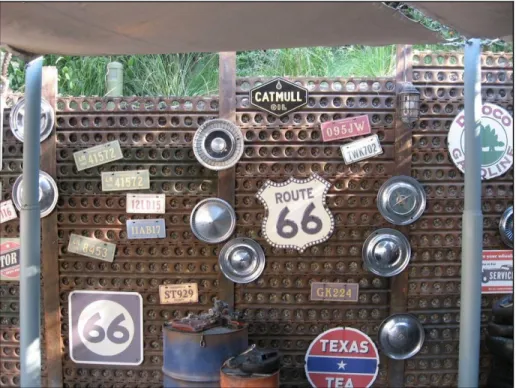
Figure 2.1: Example puzzle-related theming, DCA Condor Flats On Day 2, we visited WDI headquarters in Glendale and Walt Disney Studios in Burbank. More so than any of our conference calls to that point had been, our face-to-face meeting with WDI helped us springboard out of design and into development. We finalized our general narrative and outlined our core gameplay mechanics, and were able to begin planning the game’s finer details. Before we left, we were even given a complete overview of the many changes coming to DCA.
Our tour of Walt Disney Studios was equally helpful, as it gave us the chance to meet with Dave Smith, Founder and Director of the Walt Disney Archives. Mr. Smith graciously lent us his time and told us the story of Disney’s early years in Hollywood—the period we would be targeting in our narrative.
We returned to DCA on Day 3 and systematically recorded every thematic detail in each of its lands. Although much of the data we collected was never used, our comprehensive
coverage allowed us to pick and choose content for the in-park puzzle that was as fun and appropriate to the narrative as possible, weeks after the trip.
3 Development Phase: The Narrative
Before development of its puzzles or website could begin, our alternate reality game (ARG) needed an appropriate, fun, and engaging narrative. As we were working with Walt Disney Imagineering (WDI), we had access to the countless intellectual properties owned by the Walt Disney Company. Initially, we were limited in their selection by only two factors. First, the narrative had to fit the time period of the new, 1930s Hollywood theming that will be introduced at Disney’s California Adventure (DCA) by 2012. Second, it had to fit within the DCA of today, as Guests would be visiting the Park over the course of the game and it needed to fill the role of a character in its own right.
Although several early plot concepts didn’t quite fit the bill, the narrative we eventually settled on filled our needs well. Over the course of the development cycle, as the puzzles and website were steadily constructed and the dialogue for each non-player character was written, that narrative shifted slightly, and near the end of development, one of the core characters had to be completely removed from the story. The final result, however, was a tale suitable for all ages: an adventure into the past with Kermit the Frog and the rest of Jim Henson’s Muppets.
3.1 Early Concepts and Pitches
One of the many benefits of working with the Walt Disney Company was having access to Disney’s lineup of franchises. We were encouraged by WDI to use one of these properties in favor of creating one from scratch, and devised three pitches early on, before we’d solidified our target demographic. The original pitches for “Who Framed Roger Rabbit Again,” “The Pixar Parade,” and “The Muppets Through Time” can be found in Appendix C.
3.1.1 Who Framed Roger Rabbit Again?
“Who Framed Roger Rabbit Again?” revolved around the theft of Walt’s Lost Journal. The brainchild of WDI, Walt’s Journal was a plot device they favored because it provided Guests with both a tangible goal and a recognizable reward. The goal was straightforward: to find the Journal’s pages, each of which contained some of his notes and sketches. For every page of the Journal a Guest managed to find, they were rewarded with a personal copy of it that they could then download and print out.
This narrative fit perfectly within the ARG’s core design parameters. The characters of Who Framed Roger Rabbit exist outside the bounds of the cartoon “stage,” making their interactions with the real world plausible. Similarly, WFRR is set in Hollywood in a fictional golden age of animated filmmaking that parallels the early years of Walt Disney Studios. And, since WFRR already contains a melting pot of characters, we would have a wide variety of options to choose from in fleshing out the storyline.
Unfortunately, the WFRR intellectual property was among the few franchises that its turns out we could not use, as it is not solely owned by the Walt Disney Company. Given the prototype’s time and budgetary restrictions, the “Who Framed Roger Rabbit Again?” storyline was canned.
3.1.2 The Pixar Parade
The Pixar Parade pitch was a story of homecoming. In the narrative, one of the characters from each of Disney’s Pixar animated movies was lost somewhere in southern California. It was up to the Guests to guide each character back to DCA in time for them to take part in the Pixar Parade.
The Pixar narrative was designed to mesh well with minigame-based puzzles, which could be easily contained within the bounds of a website, in turn helping to keep younger Guests from straying too far out into the Internet proper. It also integrated perfectly with present-day DCA, as the goal of the game was tied intrinsically to a daily Park event. There was, however, an inescapable problem with the concept: it had nothing to do with 1930s Hollywood, and thusly didn’t lend itself to fitting with DCA’s future thematic shifts.
The reasons behind each Pixar character’s disappearance were also major plot holes, as the characters are, technically, already at DCA and taking part in the daily parades. Since the ARG was being made for Annual Passholders who would most likely have already seen those parades, the believability of the storyline was suspect.
3.1.3 The Muppets Through Time
From the start, our favorite narrative option involved the Muppets. Though the roles of each character shifted, some characters were dropped, and others were added, the general idea of having Dr. Bunsen Honeydew build a time machine and accidentally lose the Muppets in the past appealed to us. Working the Muppets into our narrative brought with it a whole host of benefits.
Chief among them was the appeal of the Muppets themselves. Jim Henson’s creations possess a timeless humor that connects with fans of all ages, and Kermit the Frog is a
universally-recognized figure—even among young children who didn’t grow up watching the Muppet Show. The Muppets wouldn’t just reach our target demographic; they would connect with our Guests’ families and thusly help to build pseudo-player communities for the purposes of the ARG.
The Muppets were also useful in that they can interact regularly with humans. Many Muppets have been known to break character and speak directly with an audience, so if we
needed to break the fourth wall at any time (in order to effectively communicate puzzle
instructions, for instance), we could do so and still retain believability. And, since many of the characters thrive on self-deprecating humor, we could write a story that placed the Guest in the heroic role of savior, without having the Muppets appear incapable.
By the same token, the time machine component of the narrative is perfectly plausible within the Muppet universe, and allows us to set the game in 1930s Hollywood, connecting it to DCA’s new theming. As an added bonus, the Muppets already exist in DCA at the Muppet Vision 3D theater. They’re a part of the present-day park, and the theater could be used as part of the final, in-park experience.
Most intriguing to WDI, however, was the timeliness of the pitch. The Muppets are currently passing through what the New York Times calls a “Fuzzy Renaissance.”2 As a franchise, the Muppets are being readied to re-enter popular culture, with a new movie, television appearances, and parallel marketing with other major Disney brands in the works. With the Muppets at the core of the narrative, our prototype could be as helpful for them as their presence would be beneficial to the ARG.
3.2 Evolution of the Narrative
Over the course of development, the Muppet narrative underwent numerous changes, from the minute to the radical. Some of these changes were made early on, when we effectively combined all three of our pitched concepts into one story, selecting the most appropriate parts of each and working them together.
Walt’s Lost Journal, for instance, was plucked from the “Who Framed Roger Rabbit Again?” narrative. In his search for his lost friends, Kermit would ride around with Walt Disney,
2
who sketched in his journal over the course of the game. Once each puzzle was finished, its related journal page would be sent to the Guest as a token of thanks.
The idea of bringing characters home from disparate locations on a map came from the “Pixar Parade” pitch. By scattering the Muppets around California, we could showcase the real-world analogues of each of DCA’s lands—Hollywood for the Hollywood Backlot, Condor Flats for the Mojave Desert, and so on—before physically sending Guests to those lands during the in-park experience.
Some changes were made during production, when puzzle development crystallized the roles of each character. One of the four online puzzles, for instance, takes place in the
Hollywood Tower Hotel and originally starred Gonzo the Great. The puzzle’s subplot had him diving off the roof of the building at the end of his subplot, which played well to Gonzo’s daredevil characteristics. Miss Piggy was missing from the game, however, and the elegance of the Tower was too perfect for her to pass up. By the end of production, Miss Piggy had
completely replaced Gonzo in the game.
The most sweeping change we made to the narrative came a matter of days before the project’s end, when WDI informed the team that Walt Disney could no longer be a part of the game. Permission to use his name, signature, and likeness could not be obtained from the Disney family in time for the prototype’s release, and everything related to his presence had to be
removed and the story rewritten. Primarily, this meant rewriting his letter to the Guest—the downloadable document that served as a segue between the online and in-park components of the game. This call for aid, along with the instructions detailing how to bring the Muppets back home, were both rewritten in Kermit’s voice. They can be found in Appendix L.
3.3 Writing the Dialogue
Due to the nature of its narrative, every piece of textual information that is communicated to the Guest during the ARG is spoken by one of the Muppets. The dialogue that we wrote for the Muppets thusly includes every line of text in the game. Since Guests spend most of their time working to find the Muppets, they only get the chance to interact directly with a handful of characters: Dr. Bunsen Honeydew, Statler and Waldorf, and of course, Kermit the Frog.
Although a writer from Disney’s Muppets Team would eventually proofread all dialogue and rewrite it as appropriate, it was important that everything the Muppets said reflected each character’s respective mannerisms and speech patterns. Kermit the Frog, for instance, tends to use filler words such as “you know,” “well,” and “mm-hmm” regularly. Dr. Bunsen Honeydew uses fewer contractions in his speech than most people and tends to be very deliberate with his word choice, while Statler and Waldorf fill their speech with gaffes, comments, chuckles, and insults. We took special care to insert these phrasings where appropriate without overusing them or making them feel out of place.
Of course, every piece of dialogue has an explicit purpose in the narrative, and is meant to convey a particular piece of information. We also took care to deliver exposition without making it feel flat or asynchronous.
4 Development Phase: The Website
As with most alternate reality games (ARGs), online gameplay formed the core component of our prototype. In the case of our ARG’s website, our puzzles and site structure varied from that of stereotypical ARGs because of security concerns. Since Walt Disney Imagineering (WDI) had set our target demographic as families with children aged 8-14, we could not risk fostering the forum- or chat-based communities that populate other cross-media games without proper moderation. Providing such moderation is not financially feasible for a prototype.
In lieu of communities that could work together to solve puzzles, we elected to give each Guest an individualized play experience and encourage them to play with their families. We used a database to track Guest registrations, logins, and progress through the game. We also
developed an omnipresent hint system to replace the puzzle-solving power of large communities. With this system, Guests at the upper bounds of our demographic could easily solve puzzles themselves, while younger Guests could do so with the help of their families. Children would not need to delve too deeply into the Internet in order to play the game.
4.1 Building the Interface
Because our prototype’s narrative dealt with the Muppets, their visual style permeated the game’s interface. The site needed to be bright, colorful, and fun, while the interface needed to be appropriate to Dr. Bunsen Honeydew’s character, with scientific notes and cobbled contraptions peppering each page.
4.1.1 Concept Art
The goal of our early concept art was to convey a visual representation of general design layouts and ideas for interactivity. Based on the feedback received from those sketches, team member Julia Berg translated the ideas into digital mock ups, and from there to more polished components of the website.
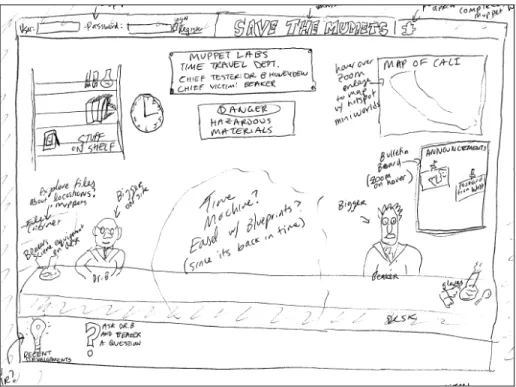
Julia began the concept art process with hand-drawn sketches of a potential registration page, multiple homepages, a puzzle-related miniworld, and a bulletin board. Initially, she came up with several ideas for how the website’s home page would look. The team selected from those ideas a layout for a fake Muppet Labs, the inspiration being that the Guest was participating in a time travel experiment and could play along with Dr. Honeydew and Beaker at work.
Figure 4.1: Early home page concept sketch
Parts of this home page would have been interactive, with various elements set up as clickable and navigation always chaining from the Muppet Labs screen. Proposed interactive objects included a bulletin board with announcements and puzzle progression; random gadgets
that would change color or animate when rolled over or clicked on; and a game entry puzzle that involved sorting through papers scattered across Bunsen’s desk in a search for clues to where and when the Muppets had been lost.
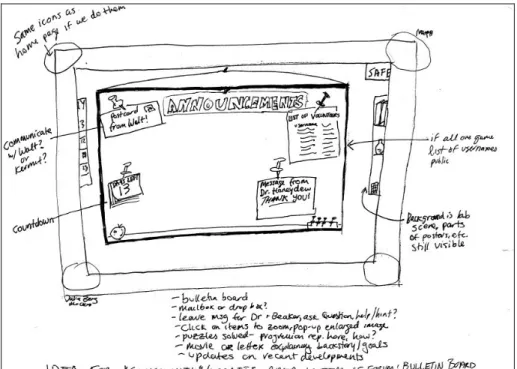
Figure 4.2: Early bulletin board concept sketch
Navigation would be accomplished via a map on the wall with tacks or photos of each Muppet's location. Clicking on the map or bulletin board would bring up an enlarged version of it on the screen that the Guest could then interact with. A variation on this idea placed a
navigation bar beneath the Muppet Labs scene with icons for “Ask Dr. Honeydew a Question” and “Latest Muppet Developments.” This concept and others were discarded, however, as they felt less interactive, too similar to computer games, and less likely to capture and hold the attention of our target demographic.
4.1.2 Mockups
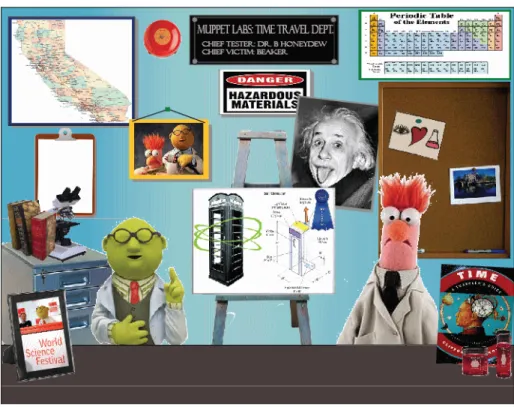
After meeting with the team and collecting feedback on her homepage and miniworld concepts, Julia translated her sketches into digital mockups. These mockups were created in Adobe Illustrator CS3 using images collected on the Internet, and were meant to show off a variety of basic layout options. Two versions of the homepage, for instance, were sent to WDI for their critiques: one cleaner and one more cluttered. WDI preferred the latter mockup, as it more closely resembled the feel of the Muppets.
Figure 4.3: Home page digital mockup, cluttered
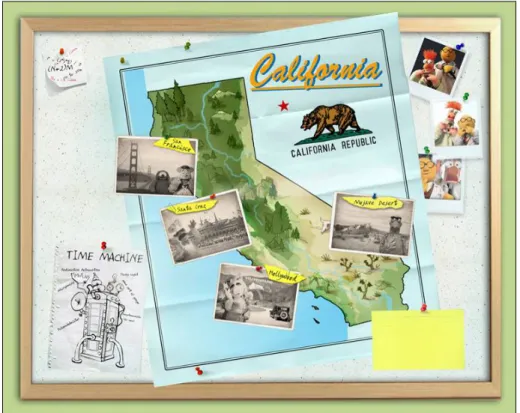
After numerous teleconferences with WDI and the integration of art assets generated by Wes Keil of Disney’s Creative Interactive group, the concept art has evolved from the early sketches seen in Figures 4.1 and 4.2 to what appears on the final website, as seen in Figure 4.4. With WDI’s input, our team decided to present the home page as the bulletin board itself, rather than a reflection of Muppet Labs with a bulletin board present on the wall. This change both
streamlined site navigation and assuaged WDI’s concerns that the Muppet Labs we presented might differ from the one shown in the Muppet Show.
Figure 4.4: Home page map, final
4.1.3 Interactivity
While a great deal of thought was put into the development of the website’s art assets, equal consideration was given to its interactivity and usability. The changes to the home page design, for instance, included the removal of an obvious tracking bar on the Muppet Labs wall. In its place, each of the photographs pinned to the bulletin board in Figure 4.4 change as that photograph’s respective puzzle is solved. The index card in the bottom-right corner of the board also tracks Guest progress.
Every page of the website has an icon of Statler & Waldorf in its lower-left corner that the Guest can click on for hints, while every page except the home page map has a second icon
in the lower-right corner to go back to that map. Clicking on the Statler & Waldorf icon produces a pop-up speech bubble with a context-sensitive hint, while clicking the red X in the speech bubble closes the hint and returns the Guest to the previous page.
Upon arrival at a miniworld—the term our team uses to refer to each themed subsection of the game—Kermit the Frog appears with a note for the Guest. The note informs the Guest of the miniworld’s backstory and previews the coming puzzle. The Guest can then click the note and continue to the puzzle page. This pop-up system allows us to deliver information to the Guest without forcing him or her to click on unnecessary buttons, simplifying the experience.
On the puzzle page, buttons are placed along a themed status bar at the bottom of the page. The status bar’s theming changes on a per-puzzle basis; for instance, in the Midnight Swing Jazz Club puzzle page, the status bar is themed to look like a marquee:
Figure 4.5: Mockup puzzle page with themed interface
In addition to the buttons that connect the Guest with Statler & Waldorf or send them back to the home page map, each puzzle page contains two more buttons: an icon of the puzzle’s
respective miniworld, used to return to the previous page, and an icon for the Dial-a-Time Phone, used to “communicate” with Kermit and solve puzzles. Clicking on the Dial-a-Time Phone icon produces an enlarged version of the phone and a text input box. Every solution inputted into the box is verified or rejected with scripting, and an appropriate message is displayed upon each entry.
4.2 Building the Website
Before construction of the website could begin, we had to register an appropriate domain name and determine the type of site to be made. Once we decided to build the game in Adobe Flash, we could finally create working content.
4.2.1 Hosting and Domain Registration
Finding appropriate hosting for the website was the first step of the site’s construction, since there were several options available to us. Our team could host the website on a WPI server, find and pay for external hosting, or ask WDI to upload it to Disney’s servers. The latter option still offered us some choice as to the manner of the hosting, since the site could be made a subdomain of www.Disney.com (thusly, TheMuppetExperiment.Disney.com) or be given its own domain name (www.TheMuppetExperiment.com).
Three of these four options were discounted fairly quickly. Hosting the site on a WPI server brought up questions of page longevity, as it would be difficult to guarantee extended server uptime. Hosting on an external service, meanwhile, brought with it security concerns, as WDI didn’t want to risk leaking Guests’ personal information. Finally, we felt that hosting on a Disney.com subdomain made the ARG feel more like a game and less like an interactive narrative. Thus, the ARG was hosted on Disney servers and given its own domain name.
Since our prototype has only one website to convey information to Guests, we only required one domain name. The idea for the eventual web address,
www.TheMuppetExperiment.com, was originally proposed by Karen Leung of WDI in a PowerPoint presentation she helped put together for Disney’s Muppet Team. A version of this presentation, modified and updated by Dan Tennant, can be found in Appendix M.
Our team loved www.TheMuppetExperiment.com and requested its use of the WDI Legal Team, along with a variety of alternatives: MuppetTimeTravel.com,
MuppetLabsOnline.com, SaveTheMuppets.com, HelpTheMuppets.com,
MuppetsThroughTime.com, and KermitAndWalt.com. All of our requests were deemed available as of October 2, 2008, and WDI was successful in obtaining our first choice, TheMuppetExperiment.com. The URL was included in the e-mail rabbitholes and a featured online article on the Disneyland Resort Annual Passholders website.
4.2.2 Adobe Flash
The decision to build the website in Adobe Flash CS3 was made by both WDI and Julia Berg, who headed the team’s online effort. Flash provides a website with excellent interactivity and cohesiveness, and all other Disney websites are made in Flash anyways, making it favorable from WDI’s perspective. However, building the website in Flash resulted in a stark increase in development time, as Julia’s experience with the program did not match her experience with HTML. She had to teach herself how to script many of the site elements in Action Script 2.0, the standard at WDI for Flash development.
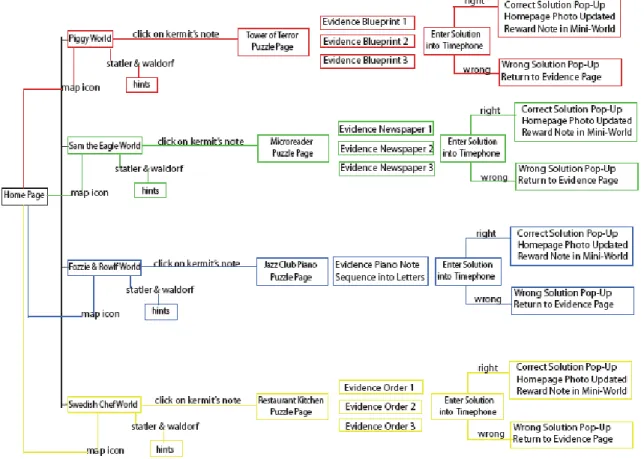
Once the site’s publishing format was selected, Julia drew up a diagram to visualize the site’s migration from “page” to “page”:
Figure 4.6: Flash website structure visualization
After discussing the diagram and the technical requirements with WDI, it became clear that the easiest approach would be to make the website a single Flash movie, beginning with the map of California on the “home page” and overlaying miniworlds and puzzle pages on top. Each puzzle was created as a separate SWF file for ease of editing in drafts, but was loading into the final Flash file as sub-movies for the purposes of release. With regards to database
implementation, the Flash movies themselves were responsible for calling the API URLs to determine what puzzles had been solved and indicate when they had been completed.
4.3 Database Communication
To properly track puzzle progress through the game and maintain individualized experiences for each Guest, we implemented a database. As outsiders, however, we weren’t
allowed to interface directly with Guest information because of privacy concerns. WDI devised a system whereby Guests would register and login on the Disneyland.com website with their Annual Passholder account information. Once logged in, they could then visit the prototype site and perform a simple registration there to customize their play experience, before continuing on to the puzzles. The same database that the Disneyland.com website uses to track user registration would be used to track state for every puzzle.
Because the code that tracks completion of puzzles is part of the prototype’s website, and the website needs to update itself according to the individual progress of each Guest, we needed a way to access their saved states without also having access to their personal information. WDI accomplished this by setting up a series of web addresses that our website could ping. Depending on whether the ping was a query or an update, these addresses would either return a state or update the database as appropriate.
In addition to saving a Guest’s state, the database needed to be able interface with two other systems: an email mailing system to send out mailers at timed intervals, and an external SMS service that Guests would use to complete the final puzzle. Julia wrote up extensive explanations of each of the database’s requirements in the Database Design Document, which can be found in Appendix I.
Robert Michel and WDI took on the responsibility of maintaining the tracking for all states connected with e-mail delivery, as well as providing different URLs to “hit” from inside the Flash files in order to mark tasks as complete. This meant that the WPI team would not have to save state on our end. Both the accepting of the terms of use at the beginning of the game and the completion of the puzzles were deemed generic “tasks.”
Robert then wrote an API that gave Julia the ability to mark each of the tasks as complete and query the database to determine which tasks had already been completed. The API can be found in Appendix J.
5 Development Phase: The Puzzles
Ultimately, the goal of our alternate reality game (ARG) was to bring Guests to Disney's California Adventure Park (DCA) and give them an enjoyable experience while there. To this end, we wanted the puzzles to be more explorative than challenging, and allow Guests to find new meaning and interest in a place they, as Annual Passholders, may have seen many times before.
Figure 5.1: Walt Disney's portrait, north wall, DCA Sorcerer's Workshop. An example of the many hidden features of DCA that Annual Passholders may not already be familiar with.
5.1 The Online Experience
As soon as time travel was solidified as the narrative’s theme, we decided we wanted Guests to be able to see the effects of the characters' actions on the timeline, and to use evidence of those effects to help them solve puzzles. Doing so required two sections to every puzzle: first,
the discovery of the evidence, and second, the determination of how to use that evidence to solve the puzzle.
5.1.1 Gathering Evidence
Initially, we planned to create the evidence-gathering portion of puzzles by planting said evidence on the Internet, in popular sites such as Wikipedia, eBay, or pages of the Disney websites. Since the Internet is primarily a means for sharing information, it is a natural location to hide the information that needs to be found. However, using existing websites presented several problems:
1. Planting fictional information would prove difficult. Free access resource sites like Wikipedia are heavily moderated and cannot be relied upon to keep planted information, particularly if that information is not verifiable. More professional websites such as Disney.com would require wading through many layers of bureaucracy for approval and would likely require significant finances in order to insert changes in a timely and streamlined manner.
2. Making newly-planted information easily findable can also be difficult. It is hard to trick a search engine into displaying a site in the top results for particular queries. While sponsored results can appear above normal search results, they are recognized by web users as advertisements. Guests cannot be relied upon to click them unless specifically instructed to, which would break their suspension of disbelief.
3. Forcing Guests to search through the unfiltered Internet could present security issues, particularly with a target audience that includes minors. Unless we could ensure that a Guest would always navigate to the intended page on the first try (i.e. via a direct link,
which would remove the magic of discovery), we could run the risk of inadvertently directing minors to unsafe websites.
For these reasons, we decided to keep the discovery of evidence strictly in-site.
Inspired by the Disney Parks and Resorts Online “Tour Disneyland Dream Suite" page3, we decided to integrate the evidence-gathering portion of each puzzle into an exploration of a puzzle-related scene. By clicking on various hidden hotspots in the scene, the Guest would discover progressively more evidence. Once all the evidence is discovered, the puzzle can then be solved.
Such techniques have been effective in various online ARG-like games, including ABC's LOSTscape4; and several other Disney sites, including the aforementioned virtual Dream Suite tour, and the Disneyland Resort Paris Tower of Terror website5. In previous cases, however, the collected hotspots were normally tracked by the game and the game was solved simply by visiting all the relevant pages. For our prototype, we wanted the Guests to actively engage the evidence they would be collecting, make it an integral part of the solution of a puzzle, though not the solution itself. In this way, each puzzle in the game could have its unique element, while still being thematically connected to the others by this similar act of collecting evidence.
5.1.2 The Haunted Tower
The first area of Disney's California Adventure that immediately grabbed our interest as a puzzle setting was the Hollywood Tower Hotel, known in the park as the Twilight Zone Tower of Terror. The Tower’s story brought our characters back to 1930s Hollywood, which matched 3 http://disneyparks.disney.go.com/disneyparks/en_US/index?name= YOMD2GiveAwayLandingPage 4 http://a.abc.com/primetime/lost/lostscape/lostscape 5 http://www.disneytowerofterror.com/
the re-theming of DCA. We wanted one of our characters to end up trapped in the tower, needing the Guest to help them escape.
In the Tower’s backstory, three of its upper floors mysteriously disappeared into the fourth dimension. We wanted to answer the question of what that meant by presenting blueprints of the tower, which would reflect the tower as it exists in the real world as well as in the Twilight Zone. Our original design involved a set of blueprints that changed dynamically as through it were being influenced by the Twilight Zone. As the guest would direct the character to move through rooms in the hotel toward the exit, doors and hallways would change, altering the paths available to the character. The pitch for this design can be found in Appendix K.
Figure 5.2: Original blueprint puzzle mockup.
The player-character interaction would have consisted of a web-based game which showed the Guest the blueprints of the tower, highlighting the character's current location and allowing the Guest to click adjacent rooms to direct the character to move there. On each move,
some doors would disappear and some might reappear, changing the paths the character would be able to take.
Because this concept didn't incorporate any ARG-like elements into its design, such as drawing the Guest away from the central site or requiring the use of outside knowledge, it was ultimately rejected. However, the idea of haunted blueprints remained through the puzzle’s final iteration.
5.1.3 The Haunted Tower (Take 2)
The next version of the Hollywood tower Hotel puzzle took into account the clear goal of taking the Guest away from the main page and requiring them to do some work outside of the website. Instead of using a fully-interactive set of blueprints to guide the character out of the hotel, the Guest would be presented with incomplete information, which they had to save and manipulate outside of the website. The Guest was tasked with unifying three parts of a
dimensionally-shifted blueprint. Each piece of the blueprint showed certain areas of the hotel’s floorplan that were inaccessible, having “fallen” into the Twilight zone, but these pieces were different from blueprint to blueprint. Only one path lead from the character’s starting location to the exit without intersecting any walls or “fallen” areas.
WDI suggested using actual blueprints of the Hollywood Tower as a basis for the puzzle. Due to confidentiality issues, the original blueprints could not be released to the public, so our puzzlemaster, Joseph Strong, traced over the relevant areas in Adobe Illustrator, omitting unnecessary details and modifying the drawing to look more like a hotel lobby and less like a ride staging area. Once this process was complete, a path was drawn on a grid overlay, and any squares not on the path were split up over three layers such that no single layer indicated the full path, but all three layers together left no other options.
Figure 5.3: Comparison of two blueprints from the Haunted Tower puzzle. Note the differences in the shaded green areas denoting impassable Twilight Zone locations.
5.1.4 Soarin' Over California
The team wanted Sam the Eagle to explore California as though he were experiencing the Condor Flats ride, Soarin' Over California. The puzzle Joseph designed involved mapping his flight patterns. Since the easiest type of information to plant in a map is a location, the goal of the puzzle became finding where Sam ended up after his travels. We ultimately decided that the most recognizable symbol on a map is a sort of “X marks the spot,” diagram, so the flight patterns were designed to intersect at a particular location: the puzzle’s solution.
Next, Joseph devised a way to convey Sam’s flight patterns as pieces of evidence. After some thought, he realized that Sam’s character presented the answer. Since Sam tends to be a loudmouth and make a big show of things wherever he goes, it was appropriate that he would cause enough of a ruckus to make the local news. The evidence would be delivered in newspaper clippings.
Neither ZIP codes nor area codes existed in the 1930s in the same manner as their present-day forms, so instead of using them as markers, we chose a large region for the
destination—Edwards Air Force Base. Joseph then plotted three flights between two cities each, with each flight crossing over the region. The cities had to be present on today’s maps but still have been established by 1937, so the flights could be fictionally documented in the local papers.
Each city in the area around Edwards AFB was researched. Once Joseph found three pairs of cities that fit the criteria, a final flight path was mapped out. This path was described in newspaper clippings written by Dan Tennant. Fortunately, two of the cities lay along the historic Route 66, the road signs of which are featured prominently throughout DCA.
5.1.5 Strange Ingredients
One of the key distinguishing features of the Paradise Pier and Pacific Wharf areas in DCA are the myriad dining options there. It is for this reason that the Swedish Chef was chosen for this location, and why the Santa Cruz Beach Boardwalk puzzle was themed around food.
One of the prototype’s earliest rabbithole concepts involved having the Swedish Chef soliciting Guests to help him assemble the ultimate recipe book. Once he had collected recipes from enough Guests, he would publish them, in slightly altered form, with the changes in each recipe comprising part of a puzzle. Although this idea was scrapped when the ARG’s target demographic was selected, we eventually worked off a similar concept for the final online puzzle.
The Swedish Chef has demonstrated many of his own creative alterations to traditional recipes in his appearances on the Muppet Show. Most of these are well-documented on sites such as Wikipedia and the Muppet Wikia, and several of the sketches themselves are available on YouTube. We wanted to make his alterations part of the puzzle, so we presented the Guest with the names of three recipes the Chef wanted to prepare: a home cooked meal, bouncy meatballs, and rubber chicken. The Guest was then charged with finding the right ingredients for each, all of which were featured prominently in their Muppet Show appearances: vitamins for the home cooked meal, a tennis racket to serve the bouncy meatballs, and a coconut for hatching rubber chickens.
5.1.6 Musical Password
For Fozzie & Rowlf's puzzle, we wanted to incorporate music. Ultimately, we decided to use the letters that denote musical notes to spell out a message the Guest would have to decrypt. The trick in designing this puzzle was finding a message that could be recognized as such, that
only contained the letters A-G, and that could only be read from beginning to end in one order that would still make sense. Dan came up with the handy phrase “GABE FED DAD A BAD EGG,” which happened to fit the criteria, so it stuck.
The puzzle presented a development challenge, as it required animating a piano without a pianist. Photos were taken from the same angle of the piano's keyboard, both in resting position, and with the relevant keys depressed from the bottom of the keys and from the top of the keys. Each pairing of the latter photos were combined into one using Adobe Photoshop, removing the fingers holding down the keys from the image. Finally, these images were animated in a
sequence that spelled out the message.
5.2 The In-Park Experience
Among the many reasons WDI wanted us to build a prototype ARG was to help offset the visual damage that construction will do to DCA over the next few years. To this end, we wanted to allow Guests to get more out of those parts of the Park left untouched by construction. This was a goal for two reasons: first, we wanted to divert attention from those areas under
construction; and second, since the construction would occur in phases, parts of the game that incorporated construction areas would eventually become obsolete once construction was completed.
5.2.1 Original Concept
The first concept for the in-park puzzle was simple exploration. We wanted to reward Guests for exploring as much of the park as possible. At this point in design, we had not visited the park, but knew some basic information about its functioning. In particular, we knew how the FastPass system operated.
Most popular rides at Disneyland Resort have two lines. While standard lines queue up in the normal fashion, FastPass line allow Guests to swipe their FastPasses into a reader. If you have less than two FastPass tickets in play, the reader prints one out with a time range stamped on it. At any time within that range, you can come back to the ride, hand your ticket to the Cast Member running the lines, and skip right to the front.
Since Guests were going to be spending time in-park playing our game rather than waiting in line for rides, we wanted to reward them with the rides they were missing. The
original puzzle concept rewarded Guests with FastPass tickets that were effective at any time, on any ride.
The implementation of this concept would have involved some method of tracking a Guest's position in the park. Various methods were explored, chiefly RFID, barcodes, and Bluetooth messaging. In each of these cases, there are two components: the reader and the tag. The Guest would carry a tag, while readers would be placed at key areas throughout the park. Whenever the Guest would find one of these Hotspots, either their carried tag or the Hotspot itself would record that they had visited that location. Once the Guest had visited enough locations, he or she could then use their tag in the same fashion as a FastPass ticket.
Unfortunately, such a design required the use of additional, expensive technology which might not serve any purpose after the game's completion. The reward would also have required a change to the FastPass system and the associated retraining of all cast members manning rides. The implementation was scrapped, but one element of the concept remained: having Guests explore the normally unseen areas of the Park.
5.2.2 Revised Concept
Once we visited the Park, we saw that much of the decoration around the Park could be interpreted as preexisting code. We documented many of these decorations and planned to integrate these “codes” into the game's story in a meaningful way. By the time of our visit, we had narrowed down the narrative of the online experience to cover four regions in California, each of them associated with areas of the Park which would exist both before and after construction:
1. Hollywood, associated with DCA's Hollywood Backlot and the Tower of Terror, 2. San Francisco, associated with DCA's Sunshine Plaza and the Golden State, 3. The Boardwalk, associated with DCA's Paradise Pier and the Pacific Wharf, and 4. The Mojave Desert, associated DCA's Condor Flats.
We also devised preliminary concepts for using A Bug's Land in DCA, but it was thematically difficult to tie into the story, as there is no real-world analogue for that area of the Park.
Using our photographs from the visit as references, Joseph scoured every nook and cranny of those areas of the park to find interesting bits of data with which to create meaning for use in the final, in-park puzzle.
5.2.3 Creating New Meaning
The narrative for the in-park puzzle dictated that since the time machine was stuck in the past and the controls were in the future, the Guest would need to recover the machine’s location and time in order to bring the Muppets back. Thus, we wanted to “plant” a place and a time within the park’s decorations. Joseph looked for words which could describe locations—street names, city names, counties, and the like—and matched them to actual locations using Google Maps. We finally decided on the city of Avalon on Catalina Island. Both “Avalon” and
“Catalina” are easily visible on Park decorations, at Paradise Pier and the Hollywood Backlot, respectively. Furthermore, Avalon was established as a city well before 1937, so it would have existed in our narrative’s timeline.
Along with the two other park lands we wanted Guests to explore in their search for clues, a particular location caught our eye as puzzle makers during our visit to the Park. Inside the Disney Animation building, the walls of the first room in the Sorcerer's Workshop attraction are covered with symbols and etchings. In particular, a portrait of Walt Disney himself is placed in a dark corner of the ceiling, behind guests as they enter the room. At this stage in our
narrative’s development, Walt Disney and his vision of California were central to our plot, and we wanted to make sure that this hidden portrait was part of the Guests’ experience.
Figure 5.4: Symbols under Walt's portrait, DCA Sorcerer's Workshop.
Directly beneath the portrait was a series of eight symbols, the fifth of which was clearly an ampersand with a dot above it. Originally, we wanted to use this to key Guests to a website like Time.com, but as the in-park experience was going to be the culmination of the online experience, we could not expect Guests to be able to access a website from inside the park in order to complete the puzzle. Instead, we decided to have the symbols spell out a street name,
like Race Ave. Unfortunately, there are very few four letter street names. The only one in Avalon, CA is Hill St., and that has a two-letter suffix. Furthermore, all eight symbols on the wall were unique, so the street name with suffix included would have to have no repeat letters. We decided to let the dot/ampersand represent a letter in the code and go with a road whose name totaled eight unique letters: Beacon St.
Now that the location was narrowed to the street, the last two pieces of data remaining were a more precise location such as a street number, and the time. For the street number, it happened that an area in the Park's Golden State section had a row of townhouses whose addresses formed a mathematical sequence: progressive powers of two. Number 256 was missing from the sequence. This seemed a very simple and thematically appropriate way to encode the street number, so it was selected.
By process of elimination, the final piece of data that had to be deciphered by the Guest as the time, and it had to be in Condor Flats. Fortunately, there is a fence in Condor Flats that is hung with road signs and license plates of all sorts. Unfortunately, every license plate with a year stamp was dated 1922, 15 years earlier than the date we had set in our story. Thus, it would have been difficult to use the numbers straight off the plates to make a sensible date and time. While a key could have been developed to turn the numbers and letters into something that would make sense to the Guest as an actual time, the process of getting there might seem too contrived and could have run the risk of spoiling the fun.
Fortunately, when dealing with addresses of time, there is no universally-acknowledged and simply-understood format. Taking into account differing time zones, daylight savings time, leap days, and the myriad other ways calendars are arbitrarily modified to favor present
time machine were to actually be built, it would need a format for time addresses that would be invariable and independent of calendars. In this case, it would appear as a code.
In the end, two license plates were chosen which stood out from the others. These plates were entirely numeric, easily identifiable, and could feasibly describe an encoded date and time.
5.2.4 Playtesting and Revisions
Instructions for finding each of these data points were written in the voice of the character Walt Disney, as the fictional inventor of the Park, and they were given to WDI to review. Fortunately for us, a few members of the WDI team were able to go to the Park to playtest the instructions, and they provided us with some constructive feedback to improve the wording of the instructions. The WDI team discovered that the symbols on the walls of the Sorcerer's Workshop were actually part of a real code spelling “Walt & Roy” in the Atlantean alphabet, from the Disney animated film Atlantis: the Lost Empire.
The puzzle for the street name could no longer be a simple symbol-letter substitution, since confusion might arise if Guests were aware of the original code. The first response was to change it two a two-layer substitution, having the Guest translate from Atlantean to Roman characters and then substitute new characters for the originals. As the one who wrote up the original set of instructions, Dan created a key that could be used to transcribe Atlantean characters, through their actual meaning, and into their contrived meaning.
In the end, this substitution was deemed too confusing, as the meaning in the
intermediary step, “Walt & Roy,” is completely discarded once the final answer is uncovered. The puzzle had to be changed completely, though the Imagineers agreed that the Sorcerer's Workshop was still a good location for a “magical” puzzle.
5.2.5 The Final Workshop Puzzle
There were still plenty of symbols arranged on the walls of the Sorcerer's Workshop besides the Atlantean runes. Particularly, there were many images of characters and icons from Disney animated films. Several such images were arranged in a recognizable sequence. Joseph looked into the names of these images and their respective movies to find a letter sequence that would result in the name of a street in Avalon, CA. It was no longer a requirement that the street name have eight letters in total or that the letters be unique from each other, since the encoding would no longer be a direct symbol-to-letter translation. Instead, we wanted to use information about the relevant Disney films to guide the Guest to the answer.
Again using Google Maps as a resource, Joseph began by looking at the first symbol in each sequence and matching a letter in a word, name, or phrase associated with that symbol with
the first letter of a street in Avalon. Proceeding sequentially, street names were eliminated from usability until Metropole Ave. was selected. Joseph wrote up instructions on how to find each
letter in the street name by using basic Disney trivia knowledge and the symbols on the Eastern wall of the Sorcerer's Workshop. The instructions were approved by WDI, and the in-park experience was finally complete.