AIS Electronic Library (AISeL)
AIS Electronic Library (AISeL)
ACIS 2017 Proceedings
Australasian (ACIS)
2017
Towards an understanding of how and why Design Science
Towards an understanding of how and why Design Science
Research scholars evaluate
Research scholars evaluate
Emanuel Stoeckli
University of St.Gallen, [email protected]
Gerard Neiditsch
University of St.Gallen, [email protected]
Falk Uebernickel
University of St.Gallen, [email protected]
Walter Brenner
University of St.Gallen, [email protected]
Follow this and additional works at: https://aisel.aisnet.org/acis2017
Recommended Citation
Recommended Citation
Stoeckli, Emanuel; Neiditsch, Gerard; Uebernickel, Falk; and Brenner, Walter, "Towards an understanding of how and why Design Science Research scholars evaluate" (2017). ACIS 2017 Proceedings. 16.
https://aisel.aisnet.org/acis2017/16
Towards an understanding of how and why Design
Science Research scholars evaluate
Emanuel Stoeckli
Institute of Information Management University of St.Gallen
St.Gallen, Switzerland
Email: [email protected]
Gerard Neiditsch
Institute of Information Management University of St.Gallen
St.Gallen, Switzerland
Email: [email protected]
Falk Uebernickel
Institute of Information Management University of St.Gallen
St.Gallen, Switzerland
Email: [email protected]
Walter Brenner
Institute of Information Management University of St.Gallen
St.Gallen, Switzerland
Email: [email protected]
Abstract
Evaluation activities in Design Science Research not only verify utility but also scientific rigour and the truth-like value of prescriptive knowledge contributions. Assuming a lack of guidance, evaluation frameworks like the one of Sonnenberg and vom Brocke have been proposed prior to evaluating their actual utility to scholars. This research now aims at evaluating how scholars actually apply the framework in practice and their reasoning for doing so. The research-in-progress paper at hand presents preliminary results from a citation analysis. While we find an increasing awareness of the relevance of ex-ante evaluations, there is still a lack of comprehensive detail on ex-ante evaluation activities and an emphasis on ex-post evaluations in artificial settings. The call to accumulate incremental prescriptive knowledge has mostly been ignored and artifact changes are rarely disclosed. Therefore, we question the missing guidance as the sole reason that scholars emphasise building rather than evaluation. We propose to conduct a case study that investigates the reasons behind scholars’ evaluation decisions.
1
Introduction
Design Science Research (DSR) in information systems (IS) aims at solving relevant classes of problems by building useful kinds of artifacts (Hevner et al. 2004). By doing so, DSR creates artificial phenomena such as constructs, models, methods, instantiations or design theories (Gregor and Hevner 2013). Besides building artifacts, evaluations ensure progress (March and Smith 1995). The critical role of evaluation is widely recognized in DSR and represented in research frameworks (Hevner et al. 2004; Hevner 2007; March and Smith 1995; Sein et al. 2011), process models (Peffers et al. 2007) and particularly in evaluation frameworks (Sonnenberg and vom Brocke 2012; Venable et al. 2016). As such, evaluation activities may occur ex-ante, i.e., before artifact construction, or ex-post, i.e., after artifact construction (Pries-Heje et al. 2008; Sonnenberg and vom Brocke 2012). Pursuing DSR evaluations ex-ante serves as artifact design validation and justification of design decisions with evidence from conceptual and prescriptive knowledge (Sonnenberg and vom Brocke 2012; Venable et al. 2016). Finally, the utility of the artifact is evaluated and demonstrated ex-post (Klecun and Cornford 2005).
Prior research shows that contemporary DSR focuses to a large extent on building artifacts, while performing poorly at evaluation activities (Pries-Heje et al. 2008). Grounded on the rationale that existing DSR literature provides insufficient guidance on evaluation, scholars have proposed various evaluation frameworks (Pries-Heje et al. 2008; Sonnenberg and vom Brocke 2012; Venable et al. 2016). While they provide suggestions on why, when, how, and what to evaluate in DSR, there is a lack of evaluation, whether their guidance proves to be effective and useful to scholars.
We argue that the relevance of utility of DSR artifacts also applies to evaluation frameworks. How does the provided evaluation guidance impact actual evaluation activities of scholars? How do scholars follow evaluation frameworks? To date and to the best of our knowledge, an in-depth understanding of how evaluation frameworks are adopted in contemporary DSR is missing. Addressing this research gap may also clarify if the prevailing lack of rigorous evaluation activities (Pries-Heje et al. 2008; Sein et al. 2011) is attributable to insufficient guidance on evaluation or if there are other reasons why scholars disregard evaluation activities, especially ex-ante.
This research-in-progress paper aims to make a first step towards closing this research gap by focusing on one particular evaluation framework. Later, we plan to incorporate other evaluation frameworks such as the framework proposed by Venable et al. (2016). To do so, we take up the framework of Sonnenberg and vom Brocke (2012) and compare how scholars who cite this framework have applied the corresponding propositions. The selection of this particular evaluation framework is grounded in three points.
First, their framework comprises not only ex-post evaluations but also ex-ante evaluations, that are widely seen as relevant to increase scientific rigor of DSR (Klecun and Cornford 2005; Pries-Heje et al. 2008; Stefanou 2001; Venable et al. 2016).
Second, the authors propose distinct activities (named as EVAL1 to EVAL4) and provide guidance on corresponding evaluation criteria and methods for each phase. This enables a structured assessment and comparison on how scholars have applied the proposed framework.
Third, five years have passed since the framework has been proposed and it has increasingly been cited in the recent years (according to Google Scholar 4 citations in 2013, 11 in 2014, 13 in 2015, 38 in 2016, 25 so far in 2017).
To sum up, the ongoing research endeavour addresses the following research questions:
RQ1. How have scholars applied the evaluation framework of Sonnenberg and vom Brocke (2012)? RQ2. What are rationales of scholars behind their DSR evaluation endeavours?
This report is structured as follows: First, the selected framework is briefly introduced before the methodology is set out. Then, the preliminary results are presented before the paper ends with a conclusion, limitations and an outlook of future research.
2
Evaluation Framework of Sonnenberg and vom Brocke (2012)
Sonnenberg and vom Brocke (2012) propose to evolve the widespread build-evaluate pattern (Hevner et al. 2004) and suggest to explicitly conduct ex-ante evaluation activities in addition to ex-post
evaluates the design decisions. EVAL3 evaluates the artifact in an artificial setting. EVAL4 evaluates the use of the artifact in a naturalistic setting. In addition, the authors suggest evaluation criteria and methods that fit the corresponding phases, which clearly addresses the lack of guidance in evaluating DSR. Furthermore, it is underlined that the prescriptive knowledge “should be documented and accumulated in a way that allows for step-wise evaluations of an artifact as it emerges in the DSR process” (Sonnenberg and vom Brocke 2012, p. 386), because it allows for making truth statements. Thus, if scholars apply the framework consistently, their activities will involve to a design-evaluate-build-evaluate pattern with each activity being documented rigorously. Based on the same reasoning they claim that incremental changes to the prescriptive knowledge base are fruitful to share if they are rigorously evaluated (Sonnenberg and vom Brocke 2012). If this is followed, then, adjustments of the prescriptive knowledge base and artifact might occur more frequently. Therefore, empirical evidence on the actual application of the evaluation framework of Sonnenberg vom Brocke (2012) is provided in the remainder of this paper.
Figure 1: Evaluation activities proposed by Sonnenberg and vom Brocke (2012)
3
Research Methodology
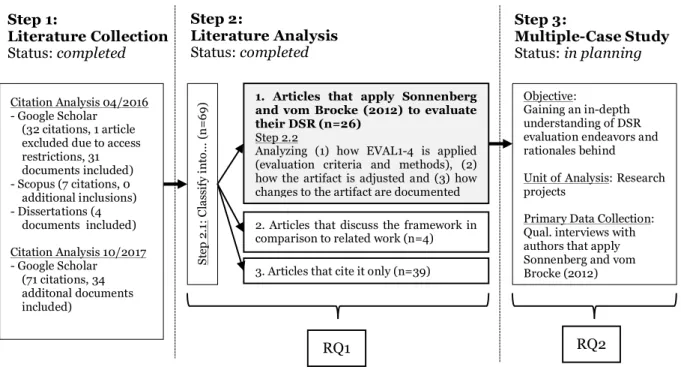
To approach RQ1, we conducted a citation analysis of the evaluation framework of Sonnenberg and vom Brocke (2012). We collected articles where the authors cite Sonnenberg and vom Brocke (2012) in two iterations (Figure 2). The first search was conducted in April 2016 and comprised the scholarly databases Google Scholar and Scopus. The second search was conducted in October 2017.
Figure 2: Research Methodology Step 1:
Literature Collection
Status: completed
1. Articles that apply Sonnenberg and vom Brocke (2012) to evaluate their DSR (n=26)
Step 2.2
Analyzing (1) how EVAL1-4 is applied (evaluation criteria and methods), (2) how the artifact is adjusted and (3) how changes to the artifact are documented
Step 3: Multiple-Case Study Status: in planning Step 2: Literature Analysis Status: completed Objective: Gaining an in-depth understanding of DSR evaluation endeavors and rationales behind Unit of Analysis: Research projects
Primary Data Collection: Qual. interviews with authors that apply Sonnenberg and vom Brocke (2012) 2. Articles that discuss the framework in
comparison to related work (n=4) 3. Articles that cite it only (n=39)
RQ1 RQ2 St ep 2 .1 : Cl as si fy i n to ... ( n = 69 ) Citation Analysis 04/2016 - Google Scholar (32 citations, 1 article excluded due to access restrictions, 31 documents included) - Scopus (7 citations, 0 additional inclusions) - Dissertations (4 documents included) Citation Analysis 10/2017 - Google Scholar (71 citations, 34 additonal documents included)
Due to the iterative nature of the framework, it appears beneficial to consider additionally PhD theses that follow this framework - scholars may have allocated the evaluation cycles to individual publications. We have subsequently sourced dissertations from the universities where the authors of articles that have already been included reside. We verified the list of dissertations with an author of the framework at the time of conducting the first search iteration (Sonnenberg and vom Brocke 2012). In total, 69 documents were covered by the subsequent analysis. Next, we read through all abstracts, introductions and conclusions as well as the paragraphs of the citation of Sonnenberg and vom Brocke (2012) in order to classify them into the following categories:
1. articles that apply the evaluation framework to evaluate their DSR (Abraham 2014; Afflerbach et al. 2016; Bärenfänger and Otto 2015; Blaschke et al. 2017; Bolsinger 2014; Braunnagel and Leist 2016; vom Brocke et al. 2014; Engelmann et al. 2017; Häckel et al. 2017; Herterich et al. 2016; Hewing 2014; Holler et al. 2017; Jannaber et al. 2017; Lehnert et al. 2017; Lück and Leyh 2017; Marjanovic 2016; Niemöller, Metzger, Berkemeier, et al. 2016; Niemöller, Metzger, Fellmann, et al. 2016; Niemöller et al. 2017; Raber 2013; Rosenberger et al. 2016; Sonnenberg 2013; Sonnenberg and vom Brocke 2014; van Staden et al. 2017; Tuunanen et al. 2015; Vanhoof 2016).
2. articles that discuss and compare the evaluation framework with related work
(e.g., Abraham et al. 2014).
3. articles that cite the article (e.g., Bodenbenner et al. 2013).
Those publications that fall into the first category were further analysed. We generated a classification schema that comprises the evaluation methods, criteria and outputs of each EVAL cycle (Sonnenberg and vom Brocke 2012). Then, we evaluated the scheme with a senior researcher and subsequently refined it, e.g., by additionally identifying publications that iteratively adjusted their artifacts during the evaluation cycles, and those where this was either not evident or had not been done. Each of the included articles has been analysed separately by each author using the above schema. The consolidation of the analysis has led to the subsequent preliminary results, which provides answers to RQ1.
In order to address RQ2 that aims at understanding the rationales of scholars behind their DSR evaluation activities, we plan to go one step further. For this, we propose a case study to collect rich contextual insights (Yin 2008) on how scholars make decisions on their evaluation endeavours of their DSR research projects, and why they seem to assign less priority to ex-ante evaluations compared to ex-post evaluations. This is grounded in the interpretative paradigm to gain a deep understanding of the meaning that individuals assign to the different evaluation phases and activities in various research contexts (Klein and Myers 1999). Thereby, the unit of analysis is a research project and to identify the cases, we build on the citation analysis at hand and take into consideration scholars that have applied (Sonnenberg and vom Brocke 2012). For primary data collection, we obtain qualitative data from semi-structured interviews. We then triangulate this data with the results of the analysis at hand.
4
Preliminary Results
We now elaborate on patterns that have emerged from the detailed analysis of a total of 26 articles that evaluate according to Sonnenberg and vom Brocke (2012).
Finding 1. More than half the publications stop the DSR process after EVAL3, i.e. the ex-post evaluation in an artificial environment. Two reasons were regularly put forward on why the authors stopped before evaluating the artifact in a naturalistic setting: (1) it was too costly or time/labor intense, or (2) it constituted a separate publication. None of these scholars mentioned issues that would have stopped them to progress to moving into a naturalistic setting.
Finding 2. Approximately half the papers allocate their evaluation activities explicitly to the proposed evaluation cycles EVAL1 to EVAL4. To do so, the following three approaches were identified:
• Textual reference to EVAL1-4 either directly at the point where the evaluation activity is described or by referring to dedicated sections within the article, to prior research, or to individual articles within a dissertation.
• Presenting a tabular overview of the evaluation phases with the conducted activities (Bärenfänger and Otto 2015).
• Visualizing the proposed and actually conducted evaluation activities (Jannaber et al. 2017; Niemöller, Metzger, Berkemeier, et al. 2016; Niemöller, Metzger, Fellmann, et al. 2016; Sonnenberg and vom Brocke 2014; van Staden et al. 2017; Vanhoof 2016).
Other scholars describe their evaluations in ways that allow for implicit reasoning about the conducted cycles, e.g., Herterich et al. (2016) mention their completed ex-ante evaluations from a previous publication and their focus on ex-post evaluation in a natural setting. However, there exists work that does not mention the cycles explicitly and at the same time lacks in providing enough detail for an implicit understanding, e.g., this is often the case for EVAL1.
Finding 3. Relating to ex-ante evaluation, Sonnenberg and vom Brocke (2012) suggests to identify the problem, then, justify the problem statement, research gap and objectives (EVAL1). This is followed by disclosing the design specifications and their justification (EVAL2). The majority did not separate their building (“identify problem”, “design”) from their evaluation activities (EVAL1, EVAL2) but rather put it down in one, e.g., reported superficially that the design specifications have been derived from literature. In the first iteration of literature collection in 2016, we found a focus on ex-post evaluations. In the second iteration in 2017, we identified an increasing number of publications that either focus solely on ex-ante evaluations (e.g., Engelmann et al. 2017; Jannaber et al. 2017; Niemöller, Metzger, Berkemeier, et al. 2016; Niemöller, Metzger, Fellmann, et al. 2016) or put more emphasis on disclosing details of ex-ante evaluations (e.g., Blaschke et al. 2017).
Finding 4. Only a minority of articles reveal changes to the artifact throughout the iterations, although evaluations should reveal the validation of incremental design decisions of a DSR process (Sonnenberg and vom Brocke 2012). Often, the iterations are disclosed but not the consequent changes to the artifact. However, some authors do disclose immaturities of their artifact that were revealed through evaluation and how they approached them, e.g., Blaschke et al. (2017). Also, a few authors put emphasis on how the artifact evolves (e.g., Sonnenberg and vom Brocke 2014) and point out the changes made in the individual evaluation steps (e.g., Bärenfänger and Otto 2015).
Finding 5. For EVAL1 only a few authors of the reviewed articles state the evaluation criteria and their focus lies on the methods literature review, expert interviews, and focus groups. Where stated, the criteria mentioned was novelty and importance. However, Sonnenberg (2013) explicitly considers various additional criteria, i.e., applicability, suitability and feasibility. EVAL2 is covered by most publications with a broad variety of evaluation criteria and methods. From the articles that cover EVAL3 and EVAL4, most authors are focusing on applicability and effectiveness as the main evaluation criteria. Nine out of twenty-six articles cover EVAL4. Of those, case study research is the primary means of evaluating the artifact in a naturalistic setting.
Finding 6. Besides structuring DSR evaluation activities according to the framework, authors cited Sonnenberg and vom Brocke (2012) in the following ways:
• To put emphasis on the distinction between ex-ante and ex-post evaluation, e.g., “[Sonnenberg and vom Brocke (2012)] distinguish between ex ante evaluation focusing on artifact refinement during the design process and ex post evaluation to validate artifact instances and artifacts in use” (Herterich et al. 2016, p. 1239).
• To put emphasis on the relevance of applying an iterative and stepwise approach to evaluation, i.e., to conduct meaningful evaluation activities already in the early stages of DSR, e.g., “not only the resulting IT artifact was evaluated but also partial results generated throughout the development process” (Johannsen and Fill 2017, p. 19).
• To justify the early communication of research, e.g., “The rationale for this ex-ante evaluation is that an early evaluation and documentation makes it easier for researchers to communicate intermediate products of a Design Science Research (DSR) process to the research com- munity” (Niemöller, Metzger, Fellmann, et al. 2016, p. 754).
• To articulate and justify evaluation criteria and evaluation methods, e.g., “we focus on the criteria internal consistency, completeness and clarity, as mentioned by [Sonnenberg and vom Brocke (2012)]” (Jannaber et al. 2017, p. 43).
5
Discussion
The preliminary results suggest that scholars applying the framework started doing so with a
focus on ex-post evaluation. Considering the more recent publications suggests an increasing
awareness of the relevance of ex-ante evaluation. This might be seen as reflecting the still
existing predominance of ex-post evaluations. Furthermore, more than half the publications
stop after evaluating the artifact ex-post in an artificial environment. Although Sonnenberg
and vom Brocke (2012) emphasize to evaluate both, the artifact and the DSR process, i.e.,
design validation and design decision justification, the results show that scholars report little
details on EVAL1 and EVAL2 cycles.
We argue that this limits the prescriptive knowledge gain. Although EVAL2 was covered by
most publications, only little detail has been disclosed on individual design decisions. The
validation of the design often occurs at a superficial level, i.e., justifying the overall design by
mentioning how they are derived. This lack of providing detail is also manifested in the
disclosure of artifact changes. Only a minority of the analysed publications elaborate clearly
on relevant changes that result from the iterative evaluation of the artifact. In this way, the
potential to increase the truth-like value of the prescriptive knowledge and the creditability of
a DSR endeavour is often not exploited.
It is here that further research is valuable to investigate why scholars refrain from sharing
detailed information on ex-ante evaluations and adjustments of the artifact. One possible
explanation might be that scholars fear to reveal weaknesses in the design. On one hand
Hevner et al. argue that “the existing knowledge base is often insufficient for design purposes
and designers must rely on intuition, experience, and trial-and-error methods” (Hevner et al.
2004, p. 9). Abraham et al. (2014, p. 21) add that “a successful artifact could also be created
ad-hoc, either by following intuition or by following a process that has never been evaluated”.
Importantly, they also underline the point that rigor cannot be ascribed in these cases.
Sonnenberg and vom Brocke (2012, p. 385) claim that DSR “requires IT artifacts to be built
in a disciplined and informed way”. Thus, scholars might fear to weaken their DSR by
conceptually justifying design decisions grounded in their experience and intuition.
Assuming that, to a certain extent, each DSR endeavour relies on the experience and intuition
of their scholars, then, disclosing details in this respect may be perceived as risky as they
could to be judged as weaknesses by reviewers. As Hevner (2007, p. 5) state “it is the synergy
between relevance and rigor and the contributions along both the relevance cycle and the
rigor cycle that define good design science research”. However, this is only one possible
explanation, future research is needed to shed light on the reasoning behind DSR scholars’
evaluation decisions.
6
Conclusion, Outlook and Limitations
This research-in-progress paper reports on preliminary results from a citation analysis of (Sonnenberg and vom Brocke 2012), which provide guidance on ex-ante (EVAL1, EVAL2) and ex-post evaluation activities (EVAL3, EVAL4) and suggestions on corresponding evaluation criteria, methods and intended outcomes. Although we do find an increasing awareness of the relevance of ex-ante evaluations in the most recent publications, there is still a lack of comprehensive detail on ex-ante evaluation activities and an emphasis on ex-post evaluations in artificial settings. In fact, the call to accumulate and share incremental prescriptive knowledge from iterative evaluations and/or artifact adjustments has often not been exploited.
While the citation analysis at hand shows how scholars follow Sonnenberg and vom Brocke (2012), further research is needed to unveil the reasons behind. In subsequent work we will deepen the understanding of DSR scholars’ evaluation decisions. The aim will be to identify reasons that prevent scholars from conducting ex-ante evaluation activities and from disclosing incremental prescriptive knowledge, e.g., justified design decisions or adjustments of their artifacts. Therefore, we propose to draw on case study research based on primary data that is collected in qualitative interviews with the authors of the articles that followed Sonnenberg and vom Brocke (2012) for their DSR evaluation. We perceive that future work that applies the evaluation framework of Sonnenberg and vom Brocke (2012) should explicitly state the applied evaluation methods and the corresponding evaluation criteria. It seems beneficial to report on relevant adjustments made to the artifact within and between evaluation efforts in order to increase the prescriptive nature of the DSR outcome.
step towards a better understanding of how and why DSR scholars evaluate following an evaluation framework. We reveal and reflect on how scholars have applied the framework of Sonnenberg and vom Brocke (2012) to evaluate their DSR. Therewith, we inform scholars that aim at improving existing or building novel evaluation frameworks.
7
References
Abraham, R. 2014. “Development of Design Principles for Boundary Objects in Enterprise Transformation,” Ph.D. Thesis, University of St. Gallen. (http://www1.unisg.ch/www/edis.nsf/SysLkpByIdentifier/4321/$FILE/dis4321.pdf).
Abraham, R., Aier, S., and Winter, R. 2014. Fail Early, Fail Often: Towards Coherent Feedback Loops in Design Science Research Evaluation, ICIS 2014 Proceedings, aisel.aisnet.org.
Afflerbach, P., Bolsinger, M., and Röglinger, M. 2016. “An Economic Decision Model for Determining the Appropriate Level of Business Process Standardization,” Bus Res (9:2), pp. 335–375. (https://doi.org/10.1007/s40685-016-0035-6).
Bärenfänger, R., and Otto, B. 2015. Proposing a Capability Perspective on Digital Business Models, in (Vol. 1), presented at the 2015 IEEE 17th Conference on Business Informatics, IEEE, July, pp. 17–25. (https://doi.org/10.1109/CBI.2015.18).
Blaschke, M., Kazem Haki, M., Riss, U., and Aier, S. 2017. “Design Principles for Business-Model-Based Management Methods—A Service-Dominant Logic Perspective,” in Lecture Notes in Computer Science, Springer, Cham, May 30, pp. 179–198. (https://doi.org/10.1007/978-3-319-59144-5_11).
Bodenbenner, P., Feuerriegel, S., and Neumann, D. 2013. “Design Science in Practice: Designing an Electricity Demand Response System,” in 8th International Conference on Design Science at the Intersection of Physical and Virtual Design, DESRIST 2013 (Vol. 7939 LNCS), Helsinki, pp. 293–307. (https://doi.org/10.1007/978-3-642-38827-9_20).
Bolsinger, M. 2014. “Bringing Value-Based Business Process Management to the Operational Process Level,” Inf Syst E-Bus Manage (13:2), pp. 355–398. (https://doi.org/10.1007/s10257-014-0248-1).
Braunnagel, D., and Leist, S. 2016. Applying Evaluations While Building the Artifact -- Experiences from the Development of Process Model Complexity Metrics, presented at the 2016 49th Hawaii International Conference on System Sciences (HICSS), ieeexplore.ieee.org, January, pp. 4424– 4433. (https://doi.org/10.1109/HICSS.2016.551).
vom Brocke, J., Braccini, A. M., Sonnenberg, C., and Spagnoletti, P. 2014. “Living IT Infrastructures — An Ontology-Based Approach to Aligning IT Infrastructure Capacity and Business Needs,” International Journal of Accounting Information Systems (15:3), pp. 246–274. (https://doi.org/10.1016/j.accinf.2013.10.004).
Engelmann, A., Heinrich, P., and Schwabe, G. 2017. Mobiles Lernen Für Industrie 4.0: Probleme, Ziele, Lernarrangements, Proceedings der 13. Internationalen Tagung Wirtschaftsinformatik (WI 2017).
Gregor, S., and Hevner, A. R. 2013. “Positioning and Presenting Design Science Research for Maximum Impact,” MIS Quarterly (37:2), pp. 337–356.
Häckel, B., Miehle, D., Pfosser, S., and Übelhör, J. 2017. Development of Dynamic Key Figures for the Identification of Critical Components in Smart Factory Information Networks, p. 2767.
Hevner, A. R. 2007. “A Three Cycle View of Design Science Research,” Scandinavian Journal of Information Systems (19:2), p. 4.
Hevner, A. R., March, S. T., Park, J., and Ram, S. 2004. “Design Science in Information Systems Research,” MIS Quarterly (28:1), pp. 75–105.
Hewing, M. 2014. Business Process Blueprinting: A Method for Customer-Oriented Business Process Modeling, Springer Fachmedien. (https://doi.org/10.1007/978-3-658-03729-1).
Holler, M., Neiditsch, G., Uebernickel, F., and Brenner, W. 2017. Digital Product Innovation in Manufacturing Industries-Towards a Taxonomy for Feedback-Driven Product Development
Scenarios, presented at the Proceedings of the 50th Hawaii International Conference on System Sciences.
Jannaber, S., Riehle, D. M., Delfmann, P., Thomas, O., and Becker, J. 2017. “Designing a Framework for the Development of Domain-Specific Process Modelling Languages,” in Lecture Notes in Computer Science, Springer, Cham, May 30, pp. 39–54. (https://doi.org/10.1007/978-3-319-59144-5_3).
Johannsen, F., and Fill, H.-G. 2017. “Meta Modeling for Business Process Improvement,” Bus Inf Syst Eng (59:4), pp. 251–275. (https://doi.org/10.1007/s12599-017-0477-1).
Klecun, E., and Cornford, T. 2005. “A Critical Approach to Evaluation,” Eur J Inf Syst (14:3), pp. 229– 243. (https://doi.org/10.1057/palgrave.ejis.3000540).
Klein, H. K., and Myers, M. D. 1999. “A Set of Principles for Conducting and Evaluating Interpretive Field Studies in Information Systems,” MIS Quarterly (23:1), pp. 67–93. (https://doi.org/10.2307/249410).
Lehnert, M., Röglinger, M., and Seyfried, J. 2017. “Prioritization of Interconnected Processes,” Bus Inf Syst Eng, pp. 1–20. (https://doi.org/10.1007/s12599-017-0490-4).
Lück, D., and Leyh, C. 2017. “Enabling Business Domain-Specific e-Collaboration: Developing Artifacts to Integrate e-Collaboration into Product Costing,” in Lecture Notes in Computer Science, Springer, Cham, May 30, pp. 296–312. (https://doi.org/10.1007/978-3-319-59144-5_18).
March, S. T., and Smith, G. F. 1995. “Design and Natural Science Research on Information Technology,” Decis. Support Syst. (15:4), pp. 251–266. (https://doi.org/10.1016/0167-9236(94)00041-2).
Marjanovic, O. 2016. “Designing Innovative Education through Action Design Research: Method and Application for Teaching Design Activities in Large Lecture Environments,” Journal of Information Technology Theory and Application (JITTA) (17:2), p. 1.
Niemöller, C., Metzger, D., Berkemeier, L., Zobel, B., Thomas, O., and Thomas, V. 2016. Designing MHealth Applications for Developing Countries, ECIS 2016 Proceedings, aisel.aisnet.org. Niemöller, C., Metzger, D., Fellmann, M., Özcan, D., and Oliver, T. 2016. “Shaping the Future of
Mobile Service Support Systems-Ex-Ante Evaluation of Smart Glasses in Technical Customer Service Processes,” in GI-Jahrestagung.
Niemöller, C., Zobel, B., Berkemeier, L., Metzger, D., Werning, S., Adelmeyer, T., Ickerott, I., and Thomas, O. 2017. Sind Smart Glasses Die Zukunft Der Digitalisierung von Arbeitsprozessen? Explorative Fallstudien Zukünftiger Einsatzszenarien in Der Logistik, Proceedings der 13. Internationalen Tagung Wirtschaftsinformatik (WI 2017).
Peffers, K., Tuunanen, T., Rothenberger, M. A., and Chatterjee, S. 2007. “A Design Science Research Methodology for Information Systems Research,” Journal of Management Information Systems (24:3), pp. 45–77.
Pries-Heje, J., Baskerville, R., and Venable, J. 2008. “Strategies for Design Science Research Evaluation,” ECIS 2008 Proceedings, pp. 1–12.
Raber, D. 2013. “Reifegradmodellbasierte Weiterentwicklung von Business Intelligence Im Unternehmen,” Ph.D. Thesis, University of St. Gallen. (http://www1.unisg.ch/www/edis.nsf/SysLkpByIdentifier/4232/$FILE/dis4232.pdf).
Rosenberger, M., Lehrer, C., and Jung, R. 2016. “Ein Datenmodell Zur Unterstützung Der Datenintegration von Nutzeraktivitäten Aus Verschiedenen Sozialen Netzwerken,” Multikonferenz Wirtschaftsinformatik. Ilmenau.
Sein, M., Henfridsson, O., Purao, S., Rossi, M., and Lindgren, R. 2011. “Action Design Research,” MIS Quarterly (35:1), pp. 37–56.
Sonnenberg, C. 2013. “Bridging the Gap Between Business Process Management and Accounting – Design and Evaluation of a Process Accounting Model,” Ph.D. Thesis, University of Liechtenstein.
Information Systems. Advances in Theory and Practice, Lecture Notes in Computer Science, Springer Berlin Heidelberg, pp. 381–397. (https://doi.org/10.1007/978-3-642-29863-9_28). Sonnenberg, C., and vom Brocke, J. 2014. “The Missing Link between BPM and Accounting: Using
Event Data for Accounting in Process-Oriented Organizations,” Business Process Management Journal (20:2), pp. 213–246. (https://doi.org/10.1108/BPMJ-12-2012-0136).
van Staden, C. J., van Biljon, J. A., and Kroeze, J. H. 2017. Using a User Experience Evaluation Framework for EModeration, presented at the 2017 Conference on Information Communication Technology and Society (ICTAS), ieeexplore.ieee.org, March, pp. 1–6. (https://doi.org/10.1109/ICTAS.2017.7920523).
Stefanou, C. J. 2001. “A Framework for the Ex-Ante Evaluation of ERP Software,” Eur J Inf Syst (10:4), pp. 204–215. (https://doi.org/10.1057/palgrave.ejis.3000407).
Tuunanen, T., Vartiainen, T., Ebrahim, M., and Liang, M. 2015. Continuous Requirements Risk Profiling in Information Systems Development, presented at the System Sciences (HICSS), 2015 48th Hawaii International Conference on, ieeexplore.ieee.org, January, pp. 4019–4028. (https://doi.org/10.1109/HICSS.2015.483).
Vanhoof, E. 2016. “Evolvable Accounting Information Systems: Applying Design Science Methodology and Normalized Systems Theory to Tackle Combinatorial Effects of Multiple GAAP,” Ph.D. Thesis, University of Antwerp. (https://repository.uantwerpen.be/docman/irua/b33331/134890.pdf).
Venable, J., Pries-Heje, J., and Baskerville, R. 2016. “FEDS: A Framework for Evaluation in Design Science Research,” Eur J Inf Syst (25:1), pp. 77–89. (https://doi.org/10.1057/ejis.2014.36). Yin, R. K. 2008. Case Study Research: Design and Methods, Applied Social Research Methods, SAGE
Publications. (https://books.google.es/books?id=fpx1AwAAQBAJ).
Copyright: © 2017 Emanuel Stoeckli, Gerard Neiditsch, Falk Uebernickel, Walter Brenner. This is an open-access article distributed under the terms of the Creative Commons Attribution-NonCommercial
3.0 Australia License, which permits non-commercial use, distribution, and reproduction in any