PERFORMANCE AUDIT REPORT
Kansas Eligibility Enforcement
System: Evaluating Delays in the
System’s Implementation
A Report to the Legislative Post Audit Committee By the Legislative Division of Post Audit State of Kansas December 2015
Legislative Division of Post Audit
The Legislative Division of Post Audit is the auditarm of the Kansas Legislature. Created in 1971, the division’s mission is to conduct audits that provide the Legislature with accurate, unbiased information on the performance of state and local government. The division’s audits typically examine whether agencies and programs are effective in carrying out their duties, efficient with their resources, or in compliance with relevant laws, regulations and other requirements.
The division’s audits are performed at the direction of the Legislative Post Audit Committee, a bipartisan committee comprising five senators and five representatives. By law, individual legislators, legislative committees, or the Governor may request a performance audit, but the Legislative Post Audit Committee determines which audits will be conducted.
Although the Legislative Post Audit Committee determines the areas of government that will be audited, the audits themselves are conducted independently by the division’s professional staff. The division’s reports are issued without any input from the committee or other legislators. As a result, the findings, conclusions, and recommendations included in the division’s audits do not necessarily reflect the views of the Legislative Post Audit Committee or any of its members.
The division conducts its audit work in accordance with applicable government auditing standards set forth by the U.S. Government Accountability Office. These standards pertain to the auditor’s
professional qualifications, the quality of the audit, and the characteristics of professional and meaningful reports. The standards also have been endorsed by the American Institute of Certified Public Accountants (AICPA) and adopted by the Legislative Post Audit Committee.
LEGISLATIVE POST AUDIT COMMITTEE
Representative John Barker, Chair Representative Tom Burroughs Representative Peggy Mast Representative Virgil Peck, Jr. Representative Ed Trimmer
Senator Michael O’Donnell, Vice-Chair Senator Anthony Hensley
Senator Laura Kelly Senator Jeff Longbine Senator Julia Lynn
LEGISLATIVE DIVISION OF POST AUDIT
800 SW Jackson Suite 1200 Topeka, Kansas 66612-2212 Telephone: (785) 296-3792 Fax: (785) 296-4482 Website: http://www.kslpa.org
Scott Frank, Legislative Post Auditor
HOW DO I REQUEST AN AUDIT?
By law, individual legislators, legislative committees, or the Governor may request an audit, but any audit work conducted by the division must be directed by the Legislative Post Audit
Committee. Any legislator who would like to request an audit should contact the division directly at (785) 296-3792.
This audit was conducted by Matt Etzel, Laurel Murdie, Daniel McCarville, Betty Liu, and Meghan Flanders. Justin Stowe was the audit manager. If you need any additional information about the audit’s findings, please contact Matt Etzel at the Division’s offices.
Legislative Division of Post Audit 800 SW Jackson Street, Suite 1200
Table of Contents
Introduction ... 1
Overview of the Kansas Eligibility Enforcement System (KEES) KEES is an Integrated Eligibility System for the State’s Medical and Social Service Programs ... 3
As Originally Planned, KEES Was to Be Completed in 2014 and Cost a Total of $138 Million to Build and $50 Million to Maintain for Five Years ... 4
Oversight, Management, and Development of the KEES Project Involves Numerous Federal, State, and Private Entities ... 5
Question 1: Have Project Delays or Other Changes to the KEES Project Resulted in Additional Costs, Reduced Anticipated Savings, or Reduced System Functionality? As of November 2015, the Core of the KEES Project was Approximately Two and a Half Years Behind the Original Schedule ... 7
Once Completed, KEES Will Likely Exceed the Original Budget to Build, Maintain, and Operate the System by at Least $46 Million Through August 2016 ... 9
Although it Appears the Main Functionality of KEES Will Work as Planned, Some Important Components Have Been Significantly Postponed or Reduced ... 11
The State is Unlikely to Realize All the Estimated Savings Expected from KEES Because Estimates Were Based on Faulty Assumptions ... 14
Project Management Issues Early in the KEES Project and Other Changes Led to Many of the Current Problems We Identified ... 16
State Oversight Bodies Do Not Always Receive Complete Information about IT Projects Like KEES .... 17
Conclusion ... 21
Recommendations ... 21
List of Figures
Figure OV-1: Summary of Private, State, and Federal Entities Involved in the KEES Project ... 5Figure 1-1: Comparison of the Original, Current, and Planned KEES Completion Dates ... 8
Figure 1-2: Comparison of Originally Estimated, Actual, and Projected KEES Costs Through 2016 ... 10
Figure 1-3: Summary Description and Status of Important and Minor Functionality in KEES ... 12
List of Appendices
Appendix A: Scope Statement... 23In August 2011, Kansas signed a contract with Accenture to design a new eligibility determination system for medical and social service benefits. Known as the Kansas Eligibility Enforcement System (KEES), the project was originally estimated to take about two years to complete and cost about $138 million to build and $50 million to maintain for five years. The original KEES project plan called for a web-based application system and would help
streamline eligibility determination for state medical and social service benefits. The system was intended to link several state and federal databases to help identify errors or fraudulent claims. Since the KEES contract was signed with Accenture in 2011, the project had several delays and missed deadlines. As a result, the Kansas Enterprise Project Management Office has placed the KEES project on caution or alert status on numerous occasions. KEES was originally scheduled to be completed by May 2014, but current projections now show KEES will not be completed until at least August 2016.
Legislators have expressed concern that delays in the system’s implementation may have increased the project’s costs and affected the system’s functionality.
This performance audit answers the following question:
1. Have delays or other changes to the KEES project resulted in additional costs, reduced anticipated savings, or reduced system functionality?
A copy of the scope statement for this audit approved by the Legislative Post Audit Committee is included in Appendix A. For reporting purpose, we have collapsed the two scope statement questions into one.
Our work included a variety of steps to evaluate how project delays and other changes have affected system costs, anticipated savings, or system functionality. Specifically, we interviewed staff from the Kansas Department of Health and Environment (KDHE), the Kansas Department for Children and Families (DCF), and the Kansas Information Technology Office to gain a better
understanding of the KEES project and how it has changed over time. We also reviewed relevant KEES project documents including presentations provided to legislative committees, the
The Kansas Eligibility Enforcement System:
Evaluating Delays in the System’s Implementation
state's contract with Accenture, project status and budget reports, and external project evaluations. Based on this documentation and our interviews with KDHE and DCF officials, we identified
significant changes to the KEES project’s timelines, scope, budget, and deliverables. We did not perform any work on internal
controls because such work was unnecessary to answer the audit question.
We conducted this performance audit in accordance with generally accepted government auditing standards. Those standards require that we plan and perform the audit to obtain sufficient, appropriate evidence to provide a reasonable basis for our findings and
conclusions based on our audit objectives. Overall, we believe the evidence obtained during this audit provides a reasonable basis for our findings and conclusions based on our audit objectives.
Our findings begin on page 7, following a brief overview of the Kansas Eligibility Enforcement System.
In 2011, Kansas Department of Health and Environment (KDHE) and Department for Children and Families (DCF) officials
combined two information technology projects, K-Med and Avenues, under a single project called the Kansas Eligibility Enforcement System (KEES).
K-Med was an eligibility determination system for medical assistance programs such as Medicaid and the Children’s Health Insurance Program (CHIP).
Avenues was an eligibility determination system for social service assistance programs including Temporary Assistance for Needy Families (TANF), Low Income Energy Assistance Program (LIEAP), the Refugee Cash Program, Work Programs, and Child Care Subsidies.
KEES was intended to allow individuals to apply for state medical and social service benefits through a single publicly available web portal. Prior to KEES, individuals could not submit electronic applications for both medical and social service programs. KEES’s original project plan called for a single publicly available web portal. This would allow individuals to apply for multiple medical and social services benefits by completing and submitting a single online application. The web portal was also intended to allow individuals to review the status of their applications once submitted.
KEES was also intended to have automated eligibility determination for medical and social service benefits. The original KEES plan called for software that could automatically verify applicants’ information by crosschecking it against existing state and federal databases. For example, KEES would verify whether an applicant was currently unemployed by communicating with other existing wage and employment databases. Once
verified, KEES’ software would automatically determine which medical or social service benefits an applicant would be eligible to receive. KDHE officials believed KEES’ automated function would reduce the number of human errors made during the eligibility determination process.
Finally, the KEES system was intended to serve as an interface to share information with the federal government’s health care exchange under the Affordable Care Act. Under the Affordable Care Act, the state had a choice to create its own health insurance exchange or allow the federal government to create and operate one on its behalf. The state chose the latter option, but elected to
Overview of the Kansas Eligibility Enforcement System (KEES)
KEES is an Integrated Eligibility System for the State’s Medical and Social Service
still have KDHE make eligibility determinations for Medicaid and CHIP applications. As a result of this decision, the state needed a way to transfer KDHE’s Medicaid and CHIP eligibility
information to the federally operated health care exchange. The state decided to build this feature into the KEES system, and have it serve as the link between the state and federal systems.
The KEES project was originally scheduled to be finished by May 2014, taking about two years to complete. The first
detailed planning document for KEES was submitted to the Kansas Information Technology Office (KITO) in January 2012.
According to this document, the medical and social service eligibility systems (K-Med and Avenues) were originally scheduled to be completed by December 2013. Other smaller system components, such as a new customer service contact center, were scheduled to be completed by May 2014.
KDHE and DCF officials originally estimated it would cost $138 million to build KEES and about $50 million to maintain it for five years. Officials from these agencies submitted budget requests to the Department of Health and Human Services (HHS) starting in 2011. The original budget showed it would cost an estimated $138 million to build KEES. The majority of these costs were for expected payments to Accenture—the vendor selected by the state to develop software for the KEES project. A smaller portion of these costs were associated with salaries for state staff working on the KEES project. These estimated maintenance costs included troubleshooting problems with the system, updating or modifying existing software, as well as other necessary services to keep KEES operational.
Federal grants will be used to pay for 85% of the build costs, and 75% of the maintenance costs. Grants from federal agencies, including HHS and the United States Department of Agriculture (USDA), provide federal funding for KEES. For example, some of the federal funds included are Medicaid, Foster Care, LIEAP, TANF, and SNAP. In general, 85% of the cost to build KEES will be funded by federal grants, with the remaining 15% being funded with state funds. Similarly, about 75% of KEES’ maintenance costs will be funded with federal grants, with 25% being covered by state general funds.
As Originally Planned, KEES Was to Be Completed in 2014 and Cost a Total of $138 Million to Build and $50 Million to Maintain for Five Years
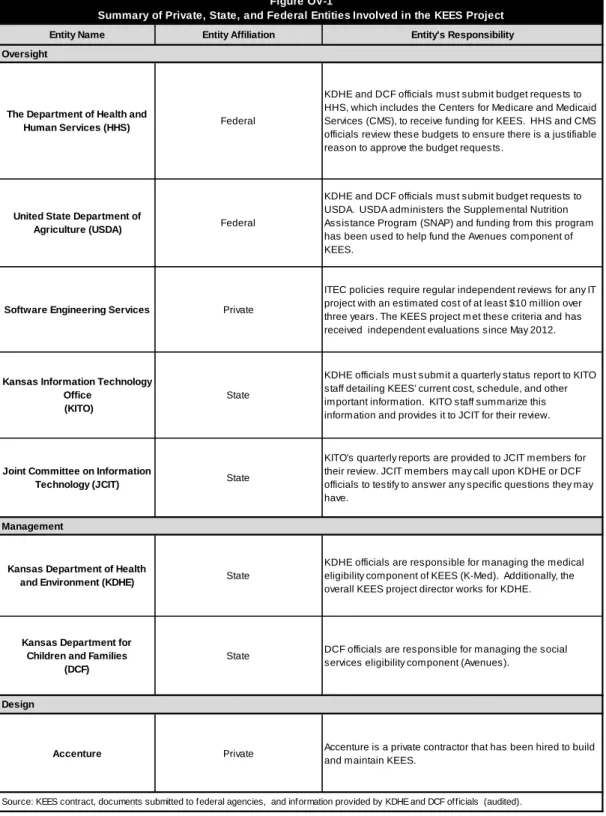
Federal entities, the state, and an independent evaluator all have oversight roles on the KEES project. Figure OV-1 below summarizes the federal, state, and private entities involved in the oversight, management, and design of the KEES system. As the figures shows, several entities provide oversight of the KEES project. Specifically, HHS tracks the progress of the KEES project in order to ensure federal funds are issued and used appropriately.
Entity Name Entity Affiliation Entity's Responsibility
United State Department of
Agriculture (USDA) Federal
KDHE and DCF officials must submit budget requests to USDA. USDA administers the Supplemental Nutrition Assistance Program (SNAP) and funding from this program has been used to help fund the Avenues component of KEES.
Software Engineering Services Private
ITEC policies require regular independent reviews for any IT project with an estimated cost of at least $10 million over three years. The KEES project m et these criteria and has received independent evaluations since May 2012.
Kansas Information Technology Office
(KITO)
State
KDHE officials must submit a quarterly status report to KITO staff detailing KEES' current cost, schedule, and other important information. KITO staff summarize this information and provides it to JCIT for their review.
Joint Committee on Information
Technology (JCIT) State
KITO's quarterly reports are provided to JCIT members for their review. JCIT members may call upon KDHE or DCF officials to testify to answer any specific questions they may have.
Kansas Department of Health
and Environment (KDHE) State
KDHE officials are responsible for managing the medical eligibility component of KEES (K-Med). Additionally, the overall KEES project director works for KDHE.
Kansas Department for Children and Families
(DCF)
State DCF officials are responsible for managing the social services eligibility component (Avenues).
Accenture Private Accenture is a private contractor that has been hired to build
and maintain KEES.
Figure OV-1
Summary of Private, State, and Federal Entities Involved in the KEES Project
Source: KEES contract, documents submitted to federal agencies, and information provided by KDHE and DCF officials (audited).
Oversight
Management
Design
Federal
KDHE and DCF officials must submit budget requests to HHS, which includes the Centers for Medicare and Medicaid Services (CMS), to receive funding for KEES. HHS and CMS officials review these budgets to ensure there is a justifiable reason to approve the budget requests.
The Department of Health and Human Services (HHS)
Oversight,
Management, and Development of the KEES Project Involves Numerous Federal, State, and Private Entities
Additionally, a private independent evaluator conducts quarterly reviews of the project. At the state level, KITO officials collect and summarize quarterly status reports from KDHE and DCF on the project’s status. KITO officials then distribute this information to members of the Joint Committee on Information Technology (JCIT). We identified a problem with cost information reported to JCIT which is described in more detail on page 14 of the report.
Managing the KEES project is a joint effort between KDHE and DCF officials. As previously mentioned, the KEES project consists of two subprojects. KDHE is responsible for managing the medical eligibility component of KEES (K-Med), whereas DCF is responsible for managing the social services eligibility component (Avenues). KEES is a joint project involving both agencies, however the overall KEES project director works for KDHE.
Accenture is under contract with KDHE and DCF to build and maintain the KEES system. In 2011, Accenture signed a contract with the state to build and maintain K-Med. The contract included an executable option for Accenture to also build the state’s social services eligibility determination project (Avenues). This option was executed immediately after the contract was signed for K-Med, at which point the joint project became known as KEES. Accenture is the primary entity responsible for building and maintaining both sub-projects that make up KEES.
Although it appears the main functionality of the KEES project will work as planned, the project has suffered from significant delays, additional costs, and reductions in both savings and functionality. Specifically, as of November 2015, the core of the KEES project was approximately two and a half years behind the original schedule (p. 7). Further, if completed by August 2016, KEES will likely have exceeded the original budget to build, maintain, and operate the system by at least $46 million (p. 9). In addition, although it appears the main functionality of KEES will work as planned, some important components have been significantly postponed or reduced (p. 11). The state is also unlikely to realize all the estimated savings expected from KEES because the original estimates of those savings were based on faulty assumptions (p. 14). It appears that project management issues early in the KEES project and other changes led to many of the current problems we identified (p. 16). Finally, state oversight bodies do not always receive complete information about IT projects like KEES (p. 17).
The Kansas Eligibility Enforcement System (KEES) consists of two subprojects, K-Med and Avenues. We compared the original completion dates to the actual (or currently projected) completion dates for the system’s three major components: the publicly available web portal, the medical eligibility determination piece (K-Med), and the social services eligibility determination piece (Avenues). Figure 1-1 on the next page shows the current status of each of these components.
The first component of the project, the publicly available web portal for medical programs, was completed slightly ahead of schedule in July 2012. As planned, the web portal would allow individuals to apply for multiple medical benefits on a single website. This web portal was originally estimated to be completed in October 2012. Kansas Department of Health and Environment (KDHE) officials and Kansas Information Technology Office (KITO) reports both showed the web portal for medical programs was implemented in July 2012, slightly ahead of schedule. Department for Children and Families (DCF) officials originally planned to incorporate the social service programs (Avenues) into this publicly available web portal by December 2013. Instead, as discussed on page 11, DCF officials now plan to develop a separate web portal for social service programs by August 2016.
Question 1: Have Project Delays or Other Changes to the KEES Project
Resulted in Additional Costs, Reduced Anticipated Savings,
or Reduced System Functionality?
As of November 2015, the Core of the KEES Project Was Approximately Two and a Half Years Behind the Original Schedule
The medical eligibility component of KEES (K-Med) was completed in July 2015—about a year and a half behind
schedule. As Figure 1-1 shows, K-Med was originally scheduled to be complete in December 2013. However, KDHE officials and KITO reports both indicate that this functionality was not
completed until July 2015. Additionally, although K-Med is currently available and is being used to determine eligibility for medical programs, some work remains to enhance its “no-touch” verification function. This is discussed in more detail on page 11of the report.
Assuming the current deadlines are met, the social services eligibility component of KEES (Avenues) will be complete in August 2016—at least two and a half years behind schedule.
As Figure 1-1 shows, Avenues was originally scheduled to be completed along with K-Med in December 2013. However, DCF officials told us Avenues will not be complete until at least August 2016. Assuming Avenues is completed by this date, work on Avenues would be finished about two and a half years behind
Federal grants fund most of the cost to build and maintain KEES. As a result, the Department of Health and Human Services (HHS) approves federal funding for KEES. We reviewed budget
documents submitted to CMS and HHS as well as contract
documents with Accenture to determine whether the KEES project is currently on budget.
The original estimate was for about $188 million to build and maintain KEES through August 2016 (the currently estimated project completion date). To determine whether KEES is still on budget, we compared the actual and projected costs to build and maintain KEES (through August 2016) to the originally estimated cost to build and maintain KEES (also through August 2016).
In total, KEES was originally estimated to cost about $138 million to build and was estimated to be completed in December 2013. Figure 1-2on the next pagecompares the originally
estimated and currently anticipated cost to build and maintain KEES through August 2016. As Figure 1-2 shows, the KEES project was originally scheduled to be completed near the end of 2013 with an estimated total build cost of $138 million.
KDHE officials originally estimated it would cost about $50 million to maintain the system through August 2016. According to KDHE officials, maintenance for KEES would have cost about $10 million per year. As Figure 1-2 shows, this maintenance period would have begun in late 2011 and ended by August 2016.
Through August 2016 it will likely cost about $234 million to build and maintain KEES—about $46 million more than originally budgeted for the same time period. Our review showed increased costs to both build and maintain the system, as described below:
It will likely cost about $179 million to complete building KEES by the planned completion date of August 2016. As Figure 1-2
shows, about $159 million had already been spent to build KEES as of June 2015. KDHE and DCF officials estimate that an additional $20 million will be needed to complete building KEES by the planned completion date of August 2016. Therefore, if the KEES project is completed by that date, we estimate the total cost to build KEES will be about $179 million.
It will likely cost about $55 million to maintain KEES through August 2016. As Figure 1-2 also shows, Accenture began maintaining portions of KEES in late 2011. As of June 2015, $17.6 million had spent to maintain KEES. Further, KDHE officials project an additional $37.6 million will be spent to maintain KEES through August 2016. It is important to note that KEES will continue to incur maintenance costs past August 2016. However, we excluded future maintenance costs from our analysis to help ensure a more accurate comparison of originally estimated and currently anticipated costs. Once Completed, KEES
Will Likely Exceed the Original Budget to Build, Maintain, and Operate the System by at Least $46Million Through August 2016
S u m m a ry o f O ri g in a lly E s ti m a te d a n d C u rr e n tl y P ro je c te d K E E S C o s ts $ 1 7 .6 m ill io n (a c tu a l c o s t to d a te ) $ 5 0 m ill io n $ 1 5 8 .6 m ill io n ( a c tu a l c o s t to d a te ) 2 0 1 3 2 0 1 4 2 0 1 7 $ 2 0 .3 m ill io n ( e s t. re m a in in g c o s ts ) $ 3 7 .6 m ill io n ( e s t. re m a in in g c o s ts ) 2 0 1 8 A v e n u e s C o m p le ti o n ( E s t. ) C u rr e n t P ro je c te d C o s t: A b o u t $ 2 3 4 m il li o n a n d s u m m a ry o f a u d it e d d o c u m e n ts p ro v id e d b y K D H E a n d D C F . a n d s u m m a ry o f a u d it e d d o c u m e n ts p ro v id e d b y K D H E a n d D C F . o n tr a c t S ig n e d w it h A c c e n tu re F u tu re M a in te n a n c e C o s ts 2 0 1 1 2 0 1 2 2 0 1 3 2 0 1 4 2 0 1 5 2 0 1 6 2 0 1 7 2 0 1 8 O ri g in a lly E s ti m a te d C o s t to B u ild a n d M a in ta in K E E S t h ro u g h A u g u s t 2 0 1 6 F u tu re M a in te n a n c e C o s ts P ro je c te d B u ild C o s t: A b o u t $ 1 7 9 m ill io n P ro je c te d M a in te n a n c e C o s ts : A b o u t $ 5 5 m ill io n W e b -P o rt a l C o m p le te d ( A c tu a l) K -M e d C o m p le ti o n ( A c tu a l) E n d o f O ri g in a l M a in te n a n c e P e ri o d C o n tr a c t S ig n e d w it h A c c e n tu re W e b -P o rt a l C o m p le ti o n ( E s t. ) K -M e d & A v e n u e s C o m p le ti o n ( E s t. ) $ $ 1 0 0 $ 2 00 $ 3 0 0 O ri g in a lly Es ti m a te d Co s t Curre n t Pro je c te d Co s t Bu ild Co s t M a in te n a n c e Co s ts Do lla rs in M illi on s C u rr e n t P ro je c te d C o s t to B u ild a n d M a in ta in K E E S t h ro u g h A u g u s t 2 0 1 6 $ 5 0 M ill $ 5 5 M ill $ 1 3 8 M ill $ 1 7 9 M ill $ 1 8 8 M ill $ 2 3 4 M ill O ri g in a l E s ti m a te d C o s t: A b o u t $ 1 8 8 m il li o n 2 0 1 1 2 0 1 2 2 0 1 5 2 0 1 6 F ig u re 1 -2 C o m p a ri s o n o f O ri g in a ll y E s ti m a te d , A c tu a l, a n d P ro je c te d K E E S C o s ts T h ro u g h 2 0 1 6 $ 1 3 8 m ill io n
Therefore, KEES will likely cost at least $46 million (about $7.5 million in state funds) more than what was originally planned to build and maintain the system through August 2016. We
estimate it will likely cost about $234 million to build and maintain KEES through August 2016. This is about $46 million more than the $188 million KDHE and DCF officials originally estimated. Because KEES is partially federally funded, we estimate the state’s share of the estimated additional cost would be about $7.5 million.
In making these estimates, we assumed that KEES will be completed by August 2016. Any additional delays in completing KEES could cause the project to cost more than the $46 million we projected.
The state’s original contract with Accenture included a list of expected features and functions for the KEES system. We reviewed amendments to the contract, change requests, and interviewed KDHE and DCF officials to understand how the system’s functionality has evolved. Based on this work, we identified any significant changes to the features and functions of the system. These are summarized in Figure 1-3on the next page.
Once completed, KEES’ main function—its ability to centrally process medical and social service program eligibility—will be provided as originally planned. As Figure 1-3 shows,
centralization of the eligibility process is a critical component of the KEES system. Prior to KEES, individuals could not submit electronic applications for both medical and social service benefits. The state also relied on several different legacy mainframe-systems to process the applications to determine individuals’ eligibility. KEES would update the state’s eligibility process by centralizing the application and determination processes into a single system. More specifically:
KEES will provide a centralized way for applicants to apply for medical and social service benefits, although two separate web portals will be used instead of a single, integrated portal. As originally planned, the KEES web portal would allow individuals to complete a single application for multiple medical and social service benefits. Currently, KDHE and DCF officials plan on having two separate web portals, one for medical benefits and one for social service benefits. Although in a different form than originally planned, these new portals will still centralize the application process for multiple medical and social service benefit programs under two applications. The portal for medical benefits was implemented in July 2012. The portal for social services benefits is estimated to be completed in August 2016.
Although it Appears the Main Functionality of KEES Will Work as Planned, Some
Important Components Have Been Significantly Postponed or Reduced
KEES will also provide a centralized way to determine applicant’s eligibility for both medical and social service benefits. As originally planned, in most cases KEES would automatically verify the accuracy of applications received from the online portal. Once verified, KEES would determine which medical or social service benefits the applicant was eligible to receive. Although the verification process is less automated than expected, KEES can currently determine which medical benefits an applicant is eligible to receive. DCF officials have not implemented the social service eligibility determination component, but they plan to have this component available by August 2016. The limitations of the
automated verification process are discussed in more detail on the next page.
Functionality Description Status
Centralized User Portal
A website for applicants to complete and submit an online application for medical and social services benefits
Partially Implemented - The medical portal (K-Med) was delivered on schedule in July 2012. Social service programs (Avenues) will now have a separate portal and is scheduled to be complete by August 2016.
Implemented (K-Med) - As of July 2015, KEES is making eligibility determinations for medical programs.
Postponed (Avenues) - The ability to determine eligibility for social services (Avenues) was postponed. Currently, Avenues is not scheduled to be complete until August 2016, which is about two and a half years behind schedule.
Automatic Verification
Connects to several state and federal databases to automatically verify information provided by the application, in most cases removing the need for worker involvement and client-provided supporting documentation
Partially Implemented - KEES can verify some application information automatically, but in most cases supporting documentation or worker involvement is still required.
Virtual Contact Center
A consolidated contact center to improve customer service by speeding up response times and increasing workforce efficiency
Removed from Plan - The Virtual Contact Center was completely removed from the KEES plan and a credit toward costs was given by Accenture.
Business Intelligence and Reporting
Data management and reporting system allowing officials to easily retrieve data and prepare reports in an effort to make the agency more efficient and knowledgeable about the kind of individuals applying for medical and social service benefits.
Partially Implemented - Core reporting functions are available now. However, KDHE officials told us it will take time for staff to become familiar with and fully utilize the reporting system.
Application Features
The ability for consumers to go online to review the status of, and make changes to, their applications
Postponed - There is not currently a deadline for these features, but they are still in scope.
Less Important Functionality
Figure 1-3
Summary Description and Status of Important and Minor Functionality in KEES
Important Functionality
Centralized Eligibility Determination A single system to determine eligibility for medical and social services programs
However, two important components of KEES have been significantly postponed or will have their functionality significantly reduced. Our review of amendments to the
Accenture contract, change requests, and interviews with KDHE and DCF officials showed the following two KEES components were significantly postponed or reduced in functionality.
The entire social service eligibility component has been postponed at least two and a half years because of project delays. The ability to centrally determine eligibility for social service benefits is a major component of the KEES promised functionality. DCF officials estimate this component will not be ready until August 2016, approximately two and a half years behind schedule. As a result, state staff have had to rely on far less efficient processes and systems to determine eligibility for these programs for much longer than originally intended.
KEES’ ability to automatically verify eligibility information is limited because of variations in client data. As originally planned, KEES would provide a more automated process to verify applicants’ information for medical eligibility. Human involvement in this process would have been reserved for complicated eligibility decisions. However, at this time automated verification is used mostly for new client applications which KDHE officials estimate accounts for about 10% of the clients currently in the system. Moreover, KDHE officials explained that KEES’ ability to automatically verify information for existing clients is limited because of differences between existing records and current applications. These differences can prevent KEES from automatically linking current applications to clients’ previous records. For example, differences in how a client’s name is spelled can prevent an automatic match. In these cases, human involvement is needed to ensure the person is identified correctly. KDHE officials told us that KEES’ automated functionality for K-Med should improve over time, but did not provide an official deadline for when this would occur. DCF officials told us that the Avenues component of KEES was never intended to have a fully automated verification function. However, DCF officials told us they plan to incorporate some of the automated verification features of KEES into Avenues by August 2016.
Finally, some less important features of the KEES system were postponed or removed entirely. Originally, KDHE and DCF officials developed a comprehensive plan to implement KEES. This plan divided the work into several smaller pieces, some of which appeared less important to the system than others. Our review showed that some of these less important pieces of work have been postponed or removed from the overall project plan.
Reporting and customer service features have been postponed or removed entirely. As originally planned, KEES would allow KDHE and DCF officials to easily retrieve and prepare reports to analyze data on the frequency and type of applications KEES’
receives. This would be done in an effort to make the agency more efficient and knowledgeable about KEES’ user base. According to KDHE officials, the core reporting functionality is currently available. However, KDHE officials told us that because the reporting system is relatively new, it will take time for staff to become familiar with it and fully utilize the reporting system.
In addition, the original project plan included a step to build a new customer service contact center, which has since been removed. Among other things, this consolidated contact center was intended to improve customer service by reducing response times on applicants’ questions. However, DCF officials told us they no longer plan to create this contact center and instead changed how they process applications—which officials say helped them process applications more timely.
Some of the KEES application features have been postponed.
As originally planned, the publicly available web portal would allow individuals to view the status of their application and edit their application online. Currently, the web portal does not offer either of these features. KDHE officials told us they still plan to implement these features at a later date, but did not provide an official deadline for when this would occur.
In addition, certain features related to eligibility notifications have been postponed. As originally planned, KEES would automatically prepare required notifications regarding an applicant’s eligibility. Currently, these notices are automatically generated, but the process requires more human involvement than originally planned. KDHE officials told us they still plan to eventually improve the automation of this process, but did not provide an official deadline for when this would occur.
Although these changes resulted in fewer features for KEES than originally planned, they do not appear to significantly affect KEES’ ability to act as a centralized eligibility determination system for medical and social service programs.
KDHE and DCF officials have consistently reported that implementing KEES could save the state about $300 million over about a ten-year period. Near the beginning of the KEES project (2011), KDHE and DCF officials estimated KEES could generate savings for the state in a number of areas. These included avoiding staff increases, fraud reductions, and avoiding federal penalties. KDHE and DCF officials continue to report these estimates to the executive branch chief information technology officer as part of their updated planning documents. However, most the staff responsible for creating these estimates are no longer
The State is Unlikely to Realize All the Estimated Savings Expected from KEES Because Estimates Were Based on Faulty Assumptions
Savings from KEES will likely be much less than the originally estimated $300 million over ten years. Additional interviews with KDHE and DCF staff revealed the four estimates we reviewed were largely based on assumptions that now seem unreasonable, making the estimates themselves highly unlikely.
It is unlikely the state will save $134 million by avoiding federal penalties because the savings baselines were overstated. KDHE and DCF officials estimated KEES would help avoid about $134 million in penalties through fiscal year 2024, mostly associated with the Temporarily Assistance for Needy Families (TANF) program. However, current officials were unable to explain the methodology behind this estimate. Additionally, our review showed that the state has paid just one TANF penalty in recent years of about $300,000. DCF officials told us that future penalties could be more frequent if the state did not implement a modern eligibility system like KEES. Although this is certainly possible, there is no evidence that future penalties would occur often enough or would be as severe as officials estimated.
The state is also unlikely to save $21 million in staffing costs as anticipated, because this estimate assumed that KEES would be highly automated. There were two main assumptions behind this estimate. First, the state would need additional staff to
accommodate increased caseloads once Medicaid eligibility was expanded under the Affordable Care Act. Second, KDHE officials reported that the costs associated with this staffing increase could be avoided because the eligibility verification and determination process would be highly automated, requiring less human interaction.
Specifically, KDHE and DCF officials estimated KEES would allow the state to avoid about $21 million in future staff increases through 2024. However, the state did not end up expanding Medicaid, and more importantly the system is not nearly as automated as originally planned, as the verification process still requires staff intervention.
It is unlikely the state will realize most of the estimated $26 million in savings related to paper and postage. PastKDHE and DCF officials estimated that KEES’ digital documentation and e-notification features could save the state about $26 million in office supplies and postage costs over 10 years (about $2.6 million per year). While KEES likely will reduce some expenses associated with paper and postage, the savings likely will fall far short of this
projection. That is because, according to the state’s accounting records, the two agencies combined averaged a total of only $3.1 million a year on postage, printing, and stationary from 2011 through 2013.
KEES will likely prevent some benefits from being awarded inappropriately, but it is not clear how much this could save the state. Past KDHE and DCF officials estimated KEES’ ability to detect fraud could save the state about $51 million through fiscal year 2024. In general, fraud detection requires two elements: the ability to cross-check applicants’ information between databases for accuracy, and the ability to perform data analytics to identify outliers
or trends that could signify intent to commit fraud. As planned, KEES will be able to interface with several databases to cross check applicants’ information, preventing benefits from being awarded inappropriately. However, KEES does not include data analytic software necessary to identify intent to commit fraud. It is unclear at this time how much preventing inappropriate payments could actually save the state.
We identified about $1 million in costs the state likely will avoid by replacing several legacy systems with KEES.
Currently, the state uses several legacy mainframe computer systems to process individuals’ applications for social service benefits. According to DCF documentation, some of these systems were first implemented about 20 years ago. When completed, KEES will allow the state to eliminate five of these systems, including the Kan-Pay system which has been used to process online vendor payments for social service programs. Based on cost estimates provided by DCF officials, we estimate the state will save about $1 million annually by eliminating these systems.
Kansas’ Information Technology Executive Council (ITEC) is responsible for establishing state policy related to information technology. One of those ITEC policies requires regular independent reviews be conducted for any IT project with an estimated cost of at least $10 million over three years. The KEES project met these criteria and has undergone independent
evaluations by the firm Software Engineering Services, since May 2012. We reviewed those evaluations to identify potential causes for the problems with KEES’ schedule, costs, and functionality.
Independent evaluations conducted early in the KEES project revealed some significant problems regarding project
management. These evaluations are completed during the course of the project and often contain important findings regarding status and potential risks.
The original project schedule was unrealistic, making it difficult for the KEES project to meet the initial deadlines. The first independent evaluation conducted in May 2012 found the KEES project schedule was unrealistic. Current KDHE and DCF officials also agreed that the original schedule was very aggressive. Although deadlines have since been changed, these original aggressive deadlines made it difficult for the state and Accenture staff to meet project deadlines from the very beginning of the project. Project Management
Issues Early in the KEES Project and Other Changes Led to Many of the Current Problems We Identified
State officials identified two specific reasons why KEES cost more to build than originally budgeted. We asked KDHE and DCF officials to describe the reasons why KEES has cost more to build than originally planned. They offered the following two reasons:
Federal and state policy changes also required more
modifications to the software than planned. For example, KDHE officials told us KEES’ software had to be modified to account for recent federal policy changes regarding medical eligibility of non-citizens. KDHE officials also told us that KEES’ software had to be modified to account for state policy changes, such as those included in Executive Re-organization Order 43 which moved the Medicaid and eligibility for services function from DCF to KDHE.
Accenture’s software required more significant modifications than planned. According to KDHE and DCF officials, Accenture’s
“out-of-the-box” software required more modifications than originally planned. Although many modifications to the software were
anticipated, far more extensive changes were required to meet the state’s needs. These modifications required additional time to plan, design, and implement and therefore increased the cost to build KEES.
Recent independent evaluations and discussions with
stakeholders indicate that project management of KEES has improved over time. Our review of the independent evaluations show that the frequency and severity of findings have somewhat decreased in recent years, indicating management of the KEES project has improved since 2012. Additionally, stakeholders we spoke to also reported improvements to the project management of KEES in recent years.
OTHER FINDINGS
Kansas’ Information Technology Executive Council (ITEC) requires any agency implementing an IT project with an estimated cumulative cost of $250,000 or more to submit quarterly reports to the executive branch chief information technology officer (CITO) and to the Legislature’s Joint Committee on Information
Technology (JCIT). Our review identified some problems related to the cost information submitted for the KEES project.
The Kansas Information Technology Office (KITO) provides summary quarterly reports to the executive branch CITO and to the Legislature’s JCIT. KITO administers the daily operations of ITEC. As part of that effort, KITO reviews and summarizes the quarterly information submitted by agencies implementing large IT projects. KITO uses that information to report the current status of
State Oversight Bodies Do Not Always Receive Complete Information about IT Projects Like KEES
the state’s large IT projects to JCIT. We found several issues with KITO’s summary quarterly reports submitted to JCIT. Those issues include:
Quarterly summary reports were based on information that is self-reported by agency officials. KITO officials review and summarize the quarterly information submitted by the agencies that are implementing large IT projects and provide the summarized information to the executive branch CITO and the JCIT. However, KITO officials told us they rely mostly on the self-reported information which is not checked or verified.
The reports may be based on recast schedules which do not represent the original project deadlines. For example, the KEES project plan has been updated three times since it was originally approved in early February 2012. The project deadlines and proposed budget were revised in each of the three updates. KITO officials used the revised, rather than the original, project plans to determine the current status of the project. Revising the deadlines and the budget makes sense from an ongoing project management perspective because officials must accommodate changes to the project plan and manage towards new project goals. However, for accountability purposes, repeatedly revising the deadlines and the project budget obscured the extent to which the project had fallen behind schedule and gone over budget.
The cost information in the reports was incomplete. Kansas Department of Health and Environment (KDHE) quarterly reports to KITO showed that $122.9 million had been spent to build KEES as of June 2015. However, in the most recent information submitted by KDHE to the Centers for Medicare and Medicaid and the Department of Health and Human Services, actual costs to build KEES totaled about $158.6 million. The two reported amounts are difference because KDHE did not include certain non-IT costs, such as software maintenance costs, supplies and travel expenses. These costs were excluded because ITEC policies and guidelines are vague regarding which IT costs should be reported, and it has become common for agencies to individually determine which costs to report to KITO.
The reports did not include the results of independent
evaluations. ITEC policy requires IT projects with a total cost of at least $10 million over three years to be reviewed regularly by an independent evaluator. These evaluations are completed during the course of the project and often contain important findings regarding the project’s status and potential risks. Although these reports identified several problems with the KEES project early on and were regularly submitted to branch CITOs, the information is not included in the summary quarterly reports prepared by KITO.
not always provide an accurate or timely picture of the project. At least partially as a result of that audit, the 2015 Legislature passed House Bill 2010, which in the future will allow our staff to monitor ongoing information technology projects to identify and alert oversight bodies of potential problems early on.
Conclusion and Recommendations
Developing the new Kansas Eligibility Enforcement System
(KEES) has been a significant undertaking for the state, replacing a number of outdated systems and merging the application process for a number of medical and social service programs. The project has required coordination between two key state agencies—KDHE and DCF—as well as a private contractor, and federal agencies. Unfortunately, the KEES project has fallen significantly behind schedule and gone over budget. In addition, while the final system will provide the core functionality that was promised—a
centralized eligibility determination system for medical and social service programs—many other features have been delayed, modified, or eliminated entirely. The problems can be traced to early issues with the project, including overly aggressive deadlines and problems with how the project was managed. Recent evidence indicates those issues have improved over time. However, the early mistakes will result in the state getting a less robust medical
benefits system than was originally intended and at minimum, has delayed the social services portion of KEES by at least two and half years.
1. To address the issues regarding inaccurate cost savings estimates discussed on pages 14 through 16, KDHE officials should:
a. No longer report these inaccurate cost saving estimates to the executive branch chief information technology officer.
b. Revaluate KEES’ current functionality and other relevant factors when updating KEES’ savings in the future.
2. To address the issue with limited oversight of large IT projects discussed on pages 17 through 19, the Information Technology Executive Council should consider amending current policy to clarify which costs associated with an IT project should be included in the quarterly reports to KITO.
1. To ensure the KEES project does not go further over budget or over schedule as discussed on pages 7 through 11, the JCIT should continue hearing regular testimony from KDHE and DCF officials on the status of the project until KEES is complete.
Conclusion
Recommendations for Executive Action
Recommendations for Legislative Action
APPENDIX A Scope Statement
This appendix contains the scope statement approved by the Legislative Post Audit Committee for this audit on March 4, 2015. The audit was requested by the House Committee on
APPENDIX B Agency Response
On November 16, 2015 we provided copies of the draft audit report to the Kansas Department of Health and Environment. Its response is included as this Appendix. Following the agency’s written response is a table listing the department’s specific implementation plan for the recommendation. Agency officials agreed to implement our recommendation and had no comments in their formal response that required us to change the report.
Agency Action Plan
1.
KEES will continue to work with KITO to comply with all KITO project reporting requirements for project status and costs. KEES will review any future submissions of DA 518 and DA 519 documents to accurately project any future cost savings. Regular financial and performance audits are required under CMS rules for Medicaid Eligibility Determination Activity. KEES will continue to actively monitor and audit the financial and
operational performance of the KEES System and any projected cost savings attributed to functional improvements with KEES and provide this information to appropriate officials.
LPA Recommendation
To address issues regarding inaccurate cost savings estimates, KDHE officials should take the following steps:
b. Revaluate KEES' current functionality and other relevant factors when updating KEES' savings in the future.
a. No longer report these inaccurate cost savings estimates to the executive branch chief information technology officer.
Have delays or other changes to the KEES project resulted in additional costs, reduced anticipated savings, or reduced system functionality?
Audit Title: The Kansas Eligibility Enforcement System: Evaluating Delays in the System's Implementation Agency: KDHE