Disclaimer:
This work has been accepted for publication in the IEEE International Conference on
Image Processing:
link: https://2018.ieeeicip.org/
Copyright:
c
2018 IEEE. Personal use of this material is permitted. Permission from IEEE must
be obtained for all other uses, in any current or future media, including reprinting/
republishing this material for advertising or promotional purposes, creating new
collec-tive works, for resale or redistribution to servers or lists, or reuse of any copyrighted
component of this work in other works.
BEST SOURCES FORWARD:
DOMAIN GENERALIZATION THROUGH SOURCE-SPECIFIC NETS
Massimiliano Mancini
1,2Samuel Rota Bul`o
3Barbara Caputo
1,4Elisa Ricci
2,51
Sapienza University of Rome, Rome, Italy
2Fondazione Bruno Kessler, Trento, Italy
3
Mapillary Research, Graz, Austria
4Italian Institute of Technology, Genova, Italy
5
University of Trento, Trento, Italy
ABSTRACT
A long standing problem in visual object categorization is the ability of algorithms to generalize across different testing conditions. The problem has been formalized as a covariate shift among the probability distributions generating the train-ing data (source) and the test data (target) and several domain adaptation methods have been proposed to address this issue. While these approaches have considered the single source-single target scenario, it is plausible to have multiple sources and require adaptation to any possible target domain. This last scenario, named Domain Generalization (DG), is the focus of our work. Differently from previous DG methods which learn domain invariant representations from source data, we design a deep network with multiple domain-specific classi-fiers, each associated to a source domain. At test time we estimate the probabilities that a target sample belongs to each source domain and exploit them to optimally fuse the classi-fiers predictions. To further improve the generalization ability of our model, we also introduced a domain agnostic compo-nent supporting the final classifier. Experiments on two public benchmarks demonstrate the power of our approach.
Index Terms— Domain Generalization, Object Classifi-cation, Deep Learning
1. INTRODUCTION
From self-driving cars to assistive technologies for the cog-nitive and physically impaired, today we witness a pressing demand for visual recognition systems able to cope with the challenges of unconstrained settings. A crucial component for such systems is their ability to generalize across visual domains, i.e. to be able to achieve strong performances re-gardless of the underlying statistic of the data used for train-ing (source domains), compared to the statistic of all the pos-sible future test data (target domains). While the computer vision community has been aware for quite some time of the This work was supported by the ERC grant 637076 - RoboExNovo and projectDIGIMAP, grant 860375, funded by the Austrian Research Promotion Agency (FFG).
Source Specific Classifiers
f1(.,ϑ1) …. Bird Car Chair …. ... Target Image Classifiers Fusion f2(.,ϑ2) fN(.,ϑN)
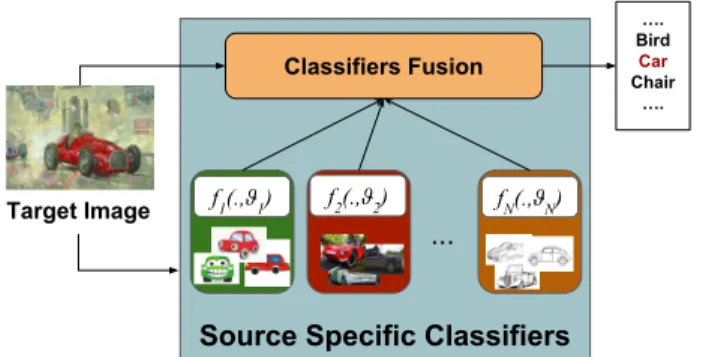
Fig. 1. Intuition behind the the proposed framework. Differ-ent domain-specific classifiers and the classifiers fusion are learned at training time on source domains,in a single end-to-end trainable architecture. When a target image is processed, our deep model optimally combines the source models in or-der to compute the final prediction.
existence of a dataset bias issue when considering different data collections [8], most efforts have been focused on re-ducing the domain shift amongtwodistributions, correspond-ing to aspecific source and aspecific target domain. Such research efforts go under the name of Domain Adaptation, for which there is a large literature of shallow and deep ap-proaches [2, 1, 19, 14].
A less researched direction is Domain Generalization (DG), that consists in bridging the domain gap regardless of the target data distribution. This concretely corresponds to scenarios where it is costly to acquire in advance target data or it is impossible to predict a priori the specific target scenario where the system will operate. Besides practical considerations, DG attempts to address the issue of dataset bias in a more principled manner: a visual recognizer ready to work in the wild should guarantee robust performancesin any target domain.
This paper contributes to this last research thread and we propose a novel deep network for addressing the problem of DG. Different from previous works for DG based on learn-ing domain-invariant representations with deep architectures
[10, 5], our intuition is that, given several source domains and their associated domain-specific classifiers, generality can be achieved at test time classifying each incoming tar-get image by optimally fusing the prediction scores of the source-specific classifiers. This is achieved through an end-to-end trainable deep architecture with two main components (Fig.1). The first implements the source-specific classifiers, while the second module is a network branch which computes the similarities of an input sample to all source domains, such as to assign weights to the source classifiers and properly merge their predictions. The second module is also designed in order to easily permit, if needed, the integration of a do-main agnostic classifier which, acting in synergy with the domain-specific models, can further improve generalization. We assess our method on two public available datasets, ob-taining state of the art performances.
Related Work.Although less researched than domain adap-tation, the need for DG algorithms has been recognized for quite some time in the literature [16]. The works presented so far can be roughly divided in two categories. The first cat-egory is based on the intuition that DG can be achieved by abstracting from the available sources some knowledge about the classes to be recognized that is domain independent. This idea is exploited by previous methods searching for a domain invariant feature space where to project the data [5, 16] or by approaches attempting to generate domain agnostic clas-sifiers using both shallow [18, 6] or deep learning models [10, 15, 12].
The second category exploits the idea that it is possible to measure the similarity among the available source domains and every sample of the target domain. By exploiting this in-formation robust classification models for the target domain are built constructing different source-specific classifiers and optimally combining them [20, 13]. Our work falls into this second category. However, opposite to previous studies, we cast the idea into a deep learning framework, proposing to our knowledge one of the first end-to-end trainable deep architec-ture for DG maintaining source-specific representations.
2. DOMAIN GENERALIZATION WITH SOURCE-SPECIFIC CLASSIFIERS 2.1. Problem Definition and Notation
The goal of DG is to extend the knowledge acquired from a set of source domains to any unknown target domain. Specifi-cally, let us consider a classification task whereCis the num-ber of categories. Our purpose is to learn a classification functionf for the unknown target domain, having only ac-cess to source samples at training time. Formally, we denote withXT the target domain and withXS ={XS1, . . . ,XSN}=
{(xi, yi, di)}Mi=1 the set ofN source domains. Here, xi is
an image,yi ∈ <C a binary vector with a single non-zero
entry indicating the semantic category associated toxi,di ∈
{1, . . . , N}the label denoting the domain to which the sam-ple belongs,Mthe total number of source samples.
Source Specific Classifiers
x ℒ c f1(x,θ1) y f2(x,θ2) fN(x,θN) ... fdom(x,θdom) w d ∑w α ℒdom [1/N, … , 1/N] z λ .
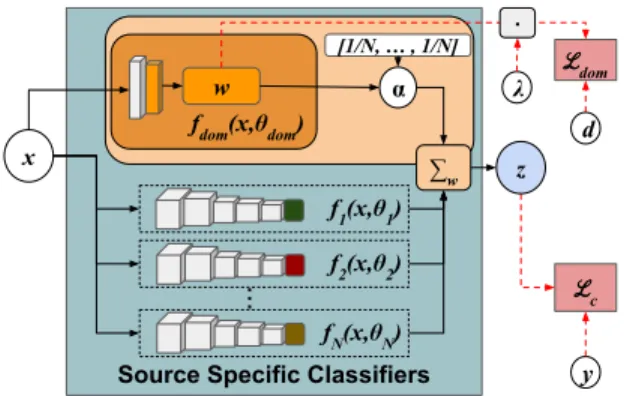
Fig. 2. Simplified architecture of the proposed framework. The input image is fed to a series of domain specific classifiers and to the domain prediction branch. The latter produces the assignmentwwhich is fed to the domain prediction loss. The samewis modulated byαbefore being used to combine the output of each classifier. The final output of the architecture
z, is fed to the classification loss.
2.2. Combining Source-specific Classifiers for DG As discussed in the introduction, our aim is to address the DG problem classifying each sample of the target domain through an appropriate combination of domain specific mod-els derived from source domains. Formally, we consider a classification functionf(xi,Θ)mapping an input imagexito
a vectorzi∈ <Cof class predictions,i.e.:
zi=f(xi,Θ) = N
X
j=1
wi,jfj(xi, θj) (1)
where fj indicates the classifier associated to the j-th
do-main,Θ ={θj}Nj=1denotes the set of parameters to learn and
eachθj the parameters corresponding to a specific domainj.
While several choices off are possible, we choose to imple-ment it with a convolutional neural network with many par-allel branches, each corresponding to a domain-specific clas-sifierfj. To avoid high computational cost, we consider the
same architecture for eachfj, sharing all the parameters
ex-cept those of the last layer before the classifier. In formulas
θj ={θˆs,θˆj}, whereθˆsindicates the shared parameters and
ˆ
θjthe domain-specific ones.
The computation of the weightswi,jused to combine the
domain-specific classifiers is at the core of our method and is discussed in the following.
In case of source samples, since each image is associated to a specific domain there is an obvious choice for setting the weightswi,j. Specifically, we can definewi,j =1di=j,
where1diis an indicator function with value 1 ifdi =jand
0 otherwise. This corresponds to learningNdomain-specific classifiers independently. In fact, due to the presence of the indicator function, training the network using a standard clas-sification lossLc(zi, yi),e.g. a cross-entropy loss, we have
∂Lc
∂fj(xi,θj) = 0forj6=di. As a consequence, the parameters
ˆ
θjof the classifier relative to domainjare updated using only
the losses computed on samples belonging to the setXJ S.
Unfortunately, learning domain-specific classifiers as dis-cussed above is not useful in a DG scenario. In fact, while at training time we can rely on the domain labeldito build the
indicator functions, this is not possible at test time since we do not have this information for target samples. To solve this is-sue and learn the weightswi,j, we propose to incorporate into
our deep architecture a parallel network branch,i.e.adomain predictionbranch, mapping a given input imagexito the
as-sociated weight vectorwi = [wi,1,· · · , wi,N]T ∈ <N. In
other words we definewi =fdom(xi, θdom), wherefdomis
the mapping function corresponding to the domain prediction branch. For each input imagexi, we impose0 ≤wi,j ≤ 1
andPN
j=1wi,j = 1for all1 ≤ i ≤ N. Thus, each weight
wi,jrepresents the probability thatxibelongs to domainj.
Since at training time we have access to the domain labels
diof source samplesxi, we can learn the parametersθdomby
minimizing a loss functionLdom(wi,dˆi)betweenwianddˆi,
wheredˆi∈ <N is a binary vector with a single non-zero entry
corresponding to the domain labeldi. In our implementation,
sincefdomshares parameters with the classification branches
fj, we train the proposed architecture minimizing the
follow-ing loss function:
L= 1 M M X i=1 (Lc(zi, yi) +λLdom(wi, di)) (2)
where both the semantic classification lossLcand the domain
prediction loss Ldom are implemented with cross-entropy
loss. The hyperparameterλbalances the contribution of the semantic classification and the domain prediction terms.
One possible issue with the proposed deep architecture is that, as minimizing the domain loss promotes the learning of independent source classifiers, source sets with few samples may correspond to classifiers with poor performances. While parameter sharing among the deep models implementingfj
naturally limits this effect, we further improve the robustness of our model adding a domain-agnostic component into the final classification function. In practice, we introduce a pa-rameter0 < α <1and at training time we randomly switch with probabilityαbetween using the computed weightswi,j
or assigning to all of them the same value1/N. This choice corresponds to modifying the classification model in Eqn.(1) as follows: zi= (1−α) N X j=1 wi,jfj(xi, θj) + α N N X j=1 fj(xi, θj) (3)
As shown in the formula the parameter αis used to regu-late the trade-off between the domain specific and the domain agnostic component. Figure 2 provides an overview of the proposed end-to-end trainable deep architecture.
3. EXPERIMENTS
Datasets. We test the performance of our method on two publicly available benchmarks. Therotated-MNIST [5] is
a dataset composed by different domains originated apply-ing different degrees of rotations to images of the original MNIST digits dataset [9]. We follow the experimental proto-col of [15], randomly extracting 1000 images per class from the dataset and rotating them respectively of 0, 15, 30, 45, 60 and 75 degrees counterclockwise. As previous works, we consider one domain as target and the rest as sources.
The PACS database [10] is a recently proposed bench-mark which is interesting due to the high domain shift within its domains. It contains images taken from different repre-sentations (i.e.Photo, Art paintings, Cartoon and Sketches) associated to seven semantic categories. Following the exper-imental protocol of [10], we train our model considering three domains as source datasets and the remaining one as target. Networks and training protocols. In our evaluation we set the parametersα= 0.25andλ= 0.5. For the experiments on the rotated-MNIST dataset, we employ the LeNet architec-ture [9] following [15]. The network is trained from scratch, using a batch size of 250 with an equal number of samples for each source domain. We train the network for 10000 it-erations, using Stochastic Gradient Descent (SGD) with an initial learning rate of 0.01, momentum 0.9 and weight de-cay 0.0005. The learning rate is dede-cayed through an inverse schedule, following previous works [4]. For the domain pre-diction branch, we take as input the image and perform two convolutions, with the same parameters of the first two con-volutional layers of the main network. Each convolution is followed by a ReLU non linearity and a pooling operation. The domain prediction branch terminates with a global aver-age pooling followed by a fully connected layer which outputs the final weights. To ensure thatPN
j=1wi,j= 1, we apply the
softmax operator after the fully connected layer.
For PACS, we trained the standard AlexNet architecture, starting from the ImageNet pretrained model. We use a batch size of 192, with 64 samples for each source domain. The initial learning rate is set to5·10−4with a weight decay of
10−6and a momentum of 0.9. We train the network for 3000
iterations, decaying the initial learning rate by a factor of 10 after 2500 iterations, using SGD. For the domain prediction branch, we use the features ofpool5as input, performing a global average pooling followed by a fully-connected layer and a softmax operator which outputs the domain weights.
Our evaluation is performed using a NVIDIA GeForce 1070 GTX GPU, implementing all the models with the pop-ular Caffe [7] framework. For the baseline AlexNet architec-ture we take the pretrained model available in Caffe.
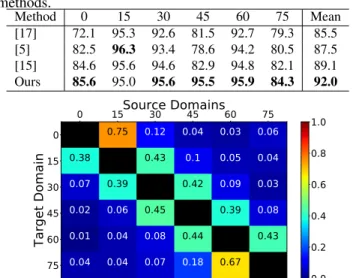
Results. We first test the effectiveness of our model on the rotated-MNIST benchmark. We compare our approach with the method in [15] and the multi-task autoencoders in [5] and [17]. The results from baseline methods are taken directly from [15]. As shown in Table 1, our model outperforms all the baselines. A remarkable gain in accuracy is achieved in the 45o case. We ascribe this gain to the capability of our
Table 1. Rotated-MNIST dataset: comparison with previous methods. Method 0 15 30 45 60 75 Mean [17] 72.1 95.3 92.6 81.5 92.7 79.3 85.5 [5] 82.5 96.3 93.4 78.6 94.2 80.5 87.5 [15] 84.6 95.6 94.6 82.9 94.8 82.1 89.1 Ours 85.6 95.0 95.6 95.5 95.9 84.3 92.0 0 15
Source Domains
30 45 60 75 0 15 30 45 60 75Target Domain
0.75 0.12 0.04 0.03 0.06 0.38 0.43 0.1 0.05 0.04 0.07 0.39 0.42 0.09 0.03 0.02 0.06 0.45 0.39 0.08 0.01 0.04 0.08 0.44 0.43 0.04 0.04 0.07 0.18 0.67 0.0 0.2 0.4 0.6 0.8 1.0Fig. 3. Rotated-MNIST dataset: analysis of the assignments computed by the domain prediction branch.
deep network to assign, for each target image, more impor-tance to the source domains corresponding to the closest ori-entations, increasing the weights of the associated classifiers. Indeed, since45o is in the middle of the range between all
possible orientations, it is likely that a stronger classifier can be constructed since we can exploit all the source models ap-propriately re-weighted. To further verify the effectiveness of our framework and its ability to properly combine source-specific models, we also compute for target samples with dif-ferent orientations the number of assignments to each source domain. In this experiment one target samplexiis assigned
to a source domain by computing the arg maxjwi,j. The
results are shown in Fig. 3 (the number of assignments are normalized for each row). The figure clearly shows that the proposed domain prediction branch tends to associate a target sample to the source domains corresponding to the closest orientations. Consequently, our deep network classifies target samples constructing a model from the most related source classifiers. This results into more accurate predictions than previous domain-agnostic models due to the specialization of source classifiers on specific orientations.
We also perform experiments on the PACS dataset. We compare our model with both previous approaches using pre-computed features (in this case DECAF-6 features [3]) as in-put [5, 20, 16] and end-to-end trainable deep models [10, 11]. For a fair comparison the deep models [10, 11] and our net-work are all based on the same architecture,i.e.AlexNet. Ta-ble 2 shows the results of our comparison. The performance of previous methods are taken directly from previous papers [10, 11]. For our approach and [10] we also report results obtained without finetuning. Our model outperforms all pre-vious methods. These results are remarkable because, differ-ently from the rotated-MNIST dataset, in PACS the domain shift is significant and it is not originated by simple image
per-Table 2. PACS dataset: comparison with previous methods. Model Art Cartoon Photo Sketch Mean [5] 60.3 58.7 91.1 47.9 64.5 [20] 59.7 52.9 85.5 37.9 58.9 [16] 64.6 64.5 91.8 51.1 68.0 [10] (no ft) 62.7 52.7 88.8 52.2 64.1 [10] 62.9 67.0 89.5 57.5 69.2 [11] 66.2 66.9 88.0 59.0 70.0 Ours (no ft) 64.1 60.6 90.4 49.4 66.1 Ours 64.1 66.8 90.2 60.1 70.3 AlexNet [10] 63.3 63.1 87.7 54.1 67.1
Table 3. PACS dataset: sensitivity analysis.
α Art Cartoon Photo Sketch 0 65.2 54.5 90.7 52.4 0.25 64.1 60.6 90.4 49.4 0.5 63.8 61.0 90.4 49.1 0.75 64.0 60.9 90.5 47.8 1 63.0 60.1 90.5 47.5
turbations. Therefore, the association between a target sam-ple and the given source domains is more subtle to capture. For sake of completeness we also report the performances obtained with the standard AlexNet network. These results shows that state of the art deep models have excellent gen-eralization abilities, typically outperforming shallow models. However, designing deep networks specifically addressing the DG problem as we do leads to higher accuracy.
We also perform a sensitivity analysis to study the impact of the parameterαon the performance and demonstrate the benefit of adding a domain-agnostic classifier. We consider the proposed approach without finetuning. As shown in Ta-ble 3, considering only the source-specific classifiers (α= 0) leads, on average, to the best performances, surpassing in the majority of the cases a domain agnostic classifier obtained by settingα = 1. This confirms our original intuition that addressing DG by fusing multiple source models is an effec-tive strategy. However, there are few situations where using only source models can lead to a decrease in accuracy (e.g. in the setting Cartoon) and incorporating a domain-agnostic component, even with reduced weight asα= 0.25, improves generalization accuracy.
4. CONCLUSIONS
We presented a novel deep architecture for addressing the problem of DG by exploiting multiple domain-specific clas-sifiers. In the network a domain prediction branch chooses the optimal combination of source classifiers to use at test time, based on the similarity between the input image and the samples from the source domains. A domain agnostic com-ponent is also introduced in our framework further improving the performance of our method. Our experiments demonstrate the effectiveness of the proposed deep architecture which out-performs state of the art models in two benchmarks. Future works will include the exploration of different architectural choices for the domain prediction branch.
5. REFERENCES
[1] F. M. Carlucci, L. Porzi, B. Caputo, E. Ricci, and S. R. Bul`o. Autodial: Automatic domain alignment layers. In International Conference on Computer Vision, 2017. [2] G. Csurka. Domain adaptation in computer vision
ap-plications. 2017.
[3] J. Donahue, Y. Jia, O. Vinyals, J. Hoffman, N. Zhang, E. Tzeng, and T. Darrell. Decaf: A deep convolu-tional activation feature for generic visual recognition. InICML, 2014.
[4] Y. Ganin and V. Lempitsky. Unsupervised domain adap-tation by backpropagation. InICML, 2015.
[5] M. Ghifary, W. Bastiaan Kleijn, M. Zhang, and D. Bal-duzzi. Domain generalization for object recognition with multi-task autoencoders. InICCV, 2015.
[6] T. Grubinger, A. Birlutiu, H. Sch¨oner, T. Natschl¨ager, and T. Heskes. Multi-domain transfer component anal-ysis for domain generalization. Neural Processing Let-ters, pages 1–11, 2017.
[7] Y. Jia, E. Shelhamer, J. Donahue, S. Karayev, J. Long, R. Girshick, S. Guadarrama, and T. Darrell. Caffe: Con-volutional architecture for fast feature embedding. In ACM-Multimedia, 2014.
[8] A. Khosla, T. Zhou, T. Malisiewicz, A. A. Efros, and A. Torralba. Undoing the damage of dataset bias. In ECCV. Springer, 2012.
[9] Y. LeCun, L. Bottou, Y. Bengio, and P. Haffner. Gradient-based learning applied to document recogni-tion. Proceedings of the IEEE, 86(11):2278–2324, 1998.
[10] D. Li, Y. Yang, Y.-Z. Song, and T. M. Hospedales. Deeper, broader and artier domain generalization. In ICCV, 2017.
[11] D. Li, Y. Yang, Y.-Z. Song, and T. M. Hospedales. Learning to generalize: Meta-learning for domain gen-eralization. InAAAI, 2018.
[12] W. Li, Z. Xu, D. Xu, D. Dai, and L. Van Gool. Domain generalization and adaptation using low rank exemplar svms. T-PAMI, 2017.
[13] M. Mancini, S. R. Bul`o, B. Caputo, and E. Ricci. Ro-bust place categorization with deep domain generaliza-tion.IEEE Robotics and Automation Letters, 3(3):2093– 2100, July 2018.
[14] M. Mancini, L. Porzi, S. Rota Bul`o, B. Caputo, and E. Ricci. Boosting domain adaptation by discovering latent domains. InComputer Vision and Pattern Recog-nition (CVPR), June 2018.
[15] S. Motiian, M. Piccirilli, D. A. Adjeroh, and G. Doretto. Unified deep supervised domain adaptation and gener-alization. InICCV, 2017.
[16] K. Muandet, D. Balduzzi, and B. Sch¨olkopf. Domain generalization via invariant feature representation. In ICML, 2013.
[17] S. Rifai, P. Vincent, X. Muller, X. Glorot, and Y. B. C. Auto-Encoders. Explicit invariance during feature ex-traction. InICML, 2011.
[18] T. Tommasi, N. Quadrianto, B. Caputo, and C. H. Lam-pert. Beyond dataset bias: Multi-task unaligned shared knowledge transfer. InACCV, 2012.
[19] R. Xu, Z. Chen, W. Zuo, J. Yan, and L. Lin. Deep cock-tail network: Multi-source unsupervised domain adapta-tion with category shift. InComputer Vision and Pattern Recognition (CVPR), June 2018.
[20] Z. Xu, W. Li, L. Niu, and D. Xu. Exploiting low-rank structure from latent domains for domain generalization. InECCV. Springer, 2014.