Analysis of Heat Transfer over a Stretching Rotating Disk by Using
Homotopy Analysis Method
M. Khaki1*, E. Dabirian2 and D.D. Ganji3 1
Department of Mechanical Engineering, Islamic Azad University, Sari Branch, Sari, Iran. 2
Department of Mechanical Engineering, Islamic Azad University, Sari Branch, Sari, Iran. 3
Department of Mechanical Engineering, Babol University, Babol, Iran.
*Corresponding Author's E-mail:[email protected]
Abstract
his work studies the problem of steady three dimensional flows and heat transfer of viscous fluid on a rotating disk stretching in radial direction has been investigated. The governing equations, continuity and momentum for this problem are reduced to an ordinary form and are solved by Homotopy Analysis Method (HAM). The accuracy of HAM is authenticated by comparing with numerical solution as Boundary Value Problem (BVP). It has been attempted to show the capabilities and wide-range applications of the HAM in comparison with the numerical method. This method led to high accurate appropriate results for nonlinear problems in comparison with numerical solution.
Keywords: Boundary layer flow, Homotopy Analysis Method, Stretching rotating disk.
1.
Introduction
The study of flow field due to a rotating disk has found many applications in different fields of engineering and industry. A number of real processes can be undertaken using disk rotation such as: fans, turbines, centrifugal pumps, rotors, viscometers, spinning disk reactors and other rotating bodies. The history of rotating disk flows goes back to the celebrated paper by Von Karman [1-3] who initiated the study of incompressible viscous fluid over an infinite plane disk rotating with a uniform angular velocity. This model is further investigated by many researchers to provide analytical and numerical results for better understanding of the fluid behavior due to rotating disks [4-5]. The investigation on rotating disks fluid flow was the main purpose of many pervious researches [6-8]. In most cases, these problems do not admit analytical solution, so these equations should be solved using special techniques. In recent decades, much attention has been devoted to the newly developed methods to construct an analytic solution of equation; such as Perturbation techniques which are too strongly dependent upon the so-called ‘‘small parameters’’ *9+. Other many different methods have introduced to solve nonlinear equation such as Adomian’s decomposition method [10], Homotopy Perturbation Method (HPM) [10–14], Variational Iteration Method (VIM) [15–18], Collocation Method [19]. In contrast with the previous analytic techniques, HAM [20-22] has the following benefits: firstly, unlike all previous analytic techniques, the HAM provides us with great freedom to express solutions of a given non-linear problem by means of different base functions. Secondly, unlike all previous analytic techniques, the HAM always provides us with a family of solution expressions in the auxiliary parameter h, even if a non-linear problem has a unique solution. Thirdly, unlike perturbation techniques, the HAM is independent of any small or large quantities. So, the HAM can be applied no matter if governing equations and boundary/initial conditions of a given
T
non-linear problem contain small or large quantities or not [23-26]. The main purpose of this study is to apply HAM to find approximate solutions of the flow and heat transfer over a rotating disk that is stretching in the radial direction. A clear conclusion can be drawn from the numerical method’s (NUM) results that the HAM provides highly accurate solutions for nonlinear differential equations.
2.
Problem statement and mathematical formulation
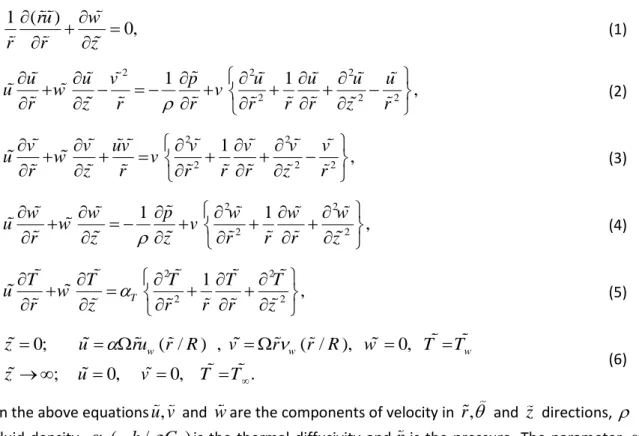
Let us consider a three dimensional laminar flow of a steady incompressible fluid over a rotating disk, which has a constant angular velocity-X. The disk is stretching in radial direction with velocity uwð~rÞ. The governing Navier–Stokes equations and energy equation with the corresponding boundary conditions for an axi-symmetric flow and heat transfer in cylindrical coordinates are given by [27- 31]: (1)
1 (
)
0,
ru
w
r
r
z
(2) 2 2 2 2 2 21
1
,
u
u
v
p
u
u
u
u
u
w
v
r
z
r
r
r
r
r
z
r
(3) 2 2 2 2 21
,
v
v
uv
v
v
v
v
u
w
v
r
z
r
r
r
r
z
r
(4) 2 2 2 21
1
,
w
w
p
w
w
w
u
w
v
r
z
z
r
r
r
z
(5) 2 2 2 21
,
TT
T
T
T
T
u
w
r
z
r
r
r
z
(6)0;
( /
) ,
( /
),
0,
;
0,
0,
.
w w wz
u
ru
r R
v
r
r R
w
T
T
z
u
v
T
T
In the above equations
u v
,
andw
are the components of velocity inr
,
andz
directions,
is the fluid density,
T(k/
Cp)is the thermal diffusivity andp
is the pressure. The parameter
is a constant known as disk stretching parameter [28].A pragmatic approach to find boundary layer equations is to introduce non-dimensional variables in the governing Eqs (1)–(6). We consider the following non-dimensional variables for cur-rent problem.
(7)
1 1 2 2 2 0 , Re , , , Re , , , r z u v w r z u v w R R R R R T T p p T T R
Where
Re
R
2/
is Reynolds number, R is the reference length andT
0 is the reference temperature. It is noteworthy that the corresponding scales in the axial direction are smaller by a factorR
1/2 thus implicitly anticipating thatRe
1
[28]. For high Reynolds number, i.e.Re
, the resulting boundary layer equations in dimensionless form are obtained as follows(8)
1 (
)
0,
ru
w
r
r
z
(9) 2 2 2u
u
v
p
u
u
w
r
z
r
r
z
(10) 2 2,
v
v
uv
v
u
w
r
z
r
z
(11)0
p
,
z
(12) 2 21
,
Pr
T
T
T
u
w
r
z
z
(13)0;
( ),
( ),
0,
;
0,
0,
0.
w w wz
u
ru
r
v
rv
r
w
T
T
z
u
v
T
where
Pr
/
Tis the Prandtl number. By using Lie group analysis by Saleem Asghar [32-34] and introducing similarity variable and the similarity functions are given by:(14) / / ( )/ 2 ( )/ 2 , ( ), ( ), ( ), ( ). b a b a a b a b a a z u r f v r g r w r h T
where the form of
h
( )
will be determined from the continuity equation. From the continuity equation, the stream function
( , )
x y
is de-fined as(15)
,
.
ru
rw
z
r
Eq.(14) together with Eq.(15)give
(16) ( 3 )/2
( ).
b a ar
f
From Eqs.(15) and (16), the form of w is given by: (17) ( )/2 3 . 2 2 b a a b a a b w r f f a a
To make the two values of w [(16) and (17)] consistent we require
(18) 3 ( ) 2 2 b a a b h f f a a
Using the similarity transformation (14) and (18), the continuity equation (8) is automatically satisfied and the boundary layer problem (9)–(3) is conveniently transformed into a self-similar form:
(19) 2 2 3 0, 2 a b b f ff f g a a (20)
3
0,
2
a b
b
a
g
fg
f g
a
a
(21)3
Pr
0,
2
a b
f
a
(22) (0) , (0) 0, (0) 1, (0) 1 ( ) 0, ( ) 0, ( ) 0. f f g f g
3. Application of Homotopy Analysis Method on problem
For HAM solutions, we choose the initial guess and auxiliary linear operator in the following form: (23)
0 , 0 , 0 f
g
(24) ( ) , ( ) , ( ) , L f f f L g gg L
(25) 2 1 2 3 4 5 6 71
(
)
0,
(
)
0,
(
)
0,
2
L
c
c
c
L c
c
L c
c
where
c i
i(
1,.., 6)
are constants. LetP
0
,
1
denotes the embedding parameter and indicates non –zero auxiliary parameters. We then construct the following equations:Zeroth –order deformation equations
(26)
0
(1
P L F
)
( ; )
p
f
( )
p N F
( ; ) ,
p
(27) (0; ) 0; (0; ) , ( ; ) 0 F p F p
F p (28)
2 3 3 23
[ ( ; )]
( ; )
( ; )
( ; )
( ; )
2
( ; )
d
a b
d
b
d
N F
p
f
p
f
p
f
p
f
p
d
a
d
a d
g
p
(29)
0
(1
P L G
)
( ; )
p
g
( )
p N G
( ; ) ,
p
(30) ( ; ) 0; (0; ) 1 g p g p (31) 2 2
3
[ ( ; )]
( ; )
( ; )
( ; )
2
( ; )
( ; )
d
a b
d
N G
p
g
p
f
p
g
p
d
a
d
b
a
d
g
p
f
p
a
d
(32)
0
(1
P L
)
( ; )
p
( )
p N
( ; ) ,
p
(33) ( ; )p 0; (0; )p 1
(34) 2 23
[ ( ; )]
( ; ) Pr
( ; )
( ; ),
2
d
a b
d
N
p
p
f
p
p
d
a
d
For
p
0
andp
1
we have(35) 0
( ;0)
( ) ,
( ;1)
( ) .
F
f
F
f
(36) 0( ;0)
( ) ,
( ;1)
( ) .
G
G
(37) 0( ;0)
( ) ,
( ;1)
( ) .
When p increases from 0 to 1 then
F
( ; ), ( ; )
p G
p
and
( ; )
p
varies fromf
0( ),
g
0( )
and 0( )
tof
( ), ( )
g
and
( )
. By Taylor's theorem and using equation (19),F
( ; ), ( ; )
p G
p
and
( ; )
p
can be expanded in a power series of p as follows:(38) 0 1 1
1
( ( ; ))
( ; )
( )
( )
,
( )
,
!
m m m m m m pf
p
F
p
f
f
p
F
m
p
(39) 0 1 11
( ( ; ))
( ; )
( )
( )
,
( )
,
!
m m m m m m pg
p
G
p
g
g
p
G
m
p
(40) 0 1 11
( ( ; ))
( ; )
( )
( )
,
( )
,
!
m m m m m m pp
p
p
m
p
In which is chosen in such a way that this series is convergent at
p
1
, therefore we have through equation (21) that (41) 0 1( )
( )
m( ) .
mF
f
f
(42) 0 1( )
( )
m( ) .
mG
g
g
(43) 0 1( )
( )
m( ) .
m
(44)
( )
1( )
( ),
f m m m mL F
F
R
(45)
1 1 1 1 0 1 2 1 1 03
2
m f m m m k k m k k k m m k k m kb
a b
R
f
f
f
f
f
a
a
g
g
M f
(46) '(0; ) 0; '(0; ) 0, '( ; ) 0 m m m F p F p F p (47)
( )
1( )
( ),
g m m m mL G
g
R
(48)
1
1 1
1
03
2
m g m m m k k m k k ka b
b a
R
g
f
g
g
f
a
a
(49) '(0; ) 0; '( ; ) 0. m m g p g p (50)
m( )
m m1( )
m( ),
L
R
(51)
1
1 1 03
Pr
2
m m m k m k ka b
R
f
a
(52) '(0; ) 0; '( ; ) 0. m p m p
(53)0,
1
,
1,
1
mm
m
Now we determine the convergency of the result, the differential equation, and the auxiliary function according to the solution expression. So let us assume:
( ) 1
H
(54)We have found the answer by maple analytic solution device. For first deformation of the solution are presented below.
(55)
2 2 2 2 3 2 2 1 3 3 2 1 2 2 2 2 1 1 1 3 1 1 2 4 6 4 1 1 1 18 9 2 3 3 2 18 15 13 8 1 1 6 72 a a a b b a f a a a b a a a b a a a
(56)
2 2 3 2 3 2 1 2 3 1 1 1 1 2 6 2 6 : 2 3 4 2 1 6 a a a b b g a a a b a
(57)
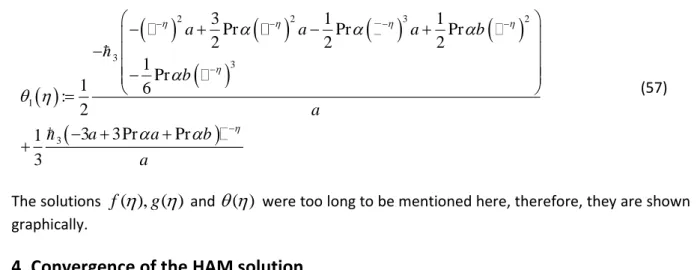
2 2 3 2 3 3 1 3 3 1 1 Pr Pr Pr 2 2 2 1 Pr 1 6 : 2 3 3Pr Pr 1 3 a a a b b a a a b a
The solutions
f
( ), ( )
g
and
( )
were too long to be mentioned here, therefore, they are shown graphically.4. Convergence of the HAM solution
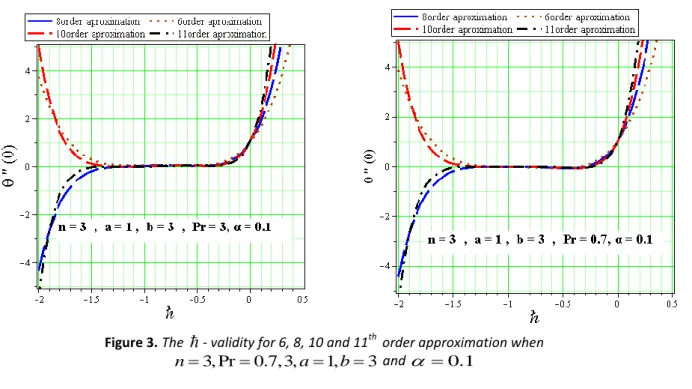
As pointed out by Liao, the convergence region and rate of solution series can be adjusted and controlled by means of the auxiliary parameter ħ*20-22]. In general, by means of the so-called ħ-curve, it is straightforward to choose an appropriate range for ħ which ensures the convergence of the solution series.
Figure 2. The - validity for 6, 8, 10 and 11th order approximation when
1, Pr 3, 1, 1
n a b and 0.5
To influence of ħ on the convergence of solution, we plot the so-called ħ-curve of f ″ (0) , g ″ (0) and
(0)
by 6, 8, 10 and 11 th-order approximation, as shown in Fig. 2 and 3. For1, Pr 3, 1, 1
n a b and 0.5 the ranges for f ″ (0) equal to
1.3
0
, for g ″ (0) equal to
1.5
0
, for n3, Pr0.7, 3,a1,b3 and 0.1 the ranges
1.5
0.4
,Figure 3.The - validity for 6, 8, 10 and 11th order approximation when
3, Pr 0.7, 3, 1, 3
n a b and 0.1
5.
Result and discussions
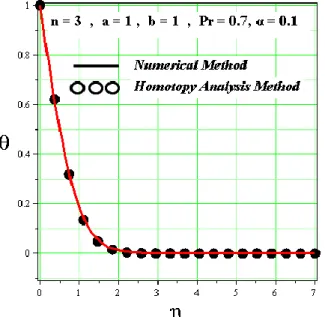
In this study, the accuracy and validity of this approximate solution on steady three dimensional flows and heat transfer of viscous fluid on a rotating disk stretching in radial direction has been investigated. The results of HAM and numerical solution are compared in Figures (4). The numerical solution is performed using the algebra package Maple 15.0, to solve the present case. The software uses a second-order difference scheme combined with an order bootstrap technique with mesh-refinement strategies: the difference scheme is based on either the trapezoid or midpoint rules; the order improvement/accuracy enhancement is either Richardson extrapolation or a method of deferred corrections [34]. By the drawing of 2-D Figures 4, of numerical solution and HAM solution for
f
( )
,f
( )
and
( )
it can be seen in graphical results the obtained analytical solution in comparison with the numerical ones represents a remarkable accuracy.Figure 4. The comparison between the numerical and HAM solution for
( ), ( )
f
g
and
( )
when n1, 3, Pr0.7, 3,a0.1,b1.The effects of controlling parameters (disk stretching parameteraand power-law stretching indexn) on the azimuthally velocity
g
( )
, the radial velocityf
( )
, the vertical velocityf
( )
and the temperature
( )
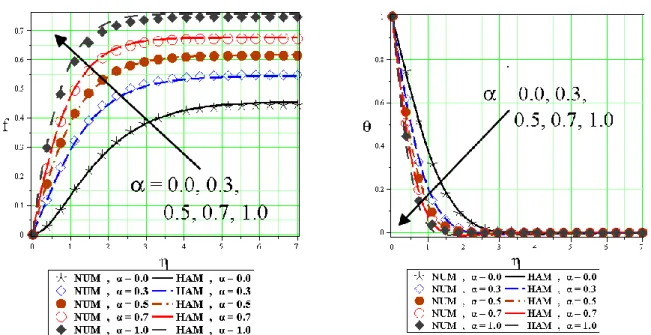
are presented in Figs. 3 and 4.Figure 5. Variation of (a) azimuthally velocity profiles, (b) radial velocity profiles, (c) vertical velocity profiles and (d) temperature profiles for different values of disk stretching parameter when
n
1,
a
1,bn, Pr3
.Figs(7) Shows the comparison of the azimuthally velocity
g
( )
, the radial velocityf
( )
, the vertical velocityf
( )
and the temperature
( )
for known values of the parameters
n
1,
a
1,bn, Pr3
and different value of stretching parameter
respectively. The results show that, by increasing value of
leads to increase radial and vertical velocities increase while the azimuthal velocity and temperature profiles decrease.Figure 6. Variation of (a) azimuthally velocity profiles, (b) radial velocity profiles, (c) vertical velocity profiles and (d) temperature profiles for power-law index n when
a
1,bn, Pr3,0.1
. In addition, Figs. (6) Shows the 4shows the effects of power-law stretching index-n of the azimuthally velocityg
( )
, the radial velocityf
( )
, the vertical velocityf
( )
and the temperature
( )
for known values of the parameters
a
1,bn, Pr3,0.1
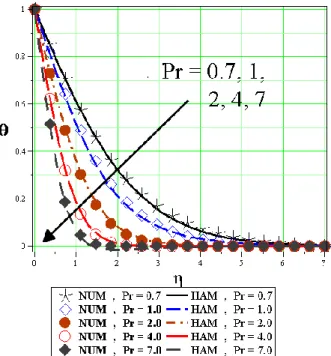
. The results show that, as the value of n increases, the temperature and the two components of velocity decrease.Figure 7.Dimensionless temperature predicted by HAM and numerical method (NUM) for different Pr Prandtl number at
n
3,
a
1,b3,0.1
Moreover, Fig7 shows the effect of Prandtl number on the dimensionless temperature profile. As observed, an increase in the Prandtl number leads to decrease in the temperature. This is an agreement with the physical fact that the thermal boundary layer thickness decreases with increasing Pr.
Conclusion
In this paper, we implemented the Homotopy Analysis Method (HAM) for finding solutions of flow and heat transfer over a rotating disk stretching non-linearly in radial direction. The governing equations, continuity and momentum for this problem are reduced to an ordinary single third form by using a similarity transformation. Furthermore, the obtained solutions by HAM are compared with numerical solution. By Comparing between numerical solution and Analytical Results proves the accuracy and validity of method. In addition, the effect of stretching parameter index n is to decrease the velocity and the temperature profile. Moreover Increase of stretching parameter
shows an increase in vertical and radial components of the velocity and decrease in azimuthal component and temperature profiles.References
[1] A. Aziz, A similarity solution for laminar thermal boundary layer over a flat plate with a convective surface boundary
condition, Commun. Nonlinear Sci. Numer. Simul. 14 (2009), 1064–1068.
[2] Abbasi, M., Hamzeh Nava, Gh., Rahimipetroudi, I., Analytic solution of hydrodynamic and thermal boundary layers over a flat plate in a uniform stream of fluid with convective surface boundary condition, Indian J. Sci. Res, 1(2014), 1, 15-19.
[3] A.H. Nayfeh, Perturbation Methods, Wiley, New York, USA, 2000.
[4] A. Vahabzadeh, M. Fakour, D. D. Ganji, I. Rahimipetroudi, Analytical accuracy of the one dimensional heat transfer in geometry with logarithmic various surfaces, Central European Journal of Engineering, 4(2014), 4, 341-351.
[5] F. White, Viscous Fluid Flow, MacGraw, New York, 1991, 335–393.
[6] Ganji, D. D., Abbasi, M., Rahimi, J., Gholami, M., Rahimipetroudi, I., On the MHD squeezeflow between two parallel disks with suction or injection via HAM and HPM, Front. Mech. Eng. DOI 10.1007/s11465-014-0303-0
[7] G.W. Bluman, S. Kumei, Symmetries and differential equations, in: Applied Mathematical Sciences, vol. 1, Springer, Berlin, New York, 1989.
[8] H. Schlichting, K. Gersten, Boundary-layer Theory, Springer, Verlag, 2000.
[9] I. Rahimi Petroudi, D. D. Ganji, A. B. Shotorban, M. Khazayi Nejad, E. Rahimi, R. Rohollahtabar, F. Taherinia, Semi analytical method for solving nonlinear equation arising of natural convection porous fin, THERMAL SCIENCE, 16 (2012), 5, 1303-1308
[10] I.V. Shevchuk, Convective Heat and Mass Transfer in Rotating Disk Systems, Springer, Berlin, 2009.
[11] J.H. He, Homotopy perturbation method: a new nonlinear analytical technique, Applied Mathematics and Computations, 135 (2003), 73-79.
[12] J.H. He, Homotopy perturbation method for solving boundary value problems, Physics Letters A, 350 (2006), 87-88. [13] J. H. He, Variational iteration method for autonomous ordinary differential systems, Applied Mathematics and Computation, 114 (2000), 115-123.
[14] J.H. He, Variational iteration method – some recent results and new interpretations, Journal of Computational and Applied Mathematics, 207 (2007) ,1,3–17.
[15] K. Millsaps, K. Pohlhausen, Heat transfer by laminar flow from a rotating plate, J. Aerosp. Sci. 19 (1952), 2, 120–126. [16] Khaki, M., Abbasi, M., Rahimi Petroudi, I., M. Naghdi Bazneshin, R., Semi- analytical investigation of a transverse magnetic field on Viscous Flow over a Stretching Sheet, MAGNT Research Report,2 (2014), 2, 50-57
[17] L. Rosehead, Laminar Boundary Layer, Oxford University Press, Oxford, 1963.
[18] M. Abbasi, D. D. Ganji, I. Rahimipetroudi, M. Khaki, Comparative analysis of MHD boundary-layer flow of viscoelastic fluid in permeable channel with slip boundaries by using HAM, VIM, HPM. Walailak Journal for Science and Technology, 11(2014), 7, 551–567.
[19] M. Awad, Heat transfer from a rotating disk to fluids for a wide range of Prandtl numbers using the asymptotic model, J. Heat Transfer 130 (2008), 1.
[20] M. Abbasi, A. Ahmadian CHashmi, I. Rahimipetroudi, Kh. Hosseinzadeh, Analysis of a fourth grade fluid flow in a channel by application of VIM and HAM, Indian J.Sci.Res. 1(2014), 2, 389-395.
[21] M. Jalil, S. Asghar, Flow of power-law fluid over a stretching surface: a lie group analysis, Int. J. Non-Linear Mech. 48 (2013) 65–71.
[22] M. Jalil, S. Asghar, S.M. Imran, Self similar solutions for the flow and heat transfer of Powell–Eyring fluid over a moving surface in a parallel free stream, Int. J. Heat Mass Transfer 65 (2013) 73–79.
[23] M. Jalil, S. Asghar, M. Mushtaq, Lie group analysis of mixed convection flow with mass transfer over a stretching surface with suction or injection, Math. Prob. Eng. 2010 (2010).
[24] M. Shahbabaei, S. Saedodin, M. Soleymanibeshei, I. Rahimipetroudi,MHD effect on thermal performance of cylindrical spin porous fin with temperature dependent heat transfer coefficient and emissivity, International Journal of Energy & Technology, 6 (2014), 16, 1–10
[25] N.K. Ibragimov, CRC Handbook of Lie Group Analysis of Differential quations, Symmetries, Exact Solutions, and Conservation Laws, vol. I, CRC Press Llc, 1994.
[26] P. Olver, Application of Lie groups to differential equations, Graduate Texts in Mathematics, vol. 107, 1986, Springer, New York.
[27] Rahimipetroudi, I., Ganji, D.D., Khazayi Nejad, M., Rahimi, J., Rahimi, E., Rahimifar, A., Transverse magnetic field on Jeffery–Hamel problem with Cu-water nanofluid between two non-parallel plane walls by using collocation method, Case Studies in Thermal Engineering, 4(2014), 193-201,
[28] Saleem Asghar, Mudassar Jalil, Muhammad Hussan, Mustafa Turkyilmazoglu, Lie group analysis of flow and heat transfer over a stretching rotating disk, International Journal of Heat and Mass Transfer 69 (2014) 140–146
[29] SJ. Liao, Beyond perturbation: introduction to the homotopy analysis method. Boca Raton: Chapman & Hall, CRC Press, 2003.
[30] SJ. Liao, Homotopy Analysis Method in Nonlinear Differential Equations, Springer & Higher Education Press, Heidelberg, 2012.
[31] SJ. Liao, Series solutions of unsteady boundary-layer flows over a stretching flat plate, Studies in Applied Mathematics, 117(2006), 239-263.
*32+ S. Momani, S. Abuasad, Application of He’s variational iteration method to Helmholtz equation, Chaos Solitons & Fractals, 27 (2006), 5, 1119–1123.
[33] T.V. Kármán, Über laminare und turbulente Reibung, Zeit. Angew. Math. Phys. 1 (4) (1921) 233–252.
[34] T. Von Kármán, C. Lin, On the existence of an exact solution of the equations of Navier Stokes, Commun. Pure Appl. Math. 14 (3) (1961) 645–655.