Capacity development platform for promoting
efficient urban water management
Phát tri
ể
n ngu
ồ
n nhân l
ự
c thúc
đẩ
y qu
ả
n l
ý
hi
ệ
u qu
ả
n
ướ
c
đ
ô th
ị
E v e n t R e p o r t
S t e f a n , C a t a l i n1* ; P h a n , H o a n g M a i1; P h a m , V a n B o2; W e r n e r , P e t e r1
1Institute of Waste Management and Contaminated Site Treatment, Technische Universität Dresden, Pratzschwitzer Str.
15, 01796 Pirna, Germany; 2Academy of Managers for Construction and Cities, Km 10, Nguyen Trai, Thanh Xuan,
Hanoi, Vietnam
The present paper summarizes the results of an application initiated within the framework of 35 years celebration of diplomatic relations between Germany and Vietnam. Within this context, the Technische Universität Dresden (TUD) and the Academy of Managers for Construction and Cities (AMC) jointly organized in 2010 a series of four thematic workshops. The one-day events have had similar structures and focused on main subjects of interest in the water sectors of both coun-tries. In Vietnam, the workshops took place in Ha Noi, Hai Phong, Nha Trang and Vung Tau. Best practice examples about conceptualization, operation and maintenance of municipal water works provided an insight view into the challenges currently faced by the water service providers. TUD and AMC, together with their German and Vietnamese partners, addressed these issues by organiz-ing the consecutive workshops under the umbrella of Vietnamese Water Supply and Sewerage As-sociation (VWSA) and in coordination with the German Water Partnership (GWP).
Bài báo trình bày tóm tắt các kết quả của một đề xuất trong khuôn khổ kỷ niệm 35 năm quan hệ
ngoại giao giữa CHLB Đức và Việt Nam. Theo đó, Trường Đại học Tổng hợp Kỹ Thuật Dresden (TUD) và Học viện Quản lý Xây dựng và Đô thị (AMC) đã phối hợp tổ chức một chuỗi bốn hội thảo chuyên đề trong năm 2010. Mỗi hội thảo thực hiện trong một ngày chương trình giống nhau và tập trung vào các chủđề chính mà cả hai quốc gia đều quan tâm trong lĩnh vực nước. Phía Việt Nam, các hội thảo được tổ chức ở các thành phố Hà Nội, Hải Phòng, Nha Trang và Vũng Tàu. Nhiều bài thuyết trình về khái niệm hóa, vận hành và bảo dưỡng các công trình cấp nước đô thịđã thảo luận sâu về những thách thức mà các dịch vụ cấp nước đang gặp phải. TUD và AMC, kết hợp với các đối tác CHLB Đức và Việt Nam, đã ghi nhận các vấn đề phát sinh thông qua việc tổ chức nhiều hội thảo liên tục dưới sự bảo trợ của Hiệp hội Cấp thoát nước Việt Nam (VWSA) và Hiệp hội nước CHLB Đức (GWP).
Keywords: water, workshop, wastewater, training, Vietnam
1. Introduction
The broad economic transition process in Vietnam, cou-pled with an increasing population growth and strong impact of climate change lead to immense pressure on local water operators. The high investment demand is being partially covered by local government with aid from international players. However, local problems require local solutions and the top-down approach is not always easy to be implemented in an effective manner. To over-come these problems, technical solutions must be backed-up with additional packages of measures in order to pro-vide a sustainable development of local capacities. The framework conditions related to the celebration of 35
years of diplomatic relations between Germany and Vi-etnam paved the road for an intense exchange of experi-ence between the two countries including several work-shops and conference on water related issues. One of these initiatives has been promoted by the Technische Universität Dresden (TUD) and the Academy of Manag-ers for Construction and Cities (AMC) who organised a series of four thematic workshops from June to October 2010. The main objective of this joint initiative is to build up decentralized cooperation platforms on technical, eco-nomic, scientific and political levels. The planned activi-ties are expected to contribute not only to the develop-ment of technical capacities but also to managerial and planning competences in water sector. Moreover, a direct link has been secured to research and development
pro-grams by including topics from current R&D projects into training curriculum.
The created platforms will lead to the construction of a human resource database composed of motivated repre-sentatives of water management sector in Vietnam. The workshop participants are being selected mostly among national and provincial level state owned companies,
private enterprises, water service providers and other institutions dealing with drinking water supply and wastewater management (69.7% from total number of participants). Beside that, scientific staff from academic institutions (15.6%), decision makers from ministerial departments (2.16%), as well as local governments (7.79%) were also invited to participate to the workshops (Table 1).
Table 1. Distribution of workshop participants
Participants Ha Noi Hai Phong Nha Trang Vung Tau Total
Ministerial representatives 5 0 0 0 5
Water service providers 31 27 47 56 161
Departments of local government 0 8 10 0 18
Academic and training institutions 16 8 8 4 36
Others 4 1 1 5 11
TOTAL 56 44 66 65 231
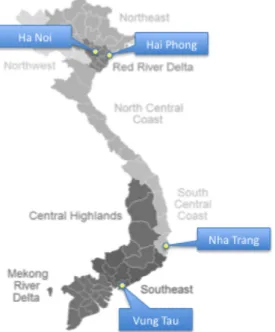
Three regions from Vietnam have been chosen to accom-modate the workshop activities: Red River Delta region (with two workshops in Ha Noi and Hai Phong, respec-tively), South Central Coast region (Nha Trang city) and Southeast region (Vung Tau city), with one workshop each (Figure 1).
Figure 1. Locations of the workshops in Vietnam and the case studies in Germany
For most effective transfer of information to targeted groups, the planned activities have been undertaken with the professional support of AMC, a well-known training institution with national and international expertise under the Vietnamese Ministry of Construction. AMC had the role of executive implementing body on the Vietnamese side, the bi-national consortium being thus allowed to use the AMC’s excellent infrastructure and experience in organising capacity building events for reaching work-shops’ objectives. On the German side, TUD has been the initiator of the program and the main coordinator of activ-ities. Several German and Vietnamese companies have been invited to actively contribute with technical input to
the workshop. These mainly include water service provid-ers such as Gelsenwasser AG, Dresden Sewage and Drainage Co., Ltd., Hai Phong Drainage Co., Ha Noi Water Works, Khanh Hoa Water Supply Co., Ba Ria - Vung Tau Urban Sewerage and Drainage Co., but also planning offices (Institute for Technical and Scientific Hydrology Ltd.) and plants manufacturers like Passavant-Roediger Ltd., Vietnam Water and Environment Invest-ment Co. Ltd., and My Chau EnvironInvest-ment & Electrical Technologies Co. Ltd.
2. Integrated water resources
man-agement and urban development
Integrated water resources management (IWRM) is a simple but very effective approach that promotes a coor-dinated management of physical resources in such a way that both people and environment will get most benefit of them without endangering a further use. IWRM can thefore be interpreted as an interdependent use of water re-sources in the same time with considering all related so-cial, economical aspects.
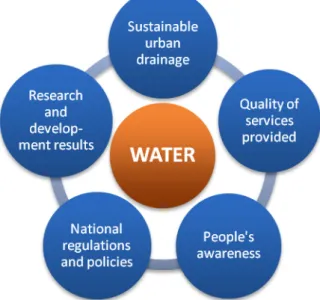
For a sustainable urban development, water management is not only a matter of technical challenges but it must also address a series of additional interrelated aspects. These include the development and implementation of suitable policies, finding appropriate financial instru-ments, development of programs for raising awareness at local community level and consistent participation of end-users, in parallel with investing continuous efforts for quality improvement of services provided.
The selection of topics to be presented at the workshop’s sessions has been done by considering the most relevant factors that can affect the good functionality of water management systems as depicted in the Figure 2:
Figure 2. Criteria for the selection of workshop’s ses-sions
Special focus has been allocated to the quality of services provided to the consumer in direct relation to implementa-tion of technical and financial soluimplementa-tions for increasing the efficiency of water management in urban areas. The lec-tures presented covered thus various subjects that can be wrapped-up in three major sessions: safe drinking water supply, efficient urban drainage and sustainable resources conservation. The following chapters will provide a sum-mary of the workshop lectures including a synopsis of general discussions initiated during the four training events in Ha Noi, Hai Phong, Nha Trang and Vung Tau.
2.1 Safe drinking water supply
2.1.1 Vietnamese policies and regulations
Mr Nguyen Ton, Chairman of Vietnamese Water Supply and Sewerage Association (VWSA) introduced the Viet-namese policies for drinking water supply and wastewater management and the status of implementation. Mr Ton mentioned the role and responsibility of different players in national water supply and drainage programs. All eco-nomic sectors are encouraged by the state to engage in investment and operation of water systems. Mr Ton ex-plained the binding agreements between water drainage companies and local authorities and how the costs for water services are calculated. The objectives by the year 2025 refer to 100% coverage of water supply in urban areas and 80% in rural areas with about 120 l daily con-sumption (at the moment 70% and 30%, respectively). Another important target is reduction of water loss below 15%, as well as providing stable water supply service. In addition, well-designed master development plans must enable sustainable exploitation and protection of water resources. Mr Ton also addressed the necessity of improv-ing the technical qualification of staff members of water companies. This could have a positive influence on rais-ing the company efficiency and reachrais-ing a higher capacity of resources exploitation (at the moment at 71%).
2.1.2 Guidelines for safe drinking water supply in metropolitan areas
Mr Matthias Lindner described the general guidelines used by GELSENWASSER AG for reaching the objec-tives of a sustainable public water supply in Germany: continuous supply and in sufficient amounts of safe drink-ing water, water exploration and exploitation usdrink-ing close-to-nature approaches and compliance with the European Water Directive. The company is following a two-way strategy: protection of environment and water resources based on prevention instead of remediation and, if preven-tion is not enough, then use “as much nature as possible and as much technology as necessary” for treatment pur-poses. For better understanding of this approach, Mr Lindner suggested a detailed set of measures aimed at helping the water provider to reach the above goals. Among them it has been mentioned the polluter-pays principle, treatment of pollutants at source, cooperation with the agricultural sector for the avoidance or minimiza-tion of the immissions and other similar prevenminimiza-tion- prevention-oriented solutions. Mr Lindner provided also some best-practice examples of standardized treatment of drinking water including artificial groundwater recharge, particle removal, adsorption and disinfection.
2.1.3 Drinking water supply in Ha Noi
Mrs Pham Thi Thanh Thuy, Deputy General Director of Ha Noi Water Works gave the audience an overview about the actual capacity and activities of her company. She also mentioned several challenges in drinking water abstraction, such as: subsidence of land and groundwater level in Ha Noi, high leakage of water pipes, higher water consumption and the water price cannot cover the invest-ments. In the long term, Ha Noi Water Works strives for a sustainable IWRM and for covering completely the drink-ing water demand of Ha Noi. For the comdrink-ing time, the company will improve its pipe net to reduce water leak-age. Another assignment is maintaining, repairing and installing new water meters. Ha Noi Water Works also want to expand their pipe net to new districts in Ha Noi, so that the water consumption of Ha Noi can be complete-ly covered.
2.1.4 Methods of improving water supply management capability in Vung Tau
Vung Tau Water Supply Joint Stock Company supplies water to 120,000 customers. The capacity conducts 150,000 m3/day with a leakage rate of 12.59%. This in-formation was delivered by Mr Dinh Tri Duc, General Director of BWACO. At the moment, the highest achievement of his company is improving capability in management and also in technology. Business administra-tion, training management skills and customer service are main focuses that should be leading to a better manage-ment system of the company. Another ambitious aim is finding suitable technical solutions in water quality and water supply system management. The quality of raw water in input must be assured as well as the quality
con-trolling during the whole treatment and supplying pro-cesses must be improved. In the near future, BWACO will apply GIS and other network remote controlling techniques to achieve these aims. The company will also use tools like business management software and digital-ised archives. Last but not least, Mr Duc reported on social activities of his company, such as: promoting awareness of water sources protection and organizing students’ extracurricular activities at the water plant. 2.1.5 Investment in water sector
Mr Le Kha Manh, General Director of VIWASEEN Cor-poration, and Mr Luong Ngoc Khanh, Director of Scien-tific Department at VIWASEEN, introduced to audience the field of activities of their company with several exam-ples on water supply and drainage projects in Southern and Northern Vietnam. Mr Khanh complemented Mr Ton with adding additional comments on the policy and in-vestment challenges in Vietnamese water sector. To re-spond increasing challenges, several solutions have been proposed: promoting suitable methods for protection of water resources, improved management solutions, apply-ing environmentally friendly technologies. Mrs Röstel confirmed the importance of PPP models for local in-vestment programs but emphasized the urgent necessity of implementation of costs covering prices for long-term development of water sector.
2.2 Wastewater collection, treatment and
disposal
2.2.1 Collection of domestic sewage
Mr Frank Männig, Head of Sewerage Network Depart-ment at Dresden Sewage and Drainage Co., Ltd. (SEDD) gave a lecture on sewer inspection. Different techniques can be used for identification of external damages to the sewerage network and thus help in the selection of suita-ble rehabilitation technologies.
Since the renewal, renovation and restoration technolo-gies are mostly based on the avoidance of excavation works, the non-invasive methods will substantially reduce the overall maintenance costs. In case of Vietnam, dis-turbance of traffic by soil excavation can be extremely important issue that can be avoided by using non-invasive techniques.
2.2.2 Decentralized and semi-centralized treatment of sewage water
With high urban development rates, an important percent-age of the investment costs are related to installation of pipelines for drinking water supply and drainage sewers. This can be addressed by putting more focus on the de-velopment of semi-centralized and decentralised systems. Mr Thorsten Frings, Deputy General Director of (MCEETECH) provided an estimation of necessary con-struction works in terms of total sewers length that need to be installed in order to reach the proposed objectives by 2025. Several solutions have been suggested such as
de-signing small sewage treatment plants according to differ-ent effludiffer-ent classes (solution adopted in Germany). The participants have shown a high interest in topics presented and raised questions regarding financial feasibility of implementation of small-scale units in Vietnam. Accord-ing to Mr FrAccord-ings, investment for treatment units for 1 - 50 PE can range from USD 2,000 - 10,000. For bigger units (50 - 1,000 PE) the plants are custom tailored based on the specific pollution load of the domestic wastewater (however, treatment steps must be designed on a case-by-case basis). Further on, examples of decentralised systems applied in Germany and other countries offered a better image about how small treatment plants could be integrat-ed into existing pre-sintegrat-edimentation tanks.
2.2.3 Management of sewage sludge
The sewage sludge is another problem insufficiently ad-dressed by Vietnamese regulations and Mr Frings empha-sised the necessity of more focus on this issue at national level. It has been suggested to always select the “most appropriate” method for sewage sludge stabilization. Dr. Mark Husmann, CEO at Passavant-Roediger GmbH, underlined the benefits of using anaerobic stabilisation methods. Dr. Husmann introduced the main principle of anaerobic digestion and presented examples of full-scale applications worldwide.
The operational benefits of anaerobic stabilisation includ-ed significant rinclud-eduction of solids producinclud-ed at WWTP (30-35%), reduction of energy costs, improvements in sludge dewaterability, reduction in greenhouse gas emissions. The benefits have been shown by an analysis done on a case study by comparing both aerobic and anaerobic sludge stabilisation and considering several indicators such as tank volume, energy consumption and amount of produced sludge.
2.2.4 Case study from Germany SAXONY, Dresden
Mrs Gunda Röstel, General Director of Dresden Sewerage and Drainage Company, Ltd., explained that the challeng-es faced now by the Vietnamchalleng-ese drainage companichalleng-es have been similar in Eastern Germany about (only) 20 years ago. Mrs Röstel talked about different managerial instru-ments, including open customer management as part of the PPP model implemented at SEDD in Dresden, where 51% of the shares belong to the state and 49% to the pri-vate water company Gelsenwasser AG. Among all com-mon challenges, the costs related to energy consumption are extremely high, which made the drainage company looking for alternatives. It has been estimated that by the year 2012 the Dresden Sewage and Drainage Co. will cover more than 50% of own energy demand by using renewable sources.
In parallel to optimization of technical processes, the company is searching for additional management tools such as using renewable energy for own company de-mand. By reducing energy consumption and partial
sub-stitution with renewable sources, the water provider can make substantial benefits. The main strategy of SEDD is oriented therefore on three directions: increase the energy efficiency by careful monitoring and reduction of energy consumption, independent powering of WWTP on the next future, as well as making use of energy surplus by selling it to third parties. Besides obvious financial bene-fits, the concept is rather new for the Vietnamese water sector and not yet considered as priority. However, this could be included on the design of future WWTP.
2.2.5 Case studies from Vietnam SOUTH CENTRAL COAST REGION Nha Trang (Khanh Hoa Province)
Mr Tran Van Huy, General Director of Khanh Hoa Water Supply Co., presented the activities of the water services provider in Nha Trang. The company is in charge with both water supply of the city, as well as design and man-agement of sewerage system (including service for private septic tanks). The company is facing technical challenges related to drinking water pipes rehabilitation works (thus high water loss ratios) but also is facing financial con-strains in development projects. Moreover, maintenance works are restricted by responsibility conflicts, the com-pany not having access to collecting and management of many operational parameters. Fast urbanisation rate is posing additional threads to urban drainage efficiency due to insufficient synchronisation between different invest-ment programs. Discussions have been raised regarding the pollution of Cai River that requires implementation of flexible treatment technologies. Very sensitive issue is represented by drinking water supply to offshore islands, which at the moment is done by small operators who transport fresh water from the main land. Due to very high costs of water desalination projects, water supply for the islands still must be done in conventional ways. One suggestion is to focus on the development of the touristic sector for co-financing of future development projects. SOUTHEASTERN REGION
Vung Tau city(Ba Ria - Vung Tau Province)
Mr Hoang Duc Thao, General Director of Ba Ria – Vung Tau Urban Sewerage and Development Company (BUSADCO) gave general information about all services delivered by his company in wastewater sector: consul-tancy services, services in water supply, drainage and environmental sanitation. At the moment, BUSADCO owns 10 projects with the total investment cost of 329 million USD on the field of wastewater collection, treat-ment and drainage. In the last years, the company has also achieved very positive results on remediation of water pollution in Vung Tau. Wastewater was prevented from directly discharging into the beaches, tourism, public and residential areas. Also the stench of regulation lakes and open wastewater drainage channels in Vung Tau City could be reduced. According to Mr. Thao, six large partial flooding areas of the province were completely eliminat-ed.
Moreover, the company developed successfully different technical products, such as: a winch for cleaning drainage systems, the technology of fabricating pre-cast reinforced concrete with thin walls, improved septic tanks in urban as well as in rural areas. Many of them were certified and have won national and international prizes. The technolo-gy of fabricating pre-cast is also implemented by BUSADCO in two wastewater plants, in Ha Noi and Vinh City.
RED RIVER DELTA REGION
Hai Phong City (Hai Phong Municipality)
Mr Nguyen Minh Tuan, General Director of Hai Phong Drainage Company, introduced the situation of sewage collection in Hai Phong by describing the local geograph-ical, social and economic characteristics. The wastewater drainage is in rather poor conditions, the city having in-sufficiently developed sewerage network, no central wastewater treatment plant, prices are by far not covering the involved costs, people’s awareness about protection of drainage system is still weak, unclear regulations about collection of municipal waste, lack of waste and sewage water collection from industrial areas etc. Currently, sew-age water is collected from the private septic tanks by trucks and discharged into open ponds. After aeration and sedimentation, the remaining sludge is mixed with organ-ic waste and composted. Mr Tuan made several sugges-tions on the improvement of existing situation: raising people’s awareness on the protection of drainage system, better management and maintenance of existing drainage system, building a sewage treatment plant in western side of the city, as well as enhancing the technical capacity of staff members of the drainage company.
2.3 Tools for resources protection
2.3.1 Storm water management
Dr. Lothar Fuchs, CEO Institute for Technical and Scien-tific Hydrology, Ltd. (itwh), provided general guidelines on how to avoid the threads of high urbanisation on water resources. Among common mistakes made nowadays in urban planning, Dr. Fuchs enumerated the long distance transportation of wastewater without cleaning it, discharg-ing the water directly into the water courses, builddischarg-ing dykes and concreting river banks thus destroying their natural self-cleaning potential as well as cosmetically beatifying infrastructure with planting not adapted to natural soil and water conditions. As consequence of single-minded engineering and landscape architecture, natural water cycles can be irremediably destroyed. Dr. Fuchs provided several nature-oriented solutions against these threads and exemplified with cases studies from Germany and Vietnam where integrated storm water management concepts has been proposed. The solutions are based on one simple principle: combination of per-forming essential engineering tasks with providing recrea-tional open space functions for population. This can be achieved by making use as much as possible of natural
processes, with designing the urban landscape as a hybrid of infrastructure, ecological functions and green space for people.
Regarding the case study from Long Bien district, Ha Noi, the comments from audience confirmed the necessity of separation of drainage from storm water, a high interest being manifested in replication potential of the project. Mr Nguyen Minh Tuan from Hai Phong raised the ques-tion of financing opques-tions for projects of this kind, not only regarding investment but also maintenance (will the popu-lation support the costs, local authority or external sources?). Dr Fuchs added that main objective in Long Bien is the avoidance of groundwater table lowering by sustainable management of storm water in addition to flooding prevention measures. The costs have to be calcu-lated on a larger scale based on prevention-restoration comparison. Discussions have been running into multi-function purpose facility use and Dr. Fuchs underlined the self-maintenance character of such concept. Further comments referred to the specific geographical position of the project, as other areas (e.g. Ha Noi downtown) have more important flooding problems. However, the project in Long Bien has a preventive character and targets rather at ‘avoidance’ instead of ‘reparation’ methods.
2.3.2 Artificial groundwater recharge
Prof. Peter Werner from the Technische Universität Dres-den emphasized the negative impact caused by lowering of the groundwater tables on urban infrastructure. Addi-tional recharge of groundwater table can be done artifi-cially by infiltration of storm water and pre-treated do-mestic sewage water. Several case studies worldwide have been presented with a more detailed example from Berlin, Germany, where over 75% of drinking water de-mand is covered by bank river filtration and artificial groundwater recharge (AGR) and Long Bien district, Ha Noi.
Lab-scale investigations on the efficiency of soil-aquifer-treatment have shown an increased capacity of soil matrix for further clean up of infiltration water. Different infiltra-tion scenarios have been analysed using computer models for establishing most convenient conditions for artificial recharge. The results of the preliminary studies indicate that AGR can be a feasible method for prevention of further lowering of groundwater table.
3. Conclusions and recommendations
3.1 Podium discussion in Hanoi
Discussions have been mainly polarized on financial and technical issues. Regarding financial aspects, special focus has been allocated to cost-covering prices in water sector as instrument for investment in water sector. Be-side national development programs, new investment sources must be sought-after, especially on the interna-tional side. In this case, attention shall be paid to devel-opment and implementation of new standards and policies
and their real suitability to Vietnamese conditions. Re-garding technical issues, the audience claimed a more efficient use of water resources including a series of measures for water loss minimisation. The lesson learned from workshop in Ha Noi is to always back-up the pro-motion of modern technologies with efficient training programs and know-how transfer for a sustainable urban development.
3.2 Podium discussion in Vung Tau
Vung Tau can be considered as best-practice example on urban water management, both for its drinking water supply as well as for sewerage and drainage situation. Despite its superb geographical location, the city is facing threads of global change such as sea level raising, intru-sion of salt water into drinking water supply system etc. The city municipality is continuously implementing pro-grams for raising people’s awareness on water resources protection, including programs applied in schools and teaching institutions. One question from audience referred to the difficulty in evaluating the performance of water service providers especially in cases when they have monopole on a local market. This is however not applica-ble to all cities, in Ho Chi Minh City for instance the water services are provided by five different companies. The audience has shown interest in the courses offered by AMC and suggested development of training programs for increasing the retirement revenue for companies’ staff members.
3.3 Podium discussion in Hai Phong
Discussions focused on the sea level rising (climate change) and salt water intrusions due to lowering of groundwater level. Hai Phong does not face important problems with sea water intrusion due to its higher posi-tion. However, an important problem is caused by the damaged sewers, thus allowing intrusions of external waters. Hai Phong is using a video survey system for the sewerage network but this can only be operated in dry conditions, Mr Nguyen Tuan being very interested in survey systems that can operate under water. Mr Männig explained that under water operation is not a technical issue but rather the visibility is the obstruction factor (high turbidity does not allow collection of good video data).
Based on a Japanese consultancy study, Mr Tuan consid-ers that a decentralised wastewater treatment system may not be feasible in Hai Phong due to high population densi-ty and is concerned about odour problems in decentralised systems. Mr Husmann gave the example of a decentral-ised plant in the middle of Bangkok, where hotels and residential areas are located right close to the treatment plant and explained that odour issues can be easily con-trolled.
Mr Tuan brings into discussion the heavy metals issue, which can be handled by the big, centralised treatment plants, but is not yet clear the situation of small decentral-ised plants. Mr Husmann suggested treatment of heavy
metals directly at source, otherwise they can accumulate in the sludge and only solution is combustion.
3.4 Podium discussion in Nha Trang
The participants have shown high interest on the costs of technologies involved in different lectures. Mr Frank Männig provided some prices for video survey cameras that can vary from 3,000 - 4,000 EUR (hand hold camera) to 50,000 EUR and much more for an automated system, depending on accuracy, size and additional functionali-ties. Mr Mark Husmann offered some prices ranges for sewage sludge stabilisation plants stressing that exact costs can vary a lot based on the technology used and local conditions.
Mr Mark Husmann addressed the audience and asked for the initiation of direct bilateral contacts between Viet-namese companies in water sector and German represent-atives. Further projects can be initiated on case-by-case basis and Mrs Gunda Röstel explained the role of such workshop on improving the relationships between tech-nical, political and private sectors in both countries.
3.5 Workshops’ outcomes and further
coop-eration
The workshops organized with technical expertise from both German and Vietnamese experts have aimed at set-ting the foundation stones for a network of competence among water service providers from both countries. As fruitful example, direct bi-lateral partnership is currently being under preparation between Ba Ria - Vung Tau Ur-ban Sewerage and Drainage Co. and Dresden Sewerage and Drainage Co. On another level, the project facilitated a direct link between the Vietnam Water Supply and Sewerage Association (VWSA) and German Water Part-nership (GWP) whose representatives agreed upon sign-ing a Memorandum of Understandsign-ing for enablsign-ing closer contacts between water companies from both countries. The workshops’ outcomes have been wrapped-up during an official reception offered by the German Embassy in Vietnam. With this occasion, the German Ambassador Mr
Rolf Schulze and the Vietnamese Vice-Minister of Con-struction, Mr Tran Van Son saluted the running initiatives and expressed full support for further activities in the field of capacity development. In this regard, representatives of TUD and AMC signed a long-term agreement for jointly designing training programs on urban management and promoting long-term cooperation in water supply and drainage technologies.
4. Acknowledgement
The four workshops have been sponsored by the German Federal Ministry of Education and Research (project ‘IWAS’, BMBF internal reference no. 02WM1028) and its International Bureau (project ‘TEAM’, IB internal reference no. VN 10/025) and co-sponsored by the Viet-namese Ministry of Construction (MOC) through its exe-cuting body AMC. The authors would like to acknowledge the staff members of AMC for perfect workshops implementation, as well as Mr Nguyen Ton from VWSA for his scientific expertise and consultancy. Many thanks go also to the invited speakers for their valuable contributions and last, but not least, to all work-shops’ participants for their interest in the presented top-ics.
5. References
[1] Stefan, C., Phan, H.M., Werner, P. (Ed.) (2010) German-Vietnamese Platform for efficient urban water management. Capacity development initiative - fundamental basis and experience exchange. Book series of Forum of Waste Management and Contam-inant Site Treatment, Vol. 70. Dresden, Germany. ISBN 978-3-934253-62-9.