FIND
: Identifying Functionally and Structurally Important
Features in Protein Sequences with Deep Neural Networks
Ranjani Murali1∗ James Hemp2∗ Victoria Orphan1
Yonatan Bisk3
1Division of Geological and Planetary Sciences, California Institute of Technology 2School of Medicine, University of Utah
3Paul G. Allen School of Computer Science & Engineering, University of Washington
Abstract
The ability to correctly predict the functional role of proteins from their amino acid sequences would significantly advance biological studies at the molecular level by improving our ability to understand the biochemical capability of biological organisms from their genomic sequence. Existing methods that are geared towards protein function prediction or annotation mostly use alignment-based approaches and
probabilistic models such as Hidden-Markov Models. In this work we introduce a deep learning architecture (FunctionIdentification with NeuralDescriptions orFIND) which performs protein annotation from primary sequence. The accuracy of our methods matches state of the art techniques, such as protein classifiers based on Hidden Markov Models. Further, our approach allows for model introspection via a neural attention mechanism, which weights parts of the amino acid sequence proportionally to their relevance for functional assignment. In this way, the attention weights
automatically uncover structurally and functionally relevant features of the classified protein and find novel functional motifs in previously uncharacterized proteins. While this model is applicable to any database of proteins, we chose to apply this model to superfamilies of homologous proteins, with the aim of extracting features inherent to divergent protein families within a larger superfamily. This provided insight into the functional diversification of an enzyme superfamily and its adaptation to different physiological contexts. We tested our approach on three families (nitrogenases,
cytochromebd-type oxygen reductases and heme-copper oxygen reductases) and present a detailed analysis of the sequence characteristics identified in previously characterized proteins in the heme-copper oxygen reductase (HCO) superfamily. These are correlated with their catalytic relevance and evolutionary history. FIND was then applied to discover features in previously uncharacterized members of the HCO superfamily, providing insight into their unique sequence features. This modeling approach
demonstrates the power of neural networks to recognize patterns in large datasets and can be utilized to discover biochemically and structurally important features in proteins from their amino acid sequences.
Author summary
Introduction
1A central idea of molecular evolution is that homologous proteins in different biological 2
organisms possess similar structural and functional properties. Homology of proteins is 3
based on their amino acid sequences, which have some structural and functional 4
properties encoded into them. The extent of sequence similarity of proteins can be used 5
to classify proteins as belonging to different groups that each perform distinct functions 6
or possess a specific set of properties. The proteins which fall within previously 7
identified clusters are then annotated as having a specific function, which is usually 8
experimentally determined for one or more proteins within a cluster. Computational 9
tools such as sequence alignment based methods have been used to infer the biological 10
roles of proteins, based on their similarity to experimentally characterized proteins [1]. 11
These methods can be effective when comparing sequences with a high degree of 12
similarity (60 percent or higher) but fail for more distantly related proteins [2]. 13
Improvements were made to such methods by adding some position specific information 14
to make local alignments [3], or by measuring sequence similarity against databases such 15
as Pfam, with curated domain assignments [4]. Other methods include probabilistic 16
models such as HMMer which calculate a sequence profile indicating the frequency of 17
occurrence of a given amino acid in each position of a protein sequence [5], models 18
incorporating information from phylogenetic trees such as SIFTER [6] or neural network 19
based models where proteins are trained based on InterPro or GO classifications [2]. All 20
of the above methods are more accurate for certain functions and biological systems, 21
and they are evaluated regularly using the critical assessment of functional annotation 22
(CAFA) challenge [7]. There are different challenges for each of the previous methods, 23
some of which have been empirically demonstrated - BLAST alignments for example, 24
cannot easily distinguish between parts of the sequence that align to conserved domains 25
and some variable and less functionally relevant parts of sequences, and HMMs are 26
more useful for annotation when built off a large data set for each protein domain. 27
Neural networks offer some advantages over these methods. 28
Neural networks are computationally different from traditional methods, which are 29
based on sequence alignments. Sequence alignments are computationally limited, and 30
align sequences in a pair-wise manner and iterate over all possible pairs of sequences to 31
compute the extent of similarity between proteins in a given database. In contrast, 32
neural networks can process a larger set of sequences simultaneously to model the 33
similarity in their amino acid sequences. With such advantages, neural networks have 34
been shown to perform classification tasks with a high level of accuracy, even with 35
smaller training sets [8] [9] [10] [11]. Another strength of neural networks is their ability 36
to identify patterns or signals in large sets of data. Large protein superfamilies 37
constitute such a large data set, from which it is conceivable that a neural network can 38
identify “patterns” or functional features that correlate with functional characteristics, 39
provided we curate a database with such specific and useful labels. An often cited 40
disadvantage of neural networks is that they provide little information on the features 41
that were used for classification. We have overcome this disadvantage by making our 42
neural network model interpretable. 43
Our neural network model uses a neural attention mechanism to identify sequence 44
features that are correlated with protein annotation. We use as input, a database of 45
primary amino acid sequences that have been assigned “labels” that are defined based 46
on phylogenetically identified clusters. The network is then trained on these protein 47
sequences and labels to generate a classification model. This model is then used to 48
the model to use small sets of a protein’s sequence to classify it, thus identifying small 50
functional or structural motifs that are inherent to a protein and correlated with the 51
label it is assigned. While traditional methods require rigorous analysis of sequence 52
alignments, extensive knowledge of prior biochemical literature and biochemical 53
intuition, use of interpretable neural network models such as ours offers a useful 54
time-saving tool. Direct extraction of sequence features unique to protein families will 55
aid in mechanistic understanding of proteins unique to different organisms and 56
pathways. Many attempts have been made to use certain characteristics such as % 57
conservation, solvent accessibility or information on neighboring residues to correlate 58
structural features with a protein’s function [12] [13] [14] but, our model is able to 59
identify conserved sequence features directly from primary sequence and without being 60
fed such curated information. 61
To evaluate our method, we built models to classify three different enzyme 62
superfamilies – cytochromebd-type oxygen reductases, nitrogenases and heme-copper 63
oxygen reductases. We achieved a classification accuracy greater than 97 % for all of 64
these families ; comparable to a classification model we built based on Hidden-Markov 65
Models. In addition, our model extracts structurally and functionally important 66
sequence features. We compare the strengths and weaknesses of the above two 67
approaches and discuss different parameters that can be optimized to enhance 68
classification by the neural network. Further, we focused on and evaluated sequence 69
features identified in the model as belonging to each protein family of the heme-copper 70
oxygen reductase (HCO) superfamily. HCOs are a large superfamily of enzymes with 71
several biochemically well-characterized family members. By using the case of 72
experimentally characterized HCO enzymes, we validated our algorithm. Then, we 73
utilized the model to discover several new interesting features in previously 74
uncharacterized members of the HCO superfamily. The HCO superfamily classification 75
model can be used to investigate new HCO sequences – to automatically identify the 76
family they belong to, and extract novel features characteristic of that protein. Finally, 77
our neural network approach is applicable to many protein databases, either small or 78
large in dataset provided they are curated with appropriate labels to train on. When 79
used with different protein superfamilies, we gain additional insight into their 80
biochemical characteristics and into their evolutionary diversification. In order to make 81
our tool accessible, we have madeFINDavailable as a Jupyter notebook, allowing 82
users to train any curated and labelled database of their choice for classification and 83
feature extraction. Given the abundance of genomic and metagenomic sequence data 84
that is currently available and the dearth of functional information, this tool will be 85
helpful in generating additional insight into the possible role of divergent protein 86
sequences as they are discovered. 87
Heme-copper Oxygen Reductase Superfamily
88Background
89The heme-copper oxygen reductase superfamily consists of families of respiratory 90
enzymes – Oxygen reductases (O2-reductases) which perform oxygen reduction to water, 91
or nitric oxide reductases (NOR) which perform nitric oxide reduction to nitrous 92
oxide [15] [16]. It was hypothesized that one family (NOD) performs nitric oxide 93
dismutation [17]. Briefly, these transmembrane enzymes receive electrons from a 94
periplasmic or membrane bound electron donor (cytochrome c or quinol respectively) 95
and use these electrons to perform oxygen or NO reduction. The core architecture of 96
this enzyme typically constitutes a 12-transmembrane helix subunit where the active 97
Fig 1. The heme-copper oxygen reductase superfamily is divided into 18 families based on monophyletic clades recovered through phylogenetic clustering of HCO amino acid sequences. The same clades were recovered using PhyML and MrBayes. The base sequence alignment used for the generation of this tree, as well as the phylogenetic trees are available on our Github databasehttps://github.com/ybisk/FIND.
received from the physiological electron donor (subunit II). However, in one of the 99
families (qNOR), these two subunits are fused into a single polypeptide. The central 100
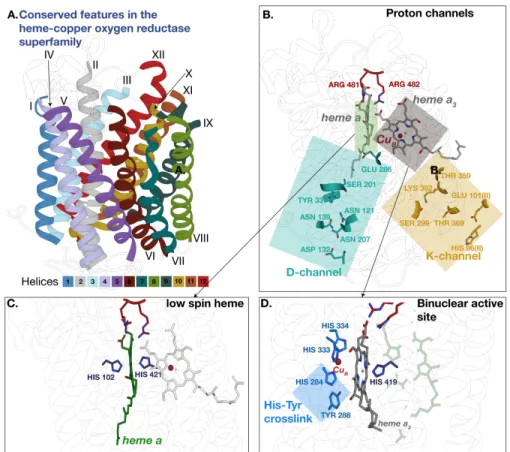
subunit I consisting of 12 transmembrane helices includes several features, conserved 101
across the families that aid in catalyzing the reduction ofO2 or NO. These features can 102
be categorized in terms of protein components needed for (1)electron transfer to the 103
active site, (2)proton transfer to the active site, (3)gas diffusion to the active site and 104
(4) stabilization of redox-active components during catalysis. Co-factors which aid 105
electron tranfer within HCOs include a high-spin heme that transfers electrons from 106
subunit II to the active site and, the active site constituting a low-spin heme and a 107
metal ion. Multiple sequence alignments (MSAs) and experimental studies have 108
identified the amino acids which bind the above mentioned hemes and metals [16]. 109
For proton transfer to the active site, there are conserved proton channels within 110
some of the families, which (i) uptake protons from the cytoplasm for oxygen reduction 111
to water and (ii) translocate protons from the cytoplasm to the periplasm (pumping 112
protons) for generation of proton-motive force(pmf) [18]. This latter mechanism for 113
generation of pmf is absent in cNOR and the proton channel leading from the periplasm 114
replaces the cytoplasmic channel [19]. A gas diffusion channel for diffusion ofO2or NO 115
to the active is present in all of the characterized HCO enzymes, with variations 116
depending on whether the substrate isO2 or NO and the substrate affinity of a given 117
enzyme [20] [21]. 118
Finally, the two hemes involved in catalysis are stabilized by conserved arginines in 119
Table 1. Conserved features in subunit I of heme-copper oxygen reductases, which are important for binding of heme or metal co-factors, transport of substrates to the active site, or catalysis of oxygen reduction to water
Functional characteristic Location in polypeptide sequence
Low spin heme binding site Helix 2 and Helix 10
High spin heme binding site Helix 10
CuB orF eB binding site Helix 6 and Helix 7
O2 diffusion channel Helix 2
and periplasmic loop between Helix 3 and 4
D proton channel Helix 2, Helix 3, Helix 4,
(present only in the A-family) and cytoplasmic loop between Helix 2 and 3
K proton channel Helix 6 and Helix 8
Stabilization of hemes (in C, cNOR) Periplasmic loop between Helix 1 and Helix 2 Stabilization of hemes (in A, B) Periplasmic loop between Helix 11 and Helix 12
The latter Ca2+ is stabilized by interactions with two glutamic acid residues. These
121
glutamates are further stabilized by hydrogen bonding interactions with conserved 122
residues, including a conserved arginine in both families [22] [19]. A fundamental 123
difference in the active site ofO2reductases and NORs involves a unique co-factor - a 124
conserved histidine and a tyrosine, found in allO2reductases make a crosslink to each 125
other and provide an electron to oxygen during catalysis [23]. The tyrosine from the 126
cross-link is absent in the NORs and is replaced by a glutamate or asparagine in the 127
experimentally characterized NORs [24] [25] [26]. All of the above mentioned features 128
are detailed inFigure2andTable 1. 129
To classify protein families within our model, only subunit I was used as was done 130
for their original assignment using phylogenetics [15]Figure 1. 11O2-reductase 131
families and 7 NOR families were used to train the model for classification. NODs were 132
left out of the model because of the smaller set of sequences available for this family. 8 133
of theO2-reductase families were previously described [15] while the I,J,K families have 134
not been previously reported. The cNOR, qNOR and bNOR1, eNOR and sNOR [15]
135
families have been previously described and so has the gNOR family [27]. The remaining 136
family, nNOR is being reported for the first time but will be described in detail in a 137
separate study2. A number of the conserved features mentioned above, as well as
138
variations unique to families within the superfamily were discovered by the model. 139
Materials and Methods
140Data
141Our model represents all proteins as a string of characters. Sequences from within the 142
heme-copper oxygen reductase superfamily were used as input, with their functional 143
annotation assigned by protein phylogenetics. The number of sequences within each 144
family/class are reported inTable 2. 145
Computational Model (FIND)
146In this section we introduce our model forFunctionIdentification with Neural 147
Descriptions orFINDfor short. Our task is to predict the function of a protein based 148
1previously referred to as the qCu
ANOR
Fig 2. Conserved features in subunit I of the heme-copper oxygen reductases. These features, mentioned inTable 1were mapped onto the crystal structre of the A-family enzyme fromRhodobacter sphaeroides RCSB ID:2gsm.PanelsAandB present identical views of the enzyme locating structural features within the context of their
transmembrane helices. A.Structure of A-family enzyme color-coded according to the location of transmembrane helices in the enzyme. B.Location of the active-site heme and metal co-factors as well as conserved D- and K-proton channels within the HCO enzyme. C.Conserved histidines binding the low-spin heme in HCO.D.Conserved amino acids in the binuclear active site including the histidine-tyrosine crosslink that is unique to HCO.
Table 2. Database of protein sequences used in this study from the following superfamilies - heme-copper oxygen reductase (HCO), nitrogenase, cytochromebd. These sequences were split into a training set (Tr), validation set(Val) and test set(Te) for training the artificial neural network for protein classification, and for testing the accuracy of the model, respectively.
heme-copper oxygen reductase cytbd nitrogenases
Tr/Val/Te Tr/Val/Te Tr/Val/Te Tr/Val/Te
A 2569/384/729 bNOR 41/ 5/ 8 A 47/ 6/ 21 Anf 15/ / 5 B 535/ 87/160 cNOR 98/ 19/ 24 B 33/ 1/ 7 nifDI 164/ 28/ 61 C 819/126/229 eNOR 209/ 33/ 55 C 206/24/ 51 nifDII 107/ 15/ 21 D 66/ 9/ 15 gNOR 46/ 5/ 15 E1 373/58/118 nifD ANME 4/ 1/ 4 E 41/ 11/ 11 nNOR 33/ 4/ 7 E2 123/17/ 33 VnfD 8/ / 3 F 26/ 4/ 8 qNOR 284/ 32/ 74 E3 26/ 8/ 10 G 13/ 2/ 3 sNOR 140/ 23/ 40 E4 41/ 3/ 9 H 13/ 1/ 8 I 17/ 1/ 3 J 11/ 1/ 3 K 5/ 1/ 1
solely on its amino acid sequence. For this task, we use prior information in the form of 149
a database of protein sequences which are correlated with a functional label. We then 150
generate a computational model to identify parts of sequence features in the database 151
sequences that correlate with its functional label. Then, the model is used to apply one 152
of the previously curated functional labels to the query amino acid sequence by 153
identifying the predictive features inherent in them. In computational terms, we need to 154
find predictive regions of strings for a multi-class prediction which we train with 155
gradient descent and a standard cross-entropy loss. Our task presents two unique 156
challenges: long sequences and a comparatively small dataset. 157
The traditional approach to processing strings for categorization within Natural 158
Language Processing is to use a Recurrent Neural Network (RNN) [28] sequence model 159
to compress the input. Because our sequences range from 232 to 1095 characters, 160
averaging over 500, RNNs, even when used with an long short-term memory (LSTM) 161
cell [29], will suffer from vanishing gradients [30] and fail to learn. Secondly, as our goal 162
is the construction of a model which provides interpretable insights into functionally 163
predictive aspects of the input, we want to build an attention mechanism [31] which 164
does not dramatically increase our parameter space, given the limited data we have 165
access to. We are able to overcome both of these issues efficiently by using a weighted 166
sum of local predictors, each resulting from a shallow stack of convolutions, and 167
normalized confidence. 168
We present the basic structure of our model inFigure3. A stack of 169
convolutions [32] are applied until we reach a kernel of width 16 (k= 16). The final 170
hidden vector is then passed through two feed-forward layers in order to produce both 171
an attention weight and a set of predictions. The attention weights are normalized 172
across the sequence and then multiplied by their corresponding prediction distributions 173
(logits). This provides a single reweighted logit for the whole sequence scaled by each 174
sub-predictor’s confidence. Finally, these values are summed and used for prediction at 175
inference time or updated via a cross-entropy loss during training. 176
More formally, each unique amino acid type is assigned a random vector inRn, 177
represented simply as an embedding matrixE∈Ra×n. An input sequence S is 178
therefore embedded ase=S·E, before passing ethrough 1-dimensional convolutions 179
1
Attention & Local Predictions
K
1K
4K
8Convolution
Layers
…
=
Final Prediction
K
16 AA 2 4 8 16 32…
27X
27
<latexit sha1_base64="iuEFzMlW8k7L0iNmZ1sKJg6ykkY=">AAACA3icbVBNS8NAEN3Ur1q/oh57WSyCp5AUoXorevFYwdhCE8Jms2mXbjZhdyOE0IMX/4oXDype/RPe/Ddu2xy09cHA470ZZuaFGaNS2fa3UVtb39jcqm83dnb39g/Mw6N7meYCExenLBWDEEnCKCeuooqRQSYISkJG+uHkeub3H4iQNOV3qsiIn6ARpzHFSGkpMJteRGXGUCFVwQj0ZJ4EZbtjWRafBmbLtuw54CpxKtICFXqB+eVFKc4TwhVmSMqhY2fKL5FQFDMybXi5JBnCEzQiQ005Soj0y/kTU3iqlQjGqdDFFZyrvydKlEhZJKHuTJAay2VvJv7nDXMVX/gl5VmuCMeLRXHOoErhLBEYUUGwYoUmCAuqb4V4jATCSufW0CE4yy+vErdtXVrO7Xmre1WlUQdNcALOgAM6oAtuQA+4AINH8AxewZvxZLwY78bHorVmVDPH4A+Mzx+WipeZ</latexit><latexit sha1_base64="iuEFzMlW8k7L0iNmZ1sKJg6ykkY=">AAACA3icbVBNS8NAEN3Ur1q/oh57WSyCp5AUoXorevFYwdhCE8Jms2mXbjZhdyOE0IMX/4oXDype/RPe/Ddu2xy09cHA470ZZuaFGaNS2fa3UVtb39jcqm83dnb39g/Mw6N7meYCExenLBWDEEnCKCeuooqRQSYISkJG+uHkeub3H4iQNOV3qsiIn6ARpzHFSGkpMJteRGXGUCFVwQj0ZJ4EZbtjWRafBmbLtuw54CpxKtICFXqB+eVFKc4TwhVmSMqhY2fKL5FQFDMybXi5JBnCEzQiQ005Soj0y/kTU3iqlQjGqdDFFZyrvydKlEhZJKHuTJAay2VvJv7nDXMVX/gl5VmuCMeLRXHOoErhLBEYUUGwYoUmCAuqb4V4jATCSufW0CE4yy+vErdtXVrO7Xmre1WlUQdNcALOgAM6oAtuQA+4AINH8AxewZvxZLwY78bHorVmVDPH4A+Mzx+WipeZ</latexit><latexit sha1_base64="iuEFzMlW8k7L0iNmZ1sKJg6ykkY=">AAACA3icbVBNS8NAEN3Ur1q/oh57WSyCp5AUoXorevFYwdhCE8Jms2mXbjZhdyOE0IMX/4oXDype/RPe/Ddu2xy09cHA470ZZuaFGaNS2fa3UVtb39jcqm83dnb39g/Mw6N7meYCExenLBWDEEnCKCeuooqRQSYISkJG+uHkeub3H4iQNOV3qsiIn6ARpzHFSGkpMJteRGXGUCFVwQj0ZJ4EZbtjWRafBmbLtuw54CpxKtICFXqB+eVFKc4TwhVmSMqhY2fKL5FQFDMybXi5JBnCEzQiQ005Soj0y/kTU3iqlQjGqdDFFZyrvydKlEhZJKHuTJAay2VvJv7nDXMVX/gl5VmuCMeLRXHOoErhLBEYUUGwYoUmCAuqb4V4jATCSufW0CE4yy+vErdtXVrO7Xmre1WlUQdNcALOgAM6oAtuQA+4AINH8AxewZvxZLwY78bHorVmVDPH4A+Mzx+WipeZ</latexit><latexit sha1_base64="iuEFzMlW8k7L0iNmZ1sKJg6ykkY=">AAACA3icbVBNS8NAEN3Ur1q/oh57WSyCp5AUoXorevFYwdhCE8Jms2mXbjZhdyOE0IMX/4oXDype/RPe/Ddu2xy09cHA470ZZuaFGaNS2fa3UVtb39jcqm83dnb39g/Mw6N7meYCExenLBWDEEnCKCeuooqRQSYISkJG+uHkeub3H4iQNOV3qsiIn6ARpzHFSGkpMJteRGXGUCFVwQj0ZJ4EZbtjWRafBmbLtuw54CpxKtICFXqB+eVFKc4TwhVmSMqhY2fKL5FQFDMybXi5JBnCEzQiQ005Soj0y/kTU3iqlQjGqdDFFZyrvydKlEhZJKHuTJAay2VvJv7nDXMVX/gl5VmuCMeLRXHOoErhLBEYUUGwYoUmCAuqb4V4jATCSufW0CE4yy+vErdtXVrO7Xmre1WlUQdNcALOgAM6oAtuQA+4AINH8AxewZvxZLwY78bHorVmVDPH4A+Mzx+WipeZ</latexit>...n
a
iZ
⇥
<latexit sha1_base64="1CR9i6NsoyjEO/lNI+zsfKp2g4U=">AAAB/XicbVBNS8NAEJ3Ur1q/quLJy2IRPJVEBPVW9OKxgrHFJoTNdtMu3XywuxHKEvCvePGg4tX/4c1/47bNQVsfDDzem2FmXphxJpVtf1uVpeWV1bXqem1jc2t7p767dy/TXBDqkpSnohtiSTlLqKuY4rSbCYrjkNNOOLqe+J1HKiRLkzs1zqgf40HCIkawMlJQP/AigYnGgWZFoR8KT7GYyqDesJv2FGiROCVpQIl2UP/y+inJY5oowrGUPcfOlK+xUIxwWtS8XNIMkxEe0J6hCTZLfD09v0DHRumjKBWmEoWm6u8JjWMpx3FoOmOshnLem4j/eb1cRRe+ZkmWK5qQ2aIo50ilaJIF6jNBieJjQzARzNyKyBCbPJRJrGZCcOZfXiTuafOy6dyeNVpXZRpVOIQjOAEHzqEFN9AGFwhoeIZXeLOerBfr3fqYtVascmYf/sD6/AG/b5Yy</latexit><latexit sha1_base64="1CR9i6NsoyjEO/lNI+zsfKp2g4U=">AAAB/XicbVBNS8NAEJ3Ur1q/quLJy2IRPJVEBPVW9OKxgrHFJoTNdtMu3XywuxHKEvCvePGg4tX/4c1/47bNQVsfDDzem2FmXphxJpVtf1uVpeWV1bXqem1jc2t7p767dy/TXBDqkpSnohtiSTlLqKuY4rSbCYrjkNNOOLqe+J1HKiRLkzs1zqgf40HCIkawMlJQP/AigYnGgWZFoR8KT7GYyqDesJv2FGiROCVpQIl2UP/y+inJY5oowrGUPcfOlK+xUIxwWtS8XNIMkxEe0J6hCTZLfD09v0DHRumjKBWmEoWm6u8JjWMpx3FoOmOshnLem4j/eb1cRRe+ZkmWK5qQ2aIo50ilaJIF6jNBieJjQzARzNyKyBCbPJRJrGZCcOZfXiTuafOy6dyeNVpXZRpVOIQjOAEHzqEFN9AGFwhoeIZXeLOerBfr3fqYtVascmYf/sD6/AG/b5Yy</latexit><latexit sha1_base64="1CR9i6NsoyjEO/lNI+zsfKp2g4U=">AAAB/XicbVBNS8NAEJ3Ur1q/quLJy2IRPJVEBPVW9OKxgrHFJoTNdtMu3XywuxHKEvCvePGg4tX/4c1/47bNQVsfDDzem2FmXphxJpVtf1uVpeWV1bXqem1jc2t7p767dy/TXBDqkpSnohtiSTlLqKuY4rSbCYrjkNNOOLqe+J1HKiRLkzs1zqgf40HCIkawMlJQP/AigYnGgWZFoR8KT7GYyqDesJv2FGiROCVpQIl2UP/y+inJY5oowrGUPcfOlK+xUIxwWtS8XNIMkxEe0J6hCTZLfD09v0DHRumjKBWmEoWm6u8JjWMpx3FoOmOshnLem4j/eb1cRRe+ZkmWK5qQ2aIo50ilaJIF6jNBieJjQzARzNyKyBCbPJRJrGZCcOZfXiTuafOy6dyeNVpXZRpVOIQjOAEHzqEFN9AGFwhoeIZXeLOerBfr3fqYtVascmYf/sD6/AG/b5Yy</latexit><latexit sha1_base64="1CR9i6NsoyjEO/lNI+zsfKp2g4U=">AAAB/XicbVBNS8NAEJ3Ur1q/quLJy2IRPJVEBPVW9OKxgrHFJoTNdtMu3XywuxHKEvCvePGg4tX/4c1/47bNQVsfDDzem2FmXphxJpVtf1uVpeWV1bXqem1jc2t7p767dy/TXBDqkpSnohtiSTlLqKuY4rSbCYrjkNNOOLqe+J1HKiRLkzs1zqgf40HCIkawMlJQP/AigYnGgWZFoR8KT7GYyqDesJv2FGiROCVpQIl2UP/y+inJY5oowrGUPcfOlK+xUIxwWtS8XNIMkxEe0J6hCTZLfD09v0DHRumjKBWmEoWm6u8JjWMpx3FoOmOshnLem4j/eb1cRRe+ZkmWK5qQ2aIo50ilaJIF6jNBieJjQzARzNyKyBCbPJRJrGZCcOZfXiTuafOy6dyeNVpXZRpVOIQjOAEHzqEFN9AGFwhoeIZXeLOerBfr3fqYtVascmYf/sD6/AG/b5Yy</latexit>
Attention
Class Prediction
p
(
f
|
seq)
<latexit sha1_base64="JYZftvFx5BkcP1zx3sL7kv1txsc=">AAAB+3icbVBNS8NAFHzxs9avaI9eFotQLyURQb0VvXisYG2hDWWz3bRLd5O4uxFCrH/FiwcVr/4Rb/4bN20O2jqwMMy8x5sdP+ZMacf5tpaWV1bX1ksb5c2t7Z1de2//TkWJJLRFIh7Jjo8V5SykLc00p51YUix8Ttv++Cr32w9UKhaFtzqNqSfwMGQBI1gbqW9X4lqAHlFPYD2SIlP0fnLct6tO3ZkCLRK3IFUo0OzbX71BRBJBQ004VqrrOrH2Miw1I5xOyr1E0RiTMR7SrqEhFlR52TT8BB0ZZYCCSJoXajRVf29kWCiVCt9M5iHVvJeL/3ndRAfnXsbCONE0JLNDQcKRjlDeBBowSYnmqSGYSGayIjLCEhNt+iqbEtz5Ly+S1kn9ou7enFYbl0UbJTiAQ6iBC2fQgGtoQgsIpPAMr/BmPVkv1rv1MRtdsoqdCvyB9fkDj4mURg==</latexit><latexit sha1_base64="JYZftvFx5BkcP1zx3sL7kv1txsc=">AAAB+3icbVBNS8NAFHzxs9avaI9eFotQLyURQb0VvXisYG2hDWWz3bRLd5O4uxFCrH/FiwcVr/4Rb/4bN20O2jqwMMy8x5sdP+ZMacf5tpaWV1bX1ksb5c2t7Z1de2//TkWJJLRFIh7Jjo8V5SykLc00p51YUix8Ttv++Cr32w9UKhaFtzqNqSfwMGQBI1gbqW9X4lqAHlFPYD2SIlP0fnLct6tO3ZkCLRK3IFUo0OzbX71BRBJBQ004VqrrOrH2Miw1I5xOyr1E0RiTMR7SrqEhFlR52TT8BB0ZZYCCSJoXajRVf29kWCiVCt9M5iHVvJeL/3ndRAfnXsbCONE0JLNDQcKRjlDeBBowSYnmqSGYSGayIjLCEhNt+iqbEtz5Ly+S1kn9ou7enFYbl0UbJTiAQ6iBC2fQgGtoQgsIpPAMr/BmPVkv1rv1MRtdsoqdCvyB9fkDj4mURg==</latexit><latexit sha1_base64="JYZftvFx5BkcP1zx3sL7kv1txsc=">AAAB+3icbVBNS8NAFHzxs9avaI9eFotQLyURQb0VvXisYG2hDWWz3bRLd5O4uxFCrH/FiwcVr/4Rb/4bN20O2jqwMMy8x5sdP+ZMacf5tpaWV1bX1ksb5c2t7Z1de2//TkWJJLRFIh7Jjo8V5SykLc00p51YUix8Ttv++Cr32w9UKhaFtzqNqSfwMGQBI1gbqW9X4lqAHlFPYD2SIlP0fnLct6tO3ZkCLRK3IFUo0OzbX71BRBJBQ004VqrrOrH2Miw1I5xOyr1E0RiTMR7SrqEhFlR52TT8BB0ZZYCCSJoXajRVf29kWCiVCt9M5iHVvJeL/3ndRAfnXsbCONE0JLNDQcKRjlDeBBowSYnmqSGYSGayIjLCEhNt+iqbEtz5Ly+S1kn9ou7enFYbl0UbJTiAQ6iBC2fQgGtoQgsIpPAMr/BmPVkv1rv1MRtdsoqdCvyB9fkDj4mURg==</latexit><latexit sha1_base64="JYZftvFx5BkcP1zx3sL7kv1txsc=">AAAB+3icbVBNS8NAFHzxs9avaI9eFotQLyURQb0VvXisYG2hDWWz3bRLd5O4uxFCrH/FiwcVr/4Rb/4bN20O2jqwMMy8x5sdP+ZMacf5tpaWV1bX1ksb5c2t7Z1de2//TkWJJLRFIh7Jjo8V5SykLc00p51YUix8Ttv++Cr32w9UKhaFtzqNqSfwMGQBI1gbqW9X4lqAHlFPYD2SIlP0fnLct6tO3ZkCLRK3IFUo0OzbX71BRBJBQ004VqrrOrH2Miw1I5xOyr1E0RiTMR7SrqEhFlR52TT8BB0ZZYCCSJoXajRVf29kWCiVCt9M5iHVvJeL/3ndRAfnXsbCONE0JLNDQcKRjlDeBBowSYnmqSGYSGayIjLCEhNt+iqbEtz5Ly+S1kn9ou7enFYbl0UbJTiAQ6iBC2fQgGtoQgsIpPAMr/BmPVkv1rv1MRtdsoqdCvyB9fkDj4mURg==</latexit>
˜
p
(
f
|
h
i)
<latexit sha1_base64="Hhu6xi5dXQq1N0mDfNKDUDNP3nE=">AAAB+nicbVBNS8NAEJ3Ur1q/Yj16WSxCvZREBPVW9OKxgrGFNoTNZtMu3XywuxFLzF/x4kHFq7/Em//GbZuDtj4YeLw3w8w8P+VMKsv6Niorq2vrG9XN2tb2zu6euV+/l0kmCHVIwhPR87GknMXUUUxx2ksFxZHPadcfX0/97gMVkiXxnZqk1I3wMGYhI1hpyTPrA8V4QPO0aIboCY08duKZDatlzYCWiV2SBpToeObXIEhIFtFYEY6l7NtWqtwcC8UIp0VtkEmaYjLGQ9rXNMYRlW4+u71Ax1oJUJgIXbFCM/X3RI4jKSeRrzsjrEZy0ZuK/3n9TIUXbs7iNFM0JvNFYcaRStA0CBQwQYniE00wEUzfisgIC0yUjqumQ7AXX14mzmnrsmXfnjXaV2UaVTiEI2iCDefQhhvogAMEHuEZXuHNKIwX4934mLdWjHLmAP7A+PwBkEqTrA==</latexit><latexit sha1_base64="Hhu6xi5dXQq1N0mDfNKDUDNP3nE=">AAAB+nicbVBNS8NAEJ3Ur1q/Yj16WSxCvZREBPVW9OKxgrGFNoTNZtMu3XywuxFLzF/x4kHFq7/Em//GbZuDtj4YeLw3w8w8P+VMKsv6Niorq2vrG9XN2tb2zu6euV+/l0kmCHVIwhPR87GknMXUUUxx2ksFxZHPadcfX0/97gMVkiXxnZqk1I3wMGYhI1hpyTPrA8V4QPO0aIboCY08duKZDatlzYCWiV2SBpToeObXIEhIFtFYEY6l7NtWqtwcC8UIp0VtkEmaYjLGQ9rXNMYRlW4+u71Ax1oJUJgIXbFCM/X3RI4jKSeRrzsjrEZy0ZuK/3n9TIUXbs7iNFM0JvNFYcaRStA0CBQwQYniE00wEUzfisgIC0yUjqumQ7AXX14mzmnrsmXfnjXaV2UaVTiEI2iCDefQhhvogAMEHuEZXuHNKIwX4934mLdWjHLmAP7A+PwBkEqTrA==</latexit><latexit sha1_base64="Hhu6xi5dXQq1N0mDfNKDUDNP3nE=">AAAB+nicbVBNS8NAEJ3Ur1q/Yj16WSxCvZREBPVW9OKxgrGFNoTNZtMu3XywuxFLzF/x4kHFq7/Em//GbZuDtj4YeLw3w8w8P+VMKsv6Niorq2vrG9XN2tb2zu6euV+/l0kmCHVIwhPR87GknMXUUUxx2ksFxZHPadcfX0/97gMVkiXxnZqk1I3wMGYhI1hpyTPrA8V4QPO0aIboCY08duKZDatlzYCWiV2SBpToeObXIEhIFtFYEY6l7NtWqtwcC8UIp0VtkEmaYjLGQ9rXNMYRlW4+u71Ax1oJUJgIXbFCM/X3RI4jKSeRrzsjrEZy0ZuK/3n9TIUXbs7iNFM0JvNFYcaRStA0CBQwQYniE00wEUzfisgIC0yUjqumQ7AXX14mzmnrsmXfnjXaV2UaVTiEI2iCDefQhhvogAMEHuEZXuHNKIwX4934mLdWjHLmAP7A+PwBkEqTrA==</latexit><latexit sha1_base64="Hhu6xi5dXQq1N0mDfNKDUDNP3nE=">AAAB+nicbVBNS8NAEJ3Ur1q/Yj16WSxCvZREBPVW9OKxgrGFNoTNZtMu3XywuxFLzF/x4kHFq7/Em//GbZuDtj4YeLw3w8w8P+VMKsv6Niorq2vrG9XN2tb2zu6euV+/l0kmCHVIwhPR87GknMXUUUxx2ksFxZHPadcfX0/97gMVkiXxnZqk1I3wMGYhI1hpyTPrA8V4QPO0aIboCY08duKZDatlzYCWiV2SBpToeObXIEhIFtFYEY6l7NtWqtwcC8UIp0VtkEmaYjLGQ9rXNMYRlW4+u71Ax1oJUJgIXbFCM/X3RI4jKSeRrzsjrEZy0ZuK/3n9TIUXbs7iNFM0JvNFYcaRStA0CBQwQYniE00wEUzfisgIC0yUjqumQ7AXX14mzmnrsmXfnjXaV2UaVTiEI2iCDefQhhvogAMEHuEZXuHNKIwX4934mLdWjHLmAP7A+PwBkEqTrA==</latexit>
h27
<latexit sha1_base64="qcKy2R4hZjNMphimele019cJRIQ=">AAAB7HicbVBNTwIxEJ3FL8Qv1KOXRmLiiewSE/BG9OIRExdIYEO6pQuVbrtpuyZkw3/w4kGNV3+QN/+NBfag4EsmeXlvJjPzwoQzbVz32ylsbG5t7xR3S3v7B4dH5eOTtpapItQnkkvVDbGmnAnqG2Y47SaK4jjktBNObud+54kqzaR4MNOEBjEeCRYxgo2V2uNBVqvPBuWKW3UXQOvEy0kFcrQG5a/+UJI0psIQjrXueW5iggwrwwins1I/1TTBZIJHtGepwDHVQba4doYurDJEkVS2hEEL9fdEhmOtp3FoO2NsxnrVm4v/eb3URI0gYyJJDRVkuShKOTISzV9HQ6YoMXxqCSaK2VsRGWOFibEBlWwI3urL68SvVa+r3v1VpXmTp1GEMziHS/CgDk24gxb4QOARnuEV3hzpvDjvzseyteDkM6fwB87nD5/vjrI=</latexit><latexit sha1_base64="qcKy2R4hZjNMphimele019cJRIQ=">AAAB7HicbVBNTwIxEJ3FL8Qv1KOXRmLiiewSE/BG9OIRExdIYEO6pQuVbrtpuyZkw3/w4kGNV3+QN/+NBfag4EsmeXlvJjPzwoQzbVz32ylsbG5t7xR3S3v7B4dH5eOTtpapItQnkkvVDbGmnAnqG2Y47SaK4jjktBNObud+54kqzaR4MNOEBjEeCRYxgo2V2uNBVqvPBuWKW3UXQOvEy0kFcrQG5a/+UJI0psIQjrXueW5iggwrwwins1I/1TTBZIJHtGepwDHVQba4doYurDJEkVS2hEEL9fdEhmOtp3FoO2NsxnrVm4v/eb3URI0gYyJJDRVkuShKOTISzV9HQ6YoMXxqCSaK2VsRGWOFibEBlWwI3urL68SvVa+r3v1VpXmTp1GEMziHS/CgDk24gxb4QOARnuEV3hzpvDjvzseyteDkM6fwB87nD5/vjrI=</latexit><latexit sha1_base64="qcKy2R4hZjNMphimele019cJRIQ=">AAAB7HicbVBNTwIxEJ3FL8Qv1KOXRmLiiewSE/BG9OIRExdIYEO6pQuVbrtpuyZkw3/w4kGNV3+QN/+NBfag4EsmeXlvJjPzwoQzbVz32ylsbG5t7xR3S3v7B4dH5eOTtpapItQnkkvVDbGmnAnqG2Y47SaK4jjktBNObud+54kqzaR4MNOEBjEeCRYxgo2V2uNBVqvPBuWKW3UXQOvEy0kFcrQG5a/+UJI0psIQjrXueW5iggwrwwins1I/1TTBZIJHtGepwDHVQba4doYurDJEkVS2hEEL9fdEhmOtp3FoO2NsxnrVm4v/eb3URI0gYyJJDRVkuShKOTISzV9HQ6YoMXxqCSaK2VsRGWOFibEBlWwI3urL68SvVa+r3v1VpXmTp1GEMziHS/CgDk24gxb4QOARnuEV3hzpvDjvzseyteDkM6fwB87nD5/vjrI=</latexit><latexit sha1_base64="qcKy2R4hZjNMphimele019cJRIQ=">AAAB7HicbVBNTwIxEJ3FL8Qv1KOXRmLiiewSE/BG9OIRExdIYEO6pQuVbrtpuyZkw3/w4kGNV3+QN/+NBfag4EsmeXlvJjPzwoQzbVz32ylsbG5t7xR3S3v7B4dH5eOTtpapItQnkkvVDbGmnAnqG2Y47SaK4jjktBNObud+54kqzaR4MNOEBjEeCRYxgo2V2uNBVqvPBuWKW3UXQOvEy0kFcrQG5a/+UJI0psIQjrXueW5iggwrwwins1I/1TTBZIJHtGepwDHVQba4doYurDJEkVS2hEEL9fdEhmOtp3FoO2NsxnrVm4v/eb3URI0gYyJJDRVkuShKOTISzV9HQ6YoMXxqCSaK2VsRGWOFibEBlWwI3urL68SvVa+r3v1VpXmTp1GEMziHS/CgDk24gxb4QOARnuEV3hzpvDjvzseyteDkM6fwB87nD5/vjrI=</latexit>
h<latexit sha1_base64="VP/aLWFVScRxg6REBBdCgiNrZ3s=">AAAB7HicbVBNTwIxEJ3FL8Qv1KOXRmLiiewiiXojevGIiQsksCHd0oVKt920XROy4T948aDGqz/Im//GAntQ8CWTvLw3k5l5YcKZNq777RTW1jc2t4rbpZ3dvf2D8uFRS8tUEeoTyaXqhFhTzgT1DTOcdhJFcRxy2g7HtzO//USVZlI8mElCgxgPBYsYwcZKrVE/u6hN++WKW3XnQKvEy0kFcjT75a/eQJI0psIQjrXuem5iggwrwwin01Iv1TTBZIyHtGupwDHVQTa/dorOrDJAkVS2hEFz9fdEhmOtJ3FoO2NsRnrZm4n/ed3URFdBxkSSGirIYlGUcmQkmr2OBkxRYvjEEkwUs7ciMsIKE2MDKtkQvOWXV4lfq15Xvft6pXGTp1GEEziFc/DgEhpwB03wgcAjPMMrvDnSeXHenY9Fa8HJZ47hD5zPH5ngjq4=</latexit><latexit sha1_base64="VP/aLWFVScRxg6REBBdCgiNrZ3s=">AAAB7HicbVBNTwIxEJ3FL8Qv1KOXRmLiiewiiXojevGIiQsksCHd0oVKt920XROy4T948aDGqz/Im//GAntQ8CWTvLw3k5l5YcKZNq777RTW1jc2t4rbpZ3dvf2D8uFRS8tUEeoTyaXqhFhTzgT1DTOcdhJFcRxy2g7HtzO//USVZlI8mElCgxgPBYsYwcZKrVE/u6hN++WKW3XnQKvEy0kFcjT75a/eQJI0psIQjrXuem5iggwrwwin01Iv1TTBZIyHtGupwDHVQTa/dorOrDJAkVS2hEFz9fdEhmOtJ3FoO2NsRnrZm4n/ed3URFdBxkSSGirIYlGUcmQkmr2OBkxRYvjEEkwUs7ciMsIKE2MDKtkQvOWXV4lfq15Xvft6pXGTp1GEEziFc/DgEhpwB03wgcAjPMMrvDnSeXHenY9Fa8HJZ47hD5zPH5ngjq4=</latexit><latexit sha1_base64="VP/aLWFVScRxg6REBBdCgiNrZ3s=">AAAB7HicbVBNTwIxEJ3FL8Qv1KOXRmLiiewiiXojevGIiQsksCHd0oVKt920XROy4T948aDGqz/Im//GAntQ8CWTvLw3k5l5YcKZNq777RTW1jc2t4rbpZ3dvf2D8uFRS8tUEeoTyaXqhFhTzgT1DTOcdhJFcRxy2g7HtzO//USVZlI8mElCgxgPBYsYwcZKrVE/u6hN++WKW3XnQKvEy0kFcjT75a/eQJI0psIQjrXuem5iggwrwwin01Iv1TTBZIyHtGupwDHVQTa/dorOrDJAkVS2hEFz9fdEhmOtJ3FoO2NsRnrZm4n/ed3URFdBxkSSGirIYlGUcmQkmr2OBkxRYvjEEkwUs7ciMsIKE2MDKtkQvOWXV4lfq15Xvft6pXGTp1GEEziFc/DgEhpwB03wgcAjPMMrvDnSeXHenY9Fa8HJZ47hD5zPH5ngjq4=</latexit><latexit sha1_base64="VP/aLWFVScRxg6REBBdCgiNrZ3s=">AAAB7HicbVBNTwIxEJ3FL8Qv1KOXRmLiiewiiXojevGIiQsksCHd0oVKt920XROy4T948aDGqz/Im//GAntQ8CWTvLw3k5l5YcKZNq777RTW1jc2t4rbpZ3dvf2D8uFRS8tUEeoTyaXqhFhTzgT1DTOcdhJFcRxy2g7HtzO//USVZlI8mElCgxgPBYsYwcZKrVE/u6hN++WKW3XnQKvEy0kFcjT75a/eQJI0psIQjrXuem5iggwrwwin01Iv1TTBZIyHtGupwDHVQTa/dorOrDJAkVS2hEFz9fdEhmOtJ3FoO2NsRnrZm4n/ed3URFdBxkSSGirIYlGUcmQkmr2OBkxRYvjEEkwUs7ciMsIKE2MDKtkQvOWXV4lfq15Xvft6pXGTp1GEEziFc/DgEhpwB03wgcAjPMMrvDnSeXHenY9Fa8HJZ47hD5zPH5ngjq4=</latexit> 32
Fig 3. OurFINDmodel works by feeding Amino Acid sequences through increasingly wide convolutions (1, 4, 8, 16) yielding a final receptive field of 26. hi is multiplied by
two fully connected layers to produce an attention weight and a prediction over the labels. The solid and dashed lines indicate example receptive fields forh27 andh32.
s∈Rl×h for a sequence of lengthl. Each element is then passed through a single linear 181
layer to produce an attention (αi=si·A whereA∈Rh×1) and prediction logits 182
(pi=si×P where P∈Rh×L forL labels). αis then normalized via softmax to 183
produce a distribution over allli so the global sequence logits are simply computed as 184
ˆ
p=Piαipi, yielding a prediction vector ˆp∈R1×L, which is again normalized to 185
form a distribution over the labels. 186
By normalizing attention across the entire sequence, the model is forced to choose a 187
small set of sequences from which to make its prediction. This provides us with 188
interpretable sequences to analyze. Finally, the convolution allows for efficient parallel 189
analysis of every subsequence. All models were implemented in PyTorch,3optimized
190
with Adam [33], BatchNorm [34], and using a hidden dimension ofn= 256 which was 191
chosen based on the validation set performance. All code and data are available on 192
GitHub for reproducibility and extension athttps://github.com/ybisk/FIND. The 193
code is also available in a Jupyter notebook for easy execution. 194
Building a database for each enzyme superfamily
195Most of the families for heme-copper oxygen reductase superfamily were previously 196
defined in [15]. The previously undefined families of NOR were designated in the same 197
way, creating phylogenetic trees and separating out enzyme sequences belonging to 198
monophyletic clades within the tree. Once the families were defined,4 a query sequence
199
for each of the families was used to search the NCBI non-redundant protein sequence 200
database using Biopython’s Entrez module and the BLAST tool to identify hits. 201
Accession numbers for the hits were retrieved using the SeqIO module and then protein 202
sequences were retrieved, again using Entrez to connect to the NCBI database. Bit 203
Score and e-value cut-offs could not be identified to entirely separate the sequences 204
according to families. Therefore, the sequences were then manually curated and labelled 205
as belonging to their respective families. When enough sequences were not identified in 206
the NCBI database, sequences were retrieved from metagenomes on JGI’s IMG server. 207
All accession numbers are provided in Supplementary information. A similar method 208
3http://pytorch.org
was used for building a database for cytochromebd-type oxygen reductases and 209
nitrogenases. However, no metagenome sequences were included for nitrogenases. The 210
nitrogenases database also included unpublished sequences from a private database.5
211
Analysis of “predictor” sequence features learned by the model
212The model was forced to choose small sections of a query sequence to classify a given 213
protein as belonging to one of the different HCO families. The extracted sequence 214
feature was then retrieved and represented using a reference crystal structure or model 215
in the following way. An (MSA) was generated using the query sequence that the model 216
has just classified, and a set of previously curated set of HCO sequences belonging to 217
the output class. The extracted feature was searched against the MSA to locate the 218
corresponding location in the sequence of the reference structure. The “predictor” 219
sequences were then mapped using different colors onto the reference structure using 220
Chimera. [35] 221
Generation of structural models
222Crystal structures for previously characterized enzymes within the HCO superfamily 223
were used to display the sequence features predicted by the learning algorithm. When a 224
crystal structure was not available, models of the HCO family were generated using the 225
i-TASSER structural modelling server. [36] Reference sequences used for generating a 226
model and the quality of the model itself are found inTable S2. The models 227
themselves are available on Githubhttps://github.com/ybisk/FIND. 228
A Hidden Markov Model classifier for heme-copper oxygen
229reductases
230Using the same test set as that defined for learning the classification model, we created 231
MSAs for each of the families identified within the HCO superfamily. These MSAs were 232
used to create a HMM profile for each protein family, using the HMMbuild function in 233
the HMMer module [5]. A file with a set of query sequences was then searched against 234
each of the HCO-family HMM profiles, using the hmmscan function. The family against 235
which the query sequence achieved the highest domain-based Bit Score was taken to be 236
its label. Classification accuracy was then determined using the standard parameters of 237
precision, recall and the harmonic mean, F1. 238
Results and Discussion
239Our model was evaluated for its ability to classify a protein belonging to one of three 240
test superfamilies - cytochromebd-type oxygen reductases, nitrogenases and 241
heme-copper oxygen reductases. Its accuracy at performing the above task was 242
compared to that of a Hidden-Markov based classification tool, using standard 243
evaluation paramaters. Thereafter, the sequence features used by a model for the HCO 244
family members were validated using prior biochemical literature on the subject. The 245
validated model was used to classify and characterize enzymes from the families that 246
have not been experimentally tested. 247
5communication from Victoria Orphan and Connor Skennerton
6Pr = tp/(tp + fp), Re = tp/(tp + fn), F1= 2.Pr.Re/(Pr + Re), where tp, tn, fp and fn are true positives, true negatives, false positives and false negatives respectively.
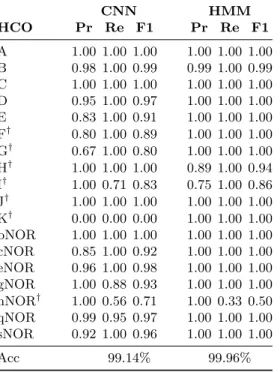
Table 3. Protein classification accuracy achieved using a convolution neural network in comparison to a Hidden Markov Model-based classifier. Classification accuracy is evaluated using – Precision (Pr), Recall (Re) and Harmonic mean (F1).6
(a) HCOs CNN HMM HCO Pr Re F1 Pr Re F1 A 1.00 1.00 1.00 1.00 1.00 1.00 B 0.98 1.00 0.99 0.99 1.00 0.99 C 1.00 1.00 1.00 1.00 1.00 1.00 D 0.95 1.00 0.97 1.00 1.00 1.00 E 0.83 1.00 0.91 1.00 1.00 1.00 F† 0.80 1.00 0.89 1.00 1.00 1.00 G† 0.67 1.00 0.80 1.00 1.00 1.00 H† 1.00 1.00 1.00 0.89 1.00 0.94 I† 1.00 0.71 0.83 0.75 1.00 0.86 J† 1.00 1.00 1.00 1.00 1.00 1.00 K† 0.00 0.00 0.00 1.00 1.00 1.00 bNOR 1.00 1.00 1.00 1.00 1.00 1.00 cNOR 0.85 1.00 0.92 1.00 1.00 1.00 eNOR 0.96 1.00 0.98 1.00 1.00 1.00 gNOR 1.00 0.88 0.93 1.00 1.00 1.00 nNOR† 1.00 0.56 0.71 1.00 0.33 0.50 qNOR 0.99 0.95 0.97 1.00 1.00 1.00 sNOR 0.92 1.00 0.96 1.00 1.00 1.00 Acc 99.14% 99.96% †Families with <10 sequences.
(b) Nitrogenases CNN HMM Family Pr Re F1 Pr Re F1 nifDI 1.00 1.00 1.00 1.0 1.0 1.0 nifDII 0.96 1.00 0.98 1.0 1.0 1.0 Anf 1.00 1.00 1.00 1.0 1.0 1.0 nifD ANME 1.00 0.25 0.40 1.0 1.0 1.0 VnfD 0.60 1.00 0.75 1.0 1.0 1.0 Acc 96.8% 100%
(c) Cytochromebd-type oxygen
reductases CNN HMM Family Pr Re F1 Pr Re F1 A 1.00 1.00 1.00 1.0 1.0 1.0 B 1.00 1.00 1.00 1.0 1.0 1.0 C 1.00 1.00 1.00 1.0 1.0 1.0 E1 0.99 1.00 1.00 1.0 1.0 1.0 E2 1.00 1.00 1.00 1.0 1.0 1.0 E3 1.00 0.90 0.95 1.0 1.0 1.0 E4 1.00 1.00 1.00 1.0 1.0 1.0 Acc 99.6% 100%
Comparison of classification accuracy - CNNs and Hidden
248Markov Models
249In all three test cases, the CNNs performed classification with an accuracy greater than 250
96%.7(Table 3) This was comparable to the classification accuracy achieved by an
251
HMM-based classifier that we designed. Impressively, the CNN achieves a high level of 252
classification accuracy for the relatively small data set of nitrogenases, though the 253
HMM classifier achieves perfect accuracy in that case. It is conceivable that 254
HMM-based classifiers are more accurate for smaller, more homogenous data sets as 255
there is less variation across a domain in such datasets. This might present a case of 256
over-fitting the data, which is less likely in the case of CNNs which model all of the 257
HCO sequences at the same time. In the cytochromebd-type oxygen reductases, both 258
the HMM and CNN perform classification with greater than 99% accuracy. 259
Interestingly, HMM and CNNs are more accurate for different families within the large 260
superfamilies. In HCO classification for example, the CNN predicts the H and nNOR 261
families more accurately than the HMM, while the HMM is more precise when 262
predicting several families, especially F and G. There are two fundamental difference 263
between these approaches - the CNN uses smaller sections of sequences to make a 264
prediction of function while the HMM uses whole domain similarity, and the CNN 265
models all sequences simultaneously while the HMM uses pairwise comparisons. It is 266
possible that our CNN model performs well where unique features, comparable to the 267
length of our receptive field are easy to identify, while the HMMs may identify a more 268
7Models achieve>90% accuracy with in the first 10 epochs, but may not capture all families until 100. We stopped all runs at a 100 as the learning rate begins to converge to zero
dispersed combination of sequence features. In the HCO superfamily, it is apparent that 269
unique features are formed through evolutionary diversification and are conserved. 270
Correspondingly, our model is able to easily classify members within the HCO family. 271
The performance of the model on the HCO superfamily, particularly with families 272
with small data sets is impressive. Previously, an HMM-based classifier was created for 273
the HCO superfamily but, it does not incorporate as much phylogenetic diversity of this 274
superfamily as we present here [37]. Therefore, we built an updated model for this task, 275
which performs the task with>99 % accuracy. It is interesting to note that 276
classification by both CNN and HMM is least accurate in the case of the I family of 277
O2-reductases and nNOR, which is consistent with these being a more complicated task 278
for both algorithms that we used. Further, it appears that the false positives for the 279
I-family is often the G-family, which is corroborated by their close phylogenetic 280
relationship (Figure 1). This is also true for nNOR and sNOR, which are closely 281
related. Sequence analysis of subunits II from these enzymes also suggest that they have 282
recently diverged, with respect to their evolutionary history. It is intriguing that even 283
when we force the model to make predictions using smaller regions of the amino acid 284
sequence, it is sensitive to close phylogenetic relationships. Our feature extraction 285
method allows us to get a tangible understanding to the physical nature of these close 286
evolutionary relationships, i.e what features are common to close evolutionary partners 287
and which features vary between distant ones. 288
Predictor sequences obtained using attention mechanism
289One of the primary goals in this work is to identify inherent patterns within protein 290
sequences that may not be easy to identify without prior knowledge and biochemical 291
intuition. In accordance with that goal, we forced our classification algorithm to identify 292
parts of the protein sequence that are most conserved within a given family of enzymes. 293
The algorithm identifies these sections of protein sequences, or sequence features, by 294
preferentially weighting those that are correlated with the correct functional or 295
structural label. We validate these “predictor” sequence features against prior 296
knowledge of the known HCO families, and then characterize the novel sequence 297
features within the new families. 298
Validation of the model using extensively characterized HCO families 299
The classification model correctly identifies several features from the known HCO 300
families - A, B, C, cNOR and qNOR(Figure 4, Table S1). From the A-family, the 301
most often extracted feature is in the active site (present in Helix 6), including either 302
the conserved glutamate or tyrosine and serine, which are the amino acids from which 303
protons are loaded onto the oxygen molecule as it is reduced at the active site(Figure 304
4). One of these two variants is always present in the A-family and only in this family. 305
The C-family “predictor” sequence most often identified is the tyrosine belonging to the 306
histidine-tyrosine crosslinked cofactor, which is located on a different helix (Helix 7), 307
than in the rest of theO2-reductases where it is found in Helix 6(Figure 4). In the 308
B-family, the model derives motifs corresponding to its active site and a tyrosine that is 309
conserved in the proton channel(Figure 4). In the cNOR family, one often identified 310
feature is around Helix 10, including a conserved threonine residue suggested to line a 311
proton channel leading from the periplasm to the active site [19]. (Figure 4C.). In 312
both C and cNOR, a conserved arginine which is involved in stabilizing the active site 313
heme is present. cNOR has a glutamate in place of the tyrosine from the cross-linked 314
cofactor present in theO2-reductases. All the sequence features derived were consistent 315
Fig 4. Sequence features revealed by classification algorithm. Sequence features were mapped onto crystal structures of HCO enzymes that are well characterized. The PDB codes for A, B, C, cNOR, qNOR family crystal structures used are 2gsm, 1xme, 3mk7, 3wfb, 3ayf respectively
listed inTable 1, indicating that the model is extracting parts of a given enzyme’s 317
sequence that correlate with meaningful aspects of its function. 318
Identification of sequence characteristics unique to previously 319
uncharacterized HCO families 320
After validating the model, we used the model to extract sequence features from the 321
remaining families which have not been well characterized. Characteristics unique to 322
each family were uncovered, indicative of their adaptation to a unique environment and 323
role. Among the more striking sequence traits was recognized in the J family, which has 324
two tyrosines replacing histidines which are typically ligands to the active site heme and 325
high-spin heme. (Figure 5) This is likely to have an effect on the midpoint potential of 326
the heme; the anionic nature of tyrosine as a ligand is likely to lower the midpoint 327
potential of the heme. [38] Also interesting are residues corresponding to a proton 328
channel in the nNOR family in a structurally analogous location to that of the B family. 329
This would be physiologically significant, indicating that this enzyme could generate 330
proton motive force. A similar channel leading from the cytoplasm to the active site has 331
been shown in the electrogenic bNOR [26]. nNOR also appears to have a histidine to 332
Fig 5. Sequence features revealed by classification algorithm. Sequence features were mapped onto homology models of HCO enzymes that are uncharacterized. The structural model and quality parameters for each model used for each family is identified inTable S2
pathway. A histidine to glutamate substitution as a heme ligand is uncovered in gNOR, 334
which would have a significant effect on the midpoint potential and spin state of the 335
heme. Finally, in K and eNOR, conserved residues around theO2/NO diffusion channel 336
are found. The full set of features is listed inTable S1with corresponding amino acid 337
numbering for previously characterized HCOs. 338
By using these extracted features, it has thus been possible to gain insight into some 339
functional and structural characteristics of biochemically uncharacterized proteins. It is 340
interesting that most of the features that have been identified are part of 341
transmembrane helices. This is consistent with a majority of the catalytically important 342
residues in HCO enzymes being present in the membrane. 343
A brief analysis of the sequences extracted by the CNN from nitrogenases’ 344
classification indicates that active site features are used as the markers for classification. 345
This suggests that this method is as successful for smaller and cytoplasmic proteins. 346
Extraction of features from cytochromebd identify locations near the electron donor 347
binding site, and certain periplasmic loops. A full description of features identified for 348
nitrogenases and cyt bd is beyond the scope of this work and will be presented 349
elsewhere. 350
A simplified model of functional diversification within the HCO
351family members
352Use of different model parameters to gain insight into different
353protein features
354The neural network model is built on several parameters - the size of the embedding 355
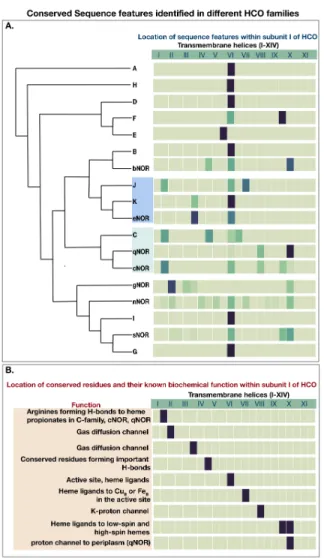
Fig 6. Correlation of evolutionary history with sequence features identified in different HCO families. A heatmap of extracted features as they are located within the conserved subunit I, is correlated with the phylogenetic relationships identified inFigure1.
Features from five different training runs were combined and mapped onto subunit I. improve classification accuracy as well as extract different features from protein 357
sequences. The embedding matrix is used to encode each amino acid in a protein 358
sequence with a unique vector that, in a sense, quantifies the characteristics associated 359
with that amino acid. Modification of the the size of the embedding matrix used to code 360
for an input sequence can modify the complexity available to the model. Intuitively, this 361
would vary the model’s ability to perceive relationships between different amino acids, 362
for e.g., between polar residues or between acidic amino acid residues. Further, the 363
number of convolutional layers and kernel sizes varies the length of the receptive field, 364
or essentially the maximum length of sequence the model is capable of attending to 365
when using the attention mechanism. The attention mechanism is used to extract 366
sequence features, and the model seems capable of using as small a receptive field as 15 367
amino acids to accurately predict classes of protein families. Use of dilation in the 368
neural networks can increase this receptive field further and the most striking contrast 369
in the features learned by the model is perceived when combining dilation with the 370
to increase the importance of the rarer classes to the learning of the model, improves 372
classification accuracy. A careful examination of model parameters used to build a 373
neural network indicates that there is significance to the modified use of these 374
parameters. (Data present in Githubhttps://github.com/ybisk/FIND) However, the 375
consistency in the features learned for the different classes using a weighted, 376
convolutional network with 256 parameters in the embedding matrix is the highest and 377
we used these parameters to generate the final model for the HCO classification. 378
Using the classification model learned by the neural network, we extracted the top 379
“predictors” or weights assigned to various parts of the sequence within HCO family 380
members. Simply, this provides us with sequence patterns or motifs correlated with a 381
given label. These patterns were plotted using a heat map to demonstrate the location 382
of identified sequence features within subunit I of the enzyme. We find that several of 383
these patterns correlate with the evolutionary history of the HCO family, as shown in 384
Figure6. Comparison of the distribution of identified features within different families 385
demonstrates the differential functional adaptation of some of the families. For instance, 386
the regions identified as predictive in cNOR and qNOR center around helices 8, 9 and 387
10 where residues lining a proton channel for protons to enter the active site from the 388
periplasm are found. Conversely, A, B and C families ofO2reductases have a proton 389
channel leading from the cytoplasm to the active site. Sequence motifs found in the 390
C-family oxygen reductase are centered around the region between helices 1 and 2, 391
where a periplasmic loop exists that stabilizes hemeb3in the C-family [22]. Conserved 392
features are identified in cNOR from the same region. The above identified correlations 393
are significant because they correspond to the phylogenetic relationship between the 394
C-familyO2 reductase, and cNOR and qNOR. The close evolutionary relationship 395
between the C-family, cNOR and qNOR has been observed before [39] [25] and the 396
common structural features associated with these families appear to corroborate that. A 397
similar relationship is observed between K and eNOR which cluster closely together in 398
our HCO phylogenetic tree. Conserved residues such as threonine and tyrosine (in the 399
K-family), and a tyrosine in eNOR in the loop between Helices 3 and 4, likely affect the 400
O2 and NO diffusion pathway, which have been explored in the A, B and C-family [21]. 401
These features are suggestive of adaptations specific to substrate concentrations [40]. 402
Within the context of a multi-class classification model, we intuit that structural 403
differences between the families are weighted and extracted. This implies that the 404
model does not discover every feature conserved in a family but uncovers those 405
characteristics that are unique to each clade. A complete picture of each enzyme 406
family’s catalytic and structural characteristics may not be obtained from the model 407
but, it has the advantage of providing insight into the bigger picture of functional 408
diversification within the enzyme superfamily. This in turn is correlated with the nature 409
of catalytic machinery and structural features within a given family. In identifying 410
features that are significant enough to be conserved within a clade and yet, adaptable 411
within the larger superfamily, we discern what some of the constraints for evolution of 412
these proteins are and how they diverged through time. 413
Conclusion
414OurFINDclassification model has accurately classified members of three different 415
enzyme superfamilies - heme-copper oxygen reductases, nitrogenases and cytochrome 416
bd-type oxygen reductases. It performs this task with accuracy comparable to a 417
well-accepted classification technique based on Hidden Markov Models. In addition, our 418
model is able to automatically extract interesting, unique sequence features correlated 419
with the labels we imposed. This facet of our model allows us to infer biochemically and 420
alignments, which are typical of traditional methods. In this way, it is uniquely useful 422
for investigating large sets of uncharacterized proteins. Further, our model provides 423
insight into the evolutionary relationships of proteins within an enzyme superfamily, by 424
identifying some traits that are specific to each protein. The novel uncharacterized 425
members of heme-copper oxygen reductases that we have described and the unique 426
features we have identified in their protein sequences would be an interesting set of 427
targets for biochemical characterization. In our work, we have seen the promise of deep 428
learning methods; to classify proteins and to identify innate structural and functional 429
features associated with function, directly from primary sequence. In the future, these 430
methods can be used to tackle the heterogeneity in biological sequence data and 431
understand aspects of protein diversity and functional adaptation. 432
Acknowledgments
433This work was funding by DARPA’s CwC program through ARO (W911NF-15-1-0543), 434
the Moore Foundation(Award to VJO: GBMF3780), the Department of Energy (Award 435
to VJO: DE-SC0016469) and the Center for Dark Biosphere Investigations(NSF Award 436
to VJO: OCE-0939564). We are grateful to Daan Speth for reading the manuscript at 437
multiple stages of completion and for his useful comments throughout the process. We 438
would also like to thank Dr. Robert Gennis for reading the manuscript and offering 439
helpful comments, Grayson Chadwick for useful discussion on bioinformatics strategies 440
and Haley Sapers for her instructive critique of the figures. 441
References
1. Altschul SF, Gish W, Miller W, Myers EW, Lipman DJ. Basic local alignment search tool. Journal of Molecular Biology. 1990;215(3):403 – 410.
doi:https://doi.org/10.1016/S0022-2836(05)80360-2.
2. Clark WT, Radivojac P. Analysis of protein function and its prediction from amino acid sequence. Proteins: Structure, Function, and Bioinformatics. 2011;79(7):2086–2096. doi:10.1002/prot.23029.
3. Altschul SF, Koonin EV. Iterated profile searches with PSI-BLAST—a tool for discovery in protein databases. Trends in Biochemical Sciences. 1998;23(11):444–447. doi:10.1016/S0968-0004(98)01298-5.
4. Sonnhammer ELL, Eddy SR, Durbin R. Pfam: A comprehensive database of protein domain families based on seed alignments. Proteins: Structure, Function, and Bioinformatics. 1997;28(3):405–420.
doi:10.1002/(SICI)1097-0134(199707)28:3¡405::AID-PROT10¿3.0.CO;2-L. 5. Eddy SR. Profile hidden Markov models. Bioinformatics. 1998;14(9):755–763.
doi:10.1093/bioinformatics/14.9.755.
6. Engelhardt BE, Jordan MI, Muratore KE, Brenner SE. Protein Molecular Function Prediction by Bayesian Phylogenomics. PLOS Computational Biology. 2005;1(5). doi:10.1371/journal.pcbi.0010045.
7. Jiang Y, Oron TR, Clark WT, Bankapur AR, D’Andrea D, Lepore R, et al. An expanded evaluation of protein function prediction methods shows an
improvement in accuracy. Genome Biology. 2016;17(1):184. doi:10.1186/s13059-016-1037-6.
8. Volpato V, Adelfio A, Pollastri G. Accurate prediction of protein enzymatic class by N-to-1 Neural Networks. BMC Bioinformatics. 2013;14(1):S11.
doi:10.1186/1471-2105-14-S1-S11.
9. Szalkai B, Grolmusz V. SECLAF: A Webserver and Deep Neural Network Design Tool for Biological Sequence Classification. ArXiv e-prints. 2017;.
10. Li Y, Wang S, Umarov R, Xie B, Fan M, Li L, et al. DEEPre: sequence-based enzyme EC number prediction by deep learning. Bioinformatics.
2018;34(5):760–769. doi:10.1093/bioinformatics/btx680.
11. Amidi S, Amidi A, Vlachakis D, Paragios N, Zacharaki EI. Automatic single- and multi-label enzymatic function prediction by machine learning. PeerJ.
2017;5:e3095. doi:10.7717/peerj.3095.
12. Song J, Li F, Takemoto K, Haffari G, Akutsu T, Chou KC, et al. PREvaIL, an integrative approach for inferring catalytic residues using sequence, structural, and network features in a machine-learning framework. Journal of Theoretical Biology. 2018;443:125 – 137. doi:https://doi.org/10.1016/j.jtbi.2018.01.023. 13. Xin F, Myers S, Li YF, Cooper DN, Mooney SD, Radivojac P. Structure-based
kernels for the prediction of catalytic residues and their involvement in human inherited disease. BMC Bioinformatics. 2010;11(10):O4.
doi:10.1186/1471-2105-11-S10-O4.
14. Petrova NV, Wu CH. Prediction of catalytic residues using Support Vector Machine with selected protein sequence and structural properties. BMC Bioinformatics. 2006;7:312. doi:10.1186/1471-2105-7-312.
15. Hemp J, Gennis RB. In: Sch¨afer G, Penefsky HS, editors. Diversity of the Heme–Copper Superfamily in Archaea: Insights from Genomics and Structural Modeling. vol. 45. Berlin, Heidelberg: Springer Berlin Heidelberg; 2008. p. 1–31. 16. Pereira MM, Sousa FL, Ver´ıssimo AF, Teixeira M. Looking for the minimum
common denominator in haem–copper oxygen reductases: Towards a unified catalytic mechanism. Biochimica et Biophysica Acta (BBA) - Bioenergetics. 2008;1777(7):929 – 934. doi:https://doi.org/10.1016/j.bbabio.2008.05.441. 17. Ettwig KF, Speth DR, Reimann J, Wu ML, Jetten MSM, Keltjens JT. Bacterial
oxygen production in the dark. Frontiers in Microbiology. 2012;3:273. doi:10.3389/fmicb.2012.00273.
18. Chang HY, Choi SK, Vakkasoglu AS, Chen Y, Hemp J, Fee JA, et al. Exploring the proton pump and exit pathway for pumped protons in cytochrome ba3 from Thermus thermophilus. Proceedings of the National Academy of Sciences. 2012;109(14):5259–5264. doi:10.1073/pnas.1107345109.
19. Schurig-Briccio LA, Venkatakrishnan P, Hemp J, Bricio C, Berenguer J, Gennis RB. Characterization of the nitric oxide reductase from Thermus thermophilus. Proceedings of the National Academy of Sciences of the United States of America. 2013;110(31):12613–12618. doi:10.1073/pnas.1301731110.
20. Luna VM, Chen Y, Fee JA, Stout CD. Crystallographic Studies of Xe and Kr Binding within the Large Internal Cavity of Cytochrome ba3 from Thermus thermophilus: Structural Analysis and Role of Oxygen Transport Channels in the Heme−Cu Oxidases,. Biochemistry. 2008;47(16):4657–4665.
21. Mahinthichaichan P, Gennis RB, Tajkhorshid E. Cytochrome aa3 Oxygen Reductase Utilizes the Tunnel Observed in the Crystal Structures To Deliver O2 for Catalysis. Biochemistry. 2018;57(14):2150–2161.
doi:10.1021/acs.biochem.7b01194.
22. Buschmann S, Warkentin E, Xie H, Langer JD, Ermler U, Michel H. The Structure of cbb3 Cytochrome Oxidase Provides Insights into Proton Pumping. Science. 2010;329(5989):327–330. doi:10.1126/science.1187303.
23. Hemp J, Robinson DE, Martinez TJ, Kelleher NL, Gennis RB. The Evolutionary Migration of a Post-Translationally Modified Active-Site Residue in the
Proton-Pumping Heme-Copper Oxygen Reductases. Biochemistry. 2006;45(51):15405–15410. doi:10.1021/bi062026u.
24. Hino T, Matsumoto Y, Nagano S, Sugimoto H, Fukumori Y, Murata T, et al. Structural Basis of Biological N2O Generation by Bacterial Nitric Oxide Reductase. Science. 2010;doi:10.1126/science.1195591.
25. Matsumoto Y, Tosha T, Pisliakov AV, Hino T, Sugimoto H, Nagano S, et al. Crystal structure of quinol-dependent nitric oxide reductase from Geobacillus stearothermophilus. Nature Structural &Amp; Molecular Biology. 2012;19:238. 26. Al-Attar S, de Vries S. An electrogenic nitric oxide reductase. FEBS Letters.
2015;589(16):2050–2057. doi:10.1016/j.febslet.2015.06.033.
27. Sievert SM, Scott KM, Klotz MG, Chain PSG, Hauser LJ, Hemp J, et al. Genome of the Epsilonproteobacterial Chemolithoautotroph Sulfurimonas denitrificans. Applied and Environmental Microbiology. 2008;74(4):1145–1156. doi:10.1128/AEM.01844-07.
28. Elman JL. Finding structure in time. Cognitive Science. 1990;14(2):179–211. 29. Hochreiter S, Schmidhuber J. Long Short-Term Memory. Neural Computation.
1997;9(8):1735–1780. doi:10.1162/neco.1997.9.8.1735.
30. Hochreiter S, Bengio Y, Frasconi P, Schmidhuber J. Gradient flow in recurrent nets: the difficulty of learning long-term dependencies. In: Kremer SC, Kolen JF, editors. A Field Guide to Dynamical Recurrent Neural Networks. IEEE Press; 2001. p. 237 – 243.
31. Bahdanau D, Cho K, Bengio Y. Neural machine translation by jointly learning to align and translate. In: Proceedings of the 3rd International Conference on Learning Representations; 2015.
32. Lecun Y, Boser B, Denker JS, Henderson D, Howard RE, Hubbard W, et al. Backpropagation applied to handwritten zip code recognition. Neural computation. 1989;1(4):541–551.
33. Kingma DP, Ba J. Adam: A Method for Stochastic Optimization. In:
Proceedings of the 3rd International Conference for Learning Representations; 2015.
34. Ioffe S, Szegedy C. Batch Normalization: Accelerating Deep Network Training by Reducing Internal Covariate Shift. In: Proceedings of the 32nd International Conference on International Conference on Machine Learning. vol. 37; 2015. p. 448–456.
35. Pettersen EF, Goddard TD, Huang CC, Couch GS, Greenblatt DM, Meng EC, et al. UCSF Chimera—A visualization system for exploratory research and analysis. Journal of Computational Chemistry;25(13):1605–1612.
doi:10.1002/jcc.20084.
36. Zhang Y. I-TASSER server for protein 3D structure prediction. BMC Bioinformatics. 2008;9(1):40. doi:10.1186/1471-2105-9-40.
37. Sousa FL, Alves RJ, Pereira-Leal JB, Teixeira M, Pereira MM. A Bioinformatics Classifier and Database for Heme-Copper Oxygen Reductases. PLOS ONE. 2011;6(4):1–9. doi:10.1371/journal.pone.0019117.
38. Adachi S, Nagano S, Ishimori K, Watanabe Y, Morishima I, Egawa T, et al. Roles of proximal ligand in heme proteins: replacement of proximal histidine of human myoglobin with cysteine and tyrosine by site-directed mutagenesis as models for P-450, chloroperoxidase, and catalase. Biochemistry.
1993;32(1):241–252. doi:10.1021/bi00052a031.
39. Zumft WG. Nitric oxide reductases of prokaryotes with emphasis on the respiratory, heme–copper oxidase type. Journal of Inorganic Biochemistry. 2005;99(1):194 – 215. doi:https://doi.org/10.1016/j.jinorgbio.2004.09.024. 40. Han H, Hemp J, Pace LA, Ouyang H, Ganesan K, Roh JH, et al. Adaptation of
aerobic respiration to low O2 environments. Proceedings of the National Academy of Sciences. 2011;108(34):14109–14114. doi:10.1073/pnas.1018958108.
Predictor Lo cation Reference Lo cation on Lo cation on Notes (Helix) structure/sequence reference structure B-family A FWYF G HP E VY IVFFP A L GI 6 2gsm -Rho dobacter Sphaeroides His284, Pro285, V al287, T yr288, Leu295 activ e site B G H A V VYFWL L P A Y YVW Y AI 6 1xme -Therm us ther-mophilus His233, V al236, T yr237, Phe238, T rp239, L eu240, Pro242, T yr244, T yr248 activ e site C I R KVKHI Y V AN W FYGAFIL Bt wn 4 & 5 3mk7 -Pseudomonas Stutzeri Arg152, T yr158, T rp162 ? S P L Y S HT L SLIG FW SLI IV Bt wn 6 & 7 3mk7 -Pseudomonas Stutzeri Pro233, Ser236, Leu239, Phe244, T rp245 proton channel GEYIHF G R V R PV H V GTVTL Bt wn 1& 2 3mk7 -Pseudomonas Stutzeri Arg55, Arg57, His60 R, R H-b onding to propionate W ALIAI Y IW A G P HH LHYSA 7 3mk7 -Pseudomonas Stutzeri T rp245, T yr 251, Gly255, His257, His258 tyrosine from crosslink in heli x 7 D G H A V VY MA WL P A V AAL Y LL 6 AA Y 7 9522.1 His247, V al250, T yr251, Pro256, Ala257, T yr26 2 His233, V al236, T yr237, Pro242, T yr248 activ e site E LL WLI LFW FY GHPVVY YV P Bt w n 5 & 6 WP 010980480.1 Leu233, Phe234, T rp235, Gly237, His238, Pro239, V al240, V al24 1, T yr242, Pro245 His233, V al236, T yr237 activ e site F K GLFW Y A DHPL VYF A PY T L 6 WP 009072005.1 Lys251, Gly252, L eu253, Phe254, T rp255, Asp257, His258, Pro259, Leu260, V al261, T yr262, P he 2 63, Pro265, T yr266, Leu268 His233, V al236, T yr237, Phe238 activ e site I HNT G WI F G H F HIM L TL YS Bt wn 9 & 10 His389, Asn390, Thr 391, T rp 393, Ile394, His397, His399, Ile400, Met401 His376, Asn377, Thr378, Gly383, His384, Phe385, His386 p eriplasmic lo op. Near heme bi n di ng sites
G HPVVYLLLFP A V A VY Y W LI 6 > Ga0074051 117544472 Heme/copp er-t yp e cyto c hrome/quinol o xidases, subunit 1 His268 to Ala278, T yr283 , Leu285 His233, V al236, T yr237, Leu23 9, Pro242, T yr248 activ e site H AI L FW F W GHPIVY V A VI P A 6 EQB72844.1 Phe289, T rp290, T rp292, Gly293, Hi s2 94, Pro295, Ile296, V al29 7, T yr298, Pro303 His284, Pro 285, V al287, T yr288 , Leu295 (compared to A) activ e site I F GHPIVYFTLFSFLGAA YY Bt w n 5 & 6 > JGI11615J12901 103556841 Heme/copp er-t yp e cyto c hrome/quinol o xidases, subunit 1 Phe265 to T yr2 83 His233, V al236, T yr237, Phe23 8, Leu240, T yr248 activ e site, con-serv ed histidine and threonine near activ e site J W HIL FH NL HYLP LMA TV L V 6 OGA41786.1 T rp2 33, Phe237, His238, His241, T yr242, Ile24 3, Pro24 4 His233, T yr23 7 AM Y L VFV P P T SL YH MFLE P 7 T yr278, Pro283, Thr285, T yr279, H is28 0, Pro29 4 His257, His258, Pro263 YH ligands to heme SGAL YY RML TGHAILGFVY Bt wn 1 & 2 Thr60, His62 Thr70, His72 conserv ed F/W in B, ENOR etc VPTL T AFLI IIASLEMY AR 8 Pro238, missing thr312 Pro308 conserv ed S/T p ossibly for proton chan ne l L VVNMV GVF A GAD VL YT AF 3 Gly119, T yr 124 conserv ed tyrosine. Also tyr/phe in B K WK QIFW GF GHT A QYINIAA 6 Ga0132257 100159340 Arg233, T rp23 7, Gly240, His241, Gln244, T yr245, Asn247, Ala250 Arg225, His233, T yr237 activ e site. RHNNMWMP AHIHGALA GGT Bt w n 9 & 10 His385, Asn386, Ala39 2, His395, Gly400, Thr403, His376, Asn377, Thr378, Gly383, His384, Phe385, His386 VMYTL Y VPLRADPLF Y L GH Bt wn 3 & 4 Thr142, Pro146 , T yr144, Phe153, Leu155, Gly156 Thr134, T yr136, Pro138 gas diffusion c han-nel
LSRIAFLFYLFFTIPV AAH 7 Arg274, Gly276, Phe277, Pro286, His290 Arg266, Phe269, Pro278, Gly280, His282 Histidine li g and to lo w-spi n heme CNOR D QYFWWWVV HL WVE A T WE V 6 3O0R, 3WFB Asp198, His207, Leu208, T rp209, V al210, Glu211, T rp214, Gl u 215 activ e site W QWIGSI FS SL E VVPFF AM 8 T rp269, Gly273, Phe276, Ser277, Glu280 conserv ed gluta-mates G T QL T AA HGHL AFF GA Y V A 10 Thr341, His347 , Gly348, His349, L eu350, Gly354, Ala355, T yr35 6 T344 MQ TL PQI N L Y S HGT QLAP A Bt wn 9 & 10 Thr330, Leu331 , Asn335, T yr337, His339, Gly340, Thr341 T330 proton c han-nel to p eriplasm MYYDRSSFYGFD VNR YIPF Bt wn 1 & 2 Phe53 conserv ed arginine, binding to propi-onates to Ca2+ QNOR ADFW R W W VV H L WVE QSF E F 7 3A YF Arg503, T rp505, His508, T rp510, V al511, Glu512, Glu516 activ e site IIT G MI G T A HH YYFN G LPT 8 Gly553, Gly556, His559, His560, Gly565 Histidines binding CuB GVV AF GA GLINMPVINYYL 10 Gly625, Ala626, Gl y 627, Gly630, Asn634, Pro636 proton c h annel to p eriplasm ENOR GHGSQQINLAAMITVWYFL 6 WP 012842681.1 Gly240, His241, Gln244, Gln245, Asn247, Ala250, T rp255, T yr256 Gly232, His233, T yr248 activ e site PMPISPLFY A GAIVFILGT Bt wn 3 & 4 T yr155, Il e15 9, Gly164 Pro138, T yr146 Gas diffusion c han-nel WNLLIFWMVFMEV AIL Y V G 2 Leu82, Phe88, Glu90, Ala92 Phe84, Gln86 Gas diffusion c han-nel