Affective Negotiation Support Systems
Joost Broekensa*, Catholijn M. Jonkera and John-Jules Ch. Meyerb
a
MMI, TU Delft, Mekelweg 4, 2628 CD, Delft, The Netherlands
b
Computer Science, Utrecht University, Padualaan 14, 3584CH, Utrecht, The Netherlands
Abstract. Negotiation is a process in which two or more parties aim to reach a joint agreement. As such negotiation involves rational decision making about options and issues. However, negotiation also involves social interaction and dilemmas as well as personal preferences and opinions. Negotiation is a multifaceted process in which affect plays a critical role, a role con-firmed in recent empirical studies. In this position paper we first argue that affect is an important issue to consider when devel-oping a negotiation support system. We do so by giving a strategic overview of some of the most important findings in the affect-cognition and affect-negotiation literature. Second, we show in a structured manner during which phases in the negotia-tion process what emonegotia-tion-related concepts play a major role, as well as discuss more concrete affect-related support funcnegotia-tions an affective negotiation support system could offer. Third, we analyze the feasibility of these functions by reviewing currently available affective computing technologies, such as affect measurement, emotion modeling, emotion expression, emotional reasoning, and emotional agents.
Keywords: Affect, Negotiation, Negotiation Support Systems, Affective Computing, Review
*
Corresponding author. E-mail: [email protected].
1. Introduction
Negotiation is a process in which two or more par-ties aim to reach a joint agreement regarding an ex-change of goods and services. As such, negotiation involves rational decision making about options and issues. For example, given the choice between two car deals, one has to decide about price, model, color, warrantee, etc. Listing and weighing these car-related issues can be seen as a rational process for coming up with a combined value for each option. Negotiation experts [55, 144] emphasize that negotiation is not just about money and exchange of property, but also about relationships, awareness of all issues (domain model), personal preferences (user and opponent model), making sure you have a good alternative (if no deal is reached), and reflection on your perform-ance. So, not only objective aspects such as money, color and brand are important, but also more subjec-tive issues such as, do I want to keep this car dealer, will I see this person again, did I explore enough al-ternative cars, how much do I like this car, do I want to be seen in this model. In addition, a by now con-siderable body of research has shown that emotions influence the negotiation outcome. For example, the
best negotiation outcomes are reached when people manage to create and maintain a positive and relaxed atmosphere, see e.g., [27, 105, 144]. Negotiating is an emotional process, certainly for the novice nego-tiator [147]. The more that depends on the outcome of the negotiation, the more intense the emotions. Negative feelings such as not being in control of the situation, not knowing what to expect, and fearing to underperform inhibit the exchange of information about underlying concerns, whereas in a relaxed at-mosphere the additional information broadens the scope of the negotiation [56, 146]. In fact, a bad at-mosphere and a lack of information are structural barriers to agreement [99]. Furthermore, human ne-gotiators make mental errors some of which are re-lated to emotions, such as biased perception, irra-tional expectations, overconfidence, and unchecked emotions [99].
Interestingly, recent research shows that the dis-play of negative emotions such as anger can in some cases enhance the negotiation outcome for the person showing the negative emotion [138]. However, this beneficial effect is dependent on the strength of the alternatives of the opponent [45, 138]. This indicates that both positive emotions and negative emotions
can be useful and detrimental to the negotiation proc-ess. In fact, the relation between emotion and nego-tiation is complex [7, 47]. In this article we first re-view and structure the relation between emotion and negotiation.
Two areas of research related to negotiation soft-ware can be distinguished: negotiation support sys-tems (NSS) and automated negotiating agents (ANA). Whereas the focus of the former type of software is on enabling a user to negotiate by means of structur-ing the process and possibly by offerstructur-ing analysis support, in essence a special purpose decision sup-port system, the latter type of software is aimed at automating (parts of a) negotiation completely [73]. Up until now, a negotiation support system (NSS) supports negotiators with the rational part of the ne-gotiation process such as exploration of issues, iden-tification of alternatives and calculating bids [73]. As emotions play such an important role in the negotia-tion process, in this article we argue that negotianegotia-tion support systems should help negotiators cope with the interplay between emotion and the negotiation process. We show in what ways such a system could help, and we discuss the feasibility of these ideas in relation to current affective computing techniques. In this article we do not present a working system or evaluations thereof. We argue, based on the affect - negotiation literature, for the inclusion of affect-related functionality in such systems as well as show what kind of functions affect could have in such sys-tems. Secondly, we show that some – but definitely not all – of these functions are feasible in the near future.
The type of Affective Negotiation Support System we envision is an ambient intelligent device. A typi-cal user would use the Affective NSS on a mobile device (smart phone, small laptop). It uses low-invasive emotion measurement technology [150] to assess the user’s emotional state and it uses artificial intelligence techniques to proactively assist the user in making negotiation-related decisions. So, with ambient intelligent we do not mean “disappearing technology” but more so technology that proactively assists people in their daily lives [5]. In our case, the Affective NSS detects the context of the user, i.e., the user’s emotion and the negotiation process at hand, and suggests to the user possible negotiation behavior. As such, typical ambient intelligent research themes such as multimodal context sensitivity [137], trustful persuasion, and low-invasive emotion detection [1] are very relevant in two senses: the development of an Affective NSS will benefit from existing research and will contribute to these research themes.
The rest of this article is structured as follows. First, we define emotion concepts and negotiation concepts to facilitate the discussion in the rest of the article. Then, relations between emotion and negotia-tion will be strategically reviewed to show the rich-ness of the interplay between emotion and negotia-tion. Second, we structure the relations between emo-tion and negotiaemo-tion. This structure is based on the emotion and negotiation concepts defined earlier as well as the reviewed relations between negotiation and emotion. We use this structure to discuss the affect-related support functionality of an affective negotiation support system, i.e., how can such a sys-tem help negotiators cope with the relation between emotion and negotiation. Finally, to identify the fea-sibility of the discussed functions, we briefly review the affective computing literature, i.e., the field of research aimed at measuring, modeling, expressing and using emotion in computerized systems [120, 121].
2. Emotion and Negotiation
In this section we detail the notion of negotiation. We also detail the notion of emotion. After that we give a short overview of existing relations between emotion and cognition, as well as provide a more focused overview of different ways in which emotion and negotiation influence each other.
2.1. Negotiation
Negotiation is a process in which two or more par-ties aim to reach a joint agreement regarding an ex-change of goods and services. A key aspect of nego-tiation is that neither of the parties involved can reach a solution by itself [144]; interpersonal decision mak-ing is always involved. Further, negotiation is a phe-nomenon that is influenced by culture [74]. People in different cultures have different negotiation styles [132]. Negotiation also plays an important role in human life, not just in politics or when buying a house. Many situations can be approached from a negotiation point of view, and in fact are negotiations, although simple and short ones. These situations are not limited to buyer-seller interactions, as is often believed by non-professional negotiators. Consider for example the following typical evening interaction between John and Jane.
Jane: “Our kid is getting tired, John will you put him to bed today.”
John: ”Sure, will you tidy up the kitchen a little bit.”
Jane: ”Let’s do that together, cause it’s quite a mess, and I made dinner already.”
John: ”Ok, that’s fair, would you then please pre-pare the bottle for the little one while I change him, so that we can quickly finish everything and watch the evening news?”
Jane: ”Ok”.
This is a common situation in which a household package deal is concocted about what has to be done, why it has to be done now and who does what. We don’t think about this as negotiation, but it actually is. There are issues and preferences involved (who does the kid, who does the kitchen, who cooks), there is the exchange of bids, the introduction of new issues (prepare the bottle), making compromises (do the kitchen together), and trying to get to a joint outcome (watch the evening news).
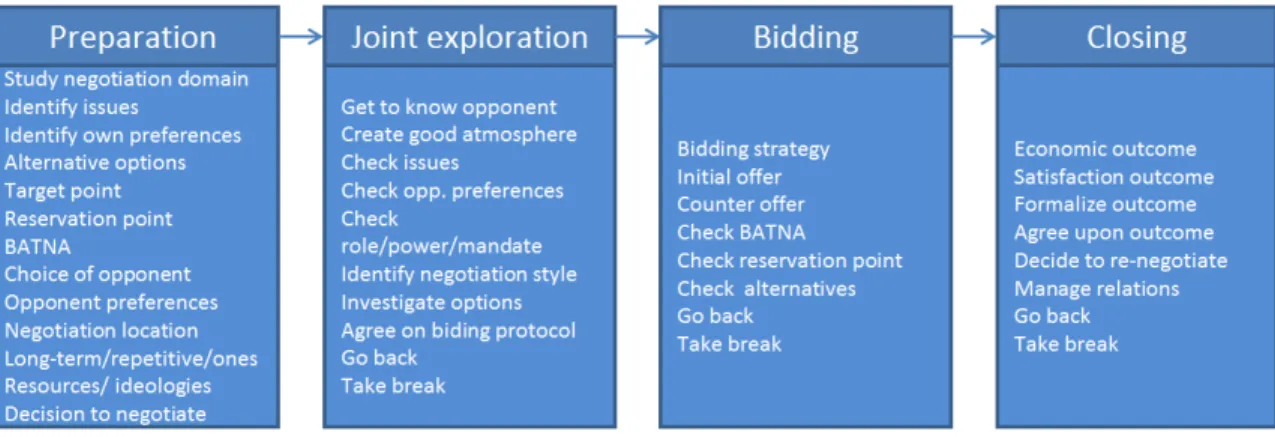
The main goal for a negotiation is to reach an agreement that is beneficial to all of the involved parties. Here we give an overview of the most impor-tant steps in the process and the variables involved. Negotiation starts much earlier than inexperienced negotiators realize. Four major stages can be dis-cerned (Figure 1a): private preparation, joint explora-tion, bidding, and closing, see e.g., [73, 144].
The first stage, private preparation, is about infor-mation gathering and reflection before meeting the other party. The negotiator investigates the negotia-tion domain, his/her profile and that of the opponent. In this phase the negotiator typically defines his/her preferences, thinks about alternative outcomes (also called options or alternative deals), the desired and minimal outcome (called target point and reservation point, respectively), the best alternative to no agree-ment (BATNA), identifies the other party, what their BATNA is, as well as whether the negotiation has a long-term, one shot or repetitive nature, whether the negotiation involves ideologies or resources, and whether negotiation agreement must be reached [144]. Whether a negotiation is a long-term, one shot or repetitive one is particularly important as this in-fluences the negotiation process and strategy quite a lot. For example, when buying a car at a dealer that is not your own (one-shot negotiation), claiming value can be done quite “aggressively” as there is little risk in harming the relation (there is none).
In the second phase, joint exploration, the negoti-ating parties get to know each other, but don’t place bids on the table. The aim is to check the information gathered so far, to create a good atmosphere, get to know the other persons, their role, power, mandate, and bargaining style, to investigate potential options, identify useful negotiation styles, and to agree upon a protocol for the bidding.
In the third phase, bidding, bids are exchanged. For each incoming bid the negotiator has to decide whether to accept, make a counteroffer, take a break, or stop (when a better alternative exists elsewhere). During this phase, the bidding strategy plays an im-portant role. Also, it is imim-portant to keep track of alternative options, your reservation point and your BATNA during this phase. Each bid has to be checked against these.
Two aspects during the joint exploration and bid-ding phase are particularly important: creating value and claiming value [144]. Creating value is about “making the pie bigger”, i.e., increasing what can be divided amongst the negotiators by introduction of new issues important to both, exchange of informa-tion about preferences about issues, and the devel-opment of package deals not single issue deals. Claiming value is about “slicing the pie” in such a way that you get equal or more than your reservation point (the lowest acceptable value of a deal). Claim-ing value is a distributive process, creatClaim-ing value is a collaborative process.
In the fourth phase, closing, the outcome of the bidding stage is formalized (e.g., in contractual form) and confirmed by both parties. If necessary (e.g., parts of the deal are not clear), the negotiation returns to one of the previous stages. Although relation man-agement is important during the complete negotiation process, it is particularly important in the closing phase [144]. After the closing phase, negotiators part, and regrets and wrong impressions can be formed. If the negotiation was a long-term or repetitive one, a successful closing phase is essential for future nego-tiations and relations.
In the section on affective negotiation support sys-tem we use the four phases and negotiation variables to structure the possible roles affect could play in each phase and for each variable.
Figure 1a. Four negotiation phases with most of the important activities in each phase.
Figure 1b. Hoop net view of the negotiation process. It is easy to go to the next phase but difficult to go back to a previous phase.
2.2.Definition of Affective terms: Mood, Emotion, and Attitude
Until now we have talked about emotion and affect as if it were one thing. Emotion, however, is a com-plex topic, and agreement on one solid definition does not really exist. We will not attempt to define emotion here, as many excellent works have been published from different perspectives that together do much more credit to the diverse and multimodal na-ture of emotion [60, 91, 95, 106, 113, 116, 120, 128, 131, 135]. In this section we explain what the differ-ent emotion-related terms usually refer to, and the above-mentioned references are a collective source
for this explanation. We do so because in later sec-tions we use these terms to explain and structure the different relations that exist between affect and tiation. Most notably in the section on affective nego-tiation support systems we use these terms to identify the different roles emotion, mood and attitude can play in such systems.
Affect (as in affective science) is the commonplace term for everything that has to do with emotion, in-cluding emotion, mood, affective attitude and emo-tional traits. Emoemo-tional traits are long term predispo-sitions of a person to be in a particular emotion or to react to events in a particular emotional manner. Al-though important for negotiation, we do not consider emotional traits in this article. Emotion, mood and affective attitude are different but strongly related and influence each other. In general, an emotion is comprised of a facial expression, feeling (the con-scious experience of the emotion), cognitive process-ing aimed at evaluatprocess-ing the situation in terms of per-sonal relevance, physiological change and action readiness. Furthermore, emotion refers to a short but intense episode that, in addition to the previously mentioned aspects such as facial expressions, is char-acterized by “attributed affect to a causal factor”. An emotion is a noticeable and usually powerful experi-ence. For example, I feel (and notice I am) happy when seeing an old friend. In contrast, mood refers to a silent presence of moderate levels of affect, not necessarily related to the preparation of action. Mood is not (consciously) attributed to a causal factor. I can feel frustrated for half a day without knowing why. Affective attitude refers to affect associated with
something or someone, in contrast to affect arising
because of that thing or person. An affective attitude is an affective association coupled to a thing or per-son, an emotion is an evaluation of a thing or person
in terms of personal relevance. For example, I like a particular popular science book I read (existing affec-tive association) versus I like you because you just invited me over for dinner (attribution of affect to causing event/person). The essence of an attitude is that it is preexisting affective information that is as-sociated with concepts or persons. To complicate matters a little, affect is also used to refer to a par-ticular view on emotion and mood, in which multiple dimensions (usually two or three) are used to de-scribe the core of emotion and mood (see below).
There are several theoretical views on how to think about (and computationally model) emotion. These views can be categorized in multiple ways, but the following categorization has been used quite often in literature and is based on the way emotion is repre-sented: as categories of emotion, dimensions or prin-cipal factors, and components that form an emotion.
2.2.1.Discrete emotions or categories.
The literature on categories of emotion is exten-sive. For this paper, we limit ourselves to an exam-ple: Ekman and Friesen proposed the following six universal facial expressions: anger, fear, disgust, sur-prise, happiness, and sadness [48]. The essence of emotion categories is that each emotion has a unique “multi modal program” associated with it (e.g., fear, arousal, flight, sweating are all part of the fear “pro-gram”). For an overview of literature on emotional categories see [37]. In experimental research that studies the influence of emotions on behavior (e.g., negotiation), emotion is often equated with particular discrete emotions.
2.2.2.Dimensions.
Research on emotion dimensions proposes that each emotion (and affect in general) can be described using several affective dimensions [14, 107, 131]. The essence of this perspective is that a limited set of dimensions can describe a large set of emotions by emphasizing commonalities (e.g., core physiological activity [131], or approach versus avoidance) be-tween emotions, and deemphasize the uniqueness of individual emotions. An important representative of this perspective is the pleasure (valence), arousal, and dominance (PAD) model [107]. In this model the dimension pleasure refers to pleasantness of the emo-tions, for example by qualifying the emotion as posi-tive or negaposi-tive. The arousal dimension refers the extent of bodily activation. The dominance dimen-sion refers to whether the subject is in control, or the environment. Most emotion psychologists agree that
at least pleasure (whether affect is positive or nega-tive) and arousal are core dimensions of affect. The dimensional approach is particularly important for mood, as in experimental studies (including those on affect and negotiation) the mood of a subject is often defined in terms of these dimensions, usually valence but sometimes also arousal and dominance.
2.2.3.Components.
The third perspective on emotion is the componen-tial view, of which cognitive appraisal theory is a prototypical member. For an overview of appraisal theories, see [50]. Emotions are defined as “valenced reactions to events, agents, or objects, with their par-ticular nature being determined by the way in which the eliciting situation is construed” ([113], p. 13). The essence is that different cognitive processes (components) result in an interpretation of a situation and that this interpretation is a major explaining fac-tor in emotion. It has become a standard model for synthesizing emotions in computers [120] and proved useful for computational reasoning about emotions [140]. This view on emotion is rarely used in ex-perimental studies aimed at understanding the influ-ence of emotion on negotiation, although exceptions exist [23].
Emotion is a multimodal phenomenon and study-ing it benefits from a multidisciplinary standpoint. Across disciplines, there exist commonalities. For example, many emotion researchers believe that there are two common affective factors that are useful to describe a mood, emotion or attitude: valence and arousal. Within a discipline, these factors can be studied in different ways: are these factors the psy-chological core of emotion, which areas or mecha-nisms in the brain are involved, are these always in-dependent (orthogonal), are they artifacts of statisti-cal analysis of many factors, etc. Other common views exist, for example, with regard to theories that explain emotion elicitation (where does the emotion come from). Most agree that an emotion is the result of an evaluation of the situation in terms of personal relevance. It depends on the discipline which aspect of this evaluation is highlighted. Is it a cognitive evaluation, is it conscious, holistic, component-based, automatic, biologically hard-wired, social, etc.? For a recent overview and reflection upon emotion elicita-tion, see [67]. For a quick and broad introduction to the different emotion theories and the history of these see chapter 5 in [51] or chapter 3 in [91].
An important distinction in the context of negotia-tion is felt versus displayed emonegotia-tion. These need not
be the same (consider, e.g., strategic use of emotion and expression suppression), and the effects on the negotiation process are not the same either, as we will see in the next subsections. In the rest of this article we will use the terms emotion, emotion dis-play, mood, attitude, and affect as described in this section.
2.3.Generic relations between emotion and cognition
There is a long history of research into the influ-ences of affect on cognition. As affect has been found to influence thought and behavior in many ways, we provide a brief overview of the main find-ings.
Emotion is related to the urge to act, see, e.g., [59]: run away when in danger, fight when trapped, laugh and play when happy. Specific emotions trigger spe-cific behaviors (e.g., fight or flight). So, emotion is not only related to the urge to act, some emotions— when strong enough—make us really act.
In general, emotion motivates behavior.
Emotion and feelings influence how we interpret stimuli, how we evaluate thoughts while solving a problem [39] and how we remember things. A per-son's belief about something is updated according to emotions: the current emotion is used as information about the perceived object [58, 63], and emotion is used to make the belief resistant to change [61]. Ergo, emotions are “at the heart of what beliefs are about” [60]. This is important for negotiation, as preferences about issues are in fact beliefs about issues.
Preferences therefore have an important affective quality.
Affect influences information processing in hu-mans; positive affect facilitates top-down, “big-picture” heuristic processing while negative affect facilitates bottom-up, “stimulus analysis” oriented processing [4, 58, 63, 110, 119]. Positive affect is associated with flexible and creative problem solving, while negative affect is associated with critical evaluation of stimuli. Affect also influences atten-tion and working memory in particular. Positive af-fect increases working memory performance by fa-cilitating switching to a new cognitive set (updating the contents of working memory) [46]. Positive af-fect also impairs working memory performance as indicated by lower performance on planning and de-ductive reasoning [111], perhaps due to higher dis-tractibility [46]. In these studies, affect is interpreted as moderate levels of valence (positive or negative
mood), and the influence on cognition is at a meta-level (affect as parameter). A second way in which affect influences processing is by inducing biases in the decisions made during the process. For example, when in a positive mood people tend to think of posi-tive things thereby biasing the options they generate during a decision making process (mood congruency: mood favors associations compatible with that mood). Furthermore, the extent to which mood influences reasoning and decision making is dependent on the type of information processing employed by the per-son [58]. For example, elaborate decision making in which many novel options are evaluated and gener-ated is prone to affective biases, while motivgener-ated processing guided by a clear goal is not.
These findings show that mood influences informa-tion processing.
Further, and important for negotiation, affect in-fluences judgment. It has been shown that positive affect renders people less critical with regards to the strength of a persuasive argumentation [100]. This could be due to reduced cognitive capacity [100], but also due to a tendency of people in a positive mood to be prone to a heuristic form of processing in which they use prior beliefs to form judgments instead of extensively analyze the argumentation itself (for an overview see [54]).
Regardless the underlying mechanisms, mood in-fluences judgment.
Many of these studies are based upon the idea that valence is the component to look at when investigat-ing the influence of affect on cognition. However, specific emotions have specific effects on cognition. Of course, being happy and enthusiastic makes you feel optimistic about the future, but interestingly, angry people also make optimistic judgments about future events, while fearful people make pessimistic judgments [93]. Also, angry but not sad subjects used a more heuristic-based processing approach in stereo-typic judgments [12].
Not only mood, but also specific emotions have specific effects on cognition.
In this short overview, we have seen that affect in-fluences cognition in at least the following ways: emotion motivates behavior; emotion influences be-liefs; mood influences information processing; mood influences judgment; and there are emotion specific effects.
2.4.Relations between emotion and negotiation
In the previous section we have reviewed some of the important influences of affect on cognition. There are also negotiation-specific relations between affect and cognition. We now review some of the main findings of experimental studies into the relation be-tween affect and negotiation.
2.4.1.Positive affect.
Although it is debatably whether being elated or extremely funny has positive effects on a negotiation, positive affect in general has a beneficial influence on the negotiation process, outcome and relations. Positive affect increases the tendency to use a coop-erative integrative style [7, 27]. Positive affect in-duced through smell decreases the tendency to handle conflicts with avoidance and competition, and in-creases the size of monetary goals and number of concessions during negotiation [6].
Having one emotionally intelligent person in a dy-adic negotiation (i.e., two parties involved) is related to more value creation (when two persons negotiate over a deal consisting of issues and each issue has a number of points of fictive value for each person, the created value of a final deal is the sum of the points over all issues for both persons; emotional intelli-gence is related to perceiving emotions, using tions, understanding emotions, and regulating emo-tions [151]). However, the emotionally intelligent person is unable to claim that value (measured as the portion of points the emotionally intelligent person received as bargaining outcome), resulting in more value for the other party [42]. A potential explanation is the tendency of emotionally intelligent persons to be cooperative, trusting and to favor a good atmos-phere [42].
As discussed earlier, such a positive attitude helps the generation of integrative solutions, but perhaps not to subsequently claim what should be yours. Re-lated to this is the work described in [3]. The authors find that having a positive affective personality trait again favored reaching integrative deals, and did not negatively affect the creation of value (joint out-come).
Positive affect fosters a cooperative approach but might hinder claiming what is yours.
2.4.2.Negative affect.
In general, a negative mood and more specific felt anger and fear have a negative influence on the nego-tiation process [2]. In particular felt anger has
nega-tive influences on the negotiation with respect to the integrative character of the negotiation [138]. Nego-tiators who feel angry create less value.
However, expressing anger can be a good strategy in claiming value, but only if the opponent has poor alternatives [138]. Interestingly, anger expression did not affect the creation of value in this study, meaning there is no negative side effect with respect to the integrative character of the negotiation. A further restriction on communicating anger is the observa-tion that anger communicaobserva-tion is useful for enforcing high offers from an opponent, but only if the oppo-nent does not have the opportunity to deceive the other and when rejecting an offer has consequences [45]. While anger expression does force the other party into making concessions, the expression of an-ger during a multiparty negotiation may exclude the anger expressing party from further forming of coali-tions [9]. This means that anger might help you get more, but it might also exclude you from further ne-gotiation. It is also important how to communicate anger (and happiness). Anger directed at the other party is less effective at eliciting large concessions than happiness directed at that party, while the role of anger and happiness directed at offers is reversed [139]. This means that, while useful, expressing an-ger is a rather delicate tactic.
Feelings of guilt after a round of negotiation com-bined with a competitive strategy during that round positively influence cooperation behavior in the next round in a repeated social bargaining game (prison-ers’ dilemma) [82]. Although this study is not di-rectly related to dyadic negotiation in the strict sense (exploration of issues, options, bidding, closure, etc.), it is relevant. It shows that in repeated negotiations, feelings of guilt can influence negotiators to choose for a more cooperative solution (win-win) in the fu-ture instead of a competitive one (win-lose).
Felt negative affect has a negative effect on inte-gration, except guilt which favors cooperation; ex-pressed anger can help claiming value, but express-ing anger is not without risk.
2.4.3.Contradictions between positive and negative affect.
Slightly contradicting to the positive effects of an-ger expression are the findings by [86]. They find that displaying positive or neutral emotion, but in any case not negative emotion, is a better strategy at both gaining concessions from the opponent as well as the likelihood to close a deal (and have a long-term rela-tionship). Apparently, the display of both positive
and negative emotion can help claiming value, but when this exactly happens depends on the negotiation task (the tasks in the last two studies were different) and context (such as alternatives, perceived power, consequences, culture, etc.).
The relation between perceived own power and perceived anger of the opponent has been confirmed in a large study [85]. It was found that variables such as having more alternatives and a better BATNA influence the perceived level of power, and that this counteracted the effects of anger expression of the opponent, such that the usual effect of an angry op-ponent (more concessions) was void. In another study, a compatible finding was found [84]. If a per-son in a dyadic negotiation perceives the emotion of the opponent to be angry (as opposed to neutral or happy), that person concedes more easily but only if (a) the person has low power perception of itself in the negotiation (low number of alternatives), or (b) the person has no time pressure in the negotiation, or (c) that person’s personality has a low need for cog-nitive closure (cogcog-nitive closure means having a need for clear rules, motivations and goals, and a tendency to quickly form conclusions). This indicates that the context of the negotiation influences the way negotia-tors process information, and the more the context favors clear motivated processing, the less the nego-tiator is influenced by anger of the opponent [84]. Further, given the fact that an important mediating factor is perceived power of the self and the opponent, it could well be that communicated/perceived power is the responsible factor for the effect of happiness and anger expression. Both happiness and anger are high power (dominance) emotions [106].
The communication of and perceived level of power (dominance) seems to be the common factor in anger and happiness expression effects on claiming value. Motivated processing limits the effects of an-ger expression.
2.4.4.Mood and process.
The perception of a negotiation being a fair proc-ess influences the affective reaction about the procproc-ess [71]. If, during a negotiation the process is perceived as fair, the negotiation itself is seen as more positive and vice versa. Additionally, a positive perception of the process is positively related to the economic size of the outcome gained by a negotiator (claimed value). This could indicate that being happy about the process helps getting a good outcome (although the study cited cannot conclude this because this in-volves causality, and both measures were taken after
the outcome, so the inverse relation can also be true: good outcome, therefore happy with the process).
It has been found that mood is contagious during a negotiation setting [8]. In a negotiation exercise where fictive rewards had to be distributed amongst the participants in the negotiation (group size was 2-4 persons), the mood of the participants was signifi-cantly influenced by the mood of a secret confederate added to the group (as an extra group member). Posi-tive affecPosi-tive manipulations by the confederate re-sulted in a more positive mood in the group and vice versa. Further, a positive mood resulted in both co-operative behavior (measured as the standard devia-tion in the distribudevia-tion of reward among the partici-pants in a group) and less conflict.
In fact, several of the findings just reviewed are compatible with the affect infusion model as pro-posed by [58]. This model proposes that the extent to which affect influences information processing de-pends on the processing style. The results in the study by [84] indicate that motivated information processing, a type of processing where there is a clear definition of outcomes, is less influenced by affect. Compatible with this analysis is the proposal by [64]. They argue that complex negotiations (and cross-cultural negotiation is the example they take) are usually done in the substantive processing mode [58], a mode characterized by complex judgments, open ended goals, and new information. The substan-tive processing mode is prone to affect infusion (i.e., mood congruent associations influence the reasoning process). As a result, mood strongly influences the reasoning process and this can result in a vicious cir-cle [64]. The authors propose to approach complex negotiations from a motivated processing point of view, as this is a more goal-oriented form of reason-ing and less prone to affect infusion. We think that for non-professional negotiators many negotiations can be considered complex ones, and therefore this is an important finding in general.
Together, these findings indicate that mood is an important factor for the course of a negotiation: it influences the mood of others, and a positive mood makes the process more cooperative and less con-flicting and influences the economic outcome.
3.Affective negotiation support systems
In this section we work towards affective negotia-tion support. First we briefly explain the current state of the art of negotiation software. Then we provide a
structured overview of the relations between affect and negotiation just reviewed. We use this overview to discuss the functionality an affective negotiation support tool could offer to help coping with or strate-gically use affect in negotiation.
3.1.Negotiation software
First, we briefly discuss current negotiation soft-ware. Apart from research into negotiation mediated by technology, such as e-mail and other digital com-munication means [143], two areas of research re-lated to negotiation software can be distinguished: negotiation support systems (NSS) and automated negotiating agents (ANA). Whereas the focus of NSS is on helping a user to negotiate by means of structur-ing the process and offerstructur-ing analysis support (in es-sence a special purpose decision support system), ANA are aimed at automating (parts of a) negotiation completely [73] We will now give a brief overview of existing negotiation support systems and auto-mated negotiation agents..
NSS can be used in different kinds of usage con-texts. A high-level distinction of contexts into the categories preparation and training versus real-time usage has been identified by negotiation experts [123]. The preparation and training context refers to use of the system while structuring preferences, iden-tifying alternatives, reflecting upon the process, in short, usage in which there is no direct contact with the other party involved in the negotiation. Real-time usage refers to those situations where parties are in direct (but not necessarily face-to-face) contact. Fur-ther, such a system can have different roles in the negotiation process: mediation or personal adviser of
one of the parties. Inspire
(http://interneg.carleton.ca/inspire/) is a Web-based negotiation support system. It contains a facility for specification of preferences and assessment of offers, an internal messaging system, graphical displays of the negotiation's progress, and other capabilities. It has been used to support humans in negotiation as well as to collect data about such negotiations for research purposes. One of the main benefits of In-spire is its ability to offer the user a structured ap-proach to prepare and engage in a negotiation, and its use as a training tool. Another NSS example is pro-vided by Athena (www.athenasoft.org) that has been primarily used in education. As is the case for Inspire, users of Athena have to build content models them-selves. That is, preferences are elicited from the user who has to provide the domain structure as well. The
provided support does not include predefined reposi-tories of content models, interaction support, or assis-tance in selecting a bidding strategy. As a final ex-ample, Smartsettle (http://www.smartsettle.com) is a commercial negotiation support system that also pro-vides bidding support. Interestingly, while other sys-tems keep offers and demands hidden, Smartsettle displays proposals and suggestions to all parties (a mediation perspective).
With respect to automated negotiating agents (ANA), in the past decade various models have been proposed and many results on the performance of such agents have been published [24, 80, 109, 124]. The research has mainly focused on devising strate-gies, protocols, and negotiation languages, i.e., lan-guages to represent negotiation domains [88, 129, 142]. Among others, it has been demonstrated and replicated that automated negotiating agents may obtain significant improvements over the outcomes obtained by humans; see e.g., [13]. Typically, in the automated negotiation literature concession-based strategies have been proposed. A concession-based strategy proposes as a next offer a bid that has a de-creased utility compared to the previously proposed offer. An example of such a strategy, which does not use any domain or opponent knowledge, is the time-dependent strategy [52]. The time-time-dependent strategy decides on a negotiation move based on considera-tions derived from the agent’s own utility space only. Such a strategy cannot search through the negotiation outcome space for outcomes that are mutually bene-ficial for both parties and thus is not always able to reach so-called win-win outcomes [96, 125]. A time-dependent strategy will therefore most likely be inef-ficient in complex negotiation domains and reach suboptimal agreements. An additional problem in negotiations occurs when the preference spaces of the negotiators are non-linear. However, new solutions are being forward, see e.g., [53, 102]. Another com-plicating factor is the problem of incomplete infor-mation. Approaches have been put forward to learn an opponent’s preferences given the negotiation moves that an opponent makes during the negotiation, see e.g. [26, 33, 72, 79, 97, 112, 114, 152]. For ex-ample, negotiating agents can obtain a good ap-proximation of an opponent’s preferences in a single-session negotiation by studying the offers made by the opponent, see [72]. The above techniques are applicable not only in automated negotiation, but also in the area of negotiation support systems, that is getting more attention over the years, see e.g., [31, 73, 81, 98].
In this article we focus on the use of an NSS as a personal advisor, in both the preparation, as well as real-time phases. Further, in this article we focus on negotiation support systems, not on automated nego-tiation agents (although ANA technology can be part of an NSS, e.g., when preparing bids or bidding strategies). As can be seen in the previous review, negotiation support systems (and ANA) support ne-gotiators with the rational part of the negotiation process such as exploration of issues, identification of alternatives and calculating bids. Affect plays an important role in the negotiation process, as we have seen in the literature reviewed previously. Therefore, we claim that negotiation support systems should help negotiators cope with the interplay between af-fect and the negotiation process. One way to do so is by installing an NSS as a trusted “rational” mediator in between negotiators in emotional situations, for example as proposes by [10]. Now the role of affect is addressed by trying to minimize it. In the next sec-tion we propose a different approach, namely, to ex-plicitly embed in the design of an NSS the support for the different roles affect can play during a nego-tiation.
3.2.Affective negotiation support systems: functionality
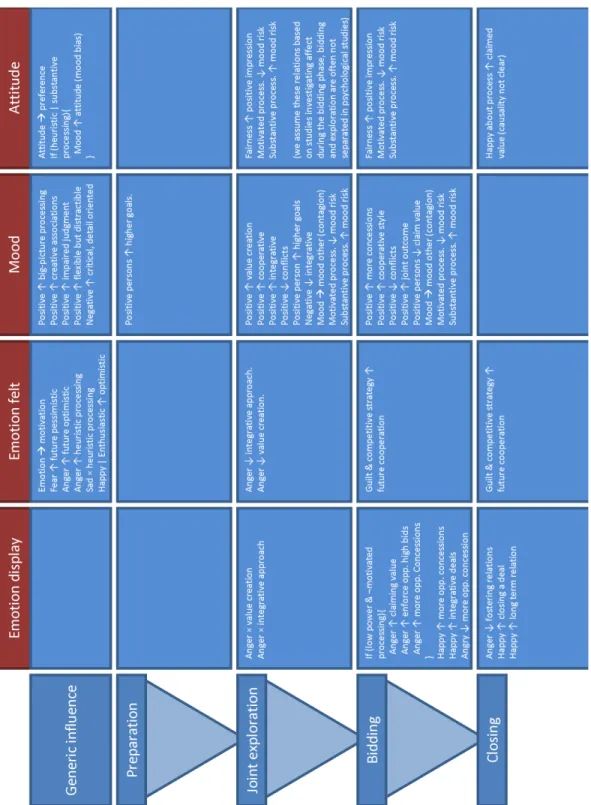
In this section we propose affect-related functions a negotiation support system could have. We organ-ize the discussion of functions according to the struc-tured overview of the relations between affect and negotiation as found in the psychological studies re-viewed earlier (Figure 2). This overview has two dimensions. Our first dimension is the negotiation phase (as previously defined in the Negotiation sec-tion). This approach is compatible with the one pro-posed in [7] in which the different influences of af-fect are also categorized according to the phase of the negotiation. We use slightly different phases, i.e., we have separated the negotiation phase in [7] into joint exploration and bidding, and merged their outcomes
and implementation phases into one phase called
closing. Our second dimension is the type of affect involved (as previously defined in the Emotion sec-tion). We have taken the four different types of affect as described earlier. Our approach is compatible with, but also slightly different from, the one described in [145]. The authors separate emotions that exist be-fore the negotiation (called exogenous emotion) and emotions that are felt during the negotiation (endoge-nous emotions), compatible with our distinction of
the negotiation process in phases. Further, they dis-tinguish between felt and expressed emotions, equivalent to our distinction between emotion display and emotion. We introduce two extra distinctions, based on the previously discussed affect-cognition literature, being the distinction between mood and emotion, and emotion and attitude. The reason for doing so is that attitude is quite different from both mood and emotion (as explained earlier), and emo-tion and mood have different influences on cogniemo-tion and behavior (mood has global, subtle influences, while emotion has direct, strong influences).
The discussion of possible affect-related functions of negotiation support systems (NSS) is organized in order of negotiation phase (top-down in Figure 2). Functions are to be interpreted as functional require-ments an affective NSS could have. All functions are numbered and presented as conclusion to an intro-ductory paragraph. First we describe how generic influences of affect on cognition could be used in a negotiation support system. Then we describe for each phase potential affect-related functions. All of the hypothesized functions are based on findings from the affect-negotiation literature just reviewed. We focus on online “light” support not offline “deep” training. This distinction into two types of support has been proposed by negotiation experts [123]. An example of offline training, i.e., virtual reality sce-nario-based training, will be discussed in a separate paragraph at the end of this section. The feasibility of the different functions we propose for an affective NSS will be discussed in the section on affective computing techniques.
3.2.1.Generic affective support.
Emotions are strongly linked to motivation. The genuine expression of an emotion is therefore an in-dication of underlying concerns, beliefs and desires. This means that the expression of emotion during the negotiation process should be taken as a signal. Es-pecially as specific emotions signal specific meaning, for example fear signals a pessimistic view on the future, while anger and enthusiasm signal an optimis-tic view of the future. Such signals can be taken into account during the negotiation in two different ways: as something to cope with, or as something to use strategically.
1a. The NSS detects the felt emotion of the negotia-tor and his/her opponent, and indicates effects ac-cording to the generic influences of felt emotions. 1b. The NSS detects the expressed emotion of the negotiator and his/her opponent, and indicates
ef-fects according to emotion display in different phases and suggests changing expression.
The same holds for the influences of mood. Mood influences information processing in important ways. Positive moods favor creative, big-picture integrative thinking, while negative moods favor critical evalua-tion of details. An NSS can help to make someone aware of one’s mood and the effects this mood can have on the decision making process. For example, it is necessary in a negotiation process to consider if the negotiation is ready to move to the next phase. Did we explore enough options? Did we exchange enough information of issues? Can we now start bid-ding? Negotiators moving through the different phases can be seen as fish swimming into a hoop net (Figure 1b); it is easy to move on, but difficult to get back.
2. The NSS detects the negotiator’s mood and if the negotiation is moving towards the next phase. The NSS indicates to the negotiator whether his/her mood is compatible with critically analyzing the cur-rent phase. Positive moods should be avoided, neu-tral or slightly negative mood are favored.
A related issue is that it is difficult to decide to go back, as this usually involves more effort and it might be perceived as offending by the opponent. As such, an NSS can help a negotiator to “gracefully” step back by giving canned sentences, but also ask the negotiator how he/she feels about going back. If this results in a negative emotion, the next step is to work on a strategy to go back that does feel good. If a negotiator ends up in the closing phase not feeling good about the solution and not feeling good about going back one or two phases, then that will result in a bad deal.
3. The NSS periodically asks the negotiator about his/her attitude about the “decision to step back”, raises a red flag when this attitude is negative, and helps identifying a “step back strategy” that feels good.
Further, mood can influence attitudes, and thereby opinions about opponents, issues and options. A posi-tive mood triggers information that has a posiposi-tive affective association and vice versa (mood congru-ency). Further, the current mood, if one is unaware of it, influences how beliefs are evaluated (mood as information). This means that while evaluating op-tions, issues and preferences, one should be aware of two things: first, did I (we) cover a broad range and not just the mood-congruent range, and second, did we evaluate the options, issues and preferences in an objective way?
4. The NSS detects the negotiator’s mood and if the negotiator is identifying / evaluating options, and indicates potential dangers of mood congruency and mood as information.
5. The NSS detects negotiator’s mood and if the negotiation is in a phase characterized by an elabo-rate reasoning style (open ended reasoning and new information), and either indicates potential dangers or offers to cope with the situation by structuring the negotiation process to enforce a motivated process-ing style (e.g., helpprocess-ing the negotiator(s) to set clear goals).
3.2.2.Preparation phase support.
In our literature survey we have not found many negotiation-specific influences of affect in the prepa-ration phase, probably because negotiation experi-ments mostly focus on the exploration and bargaining part and not on the preparation part. However, as the preparation phase essentially is not a negotiation-specific phase, but more so an information gathering and preference analysis phase, we will outline some of the possible functions for an NSS based on the reviewed generic influences of affect on cognition. First, it is essential to get a good overview of the op-tions, issues and your preferences. It is useful to both vary your mood during this phase (i.e., explore issues not only when in a good mood, but also when in a bad mood) and be made aware of your mood. 6. The NSS continuously detects negotiator mood while he/she is working on preference elicitation and analyses “mood” coverage. If needed, it advises to think about preferences in different moods.
It is equally useful for a negotiator to become ex-plicitly aware of the emotions you are likely to feel during the negotiation when preparing for the nego-tiation (e.g., when negonego-tiation is perceived as some-thing difficult, the negotiator might feel fear). 7. The NSS measures the negotiator’s attitude with respect to target point (goal), reservation point, is-sues, opponent and the decision to negotiate in the first place. If negative attitudes are detected, training is advised after which the NSS re-measures attitudes.
An NSS can in fact play an important role in prac-ticing negotiations. A virtual scenario can be played out with an artificial intelligent agent that is able to simulate negotiation choices and affective reactions. By playing the scenario, you could try out different strategies and get accustomed to the idea of having to negotiate about particular (perhaps emotionally laden) issue. Training will be discussed in more de-tail at the end of this section.
Finally, for a negotiation support system (and in particular bidding support) it is essential that users input valid preferences for the different issues that play a role in the negotiation. Currently, user prefer-ences about issues and options are usually modeled on a one dimensional scale ranging from good to bad. Users might benefit if an NSS is able to model affec-tive preferences about options and issues. For exam-ple, I am disappointed if this would be the price for the new car. I am happy if I would get metallic paint for free. I would be angry if I end up at my reserva-tion point. Such affective preferences can be mod-eled in different ways. For example, one could repre-sent a preference numerically on the different affec-tive dimension such as pleasure, arousal and domi-nance. Another example would be to include particu-lar discrete emotions as issues about options and al-low the user to rate the importance of different emo-tions, e.g., it is very important that I do not have any regret, or, it is very important I am happy.
8. The NSS is able to elicit affective preferences (and use these for bidding support later on).
3.2.3.Exploration phase support.
In the exploration phase, emotion plays an impor-tant role. First, it is imporimpor-tant to limit the amount of felt anger (or sadness and fear for that matter). Obvi-ously, one cannot just suppress these feelings, but one can take breaks, continue the negotiation another time or try to identify what exactly makes one angry. Such negative emotions hinder an integrative ap-proach as well as the creation of value (win-win po-tential). An NSS can detect anger and suggest such steps. As an example consider the work by [78], who identified the role of anger in computer mediated negotiation. They found that flaming (hostile emo-tional communication) was completely mediated by anger resulting from (a) frustration resulting from the communication medium (text chat in their case), (b) uncertainly about the negotiation task, and (c) anger directed at the other party. They propose three steps negotiators can take to reduce anger: reinterpretation, managing provocation, and relaxation.
9. The NSS detects felt anger, sadness and fear by the negotiators and tries to manage the situation by making negotiators aware of the moments in which anger was detected and suggesting taking a break.
A negative mood can hinder an integrative ap-proach as well. A positive mood favors integrative problem solving and creativity, and helps to avoid conflicts. These are important aspects in the joint exploration phase, as one of the major goals is to
explore options. Exploration requires a creative and flexible mind set.
10. The NSS detects the overall mood (e.g., aver-age of, and difference between moods of both nego-tiators) and indicates if the mood is compatible with the beginning of the exploration phase.
People in a good mood also set high goals. This might be a good thing, depending on the negotiation context. If the negotiation is perceived as very com-plex, or the opponent is not someone to do big con-cessions, it is perhaps better to not set your goals too high, and therefore favor a less enthusiastic mood. As a positive mood also favors heuristic decision making (not detail oriented) and hinders making correct judgments by making a person accept propositions too easily, it is important to balance the mood, also during this phase. As it is important to cover the scope of issues and options as good as possible, this also involves critical analysis of these issues and op-tions. This is favored by a negative (or at least slightly negative to neutral) mood.
11. The NSS detects the overall mood and whether enough information is generated and suggests that it is time to change mood and critically analyze the data.
12. The NSS explicitly breaks up the exploration phase in a “positive brainstorm phase” and a “neu-tral/reserved analysis phase”.
13. The NSS facilitates the right mood through standard mood induction techniques such as showing short movie clips with either positive or negative affective content.
Any mood has the risk of mood induction; the in-fluence of mood on attitudes in this case about for example the negotiation issues, options, and oppo-nent. This means that a person’s mood will both color the associations he/she has and limit the kind of associations available. If the goal is to have a broad look, it might therefore be a good strategy to keep a neutral mood, or vary the mood across the positive-negative spectrum, as discussed above. An alterna-tive strategy is to pick an information processing style that is less prone to these two effects: motivated processing. An NSS could help negotiators by setting clear goals and structuring the process. This in and of itself might already reduce the influence of mood on judgment and attitudes. Functions 4 and 5 already cover these issues.
3.2.4.Bidding phase support.
In the bidding phase emotion expression seems to be important. Both positive and negative expressions
(happiness and anger, respectively) can help to claim value by making the opponent do high bids and more concessions. However, anger expression can have obvious negative side effects, and anger only has a positive effect on claiming value if the opponent feels less powerful (poor BATNA, poor alternative options, no ability to deceive, rejection has conse-quences). An NSS can help to identify when anger expression is useful and how anger could be inter-preted. Consider for example the findings by [122] who show that selective use of anger and happiness expression can have a positive effect on the “fixed-pie” perception of negotiators. They showed that when anger is used as a reaction to another party’s low priority issue in a bid and happiness to that party’s high priority issue in that bid, that party’s fixed-pie perception is reduced. When anger and happiness were inversed, the effect on fixed-pie per-ception was reversed too. This indicates that affect can also be used as information about issue priority. 14. The NSS detects expressed emotion by the op-ponent and indicates what these signals could mean according to the relations depicted in Figure 2. 15. As the NSS keeps track of options, preferences and issues as well supports the user in calculating bids, it can suggest the use of anger (or enthusiasm, see below) expression as a tactic to force an oppo-nent into giving up value when it estimates that the opponent has a low-power position.
16. The NSS analyzes if the “expression tactic” worked by analyzing the value of the counter offer. 17. The NSS adapts its bidding strategy according to the “expression tactic”.
Strategic use of emotion expression can be made dependent on the relation between the negotiators, the type of negotiation (long-term, repeated, one-shot), and the current mood. If anger expression is not an option, the NSS could suggest the use of en-thusiasm expression about a particular bid. As it seems from the literature that the underlying dimen-sion influencing the bidding is power (as communi-cated by both enthusiasm/happiness and anger) an-other way of manipulating the situation in order to claim value is by consistently keeping track of the “power situation” of both negotiators.
18. The NSS detects the level of power of both op-ponents as calculated from objective measures such as BATNA and strength of alternatives as well as the mood. It presents these levels to the negotiator. 19. The NSS adapts its bidding strategy based on the power levels of the negotiators.
A last important thing is fairness and guilt. If the bidding is perceived as fair, people have a positive
impression of the process and this makes them hap-pier about the outcome.
20. The NSS offers a tool to enhance fairness of the bidding by explaining and enforcing bidding rules
21. The NSS detects negotiators’ attitude about fairness about the process and presents this to the negotiators as feedback.
22. The NSS uses the detected perception of fair-ness to suggest other bids.
Related to fairness is the aspect of guilt. As guilt influences future negotiation behavior towards coop-eration, an NSS can help to use guilt strategically but also help to cope with the effects of guilt.
23. The NSS detects that you feel guilty during the bidding and suggests taking a break and reflecting upon the reason for that feeling as a protection for future negotiation rounds.
24. In a long-term or repeated bargaining situa-tion, the NSS uses opponent guilt in its bidding strat-egy.
25. The NSS reminds the negotiator to trigger feel-ings of guilt in the opponent.
Apart from these more strategic uses of emotion expression, the NSS can also help creating the right information processing style (i.e., motivated process-ing) and manage moods as explained in the previous paragraphs and covered by the functions in those paragraphs.
3.2.5.Closing phase support.
In the closing phase, critical reflection upon the negotiation as well as relation building are most im-portant. Critical reflection should occur because after signing the deal (or paying for the car) it is practi-cally impossible to go back. It is essential to figure out if (a) you are near your target point and in any case not under your reservation point, and (b) the opponent is not under his/her reservation point. If either of the two parties is giving in too much, honor-ing the deal will be an issue because feelhonor-ings of re-gret will start to develop when the two parties part. An important aspect here is outcome satisfaction. 26. The NSS detects outcome satisfaction of both opponents (measures outcome attitude), and makes the negotiators aware of this.
27. The NSS detects outcome satisfaction and uses this to propose other bids (satisfaction-based re-negotiation).
Relation building is important in repeated and long-term bargaining, but less important in one-shot bargaining. Negotiators need to plan relation building
activities even before the negotiation. As relation building is a social activity, we currently do not see how an NSS could really help in doing so. This help is probably limited to giving several hints about what could be done, such as planning dinner after an im-portant negotiation.
28. The NSS suggests relation building activities before and after the negotiation.
3.2.6.Offline-training.
The previous discussion has been about negotia-tion support during the actual negotianegotia-tion. Now we briefly suggest several possibilities for training as part of the preparation of a negotiation using an NSS. We focus on affect-related functionality that could be provided in virtual reality scenario-based training. The training would aim for two things: first, to train a novice negotiator in negotiation skills in general, and second, to prepare a negotiator for a particular nego-tiation. We first discuss training generic skills. Dif-ferent dynamic scenarios could be developed that involve typical negotiation settings such as job nego-tiation (application and contract, contract re-negotiation, firing personnel), buyer-seller negotia-tion (car, house, appliances), and divorce. An artifi-cially intelligent virtual character plays the role of the opponent, and the user can choose the role he/she wants. Multiple of such AI characters may be avail-able for training. The AI-character has beliefs, de-sires, goals, personality, a negotiation/conflict han-dling style, mood and emotion. In addition to this, different scenarios are developed, each describing the negotiation setting, issues, options, preferences of the AI-agent as well as events that can occur during the negotiation. The user prepares his/her part of the sce-nario through instruction, and perhaps use of the NSS to structure the issues, options and preferences. While playing the scenario, the user’s emotional state as well as negotiation actions (such as bids) are measured. Afterwards the user can be confronted with his/her reactions. In fact, the complete range of affect support functions described above can be used extensively during this training, as the issue of pri-vacy (of the opponent) is less relevant and the ac-ceptability of being measured and wired is higher [18]. Further, the user could ask the system to explain the behavior of the AI character, during and after the scenario. As the character generates its behavior in a semi-automated and dynamic way that depends on interaction with the user and events that occur in the virtual reality environment, the character will exhibit variations in its behavior every time the scenario is
played. An explanation function would generate plausible explanations of the AI character’s actions based on the character’s internal state. Such an adap-tive and dynamic virtual reality scenario is very much compatible with the idea of serious gaming (although we haven’t touched the gaming aspect here).
Given that a flexible scenario system as described above exists, the user can develop its own scenarios and agents and prepare for a particular negotiation. Now, the possibility exists to fully configure the NSS’s training function to train a particular negotia-tion setting. This can be integrated with existing tools such as preference elicitation tools and bidding sup-port.
29. The NSS provides a training facility to work through different user-definable scenarios (with or without affective support as mentioned in function 1-28). Affective reactions (mood, emotion) and user actions are logged and used as training feedback.
Table 1
Classification of affect-related NSS functions
Output Input Change affect Use affect in NSS functions Help negotiation process (tips, strategy, coping) Expressed emotion (self & other) 1b 1b, 14 Felt emo-tion 9 1a Mood 5, 23 19, 24 2, 4, 5, 6, 10, 11, 18, 23 Attitude 3, 7 8, 22, 27 3, 7, 21, 26 Non-affective 13, 15, 20, 25 17 12, 16, 28 3.2.7.Summary
We have discussed a large variety of ways in which an NSS can help a user cope with and use af-fect in negotiation. However, we have not touched upon the technical feasibility of all of this. We have done so on purpose. In this section we wanted to
cre-ate a vision, a long-term goal, of what could be done in an affective negotiation support system based on experimental data from affect and cogni-tion/negotiation literature. To be able to implement these functions, affective computing techniques [120, 121] are needed. In order to get an idea of the techni-cal feasibility of the described functions, in the next section we discuss the state of the art of affective
computing (although only at a high-level, because the scope of this article does not permit us to go into de-tail), and link this to the different functions we pro-posed in this section. To discuss the feasibility of these functions more systematically, we classify them in Table 1 according to (affective) input and intended use.
Figure 2. Overview of affective influences on negotiation. The first row summarizes generic influences. Subsequent rows summarize influ-ences per negotiation phase. Signs mean the following: ‘↑’ denotes a positive relation, ‘×’ denotes no relation, ‘↓’ denotes a negative relation, ‘’ means ‘influences’ in a more generic sense. See the sections on the relations between affect and cognition/negotiation for further details.