POMS Abstract Acceptance No - 015-0947
Study of Cold Chain Logistics Implementation Strategies:
Insights from UAE Industry
Mohammed Tamimi1, Balan Sundarakani2* and Prakash Vel3 1
Radio Optimization Engineer, Du, Emirates Integrated Telecommunications Company, Dubai 50266, U.A.E, Email: [email protected]
2,3
Faculty of Business and Management, University of Wollongong in Dubai, Knowledge Village, Dubai 20183, United Arab Emirates
Email: [email protected] & [email protected] *Corresponding Author
POMS 21st Annual Conference Vancouver, Canada May 7 to May 10, 2010 Abstract
This article highlights the concept of cold chain logistics, the importance of cold chain logistics and the role and benefits of cold chain logistics among different industries. It analyses challenges of implementing the cold chain logistics by taking a case of pharmaceutical drugs Industry located in the United Arab Emirates (UAE) and introduces some general cost and concerns of cold supply chain practices associated to this region. Finally the paper discusses risks associated with the implementation and potential opportunities of the cold chain logistics in the UAE region.
Introduction
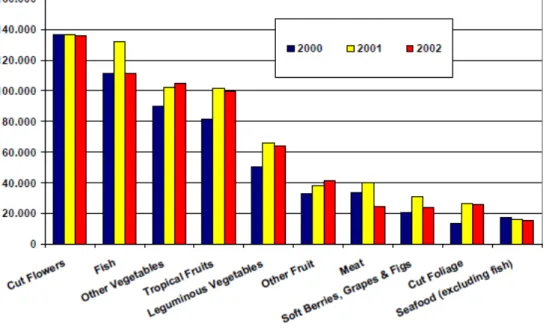
Cold Chain Management (CCM) can be defined as the network of facilities and distribution options that performs the usual functions of a standard supply chain cycle but with temperature and humidity control throughout the supply chain stages and entities. (Last, 2009). Cold supply chain has become more and more important within the changing global economy today due to the huge increasing demand on the products of temperature controlled industries, especially fresh agricultural products, manufactured food, chemicals, military services, and medical vaccines. Figure 1 shows the growth trend in supply chain industries and services. Cold chain logistics is considered as huge competition advantage as it cause a valuable extension to product shelf life which gives the suppliers the ability to access overseas markets and to meet the huge local demand caused by the population growth as well. (Taylor, 2006).
Figure 1: Cold supply chain services growth worldwide (Source: Adapted from CCA, 2009)
In an increasingly global market the demand for temperature controlled food and non-food is increasing in many markets across the globe. One important factor is the movement of manufacturers and retailers to emerging markets in Asia and Latin America, as well as the changing tastes of consumers in more mature markets. This has resulted in high levels of investments by logistics companies and their associate suppliers as they have acquired or partnered local players in order to access these markets and to open temperature controlled operations in these regions to serve the growth in prosperity of local populations. (Global Cold Chain Logistics Report, 2009). Temperature monitoring and control are essential mechanisms in cold chain management, because they are necessary for maintaining food safety and quality. According to Salin and Nayga (2003) multinational restaurant companies like McDonalds, KFC and Burger King etc., manage technical challenges in target markets with tight specifications and exclusive supply chains, while smaller firms use extensive networks to supply imported frozen potatoes.
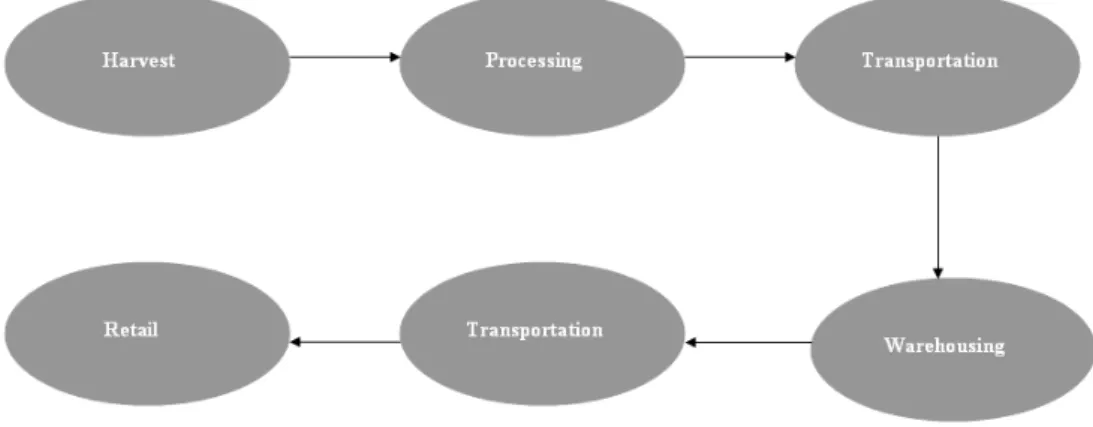
Any changes in time-distance or temperature in the chain could cause the net present value of the activities and their added value in the supply chain to be perturbed. Bogataj et al. (2005) investigated that perturbation analyses are especially important to assure the stability of cold chains in the CCM. What conditions should be fulfilled to assure that after such robust perturbations of parameters and especially time delays (lead times and some other delays) the behaviour of the logistics chain would still be within the prescribed limits. Figure 2 shows the most common services and products provided by the cold chain logistics industry.
Figure 2: Cold chain logistics stages
Cold Chain Logistics System
Although cold chain concept has been existing for decades literature on the CCM methodologies are limited (Cunningham, D.C. (2001), Collins et al. (1999), Boyd et al. (2003), Hamdar, B.C. (1999)). Most of the literatures discuss either the supply chain performance or impact of other enablers in it. Very few articles focus the CCM and its implementation strategies. Consolidating all the literature, the cold supply chain logistics system aims to store & transport the temperature sensitive goods from the manufacturer to the consumer in a potent and a safe state.
The cold chain system comprises three major elements:
• Personnel, who use and maintain the equipment,.
• Equipment for safe storage and transportation of goods.
• Procedures to manage the program and control distribution and use of the goods.
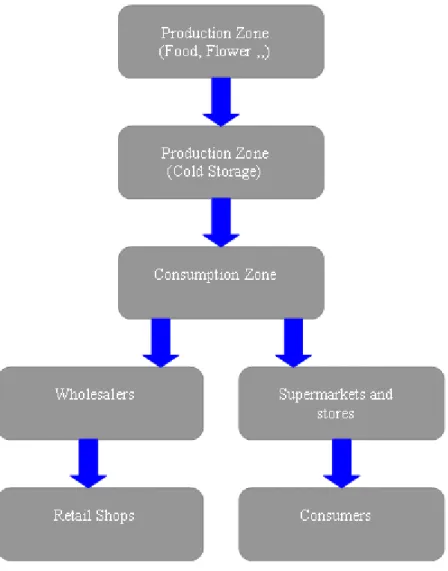
Figure 3. demonstrates a typical cold chain cycle, along the different stages through the process of delivering the temperature-sensitive goods from the manufacturer to final consumer. (Roodbergen, 2008)
Figure 3: Cold chain logistics system (Source: Adapted from Yanmar, 2009)
Cold Chain Logistics Example: Pharmaceutical Drugs Industry
Cold chain logistics in pharmaceutical drugs industry is concerned about the storage and the transportation of medical vaccines in a safe environment from the manufacturer to the person who will use it, this is extremely vital in this industry as it is known that most vaccines and drugs lose its medical benefits and over time, especially if exposed to sun light and heat. There are different storage and transportation conditions appropriate to each level of the parametrical drugs industry cold chain. Thus, each level requires different storage and transportation equipments
depending on the quantity of vaccine and drugs to be stored, the duration of storage and the temperature necessary, all equipment must be able to keep vaccines and drugs safely regardless of the outside temperature. Cold chain logistics system in pharmaceutical drugs industries consists of two major stages; Storage and transportation. (World Health Organization, 1998)
Cold chain system stage 1: Storage
Most vaccines and drugs lose potency over time, especially if exposed to heat, that’s why all Vaccines must be stored at a temperature higher than 0o and lower than +8o C, the below table shows the appropriate temperatures to store vaccines at different levels of the cold chain as per the recommendations (See Table 1).
Table 1: Vaccines storage temperatures (World Health Organization, 1998)
Various storage temperatures and condition are suitable for each and every level of the cold chain cycle; each level requires different type of storage cold chain equipments depending on the quantity to be stored, the duration of storage and the temperature needed. Some of theses widely used storage conditions are: Cold rooms, top-opening freezers, and icepack freezers. (World Health Organization 1998)
Cold chain system stage 2: transportation
All transportation methods in the cold chain cycle must be able to protect the vaccines from high temperature. However, in winter, when the temperatures goes below 0 o C protection against freeze condition must be considered as well, cold boxes and vaccine carriers are efficient to provide the needed protection. (World Health Organization 1998).
Issues and Costs in Cold Supply Chain Implementation
Although cold supply chain practices has introduced a lot of benefits and advantages to the related industries supply chain efficiency and competitiveness, this advantages come at price, below are a few issues to be addressed when considering a cold supply chain design and implementation: (Blanchard, 2007)
The use of non-environmental gas compounds
All cold chain equipments must contain at least one type of “organic gas compounds”, these gas components are called CFC gases, and it was recently discovered that these components can cause a serious environmental damage if released to the atmosphere, therefore, a new generation of cold chain equipment was introduced in 1996 to replace those using CFC gases, The new equipment is considered as CFC-free which comes for a higher price of course. The symbol shown below is used on refrigerators, air conditioners and drug carriers to highlight that the equipment has been made using CFC-free gazes and hence; has no harmful environmental effect. (Blanchard, 2007) Frosting
Ice can slowly build up on the freezing surface of the refrigerator during its operation; this frost layer must be continuously removed as it lowers the cooling efficiency of
the cold chain equipment, that's why regular defrosting is important which have to be added to the equipment maintenance total cost. (World Health Organization, 1998). Safety concerns
Since all of the cold supply chain equipments are powered by electricity, a qualified electricity technician has to be used to confirm the proper installation and deployment of all connections, plugs and switches, safety kits and circuit breakers has to be considered to protect the personnel and the equipment in case of any failure. (Blanchard, 2007)
Continuous Control and monitoring of temperatures
Maintaining correct temperatures during storage and transportation is a very important task for the cold supply chain cycle; temperature readings must be continuously taken in order to:
• Ensure that the vaccines are stored at the correct temperature condition.
• Ensure that the cold chain equipment is operating successfully.
Continuous monitoring of temperatures should be a regular task, and should be performed at the start and end of each day, although there are a lot of monitoring devices and equipments to help measuring, controlling, and recording the cold chain equipment temperature, it still needs extra man power overhead than the regular non-temperature controlled supply chain logistics. (World Health Organization, 1998)
Figure 4: Different temperature monitoring and controlling devices
(Source: World Health Organization, 1998)
Cold Chain Implementation in UAE
Considering the very high temperature and humidity levels observed in the UAE most of the year, cold supply chain logistics practices have become more and more important to the businesses in the country in order to maintain an acceptable and profitable “shelf life” for their products and goods.
Dubai Flower Center
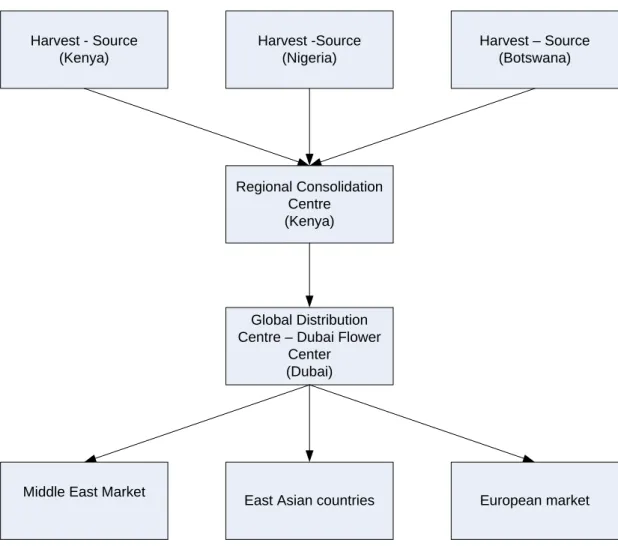
One of the most applicable examples of cold chain logistics implementation in the UAE is Dubai flower center which is a temperature and humidity controlled facility used to import, export and distribute all different type of flowers. The “As-Is” scenario of the case of flower supply chain system is shown in Figure 5.
Harvest - Source (Kenya) Regional Consolidation Centre (Kenya) Harvest – Source (Botswana) Harvest -Source (Nigeria) Global Distribution Centre – Dubai Flower
Center (Dubai)
Middle East Market
European market East Asian countries
Figure 5. The current (As-IS) scenario of flower supply chain
Current flower distribution system According to the United States department of agriculture; studies and estimations have proven that there is an approximate of 20% loss of flowers during the marketing stage only due to temperature and humidity conditions which approximately worth around 90 million dollars worth of losses every year. That’s why cold chain logistics is used in this industry to achieve two major benefits, firstly to maintain the environmental condition to reduce deterioration and secondly to extend the flower “shelf life” period.
Cold Chain practices used in Dubai flower center
A lot of cold chain practices used in Dubai flower center to achieve the environment control need, some of them are: (CCA, 2009)
• Refrigerators are used to deliver the goods from the airplane to the center facilities
• Sealed bays to receive and dispatch the cargo
• Air locked land-side and air-side bays
• Vacuum cooling equipment for quick cooling results
• Temperature and humidity controlled storage area
Conclusions
Cold chain supply chain is the network of facilities and distribution options that performs the usual functions of a standard supply chain cycle but with temperature and humidity control throughout the supply chain stages and entities. Some of the managerial implications identified from this study are:
• Cold Supply chain is applicable in so many industries like: 9 Agricultural products
9 Food manufacturing 9 Chemicals industries 9 Medical vaccines and drugs
• Cold supply chain has major benefits on the industries that use it like: 9 Valuable extension to the product shelf life
9 Gives the ability to access overseas markets 9 Gives the ability to meet the huge local demand
• Cold supply chain implementation has some costs and concerns like: 9 The use of non-environmental gas compounds
9 Frosting
9 Safety concerns
9 Continuous Control and monitoring of temperatures
Cold supply chain practices have been extremely successful in UAE amidst its challenges, the hot weather most of the year. An example case of Dubai flower center has been discussed associated with some critical implementation challenges, opportunities and managerial implications.
References
• Agenci Aminas. 2009. Available: www.agenciaminas.mg.gov.br. Last accessed 30 Dec 2009.
• Blanchard, D. 2007 Supply chain management best practices, New Jersey, John Wiley & sons, Inc.
• Bogataj, M., Bogataj, L. and Vodopivec, R., (2005), Stability of perishable goods in cold logistic chains, International Journal of Production Economics,
Volumes 93-94, 8, pp 345-356
• Boyd, S.L., Hobbs, J.E., Kerr, W.A. (2003), "The impact of customs procedures on business to consumer e-commerce in food products", Supply
Chain Management: An International Journal, Vol. 8 No.3, pp.195-200.
• CCA, 2009. Available: www.coolchain.org. Last accessed 08 Dec 2009.
• Chopra, S. and Meindl, P. 2007 Supply Chain Management: Strategy, Planning, and Operation. 3rd ed. Upper Saddle River, N.J: Prentice Hall.
• Collins, A., Henchion, M., O'Reilly, P. (1999), "The impact of coupled-consolidation: experiences from the Irish food industry", Supply Chain
Management: An International Journal, Vol. 4 No.2, pp.102-11.
• Cunningham, D.C. (2001), "The distribution and extent of agrifood chain management research in the public domain", Supply Chain Management: An
International Journal, Vol. 6 No.5, pp.212-5.
• Dzever, S., Merdji, M., Saives, A-L. (2001), "Purchase decision making and buyer-seller relationship development in the French food processing industry",
Supply Chain Management: An International Journal, Vol. 6 No.5, pp.216-29.
• Global cold Chain 2009, Available: www.gcca.org. Last accessed 08 Dec 2009
• Global Cold Chain Logistics Annual Report, 2009, ‘Transport Intelligence; market intelligence for the transport and logistics industry’ Available online [Accessed on 23/01/2010]
• Hamdar, B.C. (1999), "A new era for efficient food manufacturing in the Lebanon: the experience of conserves modernes chtaura", Supply Chain
Management: An International Journal, Vol. 4 No.1, pp.14-17.
• JOHN M. LAST. Cold chain. Available: www.answers.com. Last accessed 20 Dec 2009
• Kohli, P. 2008, Fruits and Vegetables Post-Harvest Care: The Basics.
• Roodbergen, K. 2008, Finding New Efficiencies in the Cold Chain.
• Salin, V., Nayga, R.M. Jr (2003), "A cold chain network for food exports to developing countries", International Journal of Physical Distribution &
• Stank, T., Crum, M., Arango, M. (1999), "Benefits of inter-firm coordination in food industry supply chains", Journal of Business Logistics, Vol. 20 No.2,
pp.21-41.
• Sunwell Technologies. 2009. Available: www.sunwell.com. Last accessed 25 Dec 2009
• Taylor D, 2006, Global Cases in logistics and Supply Chain management, Thompson, South Western, USA
• The med guru. 2009. Available: www.themedguru.com. Last accessed 30 Dec 2009.
• World Health Organization. 1998 Safe vaccine handling. Geneva, Basics, USAID and UNICEF
• Yanmar Co. 2009. Available: www.yanmar.co.jp. Last accessed 25 Nov 2009.
• Zylbersztajn, D., Filho, C.A., Pinheiro, M. (2003), "Competitiveness of meat agri-food chain in Brazil", Supply Chain Management: An International