Student Engagement in Higher Education Journal 71 Vol 1, Issue 2, 2017
Title: Engaging students in bioscience research to improve their learning
experience
Page, H., Ralebitso-Senior, T.K. and Orr, C.H.
School of Science and Engineering, Teesside University, Borough Road, Middlesbrough, UK.
Email Addresses:
[email protected] [email protected]
For correspondence, please contact: [email protected]
Biographies:
Mrs Helen Page, Senior Lecturer, promotes student engagement through partnership working and advocates fairness in group work assessment methods.
Dr Ralebitso-Senior is a active academic who engenders and practices research-informed teaching at every level in Higher Education.
Dr Orr is a Senior Lecturer and researcher aiming to improve student engagement and increase learning by embedding research-led teaching.
Summary
Combining teaching and research is the definitive principle of ‘research-informed teaching’ (RIT) (Healey, 2005). RIT is pivotal for improving the student learning experience. All undergraduate students within the School of Science and Engineering, Teesside University (TU), can become RIT co-creators via their curricula-based Level 5 project proposal module and Level 6 research project.
This case study illustrates how the authors used complementary, co-curricula methods to enhance student engagement with bioscience research utilising co-designed research projects and publication preparation. The success of student involvement in these
initiatives was measured against six key personal attributes (Adaptable, Articulate, Aspiring,
Creative, Critical, Confident), questionnaire responses from ten respondents, and a
summary of tangible research outputs. An evaluation of staff involvement was made with semi-structured interviews.
Overall, the research-led, partnership approach resulted in increased student motivation, aspiration and confidence in their further learning and employment.
Description of project
The biosciences staff at Teesside University (TU) use different RIT approaches to provide a range of opportunities for all students to develop key personal attributes. These curricula
Student Engagement in Higher Education Journal 72 Vol 1, Issue 2, 2017
approaches include teaching research and enquiring skills, production and critique of research bids and engagement with a Level 6 research project. However, the current case study focuses on co-curricula approaches that complement and add value to student learning, but which sit outside of their degree programmes.
The authors aim to outline different approaches that TU bioscience staff have employed to engage students in RIT and report on the success of these strategies for both students and staff. We hypothesise that additional co-curricula RIT initiatives will further strengthen six key personal attributes (Adaptable, Articulate, Aspiring, Creative, Critical, Confident) in our graduates.
Co-curricula initiatives
As TU academics, there are several funding streams that are available to us and which we exploited. TU funding includes the centralised Students as Researchers (SARS) scheme and project-related Student Research Assistants. External funding was obtained successfully from: Society of General Microbiology (SGM); Society for Applied Microbiology (SfAM); and industrial-linked/-funded initiatives. To ensure equity of opportunity, positions were advertised to all Level 5 and 6 students. However, since the external funding was
competitive, and the schemes dictated specific criteria (e.g. likely to pass with a 2:1), some student selection was required. To ensure inclusivity and prevent the potential
development of an ‘elite’ model (Kuh, 2007), where only a small percentage of highly
engaged students are involved and therefore benefit, we were mindful to give opportunities to a range of students each year.
Topics for the co-curricula initiatives were identified by the authors from on-going PhD programmes, new research areas and industry-linked enterprises. The details of the work were negotiated with the students to ensure a partnership approach. Example topics included: (i) recovery of spermatozoa from bathwater as an alternative for evidence recovery where there is a delay in reporting a sexual assault; and (ii) measuring the effects of biochar on nitrogen-fixing bacteria from the rhizosphere of clover in relation to
sustainable and ‘climate-smart’ agriculture. Additionally, these subjects were adopted to complement the School’s mission statement: ‘Developing the problem solvers, innovators and leaders of the future’. As a result, our bids to funded schemes specified the
implementation of this statement as a key criterion towards enhanced student learning and engagement. Further emphasis was placed on developing technical and practical skills, emotional intelligence, problem solving, and self-management within dynamic and cross-disciplinary teams.
Enabling Partnership
One of the key challenges of engagement with research is defining and aligning the needs and expectations of the principal stakeholders such the students, funding bodies and external business partners. Working collaboratively with the academics (Healey, Flint & Harrington, 2014), students designed the co-curricula projects to be scientifically valid and produce outcomes which contributed to the overarching aims of wider research
Student Engagement in Higher Education Journal 73 Vol 1, Issue 2, 2017
allowing increased legitimacy in their role as co-creators of knowledge (Neary, 2008). Furthermore, students often completed data analysis or contributed to the literature mining and writing of publications. Promoting these additional opportunities familiarised the students with the requirements for publication, thus raising the profile of research practices.
Evidence of effectiveness and impacts
The benefits of participation in RIT on student development were evaluated against six essential, cross-discipline attributes: Adaptable, Articulate, Aspiring, Creative, Critical,
Confident, or the 3As and 3Cs, which was the goal of TU’s Learning, Teaching and Student
Experience Strategy (2012-16). These attributes were used to design a questionnaire in accordance with the University' research ethics guidelines. Consent was obtained from students who had participated in co-curricula RIT initiatives. They subsequently rated their perception of the six attributes, on a scale of zero (no ability) to nine (fully accomplished), before and after completing their research, and commented on their experiences of being involved in the projects (Appendix 1). Differences were analysed statistically using the Mann Whitney U test.
A total of ten RIT participants, who reflected the diverse characteristics of the TU student population, responded to the questionnaire. They included male, female, BME,
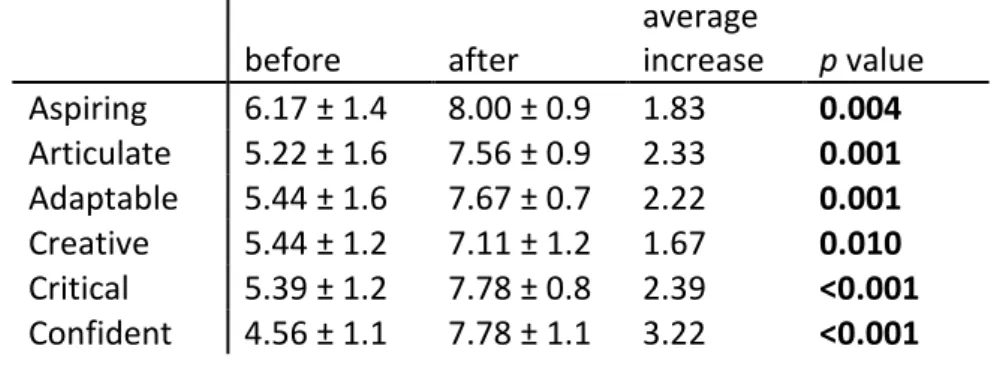
undergraduate/postgraduate, international, and home students. Overall, the respondents’ perceived ratings showed improvements in the six attributes after taking part in the RIT scheme (Figure 1), which was confirmed quantitatively with increased capabilities that were statistically significant (p < 0.05; Table 1). Articulate, which the respondents perceived as their weakest attribute pre-involvement, showed the highest increase from 5.22 ± 1.6 to 7.56 ± 0.9. Confident, frequently stated as a skill lacking in post-1992 University graduates (Holker, 2012), increased the most overall and by an average greater than three points (p < 0.001). Although showing one of the lowest increases, Aspiring was rated the strongest skill after the RIT engagement (8.00 ± 0.9).
Student Engagement in Higher Education Journal 74 Vol 1, Issue 2, 2017
Student Engagement in Higher Education Journal 75 Vol 1, Issue 2, 2017
Table 1: Average increase in student’s perception of their skills following engagement in RIT initiatives. before after average increase p value Aspiring 6.17 ± 1.4 8.00 ± 0.9 1.83 0.004 Articulate 5.22 ± 1.6 7.56 ± 0.9 2.33 0.001 Adaptable 5.44 ± 1.6 7.67 ± 0.7 2.22 0.001 Creative 5.44 ± 1.2 7.11 ± 1.2 1.67 0.010 Critical 5.39 ± 1.2 7.78 ± 0.8 2.39 <0.001 Confident 4.56 ± 1.1 7.78 ± 1.1 3.22 <0.001
Key outputs to which all ten respondents contributed include: presentation of six oral papers/posters at conferences; publication of two book chapters and five peer-reviewed journal articles; and submission of bids for three PhD studentships. Student recipients of the SGM and SfAM vacation/summer studentships were sponsored further to attend and present at the society conference (SGM), awarded 1-year full student memberships and invited to a 1-week writers’ workshop (SfAM). All of these tangible outputs encourage the notion of ‘student-as-producer’, resulting in an improved student experience, as students truly become the creators of knowledge (Neary, 2008).
Reflections on the project Student perspective
In addition to evaluating themselves against the 3As and 3Cs, participants responded to a questionnaire designed to ascertain benefits gained and their views on reservations identified by academic staff involved in RIT. Concerns from academic staff were identified during semi-structured interviews before incorporation into the questionnaire. A primary apprehension was that participation would encroach on students study time with
potentially detrimental impacts on their grades. Respondents praised the flexibility of the initiatives, which allowed them to organise their own schedule, working minimally during exam periods and increasing their workload at quieter times or during the summer. Consequently, students felt they had gained additional organisational skills, which would not have been acquired had the timetable been rigid.
Regarding the benefits of participation, all respondents highlighted their appreciation for the ‘real-life’ context of their work. Others benefited from working more autonomously and improving their overall knowledge, scientific writing ability, application of statistical
evaluation and analysis and organisational skills. Students highlighted the benefits of developing current, and gaining new, practical skills, to support and enhance their learning: ‘this experience of performing essential experiments has provided me with the confidence to
conduct a thorough and high quality research project’, thereby corresponding with the
increase observed in the Confident attribute. Furthermore, they identified a change in mind-set needed to cope with the stop/start/repeat process of building new knowledge and
Student Engagement in Higher Education Journal 76 Vol 1, Issue 2, 2017
refining methodologies in real-life research, in comparison to the structured, linear formal learning within modules.
They recognised that experiencing a research environment would be beneficial in
employment contexts. All acknowledged that the RIT experience added to their CVs, making them stand out, and giving them real-world experiences they could talk about during job interviews: ‘When applying for jobs after university, I used the position … to demonstrate
that I was willing to further develop my skills beyond what is required for my university modules … to improve my employability.’ The confidence of some had increased enough to
extend the search for employment out with the biological science sector. This is an additional positive outcome from developing the RIT initiatives and will, potentially, contribute to improved flexibility and horizon-broadening for students when seeking graduate employment or further study. The respondents are all in graduate employment or post-graduate study.
Most students felt that, while their academic experience covered the fundamental techniques and topics needed, the co-curricula projects enabled more practice, greater context and wider insight into the world of research. “It gave me access to the bioreactor
and repeated use of DGGE.” … “I feel the researcher scheme has provided me with the opportunity to discover how scientific research is carried out.” … “The thought of the work potentially being published at some stage was a real driver of responsibility and
professionalism that I will certainly take with me.”
In agreement with Crawford et al. (2015), participants benefitted from greater dialogue with academic members of staff on topics outside the curriculum. “It was good … to talk with,
and be listened to, a member of the academic staff on something not related to course content. I don’t think I realised at the time but I think this was a huge confidence boost.”
This, along with autonomy, ownership and self-realisation, led to increased confidence and feelings of greater advantage in their subsequent learning in other taught modules. “It also
provided me with additional theoretical and practical knowledge about biological analysis techniques that were part of my research project and third year biology modules.” Notably,
many students also indicated that the initiatives raised their aspirations and increased their self-belief and confidence in what they could achieve outside of university (Kuh, 2007). An outcome of this was a greater determination to work harder within all aspects of their degree in order to achieve higher grades. “Having that context inspired me to work harder
than I otherwise would have, as I understood the relevance of what was being taught.” Staff perspective
Overall RIT initiatives have been well received by academic staff as the potential benefits to students, such as increased enthusiasm for learning and development of employability skills, are obvious and well reported (Healey et al., 2014). Nevertheless, there were some initial common concerns from those (n=7) involved in co-curricula initiatives regarding increased workload and managing the students’ needs and expectations. These were overcome largely by: adopting flexible timetabling and positioning within the academic year; and engaging in open and honest dialogue with students to ensure true partnership learning and emphasise their role as ‘student-as-producer’ (Healey, 2005; Neary, 2008).
Student Engagement in Higher Education Journal 77 Vol 1, Issue 2, 2017
Whilst inclusion of RIT within curricula is possible, linking this to laboratory-based activities that generate publishable data is often difficult. However, sufficient flexibility exists when co-creating research projects, permitting experimental designs that produce data to align with existing research work and, thus, increasing research output numbers and quality. Advantages therefore included the generation of sufficient data for publication, within the overarching aims of the research team, thereby allowing researchers to build their research portfolios. Although many of the RIT initiatives contributed to publishable outputs, with students involved and acknowledged fully in the authors list, the students themselves did not report these benefits in their evaluations with the same emphasis as their academic supervisors.
Academic staff recognised that the initiatives did more than just engage the students in the subject area, as reported by Crawford, Horsley, Hagyard and Derricott (2015). The
outcomes from involvement were more holistic in that the students’ overall attendance, engagement and perceived motivation had improved. Thus as Fredericks, Blumenfeld and Paris (2004) discussed, they had become empowered in their learning. “Through the work
as a student research I could improve my scientific writing skills as well as my statistical knowledge and team working skills, which are all skills that I could apply to my degree and my following working life.” This has numerous cyclical benefits including better
performance of the individuals [and cohort], greater overall success of their programme of study which, in turn, provides credible, student-informed material for marketing and recruitment purposes, such as student profiles on our webpages. “When applying for jobs
after university, I used the position … to demonstrate that I was willing to further develop my skills beyond what is required for my university modules. ... Scientific writing, planning of research projects, the use of statistical analysis techniques and team work are all essential skills that I use on a day-to-day basis during my current job. I definitely think that working as a student researcher was very beneficial… to improve my employability.”
Follow up and future plans
The success demonstrated in this case study can be disseminated to encourage wider academic involvement in future RIT initiatives across the School. This should expand the identified opportunities to more students and, subsequently, increase student engagement across a greater range of programmes and disciplines concomitant with reducing the potential of an ‘elite’ model (Kuh, 2007). Further development of RIT initiatives would also allow the authors the opportunity to analyse a larger sample size, thus permitting additional interpretation of the impact of age, gender and prior experience on the personal and
professional skills gain of the students.
Related publications and resources
Crawford, K., Horsley, R., Hagyard, A. & Derricott, D. (2015). Pedagogies of partnership: what works. Retrieved from: www.heacademy.ac.uk/project/pedagogies-partnership-what-works
Student Engagement in Higher Education Journal 78 Vol 1, Issue 2, 2017
Fredericks, J.A., Blumenfeld, P.C. & Paris, A.H. (2004). School engagement: Potential of the concept, state of the evidence. Review of Educational Research, 74(1), 59-109. doi:
10.3102/00346543074001059
Healey, M. (2005). Linking research and teaching: exploring disciplinary spaces and the role of inquiry-based learning. In: R. Barnett (Ed.), Reshaping the University: New Relationships
between Research, Scholarship and Teaching. (pp. 67-78) Maidenhead: McGraw Hill/Open
University Press.
Healey, M., Flint, A. & Harrington, K. (2014). Engagement through partnership: Students as partners in learning and teaching in higher education. Retrieved from:
www.heacademy.ac.uk/sites/default/files/resources/Engagement_through_partnership.pdf Holker, T. (2012). Compendium of Effective Practice in higher education retention and success. Retrieved from: https://www.heacademy.ac.uk/resources/detail/what-works-student-retention/Compendium_Effective_Practice
Kuh, G. (2007). How to help students achieve. The Chronicle of Higher Education, 53. Retrieved from:
http://nsse.indiana.edu/pdf/2007_%20How%20to%20Help%20Students%20Achieve.pdf Neary, M. (2008), Student as producer: risk, responsibility and rich learning environments in Higher Education. In: J. Barlow, G. Louw & M. Price (Eds.), Social purpose and creativity –
Student Engagement in Higher Education Journal 79 Vol 1, Issue 2, 2017
Aspiring
Creative
Articulate
Critical
Adaptable
Confident
1 2 3 4 5 6 7 8 9
0
1 2 3 4 5 6 7 8 9
9 8 7 6 5 4 3 2 1
1 2 3 4 5 6 7 8 9
9 8 7 6 5 4 3 2 1
9 8 7 6 5 4 3 2 1
Appendix 1 - QuestionnairePlease fill in the questions below summarising your experience working as a student
researcher. We are trying to evaluate the success of students working in research by writing a short case study for an educational journal. The information you provide will facilitate this and enable us to improve the process for future students. All answers will be treated with confidence and remain anonymous upon potential publication.
1. Using the hexagons below please rank your skills prior to, and on completion of, your research project. A score of 0 means you feel you have no ability in this area and a score of 9 means you are fully accomplished in this skill.
BEFORE
AFTER
Aspiring
Creative
Articulate
Critical
Adaptable
Confident
1 2 3 4 5 6 7 8 9
0
1 2 3 4 5 6 7 8 9
9 8 7 6 5 4 3 2 1
1 2 3 4 5 6 7 8 9
9 8 7 6 5 4 3 2 1
9 8 7 6 5 4 3 2 1
Creative• Can you come up with your own ideas? Critical
• Can you recognise where you need to improve?
Confident
• Do you feel confident in your own abilities? Aspiring
• Do you feel you have the potential to do well at university and beyond?
Articulate
• Can you explain your ideas well?
Adaptable
• Can you adapt to new situations?
Student Engagement in Higher Education Journal 80 Vol 1, Issue 2, 2017
For the following questions please first respond with a score from 0 to 5 with 0 for “strongly disagree” and 5 for “strongly agree”, giving some detail as to why you have given this score.
2. Working as a student researcher was beneficial to my learning. Comments:
3. I learned new skills which I would not have been introduced to within my taught programme.
Comments:
4. I was able to easily balance my studies with the time required to complete the project (Not applicable if the research you completed was part of your UG 3rd year project).
Comments:
5. Working as a student researcher benefitted my university modules? Comments:
6. The additional training I received has helped me with my employment since I have left University/I feel the additional training I received will help me to gain employment once I leave University
Comments: