Copyr Worki discus
right © 2007, 20 ing papers are ssion only. It m
008, 2009, 2011 e in draft for may not be rep
by Jill Avery, T m. This work roduced witho Thomas J. Steen king paper is out permission
Addin
Predic
Cross-over T
Jill Aver
Thomas
John De
Mary Ca
Workin
07-043
July 18, 2
nburgh, John D distributed fo n of the copyrigng Bric
cting th
-Chann
Time
ry
s J. Steen
eighton
aravella
ng Pap
2011
Deighton, and M or purposes of ght holder. Coks to C
he Patt
nel Ela
nburgh
er
Mary Caravell f comment an opies of workinClicks:
terns of
asticitie
a nd ngf
es
ADDING BRICKS TO CLICKS:
PREDICTING THE PATTERNS OF CROSS-CHANNEL ELASTICITIES OVER TIME
Jill Avery* Assistant Professor
Simmons School of Management 300 The Fenway, M-336 Boston, MA 02215 617.521.3853 [email protected] Thomas J. Steenburgh Associate Professor Harvard Business School
Soldiers Field Road Boston, MA 02163
617.495.6056
John Deighton
Harold M. Brierley Professor of Business Administration Harvard Business School
Soldiers Field Road Boston, MA 02163
617.495.6545 [email protected]
Mary Caravella
Assistant Professor in Residence University of Connecticut School of Business 2100 Hillside Road Storrs, CT 06269-1041 860.486.9010 [email protected] *Corresponding Author
ADDING BRICKS TO CLICKS:
PREDICTING THE PATTERNS OF CROSS-CHANNEL ELASTICITIES OVER TIME
ABSTRACT
In this paper, we propose a conceptual framework to explain whether, when, and for which type of customer the introduction of a new channel helps and hurts sales in existing channels. Our framework separates short- and long-run effects by analyzing underlying channel capabilities. It suggests that order of entry matters, such that, for example, adding the Internet channel to a retail store channel should produce different effects than adding a retail store to the Internet channel. To test our theory, we analyze a unique data set from a high-end retailer using matching methods. Unlike previous research, which has predominantly studied the introduction of an Internet channel, we study the introduction of a retail store and find evidence of cross-channel synergy, as the presence of a retail store increases demand in the catalog and Internet channels over time.
KEYWORDS: multichannel retailing, channels of distribution, channel management, channel migration, direct marketing, e-commerce, retail stores
As new technologies opened new paths to market, the practice of multichannel retailing greatly expanded. Retailers like Wal-Mart opened e-commerce websites to supplement their brick-and-mortar stores, and retailers like Dell began moving into the shopping mall. Today, there is an increasing sentiment among retailers that a multichannel presence creates synergy, with stores acting as billboards for the brand, catalogs providing enticing reminders to buy, and the Internet providing an ever-present storefront. Despite the explosion of multichannel retailing in practice, the academic literature has yet to develop a broad theory of how channels work together, and empirical evidence of cross-channel synergy has yet to be documented.
In this paper, we propose a conceptual framework to predict the patterns of cross-channel elasticities that occur over time following the introduction of a new channel. The framework separates short and long run effects by analyzing the channels‟ underlying capabilities. It predicts that the order of entry should matter when new channels are added to the system, such that adding a retail store to the Internet channel should produce different effects than vice versa. In addition, we extend the current empirical literature, which has focused on the introduction of the Internet channel (Ward 2001; Deleersnyder et al. 2002; Geyskens, Gielens, and Dekimpe 2002; Biyalogorsky and Naik 2003; Ansari, Mela, and Neslin 2008), by testing our theory on a unique data set collected from a retailer of high-end apparel, accessories, and home furnishings, that added four new retail stores in areas previous served by only catalog and Internet channels.
Our results show that adding a retail store has a different impact across channels, across time, and over the consumer lifecycle. We show that opening a retail store cannibalizes demand in the catalog channel right away. But, over time both of the direct channels benefit from store‟s presence, with the Internet channel experiencing a greater boost, illuminating cross-channel synergy left undiscovered by previous empirical studies. Also, while the store initially
cannibalizes existing customers in the direct channels, over time it brings in new customers for them at a faster rate and encourages repeat customers to purchase in the catalog and Internet channels in greater numbers.
Our results show when and how multichannel retailing can produce synergistic effects across channels. Although our results are based on a data collected from a single retailer, our framework suggests other contexts in which they would apply and explains why they differ from previous work that has focused on the introduction of an Internet channel.
CONCEPTUAL FRAMEWORK
Before proposing a set of testable hypotheses for our particular research setting, we begin by developing a conceptual framework that helps explain the effects of channel expansion. To predict the patterns of cross-channel elasticities that will occur over time, our analysis abstracts away from specific channels by focusing their capabilities. We define a capability as an enabling characteristic of a channel that allows consumers to accomplish their shopping goals. The
framework does not depend on being able to develop an exhaustive list of channel capabilities, which would seem an impossible task because there is no end to the needs of consumers. Rather, it depends on being able to classify each capability of the new channel on two dimensions:
(1) Does a given capability of the new channel substitute for or complement the capabilities of the pre-existing channels?
(2) Is a given capability quickly apparent to the consumer or must it be learned through experience?
Weighing the answers to the first question helps determine whether the new channel will cannibalize1 demand in the pre-existing channels or will generate incremental demand for them.
1 Cannibalization is a reduction in sales in a pre-existing channel, either partial or full, due to the introduction of
Cannibalization of customers and sales will result if a new channel too closely duplicates existing capabilities (Moriarty and Moran 1990; Deleersnyder et al. 2002) or offers superior capabilities (Alba et al. 1997). Incremental demand in the existing channels will be generated if a new channel provides complementary capabilities that attract new customers to the existing channels or cause existing customers to purchase more.2 Complementary capabilities offset capability weaknesses in the existing channels and/or offer compatible functionality that encourages cross-channel buying. Since each channel has different capabilities (Baker et al. 2002; Verhoef, Neslin, and Vroomen 2007), the pattern of cross-channel elasticities that occur should depend on the type of channel being added and the composition of the pre-existing portfolio. This suggests that the order of entry matters and that different patterns should occur depending on whether bricks are added to clicks or vice versa.
The answer to the second question determines the timeframe in which we should expect to observe a given effect. Existing empirical studies do not separate the short from the long term effects of opening a channel, thereby leaving the dynamic nature of cross-channel effects
unknown. Some channel capabilities are conspicuous.They are quickly apparent to consumers and should change their behavior in the short term, thereby affecting sales in the short-run. Alternatively, experiential capabilities are learned through experience or accrued over time before they begin to affect shopping behavior; the impact of these capabilities should be observed in the long run. For example, it is fairly obvious to consumers that a retail store
provides the opportunity to talk to salespeople, touch merchandise, and get advice about what to buy. If these capabilities matter to consumers, we should observe their effects in the short term. On the other hand, it takes repeated exposure to the retail store‟s “living billboard” to build
2
awareness and positive brand associations. If these capabilities matter, we should expect to observe their effects over time.
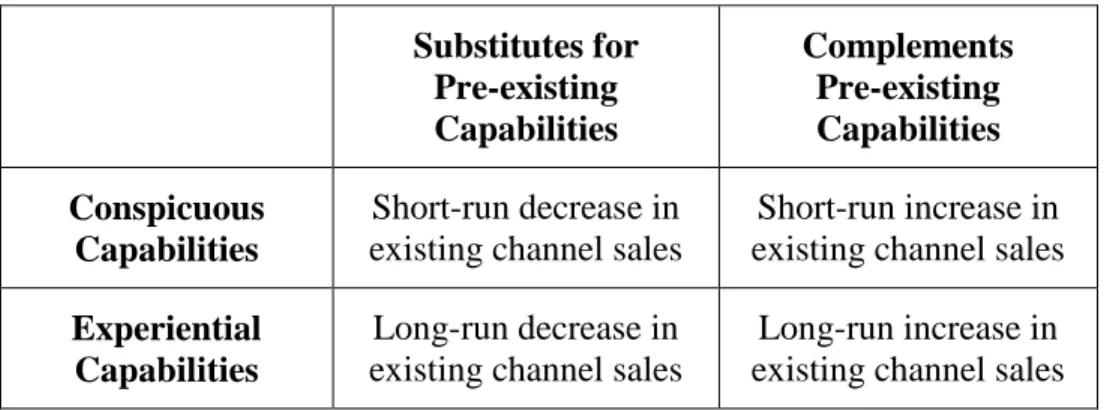
The two-by-two matrix in Table 1 can be helpful in predicting the net effects of introducing a new channel.
--Insert Table 1 about here--
We should observe short-run effects if the new channel has conspicuous capabilities and long-run effects if the new channel has experiential capabilities. We can predict whether the net short term effect is positive or negative by judging whether the new channel‟s conspicuous capabilities predominantly complement or substitute for those of the pre-existing channels.3 (The net effect would be zero if the complementary and substitutive capabilities have equal weight.) Similarly, we can predict the net long-run effects by assessing the experiential capabilities of the new channel.
RESEARCH HYPOTHESES
We now use our conceptual framework to develop a set of testable hypotheses for our particular research setting. Unlike prior published research, which studies the effect of adding an Internet channel (Ward 2001; Deleersnyder et al. 2002; Geyskens et al. 2002; Biyalogorsky and Naik 2003; Ansari et al. 2008), our study is focused on studying the effects of introducing brick-and-mortar stores to pre-existing direct channels. Studying this type of channel addition seems particularly important today because many retailers born on the Internet or in direct mail catalogs, such as Athleta, J. Jill, and Garnet Hill, are establishing retail store presence to
3
In hypothesizing the net effect of these opposing forces, we looked across the capabilities to determine whether positive or negative synergies dominated. Given that we did not have individual level customer preference data available, this seemed to be the most prudent assumption. However, it is likely that capabilities are differentially weighted by customers. In the discussion section, we outline a process by which retailers can survey prospective customers and apply weights to each capability.
complement their direct businesses. There is growing sentiment that having a brick-and-mortar presence can provide a competitive advantage to the direct channels, as suggested by Raul Vasquez, Walmart.com chief executive (Bustillo and Fowler 2009):
There was a time when the online and offline businesses were viewed as being different. Now we are realizing that we actually have a physical advantage thanks to our thousands of stores, and we can use it to become No. 1 online.
Little empirical evidence exists to support this idea in the literature. Our framework helps predict when a physical store provides an advantage to the direct channels and when it does not.
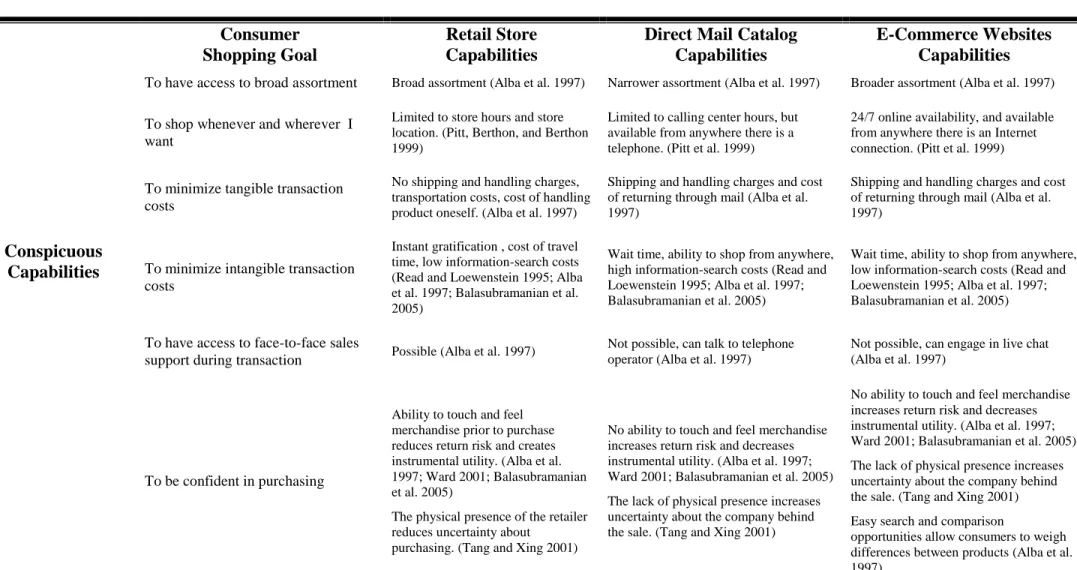
We provide a general assessment of each channel‟s capabilities for a set of functions
relevant to our setting in Table 2.
--Insert Table 2 about here--
The table shows that the channels differ in their capabilities in our context. Obviously, this list of capabilities will not apply in all contexts, but the process of assessing capability differences across channels can be used in other settings. Enumerating the conspicuous and experiential capabilities of a store channel helps us develop hypotheses for how the store openings should affect the direct channels over time. We discuss the store‟s capabilities relative to the Internet channel and to the catalog channel below.
The Short Term Effects of Conspicuous Capabilities
There are several conspicuous capabilities that favor a retail store over the direct channels. A store allows customers to “touch and feel” merchandise prior to purchase,
eliminating some of the risk of purchasing through direct channels. A store also gives consumers a chance to talk to salespeople face-to-face when deciding whether to buy and provides an immediate sense of gratification when they do, two capabilities not offered by the direct
channels. By switching their purchases to the retail store, shoppers can avoid paying shipping and handling charges associated with buying in the direct channels, lowering their transaction costs. These capabilities are fairly obvious to consumers, given that retail stores are well-known to consumers and most will already be familiar with this type of shopping experience. Since neither of the direct channels provides these opportunities, they should be substitutive capabilities that drive short-term cannibalization of both the catalog and Internet channels.
Two other substitutive capabilities affect only the catalog channel. The retail store provides a much greater assortment of merchandise than the catalog channel does. Since greater assortment is a substitutive capability, this suggests that the opening a store channel should hurt the catalog more than the Internet. The retail store also offers greater information-search
capabilities than the catalog channel, but less information-search capabilities than the Internet channel (Balasubramanian, Raghunathan, and Mahajan 2005). An asymmetrical response between the two direct channels is consistent with the finding reported in a working paper by Pauwels and Neslin (2009) who empirically showed that catalog sales were cannibalized by the opening of a retail store, while Internet sales were not. In their setting, catalog orders decreased by 14% and existing customers made purchases less frequently following the store opening.
The store does offer a complementary capability in that it eliminates a hassle cost inherent in the direct channels because it provides another way to return defective merchandise ordered via a catalog or the web. While this may not be immediately obvious to customers choosing a channel, as various retailers have different policies regarding cross-channel returns, this is something that is likely to be learned very quickly as the new channel launches. In total, the store‟s conspicuous capabilities are largely substitutes for those of the pre-existing channels. This suggests that the introduction of a store channel should cannibalize sales from both of the
direct channels in the short term, and that cannibalization effects should be felt more strongly in the catalog channel versus the Internet channel, due to the store‟s assortment advantage and
greater information-search capabilities over the catalog channel.
H1: Following the opening of a store, sales in the catalog and Internet channels from customers living within the retail trading area surrounding the store will decrease in the short term.
H2: Following the opening of a store, sales in the catalog channel from customers living within the retail trading area surrounding the store will decrease more than sales in the Internet channel will in the short term.
The Long Term Effects of Experiential Capabilities
There are several experiential capabilities that suggest the retail store will complement the direct channels in the long term. Managers increasingly view stores as living advertisements that generate reach and frequency for the brand message. Consider the following (Chang 2009):
Stores act as the brand‟s billboard… Best Buy Mobile stores, located in high-end shopping malls, are attracting customers who are new to its brand. – Scott Moore, Vice President of Marketing, Best Buy
Valuable brand associations attributed to the distribution channel may transfer to the retailer‟s brand (Jacoby and Mazursky 1984; Keller 1993) and positive associations formed through the knowledge and/or patronage of one channel can transfer to the other channels as a halo effect (Kwon and Lennon 2009). Furthermore, consumers who are multichannel shoppers are exposed to more marketing communications than single channel shoppers (Kumar and Venkatesan 2005; Ansari et al. 2008). Increases in brand awareness and the creation of positive brand associations are likely to come only after repeated exposure to the “living billboard” of the store, as branding
effects generally accrue only after a minimum threshold level of exposures is achieved and then show an additive effect over time (Simon and Arndt 1980). Since repeated exposure to the retail
store should strengthen brand awareness and deepen brand associations, we expect the resulting effects of this complementary capability to increase sales in the direct channels over time.
Although the branding capabilities of the retail store should complement both the Internet and the catalog channels, the Internet should benefit more than the catalog channel does because it is a less intrusive medium. The Internet has been described as an inbound marketing
communications channel (Halligan and Shah 2009) because consumers have to actively search out websites before making purchases. In contrast, a catalog intrudes into the consumers‟ consciousness and can be described as an outbound marketing communications channel. Catalogs are sent frequently, making consumers who receive them aware of visually appealing merchandise and reminding them to buy at regular intervals. Frazier (1999) highlights the branding benefits of a catalog. Therefore, catalogs serve as highly effective brand
communications, making it more likely that they will elicit brand awareness and strong brand associations for the retailer, as well as serve as a call to action.
Search advertisements or email marketing campaigns used to drive demand to the website channel are less effective brand communications due to the fact that many consumers ignore them and because they do not offer the strong visual presentation of the catalog, making it less likely that they will elicit the same level of brand awareness and strong brand associations for the retailer as a catalog. Ansari et al. (2008) found a positive association between sending catalogs and catalog shopping, but a diminishing marginal return for sending emails to drive Internet purchase. They also found that the marketing communications stemming from the catalog channel are more effective at driving people to shop on the web than email communications are at driving people to shop via catalog. Therefore, the Internet channel appears to require greater
outbound marketing programs like the “living billboard” that the store offers, while the catalog
channel is largely self-sufficient at driving its own demand.
Additionally, the retail store‟s physical presence reduces uncertainty about buying
through the direct channels by providing the consumer with a physical place to go if trouble ensues from the purchase. The retail store provides the consumer reassurance that there is a real company standing behind the digital or telephonic purchase. This capability is likely to be more valuable for customers shopping in the Internet channel which was a fairly new channel during the time period of our data collection, as previous research has shown that consumers are nervous about purchasing online and that the presence of a physical store in their local market relieves their concern (Tang and Xing 2001).
The addition of a store channel could increase loyalty between the retailer and all of its consumers, including those purchasing in direct channels, over time. Since loyalty is created both with the retailer overall and with a particular channel (Reynolds and Beatty 1999; Ansari et al. 2008), it would both complement and substitute for the direct channels‟ capabilities. Loyalty established with the retailer would be complementary because consumers would become more likely to shop with the retailer across all of its channels rather than with competitors when they are thinking about buying. Loyalty to a particular channel would attract new customers to the retailer who favor shopping in retail stores, but make them less likely to patronize the direct channels. Finally, the store channel offers consumers a shared social experience while they shop, increasing the value they derive from their purchase. Since shoppers in the direct channel shop alone, the social interaction that the store offers is a substitutive capability.
In total, the store‟s experiential capabilities mostly complement those of the direct channels. This suggests that the introduction of a retail store should increase sales in both of the
direct channels over time. Given that consumers shopping in the Internet channel require more outbound marketing communications and more reassurance about their purchases, the
complementary effects should be felt more strongly in the Internet channel versus the catalog channel. Thus, we predict:
H3: Following the opening of a store, sales in the catalog and Internet channels from customers living within the retail trading area surrounding the store will increase in the long term.
H4: Following the opening of a store, sales in the Internet channel from customers living within the retail trading area surrounding the store will increase more than sales in the catalog channel will over the long term.
Customer Effects
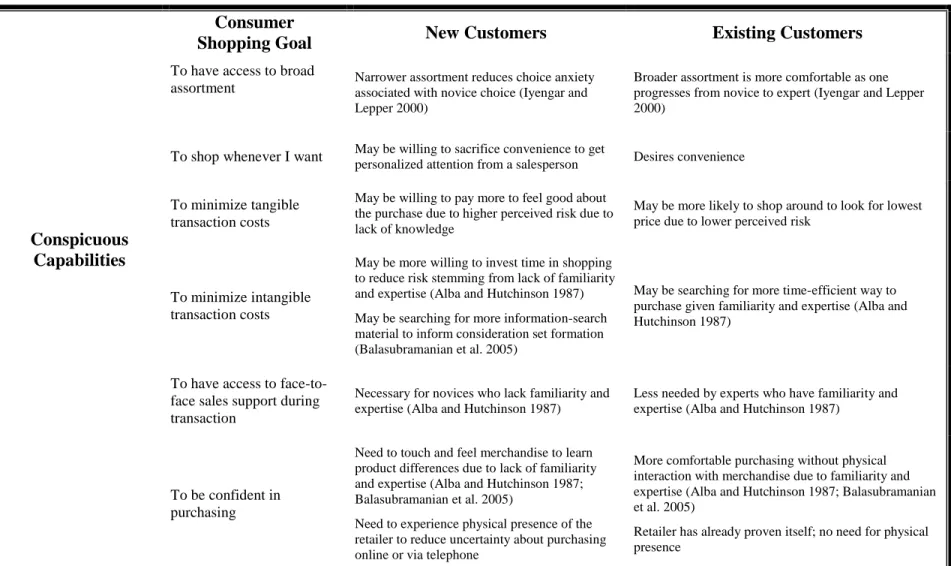
Finally, our theory allows us to make a distinction in the buying behavior of first-time and repeat customers. Prior literature suggests that consumers use different channels during their lifecyle (Neslin and Shankar 2009). When assessing which type of customer (new vs. existing) will drive cannibalizing and complementary effects, we need to understand whether and how the conspicuous and experiential capabilities of the new channel are differentially valued by the two segments. The utility of different channel capabilities varies according to consumers‟ levels of
familiarity and perceived expertise in choosing (Balasubramanian et al. 2005); therefore we expect different weightings across new and existing customers. We summarize the consumer shopping goals and channel capability requirements of new customers relative to existing customers in Table 3 and discuss them below to inform our hypothesis development.
--Insert Table 3 about here--
It is likely that the retail store will serve as an acquisition engine for the direct channels. Given the retail store‟s superiority on capabilities that are important to prospective customers, such as sales assistance and the opportunity to touch and feel the merchandise, many consumers
who are not currently purchasing in the direct channels are likely to try shopping in the store. New customers are more likely than existing customers to require a multisensory, experiential shopping experience to help them assess their options (Balasubramanian 1998). Given the prevalence of multichannel shopping behavior (Reda 2002), some of these new store shoppers are likely to begin purchasing across channels over the longer term, bringing them to the website and catalog for some portion of their purchases. This is consistent with Coldwater Creek‟s strategy, a company selling women‟s apparel via direct channels that first opened retail stores in
1999 to capitalize on complementary effects, as expressed by its chief executive officer: “Believing that the ability to occasionally „touch and feel‟ merchandise will remain a coveted aspect of the American woman's shopping experience and to provide another means by which to introduce current and prospective customers to our catalogs and e-commerce web site, we have also embarked on a program of selectively establishing for the first time full-line retail stores in highly-trafficked urban areas.” (2002)
Given that this is a two-step process, we would expect to see increases in the number of new
customers shopping in the direct channels increase not immediately, but rather in the long term. Beyond this direct approach, the retail store should also serve an important branding
function for new customers even if they do not purchase in the store prior to coming to the direct channels. First time customers lack brand awareness and need channels to generate outbound marketing impressions, while repeat customers are more aware of the brand and need less marketing to spur purchase. The store‟s experiential capabilities such as its “living billboard” raise brand awareness for the retailer and contribute strong brand associations that are required before customers will make the choice to buy from the retailer online or in the catalog.
Hence, the number of new customers purchasing in the direct channels should increase over time due to the greater outbound marketing presence of the store and its brand awareness and association building capability. Thus, we predict:
H5: Following the opening of a store, the number of new customers purchasing in the direct channels will increase in the long term.
We predict that existing customers will follow the main patterns outlined above in H1 and H3. Some direct channel customers may quickly switch all or some of their shopping to the store because of the store‟s conspicuous capabilities, such as its broader assortment (vs. the
catalog) and reduced tangible and intangible costs due to the fact that they do not have to pay shipping and handling and do not have to wait for their purchases to arrive via mail that make it superior to the direct channels. Other direct channel customers who previously searched and bought online may instead search online and then shop in the store when they want to touch and feel the product or discuss the purchase with a salesperson (Verhoef et al. 2007). This will lead to cannibalization and reduce the number of existing customers shopping in the direct channels in the short term.
H6: Following the opening of a store, the number of existing customers purchasing in the direct channels will decrease in the short term.
Nevertheless, the experiential capabilities offered by the store opening are predominantly complementary for existing customers, which should increase the number of existing customers buying in the direct channels over time. The constant billboard effect of the store‟s presence
should remind existing customers of the retailer so that when they are at home and ready to buy, the retailer‟s brand should be more salient in their minds. The retailer‟s brand associations
should be strengthened for those direct channel customers who experience shopping in the store, which should make purchasing online or via catalog from the retailer more likely. The
opportunity to shop across channels should increase the loyalty of direct channel customers to the retailer as a whole and make purchasing online or via catalog from the retailer more likely.
H7: Following the opening of a store, the number of existing customers purchasing in the direct channels will increase over the longer term.
DATA AND RESEARCH METHODOLOGY
Our study is based on data collected from a multichannel retailer of high-end apparel, accessories, and home furnishings. This retailer operates stores in shopping malls in limited regions of the country and sells directly to consumers through catalogs and the Internet. Overall, sales from the retail stores have been significantly higher than sales from the direct channels, but growth in the direct channels has been dramatic over the last decade. The retail stores and the direct channels carry the same merchandise and use the same price points for regular ticket pricing. Nevertheless, the day-to-day operations of these two units are largely independent, with each unit running separate merchandising and pricing promotions and making separate
advertising and communications decisions. It is important to note that, during the time of our study, the catalog and Internet channels did not locally customize their marketing policies in regions in which stores were opened, but rather pursued a national marketing plan that was consistent across all regions. This is important because it provides us with a clean test of the impact of opening a retail store on the direct channels, as our retailer did not adjust its marketing strategies in the Internet or catalog channels to anticipate or reflect changes in sales due to the launch of the stores.
The retailer opened four retail stores in one U.S. state during our observation period. Two of the stores were opened in retail trading areas that were previously served by only the direct channels, and two were opened in areas neighboring a pre-existing retail store. (The pre-existing stores had been opened for more than five years prior to our observation period.) ZIP codes were assigned to retail trading areas based on the resident consumers‟ driving time to the nearest store.
because it represents a reasonable cut-off to the draw of a shopping mall.4 This cut-off was based on discussions with retailing experts and shopping mall managers regarding a reasonable drive time from which a shopping mall would draw. This resulted in a total of 550 ZIP codes being assigned to the four retail trading areas as follows; these geographical areas represent our treatment regions:5
Retail Trading
Area Year Opened
Neighboring
Store ZIP Codes
# of Monthly Observations Store A Fall 2000 Yes 61 1086 Store B Fall 2001 No 209 100 Store C Fall 2002 Yes 97 87 Store D Fall 2002 No 183 87
We were interested in understanding how the store openings affected both sales and the number of customers purchasing in the direct channels in the surrounding ZIP codes over time. To answer these questions, we were able to collect data on the net catalog sales, the net Internet sales,7 the number (i.e. count) of first-time customers making a purchase in the direct channels, and the number of repeat customers making a purchase in the direct channels. Our monthly observations begin 36 months prior to each of the four store openings (34 months in Store A due to data constraints) and end in December 2006.
Quasi-Experimental Design with Matching
4 For stores A and C, where there were already existing stores within a 60 minute drive, we assigned to each store
region only those ZIP codes where the new store was the closest store.
5 These numbers reflect the elimination of two ZIP codes due to lack of data.
6 Since the Internet channel opened in October of 1999, we were limited to 22 months of data in Store A, 35 months
of data in Store B, 36 months of data in Store C, and 36 months of data in Store D in the pre-period prior to the store openings.
7 The company defines these data as sales net of returns respectively generated by catalog mailings and online
We use a quasi-experimental design to draw inference about how the retail store openings affected direct channel sales. Observations in the four treatment regions are compared with observations in control regions before and after stores opened. Like any research design, this approach has its advantages and weaknesses. The advantage of a quasi-experimental design is that it can control for outside events that coincide with the occurrence of an intervention and interfere with its effects. For example, a general economic recession occurring at the time of a store opening would attenuate the positive branding effects that a store opening might have on sales. This type of outside event does not pose a problem in a quasi-experimental design because both the treatment and control groups would suffer from the recession and its confounding influence would be controlled. The use of a treatment/control design allows us to control for seasonal variations and annual fluctuations in sales driven by external factors, such as the growth of Internet penetration.
The challenge in implementing a quasi-experimental design lies in identifying a control group that is comparable to the treatment group. In our setting, it is reasonable to believe that the retailer is more likely to open stores in trading areas with favorable geo-demographic and
shopping behavior characteristics. Thus, we need to worry that the population of consumers that resides near stores is fundamentally different from the population of consumers that does not. In a perfect world, we would address this concern by randomly assigning store openings to different retail trading areas, which would create balance between the two groups. Obviously, this solution is not feasible in the real world, so matching is used to make the treatment and control groups comparable.
The basic idea of matching is to transform observational data so that they more closely resemble data that would have resulted from random experimentation. These procedures work by
making the control group as similar, and, therefore, as comparable, as possible to the treatment group across covariates believed to affect the outcome variable of interest. Although matching techniques are just beginning to be used in marketing (c.f. von Wangenheim and Bayon 2007), they have already gained wide acceptance in other fields in the social sciences.8 The matching literature is broad and theoretically sophisticated, which can make it difficult for an applied researcher to develop a coherent strategy to implement these methods. We addressed this
problem by using the strategy suggested by Ho et al (2007), which allowed us to test most of the commonly used procedures and to choose the particular procedure that provided the best match for our data. Details of our matching procedure are included in the technical appendix.
In summary, to isolate the effects of the store opening and rule out alternative
explanations for sales changes due to confounding variables, we matched four treatment and control regions across a broad set of geographic, demographic, behavioral, sales, marketing activity, and competitive variables. We were then ready to analyze how the physical store openings affected direct channel sales.
Model Specification
Our interest was in understanding how opening a store would affect the direct channel sales and the number of customers making purchases in both the short- and the long-run. Hence, we included a term in the model to capture an immediate shift in direct channel sales right when the store opened and a term to capture a trend in sales afterwards. Thus, we specified the model as:
treatmentt – controlt= 0 + 1 store.opent + 2 post.open.monthst + 3 store.dummyt + t
8 Examples include Winship and Morgan (1999) in sociology; Lee and Wahal (2004) in finance; Ho, Imai, King and
Stuart (2007) in political science; Jaffe, Trajtenberg, and Henderson (1993), Meyer (1995), and Heckman, Ichimura, Smith and Todd (1998) in economics; and Hansen (2004) in education.
We estimated9 four sets of models to understand the effect of the store openings on the direct channels: Model 1 estimates the effect on net catalog sales, Model 2 estimates the effect on net web sales, Model 3 estimates the effect on the number of new customers purchasing, and Model 4 estimates the effect on the number of existing customers purchasing. The variable treatmentt –
controltmeasuresthe difference between the treatment and control groups for the outcome
variable of interest (e.g. the difference in monthly catalog sales in Model 1) at time t. Our analysis focuses on the two variables store.opent and post.open.monthst, which
identify the nature of the response to the store openings over time. The variable store.opent is a
step-function that represents the store opening intervention. It takes the value 0 prior to the store opening and 1 afterwards. A negative coefficient would suggest that opening a physical store has a short-run detrimental impact on the direct channels that persists over time. The variable
post.open.monthst represents the number of months from the store opening to month t, taking the
values 0 to 73 for Store A, 0 to 63 for Store B, and 0 to 50 for Stores C and D. (It takes the value zero prior to the store openings and in the month that the store opens.) A positive coefficient would suggest that opening a physical store is increasingly beneficial to the direct channel over time. Prior theory does not necessarily suggest that this needs to be the case. It might also be possible for the store to increasingly cannibalize sales from the direct channel, which would be suggested by a negative coefficient. Store dummies were included to account for cross sectional differences across stores.
Testing for robustness, we tried a number of differently shaped response curves after the store openings. For example, we added a squared post.open.monthst term to the model to test
whether the response was non-linear over time. We found these terms to be non-significant,
which allowed us to keep the simple linear specification. This had the added benefit of making our analysis relatively easy to interpret.
FINDINGS
For each outcome variable of interest, we estimated a full model that included data from all four stores. Then, to investigate potential differences between stores that opened in
completely virgin retail trading areas and those that were opened in areas neighboring a pre-existing store, we ran separate models, which combined Stores B and D (virgin retail trading areas) and which combined Stores A and C (retail trading areas neighboring a pre-existing store).
The Effect of the Store Openings on the Catalog Sales Channel
The results for catalog channel sales are reported in Table 4, Model 1. --Insert Table 4 about here--
Beginning with the full model, the store.opent coefficient is negative and significant (β1 =
-12,924, p < .001), indicating that catalog channel sales dropped in the short-run after the brick and mortar stores opened, supporting H1. The post.open.monthst coefficient is positive and
significant (β2= 164, p < .05), indicating that the catalog channel sales continuously grew over
time after the initial decline, supporting H3. These results suggest that catalog channel sales were cannibalized shortly after the brick and mortar stores opened, but also that the catalog channel increasingly benefited from the store‟s presence over time.
Giving economic meaning to these results, catalog channel sales dropped by 11.9% shortly after the brick and mortar stores opened. Nevertheless, these sales would recover to the level that would have been expected had the store never opened in 79 months and would
subsequently continue growing. The short term decrease in sales we uncovered is consistent with the cannibalization found in a working paper by Pauwels and Neslin (2009). However, the complementary effect found here has not been previously detected, leaving long run benefits to the catalog channel undiscovered.
Turning to the sub-models, we observe a similar pattern of cannibalization and
complementarity, with some differences depending on whether another store was present in a neighboring retail trading area. The store.opent coefficient is negative and significant regardless
of whether the store opened in completely virgin territory (β1 = -14,157, p < .01), or in a region
neighboring a pre-existing store (β1= -11,350, p < .05). The post.open.monthstcoefficient is
insignificant (β2 = 133, p > .10) if the store opened in virgin territory, but is positive and
significant (β2 = 181, p < .10) if it opened in a region neighboring a pre-existing store.
These results imply that the catalog channel experienced a greater degree of
cannibalization and less complementarity if the brick and mortar store opened in virgin territory. If the store opened in virgin territory, sales in the catalog channel immediately dropped by 14.3% and do not return to the level that would have been expected had the store never opened within the first eight years. In contrast, if the store opened in a region neighboring a pre-existing store, sales in the catalog channel dropped by only 9.6% and it took only 63 months for them to return to the level that would have been expected had the store never opened.
This is consistent with our conceptual framework. We would expect that consumers have already been exposed to some of the store‟s capabilities in regions where the retailer has
pre-existing stores nearby. Therefore, the catalog channel would have experienced a shallower drop if existing customers in the retail trading area had already switched some of their purchases to the pre-existing store in the neighboring region prior to the new store opening. Furthermore, the
complementary effect which we hypothesized was due to the store‟s billboard effect on brand
awareness would be stronger for customers living in a region with a pre-existing store who have already built up some level of brand awareness and brand associations, due to the additive nature of branding effects.
The Effect of the Store Openings on the Internet Channel
The results for the Internet channel sales are reported in Table 4, Model 2. Beginning with the full model, the store.opent coefficient is insignificant (β1 = 35, p > .10), indicating no
short-term drop in sales following the store opening, thus, H1 was not supported in the Internet channel. The post.open.monthst coefficient is positive and significant (β2 = 823, p < .001),
supporting H3, indicating that the Internet channel sales continuously grew over time. Although there was no immediate cannibalization, the Internet channel did increasingly benefit from the presence of the brick and mortar stores over time.
Our results suggest that the store openings have a greater positive impact on the Internet channel than on the catalog channel. Although the catalog channel suffered cannibalization immediately following the introduction of brick and mortar stores, the Internet channel did not, supporting H2. Furthermore, while both the catalog and the Internet channels increasingly benefited from the presence of brick and mortar stores, the complementary effect was approximately five times greater in the Internet channel than it was in the catalog channel, supporting H4. These results are consistent with the idea that the capabilities of the store
channel, such as its ability to generate greater brand awareness and associations, complement the Internet channel more than they complement the catalog channel. Broadly speaking, these results
are consistent with Pauwels and Neslin (2009) which also finds that the introduction of brick and mortar stores more adversely affects the catalog channel than the Internet channel.
The sub-models paint the same picture. Regardless of where the store opened, the store.opent coefficient is insignificant (β1= -4,857, p > .10 in virgin areas and β1= 12,586, p >
.10 in areas neighboring pre-existing stores), reflecting the fact that web sales are resistant to cannibalization from retail stores. The post.open.monthst coefficient is positive and significant
(β2 = 334, p < .001 in virgin areas and β2= 1,165, p < .001 in areas neighboring pre-existing
stores). Like we found in the catalog channel, the complementary effect was greater when there were pre-existing stores in the area. These differences can be seen in Figure 1, which visually depicts the difference in web sales between the treatment and control groups in both types of regions. This again suggests that the store‟s billboard effect was additive and built upon existing awareness in the market.
The Effect of the Store Openings on Combined Direct Channel Sales
Like many firms, the retailer in this study manages the direct and store channels through separate organizations, making it particularly important to understand how the store openings affect sales in the combined direct channels. Combining the results from the catalog and web channels, we find that direct channel sales fall by 11.1% immediately after the stores opened, but they recovered to the level that would have been expected had the store never opened in
approximately 13 months. When the stores opened in virgin territories, the cannibalization was greater and the recovery period was longer. Sales dropped by 13.3% and the recovery took 30 months when the stores opened in virgin territory, but sales dropped by only 8.9% and the recovery took 8.4 months when the stores opened in areas neighboring a pre-existing store.
From a managerial perspective, these results suggest that the expansion of the store channel should create only minor conflict with the direct channels. In the short run, managers in the direct channel might be entitled to some temporary relief in their revenue targets due to the store openings. In the long run, they should be supportive of store openings because direct channel sales recover to the point that they would have been had the stores never opened in a relatively short period of time, and the benefits of having a brick and mortar store in a retail trading area continue to increase over time. We suggest that this occurs because the brick and mortar stores possess capabilities found in neither the catalog nor the Internet channels.
As Stern et al. reminds us, “One of the key elements of channel management is deciding
how many sales outlets should be established in a given geographic area.” (1996: 340). Although store placement decisions are primarily made based on whether the area can generate
incremental sales in the store to cover its costs, our results suggest that having a denser store population in an area can offer value for sales from the direct channels as well. Having more than one store in an area may be beneficial for the direct channels due to the branding effects stores have on sales in the catalog and Internet channels. Adding an additional store to a region that already had a store accelerated the complementary effects observed.
The Effect of the Store Openings on First-Time Direct Channel Customers
We used the same procedures to analyze the customer data. Separate models were run for new and repeat customers to determine if the short-run drop and longer term growth in direct channel sales varied across the customer lifecycle. We first explored the effect of the store openings on first-time direct channel customers. First-time customers represent households who have not purchased from either of the direct channels in the past. The company identified
households as “new” only in the first month that they make a direct channel purchase;
subsequent purchases from the household appear in the repeat customer data.
The results for the shopping behavior of first-time customers are reported in Table 5, Model 3.
--Insert Table 5 about here--
In the full model, the store.opentcoefficient is insignificant (β1 = -10.2, p > .10), indicating that
the number of new customers shopping with the direct channels was not affected after retail stores were opened in the area. The post.open.monthst coefficient is positive and statistically
significant (β2 = 1.13, p < .001). This shows that the introduction of a physical store increased the
number of new customers shopping in the direct channels over time, supporting H5. In other words, the physical store acted like a billboard for the direct channels by attracting new customers to the retailer at a faster rate than would have been expected had the store never opened.
Some differences in the patterns of new customer acquisitions in the direct channel emerged depending on whether another store was present in a neighboring retail trading area. The store.opentcoefficient is significant and negative in virgin areas (β1 = -31.8, p < .01), but is
insignificant in areas neighboring pre-existing stores (β1 = 11.8, p > .10). This suggests that a
store cannibalizes some new customers, but in regions where pre-existing stores existed, this cannibalization had already happened. The post.open.monthst coefficient is positive and
statistically significant in both of the regions (β2 = 1.29, p < .001 in virgin areas and β2 = 0.98, p
< .001 in areas neighboring pre-existing stores). Our results suggest that some customers who would like to try the brand (and who would have done so even if the store had not opened) immediately choose to do so through the store instead of the direct channels. This could be due
to the fact that it would be very difficult for a customer to try the brand in virgin territories except through the direct channels prior to the store opening. Over time, however, the stores entice new customers to the brand at a faster rate in all territories.
The Effect of the Store Openings on Repeat Direct Channel Customers
We next explored the effect of the store openings on existing direct channel customers. Repeat customers represent households who have previously purchased from direct channels in the past. The results for the shopping behavior of repeat customers are reported in Table 5, Model 4. In the full model, the store.opentcoefficient is negative and statistically significant (β1
=-103, p < .001), supporting H6, indicating that the number of repeat customers purchasing in the direct channels decreased in the short term following the opening of the stores. The
post.open.monthst coefficient is positive and statistically significant (β2= 2.35, p < .001),
supporting H7, indicating that the number of repeat customers purchasing in the direct channels increased in the long term following the opening of the stores.
The complementary result could be caused by one of three consumer behavior processes. First, the incremental new customers who were added to the direct channels following the store opening (see Model 3 results) continued to purchase from the direct channels in the long term. As new customers become repeat customers the second time they purchase, all of the purchases beyond their first roll into the repeat customer counts. Second, some of the repeat customers who switched some of their purchasing to the store channel when it opened returned to the direct channels over the longer term and resumed purchasing there. Third, some of the repeat customers who did not switch some of their purchasing to the store channel when it opened shortened their inter-purchase cycle in the direct channels as a result of the store opening; these customers began
shopping in the direct channels more frequently than they had prior to the store opening. Given that we do not have household level data, it is impossible to discern which of these three processes is occurring.
The same patterns held across regions with and without pre-existing stores. The store.opentcoefficient is negative and significant both in virgin territories (β1 =
-162, p < .001), and in areas neighboring pre-existing stores (β1 = -43, p < .05). This pattern of
results suggests that some existing customers who were likely to switch some of their demand to retail stores already had done so in the regions where retail stores existed prior to the new store opening. Therefore, the opening of an additional store had less effect on their behavior than it did for customers in virgin regions. Existing customers who did not have access to a retail store in the past switched some of their demand from the direct channels when a new store opened in their region.
The post.open.monthst coefficient is positive and statistically significant both in virgin
territories (β2= 2.75, p < .001) and in areas neighboring pre-existing stores (β2= 1.93, p < .001).
This suggests that the introduction of a physical store increased the number of existing customers purchasing from the direct channels regardless of whether the surrounding region already had a pre-existing store.
GENERAL DISCUSSION
Our research contributes to the knowledge of multichannel retailing by showing whether, when, for whom, and why a new channel helps and hurts existing channels. First, we propose a conceptual framework that predicts the pattern of cross-channel elasticities that occur over time following the introduction of a new channel. Our framework, which analyzes underlying
capabilities, suggests that both the type of channel being added and the composition of the pre-existing system matters because different channels have different capabilities. This helps explain why empirical results differ depending on whether the Internet is being added to a retail store channel (the focus of most previous studies) or a retail store is being added to an Internet channel (the focus of our work). Crucially, our framework examines how the passage of time, something that has been largely ignored in previous work, influence cross-channel effects. We propose that some channel capabilities are immediately apparent to consumers while others must be learned, resulting in different short- and long-term effects. We also propose that new and existing
customers have different shopping goals and therefore differentially value channel capabilities. We then test our framework using sales data. Our empirical results confirm our hypotheses, showing that adding a retail store cannibalizes sales in the catalog, but not the Internet, channel right when it opens, but that its continued presence benefits both the Internet and catalog channels over time. Our longitudinal design allows us to observe these opposing forces and disentangle their effects in a way that the cross-sectional designs used by prior researchers do not. Furthermore, we show that while the store initially reduces the number of existing customers purchasing in the direct channels, it brings more new customers in at a faster rate and encourages higher numbers of existing customers to purchase in the direct channels over time.
Relationship with Prior Empirical Studies
Although these findings may be particular to our research setting, our broad conceptual framework provides a way to generate hypotheses in other settings, suggests the limitations of existing empirical findings, and explains why multichannel retailing systems need to be studied from multiple perspectives. Although there is only a limited amount of previous empirical
studies on multichannel systems, some empirical findings do exist. Rather than being at odds with our findings, these results help highlight the value of our framework. Since the Internet channel has different capabilities than a store channel, we would expect different results if an Internet channel is added to a brick and mortar system than we would if a retail store is added to an Internet channel. Looking at the capabilities of each channel helps us predict both the valence of the effect on sales in the existing channel and the timing in which to expect sales changes.
In the newspaper (Deleersnyder et al. 2002) and music (Biyalogorsky and Naik 2003) industries studied in previous work, the Internet channel offered customers a broader assortment of content or products than the brick and mortar channel, as illuminated by Anderson (2006). With the addition of the Internet channel, customers could shop 24/7 increasing the convenience of purchasing. Given that both news and music CDs are both products that do not need to be handled prior to purchase, shopping for these items on the Internet is less risky than purchasing products such as clothing or furniture. Thus, it seems likely that, in both of these industries, an Internet channel would cannibalize the brick and mortar operations, and, in fact, both sets of researchers hypothesized a cannibalizing effect. However, at the time these studies were run, e-commerce was relatively new and consumers might have needed to experience reading and shopping on it before deciding to switch to this channel. A longer timeframe may have been necessary to detect the cannibalization, which seems now to have occurred in these industries (Danaher et al. 2008; Benilde 2010), despite the null effect found by the researchers.
Since marketing communications on the Internet are more inbound in nature, introducing the Internet channel would not necessarily create greater awareness for newspaper subscriptions or Tower Record retail stores. Therefore, complementary effects stemming from increased brand
awareness and strengthened brand associations would probably not be seen. Across both existing studies, no complementary effects were found when the Internet channel was added.
Opportunities for Future Research
We recognize that other factors in addition to the ones we are able to study given our data limitations, such as company and product (Balasubramanian et al. 2005), customer heterogeneity (Inman, Shankar, and Ferraro 2004; Thomas and Sullivan 2005), marketing (Ansari et al. 2008), competitive, and contextual contingencies also play a role in determining customers‟ likelihood to switch channels in a multichannel system. These suggest moderating conditions that offer opportunities for future research, some of which are highlighted below.
For example, we would expect that the retailer‟s brand equity, a company contingency, would moderate our results. In our framework, we propose that synergistic effects are driven by a greater ability to provide outbound marketing communications: the billboard effect of the retail stores increase brand awareness and brand associations for all channels. Compared to our
analysis of a well-known company, we predict that direct retailers with less established brands may benefit more from the billboard effect that the opening of a new store brings. Their direct business may recover more quickly from the initial drop in sales and experience more rapid growth afterward. For product moderators, Inman et al. (2004) hypothesize that certain product categories are more highly associated in consumers‟ minds and purchasing practices with one
particular channel than others. Research (Alba et al. 1997; Balasubramanian et al. 2005) also suggests that the type of good being purchased (search/ experience/credence goods or utilitarian/ experiential goods) may affect the consumer‟s shopping goals and therefore affect whether the capabilities of a particular channel are attractive. The timing of the opening of a retail store in
relation to the growth of the Internet channel may be a context moderator affecting cross-channel switching behavior. In the early days of the Internet channel as studied here, Internet sales were not cannibalized by the opening of a retail store; however, as Internet penetration grows and as shopping via the Internet becomes more predominant, the opening of retail stores may begin to cannibalize Internet sales to a greater extent. This may reflect the fact that early adopters of Internet shopping were younger from retail store shoppers, so the opening of a store had little impact on them. However, as Internet shopping diffuses into the mainstream, the demographic differences between Internet shoppers and retail store shoppers are beginning to disappear, making it more likely that the opening of a retail store will both cannibalize Internet sales in the short term and complement Internet sales in the longer term.
In summary, our theoretical model is just the beginning of the exploration of possible contingencies that affect cross-channel elasticities. It is our hope that future research will pursue understanding some of these additional contingencies to push our collective understanding of the complicated interplay involved in predicting channel cannibalization and complementarity.
Limitations
One of the weaknesses of our empirical test is our lack of data on customer preferences and heterogeneity. As our dataset was aggregated at the level of the zip code, and not at the individual household data, we were unable to observe how customer heterogeneity affected our results. It is likely that different customer segments differentially weigh the importance of channel characteristics (Alba et al. 1997), beyond the distinction of new versus existing customers that we empirically explore in this paper. For example, within a retailer‟s customer portfolio there may exist segments who are too busy to shop during business hours who would
weigh the capability of offering 24/7 shopping availability very heavily. Other segments may be price sensitive and therefore would weigh the capability of eliminating shipping and handling costs very heavily. In developing our hypotheses, we noted that the capabilities of the store could both cannibalize and complement sales in the direct channels. In hypothesizing the net effect of these opposing forces, we looked across the capabilities to determine whether positive or negative synergies dominated. Given that we did not have individual level customer preference data available, this seemed to be the most prudent assumption. However, it is likely that
capabilities are differentially weighted by customers, with some being more important and some being less important when making a channel choice. When applying our theory in a real setting, retailers should survey prospective customers and existing customers to understand their
shopping goals and the weights that they give to each channel capability, using tools like
conjoint analysis, to ascertain the appropriate weighting scheme to better predict cannibalization and complementarity in their particular setting.
Our results are based upon a customer portfolio that contained a certain percentage of new versus existing customers. Given that we found differences in whether and how
cannibalization and complementarity affected new and existing customers, the ratio of new to existing customers in a particular customer portfolio may moderate our results. For example, we found that the number of new customers purchasing in the direct channels was unaffected by the store‟s opening in the short term, but that the number of existing customers decreased
immediately following the launch of the new channel. This consumer-level behavior contributed to the aggregate sales patterns we observed, where sales decreased in the catalog channel in the short term, while Internet sales held constant. Thus, a firm that has a higher percentage of existing customers in their portfolio is likely to see deeper sales decreases than we document
here, while a firm that has a lower percentage of existing customers in their portfolio is likely to see shallower sales decreases.
When a new channel is added to an existing distribution channel portfolio, the retailer has the opportunity to strategically manage cannibalization and complementarity by taking
marketing actions to mute or encourage each type of effect (Ansari et al. 2008). For example, retailers that want to migrate customers from a high cost channel to a lower cost channel may offer existing customers incentives to switch channels. Retailers that want to thwart customers from switching channels may increase the switching costs of customers by locking them into their existing channel through actions such as offering purchase points to customers only in store, or by saving customers‟ online data in a one-click file, so that ordering online is easier. In our research setting, the retailer did not strategically manage the cross-channel cannibalizing and complementary effects through marketing activities. Marketing activities were constant across experimental and control conditions, giving us a clean test of the effect of the store opening on the direct channels without marketing intervention. Future research can explore how cross-channel elasticities are a function of strategic marketing objectives and decisions on the part of the firm. Just as the retailer may strategically manage its cross-channel elasticities through targeted marketing programs, so too its competitors may try to thwart the growth of a new channel in the marketplace. Competitors can increase promotional activity during the launch of a new channel, blanketing consumers in the market with catalogs, email promotions, or
advertising. As our dataset did not include competitive sales data or marketing activity, we were unable to observe whether our retailer‟s competitors attempted to intervene. Modeling the retailer‟s and its competitors‟ strategic responses to channel additions as a dynamic and
As our dataset includes sales and customer data from only one retailer, caution must be used when generalizing our empirical results to other retail settings. In an effort to generalize our work, we present a conceptual model that offers theoretical and managerial insight into the underlying consumer goals that drive cross-channel purchases. However, as Frazier warns, “It is improbable that any single framework or model relating to behavioral phenomena can apply across all channel systems in the world due to differences that exist across them,” (1999: 238). This paper joins other empirical work in multichannel retailing that focuses on analyzing a solo retailer (Biyalogorsky and Naik 2003; Venkatesan, Kumar, and Ravishanker 2007; Ansari et al. 2008; Pauwels and Neslin 2009) or a single product category (Deleersnyder et al. 2002), moving us closer toward empirical generalizations. Our hope is that our contingency model that explores three contingency conditions and specifically, our process for analyzing the capabilities of
channels in a retailing system, will provide guidance that can travel across retailing contexts. The insights we offer on the channel, customer, and time contingencies provide managers ways to interpret our results in the context of their own business.
Anotherlimitation of our dataset is that our customer data is aggregated at the direct channel level, unlike our sales data that exists at the individual catalog and Internet channel levels, limiting our ability to observe customer count differences between the catalog and Internet channels. Future research has the opportunity to explore this finer channel-level distinction. Our dataset is also limited in that it does not allow us to investigate the aggregate sales effect of adding retail stores to the complete distribution system, in that we do not have access to retail store sales data by period. However, over the time period of the study, sales from the retail stores were significantly higher than sales from the direct channels in the surrounding retail trading area. Given the strong in-store sales levels, the low levels of cross-channel
cannibalization, and the high levels of cross-channel complementarity uncovered, the addition of the retail stores was highly beneficial to the retailer‟s sales. Finally, our dataset is limited in that it does not allow us to investigate the profit implications of channel elasticities. Hence, our findings report changes in sales revenues, not in profits. Given that different channels have different operating expenses, analyzing the profit impact of channel cannibalization should amplify our results. Since retail stores, in general, have higher operating costs than catalog channels due to the addition of labor and real estate costs, switching customers from catalog
buying to retail store buying will cannibalize profits to a greater extent than it cannibalizes sales.
Managerial Implications
Our framework and findings offer insight for managing multichannel systems during channel expansion. Based on the differing profitability across channels, managers first need to ascertain which channels are most desirable for customers to frequent. In some cases, channel switching is beneficial for the retailer, for example, when existing customers switch from a high cost channel, such as using a bank teller to process a deposit, to a lower cost channel such as using an automated teller machine (Hitt and Frei 2002). In others, it is detrimental. Thus, the retailer must assess the best ways to manage cross channel elasticities to encourage their customers into the most profitable channels. Below, we offer strategies for managing sales forecasting, promotion planning, and customer acquisition and retention.
Sales forecasting. Correctly predicting the drop in direct channel sales and their eventual recovery and acceleration is crucial to managing all channels during retail store expansion if the retailer desires to maintain customers in the catalog and Internet channels, particularly since most retailers use RFM models to drive catalog mailings and email solicitations. RFM models
calculate whether to send a customer a catalog or an email based on their purchase recency, frequency, and monetary value to the firm. Retailers that rely on RFM models may decrease catalog mailings to customers who have temporarily switched some of their purchasing to the retail store channel. Particularly in the catalog channel, this decrease in marketing support may intensify the drop in sales and prolong the onset of synergistic effects. Retailers who understand the patterns of cross-channel elasticities can adjust the algorithm driving the RFM model to
account for the store opening to avoid any counterproductive decrease in marketing support.
Promotion planning. Our findings also provide guidance to managers on how to structure promotions when a new channel is added. Given that stores lead to sales increases in the direct channels over time, promotions that encourage customers to shop across channels should be implemented. Structurally, the retailer studied here maintained the retail store and direct channels operating units as separate entities, perhaps limiting complementary effects due to a dearth of cross-channel promotion. Cooperative cross-channel marketing can improve sales in all channels or drive sales from less profitable channels to more profitable ones. For example, if catalog cannibalization is undesirable to the retailer, it can offset drops in sales by increasing direct channel promotions in the area surrounding the store during the store opening period. This may keep existing customers in the catalog channel rather than enticing them to shop in the store. In this case, the store becomes a new customer acquisition engine with its promotional vehicles targeted towards new, rather than existing, customers, with the hope that these new customers will eventually migrate to the lower cost catalog and online channels.
Customer acquisition and retention management. Ourfindings provide insight for customer relationship management by illuminating how the addition of a new channel affects customer acquisition and retention in existing channels. The opening of a retail store has a small