Departament d’Arquitectura de Computadors UNIVERSITAT POLITÈCNICA DECATALUNYA
Programming Models for
Mobile Environments
By
FRANCESC-JOSEPLORDAN GOMIS
Advisor: Rosa M. Badia
A dissertation submitted to the Universitat Politècnica de Catalunya in accordance with the requirements of the degree of
ABSTRACT
For the last decade, mobile devices have grown in popularity and became the best-selling comput-ing devices. Despite their high capabilities for user interactions and network connectivity, the computing power of mobile devices is low and the lifetime of the application running on them limited by the battery. Mobile Cloud Computing (MCC) is a technology that tackles the limitations of mobile devices by bringing together their mobility with the vast computing power of the Cloud. Users can run the application on their smartphone or tablet and interact with it through its graphical interface or any of the sensors embedded on the device. Then, the application offloads the execution of the computing-intensive parts of the application onto the Cloud. Thus, the application exploits resource-richer nodes to reduce the execution time of the application. Besides, since the embedded computing elements do not compute, the energy consumption of the mobile device shrinks and its battery lasts longer.
Programming applications for Mobile Cloud Computing (MCC) environments is not as straightforward as coding monolithic applications. On the one hand, developers have to deal with the issues related to parallel programming for distributed infrastructures: application parti-tioning, data dependencies monitoring, scheduling the computation on the available resources and implementing an offloading mechanism to submit the execution and transfer data values. Besides, the high mobility of the devices adds two new concerns to the cost/benefit analysis: the battery lifetime and the variability of the network. The battery is a limited source of energy; therefore, the amount of energy that an application consumes is important, and developers have to be aware of it when deciding where each execution unit runs. The network variability can rapidly change the costs of transferring the data to and from the remote nodes. Handing over to a mobile data connection from a Wi-Fi network increases significantly the time to transfer a data value and the energy consumed and the price to pay per each byte of data. In extreme cases, the mobile device can become isolated from the rest of the infrastructure. Developers have to control these situations and provide the application with the necessary mechanisms to continue its execution even if the isolation becomes persistent.
As with any other distributed environment, developers turn to programming models to improve their productivity by avoiding the complexity of manually dealing with these issues and delegate on the corresponding model all the management of these concerns. This thesis contributes to the current state of the art with an adaptation of the COMPSs programming model for MCC environments. COMPSs allows MCC application programmers to code their
they were to run on the mobile device. When the programming environment builds the distribution package for an application, it bundles a modified version along with the runtime system that supports its execution. At execution time, this runtime system automatically partitions the application written by the developer into tasks and orchestrates their execution on top of the available resources: the CPU of the device, GPUs or other accelerators embedded in it and computing resource in remote nodes. Given that the native language of the device cannot run on the GPU of the mobile, this thesis proposes an extension of the programming model to provide developers with method polymorphism: programmers can implement one method in different ways so that the runtime decides dynamically which of the available version run for each task.
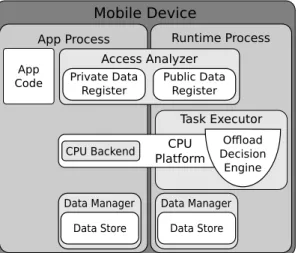
Regarding the runtime system, this thesis contributes with a new architecture redesigned with the characteristics of MCC in mind. For managing the available resources holistically, the runtime runs as a service which all the applications running simultaneously on the mobile device contact for submitting the execution of their tasks. The runtime clusters the computational devices into Computing Platforms according to the mechanisms required to provide the pro-cessing elements with the necessary input values, launch the task execution avoiding resource oversubscription and fetching the results back from them. The most simple platform is the CPU Platform which has a static pool of threads to run tasks on the cores of the CPU. The GPU Platform leverages on OpenCL to run tasks as kernels on GPUs or other accelerators embedded in the mobile device. Finally, the Cloud Platform offloads the execution of tasks onto remote resources.
Hosting part of the computation on the local computing devices and offloading part of it onto remote resources forces the runtime to implement a mechanism to share data values among the nodes of the infrastructure. The shared information is potentially privacy-sensitive, and the runtime exposes it to possible attackers when transferring the data values through the network. To protect the application user from data leaks, it is necessary that the runtime authenticates both ends of network connections and encrypts and signs the content of the messages to provide communications with secrecy, integrity and authenticity.
For collaboratively exploiting both, local and remote resources, the runtime has to implement a mechanism that decides whether is worth running a task on embedded or on remote resources. For that purpose, the runtime picks one of the Computing Platforms according to the costs – time, energy and money – of running the computation on each of the platforms. Besides, in the case of the Cloud Platform, the system has to determine also which of all the nodes composing the underlying infrastructure should host the execution and when. In the case of a network breakdown that isolates the mobile device from the remote nodes, the runtime has to ensure that both parts continue with the execution. The mobile device has to respond using only the resources embedded in it, what could incur in the re-execution of computations already ran on
the remote resources to re-compute some unaccessible values. Remote workers have to continue with the execution so that in case of reconnection, both parts synchronize its progress to reduce the impact of the disconnection on the application performance.
ACKNOWLEDGMENTS
W
ith few words, I would like to show my gratitude to all the people who helped me during this project for their support.To begin with, I want to thank all the current and former members of the Workflows and Distributed Computing team of the Barcelona Supercomputing Center for their assistance. Rosa MaBadia, for mentoring my academic formation from the final project of the Computer Engineer-ing degree until the presentation of this thesis. Without her careful direction and her guidance to highlight the major problems and relevant results, this dissertation would have never been possible. Javier Conejero, Jorge Ejarque, Roger Rafanell, Cristián Ramón-Cortés, Raul Sirvent and Enric Tejedor, for their technical perspective on the main problems presented in this docu-ment. Adrià Aguilà, Javier Álvarez, Pol Álvarez, Ramon Amela, Víctor Antón, Pedro Benedicte, Arnau Canyadell, Sandra Corella, Carlos Díaz, Marc Domínguez, Fredy Juares, Daniele Lezzi, Jordi Montes, Sergio Rodríguez, Carlos Segarra, Salvi Solà and Albert Serven, for all those long discussions that helped me facing concrete problems from a different point of view or making some design decisions.
I also want to dedicate some words of gratitude to Jens Jensen and Wen-Mei Hwu, who allowed me to visit the Science and Technology Facilities Council (STFC) and the Coordinated Science Laboratory (CSL) of the University of Illinois at Urbana-Champaign (UIUC). Besides the technical education, both stays in the United Kingdom and the United States were once-in-a-lifetime experiences that I will always remember fondly together with all the life lessons learned abroad.
I am also grateful for all those people who showed interest for the thesis, but also, that made me keep a distance from the project and enjoy this period in my life beyond the academical and technical aspect. It would make a too long list to include all their names, but I would like to give a special acknowledgment and express my deepest and sincere gratitude to my family: parents, grandparents, siblings – brothers and sisters-in-law –, uncles, aunts and all the cousins; and closest friends: Lluís, Marc, Ivan and all the members of the volleyball team. Thanks for always
Catalan societies for funding my research through their institutions. First, to the Ministry of Economy, Industry and Competitiveness (MINECO) from the Spanish Government for the sup-port received through the projects TIN2012-34557 and TIN2015-65316-P, the grant of Severo Ochoa Program (SEV-2011-00067) and the grants of the Research Training Program received for the predoctoral training (BES-2013-067167) and mobility (EEBB-I-15-09808, EEBB-2016-11272). Also, the Generalitat of Catalunya partly supported this work through contracts 2014-SGR-1051 and 2014-SGR-1272; and the European Commission through the ASCETiC (FP7-ICT-2013.1.2 contract 610874) and mF2C (Horizon 2020 contract 730929) projects.
Wholeheartedly, thank you all.
TABLE OF
CONTENTS
Page
List of Tables xi
List of Figures xiii
I Context 1
1 Introduction 3
1.1 Motivation . . . 5
1.2 Objectives . . . 6
1.3 Thesis Contributions . . . 8
1.3.1 Publications Related to the Thesis . . . 10
1.4 Thesis Organization . . . 13
2 Background: Android 15 2.1 Software Architecture . . . 15
2.2 Applications . . . 17
2.3 Application Package Building . . . 20
2.4 Process and Thread Management . . . 21
3 State of the Art 23 3.1 Sources of Parallelism . . . 24
3.2 Parallel Systems . . . 25
3.3 Parallel Programming . . . 26
3.3.1 Handling the Parallelism . . . 28
3.3.2 Handling the Heterogenity of the System . . . 30
3.4 COMPSs . . . 31
3.5 Mobile Cloud Computing . . . 35
3.6 Mobile Cloud Computing Frameworks . . . 38
II General Proposal 43
4 System Overview 45
4.1 Programming Model Extension: Polymorphism . . . 47
4.2 Runtime Toolkit Architecture . . . 47
4.3 Instrumentation . . . 50
4.4 Summary . . . 52
III Exploitation of Local Computing Resources 55 5 CPU Exploitation 57 5.1 CPU Platform . . . 58
5.2 Proxied Execution . . . 62
5.3 Evaluation . . . 64
5.3.1 Automatic Parallelization . . . 65
5.3.2 Impact of Proxied Executions . . . 70
5.4 Summary . . . 74
6 GPU Exploitation 77 6.1 Related Work . . . 78
6.2 Background: OpenCL . . . 79
6.3 Programming Model Extension . . . 80
6.4 OpenCL Platform . . . 82
6.5 Evaluation . . . 86
6.5.1 OpenCL Platform Performance . . . 86
6.5.2 Load Balancing Decisions . . . 89
6.6 Summary . . . 96
IV Exploitation of Remote Computing Resources 99 7 Remote Resources Exploitation 101 7.1 Cloud Platform . . . 102
7.2 Data Manager Implementation . . . 104
7.3 Cost Forecasting . . . 108
7.4 Fault tolerance . . . 110
7.5 Evaluation . . . 113
7.5.1 Exchanged Message Evaluation . . . 115
7.5.2 Overall Performance Evaluation . . . 117
TABLE OF CONTENTS 8 Secure communications 125 8.1 Backgroung: GSSAPI . . . 126 8.2 GSSAPI Integration . . . 128 8.3 Performance Evaluation . . . 131 8.3.1 Security Overheads . . . 131
8.3.2 Security Impact on Applications . . . 134
8.4 Summary . . . 136
9 Offloaded Scheduling System 139 9.1 General Aspects of the Scheduling System . . . 140
9.2 Initial Scheduling . . . 142
9.3 Scheduling Optimization . . . 146
9.4 Dynamic Resource Provisioning . . . 153
9.5 Evaluation . . . 158 9.6 Summary . . . 161 V Conclusions 165 10 Conclusion 167 10.1 Future Work . . . 173 Bibliography 177
L
IST OFTABLES
TABLE Page
3.1 Comparison of MCC frameworks. . . 39 5.1 Power consumption and computing capacity according to the state of the screen of the
mobile device (screen off, the screen on at 0% brightness and 100%) and its activity (idle and computing). . . 65 7.1 Relation between each computing configuration (Mobile with screen off, mobile with
the screen on at 0% brightness, laptop or cloud VM) with the analysis of each core element execution. . . 114 7.2 Network benchmark results. . . 115 7.3 Direction of each type of message according to the placement of the data directory:
centralized on the mobile device (mobile), hosted by the worker nodes (Workers) or shared among all the nodes composing the infrastructure included the mobile (Mobile+Workers). . . 116 7.4 Number of messages and number of bytes received/transmitted by the mobile during
a low-resolution execution according to the size of the underlying infrastructure and the nodes hosting the data directory (the mobile device, the worker nodes or shared across the whole infrastructure. . . 116 7.5 Number of messages and number of bytes received/transmitted by the mobile during
a high-resolution execution according to the size of the underlying infrastructure and the nodes hosting the data directory (the mobile device, the worker nodes or shared across the whole infrastructure. . . 117 8.1 Actual size of transferring 250, 2,500, 10,000, 100,000, 1,000,000 and 10,000,000 bytes
according to the token size in bytes (256, 512, 1,024, 2,048, 4,096, 8,192, 16,384). . . . 133 8.2 Timespan (ms) to transfer 250, 2,500, 10,000, 100,000, 1,000,000 and 10,000,000 bytes
according to the token size in bytes (256, 512, 1,024, 2,048, 4,096, 8,192, 16,384). . . . 133 9.1 Scheduling system preferences according to the user profiles detected by Green Prefab.158 9.2 Idle VM price breakdown. . . 159
9.3 Average measures for each version of thesimulateCore Element running an Energy-Plus execution. . . 160 9.4 Results obtained after executing the application configuring the system according to
LIST OF
FIGURES
FIGURE Page
2.1 Android software stack. (Source: https://developer.android.com) . . . 18 3.1 Parallel execution of 7 instructions in a basic five-stage (InstructionFetch,Instruction
Decode,Execution,Memory Access, RegisterWriteBack) pipeline. In the fifth cycle, 5 instructions are running in parallel, the fist has already completed its execution and the last has not entered the pipeline. . . 24 3.2 Architectures of computing systems. . . 26 3.3 Sample application code written in Java. . . 33 3.4 Core Element Interface for the sequential application in Figure 3.3. It defines three
CEs: prepareParameters, that creates an object with the simulation parameters out of a string; simulate, which runs the simulation and creates a report of the execution; and aggregate, which merges a report into another. . . 34 3.5 Directed acyclic graph representing the task workflow automatically detected by
COMPSs for the application presented in Figures 3.3 and Figures 3.4. . . 35 4.1 Layout of the components of the distributed infrastructure that could be used by
applications developed with the proposed framework. . . 46 4.2 Sort method CE declaration with two possible versions implemented in RadixSort and
BubbleSort classes respectively. . . 47 4.3 Definition of the interface to the Runtime toolkit. . . 48 4.4 Runtime system architecture with three available Computing Platforms: one for the
cores of CPU, on to offload tasks to the GPU and one gathering all the remote resources. 49 4.5 AndroidManifest file extended by the COMPSs Instrumenter. The additional elements
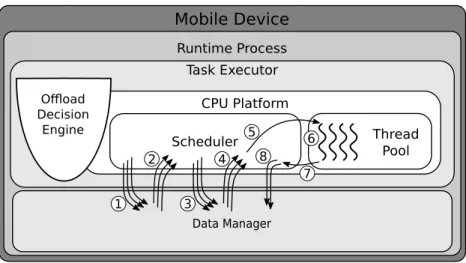
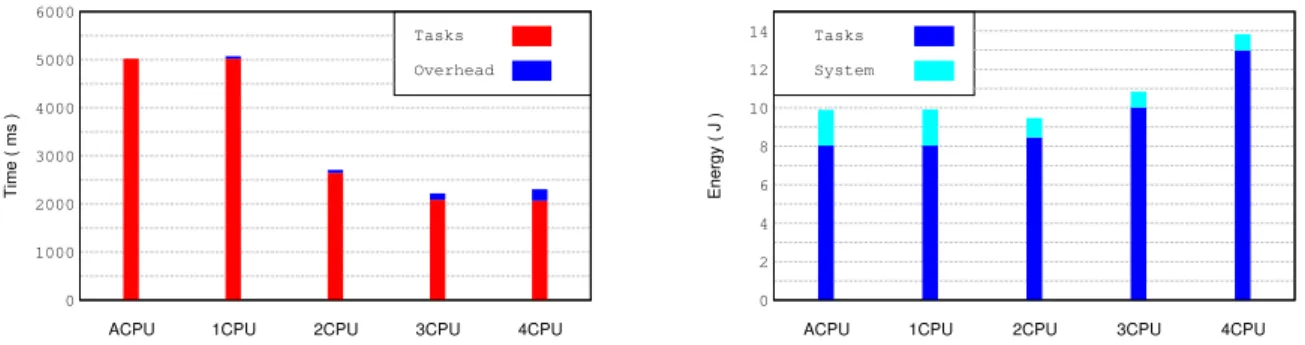
are highlighted over the gray code which corresponds the original Android Manifest. 52 5.1 Architecture of the CPU platform illustrating the flow involving a task execution. . . 59 5.2 Models to forecast the end time, energy consumption and monetary cost of running a
tasktwith implementationion the local CPU cores. . . 61 5.3 Architecture of the CPU platform with proxied execution illustrating the flow involving
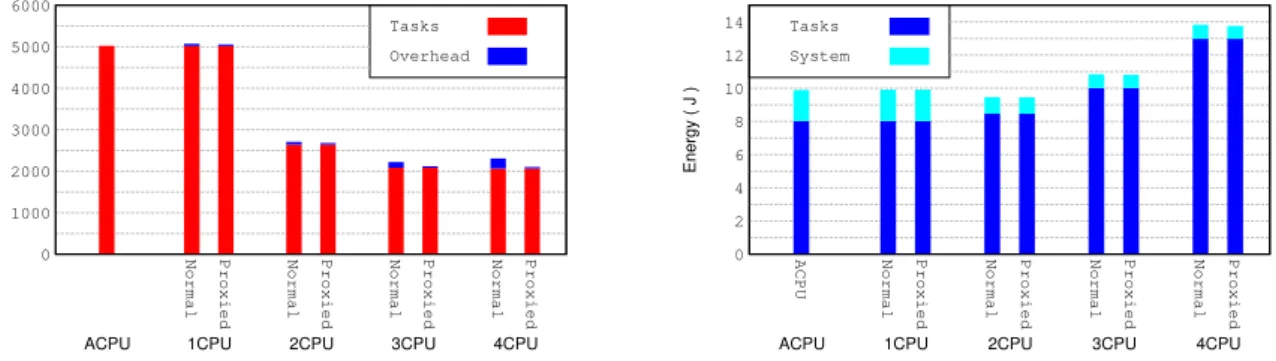
5.4 Workflow representation for the three applications used during the tests: Digits Recognition, Bézier Surface and Canny Edge Detection (left to right). . . 64 5.5 Execution time (left) and energy consumption (right) obtained when running DR with
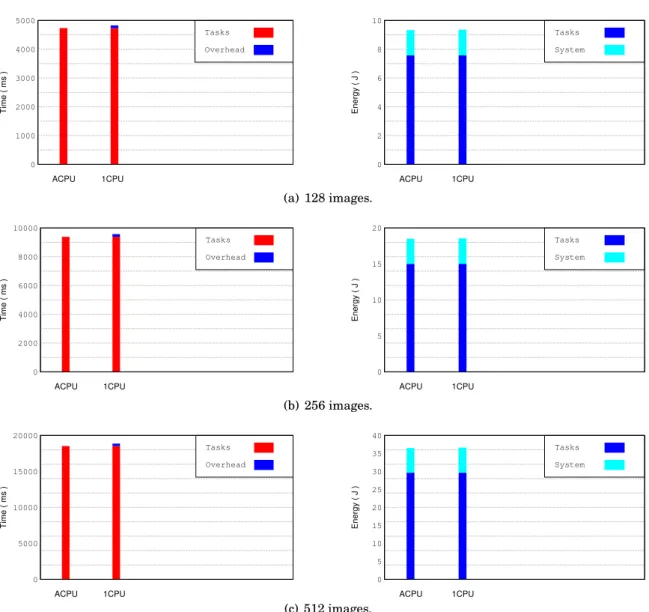
the CPU platform. . . 67 5.6 Execution time (left) and energy consumption (right) obtained when running BS with
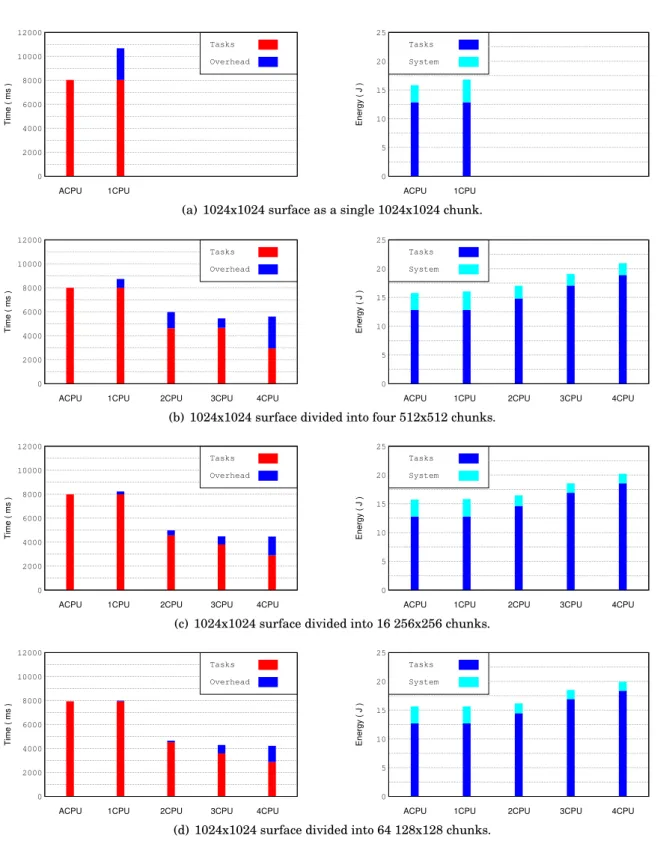
the CPU platform. . . 68 5.7 Execution time (left) and energy consumption (right) obtained when running CED
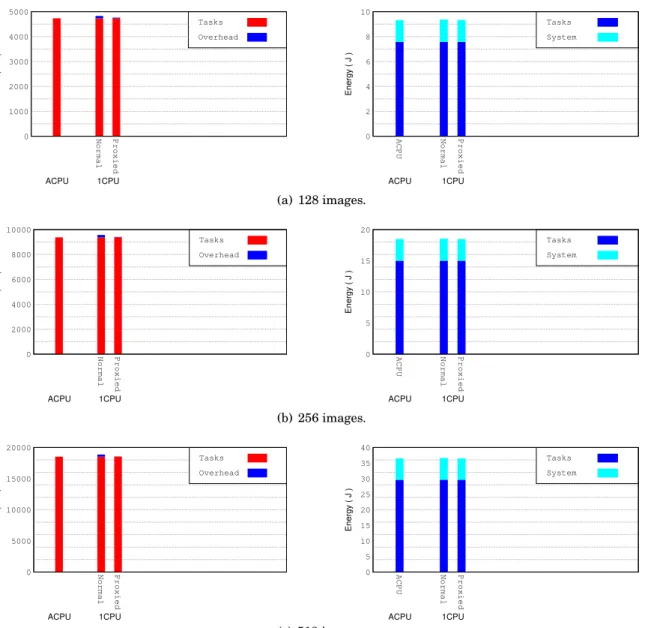
with the CPU platform. . . 69 5.8 Execution time (left) and energy consumption (right) obtained when running DR with
the CPU platform comparing executions on theOrchestratorprocess (Normal) or on the application process (Proxied). . . 71 5.9 Execution time (left) and energy consumption (right) obtained when running BS with
the CPU platform comparing executions on theOrchestratorprocess (Normal) or on the application process (Proxied). . . 73 5.10 Execution time (left) and energy consumption (right) obtained when running CED
with the CPU platform comparing executions on theOrchestratorprocess (Normal) or on the application process (Proxied). . . 74 5.11 Diagram of the runtime architecture with a single CPU platform with proxied executions. 75 6.1 Example of a matrix multiplication with two implementations: one in OpenCL and
one as a regular method. The code of the kernel is in the matmul.cl resource, and it has to be executed by as many threads as the number of rows in matrixatimes the number of columns of matrixb. The result of the method is a bi-dimensional matrix with as many rows as matrixaand as many columns as matrixb. . . 82 6.2 Dependency graph of commands submitted to the OpenCL device to run the matmul
task from application introduced in Figure 6.1. . . 85 6.3 Execution time (left) and energy consumption (right) obtained when running DR with
512 images using both devices, the CPU and the GPU. . . 87 6.4 Execution time (left) and energy consumption (right) obtained when running BS with
blocks of 256x256 using both devices, the CPU and the GPU. . . 88 6.5 Execution time (left) and energy consumption (right) obtained when running CED
using both devices, the CPU and the GPU. . . 89 6.6 Execution time (left) and energy consumption (right) obtained when DR processes 128,
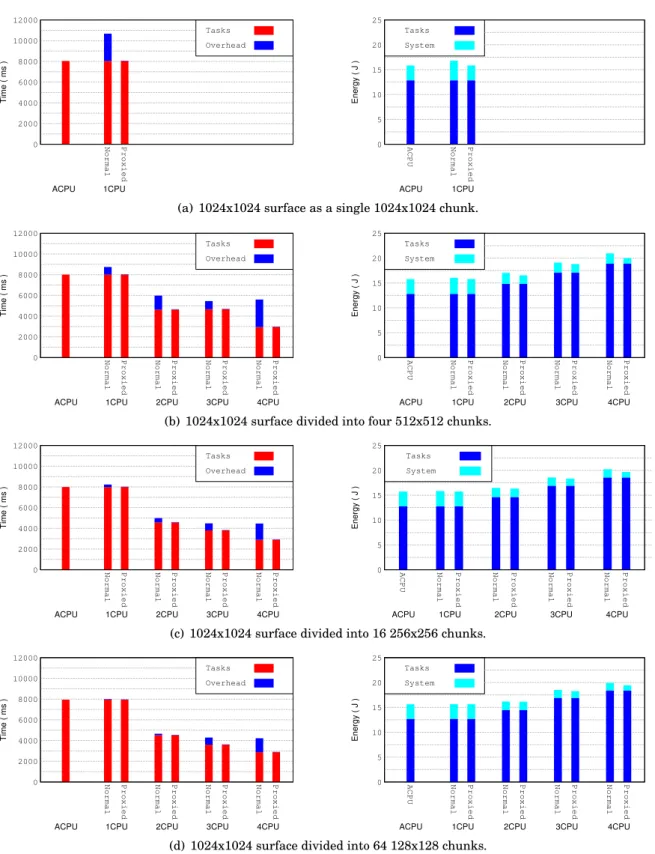
256 and 512 images (top to bottom) using the CPU and OpenCL platforms. . . 90 6.7 Execution time (left) and energy consumption (right) obtained when BS computes a
1024x1024 points surface splitted into chunks of 1024x1024, 512x512, 256x256 and 128x128 (top to bottom) using the CPU and OpenCL platforms. . . 93 6.8 Execution time (left) and energy consumption (right) obtained when CED processes
LIST OFFIGURES
6.9 Detail of Figure 6.9 comparing the execution time (left) and energy consumption(right) obtained with different schedulers on heterogeneous cases. . . 95 6.10 Diagram of the runtime architecture with a single CPU platform with proxied executions. 96 7.1 Architecture of the Cloud Platform illustrating the flow involving a task execution. . 104 7.2 Data creation notification and transfer request. . . 105 7.3 Example of a data directory query in a five-node peer-to-peer network sharing a [0-31]
hashcode range and the route followed by a query access to hashcode 29 from Worker A.108 7.4 Models to forecast the end time, energy consumption and monetary cost of running a
tasktwith implementationion the local CPU cores. . . 111 7.5 HeatSweeper task dependency graph for a three sources optimization on four possible
locations resulting in 14 simulations and 13 getBest executions. Dark blue nodes representsimulatetasks and cyan nodes depictgetBestexecutions. . . 113 7.6 Execution time (left) and energy consumption (right) obtained for a low-resolution
execution with a centralized data directory. . . 118 7.7 Execution time (left) and energy consumption (right) obtained for a high-resolution
execution with a centralized data directory. . . 120 7.8 Execution time (left) and energy consumption (right) obtained for a low-resolution
execution with a data directory distributed among all the nodes. . . 120 7.9 Diagram of the runtime architecture with a CPU platform, an OpenCL platform and
a Cloud platform. . . 122 8.1 Runtime architecture diagram with secured communications. The red dashed arrow
shows the flow followed by a task submission command send by the mobile device to one of the workers. . . 130 8.2 Timeline of the TCP Connection Establishment and GSSAPI Negotiation. . . 132 8.3 Comparison of the execution times for the low-resolution (left) and high-resolution
(right) obtained when using non-secure and secure communications. . . 135 9.1 Four possible dependency graphs among eight actions. The top graph corresponds to a
scenario with resources able to host all the actions at a time, and the others are three different schedulings on resources able to host up to two actions at a time. . . 142 9.2 Evolution of thegaplist within theNode Schedulerand the resource dependencies
when scheduling three actions (Action1 and Action2 require one CPU core and Action3 requires two CPU cores) on a node with two CPU cores. Eachgapis described as a 4-tuple indicating the resources contained, the start time, the end time and the origin action, respectively. . . 145 9.3 Execution plan generated only with the initial scheduling policy of twelve actions on
one node before performing the local-scope optimization (left) and the group classifica-tion at the end of the Scan phase (right). . . 147
9.4 Simulation state at the beginning of the reschedule process in the example already scanned in Figure 9.3. The leftmost part of the figure shows the list of events expected to happen (<timestamp, type of event: Start Action (SA) or Static Dependencies Release (SDR), Action>), the center, the list of available resources as gaps, and the rightmost part, the content of the updated groups. . . 149 9.5 Flowchart of the iterative process leading the Reschedule stage of the local optimization.151 9.6 Execution plan after the local-scope optimization processes the execution plan on the
left part of Figure 9.3. . . 152 9.7 Models to estimate the end time, energy consumption and monetary cost of running a
Part I
C
H A P T E R1
INTRODUCTION
T
he evolution of IT technologies cannot be understood if it is not related to the computation needs of the society. The first digital electronic computers appeared in the context of World War II and were designed to speed up military processes such as computing artillery firing tables or breaking message encryption [22]. They were sophisticated, user-unfriendly machines that required several engineers to operate them to generate useful results. Governments, research centers, universities and big corporations quickly saw the potential of those systems and invested lots of money to adopt them to process more generic information: statistics on the census, bank accounts, engineering problems, ... Computers quickly evolved to the point that, at the late 1950s, one single computer was giving support to hundreds of trained users that from their terminals, simpler computers, were offloading the heavy-computing or data sensitive processes to a central unit with higher memory and computing capacity (the mainframe).As the computational complexity of the problems faced by scientist and corporations grew, also did the demand for computational power to the IT industry. Although computer architects enhanced the capabilities of a single computer, the only affordable way to obtain such computing power was to coordinate many computers to give a quicker response. The Cluster [20] and Supercomputer technologies were the result of the research to provide IT users with platforms with a higher computing capacity.
The main issue with these high-performance systems is their economic cost of acquisition and maintenance. For this purpose, at the early 90s, the IT community developed the Grid [43], a set of technologies that allowed IT communities from all over the world to share their data, data storage space, computing power and applications while dividing the costs related to such infrastructure. Mostly adopted by scientific organizations, grids allowed the cooperation to tackle
larger, more complex problems and accomplish scientific goals unapproachable without them. The advent of the Cloud [16, 98] meant one step further in that direction. IT companies with massive computing infrastructures (Amazon, Microsoft, Google, ...) realized that a significant part of their data centers, designed to support peak demand, was unused most of the time, and decided to commercialize computing as a utility. Cloud providers offer access to isolated computing resources running on top of their large IT infrastructures as VM instances. Consequently, the Cloud converted the purchase, maintenance and operation expenses into a pay-as-you-go bill; and emerged as the solution to the computation needs of nowadays’ society.
Parallelly to this computing power growth process, there has been a miniaturization of the systems. The discovery of transistors and the development of integrated circuits and micropro-cessors allowed not only to reduce the size of the devices and increase their capabilities but also fostered the birth of new kinds of devices. During the 1980s, all the power of a mainframe could fit into a single desk-sized device: the personal computer (PC). PCs opened the gates of the universality of IT technologies; slowly, computers put out the head in every house. Due to the high capabilities of these devices and the low requirements of applications targeted to them, developers wrote sequential codes running on their CPUs, which were growing more powerful year after year by increasing their clock frequency.
The continued miniaturization and the technical advancements in batteries made possible the appearance of portable devices, such as laptops, which grew in popularity during the 2000s. Today, their evolution, the mobile devices, dominate the market of computing devices. Smartphones and tablets have a little computing capability compared to laptops and servers. However, they stand out for their high mobility and the wide range of possibilities to interact with the user: multiple microphones, multitouch screens, cameras, positioning, and a large set of sensors such as proximity, light, compass, gyroscope, accelerometers, etc. People always bring a mobile device that connects them to the Internet and provides immediate access to computing services that support them in their work or daily life. For instance, a doctor visiting interned patients in their rooms can read on a tablet the medical history of a patient, look up the results of previous tests, check the patient evolution within the last hours, and then, decide the most suitable treatment. Mobile Cloud Computing (MCC) [38] deprecates the centralized paradigm used in personal devices and picks up the mainframes model, where people use a simple device to interact with the application, and remote, high-performing resources host the heavy-weighted computations. It brings together the interaction capabilities and immediate network access of mobile devices with the infinite computing capacity of the Cloud. Thus, mobile users can increase the computing capacity of their devices and solve more complex computational problems. Instead of consulting the evolution of patients, doctors could simulate the impact of several treatments on them and pick the most suitable one.
1.1. MOTIVATION
1.1
Motivation
Developing parallel applications targeted to distributed environments is not as straightforward as writing sequential applications. To achieve good performance on complex applications, developers must face the technical concerns related to the parallelization and distribution of the application.
Since the appearance of multicore processors at early 2000s, programmers had to shift their mentality when developing applications: it was no longer sufficient to fit the algorithm in the computer capabilities and make it run as efficiently as possible; the workload of the application was to be distributed among several processors working at the same time. Thus, before coding the application, developers have to study the algorithm to find the parallelism inherent in it, split it into several execution units – known as jobs, tasks or threads – and determine the required data communications among them. The new code has to orchestrate the execution of these units aiming to run the maximum number of them at the same time while guaranteeing the result of the application.
Running parallel applications atop distributed infrastructures adds an extra dimension to the complexity of programming: the job scheduling [47]; i.e., assigning each execution unit to a node where to run at a particular time while trying to minimize the overall makespan. Execution units may use data values computed by other units assigned to a different node; therefore, the involved nodes need to communicate to transfer such data values from the producer node to the consumer before it reads them. Data transfers threaten the performance of the application since they add overhead to the actual computation. The heterogeneity of the system also plays a major role in job scheduling: the difference on the hardware features of each node affects the execution of each block. Job scheduling is an optimization problem in which the programmers try to maximize the number of execution units assigned to the most performing resource and minimize the additional overhead caused by data transfers.
Besides their hardware, infrastructures can also be heterogeneous on their software: different operating systems may manage the nodes composing it and require different protocols and middleware to interact with them. Heterogeneity not only affects the job scheduling but also on how nodes communicate one with each other. Programmers must be aware of which middleware is required to interact with each node and know the programming and running details of each to code the data transfers between nodes and the computation submissions using the proper software for each case.
In addition to the traditional concerns of distributed, parallel computing, mobile computing brings two new concerns to programmers. First, mobile devices are bound to a battery whose lifetime limits the execution time of the applications running on them. Hence, energy consumption becomes one of the heaviest arguments to select one implementation over many others.
The second important aspect is the high-mobility of these devices, which entails a rapid variability of the network conditions: switching mobile data protocols modify the network speed drastically and network breakdowns are likely to happen and isolate the mobile for long periods.
Applications should dynamically adapt their execution according to the current conditions to avoid harming their performance and energy-efficiency. And, in the case of network breakdown, an application should be able to keep its progress by implementing fault-tolerance mechanisms that allow it to run already offloaded computation on the computing devices embedded in the device.
Facing all the issues discussed above and taking into account all the variables requires a high level of expertise. For people coming from areas of knowledge other than parallel and distributed computing, it means to turn to experts to achieve their goals; for experts, it means spending precious time. This difficulty incurs a crucial need for parallel languages and programming models that improve the programming productivity [17, 73] by easing the writing of parallel applications for MCC environments while still achieving a performance comparable to applications written by MCC experts.
Programming model designers decide which of these issues are transparently handled by the model and which ones are exposed to the programmer depending on their objectives. On the one hand, explicit programming models offer a specific language, syntax or API through which programmers specify how to deal with the issue; thus allowing the developer to tune up the application to obtain better performance. On the other hand, implicit programming models hide as many details as possible to their users offering a more comfortable programming experience. Later, the compiler or a toolkit executed along with the application analyzes the application to manage the parallelization/distribution in the best way possible. Ideally, programming models should offer the programmability of the implicit programming models, while applications should get a similar performance as if an experienced developer coded them using an explicit model. In the end, programmers should be aware of the parallel, distributed nature of their code, but agnostic to the details of their management.
1.2
Objectives
Given the difficulties to develop MCC applications and being aware of the approach followed to ease the programming of parallel and distributed applications, the following research question arises:
Could a programming model allow developers to create an application to run on a mobile device and transparently exploit an MCC infrastructure to enhance its performance?
With the purpose of answering this question, this thesis pursues providing developers with an implicit programming model that abstracts away from the programmer the management of the parallelism inherent to the application and the exploitation of the underlying infrastructure as much as possible.
Regarding the programmability of the model, the objective is to smooth its adoption and steepen its learning curve so that developers improve their productivity directly. For that purpose,
1.2. OBJECTIVES
the model should offer a programming already natural to the user by building on the native lan-guage of the target platform and trying to avoid model-specific APIs to construct the application. While coding, developers should focus only on the interface with the user and the logic of their solution as if applications were to run only on the mobile device. Therefore, there is no reason for them to add any reference to the underlying MCC infrastructure on the code of the application. Applications should be infrastructure-agnostic.
Although logical algorithms are inherently parallel, the human mind conceives them more easily as an ordered sequence of operations. However, even when applications are to run on one single device, to get the most out of its computing resources, developers need to exploit this parallelism. To release developers from the additional mental and technical exercise that parallel computing requires, the model should allow programming the applications in a sequential fashion. Thus, they can concentrate on the logic of the solution to the problem of their specific area of knowledge. Generally, mobile applications already separate their logic from the interaction with the user in different threads to improve the responsiveness of the GUI. Therefore, the programming model should also allow developers to code applications using multiple execution threads and exploit the inherent parallelism on each of them.
Regarding the mechanism that converts the code written by the developers into how the application actually runs, the lack of information about the infrastructure on the code and the variability of the network conditions make a compiler unviable. A runtime toolkit has to run along with the application to transform it. This runtime analyzes the code of the application to partition it into several units of execution and detect the dependencies that exist among them. Guaranteeing the sequential consistency of the application, it should orchestrate the execution of these units on the multiple computing devices that compose the infrastructure. The runtime can always count on the computing elements embedded on the mobile: the cores of its CPU, the stream processors of its GPU or any other accelerator integrated on it; to process these execution units. Besides, the runtime can offload the computation onto remote resources reachable through the network: physical or virtual machines connected to the same local network or accessible through the Internet. To decide which resources assigns to each task, the runtime should implement a scheduling policy that considers: the execution time, so that the user gets a better application performance; the energy consumption, so that the battery lasts longer; and the economic cost.
Despite the benefits of using remote resources, using the network incurs new concerns to handle by the runtime. Developers code applications that eventually produce a result using the computing resources embedded on the mobile. Their code does not contemplate any network interactions; the programming model runtime automatically decides to make use of the resources available through the network. Therefore, the runtime has to handle all the details and problems with the network connection transparently and implement fault-tolerance and recovery methods that allow the application execution to progress even in those cases where the mobile becomes isolated from the rest of the infrastructure.
Besides, the information used and generated by mobile applications is likely to contain privacy-sensitive details about the user. The programming model should add no vulnerabilities to the applications that may expose the data on which applications work. For that purpose, all the communication across untrustworthy networks have to be secured by authenticating both ends of the connection and encrypting and signing the content of the transferred messages. If the runtime ensures the authenticity, integrity and secrecy of the network messages, in-transit data is protected from attackers.
1.3
Thesis Contributions
The main contribution of this thesis is answering the research question set out in the objectives section. Yes; a programming model can allow developers to create an application to run on a mobile device and transparently exploit an MCC infrastructure to enhance its performance. For demonstrating so, the following chapters describe a programming model along with its runtime system that achieves the objectives described afore.
Contribution 1:
Extensions to the programming model to support MCC environments
The presented model builds on COMPSs [91]: a task-based programming model with which developers can write sequential, infrastructure-agnostic applications that run in parallel on top of distributed infrastructures. Regarding the programmability of the model, this dissertation contributes in two significant points. First, the extension of the model to support task polymor-phism. Thus, a task can have different versions to achieve the same purpose, not only versions implementing different algorithms but also versions targetting different architectures such as CPUs, GPUs or remote web services.
The second contribution to the programmability of the model lies in the integration of the model into the application building and packaging process of Android. To publish and distribute an application, Android bundles the application along with an application description into an Android package (apk) file. The proposal described in this dissertation extends the regular process with an additional step that performs all the necessary modifications to the content of the package so that the runtime can detect the parallelism and exploit the underlying infrastructure.
Contribution 2:
Redesigned architecture for the runtime system
Regarding the runtime of the model, this dissertation proposes a new architecture specially designed with the characteristics of MCC in mind. Despite using the same mechanism to detect the tasks composing one application, the new architecture allows the runtime to holistically orchestrate the parallelism of several applications to achieve a better exploitation of the available
1.3. THESIS CONTRIBUTIONS
resources. Computing platforms group together computing resources and handle the execution of tasks on them; the runtime balances the workload among computing platforms according to the will of the application user. Thus, when the user is in a hurry and needs the result as soon as possible, the runtime fosters those scheduling decisions that pursue reducing the execution time. When the battery is low, the end user can set up the runtime to prioritize those decisions that reduce the energy consumption. In other situations, the runtime could opt for options with a good balance between the temporal, energetic and monetary costs.
Contribution 3:
Design and implementation of computing platforms
This thesis contributes with three different computing platforms. The first, and most simple one, orchestrates the execution of tasks on the cores of the CPU. By just using this platform, the application can already exploit the parallelism of the application transparently by running tasks on several cores at a time. The second platform leverages on OpenCL to offload the execution of tasks onto GPUs or other accelerators embedded on the mobile. Computing platforms have to conduct all the necessary operations to run a task on the managed resources transparently to the runtime. Thus, the OpenCL platform deals with all the memory management to ensure that all the input values are on the device so that the kernel produces the proper results, and collect the results of the kernel execution.
Finally, the third platform allows the runtime to offload task execution onto remote resources. For that purpose, it proposes a mechanisms to submit task executions and sharing data val-ues based on a distributed hash table. The platform completes its basic functionality with a mechanism to tolerate network breakdowns. Mobile devices are likely to experience glitches on the service due to network handovers or long-lasting periods of isolation for entering in out-of-range areas. The described solution allows both, the mobile device and the remote nodes, to keep progressing on the computation autonomously. Thus, in the case of reconnection, both sides synchronize their progress with low impact on the application performance; otherwise, if the device never reconnects to the network, its autonomicity allows the device to provide the application user with the expected result.
Contribution 4:
Security on network communications
Communications due to the offloading and data sharing mechanisms may expose sensitive data by transferring it through untrustworthy networks as discussed afore. To protect the data and avoid that attackers fetch information from nodes impersonating other components of the infrastructure, the platform authenticates the ends of the connection and encrypts and signs the content of the messages. For doing so, the runtime builds on the Generic Security Services API, an interface shared by several security frameworks that allows applications to use interchangeably
any of the implementing frameworks, to forward the security management to a security-specific framework. With this, an organization can publicly offer its resources and control that only its members access it and ensure that in-transit data remains protected. Besides, if several organizations federate their identity management, the members of any organization within the federation could benefit from the resources belonging to any federation partner using one single identity (Single Sign-On).
Contribution 5:
Configurable multi-objective scheduling system
All the contributions previously described focus on improving the user experience from an application point of view. The last contribution of this thesis aims to benefit the owner of the infrastructure onto which the mobile device offloads the computation. Unlike when the runtime submits part of the computation to a single laptop, on larger infrastructures, like the ones offered to the members of an organization, the scheduling of tasks may have a significant impact on the operational expences of the infrastructure. To provide infrastructure owners with some mechanism to control the resource usage and its costs, this dissertation describes a multi-objective scheduling system. With it, the platform owner can influence on the scheduling decisions to foster a shorter execution time, a higher energy-efficiency or trying to reduce the monetary cost of hosting the computation.
1.3.1 Publications Related to the Thesis
The following list contains the publications related to the thesis along with a brief summary of their content that highlights the contributions included on them.
Journals
• Title:ServiceSs: An Interoperable Programming Framework for the Cloud [67]
Authors:F. Lordan, E. Tejedor, J. Ejarque, R. Rafanell, J. Álvarez, F. Marozzo, D. Lezzi, R.
Sirvent, D. Talia, and R. M. Badia
Journal:Journal of Grid Computing, vol. 12, no. 1, pp. 67-91
Publisher:Springer Netherlands
Date of publication:March, 2014
DOI: 10.1007/s10723-013-9272-5
This article extends COMPSs to use it in web service environments. Regarding the program-ming, it allows to define and use web services as the implementation for tasks. Although it introduces the possibility of implementing tasks with mechanisms other than methods written within the application, it only allows one single implementation for each. The second relevant contribution presented in this article refers to the runtime: it adapts the runtime architecture to enable the holistic orchestration of several applications (web service
1.3. THESIS CONTRIBUTIONS
invocations) by splitting it into two parts. The first one detects the tasks on the application and monitors the data dependencies among them. The second part of the runtime orches-trates the execution of tasks on the available resources and dynamically adapts the amount of resources to the current workload.
• Title:COMPSs-Mobile: Parallel Programming for Mobile Cloud Computing [66]
Authors:F. Lordan and R. M. Badia
Journal:Journal of Grid Computing, vol. 15, no. 3, pp. 357-378
Publisher:Springer Netherlands
Date of publication:September, 2017
DOI: 10.1007/s10723-017-9409-z
This article presents an initial version of the prototype described in this dissertation. The programming model does not support task polymorphism yet; however, the paper describes all the necessary tools to use the model to develop Android applications. The described runtime already executes on the mobile device, but tasks always run on the CPU or offloaded them onto the Cloud. Although the architecture of the runtime is not the definitive one, it already implements the offloading, data sharing – through a distributed data directory – and network disruption-tolerance mechanisms.
• Title:Towards Mobile Cloud Computing with Single Sign-On Access [69]
Authors:F. Lordan, J. Jensen, R. M. Badia
Journal:Journal of Grid Computing, pp. 1-20
Publisher:Springer Netherlands
Date of publication:September, 2017
DOI: 10.1007/s10723-017-9413-3
This article describes the extension of the runtime to secure with authenticity, secrecy and integrity the network communications through which the runtime offloads the tasks and transfers the data. The publication details all the adaptations done to the programming model, basically on the runtime, to integrate GSSAPI on it.
International Conferences
• Title:COMPSs-Mobile: Parallel Programming for Mobile-Cloud Computing [65]
Authors:F. Lordan and R. M. Badia
Proceedings:2016 16th IEEE/ACM International Symposium on Cluster, Cloud and Grid
Computing (CCGrid), pp. 497-500
Publisher:IEEE
Date of publication:May, 2016
Conference location: Cartagena de Indias, Colombia
This article is an early version of the homonymous paper published in Journal of Grid Computing. This paper already describes the initial runtime architecture and the offloading, data sharing – with the data directory centralized on the mobile device – and a fault tolerance mechanism that only ensures the autonomy of the mobile.
• Title:Energy-Aware Programming Model for Distributed Infrastructures [68]
Authors:F. Lordan, J. Ejarque, R. Sirvent and R. M. Badia
Proceedings:2016 24th Euromicro International Conference on Parallel, Distributed, and
Network-Based Processing (PDP), pp. 413-417
Publisher:IEEE
Date of publication:February, 2016
Conference location: Heraklion, Crete, Greece
DOI: 10.1109/PDP.2016.39
This article introduces task polymorphism as a mean to allow scheduling policies to control the energy consumed by the infrastructure while running an application. In this case, task polymorphism only considers implementing different algorithms running on the cores of the CPU; however, a task implementation can use more than one core of the CPU.
Workshops
• Title: An architecture for programming distributed applications on Fog to Cloud
sys-tems [71]
Authors:F. Lordan, D. Lezzi, J. Ejarque, and R. M. Badia
Workshop:1st Workshop on Fog-to-Cloud Distributed Processing (F2C-DP)
Workshop date:September, 2017
Workshop location: Santiago de Compostela, Spain
Proceedings:Euro-Par 2017: Parallel Processing Workshops. Lecture Notes in Computer
Science, vol. 10659, pp. 325-337
Editors:D. Heras and L.Bougé
Publisher:Springer International Publishing
Date of publication:February, 2018
DOI: 10.1007/978-3-319-75178-8_27
This article introduces the whole solution and discusses its suitability of the programming model for mobile Fog to Cloud environments. The proposal considers one mobile device as the cornerstone of the whole infrastructure. Applications running on it discover the nearby sensors and collect data from them. However, the programming model does not assist programmers with such interactions; they have to handle all the issues related to them programmatically. The mobile processes all the gathered information using the local computing devices, usually the CPU and the GPU, but it can delegate part of the computation and offload it onto the Cloud. The current implementation of the data-sharing
1.4. THESIS ORGANIZATION
and fault-tolerance mechanisms do not support offloading computation onto other peers in the Fog since they do not consider the possibility of losing data values because of the unavailability of one peer.
• Title:Enabling GPU support for the COMPSs-Mobile framework [70]
Authors:F. Lordan, R. M. Badia and W. Hwu
Workshop:4th Workshop on Accelerator Programming Using Directives (WACCPD)
Workshop date:November, 2017
Workshop location: Denver, Colorado, United States of America
Proceedings:Accelerator Programming Using Directives. WACCPD 2017. Lecture Notes
in Computer Science, vol. 10732, pp. 83-102
Editors:S. Chandrasekaranand G. Juckeland
Publisher:Springer International Publishing
Date of publication:January, 2018
DOI: 10.1007/978-3-319-74896-2_5
This article proposes an extension of the programming model that allows applications to benefit from GPUs and other accelerators embedded on the mobile device to improve their performance. For that purpose, developers have to implement the task as an OpenCL kernel and use a new annotation to let the runtime know of the implementation existence. The article describes all the necessary mechanisms so that the runtime manages the content of the device memory and submits the kernel executions transparently to the developer.
Pending for submission
• Title:Multi-objective Self-adaptation of Task-based Application Execution in Elastic
Dis-tributed Computing Infrastructures
Authors:F. Lordan, P. Álvarez, J. Ejarque, R. Sirvent and R. M. Badia
This article will describe the system designed and implemented for scheduling task exe-cutions on the available resources and provisioning the necessary resources dynamically. The policies defined in the article take into account application-level information to achieve multiple objectives related to the timespan of the execution, its energy consumption and its economic cost. In practice, the policies try to minimize one of the three parameters while meeting boundaries for the other two parameters. For instance, the policies could try to minimize the energy consumption of the application while guaranteeing that the application ends in less than one hour and spends less than 3e.
1.4
Thesis Organization
After introducing the topic of the thesis and exposing the motivation behind it and its contribu-tions, this first part of the dissertation continues contextualizing the work and provides some
background information about Android in Chapter 2. Chapter 3 analyses the state of the art on programming models for parallel computing and, more specifically, for mobile cloud computing. The rest of the dissertation is divided into four parts. Part II, entitled General Proposal, explains the solution proposed to ease the development of applications through one single chapter (Chapter 4) describing the programming model and giving an overview of the runtime system that supports it.
In Parts III (“Exploitation of Local Computing Resources”, Chapters 5- 6) and IV (“Exploita-tion of Remote Computing Resources”, Chapters 7- 9) the disserta(“Exploita-tion delves into the exploita(“Exploita-tion of the available resources. On the one hand, the former details the mechanisms used for running tasks on the computational resources embedded on the mobile device. Chapter 5 describes how the runtime uses the cores of the CPU of the mobile device, while Chapter 6 discusses how the prototype benefits from the computing devices embedded on the mobile other than the CPU, such as GPUs, through OpenCL.
On the other hand, Part IV describes how the runtime exploits remote resources. Chapter 7 details the mechanisms to offload task, share data and tolerate network disruptions. Chapter 8 explains the securing of the network communications with mutual authentication and message integrity and secrecy by means of GSSAPI. Chapter 9 describes the system for scheduling tasks on the remote workers to allow the owner of the infrastructure to control the operational expenses of running tasks there.
Finally, the fifth and last part of the dissertation, entitled Conclusion, wraps up the disserta-tion with one single chapter that lays out the conclusions extracted from the presented work and introduces possible directions to continue the research.
C
H A P T E R2
BACKGROUND: A
NDROIDA
ndroid is an open-source platform designed primarily for touchscreen mobile devices that offers support at all levels of the software stack, from operating system functionalities to sample applications. Android was initially developed by Android, Inc., a company founded by Andy Rubin, Rich Miner, Nick Sears and Chris White to develop "smarter mobile devices that are more aware of its owner location and preferences". In July 2005, Google acquired Android, Inc. planning to enter the mobile phone market, and in November 2007 founded the Open Handset Alliance, a consortium along with other technology companies, with the goal to create open standards for mobile devices. Since then, the Open Handset Alliance has been the developer of the Android platform.2.1
Software Architecture
A user of an Android device sees the whole platform as a set of software application (apps) that enacts some functionalities through the mobile hardware device. Despite Android already provides some built-in applications implementing basic features like a phone dialer, an SMS client, a contacts manager, an email reader or a web browser; most of the applications are developed by third-party organizations that publish them on on-line Application stores, such as Google Play.
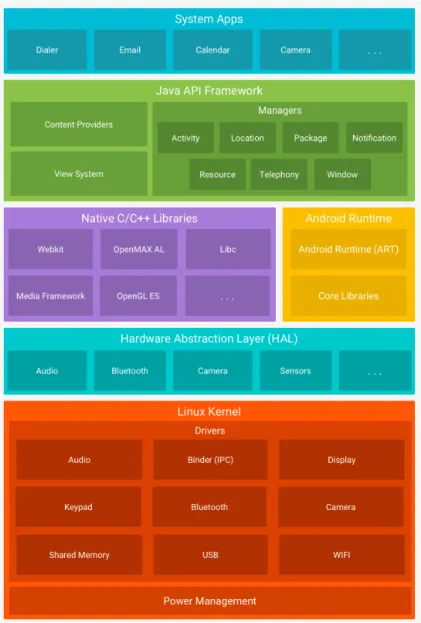
To ease the development of these applications, the platform offers the Application framework: a set of pre-installed blocks of software that are likely to be reused by various applications that manage the basic functions of the mobile. Thus, it reduces not only the complexity of the application code, but also their size by eliminating repetitive code. Some of the most important
blocks contained in this layer are:
• Package Manager: a database that keeps track of all the applications currently installed
on the device and allows them to interact with each other
• Window Manager: manages the many windows that comprise an application: notification
bar, main application window or any sub-window defined in it
• View System: contains common UI-related elements such as tabs, buttons, icons,
text-boxes, labels, ...
• Resource Manager: manages all the non-source code entities that compose the
applica-tion: text strings, images, media content, interface layouts, ...
• Package Manager: a database that keeps track of all the applications currently installed
on the device and allows them to interact with each other
• Activity Manager: coordinates and supports the navigation across different screens of
applications
• Content Providers: set of databases that allow applications to store and share structured
data across applications
• Location Manager: provides applications with location and movement information
ob-tained through GPS, sorrounding Wi-Fi networks or cell tower information
• Notification Manager: manages the information placed on the notification bar
• Telephony Manager: manages all voice phone calls
Developers often use operations that are hardware-specific or performance-sensitive: calls to the operating system, surface management, media reproduction, rendering of web (webkit) and graphics (OpenGL), database operations (SQLite), security (SSL), etc. For that purpose the Application framework leverages on a set of system libraries, usually written in C or C++, optimized for the harware capabilities of the device. These libraries, also known as native libraries, comprise the library layer of the software stack. The implementation/tuning of these high-performing libraries is responsibility of the mobile vendor and may not be included on all devices.
In addition to these system libraries, the layer also includes the Android Runtime (ART) [2], which supports the writting and execution of Android applications. Android applications are written in the Java programming language. This component of the framework contains a set of reusable Java building blocks that include the basic software implementations of data structures, concurrency mechanisms, file and network IO, applications lifecycle management, webservices interaction and testing. Although programmers code in Java, Android applications do not run
2.2. APPLICATIONS
on a Java Virtual Machine since it is not designed to run on resource-constrained environments. Originally, Android developed the Dalvik VM [24] particularly tailored for that purpose: a register-based VM optimized for low memory requirements that relied on the underlying OS to isolate processes, manage memory and support threads while allowing multiple VM instances to run at once. Since Android 5.0 "Lollipop", the Dalvik VM is discontinued. Android incorporated Ahead-of-time (AOT) compilation which translates the Dalvik bytecode of the application to device-specific instructions at install-time. This allowed to improve applications performance on the phone without sacrificing their portability. Subsection 2.3 elaborates on how the Java code written by the programmer is transformed to run on the device.
To keep Android agnostic about low-level driver implementations, it defines a standard interface for vendors to implement, the hardware abstraction layer (HAL). Thus, vendors can implement funcionalities without affecting software of higher-levels.
The Linux Kernel layer is the bottom of the Architecture and the heart of the whole system by gathering all the core services that any Android device relies on. It provides generic operating system services such as management of memory and processes, storage and network I/O, security settings to grant/deny access to hardware devices or data. It also offers an interface that allows to plugin hardware device drivers so Android can communicate with a wide range of low-level components that are often coupled to the mobile. The layer also includes some Android-specific components that target to mobile-related issues such as the power management, memory sharing or its own interprocess communication mechanism known as binder.
Figure 2.1 illustrates the different layers of the Android Software stack described above.
2.2
Applications
As explained in the previous section, applications are how users access to the device functionalities. A user interacts with an application through the graphical interface developed by its programmer along with all the logic that supports the feature. To help on that job, the Android Framework provides four building blocks: activities, services, content providers and broadcast receivers.
Activities are designed to contain the visual interface through which users give and receive information from and to the application. By convention, an activity should support a single and individually-focused action that user can do and string together to other activities to achieve a common purpose. Tasks gather all the activities related to the same goal, not necessarily from the same application, and organizes them as a stack where the top activity is shown to the user. When the user launches an application, a new task is started along with a new activity which is pushed onto the top of the stack.
From the forefront activity, the user might need to navigate to a new activity. In this case, Android suspends the current activity, captures its current state, creates the new activity and pushes onto the top of the stack. When the activity is no longer useful, it is destroyed and popped
Figure 2.1: Android software stack. (Source: https://developer.android.com)
out of the stack; the new peek activity resumes its execution and is shown to the user. Developers only need to focus on the graphical elements shown to the user in each activity and the actions that need to be taken when interacting with them; the base Activity class encapsulates all the management of the task stack and the lifecycle of that particular activity.
When the application requires two components to interact, e.g. the current activity creates a new activity or opens a web page in the browser, developers turn to Intents. Intents are a class of the Android framework that represents an action to be done: create a new activity or a service, notify an event, etc. The component that the action targets can be explicitly indicated by the developer, for instance, creating a new activity of the same application; or developers may leave it implicit in the code indicating only the action to perform and Android determine which component
2.2. APPLICATIONS
of which application receives the action through a process known as Intent Resolution. Intent Resolution relies on a manifest (AndroidManifest.xml) attached to each application describing its components and which actions they support. At runtime, when an Intent is created and to be delivered, the system matches the action with some known component (action Id, data type and category). Multiple components can accept the same kind of intent, in that case, Android needs to choose a single one, usually asking the user.
Services are the application component designed to support long running operations with-out providing any user interface. Mainly they are used for two purposes: performing work in background outlasting the calling application and interaction among different processes. They can take two forms: started and bounded. Started services are started by another aplication component and run in background indefinetely even if the component that started is destroyed. Usually, a service is started to perform a single operation that does not return a result to the caller and it stops by itself when the operation completes. Other application components can bind to a service whether it was created by the same application or by another one. A bound service offers a client-server interface to interact with this service (known as IBinder), send requests and get results. Once the client component gets bound to the service it receives a stub implementation of the IBinder. Multiple components can bind to the service at once; the service is alive as long as other components are bound to it. To allow clients from different applications to access a service it is necessary to define the service interface using the Android Interface definition Language (AIDL).
The purpose of BroadcastReceiver is to enable application to react to system-wide events. Developers specify on the AndroidManifest which events the application receives and which individual BroadcastReceiver handles them. When an event needs to be broadcasted, the source application/hardware creates an event representing it with some additional information about it; Android notifies to any application component registered in the system through the Intent Re-solver invoking the onReceive method on the corresponding BroadcastReceiver implementations passing the intent as a parameter.
The last building block of Android applications are ContentProviders which their main pur-pose is to allow data sharing across different applications. ContentProviders represent centralized repositories of structured data with data access control (specify and enforce permissions). Ap-plications that want to access a particular ContentProvider do so through the ContentResolver class which presents a database-style interface that lets read and write data from and to a ContentProvider and supports methods such as query, insert, update and delete. To use a Con-tentResolver, applications identify the data they want and the content provider that hosts the data through a URI composed by a scheme (content://), an authority which indicates the specific ContentProvider, a path containing 0 or more segments indicating the specific dataset, and the ID indicating the specific record.
ContentProvider stores information such as bookmarks and browsing history; CALL LOG keeps track of the telephone calls; CONTACTS manages contact information; MEDIA keeps track of the pictures, songs and videos; and many more.
Sometimes applications need to squeeze extra performance from the device. In these cases, Android allows to build part of the application as a native library and write it in C or C++ and directly interact with the embedded devices of the mobile platform such as network interface, GPUs, accelerators or sensors. Developers dynamically load these libraries at any point of the code and they access to their functions through the Java Native Interface (JNI).
In addition to the code implementing the logic, applications are also include non-source code entities called resources; things like images, sound and video media, the layout of a screen or strings of characters. Managing them separately from the application code and using them properly has a significant impact on the portability of the application since they allow to alter the content shown to the user without need of changing the application or recompiling it. Choosing among different set of strings to be used allows applications to translate to any language. Providing a different layout for each device size or orientation (landscape or portrait) allows applications to adjust to the user interface to the current configuration. For applications to automatically adapt to the current configuration, Android requires the developer to classify the resources in a specific folder hierarchy according to their kind and the device configuration when they sould be used.
2.3
Application Package Building
Android applications are written in Java language and bundled in Android package (.apk) files for distribution that users can obtain from application stores such as Android Store. The Android Software Development Toolkit (SDK) assists the programmer on the building of the apk file from the Java code following a four steps process.
The first step, known as Android Resource Manager, scans the resources of the application and creates a Java class, named R, to ease the access resources. This class classifies all the resource of the applications in other classes according to the file hierarchy and assigns to each resource a unique identifier which is published as a constant of the R class. For instance, the identifier 0x7f020000 could correspond to an image stored in the folder res/drawable/image1.jpg and using the constant R.drawable.image1 they fetch the picture from the ResourceManager framework component. Since this R class is necessary to code the application, IDEs supporting Android programming run this step everytime that a new resource is added to the application.
During the second stage, the Android Pre Compiler, the Android SDK scans all the project looking for AIDL (Android Interface Definition Language) files to generate all the proxy-stub classes required for interprocess communications. At this point, the application has all the Java classes the compose it and they are compiled by the Java compiler to generate Java bytecode on a