Drug Dependence in the Geriatric Age Group: A
Clinic-Based Study
Sandeep Grover, Anand S. Irpati, Baljeet Singh Saluja, Debasish Basu and Surendra Kumar Mattoo
Drug De-addiction & Treatment Centre, Department of Psychiatry, Postgraduate Institute of Medical Educa-tion & Research, Chandigarh, India
Corresponding author: Dr Sandeep Grover, Assistant Professor, Department of Psychiatry, PGIMER, Chandigarh 160012, E-mail: [email protected]
Abstract
This research aimed to study the demographic and clinical profile of elderly subjects (≥ 60 years) presenting to a state-funded drug addiction centre in northern India. Out of 80 elderly subjects registered with the Centre during 1978-2003, 63 subjects who were diagnosed by qualified psychiatrists to have substance dependence as per the ICD-9/ICD-10 and for whom complete case records were available were taken up for the study. A steady rise from 1 case per year to 9.5 cases per year was seen over the years. All subjects were male, most were married (81%), poorly edu-cated (60%), still working (58.7%), belonging to low (63.5%) or middle (22.2%) socioeconomic status, and had minimal (52.4%) or poor (07.9%) social support. The prominent substance use related patterns were: alcohol (60%) and opioids (35%); onset of substance use since thirties (81%); substance use started out of curiosity (81%); substance use related lifetime medical complications (35%), and mild impairment in family (66.7%), marital (60.2%), social (49.2%), financial (47.6%) occupational (41.3%) and physical (39.7%) domains. Most of the subjects were detoxi-fied using benzodiazepines (80%) and were not advised pharmacoprophylactic agents (55%). The mean duration of follow-up was 10.82 months and 58.7% were abstaining at the last follow-up. Although the numbers are very small, they show a trend in the recent decades of elderly population’s gradually increasing attendance at a de-addiction clinic in India (German J Psychiatry 2008; 11: 10-15).
Keywords:elderly, substance dependence, India Received: 21.12.2007
Published: 15.1.2008
Introduction
lobally there is an increase in the elderly population and India is no exception to this. The Indian data on the elderly show the figures of 20 million in 1951, 84 million in 2001 and an estimated 326 million in 2050 (United Nations, 1995). However, in the recent decades the traditional joint family system that cared for the elderly has been breaking down without a public social security system replacing it, resulting in the elderly being either less cared for or forced to live on their own. The psychological and physiological changes rendering them very vulnerable, it is important to study the problems and needs of the elderly. One of the largely under-diagnosed and under-treated prob-lems in this population is substance use (Crome & Day,1999).
The substance use/abuse data on the elderly population is sparse globally; the available data is mostly from the West and for alcohol rather than for other substances (Widlitz & Marin, 2002). In USA alcohol and substance abuse have been reported to be the third leading health problem among those aged >55 years, as also constituting 10% of all cases treated by geriatric mental health facilities (Reifleret al, 1982; Ticehurst, 1990; Zimberg, 1987). In the UK a household survey reported that 17% men and 7% elderly women aged
≥65 years consumed more than the recommended limit of alcohol and 3–9% were heavy alcohol users (Coulthardet al, 2000). The Indian research in this area is mostly on preva-lence of alcohol abuse (Sethi & Trivedi, 1979; Varma et al, 1980; Mohan et al , 2001; Gupta et al, 2003) and has not addressed the use/abuse of other substances and the factors associated with the initiation, continuation and discontinua-tion. These factors need to be taken into account while for-mulating and organizing demand reduction strategies and therapeutic services for substance use. Hence the need for
G
the present research that aimed to study the sociodemo-graphic and clinical profile of the elderly people attending a de-addiction center in northern India.
Methods
The study was conducted at the Drug De-addiction and Treatment Centre (DDTC) of the Department of Psychiatry at the Postgraduate Institute of Medical Education & Re-search, Chandigarh - a state-funded tertiary-care multispe-cialty institute in northern India. At the DDTC most patients come by self or family referral while some are referred from other hospitals or other departments of our Institute. The services provided by a team of psychiatrists, social workers, clinical psychologists and nurses include outpatient, inpa-tient, laboratory, aftercare, liaison with other governmental and non-governmental agencies and self-help groups. The patients and their family members are initially assessed briefly by a psychiatrist (a postgraduate in psychiatry) and later assessed in detail by a trainee psychiatrist who, after discussion with a Consultant Psychiatrist, finalizes the man-agement plan and the diagnoses as per the ICD (ICD-9 till 1992 and ICD-10 1992 onwards). The planned management is carried out by the treating team and includes referral to/liaison with other departments, pharmacotherapy, psy-chotherapy, yoga-therapy, home visits and socio-occupational rehabilitation. Regular (usually monthly) fol-low-ups are done to monitor and document the drug use profile, treatment issues, and the physical, psychological, social and occupational functioning.
The cohort for this study consisted of all patients aged more than 60 years registered at the DDTC between September 1978 and December 2003 (a little over 26 years). For this chart-review study we found that out of the 80 subjects registered during the specified period, the complete case records were available for 63 subjects.
Measures
The following measures were considered in this study:
Socio-demographic information profile. A semi-structured pro-forma was used to record sex, age, marital status, educational level, occupation, income, family type, religion and locality. One variable named ‘family/social support system’ was added to this section. ‘Poor support’ was rated when there was either unavailability of, or lack of assistance from, key care giving and supervising figures in family (usually spouse, but also parents, sibs or children) or in society (peer group, colleagues, job supervisor, self-help groups, religious-spiritual affiliations, etc.). ‘Good/fair’ support was rated when there was availability and assistance from at least one member each from both these sources. As the social support of an individual could vary over time, the inference about the same was drawn from cumulative evaluation of the pa-tient from the first contact to the last contact. This measure
of social support has not undergone a psychometric evalua-tion.
Information on clinical and substance use profile. This included type of predominantly used substance, duration of dependence (onset marked from the year in which the patient first met criteria for dependence as per ICD-9 or 10), relapses, treat-ments and hospitalizations in the past (before the index treatment episode), detailed physical and psychiatric comor-bidity, and other substance use. The information about the physical and psychiatric comorbidity was inferred from the history, clinical and laboratory evaluation and monitoring of the patient throughout the contact period.
Impairment in various areas of functioning. Four levels of drug related complications were operationalized covering health, occupation, finance, family, marital, legal, and social domains of functioning (Grover et al, 2005). The severity of compli-cations at the first presentation (nil, mild, moderate, and severe) was extracted from the case records using a standard-ized guideline. This measure of impairment has not been subjected to a psychometric evaluation.
Status at last follow-up. Abstinence, lapse, or relapse were con-sidered the primary outcome measures. Abstinence was defined as no substance intake. Lapses were defined as using the substance less than that for relapse. Relapse was defined as re-emergence of substance dependence as per the ICD-9 or ICD-10.
Duration of follow-up. It was calculated in number of months from first visit to the last visit to the hospital.
Results
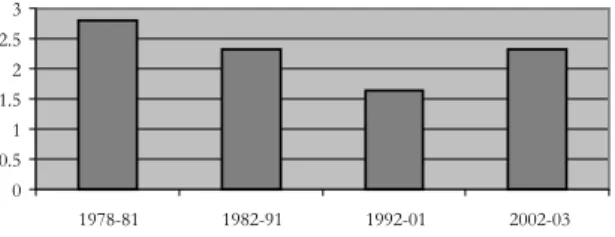
During the 1978-2003 period out of the 4080 subjects 80 were of more than 60 years of age when registered in the DDTC; thus the elderly population formed 1.96% of the total registration. The 80 cases registered during different blocks of years were: 1978-1981=3 case (out of total 107 cases), 1982-1991=21 cases (out of total 905 cases), 1992-2001=37 cases (out of total 2254 cases) and 2002-2003=19 cases (out of total 814 cases), as shown in Figure 1.
How-Figure 1. Percentage of elderly cases in different peri-ods 0 0.5 1 1.5 2 2.5 3 1978-81 1982-91 1992-01 2002-03 Years Percentages
ever, the percentage fluctuated from 1.64% in years 1992-2001 to 2.8% in years 1978-1981 (Figure 1). The remaining part of the results focuses on the 63 out of 80 subjects for whom complete records were available.
Sociodemographic profile
All subjects were men. The mean age at presentation was 65 ±4.9 years with a range of 60-95 years, and all except 4 cases had presented before the age of 75 years. The married sub-jects accounted for 81%; the rest included never married (4.8%), widowed (11.1%) and separated (3.2%) subjects. Only 40% subjects had completed the school, a third had left the school unfinished and the rest were illiterate (26.7%). More than half of the subjects (58.7%) were working. The urban (52.4%) and rural (47.6%) distribution was nearly equal. Almost all subjects were either Sikh (50.8%) or Hindu (46.0%). Most were living in a joint family (42.9%) or a nu-clear family (38.0%), the rest were in extended families (9.6%) or were living alone (9.6%). The socioeconomic level was mostly low (63.5%) or middle (22.2%). Of those from low socioeconomic level 62% were still working. The social support was fair in only 40% subjects, in others it was mini-mal (52.4%) or poor (07.9%).
Clinical Profile
Most subjects had been taking the drugs for decades. The mean age at first use of the primary substance was 33.53±15.29 years (Range: 11-69.5 years) and mean duration of the illness was 372.9±191.17 months (Range: 3-960 months). The mean duration of dependence on the primary substance was 232.46±173.59 months (Range: 2-900 months). Only 19% subjects (12 cases) had started using the substance for the first time after the age of 50 years, the common substances for them being opioids (raw opium – 4 cases; pentazocine – 1 case; poppy husk – 1 case; morphine -1 case) and alcohol (3 cases). One case each was using can-nabis and lorazepam.
The main reason for initiating the substance use was curios-ity (81%), other reasons being family problems (3.2%), iatro-genic/prescription (11.1%), psychopathology (3.2%) and self-medication (1.6%). The reasons for initiating substance use showed marked changes in relation to age at onset being before or after 50 years: curiosity (88% and 50% respec-tively), iatrogenic/ prescription (8% and 25% respecrespec-tively), family problems (2% and 8.3% respectively) and psychopa-thology (0% and 16.7% respectively).
More subjects were brought in by their relatives (55.6%), than those who came at their own initiative (20.6%) or were referred by other departments of our Institute (23.8%). The family history was positive for substance dependence in 25.4% and for other psychiatric disorders in 4.8% subjects. All the subjects were currently dependent on at least one substance. The commonest primary class of substance was alcohol (60.3%) followed by opioids (35%); only one case was using cannabis and one case each lorazepam and
diaze-pam. The opioids used included raw opium (20.6%), poppy husk (9.5%), pentazocine (3.2%) and morphine (1.6%). Only 27% subjects were dependent on more than one substance, nicotine being the most common (11.1%) second substance of use, followed by alcohol (6.3%), benzodiazepines (3.2%) and cannabis (1.6%). The mean quantity of alcoholic drink consumed per day was 721.31±503.86 ml (range 175-3000 ml). Current medical complications were present in 16% subjects and included delirium tremens (7.9%) and delirium, jaundice, withdrawal seizures, cerebellar degeneration and substance induced psychosis (1.6% each). Lifetime medical complications were present in 35% subjects and included diabetes mellitus (11.1%), alcoholic liver disease (9.5%), dementia (3.2%), and head injury with or without subdural hematoma, hypothyroidism, ischemic heart disease, hyper-tension and cerebrovascular accident, cerebellar degenera-tion, hearing impairment and constipation (1.6% each).
Impairment
Majority of the subjects had mild impairment in almost all domains. No impairment was noted for subjects ranging from 97% for legal domain to 17.5% for physical domain. Mild impairment was more often noted in family (66.7%) and marital (60.2%), followed by social (49.2%), financial (47.6%), occupational (41.3%) and physical domains (39.7%). Moderate impairment was noted mainly in physical (30.2%) and social domains (28.6%) and less often in finan-cial (17.5%), occupational (14.3%) family (12.7%) and mari-tal domains (6.3%). Severe impairment was seen mainly in physical domain (12.7%); and ranging from 6.3% for finan-cial domain to 1.6% for family and sofinan-cial domains. The legal domain was impaired mildly in only one case.
Treatment
More than 80% subjects were detoxified with benzodiazepi-nes alone (for alcohol and benzodiazepibenzodiazepi-nes) and clonidine plus benzodiazepines (for opioids). The benzodiazepines used included oxazepam (22.2%), chlordiazepoxide (20%), lorazepam (12.7) and diazepam (3.2%). Post-detoxification pharmacoprophylaxis was advised in 45% cases but was accepted by only 11% subjects. The pharmacoprophylactic agents used included disulfiram (5 cases) and acamprosate and naltrexone (1 case each). The reasons for not advising pharmacoprophylaxis (in 55 % subjects) were poor motiva-tion, physical complications or extreme age.
Outcome
The mean duration of follow-up was 10.82±35.84 months (range: 0-276 months), and the mean number of visits to the hospitals during the contact period was 7.82±21.51 (range: 1-174). Majority of the sample (58.7%) was abstaining at the last follow–up, one third continued to take the substance (33.3%), and 8% of the sample relapsed while on the treat-ment.
Correlation analysis
Age at presentation had negative correlation with financial (Spearman’s rho 0.254; p<0.05) and occupational impair-ment (Spearman’s rho 0.279; p<0.05). There was negative correlation between physical impairment and age at first use of primary substance (Spearman’s rho 0.250; p<0.05) and positive correlation with duration of follow up (Spearman’s rho 0.266; p<0.05) and number of follow up (Spearman’s rho 0.377; p<0.01). The impairment in family domain had positive correlation with duration of use of primary sub-stance (Spearman’s rho 0.363; p<0.01), duration of follow up (Spearman’s rho 0.365; p<0.01) and number of follow-ups (Spearman’s rho 0.261; p<0.05). Similarly, impairment in marital domain had positive correlation with duration of use of primary substance (Spearman’s rho 0.342; p<0.01) and duration of follow up (Spearman’s rho 0.287; p<0.05). There was positive correlation between duration of dependence and impairment in legal domain (Spearman’s rho 0.256; p<0.05), family (Spearman’s rho 0.292; p<0.05), marital (Spearman’s rho 0.402; p<0.01) and occupational domain (Spearman’s rho 0.283; p<0.01).
Discussion
Before discussing the important findings of our research, it is important to point out that most of our patients and their accompanying caretakers reported of many older substance abusers in their locality who had not sought treatment for the reasons of lack of awareness of and/or resources to avail these services. Thus the treatment seekers represented only a small proportion of the actual community load of the older substance abusers. However, rural-urban and religious pro-file of our sample conforming to that of the same age group in the community reflects that ours was a more or less repre-sentative sample (Census of India, 2001).
The present research was a retrospective chart review for the sociodemographic and clinical profile of treatment seeking elderly substance abusers in northern India. Between 1978 and 2003, the significant rise in the elderly cases from 1 to 9.5 per year, although not reflected in term of percentage, indicates an increase in treatment seeking if not of the sub-stance abuse among the elderly in the community. Difficul-ties in detection, screening, treatment engagement and reten-tion for substance use disorders in this populareten-tion are well known (Culberson, 2006). In India, factors likely to attenuate clinic attendance include the major stigma associated with substance use disorders especially in the elderly (more so because they are traditionally held in high respect in Indian families due to their mature age and hence any ‘irresponsible’ behaviour by them such as substance abuse is even more stigmatized). Also, the referral process for them to an addic-tion clinic may be inadequate, in view of the relative lack of awareness of the problem. Thus, the numbers reported in this paper, although still very small, should be seen as a tip of the iceberg.
The mean age (65 years) and the mean duration of substance dependence (20 years) meant that the substance abuse was largely a problem continuing from adulthood. The excess of low socioeconomic and educational status and minimal or poor social support reflect the consequence of the substance abuse rather than the community profile of the elderly. Alcohol dependence accounting for 60% of the sample, conforms to the Western literature that for drinking-related problems in elderly the risk factors were male gender (O’Connell et al, 2003), age <75years (Akers et al, 1989), lower education, income and social network supports and resources (Gomberg, 1990). Most of our cases being married reflect as much the increased life expectancy as the local culture of treating the marriage as a-must and lifetime-commitment (Khandelwal et al, 2004). Most of our cases still working reflects one or both of the community encourage-ment for the elderly to be active and productive for as long as possible, and the low socioeconomic status forcing almost two thirds of these to continue to work. Almost half of our sample coming from a nuclear family (38%) or living alone (9.6%) and with social support being minimal (52.4%) or poor (7.9%), reflects that the traditional joint family system is being replaced by a nuclear family set up leaving the eld-erly with less or no social support (Trivedi, 2000).
Curiosity remaining the commonest reason in both our subgroups, external reasons (iatrogenic, relationship distress and psychopathology) were over reported in those starting substance abuse/use later (around fifties) compared to those starting early (around thirties).
The mean duration of 20 years to develop dependence was essentially because 60% of the sample was abusing alcohol, which is known to take many years for the development of dependence. Western research has identified two types of older alcohol abusers: the early onset/ “survivors”, about 70%, have higher rates for family history of alcoholism and alcohol related medical problems; the late onset/ “reactors” associated with the age of 50 plus, a major life stressor and higher income (McGrath et al, 2005). Our findings are simi-lar with ‘survivors’ accounting for 92% of our cases, 23% of them having a family history of substance dependence, and almost all of them having lifetime substance related compli-cations; while 2 out of 3 “reactors’’ developed cerebellar degeneration and alcohol induced psychosis, suggesting higher vulnerability of this type to neuropsychiatric compli-cations.
Similar to Western reports (Glantz, 1985) alcohol was the commonest substance of abuse in our sample (60%) reflect-ing its easy availability and high social acceptability as a licit substance. The higher consumption of mean 720 ml/day of distilled alcohol in our cases is similar to that reported earlier from this region (Gupta et al, 2003)but not from the devel-oped countries (British Medical Association, 1995); the rea-son may be the that half of our sample came from rural areas and mostly used locally distilled alcohol of lower than the legal standard of 42.7%v/v strength.
Raw opium and poppy husk (21% & 8% of the total sample) as the commonest opioids point to their traditional availabil-ity and abuse in this region as also the fact that their abuse did not progress to more potent synthetic opioids. Only a
few of our cases using benzodiazepines (3.2% each as pri-mary and secondary substance of use) is similar to the West-ern research reporting 5 to 33% of the elderly abusing pre-scription drugs (Jinks & Raschko, 1990; Ostrum et al, 1985). Nicotine, though the commonest second substance of de-pendence was infrequent (11.1%) compared to the adult population in our catchment area (Jindalet al, 2006). This could be explained by half of our cases being Sikhs, a com-munity that traditionally discourages tobacco (Chadda & Sengupta, 2002) and shows lower rates of tobacco use (Venkatanarayan et al, 1996).
Delirium tremens in 13% alcohol dependent cases reflects the higher prevalence of severe withdrawal and the need for a proper assessment in all elderly as also reported in the West (Liskow et al, 1989;Brower et al, 1994). Complications attributable to substance abuse rose from 33% in the whole sample to 54% among the alcohol abusers. Also, moderate to severe physical impairment in half of the sample empha-size the significant physical morbidity and the need for ab-stinent since the adulthood. Mild to moderate social impair-ment in most cases may also mean that substance use among the elderly is not well accepted.
Pharmacotherapy profile of our sample being similar to that among the adults suggests that the elderly tolerate the medi-cation well. In line with Miller et al’s (1991) recommendation chlordiazepoxide was the most used benzodiazepine in ear-lier decades. However, with newer recommendations (Widlitz & Marin,2002; Dufour & Fuller, 1995) oxazepam in hepatically compromised subjects and lorazepam had be-come the norm in the preceding decade.
Non-use of pharmacoprophylaxis in 89% of the sample indicates that in elderly the mainstay of treatment and relapse prevention has to be nonpharmacological. Despite the risk of serious adverse effects (Dufour & Fuller, 1995; Schonfeld & Dupree, 1995)the liberal use of Disulfiram in our sample must be because of its very low cost.
Earlier age at onset correlating with greater physical impair-ment, longer duration of use or dependence correlating with greater impairment in marital, family, occupational and legal domains, and more hospital visits correlating with longer period of follow up together reflect greater family burden and greater use of health care resources in the elderly sub-stance abusers.
Limitations of the study
The retrospective chart review findings of this study may not reflect the patterns and profiles of all the substance abusing elderly in the community.
Conclusions
This study provides over a quarter of a century data on treatment seeking substance abusers showing substance abuse as a significant problem in the older population, often
as a pattern that continued from their adulthood. Although the actual numbers of such patients attending the clinic are still very small, the emerging demographic changes in the community warn of the likely worsening of the problem in the future decades. In that sense, this paper may be gainfully seen as a ‘curtain-raiser’ rather than a comprehensive ac-count of substance abuse among the elderly in India. Hence, specialized substance abuse services for the elderly need to be developed and organized so that almost all the potential cases are provided the requisite care. Also the communities need to take steps to prevent this problem from emerging as a residue of the adult substance use problem.
References
Akers RL, La Greca AJ, Cochrane J, Sellers C. Social Learn-ing Theory and Alcohol Behavior among the Elderly. Sociol Q 1989; 30: 625-638.
British Medical Association. Alcohol: Guidelines on Sensible Drinking. BMA, London. 1995.
Brower KJ, Mudd S, Blow FC, et al. Severity and treatment of alcohol withdrawal in elderly versus younger pa-tients. Alcohol Clin Exp Res 1994; 18:196 – 201. Census of India, 2001. Website:
http://www.censusin-dia.net/
Chadda RK, Sengupta SN. Tobacco use by Indian adoles-cent. Tobacco Induced Diseases 2002; 1: 111–119. Coulthard M, Farrell M, Singleton N, et al. Tobacco, alcohol
and drug use and mental health. London: TSO. 2000. Crome IB, Day E. Substance misuse and dependence, older
people deserve better services. Rev Clin Gerontol 1999; 9:327–342.
Culberson JW. Alcohol use in the elderly: beyond the CAGE. Part 2. Screening instruments and treatment strategies. Geriatrics 2006; 61: 20-26.
Dufour M, Fuller RK. Alcohol in the elderly. Annu Rev Med 1995; 46:123-132.
Glantz MD. “The Detection, Identification and Differentia-tion of Elderly Drug Misuse and Abuse in a Research Survey. In: The Combined Problems of Alcoholism, Drug Addiction and Aging. Springfield, IL: Charles C. Thomas., 1985.
Gomberg EL. “Drugs, Alcohol and Aging” In: L. Koziowdki, H. Annis, H. Cappell, F. Glaser, M. Goodstadt, Y. Israel, H. Kalant, E. Sellers, E. Vin-gilis., ed. Research Advances in Alcohol and Drug Problems New York: Plenum Press, 1990.
Grover S, Irpati AS, Saluja BS et al. Substance Dependent Women Attending a De-addiction Center in North India: Sociodemographic and Clinical Profile. Indian J Med Sci 2005; 59: 283-291.
Gupta PC, Saxena S, Pednekar MS, Maulik PK. Alcohol consumption among middle aged and elderly men: a community study from western India. Alcohol Alco-hol 2003; 38: 327-331.
Jindal SK, Aggarwal AN, Chaudhry K, et al. Tobacco smok-ing in India: prevalence, quit-rates and respiratory morbidity. Indian J Chest Dis Allied Sci 2006; 48:37-42.
Jinks MJ, Raschko RR. Profile of alcohol and prescription drug abuse in a high-risk community-based elderly population. DICP 1990; 24:971-975.
Khandelwal SK, Jhingan HP, Ramesh S, Gupta RK, Srivastava VK. India mental health country profile. Int Rev Psychiatry, 2004; 16:126-141.
Liskow BI, Rinck C, Campbell J, Se Souza C. Alcohol with-drawal in the elderly. J Stud Alcohol 1989; 50:414 – 421
McGrath A, Crome P, Crome IB. Substance misuse in older population. Postgrad Med J 2005; 81: 228-231. Miller NS, Belkin BM, Gold MS. Alcohol and drug
depend-ence among the elderly: Epidemiology, diagnosis, and treatment. Compr Psychiatry 1991; 32:153-65. Mohan D, Chopra A, Ray R, Sethi H. Alcohol consumption
in India: a cross sectional study. In: Room, R., Demers A, Bourgault C., ed. Surveys of Drinking Patterns and Problems in Seven Developing Coun-tries, World Health Organization, Geneva, 2001:103– 114.
O’Connell H, Chin AV, Cunningham C, Lawlor B.2003. Alcohol use problems in elderly people - redefining an age-old problem in old age. BMJ 2003; 327:664-667.
Ostrum JR, Hammarlund ER, Christensen DB et al. Medica-tion usage in an elderly populaMedica-tion. Med Care 1985; 23:157-164.
Reifler B, Raskind M, Kethley A. Psychiatric diagnoses among geriatric patients seen in an outreach program. J Am Geriatr Soc 1982; 30: 530-533.
Schonfeld L, Dupree LW. Treatment approaches for older problem drinkers. Int J Addict 1995; 30:1819-1842. Sethi BB, Trivedi JK. Drug abuse in a rural population.
Indian Journal of Psychiatry 1979; 21: 211–216. Ticehurst S. Alcohol and the elderly. Aust N Z J
Psychia-try1990; 24: 252-260.
Trivedi JK. Psychological manifestations of aging. Indian Journal of Psychiatry, 2000; 42: 223-224.
United Nations. World Population Prospects, The 1994 Revision, ST/ESA/SERA/145, United Nations, New York. 1995.
Varma VK, Singh A, Singh S, Malhotra A. Extent and pat-tern of alcohol use and alcohol related problems in North India. Indian Journal of Psychiatry 1980; 22: 331–337.
Venkatanarayan KM, Chadda SL, Hanson RL, et al. Preva-lence and pattern of smoking in Delhi: Cross-sectional study. BMJ 1996; 312: 1576-1579.
Widlitz M, Marin DB. Substance abuse in older adults: An overview. Geriatr 2002; 57:29-34.
World Health Organization. The ICD-10 Classification of Mental and Behaviour Disorders - Clinical Descrip-tions and Diagnostic Guidelines. Geneva, WHO, 1992.
World Health Organization. The ICD-9 Classification of Mental Disorders. Geneva, WHO, 1979.
Zimberg S. Alcohol abuse among the elderly. In: Carstensen LL & Edelstein BA, ed. Handbook of Clinical Ger-ontology, New York: Pergamon Press, 1987: 57-65.
The German Journal of Psychiatry · ISSN 1433-1055 · http:/www. gjpsy.uni-goettingen.de
Dept. of Psychiatry, The University of Göttingen, von-Siebold-Str. 5, D-37075 Germany; tel. ++49-551-396607; fax: ++49-551-392004; e-mail: [email protected]