Adaptive Cooperative Network Coding Based MAC
Protocol for Device-to-Device Communication
Eftychia Datsika
∗, Angelos Antonopoulos
†‡, Nizar Zorba
§, Christos Verikoukis
† ∗IQUADRAT Informatica S. L., Barcelona, Spain†Centre Tecnologic de Telecomunicacions de Catalunya (CTTC), Castelldefels, Barcelona, Spain ‡Signal Theory and Communications Department, Technical University of Catalonia (UPC), Barcelona, Spain
§Qatar University, Doha, Qatar
Email: [email protected],{angelos.antonopoulos, cveri}@cttc.es, [email protected] Abstract—Device-to-Device (D2D) communication allows the
direct connection of mobile devices in a cellular network. In D2D networking, cooperative communication is inherent due to the proximity of the devices that are able to overhear and forward information. Particularly, adjacent devices can act as relays and assist the communication of other devices. Network Coding (NC) can further increase the cooperation gains, since a number of packets can be encoded and transmitted together. However, the contention among multiple relays causes channel access issues that must be regulated by effective Medium Access Control (MAC) protocols. In this context, we propose an Adaptive Cooperative Network Coding-based MAC (ACNC-MAC) protocol that utilizes cooperative relaying and exploits NC opportunities in a D2D topology. Both analytical and simulation results show that the proposed protocol is advantageous in terms of energy efficiency without sacrificing the Quality of Service (QoS).
Keywords—Cooperation, Network coding, D2D communication, Medium Access Control (MAC), LTE-Advanced networks.
I. INTRODUCTION
Currently, Long Term Evolution Advanced (LTE-A) cel-lular networks provide the end-users with a large variety of multimedia applications, like content sharing and social networking related services. The unprecedented increase of data exchanged between network components, such as LTE-A evolved NodeB base stations (eNBs), relays and user ter-minals (UEs), has raised complex technical challenges for the mobile network operators. On one hand, the required Quality of Service (QoS) must be achieved without inflating the servicing cost; on the other hand, serving each UE through the eNB tends to provoke cell congestion, especially when high data rate services (e.g., online gaming, video sharing, location–aware applications, etc.) are supported [1]. Recently, the Third Generation Partnership Project (3GPP) has brought to the spotlight the concept of Device-to-Device (D2D) com-munication that enables the direct connection among UEs, with the purpose to offload users from the cellular network and improve the network performance in terms of energy efficiency and throughput. D2D connections can either operate in the licensed frequency band along with cellular communication links (inband D2D) or in the unlicensed spectrum, by utilizing wireless technology standards, like Wi–Fi Direct or Bluetooth (outband D2D) [2].
Outband D2D connections can be either under cellular con-trol, i.e., managed by eNBs, or autonomous and coordinated by the users. In autonomous outband D2D communications, the UEs can be connected to other UEs through Wi–Fi, creating
a D2D mobile cloud [3], where neighboring devices can be interconnected, share resources and relay received information. Indeed, the capability of modern smart UEs for content sharing is leveraged by the D2D connectivity. Data dissemination among devices has empowered numerous social services and commercial applications that take advantage of UEs’ proxim-ity. Even cooperative downloading can be performed among nearby devices that are interested in the same digital content. The devices may receive data via direct LTE-A connections and exchange the desired content fractions by establishing bidirectional flows [4].
Nevertheless, the dynamic multi–user nature of D2D wire-less links induces two main issues that affect the potential of D2D networking. First, the links among devices willing to communicate may suffer from low Signal-to-Noise Ratio (SNR) that might cause a large number of packet retrans-missions, leading to unacceptable delay values. In such cases, cooperation can be useful so that UEs in the same area can benefit from idle UEs that can act as relays. The second major issue that arises concerns the synchronization of multiple relays that contend for the wireless channel aiming to help the direct transmissions. Following the IEEE 802.11 Standard specification, the Distributed Coordination Function (DCF) can be used as MAC mechanism [5] during the relay–assisted cooperative retransmission process. Random access inevitably causes collisions, especially at heavy traffic load, thus, making imperative the need for MAC protocols that coordinate the relay transmissions [6].
Further network performance gain from D2D cooperation can be achieved with the aid of Network Coding (NC) tech-nique, which combines packets from the same or different information flows at intermediate nodes or relays [7]. In the last few years, various cooperative MAC protocols have appeared that exploit NC and the existence of multiple overheard packets in the nodes. NC packets can be encoded together, resulting in more efficient bandwidth utilization [8], [9]. The COPE protocol [8] was the first work that applied NC in MAC layer, utilizing the capability of neighboring nodes to overhear transmitted packets (opportunistic listening). Building upon COPE, the BEND protocol [10] suggests proactive packet mixing at potential relays where multiple unidirectional flows intersect, although the opportunistic forwarding relies on the information conveyed in large size ACK frames. In the context of bidirectional flows, the authors of [9] have introduced NCCARQ–MAC, an NC–based MAC protocol that coordi-nates the transmissions among a set of relay nodes. It helps
the communication between nodes in saturated conditions but allows cooperation only when NC conditions are met. In [11] and [12], cooperative retransmission processes that extend coding opportunities, by using corrupted packets, are proposed. However, these schemes either require additional packet exchange [11] or strict synchronization [12], in order to fully exploit the NC potential in case of bidirectional communications.
Particularly in the case of D2D connections, where battery– powered devices are involved, it is reasonable that a MAC scheme should harness coding opportunities as much as possi-ble. To that end, we propose an Adaptive Cooperative Network Coding-based MAC (ACNC–MAC) protocol that takes advan-tage of NC in order to effectively manage packet retransmis-sions in relay–aided bidirectional communication over D2D links. Furthermore, even if NC conditions are not satisfied, ACNC–MAC behaves as a simple cooperative protocol. The main contribution of this work consists in the following:
(i) We present an energy–efficient NC–based protocol, which allows neighboring idle UEs that overhear cooper-ation requests to participate in cooperative transmissions and support communication flows among other UEs. (ii) We provide an analytical model for the achieved
net-work throughput in saturated conditions. Also, extensive simulation study in both saturated conditions and non-saturated conditions with varied traffic rates is performed. The rest of the paper is organized as follows. The consid-ered system model is described in Section II. In Section III, the ACNC–MAC protocol is presented, while the throughput analysis for saturated conditions is given in Section IV. Sim-ulation results are provided in Section V and conclusions are drawn in Section VI.
II. SYSTEMMODEL
In the D2D-enabled cellular network of Fig. 1a, multiple UEs reside in the same cellular cell. Apart from the LTE links to the local eNB, each UE can connect to other UEs via Wi– Fi. We consider the example of D2D connection depicted in Fig. 1b, where the sources U E1 and U E2 intend to initiate communication. The sourceU E1 sends its queued packets to source U E2, and converselyU E2 intends to send packets to U E1, establishing a bidirectional flow. The packets of each source are generated according to a Poisson arrival process with intensity λ1 andλ2 for U E1 andU E2, respectively.
Since the SNR of the D2D link between U E1 and U E2 may vary in time, the instantaneous channel conditions might deteriorate, causing erroneous packet receptions. After the source (U E1 or U E2) fails to receive a packet correctly, it will ask for cooperation from other UEs in the area. Arbitrarily distributed adjacent UEs are potential relays that can be used to help the U E1 ↔ U E2 connection through opportunistic listening, and are able to retransmit the overheard packets. In the considered D2D topology, the UEs that can support the U E1 ↔ U E2 communication decide whether they will join the relay set R = {r1, r2, . . . , rn}, according to their status
(in transmission or idle mode). Given that the traffic between U E1andU E2is bidirectional, NC can be applied by the relays so that packets of both flows are served simultaneously.
The channels between the sources U E1 and U E2 and the relays are assumed to be independent of each other. The packet error rates (PERs)P ER(U E1↔U E2),P ER(U E1↔r)and
P ER(U E2↔r), r ∈ R are different for each D2D link. For
(a) A D2D–enabled cellular network
(b) Relay–aided bidirectional communication between two UEs Fig. 1: Considered communication scenario
each transmission, the UEs can use different data rates, noted as Rs,r for the sources andRr,s for the idle relay candidates,
wheres∈S={U E1, U E2} andr∈R.
Moreover, each UE that wishes to transmit utilizes the DCF method of IEEE 802.11 Standard, based on the Carrier Sense Multiple Access with Collision Avoidance (CSMA/CA) technique. DCF resolves collisions through multiple levels of contention windows and backoff stages. In the initial backoff stage, the value of contention window has the minimum value cwmin. After each collision, the value will be doubled until
the maximumcwmaxis reached. The contention window will
be reset to cwmin after each successful transmission.
III. THEACNC-MAC PROTOCOL
In this section, the operation of ACNC–MAC protocol is described.
A. Design details
We consider the topology of Fig. 1b, where two sources U E1 andU E2 start a new communication round. Each source that has a packet to transmit in its queue will contend for channel access. It senses the channel idle for DCF Inter Frame Space (DIFS) time and waits for a random backoff time RB before attempting to transmit.
Letting U E1 be the UE that wins channel access and sends its packetp1,U E2overhears the transmission but cannot decode the packet correctly. U E2 will ask for cooperation by sending a special control frame, the Request-for-Cooperation
(RFC) frame after a Short Inter Frame Space (SIFS) period of silence. If U E2 has another packetp01 in its queue ready for transmission, it can be sent along with RFC.
The neighboring idle UEs are triggered by the reception of RFC. Each UE–relay candidate that can help theU E1↔U E2 transmission will contend for channel access by selecting the appropriate backoff value according to the number of received packets. Then, it will send its own control frame, the Eager-To-Cooperate(ETC) frame, after sensing the channel for SIFS. ETC will be transmitted piggy–backed with the overheard data packets which have been received successfully by the relay. Either one or two packets encoded together are transmitted and ETC indicates the number of ACK frames expected. As the number of packets received by the relays at each transmission round varies, the cooperation phase must be adapted so that the maximum number of packets is served. This can be achieved by the backoff arrangement discussed in Section III-B.
Due to the variable duration of the cooperation phase, the sources cannot be aware of the number of packets correctly received by the relays, thus they do not know when the cooperation round ends and might attempt to initiate a new transmission. To handle this issue, it is sufficient for the sources to know how many ACK frames are expected so as to schedule their subsequent transmissions. This information is available at the relay that wins the contention phase and can be included in the transmitted ETC frame. According to the number of packets existing in the relays, ACNC–MAC handles three different cases at the relay selection phase:
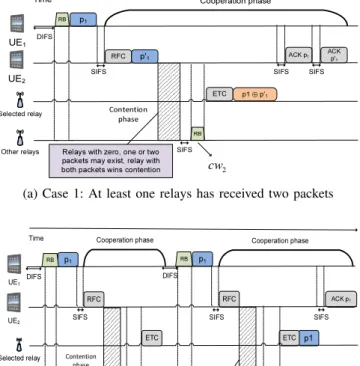
Case 1: At least one relay has received packets from both UEs. This means that the relays that have both packets p1 andp01 gain priority and ETC+(p1⊕p01) is transmitted. Thus, two ACK frames have to be sent in order to terminate the cooperation.
Case 2: Some of the relays have correctly decoded one packet only, eitherp1orp01, while others may not have received any packet. None of the relays have both packets. In this case, p01 was not sent or was not correctly received by some relays. Also, p1 was not decoded correctly by all the relays. The relay that wins channel access will transmit either ETC+p1 or ETC+p01. Only one ACK is expected and it will be sent by the receiver UE.
Case 3: None of the relays have received any packet, thus only an ETC frame will be transmitted. No ACK frame will be sent and the two UEs will contend again for access.
B. Relays’ backoff selection
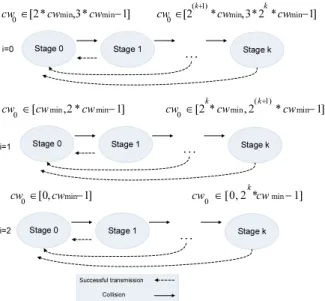
In order to prioritize retransmissions that will serve the maximum possible number of packets, relays that have over-heard the maximum number of packets should gain channel access. For the arrangement of the relay prioritization, dif-ferent non-overlapping ranges can be used for the backoff counter. The backoff range is divided into several small ranges according to the number of packets i existing in each relay. Depending on i and given cw(k) as the contention window of the current backoff stage k, each relay will select the contention window cwi∈[cwmin, cwmax]from the following
ranges, as shown in Fig. 2:
cwi∈ [2cw(k),3cw(k)−1], ifi= 0 [cw(k),2cw(k)−1], ifi= 1 [0, cw(k)−1], ifi= 2 (1)
Fig. 2: DCF backoff stages for ACNC–MAC
For example, starting with cwmin equal to 32, the backoff
values cw2 of the relays that have received two packets will be chosen randomly in [0, 31]. If a collision occurs among relays, cwmin is doubled and the values are selected from the
range [0, 63].
C. Operational examples
Having described the basic components of ACNC–MAC, let us now provide two examples that better illustrate its operation for the cases mentioned in Section III–A, considering the network topology of Fig. 1b.
In case 1 (Fig. 3a), relays with zero, one or two packets may exist simultaneously. Their contention windows are cw0, cw1 and cw2, respectively. As the relay(s) with both packets have the shortest backoff value, one of them will gain channel access and transmit the encoded packet, along with ETC. After decoding the XOR-ed packet, the two sources acknowledge the received packets.
Fig. 3b refers to cases 2 and 3. Each relay has at most one packet (p1). If both sources transmitted a packet, the packet would be eitherp1orp01. If all relays have failed to receive any packet, they enter contention phase with contention window equal tocw0. The winner sends an ETC frame only. The relays that have decoded the packet use a cw1 contention window, while the rest of them that have not decoded any packet use a cw0 contention window. The winner relay transmits ETC along with the packet it has received. The cooperation phase ends upon the reception of one ACK frame.
IV. SATURATION THROUGHPUT ANALYSIS
In this section, we present the analysis for the saturation throughput of ACNC–MAC. In saturated conditions, both sources transmit a packet at each round. The network through-put can be defined as the ratio of the expected successfully delivered payload bits E[P]and the average time for a packet to be delivered to the destination Ttotal:
S = E[P]
Ttotal
. (2)
The average packet payload E[P] is a function of the proba-bilityP1that one packet is successfully delivered at the end of
(a) Case 1: At least one relays has received two packets
(b) Case 2: Relays have received maximum one packet Fig. 3: ACNC–MAC operation examples
cooperation and the probabilityP2that packets of both sources are successfully received:
E[P] =P1s+ 2P2s, (3) where s is the payload size. The total time required for the successful reception of two source packets is defined as:
Ttotal=T2P2+T1P1+T0P0. (4)
The termTtotalis the weighted sum of three delay values that
are related to cooperation phases with different outcomes. The weights P2, P1 and P0 are the probabilities of the different numbers of packets acknowledged at the end of coop-eration and refer to the three cases mentioned in Section III-A. P2is the probability that two packets are successfully received. This case occurs when at least one relay receives two pack-ets and can encode them together. Letting Pe,(U E1↔r) and
Pe,(U E2↔r)be the packet error probabilities in the D2D links ∀r∈R, the probability that a relayr correctly receives both packets is given byPr,2= (1−Pe,(U E1↔r))(1−Pe,(U E2↔r)).
If at least one relay decodes both source packets and can perform NC, the cooperation phase ends with the reception of two ACK frames. Therefore, the probability P2 can be calculated as: P2= 1− R Y r=1 (1−(1−Pr,2)). (5) The case that one packet is received by one of the two sources occurs with probabilityP1. At least one of the relays receives
one of the two source packets and the cooperation terminates with the reception of one ACK frame. The probability that a relayrcorrectly receives exactly one packet is given byPr,1=
(1−Pe,(U E1↔r)) + (1−Pe,(U E2↔r))−2(1−Pe,(U E1↔r))(1−
Pe,(U E2↔r)). Thus,P1 can be derived by:
P1= 1− R Y r=1 (1−Pr,1) R Y r=1 (1−Pr,2). (6) P0 is the probability that no packet is received by any source finally. This event occurs when none of the relays receives any packets. As the probability that a relayr fails to receive both packets is equal toPe,(U E1↔r)Pe,(U E2↔r), the probability that
all the relays do not receive any packet is the probability that no packet is acknowledged at the end of cooperation and can be expressed as: P0= R Y r=1 Pe,(U E1↔r) R Y r=1 Pe,(U E2↔r). (7)
The aforementioned probabilities are associated with the delay values T2,T1 andT0.T2 is the average time required for the successful reception of two packets and T1 is the average time required for the successful reception of only one packet. The term T0 is the average delay of a cooperation phase that does not deliver any packet, since the relays have failed to receive any of the transmitted packets. Each of these terms comprises of two components: the minimum average delay in case of perfect synchronization of relays (contention– free cooperation phase) and the additional delay induced by the contention of the relays during the cooperation phase. These values differentiate according to the number of packets the relay transmits. Under these considerations, the average delay induced in a cooperation phase that ends with iACK frames, i∈ {0,1,2}, is:
Ti=Ti,min+Ti,cont. (8)
When no packet is acknowledged, namelyi= 0, the minimum average delay is:
T0,min=DIF S+Tp1+TRF C+Tp01+SIF S
+TET C+ 2SIF S+E[r](SIF S+TET C).
(9) Similarly, for the case that one packet only is acknowledged, i= 1, the minimum average delay of contention–free cooper-ation phase is:
T1,min=DIF S+Tp1+TRF C+Tp01+SIF S
+TET C+ 2SIF S+TACK+E[r](SIF S+TET C+Tp1).
(10) When both sources receive their desired packets the minimum average delay of the cooperation phase is equal to:
T2,min=DIF S+Tp1+TRF C+Tp01+SIF S+TET C
+ 2SIF S+ 2TACK +E[r](SIF S+TET C+Tp1⊕p01).
(11) The average delay of a cooperation phase includes also the termTi,cont, which refers to the delay due to relays contention
and is expressed as:
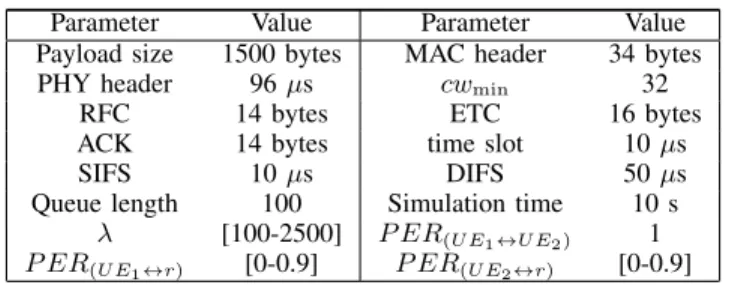
Parameter Value Parameter Value Payload size 1500 bytes MAC header 34 bytes PHY header 96µs cwmin 32
RFC 14 bytes ETC 16 bytes ACK 14 bytes time slot 10µs SIFS 10µs DIFS 50µs Queue length 100 Simulation time 10 s
λ [100-2500] P ER(U E1↔U E2) 1
P ER(U E1↔r) [0-0.9] P ER(U E2↔r) [0-0.9]
TABLE I: Simulation parameters
whereE[r]is the expected number of retransmissions, directly related with P ER(U E1↔r) andP ER(U E2↔r) [13]. The term
Tc,i corresponds to the average time required to transmit
packets during the contention phase among the relays and obtains a different value for each i, given that the number of packets a relay receives varies. Furthermore, the average backoff times selected by the relays from different ranges, according to the number of packets i they wish to transmit, changes as well. They can be estimated using the backoff counter model described in [9].
V. PERFORMANCEEVALUATION
In this section, we validate the analytical model in saturated conditions and we assess the performance of the proposed protocol in different scenarios. An event–driven C++ simulator has been developed that applies the rules of ACNC–MAC using the settings described in Section V-A. The simulation results are discussed in Section V-B.
A. Simulation Setup
We consider the topology of Fig. 1b with n = 5 and simulate the bidirectional communication of the two active UEs,U E1andU E2, aided by 5 adjacent and initially idle UEs that can be used as relays. It is assumed thatP ER(U E1↔r)=
P ER(U E2↔r) and the UEs generate packets according to
a Poisson traffic model with the same intensity λ. It is assumed that P ER(U E1↔U E2)= 1, thus a cooperation phase
is always initiated. The power level of transmission state PT
is set to 1900 mW, while for reception and idle states it is PR = PI =1340 mW. The control frames RFC, ETC
and ACK are transmitted at the rate of 6 Mb/s. Two data rate scenarios are tested, using the simulation parameters and settings of Table I. The transmission rates for the active UEs are Rs,r ={6,54} Mb/s for low and high data rate scenario,
respectively, while the relays transmit in both scenarios at a constant rate Rr,s = 54Mb/s.
For the evaluation of our MAC scheme, we compare it with a version of NCCARQ–MAC [9], modified to operate under non–saturated conditions. Upon the erroneous reception of a packet, the destination UE will send an RFC frame along with its own packet, if its queue is not empty. The relays begin contention only when they have received packets from both UEs and can perform NC.
ACNC–MAC and NCCARQ–MAC were tested in two cases: (a) in saturated conditions with variable PERs for both links and (b) using different Poisson traffic values λ ∈
[100,2500]. The performance of both schemes is evaluated in terms of the aggregated network throughput and the energy efficiency metricη [14].
B. Simulation Results
Figure 4(a) shows the throughput performance for the first test case with regard to different PERs considering two differ-ent data rate scenarios. As observed, the simulation and theo-retical results for throughput performance match, thus verify-ing the proposed throughput analysis for saturated conditions. ACNC–MAC achieves better performance than NCCARQ– MAC, as it better exploits cooperation opportunities by serving at least one packet per communication round. For PERs in [0, 0.5], ACNC–MAC achieves an improvement up to 71% and
73% in low and high data rate scenario, respectively.
In Fig. 4(b), the energy performance in the first test case is depicted. It is obvious that the energy efficiency curves are similar to throughput curves, as expected. As PER increases, more retransmissions are required in order to correctly deliver each packet, thus the energy efficiency for each successful packet transmission reduces. ACNC–MAC performs better than NCCARQ–MAC in both data rate scenarios for all PER values. More useful bits are delivered under the same energy consumption, as ACNC–MAC allows for relays retransmis-sions, even when NC is not possible. In each cooperation round of NCCARQ–MAC, either two packets are delivered or none. The gain of ACNC–MAC is higher when high data rates are used, reaching a71% increase for PER=0.3.
In Fig. 4(c), the throughput performance for the second test case is presented. For lower traffic intensity, namely λ <300, the gains of NC are not fully exploited, due to scarce packet arrivals. Instead, as traffic in source increases, NC possibility becomes higher leading to a throughput increase. ACNC–MAC achieves throughput gains up to41% in low rate scenario and up to 38%in high rate scenario, for λin [900, 2300].
Figure 4(d) shows the performance in terms of energy efficiency for the second test case. Notably, for ACNC–MAC the energy efficiency is higher than NCCARQ–MAC in both data rate scenarios. For high data rate the energy energy efficiency is 32−39% higher, when ACNC–MAC is used. As for the low rate scenario, both schemes’ energy efficiency deteriorates. Still, with ACNC–MAC the energy efficiency is almost doubled comparing to NCCARQ–MAC.
It is also worth pointing out that throughput and energy efficiency plots exhibit a similar behavior in case of saturated conditions, whereas they differentiate when varied traffic val-ues are used. Moreover, as traffic intensity increases, the en-ergy efficiency remains at the same levels. These observations can be explained by the fact that, for small λ, fewer packets are delivered and more idle slots exist, while for higherλmore packets are delivered but the energy efficiency is similar, since less idle slots exist but more packet receptions occur, given that PR=PI.
VI. CONCLUSIONS
In this paper, a new NC–based cooperative MAC protocol (ACNC–MAC) for outband D2D communication has been presented. ACNC–MAC allows the exploitation of idle UEs with the aim of helping the bidirectional communication of neighboring UEs. The conducted simulations have illustrated that ACNC–MAC is beneficial in terms of both throughput and energy efficiency, mainly in saturation and high traffic cases and particularly when high data rates are used. In our future work, we plan to design analytical models for the non-saturation case and study the impact of the cellular links on the D2D communication.
(a) Total throughput in saturation (b) Energy efficiency in saturation
(c) Total throughput for variousλand PER=0 (d) Energy efficiency for variousλand PER=0
Fig. 4: ACNC–MAC performance results
ACKNOWLEDGEMENT
This work has been funded by the Research Projects ENIAC-ESEE (324284) and Artemis-CopCams (332913).
REFERENCES
[1] A. Laya, Kun W., A. Widaa, J. Alonso-Zarate, J. Markendahl, and L. Alonso, “Device-to-device communications and small cells: enabling spectrum reuse for dense networks,” IEEE Wireless Communications, vol. 21, no. 4, pp. 98–105, Aug. 2014.
[2] A. Antonopoulos, E. Kartsakli, and C. Verikoukis, “Game Theoretic D2D Content Dissemination in 4G Cellular Networks,” IEEE Commu-nications Magazine, vol. 52, no. 6, pp. 125–132, June 2014. [3] M. Katz, F. Fitzek, D. Lucani, and P. Seeling, “Mobile Clouds as
the Building Blocks of Shareconomy: Sharing Resources Locally and Widely,”IEEE Vehicular Technology Magazine, vol. 9, no. 3, pp. 63–71, Sept. 2014.
[4] F. H. P. Fitzek, J. Heide, M.V. Pedersen, and M. Katz, “Implementation of Network Coding for Social Mobile Clouds [Applications Corner],”
IEEE Signal Processing Magazine, vol. 30, no. 1, pp. 159–164, Jan. 2013.
[5] “IEEE Standard for Information technology–Telecommunications and information exchange between systems, local and metropolitan area networks–Specific requirements Part 11: Wireless LAN Medium Access Control (MAC) and Physical Layer (PHY) Specifications,” IEEE Std 802.11-2012 (Revision of IEEE Std 802.11-2007), pp. 1–2793, March 2012.
[6] R.A. Khan and H. Karl, “MAC protocols for Cooperative Diversity in Wireless LANs and Wireless Sensor Networks,”IEEE Communications Surveys & Tutorials, vol. 16, no. 1, pp. 46–63, First Quarter 2014. [7] R. Ahlswede, C. Ning, S.-Y.R. Li, and R.W. Yeung, “Network
Information Flow,”IEEE Transactions on Information Theory, vol. 46, no. 4, pp. 1204–1216, Jul. 2000.
[8] S. Katti, H. Rahul, W. Hu, D. Katabi, M. M´edard, and J. Crowcroft, “XORs in the Air: Practical Wireless Network Coding,” SIGCOMM Comput. Commun. Rev., vol. 36, no. 4, pp. 243–254, Aug. 2006. [9] A. Antonopoulos, C. Verikoukis, C. Skianis, and O. B. Akan, “Energy
efficient network coding-based MAC for cooperative ARQ wireless networks,” Ad Hoc Networks, vol. 11, no. 1, pp. 190 – 200, 2013. [10] J. Zhang, Y. P. Chen, and I. Marsic, “MAC-layer Proactive Mixing for
Network Coding in Multi-hop Wireless Networks,”Computer Networks, vol. 54, no. 2, pp. 196 – 207, 2010.
[11] A. Munari, F. Rossetto, and M. Zorzi, “Phoenix: making cooperation more efficient through network coding in wireless networks,” IEEE Transactions on Wireless Communications, vol. 8, no. 10, pp. 5248– 5258, Oct. 2009.
[12] X. Wang and J. Li, “Network Coding Aware Cooperative MAC Protocol for Wireless Ad Hoc Networks,” IEEE Transactions on Parallel and Distributed Systems, pp. 167–179, Jan. 2014.
[13] G. Cocco, D. Gunduz, and C. Ibars, “Throughput Analysis in Asym-metric Two-Way Relay Channel with Random Access,” in IEEE International Conference on Communications (ICC), June 2011, pp. 1–6.
[14] V. Rodoplu and T.H. Meng, “Bits-per-Joule Capacity of Energy-Limited Wireless Networks,” IEEE Transactions on Wireless Communications, vol. 6, no. 3, March 2007.