Annales UMCS Informatica AI 5 (2006) 441-452
Annales UMCS
Informatica
Lublin-Polonia Sectio AI http://www.annales.umcs.lublin.pl/Intelligent Tutorial System LISE
Barbara Goc
ł
owska
*, Zdzis
ł
aw
Ł
ojewski
Institute of Computer Science, Maria Curie-Sklodowska University,Pl. M.Curie-Skłodowskiej 1, 20-031 Lublin, Poland Abstract
Development of information technology results in creation of more and more advanced teaching assisting systems. The authors of the article made an attempt to design and use the adaptative educational system based on the technologies: J2EE, JSF and XML. Unlike most hitherto solutions, the authors propose a three-tier architecture of the system and its improvement with additional functionalities.
1. Introduction
In search for effective methods of conveying contents, the handbooks, meeting the needs, perception possibilities, rate of user’s learning and even field of knowledge started a few years ago. According to Brusilovsky [1], they are an alternative to traditional teaching enabling individualization by adjusting the system to goals, preferences and knowledge of each individual user.
In its simplest form [2-6], the system doses small portions of knowledge checking the user’s progress from time to time. Depending on the results, it provides next modulus of knowledge or moves to the pages which according to the tutor’s model, have not been mastered. If the effects of the sample are not correct or optimal, the system starts to assist the learner in searching for error sources. If it is necessary, the student can observe again the expert’s attitude in this task. As the renewed observations result from a question asked by a learner, acquiring their details increases many times [7].
Teaching contents are represented in the form of semantic network (basic technique of knowledge representation). The smallest portions of knowledge (units or modules) are connected with edges of semantic network graphs. If the relations are explicitly marked by connections in the graph, the inference algorithm can be active passing according to connections (model situation). If it is not the case, the Bool rules are applied. The system must know what
*Corresponding author: e-mail address: [email protected]
knowledge it possesses, control the knowledge state of the user searching an optimal path for him and use the adequate system of requesting [3].
Most Intelligent Tutorial Systems described in literature [2-6] are based on the rule of enquiry (starting rules, serving questions depending on the obtained answers, returning the answers with a commentary on fragmentary results, rules for student’s work, final rules). Some of the created systems [2] are implemented in distance learning platforms. In these cases they can be treated as perfect supplement for e-learning platforms.
A good evidence for such procedure is the method used by the EVA system creators [8]. Guzman and Nunez-Esquer make a synchronic educational plan (throw the distance learning platform: TV lectures, teleconferences, on-line questions and answers, chats) for each student. Moreover, they group pupils into classes and the selection criterion is: similar educational trajectory, close geographical area. Besides synchronic learning, students can learn using individual ways, purchasing books, listening to lectures, studying during classes, asking tutors, training using the computer.
The results of research carried out by [2] confirm rightness of this approach. Independent of the attempts of this kind implementation, one should consider how to improve effectiveness of the created tutor system. According to many authors, among others [9], choice of contents is the most essential. The success of teaching process in the Intelligent Tutorial System depends on the way it presents field of knowledge to the learner and the change of presentation way (progress and extent of difficulties) according to the progress of the learner [10]. For example: animations according to [9] are appropriate to direct teaching, simulations to cognitive learning and diagrams to teaching in the decision making process.
ITS should adjust the teaching material for an individual student (considering knowledge and abilities) in an optimal way. It should provide the student with the information about his achievements in learning, error diagnosis, directions and tips (what and how to learn or revise). Learning proceeds through the interaction with the expert called tutor. As a result, for a student the server behaves like a real tutor (teacher) in the area of teaching methods and conducting lessons [11].
In the case of most IT’S e.g. EVA (called by its creators “polybooks”) – at the start of the system diagnose the individual knowledge of students and based on the results they determine learning trajectory for each student.
According to many authors [13,14], the system construction and even relations e.g. between the kind of navigation and the field of knowledge are the factors determining effectiveness of the applied systems. The others e.g. Witkin [15] state that in the case of abstract content acquisition, a non-linear or mixed style of learning is most frequently chosen which allows for free gaits over the
pages chosen by the student (Field Independent). It can be compared to the studies by the mature reader contrary to reading a chapter from cover to cover.
While studying the text, the reader tries to find broadening of unclear or understanding of the read contents impossible. During such learning books, encyclopaedias are in use and notes are made. This is consistent with cognitive approach to teaching which is the basis of the adaptative educational system.
2. Preliminary assumptions
Nonlinear learning of the contents in the electronic form is conducted through hyperlinks made accessible by the author. This creates additional possibilities of preparing a “friendly” text for a reader [1]. In our opinion all these factors play a significant role. However, designing the system one can not concentrate only on one or two aspects. They must be treated as a whole. Therefore in our system we accepted the following assumptions:
– different rule engine should be applied depending on the field of knowledge (field causing difficulties in proper understanding of the text and that in which it is sufficient „to learn”),
– the most essential feature of the system is a proper construction of content. Therefore we propose to elaborate a redactor’s model projecting reports based on the graph-matrix analysis concerning the errors made by the authors. This will allow to diagnose the authors’ errors and thus to correct their quality. This stage of work is in the sphere of a project,
– a main disadvantage of many ITS is application of typical navigation which demobilizes the user on account of monotony of a learning scheme. If a student achieves a score below a required standard of correctness, then after the attempts of error discussion the system sends the student to the beginning of the paragraph,
– effective solution of “dull navigation” problem is, in our opinion, introducing additional elements “breaking” this scheme: chatboot (called Expert by us [17] and programmed teaching module [18] applied in the fields causing difficulties in understanding text e.g. in physics or in others, – choice of learning path can be assisted [19] as in many known systems
using suitable heuristics.
3. LISE – Lubelian Intelligent System of Education
The authors of this article made an attempt to prepare and apply The Tutorial System LISE. Its main elements are: student model and tutor model. The novelty of the LISE system is introducing author, redactor, editor and expert models.
Redactor model can be compared with others analyzing frequency of failures in doing control tests of individual paragraphs compared with all the others. The
detailed analysis of the errors made by students will allow to diagnose the cause of failures.
The author’s model is composed of the results obtained by the system users including first of all deviations from the average (number of atypical repetitions, comparison of points scored in courses elaborated by various authors and in individual units or paragraphs).
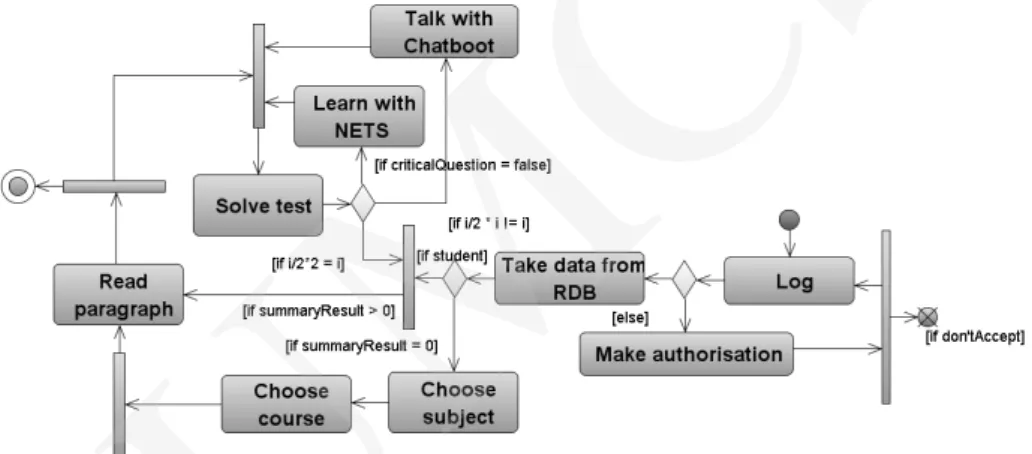
From the user’s point of view, the student session is the most interesting. Fig. 1 shows the diagram of system user activities. Typical session starts at the moment of user’s logging.
Fig. 1. Activity diagram of LISE LoginPage
In the case of logging process success (data of logging user are compared with those stored in the database), the user is sent to the last consumed paragraph. The information about the current point of learning is taken from the table CurrentLog. This refers to the situation when the system user is a student. If logging takes place for the first time, the authorisation by the user is necessary, Then ready made converters and validators supplied along with JSF technology are made use of in this process.
StudentPage
Learning stars in the same way as in a common handbook with an introduction into a given paragraph. Successive units corresponding to chapters and being a name like in many other ITS units form a small closed whole. A student does not have many possibilities in choice of individual units if he reads them for the first time. If reading takes place another time, then a student can choose which unit belonging to a given paragraph he wants to read.
PartTestPage
Each paragraph ends with a control test. The obtained results are decisive about further educational path. In the first test version of LISE simple rules were applied (figure above): if a student solved 51% of test questions correctly and did not come across a critical question or handled it, then he moves to the next paragraph. When the user comes across a critical question and gives an erroneous answer, the student is sent to the Nonlinear Education Tutoring System – NETS (in the test version, this module is not ready yet).
ExpertPage
The experience the authors gained from LISE, studying the test lesson units of various tutor systems disclosed monotony of frequent reading of the same units in the case of test solving failure. Therefore the Chatboot module breaking the system monotony [17] was introduced. The Expert module in its essential and attractive form having a dialogue with the user resembles the most essential fragments of knowledge contained in the paragraph. At the time being we accepted the rule that in the case of even failures during the part test solving, a student has dialogue with the Expert and during the odd ones he reads the paragraph content again.
NETSPage
The NETS module will be mainly used in a physics course, in other courses only when the student’s problems will be connected with the lack of understanding of teaching contents but not difficulties with their memorizing. The question which is called by the authors LISE uncovers existence of preconceptions or misconceptions and therefore requires firstly disclosure of the way of user’s reasoning and secondly being aware of errors and finally correct on of explanation of the problem. This is achieved through programmed teaching whose essential part are tasks- problems.
EndTestPage
The activity of rule engine is most evident during the action preparing the student for a final examination. This role is played by the unit EndTest. In this stage of learning Student Model subjects test questions choice to many factors: number of “failed” tests, time of solving tests, effects of talks chatboot, weight of test questions and thus functionality of concepts referring to corresponding graph concepts. As in many other ITS, the final test draws a larger number of questions from the paragraphs causing the most problems during their learning with a special emphasis on those characterized by a large weight coefficient.
Model Tutor is responsible for student monitoring. Analyzing the notation in the table CurrentLog, it uses the rules allowing for the optimal choice of learning path. The next version of the LISE system is going to have two levels of difficulties which will be chosen in the course owing to application of neuron network. The authors hope that moving a student from one level to another in the course of learning, on one hand will allow to avoid student’s discouragement with too easy handbook (dull and overloaded explanations) and on the other hand will protect from too brief introduction of new contents if it proves that a student possesses sufficient preliminary knowledge to go at least through some paragraphs at a faster rate.
4. Model of a basic paragraph
Adaptative systems are an alternative to traditional teaching allowing for individualization by adjusting to aims, preferences and knowledge of each individual user. The model must possess tools for acquiring and diagnosing students’ knowledge. Based on the results, “learning trajectory” is determined for each student.
The model of adaptative educational platform is based on well formulated division into knowledge units (paragraphs) whose aim is to draw near a certain defined store of concepts.
Each unit of knowledge can possess a few crucial interrelated problems.
In a simple model the paragraph
L
kis defined as follows:
(
, , , , , , , , ,)
k k k k k k ki k k k L ≡ FP P Q E N T T wL mL E ,where: FPk – the collection of multimedial materials concerning a given lesson
(e.g. Fragments of text, graphics, sound, video, etc.,), Pk – the collection of
concepts in a given lesson unit, Qk – the collection of questions related to the
lesson unit Lk arranged into a suitable type groups of guiding tests, Ek – the
„expert”, assisting chatboot having a dialogue with the participant and allowing currently to remove found concept failures, Nk – the programmable teaching
module, Tki – the mini-test, (related to a single concept, Ti – the basic test, for
navigation between lessons, E – the predictor determining the individual learning path of information from previous lessons as well as the results of mini-tests, tests and information about student’s activity, wLK – the lesson weight,
wLK∈ (0,1), mLki – the minimal admissible level of knowledge, mLki∈ (-1,1).
The model is based on two kinds of tests: mini – tests Tki, to be used by the
Expert and NETS modules and the basic test Tkfor navigation between lessons.
The additional tool is Chatboot Ek allowing to make the platform more friendly
for the user by introduction of elements of dialogue with the user when there is need for filling found knowledge gaps.
Collection, measurement and diagnosis of knowledge based on the above tools determine “learning trajectory” for each student. A perfect tool for
automatic collection and classification of knowledge about a participant are artificial neuron networks.
The tutorial system will include separated components (neuron network and simple expert system) which will be used to analyse the participant’s knowledge.
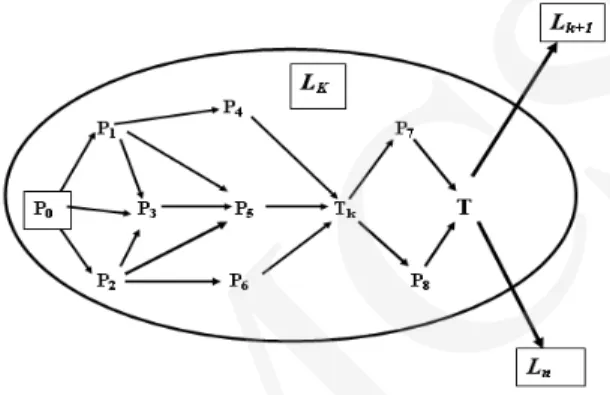
Fig. 2. Schematic structure of typical lesson module Lk
The simplest form of the network is the Perceptron type network of n entrances representing n-dimensional, binary vector of knowledge about a participant and m-dimensional exit for classification or discovery of rules for the expert system. Network teaching consists in a multiple supply of correct models of significant interest for us. The integrated expert-neuron system can solve the problem of acquisition of knowledge about participant e.g. from tests, log recording, time measurement, participant activity, etc. and then it is applied for formation of individual teaching path for each participant. Figure 2 shows a scheme of typical lesson module structure Lk.
5. Technology
The platform J2EE used by us makes accessible a multitier application model for components management.
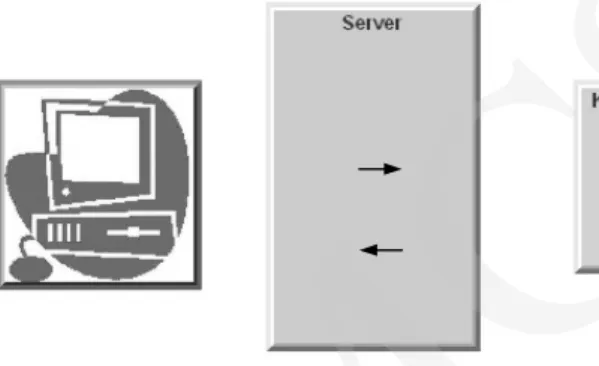
Elaborating the system LISE, the authors of the paper based on the three-tier model (client, server, database, Fig.3). The server J2EE is responsible for both management and collaboration of components as well as safety transactions, onomatology, both local and distant connections while using the JSF and EJB technologies.
Effective management requires precise defining of rules, privileges, types of transaction and determining accessibility of produced methods. Both JSF [20] based on Java Servlet and Java Server Pages and EJB extend these possibilities providing the own, handy tools.
One of them is the way of communication with the database. Access to durable resources can be obtained by means of the object CaschedRowSet and
auxiliary components JavaBean. Depending on the role the JSF components play in application, they implement the interfaces AbstractSessionBean, AbstractPageBean, etc, from the package com.sun.jsfel.app. – FacesBean respectively [21].
Fig. 3. Architecture of the tutorial system LISE
The environment in which we prepared the test version of the system LISE render the configured source of data accessible using the object CachedRowSet which allows to rewind acquired topicality and makes series of database records. It serves for buffering the data connected with the database only during generating topical methods, recording or reading the data. Such a solution has a positive effect on application action rate.
One of the most essential decisions choosing J2EE or at present JEE technology was about collection data and manipulation on those stored in the knowledge base (mainly in the database). The choice was made between EJB and JSF technologies.
Both technologies allow to make enquiries into the object in the database. Thought over unrelated keys location in the database tables allows to merge fields and sort the data in the most convenient way for the system needs. Both technologies provide this possibility. They also assist convenient definition of user’s roles and his or her access to the data and the generated methods.
However, Java Server Faces technology provides additional possibility of easy connection of data with the graphic components which was decisive in choice of this technology. However, only additional tests (e.g. method generation rate, stability or calibration studies) will allow to confirm or deny the choice rightness. The functions intermediary between a graphic component and the JDBC technology are performed by DataProvider.
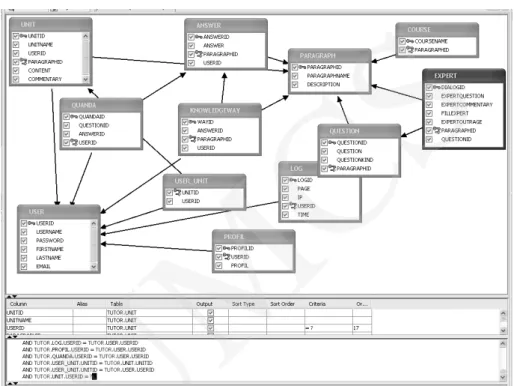
Figure 4 is the example of organization of base fragment of the data Tutor created for the needs of LISE system. To make datasteering flexible and to allow to use object enquiries, we located a few unrelated keys in the presented tables.
JSF technology similar to EJB allows to use the simple language, Query Language to make enquiries.
Fig. 4. Exemplary application of „data administrator” and QL language to manipulate on records and tables of datatable
To project e.g. the contents or title of the unit on the page StudentBean database tables are collected using the method Plug and Play (this possibility is provided by the environment Creator 2) and connected with the graphic component which is to be used for data presentation.
At this moment the environment generates the object CachedRowSet (method init()) in the session pool. This object will be directly connected with the knowledge base. The code of generated component in Session Beans looks as follows:
// code generated in the component SessionBean private void _init() throws Exception {
unitRowSet.setDataSourceName("java:comp/env/jdbc/tutor"); unitRowSet.setCommand("SELECT * FROM TUTOR.UNIT");
unitRowSet.setTableName("UNIT"); }
//there is created an object and its accessory
private CachedRowSetXImpl unitRowSet = new CachedRowSetXImpl(); public CachedRowSetXImpl getUnitRowSet() {
return unitRowSet;
}
public void setUnitRowSet(CachedRowSetXImpl crsxi) { this.unitRowSet = crsxi;
}
In turn, the effect of graphic component connection is creation of a method initiating formation of suitable object DataProvider in the component StudentBean.
private void _init() throws Exception {
unitDataProvider.setCachedRowSet((javax.sql.CachedRowSet) getValue("#{SessionBean1.unitRowSet}"));
}
Rendering the data for the user takes place in the prerender() method and in that connected with the user’s action e.g. pressing the hyperlink or acceptance with a push. A suitable code is given below:
private void prerender() {
try {
getSessionBean1().getUnitRowSet().setObject(17, getSessionBean1.getUnitId())(;
} catch (Exception ex) {
error("It is not possible to read UnitTitle " +
getSessionBean1().getUnitTitle() + ": " + ex.getMessage());
log(("It is not possible to read UnitTitle " + getSessionBean1().getUnitTitle() + ": ", ex);
} }
public String nextButton_action() {
getSessionBean1().getUnitRowSet().cursorNext();
return null;
}
Conclusions
Intelligent Tutorial System LISE is an attempt to extend functionalities encountered so far in the applications of this type.
In particular, there are introduced additional agents, whose task is to individualize the learning process and to adjust to user’s preferences and needs.
Innovatory solutions are the modules Expert and NETS.
The module Expert is a kind of specialized chatboot whose task is supplementing (in the absorbing way by having an “intelligent” dialogue with users) part gaps of knowledge. This module can work in every stage of the system LISE, being an essential extension of its functionality.
The module NETS is used only in some courses, when a given part of material creates conceptual difficulties.
Another problem are technologies used for creating the platform LISE. The authors assumed that platform functionality can be significantly improved only when application is based on modern technologies J2EE.
Due to difficulties of many former creators of ITS systems resulting from basing only on the servlet technologies JSP and HTML, the authors of LISE decided to use the most modern technologies assisting multitier architectures and authorization system (JASS, JSE, XML, EJB).
Further plans connected with the system LISE predict:
– research on effect of Expert and NETS modules application on the system effectiveness,
– introduction of REDACTOR model,
– use of neuron network in order to optimize learning trajectory,
– research on information flow rate using various information technologies.
References
[1] Brusilovsky P., Adaptive navigation support in educational hypermedia: the role of student knowledge level and the case for meta-adaptation, British Journal of Educational Technology, 34(4) (2003) 487.
[2] Cheung B., Hui L., Zhang J., Yiu S., M., Smart tutor: An Intelligent tutoring system in web-based adult education, Journal of Systems and Softwares, 68 (2003) 11.
[3] Devedzic V., Key Issues in next-Generation Web-Based Education, IDEE Transactions on systems, Man, Add Cybernetics- Part C: Applications and Reviews, 33(3) (2003).
[4] Ford M., Billington D., Strategies in human nonmonotonic reasoning, Computational Intelligence, 16(3) (2000) 446.
[5] Andre E., Rist T., Muller J., WebPersona: A Life-Like Presentation Agent for Educational Applications on the World-Wide Web, Proceedings of the workshop “Intelligent Educational Systems on the World Wide Web”, 8th World Conference of the AIED Society, Kobe, Japan,
18-22 August 1997.
[6] Jarvis M., Nuzzo-Jones G., Heffernan N., Applying Machine Learning Techniques to Rule Generation in Intelligent Tutoring Systems, source from CTAT page
[7] Colins A., Brown J.S., Newman, S.E., Cognitive Apprenticeship: Teaching the crafts of reading, writing and mathematics, Knowing, learning and Instruction (Ed. L. B. Resnick) Hillsdale, NJ: Lawrance Erlbaum Associates, (1989) 453.
[8] Guzman A., Nunez-Esquer G., Virtual Learning spaces in distance education: tools for the EVA project, Expert Systems and Applications, 15 (1998) 205.
[9] Patel A., Russell D., An initial Framework of Contexts for Designing usable Intelligent Tutoring Systems, Information Services and Use, 18(1-2) (1998) 65.
[10] Kinshuk, Lin T., Yang A., Patel A., Plugable intelligent tutoring and authoring: An integrated approach to problem-based learning, International Journal of Continuing Engineering Education and Life-Long Learning, 13 (1/2) (2003).
[11] Devedzic V., B., Key Issues in Next-Generation Web-Based Education, IEE Transactions on Systems, Man, and Cybernetics-Part C: Applications and Reviews, 33(3) (2000).
[12] Devedzic V., B., Harrer A., Software Patterns in ITS Architectures, International Journal of Artificial Intelligence in Education (IJAIED), 15(2) (2005).
[13] Lebow D., Constructivist values for instructional systems design: five principles toward a new mindset, Educational Technology Research and Development, 41(3) (1993) 4.
[14] Paterno F., Mancini C., Designing web interfaces adaptaable to different types of use, Paper presented at Museums and the Web 99,
(http://www.archimuse.com/mw99/papers/ paterno/paternp.html)
[15] Witkin H.A., Moore C.A., Goodenough D.R., Cox P.W., Field – dependent and field independent cognitive styles and their educational implications, Rewiew of Educational review, 47(1) (1977) 1.
[16] Chen S., A cognitive model for non-linear learning in hypermedia programmers, British Journal of Educational Technology, 33(4) (2002) 449.
[17] Gocłowska B.,Łojewski Z., Technologies Java Server Faces and Java Bean in application Ekspert, Annales UMCS, Informatica 2006, submitted.
[18] Gocłowska B., How to affect to conceptual changes?, Fourth European Symposium on Conceptual Change, Philosophical, Historical, Psychological and Educational Approaches, Delphi Greece, May 19-23, 2004, (2004) 162.
[19] Simic G., Devedzic V., Building an intelligent system using modern Internet technologies, expert systems with Applications, article in press, (2005).
[20] Geary D., Horstmann C., Core Java Server Faces, Java 2Platform, Enterprise Edition, Prentice Hall PTR, Upper Saddle River, Sun, (2004) 658.
[21] Geary D., A first look at Java Server Faces, Part 2, Explore Java Server components, Java World, (2002) 12.