HAL Id: tel-02392255
https://hal.archives-ouvertes.fr/tel-02392255
Submitted on 4 Dec 2019HAL is a multi-disciplinary open access archive for the deposit and dissemination of sci-entific research documents, whether they are pub-lished or not. The documents may come from teaching and research institutions in France or abroad, or from public or private research centers.
L’archive ouverte pluridisciplinaire HAL, est destinée au dépôt et à la diffusion de documents scientifiques de niveau recherche, publiés ou non, émanant des établissements d’enseignement et de recherche français ou étrangers, des laboratoires publics ou privés.
Efficient motion analysis and virtual reality methods for
preventive and corrective ergonomics
Charles Pontonnier
To cite this version:
Charles Pontonnier. Efficient motion analysis and virtual reality methods for preventive and corrective ergonomics. Biomechanics [physics.med-ph]. ENS Rennes, 2019. �tel-02392255�
HABILITAT
ION A DIR
IG
ER DE
S
RECHER
C
HES
Présentée devant :
L’Ecole Normale Supérieure de Rennes
Par :
Charles Pontonnier
Titre :
Efficient motion analysis and virtual reality
methods for preventive and corrective
ergonomics
Soutenue le 29 novembre 2019 devant le jury composé de :
Pr. Valentina Camomilla, Bohnes Institute, Rome
Dr. Damien Chablat, CNRS, Nantes
Pr. Laurence Cheze, Université de Lyon 1, Lyon
Pr. Georges Dumont, ENS Rennes, Rennes
Pr. Frédéric Noël, INP, Grenoble
Dr. André Plamondon, Institut de recherche Robert Sauvé en
Santé et Sécurité au travail, Montréal
Pr. Nasser Rezzoug, université de Toulon, Toulon
1 CONTENTS
CURRICULUM VITAE PAGE 2
RESEARCH ACTIVITY REPORT PAGE 14
Chapter 1 – Introduction Page 15
Research context ... 16
Research objectives and challenges ... 18
Document overview ... 21
Main contributions ... 21
Chapter 2 – Efficient musculoskeletal simulation for ergonomics Page 24 Introduction ... 25
Topic 1: Efficient muscle forces estimation... 28
Topic 2: Efficient scaling ... 34
Topic 3: Musculoskeletal simulation in industrial conditions ... 41
Topic 4: Integrative approach ... 50
Conclusion ... 52
Chapter 3 – Efficient virtual reality for ergonomics Page 54 Introduction ... 55
Topic 1: Biomechanical fidelity of virtual environments ... 57
Topic 2: Collaborative virtual environments for ergonomics ... 67
Conclusion ... 74
Chapter 4 – Perspectives Page 75 Introduction ... 76
Evolving industrial work conditions: 4.0 industry ... 76
Topic 1: Evaluating assistive devices and their impact on workers health ... 77
Topic 2: Simplifying the evaluation ... 79
Topic 3: Integrating ... 82
Conclusion ... 83
2
3 CHARLES PONTONNIER
Born on September 24th, 1980 in Sablé sur Sarthe (France)
2 children EDUCATION
2010 PhD degree from the University of Rennes 1, France, def. on Nov. 12, 2010.
“Mechanical simulation for an ergonomic analysis of the workstations: elbow and forearm case” PhD advisor: Georges Dumont, Professor, Ecole Normale Supérieure de Rennes
Examiners panel: Laurence Chèze (Professor, Lyon University) and Eric Berthon (Professor, Marseille University), Mark De Zee (Associate Professor, Aalborg University (Denmark)), Damien Chablat (CNRS researcher, Nantes), Bruno Arnaldi (Professor, INSA Rennes)
2007 “Agrégation” (Industrial Sciences – Mechanics), secondary teaching qualifications, Ecole Normale Supérieure de Rennes
2004 Postgraduate degree (Advanced control), INSA engineering school, Toulouse, France. Master
thesis topic: “Design and control of an assistive miction robot actuated by artificial muscles”.
2003 Engineering Degree (mechanics and control), INSA engineer school, Rennes, France
WORK EXPERIENCE & TRAINING 2018 – today
1 year Associate professor at ENS RENNES, MimeTIC team. Topic: Musculoskeletal simulation and VR tools for ergonomics 2012 – 2018
6 years Associate professor at Ecoles de Saint-Cyr Coëtquidan (in secondment of ENS Rennes), MimeTIC team. Topic: Musculoskeletal simulation and VR tools for ergonomics
2011 – 2012
1 year Temporary assistant professor at ENS RENNES, MimeTIC team. Topic: Biomechanical fidelity of VR environments for ergonomics
2010 – 2011
1 year Post-doctoral fellowship at Aalborg University, under the supervision of Pascal Madeleine (Professor) and Mark de Zee (Assistant professor). Topic: Musculoskeletal simulation for meat cutting tasks analysis
2007 – 2010
3 years PhD preparation at the IRISA lab in Rennes, France.
2005 – 2007
4 2004 – 2005
1 year Industrial worker, Postman (career break).
2004
6 months M.Sc preparation Systèmes), now integrated in LAAS-CNRS lab. at LATTIS (Laboratoire Toulousain de Technologie et d’Ingénierie des 2003
6 months Engineer training at Comau Systèmes France (now, Comau France). Topic: Characterization and optimization of a robotic car seat assembly process
PUBLICATIONS
JOURNAL PUBLICATIONS
• Pontonnier, C., & Dumont, G. (2009). Inverse dynamics method using optimization techniques for the estimation of muscles forces involved in the elbow motion. International Journal on Interactive Design and Manufacturing (IJIDeM), 3(4), 227.
• Pontonnier, C., & Dumont, G. (2010). From motion capture to muscle forces in the human elbow aimed at improving the ergonomics of workstations. Virtual and Physical prototyping, 5(3), 113-122.
• Pontonnier, C., Samani, A., Badawi, M., Madeleine, P., & Dumont, G. (2014). Assessing the ability of a vr-based assembly task simulation to evaluate physical risk factors. IEEE transactions on visualization and computer graphics, 20(5), 664-674.
• Pontonnier, C., De Zee, M., Samani, A., Dumont, G., & Madeleine, P. (2014). Strengths and limitations of a musculoskeletal model for an analysis of simulated meat cutting tasks. Applied ergonomics, 45(3), 592-600.
• Pontonnier, C., Dumont, G., Samani, A., Madeleine, P., & Badawi, M. (2014). Designing and evaluating a workstation in real and virtual environment: toward virtual reality based ergonomic design sessions. Journal on Multimodal User Interfaces, 8(2), 199-208.
• Grenier, D., Kerbrat, O., Le Bourhis, F., & Pontonnier, C. (2014). Contribution à la pédagogie par projet : retour d'expérience en conception de systèmes mécatroniques à l'ENS Rennes. La revue 3EI, 76, 1-8.
• Samani, A., Pontonnier, C., Dumont, G., & Madeleine, P. (2015). Shoulder kinematics and spatial pattern of trapezius electromyographic activity in real and virtual environments. PLOS one, 10(3), e0116211.
• Nguyen, H., Pontonnier, C., Hilt, S., Duval, T., & Dumont, G. (2017). VR-based operating modes and metaphors for collaborative ergonomic design of industrial workstations. Journal on Multimodal User Interfaces, 11(1), 97-111.
• Muller, A., Pontonnier, C., & Dumont, G. (2017). Uncertainty propagation in multibody human model dynamics. Multibody System Dynamics, 40(2), 177-192.
• Cruz Ruiz, A. L., Pontonnier, C., Pronost, N., & Dumont, G. (2017). Muscle‐Based Control for Character Animation. Computer Graphics Forum 6(6), 122-147.
• Cruz Ruiz, A. L., Pontonnier, C., & Dumont, G. (2017). Low-Dimensional Motor Control Representations in Throwing Motions. Applied Bionics and Biomechanics, 1-26.
• Plantard, P., Muller, A., Pontonnier, C., Dumont, G., Shum, H. P., & Multon, F. (2017). Inverse dynamics based on occlusion-resistant Kinect data: Is it usable for ergonomics?. International Journal of Industrial Ergonomics, 61, 71-80.
5
• Cruz Ruiz, A. L., Pontonnier, C., Levy, J., & Dumont, G. (2017). A synergy‐based control solution for overactuated characters: Application to throwing. Computer Animation and Virtual Worlds, 28(6).
• Muller, A., Pontonnier, C., & Dumont, G. (2018). The MusIC method: a fast and quasi-optimal solution to the muscle forces estimation problem. Computer methods in biomechanics and biomedical engineering, 21(2), 149-160.
• Muller, A., Pontonnier, C., & Dumont, G. (2018). MusIC method enhancement by a sensitivity study of its performance: application to a lower limbs musculoskeletal model. Computer Methods in Biomechanics and Biomedical Engineering.
• Muller, A., Pontonnier, C., Puchaud P. & Dumont, G. (2019). CusToM: a Matlab toolbox for musculoskeletal simulation. Journal of Open Source Software 4.33: 1-3.
• Haering, D., Pontonnier, C., Bideau, N., Nicolas, G., Dumont, G. (2019). Using torque-angle and torque-velocity models to characterize elbow mechanical function: Modelling and applied aspects. Journal of Biomechanical Engineering
• Muller, A., Pontonnier, C., & Dumont, G. (2019). Motion-based prediction of hands and feet contact efforts during asymmetric handling tasks. IEEE Transactions on Biomedical Engineering.
• Sorel, A., Plantard, P., Bideau, N., & Pontonnier, C. (2019). Studying fencing lunge accuracy and response time in uncertain conditions with an innovative simulator. PLOS one.
• Muller, A., Pontonnier, C., Robert-Lachaine, X., Dumont, G. & Plamondon, A. (2019). Motion-based prediction of external forces and moments and back loading during manual material handling tasks. Applied Ergonomics.
CONFERENCE PROCEEDINGS (PEER REVIEWED)
• Pontonnier, C., & Dumont, G. (2008). From motion capture to muscle forces in human elbow aiming at improving ergonomics of working stations. In Virtual Concept 2008 & IDMME 2008 (pp. 8-pages).
• Pontonnier, C., & Dumont, G. (2009). Motion analysis of the arm based on functional anatomy. In 3D Physiological Human Workshop (pp. 137-149). Springer, Berlin, Heidelberg.
• Pontonnier, C., & Dumont, G. (2010). Functional Anatomy of the Arm for Muscle Forces Estimation. In Symposium on Computer Methods in Biomechanics and Biomedical Engineering (CMBBE).
• Pontonnier, C., & Dumont, G. (2010). Interpolating muscle forces in an inverse dynamics approach. In Symposium on Computer Methods in Biomechanics and Biomedical Engineering (CMBBE).
• Pontonnier, C., De Zee, M., Samani, A., Dumont, G., & Madeleine, P. (2011). Meat cutting tasks analysis using 3D instrumented knife and motion capture. In 15th Nordic-Baltic Conference on Biomedical Engineering and Medical Physics (NBC 2011) (pp. 144-147). IFMBE Proceedings.
• Pontonnier, C., Dumont, G., de Zee, M., Samani, A., & Madeleine, P. (2012). Cutting force and emg recordings for ergonomics assessment of meat cutting tasks: influence of the workbench height and the cutting direction on muscle activation levels. In ASME 2012 11th Biennial Conference on Engineering Systems Design and Analysis (pp. 207-216). American Society of Mechanical Engineers.
• Pontonnier, C., Dumont, G., Samani, A., Madeleine, P., & Badawi, M. (2012). Designing and evaluating a workstation in real and virtual environment: from digital mock-up to realization. In 2012 IEEE 3rd International Conference on Cognitive Infocommunications (CogInfoCom), (pp. 249-254).
• Pontonnier, C., Duval, T., & Dumont, G. (2013). Sharing and bridging information in a collaborative virtual environment: application to ergonomics. In 2013 IEEE 4th International Conference on Cognitive Infocommunications (CogInfoCom), (pp. 121-126).
6
• Pontonnier, C., Duval, T., & Dumont, G. (2014). Collaborative virtual environments for ergonomics: Embedding the design engineer role in the loop. In proceedings of IEEE International Workshop on Collaborative Virtual Environments (3DCVE), 2014 (pp. 1-5)
• Nguyen, T. T. H., Duval, T., & Pontonnier, C. (2014). A new direct manipulation technique for immersive 3D virtual environments. In Proceedings of the 24th International Conference on Artificial Reality and Telexistence and the 19th Eurographics Symposium on Virtual Environments (pp. 67-74). Eurographics Association.
• Pontonnier, C., Dumont, G., & Duval, T. (2014). Ergonomics and Virtual Reality: VISIONAIR Project examples. In EuroVR 2014.
• Cruz Ruiz, A. L., Pontonnier, C., & Dumont, G. (2014). A bio-inspired limb controller for avatar animation. Computer methods in biomechanics and biomedical engineering, Proceedings of Congrès de la Société de Biomécanique 2014, 17(sup1), 174-175.
• Cruz Ruiz, A. L., Pontonnier, C., Levy, J., & Dumont, G. (2015). Motion control via muscle synergies: Application to throwing. In Proceedings of the 8th ACM SIGGRAPH Conference on Motion in Games (pp. 65-72).
• Muller, A., Pontonnier, C., Germain, C., & Dumont, G. (2015). Dealing with modularity of multibody models. Computer methods in biomechanics and biomedical engineering, Proceedings of Congrès de la Société de Biomécanique 2015, 18(sup1), 2008-2009.
• Muller, A., Germain, C., Pontonnier, C., & Dumont, G. (2015). A comparative study of 3 body segment inertial parameters scaling rules. Computer methods in biomechanics and biomedical engineering, Proceedings of Congrès de la Société de Biomécanique 2015, 18(sup1), 2010-2011.
• Cruz Ruiz, A. L., Pontonnier, C., Sorel, A., & Dumont, G. (2015). Identifying representative muscle synergies in overhead football throws. Computer methods in biomechanics and biomedical engineering, Proceedings of Congrès de la Société de Biomécanique 2015, 18(sup1), 1918-1919.
• Samani, A., Pontonnier, C., Dumont, G., & Madeleine, P. (2015). Kinematic synergy in a real and a virtual simulated assembly task. In Proceedings 19th Triennial Congress of the IEA (Vol. 9, p. 14).
• Muller, A., Germain, C., Pontonnier, C., & Dumont, G. (2016). A simple method to calibrate kinematical invariants: application to overhead throwing. In ISBS-Conference Proceedings Archive (Vol. 33, No. 1).
• Plantard, P., Sorel, A., Bideau, N., & Pontonnier, C. (2017). Motion adaptation in fencing lunges: a pilot study. Computer Methods in Biomechanics and Biomedical Engineering, Proceedings of Congrès de la Société de Biomécanique 2017, 20(sup1), 161-162.
• Haering, D., Pontonnier, C., & Dumont, G. (2017). Which mathematical model best fit the maximal isometric torque-angle relationship of the elbow ?. Computer Methods in Biomechanics and Biomedical Engineering, Proceedings of Congrès de la Société de Biomécanique 2017, 20(sup1), 101-102
• Hilt, S., Pontonnier, C., & Dumont, G. (2017). Model Based Compensation for Low Mass Objects Haptic Manipulation in Virtual Environments. In International Conference on Virtual Reality and Augmented Reality, Lecture Notes in Computer Sciences 10700, (pp. 87-101).
• Muller, A., Haering, D., Pontonnier, C., & Dumont, G. (2017). Non-invasive techniques for musculoskeletal model calibration. In Congrès Français de Mécanique.
• Haering, D., Pontonnier, C., Nicolas, G., Bideau, N., & Dumont, G. (2018). The effects of awkward versus natural shoulder configurations on elbow maximal torque based on isokinetic dynamometer. In XV International Symposium on 3D Analysis of Human Movement.
• Puchaud, P., Sauret, C., Muller, A., Bideau, N., Dumont, G., Pillet, H., & Pontonnier, C. (2018). Evaluation of geometrically calibrated segment lengths: preliminary results on inter-hip, femur and shank cases. In XV International Symposium on 3D Analysis of Human Movement.
7
• Puchaud, P., Dumont, G., Bideau, N., & Pontonnier, C. (2019). A case study with custom: a comparison of normal and altered gait with an ankle brace. In ESB 2019-25th Congress of the European Society of Biomechanics (pp. 1-1).
• Puchaud, P., Dumont, G., Bideau, N., & Pontonnier, C. (2019). Knee Torque Generation Capacities Modelled with Physiological Torque-Angle-Velocity Relationships. Computer Methods in Biomechanics and Biomedical Engineering, Proceedings of Congrès de la Société de Biomécanique 2019.
• Pontonnier, C., Livet, C., Muller, A., Sorel, A., Dumont, G., Bideau, N. (2019).Ground Reaction Forces and Moments Prediction of Challenging Motions: Fencing Lunges. Computer Methods in Biomechanics and Biomedical Engineering, Proceedings of Congrès de la Société de Biomécanique 2019.
OTHER CONFERENCE PARTICIPATIONS (POSTERS, DEMOS, PRESENTATIONS)
• Pontonnier, C., De Zee, M., Samani, A., Dumont, G., & Madeleine, P. (2011). Trend validation of a musculoskeletal model with a workstation design parameter. ISB Technical Group on Computer Simulation Symposium 2011, Leuven, Belgium, 2011
• Pontonnier, C., & Dumont, G. (2011). Using a Cocontraction Ratio to Predict Antagonistic Behavior During Elbow Motion. International Society of Biomechanics 2011 Congress, Jul 2011, Brussels, Belgium. 2011,
• Samani, A., Pontonnier, C., Dumont, G., & Madeleine, P. (2014). Goal-relevant and non-goal-relevant variability in a real and a virtual simulated assembly task. Book of Proceedings, Isek 2014, Xx Congress of the International Society of Electrophysiology and Kinesiology, 15-18 July 2014, Rome, Italy
• Samani, A., Pontonnier, C., Dumont, G., & Madeleine, P. (2014). Biomechanics of the shoulder joint in real and virtual environments. Book of Proceedings, Isek 2014, Xx Congress of the International Society of Electrophysiology and Kinesiology, 15-18 July 2014, Rome, Italy.
• Nguyen, T. T. H., Duval, T., & Pontonnier, C. (2014). Demonstration of the 7-handle technique. In ICAT-EGVE 2014.
• Pontonnier, C., Villa, C., & Bascou, J. (2016). Identifying knee prosthesis characteristics during swing phase through optimization. In 22nd Congress of the European Society of Biomechanics.
• Haering, D., Pontonnier, C., Bideau, N., Nicolas, G., & Dumont, G. (2016). Preliminary report on the effects of patient positioning and testing modes on elbow isokinetic measurement. In 22nd Congress of the European Society of Biomechanics.
• Muller, A., Pontonnier, C., & Dumont, G. (2016). Uncertainty spreading from kinematics to dynamics in multibody human models. In 22nd Congress of the European Society of Biomechanics.
• Muller, A., Demore, F., Pontonnier, C., & Dumont, G. (2017). MusIC makes the muscles work together. In XVI International Symposium on Computer Simulation in Biomechanics (p. 2).
• Haering, D., Pontonnier, C., Bideau, N., Nicolas, G., & Dumont, G. (2017). Task Specific Maximal Elbow Torque Model For Ergonomic Evaluation. In XXVI Congress of the International Society of Biomechanics.
• Muller, A., Chauwin, M., Pontonnier, C., & Dumont, G. (2017). Influence of Physiological Constraints on a Subject-specific BSIP Calibration. In XXVI Congress of the International Society of Biomechanics.
• Pontonnier, C. (2017) « Applications de la réalité virtuelle en ergonomie » in the workshop « Avancées
technologiques pour l’étude des mouvements humains » organized by Julie Côté, Jason Bouffard et Mickael Bégon. 85èmeCongrès de l’ACFAS (Montréal)
8
• Pontonnier C. (2017) « Réalité virtuelle et analyse du mouvement pour la conception et la correction des postes de travail ». Seminar at Institut Robert Sauvé en Santé et Sécurité au Travail (IRSST, Montréal), organized by André Plamondon.
• Puchaud, P., Sauret, C., Muller, A., Bideau, N., Dumont, G., Pillet, H., & Pontonnier, C. (2018). Preliminary comparison of EOS-derived and geometrically calibrated segment lengths: inter-hip and femur cases. In 8th World Congress of Biomechanics
• Muller, A., Pontonnier, C., Robert-Lachaine, X., Dumont, G., Plamondon, A. (2019) Motion-based estimation of back loading during manual material handling tasks, 10th International Scientific Conference on the Prevention of Work-Related Musculoskeletal Disorders (PREMUS 2019)
BOOK CHAPTERS
• Dumont, G., Pontonnier, C., & Wang, Z. (2014). Virtual Reality Based on Interactive Mechanical Simulation for Design Improvement. In Advances in Computers and Information in Engineering Research, Volume 1. ASME Press.
SUPERVISION
POST-DOCTORAL FELLOWS
• Diane Haering, ENVERGO, Joint Torque Envelops for Ergonomics 2015-2017, with Nicolas Bideau and Georges Dumont
PH.D STUDENTS
• Ana Lucia Cruz Ruiz, Ph. D., 2013-2016, co-advisor (50%) with Georges Dumont. “Low-dimensional Control Representations for Muscle-based Characters: Application to Overhead Throwing”, in ENS Rennes DEFENDED
• Antoine Muller, Ph.D., 2014-2017, co-advisor (50%) with Georges Dumont. “Methodologic
contributions to the human musculoskeletal analysis for a tradeoff between accuracy and performance”, in ENS Rennes DEFENDED
• Simon Hilt, 2017-, Ph.D., co-advisor (50%) with Georges Dumont. “Biofidelity of haptic interactions
for physical risk factor assessments in virtual environments”, in ENS Rennes
• Pierre Puchaud, 2017-, Ph.D., director (100%) and co-advisor (40%) with Georges Dumont and
Nicolas Bideau. “Generic and specific musculoskeletal model of the soldier to assist its physical
activity”, in ENS Rennes
• Olfa Haj Mamhoud, 2018-, Ph.D., co-advisor (33%) with Franck Multon and Georges Dumont.
“Monitoring efficiency and ergonomics on industrial sites”, in Université Rennes 2
• Claire Livet, 2019-, co-director (50%) with Georges Dumont. “Constrained dynamics for musculoskeletal analysis in real time: toward alternative muscle forces estimation methods”, in ENS Rennes
9
• Louise Demestre, 2019-, co-director (50%) with Georges Dumont, co-advisor (25%) with Nicolas Bideau and Guillaume Nicolas, “Musucloskeletal simulation and elastic structures for sports” in ENS Rennes
MASTER STUDENTS
• Hielke Kiwiet, master student, 6 months internship with Mark De Zee in Aalborg University, 2011
• Stephen Piton, master student, 6 months, with Georges Dumont in Université Rennes 1, 2013
• Antoine Muller, master student, 6 months, with Georges Dumont in ENS Rennes, 2014
• Yuka Ishii, master student, 1 month, in Ecoles de Saint-Cyr Coëtquidan, 2015
• Alexandre Berger, master student, 3 months, in Ecoles de Saint-Cyr Coëtquidan, 2016
• Ryan Abi Sleiman, master student, 6 months, with Diane Haering in ENSAM ParisTech, 2016
• Simon Hilt, master student, 6 months, with Georges Dumont in ENS Rennes, 2017
• Claire Livet, master student, 6 months, with Georges Dumont in Université Rennes 1, 2019
• Thibault Flaven, master student, 6 months in Université Rennes 1, 2019
OTHER SCIENTIFIC ACTIVITIES
REVIEWER
Journals
IEEE Transactions on Visualization and Computer Graphics (TVCG) Elsevier Applied Ergonomics
Springer Multibody Systems Dynamics IEEE Computer Graphics and Applications MDPI Sensors
ACM Computing Surveys MDPI Computers
Hindawi Complexity
International Journal of Virtual Reality Conferences
Interfaces Homme-Machine 2015
ACM Virtual Reality Software and Technology (VRST) 2016 IEEE Virtual Reality (VR) 2018
10
EXPERTISE
Participation to the work group AFNOR on the impact evaluation of body-mounted assistive devices (exoskeletons) on the human at work, led by François Marsy, from September 2015 to March 2017.
Participation to the writing of « accord AFNOR AC Z68-800 » « Dispositifs d’assistance physique à contention
de type exosquelettes robotisés ou non - outils et repères méthodologiques pour l’évaluation de l’interaction
humain-dispositif » published April 6th ; 2017. Coordinating section « Outils de Simulation ». PROJECT ID
EUROPEAN FUNDING
VISIONAIR (2011-15)
Call: FP7 INFRA / Role: Investigator
Led by Frédéric Noël (Professor, Grenoble INP). The VISIONAIR project was an infrastructure project from call FP7 (GA 262044). The aim was to create a european infrastructure that would be a unique, visible and attractive entry point for high-end visualization and immersion facilitites. 20 partners project (6.5 m€). I was
involved onto collaborative research activities and transnational access (welcoming european researchers into virtual reality facilities for ergonomic applications).
NATIONAL (ANR) FUNDING
ANR ENTRACTE (2013-16) ~300K€
Call: ANR- CONTINT 2013 Project / Role: Local coordinator, Work Package leader
Led by Nicolas Mansard (LAAS-CNRS Researcher, Gepetto Team, Toulouse). The aim of the project was to understand the human motor control in constrained environments to generate control laws for virtual avatars and humanoid robots. Two partners project (LAAS and INRIA). I was coordinator for the INRIA partner and work package leader for « Human Body and Action Models ». ENTRACTE was awarded of the Numerical Grand Prize at the 10th numerics day of the ANR in 2017.
ANR CAPACITIES (2020-24) ~80K€
Call: ANR- PRC 2019 Project / Role: Local coordinator, Work Package leader
Led by Christophe Sauret (Institut de Biomécanique Humaine Georges Charpack, ENSAM ParisTech, Paris). The aim of the project is to define biomechanical costs associated to manual wheelchair production. Four partners project (ENSAM, ENS Rennes, CERAH and LAMIH). I am coordinator for the ENS Rennes partner.
11
OTHER FUNDINGS
INRIA ENVERGO (POST-DOCTORAL FUNDING, 2015-2017), ~90K€ Role: Coordinator
Developing joint torque envelope models for ergonomics.
SAFRAN-SAINT CYR FUNDATION “AUGMENTED SOLDIER IN THE NUMERICAL BATTLEFIELD”
INDUSTRIAL CHAIR (DOCTORAL FUNDING, 2017-2020), ~150K€ Role: Musculoskeletal analysis expert
Generic and specific musculoskeletal models for the prototyping of load carriage assistive devices (exoskeletons). Chair sponsored by SAFRAN group, led by Yvon Erhel (Professor, Ecoles de Sainr-Cyr Coëtquidan).
RESEARCH SUMMARY
PH.D. PREPARATION AT IRISA (2007-10)
I started my research activity at IRISA in 2007 under the supervision of Georges Dumont. At this date, we were integrated into the Bunraku team, which dealt with motion analysis, avatar animation and virtual reality. Georges did already work on dynamics-based motion analysis/synthesis for humans at this date. As a Ph.D. candidate, my objective was to extend inverse dynamics analysis to the muscle level with a specific focus on performance and accuracy to make it usable in preventive ergonomics (during virtual reality sessions for example). The research key point was to propose innovative approaches in musculoskeletal analysis to diminish the computation time without accuracy loss. My thesis was a real jump into a new world that was the musculoskeletal simulation, and it was the opportunity to propose original ideas around i) advanced cost functions able to better predict co-contraction ii) interpolation-based muscle forces estimation methods able to provide similar results to optimization ones in a significantly lower computation time.
POSTDOCTORAL STAY AT AALBORG UNIVERSITY -SMI (2010-11)
After obtaining my Ph.D. degree I made a 1-year postdoctoral stay in the University of Aalborg, Denmark. This was the opportunity to work with a recognized researcher in the musculoskeletal community -Mark de Zee and a recognized researcher in physical ergonomics – Pascal Madeleine. My topic was to assess the limits of musculoskeletal modeling and the way it can be used for physical risk factors assessment, with a specific application to meat cutting tasks.
I demonstrated the usability of an upper limb musculoskeletal model for physical risk factors assessment, under conditions that are i) relative comparison of work conditions ii) investigating primary task effectors only.
12
TEMPORARY ASSISTANT PROFESSOR AT ENS RENNES - IRISA (2011-2012)
Back in Rennes after my post-doctoral fellowship, I had a temporary assistant professor position for one year. This short contract was an opportunity for me to join the VISIONAIR project, that was an INFRA FP7 european project, led by Frédéric Noël, enabling the use of Virtual Reality facilities for researchers of various domains. In this scope, I proposed an application to my colleagues from Aalborg, Pascal Madeleine and Afshin Samani to work on the usability of virtual reality for physical risk factors assessment. We developed an ambitious experimental framework, enabling the biomechanical comparison at the postural and muscle level of assembly tasks performed in real and virtual environments. We began to call this biofidelity, or biomechanical fidelity, that is the propensity of virtual environments and their interaction to generate realistic biomechanical responses of the subject regarding a task to perform, a fundamental feature for applications in preventive ergonomics. We obtained several interesting results, particularly showing that i) there were perception issues between felt and measured postures in VR ii) such simulator was usable as an ergonomic assessment tool since the evolution of most physical risk factors criteria in function of workstation design parameters was similar in real and virtual environments. Obviously, this work was limited to small assembly tasks and need to be extended to a larger applicative scope.
ASSOCIATE PROFESSOR AT ENS RENNES – MIMETIC RESEARCH TEAM (SINCE 2012)
I finally get an associate professor position in mechanics at ENS Rennes, in secondment at Ecoles de Saint-Cyr Coëtquidan (French military school) in 2012. I continued to work in the MimeTIC research team since this date, continuing to contribute on both virtual reality and motion analysis developments for ergonomics. Since this date, I supervised 7 PhD theses (2 defended, 5 ongoing at this date), 1 post-doctoral fellow and several Master theses.
We particularly focused on the design roles and metaphors to be provided to users in collaborative environments for ergonomics, as well as on efficient motion analysis tools for corrective and preventive ergonomics, with the idea to democratize the use of such tools to non-expert people.
Since September 2018, I achieved my secondment at Ecoles de Saint-Cyr Coëtquidan and I am now at ENS Rennes as an associate professor.
TEACHING SUMMARY
ECOLES DE SAINT-CYR COEQUIDAN (ECOLE SPECIALE MILITAIRE, ECOLE INTERARMES)
(2012-2018) Numerical methods –20h course (Master 1 mechanics-physics). Design of the course, practicals and writing of the courses supports
(2012-2018) Simulation of mechanical systems –20h course (Master 1 mechanics-physics). Design and realization of the course, practicals and courses supports with Brice Mudry, Professeur Agrégé in mechanics.
(2012-2018) Lagrangian mechanics and vibration of discrete systems – 40h course (Master 1 mechanics-physics). Design of the practicals (10h).
(2012-2018) Numerical control – 20h course (Bachelor 3 electronics). Design of the course, practicals and writing of the courses supports
13 (2012-2018) Robotics: serial and legged robots – 20h course (Master 1 electronics). Design of the course,
practicals and writing of the courses supports
(2014-2018) International robotics seminar (international cadets officers) on legged robots – 12h course in english. Design and realization of the course, practicals and courses supports with Brice Mudry, Professeur Agrégé in mechanics.
(2014-2018) Research projects (100h each, Master 1 mechanics-physics): Design and command of a quadruped robot, Characterization of mechanical properties of knee prosthesis by motion analysis, analysis in ecological situation of amputee gait, design of a rehabilitation system for amputee people. (collaborations with the Centre d’Etude et de Recherche sur l’Appareillage des Handicapés,
from « Invalides » institution)
ECOLE NORMALE SUPERIEURE DE RENNES (DEPARTEMENT MECATRONIQUE)
(2007-2012) Strengths of materials, limitations and specificities – 24h course (Master 2 in higher education of engineering sciences). Design of the course, practicals and writing of the courses supports. (2011-2012) Continuum mechanics – 24h course (Master 2 in higher education of engineering sciences). Design
of the course, practicals and writing of the courses supports.
(2014-2019) Mechanical and Multiphysics systems simulation – 24h course (Master 2 in higher education of engineering sciences). Design of the course, practicals and writing of the courses supports. (2017-2019) Simulation of poly-articulated systems – 24h course (Master 1 in complex systems engineering).
Design of the course, practicals and writing of the courses supports.
(2017-2019) Serial robotics – 20h course (Bachelor in complex systems engineering). Design of the course, practicals and writing of the courses supports.
(2007-2019) Preparation to oral exams in « Agrégation de Mécanique » (Master 2 in higher education of engineering sciences). Industrial projects, educational usage of practicals.
(2017-2019) Numerical methods projects – (Bachelor in complex systems engineering). Numerical methods for human lower limbs simulation, numerical simulation of a transtibial prosthesis.
UNIVERSITE DE RENNES 2
(2016-2018) Musculoskeletal analysis of workstations ergonomics (Master 1 Engineerig and ergonomics of physical activity).
UNIVERSITE DE RENNES 1
(2018-2019) Musculoskeletal analysis with CusToM – 8h course (PhD course)
FUN STUFF
14
15
CHAPTER 1
I
NTRODUCTION
Simulated assembly tasks in real and virtual environments
Pontonnier, C. et al. (2014). Assessing the ability of a VR-based assembly task simulation to evaluate physical risk factors. IEEE transactions on visualization and computer graphics, 20(5)
16 RESEARCH CONTEXT
Figure 1.1 –(Left) A scene from Charlie Chaplin’s “Modern Times” illustrating the man-machine interaction and its consequences on the worker health. (Right) An illustrative engine assembly line in 2015 (Getty images).
New manufacturing processes accompanying industrial revolutions impacts work organization as well as work conditions in a broad way. Productive industrial contexts favored the appearance of work-related diseases, especially work-related musculoskeletal disorders (WMSD) that are considered as one of the major health, social and economic issue of the last decades. Annual national and international work reports are all showing similar trends: WMSD declarations are still growing in all countries over the world. WMSD are impacting the health of the worker and its capability to perform his work in a convenient manner. It is in France the 2nd cause of
invalidity declaration, being involved in more than 10 million of work days losses in 2015. WMSD represents more than 80% of the work-related diseases to be declared, representing more than 1 million cases in 20171.
This phenomenon is largely under estimated by the national work-related diseases statistics, since a large part of these diseases are not declared. The 6th European working conditions survey shows that in 2015 back pain (44%), neck and upper limb pains (42%) are the 2 first health issue of European workers (in 28 EU countries plus 5 candidate countries, plus Norway and Switzerland) [1]. WMSD are at first place of the work-related diseases in most industrialized countries.
The risk factors involved in the development of work-related musculoskeletal disorders (WMSD) are commonly divided into internal and external risk factors [2]. Individual factors like age, gender, fitness level, and personality are known as internal risk factors. The external risk factors are expressed in terms of physical and psychosocial components. Stress and pain behavior, as well as work inter-personal relationships have been identified as some of the important psychological risk factors. A relatively fixed erect posture, repetitive arm movements, heavy work, insufficient rest, vibrations as well as static posture are recognized important physical factors contributing to WMSD [2,3]. Thus, the presence of internal and external risk factors emphasizes the complex etiology of WMSD. Further, the inter-relationships among the risk factors do not facilitate the evaluation of the impact of ergonomic interventions.
17 The need of prevention and occurrence reduction of WMSD is the icing on the cake of all consensual debates about well-being and health at work. However, these intentions are not yet well translated to effective results due to the lack of economic interest for industrials in preserving the health of their employees. This observation tends to evolve in the last ten years due to the demonstrated direct and indirect economical costs for the companies that are caused by WMSD. Since this is a major issue in our modern societies, there is a need of adapted tools and methods to be developed to prevent such diseases systematically in many work sectors, particularly in analyzing the most prevalent risk factors that are the physical ones. Industrial plants are the most obvious playground, since high cadence, strenuous and repetitive tasks are listed as some of the main physical risk factors involved in WMSD appearance. Office work is also a very challenging sector, with prolonged sit posture, neck-shoulder solicitations and carpal syndrome channel occurrences.
To minimize physical risk factors, two types of approaches may be considered:
- Corrective ergonomics, that we can define as any corrective action made to minimize risk factors identified on an existing setup. Classically, ergonomists use assessment scores (RULA [4], REBA [5], NIOSH [6] …) to evaluate the postural and force constraints applied to the worker. These approaches are relevant but asks for long and tedious observation phases to be efficient and can provide information on a restricted set of key moments of the task to be assessed. Therefore, there is a need for low cost and efficient motion analysis tools to be deployed on site to diagnose and help ergonomists to plan an action. Such systems may be efficient only if they can be deployed quickly without perturbing the work process, be easily analyzed by the ergonomist, be fast enough to provide a feedback to the ergonomist or the user in almost real time, and reliable enough to provide insightful information at both postural and force (muscle) levels.
- Preventive ergonomics, that we can define as any preventive action made to minimize risk factors during the design of a work setup. Such approaches were historically applied to physical mock-ups on which the methods evoked above for corrective ergonomics were applied. A physical mock-up is not easy and fast to realize and is quite complex to modify in order to minimize a risk factor. Digital mock-ups opened the way to several enhancements in preventive ergonomics. First, digital manikins were used to assess risk factors on a mock-up only by simulation – what is commonly called digital human modeling [7]. This approach is limited since it does not consider the worker specificities (morphology,
work habits, skills…) and is mainly postural (therefore applied to reachability issues or key moments of the task), even if several advances have been made on physically realistic manikins [8] and on incorporating force features in the assessment [71]. Therefore, there is a need for low cost and efficient tools to be used during the design phase of a workstation and involving the worker in the design and assessment. Such systems may be efficient only if they are able to properly represent the real work conditions (leading to similar biomechanical solicitations), to make user and experts able to participate to the design, to make the design easy to modify, and to make the results available quickly.
Both approaches can be extended to any other risk factor mentioned above, even if it is not the purpose of the current document. Their application to the physical risks factors is leading to several research questions that are presented below and that are the main scientific objectives of my research.
18 RESEARCH OBJECTIVES AND CHALLENGES
The approaches presented above are leading to a set of scientific challenges to be reached. In the following sections, we are presenting a brief introduction of these challenges.
DEMOCRATIZE MUSCULOSKELETAL SIMULATION AS A DAILY LIFE TOOL FOR ERGONOMISTS
Both preventive and corrective approaches ask for efficient motion analysis tools to be deployed and integrated as support decision for ergonomists. Musculoskeletal simulation is the most advanced way to analyze motion and the most relevant simulation to be used in ergonomics, for the following reasons.
The interests and applications for musculoskeletal simulation (MS) are on the rise in diverse fields in addition to ergonomics, e.g. rehabilitation sports, clinics… Indeed, this tool has the potential to provide insightful information about motion and motor control of humans at kinematical, dynamical and muscle levels through minimally invasive measurements.
The simulation itself consists in solving kinematics and dynamics equations of a motion in order to estimate the forces necessary to generate it. Classical musculoskeletal simulation is performed in a “inverse dynamics”
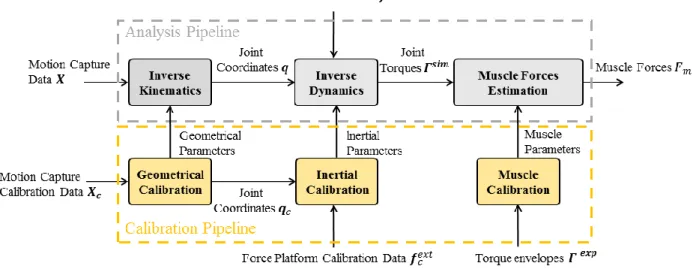
fashion way, leading to the following analysis pipeline:
Figure 1.2. Classical inverse dynamics musculoskeletal simulation pipeline. Inputs are generally motion capture data and external forces measures data, and outputs are the quantities on the right side of the boxes: joint coordinates, joint torques and muscles forces against time. Joint reaction forces are also one of the possible outputs depending on the way the inverse dynamics step is implemented. Calibration procedures accompany these analysis steps to scale the corresponding layers of the musculoskeletal model (geometrical, inertial and muscle layers)to the subject. Extracted from [9].
Generally, in MS, a musculoskeletal model (MSM) relies on an arborescent structure of rigid segments linked by joints and actuated through muscles. Therefore, such a model exhibits 3 descriptive levels of parameters coupled together. First, the geometrical level (segment lengths, joint centers …) corresponding to the osteo-articular model, second, the inertial level (mass, inertias, center of mass…), and last the muscle level. The last
19
points, wrapping surfaces…) and force generation parameters (Maximal isometric strength, tendon slack length
…). This hierarchy is leading to a large set of parameters influencing such simulation. Three major leaks remain to achieve widespread use of such inverse analysis in ergonomics:
- First, computation methods must be enhanced to make these simulations easier to deploy and use daily, with a higher accuracy in the results. Currently, most musculoskeletal analyses need heavy pre-processing of the data, large computation time and heavy post-pre-processing to give relevant results. This is clearly non-compatible with a daily use by non-expert users such as ergonomists, asking for a similar level of accuracy with drastically decreased computation and processing times. This is also a real need to make such simulations usable in preventive ergonomics sessions, leading to similar computation issues. Reducing computation time also opens the opportunity to enhance the work conditions by biofeedback, enabling the worker to assess and modify by itself its work gestures and procedures. There are also efforts to be made on the force estimation problem itself, representing more accurately the motor control of the subject in relation to a task. It is well known that current methods used in the field badly predict co-activation behaviours for example.
- Second, the calibration of MSM to subjects (scaled to subject models) still requires significant improvements to be made. Now, accurate models are systematically based on invasive, expensive and rare tools (MRI, CT-scans, …). Moreover, this data asks for tedious post-processing to be used for scaling. There is a need of simplified scaling methods able to personalize models in a limited time and with a limited set of measures, as it would be used in an ergonomics context.
- Third, the experimental facilities necessary to drive such simulation are still heavy to deploy and costly (optoelectronic systems, force platforms…). This is also non-compatible with onsite analysis. In an industrial plant, a complete motion capture system with external force measurements is difficult to deploy and ask to modify the environment (occlusions, luminosity) to be efficient. This reduces the ecology of the situations to analyse and impact the production of the plant. There is a need of methods able to provide accurate musculoskeletal results from a degraded or reduced set of data, collected with limited and minimally impacting equipment.
These issues are motivating most of the developments I present in the second chapter of this manuscript, and are extensively described there.
MAKE VIRTUAL REALITY REALISTIC AND USABLE ENOUGH TO BE USED IN PREVENTIVE ERGONOMICS
The recent development of virtual reality headsets and glasses made it very popular the last few years. This is also a valuable tool to prototype virtually workstations and products. This approach is more cost-effective and convenient since working directly on the Digital Mock-Up (DMU) in a virtual environment is preferable to constructing a real physical mock-up in a Real Environment (RE). This is substantiated by the fact that a Virtual Reality (VR) set-up can be easily modified, enabling quick adjustments of the workstation design. Indeed, the aim of integrating ergonomics evaluation tools in VE is to facilitate the design process, enhance the design efficiency, and reduce the costs. VR has already been used in ergonomics to assess aspects of manual handling operations [10,11,12]. In such applications, the end-user, generally the future operator of the workstation to design, is immersed in a VR-based simulator that mimics the real work environment and he or she is asked to perform tasks through interactions in VE corresponding to tasks he would perform in RE. Interactions are mostly performed with peripherals such as motion-tracking systems or haptic interfaces. Other actors of the
20 design - ergonomists, in charge of the evaluation of the system regarding the user, and design engineers, in charge of the functionality of the system regarding the production scheme – can also interact with the scenes and the end-user to enhance both working conditions and workstation usability. Generalize the use of such systems to systematize the ergonomic assessment in a design process ask for the following research questions:
Figure 1.3 –A generic collaborative framework for ergonomics assessment in a virtual environment, involving an end-user (operator), ergonomists and design engineers (from [13]).
- First, the environment must be collaborative and propose efficient metaphors and design modes to be used by the different actors of the design. It asks for architectural and behavioral questions, regarding the way the actors are interacting with the scene and between them. For example, an ergonomist must be able to provide ergonomic recommendations to the end-user and the design engineer whereas the latter may have to indicate production constraints to the other actors.
- Second, how reliable are the recommendations issued from a VR-based ergonomics study? And how realistic is the simulator? To make a VR simulator usable for ergonomics purposes, it asks to ensure the transferability of the results from the virtual world to the real one. This transferability can be reached only at a cost of the thorough assessment of the realism of the simulator regarding the tasks to simulate. Therefore, there is a need of collaborative methods in high end realistic environments to democratize preventive ergonomics as a credible decision support tool for ergonomists and designers, and a real need of assessment of the realism of such systems in biomechanical terms to be used in preventive ergonomics.
21
APPLIED AND AFFORDABLE
There is no interest in having such applied research objectives if there is no application behind. It is fundamental to me that the developments we make in the two domains presented above must be applied to real cases. Musculoskeletal simulation as well as VR are generally still used by experts without a real adoption of the methods by end-users (ergonomists in our case). To achieve a deployment of such methods in broad way, there is a need of tools to be developed that would be i) easy to use ii) fast and integrative iii) customizable.
There is also a lot to do to prove the interest and usability of such methods in many applicative fields. Therefore, all the applications we can pursue are of interest to show the usability of these methods in these cases.
DOCUMENT OVERVIEW
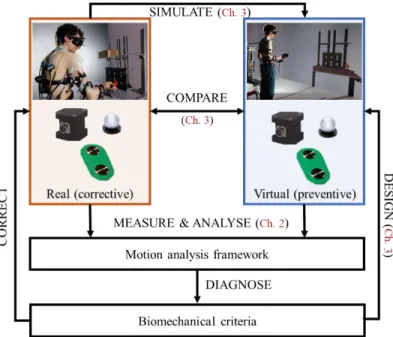
Regarding the challenges presented above, the next chapters are explaining into details the different contributions I participated to in the last 12 years, since I began my PhD thesis. A final section is concluding and opening perspectives to this work. The figure 1.4. summarizes the principle of corrective and preventive assessment of physical risk factors and replace the plan of the manuscript within this scheme.
Figure 1.4. Document overview: corrective and preventive physical risk factors assessment and the corresponding contributions gathered by chapters.
22 MAIN CONTRIBUTIONS
EFFICIENT MUSCULOSKELETAL SIMULATION FOR ERGONOMICS (CHAPTER 2)
As stated in introduction, musculoskeletal simulation is a fundamental tool for studying physical risk factors at work. To enhance their efficiency and reliability, we proposed several contributions related to the issues raised in the previous section.
EFFICIENT MUSCLE FORCES ESTIMATION
In this contribution we proposed alternative methods (interpolation) to classical (optimization) methods for muscle forces estimation. The main strength of this approach consists in its propensity to get in a very reduced time, compared to classical methods, results with a similar optimality. The developed method (MusIC, for Muscle Forces Interpolation and Correction) is about 30 times faster than classical optimization for a 12 DoF lower limbs model with 82 muscles.
EFFICIENT SCALING
Musculoskeletal models have to be scaled to the subject in order to be as accurate as possible. We proposed
several studies on this subject to get i) realistic geometrical parameters (segment lengths, joint axes…) ii) realistic muscle parameters (maximal isometric force, optimal muscle length…). We particularly explored the importance of these parameters with regard to the results through sensitivity studies. We also proposed alternative joint strength models to represent the subject capacities in terms of force generation, that is absolutely fundamental for physical risk factors assessment.
MUSCULOSKELETAL SIMULATION IN INDUSTRIAL CONDITIONS
Such simulations are interesting only if they are applicable to real situations. Therefore, we developed methods to make it usable out of the lab. We particularly developed inverse dynamics methods based on depth camera data, since this device is easy to deploy in any environment with a minimal action on the subject to study, and we developed external forces prediction methods able to provide external forces applied on a given subject from a measure of its motion only. Such method is really relevant out of the lab, since force platforms or any over external forces measurement device are difficult to deploy on field.
INTEGRATIVE APPROACH
All of our development in musculoskeletal simulation have been integrated in a single open source Matlab toolbox2, following the idea that: i) it has to be usable by anyone ii) it has to be as modular as possible (changing
23 models, analysis to run, input data …) iii) it has to be alive. I am particularly proud to have participated to this development, that is full of promises for the next years.
EFFICIENT VIRTUAL REALITY FOR ERGONOMICS (CHAPTER 3)
As I already explained above, virtual reality is a powerful and appealing tool for preventive ergonomics and physical risk factors assessment. To enhance its efficiency and reliability, I proposed several contributions relative to the issues raised in introduction.
BIOMECHANICAL FIDELITY OF VIRTUAL ENVIRONMENTS
First, we made some fundamental studies comparing real and virtual assembly/sorting tasks in terms of biomechanical quantities. These works showed interesting similarities and discrepancies between real and virtual results, enabling a cautious use of such setup for preventive ergonomics…of such tasks. It led us to the concept of biomechanical fidelity, that is extensively presented in the introduction of the corresponding chapter.
COLLABORATIVE VIRTUAL ENVIRONMENTS FOR ERGONOMICS
Second, we focused on collaborative virtual environments, enabling the joint work of 3 actors, that are an ergonomist, a design engineer and an end-user. We particularly focused on the interaction modes and metaphors that such setups may propose, and on their evaluation in terms of usability.
24
CHAPTER 2
E
fficient musculoskeletal simulation for
ergonomics
Motion analysis of a handling task with the CusToM toolbox
Muller, A. et al. (2019). CusToM: a Matlab toolbox for musculoskeletal simulation. Journal of Open Source Software.
25 INTRODUCTION
Developing efficient musculoskeletal simulation for ergonomics is a real need regarding the specificities of this activity. Indeed, preventive or corrective ergonomics in an industrial context are subject to constraints, having to be performed in a limited time and with limited means. At the same time, having an idea of forces exerted by the worker is mandatory to have a complete assessment of its work conditions. This observation militates for tools that can be accurate enough to provide reliable force information about the workers activity, fast enough to be deployed in a relatively short time and deployed with a minimum of experimental means. Several commercial or open-source musculoskeletal simulation solutions have been developed during the past years. The two most well-known software solutions are the AnyBody Modeling System [14] and OpenSim [15].Such systems have found multiple applications in clinics, sports, rehabilitation as well as exoskeleton prototyping. Their use in physical risk factors assessement is still subject to questions, that I will now develop.
The musculoskeletal analysis of a motion by inverse dynamics thanks to a musculoskeletal model exhibiting 𝑛𝑐
degrees of freedom, 𝑛𝑏 bodies, and 𝑛𝑚 muscles can be summarized by the following scheme:
Figure 2.1. Inverse dynamics analysis pipeline.
Generally, the inputs are motion capture data coming from an optoelectronic system, in other words the 3D position against time of a set of markers 𝑿, and external forces data coming from force platforms, in other words 6D efforts (forces and moments) under each foot of the subject 𝑓𝑒𝑥𝑡. The first processing step (inverse
kinematics) consists in computing the joint coordinates and its derivatives against time (𝒒, 𝒒̇, 𝒒̈). This is generally done by minimizing the distance between experimental and reconstructed markers placed on the kinematical model, that can be defined as an optimization problem [16], although alternative methods proved their value to compute the joint coordinates efficiently (Jacobian-based [9], Extended Kalman filters [17]). The second step consists in the inverse dynamics itself, generally solved thanks to an iterative approach like the Newton-Euler algorithm if the biomechanical model is an open structure, or global (Lagrange based) approaches for structures involving closed loops [18]. Therefore, it computes the joint torques 𝚪𝒔𝒊𝒎 from the external forces and the motion quantities in the joint space (𝒒, 𝒒̇, 𝒒̈). Finally, the muscle forces estimation is the step computing the muscle forces from the joint torques. Most musculoskeletal models exhibit actuation redundancy that leads to an infinite number of actuation solutions, as there are less equations (dynamics equations) than unknowns (muscle forces, given that muscles can only pull). The models may also exhibit under actuation, due to the fact that a single muscle can actuate several joints simultaneously, such as bi-articular muscles. These challenges can be solved by defining what is the optimal actuation solution, through the modelling of known motor control laws associated to a motion. Several models of motor control are actively studied and used in the fields of neuroscience, biomechanics, and robotics to generate muscle forces. In inverse dynamics based musculoskeletal analyses, the force sharing problem – distributing the forces deployed by muscles to generate a given motion - is mostly solved thanks to optimization methods. In [19, 20] the force sharing problem is assumed to be an optimization problem, consisting in minimizing a criterion representing a central nervous system (CNS) strategy. The criterion represents a cost, e.g. metabolic energy, muscle fatigue or joint reaction forces. It is also
26 noteworthy that both inverse dynamics and muscle forces estimation must be solved simultaneously in the case of closed loop systems, since computing the joint torques for closed-loop is a non-sense. This is the way it is handled in AnyBody for example [14].
The analysis pipeline applies inputs to a model that needs to be scaled to the subject to study. A classical whole-body musculoskeletal model exhibits ~50 DoF, ~50 solids, and ~300 muscles that leads to ~5000 parameters to be known to fully scale it. At the geometrical level, the parameters are segment lengths, joint axes, joint locations and muscle paths. At the inertial level, the parameters are the body segments inertial parameters (masses, centers of masses locations, inertia matrices). At the muscle level, the parameters are the force
generation parameters (optimal muscle fiber length, maximal isometric force…). Individual factors such as
height, weight, or fat mass index are completing this model and may be used to scale it [21].
Classically, regression methods based on anthropometric data collections on cadavers have been used to scale both geometric and inertial parameters [22,23,24]. Muscle parameters have also been scaled thanks to anthropometric rules, as it has been done in [25] or presented in [26]. However, such methods do not enable to obtain accurate subject specific models. Three-dimensional scanning or magnetic resonance imaging measurements have also been used to calibrate precisely and individually geometric, inertial and muscle parameters [27,28,29], but these methods are expensive, long to post-process and can be invasive (radiations). Consequently, subject-specific scaling methods with lighter, less invasive and faster protocols have been developed. These methods mainly rely on equipments available in a motion analysis laboratory.
Calibration of geometrical parameters (joint axes orientations, bone lengths, joint positions...) based on motion capture data has been proposed in several studies [30-33]. In most of these papers, the main idea consists in minimizing the reconstruction error between the model anatomical landmarks location and recorded experimental markers placed on the same landmarks among a given set of frames. Segments dimensions and joint centers of rotation are then extracted from the optimized data. Solutions [32,33] are the ones implemented in the AnyBody Modeling System, whereas solution [31] can be found in OpenSim.
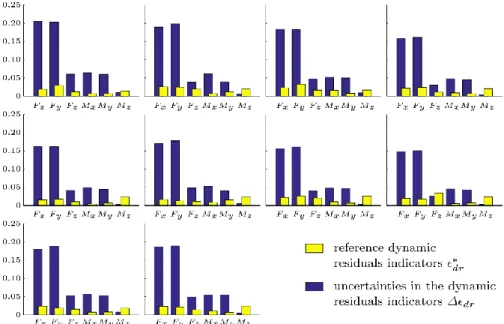
Non-invasive optimization methods have also been proposed to estimate personalized inertial parameters (center of mass location, mass, inertia...) in vivo. It requires using motion capture and external force measurements to obtain the optimal Body Segment Inertial Parameters (BSIP) that best fit the motion dynamics equations [34]. Different approaches were used to solve this problem. [35, 36,37] wrote the inverse dynamics to inertial parameters relationship under the form of a system of a linear equation and solve the corresponding problem in a least-square sense. This approach has also been applied to more affordable measurement systems [38]. Meanwhile, [39,40] focused on the 6 degrees of freedom (DoF) joint between the floating-base system and the global reference frame as a measure of the simulation accuracy. The optimization problem consisted in minimizing the generalized forces at this virtual joint that corresponds to the dynamic residuals. We can also cite [41] that estimated the inertial parameters by adjusting ellipsoid shapes on photographies and anatomical landmarks from motion capture data. The AnyBody modeling system does not have any inertial calibration (customized values are scaled from geometrical parameters and initial anthropometric values), whereas OpenSim uses a residual reduction algorithm (RRA) to modify masses and centres of mass position, by minimizing the residuals between external forces and acceleration data (a method close to the ones proposed in [39,40]).
Finally, the most challenging calibration remains on the muscle aspect, since no direct measurement of muscle force generation parameters is possible and only a few non-invasive (strength based) techniques exist [42]. We will separate the muscular calibration in two steps. First, the geometrical calibration described above is also used to scale the relative origin, insertion and paths of the action lines of muscles. Next, the muscular calibration
itself is calibrating the muscle force generation parameters (tendon slack length, isometric strength…). These
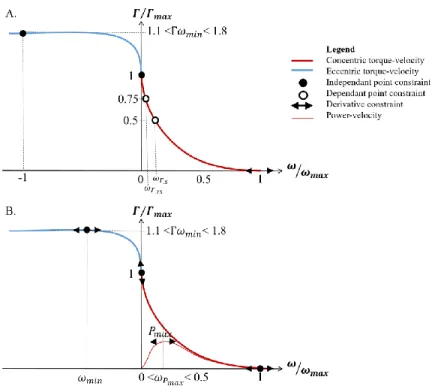
techniques are based on the measurement of the maximal joint strength (i.e. the maximal torque developed by a given joint for a given angular position and velocity, thanks to an isokinetic ergometer) corresponding to isometric or isokinetic muscle efforts and trying optimizing muscle parameters to match these values. For example, [43] proposed a two-step optimization method based on isometric measurements, first solving the
27 force sharing problem among upper limb joints, and second fitting at best individual muscle torques by changing muscle parameters. [44] proposed a similar approach with the addition of isokinetic trials to enhance the calibration whereas [45] used isometric trials and EMG to scale muscles parameters of a hand MSM. [46] proposed an approach coupling EMG measurements and motion capture trials to calibrate the musculo-tendon parameters of the muscles crossing the elbow [45] has been applied with a low coupling with the AnyBody modelling system whereas OpenSim only exhibits a geometrical calibration. Force generation parameters are not scaled to the subject in this software. In a general way, there is no whole-body rule enabling a complete scaling from a set of measures for this layer of the MSM.
Even if this short summary of what we call musculoskeletal simulation is appealing for ergonomics, there are still several limitations hampering its use, as we already presented it in the introduction of this manuscript:
- First, computation times must be decreased in order to make these simulations easier to deploy and use daily. Optimization remains costly in terms of computation time, despite of several implementations and improvements in the last years. Mostly, the use of Sequential Quadratic Programming Methods (SQP) have deeply improved the computation times since the muscle forces estimation problem is well shaped for such an algorithm. However, in real-time simulations including muscle forces estimation, the result remains suboptimal. In the method proposed in [47], muscles were gathered by functional groups to reduce the problem complexity, that led to strong bias in the estimated forces. In the work of [48], the use of a neural network dedicated to quadratic optimization led to a real-time but sub-optimal result, since computation time was limited to ensure real-time computation. Moreover, force-length and force-velocity relationships were not considered in the muscle models in this paper. Last, these approaches are limited to a given musculoskeletal model and are not systematically applicable to any other model. Therefore, there is a need for alternative methods able to give in a limited amount of time similar results to classical methods and independent from the model to be analysed. This is one of the contributions I work on during the past twelve years, as it is presented in the following section.
- Second, the calibration of MSM to subjects (scaled to subject models) may benefit for simplification in both acquisition and processing of the data, to bypass too invasive and costly methods - imagery based methods. Even if alternatives methods circumvented these issues by using directly the motion and external forces data to scale the subject as mentioned above, there is a lack of validation of these
methods. Since they indirectly calibrate the parameters with resulting values (motion, forces,…), they
have a propensity to overfitting, meaning over-calibrating parameters to minimize an error that is caused by another issue. Moreover, their usefulness is questioning and may ask for sensitivity analyses to understand their importance in the accuracy of the results. The second topic of this chapter deals with these analyses and their impact on these methods.
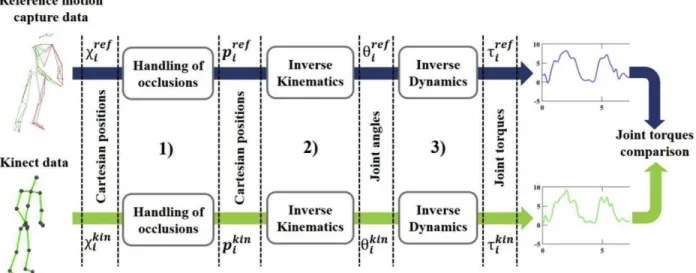
- Third, the data acquisition and processing should be simplified drastically to make it usable onsite. In an industrial context, there is no room for heavy and impacting protocols. The systematic use of optoelectronic motion capture data and force platforms for such analyses is particularly constraining. A few studies showed the potential application of inverse kinematics and inverse dynamics methods to alternative motion capture data, such as inertial measurements units (IMUs) [49-52] and Depth cameras [53] data. If IMUs data tend to be as accurate as motion capture, the scaling of the model is still very complicated with such a system since it provides no absolute measure of distance. Moreover, the application of classical inverse dynamics methods remains a complex procedure with such a data. Depth cameras showed a good potential to be used in ergonomics, however the input data is relatively poor and ask for simplified models to be deployed (ex: no wrist motion, no ankle motion) for inverse dynamics analyses. Finally, these analyses are very limited by the lack of external forces measurement. This data is mandatory to estimate internal forces and torques. A few studies proposed approaches to estimate these forces only from the whole motion of the subject, but there is still a need of improvement
28 to make them usable with any model and with multiple contacts. These issues are leading to the third topic of this chapter.
- Last, to democratize the use of this tool for physical risk factors assessment, there is a necessity of simplification of the processing to make it usable by non-expert people. Currently, musculokeletal simulation still asks for expertise to be driven (typically: researchers of the domain), and tedious pre and post-processing actions. The definition of new models to be studied and coupled with original analysis protocols asks for complex developments in softwares like OpenSim or AnyBody. This issue is leading directly the contribution proposed in the fourth topic of this chapter.
TOPIC 1: EFFICIENT MUSCLE FORCES ESTIMATION CONTEXT AND OBJECTIVE
In relation to the first issue presented in the previous section, we focused on the development of muscle forces estimation methods that could run in -almost- real time, independently from the model to run and independently from the problem to solve. In other words, we proposed solutions able to replicate the results of an optimization method without solving it. The main assumption behind this kind of solution is that we can find from pre-computed data an approximation of the optimal solution, since muscles are viscoelastic actuators that behave continuously against time (and therefore against motion quantities) due to their force-length and force-velocity relationships. The first occurrence of this idea was developed during my PhD thesis [54,55]. This first approach consisted in approximating the solution of a classical optimization thanks to a barycentric interpolation in the articular space (𝒒, 𝒒̇, 𝒒̈). First, it consisted in feeding a database with results of a classical optimization. For a set of reference motion capture and external forces data, we computed the following optimization:
{ At each frame: 𝑚𝑖𝑛 𝑓(𝑭) = ∑ ( 𝐹𝑖 𝐹𝑚𝑎𝑥𝑖) 2 𝑛𝑚 Subject to: 𝚪𝒔𝒊𝒎− 𝑅𝑭 = 0 𝐹𝑖− 𝐹𝑚𝑎𝑥𝑖≤ 0 (1)
Where 𝑭 is the muscle forces vector - 𝑭𝒎𝒂𝒙 being the maximal muscle forces vector, 𝑓(𝑭) the cost function to
minimize - representing the CNS behavior (here the squared sum of the normalized muscle forces), 𝚪𝒔𝒊𝒎 the joint torque vector and 𝑅 the moment arms matrix. The database was transformed through a Delaunay tessellation of the (𝒒, 𝒒̇, 𝒒̈) joint space.
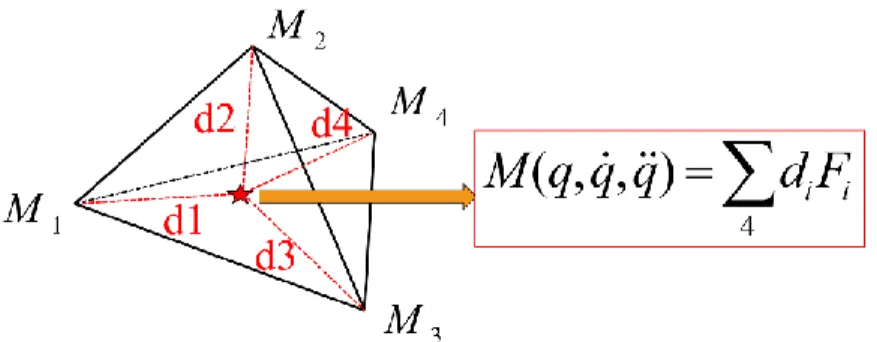
The interpolation step consisted, for a sample motion, to find at any frame the simplex containing the current
(𝒒, 𝒒̇, 𝒒̈) state of the joint and to apply a barycentric interpolation to the current state inside this simplex to find an approximation of the muscle forces, as shown in figure 2.2.
![Figure 1.3 – A generic collaborative framework for ergonomics assessment in a virtual environment, involving an end-user (operator), ergonomists and design engineers (from [13])](https://thumb-us.123doks.com/thumbv2/123dok_us/11022339.2989529/22.918.178.737.207.575/collaborative-framework-ergonomics-assessment-environment-involving-ergonomists-engineers.webp)
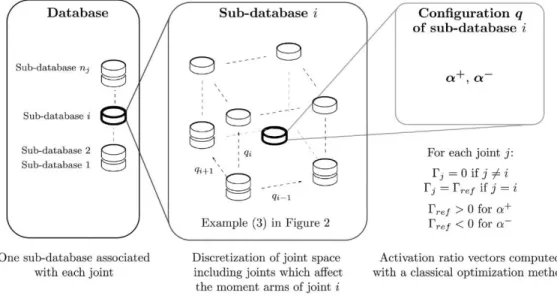
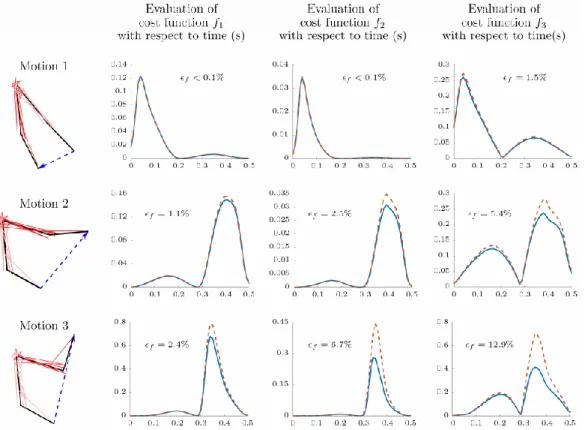
![Figure 2.6. A summary of the results obtained in [57]. One can see the similarity of the results between the accuracy of the interpolated moment arms in the databse (on the left) and the accuracy of the MusIC method (on the right)](https://thumb-us.123doks.com/thumbv2/123dok_us/11022339.2989529/34.918.151.772.552.757/figure-summary-results-obtained-similarity-accuracy-interpolated-accuracy.webp)