STEMPS Theses & Dissertations STEM Education & Professional Studies
Winter 2013
In Search for Instructional Techniques to Maximize
the Use of Germane Cognitive Resources: A Case
of Teaching Complex Tasks in Physics
Yekaterina Sliva Old Dominion University
Follow this and additional works at:https://digitalcommons.odu.edu/stemps_etds
Part of theCurriculum and Instruction Commons,Educational Methods Commons, and the
Science and Mathematics Education Commons
This Dissertation is brought to you for free and open access by the STEM Education & Professional Studies at ODU Digital Commons. It has been accepted for inclusion in STEMPS Theses & Dissertations by an authorized administrator of ODU Digital Commons. For more information, please [email protected].
Recommended Citation
Sliva, Yekaterina. "In Search for Instructional Techniques to Maximize the Use of Germane Cognitive Resources: A Case of Teaching Complex Tasks in Physics" (2013). Doctor of Philosophy (PhD), dissertation, STEM and Professional Studies, Old Dominion University, DOI: 10.25777/ff5p-4c84
IN SEARCH FOR INSTRUCTIONAL TECHNIQUES
TO MAXIMIZE THE USE OF GERMANE COGNITIVE RESOURCES: A CASE OF TEACHING COMPLEX TASKS IN PHYSICS
by
Yekaterina Sliva
Combined B.S. and M.S. January 1990, Moscow State University
A Dissertation Submitted to the Faculty of Old Dominion University in Partial Fulfillment o f the
Requirements for the Degree o f
DOCTOR OF PHILOSOPHY EDUCATION
OLD DOMINION UNIVERSITY December 2013
Gary R. Morrison (Director)
Ginger S. Watson (Member)
IN SEARCH FOR INSTRUCTIONAL TECHNIQUES
TO MAXIMIZE THE USE OF GERMANE COGNITIVE RESOURCES: A CASE OF TEACHING COMPLEX TASKS IN PHYSICS
Yekaterina Sliva
Old Dominion University, 2013 Director: Dr. Gary R. Morrison
The purpose o f this study was to introduce an instructional technique for teaching complex tasks in physics, test its effectiveness and efficiency, and understand cognitive processes taking place in learners’ minds while they are exposed to this technique. The study was based primarily on cognitive load theory (CLT). CLT determines the amount of total cognitive load imposed on a learner by a learning task as combined intrinsic (invested in comprehending task complexity) and extraneous (wasteful) cognitive load. Working memory resources associated with intrinsic cognitive load are defined as germane resources caused by element interactivity that lead to learning, in contrast to extraneous working memory resources that are devoted to dealing with extraneous cognitive load. However, the amount o f learner’s working memory resources actually devoted to a task depends on how well the learner is engaged in the learning
environment. Since total cognitive load has to stay within limits o f working memory capacity, both extraneous and intrinsic cognitive load need to be reduced. In order for effective learning to occur, the use o f germane cognitive resources should be maximized. In this study, the use of germane resources was maximized for two experimental groups by providing a learning environment that combined problem-solving procedure with prompts to self-explain with and without completion problems.
The study tested three hypotheses and answered two research questions. The first hypothesis predicting that experimental treatments would reduce total cognitive load was not supported. The second hypothesis predicting that experimental treatments would increase performance was supported for the self-explanation group only. The third hypothesis that tested efficiency measure as adopted from Paas and van Merrienboer (1993) was not supported. As for the research question o f whether the quality of self explanations would change with time for the two experimental conditions, it was determined that time had a positive effect on such quality. The research question that investigated learners’ attitudes towards the instructions revealed that experimental groups understood the main idea behind the suggested technique and positively reacted to it. The results of the study support the conclusions that (a) prompting learners to self-explain while independently solving problems can increase performance, especially on far transfer questions; (b) better performance is achieved in combination with increased mental effort; (c) self-explanations do not increase time on task; and (d) quality of self explanations can be improved with time. Results based on the analyses o f learners’ attitudes further support that learners in the experimental groups understood the main idea behind the suggested techniques and positively reacted to them. The study also raised concern about application of efficiency formula for instructional conditions that increase both performance and mental effort in CLT. As a result, an alternative model was suggested to explain the relationship between performance and mental effort based on Yerkes-Dodson law (1908).
Keywords: instructional design, cognitive load, complex tasks, problem-solving, self-explanation
This dissertation is dedicated to my family who was very patient with me and supported my efforts throughout this journey.
ACKNOWLEDGMENTS
I have been lucky to be surrounded by a great group o f scholars, researchers, and professionals who have helped me throughout the whole process o f shaping this study and implementing it in a real classroom. Dr. Morrison was there for me providing mentoring and always challenging me to think deeper and prepare every small detail to make this study meaningful. Dr. Watson provided ongoing counseling on methodology. She was the first person I have shared my findings with, and she was the one who guided me to bring them together and come up with interpretations. Dr. Godunov’s support helped me to believe in what I was doing. I am especially grateful for his collaboration on preparing materials for this study. Dr. Godunov was also the one who provided the
environment where I could have access to a wonderful group of students. Finally, I want to acknowledge and thank students who participated in this study. They took time to do all the required work, especially those who approached me to get clarity on how to do it better and continued to improve their problem-solving skills throughout the duration of this study. Without their hard work, this study would not be possible.
TABLE OF CONTENTS
Page
LIST OF TABLES... viii
LIST OF FIGURES... ix
Chapter I. INTRODUCTION AND LITERATURE REVIEW... 1
COGNITIVE PROCESSES AND COMPLEX TASK S... 1
SELF-REGULATED LEARNING...2
COGNITIVE LOAD THEORY...4
MAXIMIZING THE USE OF GERMANE COGNITIVE RESOURCES... 9
MEASURING COGNITIVE L O A D ...13
PURPOSE OF THE RESEARCH...21
II. METHODS...23 PARTICIPANTS... 23 RESEARCH DESIGN...25 TREATMENTS... 25 INSTRUMENTS... 28 PROCEDURE... 34 DATA...38 III. RESULTS...41 HYPOTHESIS I ... 41 HYPOTHESIS I I ... 43 HYPOTHESIS III... 45 RESEARCH QUESTION 1... 50
RESEARCH QUESTION II... 52
IV. DISCUSSION AND CONCLUSIONS...59
HYPOTHESIS I I ... 59 HYPOTHESIS 1 ... 64 HYPOTHESIS III... 67 RESEARCH QUESTION 1... 72 CONCLUSIONS... 75 REFERENCES...77 APPENDICES A. TUTORIAL ON SELF-EXPLANATIONS...85
B. HOMEWORK: EXAMPLES OF HANDOUTS... 94
D. PARTIAL CREDIT CRITERIA...104
E. STORY PROBLEM SCORING RUBRIC... 105
F. SUMMARY OF POSTTEST GRADING... 106
G. QUALITY OF SELF-EXPLANATIONS SCORE RUBRIC... 107
H. SURVEY...108
I. INFORMED CONSENT FORM ...111
LIST OF TABLES
Table Page
1. Effort-Performance and Relative Condition Efficiency Means (Paas and van
Merrienboer, 1993)...18
2. Measures of Cognitive L o ad ... 30
3. Measures of Cognitive Load Recorded for Each Participant... 31
4. Data Related to Research Questions and Hypotheses...38
5. Instructional Condition Efficiency...47
6. Summary o f Survey Responses... 53
7. Example of Story-Problem Mental Effort Rating and Performance by Treatment Group... 66
8. Changes in Number of Participants within Quality o f Self-Explanations Sub-Groups...73
Figure Page
1. Instructional Condition Efficiency...18
2. Likert-Type Scale for Invested Mental Effort... 30
3. Time on Task for Three Treatment Groups on Four Homework Submissions... 46
4. Posttest. Instructional Condition Efficiency... 48
5. Quality of Self-Explanations for Two Experimental Groups on Four Homework Submissions... 51
6. Quiz and Posttest Grades... 60
7. Near Transfer Scores... 60
8. Far Transfer Scores...61
9. Cognitive Load Measures... 64
10. Illustration of Yerkes-Dodson Law (1908)...69
11. Curve Connecting Efficiency Measures for Three Treatment Groups... 70
CHAPTER I
INTRODUCTION AND LITERATURE REVIEW
Introduction
Cognitive skill acquisition is a process targeting the ability to solve problems in intellectual tasks, which can differ by problem complexity. Complex learning requires more than mastering isolated skills and foremost deals with learning to coordinate separate skills that are necessary for authentic real-life task performance. Moreover, integration of knowledge structures, problem-solving techniques, reasoning skills, and attitudes is critical for effective performance in complex learning (van Merrienboer, Kester, & Paas, 2006).
Cognitive Processes and Complex Tasks
Effective instructional methods for practicing complex tasks differ from those effective for simple tasks (van Merrienboer et al., 2006). In contrast to simple tasks, complex tasks typically impose a very high cognitive load on the learner’s cognitive system. Building expertise in complex conceptual domains of knowledge, such as in geometry, physics, biology, or computer programming, can be explained through understanding of cognitive processes taking place in learners' working and long-term memory. Working memory capacity is considered limited to seven plus or minus two elements or chunks of information (Miller, 1956) with information lost after
approximately 20 seconds (Peterson & Peterson, 1959), if not stored in a long-term memory or constantly refreshed. Information has to pass through working memory that has partly independent processing channels for visual/spatial and auditory/verbal
information before it can be transferred to long-term memory that has virtually unlimited capacity. Since working memory is the gateway to long-term memory, the limitation of
is considered to take place through schema construction and automation, therefore the second consideration for the design of instruction is the construction and automation of schemas. Schemas bring together multiple information elements that can be treated as a single element when recalled in working memory. Schemas are constructed by either creating a new schema or by extending and modifying existing schemas. Schemas become automated with practice allowing both fluid performance on familiar tasks, and by freeing working memory capacity, performance on unfamiliar tasks that otherwise would be impossible.
Self-Regulated Learning
According to Zimmermann (1989), self-regulated learning refers to how students become masters o f their own learning processes. Zimmermann explained that self- regulated learning is not a mental ability or a performance skill, but rather it is the self- directed process through which abilities are transformed into task-related skills; it involves active learning in terms o f metacognition, motivation, and action control. Learners engaged in self-regulated learning have a clear understanding o f how and why to employ self-regulatory strategies in order to acquire knowledge.
The facilitation of self-regulated learning is a balancing act between necessary external support and desired internal regulation (Koedinger & Aleven, 2007). From an instructional point of view, there are two ways to externally support self-regulated learning within problem-solving processes. Direct external support (i.e., direct
instruction) facilitates explicit problem-solving strategies, their application, and transfer; and an indirect external support facilitates application o f already existing
problem-3
solving skills. For example, if learners already possess certain problem-solving strategies but fail to use this knowledge in a specific situation, it would be reasonable to prompt them to apply their existing strategic knowledge effectively. An instructional method for indirect support of the regulation of learners’ problem-solving processes is prompting (Wirth, 2009). The purpose of prompts is to direct learners to perform a specific activity which is contextualized within a particular problem-solving situation (Davis, 2003). According to Davis (2003), prompts can be categorized as generic or directed. While generic prompts ask learners to reflect on their performed problem-solving activities, directed prompts provide them with an expert model of thinking in the problem-solving process. Therefore, from self-regulated learning perspective, the goal of an instructional strategy intervention is to introduce learners to specific instructional strategies that assist in task completion and support learners' self-regulated engagement in tasks so that they can learn to manage their cognitive processes during learning. The focus o f this study was on building expertise in physics. In particular, this study investigated management o f cognitive load during the process of skill acquisition in complex tasks in physics by means of prompts used to guide learners in their problem-solving activities.
Literature Review
Recent instructional design approaches tend to focus on authentic tasks that are based on complex real-life experiences. Such tasks require learners to employ and integrate their knowledge, skills, and attitudes necessary for effective task performance. However, complex tasks pose high cognitive load on learner's cognitive system that, in turn, may interfere with learning. Therefore, it is important to integrate knowledge about human cognitive architecture into the design of instruction. Cognitive load theory
(Sweller, 1988) provides designers with an important perspective for choosing
appropriate instructional methods based on implications of task complexity relative to the learner's cognitive system.
Cognitive Load Theory
Cognitive load theory (Sweller, 1988) uses interactions between information structures and knowledge about cognition to design instruction. The theory emphasizes that working memory capacity is limited when dealing with novel information obtained through sensory memory. Cognitive load refers to the processing demands placed on working memory at a specific point in time.
Recent changes in cognitive load theory. Cognitive load theory (CLT)
traditionally differentiated between three types o f cognitive load: intrinsic, extraneous, and germane; and assumed that these three types o f cognitive load are additive.
Working-memory load may be affected by the complexity o f the learning task (intrinsic cognitive load) or by the manner in which it is presented (extraneous cognitive load). Historically, germane cognitive load was viewed as the remaining working memory capacity, which was used for schema construction (Sweller, van Merrienboer, & Paas,
1998); this type of load was thought to occur when learners engage in a deep information processing such as mentally organizing the material and relating it to prior knowledge (DeLeeuw & Mayer, 2008).
Recently, Sweller, Ayers, and Kalyuga (2011) proposed to differentiate between two types of cognitive load imposed by instructional materials: intrinsic (useful) and extraneous (wasteful). On the other hand, the authors suggested that working memory resources can be divided into two types o f resources: germane (i.e., resources devoted to
5
intrinsic cognitive process) and extraneous (i.e., resources that deal with extraneous cognitive load). Sweller et al. (2011) explained that learner’s working memory could be overloaded if the combined intrinsic and extraneous cognitive load exceeds its capacity. Sweller and his colleagues emphasized that germane cognitive load is a reflection of the amount of load imposed by intrinsic element interactivity and does not independently contribute to total cognitive load, thus, they have started using the term germane
resources rather than germane load. Working memory resources that are actually devoted to dealing with intrinsic cognitive load and lead to meaningful learning are defined as germane resources.
According to Sweller et al. (2011), the primary goal of CLT is to devise instructional procedures that reduce extraneous cognitive load and thus decrease the working memory resources that need to be devoted to processing information that is extraneous to learning. The working memory resources that are not needed to deal with extraneous cognitive load can be redirected to deal with intrinsic cognitive load that is germane to the learning process. More efficient and effective learning can be achieved by eliminating or minimizing cognitive activities that are not essential for learning because they generate unnecessary load (i.e., extraneous cognitive load) typically caused by inappropriate instructional formats; and by managing essential for learning load (i.e., intrinsic cognitive load) determined by interacting elements of information. Intrinsic load should either be reduced or increased depending on available cognitive resources and instructional goals.
Some of the techniques recommended for managing intrinsic load on the initial stages of learning are segmenting learning tasks into smaller parts causing the learner to
process less information at a time; pre-training learners in essential definitions and procedures prior to the main instructional session; and learning a limited number of selected isolated elements of information during an initial stage of instruction followed by the next stage of instruction that includes all interactive elements o f information in their full complexity (Sweller et al., 2011).
Two approaches to managing intrinsic cognitive load on later stages of skill acquisition include self-explanations and varying the content or examples in the instruction. Intrinsic cognitive load could be productively increased by prompting students to self-explain problem-solving steps and procedures using their knowledge of domain principles (self-explanation effect; e.g., Renkl & Atkinson, 2003). A second strategy is to vary the content o f learning task by considering different situations and conditions rather than similar ones (variability o f worked examples; e.g., Paas & van Merrienboer, 1994).
Types of Cognitive Load: A Closer Look. Intrinsic cognitive load traditionally refers to the amount of cognitive processing required to comprehend material and
depends on the number o f elements o f information that must be processed simultaneously and their interactivity (Clark, Nguyen, & Sweller, 2006). Sweller and Chandler (1994) explained that the complexity of the instruction increases when instructional content is composed of component parts or "elements" and there is a relationship between these elements (i.e., the elements "interact" with each other). Sweller and Chandler described this phenomenon as element interactivity. Similarly, when van Merrienboer and Sweller (2005) described element interactivity they noted that if the number o f elements that need to be organized in the working memory increases linearly, then the number o f their
7
possible combinations increases exponentially. Thus, problems or content with high element interactivity are more difficult to understand as they may overwhelm working memory with intrinsic load and prevent the formation o f a schema. Element interactivity can be determined by the number of interacting elements that the learner has to process at a particular level of expertise (van Merrienboer & Ayers, 2005). For example, learning the alphabet has low intrinsic load as learning A is not dependent on learning G. In contrast, solving a math story problem typically has high element interactivity as the learner must keep several interacting elements in working memory to solve the problem. Schemas that are stored in a long-term memory allow learners to process multiple
elements as one element and decrease working memory load. Since intrinsic cognitive load depends on the complexity o f the content, it was originally thought impossible to alter by instructional intervention (Sweller & Chandler, 1994). However, recent research suggests that this type of load can be reduced (Pollock et al., 2002; van Merrienboer et al., 2003).
Extraneous cognitive load is controllable and depends on the instructional
intervention; in particular, extraneous load is determined by the design of the instruction. The reduction in extraneous cognitive load is critical when instructions contain materials that pose high intrinsic load (Sweller & Chandler, 1994; Paas, Renkl, & Sweler, 2003; van Merrienboer & Sweller, 2005). A combination of high intrinsic and high extraneous cognitive load may be detrimental to learning because working memory may be
overloaded. If, in contrast, the intrinsic cognitive load is low due to low element interactivity, a high extraneous cognitive load due to poor design features may be less harmful. Total cognitive load has to stay within working memory limits. The reduction
in extraneous cognitive load becomes the initial focus o f the design o f instruction when intrinsic cognitive load is high, as it is the easiest to control. This reduction in total cognitive load allows for additional working memory resources that are germane to learning to be used for schema development.
Reducing Extraneous Cognitive Load. The following techniques for the
reduction in extraneous load during information presentation have been extensively studied: using integrated text and diagram formats instead o f split-source formats (split- attention effect; e.g., Chandler & Sweller, 1991), avoiding presentation o f redundant information (redundancy effect; e.g., Chandler & Sweller, 1991), and the use of multiple modalities to present mutually referring textual and pictorial information (modality effect; e.g., Mousavi, Low, & Sweller, 1995). In addition, to support acquisition of problem-solving skills, extraneous cognitive load can be reduced by presenting worked examples in integrated format prior to practicing problem-solving (worked examples effect; e.g., Sweller, 1999).
Another instructional technique for reducing extraneous cognitive load is the use o f completion problems. Van Merrienboer and Krammer (1987) first suggested the use o f completion problems to increase the transfer o f computer programming skills.
Completion problems are problems for which a given state, a goal state, and a partial solution are provided to learners who must complete that partial solution by providing intermediate steps. Completion problems are known to bridge worked examples and conventional problems. The completion problem effect indicates that solving completion problems yields higher transfer o f acquired skills than conventional problem solving. An explanation for this effect is that learners who work on conventional problems apply
9
means-ends analysis that poses high extraneous cognitive load on learners’ working (Sweller, 1988). In contrast, while learners work on completion problems they focus their attention on problem states and associated solution steps enabling them to induce cognitive schemas, in particular cognitive schemas that allow for transfer o f acquired skills (van Merrienboer, Shuurman, de Crook, & Paas, 2002). However, most of the studies on completion problems provided strong support to the completion problems effect but did not collect data on cognitive load (van Merrienboer, 1990; van Merrienboer & de Croock, 1992). Paas (1992) first compared the effects of completion problems, worked examples, and conventional problems on cognitive load during transfer test performance and training performance. Paas found that completion problems or worked examples required the same amount o f mental effort during training and led to higher transfer test performance, combined with lower cognitive load during the test than conventional problems.
Maximizing the Use of Germane Cognitive Resources
A more recent development in the design o f instructions based on CLT considerations is the employment o f practices that maximize the use o f germane
cognitive resources (Paas, et al., 2003; Sweller et al., 1998; van Merrienboer & Sweller, 2005; Clark, et al., 2006). When extraneous and intrinsic cognitive loads are lowered, learners may have cognitive capacity freed that can be invested in processes that directly contribute to learning (i.e., germane cognitive resources). However, learners are unlikely to engage in such activities spontaneously (Renkl, Stark, Gruber, & Mandl, 1998; Renkl,
1999), therefore research efforts should be directed toward identifying instructional techniques that stimulate learners to invest cognitive resources in activities relevant for
resources is to engage learners in self-explanation activity (Clark et. al., 2006). Prior
studies have established the advantages of self-explanation activity with respect to learning outcomes, however, these studies were mostly concerned with self-explanation activity during the study o f worked examples (Chi, Bassok, Lewis, Reimann, & Glaser,
1989; Renkl, 1997; Renkl, et al., 1998; Renkl & Atkinson, 2003; Atkinson, Renkl, &
Merrill, 2003). Aleven and Koedinger (2002) suggested that prompting to self-explain
during problem solving rather than during example study also fosters learning. Aleven and Koedinger reported that problem solving in intelligent tutoring environment can be enhanced by prompting learners to self-explain by identifying the underlying problem solving principles.
Self-explanation. Chi et al. (1989) found that an instructional strategy requiring
students to generate and articulate explanations of their own reasoning or understanding enhances deeper learning. Self-explanations involve generating comments that contain domain-relevant information and provide links beyond the information given. For example, the instruction might prompt learner to use self-explanatory strategy by directing the student to read a sentence about circulatory system and then explain what new information each line provides and how it relates to what was previously read (see Chi, DeLeeuw, Chiu, & LaVancher, 1994). The term self-explanation is referred to
explanations generated by the learner, which could be done by speaking aloud or in one’s own head, written or typed. Providing feedback on the correctness o f the explanation is beneficial. It is important to mention that generating incorrect self-explanations does not depress effective performance (Chi et al., 1989). Chi and her colleagues suggested that a
11
possible mechanism underlying self-explanations o f worked examples is producing a qualitative constraint network that represents knowledge of the solution steps, which possibly links together general theory and specific application. When a similar problem is encountered, qualitative propagation through the constrained network can yield a plan for a quantitative solution.
The effect of self-explanations can be explained from a cognitive load theory perspective. Learners who use cognitive and metacognitive elaboration strategies invest more mental effort, which is utilization of germane cognitive resources that stimulates construction of schemas. Renkl and Atkinson (2003) described the use o f germane cognitive resources for different stages of skill acquisition: in early stages, germane resources are used to self-explain illustrated principles and generalize over presented worked examples. In later stages, when learners study worked examples in-depth,
germane resources are utilized by anticipation of solution steps and imagining, and in the final stage, these resources are used for problem-solving. Renkl and Atkinson (2003) distinguished between the following self-explanation activities that have proven to be crucial: principle-based explanations (a learner assigns meaning to operators by
identifying the principle), explication o f goal-operator combinations (a learner assigns meaning to these operators by identifying sub-goals), and noticing coherence (a learner identifies connections among worked examples, which supports building abstract schemas).
Quality o f self-explanations. Prior research identified considerable differences in learners’ ability to self-explain (Chi et al., 1989; Renkl, 1997). In a study by Chi et al. (1989), the quality of self-explanations was measured by the number o f inferences that
fill in information gaps in the text. The term “high quality self-explanations” referred to generating inferences, integrating statements, and providing comments reflecting deep analyses of the text; and the term “low quality of self-explanations” referred as to
paraphrasing and re-reading statements. Chi et al. found that learners who spontaneously generated a larger number of high quality self-explanations while studying incomplete worked examples scored significantly higher on post-tests than those learners that
generated fewer high quality self-explanations. Renkl (1997) fixed the learning time for each individual in a study to isolate qualitative differences in self-explanation activities. He distinguished between successful and unsuccessful learners in the following main points: (1) principle-based explanations; (2) explication of goal-operator combinations; (3) anticipative reasoning; and (4) metacognitive monitoring. In addition, Renkl found that the successful learners frequently did not provide all o f the types o f self-explanations that were positively related to learning outcomes. According to Renkl, there are two types of successful learners: principle-based explainers and anticipated reasoners. Principle-based explainers are those who during their self-explanation activity mostly assign meaning to operators utilizing both principle-based explanations and explicating goal-operator combinations. Anticipated reasoners are those who mainly concentrate their effort on solution steps. Principle-based explainers did not frequently anticipate solution steps, in contrast to anticipative reasoners, who mainly concentrated their effort on solution steps and refrained from frequent principle-based explanations and
explication of goal-operator combinations. Renkl (1997) identified two groups o f unsuccessful learners: passive and superficial explainers. The passive explainers demonstrated a low level of self-explanation activity. Superficial explainers spend little
13
time on studying worked examples. Renkl pointed out that most learners belong to the unsuccessful groups.
Prompts to self-explain. Self-explanation activity requires learners to invest
mental effort into deep processing o f information. Studies have shown that most learners do not spontaneously provide self-explanations while they study worked examples
(Renkl, 1997; Renkl, et al., 1998). Renkl et al. (1998) suggested that a learning
environment that combines the procedure with prompts to self-explain would encourage more active processing of worked examples. The authors suggested using prompts to elicit principle-based self-explanations at initial stages of learning, followed by
procedures that induce anticipations to foster far transfer to improve schema formation. Similarly, Atkinson, Renkl, & Merril (2003) recommended the use o f prompts to sejif- explain for teaching skills in complex subject domains because it enhances transfer performance and is relatively easy to implement without additional instructional time.
The effect of the described above cognitive load type-specific manipulations need to be empirically validated for instructional designers to be able to properly implement the proposed interventions into the design o f instructions. However, research on cognitive load theory has not yet established type-specific measures o f cognitive load (Ayers,
2006). In addition, this situation imposes challenges to testing CLT as a theory (Beckmann, 2010).
Measuring Cognitive Load
Recently, DeLeeuw and Mayer (2008) investigated separate measures for
different types of cognitive load. DeLeeuw and Mayer suggested that: (a) response time to the secondary task is most sensitive to manipulations of extraneous processing created by adding redundant texts; (b) mental effort ratings during learning are sensitive to
manipulations of intrinsic processing created by sentence complexity; and (c) difficulty ratings are most sensitive to differences related to germane processing reflected by transfer test performance. Manipulations of intrinsic cognitive load in DeLeeuw and Mayer’s (2008) study were realized through the variations in complexity of the sentences learners had to process in order to perform the learning task. Beckmann (2010) who carefully analyzed DeLeeuw and Mayer’s (2008) study pointed out that some sentences were sufficiently complex and adequately prepared learners for performing tasks, while other sentences were unnecessary complicated, and therefore posed additional extraneous load on learner’s cognitive system. Beckmann concluded that it would be difficult to objectively differentiate between sufficiently complex sentences and unnecessarily complicated sentences. Beckman questioned whether the DeLeeuw and Mayer’s manipulations actually varied sources of extraneous cognitive load, as opposed to intended intrinsic, and consequently considered assigned validity of effort ratings with regard to intrinsic load less than convincing.
Paas and his colleagues (Paas & van Merrienboer, 1993; Paas, Touvinen, Tabbers, & van Gerven, 2003) identified three main indicators of total cognitive load: mental effort, mental load, and performance. Mental effort is the cognitive capacity that is allocated to accommodate the demands imposed by the specific task (Paas et al, 2003). Mental effort could be measured by obtaining from the learner subjective ratings
provided after the task completion. Mental load reflects total cognitive load imposed by a particular task on the learner’s cognitive system. This load depends on task
characteristics and the learner’s level o f expertise (Beckmann, 2010). The third main indicator of cognitive load is performance measures, such as posttest scores that directly measure learning outcomes.
15
The most common measurement of total cognitive load, developed by Paas (1992), is a 9-point rating scale for obtaining subjective measures o f participant’s
perceived amount of invested mental effort. The 9-point mental effort rating scale can be used for multiple measurements during experiments, such as a single measurement after each task. This rating scale has demonstrated high internal consistency with reliability coefficient (Cronbach’s alpha) in the range between .83 and .93 in several studies (Paas, van Merrienboer, & Adam, 1994; Paas, 1992; Paas & van Merrienboer, 1994; Kester, et al., 2004).
The reliance on subjective measures of total cognitive load alone will not provide conclusive results about the success in optimizing instructional design (Beckmann, 2010). Beckmann (2010) explained that each o f the three possible outcomes of manipulations of cognitive load: decrease, no change, or increase could indicate both success and failure of an instructional intervention from a CLT perspective when only total cognitive load is measured. The decrease in total cognitive load does not provide enough information to conclude whether the intervention was successful. It signifies that extraneous load was reduced; however, does not clarify whether cognitive resources were redirected into germane activities. No change either suggests that none o f cognitive load types were affected by design manipulations, or that extraneous cognitive load was reduced and the use of germane resources increased. According to Beckmann, an increase in in mental effort ratings indicates a partial success and suggests higher levels of germane activity, while the design manipulation failed to reduce sources of extraneous cognitive load. One could argue with this statement and suggest that an increase in total load would rather indicate that the intervention did more harm than good from a CLT-perspective. For
CLT-based interventions, reference to objective performance measures combined with subjective ratings could help researchers to decide whether an intervention was
successful (Beckmann, 2010). Based on the assumption that cognitive load
manipulations enable learners to process information faster and easier, performance measures combined with time on task or mental effort invested in the task completion can reveal important information about cognitive load (Beckmann, 2010). Learning
efficiency, suggested by Morrison, Ross, and O’Dell (1988) measured level of
achievement attained per allocated instructional time for CBI instructions. Efficiency scores were computed as a ratio of a total posttest score and lesson completion time. Instructional efficiency measure developed by Paas and van Merrienboer (1993) as a combination of test performance measures and intensity o f mental effort invested into task completion is another measure that can provide a good estimator o f cognitive load and consequently of the effectiveness o f an instructional intervention (Sweller et al.,
1998; Beckmann, 2010).
Efficiency of Instructional Condition. Efficiency o f instructional condition
measure combines measures o f test performance with measures o f mental effort invested to attain this test performance (Paas and van Merrienboer, 1993). This measure can be calculated based on two separately obtained measures: participants’ post-test
performance and 9-point rating scale measures o f perceived amount o f invested mental effort. First, measures o f the invested mental effort and performance have to be
standardized (the mean value has to be subtracted from each participant’s value, and the result divided by standard deviation), yielding in each participant’s z-score for the
17
invested mental effort and a z-score for performance. Second, instructional condition efficiency score can be computed for each participant using the following formula:
7. — 7
r - performance mental _ effort
E ' ~ ' j r ~ ~
This formula was derived using the perpendicular distance o f a point defined by two coordinates in Cartesian coordinate system with invested mental effort on x-axis and performance on y-axis to a zero-efficiency line, where mental effort is equal to
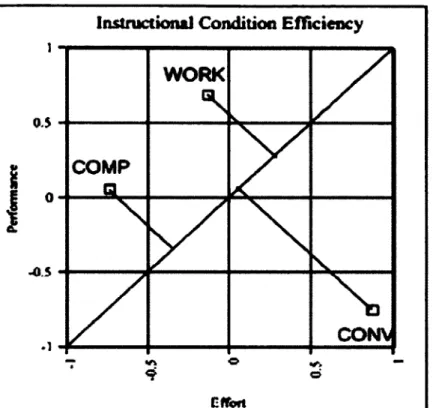
performance. Mental efficiency can be visualized using graphical representations. When considering these graphs, one should note that the instructional conditions located above the diagonal line (mental effort = performance) have greater relative efficiency scores because they have a higher group performance with lower invested mental effort (Paas & van Merrienboer, 1993). Conversely, low instructional efficiency (below the line) is the result of low task performance and high mental effort invested (Tuovinen & Paas, 2004). Figure 1 represents relative instructional condition efficiency for the three conditions: conventional problem-solving, worked examples, and completion problems, obtained based in the results o f the experiment presented in Table 2, as adapted from Paas and van Merrienboer (1993).
Instructional Condition Efficiency WORK 0.5 COMP 41.5 CONV o o _____________________________ Effort_________________________
Figure 1. Instructional Condition Efficiency. Adapted from “The efficiency of instructional conditions: An approach to combine mental effort and performance measures,” by F. Paas, and J. J. G. van Merrienboer, 1993, Human Factors, 55(4), 737-743.
Table 1
Effort-Performance and Relative Condition Efficiency Means (Paas and van Merrienboer, 1993)
Instructional condition Effort Performance
Relative condition efficiency Conventional 0.87 -0.75 -1.15 problems Worked examples -0.13 0.69 0.58 Completion problems -0.74 0.06 0.57
Note. Adapted from “The efficiency o f instructional conditions: An approach to combine mental effort and performance measures,” by F. Paas, and J. J. G. van Merrienboer, 1993, Human Factors, 35(A), 7 3 7 -743.
The perpendicular distance from the neutral efficiency condition (diagonal line) where effort equals to performance to each o f the points plotted in the effort-performance coordinate system, according to the group effort and performance means, represents the efficiency values for each group. As shown on the graph, the conventional problem
19
solving group demonstrated the lowest efficiency, as compared to worked examples and completion problems that have demonstrated almost equal efficiency.
Van Gog and Paas (2008) revisited the formula for the efficiency o f instructional condition that was adapted with some modifications to the original one and strongly recommended studies to use the original formula. The authors gave two important recommendations to researchers analyzing efficiency o f an instructional condition that decrease extraneous load and increase germane activity: (1) use the 9-point rating scale based on perceived amount of invested mental effort, rather than a 7-point perceived task difficulty rating scale; and (2) use mental effort rating scale and performance scores during the testing phase, rather than mental effort during the learning phase and
performance scores for the testing phase. Van Gog and Paas analyzed commonly used practices in obtaining subjective mental effort measures and concluded that the 9-point mental effort rating is a more precise instrument for measuring total cognitive load than widely adopted 7-point rating scale (e.g., Kalyuga, Chandler, & Sweller, 1998, 1999, 2000, 2001; Moreno & Valdez, 2005, as sited in van Gog & Paas, 2008) asking participants not to rate mental effort, but to rate how difficult they perceived the task. The authors explained that although the concepts o f invested mental effort and perceived task difficulty are related, asking students to rate how much mental effort they invested in completing the task versus how difficult they perceived a task are two different questions that can lead to different interpretations. According to van Gog and Pass, the first
question (invested mental effort) pertains to a process, and the perception will likely involve more aspects than only the task itself, whereas the second question (perceived task difficulty) pertains mainly to the task. Therefore, questions o f perceived task
difficulty in comparison to invested mental effort will most likely lead to nonequivalent ratings, presumably on the extreme end of the scale. For example, Paas, Tuovien, van Merrienboer, and Darabi (2005) have shown that when learners perceive a problem to be extremely difficult, they may not be motivated to invest much effort into it.
Van Gog and Paas (2008) explained that measures o f mental effort in combination with performance measures during the task performance provide researches with a better indicator of the quality of learning outcomes. For example, in case of the study that aims to reduce extraneous and intrinsic cognitive load and increase the use of germane
resources, it is expected that learners in the treatment condition would require more mental effort investment during the learning phase. One could expect that because this effort was invested in learning, higher performance score and a less mental effort on the test compared to non-treatment group. However, if the invested mental effort was only measured during the learning phase it could be higher than during the actual test, and therefore efficiency o f instructional condition will result in incorrect lower numeric value. Although efficiency of instructional condition was not measured in Sliva,
Morrison, and Watson (2011) study, the presented argument suggests why no significant difference in cognitive load measures taken during the learning phase were found,
although the study demonstrated higher transfer test performance for the experimental condition where participants were prompted to self-explain and plant, compared to non prompted (control) condition. Although total cognitive load remained the same for both groups the control and experimental, better learning outcomes in the experimental group suggest the following explanation. Since intrinsic load was held constant for the learners with the same level o f expertise, the change in total load remained constant. Since better
21
learning outcomes occurred, the results suggest that during the testing phase extraneous load was further reduced and the use o f germane resources was increased for the
experimental group, because the use of extraneous and germane resources are defined to have opposite effects on learning: detrimental or beneficial, respectively (Ayres, 2006; van Gog & Paas, 2008).
The use of relative mental efficiency of instructional condition allows the learner to combine the effort invested during performance with the actual performance on a test. This effect, in turn, allows the researcher to compare instructional formats not only in terms o f their effectiveness but also in terms of their efficiency. A number o f studies have demonstrated the added value o f the efficiency measure by showing that differences in the effectiveness of instructional condition are not always identical to differences in their efficiency (Paas & van Merrienboer, 1994; Pollock, et al., 2002; van Gerven, Paas, van Merrienboer, & Schmidt, 2002; van Gerven, Paas, van Merrienboer, Hendriks, & Schmidt, 2003; van Merrienboer, et al., 2002).
Purpose of the Research
The purpose o f this study was to compare the use o f prompts to self-explain with and without completion problems, and conventional problem-solving practice.
Research Questions and Hypotheses
The study tested three hypotheses and asked two research questions. The following were the three hypotheses:
1. Perceived cognitive load reported by participants in two experimental conditions (i.e., prompted to self-explain and prompted to self-explain completion problems) will be
lower than perceived cognitive load reported by participants in the control condition during both learning and testing phases.
2. Participants in the two experimental conditions will perform better than participants in the control condition on quizzes and a posttest.
3. The two experimental conditions will have higher efficiency than the control condition.
The study also aimed to answer the following research questions:
1. Will the quality of self-explanations change throughout the duration o f the study for the students in two experimental conditions?
2. Will the treatment groups show a more favorable attitude towards the instructional strategy?
CHAPTER II
METHODS
Participants
Initially, 63 undergraduate students enrolled in a semester-long calculus-based introductory physics course (that is, one lecture section) at an urban university in the United States consented to participate in this study. Participants were randomly assigned to three equal groups (i.e., self-explanation, self-explanation & completion, and control groups) o f 21 students each. However, data from only those participants who completed all the work required for this study was taken in consideration resulting in adjusted self explanation (n = 19), adjusted self-explanation & completion (n=18), and control (n = 19) groups; a total of 56 participants. Participants were majors in the following fields:
computer science, chemistry, biology, mathematics, physics, exercise science, and engineering. There were no direct benefits offered for participating in this study. When students were invited to participate in this study, they were offered an opportunity to be introduced to instructional techniques that could improve their problem-solving skills.
Research Design
The study utilized 3 (between) x 4 (within) fixed-effects design. Treatments were instructional condition (self-explanation, self-explanation & completion, and control) measured weekly for the four weeks. A two-way ANOVA was used to compare three treatment conditions measured weekly over the four week study period for the following measures: cognitive load for homework assignments and quizzes; time on task for homework assignments; and performance for quizzes. A two-way ANOVA was used to compare two prompted self-explain conditions (i.e., between subjects) measured weekly over the four-week study period (i.e., within subjects) for the quality o f self-explanations
on homework assignments. Further ANCOVA was used to compare how quality of self explanations changed between two experimental groups with time (weekly submission number used a covariate). In addition, one-way ANOVA was used to compare the quality of self-explanations between the first and the last submission for each experimental group separately. The study also utilized a one-way ANOVA to compare three treatment
conditions (between subjects) as measured for one posttest for cognitive load and performance. Since efficiency score was based on normalized measures o f performance and mental effort, a simple comparison for average values o f efficiency was performed between groups. And finally, between groups comparison o f eight survey items requiring responses on a 7-point rating scale was performed using one-way ANOVA; comments to the remaining six survey items were analyzed qualitatively.
In-Class Instruction. All students participating in this study received the same
in-class instruction throughout the study. This strategy ensured that content was the same across all treatments. All students attended the same lecture together. During the initial in-class information presentation, extraneous and intrinsic cognitive load were reduced for all treatment groups in the following manner.
To reduce intrinsic cognitive load, this study utilized presentation o f information in two phases: first, the element interactivity of materials was reduced by presenting interacting elements in isolation, and second, all the information was presented in its full- complexity (Pollock et al., 2002). And a simple-to-complex sequence with general
supportive information presented first, before an equivalent learning task (van Merrienboer et al., 2003) was used.
Extraneous cognitive load during the lectures was reduced by using integrated text and diagram formats in the PowerPoint slides, avoiding presentation of redundant information, and using audio and visual modalities to present mutually referring textual and pictorial information (i.e., the instructor also drew diagrams and simultaneously verbally explained the interrelations between the elements in these diagrams), as suggested by Sweller et al. (1998). In addition, to support acquisition o f problem solving skills, worked examples were integrated into class presentations (Sweller, 1999). Unique worked examples were designed by the instructor and were different from
assigned homework problems.
T reatments
All participants were assigned the same seven homework problems each week. The following paragraphs explain how the treatments differed.
Control Treatment. The control group was simply instructed to solve homework
problems and did not receive any explicit prompts or partial solution. For example, for a unit on the conservation o f energy, students were asked to solve the following problem at home: A spring of constant k=340 N/m is used to launch at 1.5-kg block along a
horizontal surface whose coefficient of sliding friction is 0.27. If the spring is compressed 18 cm, how far does the block slide?
Self-Explanation Treatment. Participants in this group received the following
prompts to self-explain: (1) name the topic you are investigating; (2) state the general principle that can be used to solve this problem; (3) write down the formula for that principle; (4) adjust this formula for the specific situation and name each component of the obtained formula; (5) using the results o f the previous step, derive an equation or a
system of equations for solving the problem; (6) solve that equation or a system of equations for the unknown variable, and find a numeric answer; and (7) check your answer in terms o f measurement units and from a common sense point o f view. For example, the final prompt for checking answer in terms o f measurement units was, “To check the measurement units means to confirm that the units derived from a final algebraic solution correspond to the measurement units, in which to-be-found value is measured.” According to the instructor o f the course, students do not check measurement units on the regular basis, if they are not specifically instructed to do so. Participants in the self-explain condition received initial training in how to self-explain. This training consisted of a PowerPoint tutorial in which each o f the steps of self-explanation activity was outlined and helpful hints on how to better self-explain were provided. This tutorial can be found in Appendix A.
Self-Explanation & Completion Treatment. Participants in this group were
given partial solutions to the problems in addition to the prompts to self-explain. Completion problems were posted weekly in a special section of Blackboard for the prompted self-explain completion group. Other treatment groups could not view these problems. A partial solution was designed to help students in identifying the goal state of the problem. Such help could be in the form of formula(s) for the principle for solving the problem and formula(s) for the application o f that principle to a specific task (i.e., operands to use in algebraic form). All other intermediate solution steps and the final answer were omitted requiring learners to complete the solution. For example, self explanation & completion group was assigned the same problem on conservation of energy. Participants in this group could see the following partial solution on Blackboard:
27
A K + A U = Wnc
1Ue = —k x
2
e 2K
=- ^ t mgL
Participants in this group were also directed to follow the same seven-step prompts as asked of the self-explanation group and received the same initial training on how to self explain.
Example handouts for each group can be found in Appendix B. Sample homework submissions for each of the groups can be found in Appendix C.
During the semester, all students enrolled in a calculus-based introductory
Physics course were required to do their homework online. Students were presented with the problem in multiple choice question format with answers in a numeric form. Students were directed to solve the problem with pencil and paper and then select an answer that best represented their solution from the answer options. Since students had multiple attempts to find the right answer, such practice often resulted in guessing instead of solving the problem. Although the instructor required a specific format for solving problems, he had no control over students' problem-solving practice at home. During this study, participants were required to write down their solutions on paper and submit them to the researcher, as opposed to simply selecting the answer, which could result in better quality solutions, regardless of the treatment group. However, participants prompted to self-explain were presented with the general systematic approach on how to solve physics problems. Participants prompted to self-explain completion problems were provided with both a partial support in identifying the goal state and a systematic approach to
solving problems. In contrast, the control group might be more likely to implement a means-ends analysis (Sweller, 1988).
Instruments
The following is the description of instruments that were used to measure quiz- and post-test performance, cognitive load, efficiency, quality of self-explanations, and learners' attitude towards the instruction.
Quizzes. Four weekly quizzes were administered to all participants during this
study. At the start of the week following the instructional presentation and submission of homework, all students were given a closed-book and closed-notes quiz based on the materials presented during the previous week. Students had 20 minutes to complete the quiz.
Quiz design. This quiz consisted of one problem with five sub-questions each requiring free response. From these five sub-questions, one measured comprehension, two sub-questions measured near transfer, and two sub-questions measured far transfer.
Quiz grading. Quizzes were graded by the course instructor. A total o f 22 maximum points could be awarded for the quiz that is two possible points with no partial credit for the sub-question measuring comprehension, and five possible points using partial credit for each near and far transfer sub-question. The rubric that was used to assign partial credit (as adapted from the course instructor) can be found in Appendix D. Quizzes [1-4] produced Cronbach’s Alpha coefficient varying between 0.72 and 0.74 (i.e., 0.72, 0.74, 0.72, and 0.73, respectively).
Posttest. At the end o f the fifth week counted from the day the study began, and
29
posttest based on eleven instructional objectives covered during the four preceding weeks of the study. This test was adapted directly from the instructor's practices.
Posttest design. The posttest consisted o f 11 problems that included four rote level problems testing recall; four problems similar to those used for weekly quizzes testing near and far transfer of performance, as well as comprehension; and three story problems specifically testing far transfer, as well as learner's ability to translate a word problem into physics context. Rote level problems were presented in a multiple-choice format, and the remainder of the problems required free responses. Some o f the problems consisted of several scored elements resulting with a total o f 27 items on this posttest. Students had 1 hour and 50 minutes to complete this test.
Posttest grading. A posttest was graded by the course instructor. Rote level problems were worth one point each without a partial credit option for a maximum of four points possible. Partial credit for the four near and far transfer problems was awarded in the same manner as for the quiz problems (see quiz grading). Each story problem was worth a maximum o f 10 points. The rubric for the score awarded for the story problem can be found in Appendix E. And the summary of the posttest grading can be found in Appendix F.
The maximum score for the posttest was 122. Scoring consisted o f a maximum o f four points possible for recall, eight points possible for comprehension; a maximum o f 40 points possible for the near transfer; and a maximum of 70 points possible for the far transfer. A posttest grade was calculated as a percentage o f total points awarded out of maximum possible points. Cronbach’s Alpha for the test was 0.84.
Cognitive Load Measures. Cognitive load measures were taken after
completion of each homework problem, each quiz, and for after solving each posttest problem resulting in 43 measures of cognitive load for each participant. Participants in each treatment condition were instructed to rate their invested mental effort on a 9-point Likert-type scale, as adopted from Paas (1992). To rate invested mental effort, students were asked: “How much mental effort did you invest in solving this problem?" and rate their responses froml (very, very low) to 9 (very, very high) on a 9-point scale. Example of the scale is provided below:
1---2--- 3--- 4---5--- 6--- 7--- 8--- 9
very, very,
very low very high
Figure 2. Likert Scale for Invested Mental Effort.
The following table explains how many cognitive load measures were recorded for each participant on each task. Each recording was treated as an individual score. Cognitive load measures were calculated as mean values.
Table 2
Measures o f Cognitive Load
Task Number When Measured Total Recordings Total
Homework 7 After each problem 4 28
Quizzes 1 After completing quiz 4 4
Posttest 11 After each problem 1 11
A total of 63 students participated in this study. However, only data from 56 participants were used for the purpose o f this study because data from seven participants were incomplete or missing. The following table explains how many participants failed to
31
provide cognitive load measures, the reason for that failure, and a total number o f participants whose data were collected and used in this study.
Table 3
Measures o f Cognitive Load Recorded fo r Each Participant
Number o f Number o f Number o f participants failed to participants reported
Task participants accomplish Reason in the study
Homework 1 Reported 1 CL
measure on
submissions 1 and 2
Quizzes 5 N ot all 4 quizzes
taken
Posttest 1 N o CL measures
reported
Total 63 7 56
A total of 43 cognitive load measures were recorded for each of the 56 participants on a 9-point Likert scale, resulting in a total of 2,408 recordings. Cronbach’s Alpha for the rating scale combining all cognitive load measures was 0.89.
Additional Data: Efficiency Measures
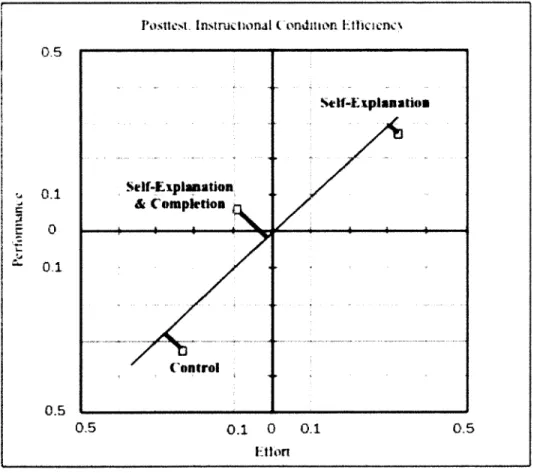
The efficiency of instructional condition scores (as adopted from Paas & van Merrienboer, 1993) were calculated based on measures o f participants’ performance on the quizzes, posttest, and self-reported measures o f mental effort. For the four quizzes, each student’s score on each quiz was combined with self-reported measure o f cognitive load for the quiz. For the posttest, each student’s score on each posttest problem was combined with the self-reported measure of cognitive load for that problem. Efficiency o f instructional condition was calculated in the following way. First, both student’s performance measure and invested into that performance mental effort measure was standardized, yielding in each participant’s z-score for performance and a z-score for the
invested mental effort. Second, instructional condition efficiency score was computed for each student, using the following formula:
Z — Z
*-» performance m enial _ effort
E
---For each student, one efficiency measure was calculated for each quiz (a total of four quizzes) and 11 efficiency measures were calculated on a posttest.
Time on task. Since time on task was limited for quizzes (i.e., 20 minutes) and a
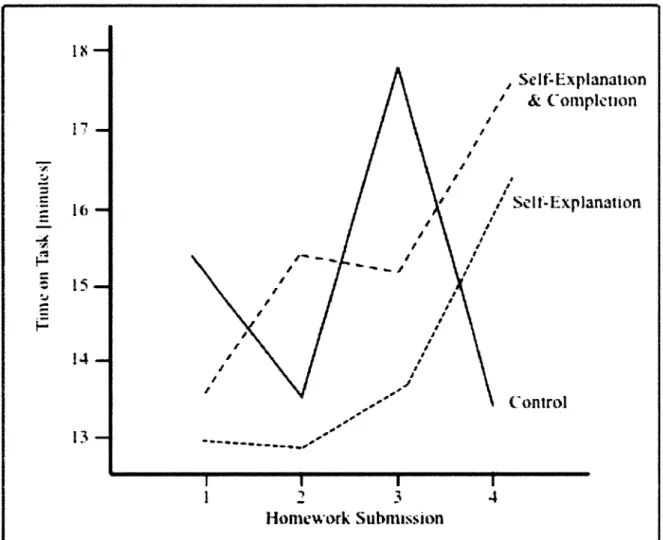
posttest (i.e., 1 hour and 50 minutes), time on task measures were only obtained for homework submissions. After completion of each homework problem, participants in all four treatment groups self-reported the time they spent solving the problem. They were asked: “How much time did it take you to solve the problem?” and recorded time in hours (if applicable) and minutes. For each student, seven time measures (minutes spent on each problem) were recorded for each homework submission (a total of four weekly submissions).
Quality of Self-Explanations Measures. To obtain a score on the quality o f self
explanations, two independent raters evaluated each of the seven homework problems submitted across the four homework assignments by the participants in the self
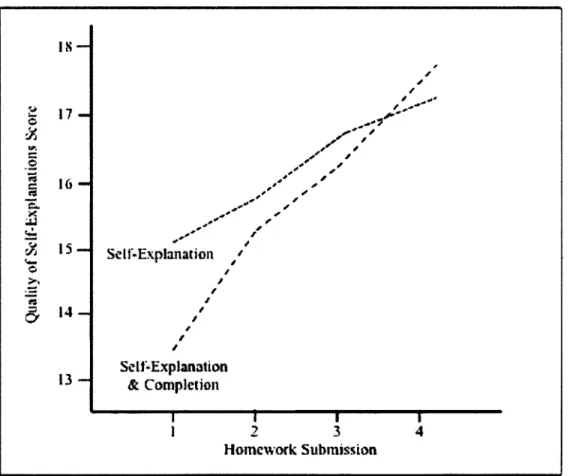
explanation and self-explanation & completion groups. A rating of zero to three was assigned to each of the seven prescribed self-explanation steps ranging from no points when no attempt was made to complete that step to points o f one, two and three to represent a failed attempt, a partially correct attempt, and a completely correct attempt, respectively. Points from the seven steps were added together for a total score o f 0 to 21, adapted from Sliva et al. (2011) study. This rubric can be found in Appendix G.
33
Two raters were recruited from TAs working with the course instructor during the semester. They received initial instructions on how to evaluate homework submissions for the quality of self-explanations on the first week o f the study. The researcher was available to meet with raters during the study to discuss any questions or concerns. Inter rater reliability was assessed using Cronbach's Alpha coefficient. Cronbach’s Alpha estimated the correlation between two independent raters and allowed to interpret the result as an estimate o f interrater reliability. For this study, Cronbach’s alpha coefficient of 0.96 (alpha>0.90) suggested excellent agreement between raters. One quality of self explanation score was assigned for each student on each submission. This score was calculated as a median value of all quality scores measured by both raters on all problems for that submission. Cronbach’s Alpha for the instrument measuring quality of-self- explanation score in this study was also 0.96.
Attitude Survey. A 15-item attitude survey was administered immediately
following the posttest in order to better understand the participants’ attitude toward the instruction. In the survey, participants were asked to report their treatment group and then asked to rate their overall agreement on a 7-point Likert-type scale ranging from
"strongly agree" to "strongly disagree" for eight statements related to the effectiveness of the treatment, changes that it may have induced, and the likelihood that the participant would continue using this method in the future. The scores for these Likert items were calculated as means. Cronbach’s Alpha for these eight items was 0.93. In addition, participants completed six open-ended response items regarding what they especially liked or disliked about the study and any other thoughts or comments about their
experiences with the instructional method. Open responses were interpreted qualitatively. A copy o f the survey is located in Appendix H.
Procedure
The research was conducted during a six-week period in the fall semester of 2012, starting approximately three weeks after the start o f the semester. Students met with their instructor twice a week for a 1 hour and 50 minute lecture. Approximately one week prior to the study, the researcher introduced the study to the class and distributed and collected Informed Consent Forms. The copy o f the Informed Consent Form can be found in Appendix I. Consenting participants then were randomly assigned to one o f three treatment groups. Participants were not explicitly told to which treatment group they were assigned and groups were coded as A, B, and C to minimize their knowledge of the treatments.
Participants in the two self-explain treatments received training on self
explanations during the last 15 minutes of the lecture prior to the beginning of the study. PowerPoint tutorial on how to self-explain used for this training was available to
participants in the two experimental groups on BlackBoard throughout the duration o f the study. For the first homework assignment consisting of seven problems, participants in all three treatment groups received handouts with detailed instructions on how to prepare and submit homework assignments. In addition, examples on how each group had to submit their homework assignments were posted online separately for each treatment group. Participants were required to review self-explanation tutorial prior to submitting the first homework assignment. Participants were also required to follow the instructions in their handouts while working on their first homework assignment. During subsequent
35
study weeks, handouts and examples were available separately online to each treatment group and participants were asked to review these when working on homework
assignments.
The same in-class instructions were used for all the treatment groups with all participants attending the same lecture (i.e., at the same time), thus there was no
variability in the lecture instruction. The instructor delivered instructional materials and demonstrated worked examples in the same manner for all students during the lectures. The researcher was present at all lectures to record any variations in the amount of explanations provided by the instructor in class to ensure that lectures were not designed in favor of self-explanation technique.
During the lectures, the instructor introduced facts, concepts, and principles to all students together in the same auditorium. After a brief introduction of historical facts, the instructor presented students with formal definitions of the concepts, pointed out their critical attributes, and compared and contrasted these attributes for closely related concepts. During the lecture, the instructor used the RULEG approach. When using RULEG, the instruction begins with the statement of the rule or principle that explains the relationships between concepts that is further followed by the application o f this rule or principle (Morrison, Ross, Kalman, & Kemp, 2011). In this study, application of the rule or principle consisted of multiple worked examples. The number o f worked
examples demonstrated in class varied dependent on topic complexity and available time. These worked examples were presented to all students using the format the instructor requires for solving physics problems in his class: (1) state what is given and what needs to be found, (2) create and label a related diagram, and (3) solve the problem