171
Towards Coupled Interaction - Practical Integration of Physiological
Signals
Inês Oliveira, Luís Duarte, Nuno M. Guimarães, Luís M. Carriço and Ovidiu Grigore Keywords: Physiological Signals, Interaction Design, Coupled Interaction
Abstract
The search for usable systems has highlighted design criteria like adaptiveness or accessibility support. The systemic view of interaction, encompassing the human user, artifacts, language, methodology and training, influenced the design principles of past and current systems. How-ever, users have been taken as black boxes, communicating with the machine through more or less sophisticated languages. The recognition of cognitive or emotional status of the user and its integration in the interaction design is the basis of the coupled interaction notion, a view of the structural coupling concept derived from more general system theories.
A dimension of this coupling strategy is the integration of human physiological signals. Rea-lizing the constraints of current systems, this paper describes technical experience gained from the use of EEG (electroencephalography) for evaluation of “reading” tasks and from the use of ECG (electrocardiography) information as an input modality, and tries to build an integrated view for interaction design with these physiological multimodalities.
Introduction
HCI has evolved in multiple directions but, in spite of the innovative interaction opportunities, the integration of the intrinsic human status has not been considered with a comparable level of depth. The consideration for the physical/physiological (phy-) state or information of a human user can be a fundamental element in the interaction and in the overall experience design.
The evolution of acquisition technology for human phy- information (like EEG, ECG or dermal activity, EDA ), the accuracy of the processing techniques, and the understanding of the mapping between “human phy- features” and cognitive activities (sleep, reading, math reason-ing, stress or fatigue) build up a framework for design and development of “coupled interaction environments”. The notion of coupled interaction is inspired by theoretical concepts of human cognition and systems interaction, such as the ones described in (Maturana H., and Varela, F. 1987) and contextualized for systems design in (Winograd, T. and Flores, F., 1986).
In this paper we discuss practical dimensions related with the integration of phy- signals in interactive systems. These dimensions were identified in simple experiences with EEG and ECG signals. The experiences were designed to demonstrate the value of this integration, but also to set up platforms that allow us to engineer coupled systems and applications.
The next section provides a systematic overview of design and development issues that we encountered in our experiences. The following section briefly describes two samples applica-tions, which provide examples for the brief review of the design issues that follows. We con-clude with a summary of lessons learned so far and prospects for future designs.
Problem Dimensions and Critical Factors
The integration of phy- signals in interactive designs is constrained by a number of factors that have to be harnessed. We group these into five classes: (a) Set up and acquisition, (b) Processing methods, (c) User heterogeneity, (d) Task context, and (e) Level of intrusiveness.
Set up and Acquisition
Phy- signals reflect global and persistent, as well as local and instantaneous conditions of the user. The acquisition devices are based on the capture of sensitive electrical activity generated in the user’s body. The electrode configuration, signal quality, and stability in acquisition pro-cedures, is a critical factor when reliable conclusions are sought. Moreover, experience in the acquisition of phy- signals comes from clinical settings or controlled experiments, which tend to isolate specific user features and extract “in vitro” results, as opposed to “in vivo” data1
Processing Methods
.
Much of the opportunities for integration of phy- information in interactive systems derive from progresses in signal processing methods and capacity. The growing computing capacity, together with advances and experience in machine learning algorithms allow the construction of feasible and tractable feature detection and classification solutions. The flexibility of the signal processing methods is also relevant as a trade off to the signal quality limitations and constraints that are imposed by the “in vivo” situations and that we mentioned above.
User Heterogeneity
User heterogeneity is a known and basic factor in human computer interaction and usability engineering. The integration of phy- signals highlights this heterogeneity in very specific as-pects. Each user has its own phy- profiles and therefore personalization procedures are to be expected in most interactive designs relying in such information. Gender, age, task experience, and training induce heterogeneity in the reference patterns.
Task Context
The central purpose of the integration of the phy- signals is the determination of a given cogni-tive state in the context of task, to achieve better adaptation and improve the user experience. Real world tasks are usually multidimensional and affect the values of the phy- signals in dif-ferent ways. A reliable conclusion on a given cognitive state based on a finite set of tractable
phy- signals requires a high level of certainty on the relevant features and the elimination of the task-related artefacts.
Level of Intrusiveness
Several types of phy- signals require electric devices to be connected to the user. Even with growing application of wireless technology (ECG/HR devices or EEG caps using Bluetooth connections), there is still a compromise to be made between the level of device intrusiveness that the user is willing and able to support and the effectiveness of the interactive design. In any case, a fundamental concern is the design and development of less and less intrusive technology and techniques, which match the “in vivo” characteristics of real world interactions. The trade off is, as with other factors mentioned above, an increase in uncertainty and more strain placed in the robustness requirements of the signal processing methods.
1
Sample Applications
To explore the integration of phy- signals, a set of sample applications was developed. We de-scribe two of them briefly.
Assisted Reading
Reading activity is a good indicator of the user concentration while interacting with an applica-tion. Users will stop reading if they feel disturbed, confused, lose their interest, or even if the application visual characteristics disturb its legibility. We developed two basic assisted reading applications that demonstrate the above experiments: ReadingTester and ReadingScroller.
ReadingTester tests a “reading event script” in real time. An event script is a sequence of events with certain duration that are generated by the application.
Fig. 1: ReadingTester (a) Set Up, (b) Text Page (c) Script Screen (d) ReadingScroller
The subject is exposed to the events, while its EEG is captured and analyzed. Only two types of events are being considered: blank_screen and show_text. Fig. 1(a) shows application while a news text is being displayed. The application builds a report with performance measures when the detection process stops and can also record the EEG signal and test events against a previously recorded file. ReadingScroller (fig. 1d) controls text scrolling through EEG signals: while the user is reading the text scrolls, and it stops scrolling if the user stops reading.
Physiological Rhythm Game (PRG)
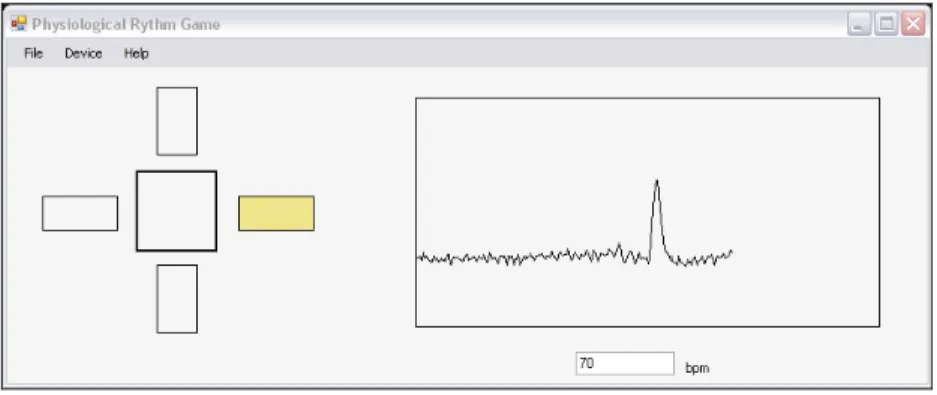
The PRG is a demo based on the Quick Time Event (QTE) gameplay concept used in video games. Instead of using traditional input devices, we used a device integrating a 3-axis accele-rometer and an ECG/HR2
Fig. 2 shows the PRG’s interface. The left part shows the five different inputs. A yellow color requests the user to react accordingly. After the reaction, a red or green color corresponds to a . PRG features five inputs (up, down, left, right and center) which users have to perform in order to earn points. These inputs are performed by tilting the accele-rometer upwards, downwards, left, right or forward, respectively. Incorrect or absent input de-creases the player score. The rate of input requests depends on the player’s current HR. As an example, if the player’s HR rate is greater than 90bpm, requests are generated every 0.5 second, and if the HR is lower than 61bpm, requests occur every 1.5 seconds. The time the user has to answer to the stimulus also varies according to the HR.
2
wrong or correct reaction. The right side shows the ECG and the current HR (which can be hidden as some researchers argue that they can negatively influence the users).
Fig. 2: Physiological Rhythm Game (PRG) Interface.
Experience with Critical Factors
Set up and Signal Acquisition
EEG signals were captured using a 16-channel low cost device3
The set up of the capture equipment is nevertheless complex. All the requirements indicated by suppliers and technicians were fulfilled, and we gathered a significant set of reliable sam-ples. The captures included grounding the subjects, replicate the experiment using medical capture devices (at a Hospital EEG installation), and validate results by EEG technical experts. Setting up any EEG capture requires putting conductive gel and measuring each electrode’s impedance. With a low cost device/software, this operation is done manually with a multime-ter
connected to a PC/SCSI-interface. The channel amplification is referential to the ear electrodes, meaning that the signal is amplified 32000x in relation to the value in the ears lobes. MindSet channels are connected to an electro-cap – an electrode application technique made of an elastic fabric with pure tin electrodes (sensors). The electrodes are positioned using the International 10-20 method. The signal is captured with 256Hz sample rate.
4
. A balanced impedance, lower than 6000Ω (a threshold defined by the cap manufacturer), in all 16 electrodes must be obtained (with more or less gel, meaning lower or higher imped-ance, respectively). Impedance depends on subject-specific characteristics such as skin conduc-tivity or hair type.
ECG/HR values come from a 300 Hz sampling device (AliveTec), with a range of [-2.66 mV, +2.66 mV]. The accelerometer data has a sampling rate of 25 Hz, where each sample includes three (3) values, one axis, measuring acceleration relative to g5
Processing Methods
[-2.7g, 2.7g]. Set up is much simpler in this case but gel and two adhesive electrodes have to be applied to the user’s chest.
The ECG/HR processing was minimal since the detailed features of the ECG wave-forms were not addressed in the sample applications.
The EEG processing however was a critical factor. As described with further detail in (Olivei-ra, I. et al 2009), we used a KNN classifier6 , together with a PCA7
3
MindSet-1000
reduction of the feature
4
Other EEG devices include an impedance checking application
5
Gravity acceleration
6
K-Nearest Neighbor, SPRTOOL MATLAB Toolbox, http://cmp.felk.cvut.cz/cmp/software/stprtool/index.html, 2009
7
vector (a feature vector in EEG is directly related with electrodes and rhythms). The setting of the K- parameter in the KNN classifier was chosen after an analysis of a sample set and the determination of the value that generated a minimal error rate (K=5 in our case). The PCA analysis led to a feature reduction to the order of thirteen (13). Overall, the reading detection, with a low cost device and in the normal conditions of the computing lab, could be achieved with an average error rate of 10.13%, a precision rate of 95.29% and a recall rate of 83.11%. These values are promising but still have to be confronted with harsher “in vivo” factors, like real time operation and further feature/electrode reduction, incorporating further results like the ones reported in (Bizas et al, 1999).
User heterogeneity
The simplest ECG features are relatively uniform across users, but the HR at rest of each individual user is clearly a personal characteristic. The PRG application has to take this base reference as a variable value.
In the EEG experiences, all data was recorded without previous training on three (3) distinct subjects, all right-handed, ages 30 to 50, two males, and one female, Caucasian and with no relevant vision disabilities. The female was the main subject having about 20 experiment trials. Men were tested once for comparison purposes. We kept a journal about the impedance, envi-ronment conditions, subjects’ degree of sleepiness, and time of day. We did not fully meet the impedance requirements with the male subjects (in one the values rounded 10000Ω, and 7000Ω in the other). Skin conductance is influenced by factors like the amount of hair, usage of hair products such as gel, or even race-dependent type of hair. The female subject was, in fact, the subject with more hair and was considered having an excellent skin conductance by an EEG technician while subjected to a similar experiment in a clinical environment.
Task context
The task context imposes side effects in the acquisition of phy- signals. In our case, the objec-tives of building the assisted reading tools, like the ReadingScroller. This interface raised sev-eral problems that have to be addressed in future. First, the objectives of the task characteriza-tion guide the signal processing targets. In the case of ReadingScroller, we require a one class classifier, which has proven to be more complicated to train and tune then a two-class one. Second, the peculiarities of the tools design have to taken into account to minimize the interfe-rences with the signal acquisition and processing. In the case of the ReadingScroller, the text is always moving making it cumbersome and even difficult to actually stop reading.
In general, phy- based interaction designs are highly sensitive to the physical and cognitive side effects of the task contexts. Muscular activity, physical or mental fatigue, multiple and concurrent stimuli, have to be, whenever possible, filtered out by the appropriate signal choices and processing options.
Level of intrusiveness
As we mentioned above, the level of intrusiveness of the capture devices in the user situation is a critical factor to the design decisions for this type of applications. EEG setups, even when performed in the research lab, impose a significant overhead in experience preparation. The use of EEG for interaction studies and interface enhancement as a passive BCI component (Zander, T.O. et al. 2009) is viable nowadays, and progress is to be expected in the development of more accurate, less intrusive and more portable devices.
Conclusions and Open Issues
The first conclusion that we should stress at this stage of the work is the demonstration of the actual feasibility of integrating physiological information in real life interactive systems. Read-ing activities can be detected and assisted through the acquisition and use of EEG signals, games that explore the HR can be designed and played by an accidental user.
The experiences carried out so far also lead to the conclusion that the maximal isolation of re-levant physiological information is an important requirement, to deal with artefacts related with lateral human activity and to reach appropriate levels of robustness in the classification and discrimination decisions. This isolation can be sought at several stages of the information chain, either at the capture stage (a minimal set of EEG electrodes and rhythms can be used, for example), or at the processing stage, where signal filtering and component analysis can reduce the complexity of the analysis.
The experiences raise the question of the multimodality of physical, psychological or emotion-al states as in (Dussault et emotion-al, 2005). For example, a state of stress or fatigue may well be better characterized by the conjugate of several physiological indications (on EEG or HR). This mul-timodal complementarity is an important design guideline.
The issue of “wiring” or intrusiveness will remain a major obstacle for some time. We can ex-pect wireless devices to become pervasive, like ECG/HR T-shirts8
References
, or special EEG caps (Lin, C.-T. et al, 2008). In any case, the multimodality argument reinforcing this approach, non-intrusive techniques like image-based facial expression recognition with or without infrared (IR) imaging should be considered as a complementary way to integrate the user’s physical information into the system.
Oliveira, I., Grigore, O., Guimarães, N. (2009). Reading Detection Based on Electroencephalo-gram Processing. Proceedings of the 13th WSEAS International Conference on Comput-ers, Rhodes, Greece, July 23-25, 2009, ISBN 978-960-474-099-4
Zander, T.O., Kothe, C., Welke, S. and Roetting, M. (2009). Utilizing Secondary Input from Passive Brain-Computer Interfaces for Enhancing Human-Machine Interaction. In Foundations of Augmented Cognition, LNCS, Springer, doi: 10.1007/978-3-642-02812-0 Lin, C.-T., Ko, L.-W., Chiou, J.-C., Duann, J.-R., Huang, R.-S., Liang, S.-F., Chiu, T.-W., and
Jung, T.-P. (2008). Noninvasive Neural Prostheses Using Mobile and Wireless EEG,
Proceedings of the IEEE, 96(7), July 2008, doi: 10.1109/JPROC.2008.922561
Maturana, H. and Varela, F. (1987). The Tree of Knowledge: the Biological Roots of Human Understanding, Shambhala, 1987, ISBN-13: 978-0877736424
Winograd, T. and Flores, F. (1986). Understanding computers and cognition, Addison Wesley, 1986, ISBN-13: 978-0201112979
Bizas, E., Simos, G., Stam, C.J., Arvanitis, S., Terzakis, D. and Micheloyannis, S. (1999). EEG Correlates of Cerebral Engagement in Reading Tasks, Brain Topography, 12 (2), 1999, doi: 10.1023/A:1023410227707
Dussault, C., Jouanin, J-C., Philippe, M., Guezennec, C. (2005). EEG and ECG Changes Dur-ing Simulator Operation Reflect Mental Workload and Vigilance. Aviation, Space, and Environmental Medicine, 76 ( 4), 2005.