open access
1Population Health Sciences Division, University of Dundee, Dundee DD2 4BF, UK 2Department of Mathematics and Statistics, University of Strathclyde, Glasgow, UK 3Centre for Population Health Sciences, University of Edinburgh, Edinburgh, UK 4Health Services Research Unit, University of Aberdeen, Aberdeen, UK
5Centre for Health Policy, University of Melbourne, Melbourne, Australia 6Department of Academic Primary Care, University of Aberdeen, Aberdeen, UK 7Strathclyde Institute of Pharmacy and Biomedical Sciences, University of Strathclyde, Glasgow, UK 8Information Services Division, NHS National Services Scotland, Edinburgh, UK
Correspondence to: B Guthrie [email protected] Additional material is published online only. To view please visit the journal online.
Cite this as: BMJ 2016;354:i4079 http://dx.doi.org/10.1136/bmj.i4079 Accepted: 14 July 2016
Data feedback and behavioural change intervention to improve
primary care prescribing safety (EFIPPS): multicentre, three arm,
cluster randomised controlled trial
Bruce Guthrie,
1Kimberley Kavanagh,
2Chris Robertson,
2Karen Barnett,
3Shaun Treweek,
4Dennis Petrie,
5Lewis Ritchie,
6Marion Bennie
7 ,8ABSTRACT
ObjeCtive
To evaluate the effectiveness of feedback on safety of prescribing compared with moderately enhanced usual care.
Design
Three arm, highly pragmatic cluster randomised trial.
setting anD partiCipants
262/278 (94%) primary care practices in three Scottish health boards.
interventiOns
Practices were randomised to: “usual care,” consisting of emailed educational material with support for searching to identify patients (88 practices at baseline, 86 analysed); usual care plus feedback on practice’s high risk prescribing sent quarterly on five occasions (87 practices, 86 analysed); or usual care plus the same feedback incorporating a behavioural change component (87 practices, 86 analysed).
Main OutCOMe Measures
The primary outcome was a patient level composite of six prescribing measures relating to high risk use of antipsychotics, non-steroidal anti-inflammatories, and antiplatelets. Secondary outcomes were the six individual measures. The primary analysis compared high risk prescribing in the two feedback arms against usual care at 15 months. Secondary analyses examined immediate change and change in trend of high risk prescribing associated with implementation of the intervention within each arm.
results
In the primary analysis, high risk prescribing as measured by the primary outcome fell from 6.0% (3332/55 896) to 5.1% (2845/55 872) in the usual care arm, compared with 5.9% (3341/56 194) to 4.6% (2587/56 478) in the feedback only arm (odds ratio 0.88 (95% confidence interval 0.80 to 0.96) compared with usual care; P=0.007) and 6.2% (3634/58 569) to 4.6% (2686/58 582) in the feedback plus behavioural change component arm (0.86 (0.78 to 0.95); P=0.002). In the pre-specified secondary analysis of change in trend within each arm, the usual care educational intervention had no effect on the existing declining trend in high risk prescribing. Both types of feedback were associated with significantly more rapid decline in high risk prescribing after the intervention compared with before.
COnClusiOns
Feedback of prescribing safety data was effective at reducing high risk prescribing. The intervention would be feasible to implement at scale in contexts where electronic health records are in general use.
trial registratiOn
Clinical trials NCT01602705.
Introduction
Prescription drugs significantly improve patients’ out-comes but are also a major cause of harm in both pri-mary and hospital care.1-3 Approximately one in 20
hospital admissions is caused by adverse drug events,1
and at least half of these adverse drug events are pre-ventable.4 The classes of drug most often implicated
are antiplatelet drugs (including aspirin), diuretics, non-steroidal anti-inflammatory drugs, warfarin, opi-oids, β blockers, angiotensin converting enzyme inhib-itors/angiotensin receptor blockers, and hypoglycaemic drugs.4 Mortality has most frequently been associated
with prescribing of non-steroidal anti-inflammatory and antiplatelet drugs,1 although several less
com-monly prescribed drugs also cause significant numbers of deaths, including antipsychotics in older people with dementia.5 Several consensus validated sets of
indicators of potentially inappropriate or high risk pri-mary care prescribing are available,6-9 and high risk
prescribing measured using these indicator sets is both common and variable between primary care practices (although not all such prescriptions will be inappro-priate, as benefit will outweigh risk in at least some patients).10
Compared with hospital based studies, relatively few trials have looked at interventions to improve safety of
WhAT IS AlReAdy knoWn on ThIS TopIC
Extensive evidence shows that audit and feedback is an effective intervention across a range of healthcare contexts and outcomes with small to moderate effects on the targeted quality or safety measure
Little evidence exists for the effectiveness of feedback in the context of prescribing safety, and more generally older audit and feedback trials were often
methodologically limited
WhAT ThIS STudy AddS
This study used an intervention intended to reduce high risk prescribing, with comparison of different feedback formats (feedback only (arm 2) and feedback plus a theory informed behavioural change intervention (arm 3))
There was no evidence that a simple educational intervention with enhanced support for searching (usual care arm) significantly reduced the targeted high risk prescribing
prescribing in primary care, despite primary care physi-cians in most developed countries being responsible for prescribing most community dispensed drugs. Much previous research has focused on pharmacist led inter-ventions, although the effect of such interventions is variable and sometimes negative, at least partly owing to lack of integration with existing primary medical care.1112 The PINCER trial found a statistically and
clinically significant reduction in targeted high risk prescribing in a UK primary care context from imple-menting an intervention combining educational out-reach, feedback, and pharmacist led review of patients receiving high risk prescribing.13 More recently, the
DQIP complex intervention comprising educational outreach, informatics to identify patients and support general practitioner led review, and small financial incentives to review was shown to reduce high risk pre-scribing of non-steroidal inflammatory and anti-platelet drugs in UK primary care by approximately one third and was associated with significant reductions in emergency hospital admissions for gastrointestinal bleeding and heart failure.14 However, complex
inter-ventions such as PINCER and DQIP are relatively diffi-cult and expensive to implement at scale.
Audit and feedback is an attractive intervention from this perspective because countries and health systems are increasingly creating comprehensive patient level datasets from electronic prescribing or electronic medical record data. In this context, feed-back is relatively inexpensive to implement across whole systems, potentially allowing expensive inter-ventions to be deployed more selectively. The 2012 Cochrane review of trials of feedback found good evidence that feedback is effective, but with a wide range of observed effects across studies.15 Although
feedback interventions targeting prescribing were in general more effective than those targeting other outcomes, only three trials included in the review examined the effect of feeding back data on safety of prescribing (two targeting benzodiazepine use1617
and one targeting risky non-steroidal anti-inflamma-tory drug use18 ). None found feedback to be effective
in reducing high risk prescribing, although only one trial was judged to have low risk of bias, emphasising that the evidence base for feedback is weak in the con-text of prescribing safety.15
We aimed to add to the limited evidence about the effectiveness of feedback of data on prescribing safety and to fill gaps in the broader evidence about feedback identified by the most recent systematic review by car-rying out a large trial (EFIPPS) of an intervention devel-oped using both theory and empirical evidence to design the intervention in collaboration with clinicians and with comparison of different feedback formats, clearly defined primary outcomes, and adjustment for baseline performance.15 We therefore developed two
theory informed formats for feedback on prescribing safety and tested their effectiveness at reducing high risk prescribing to patients compared with emailed educational material in a three arm cluster randomised trial in 262 primary care practices in Scotland.
Methods
study design and participants
The study was a three group, parallel arm, pragmatic, cluster randomised controlled trial, described in more detail in the published protocol.19 Cluster
randomisa-tion was appropriate because feedback of high risk pre-scribing data was at practice level. Practices were eligible if they were located in one of three Scottish health boards (geographically defined administrative organisations in the National Health Service in Scot-land), if their registered list size was at least 250 patients (all practices smaller than this are unusual in the patients served—for example, by serving only homeless people), if at least 93% of their prescriptions could be linked to individual patients, and if they were estab-lished before 1 January 2011. Practices were excluded from follow-up or analysis if they ceased to exist during the trial or if they merged with a practice from a differ-ent arm during the trial.
Decisions about individual patient care remained the sole responsibility of the practice and the individual general practitioners working in it, so consent by patients was not required. No changes to the protocol, eligibility criteria, or outcomes occurred after the trial started.
randomisation and blinding
Practices were randomised to each arm on a 1:1:1 basis. As all practices were randomised at the same time, bal-ancing the allocation sequence was unnecessary, but randomisation was stratified by participating health board (three strata, as boards have a remit to ensure that general practice prescribing is effective, safe, and value for money but vary in the amount of prescribing support provided to practices) and baseline high risk prescribing as measured by the primary outcome (in thirds). The trial statistical team used a random number generator to randomise each practice to one of three groups, and the Tayside Clinical Trials Unit inde-pendently carried out random allocation of each of these groups to the three trial arms. The project team were blinded to the allocation during the conduct of the trial. Practices were not formally blinded; however, as they were not asked for consent, practice staff were not aware that they were in a trial. All outcomes were mea-sured using routinely recorded dispensed prescribing data by using pre-defined indicators, neither of which could be influenced by practices (except by changing their prescribing) or the research team. The trial statis-ticians were blinded for data cleaning and analysis.
interventions
A detailed description of the development of the inter-ventions and examples of study materials has been pre-viously published.20 The two interventions evaluated
At the start of the trial, all practices received a short educational newsletter describing the targeted high risk prescribing and recommending that practices review patients at potential risk; this was similar to existing NHS Scotland material regularly sent to practices. NHS Scotland Information Services Division sent the educa-tional newsletter (appendix 120), which included a link
to a webpage with downloadable searches to facilitate identification of patients in practices’ electronic medi-cal records and further information about the targeted prescribing. Practices in arm 1 received only the educa-tional newsletter, which is routine practice in NHS Scot-land, plus support for searching, which is not routine. The arm 1 comparator against which the two more active interventions were evaluated was therefore mod-estly enhanced “usual care,” chosen to reflect a simple to implement “best practice” comparator and to over-come health boards’ concerns about identifying poten-tially risky prescribing and doing nothing whatsoever about it.
Practices in arm 2 (feedback) were additionally sent feedback of their rate of the targeted prescribing bench-marked against the rate achieved by the 25% of Scottish practices with the most optimal rates in the year before feedback started. The choice of benchmark represents current practice in NHS Scotland to use a “best in class” comparison rather than mean or median performance. Feedback design drew on knowledge of factors associ-ated with greater response and included both presenta-tion of graphical data showing change over time versus
the benchmark and a written explanation of why the indicators were important and what actions practices should take in response. Feedback of practices’ rates of the six individual measures of high risk prescribing was sent quarterly by email for five rounds for the year June 2012 to June 2013, with the email signed by senior staff in the health board and NHS Scotland Information Ser-vices Division. Educational material and feedback was sent to a single practice email address used by the par-ticipating health boards to communicate routinely with practices, which was either a generic practice email address (typically checked by an administrative staff member) or the address of the practice manager or a nominated prescribing lead (typically a general practi-tioner). The research team had no direct control over what recipients did with the email or attached educa-tional material or feedback.
Practices in arm 3 (feedback plus theory informed behavioural change component) received the same edu-cational newsletter and feedback, but the feedback document additionally included a one page theory informed behavioural change component intended to increase the likelihood that practices would respond to the feedback by searching for and reviewing patients receiving the targeted prescribing. We created four dif-ferent behavioural change components focused on the three domains of the theory of planned behaviour (atti-tudes, subjective norms, and perceived behavioural control) and an action planning component based on the health action process approach.2122 Each of the five
rounds of feedback contained one of these components, with the action planning intervention delivered twice. Appendix 2 gives examples of the behavioural change components, and appendix 3 gives an anonymised example of feedback including the action planning component (the feedback only arm had a blank page 2 but was otherwise identical).20
Outcomes
We selected outcomes from measures that had been val-idated in one or more recent formal consensus stud-ies,823 on the basis of their perceived importance and
their feasibility to implement using national prescrib-ing data. Selection was done by the project Steerprescrib-ing Group, which included representatives from each of the three participating health boards, NHS Scotland Infor-mation Services Division (who manage the national data), and the research team. Box 1 lists the six individ-ual indicators selected. We measured all outcomes by using routinely available dispensed prescribing data held by NHS Scotland. Measurement was at the level of the patient, using binary variables whereby, at the end of each quarter, patients with risk factors for adverse drug effects (for example, having a prescription for an oral anticoagulant) were defined as receiving or not receiving a specified high risk prescription in that quarter (for example, prescription of an oral non-steroi-dal anti-inflammatory drug without gastroprotection). The primary outcome was a binary composite measur-ing the proportion of patients particularly at risk of an adverse event from the specified prescribing who box 1: primary and secondary outcomes
primary outcome
Proportion of patients included in one or more of the defined six individual secondary outcomes (denominator) who receive any high risk prescription (numerator)*
secondary outcomes
• S1: Proportion of patients aged 75 years and over (denominator) who receive a prescription for an oral antipsychotic (numerator)†
• S2: Proportion of patients aged 65 years and over and currently treated with a diuretic and an angiotensin converting enzyme inhibitor or angiotensin receptor blocker (denominator) who receive a prescription for an oral non-steroidal anti-inflammatory drug (NSAID) (numerator) (the “triple whammy”)
• S3: Proportion of patients aged 75 years and over (denominator) who receive a prescription for an oral NSAID without co-prescription of a gastroprotective drug (numerator)
• S4: Proportion of patients aged 65 years and over and currently treated with aspirin or clopidogrel (denominator) who receive a prescription for an oral NSAID without co-prescription of a gastroprotective drug (numerator)
• S5: Proportion of patients currently treated with an oral anticoagulant
(denominator) who receive a prescription for an oral NSAID without co-prescription of a gastroprotective drug (numerator)
• S6: Proportion of patients currently treated with an oral anticoagulant (denominator) who receive a prescription for aspirin or clopidogrel without co-prescription of a gastroprotective drug (numerator)
*For all indicators, proportion is defined as numerator/denominator, usually multiplied by 100 to convert to percentage
received one or more high risk prescriptions defined by the six secondary outcomes. The outcomes pre-speci-fied at trial registration are the same as in the published protocol,19 and all are reported in this paper.
patient involvement
The study design drew on qualitative analysis of data from interviews with patients carried out during devel-opment of another intervention targeting safety of pri-mary care prescribing,25 but there was no patient or
public involvement in the study design, choice of out-come measures, or study conduct and no assessment of the burden of the intervention on patients. No patients were asked to advise on interpretation or writing up of results. There are no plans to disseminate the results of the research to study participants or the relevant patient community.
sample size
We estimated the required sample size by using the n4prop function in the CRTSize library in R,2627 with the
number of patients per practice (mean 700), the pri-mary outcome baseline rate (6.1%), and the intra-class correlation coefficient (1.26%) all calculated using the same routine dataset used to measure outcomes in the main trial. The planned primary comparisons in the study were the two intervention arms (arm 2 and arm 3) compared with usual care (arm 1) at 15 months, each to be tested at a significance level of 0.025. With 85 prac-tices randomised to each arm, the study had 93% power to detect a 25% reduction in the percentage of high risk prescribing (from 6.1% to 4.5%) between usual care and the two intervention arms at the end of the study. We chose 25% on the basis of the findings of the PINCER intervention,13 for which the closest outcome
(non-ste-roidal anti-inflammatory drug prescribing in people with a history of peptic ulcer) had a 42% reduction in odds at six months.13 We expected the EFIPPS
interven-tion to be less effective as it was less intense, so we con-sidered a 25% reduction important enough to use as the basis of the sample size calculation.
statistical analysis
We measured outcomes as repeated quarterly cross sec-tions, meaning that every measurement includes all eligible patients (permanently registered and having a risk factor for adverse drug effects from the targeted pre-scribing at the time of measurement). The main trial analysis used a multilevel logistic regression model comparing the proportion receiving a high risk pre-scription in the final quarter of the study in each arm, adjusted for two variables used to stratify randomisa-tion (health board and high risk prescribing at base-line), with the practice identifier as the clustering variable. We tested the effect of each intervention arm 15 months after the intervention was implemented sep-arately against the usual care arm at the 2.5% signifi-cance level, to control for an overall 5% signifisignifi-cance level. We used the R package lme4 to evaluate the model. To consider the change in trends over time, we used generalised estimating equations to construct a
change point model using quarterly measurement from quarter 1 2011 to quarter 3 2013. Time was centred at baseline, scaled to yearly units, and again adjusted by the randomisation stratification variables. We then modelled the change in slope as the interaction between time and study arm in the period after intervention, which was coded as a dummy variable that took the value 0 before the intervention and 1 after-wards. We evaluated the binomial generalised estimat-ing equations, adjusted for health board and high risk prescribing at baseline, by using an unstructured cor-relation structure to model the temporal corcor-relation in the observations for each practice using the R package geepack.
Results
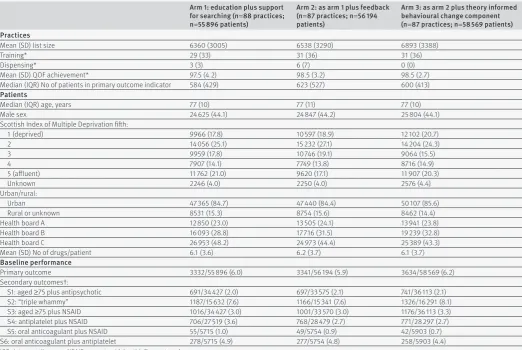
The three health boards included 278 primary care prac-tices, of which 262 (94%) were eligible for inclusion and randomised, with 170 659 registered patients particu-larly vulnerable to harm from the targeted prescribing at baseline. Four (1.5%) practices with 948 (0.6%) patients at risk at baseline were lost to follow-up owing to practices merging or splitting, and data from the remaining 258 practices were analysed (fig 1 ). Baseline characteristics of practices and patients were similar across arms. The mean age of patients at risk was 77 years, and 44% were male (table 1 ). Across all arms, 6.0% (95% confidence interval 5.9% to 6.2%) of patients particularly vulnerable to harm from the targeted pre-scribing were receiving a prescription for one or more high risk drugs at baseline, varying at individual indica-tor level from 0.8% (0.7% to 1.0%) for prescription of non-steroidal anti-inflammatory drugs without gastro-protection to people already receiving an oral anticoag-ulant to 7.8% (7.5% to 8.0%) for prescription of non-steroidal anti-inflammatory drugs to older people already receiving an angiotensin converting enzyme inhibitor/angiotensin receptor blocker and a diuretic (table 1).
At baseline, 6.0% of patients particularly vulnerable to harm in arm 1 (usual care) were receiving a high risk prescription, compared with 5.9% in arm 2 (feedback only) and 6.2% in arm 3 (feedback plus theory informed behavioural change component), falling to 5.1%, 4.6%, and 4.6% by 15 months (table 2). After adjustment for the two stratifying variables (health board and third of baseline high risk prescribing), the primary analysis found an odds ratio for receiving a high risk prescrip-tion of 0.88 (95% confidence interval 0.80 to 0.96; P=0.007) in arm 2 (feedback) compared with arm 1 (usual care) and of 0.86 (0.78 to 0.95; P=0.002) in arm 3 (feedback plus theory informed behavioural change component) compared with arm 1.
over: odds ratios of 1.01 (0.89 to 1.14) for arm 2 versus arm 1 and 1.02 (0.90 to 1.15) for arm 3 versus arm 1).
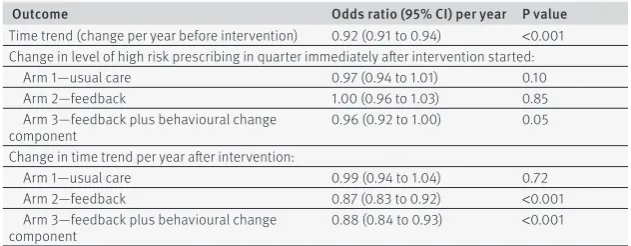
In the pre-specified secondary analysis of change in trend in the primary outcome for the three arms, we found evidence that the targeted high risk prescribing was falling before the intervention (odds ratio for change per year before the intervention 0.92, 0.91 to 0.94). The segmented regression analysis estimates the immediate effect of the intervention as the odds ratio for the average level of high risk prescribing in the quarter after the intervention compared with the quar-ter before (afquar-ter adjustment for trend) and the change in trend in high risk prescribing expressed as the odds ratio for the change in slope over the year of follow-up (fig 2 and table 3). In arm 1 (usual care), we saw no sta-tistically significant immediate change in level of high risk prescribing or change in slope after receipt of the educational intervention. In arm 2 (feedback), no immediate change in level occurred but we saw a sta-tistically significant and clinically important change in slope towards a steeper reduction (odds ratio per year of follow-up 0.87, 0.83 to 0.92). In arm 3 (feedback plus theory informed behavioural change component), we saw an immediate reduction in the level of high risk prescribing (odds ratio 0.96, 0.93 to 1.00) and a statisti-cally and clinistatisti-cally significant change in slope towards a steeper reduction (odds ratio per year of follow-up 0.88, 0.84 to 0.93).
discussion
Feedback of high risk prescribing at practice level in both formats was effective at reducing the targeted high risk prescribing compared with a simple educa-tional intervention with support for identifying patients, with similar estimated effect sizes for both
active intervention arms in the primary analysis of change from baseline (a 12% reduction on the odds of high risk prescribing in the feedback only arm 2 and a 14% reduction in the feedback plus theory informed behavioural change component arm 3). In time trends analysis, the targeted prescribing was decreasing before intervention in all three arms, possibly as a result of the cumulative effect of related regulatory risk communications in previous years.24 We found no
evi-dence that the emailed educational material and online support for searching in usual care arm 1 had any significant effect, consistent with the wider evi-dence base showing that posted educational material is ineffective at changing practice.28 Both of the
inter-vention arms were associated with a change in trend towards a faster reduction in high risk prescribing, with some evidence that the theory informed behavioural change component led to a faster initial fall (although no clinically important difference by study end). The study was not powered to detect differ-ences in the six individual indicators, but five had esti-mated reductions in rates comparable to the overall finding for the composite outcome, the exception being prescription of antipsychotics in people aged 75 years and over, for which we found no evidence of any effect.
strengths and limitations of study
Strengths of the study included that the intervention was carefully developed using the process recom-mended by the Medical Research Council Complex Interventions Framework,29 with explicit use of theory
to create two feedback formats to evaluate. We paid close attention to ensuring that the evaluated interven-tion was embedded in real world practice, and the trial itself involved more than 94% of primary care practices
Assessed for eligibility (n=278)
Randomised (n=262 practices)
Allocated to arm 1: postal educational material only (88 practices and 55 896 patients at risk at baseline)
Received allocated intervention (88 practices)
Allocated to arm 2: postal educational material plus feedback (87 practices and
56 194 patients at risk at baseline) Received allocated intervention
(87 practices)
Allocated to arm 3: postal educational material plus feedback plus theory
informed behavioural change component (87 practices and 58 569 patients at risk at baseline)
Received allocated intervention (87 practices)
Lost to follow-up Practice merger or split (2 practices,
497 patients at risk at baseline)
Lost to follow-up Practice merger or split (1 practice,
170 patients at risk at baseline)
Lost to follow-up Practice merger or split (1 practice,
281 patients at risk at baseline)
Analysed 86 practices, 58 582 patients
at risk at end of trial Excluded from analysis (n= 0)* Analysed
86 practices, 56 478 patients at risk at end of trial Excluded from analysis (n= 0)* Analysed
86 practices, 55 872 patients at risk at end of trial Excluded from analysis (n= 0)*
Excluded (n=16):
CHI completeness <93% (n=15) Practice formed after Jan 2011 (n=1)
[image:5.595.139.561.74.312.2]in three geographical areas.15 Follow-up used routinely
collected data, and all eligible patients (those perma-nently registered and with risk factors for adverse drug effects from the targeted prescribing) were included in the analysis in all three arms. In contrast to many
previous studies in this field,15 analysis used a pre-
[image:6.595.37.560.85.435.2]specified primary outcome and was adjusted for base-line performance. Analysis was limited to change in the targeted prescribing, however, and the possibility exists of unmeasured harm from stopping targeted drugs, table 2 | prevalence of high risk prescribing at end of intervention by allocation arm, and primary analysis of intervention effect. values are numbers (percentages) unless stated otherwise
Outcome
arm 1: education plus support for searching
(usual care) arm 2: as arm 1 plus feedback
arm 3: as arm 2 plus theory informed behavioural change component
adjusted odds ratio (95% Ci)*
arm 2 v arm 1 arm 3 v arm 1 primary outcome
Receipt of any high risk prescription 2845/55 872 (5.1) 2587/56 478 (4.6) 2686/58 582 (4.6) 0.88 (0.80 to 0.96); P=0.007 0.86 (0.78 to 0.95); P=0.002 secondary outcomes
S1: aged ≥75 plus antipsychotic 661/34 533 (1.9) 641/33 824 (1.9) 676/36 282 (1.9) 1.01 (0.89 to 1.14); P=0.91 1.02 (0.90 to 1.15); P=0.76 S2: “triple whammy” 1007/15 268 (6.6) 913/14 855 (6.1) 978/15 827 (6.2) 0.91 (0.81 to 1.03); P=0.12 0.91 (0.81 to 1.02); P=0.13 S3: aged ≥75 plus NSAID 797/34 533 (2.3) 637/33 824 (1.9) 748/36 282 (2.1) 0.77 (0.65 to 0.90); P=0.001 0.82 (0.70 to 0.96); P=0.01 S4: antiplatelet plus NSAID 517/27 103 (1.9) 486/28 170 (1.7) 446/28 873 (1.5) 0.88 (0.75 to 1.04); P=0.14 0.82 (0.69 to 0.96); P=0.02 S5: oral anticoagulant plus NSAID 40/6193 (0.6) 38/6294 (0.6) 30/6537 (0.5) 0.92 (0.57 to 1.49); P=0.74 0.73 (0.44 to 1.21); P=0.22 S6: oral anticoagulant plus
antiplatelet 276/6193 (4.5) 230/6294 (3.7) 202/6537 (3.1) 0.82 (0.68 to 1.00); P=0.05 0.72 (0.58 to 0.87); P<0.001
NSAID=non-steroidal anti-inflammatory drug.
*All models adjusted for two stratification variables (health board and third of primary outcome baseline performance); secondary outcome analyses additionally adjusted for baseline performance on each secondary outcome.
[image:6.595.36.565.522.652.2]†Defined in box 1.
table 1 | baseline characteristics. values are numbers (percentages) unless stated otherwise arm 1: education plus support for searching (n=88 practices; n=55 896 patients)
arm 2: as arm 1 plus feedback (n=87 practices; n=56 194 patients)
arm 3: as arm 2 plus theory informed behavioural change component (n=87 practices; n=58 569 patients) practices
Mean (SD) list size 6360 (3005) 6538 (3290) 6893 (3388)
Training* 29 (33) 31 (36) 31 (36)
Dispensing* 3 (3) 6 (7) 0 (0)
Mean (SD) QOF achievement* 97.5 (4.2) 98.5 (3.2) 98.5 (2.7)
Median (IQR) No of patients in primary outcome indicator 584 (429) 623 (527) 600 (413)
patients
Median (IQR) age, years 77 (10) 77 (11) 77 (10)
Male sex 24 625 (44.1) 24 847 (44.2) 25 804 (44.1)
Scottish Index of Multiple Deprivation fifth:
1 (deprived) 9966 (17.8) 10 597 (18.9) 12 102 (20.7)
2 14 056 (25.1) 15 232 (27.1) 14 204 (24.3)
3 9959 (17.8) 10 746 (19.1) 9064 (15.5)
4 7907 (14.1) 7749 (13.8) 8716 (14.9)
5 (affluent) 11 762 (21.0) 9620 (17.1) 11 907 (20.3)
Unknown 2246 (4.0) 2250 (4.0) 2576 (4.4)
Urban/rural:
Urban 47 365 (84.7) 47 440 (84.4) 50 107 (85.6)
Rural or unknown 8531 (15.3) 8754 (15.6) 8462 (14.4)
Health board A 12 850 (23.0) 13 505 (24.1) 13 941 (23.8)
Health board B 16 093 (28.8) 17 716 (31.5) 19 239 (32.8)
Health board C 26 953 (48.2) 24 973 (44.4) 25 389 (43.3)
Mean (SD) No of drugs/patient 6.1 (3.6) 6.2 (3.7) 6.1 (3.7)
baseline performance
Primary outcome 3332/55 896 (6.0) 3341/56 194 (5.9) 3634/58 569 (6.2)
Secondary outcomes†:
S1: aged ≥75 plus antipsychotic 691/34 427 (2.0) 697/33 575 (2.1) 741/36 113 (2.1)
S2: “triple whammy” 1187/15 632 (7.6) 1166/15 341 (7.6) 1326/16 291 (8.1)
S3: aged ≥75 plus NSAID 1016/34 427 (3.0) 1001/33 570 (3.0) 1176/36 113 (3.3)
S4: antiplatelet plus NSAID 706/27 519 (3.6) 768/28 479 (2.7) 771/28 297 (2.7)
S5: oral anticoagulant plus NSAID 55/5715 (1.0) 49/5754 (0.9) 42/5903 (0.7)
S6: oral anticoagulant plus antiplatelet 278/5715 (4.9) 277/5754 (4.8) 258/5903 (4.4)
IQR=interquartile range; NSAID=non-steroidal anti-inflammatory drug.
*Training=accredited for postgraduate general practitioner training; dispensing=dispenses as well as prescribes drugs in rural areas with no pharmacy; QOF achievement=percentage of Quality and Outcomes Framework pay for performance points achieved.
including an increase in pain (although we would expect this to lead to further review), an increase in car-diovascular events from stopping antiplatelets (although the indications for dual antiplatelet or com-bined antiplatelet and anticoagulant are relatively nar-row and most historical prescribing is not in the context of recent thrombotic events), or worsening behavioural disturbance if antipsychotics are stopped in people with dementia (although the only trial evidence in this context does not show harm3031).
A limitation of the behavioural change component was that the resources used to develop it were constrained by what the Advisory Group considered would be realistic to use in any future real world NHS implementation and by the space and delivery con-straints of being embedded in the automated feed-back. However, this is more a constraint of the highly pragmatic design brief, which emphasised creation of an intervention that could be implemented at scale, rather than a limitation of the study. The primary analysis did not find any evidence that the addition of the low intensity behavioural change intervention led to a clinically more important reduction in the tar-geted prescribing than did feedback alone (a reduc-tion in odds of 14% versus 12%, although the trial was not powered to make this comparison). However, given what seems to be a more rapid response to feedback with the implemented behavioural change component in the secondary analysis, the additional
effectiveness of more intense behavioural change interventions in this context is an important avenue for further research.
An additional limitation shared with almost all feed-back studies is that whether the effect of the interven-tion will be sustained once feedback ceases is as yet unclear.15 Also, some non-steroidal anti-inflammatory
drugs and aspirin can be bought over the counter with-out a prescription, so the targeted high risk prescribing of non-steroidal anti-inflammatory drugs and antiplate-lets is likely to be underestimated both before and after the intervention. We also cannot be certain that some patients did not replace stopped prescriptions by pur-chasing their own drugs. Finally, whether feedback would be equally effective in reducing other types of high risk prescribing is uncertain, particularly given the lack of effect on antipsychotic prescribing in older peo-ple, which is more likely to be initiated by a specialists than is the case for non-steroidal anti-inflammatory drugs in particular and for which responsibility for review may be ambiguous.
Comparison with other studies
Although many trials of data feedback have been con-ducted in other contexts, previous studies of feedback of prescribing safety data have not found feedback to be effective (two studies of a single round of feedback combined with an educational intervention targeting prescribing of benzodiazepines and non-steroidal anti-inflammatory drugs1618 and one study of three
rounds of two monthly feedback targeting benzodiaz-epine prescribing17 ). In contrast, this study showed a
clinically important reduction in the targeted prescrib-ing, possibly because of the use of repeated feedback from an authoritative NHS organisation over 15 months, clear guidance on expected behaviour, and a compari-son with a “best in class” benchmark that three quar-ters of practices were not already meeting, all of which have been shown to be associated with greater response to feedback.15
The observed effect size is smaller than that for two higher intensity interventions evaluated in cluster ran-domised trials in UK primary medical care. In the PIN-CER trial, the odds ratio for the three primary outcomes at six months ranged from 0.51 to 0.73, although unlike in our study the effectiveness of the intervention was waning by 12 months, with odds ratios for the three primary outcomes at 12 months ranging from 0.63 to 0.91.13 In the DQIP trial, the odds ratio for the primary
outcome (a composite of nine measures of high risk prescribing of non-steroidal anti-inflammatory drugs and antiplatelets) was 0.63 (0.57 to 0.68), and this effect was sustained in the 12 months after the inter-vention ceased, reflecting that the interinter-vention reduced general practitioners’ subsequent initiation of high risk prescribing.14 However, a key advantage of
automated feedback interventions is that the cost of scaling delivery across entire health systems is much less than for more intensive interventions. Although targeting a different type of prescribing, a recent trial of social norm feedback to the 20% of English general
Quarter and year
Patients particularly vulnerable
to adverse drug effects with high risk prescribing (%)
Q1 Q2 Q3 2011
Q4 Q1 Q2 Q3 Start of intervention
Q4 Q1 Q2 Q3 0
5 6 7
4
Arm 1 (usual care) Arm 2 (feedback only) Arm 3 (feedback + behavioural change component)
2012 2013
[image:7.595.142.343.73.208.2]Fig 2 | Change in composite high risk prescribing in three trial arms
table 3 | immediate change in level and change in trend in composite high risk prescribing after intervention*
Outcome Odds ratio (95% Ci) per year p value
Time trend (change per year before intervention) 0.92 (0.91 to 0.94) <0.001 Change in level of high risk prescribing in quarter immediately after intervention started:
Arm 1—usual care 0.97 (0.94 to 1.01) 0.10
Arm 2—feedback 1.00 (0.96 to 1.03) 0.85
Arm 3—feedback plus behavioural change
component 0.96 (0.92 to 1.00) 0.05
Change in time trend per year after intervention:
Arm 1—usual care 0.99 (0.94 to 1.04) 0.72
Arm 2—feedback 0.87 (0.83 to 0.92) <0.001
Arm 3—feedback plus behavioural change
component 0.88 (0.84 to 0.93) <0.001
[image:7.595.32.348.621.744.2]practices with the highest rates of antibiotic prescrib-ing also showed a small but significant reduction in targeted prescribing, consistent with carefully designed feedback delivered across large number of practices being a reasonable strategy with small but important effects.32
An alternative to this type of feedback intervention for existing prescribing is point of care reminders or alerts. The most recent Cochrane review of the effec-tiveness of point of care reminders estimated the median improvement in prescribing quality or safety associated with their implementation to be 3.3%, but with considerable heterogeneity across the 21 trials examining prescribing outcomes.33 Only three of the
studies targeted prescribing safety outcomes, with effect sizes that were respectively clinically insignifi-cant,34 similar to this study (10% relative
improve-ment35 ), and somewhat larger than this study (18%
relative improvement36). However, the considerable
heterogeneity in outcomes targeted means that the rel-ative effectiveness of point of care interventions com-pared with those that prompt review of existing prescribing is uncertain, although the two approaches are likely to be complementary.
Conclusions and policy implications
This highly pragmatic trial showed the effectiveness of a low intensity feedback intervention delivered by the NHS and implemented across nearly all practices in three geographical areas. With the rapid growth of patient level datasets based on electronic medical records or pharmacy claims data, the potential for feedback interventions to improve prescribing safety is considerable, and many healthcare systems could deploy similar interventions now. In particular, given the relative ease with which feedback can be imple-mented at scale, it has a highly plausible place as a universal core of improvement in safety of prescrib-ing to be supplemented by other more intensive inter-ventions in practices that do not respond to feedback alone.1314
The minimum requirements for implementation are a patient level prescribing dataset to allow construc-tion of safety indicators68937 and the ability to
attri-bute prescribing either to a practice (which is possible in NHS Scotland) or to an individual prescriber (which will be feasible in some other contexts). Although pre-scribing of non-steroidal anti-inflammatory drugs and antiplatelets has strong face validity, and this study provides evidence that feedback is effective for the targeted measures, the choice of indicators for feed-back should be based on what is known or believed to be particularly problematic in the local context of implementation. For example, dangerous opiate use might be judged to be a more urgent target in North America than in the UK, where opiate related deaths are much less common reflecting relatively low UK prescribing rates of oxycodone, hydrocodone, and fentanyl.3839 However, given the uncertainty about
whether other prescribing will be equally sensitive to feedback, all implementation should aim to evaluate
effectiveness carefully by using interrupted time series methods at a minimum.40 Understanding
whether effects are sustained when feedback ceases, evaluating a range of behavioural change interven-tions to accompany feedback, and identifying the most effective and cost effective blend of lower and higher intensity interventions to improve safety of prescribing in wider health systems are important areas for future research.
We thank Jackie Caldwell, Iain Bishop, Grant Wyper, Kjersti Fergusson, and Martyn Ritchie in NHS National Services Scotland Information Services Division and all members of the Advisory Group for their contribution.
Contributors: BG had the idea for the study and co-wrote the proposal with MB and CR, with input from ST, DP, and LR. BG and MB led the development of the feedback, and KB led the development of the theory informed behavioural change component, with input from all authors. KK and CR led the statistical analysis. All authors contributed to the interpretation of the findings. BG wrote the first draft of the paper; all authors contributed to editing and approval of the final manuscript. BG is the guarantor.
Funding: The study was funded by Scottish Government Chief Scientist Office project grant CZH/3/17. The funder of the study had no role in study design, data collection, data analysis, data interpretation, or the writing of the report. The corresponding author had full access to all the data in the study and had final responsibility for the decision to submit for publication. ST works at the Health Services Research Unit, University of Aberdeen, which is funded by the Chief Scientist Office of the Scottish Government Health Directorates.
Competing interests: All authors have completed the ICMJE uniform disclosure form at http://www.icmje.org/coi_disclosure.pdf (available on request from the corresponding author) and declare: no support from any organisation for the submitted work beyond the grant funding; no financial relationships with any organisations that might have an interest in the submitted work in the previous three years; no other relationships or activities that could appear to have influenced the submitted work.
Ethical approval: The study was reviewed and approved by the NHS East of Scotland Research Ethics Service (reference 11/ES/0001). As the interventions are all variants of improvement methods routinely used by the NHS and were co-designed and distributed by an NHS organisation, the Research Ethics Service did not require consent by practices. Decisions about individual patient care remained the sole responsibility of the practice and the individual general practitioners working in it, so consent by patients was also not required.
Data sharing: The data controller of the data analysed is NHS National Services Scotland. Patient level data are available subject to standard information governance requirements for use of anonymised, unconsented NHS Scotland data (http://www.informationgovernance. scot.nhs.uk/pbpphsc/home/for-applicants/). The statistical code used is available from the trial statistician Chris Robertson (chris.
Transparency statement: The lead author affirms that this manuscript is an honest, accurate, and transparent account of the study being reported; that no important aspects of the study have been omitted; and that any discrepancies from the study as planned (and, if relevant, registered) have been explained.
This is an Open Access article distributed in accordance with the terms of the Creative Commons Attribution (CC BY 3.0) license, which permits others to distribute, remix, adapt and build upon this work, for commercial use, provided the original work is properly cited. See: http://creativecommons.org/licenses/by/3.0/.
1 Pirmohamed M, James S, Meakin S, et al. Adverse drug reactions as cause of admission to hospital: prospective analysis of 18 820 patients. BMJ 2004;329:15-9. doi:10.1136/bmj.329.7456.15. 2 Gandhi TK, Weingart SN, Borus J, et al. Adverse drug events in ambulatory care. N Engl J Med 2003;348:1556-64. doi:10.1056/ NEJMsa020703.
3 Gurwitz JH, Field TS, Harrold LR, et al. Incidence and preventability of adverse drug events among older persons in the ambulatory setting.
JAMA 2003;289:1107-16. doi:10.1001/jama.289.9.1107. 4 Howard RL, Avery AJ, Slavenburg S, et al. Which drugs cause
preventable admissions to hospital? A systematic review. Br J Clin Pharmacol 2007;63:136-47. doi:10.1111/j.1365-2125.2006.02698.x. 5 Banerjee S. The use of antipsychotic medication for people with
6 American Geriatrics Society 2012 Beers Criteria Update Expert Panel. American Geriatrics Society updated Beers Criteria for potentially inappropriate medication use in older adults. J Am Geriatr Soc
2012;60:616-31. doi:10.1111/j.1532-5415.2012.03923.x. 7 O’Mahony D, Gallagher P, Ryan C, et al. STOPP & START criteria: A new
approach to detecting potentially inappropriate prescribing in old age. Eur Geriatr Med 2010;1:45-51doi:10.1016/j.eurger.2010.01.007. 8 Dreischulte T, Grant AM, McCowan C, McAnaw JJ, Guthrie B. Quality
and safety of medication use in primary care: consensus validation of a new set of explicit medication assessment criteria and prioritisation of topics for improvement. BMC Clin Pharmacol 2012;12:5. doi:10.1186/1472-6904-12-5.
9 Spencer R, Bell B, Avery AJ, Gookey G, Campbell SM. Royal College of General Practitioners. Identification of an updated set of prescribing--safety indicators for GPs. Br J Gen Pract 2014;64:e181-90. doi:10.3399/bjgp14X677806.
10 Guthrie B, McCowan C, Davey P, Simpson CR, Dreischulte T, Barnett K. High risk prescribing in primary care patients particularly vulnerable to adverse drug events: cross sectional population database analysis in Scottish general practice. BMJ 2011;342:d3514. doi:10.1136/bmj.d3514. 11 Royal S, Smeaton L, Avery AJ, Hurwitz B, Sheikh A. Interventions in
primary care to reduce medication related adverse events and hospital admissions: systematic review and meta-analysis. Qual Saf Health Care 2006;15:23-31. doi:10.1136/qshc.2004.012153. 12 Holland R, Desborough J, Goodyer L, Hall S, Wright D, Loke YK. Does
pharmacist-led medication review help to reduce hospital admissions and deaths in older people? A systematic review and meta-analysis. Br J Clin Pharmacol 2008;65:303-16. doi:10.1111/j.1365-2125.2007.03071.x. 13 Avery AJ, Rodgers S, Cantrill JA, et al. A pharmacist-led information
technology intervention for medication errors (PINCER): a multicentre, cluster randomised, controlled trial and cost-effectiveness analysis.
Lancet 2012;379:1310-9. doi:10.1016/S0140-6736(11)61817-5. 14 Dreischulte T, Donnan P, Grant A, Hapca A, McCowan C, Guthrie B. Safer
Prescribing--A Trial of Education, Informatics, and Financial Incentives.
N Engl J Med 2016;374:1053-64. doi:10.1056/NEJMsa1508955. 15 Ivers N, Jamtvedt G, Flottorp S, et al. Audit and feedback: effects on
professional practice and healthcare outcomes. Cochrane Database Syst Rev 2012;6:CD000259.
16 Holm M. Intervention against long-term use of hypnotics/sedatives in general practice. Scand J Prim Health Care 1990;8:113-7.
doi:10.3109/02813439008994941.
17 Pimlott NJG, Hux JE, Wilson LM, Kahan M, Li C, Rosser WW. Educating physicians to reduce benzodiazepine use by elderly patients: a randomized controlled trial. CMAJ 2003;168:835-9.
18 Curtis JR, Olivieri J, Allison JJ, et al. A group randomized trial to improve safe use of nonsteroidal anti-inflammatory drugs. Am J Manag Care
2005;11:537-43.
19 Guthrie B, Treweek S, Petrie D, et al. Protocol for the Effective Feedback to Improve Primary Care Prescribing Safety (EFIPPS) study: a cluster randomised controlled trial using ePrescribing data. BMJ Open
2012;2:e002359. doi:10.1136/bmjopen-2012-002359.
20 Barnett KN, Bennie M, Treweek S, et al. Effective Feedback to Improve Primary Care Prescribing Safety (EFIPPS) a pragmatic three-arm cluster randomised trial: designing the intervention (ClinicalTrials.gov registration NCT01602705). Implement Sci 2014;9:133. doi:10.1186/ s13012-014-0133-9.
21 Ajzen I. The theory of planned behavior. Organ Behav Hum Decis Process 1991;50:179-211doi:10.1016/0749-5978(91)90020-T. 22 Schwarzer R. Self-efficacy in the adoption and maintenance of health
behaviors: theoretical approaches and a new model. In: Schwarzer R, ed. Self-efficacy: thought control of action.Hemisphere, 1992: 217-42. 23 Avery AJ, Dex GM, Mulvaney C, et al. Development of
prescribing-safety indicators for GPs using the RAND Appropriateness Method. Br J Gen Pract 2011;61:e526-36. doi:10.3399/bjgp11X588501. 24 Guthrie B, Clark SA, Reynish EL, McCowan C, Morales DR. Differential
impact of two risk communications on antipsychotic prescribing to people with dementia in Scotland: segmented regression time series analysis 2001-2011. PLoS One 2013;8:e68976. doi:10.1371/journal. pone.0068976.
25 Dreischulte T, Grant A, Donnan P, et al. A cluster randomised stepped wedge trial to evaluate the effectiveness of a multifaceted information technology-based intervention in reducing high-risk prescribing of non-steroidal anti-inflammatory drugs and antiplatelets in primary medical care: the DQIP study protocol. Implement Sci 2012;7:24. doi:10.1186/1748-5908-7-24.
26 Donnar A, Klar N. Design and analysis of cluster randomization trials in health research.Arnold, 2000.
27 Rotondi M. CRTSize: sample size estimation functions for cluster randomized trials. 2011. http://cran.r-project.org/web/packages/ CRTSize/index.html.
28 Grudniewicz A, Kealy R, Rodseth RN, Hamid J, Rudoler D, Straus SE. What is the effectiveness of printed educational materials on primary care physician knowledge, behaviour, and patient outcomes: a systematic review and meta-analyses. Implement Sci 2015;10:164. doi:10.1186/s13012-015-0347-5.
29 Craig P, Dieppe P, Macintyre S, Michie S, Nazareth I, Petticrew M. Medical Research Council Guidance. Developing and evaluating complex interventions: the new Medical Research Council guidance.
BMJ 2008;337:a1655. doi:10.1136/bmj.a1655.
30 Ballard C, Hanney ML, Theodoulou M, et al. DART-AD investigators. The dementia antipsychotic withdrawal trial (DART-AD): long-term follow-up of a randomised placebo-controlled trial. Lancet Neurol
2009;8:151-7. doi:10.1016/S1474-4422(08)70295-3.
31 Ballard C, Lana MM, Theodoulou M, et al. Investigators DART AD. A randomised, blinded, placebo-controlled trial in dementia patients continuing or stopping neuroleptics (the DART-AD trial). PLoS Med
2008;5:e76. doi:10.1371/journal.pmed.0050076.
32 Hallsworth M, Chadborn T, Sallis A, et al. Provision of social norm feedback to high prescribers of antibiotics in general practice: a pragmatic national randomised controlled trial. Lancet
2016;387:1743-52. doi:10.1016/S0140-6736(16)00215-4. 33 Shojania KG, Jennings A, Mayhew A, Ramsay CR, Eccles MP, Grimshaw
J. The effects of on-screen, point of care computer reminders on processes and outcomes of care. Cochrane Database Syst Rev
2009;3:CD001096.
34 Peterson JF, Rosenbaum BP, Waitman LR, et al. Physicians’ response to guided geriatric dosing: initial results from a randomized trial. Stud Health Technol Inform 2007;129:1037-40.
35 Judge J, Field TS, DeFlorio M, et al. Prescribers’ responses to alerts during medication ordering in the long term care setting. J Am Med Inform Assoc 2006;13:385-90. doi:10.1197/jamia.M1945. 36 Tamblyn R, Huang A, Perreault R, et al. The medical office of the 21st
century (MOXXI): effectiveness of computerized decision-making support in reducing inappropriate prescribing in primary care. CMAJ
2003;169:549-56.
37 de Groot DA, de Vries M, Joling KJ, et al. Specifying ICD9, ICPC and ATC codes for the STOPP/START criteria: a multidisciplinary consensus panel. Age Ageing 2014;43:773-8. doi:10.1093/ageing/ afu075.
38 Hui Chen L, Hedegaard H, Warner M. Drug-poisoning deaths involving opioid analgesics.National Centre for Health Statistics, 2014: 1999-2011.
39 Ruscitto A, Smith BH, Guthrie B. Changes in opioid and other analgesic use 1995-2010: repeated cross-sectional analysis of dispensed prescribing for a large geographical population in Scotland. Eur J Pain 2015;19:59-66. doi:10.1002/ejp.520. 40 Wagner AK, Soumerai SB, Zhang F, Ross-Degnan D. Segmented
regression analysis of interrupted time series studies in medication use research. J Clin Pharm Ther 2002;27:299-309.
doi:10.1046/j.1365-2710.2002.00430.x.
© BMJ Publishing Group Ltd 2016