The Sleekest Link Algorithm
∗
Desmond J. Higham
†Alan Taylor
‡August 28, 2003
Abstract
How does Google decide which web sites are important? It uses an ingenious algorithm that exploits the structure of the web and is resis-tant to hacking. Here, we describe this PageRank algorithm, illustrate it by example, and show how it can be interpreted as a Jacobi iteration and a teleporting random walk. We also ask the algorithm to rank the undergraduate mathematics classes offered at the University of Strath-clyde. PageRank draws upon ideas from linear algebra, graph theory and stochastic processes, and it throws up research-level challenges in scientific computing. It thus forms an exciting and modern application area that could brighten up many a mathematics class syllabus.
1
Introduction
Everybody knows about the search engine Google, and most people use it. Why is it so successful? At the Google website
http://www.google.com/technology/
all is revealed.
“The heart of our software is PageRank; a system for ranking web pages developed by our founders Larry Page and Sergey Brin at Stan-ford University. And while we have dozens of engineers working to improve every aspect of Google on a daily basis, PageRank continues to provide the basis for all of our web search tools.”
∗This manuscript appears as University of Strathclyde Mathematics Research Report 20
(2003). A revised version will appear in The Institute of Mathematics and Its Applications (IMA)Mathematics Today.
†Department of Mathematics, University of Strathclyde, Glasgow G1 1XH, UK. Supported
by a Research Fellowship from The Leverhulme Trust.
‡Department of Mathematics, University of Strathclyde, Glasgow G1 1XH, UK. Supported
PageRank, a sleek algorithm in computational graph theory, shows how one killer mathematical idea can build up a global brand name. Google began as a research project for Ph.D. candidates Page and Brin when they were, respectively, 24 and 23 years old. It now answers over 200 million queries per day.
Our aim here is to describe PageRank, illustrate it via simple examples, and use it to pull together ideas from numerical analysis and stochastic processes. We also point out, via a somewhat frivolous example, how its utility extends well beyond the world wide web.
The observations in sections 4 and 5 are not new. Indeed, both the linear sys-tem/eigenvector formulation and the random walk interpretation are mentioned in the original work [15]. However, we believe that there are benefits to be had from a unified, low-level review—in particular, teachers in further and higher ed-ucation may find that this material can be slipped into a class on linear algebra, graph theory, stochastic processes or scientific computation. We also see it as a jumping-off point for student projects.
2
The PageRank Algorithm
Search engines must do a number of tasks. Here are three important ones.
Task 1 Locate web pages and store pertinent information in some sort of archive.
Task 2 In response to a user’s query, perform a real-time computation on the
archive to find a list of relevant web pages.
Task 3 Decide the order in which to report these pages to the user, on the basis
of (a) their relevance to the query and (b) their overall importance.
PageRank pertains exclusively to the third task. Its mission is to measure the importance of each page on the web, so as to inform part (b) of the beauty contest.
Although the precise details of Google’s inner workings are not available to the general public, the basic PageRank algorithm has been publicised by Page and Brin [15]. Typing “PageRank” into Google brings up many articles, tutorials, essays, threads, and even diatribes. As is the way with the web, these are of variable quality. (Presumably, those with the highest PageRankings will be the best!)
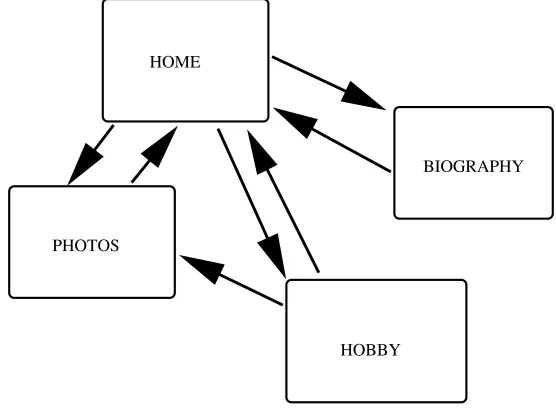
To describe the algorithm, we first think of the web as a directed graph. Figure 1 shows a dramatically simplified model of the web that consists of 4 pages, HOME, PHOTOS, HOBBY and BIOGRAPHY. The arrows indicate links, so, for example, there is a link from HOME to BIOGRAPHY and from HOBBY to PHOTOS. We can store this information in a 4 by 4 adjacency matrix, W, as illustrated in Table 1. Generally, W(i, j) is equal to 1 if there is a link from the
HOME BIOGRAPHY PHOTOS HOBBY degree
HOME 0 1 1 1 3
BIOGRAPHY 1 0 0 0 1
PHOTOS 1 0 0 0 1
[image:3.612.82.496.56.132.2]HOBBY 1 0 1 0 2
Table 1: Entries in the adjacency matrix for Figure 1. Final column shows the degree of each page.
more precisely, the out degree) is defined as the total number of links going out from that node. Equivalently, it is the sum of the entries along theith row of the adjacency matrix. Table 1 includes the degree information for Figure 1.
HOME
PHOTOS
HOBBY
BIOGRAPHY
Figure 1: Example of web pages with connections.
To generalize this concept, we need some notation.
• Let there be N web pages, arbitrarily labelled 1,2, . . . , N.
• LetW be the N ×N adjacency matrix, so the (i, j) element, wij, equals 1
if there is a link from page ito page j, and equals zero otherwise.
• Let degi denote the degree of the ith node, so degi :=
PN
j=1wij.
[image:3.612.151.429.259.464.2]The PageRank algorithm proceeds iteratively, assigning a valuern
j to thejth
page at thenth iteration. The iteration is
rjn= (1−d) +d N
X
i=1
wijrin−1
degi
. (1)
Here, d is some constant in the range 0 < d < 1. We will use d = 0.85 unless otherwise stated. The iteration can be justified quite easily. The key idea is to regard a link from i toj as a vote of confidence for page j from page i. So the importance of page j can be measured by looking at the links coming in to that page. It makes sense to weight the votes according to the level of importance of the voter—a vote from an important page should carry more weight than a vote from an unimportant page. It also makes sense to give each node an equal influence by scaling the weight of its vote by the number of votes that it casts. This means that the weight wij gets scaled to wij/degi. The final twist
in the algorithm is the introduction of the constant d. Each node gets given a ranking of 1−dfor free, and then getsd times the value arising from those votes of confidence. (We will see later that d is a little less mysterious when other interpretations of the algorithm are taken.)
Summarizing the arguments above, the iteration (1) for updating the ranking of page j could be described as follows.
• For each page i that points to j, add in the scaled value of the current ranking,rn−1
i /degi.
• Take d times this sum and add 1−d.
3
Examples
For the example in Figure 1 we have
W =
0 1 1 1 1 0 0 0 1 0 0 0 1 0 1 0
.
Taking d = 0.85 and starting with the initial guess r0
i ≡ 1, we obtained the
following results, to four decimal places,
Iteration number
We see that after 20 iterations, the PageRank values appear to have settled down in their first two decimal places. (Convergence of the algorithm is discussed in the next section.) As we would expect, HOME, which is pointed to by all other pages, receives the highest ranking. PHOTOS is next, because of the link there from HOBBY, and BIOGRAPHY and HOBBY share last place.
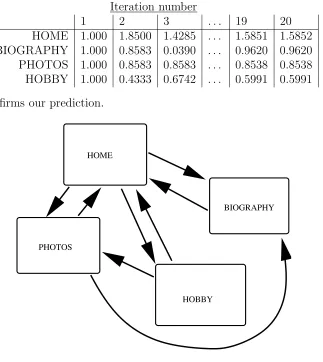
Suppose we alter the network by adding a link from PHOTOS to BIOGRA-PHY, see Figure 2. Because PHOTOS is more important than HOBBY, we would expect this new link to count more than the link from HOBBY to PHOTOS, so BIOGRAPHY should jump up the rankings. PageRank on this new network gives
Iteration number
1 2 3 . . . 19 20 HOME 1.000 1.8500 1.4285 . . . 1.5851 1.5852 BIOGRAPHY 1.000 0.8583 0.0390 . . . 0.9620 0.9620 PHOTOS 1.000 0.8583 0.8583 . . . 0.8538 0.8538 HOBBY 1.000 0.4333 0.6742 . . . 0.5991 0.5991
which confirms our prediction.
HOME
PHOTOS
HOBBY
[image:5.612.138.461.214.576.2]BIOGRAPHY
Figure 2: Example of web pages with connections.
what ordering we use for the pages, the adjacency matrix for this network is
W =
0 1 0 0 0 0 0 0 1 0 0 0 0 0 0 1 0 0 0 0 0 0 1 0 0 0 0 0 0 1 1 0 0 0 0 0
.
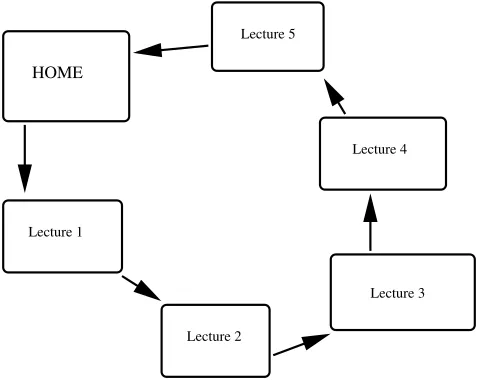
This symmetry suggests that all pages should have equal PageRank, and this is confirmed by the observation thatrj ≡1 is a fixed point of the iteration (1).
HOME
Lecture 1
Lecture 2
[image:6.612.172.412.226.416.2]Lecture 3 Lecture 4 Lecture 5
Figure 3: Example of web pages with connections.
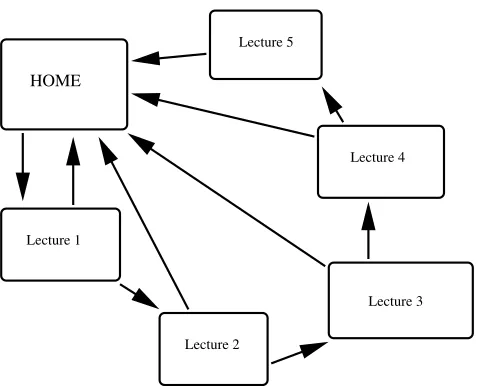
If we alter the network so that all lectures point back to HOME, as illustrated in Figure 4, then the ranking becomes, to four decimal places,
HOME 1.9879 LECTURE 1 1.8397 LECTURE 2 0.9319 LECTURE 3 0.5460 LECTURE 4 0.3821 LECTURE 5 0.3124
which is perhaps a more reasonable reflection of the relative importance of the pages.
HOME
Lecture 1
Lecture 2
[image:7.612.173.412.55.248.2]Lecture 3 Lecture 4 Lecture 5
Figure 4: Example of web pages with connections.
absolute PageRankings is likely to be minimal. Indeed, one of the big advantages of PageRank over earlier systems is its insensitivity to spammers who seek to inflate their rank by devious means. To get a high overall PageRank, your page must be referenced by other high-ranking pages, something that is hard for any particular individual to influence. Also, by focussing solely on the link structure, and not the web page content, PageRank, unlike some predecessors, cannot be misled by the insertion of important sounding words or phrases. Of course the system is not completely hack-proof. The article [2] mentions that a concerted effort by one cybersmith convinced Google to return his friend’s home page as the top-ranking match to “talentless hack.” That article also describes how a well-referenced spoof site
http://www.coxar.pwp.blueyonder.co.uk/
became the number one choice for “weapons of mass destruction.” There is also a positive feedback aspect to the process: lots of websites now refer to those two examples, giving them extra votes of confidence. A brute force approach to rank inflation may also be adopted; some commercial sites are willing to pay for incoming links [7].
The documents [3, 16] and the book [1] give more details about how web administrators can use PageRank to their advantage.
4
Jacobi Iteration
Suppose we have a linear system of simultaneous equations, Ax = b, where
A ∈ RN×N and b ∈ RN are given and x ∈ RN is to be found. If we have a
current guess for the solution, {xnk−1}N
k=1, then we may use the jth equation,
N
X
k=1
ajkxk =bj,
to find a new value forxj. Inserting xnk−1 fork 6=j and solving forxj in this way,
we get the iteration
xn j =
1
ajj
bj − N
X
k=1,k6=j
ajkxnk−1
!
.
Using this formula forj = 1,2, . . . , N, gives what is known as theJacobi iteration. Of course, we require ajj 6= 0 for allj = 1, . . . , N in order for the iteration to be
well defined. If we split A into
A= Σ +L+U,
where Σ is diagonal, L is strictly lower triangular and U is strictly upper trian-gular, then standard numerical analysis results, see for example, [14], show that the iteration converges to a unique solutionx if
ρ Σ−1(L+U)
<1. (2)
Here ρ denotes the spectral radius of a matrix, that is, the largest of the moduli of the eigenvalues. Further, the convergence is linear with a rate at least as fast asρ: given any vector norm k · k, there is a corresponding constantC such that the error, errn∈
RN with errn
k =rnk −xk, satisfies
kerrnk ≤Cρn.
Simple algebra shows that the PageRank iteration (1) is precisely the Jacobi iteration applied to the system
(I−dWTD−1)r= (1−d)e, (3)
whereI is the identity matrix,
I =
1 0 . . . 0 0 1 . .. ... ... ... ... 0 0 . . . 0 1
WT ∈RN×N is the transpose ofW, so (WT)
ij = (W)ji, Dis the diagonal degree
matrix, D=
d1 0 . . . 0
0 d2 . .. ...
... ... ... 0 0 . . . 0 dN
∈RN×N,
and e is the vector of ones,
e= 1 1 .. . 1
∈RN.
The left-hand side of (2) reduces to ρ dWTD−1
in this case. By construction,
WTD−1 has column sums equal to one, so kWTD−1k
1 = 1, where k · k1 denotes
the L1 norm. Since the spectral radius is bounded above by any subordinate
vector norm we haveρ(WTD−1)≤1, so
ρ dWTD−1
≤d.
So choosingd <1 ensures that we satisfy the convergence condition (2).
It is clear from (1) that nonnegativity in the starting vector is preserved; that is
r0
k ≥0 for all 1≤k ≤N ⇒ r n
k ≥0 for all 1≤k ≤N and 1≤n.
Hence the solutionr must have nonnegative components. Premultiplying by eT
in (3) gives
eTr−deTWTD−1r = (1−d)eTe,
which simplifies to
krk1−dkrk1 = (1−d)N.
Sokrk1 =N, a fact that can be checked in the examples of the previous section.
In summary
the PageRank iterates converge to the solutionr of the linear system
(3). This solution satisfies rk ≥0 and
PN
k=1rk =N. The PageRank
algorithm corresponds to the Jacobi iteration applied to this system, and it converges linearly with rate at leastd.
HOME 1.9020 LECTURE 1 1.6314 LECTURE 2 0.8710 LECTURE 3 0.6048 LECTURE 4 0.5117 LECTURE 5 0.4791
In the extreme, and non-useful, case whered= 0, from any starting vectorr0
the iteration produces the exact solution,r1 =e, in a single step.
5
A Teleporting Random Walk on the Web
To connect PageRanking to stochastic processes, we first introduce a few basic concepts. A discrete time, finite state,Markov chainis determined by atransition matrix,P ∈RN×N. Given that the process is at stateiat timen−1,p
ij gives the
probability that the process will be at statej at the next time level, n. Because the process must be somewhere at time n, those probabilities must sum to one;
PN
k=1pik = 1. This means that P is a stochastic matrix.
In many cases, the probability of being in state j after a large number of steps settles down to a fixed value πj, no matter what initial state was chosen.
Equivalently, πj is the proportion of time that we spend at state j in the
long-time limit. Such a vector π ∈ RN, which must satisfy PN
k=1πk = 1, is called
an invariant measure. If it exists it will satisfy PTπ = π, that is, it will be an
eigenvector of PT corresponding to the eigenvalue 1 [13, 17]. There can be no
eigenvalues bigger than 1 in modulus, because a stochastic matrix haskPTk
1 = 1,
and ρ(P)≤ kPTk
1.
Consider now the prospect of taking a random walk on the web. Having visited a web page at time n−1, we look at the links coming out of that page and choose one of them at random, uniformly, to visit at time n. If we are currently at pagei, then the probability of visiting pagej on the next step is
0 if wij = 0, (no link exists), wij
degi if wij = 1, (a link exists).
The transition matrix for this Markov chain is thusP =D−1W. Imagine surfing
the web in this way for a few billion years. A measure of the “well-connectedness” of page j is the proportion of time that we spend there, ultimately. This is precisely the quantityπj mentioned above. A possible difficulty with this picture
above. The transition matrix for teleporting isF/N, whereF ∈RN×N is a matrix
with all entries equal to one. It follows that the transition matrix for the overall teleporting random walk is
P = (1−d)
N F +dD
−1W, (4)
It is intuitively reasonable that the teleporting trick gets around difficulties asso-ciated with the construction of an invariant measure. More formally, it ensures that the Markov chain is ergodic so that there is a unique, nonnegative solution to the system PTπ=π, where we normalise so that PN
k=1πk = 1 [13, 17]. Using
(4), this linear system is
(1−d)
N F +d(D
−1W)T
π =π,
which, since F π=e and (D−1W)T =WTD−1, may be written
I−dWTD−1
π = (1−d)
N e. (5)
Comparing (5) and (3), we make the connection thatπ=r/N: the PageRank
solution, when scaled by the factorN, is precisely the invariant measure for the teleporting random walk. We can take the connection further. Given a transition matrix we may apply an unscaled version of thepower method ([4]) in an attempt to compute the invariant measure by regarding it as the eigenvector of the largest eigenvalue of PT. Having chosen x0, with x0
i ≥ 0 and
PN
k=1x0k = 1, this gives
xn =PTxn−1. Using (4), this iteration becomes
xn=
(1−d)
N F +dD
−1 W
T
xn−1,
but since FTxn =e for all n, it simplifies to
xn= (1−d)
N e+dW
TD−1xn−1.
This is precisely the original PageRank algorithm (1) with Nxn playing the role
of rn.
In summary
the normalized PageRank vectorr/N is the unique invariant measure
6
Ranking Mathematics Classes
The PageRank algorithm need not be confined to web pages. It could conceivably be let loose on any set of objects that have pairwise attachments. We note that the algorithm (1) continues to make sense when thewij are real-valued, that is, in
the case of weighted edges, and, furthermore, the weights could also be negative. Examples that spring to mind where objects could be PageRanked according to their overall influence are
• Mathematical articles: if paper i cites paper j then set wij = 1.
• Financial assets: if stockimoves up/down a short time after stockj moves up/down then setwij = 1.
• League tables: if Manchester City beat Manchester United 2-1 at home and 5-3 away, then setwunited,city = (2 + 5)−(1 + 3), etc.
In this section, we show how PageRank can be used on a graph whose nodes are classes offered to undergraduate mathematics students at the University of Strathclyde. The “link” information is provided by the pre-requisite structure between classes. We took data from
http://www.maths.strath.ac.uk/ungrad/index.html
in July 2003. (A pre-requisite was taken to be a specification on the class web page of either “Essential” or “Desirable.”) We looked at two interpretations.
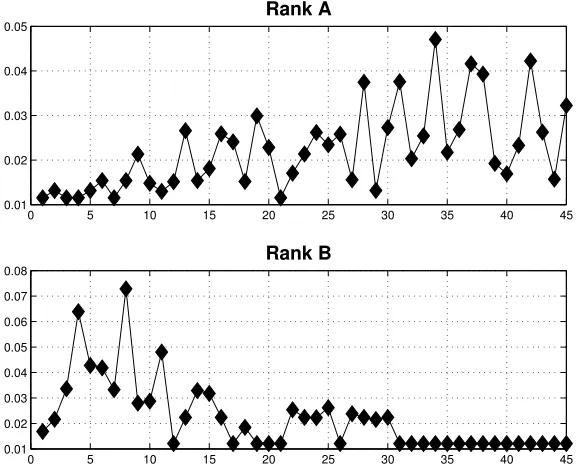
Rank A: If class i is a pre-requisite for class j, then set wij = 1. Here, votes
of confidence feed in to classes that use previously covered material, so PageRanking can be regarded as finding the “hardest” or “deepest” classes.
Rank B: If classi is a pre-requisite for class j, then set wji = 1. Here, votes of
confidence are given to classes that get used in later classes, so PageRanking can be regarded as finding the most “useful” or “fundamental” classes.
Table 2 lists the 45 classes that we considered. The class codes reveal the year of study; 11.6XX, 11.7XX. 11.8XX and 11.9XX denoting years 1,2,3, and 4 respectively. To illustrate how the connectivity structure is defined, the class 11.891, Laplace Transforms and Linear Systems, which is number 30 on our list, is specified as a pre-requisite for the class 11.938, Higher Dimensional Dynamical Systems, which is number 39 on our list. Thus w30,39 = 1 for Rank A, and w39,30 = 1 for Rank B.
The PageRank results, normalized so that krk1 = 1, are shown in Figure 5.
Index Code Class
1 11 602 Introduction to Mechanics
2 11 606 Discrete Maths
3 11 611 IT Skills and Maths Software
4 11 612 Maths 1A
5 11 613 Maths 2A
6 11 700 Multivariable Calculus
7 11 710 Finite Dimensional Vector Spaces
8 11 711 Sequences and Series
9 11 712 Newtonian Mechanics
10 11 713 Numerical Analysis 2
11 11 721 Real Variable Calculus
12 11 722 Rigid Body Mechanics
13 11 725 Algebraic Structures
14 11 731 Differential Equations
15 11 741 Vector Calculus
16 11 801 Mathematical Analysis 2
17 11 802 Advanced Newtonian Mechanics
18 11 811 Mathematical Analysis 1
19 11 812 Advanced Rigid Body Mechanics
20 11 825 Abstract Algebra
21 11 835 Vector Spaces
22 11 841 Complex Analysis 1
23 11 843 Numerical Analysis 3
24 11 851 Complex Analysis 2
25 11 852 Fluid Mechanics 1
26 11 853 Numerical Analysis 4
27 11 861 Partial Differential Equations 1
28 11 862 Fluid Mechanics 2
29 11 871 Partial Differential Equations 2
30 11 891 Laplace Transforms and Linear Systems
31 11 921 Applications of Spectral Theory
32 11 922 Applied Functional Analysis
33 11 923 Continuum Mechanics 1
34 11 924 Continuum Mechanics 2
35 11 928 Numerical Solution of Initial Value PDEs
36 11 929 Modern Methods for Differential Equations
37 11 932 Numerical Approximation
38 11 937 One Dimensional Dynamical Systems
39 11 938 Higher Dimensional Dynamical Systems
40 11 939 Numerical Solution of Boundary Value PDEs
41 11 946 Waves
42 11 947 Coding Theory
43 11 948 Calculus of Variations
44 11 949 Mathematics of Financial Derivatives
[image:13.612.156.440.80.630.2]45 11 951 Mathematics in Medicine
0 5 10 15 20 25 30 35 40 45 0.01
0.02 0.03 0.04 0.05
Rank A
0 5 10 15 20 25 30 35 40 45
0.01 0.02 0.03 0.04 0.05 0.06 0.07 0.08
[image:14.612.145.433.64.300.2]Rank B
Figure 5: PageRank results for classes in Table 2.
the benefit of incoming links. For what it is worth, Continuum Mechanics 2, our honours-level elasticity class, gets the highest Rank A score.
The picture reverses when Rank B is used. Here, the earlier year classes get credit for laying the foundations. However, the the top “usefulness” ranking goes not to a first year class but to the second year analysis course Sequences and Series. The epsilon-delta proof is vindicated.
We are not, of course, proposing PageRank in isolation as an infallible means to judge mathematics classes (especially since the two classes taught by one of the authors were deemed neither outstandingly useful nor deep!), rather we simply wish to show that the algorithm has wide applicability. Any serious implementa-tion of PageRank would undoubtedly require some applicaimplementa-tion-specific issues to be addressed (e.g., in our case, it may be prudent to treat compulsory classes in a special way), along with the the “dangling page” dilemma.
7
Discussion
Reasonable estimates suggest that the web currently contains over 3×10⁹ pages.
Google to learn more. As we saw in section 4, the PageRanking task boils down to a large, sparse, linear solve; a problem for which there are many rival methods. Identifying promising alternatives to Jacobi is a current research theme [9, 10]. Iterative methods are natural, since last month’s rankings offer a good starting approximation for this month’s, but issues such as the optimal choice ofdand the effect of the terminating criterion must be clarified before concrete comparisons are to be made.
The original article [15] refers to an alternative, personalized, version of PageRank, where F in (4) becomes a more general rank-one matrix. Here, the teleporting jumps do not land uniformly across the web, but are biased towards a user’s preferences. From teleporting it is but a tiny hop to small world networks
[5, 6, 8, 12, 18], another fascinating area where graph theory has refused to stay in its box.
References
[1] Tara Calishain and Rael Dornfest (Editors). Google Hacks: 100 Industrial-Strength Tips & Tools. O’Reilly & Associates, 2003.
[2] Anthony Cox. The war on the web. The Guardian, July 10, 2003.
http://www.guardian.co.uk/online/story/0,3605,994676,00.html
[3] Phil Craven. Google’s PageRank explained: and how to make the most of it. Technical report, WebWorkshop Document, 2002.
http://webworkshop.net/pagerank.html
[4] James W. Demmel. Applied Numerical Linear Algebra. SIAM, Philadelphia, 1997.
[5] Paul Glendinning. View from the Pennines: Making connections. Mathe-matics TODAY, 39:26–27, 2003.
[6] Peter Grindrod. Range-dependent random graphs and their application to modeling large small-world proteome datasets.Physical Review E, 66:066702, 2002.
[7] Ben Hammersley. Making the web pay. The Guardian, August 7, 2003.
http://www.guardian.co.uk/online/story/0,3605,1013313,00.html
[9] Sepandar D. Kamvar, Taher H. Haveliwala, Christopher D. Manning, and Gene H. Golub. Exploiting the block structure of the web for computing PageRank. Technical report, Stanford University (Preprint), 2003.
[10] Sepandar D. Kamvar, Taher H. Haveliwala, Christopher D. Manning, and Gene H. Golub. Extrapolation methods for accelerating pagerank computa-tions.Proceedings of the Twelfth International World Wide Web Conference, 2003.
[11] Cleve Moler. The world’s largest matrix computa-tion. MATLAB News and Notes, October, 2002.
http://www.mathworks.ch/company/newsletter/clevescorner/oct02_cleve.shtml
[12] M. E. J. Newman. The stucture and function of complex networks. SIAM Review, 45:167–256, 2003.
[13] J. R. Norris. Markov Chains. Cambridge University Press, 1997.
[14] James M. Ortega. Numerical Analysis: A Second Course. SIAM, Philadel-phia, 1990.
[15] Lawrence Page, Sergey Brin, Rajeev Motwani, and Terry Winograd. The PageRank citation ranking: Bringing order to the web. Tech-nical report, Stanford Digital Library Technologies Project, 1998.
http://www-diglib.stanford.edu/diglib/pub/projectdir/google.html
[16] Ian Rogers. Page rank explained. The Google Pagerank algorithm and how it works. Technical report, PR Computing Ltd, 2002.
http://www.iprcom.com/papers/pagerank/
[17] Sheldon M. Ross. A First Course in Probability. Prentice Hall, 5th edition, 1997.