Int. J. Electrochem. Sci., 10 (2015) 8454 - 8464
International Journal of
ELECTROCHEMICAL
SCIENCE
www.electrochemsci.org
The Study of a Phosphate Conversion Coating on Magnesium
Alloy AZ91D: II. Effects of Components and their Content in
Phosphating Bath
Qing yun Xiong1,2, Yong Zhou1,2,3,4,*, Jin ping Xiong1,2,* 1
Beijing Key Laboratory of Electrochemical Process and Technology for Materials, Beijing University of Chemical Technology, Beijing 100029, China
2
Key Laboratory of Carbon Fiber and Functional Polymer of Education Ministry, Beijing University of Chemical Technology, Beijing 100029, China
3
Key Laboratory of Green Chemical Process of Education Ministry, Wuhan Institute of Technology, Wuhan 430073, China
4
Hubei Key Laboratory of Novel Reactor and Green Chemical Technology, Wuhan Institute of Technology, Wuhan 430073, China
*
E-mail: [email protected]; [email protected]
Received: 23 June 2015 / Accepted: 30 July 2015 / Published: 26 August 2015
This paper involved a phosphate conversion coating on magnesium alloy AZ91D. The effects of components and their content in phosphating bath on the phosphate conversion coatings were studied. The optimum content for each component in phosphating bath was zinc oxide (ZnO) 2.0 g/L, phosphoric acid (H3PO4) 12.0 g/L, sodium fluoride (NaF) 1.0 g/L, sodium tartrate (C4H4O6Na2) 4.0 g/L, sodium nitrate (NaNO3) 6.0 g/L and sodium pyrophosphate (Na4P2O7) 0.5 g/L. The presence of Na4P2O7 in phosphating bath refined the microstructure of the crystal layer and made the phosphate conversion coatings more fine and smooth. The phosphate conversion coating formed at the optimum condition was composed of Zn3(PO4)2, Zn2Mg(PO4)2 and Zn.
Keywords: magnesium alloy AZ91D; phosphate conversion coating; SEM; XRD
1. INTRODUCTION
corrosion susceptibility of magnesium alloys is higher than that of other alloys [1]. Therefore, the applications of magnesium alloys are very limited due to their relatively bad corrosion resistance mainly [2-4]. There have been many studies on corrosion protection techniques for magnesium alloys: organic coatings [5], anodizing films [6], laser surface treatments [7] and chemical conversion coatings [8], especially phosphate conversion coatings [9]. The advantages of phosphate conversion coatings include easy operation, low cost, little size limitation and so on [10].
During the preparation process of a phosphate conversion coating, the critical and important program is the components in phosphating bath, and the composition of the prepared phosphate conversion coating depends on the bath components, which usually contains five parts: film-forming agent, inhibitor, complexant, accelerator and additive [11-13]. Lian et al. [11] applied zinc oxide and phosphoric acid as film-forming agent, sodium fluoride and organic amine as inhibitor, tartaric acid as complexant, sodium nitrite and sodium nitrate as accelerator, and a zinc phosphate conversion coating was prepared on magnesium alloy AZ91D surface. The prepared phosphate conversion coating had typical phosphate microstructure, and the coating was composed of Zn3(PO4)2, Zn, AlPO4 and Zn2Mg(PO4)2. Li et al. [12] applied zinc oxide and phosphoric acid as film-forming agent, sodium fluoride as inhibitor, tartaric acid as complexant, ethanolamine as additive and prepared a zinc phosphate conversion coating on magnesium alloy AZ91D surface. The presence of ethanolamine in phosphating bath refined the microstructure of phosphate crystal layer, and the phosphate conversion coating formed at the optimum ethanolamine content of 1.2 g/L showed the most uniform and compact crystal layer and provided the best corrosion protection for magnesium alloy AZ91D substrate.
In our previous study [14], the formation of a phosphate conversion coating on magnesium alloy AZ91D was studied with electrochemical methods and scanning electron microscope (SEM). In this paper, based on our previous study, the effects of components and their content on the phosphate conversion coatings are studied, and the studied phosphating bath is composed of five parts: zinc oxide (ZnO) and phosphoric acid (H3PO4) as film-forming agent, sodium fluoride (NaF) as inhibitor, sodium tartrate (C4H4O6Na2) as complexant, sodium nitrate (NaNO3) as accelerator and sodium pyrophosphate (Na4P2O7) as additive.
2. EXPERMENTAL
2.1 Material and preparation
The studied material was magnesium alloy AZ91D with the following chemical composition (wt %): Al, 9.4; Zn, 0.82; Mn, 0.23; Si, 0.01; Cu, 0.02; Ni, 0.0021; Fe, 0.005, and Mg. Samples were manually abraded up to 1000 grit with SiC abrasive papers, rinsed with de-ionized water and degreased in acetone. The samples were processed to many small plates with the size of 25 mm × 15 mm × 5mm.
2.2 Preparation of phosphate conversion coatings
[image:3.596.84.513.160.274.2]
samples into each phosphate bath shown in Table 1. The phosphating temperature and time were respectively 45 ℃ and 20 min.
Table 1. The components and their content in phosphating bath.
Component Content range (g/L) Optimum content (g/L)
Zinc oxide 1.0 - 2.5 2.0
Phosphoric acid 6.0 - 15.0 12.0
Sodium fluoride 0.5 - 1.5 1.0
Sodium tartrate 1.0 - 6.0 4.0
Sodium nitrate 0 - 12.0 6.0
Sodium pyrophosphate
0 - 1.0 0.5
2.3 Grade of phosphate conversion coatings
The samples immersed in phosphating bath for 20 min were called phosphated magnesium alloys. In order to evaluate the quality of phosphate conversion coatings, the appearance of the system form phosphate conversion coatings and phosphated magnesium alloys was classified into four grades shown in Table 2. In Table 2, grade “0” represented that there were no phosphate conversion coatings on phosphated magnesium alloys surface and magnesium alloys substrate were corroded; grade “1” represented that there were no phosphate conversion coatings but magnesium alloys substrate were not corroded; grade “2” represented that phosphate conversion coatings could be formed on phosphated magnesium alloys surface but not complete; grade “3” represented that compact and integral phosphate conversion coatings could be formed on phosphated magnesium alloys surface.
Table 2. The appearance of phosphate conversion coatings.
Grade 0 1 2 3
2.4 Weight and forming rate of phosphate conversion coatings
The weight of the phosphate conversion coatings was calculated with the following equation: W = (W1 – W2) / S (1)
[image:3.596.84.515.537.662.2]
phospahted magnesium alloys, W2 was the weight of the naked magnesium alloys, and S was the surface area of the naked magnesium alloys.
The forming rate of the phosphate conversion coatings was calculated with the equation as follows:
v = W / t (2)
Where v was the forming rate of the phosphate conversion coatings, W was the weight of the phosphate conversion coatings, and t was the phosphating time (20 min).
2.5 Scanning electron microscope (SEM) observation
The surface morphology of the samples was observed with a LEO-1450 SEM instrument (USA).
2.6 X-ray diffraction (XRD) analysis
The surface composition of the samples was analyzed with a 2500VB2+PC XRD instrument (Japan).
3. RSEULTS AND DISCUSSION
3.1 Effect of film-forming agent
In the present study, the film-forming agents in phosphating bath are ZnO and H3PO4, and the following reaction may occur in the studied phosphating bath:
ZnO + 2H3PO4 + H2O → Zn(H2PO4)2·2H2O (3)
The product Zn(H2PO4)2·2H2O of the reaction (3) can dissolve to produce ZnPO4
-, H2PO4-, H+ and H2O as follows:
Zn(H2PO4)2·2H2O → ZnPO4
+ H2PO4- + 2H+ + 2H2O (4)
After that, the complex anion ZnPO4- can dissociate to produce Zn2+ and PO43- in the studied phosphating bath as follows:
ZnPO4- → Zn2+ + PO43- (5)
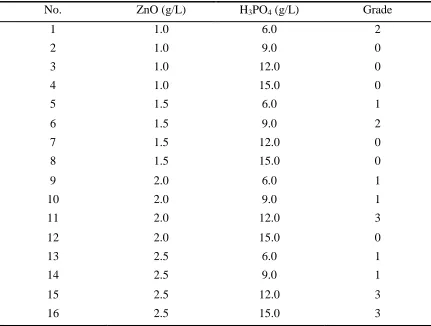
Table 3 shows the effect of ZnO and H3PO4 on the quality of phosphate conversion coatings on the magnesium alloys surface. It is seen that the compact and integral coatings can be formed on the AZ91D alloys surface when the relative quantity ratio of ZnO and H3PO4 is 1:6 and the content of ZnO and H3PO4 is respectively more than 2.0 g/L and 12.0 g/L, as shown in No. 11, 15 and 16. Therefore, the optimum content for film-forming agent in the studied phosphating bath is ZnO 2.0 g/L and H3PO4 12.0 g/L.
[image:5.596.83.514.179.505.2]
was respectively 3.2 g/L and 17.5 g/L, which consumed more film-forming agents compared with our study. Li et al. [12] prepared a zinc phosphate conversion coating on magnesium alloy AZ91D surface, consuming ZnO 6.8 g/L and H3PO4 27.2 g/L.
Table 3. Effect of ZnO and H3PO4 on the quality of phosphate conversion coatings on the magnesium alloys surface.
No. ZnO (g/L) H3PO4 (g/L) Grade
1 1.0 6.0 2
2 1.0 9.0 0
3 1.0 12.0 0
4 1.0 15.0 0
5 1.5 6.0 1
6 1.5 9.0 2
7 1.5 12.0 0
8 1.5 15.0 0
9 2.0 6.0 1
10 2.0 9.0 1
11 2.0 12.0 3
12 2.0 15.0 0
13 2.5 6.0 1
14 2.5 9.0 1
15 2.5 12.0 3
16 2.5 15.0 3
3.2 Effect of inhibitor
According to previous investigations [15, 16], only when the corrosion rate of magnesium alloys substrate is much lower than the forming rate of phosphate conversion coatings, phosphate conversion coatings can be formed on magnesium alloys surface. In the present study, NaF is applied as the component of inhibitor and is added into the studied phosphating bath directly in order to decrease the corrosion rate of the AZ91D alloys.
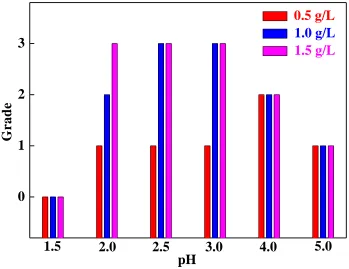
on the AZ91D alloys surface regardless of NaF content in the studied phosphating bath. Therefore, the optimum content for inhibitor agent in the studied phosphating bath is NaF 1.0 g/L.
0
1
2
3
5.0
4.0
3.0
0.5 g/L
1.0 g/L
1.5 g/L
2.5
2.0
pH
1.5
G
r
a
d
e
Figure 1. Effects of pH and NaF on the quality of phosphate conversion coatings on the magnesium alloys surface.
3.3 Effect of complexant
In the present study, C4H4O6Na2 is applied as the component of complexant in the studied phosphating bath in order to adjust the pH value and to decrease the production of sludge. According to previous investigations [11, 17], if there is no complexant in phosphating bath, the insoluble H2PO42- can precipitate out as sludge on magnesium alloys surface or in phosphating bath.
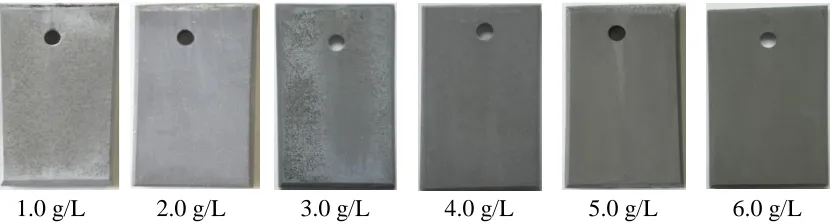
Fig.2 shows the effect of C4H4O6Na2 on the appearance of phosphate conversion coatings on the magnesium alloys surface. It is seen that the presence of sludge is on the AZ91D alloys surface when the content of C4H4O6Na2 is less than 4.0 g/L. However, when the content of C4H4O6Na2 is more than 4.0 g/L, there is no sludge on the AZ91D alloys surface and the appearance of the coatings is compact and integral. Therefore, the optimum content for complexant agent in the studied phosphating bath is C4H4O6Na2 4.0 g/L.
[image:6.596.116.465.148.417.2]
the content of organic amine was 1.2 g/L. However, tartaric acid is more expensive than sodium tartrate, and the application of organic amine may lead to environmental problems. Therefore, sodium tartrate is a rational complexant in phosphate treatment for magnesium alloys.
[image:7.596.93.509.148.260.2]1.0 g/L 2.0 g/L 3.0 g/L 4.0 g/L 5.0 g/L 6.0 g/L
Figure 2. Effect of C4H4O6Na2 on the appearance of phosphate conversion coatings on the magnesium alloys surface.
3.4 Effect of accelerator
In the present study, NaNO3 is applied as the component of accelerator in phosphating bath instead of the traditional and toxic nitrite [11, 17]. According to previous investigations [18, 19], in acidic environment, NO3- anions can react with H+ ions as follows:
NO3- + 2H+ + 2e → NO2- + H2O (6)
Further, the generated NO2- anions by reaction (6) can react with H+ ions as follows: NO2- + 2H+ + 2e → N2 + O2 + H2O (7)
During the formation of phosphate conversion coatings, the anodic and cathodic reactions occur at different electrochemical sites on magnesium alloys surface respectively: magnesium and aluminum dissolves and releases electrons at micro-anode sites, and H+ ions get electrons and hydrogen is released at micro-cathode sites, simultaneously. In the present study, there are two reactions occurring at the micro-anode sites on the AZ91D alloys surface as follows:
Mg → Mg2+ + 2e (8) Al → Al3+
+ 3e (9)
At the same time, the following reaction occurs at the micro-cathode sites: 2H+ + 2e → H2 (10)
The local pH would be increased on the AZ91D alloys surface due to the occurrence of above reaction (6), (7) and (10), resulting in the precipitation of insoluble phosphate. The following four reactions may occur on the AZ91D alloys surface:
3Zn2+ 2PO43- 4H2O → Zn3(PO4)2·4H2O (11)
2Zn2+ + Mg2+ + 2PO43- 4H2O → Zn2Mg(PO4)2·4H2O (12) 3Zn2 2H2PO4- + 4H2O + 4e → Zn3(PO4)2·4H2O + 2H2 (13)
2Zn2+ + Mg2+ + 2H2PO4- + 4H2O + 4e → Zn2Mg(PO4)2·4H2O + 2H2 (14)
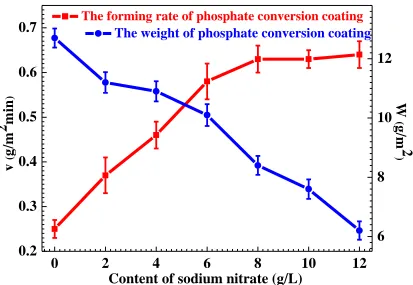
Fig. 3 shows the effect of NaNO3 on the forming rate and weight of phosphate conversion coatings on the magnesium alloys surface, where each datum is the average value of ten parallel processes for the preparation of phosphate conversion coatings, and the error ranges are also shown. It is seen that the forming rate increases with the increase of NaNO3 content from 0 to 8.0 g/L. Afterwards however, the forming rate shows very slight change with the increase of NaNO3 content from 8.0 to 12.0 g/L. At the same time, the weight of the coatings decreases with the increased NaNO3 content in the studied phosphating bath. According to previous investigations [11, 15], the higher the weight of phosphate conversion coatings, the more thick is the coatings, indicating good corrosion protection for magnesium alloys substrate. Both the forming rate and the weight of the coatings are relatively suitable when the content of NaNO3 in the studied phosphating bath is approximate to 6.0 g/L, so the optimum content for accelerator agent in the studied phosphating bath is NaNO3 6.0 g/L.
During the process of phosphate treatment, nitrite is usually applied as accelerator agent due to its good performance and low coat [11, 13, 16]. However, nitrite is a toxic substance, and it should be avoided for application.
0
2
4
6
8
10
12
0.2
0.3
0.4
0.5
0.6
0.7
6
8
10
12
W
(
g
/m
2
)
The forming rate of phosphate conversion coating
v
(
g
/m
2
m
in
)
The weight of phosphate conversion coating
Content of sodium nitrate (g/L)
Figure 3. Effect of NaNO3 on the forming rate and weight of phosphate conversion coatings on the magnesium alloys surface.
3.5 Effect of additive
[image:8.596.101.514.343.628.2]
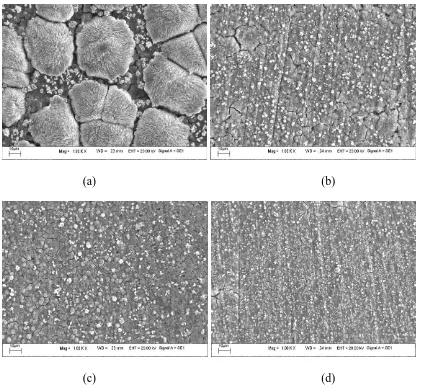
surface SEM morphology of phosphate conversion coatings on the magnesium alloys surface. It is seen from Fig. 4a that the coating formed in the phosphating bath free of Na4P2O7 shows many big crystal clusters, and there are many small crystal clusters among the big crystal clusters. However, the microstructure of the crystal layer is refined and the crystal structure of the coatings becomes more fine and smooth after the addition of Na4P2O7 into the studied phosphating bath, as shown in Fig. 4b, 4c and 4d. When the content of Na4P2O7 in the studied phosphating bath is 0.2 g/L, there are a lot of pores and cracks on the coating shown in Fig. 4b. However, when the content of Na4P2O7 is more than 0.5 g/L, the quantity of cracks and pores decreases obviously shown in Fig. 4c and 4d. Therefore, the optimum content for additive agent in the studied phosphating bath is Na4P2O7 0.5 g/L.
(a) (b)
[image:9.596.89.511.236.627.2](c) (d)
Figure 4. Effect of Na4P2O7 on the surface SEM morphology of phosphate conversion coatings on the magnesium alloys surface: (a) 0 g/L, (b) 0.2 g/L, (c) 0.5 g/L and (d) 1.0 g/L.
3.6 Phosphate conversion coating composition
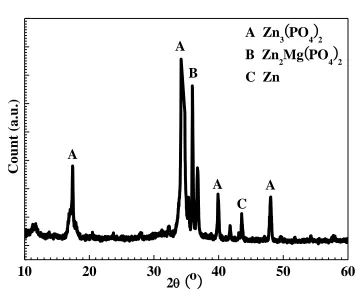
Fig. 5 shows the XRD spectrum of the phosphate conversion coating formed in the phosphating bath at the optimum condition. The major phases of the coating includes Zn3(PO4)2, Zn2Mg(PO4)2 and Zn, which is consistent with the above discussion and other authors’ reports [11, 12, 15]. The presence of Zn in the phosphate conversion coating may come from the reduction of Zn2+: the generated Zn2+ ions by reaction (5) get electron and be reduced to zinc on the AZ91D alloys surface. The related reaction of the reduction for Zn2+ ions is as follows:
Zn2+ + 2e → Zn (15)
10
20
30
40
50
60
A
C
A
B
A
2
(
o
)
C
o
u
n
t
(a
.u
.)
A Zn
3(
PO
4)
2B Zn
2
Mg
(
PO
4)
2C Zn
A
Figure 5. XRD spectrum of the phosphate conversion coating formed in the phosphating bath at the optimum condition.
4. CONCLUSIONS
(1) The phosphate conversion coating was prepared on magnesium alloy AZ91D surface. The optimum content for each component in phosphating bath was zinc oxide (ZnO) 2.0 g/L, phosphoric acid (H3PO4) 12.0 g/L, sodium fluoride (NaF) 1.0 g/L, sodium tartrate (C4H4O6Na2) 4.0 g/L, sodium nitrate (NaNO3) 6.0 g/L and sodium pyrophosphate (Na4P2O7) 0.5 g/L.
[image:10.596.113.471.246.538.2]
(3) The phosphate conversion coating formed at the optimum condition was composed of Zn3(PO4)2, Zn2Mg(PO4)2 and Zn mainly.
References
1. T.S. Shih, J.B. Liu and P.S. Wei, Materials Chemistry and Physics, 104 (2007) 497. 2. H. Inoue, K. Sugahara, A. Yananoto and H. Tsubakino, Corrosion Science, 44 (2002) 603. 3. N.T. Kirkland, J. Lespagnol, N. Birbilis and M.P. Staiger, Corrosion Science, 52 (2010) 287. 4. L.J Yang, Y.H. Wei, L.F. Hou and D. Zhang, Corrosion Science, 52 (2010) 345.
5. X.Y. Lu, Y. Zuo, X.H. Zhao, Y.M. Tang and X.G. Feng, Corrosion Science, 53 (2011) 153. 6. C.S. Wu, Z. Zhang, F.H. Cao, L.J. Zhang, J.Q. Zhang and C.N. Cao, Applied Surface Science, 253
(2007) 2893.
7. C.C. Liu, J. Liang, J.S. Zhou, L.Q. Wang and Q.B. Li, Applied Surface Science, 343 (2015) 133. 8. S. Pommiers, J. Frayret, A. Castetbon and M. Potin-Gautier, Corrosion Science, 84 (2014) 135. 9. N.V. Phuong, K.H. Lee, D. Chang and S. Moon, Corrosion Science, 74 (2013) 314.
10.G.L. Song and D.S. John, Materials and Corrosion, 56 (2005)15.
11.L.Y. Niu, Z.H. Jiang, G.Y. Li, C.D. Gu and J.S. Lian, Surface and Coatings Technology, 200 (2006) 3021.
12.Q. Li, S.Q. Xu, J.Y. Hu, S.Y. Zhang, X.K. Zhong and X.K. Yang, Electrochimica Acta, 55 (2010) 887.
13.R. Amini and A.A. Sarabi, Applied Surface Science, 257 (2011) 7134.
14.Y. Zhou, Q.Y. Xiong and J.P. Xiong, International Journal of Electrochemical Science, 10 (2015) 2812.
15.G.Y. Li, J.S. Lian, L.Y. Niu, Z.H. Jiang and Q. Jiang, Surface and Coatings Technology, 201 (2006) 1814.
16.L. Kouisni, M. Azzi, M. Zertoubi, F. Dalard and S. Maximovitch, Surface and Coatings Technology, 185 (2004) 58.
17.R.C. Zeng, Z.D. Lan, L.H. Kong, Y.D. Huang and H.Z. Cui, Surface and Coatings Technology, 205 (2011) 3347.
18.X.J. Li, F. Gui, H.B. Cong, C.S. Brossia and G.S. Frankel, Electrochimica Acta, 117 (2014) 299. 19.M. Pourbaix, Atlas of electrochemical equilibria in aqueous solutions, National Association of
Corrosion Engineers, 1974.
20.Y. Zhou, Q.Y. Xiong, J.P. Xiong and J.Y. He, International Journal of Electrochemical Science, 9 (2014) 5258.
21.L.Y. Niu, J.X. Liu, Y. Li, Z.M. Shi and L.C. Xu, Transactions of Nonferrous Metals Society of China, 20 (2010) 1356.