COMMISSION OF THE EUROPEAN COMMUNITIES
Brussels, 20.12.2000 COM(2000) 472 final
REPORT FROM THE COMMISSION ANNUAL REPORT
2
REPORT FROM THE COMMISSION ANNUAL REPORT
OF THE MEDA PROGRAMME 1999
TABLE OF CONTENTS
COMMISSIONER’S STATEMENT... 3
EXECUTIVE SUMMARY ... 4
I. MEDA 1995-1999: AN OVERVIEW... 5
I.1. REVIEW OF IMPLEMENTATION... 5
I.2. REVIEW OF THE MEDA REGULATION (MEDA II) ... 10
I.3. THE ASSOCIATION AGREEMENTS: STOCK-TAKING ... 11
I.4. MEDA 1995-1999: DRAWING SOME CONCLUSIONS... 14
II. THE MEDA PROGRAMME IN 1999... 17
II.1. THE POLITICAL AND ECONOMIC CONTEXT OF 1999 ... 17
II.2. COOPERATION WITH THE MEDITERRANEAN PARTNERS... 21
II.2.1. BILATERAL COOPERATION... 21
II.2.2. REGIONAL COOPERATION... 52
II.3. INFORMATION ACTIVITIES ABOUT THE EURO-MED PARTNERSHIP... 53
III. EUROPEAN INVESTMENT BANK OPERATIONS IN THE MEDITERRANEAN REGION ... 55
IV. EVALUATIONS OF THE MEDA PROGRAMME ... 57
V. ANNEX: FOURTH MEETING OF EXPERTS ON ECONOMIC TRANSITION IN
COMMISSIONER’S STATEMENT
The Conference of Euro-Mediterranean Foreign Ministers in Barcelona in November 1995 marked the beginning of the Euro-Mediterranean Partnership, which constitutes the most important attempt in modern history to create durable and strong bonds between the Mediterranean shores. To achieve this, the Partnership provides for action in the key areas of political, economic and social affairs.
This is a difficult endeavour but also a necessary ambition: the Partnership is essential to ensure stability and prosperity in the European Union’s neighbourhood. It is also important for the Mediterranean partners who expect not only market access, investment and transfers of know-how, but also better understanding in political, social, cultural and human affairs.
The MEDA Programme is the main component of the Euro-Mediterranean Partnership’s economic and financial co-operation. MEDA should facilitate one of the Partnership’s key objectives: the gradual establishment of a free trade area (FTA) between the European Union and its Mediterranean Partner countries by 2010.
The FTA offers immense opportunities both to the EU and to our Mediterranean Partners. To take advantage of these opportunities, our Partners will need to carry out policy reforms, structural adjustment and modernisation processes. In turn, these reforms will help to mobilise national savings and attract foreign investment. This will strengthen economic growth, reduce unemployment and improve the citizens’ well being.
In the Euro-Mediterranean Partnership, the modernisation process is helped through co-operation. The MEDA Programme is running at almost one billion € per year in grants while loans from the European Investment Bank are at a similar level. It aims at easing the economic and social consequences of free trade by providing substantial financial and economic support: promoting economic transition and private sector development, support vocational training, health, education and basic infrastructures such as water and sanitation etc.
This report summarises the way EU financial assistance has been channelled to our Mediterranean partners in the context of bilateral and regional projects and programmes. Its publication this year coincides with the discussions between the Commission and the Member States on a revised financial regulation, MEDA II, to govern EU assistance to the region for the future. MEDA II aims at streamlining procedures to ensure increased efficiency in delivering assistance. The experience gained with our Mediterranean policy to date should serve to make the necessary policy adjustments and further enhance MEDA’s impact on the economic and social reform of our Partners.
4
EXECUTIVE SUMMARY
• Europe is, by far, the largest donor of non-military aid to the Mediterranean region and is strongly supporting economic reform in the partner countries. In the period 1995-99, the European Union has provided over €4.6 billion in grants to the Mediterranean region (€3.4 billion under the MEDA programme and€1.2 billion under other budgetary lines) while, in addition, the European Investment Bank has granted loans of over€4.6 billion.
• All Mediterranean Partner countries have embarked on programmes of economic reforms, at varying speeds. The main economic thrust of the EU’s Mediterranean policy, notably since the decision to establish a Euro-Mediterranean free trade area by 2010, play an important role in the reform process.
• Commitment appropriations in the context of the MEDA Programme were fully utilised in 1995-99. For the same period, payments averaged 26% of commitments. This is due to: (a) the average implementation period for the type of projects financed by the MEDA Programme of about 4 years, (b) delays with several Mediterranean Partners in the signature of the Framework Agreements establishing the legal framework for implementation, and (c) political and other problems in financial cooperation with Turkey, Algeria, Lebanon and Syria. Moreover lack of determination on the side of Mediterranean partners to advance with structural reforms has also borne a significant share of the responsibility for delays in the implementation of the Programme.
• About 86% of MEDA resources were channelled to bilateral cooperation and about 12% to regional cooperation. Bilateral cooperation includes projects supporting economic transition, structural adjustment, the socio-economic balance, environmental protection and rural development. Actions under regional cooperation concern all the Mediterranean Partners and support all chapters of the Barcelona process (political and security partnership, economic and financial partnership, and partnership in social, cultural and human affairs).
• Although it is still too early to quantify the impact of MEDA-financed actions, they do contribute by their dynamic effects to the creation of a favourable economic environment for business and investment and to the transfer of key economic decisions from the state to the market. They also mitigate the social costs of economic adjustment by reinforcing healthcare, education and environmental protection.
• The need to focus assistance under the MEDA programme on reform is compelling. It is therefore necessary to improve strategic programming so as to ensure that MEDA interventions are coherent with national reform strategies, promoting the overall objective of the creation of a Euro-Mediterranean free trade area and strengthening the currently very weak intra-regional economic links.
• As it was emphasised in the Fourth Meeting of Experts on Economic Transition in the
Euro-Mediterranean Area held in Brussels on 2-3 October 2000 (documents in annex) the
MEDA funds would be increasingly channelled towards partners that have confirmed absorption capacity as well as a good implementation record of heir association agreement. The commitment of the partners to the implementation of their respective national reform strategies would be decisive in the assessment of their absorption capacity.
I.
MEDA 1995-1999: AN OVERVIEW
I.1. REVIEW OF IMPLEMENTATION
The MEDA Programme is the main instrument of the Euro-Mediterranean Partnership’s financial cooperation. For the period 1995-1999, it provided € 3.437 million out of the € 4.685 million envelope allocated to the 12 Mediterranean partners for the period 1995-1999 by the Cannes European Council.1
In 1995 and 1996, the MEDA Programme progressively replaced the existing financial instruments (mainly the Financial Protocols) and in 1999 represented about 90 % of the total financial commitments from the EU Budget for the Mediterranean. The MEDA Programme is mainly made up of grants (90.4% of total budgetary commitments in 1995-99) managed by the European Commission, but also includes risk capital and interest subsidies for loans (9.6%) managed by the European Investment Bank (EIB).
Some 86% of the resources allocated to MEDA are channelled bilaterally to the Partners (this concerns Algeria, Egypt, Jordan, Lebanon, Morocco, Syria, Tunisia, Turkey and the Palestinian Authority). Three countries – Israel, Malta and Cyprus - do not benefit from bilateral cooperation because of their high level of economic development. About 12% of the resources are devoted to regional activities from which all twelve Partners are eligible to benefit. MEDA resources are programmed through: three-year national indicative programmes and a regional indicative programme covering the multilateral activities.
• Commitments
Commitment appropriations available on a yearly basis are managed by the European Commission on the basis of the MEDA Regulation and within a programming process undertaken with the administration of the beneficiary Partners. Commitment appropriations were 99.9% utilised in 1995-1999.
MEDA commitment appropriations 1995-1999
1995 1996 1997 1998 1999 Total
Commitment appropriations available(€ m)
173 403 981 943 937 3 437
1
6 Commitment appropriations
used(€ m)
173 403 981 941 937 3 435
• Payments
As in any international financial cooperation activity, the rate of payments of the MEDA Programme is a direct function of the type of operation for which commitments are made. Some MEDA operations such as support to structural adjustment result in payments over a short time span, generally two years, provided that conditions agreed between the Commission and the beneficiary Government are met.
Economic transition and private sector development operations generally consist of technical assistance operations over a 3-4 year period, which influences the rate of disbursement. Classical development operations (rural development, basic health care, education, drinking water, sewage, etc) require works and services as well as procurement of equipment following tendering procedures. The implementation period is longer, generally 4 to 6 years.
Regional projects financed under the Euro-Mediterranean Partnership often consist of completely novel forms of cooperation, necessitating innovative financial and legal frameworks of a complex nature. On average, payments are spread over a 3-5 year period. Taking into account the current mix of operations, it is estimated that the average implementation (i.e. payment) period for each of the annual tranches of the MEDA Programme is about 4 years. For the period 1995-1999 cumulative payments have reached €890 million, or 26% of commitments made over the same period.
Rate of payments to commitments (1995-1999)
1995 1996 1997 1998 1999 Total
Commitments(€ m) 173 403 981 941 937 3 435
Payments(€ m) 50 155 211 231 243 890
Payments /
commitments (%)
29% 38% 21% 24% 26% 26%
The MEDA Programme is still young, its start having been delayed by lengthy negotiations for framework conventions2 with the beneficiary countries and highly complex implementation procedures. Nevertheless, most of the committed projects will shortly be moving into their operational phase and this will speed up payments significantly.
2
8
Breakdown of commitments and payments according to countries
The disbursements to commitments rate has varied considerably from country to country. Breakdown of MEDA commitments and payments by country
MEDA I (1995-1999) - bilateral and regional cooperation
Commitments Payments Payments /
commitments
€ million € million (%)
ALGERIA 164 30 18.2
MOROCCO 656 127 19.4
TUNISIA 428 168 39.3
EGYPT 686 157 22.9
JORDAN 254 108 42.5
LEBANON 182 1 0.5
SYRIA 99 0 0.0
TURKEY 375 15 4.0
West Bank and Gaza Strip 111 54 48.6
Bilateral cooperation 2 955 660 22.3%
Regional cooperation3 480 2304 48%
TOTAL 3 435 890 26%
The lower disbursement rates can be explained as follows:
– Algeria: implementation was hampered by the domestic political situation;
– Lebanon: a high number of projects was decided towards the end of the period (1999); difficulties were encountered in the implementation of two in particular (for rehabilitating the Lebanese public administration, and standards and norms);
3
Includes€63 million committed between 1997 and 1999 for technical assistance provided by MEDA teams.
4
– Syria: the framework convention has still to be signed by the Syrian authorities; – Turkey: restrictions have been imposed by the European Parliament in view of the
human rights situation; also, the framework convention was signed only recently (March 1999).
Although the Mediterranean partners have achieved considerable progress in macroeconomic stabilisation in recent years, they have been rather hesitant in implementing key economic reforms. Most countries in the region are still facing today an important reform agenda relating to the creation of favourable conditions for the development of the private sector, further trade liberalisation and privatisation. The slow pace of economic reform had an adverse impact on the implementation of MEDA projects, particularly of those relating to economic transition and structural adjustment.
Breakdown of bilateral activities
Bilateral MEDA operations from 1995 to 1999 can be broken down thematically as follows: structural adjustment, economic cooperation, the social sector, the environment and rural development.
• Structural adjustment
Structural adjustment facilities (SAF) allow direct and swift support to be given to reforms undertaken by partners in full respect of agreed conditions. A total of €520 million was committed under the SAFs between 1995 and 1999 - 15% of all MEDA commitments. The SAFs were implemented in five countries (Morocco, Algeria, Tunisia, Jordan and Lebanon). • Support for economic transition
Here the main aim is to foster the creation of a climate favourable to private sector development, particularly by setting up effective financial instruments. Support takes the form of Commission-managed cooperation programmes, or offers of risk capital to be managed by the EIB.
Economic cooperation programmes accounted for almost €900 million. Risk capital operations for a total of over €140 million were carried out in six countries (Morocco, Tunisia, Jordan, Egypt, Turkey and the West Bank and Gaza Strip).
Overall, operations in support of economic transition came to€1 035 million - over 30% of all MEDA commitments.
• Support for socio-economic balance
10 • Environment
Operations in this field in Morocco and Jordan accounted for a total of €45 million and interest rates on EIB loans were subsidised to the tune of over €190 million, bringing the total for bilateral environmental action to more than €235 million (7% of all commitments in the period).
• Rural development
Decisions were taken for rural development programmes in Morocco, Tunisia and Syria for a total of€155.5 million (4.5% of all commitments in the period).
Breakdown of regional activities
Over the period 1995-99, several activities have been decided or carried out in the following areas:
• Political
Senior Foreign Ministry officials have met to discuss political and security matters regularly, at least four times a year. They have agreed on a number of partnership building measures and have made considerable progress on the Charter on Peace and Stability. The guidelines for this Charter were agreed at the Third Euro-Mediterranean Conference held in Stuttgart (April 1999). Foreign Ministers agreed to have the text ready by the Fourth Euro-Mediterranean Conference which will be held in Marseilles (13-14 November 2000).Formal adoption will take place as soon as political conditions allow.
The following partnership building measures have been agreed:
– establishment of a network of foreign policy institutes (Euro-Mediterranean Study Commission, EuroMeSCo),
– cooperation among civil protection services on natural and man-made disasters, – creation of a register of bilateral agreements,
– exchange of information on international conventions on human rights, disarmament, humanitarian rights,
– - training seminars for diplomats,
MEDA finances the civil protection project, EuroMeSCo and the training seminars for diplomats (€3 m).
• Economic and Financial
networking, promoting the interconnection of infrastructure and reforming the legal and administrative framework to encourage pro-competitive regulation.
– Industrial cooperation: four main themes have been identified: promotion of
investment, innovation and quality, Euromed market instruments and mechanisms, improving the climate for SME development. Cooperation projects have already been developed, notably a network of investment promotion agencies (€4 m), or being developed, such as a programme for the promotion of Euromed market instruments and mechanisms and a Euro-Mediterranean regional programme for innovation and quality in companies, both to be launched in 2000. MEDA has financed the MEDSTAT programme of cooperation among statistical offices (€20 million), a number of economic networks (€ 6 million) between chambers of commerce, commercial fairs, export promotion institutions, SME organisations, industrial federations. and a network of economic institutes (Forum Euro Méditerranéen des instituts des sciences économiques, FEMISE) (€2 million).
– Environment: A Short and Medium Term Priority Action Programme (SMAP) has
been agreed and a first series of projects launched (€7 million). The second series is to be launched in 2000.
– Water: The general lines of an action programme have been agreed and a first series
of projects is to be launched in 2000.
– Energy: Projects have been launched on legal and administrative framework;
dialogue on policy, interconnection and analysis; energy and urban environment; solar energy applications; training network; and joining up electricity grids.
– Transport: A first series of maritime transport projects was launched in 1997
(€9 million); an integrated transport project should be launched in 2000.
– Information society: a project has been launched on the regulatory framework
(€3 million) and the major EUMEDIS programme (networking, interconnection and pilot projects on specific applications of information technology) is operational (€45 million).
• Social, Cultural and Human
– Culture: priorities for action have been agreed at two meetings of Culture Ministers.
The Euro-Med Heritage programme of cooperation on the cultural heritage is operational (€ 17,1 million) and Euro-Med Heritage II is to be launched in 2000. – Audio-visual: the Euro-Med Audio-visual programme on cooperation in the field of
radio, television and cinema is operational (€ 20 million).
– Youth: the Euro-Med Youth programme for youth exchanges is operational
(€6 million).
I.2. REVIEW OF THE MEDA REGULATION (MEDA II)
12
implementation be used to improve and accelerate the delivery of the EU aid to its Mediterranean Partners. An independent evaluation of the MEDA Regulation carried out in 1998-99 showed that the current decision making procedures are cumbersome and rigid. Based on the conclusions of this evaluation, the Commission submitted to the Council in mid-1999 a draft proposal for the revision of the MEDA Regulation. The draft proposal has a three-pronged strategy:
• Streamlining the decision-making process for more effective programming: The work of the MED Committee (a management Committee composed by representatives of the EU Member States to assist the Commission in the implementation of the MEDA Regulation) should be refocused onto strategic planning and programming. This can be achieved by having more substantial examination of the three year National Indicative Programmes (NIPs)5 and the Regional Indicative Programme (RIP)6. To enhance the coherence of its financial proposals with NIPs and the RIP, the Commission proposes to present its financing proposals in Annual Financing Plans for each Partner (NFPs) as well as one for the region (RFP).
• Enhancing capacities for programming and implementation: The Association Agreements provide for the gradual introduction of free trade between the EU and its Mediterranean partners. The MEDA programme is intended to play a major role in assisting the partners in the reform process required in this context. Therefore, more emphasis should be given to dialogue on MEDA programming over the medium term with the partners, taking account of their respective reform strategies, as well as coordination between the Commission and EU Member States, and coordination between bilateral and regional cooperation.
• More efficient implementation procedures: In order to improve the MEDA programme’s impact on economic and social reform in the partners and with a view to making the programme an even more effective instrument for the Euro-Mediterranean Partnership, more rapid implementation procedures need to be introduced. Harmonised procedures concerning technical and financial implementation of cooperation activities have already been developed with the aim, notably, of further rationalisation and streamlining. A wider reform of the Commission’s delivery of external aid is currently underway.
I.3. THE ASSOCIATION AGREEMENTS: STOCK-TAKING
The Association Agreements are bilateral legal instruments for establishing deeper and wider relations with the Mediterranean Partners and as such provide a strategic framework for cooperation. Built upon the old generation of Cooperation Agreements adopted in the 1970s, the Association Agreements provide for the institutionalisation of political and economic dialogue, the establishment of a free trade area, social and cultural cooperation and financial cooperation, notably through the MEDA Programme. Thus the Association Agreements constitute, at bilateral level, the strategic framework for cooperation.
5
The NIPs reflect the planning of country programmes according to the MEDA Regulation. They include indicative financial amounts for commitments and define the priority sectors for EU support.
6
14
Stock-taking of the Association Agreements PARTNER CONCLUSION OF
NEGOTIATIONS
SIGNATURE OF AGREEMENT
ENTRY INTO FORCE
Tunisia June 1995 July 1995 March 1998
Israel September 1995 November 1995 In the course of
2000
Morocco November 1995 February 1996 March 2000
PLO for the benefit of the Palestinian Authority
December 1996 February 1997 July 1997
Jordan April 1997 November 1997
-Egypt Negotiations
Concluded in June 19997
-
-Lebanon Negotiations in
progress
-
-Algeria Negotiations in
progress
-
-Syria Negotiations in
progress
-
-No formal negotiation sessions were held with Lebanon and Algeria in 1999. However, there have been informal contacts between the authorities of these two countries and the Commission services. Formal negotiations are expected to resume in the course of 2000. Financing conventions
The implementation of the MEDA Programme advanced significantly in 1999 as the last remaining framework financing conventions were signed with the authorities of the Mediterranean partners. These conventions establish the legal and administrative framework for implementation of EU cooperation activities (with the exception of structural adjustment operations which are governed by specific arrangements) and their signature is a prerequisite for the launch of individual projects.
7
MEDA framework conventions: state of play
COUNTRY INITIALLED SIGNED
(COMMISSION)
SIGNED (EIB)
ALGERIA 12 May 1998 29 July 1998 15 September 1998
CYPRUS n/a n/a
EGYPT 18 February 1998 2 July 1998
ISRAEL . n/a n/a.
JORDAN 2 February 1998 2 July 1998
LEBANON 13 May 1998 15 September 1998
MALTA n/a n/a
MOROCCO 16 July 1997 28 August 1997 28 August 1997
PALESTINE 12 December
1997
28 March 1998 1995 Agreement continues to apply.
SYRIA 15 August 1998 Agreement signed by
EIB end of March 1999.
TUNISIA 15 July 1997 20 September 1997 20 September 1997.
TURKEY 2 July 1998 19 March 1999 Agreement signed by
16
I.4. MEDA 1995-1999: DRAWING SOME CONCLUSIONS
Creating a Euro-Mediterranean economic area of shared prosperity is an ambitious objective, as illustrated by the fact that the average income per head in Europe is presently about ten times the average income per head in the Mediterranean partners. Achieving higher growth rates, especially in view of unemployment rates typically between 20-25% in many Mediterranean partners, is therefore an important objective.
Creating a free trade area is not only an ambitious objective, but also a necessity for the Mediterranean partners. One reason for this is that the markets of individual partners are simply too small to attract meaningful levels of foreign direct investment. For example, the combined GDP of the three Maghreb8 countries (combined population of 66 million people) is smaller than that of Portugal, while the GDP of the Mashrak9 countries (combined population of 86 million) does not exceed the GDP of Finland or of Greece.
Foreign direct investment could play a key role in modernising the economies of the region through the transfer of advanced methods of production and management. So far the countries in the region have not benefited from the world-wide increase in foreign direct investment flows despite their proximity to Europe and despite the favourable access conditions to the European market. To a large extent, this poor performance is policy-induced due to administrative constraints, prohibition to invest in certain sectors, unfavourable taxation etc. The challenge
The need to accelerate the process of economic transition is evident. Despite often diverging economic performances, our Mediterranean partners show remarkable similarities in terms of future economic challenges. The youthfulness of their population together with expected intensification of woman’s activity imply a considerable rise of pressure on the employment market of these countries. According to international estimates, about 45 million new jobs have to be created over the coming twenty years if the unemployment rate is to be kept at the present level. This means that Mediterranean countries should steeply raise their annual growth rates to 6-7% to absorb excess labour supply and catch up with the world economy. However, the hesitant pace of economic reforms resulted in an inadequate mobilisation of investment - domestic and foreign - and low productivity. Investment levels are currently about 24% of GDP in Mediterranean economies, against an average of 34% in some Asian economies. The share of the Mediterranean area in the flow of foreign direct investment (FDI) towards emerging economies is very low (5%). Productivity is weak mainly due to huge investments in state-owned enterprises still dominating several Mediterranean economies as well as in human skills unsuited to today’s global marketplace.
Accelerating economic transition If there is to be acceleration in growth, this will come from a more dynamic private sector. A more favourable regulatory and administrative environment will play a key role in this respect. Reforms remain particularly pressing in such
8
Morocco, Algeria and Tunisia. 9
areas as the financial sector, restructuring of public enterprises and privatisation. Increasing efficiency in the delivery of infrastructure services, including telecommunications, energy and transport will also have a significant impact on competitiveness and on overall living standards.
Modernising and transforming tax systems into equitable, efficient, and administratively practical taxation systems in support of economic growth is a necessity and an essential contribution towards improving the environment for investment and business. At the same time this will provide an opportunity to reduce dependency on imports taxes as a major source of revenue. In some countries this dependency is still high. For example 56.9% of tax revenues in the case of Lebanon are trade taxes, 31.6% in the case of Jordan and 29.8% in the case of Tunisia.
Respect of social cohesion.
Strengthening of social cohesion and environmental integration is an important accompaniment to the process of economic transition, on the basis of a sustainable development approach. In order for structural economic reforms to be successfully applied and accepted there must be a consensus in society about the objectives and the methods of reform. This implies continued determined efforts to improve the standard of living of less favoured groups of society, in particular through well-targeted interventions. Moreover, the ongoing process of demographic transition implies a rapid growth of the labour force in the short and medium term. If the unemployment situation is not to deteriorate any further, and in order to improve the sustainability of the transition process, the social cohesion issue should be taken systematically into account in the design of transition strategies. No economic reform programme is sustainable in the long-term unless it is accepted by the people. Nor is it sustainable if it does not improve the environmental conditions and does not allow the use of existing natural resources by future generations.
The role of the European Union
The projects and programmes financed through grants from the MEDA programme and the investment projects financed through loans by the European Investment Bank make an important contribution to the economic transition of the Mediterranean Partner countries, in parallel to the bilateral programmes run by the EU Member States.
MEDA financed projects in the area of economic transition aim, inter alia, at the modernisation of the industrial sector (Algeria, Egypt, Jordan), the acceleration of the privatisation process (Tunisia, Algeria), the restructuring of the financial sector (Egypt, Morocco), the upgrading of public administration (Turkey, Syria), the development of key infrastructure (West Bank and Gaza Strip, Morocco).
MEDA projects further aim at strengthening the socio-economic equilibrium by improving basic education and facilitating the access of girls and women to it (Turkey, Morocco), modernising health services and pension systems (Egypt, Tunisia), strengthening civil society (Algeria, Turkey) and protecting cultural heritage (Jordan, Syria). Most Mediterranean countries have also benefited from interest rate subsidies financed by the MEDA Programme for EIB loans in environmental protection.
18
thoroughly maintaining the global and comprehensive nature of the partnership and contributing to social stability.
Conclusions
Although MEDA is the financial instrument for all chapters of the Partnership, its main focus is on the creation of the Euro-Mediterranean area of shared prosperity which is the motor of the process, and where the establishment of a Euro-Mediterranean free trade area is pivotal. In this context the following conclusions can be drawn:
• Almost five years after the conference of Euro-Mediterranean Foreign Ministers in Barcelona in November 1995 significant progress has been achieved. Negotiations for Association Agreements between several Mediterranean partners and the Union have been concluded. While the legal ratification process has delayed the entering into effect of these agreements, this has not prevented most partners from embarking on a process of economic transition.
• MEDA I has been slow in its implementation. Commission’s procedures have been cumbersome and rigid. However, the revision of the MEDA Regulation allows for a streamlining of procedures. It also favours a more strategic programming of assistance so as to ensure that MEDA interventions are coherent with national reform strategies. The ongoing reorganisation of the external services of the Commission should also contribute to a more efficient and rapid delivery of aid.
II.
THE MEDA PROGRAMME IN 1999
II.1. THE POLITICAL AND ECONOMIC CONTEXT OF 1999
Political developments in the Mediterranean region in 1999 were to a large extent marked by the rise to power of new personalities.
In Israel, Ehud Barak was elected in May with 56% of the votes. His election gave fresh hopes for an impetus to the Middle East Peace Process following several months of paralysis. The subsequent flurry of diplomatic activity materialised in the September 1999 Israeli-Palestinian Sharm-el-Sheikh Memorandum. Its implementation is underway albeit with delays. By the end of the year, the new atmosphere also reflected positively on the Syrian track, leading to a resumption of direct Syrian-Israeli negotiations in Washington.
Two key figures in the region died in the course of 1999: King Hussein of Jordan passed away in February and King Hassan of Morocco in July. They were both succeeded to the throne by their sons, King Abdullah and King Mohamed respectively, young leaders who are committed to political and economic reform.
Furthermore, the year was marked by a substantial improvement in EU-Turkey relations. The Helsinki European Council in December accepted Turkey as a candidate for EU membership on the basis of the same criteria as applied to the other candidates.
The Barcelona Process kept its momentum. Enhanced discussions on Regional Cooperation underlined the growing importance of regional initiatives in the political, economic and cultural spheres, and emphasised the urgent need for more South-South cooperation (notably among the Med Partner counties). The Third Euro-Mediterranean Conference held in Stuttgart in April confirmed the goals set in the Barcelona Declaration, i.e. to transform the Mediterranean basin into an area of dialogue, exchange and cooperation through the strengthening of democracy, rule of law, good governance and sustainable balanced economic and social development. Guidelines were approved for a Euro-Mediterranean Charter of Peace and Stability to be elaborated by the time of the next Foreign Ministers meeting (November 2000).
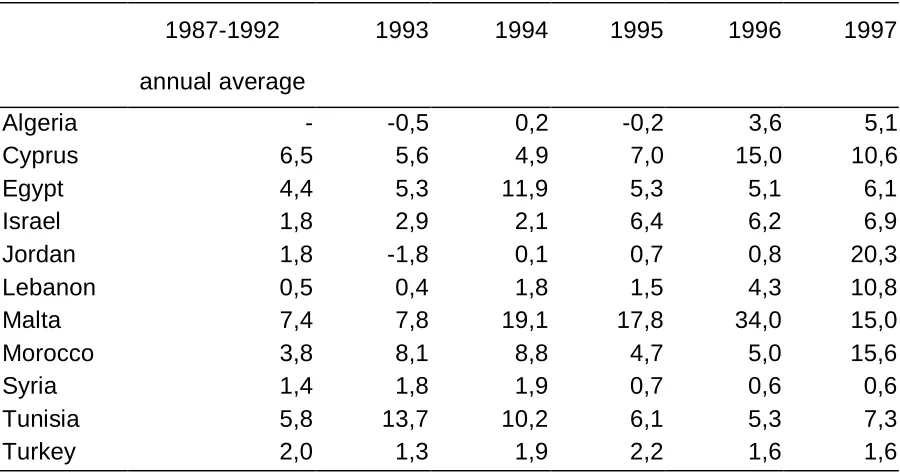
Movements in commodity prices largely influenced economic developments in the region. The increase in oil prices since March 1999 is helping Mediterranean oil producers (Algeria, Egypt, Syria10) to improve their external balances and strengthen their growth prospects. Some countries like Egypt and Jordan could also benefit indirectly from higher oil prices since they have large migrant labour forces in the Gulf oil producing countries and significant trade relations with them. Pressure for structural reforms has increased in some countries because of poor growth performance and inadequate employment creation. The full implementation of such reforms would substantially benefit the region’s longer-term economic prospects.
10
20
The EU absorbs between 60-75% of the exports of most of the Mediterranean Partners while the European Union is the principal supplier of capital goods and basic agricultural commodities. Capital inflows and tourists are predominantly of EU origin. Yet intra-regional trade remains at under 5% of regional GDP and the lack of South-South integration means that the economies of the region remain too small to attract foreign investment.
MIDDLE EAST PEACE PROCESS, 1999
In spite of all the obstacles in the way, the peace process made substantial progress in 1999, notably during the second half of the year. Indeed, the prolonged electoral period in Israel paralysed most related initiatives and activities during the first semester.
The election of Prime Minister Barak and the coming into power of a centre-left government in Israel led to a flurry of diplomatic contacts which ultimately materialised in the Israeli-Palestinian Sharm Al Sheikh agreement in September. The agreement was basically a re-negotiation of the November 1998 Wye River Memorandum. However, it also set a schedule for Permanent Status Negotiations inclusive of a Framework Agreement, due by mid February 200011, leading to a comprehensive Agreement by September 2000. Most of the commitments contemplated have been implemented albeit with slight delays12.
The European Union actively supported these developments and assisted the parties in the negotiations. Council President Fischer and Commission Vice-President Marín visited the region during the first semester. Council President Halonen visited in the second semester. The EU Special Envoy to the Peace Process Ambassador Moratinos continued to carry out an intensive shuttle diplomacy throughout the region. In addition, EU officials held numerous consultations with the core parties to the peace process and the main international players, primarily the US and Russia and also Japan, Norway and Canada.
In parallel, the EU maintained its large programme of economic assistance to the Palestinian Authority. Following the renewal of the 1993 pledges for a further five-year period13, the EU hosted and co-chaired a meeting of the Ad Hoc Liaison Committee (AHLC) on Palestine in Frankfurt in early February. Followed by the World Bank Consultative Group, both meetings served to further efforts towards sustained economic development in the West Bank and Gaza strip and enhanced budgetary transparency from the part of the Palestinian Authority. These efforts were continued at the next meeting of the AHLC that took place in October in Tokyo.
11
Later postponed to May 2000 12
Including transfer to Palestinian Authority control of a total of some 40% of the West Bank, release of several batches of prisoners and opening of the Southern route of the Safe Passage.
13
22
Maghreb and Mashrek: Demographic, Social and Economic Indicators
Indicator Unit Morocco Algeria Tunisia Egypt Jordan Israel WB Gaza Lebanon Syria Turkey Malta Cyprus World
Area (1000 Km2) 450 2381 163 1001 89 20,3 6,1 10,4 185 780 0,3 9,5
-Demography
Population Millions 1998 27,8 30 9,4 61,4 4,6 6 2,7 4,2 15,3 63,5 0,38 0,75 5896,6
Ann. Popul.Growth % 1992-98 1,8 2,2 1,6 1,9 3,3 2,6 n.a 1,8 2,8 1,5 0,7 1,1 1,4
Ann.Lab.force growth % 1992-98 2,2 4,4 2,9 2,8 4,5 3,8 n.a. 2,8 3,9 2,8 1,2 1,1 1,7
Infant mortality rate °/°° live births 1992-98 51 32 30 51 29 7 n.a 28 31 40 7 8 55
Socio-cultural indicators
GNP per capita (Atlas method, US $, 1998)
1.250 1.550 2.050 1.290 1.520 15.940 n.a. 3.560 1.020 3.160 9.440 n.a. 4.890
H.D.I. (*) 1995 0,582 0,665 0,695 0,616 0,715 0,883 n.a.. 0,749 0,663 0,728 0,850 0,850 0,706
Illiteracy rate % of people 15+ 1998 53 35 31 46 11 4 15 27 16 9 4 25
Men % of males 15+ 1998 40 24 21 35 6 2 n.a. 9 13 7 9 n.a. 18
Women % of females 15+ 1998 66 46 42 58 17 6 n.a. 21 42 25 8 n.a. 32
Economy
GDP Growth rate % 1998 6,5 5,1 5 5,7 2,2 2 4 3 5,4 2,8 4,1 4,7 1,7
Forec.GDP growth rate % 1999-03 n.a. 6 6,1 6,1 3,2 n.a. n.a. 3,5 4,8 5 n.a. n.a. 3,1
Inflation rate (**) % 1998 2,7 5 3,1 3,8 4 5,5 n.a. 4,5 -0,4 83,7 2,4 2,2
-Fiscal surpl/deficit % of GDP 1998 -3,1 -3,9 -2,4 -0,9 -6,9 -5,8 n.a. -18,9 -3,9 -8,9 -10,5 1,4 -Current Acc. Bal. % of GDP 1998 -0,1 -1,9 -3,4 -2,5 0 -0,7 n.a. -27,4 0,1 0,3 -4,8 n.a. -0,1 Total debt % of GDP 1998 55,8 63,4 51,8 38,2 115,6 n.a. n.a. 36,8 30,3 51,4 31,1 n.a.
-(*) The Human Development Index (H.D.I.) is a composite index including, inter alia, life expectancy at birth, adult literacy, real GDP per capita, gross enrolment in first-, second- and third level education (UN Development Programme, Human Development Report 1999 – values for 1997) (London, 1999)
(**) Consumer prices
II.2. COOPERATION WITH THE MEDITERRANEAN PARTNERS II.2.1. BILATERAL COOPERATION
ALGERIA EU-Algeria bilateral relations
Negotiations for an association agreement had been launched in March 1997, but were suspended by Algeria that June. Relations with Algeria picked up in the course of 1999, a process helped by the fact that the Algiers Delegation of the Commission had reopened at the end of the previous year.
Pending the conclusion of an association agreement, the political dialogue is conducted through regular ministerial-level meetings. Following the visit to Algeria on 3 November by the Council troika and Mr Patten, it was announced that formal negotiations for the association agreement would resume in the third quarter of 2000.
At the request of the Algerian Government, the Commission organised a workshop on economic transition and free trade in Algiers in June, with the participation of a number of European experts.
Political and economic developments
The start of 1999 was dominated by the April presidential elections. The Algerian authorities lost some of the reserve shown since President Zéroual had announced his resignation the previous August when a new government was appointed in January whose main brief was to prepare for the elections.
All the key political figures participated in the elections, which were won by Abdelaziz Boutéflika with 73.8% of the votes. The six other candidates had withdrawn the day before, objecting to voting conditions in the mobile and special polling stations. The official turnout was 60%.
Boutéflika’s first measures as President reflected a programme for restoring civil peace and the country’s standing internationally. The civil peace plan involved a new law under which clemency would be granted to members of armed groups giving themselves up before 13 January 2000. The plan received broad support from the population (98.6% of votes cast) in a referendum held on 16 September 1999. Though opposed by those who have suffered personally or lost relatives or friends in terrorist violence, the law is regarded as an important milestone in the process of restoring peace, and is also backed by Algeria’s main partners. It took the whole of 1999 for the President to put together a new government that was in line with his programme. The new team, under Ahmed Benbitour as Prime Minister, was finally appointed on 24 December 1999.
24
The year began amid gloomy economic prospects. Low petrol prices forced the country to dip into its currency reserves in order to meet its external obligations and 2000 was expected to be yet worse. Petrol prices began to recover and stabilise from the second quarter of 1999, however, which enabled the authorities to face payment deadlines with rather more equanimity.
The drop in petrol prices was even sharper than that experienced in 1986, but the Algerian authorities coped well. The country’s macroeconomic performance in 1999 was actually quite good and overall stability was maintained both externally and internally. Economic growth reached 3.6%, inflation continued to fall (from 5% in 1998 to 2.6% in 1999), the budget deficit stayed at 2% of GDP, compared with 3.9% the year before, but at the end of the year Algeria still had foreign currency reserves representing only 4.6 months’ imports (1998: 7.5 months). This downturn was due in part to external debt and very high debt servicing costs (over 40% of the value of the country’s exports). The prospect of a third rescheduling of external debt receded, however, with a steady recovery in petrol prices.
Despite its good macroeconomic performance, the Algerian economy continues basically to rely on income from oil. Other exports remain marginal, accounting for only 3% of the total. The growth recorded, therefore, has had no noticeable impact on unemployment, which still affects almost 30% of the workforce. Reduced reliance on oil has been set as a priority, and this can come about only through structural reform of the economy and attracting foreign direct investment.
In spite of investment incentives, the privatisation process has ground to a halt. Over a year after the launch of the privatisation programme, no privatisations have been completed successfully. The process has stagnated under a welter of procedures and turf-battles between the different institutions responsible. Foreign trade remains subject to heavy restrictions and relatively high average levels of protection. Nevertheless, the opening of a stock exchange and the arrival of the first private airlines testify to the authorities’ determination to redouble their efforts to liberalise the economy.
MEDA financial cooperation
Financial cooperation between the EU and Algeria has habitually been hampered by structural difficulties in the Algerian institutions, exacerbated by the security and political situation. Since the end of 1998, however, things have been easier and it has been possible to prepare a number of important private sector development projects. Two major financing agreements were signed for MEDA projects involving €38 million for industrial restructuring and privatisation and €57 million for helping small and medium-sized enterprises (SMEs). The first of these projects includes technical assistance to revive the process of privatising Algeria’s medium and large state enterprises, which are organised under various sectoral holdings. The second aims to make SMEs more competitive as the economy gradually opens up and a free trade area is established with the EU.
At the end of the year, €5 million was committed to a project to support civil society. Institutional support will be given to around 50-60 non-governmental organisations (NGOs) and development associations in Algeria, particular those active in the fields of local development, the environment, and women’s and youth issues.
26 ALGERIA MEDA COMMITMENTS APPROVED IN 1999
Description
€ million
1 – Support for financial sector modernisation 2 – Support for NGOs
23.2 5
Total 28.2
COMMITMENTS 1995-1999
Sector/Programme € million Share
A. Support for economic transition 129 79%
1 – EIB: interest subsidies - reducing industrial pollution 2 – Support for SMEs/SMIs
3 – Support for industrial restructuring and privatisation 4 – Support for financial sector modernisation
10.7 57 38 23.2
B. Structural/Sectoral Adjustment Facilities 30 18%
5.- Structural Adjustment Facility 30
C. Socio-economic balance support 5 3%
6.- Support for NGOs 5
EGYPT EU-Egypt bilateral relations
Negotiations on a new EU-Egypt Association Agreement reached their final stage after the key outstanding issues (agricultural quotas, readmission of third country nationals, and human rights) were resolved in the first half of 1999. The position reached by the negotiators was endorsed by the General Affairs Council in June 1999 and was subsequently examined by the Egyptian government. Initialling of the text by both parties is expected in the first part 2000 with formal signature to follow soon thereafter.
Pending the signature of a new Association Agreement, the existing bilateral understanding on trade in textiles was renewed in December 1999 to maintain the existing trade regime. Bilateral trade relations have been generally good but were overshadowed in 1999 by several sensitive disputes, notably on technical barriers to trade and phyto-sanitary related import bans. The two most serious food health related issues, the import restrictions on Egyptian potato and peanut imports because of ‘brown rot’ and ‘aflotoxin’ respectively, were resolved in time for the 1999-2000 shipping season. The dioxin-related suspension by Egypt of imports of a wide range of EU food products was still in force, but the Egyptian authorities indicated that the ban would be removed in early 2000 and replaced by a certification system to allow trade to resume.
Vice-President of the Commission, Sir Leon Brittan, visited Egypt in June 1999 to prepare for the WTO Seattle conference and to press the Egyptian authorities to resolve outstanding trade issues.
Recent Political and Economic Developments
The main political events of 1999 were the endorsement by referendum of President Hosni Mubarak’s re-nomination for a fourth six year term, and the subsequent change of government. The former Minister for Public Enterprises, Atef Obeid, was appointed Prime Minister in October 1999 with a mandate to accelerate economic and structural reform. Several new figures, including a new Minister for International Cooperation, entered the cabinet for the first time although most main portfolios remained unchanged.
One of the most serious domestic political challenges of recent years has been the activities of extremist terrorist groups. Harsh Government measures to crush the armed fundamentalist opposition led to heavy casualties on both sides and the widespread use of military courts. The massacre of foreign tourists at Luxor (November 1997) shocked most Egyptians and split the fundamentalist Islamic movement. Although the ‘Islamic jihad’ movement did not formally renounce violence, the main armed opposition declared a cease-fire which held firm in 1999.
Having contained fundamentalist terrorism, the regime has begun to release political detainees but many remain in prison. The State of Emergency (in force since 1981) has been renewed for a further three years, and there are persistent reports of heavy handed policing and poor prison conditions.
28
found on the provisions for monitoring foreign (including EU) financing to allow for the continued EC funding of NGO projects.
In the field of social legislation the Government successfully confronted conservative forces by preparing new legislation to considerably improve the status of women, notably with respect to divorce. However there is a recognition that political and social liberalism lags far behind economic liberalisation and that new measures must follow.
On the international scene, Egypt continued to re-affirm its key regional role as an important player in the Middle East Peace Process; it further improved its relations with neighbouring states (notably with Sudan and Libya) and with sub-Saharan Africa through its association to COMESA14and further strengthened its links with Europe.
The Egyptian economy performed solidly in 1999 with a real GDP growth of 5%. This performance was good in relation to the regional average but was below the government target, and growth in employment was insufficient to absorb the rising numbers of un- and under-employed. The level of savings remained far too low and the flow of foreign direct investment was well below expectations.
Declining export revenues (due to very low oil prices in 1998/99) and steeply rising imports led to a deterioration of the external accounts and increased pressure on the overvalued Egyptian pound. Foreign exchange reserves were run down in defence of the currency but they still remained relatively high (equivalent to more than 12 months of imports). Both oil prices and tourism had recovered markedly by end 1999.
MEDA Interventions in Egypt
Most MEDA budgetary commitments to finance the actions included in the 1996-1999 National Indicative Programme (NIP) were already made in 1996-1998. As a consequence, only two new commitments were approved in 1999, both with respect to MEDA interest rate subsidies to EIB loans for environmentally positive actions.
By end 1999, more than 90% of the actions initially foreseen in the NIP 1996-99 for Egypt had been committed. Proposed actions in support of financial sector and technical-vocational training (TEVT) reform were not finalised although discussions with the Egyptian authorities on defining a reform policy framework on TEVT reform continued.
Cooperation activities in 1999 focused on the implementation of the four major MEDA funded programmes approved in 1996-98, notably the:
• Social Fund for Development – Phase II (€155 million, in collaboration with World Bank); • Education Enhancement Programme (€100 million, in collaboration with World Bank); • Industrial Modernisation Programme (€250 million);
• Health Sector Reform Programme (€110 million).
14
The EU’s extensive support to the Egyptian Social Fund for Development (SFD) constitutes a major contribution to Egypt's programme to mitigate the adverse effects of economic transition. Following the positive evaluation of the first phase of the SFD, additional MEDA financing of €155 million was committed in 1996 (SFD II). Recruitment procedures for the required technical assistance for the SFD II were completed and the contract signed. The TA team will assist the SFD II in the coordination and monitoring of donor inputs.
The EU supports the Government of Egypt Education Enhancement Programme (EEP) to improve the quality of basic education. It emphasises: (1) increasing access to compulsory education, particularly for girls and under-privileged children; (2) improving the quality of education through reducing wastage and ensuring the attainment of basic skills; and (3) improving system efficiency by enhancing resource use, planning and management and accountability of teachers and system managers. Activities undertaken in 1999 in support of EEP focused on the recruitment of the technical assistance required for the project implementation.
In health, the EU supports the Government’s comprehensive 10-15 years Health Sector Reform Programme (HSRP) whose ultimate objective is to offer the Egyptian population universal access to high-quality and cost effective services in a fiscally sustainable and efficient health and health insurance system. The HSRP will initially focus on primary care, and will lay the basis for overall health manpower and system reform for which policies will be developed and implemented progressively. Following the finalisation of the tendering procedures, the contract for technical assistance to the Health Sector Reform Programme was signed in November 1999 and the full team of experts was mobilised by the end of the year. The Industrial Modernisation Programme (IMP) is a shared vision between the Egyptian Government, private sector and the European Union to help Egypt compete successfully in both the domestic and international markets. The objectives of the IMP will work at three levels. First at the policy/enabling environment level, second at the sectoral level, and third at the individual enterprise level. Assistance will be given to the Ministry of Industry to help it continue to facilitate the growth of the private business sector and produce a more business-friendly policy environment. Assistance will also be given to businessmen’s associations and to other related organisations to address the needs of the business sector. At the enterprise level, some 5,000 enterprises have been targeted for assistance to improve their competitiveness. The Financing Agreement for the IMP was signed in late 1998. In 1999 the project activities centred on the finalisation of tendering for essential studies foreseen for the initial phase and on the tendering of the complex technical assistance package to provide the director and key managers for the Industrial Modernisation Centre which will manage the implementation of this ambitious project.
30
EGYPT: 1999 MEDA COMMITMENTS,€ million
Name of project/programme Amount
Alexandria Wastewater (EIB Interest Subsidy) 6.1
Red Sea Hotel Environmental Facility (EIB Interest Subsidy) 4.9
Total 11
EGYPT: Commitments 1995-1999 (€ million)
EGYPT – Indicative Programme Update 1997-1999
Amount (€ million) Share
1 ECONOMIC TRANSITION SUPPORT
Industrial Modernisation Programme (IMP) 250 33.1%
E.I.B. interest subsidies 41.8 6%
E.I.B. capital risk 29 4.2%
Sub-total 1 320.8 46.8%
2 SOCIO-ECONOMIC BALANCE
SUPPORT
Social Fund for Development (II Phase) 155 20.5%
Basic Education Enhancement Programme 100 13.2%
Health Reform Support Programme 110 14.5%
Sub-total 2 365 53.2%
3 STRUCTURAL ADJUSTMENT
--- --- 0%
Sub-total 3 0 0%
JORDAN EU-Jordan bilateral relations
By end of 1999, the Hashemite Kingdom of Jordan as well as six EU Member states had ratified the EU-Jordan Association Agreement, signed in November 1997.
Under the Finish presidency (second semester of 1999), an EU-Troika on ministerial level, accompanied by the Commission, visited Jordan, underlining the country’s important role in the Middle East Peace Process.
Recent political and economic developments
King Hussein passed away on 7 February 1999. His son and successor, King Abdullah, has committed himself to political and economic reform. Despite its shortcomings, Jordan’s democratisation process is regarded as something of a model in the region.
King Abdullah has been active in promoting the rights of women in his country. He supported the initiative of the Government to cancel the Penal Code article providing for a lenient treatment of men physically attacking women suspected for adultery (so called “honour crimes”).
Abroad, King Abdullah and his Government further improved ties with Europe and the US and are working successfully to repair relations with the Arab world, particularly with Syria and the Gulf countries. He has continued his father’s mediation efforts in the peace process and managed to mediate between Israelis and Syrians before talks were resumed in December 1999
Moreover, King Abdullah has launched a number of initiatives with a view to modernising the public sector and promoting privatisation.
The difficult economic context prevailing in the country and the region in late 1998 / early 1999 led the General Affairs Council of 22 February 1999 to request the Commission to consider additional financial assistance to Jordan. The unstable regional situation – following the renewed conflict in the Gulf and the deadlocked peace process – adversely influenced Jordan’s economic situation. Political uncertainties, together with a very high budget deficit (estimated to have been over 10% in 1999), put the country’s foreign exchange reserves under considerable pressure.
In April 1999, Jordan signed a new programme with the International Monetary Fund (IMF) for the period 1999 – 2001 (Extended Fund Facility (EFF) reinforced by a Compensatory and Contingency Financing Facility, together worth US$228 million). In May, the World Bank accorded Jordan a new Economic Reform and Development Loan (ERDL III) of US$120 million. Furthermore, the Paris Club decided in April 1999 to reschedule some US$800 million of Jordanian debt.
32 MEDA interventions in Jordan
Jordan has received substantial resources from the MEDA Programme in support of its economic transition programme. Under MEDA I (1995 – 99) Jordan received grants of €254 million within bilateral cooperation while EIB lending operations on own resources amounted to€223 million.
The following four programmes were approved by the Commission in 1999:
• Structural Adjustment Facility (€80 million): The Commission prepared a new Structural Adjustment Facility in favour of Jordan with a view to accelerating the implementation of the country’s structural reform programme. Tranche disbursement depends upon the satisfaction of conditions negotiated with the Jordanian authorities. These mainly concern: (a) macroeconomic management, (b) fiscal reform (e.g. introduction of VAT), (c) social investments, (d) public sector reform. The disbursement of the 1st tranche (€40 million) planned for end of 1999 was postponed, because a core condition (presentation of a draft legislation for the introduction of VAT to the Parliament) could not be fulfilled.
• In the context of the implementation of the EU-Jordan Association agreement and Jordan’s recent accession to WTO, the €40 million Industrial Modernisation Programme (IMP) aims at improving competitiveness of the country’s private industry. The programme’s objectives include, inter alia: (a) the provision of non-financial services for beneficiary enterprises, particularly SMEs; (b) the diversification of financial instruments for private sector enterprises, especially for medium and long-term financing; (c) the strengthening of vocational training; and (d) the acceleration of institutional reform (reform of the Ministry of Industry and Trade and technical assistance to Jordanian institutions in charge of industrial policy).
• In view of the implementation of the Greater Amman Water Sector Improvement Programme, the Commission approved the financing of its Management Unit (€5 million). The programme consists of a large capital investment of around€200 million coming from various international donors and lenders (e.g. EIB, World Bank, Germany, Italy and US-AID) to restructure and rehabilitate Amman’s water network, in order to significantly reduce the current high level of water losses.
• The Protection and Promotion of Cultural Heritage (€3.9 million) aims at enhancing awareness and strengthening protection of Jordan’s cultural heritage (e.g. development of two archaeological sites, Um Al-Rasas and Lehun, that offer a good overview of Jordanian civilisation). This project also aims at further developing the tourism sector by providing support to Jordan’s Tourism Board.
Jordan: 1999 MEDA commitments,€ million
Name of project/programme Amount
Structural Adjustment Facility II 80
Industrial Modernisation Programme 40
Management Unit for the Greater Amman Water Sector Improvement Programme
5
Protection and promotion of cultural heritage 3.9
Total 128.9
Jordan: Commitments 1995 – 1999,
€ million
Sector/Programme € million Share
A. Support to Economic Transition 57 22,4 %
Private Sector Development Programme (Business Service Team)
Risk Capital Resources (EIB) in support of SMEs Industrial Modernisation Programme
7 10 40
B. Structural Adjustment Facilities 180 70.8 %
Structural Adjustment Facility I
Structural Adjustment Facility II
100 80
C. Socio-economic balance support 17.1 6.8 %
EIB interest subsidies for Amman Water Rehabilitation Programme
Management Unit for Greater Amman Water Sector Improvement Programme (Rehabilitation)
Tourism development and preservation of cultural heritage
8.2
5
3,9
34 LEBANON EU-Lebanon relations
Progress on negotiations for the Association Agreement with Lebanon has been slow. Negotiations began in November 1995, with the last session in April 1998, after a break of almost two years. At present, there is an agreement on most subjects. Obstacles to resuming negotiations are internal (general elections in August/September 2000), economic (resistance of protectionist private sector), fiscal (high dependence on customs revenues) and external (dominating influence of Syria). New revenue sources from the introduction of VAT foreseen for 2001 would allow for the gradual dismantlement of customs tariffs in preparation for a free trade area. The government has embraced economic liberalisation, transparency and modernisation, and is committed to fiscal reforms in its 1999 and 2000 budgets to tackle the large budget deficit. The Commission is taking the lead in assisting with these reforms in preparation for the future Accord. A call for the resumption of Association Agreement negotiations was made by the Commission in early 2000.
Recent economic and political developments
Since the end of the civil war (1975 to 1991) Lebanon has been governed by a troika composed of a President (Maronite Christian), a Prime Minister (Sunni Muslim) and a Speaker of the Parliament (Shiite Muslim). After the October 1998 elections, General Emile Lahoud replaced Hariri as President with an agenda to combat corruption, open up the political debate, accelerate economic liberalisation and strengthen transparency in public administration. He appointed Selim Hoss as Prime Minister. He has attempted to reshape state institutions along non-sectarian lines, but with limited success so far.
The new government inherited a crippling public deficit (€19 billion in early 1999), which it has sought to reduce through two successive budgets. Liberal economic policies, tax reform and privatisation are seen as the basis for economic recovery. The task of pushing through economic reforms is complicated by the current recession.
Financial Cooperation under MEDA
Lebanon has benefited from grants amounting to €184 million in the context of the MEDA Programme (1995-99). Most of this amount of aid was committed in 1999. In aid per capita terms, Lebanon is among the leading beneficiaries of EU assistance from within the group of MED partners. In addition to grants, the European Investment Bank has accorded loans of over€200 million to Lebanon.
The bulk of this financial support goes to Lebanon’s economic restructuring and
administrative rehabilitation. In August 1998 a€38 million Financing Agreement was signed
for a programme of rehabilitation of social service ministries, state agencies (electricity, water) and municipalities, following a long and catastrophic civil war. An investment
planning programme accord (€25 million) was signed in June 1999 to further strengthen the
planning and management capabilities of ministries dealing with water, energy, public works, environment and solid waste facilities.
In December 1999 the Commission formally approved a €50 million grant structural
adjustment facility designed to reinforce fiscal reform, and a€25 million grant for the creation
of a social and economic development fund to help provide a safety net to lower income groups through micro-credit schemes, community development actions and social services. A project for industrial modernisation (€11 million), approved in November 1999, is due to begin in early 2000. Industry is also to receive support through the strengthening of institutions responsible for the preparation and certification of standards and norms (€6 million), scheduled for start in first half 2000.
Lebanon: 1999 MEDA Commitments,€ million
Name of project/programme Amount
Industrial modernisation programme 11
Structural Adjustment Facility 50
Fund for social and economic development 25
TOTAL* 86
(EIB risk capital and interest subsidies are forecasted for 2000)
36
Lebanon: Commitments 1995 – 1999,
€ million
Sector/Programme € million Share
A. Economic transition 107 58.8%
Norms 6
Investment Planning 21
Industrial modernisation programme 11
E.I.B. interest rate subsidies (coastal pollution)
10.2
E.I.B. interest rate subsidies (Tripoli wastewater)
20.8
Rehabilitation of the public administration 38
B. Structural adjustment 50 27.4%
Structural Adjustment Facility 50
C. Socio-economic support 25 13.8%
Fund for social and economic development 25
MOROCCO EU-Morocco bilateral relations
By October 1999, the EU Member States’ national parliaments had all ratified the Association Agreement but its entry into force was subsequently delayed at Morocco’s request so that certain changes could be made to Annexes 2 and 6.
The changes were made by means of an exchange of letters and the Agreement, together with the letters, entered into force on 1 March 2000.
The Fisheries Agreement expired at the end of November 1999. Morocco confirmed that it did not want to renew it, but said it was prepared to look at other forms of partnership on fisheries. This was the purpose of Mr Fischler’s (the Commissioner for Agriculture, Rural Development and Fisheries) visit to Morocco on 20 and 21 December.
Some tension has arisen in trade relations between Morocco and the EU because of problems posed by the management of the import regime for Moroccan tomatoes. The Commission imposed a system of import licences on 23 December after the relevant EU tariff quotas had been exceeded. Consultations held on 17 January 2000 between the Commission and the Moroccan authorities led to the system being dropped, subject to Morocco’s undertaking to place strict limits on its exports.
Political and economic developments
The year was marked by the death of King Hassan II on 23 July and the accession of his son, Mohamed VI. The new king has departed from tradition and taken a number of measures to create a new, more liberal, political landscape. In particular, the return from exile of political opponents was a clear signal of the new regime’s will to liberalise and democratise.
The “partnership” Government that had been in power since the start of 1998 remained in office. It was, however, criticised, by the opposition in particular, for inaction.
While macroeconomic indicators are stable - a budget deficit in 1999 of less than 2.3%, a drop in outstanding external debt, greater foreign investment, recovery in the tourism sector and satisfactory foreign assets - the stagnation of growth is somewhat worrying. The farm sector is growing at a rate far below 1%. Agriculture aside, GDP growth tends to be around only 3%. These results are insufficient for genuine economic recovery, particularly given the persistence of social problems such as unemployment and poverty, which has been increasing for ten years.
MEDA operations
38
inshore fishing. Part of the funds for other projects has been specifically earmarked for the north of the country (see box).
The third and last instalment of the Structural Adjustment Facility (€50 million) was disbursed in December 1999.
Support for the development of the northern provinces
The north’s difficulties are basically linked to its poor state of development. The region has suffered from isolation and lack of investment in all areas. Today, a third of all Morocco’s migrants come from the north and a large proportion of the cultivated area is for growing kif (hashish). The EU supports the fact that development activities prioritise this region. The Commission has really intensified its efforts since 1996 and 27% of MEDA programming between 1996 and 1998 was for the north. In 1999, it received 77% of the funds, in addition to which a number of individual projects were financed under other budget headings.
The Commission’s action is designed to augment incomes with productive projects, overcome the lack of investment in the social infrastructure and fight ecological decay.
Projects in the north involve integrated rural development and the management of natural resources, support for health sector management, the integrated development of forested areas in Chefchaouen, hydro-agricultural improvements in Sahla, support for traditional inshore fishing, and slum clearance in Tangiers. Total amounts for projects concerning water and sanitation in the countryside, support for young people and sport, support for basic education and cultural centres include funds earmarked for the north.
Morocco: Commitments approved in 1999
Project/Programme € million
Interest subsidies for sanitation in: Meknès
Settat Agadir
EIB-managed projects
5.9 2.2 4.7
Support for development NGOs 4.0
Support for professional associations 5.0
Hydro-agricultural improvements (Sahla) 28.6
Support for employment 3.3
Support for the national geological mapping programme
5.0
Mediterranean rocade (road link) 80.3
Slum clearance (Tangiers) 7.0
Support for traditional Mediterranean inshore fishing 21.0
Cultural centres 5.0