COMMISSION OF THE EUROPEAN COMMUNITIES
Brussels, 20.12.2000 COM(2000) 835 final
REPORT FROM THE COMMISSION
Introduction... 3
Financial performance and streamlining of procedures ... 5
Armenia ... 8
Azerbaijan... 12
Belarus ... 15
Georgia ... 16
Kazakhstan... 19
Kyrgyzstan ... 22
Moldova... 25
Mongolia... 28
Tajikistan ... 38
Turkmenistan ... 38
Ukraine ... 40
Uzbekistan ... 44
The complementary Tacis programmes ... 48
INTRODUCTION
In 1999 the Tacis programme made a major contribution to achieving the objectives of supporting the transition to market economies and to democracy in the New Independent States (NIS)*
.
In 1999 Tacis became even more closely integrated with EU policy in the region, with the coming into force of more Partnership and Cooperation Agreements (PCAs) between the EU and individual NIS. Tacis assistance is provided on the basis of certain shared economic and political values and practices as set out in the PCA's, in particular, respect for democratic principles and human rights, and the principles of a market economy.
Stronger links between policy and technical assistance, enabled Tacis to respond even more suitably to changing circumstances in the region. This is clearly seen in, for example, the rapid response to critical events such as the €20 million of Tacis funds diverted to help overcome the negative consequences of the 1998 Russian financial crisis in other NIS; in the new activities launched in the justice and home affairs field; and in the emphasis on regional cooperation in the Caucasus. The new strategic approach has also made Tacis more visible to policy-makers, economic interest groups and civic organisations in the NIS, offering new opportunities to ensure projects benefit from local ownership. The projects selected in 1999 also contributed to the macroeconomic reform process and the sectoral reform policies of the NIS. The EU kept stressing that implementation of the Tacis programme can be successful only when the NIS’ governments undertake the necessary measures of macroeconomic reform.
Tacis projects were implemented by the Commission’s Common Service for External Relations (SCR). SCR now manages all implementation aspects – technical and operational, financial and accounting, contractual and legal – of EU aid and assistance, and is also responsible for audits and evaluations. SCR has made progress in streamlining and rationalising the administration of Tacis assistance, including tendering and contract procedures, and particularly in financial management. Links with other areas of EU policy were also reinforced. Continued progress towards EU membership for the western neighbours of the NIS – including negotiations on such questions as visa requirements or trade links – focused further attention on the role of Tacis on the important border region. The increased importance of the Baltic Sea basin in an enlarged EU and the development of the EU's Northern Dimension initiative are offering further scope for synergy with Tacis. The Northern Dimension initiative, which mainly targets the Baltic region, is a means of maximising coordination and impact of different EU activities concerning Russia and the EU candidate countries around the Baltic, to increase prosperity and respond to the specific needs of the region. Growing recognition of the special circumstances of the Barents Sea region is also leading to enhanced cooperation between Russia and the EU, and Scandinavia in particular, offering another area for Tacis to cooperate with other suitably adapted instruments. At the southern end of the area covered by the Tacis programme, Black Sea and Caspian Sea cooperation instruments are being developed, with Tacis at the forefront of the various instruments deployed to help the problems of these regions. Coordination with other donors – notably the EU’s Member States and the International Financial Institutions – were strong (particularly in the light of the Common Strategies for Russia and Ukraine), offering important sources of information and a forum for seeking greater synergies.
*
In the southern Caucasus particularly, the emphasis of Tacis activities in 1999 was linked to the broad objective of promoting regional cooperation. 1999 was a troubled political year in the region – with the assassination of leading figures within the Armenian Parliament, questions over democratic practices in some countries, and the backdrop of Russia's military campaign in the northern Caucasus. Against this background Tacis focused heavily on reopening links of communication, both to help realise the economic potential and to consolidate deeper understanding among different governments.
In terms of programme content, the aim has been to avoid dissipating Tacis's efforts by spreading them too thinly over too wide a range of projects. Tacis has consequently focused on a number of themes agreed as priorities with the NIS and the EU Member States, to support the overall economic reform and sectoral policies of the beneficiary authorities. Emphasis has been placed on addressing the social impact of transition and supporting reform of the important health sector. Structural and institutional reform has been fostered to allow market-oriented economies to function more efficiently, particularly in government departments, and in the financial sector. Attention has been focused on taxation systems, on creating legal systems which establish a secure environment for local and foreign investment and competitive market relations, and on overcoming the challenges of weak judiciaries, which can compound the problem of arbitrary enforcement and act as a major disincentive to investors.
Environmental projects have been conducted, both nationally and in multi-country programmes. European expertise in environmental technologies and industrial processes is important because of the antiquated and sometimes obsolete environmental technology of industries in the NIS. Fostering regional cooperation has also been essential because most of the major environmental challenges facing these countries, notably those relating to air and water borne pollution, are of a trans-boundary nature and require collaboration between the countries concerned. In some border regions, the health of the population has deteriorated, notably owing to the poor quality of drinking water and dangerous discharges; obsolete and inefficient environmental technology in various industrial sectors has produced waste which has a harmful effect reaching beyond border regions. Another key theme has been development of infrastructure (transport, energy and communications) central to modern knowledge- and information-based market economies, and vital for integrating countries in the region into the international economy. Private sector development has been pursued, to stimulate economic growth, job-creation, and welfare of the population. Human resources has been another major area of Tacis activity, since it is the educational systems which will underpin the long-term growth and prosperity of the NIS' economies, and contribute to the development of democratic societies and market economies by promoting new attitudes, modes of behaviour and skills among citizens. Furthermore, establishment of efficient and targeted social security systems which support the vulnerable groups in society, such as the elderly, is a major challenge to all countries in transition. Moreover, throughout all projects, in order to build lasting capacities in the region through transfer of know-how and two-way exchanges, encouragement was given to work with and through local counterpart institutions, experts and enterprises.
1999 was the last year of operation under the 1996-1999 Tacis Regulation. The new Regulation, covering 2000-06, adopted on 29 December 1999 following consultation of the European Parliament, builds on Tacis experience, and provides for an indicative total of €3,138 million of grant assistance over the next seven years. It provides greater scope for investment promotion activities, with a regional emphasis, and with a sharper focus. EU Commissioner for External Relations, Chris Patten, welcomed the entry into force of the new Regulation at the beginning of 2000 with the prediction that: 'The new instruments will allow us to build an ever closer and constructive relationship with our partners and neighbours in the NIS'.
FINANCIAL PERFORMANCE AND STREAMLINING OF PROCEDURES
In response to the broader moves towards better management of EU external assistance programmes and to the specific challenges of a programme spread over such a wide geographical area and diverse range of beneficiaries, the Tacis programme has been subject to a range of radical improvements in monitoring and supervision. Although performance did improve in many areas during 1999 there is still some way to go, however this issue is to be addressed in the reform of all EU external assistance programmes starting in mid 2000.
The reform will imply a new division of labour between the Commission services responsible for managing the Tacis programme, now DG Relex and SCR. On one hand, the identification and implementation of projects will be unified in order to shorten the time that it takes to implement approved projects. On the other hand, multi-annual programming will gain more importance, to ensure that it reflects wider policy issues, such as trade, foreign and security policy and the interests of the Tacis partner countries. Moreover, the gradual devolution of project management to the Commission’s delegations is aimed to improve the quality and responsiveness of the programme management.
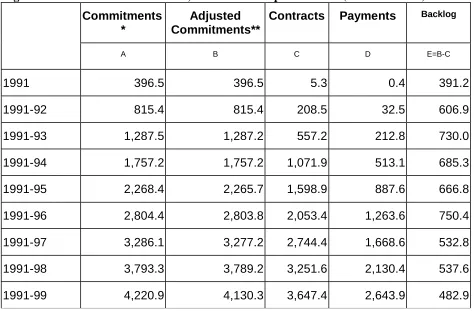
Through the efforts of the Commission to speed up procedures (in which Tacis has done better than any other EU external assistance programme), aided by a housekeeping exercise to decommit uncontracted portions from old programmes (in total €91 million in 1999), the backlog in signing contracts was cut to its lowest level since the launch of Tacis in 1991. This value, which is a cumulative measure of the residue of commitments made after deducting the value of contracts signed (and hence of commitments still available for processing into signed contracts), was down to
€455 million in 1999 (after peaking at €747 million in 1996). At this level, the amount is
Contract signing backlog against cumulative commitments
0 500 1.000 1.500 2.000 2.500 3.000 3.500 4.000 4.500
1 2 3 4 5 6 7 8 9
Net commitments (adjusted for decommitments) Backlog
(uncontracted)
Under the present rhythm of performance, it takes on average about one year to process a financial commitment into a signed contract – that is, the start of project implementation. Critical points in this process are early commitments by DG Relex, and speedier tendering and contracting by SCR. As well as improving the processing up-front, the Commission has also succeeded in speeding up the process of paying the contractors carrying out projects. Payments made reached new record levels in 1999: €513.5 million. Faster payments resulted in part from accelerated processing of invoices: in May 1999 there were 71 invoices totalling a value of€12 million over 40 days due; by December there were none, and the internal deadline for processing has been cut to 25 days.
Tacis payments 1991-99
0 100 200 300 400 500 600
1991 1992 1993 1994 1995 1996 1997 1998 1999
Contract execution backlog against cumulative contracts signed
0 500 1.000 1.500 2.000 2.500 3.000 3.500 4.000
Contracts signed Backlog (payments)
The overall state of Tacis performance in numerical or financial terms is assessed through the 'reste à liquider' (RAL) concept, the combination of contract signing and contract execution backlogs. Tracing this cumulative value, it emerges that it peaked at €1,679 million in 1998, but was cut to
€1,502 million by the end of 1999, a reduction of 11%. On current projections, the trend is now
towards a period of relative stability, with the amounts for commitments, contract signings and payments converging – which is to be expected of a mature assistance programme with a relatively steady level of commitments from one year to another.
Tacis performance in 1999 reflected the figures outlined above (and provided in detail in the annex), with payments up, commitments on target, and launches and contract signings down. Contract signings reached over 99% of commitments, excepting one late commitment (for the Chernobyl Shelter Fund in December). Resource constraints meant that processing of twelve projects, worth€28 million, had to be postponed from 1999 to 2000.
The attention devoted to internal financial management of Tacis was matched by attention to project performance on the ground. The accounts and records of expenditure financed under the programme are checked at regular intervals by external auditors contracted by the Commission. In addition to regular follow-up and controls carried out on the spot, if necessary, by the Commission's services and the Court of Auditors, contracts have been concluded with independent consultants to monitor the progress of programme and contractor activities, and to undertake a comprehensive ex-post evaluation of whether the objectives of the programmes and contracts have been achieved.
Within the new organisation of Tacis, responsibility is shared between the geographic operational units in the relevant Directorate of the External Relations Directorate-General (DG ER E) and the SCR, where directorate A has responsibility for the implementation of programmes and projects in Central and Eastern Europe, the Western Balkans, the New Independent States (former Soviet Union) and Mongolia. Other directorates are responsible for budget programming, financial monitoring; financial implementation, auditing and supervisory activities, publication, administration and approval of invitations to tender and the award of contracts, and evaluation. In 1999 the SCR also began to look at ways in which the responsibility for the implementation of individual projects could be moved from Brussels to Commission staff in the field, in particular in the four Delegations in Georgia, Kazakhstan, Russia and Ukraine. A pilot scheme in the field of private sector development saw a programme officer based in the Delegation in Almaty taking over responsibility for projects. This pilot scheme has since been extended to Kiev. Moving project responsibility closer to the projects themselves will ensure more flexible project management. The lessons learnt from the pilot projects will serve as a basis for transferring further operational responsibility to staff in the field. However, it should be noted that since the Commission does not currently have a complete network of Delegations covering the NIS, decentralisation will not be able to move as fast with Tacis as it has with other Commission programmes.
ARMENIA
In line with the broad objective of promoting regional cooperation, the Tacis focus for Armenia was increasingly on the improvement of communication links, both as a prerequisite for realising the full economic potential of the country, and as a mechanism to encourage the governments of the region to work together on mutually beneficial projects, despite the conflicts. Armenia benefited in this respect both from actions under the national Tacis programme and from the Inter-state Programme, especially Inogate and Traceca. This focus was complemented by Tacis's attention to enhancing skills in business, in government, and in agriculture, and to developing civil society – all of which have their role to play in the emergence of a country and a region with a population that can subordinate the bitterness of the past to its feeling that it has a stake in working for the future.
Some Tacis contributions in 1999
The main projects Tacis supported during the year included pioneering a new approach to building policy coherence in the regions, so that the market economy principles adopted by central government can be put into effect at local level. Until now, sub-national government has had only limited experience in independent economic management, so disciplines such as budgeting, cost estimations for investment, and prioritisation are new. The pilot project now underway in the Lori region will have direct impact there, and provide a model that can serve as a demonstration for other regions and other countries.
In addition, Tacis:
• helped strengthen the effectiveness of the judiciary and reinforce its independence by establishing a judicial training school; this has started enhancing the skills of judges and court officials, and preparing and publishing commentaries on Armenian law.
• helped introduce a social security numbering system to allow wider access to benefits and more systematic planning.
• promoted new business start-ups through support centres. • provided social work training.
Tacis in the political context
The EU-Armenia Cooperation Council held its first meeting, in Luxembourg, in October 1999, and expressed its confidence that implementing the PCA would ensure coherence between the various aspects of EU-Armenia relations, including assistance such as under Tacis. It also argued for 1999/2000 cooperation to focus on supporting the efforts to resolve the Nagorno-Karabakh conflict; identifying means of fostering regional cooperation in the Caucasus; implementation of the PCA in general and of measures aimed at facilitating trade and investment in particular; facilitation of measures aimed at allowing Armenia to close down the Medzamor nuclear power plant; strengthening the democratisation process and respect of human rights, as well as close cooperation in combating drug-trafficking.
Under the 1996-99 Tacis Indicative Programme for Armenia, approved in July 1996, priority was given to three areas of cooperation:
Human resources development: Reform of the public administration is a key element of the transition process, and Tacis projects on public administration and unemployment are intended to support policy formulation. Changes require civil servants to perform new roles in a changing political, social, economic and administrative environment, and adaptations are needed accordingly in the function and financing of public administration. Tacis has been providing assistance to establish a School of Public Administration, which has become a national training institution for the upgrading and re-qualification of enrolled civil servants and for training of the next generation. It has also been running projects in the social security field.
Private sector development: Tacis has worked to meet the needs of new, private or privatised companies in terms of business skills, restructuring advice, a stable banking system and adequate capital markets, and the development of a comprehensive legislative and regulatory framework for a market economy. Private sector support has been aimed at establishing an environment within which private operators can flourish. Tacis actions also included a project to establish an Accountancy Training Centre to provide longer-term training courses to graduates and upgrading courses for practitioners. Tacis has already helped establish the Agricultural Cooperative Bank of Armenia to provide credit so farmers could increase yields through buying seeds or modernising their machinery. Other Tacis projects have helped privatisation, trained the banking sector, and established Armenian institutions which are playing an intermediary role in the development of the private sector: an SME business centre, an agency providing advice to privatised companies undergoing restructuring, and a mutual investment fund intended to play a role in the developing securities market.
Action Programme
The latest Tacis Action Programme for Armenia (dated 1998-99) included six new projects, each worth around €1 million. Four of these projects addressed the theme of human resources development:
• Civil service: Tacis is aiming to assist the strengthening of the public administration through the development of a professional civil service structure and organisation at central and regional level.
• Regional administration: the Lori region has been chosen as a pilot case to demonstrate how regional administration can coordinate regional development policies, foster local democracy, and apply the market economy principles advocated by central government at local level.
• Training for the judiciary: the establishment of a judicial training school will enhance the skills of 100 judges and 200 court officials, and help in preparing and publishing commentaries on Armenian law.
• Employment policy: assistance to the National Employment Service is intended to build its capacity to implement an active employment policy, to study market demand, and to implement employment and business support strategies, including the training of unemployed persons. • Under the heading of private sector development, it was decided that existing Tacis work to
foster a climate for private operators should be extended. The aim is to give greater coherence to all levels of intervention, ranging from policy advice to the government, through assistance in setting up business support organisations, to training of local consultancies and direct restructuring assistance in pilot enterprises. In this way the experience from pilot restructuring assignments can be referred to the political level and can help deal with obstacles to development in the regulatory, legislative or fiscal environments.
The 1998-99 programme received a grant of€10 million, allocated as follows (in million euro): Human resources development
Enterprise restructuring and development Energy
Bistro
Small project programmes Reserve
Total
4.0 2.0 1.0 0.3 2.4 0.3 10.0
AZERBAIJAN
The Tacis programme in Azerbaijan takes account of the specific needs of the country, of the overall objective of regional cooperation, and of broader EU goals. Notably, Azerbaijan's potential as a major oil-producing country is limited by the difficulties it faces in exporting its resources to international markets. And Azerbaijan is an important transit country for European producers seeking access to markets in the Caucasus and Central Asia, as well as for European importers of goods and raw materials, including oil and gas. So Azerbaijan has benefited both under the national Tacis programme and from multi-country Tacis initiatives, especially Inogate for energy and Traceca for transport, and the regional project for agricultural reform.
Some Tacis contributions in 1999
Among the projects Tacis conducted during the year, it continued to boost the private sector through the SME Development Agency which Tacis helped to set up in Baku in 1994. The latest stage in this assistance is to make the agency financially self-sustaining. Instead of just promoting institutional changes, the agency is now increasing direct benefits to SMEs: and Tacis is co-financing the services provided, to ease the cost burden for SMEs. The aim eventually is that the agency will no longer need Tacis support. The programme has also prepared the ground for a Bank Training Centre and the development of a curriculum for senior bank managers. This centre is designed as a complement to other reforms in the banking sector, and will contribute to the development of an efficient financial sector in the country.
Furthermore, Tacis has:
• provided special aid to schools, roads and irrigation through an exceptional grant of macro-financial assistance; the results included equipment and buildings for schools, and the rehabilitation of road bridges.
• continued cooperation in higher education reform through the Tempus programme. Tacis in the political context
The first EU-Azerbaijan Cooperation Council was held in Luxembourg in October 1999. It expressed confidence that implementing the PCA would ensure coherence between the various aspects of EU-Azerbaijan relations, including assistance under Tacis and regional cooperation. And it set an agenda including support for efforts to resolve the Nagorno-Karabakh conflict and identifying means of fostering regional cooperation in the Caucasus; implementation of the PCA in general and measures aimed at facilitating trade and investment in particular; strengthening the democratisation process and respect of human rights, as well as close cooperation in combating drug-trafficking.
The constituent meeting of the new EU-Azerbaijan Parliamentary Cooperation Committee in Brussels on 18 April 2000 welcomed 'the extensive economic reform policy of the Azerbaijani governments since 1991 and the assistance provided by the EU in particular through the Tacis programme in this area'.
Under the 1996-99 Tacis Indicative Programme for Azerbaijan, approved in July 1996, priority was given to three areas of cooperation: infrastructure, private sector development, and human resources.
Development of infrastructure: Tacis has been helping the emergence of a more structured framework in the energy sector, with a more defined division of duties and authorities between policy-making, regulatory and operational functions. At the same time, Tacis has backed the establishment of an energy-saving centre and a management training centre for the energy sector, and helped rehabilitate gas and electricity infrastructures. It has also helped the authorities to recognise the urgent need for better organisation of the electricity distribution sector and of payment collection if international investors are to be attracted into financing the sector.
Transport has received major attention from Tacis because of Azerbaijan's key geographical position on the east-west route from Central Asia over the Caspian Sea to the Black Sea and Europe. Tacis has helped in the development of the Caspian Shipping Company, maritime training for the Baku Port Authority, road transport studies, assistance in railway maintenance and a joint venture for the trans-Caucasian railways, and a study on the reconstruction of a ferry terminal in Baku. The Ministry of Telecommunications benefits from advice on policy, a training centre, and high-level network planning and investment analysis.
Private sector development: Tacis is supporting a continuing reform programme to create the conditions for long-term sustainable growth, in privatisation, restructuring of industries, financial services, SME development and agriculture. Projects have included training of auditors and insolvency agents, economic and legal reform to assist trade and investment, the setting up of an SME Development Agency in Baku (Kosia), regional agro-support units to train private farmers and food processors in business management and credit applications – based on the first phase of a major regional agricultural programme which provides rural credit funds to farmers via commercial banks.
and a growing number of the workforce are employed in the private sector. And advice is being given in approximation of legislation to international requirements, and the development of trade policy to foster Azerbaijan's integration into the world economy, and its trade relations with its neighbours.
Tacis assistance also complements other EU actions - including exceptional financial assistance, and the €225 million of assistance the EU has so far provided to Azerbaijan in grants alone, for humanitarian assistance to the neediest elements of the population, food aid, structural food security assistance aimed at restoring Azerbaijan's capacity to feed its population, and rehabilitation projects in areas bordering Nagorno-Karabakh. In the agricultural sector, Tacis-led agricultural reform supported by the food security programme is an essential precondition for developing systems of rural credit.
Action Programme
The latest Tacis Action Programme for Azerbaijan (dated 1998-99) included the following projects: • continued support for the creation of a Ministry of Fuel and Energy.
• combating the environmental effects of energy production, by focusing on the rehabilitation of oil contaminated land – over 2,000 hectares on the Apsheron peninsula alone. The project includes feasibility and pilot studies of the use of local Azeri technologies, boosting the role of regulators, and attracting investment for improving the environmental impact of the energy sector.
• support for restructuring policy in the energy sector, continuing assistance to the Ministry of Fuel and Energy.
• pilot assistance to a local oil equipment manufacturing company, Azneftekhimmash, to establish itself as a supplier to international oil companies.
• helping the Ministry of Fuel and Energy, Azenerjii, and the Baku municipal electricity distribution company, Bakuelectrostet, in the management of electricity distribution.
• a feasibility study for safety improvements in upgrading and rehabilitating management and control systems for high pressure gas pipelines around Baku and Sumgait, at the Kalmas and Karadagh gas storage facilities, and at the Karadagh gas processing plants.
• a study on reconstructing Azeri railways.
• support for reorganisation of transport administration, including the creation of a Ministry of Transport to cope with the general lack of investment and maintenance since the break-up of the Soviet Union, and to create opportunities for collaboration between state and private companies and ensure synergy between transport modes and help integrate Azerbaijan into the region's multi-modal transport network.
• establishing a Bank Training Centre and developing a curriculum for senior bank managers. • establishing a rural credit financial institution which should become self-sustaining.
• pension system development and extension of health and safety protection for employees.
• establishing a Policy and Legal Advice Centre in Azerbaijan to promote integration into international trade.
The 1998-99 programme received a grant of€13.2 million, allocated as follows (in million euro): Energy
Transport and telecommunications Enterprise restructuring and development Food production, processing and distribution Human resources development
Small project programmes Reserve
Total
3.6 2.4 3.5 1.0 2.2 2.8 0.5 13.2
Azerbaijan also benefited from exceptional special assistance amounting to€9.5 million in 1999, to assist it in coping with the difficult social circumstances in the country, due in particular to the conflict in Nagorno-Karabakh.
BELARUS
Relations with Belarus remain strained, because of EU concerns over political developments there. Tacis activity in Belarus is accordingly limited to the terms of the September 1997 EU decision to provide technical assistance only in terms of regional programmes, programmes directly benefiting the democratisation process, and humanitarian aid.
No Indicative Programme has been agreed for the 1996-99 period, and consequently there is no Action Programme for 1999. Therefore there were no Tacis projects tendered during 1999. In November 1999 however, the Belarusian government endorsed the €5 million 1997 Tacis Civil Society Development programme for Belarus, which will be implemented in 2000. This programme will include projects working with Belarusian NGOs, media and students. In the field of higher education, projects that were approved under the Tempus programme 1996-97 were implemented during 1999.
GEORGIA
In common with its neighbours in the Caucasus, Tacis activities in Georgia are a support to the overall EU strategy of strengthening the independence of this important transit country between Europe and Central Asia, and its progress to a market economy and fully developed democracy. The entry into force of the PCA in July 1999 marked a positive step towards strengthening links with the EU, but 1999 also saw major developments for physical links to the west, with new ferry routes across the Black Sea to Ukraine established and further routes to Ukraine and Romania now being studied, thanks to Traceca. These new transport links are all the more important since the established routes through Russia to the north of Georgia are now disrupted because of conflict in the region.
Selected Tacis contributions in 1999
Tacis projects underway during the year included working with the government on preparations for the privatisation of the port at Poti, and guarantee equal access to all users of the port which is an important gateway on the Traceca route. Tacis provided training for judges, in support of a major reform of the judicial system. It worked towards reducing the deficit in the Georgian trade balance by promoting exports; this project is designed to provide information about markets, clients and products, standards, certifications, and transport to the Georgian export community.
In addition, Tacis:
• continued backing the CERMA project on restructuring of medium-sized privatised enterprises. • supported the Georgia-Europe Economic Policy and Legal Advice Centre project on
approximation of legislation with the EU and support for Georgia's WTO application.
• funded Georgian Economic Trends, a Tacis publication recognised by all donors as a primary source of economic analysis of the Georgian economy.
• under the Inogate project, Georgia also received assistance in mobilising investment to rehabilitate its hydrocarbon transit potential and for enhancing its competitive position as a transit country for east-west flows of oil and gas resources from the Caspian to the Black Sea region.
• continued cooperation in higher education reform through the Tempus programme. Tacis in the political context
Under the 1996-99 Tacis Indicative Programme for Georgia, which was approved by Member States in July 1996, priority was given to development of infrastructure, private enterprise and human resources.
Development of infrastructure: The Georgian energy sector suffered severely from disruption of economic links after the collapse of the Soviet Union and the civil conflicts that followed. The sector has now been partially restructured, and privatisation is under way, but there are still acute needs for training of staff and further assistance in the establishment of an institutional framework. Meanwhile assistance is given to improve accounting and financial management of the electricity generation sector, and in energy savings. The ultimate Tacis objective is to stimulate Georgian oil and gas production both onshore and offshore and to encourage foreign investment in downstream activities, and Tacis has already provided substantial assistance to the Georgian International Oil Corporation in management, in negotiation and in developing oil-transit related services. Georgia has also benefited substantially from the Traceca transport programme: the internal transport infrastructure remains in poor condition but privatisation is being envisaged – so Tacis is working to promote infrastructure rehabilitation with private investment, but without the creation of private monopolies at points of entry to the Traceca route.
Private enterprise development: At the crossroads of the oil-rich developing markets of Central Asia and the large developed markets of Europe, Russia and Turkey, Georgia is ideally located to expand exports, particularly in light industry, agriculture and agro-processing. But the poor response of privatised large enterprises to reforms has been a major constraint on growth, and the government has designated enterprise restructuring as a key priority for the next phase of Georgia's economic reforms. The banking sector is still primarily confined to short-term activity, and the lack of financial infrastructure and limited access to affordable credit is an impediment to business development. Substantial credit and investment are hampered as long as banks do not follow transparent accounting standards themselves or require them from enterprises seeking credit – an obstacle which is being addressed through the Tacis International Accounting Standards project. The agricultural credit scheme in the Regional Agriculture Reform project has to date granted a total of€17 million in loans to private farmers and traders through private commercial banks. Human resources development: The Parliament is increasingly emerging as an active player in monitoring the policies of the executive, willing to play a full part in Georgia's system of democratic checks and balances. Strengthening the capacity of the executive and the legislature is crucial for the implementation of the international obligations Georgia has taken on and for consolidating ties with Europe. Tacis actions in the past have concentrated on training the Parliament and civil servants, and there has been a recent focus on the judiciary since, for laws to be implemented, it is necessary to have a functioning and independent judicial system. Tax revenues are among the lowest in the world, and the Civil Service Reform and Training Project is one of the Tacis contributions to building a more effective administration.
Action Programme
The latest Tacis Action Programme for Georgia (dated 1998-99) included the following projects: • assistance to improve accounting and financial management of the domestic gas distribution
sector.
• restructuring large enterprises.
• establishing a sound and efficient banking sector. • promoting Georgian exports.
• developing an agricultural credit system. • promoting the growth of the tourism sector.
• continuation of Tacis support for CERMA, the post-privatisation managerial support centre. • support to accounting reform in commercial banks.
• assistance to farmers' associations by further development of rural credit schemes, building on the success of the rural agricultural reform programme (RARP).
• training of private tourism entrepreneurs, especially the small ones. • an important project on training of judges.
• reforming the customs service in order to improve tax collection, reduce opportunities for illegal activities and implement trade commitments undertaken in international agreements such as the PCA.
• at GEPLAC (Georgian-European policy and legal advice centre) a library will be set up and a Law Review on Georgian and European legislation initiated. It will now focus on assisting in the approximation of EU legislation.
• training democratically elected deputies and officials working in the local administrations in the principles of democratic local government and local government management.
The 1998-99 programme received a grant of€16 million allocated as follows (in million euro): Transport and telecommunications
Energy
Human resources development Support for enterprise
Food production, processing and distribution Bistro
Small-scale technical assistance (SSTA) Small project programmes
Reserve Total
1.0 1.5 4.0 3.5 1.0 0.5 0.2 3.8 0.5 16.0
KAZAKHSTAN
The guiding principle of Tacis actions has been to support the macroeconomic and sectoral policies of the Kazakhstan authorities, in pursuit of stability, a reversal of the decline in output, improved productivity, sustainable medium-term development, and protection of vulnerable social groups. The south-east Asian crisis and the Russian financial crisis of 1998 hurt Kazakhstan's economy, and trade in particular, showing its vulnerability to external shocks. However, following devaluation of the tenge in April 1999, Kazakhstan's exports became more competitive and the economy has started to recover steadily. The government has continued with its policy of reforms towards market economy.
Some Tacis contributions in 1999
Some of the projects supported by Tacis during the year include:
• assistance to the reorganisation of banks so they could in turn help new businesses.
• training for dog-handlers, to allow the customs service to function more efficiently in detection. • support to the national oil company for the establishment of a monitoring system.
Tacis in the political context
The first EU-Kazakhstan Cooperation Council took place in Brussels, in July 1999. It reviewed Tacis activities, and concluded that cooperation in 1999/2000 should focus in particular on improving the business climate; accelerating negotiations for accession to the WTO; fostering regional cooperation in Central Asia, notably through Traceca and Inogate; the setting up of a programme of assistance to the democratisation process, and close cooperation in combating drug-trafficking.
Under the 1996-99 Tacis Indicative Programme for Kazakhstan, approved by the Tacis Management Committee in November 1996, priority was given to structural and institutional reform, agriculture and agro-industry, and development of infrastructure.
Structural and institutional reform: Tacis assistance has consistently targeted training and education to help create independent and high-quality institutions, particularly in the disciplines of management and economics. Recently assistance has targeted skills development for the civil servants who have to conduct Kazakhstan's international relations and foreign policy. It has also focused on improving training systems within the public administration. In parallel, Tacis supported the setting up of an agency for civil service affairs responsible for nationwide public administration reform. Economic policy-making was also targeted via a macroeconomic forecasting and modelling project.
Agriculture and agro-industry: Agriculture is in a difficult state, and privatisation of farming is a central element in the government's restructuring plans. Agriculture still plays an important role in Kazakhstan, supporting over two million rural households and contributing an estimated 15% of GDP in 1995 – but this figure has dropped from 25% in 1986-90. With the genuine privatisation of land use constrained by economic, social and political factors at regional level, there is a risk that the farm restructuring process may stall unless it receives further impetus through oblast-level initiatives.
Development of infrastructure: Kazakhstan is rich in primary energy resources such as oil, gas and coal. The efficient exploitation of these resources, whether for export (much of it will be exported) or in providing domestic electricity supply, is critical to the economic development of Kazakhstan. An effective control and monitoring system in the exploitation and disposal of oil and gas products is an essential tool if the national energy resources are to be used in the best interests of Kazakhstan. Tacis is assisting the national oil company to establish such a system. In telecommunications, the national authorities face increasing demand for allocation of air waves to operators of cellular communications, satellite communications, private networks – generally all services requiring use of radio communication. Tacis has assisted in frequency management and monitoring, as well as in the establishment of an independent centre for metrology, certification and standardisation.
Action Programme
The projects covered by the theme of structural and institutional reform are designed to support the emergence of a market economy, targeting both public and private sectors:
• The state programme on legal reform aims to strengthen the legal and regulatory systems, by providing technical advice in preparation of legislation, supporting development of legal education, and improving access to legal information and raising public awareness.
• Helping Kazakh industry to work with international standards, to foster competition in national and international markets.
• Improving the skills of the Ministry of Economy in using macroeconomic modelling and forecasting techniques. The improvement of the quality and the coverage of official statistics is a prerequisite for this project.
• Assisting the continued development of business education at the Kazakh Institute for Management and Economic Research (KIMEP), with a view to ensuring institutional and academic sustainability.
• Supporting the development of an environmental and transport policy strategy to improve air quality by reducing vehicle emissions. A pilot project in Almaty will aim to reduce the impact of pollution on health.
• Strengthening the institutional capacity of the Ministry of State Revenue in tax collection and administration.
In agriculture and agro-industry, Tacis assistance is primarily directed at supporting small private farms, through the establishment of an effective rural marketing infrastructure. The rural marketing project will assist the Ministry of Agriculture and the oblasts' administrations in developing a rural market infrastructure, building on previous initiatives on wholesale markets and market information.
In infrastructure development, transport and oil and gas are the focus. In transport, the project will complement the multi-country Traceca project, by improving regulation and standards, and administrative procedures on other transport corridors linking up with the Traceca routes. With oil and gas restructured in 1997, putting operations in the hands of KazakhOil, this project will aim to strengthen the state's ability to execute the supervisory role, as well as assisting in developing quality control and safety procedures.
The 1998-99 programme received a grant of€23.9 million, allocated as follows (in million euro): Structural and institutional
reforms
Agriculture and agro-industry Infrastructure development Bistro
Small project programmes Reserve
Total
9.1 2.0 4.0 0.8 7.3 0.7 23.9
KYRGYZSTAN
Kyrgyzstan is an agricultural country, rich in mineral resources such as gold and rare metals. However, exploitation of these natural resources is hindered by the poor state of its industrial infrastructure and market links. Although this did not prevent it being one of the first NIS to join the WTO. Tacis support has focused on supporting the transition to market economy, including helping in the development of the private agricultural sector. In addition, it has targeted the development of transport and infrastructure links, including through Traeca, which helps the Central Asian countries gain more efficient links with Europe, and to some extent putting in place structures which will help the economy diversify.
Some Tacis contributions in 1999
Among the projects Tacis conducted during the year, it provided support for the Ministry of Transport and Communication for development of the post office, Department of Air Policy and the national air company. It helped set up a bank advisory service, and provided hands-on advice to individual banks and other financial institutions in cooperation with the Training Centre of the National Bank and the Regional Bank Training Centre. Tacis also delivered training on energy efficiency in production and distribution; advised on the building of a new airport; provided agri-business advisory services; and set up private livestock farmers' associations. There was continued cooperation in higher education reform in the framework of the Tempus programme.
marketing and food processing, and on stimulation of national and international trade through contacts and systematic information.
Tacis in the political context
The first Cooperation Council between the European Union and the Kyrgyz Republic took place in Brussels in July 1999, and expressed its confidence that implementing the PCA would ensure coherence between the various aspects of EU-Kyrgyzstan relations, including assistance under Tacis, and regional cooperation. Ministers concluded that cooperation in 1999/2000 should focus in particular on economic issues; on the best use of Traceca (Transport Corridor Europe-Caucasus-Central Asia) and Inogate (Interstate Oil and Gas Transport to Europe programmes), for the improvement of infrastructure links between Central Asia and Europe; on Tacis assistance to make European businesses more aware of the opportunities in Kyrgyzstan; on the monitoring of political developments affecting the stability of Central Asia; on following the democratisation process in Central Asia and, on close cooperation in combating drug-trafficking.
Under the 1996-99 Tacis Indicative Programme for Kyrgyzstan, which was approved by the Tacis Management Committee in September 1996, priority was given to structural and institutional reform, agriculture and agro-industry, and development of infrastructure.
Structural and institutional reform: The broad theme for Tacis is the reform and reorientation of structures and institutions towards supporting the emergence of a market economy. Projects address areas that are critical to the transformation process such as social reforms, support to SMEs and trade development. The upgrading of the capacity of governance and administration, through training, restructuring and policy advice, is a prerequisite for the entire reform process. The PCA sets out the framework for trade and political relations between the European Union and the Kyrgyz Republic. In addition whilst Kyrgyzstan joined the WTO in 1998, there are legislative and institutional issues to be addressed to ensure that Kyrgyzstan can meet its WTO and PCA obligations and reap the full benefits. Kyrgyzstan has begun to move towards the creation of a more favourable business climate for foreign investment by establishing a proper legislative environment. But foreign direct investment is slow in the small- and medium-sized enterprise sector, and despite high levels of technical skills and education, the capability of Kyrgyz entrepreneurs to promote themselves effectively to potential foreign partners remains weak and underdeveloped. The economic transition process brought radical social changes and deeply affected the labour market. More than half of the Kyrgyz population lives below the poverty line, unemployment being one of the major problems, and the government has set up a National Training Fund to help tackle this problem.
Development of infrastructure: The transport and communications infrastructure in the Central Asian republics was developed as part of the extensive, inward-looking, Soviet transport system, and consequently does not serve east-west links. The existing transport infrastructure would be sufficient to support a moderate recovery in economic activity if maintenance and rehabilitation activities were undertaken. However, the lack of funds for maintenance is responsible for a severe deterioration in the system to the point where major rehabilitation is required. Road transport is the principal mode of transportation in this mountainous country (over 80% of total freight), but there is a lack of real competition.
Action Programme
The latest Tacis Action Programme for Kyrgyzstan (dated 1998-99) included the following projects:
• Assisting implementation of international commitments through the PCA and accession to the WTO, via dialogue with the administration and the Kyrgyzstan Parliament, to ease adoption of legislation, and via a 'Kyrgyzstan-Europe Policy and Legal Advice Centre' (KYRPLAC).
• Support to the SME sector, via a Business Cooperation Centre in Bishkek to act as a 'first stop shop' for cross-border collaboration, with a branch office in Osh, and technical assistance to the State Agency for Foreign Investment.
• Improve the capacity of the Training Development Fund through modern technologies adapted to the country, and through training of officials, as well as direct training of the unemployed and disadvantaged groups.
• Provide farmers with good quality seeds of selected varieties, support the farmers' advisory consulting services, and improve the technical, agronomic and business knowledge of farmers and managers involved in the production of seeds, as well as implementation of a pilot project for seed production.
• Prepare a comprehensive feasibility study to rehabilitate the roads between Osh and the towns of Erkech Tam and Isfana, with a view to enabling the government to negotiate finance from the international financial institutions. The construction works themselves and the reduction of transport costs due to improved road conditions would have a positive impact on the region's economy.
The 1998-99 programme received a grant of€12 million, allocated as follows (in million euro): Structural and institutional
reform
Agriculture and agro-industry Infrastructure development Small project programmes Reserve
MOLDOVA
Moldova, on the western edge of the Tacis region, borders directly onto Romania, one of the countries negotiating to join the European Union. In common with the other NIS in Eastern Europe, as these negotiations gather pace, relations between the EU and Moldova will shift gradually to reflect this growing proximity. For Tacis in Moldova, this means supporting the development of the market economy, encouraging in particular the establishment of new trading relationships. This requires the integration of international standards and quality procedures if Moldovan producers are to gain new markets.
Some Tacis contributions in 1999
Tacis actions conducted during the year:
• allowed for work experience periods for Moldovan managers in the EU, through the Managers Training Programme – formerly Productivity Initiative Programme.
• helped small enterprises, created by staff previously employed in defence industries, in developing new business and seeking foreign partners.
• continued support to regional information centres for private farmers, who, after privatisation, directly manage their own businesses.
• assisted the Moldovan administration in starting the implementation of the Partnership and Cooperation Agreement.
• sponsored the work of the Regional Environmental Centre.
• helped the Moldovan administration in developing the concept of the Moldovan Export Promotion Organisation, which, if well managed, will be an essential tool for Moldova's trade policy.
• continued cooperation in higher education reform through the Tempus programme. Tacis in the political context
The PCA between Moldova and the EU entered into force on 1 July 1998. The implementation of the PCA involves activities in a wide range of areas, and the Cooperation Council, in its first meeting, approved a 1998-99 Joint Work Programme identifying the priority areas.
Under the 1996-99 Tacis Indicative Programme for Moldova, which was approved by the Tacis Management Committee in September 1996, priority was given to food production, processing and distribution, private sector development, and human resources development.
focused on improving the capabilities of farmers to produce, with a focus on rural community development, which includes extension and information services, and promoting the development of small private agri-business.
Private sector development: The Tacis objectives are restructuring of larger enterprises, encouraging the growth of SMEs, and promoting exports and investment. This is particularly important because the economic crisis in Russia – Moldova's major trading partner – is producing serious effects on the economy. The private sector is crucial to ensuring economic growth, integrating Moldova into the world economy, and raising the standard of living of the population. The projects will seek to assist relevant public and governmental entities, as well as private companies, in coping with the economic difficulties.
Human resources development: reform of the social protection system, support to the development of public administration. Human resources development will continue to be a key area for Moldova's transition to a modern market economy, and the difficult economic situation will put additional strains on public administration and the social sector.
The implementation of the PCA will place additional burdens on the administration. The Moldovan administration needs advice to progress in many of the areas for cooperation included in the PCA. Although some areas may already be partially covered by Tacis projects (e.g. education, customs, environment, cross-border) or by other programmes (e.g. science), a tailor-made project for PCA implementation was necessary to provide specific advice and training, according to the extensive needs existing in various fields. Tacis supports the public administration by providing training, advice to law makers in matters related to PCA implementation.
Action Programme
The latest Tacis Action Programme for Moldova (dated 1998-99) included the following new projects: In food production, processing and distribution:
• The largest project was intended to create a class of well-informed, well-trained private farmers. It would cover reform, restructuring and rationalisation of agricultural education, training and research, allowing more efficient use of resources, the introduction of modern techniques and curricula, and improved cooperation between educational institutions.
• Another project was proposed to support a network of agricultural advice centres created by the Ministry of Agriculture to provide ongoing technical advice to farmers. These extension services will help increase output and improve efficiency on farms – thus strengthening private farms and rural communities.
• A smaller project was proposed to ease the supply of agricultural machinery by helping the few existing enterprises to improve services to farmers, and boosting new actors in the market. Whilst the first two projects have subsequently been combined in a single project, the third project is still under discussion.
• The largest project is to support the creation of the Moldovan Export Promotion Organisation, a non-state, non-profit organisation, through close cooperation between the government and private sectors.
• Another project supports the independent Competitiveness and Productivity Centre, building on previous enterprise restructuring projects, by assisting privatised or restructured enterprises as well as start-ups. The Centre is being equipped to provide enterprises with specific expertise such as quality systems and control, and managerial techniques, so they can increase their international competitiveness.
• Support for restructuring of the extensive but under-used Moldovan railway system. The project helps the Ministry of Transport analyse the future role of public or private railway transport in the overall Moldovan transportation scheme, and to draw up a restructuring and/or privatisation plans.
• A special project with high priority is designed to bring back into use the war-damaged bridge over the river Dniestr near Gura Bicului, at the request of the Ministry of Transport. Since the 1992 fighting between Moldova and Transdniestria, the lack of river crossings has hampered economic development and living conditions. Reopening bridges also has clear political significance.
In the human resources development sector, health reform and regional administration are the targets, along with assistance on implementation of the PCA.
• One project focuses on strengthening the regional public administration, through work with the State Chancellery, while the Moldovan government is pursuing a reform in which the number of regions will be reduced significantly, and their functions consolidated. This presents an opportunity for Tacis to provide assistance in defining the role and functions of the regional administrations, and in establishing well-trained, efficient personnel.
• Tacis is assisting in implementation of the PCA, particularly through advice and training of staff. • The Moldovan Ministry of Health is being helped to redefine its health policy, with management training and capacity building at regional level, and a feasibility study on obligatory health insurance.
The 1998-99 programme received a grant of€19.5 million, allocated as follows (in million euro): Food production, processing and distribution
Enterprise restructuring and development Human resources development
Transport
Small project programmes Reserve
Total
MONGOLIA
Perhaps the most isolated of NIS, wedged between two huge neighbours in Russia and China, Mongolia faces many difficulties in developing its presence in the global economy; although it did join the WTO some years ago, something which neither of its big neighbours has yet done. Tacis activities in Mongolia have focused on structural reforms, to support the development of market economy, but also to modernise the infrastructure needed to ensure business and people have adequate energy sources. Transport links into and out of Mongolia present particular difficulties, and therefore Tacis has also encouraged Mongolia to seek ways of developing its links to outside markets.
Some Tacis contributions in 1999
Among the many projects Tacis conducted during the year, it: • delivered advice on tourism development;
• backed the emergence of SMEs;
• helped reintegration of ex-prisoners and eased the plight of street-children through the Link inter European non-governmental organisations (LIEN)programme;
• boosted the quality of crop production;
• improved history, medical sciences and education and teacher training via Tempus;
• encouraged the younger generation in introducing and developing democratic procedures through the Democracy Programme;
Under the 1996-99 Tacis Indicative Programme for Mongolia, which was approved by the Tacis Management Committee in September 1996, priority was given to structural and institutional reform, enterprise and financial development and development of infrastructure.
regions, remains a major problem. The continuing commitment of the government of Mongolia to the reform process is welcomed and will speed up the removal of remaining obstacles. Tacis activity under previous budgets has focused on policy advice for the promotion of enterprise and entrepreneurship, the establishment of a Mongolian Business Development Agency (including an Agro-Processing Advisory Centre) and the enhancement and strengthening of SME access to foreign investment and market information.
Development of infrastructure: Mongolia's shift towards market economy requires the improvement of infrastructure, multimodal transit arrangements, border crossing facilities and an adequate internal and international network. Transport of petroleum products is given a high priority by the government in order to provide more efficient, cost-effective, and reliable energy supplies. Up until now, the bulk of petroleum imports have been from Russian refineries. Imports were formerly made mainly through barter deals (mostly in exchange for copper and molybdenum concentrates) within the framework of five-year plans but, increasingly, purchases have had to be made in hard currency. Since 1992 the barter deal system has no longer applied. Both for strategic reasons and to introduce competition into procurement negotiations, Mongolia is now trying to diversify its sources of supply through China.
Action Programme
The latest Tacis Action Programme for Mongolia (dated 1998-99) included the following new projects:
• Facilitating the restructuring of the public administration sector. Tacis will strengthen the Institute of Administration and Management Development – the only training institution for public administration. The government wants to train more than 2,600 employees, so Tacis is boosting the capacity of the IAMD.
• Helping the National University of Mongolia adapt to the tighter budgets and tougher disciplines of a market economy: the University is to lose half its guaranteed financial public assistance, so changes in its management system and administrative structures have to be implemented urgently and quickly. A reform of economics education is also needed to train future generations of students in market economy-based policies.
• Improving the financial management of the health sector, by strengthening the skills of provincial staff so that decentralisation functions, and by using limited financial resources in the most efficient way.
• Extension of SME development activities in Mongolia: this will further strengthen the support to institutions that provide training and advisory services for SMEs; it will also develop a distance learning programme for the regions of Mongolia, and support the establishment of an investment and credit fund for small and micro enterprises. Special attention is being paid to activities which involve women and young entrepreneurs.
through encouraging and training traders in business development and modern commercial banking.
• Exploring new transport links with China: Tacis will conduct a feasibility study and an investigation of investment prospects for new facilities (including for oil trans-shipment) at the railway station at Zamyn Uud, on the south-east border – the most important station for all rail trade exchanges with China. Tacis is updating a 1993 World Bank study, taking into account recently-discovered Mongolian oil fields and the potential for export.
• Smaller projects under the SPPs include setting up a clinic for the prevention and treatment of eye diseases; assistance in course development in applied economics, law, applied science and technologies, and teacher training; protection of women and children, civic education, and professional standards in journalism, and legal support for consumers; improvement of statistical data quality, dissemination and comparability with international standards; and better control of borders and provision of information on imports, exports, trade movements and traffic in prohibited substances.
The 1998-99 programme received a grant of€11 million, allocated as follows (in million euro): Structural and institutional reforms
Enterprises and financial development Infrastructure development
Small project programmes Reserve
Total
2.8 3.1 1.6 3.0 0.5 11.0 Russian Federation
Tacis is the largest technical assistance programme in Russia, with total cumulative commitments reaching almost €2,000 million since 1991. By far the largest of the NIS, Tacis activities in Russia target a wide range of sectors, with the ever-present aim of encouraging and supporting the development of market economy and stable democracy in Russia. The 1998 financial crisis has required a significant response from Tacis in 1999, with the banking and finance sector receiving particular assistance from Tacis as a result. Russia is the only Tacis country which currently shares a border with the EU, and in 1999, under the Cross-border programme, Tacis supported the redevelopment of two border crossing points on the Russo-Finnish border. Once opened in 2000, these will make transit more efficient in this region, as well as signifying closer relations between the EU and Russia.
Some Tacis contributions in 1999
know-how to support the conversion of the chemical industry, in order to develop and produce new, civilian products, and provided support to set up or restructure commercial and specialised banks. In the area of public administration reform, social services and education, Tacis projects assisted the main ministries responsible for designing an improved system of social protection and health care, and provided training for civil servants and local government officials. It developed regional programmes to retrain the unemployed, and through the Tempus programme has promoted cooperation between universities in Russia and other countries. A continuing Tacis project is retraining discharged army officers to adapt to civilian professions.
In agriculture, Tacis concentrated on farm restructuring, focusing on assistance to the establishment of an appropriate framework for restructuring through policy and legal advice in areas such as land markets, agricultural education and training, and food quality control. Furthermore, it has promoted access to finance through pilot credit operations in selected regions and appropriate policy advice. To help farmers secure their economic viability, Tacis has worked to develop dealer and wholesale networks to ensure adequate availability of inputs and agricultural products, as well as promoting agricultural advisory and extension services for private farmers.
Work in the energy sector aimed to provide information on energy saving methods, as well as support pilot projects which put conservation theory into practice. Tacis cooperated with city authorities to evaluate the urban-heating sub-sector, and helped to introduce a modern computer-based automatic power distribution billing and settlement system.
Tacis supported the reorganisation of the energy sector administration at national level, including developing the laws and regulations necessary to encourage foreign investment in the industry. It has assisted in the modernisation of heating units at oil refineries and provided know-how on prospecting and production in the gas sector. Tacis projects have provided know-how and training on the modernisation of energy production facilities, and improved the efficiency of power generation and supply through the introduction of automated power generation, transmission and distribution control. Finally, Tacis has worked to foster technology transfer for the modernisation of existing and new design power stations.
In nuclear safety and the environmental sector, Tacis is supporting the development of strong and independent authorities which can regulate the nuclear industry; is analysing certain reactor types to identify weaknesses and planning short or medium-term solutions for the reactors concerned; and designing an early warning system, safety reviews and seismic design reviews. It is also providing essential safety equipment and reviewing operating procedures, management organisation and quality assurance, and working with the design institutes to identify potential weaknesses in plant design and to arrange short- and medium-term solutions at the reactors concerned. Tacis is also developing national environmental programmes, regional environmental cooperation plans (Black Sea, etc.).
In the telecommunications field, Tacis has provided experts to work with the Ministry of Communications, researching market needs, reviewing the telephone network and developing standards; is providing know-how on the modernisation of cable and satellite communications links; assisting the management of telephone network operators; and providing advice for establishing economically efficient systems of pricing and control.
and the Baltic. Another project facilitating trade supported the use of the trans-Siberian railway to enable the transport of containers from the Far East to the EU, offering a transit time half that of the traditional sea routes. By running a programme to improve the English (the common language of air transport) of some 400 air traffic controllers, Tacis is making the air routes across Russia safer for airlines crossing from the EU to Japan (with the most direct route to the Far East being across Siberia).
A major shortfall is the lack of capacity for freight-forwarding: while long distance transport by rail or water is reasonably efficient, capacity for local delivery of goods is insufficient. Two small Tacis projects address this need – one for training freight forwarding companies, which are still very small and not yet established, and the other to develop private trucking companies. Finally, in 1999, Tacis completed the design of the transport system in north-west Russia, an area the size of the EU, running from St Petersburg to the Komi peninsula. The region, with only 20 million people, will benefit from new economic opportunities, in particular the development of trade with the neighbouring Scandinavian countries.
Using the mechanism of the small project programmes, including the policy advice programme, Tacis is:
• providing policy advice to Government, parliament and other policy-making bodies.
• supporting democratic initiatives (free press, proper treatment of minorities, protection of human rights and electoral freedoms).
• supporting NGOs, local and regional authorities in small-scale initiatives.
• supporting enterprise through the Productivity Initiative Programme and the Managers Training Programme, the European Senior Service Network (ESSN), and cooperation between Chambers of Commerce.
• supporting SMEs with preparation and limited investment funding for the setting up of joint ventures.
• promoting harmonisation in the fields of customs; statistics; standards, certification and metrology; and intellectual and industrial property protection.