Polynomial Root-MUSIC Algorithm for Efficient
Broadband Direction Of Arrival Estimation
William Coventry, Carmine Clemente, and John Soraghan
University of Strathclyde, CESIP, EEE, 204, George Street, G1 1XW, Glasgow, UK E-mail: william.coventry, carmine.clemente, j.soraghan- @strath.ac.uk
Abstract—The popular MUSIC algorithm has been recently extended to broadband scenarios through the use of polyno-mial matrix methods and polynopolyno-mial eigenvalue decomposition algorithms, producing impressive results, at the cost of a high computational complexity. This is due to the heuristic angular search stage of the algorithm. Through the extension of the popular narrowband variant of the MUSIC algorithm, Root-MUSIC, we aim to significantly reduce the computational cost of spatio-spectral polynomial MUSIC algorithm by eliminating this searching requirement. The performance of both algorithms are analysed and compared, demonstrating a similar performance with a significant reduction in computation time.
I. INTRODUCTION
The Multiple Signal Classification (MUSIC) algorithm is a popular super-resolution DoA estimation technique for narrowband sources. Due to its popularity, there is a strongly developed framework surrounding the algorithm. This includes many variations, one being the Root-MUSIC algorithm [1]. However, MUSIC and most derivatives are reliant upon ex-ploiting the eigenstructure of a spatial-only covariance matrix. The direct use of this spatial-only covariance matrix is inappro-priate in a broadband scenario as time delay across the array can no longer be treated as a phase shift of the carrier, but rather as a linear phase shift across all frequencies [2].
Broadband DoA algorithms based on coherent signal sub-space methods coherently combine spatial covariance matrices at separate frequency bins in to a single spatial covariance matrix at a single frequency bin. This new spatial covariance matrix will have the same structure as the narrowband case, thus conventional MUSIC algorithm and variants can be used [3]. While simple, coherent signal subspace methods have drawbacks.
The method of coherently combining spatial covariance matrices at separate frequency bins into a single matrix re-quires a transformation matrix to ‘pre-steer’ the data [3]. The generation of this transformation matrix requires knowledge of the sources DoA a priori, thus a preliminary DoA estimate is required before this coherent, high resolution DoA estimation step.
Recent polynomial matrix methods, such as the polynomial eigenvalue decomposition (PEVD), provide an elegant solution in many broadband sensor array signal processing applications, such as beamforming [4] and DoA estimation. The Polyno-mial MUSIC (PMUSIC) algorithm is a super-resolution DoA estimator for broadband signals [5]. This algorithm is able to achieve very good performance, but with a high computational cost.
In this paper, we propose a generalisation of the narrow-band Root-MUSIC algorithm in [1] to broadnarrow-band scenarios via the use of polynomial matrix methods and the PEVD in effort to significantly reduce computation time.
The remainder of this paper is organised as follows; Section II discusses the data model used for broadband sources illu-minating a uniform linear array, and identifies the difficulties in broadband direction finding. Section III introduces the polynomial space-time covariance matrix and the polynomial eigenvalue decomposition. Sections IV and V introduce the SSP-MUSIC, and Root SSP-MUSIC algorithms. Section VI analyses and compares the performance of these algorithms.
Notation. To keep with standard notation, vectors and matrices are denoted by bold-lower and upper case variables respectively, e.g. a and A. Polynomial vectors and matrices are denoted asa(z)andA(z). Thez- transform of a variable a(n)is denoted asa(n)◦ − •a(z). Convolutions are denoted by the ⊗operator.
II. SIGNALMODEL
Let us consider a multi-antenna array ofM omnidirectional elements in the far field of P broadband sources through a non dispersive medium. The received signal at the array is modelled as the superposition of the P steered sources, plus additive noise, which is assumed to be uncorrelated, white, and Gaussian [5].
For a uniform linear array, the wavefront delay between adjacent antenna elements,τp, is calculated as:
τp=
dsin(θp)
c (1)
Where d is the inter element spacing, θp is the direction of
arrival of the pthsource, andc is the speed of light.
If a source is narrowband, the complex envelope is ap-proximately constant across the array manifold. This reduces the problem to a time-shifted sinusoid, i.e. a phase shift of the carrier [6]. This is an important approximation in the narrowband algorithms as this allows the formation of a simple spatial only covariance matrix at a single frequency bin.
x(n) =
P
X
p=1
[ap⊗sp(n)] +ν(n) (2)
Wherex(n)is the sampled vector of antenna signals,apis the
broadband steering vector for the pthsource,sp(n)is thepth
sampled source signal, and ν(n) is the additive noise vector. This linear phase shift can be modelled as an ideal fractional delay FIR filter, thus the broadband steering vector for thepth
source can be modelled as a vector of these ideal filters, where the delay is an integer multiple ofτp.
ap=
δ[n−0τp] δ[n−1τp]
.. .
δ[n−(M−1)τp]
(3)
Where δ[.] represents an ideal fractional delay FIR filter. This broadband steering vector may also be represented as a polynomial vector via the z-transform. Since the wavefront delay from the mth antenna is an integer multiple from that
of the first, this steering vector can be modelled with a Vandermonde structure.
ap(z) =
ψp0(z)
ψp1(z)
.. . ψ(pM−1)(z)
(4)
Where ψp(z) is the impulse response of the ideal fractional
delay filter with delay τp. This Vandermonde structure is
important when forming the Root SSP-MUSIC algorithm, which will be discussed in Section V. These ideal fractional delay FIR filters,δ[n−τ], can be approximated with reasonable accuracy using either appropriately windowed sinc filters, or more complex filter bank techniques [7].
III. SPACE-TIMECOVARIANCEMATRIX ANDPEVD
Due to the convolutive mixture model in equation 2, a range of temporal correlations need to be considered in addition to spatial correlations. This leads to the definition of the space-time covariance matrix, Rxx(z)[2]
Rxx(z) = ∞ X
τ=−∞
Rxx(τ)z−τ (5)
WhereRxx(τ) =E[x(n)xH(n−τ)]. The process is assumed to be stationary and ergodic, thus this expectation operator can be calculated through temporal averaging. This space time covariance matrix may also be expressed as:
Rxx(z) =A(z)Rss(z)A˜(z) +σ2νI (6)
Rss(τ) =E[S(n)SH(n−τ)] (7)
Where A(z) is a matrix of polynomial steering vectors, and
Rss(z)•−◦Rss(τ)is the source cross spectral density matrix.
This matrix will be full rank under the assumption that all sources are uncorrelated [8].
By construction, the space-time covariance matrix pos-sesses the required para-hermitian property (Rxx(z) =
˜
Rxx(z)) for the SBR2 [2] or SMD [9] polynomial eigenvalue decomposition algorithms. When decomposed to its para-unitary eigenvectors U(z), and polynomial eigenvaluesΛ(z), the space-time covariance matrix will take the form
Rxx(z) =U(z)Λ(z)U˜(z) (8) This can be further partitioned into signal and noise subspaces. Assuming all sources illuminating the array are uncorrelated, the source cross spectral density matrix will be of rankP, thus there will beP significant eigenvalues, indicating the dimensions of the signal subspace.
Rxx(z) = [Us(z) Un(z)]
Λs(z)
Λn(z)
˜
Us(z)
˜
Un(z)
(9)
These polynomial eigenvalues are representative of power spectral densities, and can thus be evaluated for z = ejΩ, whereΩis the normalised frequency.
IV. SSP-MUSIC ALGORITHM
The rationale behind the polynomial MUSIC algorithm is to exploit the orthogonality between signal and noise sub-spaces. It is clear that the polynomial steering vectors will form part of the signal subspace, and are thus orthogonal to that of the noise. Similar to narrowband MUSIC, the generalised quantity Γ(θ, z), can be formed [5]:
Γ(θ, z) =˜a(θ, z)Un(z)U˜n(z)a(θ, z) (10) with a(θ, z) being the test steering vector. The goal is to solve the above equation for Γ(θ, z) = 0. The conven-tional method involves forming the MUSIC spatio-spectrum, PSSP(θ,Ω), by heuristically searching across a range of
frequencies and angles. The peaks in this spatio-spectrum will coincide the solutions for Γ(θ, z) = 0.
PSSP(θ,Ω) =
1
Γ(θ, z)|z=e
jΩ (11)
While this method yields good results, it is moderately expensive in terms of its computational cost. This is due to the many convolutions required for polynomial matrix multiplication in the spatio-spectral search.
V. ROOTSSP-MUSIC ALGORITHM
Γ(z) =˜a(z)Un(z)U˜n(z)a(z) = 0
=˜a(z)C(z)a(z) (12)
whereC(z) =Un(z)U˜n(z). Recall thatψ(z)is representative of an ideal all-pass fractional delay FIR filter with delay τ, and its time reversed conjugate, ψ∗(z−1) will have a fractional delay −τ, thus ψ(z)ψ∗(z−1) ≈ 1. This allows us to express Γ(ψ(z)) as a Laurent polynomial containing
2M −1 coefficients, which are calculated as the sum of the sub-diagonals ofC(z), i.e.
Γ(ψ(z)) =
M−1
X
l=−(M−1)
bl(z)ψl(z) (13)
Wherebl is the sum oflthdiagonal of C(z).
Note that Γ(ψ(z)) is a polynomial of ψ(z), while ψ(z)
is polynomial of z, as such standard polynomial root finding algorithms cannot be directly applied to find the solutions for ψ(z). Recall that ψ(z) is a fractional delay FIR filter, representing the inter-element delay for the source(s) present.
This problem can be solved in the frequency domain by evaluating the polynomials of z for z =ejΩ. Thus equation 13 becomes:
Γ(ψ(ejΩ)) =
M−1
X
l=−(M−1)
bl(ejΩ)ψl(ejΩ) (14)
Conventional polynomial rooting algorithms can now be applied to each evaluated frequency. As ψ(z)• − ◦δ[n−τ]
is representative of an all-pass fractional delay FIR filter, with delay τ and unity gain, the P roots closest to the unit circle are indicative of the DoA of the P sources. The direction of arrival of the pthsource can be estimated via
ˆ
θp(ejΩ) = sin−1
carg(qp(ejΩ))
Ωd
(15)
Where qp(ejΩ) is the root relating to the pth source at
frequencyΩ.
VI. PERFORMANCEANALYSIS
To analyse and compare the performance of the SSP-MUSIC and Root SSP-SSP-MUSIC algorithms, parameters such as resolution, accuracy and computational time of the algorithms are evaluated through simulations.
A. Spatio-Spectral Estimation
In the simulated scenario, two wideband sources are present in anechoic conditions with directions of arrival30◦and−40◦
in the frequency bandΩ∈[0.3π,0.7π]. The received SNR is 5 dB. The spatial covariance matrix,Rxx(τ)can be estimated
via temporal averaging:
Rxx(τ)≈ 1
N N
X
n=1
x(n)xH(n−τ) (16)
The polynomial space-time covariance matrix is calculated via thez-transform of the spatial covariance matrix
Rxx(z) =
W
X
τ=−W
Rxx(τ)z−τ (17)
Note that equation 17 differs from 5 as the summation is now limited to W. The value of W should be determined experimentally such that Rxx(τ) ≈ 0 for |τ| > W [2]. As
mentioned in Section III, this polynomial matrix possesses the required para-Hermitian property, and can thus be decomposed into its polynomial eigenvalues,Λ(z), and para-unitary eigen-vectors U(z). For these simulations, the MSME-SMD PEVD [10] algorithm is used.
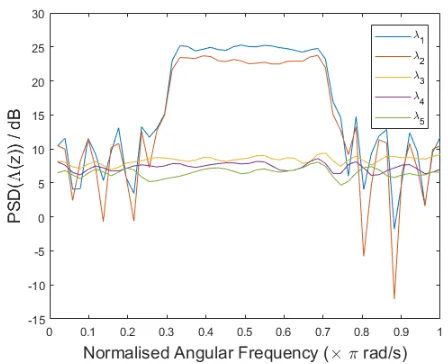
[image:3.612.327.551.388.570.2]Evaluating the polynomial eigenvalues forz=ejΩ yields the power spectral density of the eigenvalues. Similarly to the narrowband EVD on a spatial covariance matrix, the number of significant eigenvalues determine the dimensions of the signal subspace, and thus number of uncorrelated sources present. In addition, the eigenvalue power spectral density also contains spectral information on the uncorrelated sources present.
Figure 1: Polynomial Eigenvalue PSD
Figure 1 demonstrates the power spectral density (PSD) of the eigenvalues for this particular scenario. Through a threshold of 20 dB, it is clear that there are two significant eigenvalues present with spectral content in the band Ω ∈
[0.3π,0.7π].
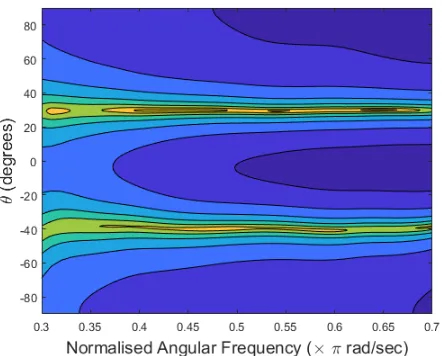
Figure 2: Polynomial MUSIC Spatio-Spectrum
Figure 2 shows the estimated spatio-spectrum with the SSP-MUSIC algorithm and correctly estimates the direction of arrival of the two sources at −40◦, and 30◦. As the eigenvalue PSD implies there are no sources outside the band
Ω∈[0.3π,0.7π], the spatio-spectrum is only estimated for this region.
[image:4.612.327.553.152.331.2]Applying the Root SSP-MUSIC algorithm on the same data set yields the spatial spectrum in Figure 3
Figure 3: Root-Polynomial MUSIC Spatio-Spectrum
While there is no amplitude information in this spatio-spectrum, the estimated directions of arrival coincides with the peaks of the SSP-MUSIC spatio-spectrum, and correctly identifies the direction of arrival of the two sources as−40◦, and30◦.
B. SNR Performance
A Monte-Carlo simulation was performed to analyse the performance of both algorithms under different SNRs. For each DoA estimate, the DoA of the source was chosen at
random from a uniformly distributed set of possible DoAs, θp ∈ [−50◦,50◦]. For each SNR, 100 runs with randomised
DoAs were performed. Figure 4 displays the mean squared error of the estimators and it is easy to see that both the SSP-MUSIC and Root SSP-SSP-MUSIC algorithms perform similarly under different signal to noise ratios, with an MSE<0.05for signal to noise ratios≥ −4 dB.
Figure 4: MSE for Monte Carlo simulation at specific SNRs
C. Computational Cost
The heuristic angular search of the SSP-MUSIC algorithm is an expensive computational task. This is due to the polyno-mial matrix multiplications when calculatingΓ(θ, z). The Root SSP-MUSIC algorithm replaces this search with finding the roots of a polynomial. Both algorithms, however still require to evaluate polynomials to estimate the spatio-spectrum.
The computer performing this simulation utilised the fol-lowing hardware and software. Intel core i7-6700 quad-core processor, 16 Gb DDR4 RAM, 256 Gb SSD, Windows 7 64 bit, MATLAB R2016b.
Table I: Normalised Mean Computation time for SSP-MUSIC and Root SSP-MUSIC algorithm
Nf 30 60 120 240
Mean Norm. SSP-MUSIC Comp Time 1 1.04 1.124 1.268 Mean Norm. Root SSP-MUSIC Comp Time 0.039 0.054 0.079 0.131
The mean normalised simulation time from 100 runs of both algorithms is displayed in Table I. All values are nor-malised to the SSP-MUSIC computation time for 30 frequency evaluation points. These results show the Root SSP-MUSIC algorithm is considerably faster in computation time, but has a stronger scaling with the number of frequencies evaluated, thus for a large number of frequency points, both algorithms will have similar complexity.
VII. CONCLUSION
[image:4.612.60.286.404.582.2]methodologies. Forming a more computationally efficient so-lution for the problem of broadband direction finding in the context of uniform linear arrays. Through simulation results, we have demonstrated that both standalone SSP-MUSIC and Root-SSP MUSIC algorithms perform similarly, yet with a substantial reduction in computational cost with the Root SSP-MUSIC algorithm, especially for searches on few evaluated frequency points.
ACKNOWLEDGMENT
This work was supported by Leonardo MW Ltd
REFERENCES
[1] R. Kumaresan and D. W. Tufts, “Estimating the angles of arrival of multiple plane waves,”IEEE Transactions on Aerospace and Electronic Systems, vol. AES-19, no. 1, pp. 134–139, Jan 1983.
[2] J. G. McWhirter, P. D. Baxter, T. Cooper, S. Redif, and J. Foster, “An evd algorithm for para-hermitian polynomial matrices,” IEEE Transactions on Signal Processing, vol. 55, no. 5, pp. 2158–2169, May 2007.
[3] H. Wang and M. Kaveh, “Coherent signal-subspace processing for the detection and estimation of angles of arrival of multiple wide-band sources,” IEEE Transactions on Acoustics, Speech, and Signal Processing, vol. 33, no. 4, pp. 823–831, Aug 1985.
[4] S. Weiss, S. Bendoukha, A. Alzin, F. K. Coutts, I. K. Proudler, and J. Chambers, “Mvdr broadband beamforming using polynomial matrix techniques,” in 2015 23rd European Signal Processing Conference (EUSIPCO), Aug 2015, pp. 839–843.
[5] M. A. Alrmah, S. Weiss, and S. Lambotharan, “An extension of the MUSIC algorithm to broadband scenarios using a polynomial eigenvalue decomposition,” in2011 19th European Signal Processing Conference, aug 2011, pp. 629–633.
[6] R. Schmidt, “Multiple emitter location and signal parameter estimation,”
IEEE Transactions on Antennas and Propagation, vol. 34, no. 3, pp. 276–280, mar 1986.
[7] M. Alrmah, S. Weiss, and J. McWhirter, “Implementation of accurate broadband steering vectors for broadband angle of arrival estimation,” inIET Intelligent Signal Processing Conference 2013 (ISP 2013), dec 2013, pp. 1–6.
[8] W. Coventry, C. Clemente, and J. Soraghan, “Enhancing Polynomial MUSIC Algorithm for Coherent Broadband Sources Through Spatial Smoothing,” in 25th European Signal Processing Conference (EU-SIPCO), 2017, pp. 2517–2521.
[9] S. Redif, S. Weiss, and J. G. McWhirter, “Sequential Matrix Diago-nalization Algorithms for Polynomial EVD of Parahermitian Matrices,”
IEEE Transactions on Signal Processing, vol. 63, no. 1, pp. 81–89, jan 2015.