Alice L.L. Gao1
Department of Applied Mathematics
Northwestern Polytechnical University, Xian, Shaanxi 710072, P.R. China
Sergey Kitaev
Department of Computer and Information Sciences
University of Strathclyde, 26 Richmond Street, Glasgow G1 1XH, UK
Philip B. Zhang2 College of Mathematical Science
Tianjin Normal University, Tianjin 300387, P. R. China
Received: ****, Revised: ****, Accepted: ****, Published: ****
Abstract
Comtet introduced the notion of indecomposable permutations in 1972. A per-mutation is indecomposable if and only if it has no proper prefix which is itself a permutation. Indecomposable permutations were studied in the literature in vari-ous contexts. In particular, this notion has been proven to be useful in obtaining non-trivial enumeration and equidistribution results on permutations.
In this paper, we give a complete classification of indecomposable permutations avoiding a classical pattern of length 3 or 4, and of indecomposable permutations avoiding a non-consecutive vincular pattern of length 3. Further, we provide a re-cursive formula for enumerating 12· · ·k-avoiding indecomposable permutations for k≥3. Several of our results involve the descent statistic. We also provide a bijec-tive proof of a fact relevant to our studies.
AMS Classification 2010: 05A05, 05A15
Keywords: pattern avoiding permutations, irreducible permutations, indecompos-able permutations, connected permutations, Catalan numbers, Bell numbers.
1. Introduction
Let [n] ={1, . . . , n}andSnbe the set of permutations of [n]. Givenπ=π1· · ·πn∈ Sn, letiπ denote the smallest index such thatπ1· · ·πiπ is a permutation of [iπ]. If
iπ =nthenπisindecomposable; otherwise,πisdecomposable. For example, 23514
is indecomposable, while 31254 is decomposable.
For a permutationπof a set{a1, . . . , an}, thereduced formofπ, denoted red(π),
is the permutation of [n] obtained from π by replacing the i-th smallest element with i. For example, red(2537) = 1324. For any permutation π, we have π = π(1)π(2)· · ·π(k) for some k≥1, whereπ(i) is a permutation such that red(π(i)) is indecomposable for all 1 ≤ i ≤ k. We say that a π(i) is a component of π. For example, the permutation 312465 has components 312, 4 and 65.
A (permutation)patternis a permutationτ =τ1· · ·τk. We say that a
permuta-tionπ=π1· · ·πncontains an occurrenceofτif there are 1≤i1<· · ·< ik ≤nsuch
that πi1· · ·πik is order-isomorphic toτ, that is, if the reduced form ofπi1· · ·πik is
τ. Ifπdoes not contain an occurrence ofτ, we say thatπavoidsτ. These patterns are referred to as “classical patterns”. For instance, the permutation 315267 con-tains several occurrences of the pattern 123, for example, the subsequences 356 and 157, while this permutation avoids the pattern 321. A comprehensive introduction to the theory of patterns in permutations can be found in [19].
Other patterns of interest to us arevincular patterns, also known as generalized patterns[1,23], where some of the elements may be required to be adjacent in the permutation. We underline elements of a given pattern to indicate the elements that must be adjacent in any occurrence of the pattern. For example, the permutation π= 136254 contains four occurrences of the pattern 132, namely, the subsequences 162, 154, 354 and 254 (in each of these occurrences, the elements inπcorresponding to 2 and 3 in the pattern stay next to each other). On the other hand,π contains only one occurrence of the pattern 132, namely, 254. If all elements in an occurrence of a pattern are required to stay next to each other, which is indicated by underlying all elements in the pattern, such a pattern is called a consecutive pattern[15]. A classical statisticdescentis just an occurrence of the pattern 21. Vincular patterns play an important role in the theory of patterns in permutations and words (see Sections 3.3 and 3.4 in [19] for details).
The notion of indecomposable permutations (also known as irreducible permu-tations orconnected permutations) was introduced by Comtet [9, 10]. Comtet was the first one to show the ordinary generating function for the number In of
inde-composable permutations of length nis ∞
X
n=1
Inxn= 1−
1
P
k≥0k!xk .
appear as the sequence A003319 in theOn-Line Encyclopedia of Integer Sequences (OEIS) [22].
Indecomposable permutations appear in various contexts in the literature, for example, see [7, 8, 12, 13, 18]. In particular, in [7, Section 4], indecomposable permutations are used to define a bijection between 231- and 321-avoiding permu-tations (finding various bijections essentially between these sets was the subject of several papers in the literature). Also, indecomposable pattern avoiding permuta-tions are a key object in [8] to find a bijection between permutapermuta-tions in question and β(1,0)-trees. Corollaries of this result include a number of equidistribution results on permutations, β(1,0)-trees and certain types of planar maps. Finally, we note that indecomposable pattern avoiding permutations were first studied by B´ona in [3], where essentially 2431-avoiding indecomposable permutations are enu-merated (indecomposable permutations are defined up to reverse in [3]) and linked in a bijective way toβ(0,1)-trees.
In this paper, we study interrelations (taking into account the descent statistic, which comes “for free”) between pattern avoiding permutations and their inde-composable counterparts for classical patterns of length 3 and 4, vincular non-consecutive patterns of length 3, and the increasing classical pattern of arbitrary length (patterns of length 2 are trivial). We use our results and known enumeration formulas for pattern avoiding permutations to enumerate indecomposable pattern avoiding permutations. Some of the obtained numbers appear in the OEIS, sug-gesting a number of bijective questions.
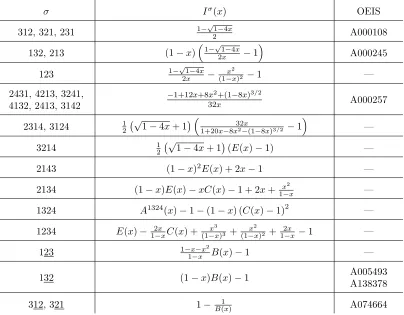
The paper is organized as follows. In Section2, we introduce generating functions to be studied in this paper and state known pattern avoiding results to be used. In Section 3, we study indecomposable permutations avoiding classical patterns of length 3 and 4, as well as the classical pattern 12· · ·kfork ≥3. In Section4, we study indecomposable permutations avoiding a vincular non-consecutive pattern of length 3, in particular, presenting a bijective result in Theorem 4.4. Finally, in Section5, we summarize our enumerative results (see Table2) and discuss directions of further research.
2. Preliminaries Let Aσ
n and Inσ be the number of σ-avoiding permutations of [n] and σ-avoiding
indecomposable permutations of [n], respectively. For 0 ≤i≤n−1, letAσ n,i and
In,iσ be the number ofσ-avoiding permutations of [n] andσ-avoiding indecomposable permutations of [n] withidescents, respectively. Thus, forn≥1, we have
Aσn=
n−1
X
i=0
Aσn,i and Inσ=
n−1
X
Let Aσ(x), Aσ(x, q), Iσ(x) and Iσ(x, q) be the generating functions forAσn, Aσn,i, Iσ
n andIn,iσ , respectively. That is,
Aσ(x, q) = ∞
X
n=0
n−1
X
i=0
Aσn,ixnqi, Iσ(x, q) = ∞
X
n=1
n−1
X
i=0
In,iσ xnqi,
Aσ(x) =Aσ(x,1) = ∞
X
n=0
Aσnxn and Iσ(x) =Iσ(x,1) =
∞
X
n=1 Inσxn.
If for patternsσ1andσ2,Aσn1 =Anσ1for alln≥0 thenσ1andσ2areWilf-equivalent. For a permutationπ=π1· · ·πn, itsreverseis the permutationr(π) =πnπn−1· · ·π1 and itscomplementis the permutationc(π) = (n+1−π1)(n+1−π2)· · ·(n+1−πn).
For example, if π= 32145 thenr(π) = 54123 andc(π) = 34521. The reverse and complement operations are called trivial bijections. It is easy to see that for any pattern σ, this pattern is Wilf-equivalent to r(σ) andc(σ). Another useful prop-erty of trivial bijections is that their composition preserves the propprop-erty of being decomposable (and thus the property of being indecomposable), which is easy to see.
One of concerns in this paper is to find interrelations between Iσ(x, q) and
Aσ(x, q) for certainσs. We note that throughout this paper we implicitly use the
fact that an occurrence of a descent cannot start in one component of a permutation and end in another one.
In the rest of this section we review a number of permutation pattern avoidance results relevant to this paper.
Lemma 2.1 ([20]). Forσ∈S3 andn≥0,Aσn =Cn= n+11 2nn
, the n-th Catalan number. Thus,
Aσ(x) =C(x) = 1− √
1−4x 2x ,
the generating function for the Catalan numbers satisfyingxC(x)2−C(x) + 1 = 0. Forn≥0, the Catalan numbers begin with1,1,2,5,14,42, . . ., which is the sequence A000108 in the OEIS [22].
The next result links the well-knownBell numbersto pattern avoiding permuta-tions. The Bell numbers begin with 1,1,2,5,15,52,203, . . . for n≥ 0, and this is the sequence A000110 in the OEIS [22].
Lemma 2.2 ([6]). When σ∈ {123,132,312,321}, forn≥0, we have Aσn=Bn,
whereBn is then-th Bell number, which is the number of set partitions of[n].
We next turn our attention to classical patterns of length 4. Table 1 presents three Wilf-equivalence classes in this case.
1 1234,4321, 1243,2134,3421,4312, 1432,2341,3214,4123, 2143,3412 2 1342,2431,3124,4213, 1423,2314,3241,4132, 2413,3142
[image:5.612.128.480.513.596.2]3 1324,4231
Table 1: The three Wilf-equivalence classes for pattern avoidance of length 4. Spaces on a line are used to group patterns equivalent via trivial bijections.
A1234
n forn≥0 begins with 1,1,2,6,23,103, . . .(this is the sequence [22, A005802]),
and we have the following lemma. Lemma 2.3 ([16]). For
σ∈ {1234,4321,1243,2134,3421,4312,1432,2341,3214,4123,2143,3412}, we have
E(x) :=Aσ(x) = 1 6x2
1 + 5x−(1−9x)34(1−x) 1 42F1
−1 4,
3 4; 1;
64x (x−1)(1−9x)3
.
Moreover, forn≥1, we have
En:=Aσn = 2 n X k=0 2k k n k
2 3k2+ 2k−2kn−n+ 1 (k+ 1)2(k+ 2)(n−k+ 1).
An exact enumeration for 1342-avoiding permutations and the corresponding generating function are given by B´ona [3]. The corresponding sequence for n≥0 begins with 1,1,2,6,23,103,512, . . . (A022558 in [22]) and the following lemma holds.
Lemma 2.4([3]). Forσ∈ {1342,2431,3124,4213,1423,2314,3241,4132,2413,3142}, we have
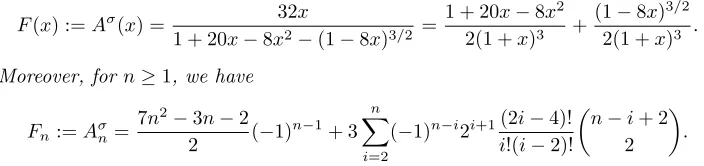
F(x) :=Aσ(x) = 32x
1 + 20x−8x2−(1−8x)3/2 =
1 + 20x−8x2 2(1 +x)3 +
(1−8x)3/2 2(1 +x)3 . Moreover, forn≥1, we have
Fn:=Aσn=
7n2−3n−2 2 (−1)
n−1+ 3
n
X
i=2
(−1)n−i2i+1(2i−4)! i!(i−2)!
n−i+ 2
2
.
However, no formula forA1324
n is known, only a recurrence relation is discovered
3. Indecomposable permutations avoiding classical patterns
Patterns are permutations, and we distinguish two cases according to whether or not they are decomposable. We start with an easier case.
3.1. Indecomposable patterns Here we deal with the following patterns:
231, 312, 321,
2341, 2413, 2431, 3142, 3241, 3412, 3421, 4123, 4321, 4132, 4213, 4231, 4312. We first establish a property holding for any indecomposable patternσ. Lemma 3.1. If σis an indecomposable pattern, then Iσ(x, q)satisfies
Iσ(x, q) = 1− 1 Aσ(x, q).
Proof. For any permutationπ, an occurrence of σ cannot start in one component and end in another one, which would contradict σ being irreducible. Similarly, a descent cannot start in one component and end in another one. Hence, the generating function for σ-avoiding permutations with k components is [Iσ(x, q)]k
and
Aσ(x, q) = 1 + ∞
X
k=1
(Iσ(x, q))k = 1 1−Iσ(x, q),
where “1+” corresponds to the empty permutation. This gives the desired result.
Combining Lemma3.1(q= 1) and Lemma2.1we obtain the following theorem, which can also be derived, e.g. from considerations in [7].
Theorem 3.2. Forσ∈ {312,321,231}, we have
Iσ(x) =1− √
1−4x
2 . (1)
Thus, forn≥1,Inσ =Cn−1, the(n−1)-th Catalan number.
Combining Lemma 3.1(q= 1) and Lemma2.4 we obtain the following theorem established in [3].
Theorem 3.3. Forσ∈ {2431,4213,3241,4132,2413,3142}, we have
Iσ(x) = −1 + 12x+ 8x
2+ (1−8x)3/2
32x .
Similarly, one can combine Lemma 3.1 (q = 1) and Lemma 2.3 to obtain a formula forIσ(x), whereσ∈ {4321,3421,4312,2341,4123,3412}. The initial values
forIσ
n in this case are 1,1,3,12,56,289,1603,9391, . . .forn≥1, and this sequence
is not in the OEIS [22].
However, we cannot obtain a formula forI4231(x) using Lemma3.1 because no formula is known forA4231(x). The initial values forIn4231 are
1,1,3,12,56,289,1604,9415, . . . forn≥1, and this sequence is not in the OEIS [22].
3.2. Decomposable patterns
The patterns here we deal with are 123, 132, 213 and 1234, 1243, 1324, 1342, 1423, 1432, 2134, 2143, 2314, 3124, 3214.
3.2.1. Decomposable patterns of length 3
Pattern 123. We first give a description of 123-avoiding decomposable permuta-tions.
Lemma 3.4. Let π=π(1)π0∈S
n, whereπ(1) is the component inπformed by the
elements in{1, . . . , iπ}. Thenπ is a123-avoiding decomposable permutation if and
only if
π(1)=iπ(iπ−1)· · ·1, π0 =n(n−1)· · ·(iπ+ 1)and1≤iπ≤n−1.
Proof. The backward direction is straightforward to see since no occurrence of the pattern 123 can start inπ(1).
For the forward direction, since π = π1· · ·πn is decomposable, one must have
1≤iπ≤n−1. If πi < πj for some 1≤i < j ≤iπ thenπiπjπn is an occurrence of
the pattern 123; contradiction. Ifπi < πj for some iπ+ 1≤i < j ≤nthenπ1πiπj
is an occurrence of the pattern 123; contradiction. Thus, we obtain the desired result.
Next we derive a relation between I123(x, q) and A123(x, q), which will give formulas for I123(x) and I123
n . The initial values for In123 for n ≥ 1 begin with
1,1,3,11,38,127,423, . . .. This sequence does not appear in the OEIS [22]. Theorem 3.5. We have that
A123(x, q) =I123(x, q) + x 2
(1−xq)2+ 1, (2)
I123(x) =1− √
1−4x
2x −
x2
and forn≥1,
In123=Cn−(n−1). (4)
Proof. By Lemma 3.4, the generating function for all 123-avoiding decomposable permutations is P
i≥1xiqi−1
P
j≥1xjqj−1 = x 2
(1−xq)2. Since any 123-avoiding per-mutation is either indecomposable, or decomposable, or the empty perper-mutation, we obtain the relation given by (2). Letting q = 1 in (2) and using Lemma2.1, we obtain (3). Finally, by Lemma 2.1and the fact that (1−x2x)2 =
P
n≥1(n−1)xn, we obtain (4). This completes the proof.
We note that (4) appears in Proposition 9 in [14].
Patterns 132 and 213. We begin with a description of 132-avoiding decomposable permutations.
Lemma 3.6. Let π =π(1)π0 ∈ S
n, where π(1) is the component in π formed by
the elements in{1, . . . , iπ}. Then πis a 132-avoiding decomposable permutation if
and only if π(1) is a132-avoiding decomposable permutation, 1≤i
π ≤n−1, and
π0 = (iπ+ 1)(iπ+ 2)· · ·n.
Proof. The backward direction is easy to see since an occurrence of the pattern 132 cannot start inπ(1) in this case.
For the forward direction, since π is decomposable, we have 1 ≤ iπ ≤ n−1.
Moreover, since π is 132-avoiding, π(1) must be 132-avoiding. Finally, if π
i > πj
foriπ+ 1≤i < j≤n thenπ1πiπj is an occurrence of the pattern 132, which is a
contradiction. This completes the proof.
Next we find a relation between Aσ(x, q) and Iσ(x, q) for σ∈ {132,213}, which
will give us formulas for Iσ(x) andInσ. The initial values forIn132=In213forn≥1 begin with 1,1,3,9,28,90,297,1001, . . ., which is the sequence A000245 in [22].
Theorem 3.7. Forσ∈ {132,213}, we have that Aσ(x, q) = 1 + 1
1−xI
σ(x, q), (5)
Iσ(x) = (1−x)
1−√1−4x
2x −1
, (6)
Iσ
1 = 1, and for n≥2,
Proof. Let σ = 132. By Lemma 3.6, the generating function for all 132-avoiding decomposable permutations isI132(x, q)P
j≥1xj =
x
1−xI
132(x, q). Similarly to the proof of Theorem3.5, we have
A132(x, q) = 1 +I132(x) + x 1−xI
132(x, q)
= 1 + 1 1−xI
132(x, q)
giving (5) forσ= 132. Lettingq= 1 in (5) and using Lemma2.1, we obtain
I132(x) = (1−x)(A132(x)−1)
= (1−x)
1−√1−4x
2x −1
giving (6) forσ= 132. From (6),I132
1 = 1 and, forn≥2 (7) follows forσ= 132. Finally, since the composition of reverse and complement preserves the property of being irreducible, and this composition applied to 132 gives 213, we have that (5), (6) and (7) hold forσ= 213. This completes the proof.
Note that (7) follows directly from Lemma3.6. Indeed, in a decomposable 132-avoiding permutation, the largest element n must be the rightmost element, and the number of such permutations is Cn−1, while the number of all 132-avoiding
permutations of lengthnisCn. Also, note that (7) appears in Proposition 9 in [14].
3.2.2. Decomposable patterns of length 4
Recall that when applying the composition of reverse and complement, the property of being decomposable is retained. Applying that composition to 2143, 1324 and 1234 yields the original pattern. For the remaining eight decomposable patterns this operation gives
I2314(x, q) =I1423(x, q), I3124(x, q) =I1342(x, q),
I3214(x, q) =I1432(x, q), andI2134(x, q) =I1243(x, q). Thus, we only need to consider seven decomposable patterns of length 4.
Patterns 2314 and 3124. We start with a description of 2314-avoiding and 3124-avoiding decomposable permutations.
Lemma 3.8. Let π = π(1)π0 ∈ S
n, where π(1) is a permutation of {1, . . . , iπ}.
Proof. For the backward direction, becauseπ(1)is 231-avoiding (resp., 312-avoiding), at most two elements in a possible occurrence of the pattern 2314 (resp., 3124) can be inπ(1). But thenπ0 contains an element smaller than an element inπ(1), which is impossible, and thusπis 2314-avoiding (resp., 3124-avoiding).
For the forward direction, sinceπ=π1· · ·πn is decomposable, we have 1≤iπ ≤
n−1. Also, clearly π0 is 2314-avoiding (resp., 3124-avoiding). Now, ifπ(1) would contain an occurrence of the pattern 231 (resp., 312) then together withπn it would
form an occurrence of the pattern 2314 (resp., 3124); contradiction. Thus π(1) is 231-avoiding (resp., 312-avoiding). This completes the proof.
The sequence for In2314 and In3124 for n ≥1 begin with 1,1,3,13,65,350,1979,
11612, . . ., which does not appear in the OEIS [22]. Theorem 3.9. We have
A2314(x, q) = 1 +I2314(x, q) +I231(x, q) A2314(x, q)−1
(8)
and
A3124(x, q) = 1 +I3124(x, q) +I312(x, q) A3124(x, q)−1
. (9)
Further, for σ∈ {2314,3124}, we have that Iσ(x) = 1
2 √
1−4x+ 1
32x
1 + 20x−8x2−(1−8x)3/2 −1
,
with Iσ
1 = 1, and for n≥2,
Inσ=Fn− n−2
X
i=0
CiFn−1−i,
whereFn is defined in Lemma 2.4.
Proof. By Lemma3.8, the generating function for 2314-avoiding decomposable per-mutations is I231(x, q)(A2314(x, q)−1), where “−1” corresponds to excluding the empty permutation as a possibility for π0. Similarly, the generating function for 3124-avoiding decomposable permutations isI312(x, q)(A3124(x, q)−1).
Note that eachσ-avoiding permutation is either the empty permutation, or an indecomposable permutation or a decomposable one. This observation shows (8) and (9).
Letq= 1 in (8). Combing this with Lemma2.4and (1), we obtain I2314(x) = 1−I231(x)
· A2314(x)−1
(10)
= (1−xC(x)) (F(x)−1) (11)
= 1 2
√
1−4x+ 1
32x
1 + 20x−8x2−(1−8x)3/2−1
Hence, by (11), we have thatI12314= 1 and forn≥2,
In2314=Fn+Cn−1−
n−1
X
i=0
CiFn−1−i
=Fn− n−2
X
i=0
CiFn−1−i.
It is straightforward to provide essentially the same derivations for the case of 3124-avoiding indecomposable permutations, which completes the proof.
Pattern 3214. We begin with a description of 3214-avoiding decomposable per-mutations. Our proof of the next lemma is similar to the proof of Lemma 3.8and thus is omitted.
Lemma 3.10. Let π =π(1)π0 ∈ Sn, where π(1) is a permutation of {1, . . . , iπ}.
Then π is a 3214-avoiding decomposable permutation if and only if π(1) is 321-avoiding and π0 is a3214-avoiding.
The initial valuesI3214
n forn≥1 begin 1,1,3,13,65,351,1999,11872, . . .and this
sequence is not in the OEIS [22]. Theorem 3.11. We have
A3214(x, q) = 1 +I3214(x, q) +I321(x, q) A3214(x, q)−1. (13)
Moreover, forE(x)andEn defined in Lemma 2.3, we have
I3214(x) =1 2
√
1−4x+ 1
(E(x)−1),
I13214= 1and forn≥2
In3214=En− n−2
X
i=0
CiEn−1−i.
Proof. We can proceed similarly to the proof of Theorem3.9to prove (13). Further, assuming thatq= 1 in (13), one can apply Lemma2.3 and (1), to obtain
I3214(x) = 1−I321(x)· A3214(x)−1 = (1−xC(x)) (E(x)−1)
=1 2
√
1−4x+ 1(E(x)−1).
From the last derivation, the formula forI3214
Pattern 2143. We begin with a description of 2143-avoiding decomposable per-mutations.
Lemma 3.12. Let π =π(1)π0 ∈ S
n, where π(1) is a permutation of {1, . . . , iπ}.
Then πis a 2143-avoiding decomposable permutation if and only if one of the fol-lowing two conditions holds:
• π(1)= 1andπ0 is2143-avoiding.
• 2≤iπ≤n−1,π(1) is2143-avoiding andπ0= (iπ+ 1)(iπ+ 2)· · ·n.
Proof. For the forward direction, sinceπis decomposable, we have 1≤iπ≤n−1.
There are two cases to consider:
• iπ= 1. It is clear thatπ(1) = 1 in this case does not affectπ0, soπ0 must be
a 2143-avoiding permutation of{2, . . . , n}.
• 2≤iπ≤n−1. Sinceπ(1) is indecomposable of length at least 2, there exist
1≤j1< j2≤iπ such thatπj1 > πj2. But then to avoid an occurrence of the pattern 2143 involving πj1 and πj2, π
0 must be the increasing permutation (iπ+ 1)(iπ+ 2)· · ·n.
The backward direction is easy to see using similar considerations as above.
The initial valuesI2143
n forn≥1 are 1,1,3,13,63,330,1838,10758, . . ., and this
sequence is not in the OEIS [22]. Theorem 3.13. We have
A2143(x, q) = 1 +I2143(x, q) +x A2143(x, q)−1+ x 1−x I
2143(x, q)−x
. (14)
Moreover, forE(x)andEn defined in Lemma 2.3, we have
I2143(x) = (1−x)2E(x) + 2x−1,
In2143= 1and forn≥2,
In2143=En−2En−1+En−2.
Proof. By Lemma 3.12, (14) follows. Further, letting q = 1 in (14) and using Lemma 2.3, it follows that
I2143(x) = (1−x)2A2143(x) + 2x−1 = (1−x)2E(x) + 2x−1,
from which the formula forI2143
Pattern 2134. We first give a description of 2134-avoiding decomposable permu-tations.
Lemma 3.14. Let π =π(1)π0 ∈ S
n, where π(1) is a permutation of {1, . . . , iπ}.
Then πis a 2134-avoiding decomposable permutation if and only if one of the fol-lowing two conditions holds:
• π(1)= 1andπ0 is2134-avoiding.
• 2≤iπ≤n−1,π(1) is213-avoiding, andπ0 =n(n−1)· · ·(iπ+ 1).
Proof. For the forward direction, since π = π1· · ·πn is decomposable, we have
1≤iπ≤n−1. There are two cases to consider:
• iπ = 1. It is clear thatπ(1) does not affect the rest of the permutation, and
π0 must be a 2134-avoiding permutation of{2, . . . , n}.
• 2 ≤ iπ ≤ n−1. Then π(1) must be a 213-avoiding permutation, or else it
would form an occurrence of the pattern 2134 withπn. Moreover, sinceπ(1)
is indecomposable, there exist 1≤j1< j2≤iπsuch thatπj1 > πj2. But then to avoid an occurrence of the pattern 2134 involvingπj1 andπj2,π
0 must be the decreasing permutationn(n−1)· · ·(iπ+ 1).
The backward direction is not difficult to see using the considerations above.
Initial values for I2134
n are 1,1,3,13,67,369,2117,12578, . . . for n≥1, and this
sequence is not in the OEIS [22].
Theorem 3.15. We have
A2134(x, q) = 1 +I2134(x, q) +x A2134(x, q)−1
+ x
1−xq I
213(x, q)−x
. (15)
Moreover, forE(x)andEn defined in Lemma 2.3, we have
I2134(x) = (1−x)E(x)−xC(x)−1 + 2x+ x 2
1−x, I2134
1 = 1and forn≥2,
Proof. The identity (15) follows from Lemma3.14. Further, settingq= 1 in (15), and applying Theorem3.7and Lemma 2.3, one has
I2134(x) = (1−x)A2134(x)−(1−x)− x 1−xI
213(x) + x 2
1−x = (1−x)A2134(x)−(1−x)−x(C(x)−1) + x
2
1−x = (1−x)E(x)−xC(x) + 2x+ x
2
1−x−1. From this, we have the desired formula forI2134
n .
Pattern 1324. We first give a description of 1324-avoiding decomposable permu-tations.
Lemma 3.16. Let π =π(1)π0 ∈ Sn, where π(1) is a permutation of {1, . . . , iπ}.
Then π is a 1324-avoiding decomposable permutation if and only if π(1) is 132-avoiding and π0 is213-avoiding.
Proof. For the forward direction, since π = π1· · ·πn is decomposable, we have
1≤iπ≤n−1. Moreover,π(1)is 132-avoiding, or else, along withπn an occurrence
of the pattern 1324 would be formed. Also, π0 is 213-avoiding or else, along with π1 an occurrence of the pattern 1324 would be formed. The backward direction is not difficult to see.
Initial values forI1324
n are 1,1,3,13,69,396,2355,14363, . . ., and this sequence is
not in the OEIS [22].
Theorem 3.17. We have
A1324(x, q) = 1 +I1324(x, q) +I132(x, q) A213(x, q)−1. (16)
Also,
I1324(x) =A1324(x)−1−(1−x) (C(x)−1)2.
Moreover,I1324
1 = 1 and forn≥2,
Proof. The identity (16) follows from Lemma 3.16. Further, setting q= 1 in (16) and applying Lemma 2.1and Theorem3.7, we obtain
I1324(x) =A1324(x)−1−I132(x) A213(x)−1
=A1324(x)−1−(1−x) (C(x)−1)2
=A1324(x)−1−(1−x)
C(x)−1
x −2C(x) + 1
.
Hence,I11324= 1 and forn≥2,
In1324=A1324n −(Cn+1−Cn) + 2(Cn−Cn−1)
=A1324n −Cn+1+ 3Cn−2Cn−1.
This completes the proof.
Pattern 1234. Decomposable 1234-avoiding permutations can be described as follows.
Lemma 3.18. Let π =π(1)π0 ∈ S
n, where π(1) is a permutation of {1, . . . , iπ}.
Then πis a 1234-avoiding decomposable permutation if and only if one of the fol-lowing two conditions holds:
• π(1)=i
π(iπ−1)· · ·1,π0 is123-avoiding and1≤iπ≤n−1, or
• π(1)6=i
π(iπ−1)· · ·1 is123-avoiding,π0=n(n−1)· · ·(iπ+ 1), and 3≤iπ ≤
n−1.
Proof. Sinceπis 1234-avoiding, thenπ(1)must be 123-avoiding, or else there would be an occurrence of the pattern 1234 involving an element inπ0. Thus, the longest increasing sequence inπ(1) is at most of length 2. There are two cases to consider.
• π(1)=iπ(iπ−1)· · ·1. Then, clearly,π0 must be 123-avoiding.
• The longest increasing subsequence inπ(1) is exactly of length 2. But then, sinceπ(1) is indecomposable, we havei
π >2 andπ0must be 12-avoiding, that
is,π0=n(n−1)· · ·(iπ+ 1).
This completes the proof.
Initial values for I1234
n are 1,1,3,13,69,400,2390,14545, . . . for n≥1, and this
Theorem 3.19. We have A1234(x, q) =
1 +I1234(x, q) + x 1−xq A
123(x, q)−1
+ x
1−xq
I123(x, q)− x 1−xq
. (17)
Also, forE(x)defined in Lemma2.3, I1234(x) =E(x)− 2x
1−xC(x) + x3 (1−x)3 +
x2 (1−x)2 +
2x 1−x−1. Moreover,I1234
1 = 1 and forn≥2 and forEn defined in Lemma2.3,
In1234=En−2 n−1
X
i=0 Ci+
1 2 n
2−n−4
.
Proof. The identity (17) follows from Lemma3.18. Further, settingq= 1 in (17), and applying Lemmas 2.1and2.3and Theorem3.5, we have
I1234(x) =A1234(x)−1− x 1−x A
123(x)−1
− x 1−x
I123(x)− x 1−x
=E(x)−1− x 1−x
2C(x)−2− x 2
(1−x)2 − x 1−x
=E(x)− 2x
1−xC(x) + x3 (1−x)3 +
x2 (1−x)2 +
2x 1−x−1. Hence, it follows thatI1234
1 = 1 and forn≥2
In1234=En−2 n−1
X
i=0 Ci+
1 2 n
2−n+ 4
=En−2 n−1
X
i=1 Ci+
n(n−1) 2 .
This completes the proof.
3.2.3. Pattern 12· · ·kwith k≥3
Here we consider patterns of the form 12· · ·k, wherek≥3, which generalizes our considerations for patterns 123 and 1234. First, we give a description of 12· · · k-avoiding decomposable permutations in the following lemma, whose proof is trivial and thus is omitted.
Lemma 3.20. If π = π(1)π0 is a 12· · ·k-avoiding decomposable permutation of lengthn, whereπ(1) is a permutation of{1, . . . , iπ}. Then there existsm,1≤m≤
Now we can enumerate 12· · ·k-avoiding indecomposable permutations.
Corollary 3.21. We have
I12···k(x, q) =A12···k(x, q)−
k−2
X
m=1
I12···(m+1)(x, q)−I12···m(x, q)·A12···(k−m)(x, q)−1−1.
Proof. By Lemma3.20, we have
A12···k(x, q) = 1+I12···k(x, q)+
k−2
X
m=1
I12···(m+1)(x, q)−I12···m(x, q)·A12···(k−m)(x, q)−1,
from which the result follows.
For example, whenk= 3, we have
A123(x) = 1 +I123(x) + I12(x)−I1(x)
· A12(x)−1
= 1 +I123(x) + x 1−x·
x 1−x, and hence
I123(x) =A123(x)−1− x 2
(1−x)2 =
1−√1−4x 2x −1−
x2 (1−x)2,
which coincides with Theorem 3.5. Note that we used the facts that I(1)(x) = 0 andA12(x)−1 =I(12)(x) =x+x2+· · ·=1−xx.
Whenk= 4, we have
A1234(x) = 1+I1234(x)+ I12(x)−I1(x)
· A123(x)−1
+ I123(x)−I12(x)
· A12(x)−1
,
and hence
I1234(x) =E(x)− x 1−x
2C(x)−2− x 2
(1−x)2 − x 1−x
−1,
which coincides with Theorem3.19. Note that we used the fact thatA123(x) =C(x).
4. Indecomposable permutations avoiding vincular non-consecutive pat-terns of length 3
length 3, which are 123, 132, 213, 231, 312, and 321. Two of these cases can be reduced to classical pattern-avoidance.
Indeed, it was shown in [6] that a permutation avoids the pattern 213 if and only if it avoids the pattern 213. Applying the complement operation, this implies that a permutation avoids 231 if and only if it avoids 231. Thus, In213 =In213 and
In231=In231 and Theorems3.7and3.2can be applied, respectively.
Pattern 123. We first give a description of 123-avoiding decomposable permuta-tions.
Lemma 4.1. Let π = π(1)π0 ∈ Sn, where π(1) is a permutation of {1, . . . , iπ}.
Thenπ=π1· · ·πn is a123-avoiding decomposable permutation if and only ifπ(1) =
π1· · ·πiπ−11andπ
0 =n(n−1)· · ·(i
π+ 1)for1≤iπ≤n−1, whereπ1· · ·πiπ−1is
a123-avoiding permutation of{2,3, . . . , iπ}.
Proof. Sinceπis decomposable, we have 1≤iπ ≤n−1. It is clear thatπ(1)is a
123-avoiding indecomposable permutation. We claim that πiπ = 1, since otherwise 1,
πiπ andπiπ+1will form the pattern 123. Further, clearlyπiπ+1> πiπ+2>· · ·> πn,
or else there would be an occurrence of the pattern 123 involving 1.
On the other hand, it is easy to see that ifπ(1)andπ0satisfy the conditions then πis 123-avoiding. This completes the proof.
Initial values for In123 forn ≥1 are 1,1,3,11,43,179,801, . . . and this sequence
is not in the OEIS [22]. Theorem 4.2. We have
A123(x, q) = 1 +I123(x, q) + x 1−xq
A123(x, q)−1xq+x. (18)
Also,
I123(x) =1−x−x 2
1−x B(x)−1, whereB(x)is the generating function for the Bell numbers.
Moreover,I1123= 1 and forn≥2,
In123=Bn− n−2
X
i=0 Bi.
Proof. By Lemma4.1, the generating function for 123-avoiding decomposable per-mutations is 1−xxq A123(x, q)−1
xq+x, hence (18) follows. Lettingq= 1 in (18), we have
I123(x) =
1− x 2
1−x
Combining with Lemma 2.2, we obtain that
I123(x) =1−x−x 2
1−x B(x)−1.
Together with the fact that 1−1x=P
i≥0x
i, we haveI123
1 = 1 and forn≥2,
In123=Bn− n−2
X
i=0 Bi.
This completes the proof.
Pattern 132. We first give a description of 132-avoiding decomposable permuta-tions.
Lemma 4.3. Let π = π(1)π0 ∈ S
n, where π(1) is a permutation of {1, . . . , iπ}.
Then π=π1· · ·πn is a 132-avoiding decomposable permutation if and only if π(1)
is132-avoiding andπ0=iπ(iπ+ 1)· · ·nfor1≤iπ≤n−1.
Proof. Ifπ is 132-avoiding, then clearlyπ(1) andπ0 are both 132-avoiding. More-over, we must haveπiπ+1< πiπ+2<· · ·< πn, or else there would be an occurrence
of the pattern 132 involving 1.
On the other hand, it is clear that ifπ(1) andπ0 satisfy the given conditions then πis 132-avoiding, which completes the proof.
Initial values forIn132forn≥1 are 1,1,3,10,37,151,674, . . ., which are essentially
the sequences A005493 and A138378 in the OEIS [22] that have several combinato-rial interpretations. In particular, this sequence counts 132-avoiding permutations that end with a rise, that is, with an occurrence of the pattern 12, which leads us to the following theorem.
Theorem 4.4. Forn≥2, the number of132-avoiding indecomposable permutations in Sn is equal to that of132-avoiding permutations inSn that end with a rise.
Proof. LetI andR be the first and the second sets, respectively, in the statement of the theorem. We provide a recursive bijectionf fromItoRproving the theorem with the base casef(21) = 12.
The set of 132-avoiding permutations can be subdivided into three disjoint sub-sets:
• S1, all 132-avoiding permutations ending with 1;
• S3, all other 132-avoiding permutations.
It is straightforward to see that the elements to the right of 1 in a 132-avoiding permutation must be in increasing order. But then in S3, n must be to the left of 1. Thus, a permutation inS3 belongs to bothI andR and we map it to itself. Further, it is easy to see thatS1 is a subset ofIbut it is disjoint fromR, whileS2 is a subset ofR but it is disjoint fromI. For a permutation π=π1· · ·πn−11∈S1
we define its image recursively as
f(π) =f((π1−1)· · ·(πn−1−1))n.
The map f described by us is easy to see to be a bijection. This completes the proof.
Next we enumerate 132-avoiding indecomposable permutations.
Theorem 4.5. We have
A132(x, q) = 1 +I132(x, q) + x 1−xI
132(x, q). (19)
Also,
I132(x) = (1−x)B(x)−1,
where B(x) is the generating function for the Bell numbers. Moreover, In132 = 1
and forn≥2
In132=Bn−Bn−1.
Proof. By Lemma4.3, the generating function for 132-avoiding decomposable per-mutations is 1−xxI132(x, q) from which (19) follows.
Lettingq= 1 in (19) and combining with Lemma2.2, we obtain that
I132(x) = (1−x)A132(x)−1 = (1−x)B(x)−1.
Hence, it follows that
In132=Bn−Bn−1 forn≥2. This completes the proof.
Patterns312and321. We first give a description of 312-avoiding and 321-avoiding decomposable permutations.
Lemma 4.6. Let π = π(1)π0 ∈ Sn, where π(1) is a permutation of {1, . . . , iπ}.
Initial values for In312 = I
321
n for n ≥ 1 are 1,1,2,6,22,92,426, . . ., and this is
the sequence A074664 in the OEIS [22] that has several combinatorial interpreta-tions. In particular, this sequence counts the number of irreducible set partitions of [n], which can be easily seen from the bijections in [6]. For more information on irreducible set partitions, see [5].
Theorem 4.7. We have
I312(x) =I321(x) = 1− 1 B(x).
Proof. Since 312 is an irreducible pattern, Lemma3.1can be applied to obtain A312(x) = 1
1−I312(x). The desired result now follows from Lemma2.2.
5. Concluding remarks
The notion of indecomposable permutations proved to be useful in various contexts, e.g. in obtaining non-trivial enumeration and equidistribution results on permuta-tions [8].
In this paper, we gave a compete classification of indecomposable permutations avoiding a classical pattern of length 3 or 4, and of indecomposable permutations avoiding a non-consecutive vincular pattern of length 3; see Table2for a summary of these results. Also, we provided a recursive formula for enumerating 12· · · k-avoiding indecomposable permutations for k≥3 (see Corollary3.21). The descent statistic is taken into account in several of our results.
A natural direction of further research is in extending our studies of indecom-posable permutations to other patterns, e.g. vincular patterns of length 4. Also, one can look at avoiding more than one pattern at the same time. Other statistics can be included in enumerative results.
Finally, one can establish a number of bijective results linking pattern avoiding indecomposable permutations to other structures (Theorem 4.4is one such exam-ple). For instance, the sequence A005493 in the OEIS [22] has many interesting combinatorial interpretations that one could try to link in a bijective way to 132-avoiding indecomposable permutations.
Acknowledgments
σ Iσ(x) OEIS
312, 321, 231 1−
√ 1−4x
2 A000108
132, 213 (1−x)1−
√ 1−4x
2x −1
A000245
123 1−
√ 1−4x
2x − x2
(1−x)2 −1 —
2431, 4213, 3241, 4132, 2413, 3142
−1+12x+8x2+(1−8x)3/2
32x A000257
2314, 3124 12 √1−4x+ 11+20x−8x322−(1−8x x)3/2 −1
—
3214 12 √1−4x+ 1
(E(x)−1) —
2143 (1−x)2E(x) + 2x−1 —
2134 (1−x)E(x)−xC(x)−1 + 2x+1−x2x —
1324 A1324(x)−1−(1−x) (C(x)−1)2
—
1234 E(x)− 2x
1−xC(x) + x3 (1−x)3 +
x2 (1−x)2 +
2x
1−x−1 —
123 1−1−x−xx2B(x)−1 —
132 (1−x)B(x)−1 A005493
A138378
312, 321 1− 1
[image:22.612.129.533.220.535.2]B(x) A074664
December 2015. Also, the authors are grateful to Filippo Disanto for brining to our attention the paper [14], and to the anonymous referee for many useful suggestions on how to improve our paper.
References
[1] E. Babson and E. Steingr´ımsson, Generalized permutation patterns and a clas-sification of the Mahonian statistics, S´em. Lothar. Combin. 44.B44b(2000), 547-548.
[2] D. Bevan, Permutations avoiding 1324 and patterns in lukasiewicz paths, J. Lond. Math. Soc. (2)92(2015), 105–122.
[3] M. B´ona, Exact enumeration of 1342-avoiding permutations: a close link with labelfed trees and planar maps, J. Combin. Theory Ser. A80(1997), 257–272. [4] M. B´ona, A new record for 1324-avoiding permutations,Eur. J. Math.1(2015),
198–206.
[5] W. Y. C. Chen, T. X. S. Li, and D. G. L. Wang, A bijection between atomic partitions and unsplitable partitions, Electron. J. Combin.18(2011), 1.7. [6] A. Claesson, Generalized pattern avoidance, European J. Combin. 22(2001),
961–971.
[7] A. Claesson and S. Kitaev, Classification of bijections between 321- and 132-avoiding permutations,S´eminaire Lotharingien de CombinatoireB60d(2008), 30.
[8] A. Claesson, S. Kitaev, and E. Steingr´ımsson, Decompositions and statistics for beta(1,0)-trees and nonseparable permutations,Adv. Appl. Math.42(2009), 313–328.
[9] L. Comtet, Sur les coefficients de l’inverse de la s´erie formelleP
n!tn, C. R. Acad. Sci. Paris S´er. A-B275(1972), A569–A572.
[10] L. Comtet, Advanced combinatorics, D. Reidel Publishing Co., Dordrecht, enlarged edition, 1974.
[11] A. R. Conway and A. J. Guttmann, On 1324-avoiding permutations, Adv. Appl. Math.64(2015), 50–69.
[13] R. Cori, Indecomposable permutations, hypermaps and labeled Dyck paths, J. Combin. Theory Ser. A116(2009), 1326–1343.
[14] F. Disanto, Some statistics on the hypercubes of Catalan permutations, J. Integer Sequences18(2015), 15.2.2.
[15] S. Elizalde and M. Noy, Consecutive patterns in permutations, Adv. Appl. Math.30(2003), 110–125.
[16] I. M. Gessel, Symmetric functions and P-recursiveness, J. Combin. Theory Ser. A53(1990), 257–285.
[17] F. Johansson and B. Nakamura, Using functional equations to enumerate 1324-avoiding permutations, Adv. Appl. Math.56(2014), 20–34.
[18] A. King, Generating indecomposable permutations,Discrete Math.306(2006), 508–518.
[19] S. Kitaev, Patterns in permutations and words, Monographs in Theoretical Computer Science, An EATCS Series, Springer, Heidelberg, 2011. With a foreword by Jeffrey B. Remmel.
[20] P. A. MacMahon, Combinatory analysis, Vol. I, II (bound in one volume), Dover Phoenix Editions, Dover, Mineola, 2004. Reprint of An introduction to combinatory analysis (1920) and Combinatory analysis. Vol. I, II (1915, 1916).
[21] D. Marinov and R. Radoiˇci´c, Counting 1324-avoiding permutations, Electron. J. Combin.9(2002/03), 2.13. Permutation patterns (Otago, 2003).
[22] N. J. A. Sloane, The On-Line Encyclopedia of Integer Sequences, published electronically at https://oeis.org.