2423
Retrofitting Distributional Embeddings to Knowledge Graphs
with Functional Relations
Benjamin J. Lengerich
Carnegie Mellon University 5000 Forbes Avenue Pittsburgh, PA 15213
Andrew L. Maas and Christopher Potts
Stanford University, Roam Analytics 195 East 4th Avenue
San Mateo, CA 94401
{amaas, cgpotts}@roaminsight.com
Abstract
Knowledge graphs are a versatile framework to encode richly structured data relationships, but it can be challenging to combine these graphs with unstructured data. Methods for retrofitting pre-trained entity representations to the structure of a knowledge graph typically assume that entities are embedded in a connected space and that relations imply similarity. However, useful knowledge graphs often contain diverse entities and relations (with potentially disjoint underly-ing corpora) which do not accord with these assumptions. To overcome these limitations, we presentFunctional Retrofitting, a framework that generalizes current retrofitting methods by ex-plicitly modeling pairwise relations. Our framework can directly incorporate a variety of pairwise penalty functions previously developed for knowledge graph completion. Further, it allows users to encode, learn, and extract information about relation semantics. We present both linear and neural instantiations of the framework. Functional Retrofitting significantly outperforms existing retrofitting methods on complex knowledge graphs and loses no accuracy on simpler graphs (in which relations do imply similarity). Finally, we demonstrate the utility of the framework by predicting new drug–disease treatment pairs in a large, complex health knowledge graph.
1 Introduction
Distributional representations of concepts are often easy to obtain from unstructured data sets, but they tend to provide only a blurry picture of the relationships that exist between concepts. In contrast, knowl-edge graphs directly encode this relational information, but it can be difficult to summarize the graph structure in a single representation for each entity.
To combine the advantages of distributional and relational data, Faruqui et al. (2015) propose toretrofit embeddings learned from distributional data to the structure of a knowledge graph. Their method first learns entity representations based solely on distributional data and then applies a retrofitting step to update the representations based on the structure of a knowledge graph. This modular approach conve-niently separates the distributional data and entity representation learning from the knowledge graph and retrofitting model, allowing one to flexibly combine, reuse, and adapt existing representations to new tasks.
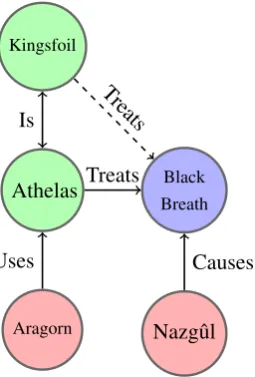
Athelas Kingsfoil
Black Breath
Nazgˆul Aragorn
Is
Treats Treats
Uses Causes
Figure 1: Toy knowledge graph with diverse relation types that connect treatments (green), diseases (blue), and persons (red) by known (solid) and unknown (dashed) relations. Traditional methods, which assume that all relations imply similarity, would retrofit Aragorn and Nazgˆul toward similar embeddings.
of Faruqui et al. (2015) would model embeddingsqAragorn ⇡qAthelas⇡qBlackBreath ⇡qN azgulˆ , which is problematic as Aragorn is not semantically similar to a Nazgˆul (they are enemies).
To address these limitations, we presentFunctional Retrofitting, a retrofitting framework that explicitly models pairwise relations as functions. The framework supports a wide range of different instantiations, from simple linear relational functions to complex multilayer neural ones. Here, we evaluate both lin-ear and neural instantiations of Functional Retrofitting on a variety of diverse knowledge graphs. For benchmarking against existing approaches, we use FrameNet and WordNet. We then move into the med-ical domain, where knowledge graphs play an important role in knowledge accumulation and discovery. These experiments show that even simple instantiations of Functional Retrofitting significantly outper-form baselines on knowledge graphs with semantically complex relations and sacrifice no accuracy on graphs where Faruqui et al. (2015)’s assumptions about similarity do hold. Finally, we use the model to identify promising new disease targets for existing drugs.
Code which implements Functional Retrofitting is available at https://github.com/
roaminsight/roamresearch.
2 Notation
A knowledge graphGis composed of a set of verticesV, a set of relation typesR, and a set of edges E where each edgee 2 E is a tuple (i, j, r) in which the relationship r 2 Rholds between vertices i 2 V andj 2 V. Our goal is to learn a set of representationsQ = {qi : i 2 V}which contain the
information encoded in both the distributional data and the knowledge graph structure, and can be used for downstream analysis. Throughout this paper, we useato refer to a scalar,ato refer to a vector, and Ato refer to a matrix or tensor.
3 Related Work
Here we are interested inpost-hocretrofitting methods, which adjust entity embeddings to fit the structure of a previously unseen knowledge graph.
3.1 Retrofitting Models
The primary introduction of retrofitting was Faruqui et al. (2015), in which the authors showed the value of retrofitting semantic embeddings according to minimization of the weighted least squares problem
G(Q) =
X
i2V
↵ikqi qˆik2+
X
(i,j,r)2E
whereQˆ ={qˆi:i2V}is the embedding learned from the distributional data and↵i, ijset the relative
weighting of each type of data. When↵i= 1and ij = degree1 (i), this model assigns equal weight to the distributional data and the structure of the knowledge graph.
More recently, Hamilton et al. (2017) presented GraphSAGE, a two-step method which learns both an aggregation functionf :Rd⇥n ! Rk, to condense the representations of neighbors into a single point, and an update functiong:Rk+d!Rd, to combine the aggregation with a central vertex. Here,dis the embedding dimensionality,kis the aggregation dimensionality, andn >0is the number of neighbors for each vertex. Note thatk > dis permitted, allowing for aggregation by concatenation. While this method is extremely effective for learning representations on simple knowledge graphs, it is not formulated for knowledge graphs with multiple types of relations. Furthermore, when the representation of a relation is knowna priori, it can be useful to explicitly set the penalty function (e.g., Mrkˇsic et al. (2016) use hand-crafted functions to effectively model antonymy and synonymy). By aggregating neighbors into a point estimate before calculating relationship likelihoods, GraphSAGE makes it difficult to encode, learn, or extract the representation of a pairwise relation.
In a similar vein, Faruqui et al. (2016) developed a graph-based semi-supervised learning method to expand morpho-syntactic lexicons from seed sets. Though the task is different from the retrofitting task we consider here, the performance and scalability of their method demonstrate the utility of directly encoding pairwise relations as message-passing functions.
3.2 Relational Penalty Functions
Our new Functional Retrofitting framework models each relation via a penalty functionfr :Rdi+dj !
R 0 acting on a pair of entities (i, j) with embedding dimensionalities di and dj, respectively. By explicitly modeling relations between pairs of entities, Functional Retrofitting supports the use of a wide array of scoring functions that have previously been developed for knowledge graph completion. Here, we present a brief review of such scoring functions; for an extensive review, see (Nickel et al., 2016).
TransE (Bordes et al., 2013) uses additive relations in which the penalty function fr(qi,qj) =
kqi+ar qjk22 is low iff (i, j, r) 2 E. The simple Unstructured Model (Bordes et al., 2012) was
proposed as a na¨ıve version of TransE that assigns all ar = 0, leading to the penalty function
fr(qi,qj) = kqi qjk22. This is the underlying penalty function of (Faruqui et al., 2015). It cannot
consider multiple types of relations. In addition, while it models 1-to-1 relations well, it struggles to model multivalued relations.
TransH (Wang et al., 2014) was proposed to address this limitation by using multiple representations for a single entity via relation hyperplanes. For a relationr, TransH models the relation as a vectorar
on a hyperplane defined by normal vectorwr. For a triple(i, j, r)2E, the entity embeddingsqiandqj
are first projected to the hyperplane ofwr. By constrainingkwrk2 = 1, we have the penalty function fr(qi,qj) =kgr(qi) +ar gr(qj)k22wheregr(x) =x wTrxwr.
TransR (Lin et al., 2015) embeds relations in a separate space from entities by a relation-specific matrix Mr 2Rd⇥kthat projects from entity space to relation space and a shared relation vectora 2Rk that
translates in relation space byfr(qi,qj) =kqiMr+a qjMrk22. We use this model as the inspiration
for our linear penalty function.
The Neural Tensor Network (NTN; Socher et al. (2013)) defines a score function fr(qi,qj) =
uTrg(qTiMrqj+Mr,1qi+Mr,2qj +br)whereur is a relation-specific linear layer,g :Rk ! Rk
is the tanh operation applied element-wise,Mr 2Rd⇥d⇥k is a 3-way tensor, andMr,1,Mr,2 2Rk⇥d are weight matrices. All of these models can be directly incorporated in our Functional Retrofitting framework.
4 Functional Retrofitting
di, dj, respectively. This gives the complete minimization:
whereqˆiis observed from distributional data,↵iand i,j,r set the relative strengths of the distributional data and the knowledge graph structure, and⇢regularizesfrwith strength set by . E is the negative spaceof the knowledge graph, a set of edges that are not annotated in the knowledge graph. FR usesE to penalize relations that are implied by the representations but not annotated in the graph. To populateE , we sample a single negative edge(i, j0, r)with the same outgoing vertex for each true edge(i, j, r)2E.
The user can calibrate trust in the completeness of the knowledge graph via the hyperparameter. In contrast to prior retrofitting work, FR explicitly encodes directed relations. This allows the model to fit graphs which contain diverse relation types and entities embedded in disconnected vector spaces. Here, we compare the performance of two instantiations of FR – one with all linear relations and one with all neural relations – and show that even these simple models provide significant performance improvements. In practice, we recommend that users select relation-specific functions in accordance with the semantics of their graph’s relations.
4.1 Linear Relations
Faruqui et al. (2015)’s model is a special case of this formulation in which
Ar=I, br =0 8r, i,j,r =
( 1
degree(i) (i, j, r)2E
0 (i, j, r)2E
Throughout the remainder of this paper, we refer to this baseline model as the “FR-Identity” retrofitting method.
Initialization
We initialize embeddings as those learned from distributional data and relations to imply similarity:
Ar=I, br =0 , ↵i =
wheredr(i)is the out-degree of vertexifor relation typer,↵is a hyperparameter to trade off distribu-tional data against structural data, and sets the trust in completeness of the knowledge graph structure. In our experiments, we use += 1, = 0for straightforward comparison with the method of Faruqui et al. (2015) and optimize↵by cross-validation. Given prior knowledge about the semantic meaning of
Learning Procedure
We optimize this model by block optimization. Conveniently, we have closed-form solutions where the partial derivatives of Eq. 3 equal0:
br =
wise tanh operation,Ar 2Rdi⇥dj, again with`2regularization.We initialize weights in a similar manner as for the linear relations and update via stochastic gradient descent. In our experiments, we use + =
= 1, and sample the same number of non-neighbors as true neighbors.
5 Experiments
We test FR on four knowledge graphs. The first two are standard lexical knowledge graphs (FrameNet, WordNet) in which FR significantly improves retrofitting quality on complex graphs and loses no ac-curacy on simple graphs. The final two graphs are large healthcare ontologies (SNOMED-CT, Roam Health Knowledge Graph), which demonstrate the scalability of the framework and the utility of the new embeddings.
For each graph, we successively evaluate link prediction accuracy after retrofitting to links of other relation types. Specifically, for each relation typer 2 R, we retrofit toG\r = (V,E\r) whereE\r = {(i, j, r0) : (i, j, r0)2E,r0 6=r}is the set of edges with all relations of typerremoved. After retrofitting, we train a Random Forest classifier to predict the presence of relationrbetween entitiesiandj(with 70% of vertices selected as training examples and the remainder reserved for testing). To have balanced class labels, we sample an equivalent number of non-edges,Er = {(i, j, r) : (i, j, r) 2/ E}with|Er | =|E| and|{j : (i, j, r)2Er }|=|{j: (i, j, r) 2E}|8i. Thus, the random baseline classification rate is set to50%. Other baselines are the embeddings built from distributional data and the retrofitting method of
Faruqui et al. (2015), denoted as “None” and “FR-Identity”, respectively.
5.1 FrameNet
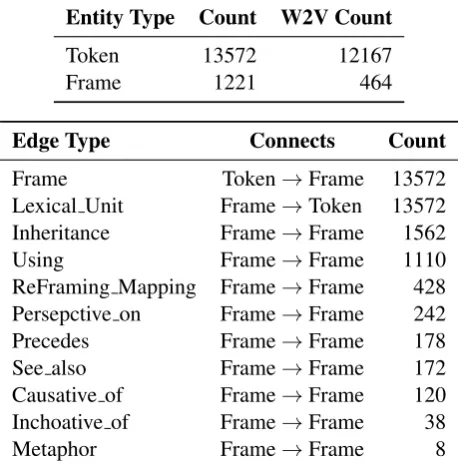
inj. We denote this relation as “Frame”, and its inverse “Lexical unit”. Finally, we connect frames by the structure of FrameNet (Table 6). Distributional embeddings are from the Google News pre-trained Word2Vec model (Mikolov et al., 2013a); the counts of each entity type that were also found in the distributional corpus are shown in Table 6.
Results
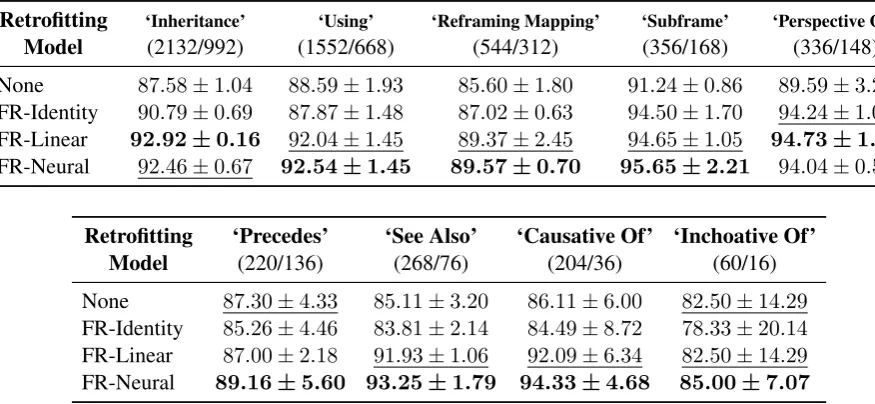
As seen in Table 1, the representations learned by FR-Linear and FR-Neural are significantly more useful for link prediction than those of the baseline methods.
Retrofitting
Model ‘Inheritance’(2132/992) (1552/668)‘Using’ ‘Reframing Mapping’(544/312) ‘Subframe’(356/168) ‘Perspective On’(336/148) None 87.58±1.04 88.59±1.93 85.60±1.80 91.24±0.86 89.59±3.25
FR-Identity 90.79±0.69 87.87±1.48 87.02±0.63 94.50±1.70 94.24±1.02
FR-Linear 92.92±0.16 92.04±1.45 89.37±2.45 94.65±1.05 94.73±1.12
FR-Neural 92.46±0.67 92.54±1.45 89.57±0.70 95.65±2.21 94.04±0.58
Retrofitting
Model ‘Precedes’(220/136) ‘See Also’(268/76) ‘Causative Of’ ‘Inchoative Of’(204/36) (60/16) None 87.30±4.33 85.11±3.20 86.11±6.00 82.50±14.29
FR-Identity 85.26±4.46 83.81±2.14 84.49±8.72 78.33±20.14
FR-Linear 87.00±2.18 91.93±1.06 92.09±6.34 82.50±14.29
FR-Neural 89.16±5.60 93.25±1.79 94.33±4.68 85.00±7.07
Table 1: Retrofitting to FrameNet. Reported values are mean and standard deviation of the link prediction accuracies over three experiments. The number of edges used for (training/testing) is shown below each edge type.
5.2 WordNet
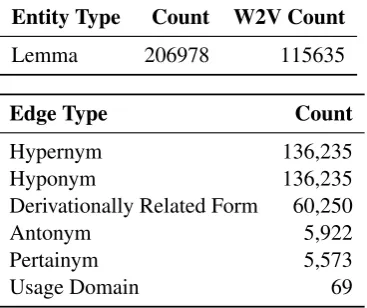
WordNet (Miller, 1995; Fellbaum, 2005) is a lexical database consisting of words (lemmas) which are grouped into unordered sets of synonyms (synsets). To examine the performance of FR on knowledge graphs which predominately satisfy the assumptions of Faruqui et al. (2015), we extract a simple knowl-edge graph of lemmas and the connections between these lemmas that are annotated in WordNet. These connections are dominated by hypernymy and hyponymy (Table 7), which correlate with similarity, so we expect the baseline retrofitting method to perform well.
Results
As seen in Table 2, the increased flexibility of the FR framework does not degrade embedding quality even when this extra flexibility is not intuitively necessary. Here, we evaluate standard lexical metrics for word embeddings: word similarity and syntatic relations. For word similiarity tasks, the evaluation metric is the Spearman correlation between predicted and annotated similarities; for syntatic relation, the evaluation metric is the mean cosine similarity between the learned representation of the correct answer and the prediction by the vector offset method (Mikolov et al., 2013b). In contrast to our other experiments, here the only stochastic behavior is due to stochastic gradient descent training, not sampling of evaluation samples. Even though the WordNet knowledge graph largely satisfies the assumptions of the na¨ıve retrofitting model, the flexible FR framework achieves sustained improvements for both word similarity datasets (WordSim-353; Finkelstein et al. (2001), Mturk-7711, and MTurk-287and syntatic
relations (Google Analogy Test Set2).
1http://www2.mta.ac.il/˜gideon/mturk771.html
Retrofitting
Model WordSim-353 Word SimilarityMTurk-771 MTurk-287 Syntactic RelationGoogle Analogy
None 0.512 0.538 0.671 0.772
FR-Identity 0.512 0.532 0.664 0.774
FR-Linear 0.542 0.562 0.679 0.793
FR-Neural 0.516±0.001 0.543±0.001 0.676±0.001 0.784±0.000
Table 2: Retrofitting to WordNet. Reported values are Spearman correlations for the word similarity tasks and mean cosine similarity for the syntatic relation task. These are deterministic evaluations, so the only source of stochasticity is the optimization of the FR-Neural model.
5.3 SNOMED-CT
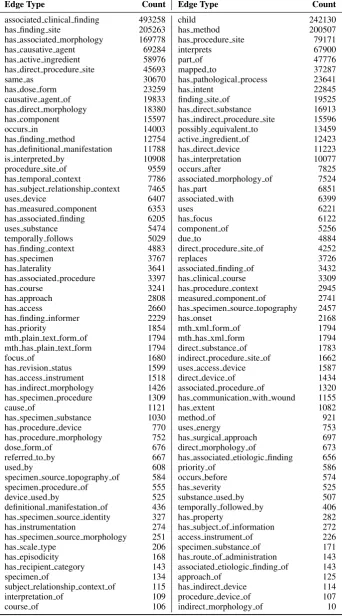
SNOMED-CT is an ontology of clinical healthcare terms and concepts including diseases, treatments, anatomical terms, and many other types of entities. From the publicly available SNOMED-CT knowl-edge graph,3 we extracted 327,001 entities and 3,809,639 edges of 169 different types (Table 8). To
create distributional embeddings, we first link each SNOMED-CT concept to a set of Wikipedia articles by indexing the associated search terms in WikiData.4 We aggregate each article set by the method of
Arora et al. (2016), which performs TF-IDF weighted aggregation of pre-trained term embeddings to create sophisticated distributional embeddings of SNOMED-CT concepts. This creates a single 300-dimensional vector for each entity.
Results
As the SNOMED-CT ontology is dominated by synonymy-like relations, we expect the simple retrofitting methods to perform well. Nevertheless, we see minimal loss in link prediction performance by using the more flexible FR framework (Table 3). Our implementation supports the use of different function classes to represent different relation types; in practice, we recommend that users select function classes in accordance with relation semantics.
Retrofitting
Model ‘Has Finding Site’(113748/49070) ‘Has Pathological Process’(19318/8124) (5042/2042)‘Due to’ (1166/376)‘Cause of’
None 95.26±0.01 98.79±0.07 91.47±0.88 79.61±1.27
FR-Identity 95.25±0.11 99.09±0.11 94.69±0.61 86.67±1.27
FR-Linear 95.35±0.01 99.35±0.01 93.50±0.46 80.82±0.49
FR-Neural 95.22±0.00 98.97±0.22 91.70±0.15 80.29±0.80
Table 3: Retrofitting to SNOMED-CT. Reported values are mean and standard deviation of the link prediction accuracies over three experiments. The number of edges used for (training/testing) is shown below each edge type.
5.4 Roam Health Knowledge Graph
Finally, we investigate the utility of FR in the Roam Health Knowledge Graph (RHKG). The RHKG is a rich picture of the world of healthcare, with connections into numerous data sources: diverse medical ontologies, provider profiles and networks, product approvals and recalls, population health statistics, academic publications, financial data, clinical trial summaries and statistics, and many others. As of June 2, 2017 the RHKG contains 209,053,294 vertices, 1,021,163,726 edges, and 6,231,287,999 attributes. Here, we build an instance of the RHKG using only public data sources involving drugs and diseases.
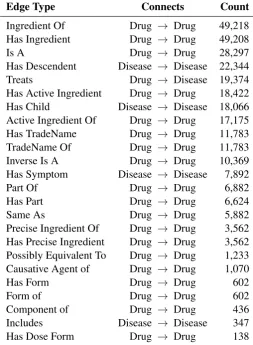
The structure of this knowledge graph is summarized in Table 9. In total, we select 48,649 disease– disease relations, 227,051 drug–drug relations, and 13,667 drug–disease relations used for retrofitting. A disjoint set of 11,306 drug–disease relations is reserved for evaluation.
In the RHKG, as in many industrial knowledge graphs, different distributional corpora are available for each type of entity. First, we mine 2.9M clinical texts for co-occurrence counts in physician notes. After counting co-occurrences, we perform a pointwise mutual information transform and`2 row normaliza-tion to generate embeddings for each entity. For drug embeddings, we supplement these embeddings with physician prescription habits. We extract prescription counts for each of 808,020 providers in the 2013 Centers for Medicare & Medicaid (CMS) dataset5and 837,629 providers in the 2014 CMS dataset.
By aggregating prescriptions counts across provider specialty, we produce 201-dimensional distribu-tional embeddings for each drug. Finally, we retrofit these distribudistribu-tional embeddings to the structure of the knowledge graph (excluding ‘Treats’ edges reserved for evaluation).
Results
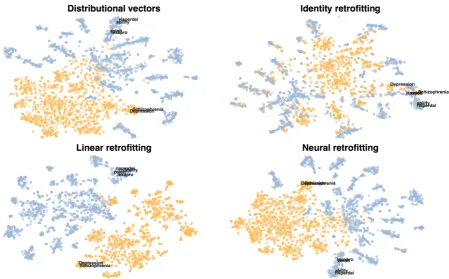
As shown in Table 5, the FR framework significantly improves prediction of ‘Treats’ relations. We hy-pothesize that this is due to the separable nature of the graph; as seen in Figure 2, the FR retrofitting framework can learn Disease and Drug subgraphs that are nearly separable. In contrast, Identity retrofitting generates a single connected space and distorts the embeddings.
Figure 2: t-SNE Projections of the retrofitted embeddings of the drugs (blue) and diseases (orange) in the Roam Health Knowledge Graph, with selected annotations reflecting the ‘Treats’ relation. The distributional space strongly separates the two kinds of entity because their representations were learned in different ways. Identity retrofitting blurs this basic semantic distinction in order to make diseases and drugs in ‘Treats’ relations more similar. As Table 5 shows, the FR models achieve this same unification, but they need not distort the basic drug/disease distinction to do it.
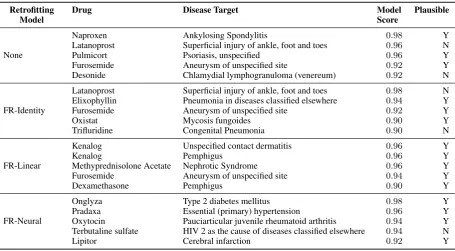
We also investigate the predictions induced by the retrofitted representations. An interesting use of healthcare knowledge graphs is to predict drugretargets, that is, diseases for which there is no annotated treatment relationship with the drug but such a relationship may exist medically. As shown in Table 4,
5https://www.cms.gov/Research-Statistics-Data-and-Systems/Statistics-Trends-and-Reports/
Retrofitting
Model Drug Disease Target ModelScore Plausible
None
Naproxen Ankylosing Spondylitis 0.98 Y
Latanoprost Superficial injury of ankle, foot and toes 0.96 N
Pulmicort Psoriasis, unspecified 0.96 Y Furosemide Aneurysm of unspecified site 0.92 Y Desonide Chlamydial lymphogranuloma (venereum) 0.92 N
FR-Identity
Latanoprost Superficial injury of ankle, foot and toes 0.98 N
Elixophyllin Pneumonia in diseases classified elsewhere 0.94 Y Furosemide Aneurysm of unspecified site 0.92 Y
Oxistat Mycosis fungoides 0.90 Y
Trifluridine Congenital Pneumonia 0.90 N
FR-Linear
Kenalog Unspecified contact dermatitis 0.96 Y
Kenalog Pemphigus 0.96 Y
Methyprednisolone Acetate Nephrotic Syndrome 0.96 Y Furosemide Aneurysm of unspecified site 0.94 Y
Dexamethasone Pemphigus 0.90 Y
FR-Neural
Onglyza Type 2 diabetes mellitus 0.98 Y Pradaxa Essential (primary) hypertension 0.96 Y Oxytocin Pauciarticular juvenile rheumatoid arthritis 0.94 Y Terbutaline sulfate HIV 2 as the cause of diseases classified elsewhere 0.94 N
Lipitor Cerebral infarction 0.92 Y
Table 4: Highest confidence drug targets that were not annotated in the Roam Health Knowledge Graph.
Retrofitting
Model (9152/2490)‘Treats’
None 72.02±0.50
FR-Identity 72.93±0.82
FR-Linear 84.22±0.82
FR-Neural 73.52±0.89
Table 5: Drug-Disease Link Prediction Accuracies.
the top retargets predicted by the linear retrofitting model are all medically plausible. In particular, the model confidently predicts that Kenalog would treat contact dermatitis, an effect also found in a clinical trial (Usatine and Riojas, 2010).The second most confident prediction of drug retargets was that Kenalog can treat pemphigus, which is indicated on Kenalog’s drug label,6 but was not previously included in
the knowledge graph. The third prediction was that methyprednisolone acetate would treat nephrotic syndrome, which is reasonable as the drug is now labelled to treat idiopathic nephrotic syndrome.7
Interestingly, several models predict that furosemide treats “aneurysm of unspecified site”, a relationship not indicated on the drug label8, though furosemide has been observed to reduce intracranial pressure
(Samson and Beyer Jr, 1982), a key factor in brain aneurysms. Finally, both the distributional data and the embeddings produced by the baseline identity retrofitting model make the nonsensical prediction that Latanoprost, a medication used to treat intraocular pressure, would also treat superficial ankle and foot injuries.
The accuracy of the predictions from the more complex models underscores the utility of the new framework for retrofitting distributional embeddings to knowledge graphs with relations that do not imply similarity.
6https://www.accessdata.fda.gov/drugsatfda_docs/label/2014/014901s042lbledt.pdf 7https://dailymed.nlm.nih.gov/dailymed/fda/fdaDrugXsl.cfm?setid=
978b8416-2e88-4816-8a37-bb20b9af4b1d
6 Conclusions and Future Work
We have presentedFunctional Retrofitting, a new framework forpost-hocretrofitting of entity embed-dings to the structure of a knowledge graph. By explicitly modeling pairwise relations, this framework allows users to encode, learn, and extract information about relation semantics while simultaneously up-dating entity representations. This framework extends the popular concept of retrofitting to knowledge graphs with diverse entity and relation types. Functional Retrofitting is especially beneficial for graphs in which distinct distributional corpora are available for different entity classes, but it loses no accuracy when applied to simpler knowledge graphs. Finally, we are interested in the possibility of improvements to the optimization procedure outlined in this paper, including dynamic updates of the and↵parameters
to increase trust in the graph structure while the relation functions are learned.
Acknowledgements
We would like to thank Adam Foster, Ben Peloquin, JJ Plecs, and Will Hamilton for insightful comments, and anonymous reviewers for constructive criticism.
References
Sanjeev Arora, Yingyu Liang, and Tengyu Ma. 2016. A simple but tough-to-beat baseline for sentence embedtd-ings.International Conference on Learning Representations.
Collin F Baker, Charles J Fillmore, and John B Lowe. 1998. The berkeley framenet project. InProceedings of the 36th Annual Meeting of the Association for Computational Linguistics and 17th International Conference on Computational Linguistics-Volume 1, pages 86–90. Association for Computational Linguistics.
Antoine Bordes, Xavier Glorot, Jason Weston, and Yoshua Bengio. 2012. Joint learning of words and meaning representations for open-text semantic parsing. InJMLR W&CP: Proceedings of the Fifteenth International Conference on Artificial Intelligence and Statistics (AISTATS 2012).
Antoine Bordes, Nicolas Usunier, Alberto Garcia-Duran, Jason Weston, and Oksana Yakhnenko. 2013. Trans-lating embeddings for modeling multi-relational data. InAdvances in neural information processing systems, pages 2787–2795.
Manaal Faruqui, Jesse Dodge, Sujay Kumar Jauhar, Chris Dyer, Eduard Hovy, and Noah A. Smith. 2015. Retrofitting word vectors to semantic lexicons. InProceedings of the 2015 Conference of the North American Chapter of the Association for Computational Linguistics: Human Language Technologies, pages 1606–1615. Association for Computational Linguistics.
Manaal Faruqui, Ryan McDonald, and Radu Soricut. 2016. Morpho-syntactic lexicon generation using graph-based semi-supervised learning. Transactions of the Association of Computational Linguistics, 4(1):1–16.
Christiane Fellbaum. 2005. Wordnet and wordnets. In Keith Brown et al., editor,Encyclopedia of Language and Linguistics, page 665670. Oxford: Elsevier, second edition.
Charles J Fillmore, Christopher R Johnson, and Miriam RL Petruck. 2003. Background to framenet.International journal of lexicography, 16(3):235–250.
Lev Finkelstein, Evgeniy Gabrilovich, Yossi Matias, Ehud Rivlin, Zach Solan, Gadi Wolfman, and Eytan Ruppin. 2001. Placing search in context: The concept revisited. InProceedings of the 10th international conference on World Wide Web, pages 406–414. ACM.
William L Hamilton, Rex Ying, and Jure Leskovec. 2017. Inductive representation learning on large graphs.arXiv preprint arXiv:1706.02216.
Yankai Lin, Zhiyuan Liu, Maosong Sun, Yang Liu, and Xuan Zhu. 2015. Learning entity and relation embeddings for knowledge graph completion. InAAAI, pages 2181–2187.
Tomas Mikolov, Wen-tau Yih, and Geoffrey Zweig. 2013b. Linguistic regularities in continuous space word representations. InProceedings of the 2013 Conference of the North American Chapter of the Association for Computational Linguistics: Human Language Technologies, volume 13, pages 746–751.
George A Miller. 1995. Wordnet: a lexical database for english. Communications of the ACM, 38(11):39–41. Nikola Mrkˇsic, Diarmuid OS´eaghdha, Blaise Thomson, Milica Gaˇsic, Lina Rojas-Barahona, Pei-Hao Su, David
Vandyke, Tsung-Hsien Wen, and Steve Young. 2016. Counter-fitting word vectors to linguistic constraints. In Proceedings of the 2016 Conference of the North American Chapter of the Association for Computational Linguistics: Human Language Technologies, pages 142–148.
Maximilian Nickel, Kevin Murphy, Volker Tresp, and Evgeniy Gabrilovich. 2016. A review of relational machine learning for knowledge graphs. Proceedings of the IEEE, 104(1):11–33.
Duke Samson and Chester W Beyer Jr. 1982. Furosemide in the intraoperative reduction of intracranial pressure in the patient with subarachnoid hemorrhage.Neurosurgery, 10(2):167–169.
Richard Socher, Danqi Chen, Christopher D Manning, and Andrew Ng. 2013. Reasoning with neural tensor networks for knowledge base completion. InAdvances in neural information processing systems, pages 926– 934.
Richard P Usatine and Marcela Riojas. 2010. Diagnosis and management of contact dermatitis. American family physician, 82(3):249–255.
Zhen Wang, Jianwen Zhang, Jianlin Feng, and Zheng Chen. 2014. Knowledge graph embedding by translating on hyperplanes. InTwenty-Eighth AAAI Conference on Artificial Intelligence.
A Structure of Knowledge Graphs
A.1 FrameNet
The structure of the FrameNet (Baker et al., 1998; Fillmore et al., 2003) knowledge graph is shown in Table 6.
Entity Type Count W2V Count
Token 13572 12167
Frame 1221 464
Edge Type Connects Count
Frame Token!Frame 13572
Lexical Unit Frame!Token 13572
Inheritance Frame!Frame 1562
Using Frame!Frame 1110
ReFraming Mapping Frame!Frame 428
Persepctive on Frame!Frame 242
Precedes Frame!Frame 178
See also Frame!Frame 172
Causative of Frame!Frame 120
Inchoative of Frame!Frame 38
Metaphor Frame!Frame 8
A.2 WordNet
The structure of the WordNet knowledge graph (Miller, 1995) is shown in Table 7.
Entity Type Count W2V Count
Lemma 206978 115635
Edge Type Count
Hypernym 136,235
Hyponym 136,235
Derivationally Related Form 60,250
Antonym 5,922
Pertainym 5,573
Usage Domain 69
Table 7: Structure of the WordNet knowledge graph.
A.3 SNOMED-CT
The structure of the knowledge graph extracted from the SNOMED-CT ontology is shown in Table 8.
A.4 Roam Health Knowledge Graph
Edge Type Count Edge Type Count
associated clinical finding 493258 child 242130 has finding site 205263 has method 200507 has associated morphology 169778 has procedure site 79171 has causative agent 69284 interprets 67900 has active ingredient 58976 part of 47776 has direct procedure site 45693 mapped to 37287 same as 30670 has pathological process 23641 has dose form 23259 has intent 22845 causative agent of 19833 finding site of 19525 has direct morphology 18380 has direct substance 16913 has component 15597 has indirect procedure site 15596 occurs in 14003 possibly equivalent to 13459 has finding method 12754 active ingredient of 12423 has definitional manifestation 11788 has direct device 11223 is interpreted by 10908 has interpretation 10077 procedure site of 9559 occurs after 7825 has temporal context 7786 associated morphology of 7524 has subject relationship context 7465 has part 6851 uses device 6407 associated with 6399 has measured component 6353 uses 6221 has associated finding 6205 has focus 6122 uses substance 5474 component of 5256 temporally follows 5029 due to 4884 has finding context 4883 direct procedure site of 4252
has specimen 3767 replaces 3726
has laterality 3641 associated finding of 3432 has associated procedure 3397 has clinical course 3309 has course 3241 has procedure context 2945 has approach 2808 measured component of 2741 has access 2660 has specimen source topography 2457 has finding informer 2229 has onset 2168 has priority 1854 mth xml form of 1794 mth plain text form of 1794 mth has xml form 1794 mth has plain text form 1794 direct substance of 1783 focus of 1680 indirect procedure site of 1662 has revision status 1599 uses access device 1587 has access instrument 1518 direct device of 1434 has indirect morphology 1426 associated procedure of 1320 has specimen procedure 1309 has communication with wound 1155
cause of 1121 has extent 1082
has specimen substance 1030 method of 921 has procedure device 770 uses energy 753 has procedure morphology 752 has surgical approach 697 dose form of 676 direct morphology of 673 referred to by 667 has associated etiologic finding 656
used by 608 priority of 586
specimen source topography of 584 occurs before 574 specimen procedure of 555 has severity 525 device used by 525 substance used by 507 definitional manifestation of 436 temporally followed by 406 has specimen source identity 327 has property 282 has instrumentation 274 has subject of information 272 has specimen source morphology 251 access instrument of 226 has scale type 206 specimen substance of 171 has episodicity 168 has route of administration 143 has recipient category 143 associated etiologic finding of 143
specimen of 134 approach of 125
subject relationship context of 115 has indirect device 114 interpretation of 109 procedure device of 107 course of 106 indirect morphology of 10
Entity Type Count
Drug 223,019
Disease 95,559
Edge Type Connects Count
Ingredient Of Drug ! Drug 49,218
Has Ingredient Drug ! Drug 49,208
Is A Drug ! Drug 28,297
Has Descendent Disease ! Disease 22,344
Treats Drug ! Disease 19,374
Has Active Ingredient Drug ! Drug 18,422
Has Child Disease ! Disease 18,066
Active Ingredient Of Drug ! Drug 17,175
Has TradeName Drug ! Drug 11,783
TradeName Of Drug ! Drug 11,783
Inverse Is A Drug ! Drug 10,369
Has Symptom Disease ! Disease 7,892
Part Of Drug ! Drug 6,882
Has Part Drug ! Drug 6,624
Same As Drug ! Drug 5,882
Precise Ingredient Of Drug ! Drug 3,562
Has Precise Ingredient Drug ! Drug 3,562
Possibly Equivalent To Drug ! Drug 1,233
Causative Agent of Drug ! Drug 1,070
Has Form Drug ! Drug 602
Form of Drug ! Drug 602
Component of Drug ! Drug 436
Includes Disease ! Disease 347
Has Dose Form Drug ! Drug 138