Copyright © 1999, American Society for Microbiology. All Rights Reserved.
Effect of the Attenuating Deletion and of Sequence Alterations
Evolving In Vivo on Simian Immunodeficiency
Virus C8-Nef Function
SILKE CARL,1A. JOHN IAFRATE,2JACEK SKOWRONSKI,2CHRISTIANE STAHL-HENNIG,3 ANDFRANK KIRCHHOFF1*
Institute for Clinical and Molecular Virology, University of Erlangen-Nuernberg, 91054 Erlangen,1 and German Primate Center, 37077 Go¨ttingen,3Germany, and Cold Spring Laboratory,
Cold Spring Harbor, New York 117242 Received 13 October 1998/Accepted 3 January 1999
The simian immunodeficiency virus macC8 (SIVmacC8) variant has been used in a European Community Concerted Action project to study the efficacy and safety of live attenuated SIV vaccines in a large number of macaques. The attenuating deletion in the SIVmacC8nef-long terminal repeat region encompasses only 12 bp and is “repaired” in a subset of infected animals. It is unknown whether C8-Nef retains some activity. Since it seems important to use only well-characterized deletion mutants in live attenuated vaccine studies, we analyzed the relevance of the deletion, and the duplications and point mutations selected in infected macaques for Nef function in vitro. The deletion, affecting amino acids 143 to 146 (DMYL), resulted in a dramatic decrease in Nef stability and function. The initial 12-bp duplication resulted in efficient Nef expression and an intermediate phenotype in infectivity assays, but it did not significantly restore the ability of Nef to stimulate viral replication and to downmodulate CD4 and class I major histocompatibility complex cell surface expres-sion. The additional substitutions however, which subsequently evolved in vivo, gradually restored these Nef functions. It was noteworthy that coinfection experiments in the T-lymphoid 221 cell line revealed that even SIVmacnefvariants carrying the original 12-bp deletion readily outgrew an otherwise isogenic virus containing a 182-bp deletion in thenefgene. Thus, although C8-Nef is unstable and severely impaired in in vitro assays, it maintains some residual activity to stimulate viral replication.
Studies with the simian immunodeficiency virus (SIV) ma-caque model have shown that an intactnefgene is critical for efficient replication and the development of AIDS (23). Pre-mature stop codons in the nef open reading frame (ORF) reverted to open forms within the first 2 weeks after infection, resulting in subsequent disease progression. In contrast, nef-deleted forms did not induce disease, showed very low levels of p27 plasma viremia during the acute phase of infection, and an approximately 100- to 1,000-fold reduced cell-associated viral load in the postacute phase (23). Under certain experimental conditions, however, when neonatal monkeys born to unvacci-nated mothers are infected with extremely high doses of virus soon after delivery, evennef-defective SIV variants are patho-genic (6, 46). Several studies have demonstrated that some long-term nonprogressors of human immunodeficiency virus type 1 (HIV-1) infection harbornef-defective forms of HIV-1, suggesting that an intactnefgene is of similar importance for human AIDS pathogenesis (13, 25, 36).
Although an intact nef gene has a drastic effect on viral replication in vivo, it is dispensable for efficient replication in most in vitro cell culture systems. It is largely unclear how Nef enhances viral replication in vivo. However, several in vitro activities of Nef that may potentially play a role in the patho-genesis of AIDS have been established. Nef increases the in-fectivity of viral particles (8, 27, 28, 42). This effect may involve a modification of the virions that results in moefficient re-verse transcription (2, 8, 31, 37). Furthermore, Nef stimulates
viral replication in primary lymphocytes and in the T-lymphoid 221 cell line (3, 27, 42). The enhancement of viral particle infectivity or the activation of the large pool of quiescent T lymphocytes in vivo could directly enhance viral spread in vivo. Nef downregulates the cell surface expression of CD4 (1, 15, 17) and of class I major histocompatibility complex (MHC) molecules (9, 38). Downregulation of CD4 may prevent super-infection, promote viral particle release, and impair T-helper-cell functions, and downmodulation of MHC class I molecules may allow evasion of cytotoxic-T-lymphocyte (CTL) lysis by HIV-1-infected cells.
The important role ofnef in pathogenesis has made it an important target for the development of live attenuated AIDS vaccines. Rhesus macaques that were infected withnef-deleted forms of SIVmac239 were fully protected against subsequent challenge with high doses of heterologous pathogenic SIV (11). The efficacy of live attenuated SIV vaccines has been confirmed in a number of independent studies (4, 40, 46). An SIVmac variant containing a large deletion of 182 bp in the nef-unique region was used in the initial study to minimize the risk of reversion and to ensure thatneffunction is completely disrupted (23). Subsequent studies showed that more than 300 bp of upstream regulatory U3 sequences of the long terminal repeat (LTR) serve mainly as a Nef coding region (21, 24). The multiple deleted SIV mutants currently used for the develop-ment of a life attenuated AIDS vaccine in the United States contain deletions of 182 bp in the nef-unique region and of approximately 300 bp in the U3 region (46), thus removing about 66% of the entirenefgene.
In studies of the European Community Concerted Action project designed to examine the mechanism of immune pro-tection and the safety of live attenuated vaccines, a naturally * Corresponding author. Mailing address: Institute for Clinical and
Molecular Virology, University of Erlangen-Nuernberg, Schlossgarten 4, 91054 Erlangen, Germany. Phone: 852-6483. Fax: 49-9131-852-2101. E-mail: [email protected].
2790
on November 9, 2019 by guest
http://jvi.asm.org/
occurring SIVmac variant (C8) has been commonly used (5, 10, 14, 30, 39, 43, 44). The SIVmacC8 clone was derived from the pathogenic SIVmac32H isolate (34). The major difference of the attenuated C8 variant from the pathogenic J5 clone, which was obtained from the same animal infected with the 32H isolate, is an in-frame deletion of just 12 bp in thenefgene (35). In the deduced C8-Nef sequence amino acids (aa) 143 to 146 (DMYL) are missing. It has been shown, that this deletion can be repaired in vivo by a sequence duplication of 12 bp (14, 43, 45). Subsequently, the duplicated region continues to evolve until it is virtually indistinguishable from the functional wild-type sequence (4-aa deletion3EKIL3EIYL3DIYL; wild type, DMYL) (45). The reversions innefare associated with increased virulence and with the development of immu-nodeficiency, indicating that this region innefis important for the full replicative potential in vivo (14, 43, 45).
Studies in a great number of rhesus macaques have estab-lished that the SIVmacC8 Nef variant has an attenuated phe-notype in vivo (5, 10, 14, 30, 39, 43–45). However, 98.5% of the nefORF is still intact, and an almost full-length Nef protein could be expressed. It is unknown whether the SIVmacC8 variant is fully attenuated, or whether it expresses a Nef pro-tein that is partly active. Therefore, we have investigated C8-Nef variants containing the original deletion of aa 143 to 146, as well as forms with the predicted repaired sequences EKIL, EKFL, EIYL, DIYL, and DMYL, in well-established in vitro assay systems for Nef function. Protein stability and the ability of Nef to downregulate CD4 and MHC class I surface expres-sion and to enhance virion infectivity and viral replication were impaired by the 4-aa deletion, and functional activity was grad-ually restored by the duplication and point mutations evolving in infected macaques. However, our results also demonstrate that the C8-nefallele still provides a replicative advantage in a T-lymphoid cell line, suggesting that it maintains some activity in promoting viral replication in vivo.
MATERIALS AND METHODS
DNA analysis.SIVnefgenes were amplified by nested PCR (24) directly from peripheral blood mononuclear cell (PBMC) DNA derived from two macaques infected with the SIVmacC8 clone, Mm1820 (at 15 and 42 weeks postinfection) and Mm1823 (at 15, 20, and 42 weeks postinfection), which had developed signs of immunodeficiency (14, 43). For the first round of PCR amplification, primers p90 (59-CTATCGAGAGTATACCAGATCC-39positions 9230 to 9251) and p41 (59-TCTGCCAGCCTCTCCGCAGAGCG-39, positions 10239 to 10261) were used. For the second round of amplification, 5ml of the 100-ml reaction mixture was used with primers p91 (59-ATACTCCAGAGGCTCTCTGC-39, positions 9260 to 9279) and p42 (59-CGACTGAATACAGAGCGAAATGC-39, positions 10218 to 10240). The numbering corresponds to the SIVmac239 sequence (33). PCR fragments were gel purified with the Quiaquick gel extraction kit (Diagen, Basel, Switzerland) and sequenced directly or after cloning into an expression vector. Sequencing was performed with the Prism sequencing kit (Perkin-Elmer, Foster City, Calif.) and with an Applied Biosystems 373 DNA sequencer accord-ing to the protocols of the manufacturers. Sequences were analyzed by usaccord-ing the GCG sequence analysis software-package (Genetics Computer Corp.).
Construction of SIVmac239DC8 and SIVmacC8 Nef variants.Site-directed mutagenesis to generate the C8 variants EKIL, EIYL, and DMYL and the deletion mutant 239DC8 was performed by spliced overlap extension PCR with mutagenic internal primers (19). Briefly, theenv-nefregion was amplified with primers P1 (59-ACCTATCTAGAATATGGGTGGAGC-39, positions 9333 to 9343; boldface letters indicate anXbaI restriction site) and P3 (59-TAAGATT CTATGTCTTCTTGC-39, positions 9737 to 9758). Thenef-LTR region was amplified with primers P2 (59-GTCCCTACGCGTCAGCGAGTTTCCTTCTT G-39), which binds to bases 10106 to 10124 of the SIVmac239 sequence and contains anMluI restriction site (indicated in boldface), and P4 EKIL (59-GAC ATAGAATCTTAGAGAAGATCTTAGAAAAGGAGG-39, positions 9745 to 9780), P4 EIYL (59-GACATAGAATCTTAGAGATTTACTTAGAAAAGGA GG-39, positions 9745 to 9780), P4 DMYL (59-GACATAGAATCTTAGACAT GTACTTAGAAAAGGAGG-39; positions 9745 to 9780), or P4DC8 (59-GAA GACATAGAATCTTAGAAAAGGAAGAAGGCATC-39), which bind to nucleotides 9741 to 9758 and nucleotides 9771 to 9788. Mm1823 K1 recovered at 20 weeks postinfection was used as template to generate the EKIL, EIYL, and DMYL variants. Numbers refer to the published SIVmac239 sequence (33), and
mutated positions are underlined. The left- and right-half PCR products were gel purified, mixed at equimolar amounts, subjected to a second PCR with primers P1 SIVXbaI and P2 SIVMluI, and then gel purified. For Nef expression in Jurkat T cells, the nef variants were inserted into a T-cell-specific pCD3-b
expression vector by using the uniqueXbaI andMluI sites. Sequence analysis of the PCR-derived inserts confirmed that only the intended changes were present. To construct the proviral clones, the PCR products were inserted into a modified pBR322 vector containing the full-length SIVmac239 proviral DNA by using the uniqueNheI andEcoRI sites in the SIV envelope and the vector sequences flanking the 39end of the provirus as described elsewhere (26). Twonef-defective controls were used, SIVmac239nef* contains a premature in-frame TAA stop signal at the 93rd codon ofnefand SIVmac239DNef contains a 182-bp deletion innef(23).
Production of virus stocks.Generation of virus stocks was performed by the calcium phosphate method essentially as described earlier (12). Briefly, 293T cells were transfected with 5mg of the full-length proviral SIVmac239 constructs differing only in the nefgene. After overnight incubation, the medium was changed and virus was harvested 24 h later. Viral stocks were aliquoted and frozen at280°C; p27 antigen concentrations of viral stocks were then quanti-tated by using a commercial HIV-1–HIV-2 enzyme-linked immunosorbent assay (Immunogenetics, Zwijndrecht, Belgium).
Cell culture, infectivity, and viral replication.293T and sMAGI cells were grown in Dulbecco modified Eagle medium supplemented with 10% fetal calf serum (FCS). Infection of sMAGI cells was performed as described previously (7), except that no DEAE-dextran was added. Viral infectivity was quantitated with the Galacto-Light Plus Chemoluminescence Reporter Assay Kit (Tropix, Bedford, Mass.) as recommended by the manufacturer. TheHerpesvirus saimiri-transformed T-cell line 221 (3) was maintained in the presence of 100 U of interleukin-2 (IL-2) per ml (Boehringer, Heidelberg, Germany) and 20% FCS, and infections were performed in the presence of 50 U of IL-2 per ml and with 5% FCS as described previously. Supernatants were collected at 3- or 4-day intervals, and virus production was measured by reverse transcriptase assay as described previously (32).
Nef expression in infected CEMx174 cells.CEMx174 cells were infected with virus containing 10 ng of p27 core antigen derived from transfected 293T cells. When cytopathic effects were observed, cells were pelleted and lysates were generated as described previously (29) and then separated by sodium dodecyl sulfate-polyacrylamide gel electrophoresis in 12% polyacrylamide. Nef proteins were detected by Western blot analysis with rabbit anti-Nef-serum. For detection of p27 core protein an anti-gag serum derived from SIVmac p27 hybridoma cells (55-2F12) was used (18). For enhanced chemiluminescence (ECL) detection, horseradish peroxidase-conjugated secondary antibodies were used.
Nef expression in transfected 293T cells.293T cells were cotransfected with 20
mg of expression plasmid encoding for the different Nef variants and 5mg of
b-galactosidase reporter plasmid. Nef expression was detected by ECL immu-noblotting with rabbit anti-Nef serum.b-Galactosidase activity in the lysed cel-lular extracts was quantitated with the Galacto-Light Plus Chemoluminescence Reporter Assay Kit as recommended by the manufacturer.
Functional analysis.Dose-response analysis of the effect of Nef on CD4 and MHC class I cell surface expression were assayed as described previously (16, 20, 41). Briefly, the JJK subline of Jurkat T cells was cotransfected by electropora-tion with a CD20 expression plasmid and various amounts of Nef expression plasmid and carrier DNA. The cell surface expression of CD4, CD20, and MHC class I was analyzed 30 to 36 h after transfection by using an Epics-Elite flow cytometer.
Coinfection of 221 cells.To detect even modest differences in the replication of SIVmac Nef variants, 2.5 million 221 cells were seeded into 24-well plates, coinfected with two virus stocks (each containing 10 ng of p27 antigen), and cultured in the presence of 50 U of IL-2 per ml. In weekly intervals, 50ml of cell-free supernatant was used to infect a fresh 221 cell culture, and the infected cells were pelleted to extract genomic DNA. Subsequently, thenef-LTR region was amplified, and the PCR products were analyzed by electrophoresis through 1.5% agarose gels and then sequenced as described previously (26).
RESULTS
Repair of the 12-bp deletion in vivo.Two of eight rhesus macaques inoculated with the SIVmacC8 variant at the Ger-man Primate Center developed signs of immunodeficiency at weeks 38 (Mm1820) and 28 (Mm1823) after infection (14, 43). The other six monkeys, two preinfected for 42 weeks and four preinfected for 22 weeks, resisted challenge with pathogenic SIV and remained asymptomic, with low viral loads, through-out the 2-year observation period (14, 43). We amplified the entire nefgenes from sequential PBMC samples drawn from the progressing macaques in order to obtainnefalleles similar to that of the input C8 provirus and repaired forms selected in vivo for functional analysis. No changes in the deleted region
on November 9, 2019 by guest
http://jvi.asm.org/
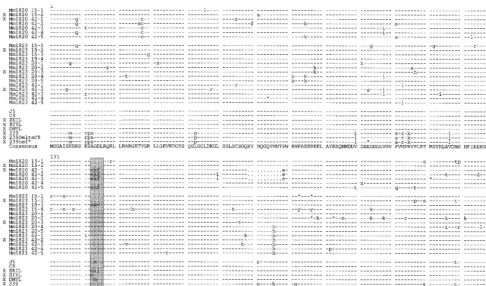
were detected in proviral nef sequences recovered from Mm1820 at 15 weeks postinfection. However, four of fivenef sequences derived from Mm1820 at 42 weeks postinfection contained an almost perfect 12-bp repeat, substituting the 4-aa deletion with the predicted sequence EKFL (Fig. 1). Three of these four sequences also contained a downstream deletion of 30 bp, predicting deletion of aa 189 to 198. From the second animal, Mm1823, three sequential PBMC samples obtained at 15, 20, and 42 weeks postinfection were analyzed. Three of fournefsequences obtained from the earliest time point still contained the deletion, and one contained an almost perfect 12-bp duplication, with the predicted amino acid sequence EKVL. In contrast, allnefsequences derived from the 20- and 42-weeks-postinfection time points contained an amino acid sequence (DIYL) identical to the SIVmac239 Nef (Fig. 1).
Selection ofnefalleles for functional analysis.Two sets of nefalleles were selected to assess the functional relevance of the 4-aa deletion and the duplications and point mutations that evolved in vivo. The first set consisted of representative nef alleles obtained for each time point of sampling from Mm1820 and Mm1823 (Fig. 1). This set included the Mm1820 15-1 Nef, which contains the original 4-aa deletion (1820DC8); the Mm1820 42-1Nef, which contains the sequence EKFL in con-junction with a deletion of aa 189 to 198 (1820EKFLD10); the Mm1823 15-2Nef, which also contained the 4-aa deletion (1823DC8); and the Mm1823 20-3Nef (1823DIYL20) and the 42-2 Nef (1823DIYL42), which contain the same amino acid sequence (DIYL) as the wild-type Nef. The second set in-cluded three C8-Nef variants with the predicted repaired
se-quences EKIL, EIYL, and DMYL that have been observed in a previous study (45). These three variants were constructed by mutagenesis. As an additional control, the region correspond-ing to the 12-bp deletion in the C8nefwas removed from the nef gene of the pathogenic SIVmac239 clone (239DC8) (Fig. 1).
[image:3.612.58.545.71.357.2]Deletion of aa 143 to 146 reduces Nef steady-state expres-sion levels.The deletion in the C8-Nef is located in the highly conserved core of the Nef protein and may affect stability. To investigate whether the mutated Nef proteins are expressed in infected cells, the virus stocks generated by transient transfec-tion of 293T cells were used to infect the T/B hybrid CEMx174 cell line. The wild-type (239wt) Nef protein was efficiently synthesized in the infected cells, whereas no Nef-specific signal could be detected in cells infected with thenef* control virus (Fig. 2A). Only low amounts of Nef could be detected in cells infected with the SIVmac239DC8 and 1823DC8 nef variants carrying the 12-bp deletion. In contrast, comparable amounts of p27 capsid antigen were detected, indicating that all cell cultures were efficiently infected. All sixnefalleles containing duplications (EKIL, EIYL, DMYL, 1820EKFLD10, 1823 DIYL20, and 1823DIYL42) were efficiently expressed (Fig. 2A). To confirm these results in an independent assay, 293T cells were transiently cotransfected with plasmids expressing Nef andb-galactosidase. Western blot analysis revealed effi-cient expression of the 239Nef and the EKIL- and DMYL-Nef proteins (Fig. 2B). In contrast, only very low amounts of the 1823DC8 and 239DC8 Nef proteins could be detected. The low levels of the 1823DC8 and 239DC8 Nef proteins in the 293T FIG. 1. Alignment of the predicted Nef amino acid sequences analyzed. In the upper part of the figure Nef sequences detected in Mm1820 and Mm1823 are shown. The animal number is indicated in the left column. The two-digit numbers in the right column give the number of weeks postinfection, and the number after the dash specifies the individual clone. The predicted amino acid sequences of the J5- and C8-Nef variants; the constructed EKIL-, EIYL-, and DMYL-Nef mutants; and the 239wt, 239DC8, andnef* variants are shown underneath. The consensus sequence is given on the bottom line. Symbols:2, identity with the consensus Nef sequence; z, gaps introduced to optimize the alignment; *, a stop signal; and X,nefalleles selected for functional analysis. The deleted region of aa 143 to 146, which is repaired
in vivo, is shaded.
on November 9, 2019 by guest
http://jvi.asm.org/
cells did not result from low transfection efficiencies, since the quantities of b-galactosidase activity in the cellular extracts were comparable to those observed in the cells transfected with the 239Nef expression vector (Fig. 2B).
Repair of the 12-bp deletion gradually restores the ability of Nef to stimulate viral replication and to enhance virion infec-tivity.Replication of SIVmac in theHerpesvirus saimiri-trans-formed T-lymphoid rhesus cell line 221 in the absence of IL-2 depends on the presence of an intactnef gene, and this cell culture system may represent a model for evaluating the ability of Nef to cause lymphoid-cell activation (3). At low levels of IL-2 in the culture medium, Nef variants containing a prema-ture stop codon (239nef*), the 12-bp deletion (Mm1823DC8), or the initial duplication (EKIL) replicated very inefficiently (Fig. 3). Variants carrying the 1823DIYL20 and EIYL nef alleles showed marginally increased replication. In contrast, the DMYL-Nef showed an intermediate phenotype, and the
form selected late in infection of Mm1823 (1823DIYL42) was fully active (Fig. 3). Results obtained with different prepara-tions of rhesus PBMC, which were infected at a low multiplic-ity of infection and stimulated 3 or 6 days later, were similar to those obtained with 221 cells but were more variable (data not shown). In contrast, all Nef variants replicated with compara-ble efficiency in CEMx174 cells (Tacompara-ble 1).
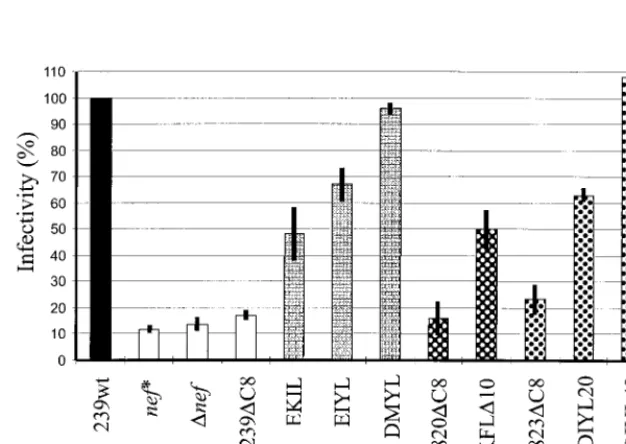
The same virus stocks were used to assess the influence of the 4-aa deletion and the reversions on virion infectivity in sMAGI cells. This cell line is a derivative of a rhesus macaque mammary tumor cell line engineered to express human CD4 and containing an integrated copy of a truncated HIV-1 LTR fused to the b-galactosidase gene (7). As shown in Fig. 4, defects in thenefgene decreased viral infectivity for sMAGI cells by approximately 8- to 10-fold (239nef*, 11.66 1.4%;
Dnef, 13.6 6 2.3%). Nef alleles carrying the 12-bp deletion (239DC8, 1820DC8, and 1823DC8) increased virion infectivity only marginally to 16 to 23% of the level of the SIVmac239wt control (Fig. 4 and Table 1). The initial duplications resulted in an intermediate phenotype, and the additional amino acid substitutions selected in Mm1823 later in infection fully re-stored the ability of Nef to increase virion infectivity (Fig. 4 and Table 1).
Restoration of CD4 and MHC-I downmodulation.Thenef alleles were cloned into a T-cell-specific expression vector. Transient transfection of the 293Nef expression plasmid into Jurkat T cells resulted in a dose-dependent downregulation of CD4 cell surface expression (Fig. 5A). At the highest amount (20mg) of expression plasmid, an approximately 20-fold effect was observed. In contrast,nefalleles carrying the 12-bp dele-tion or an early duplicadele-tion (EKIL) showed only marginal activity even at the highest concentrations (Fig. 5A). It remains to be elucidated whether the EKIL-Nef is impaired in CD4 internalization or in subsequent sorting to the lysosome. How-ever,nefalleles that evolved later in infection (EIYL, DMYL, and 1823DIYL42) were able to downregulate CD4 surface expression, albeit with reduced efficiency compared to the 239wt Nef. The 1820EKFLD10 nef, carrying a downstream deletion of 30 bp in addition to the 12-bp duplication, was inactive in CD4 downregulation.
Similar to the results obtained upon CD4 downmodulation, the 1823DC8 and 1820EKFLD10 Nef proteins were unable to downregulate MHC-I surface expression (Fig. 5B). In contrast, EIYL, DMYL, and 1823DIYL42 showed an activity
[image:4.612.53.294.483.675.2]compara-FIG. 2. Deletion of aa 143 to 146 reduces Nef steady-state expression levels. (A) Detection of viral proteins in CEMx174 cells infected with SIVmac239 containing wild-type or mutantnefgenes. CEMx174 cells were infected with viral stocks containing 10 ng of p27 core antigen (derived from 293T cells transiently transfected with the proviral Nef mutant constructs indicated) and cultured until cytopathic effects were observed. Uninfected CEMx174 cells were used as negative control. (B) 293T cells were cotransfected with 20mg of expression plasmid encoding the indicated Nef proteins and 5mg ofb-galactosidase reporter plasmid. As a negative control, empty pFJ-EA vector was used. ECL immunoblot and quantitation ofb-galactosidase activity were performed as described in the Materials and Methods.
FIG. 3. Growth of SIVmac239 and SIVmacC8 Nef variants in theHerpesvirus saimiri-transformed rhesus monkey T-cell line 221. Cells were propagated in the presence of a low amount of IL-2 (50 U/ml). Virus stocks containing 10 ng of p27 antigen were used for infection, and production was monitored by reverse tran-scriptase assay at the indicated days postinfection. Similar results were obtained in three independent experiments. P.S.L.5photo-stimulated light emission.
on November 9, 2019 by guest
http://jvi.asm.org/
ble to 239wt Nef and resulted in a reduction of MHC-I surface expression of up to 10-fold. The EKIL and 1823DIYL20nef alleles showed an intermediate activity (Fig. 5B).
The 12-bp deletion does not completely disrupt the ability of Nef to increase viral replication in 221 cells. Our results showed that deletion of aa 143 to 146 impairs Nef expression and has pleiotropic effects on in vitro activities (summarized in Table 1). However, it seemed that even thenefalleles contain-ing the 12-bp deletion still maintained some marginal activity in infectivity enhancement as well as in CD4 and MHC-I down-modulation. In particular, viral replication and infectivity as-says are somewhat variable and modest differences are difficult to demonstrate. To detect subtle differences in replicative ca-pacity in vitro, 221 cells were coinfected with SIVmacC8-Nef
variants and viruses carrying a deleted or a full-lengthnef. As shown in Fig. 6, the SIVmac239wt variant rapidly outgrew the isogenicnef-deleted forms. After coinfection of 221 cells with SIVmac239DNef and the 239DC8 or 1823DC8 Nef variants, both the forms carrying the 12-bp deletion and the 182-bp deletion innef were detected after the first passage (Fig. 6, upper panel). After the second passage, however, the 12-bp deletion mutants became predominant, and for the last two passages the nefallele with the 182-bp deletion was not de-tected (Fig. 6). In contrast, when 221 cells were coinfected with SIVmac239wt and the forms with the 12-bp deletions, only the wild-type 239nef could be detected by direct sequence analysis of PCR fragments (Fig. 6, lower panel). Similarly Nef variants containing duplications (EKIL and DMYL) outgrew the virus
[image:5.612.50.553.83.226.2]FIG. 4. Infectivity of SIVmac239 and SIVmacC8 Nef variants. sMAGI cells were infected in triplicate with virus containing 100 ng of p27 antigen derived from transient transfection of 293T cells.b-Galactosidase activities were assayed at 3 days postinfection. The average values relative to wild type obtained from five experiments performed with different virus stocks are shown.
TABLE 1. Functional relevance of SIVmacC8nefmutations
Nef variant (aa 143 to 146)Sequence a
Replicationb
sMAGI (%) Activity
b Expressionc
221 CEMx174 CD4 MHC-I CEMx174 293T
239wt DIYL 111 111 100 111 111 11 11
nef* (DIYL) (1) 111 1061 NDd ND 2 ND
Dnef (DIYL) (1) 111 1362 NAe NA 2 NA
239DC8 Deleted (1) 111 1762 ND ND (1) (1)
EKIL EKIL (1) 111 4869 (1) 1 11 1
EIYL EIYL 1 111 6766 11 111 11 ND
DMYL DMYL 11 111 9662 11 111 11 1
1820DC8 Deleted ND ND 1666 (1) (1) ND ND
1820EKFLD10 EKFL (1) 111 5067 (1) (1) 11 ND
1823DC8 Deleted (1) 111 2365 (1) (1) (1) (1)
1823DIYL20 DIYL 1 111 6362 1 11 11 ND
1823DIYL42 DIYL 111 111 108614 11 111 11 ND
aThe Nef amino acid sequences are shown in Fig. 1. Thenefgene region coding for aa 143 to 146 is present but is not expressed in the SIVmac239nef* andDnef
variants; hence, aa 143 to 146 for these two variants are placed in parenthesis.
bReplication or activity was as follows:111, comparable to 239wt;11, slightly reduced;1, strongly reduced; (1), comparable tonef-defective controls. cAmount of Nef protein detected in infected CEMx174 and transiently transfected 293T cells. Levels of Nef expression were as follows:11, high; (1), low; and
2, not detectable.
dND, not done. eNA, not applicable.
on November 9, 2019 by guest
http://jvi.asm.org/
[image:5.612.146.459.477.699.2]containing thenefgene with the original 12-bp deletion. These results show that the variants containing the duplications se-lected for in vivo have a higher replicative potential than the C8-Nef variant. However, even the nef alleles carrying the
original 12-bp deletion maintained some residual activity to stimulate SIV replication in this T-lymphoid cell line.
DISCUSSION
[image:6.612.146.456.70.310.2]We have found that the deletion of aa 143 to 146 in SIV-macC8-Nef, which clearly attenuates SIV replication in vivo (4, 5, 10, 14, 30, 34, 39, 43–45), disrupts Nef function in vitro. The deletion also impaired Nef expression, thus explaining the pleiotropic effects on functional activity. The early 12-bp du-plications (EKFL and EKIL) selected in vivo resulted in stable Nef protein expression but had only marginally restorative effects on the ability of Nef to stimulate viral infectivity and replication and to downmodulate CD4 and MHC-I. This indi-cates that the deleted region in Nef is important for proper folding of the Nef molecule. In vivo, additional amino acid substitutions were selected and the evolution of the 4-aa region to sequences similar or identical to that present in the Nef proteins of the pathogenic SIVmac239 and SIVmacJ5 variants was associated with increasing viral loads and disease progres-sion (14, 43, 45). In agreement with the selective pressure observed in vivo, functional analysis revealed that these amino acid substitutions gradually almost fully restored all of the in vitro Nef activities investigated. The restorative effects of the various duplications varied slightly between the different in vitro assay systems. This can best be compared for the con-structed EKIL-, EIYL-, and DMYL-Nef variants that are oth-erwise isogenic to each other and to the C8-Nef. The initial duplication (EKIL) had a moderate restorative effect on infec-tivity and on MHC-I downregulation but not on the down-modulation of CD4. A replicative advantage of the EKIL-Nef variant, compared to the C8-Nef variant, in 221 cells could only be demonstrated by coinfection experiments. With the excep-tion of two amino acid substituexcep-tions, K181R and A249T, the constructed DMYL-Nef is identical to that of the J5 clone but differs at 15 aa positions from the 239Nef (Fig. 1). The DMYL-Nef showed an activity comparable to the 239DMYL-Nef in the en-hancement of infectivity and in MHC-I downregulation but FIG. 5. Downmodulation of CD4 (A) and MHC class I (B) surface expression by SIVmacC8 variants. Jurkat T cells were transfected with the indicated amounts of vectors expressing the SIVmac239 and C8nefgenes. CD4 and MHC class I expression on the cell surface was determined by flow-cytometric analysis.
FIG. 6. Coinfection of 221 cells with SIVmac239 and SIVmacC8 Nef vari-ants. 221 cells were infected with equal amounts of p27 antigen (10 ng) of the mutants indicated. At weekly intervals the supernatant was used to infect a new culture (passages 1 to 4), and the cells were used for extraction of genomic DNA. Thenefgene was amplified from 221 cells coinfected with theDNef variant and the other variants indicated, and the PCR products were separated on a 1.5% agarose gel (upper panel). In the lower panel, the results of direct sequence analysis of DNA fragments spanning nef are shown. Sequence analysis was performed as described previously (26). Levels ofnefalleles carrying theDC8 deletion were always below 10%. The results are shown for 221 cells that were grown in the presence of 50 U of IL-2 per ml. Abbreviations: K, uninfected CEMx174 cells;DNef, SIVmac239DNef.
on November 9, 2019 by guest
http://jvi.asm.org/
was less active in CD4 downmodulation and in its ability to stimulate viral replication. In contrast to the highly pathogenic SIVmac239 clone (22), the J5 virus has been reported to be only moderately pathogenic (35). It seems possible that the higher pathogenicity of SIVmac239 is due to a more activenef allele.
Our results show that even the 12-bp deletionnefvariants have some residual activity to stimulate viral replication, al-though only very low amounts of the deleted Nef protein could be detected in infected cells. Similarly, these variants seemed to retain some marginal activity in other in vitro assay systems for Nef function. These findings may explain why, in contrast to macaques infected with SIVnefvariants containing a 182-bp deletion innef (24), no additional large deletions in the U3 region have been found in macaques infected with the C8 variant. The residual activity may provide a selective advantage over forms in which thenefgene is completely disrupted. It has been described that the C8-Nef can be detected in infected cells (45) and that it can induce CTL responses (14). Macaques infected with the C8 variant seem to be more rapidly protected against challenge with pathogenic SIV than are animals vacci-nated with the SIVmac239 variant containing the 182-bp de-letion innef(30, 43). Since protection is linked to the replica-tive capacity of the vaccine virus (46), these previous results also suggested that the C8-Nef may not be entirely inactive.
In one of the animals infected with the C8-Nef variant (Mm1823) our findings were similar to those of Whatmore et al. (45). They noted an almost perfect 12-bp duplication event and a subsequent evolution to forms that are indistinguishable from the wild-type Nef. In this animal functional Nef activity was also fully restored, and mostnef genes detected at later time points were intact. Mm1823 showed declining CD4/CD8 ratios by between 20 and 32 weeks postinfection and progress-ing peripheral lymphadenopathy beginnprogress-ing at week 42 (14, 43). The 1823DIYL20 Nef, which was obtained when the animal started to develop signs of immunodeficiency (14, 43), showed an intermediate phenotype in in vitro assays for Nef function (summarized in Table 1). The 1823DIYL42nefallele, obtained when more severe clinical alterations were observed, was al-most fully active. This form contains the same 4-aa repair as the 1823DIYL20 Nef, but it differs at 8 other amino acid positions (Fig. 1). Thus, the higher functional activity of the 1823DIYL42 Nef may be due to the presence of these addi-tional amino acid substitutions. In particular, the Q196H change may be relevant for Nef function and increased viral pathogenicity, since this change is also present in the Nef protein of the highly pathogenic SIVmac239 Nef and has been observed in other C8-infected macaques (45). Surprisingly, three of four “repaired”nef alleles derived from the second animal, Mm1820, at 42 weeks postinfection contained a down-stream deletion of 30 bp, predicting deletion of Nef aa 189 to 198. We have not observed similar in-frame deletions in thenef gene of 14 SIVmac239wt-infected animals (25a). However, Sharpe et al. (39) have observed a similar deletion of 33 bp (removing aa 193 to 203), which evolved after the 12-bp du-plication. Thenefallele carrying the 30-bp deletion together with a 12-bp duplication (1820EKFLD10) was largely inactive in functional assays, and it remains to be elucidated why short in-frame deletions close to the 39 end of the nef gene are selected in some animals infected with the C8 variant. Mm1823 developed more-severe alterations than did Mm1820 that were indicative of an immunodeficiency (14, 43). Our observation that Nef function was fully restored in Mm1823, but not in Mm1820, is in agreement with these previous findings.
In summary, we have shown than an attenuated SIVmac variant that has been broadly used for studies on live
attenu-ated SIV vaccines throughout Europe contains anefgene that is largely defective in in vitro assay systems. In addition to the previous observation that the 12-bp deletion can be repaired to forms that are indistinguishable from wild-typenefalleles (and thus also from the challenge virus), our finding that the C8-Nef still has some residual activity, at least in the stimulation of viral replication, raises even more questions concerning the use of this variant for studies of live attenuated AIDS vaccines.
ACKNOWLEDGMENTS
We thank Mandy Krumbiegel for technical assistance, Bernhard Fleckenstein for support and encouragement, and Klaus U¨ berla for critical reading of the manuscript. We also thank Martin P. Cranage and E. W. Rud for providing the C8 virus, Julie Overbaugh and Bryce Chackerian for sMAGI cells, and Lou Alexander and Ronald C. Des-rosiers for the 221 cells. The SIVmac p27 hybridoma cells (55-2F12) were kindly provided by Niels Petersen through the NIH AIDS Re-agent Program.
This work was supported by the Public Health service grant TA-42561 to J.S., the Deutsche Forschungsgemeinschaft, the Wilhelm-Sander Stiftung, and the Bundesministerium fu¨r Forschung und Tech-nologie.
REFERENCES
1.Aiken, C., J. Konner, N. R. Landau, M. E. Lenburg, and D. Trono.1994. Nef induces CD4 endocytosis: requirement for a critical dileucine motif in the membrane-proximal CD4 cytoplasmic domain. Cell76:853–864.
2.Aiken, C., and D. Trono.1995. Nef stimulates human immunodeficiency virus type 1 proviral DNA synthesis. J. Virol.69:5048–5056.
3.Alexander, L., Z. Du, M. Rosenzweig, J. J. Jung, and R. C. Desrosiers.1997. A role for natural SIV and HIV-1nef alleles in lymphocyte activation. J. Virol.71:6094–6099.
4.Almond, N., K. Kent, M. Cranage, E. Rud, B. Clarke, and E. J. Stott.1995. Protection by attenuated simian immunodeficiency virus in macaques against challenge with virus-infected cells. Lancet345:1342–1344.
5.Almond, N., J. Rose, R. Sangster, P. Silvera, R. Stebbings, B. Walker, and E. J. Stott.1997. Mechanisms of protection induced by attenuated simian immunodeficiency virus. Protection cannot be transferred with immune se-rum. J. Gen. Virol.78:1919–1922.
6.Baba, T. W., Y. S. Jeong, D. Pennick, R. Bronson, M. F. Greene, and R. M. Ruprecht.1995. Pathogenicity of live, attenuated SIV after mucosal infection of neonatal macaques. Science267:1820–1825.
7.Chackerian, B., N. L. Haigwood, and J. Overbaugh.1995. Characterization of a CD4-expressing macaque cell line that can detect virus after a single replication cycle and can be infected by diverse simian immunodeficiency virus isolates. Virology213:386–394.
8.Chowers, M. Y., C. A. Spina, T. J. Kwoh, N. J. Fitch, D. D. Richman, and J. C. Guatelli.1994. Optimal infectivity in vitro of human immunodeficiency virus type 1 requires an intactnefgene. J. Virol.68:2906–2914.
9.Collins, K. L., B. K. Chen, S. A. Kalams, B. D. Walker, and D. Baltimore. 1998. HIV-1 Nef protein protects infected primary cells against killing by cytotoxic T lymphocytes. Nature391:397–401.
10. Cranage, M. P., A. M. Whatmore, S. A. Sharpe, N. Cook, N. Polyanskaya, S. Leech, J. D. Smith, E. W. Rud, M. J. Dennis, and G. A. Hall.1997. Macaques infected with live attenuated SIVmac are protected against superinfection via the rectal mucosa. Virology229:143–154.
11. Daniel, M. D., F. Kirchhoff, S. C. Czajak, P. K. Sehgal, and R. C. Desrosiers. 1992. Protective effects of a live attenuated SIV vaccine with a deletion in the nefgene. Science258:1938–1941.
12. Deng, H., R. Liu, W. Ellmeier, S. Choe, D. Unutmaz, M. Burkhart, P. Di Marzio, S. Marmon, R. E. Sutton, C. M. Hill, C. B. Davis, S. C. Peiper, T. J. Schall, D. R. Littman, and N. R. Landau.1996. Identification of a major co-receptor for primary isolates of HIV-1. Nature381:661–666.
13. Deacon, N. J., A. Tsykin, A. Solomon, K. Smith, M. Ludford-Menting, D. J. Hooker, D. A. McPhee, A. L. Greenway, A. Ellett, and C. Chatfield.1995. Genomic structure of an attenuated quasi species of HIV-1 from a blood transfusion donor and recipients. Science270:988–991.
14. Dittmer, U., T. Nisslein, W. Bodemer, H. Petry, U. Sauermann, C. Stahl-Hennig, and G. Hunsmann.1995. Cellular immune response of rhesus mon-keys infected with a partially attenuatednefdeletion mutant of the simian immunodeficiency virus. Virology212:392–397.
15. Garcia, J. V., and A. D. Miller.1991. Serine phosphorylation-independent downregulation of cell-surface CD4 bynef. Nature350:508–511. 16. Greenberg, M. E., A. J. Iafrate, and J. Skowronski.1998. The SH3
domain-binding surface and an acidic motif in HIV-1 Nef regulate trafficking of class I MHC complexes. EMBO J.17:2777–2789.
17. Guy, B., M. P. Kieny, Y. Riviere, C. Le Peuch, K. Dott, M. Girard, L.
on November 9, 2019 by guest
http://jvi.asm.org/
Montagnier, and J. P. Lecocq.1987. HIV F/39orf encodes a phosphorylated GTP-binding protein resembling an oncogene product. Nature330:266–269. 18.Higgins, J. R., S. Sutjipto, P. A. Marx, and N. C. Pedersen.1992. Shared antigenic epitopes of the major core proteins of human and simian immu-nodeficiency virus isolates. J. Med. Primatol.21:265–269.
19.Horton, R. M., H. D. Hunt, S. N. Ho, J. K. Pullen, and L. R. Pease.1989. Engineering hybrid genes without the use of restriction enzymes: gene splic-ing by overlap extension. Gene77:61–68.
20. Iafrate, A. J., S. Bronson, and J. Skowronski.1997. Separable functions of Nef disrupt two aspects of T cell receptor machinery: CD4 expression and CD3 signaling. EMBO J.16:673–684.
21. Ilyinskii, P. O., M. D. Daniel, M. A. Simon, A. A. Lackner, and R. C. Desrosiers.1994. The role of upstream U3 sequences in the pathogenesis of simian immunodeficiency virus-induced AIDS in rhesus monkeys. J. Virol. 68:5933–5944.
22. Kestler, H. W., T. Kodama, D. J. Ringler, M. Marthas, N. Pedersen, A. Lackner, D. Regier, P. K. Sehgal, M. D. Daniel, and R. C. Desrosiers.1990. Induction of AIDS in rhesus monkeys by molecularly cloned simian immu-nodeficiency virus. Science248:1109–1112.
23. Kestler, H. W., D. J. Ringler, K. Mori, D. L. Panicali, P. K. Sehgal, M. D. Daniel, and R. C. Desrosiers.1991. Importance of thenefgene for mainte-nance of high virus loads and for development of AIDS. Cell65:651–662. 24. Kirchhoff, F., H. W. Kestler, and R. C. Desrosiers.1994. Upstream U3
sequences in SIV are selectively deleted in vivo in the absence ofnef func-tion. J. Virol.68:2031–2037.
25. Kirchhoff, F., T. C. Greenough, D. B. Brettler, J. L. Sullivan, and R. C. Desrosiers.1995. Absence of intactnefsequences in a long-term, nonpro-gressing survivor of HIV-1 infection. N. Engl. J. Med.332:228–232. 25a.Kirchhoff, F., and C. Stahl-Hennig.Unpublished observations.
26. Lang, S. M., A. J. Iafrate, C. Stahl-Hennig, E. M. Kuhn, T. Nisslein, M. Haupt, G. Hunsmann, J. Skowronski, and F. Kirchhoff.1997. Association of simian immunodeficiency virus Nef with cellular serine/threonine kinases is dispensable for the development of AIDS in rhesus macaques. Nat. Med. 3:860–865.
27. Miller, M. D., M. T. Warmerdam, I. Gaston, W. C. Greene, and M. B. Feinberg.1994. The human immunodeficiency virus-1nefgene product: a positive factor for viral infection and replication in primary lymphocytes and macrophages. J. Exp. Med.179:101–114.
28. Miller, M. D., M. T. Warmerdam, K. A. Page, M. B. Feinberg, and W. C. Greene. 1995. Expression of the human immunodeficiency virus type 1 (HIV-1)nefgene during HIV-1 production increases progeny particle infec-tivity independently of gp160 or viral entry. J. Virol.69:579–584. 29. Morrison, H. G., F. Kirchhoff, and R. C. Desrosiers.1995. Effects of
muta-tions in constant regions 3 and 4 of envelope of simian immunodeficiency virus. Virology210:448–455.
30. Norley, S., B. Beer, D. Binninger-Schinzel, C. Cosma, and R. Kurth.1996. Protection from pathogenic SIVmac challenge following short-term infec-tion with anef-deficient attenuated virus. Virology219:195–205.
31. Pandori, M. W., N. J. Fitch, H. M. Craig, D. D. Richman, C. A. Spina, and J. C. Guatelli.1996. Producer-cell modification of human immunodeficiency virus type 1: Nef is a virion protein. J. Virol.70:4283–4290.
32. Potts, B. J. 1990. “Mini” reverse transcriptase assay, p. 103–106.InA.
Aldovini and B. D. Walker (ed.), Techniques in HIV research. Stockton, New York, N.Y.
33. Regier, D. A., and R. C. Desrosiers.1989. The complete nucleotide sequence of a pathogenic molecular clone of SIV. AIDS Res. Hum. Retroviruses 6:1221–1231.
34. Rud, E. W., J. R. Jon, B. A. Larder, B. E. Clarke, N. Cook, and M. P. Cranage.1992. Infectious molecular clone of SIVmac32H:nefdeletion con-trols ability to reisolate virus from rhesus macaques. Vaccines92:229–235. 35. Rud, E. W., M. Cranage, J. Yon, J. Quirk, L. Ogilvie, N. Cook, S. Webster,
M. Dennis, and B. E. Clarke.1994. Molecular and biological characteriza-tion of simian immunodeficiency virus macaque strain 32H proviral clones containingnefsize variants. J. Gen. Virol.75:529–543.
36. Salvi, R., A. R. Garbuglia, A. Di Caro, S. Pulciani, F. Montella, and A. Benedetto.1998. Grossly defectivenefgene sequences in a human immuno-deficiency virus type 1-seropositive long-term nonprogressor. J. Virol.72: 3646–3657.
37. Schwartz, O., V. Marechal, O. Danos, and J. M. Heard. 1995. Human immunodeficiency virus type 1 Nef increases the efficiency of reverse tran-scription in the infected cell. J. Virol.69:4053–4059.
38. Schwartz, O., V. Marechal, S. Le Gall, F. Lemonnier, and J. M. Heard.1996. Endocytosis of major histocompatibility complex class I molecules is induced by the HIV-1 Nef protein. Nat. Med.2:338–342.
39. Sharpe, S. A., A. M. Whatmore, G. A. Hall, and M. P. Cranage.1997. Macaques infected with attenuated simian immunodeficiency virus resist superinfection with virulence-revertant virus. J. Gen. Virol.78:1923–1927. 40. Shibata, R., C. Siemon, S. C. Czajak, R. C. Desrosiers, and M. A. Martin.
1997. Live, attenuated simian immunodeficiency virus vaccines elicit potent resistance against a challenge with a human immunodeficiency virus type 1 chimeric virus. J. Virol.71:8141–8148.
41. Skowronski, J., and R. Mariani. 1995. Transient assay for Nef-induced down-regulation of CD4 antigen expression on the cell surface, p. 231–242. InD. Rickwood, B. D. Hames, and J. Karn (ed.), HIV-1: a practical ap-proach. IRL Press/Oxford University Press, Oxford, England.
42. Spina, C. A., T. J. Kwoh, M. Y. Chowers, J. C. Guatelli, and D. D. Richman. 1994. The importance ofnefin the induction of human immunodeficiency virus type 1 replication from primary quiescent CD4 lymphocytes. J. Exp. Med.179:115–123.
43. Stahl-Hennig, C., U. Dittmer, T. Nisslein, H. Petry, E. Jurkiewicz, D. Fuchs, H. Wachter, K. Matz-Rensing, E. M. Kuhn, F. J. Kaup, E. W. Rud, and G. Hunsmann.1996. Rapid development of vaccine protection in macaques by live-attenuated simian immunodeficiency virus. J. Gen. Virol.77:2969–2981. 44. Titti, F., L. Sernicola, A. Geraci, G. Panzini, S. Di-Fabio, R. Belli, F. Mo-nardo, A. Borsetti, M. T. Maggiorella, M. Koanga-Mogtomo, F. Corrias, R. Zamarchi, A. Amadori, L. Chieco-Bianchi, and P. Verani.1997. Live atten-uated simian immunodeficiency virus prevents super-infection by cloned SIVmac251 in cynomolgus monkeys. J. Gen. Virol.78:2529–2539. 45. Whatmore, A. M., N. Cook, G. A. Hall, S. Sharpe, E. W. Rud, and M. P.
Cranage.1995. Repair and evolution ofnefin vivo modulates simian immu-nodeficiency virus virulence. J. Virol.69:5117–5123.
46. Wyand, M. S., K. H. Manson, M. Garcia-Moll, D. Monfiori, and R. C. Desrosiers.1996. Vaccine protection by a triple deletion mutant of simian immunodeficiency virus. J. Virol.70:3724–3733.