A STUDY OF THE RELATIONSHIP BETWEEN SCHOOL CLIMATE AND STAFF-DEVELOPMENT PRACTICES
by
JOHN G. DOCKER
B.A., Dip. Educ., M. Educ. Stud. (Tas.), M.A.C.E.A.
Submitted in fulfilment of the requirements for the degree of
I certify that this thesis contains no material which has been accepted for the award of any other higher degree or graduate diploma in any tertiary institution and that, to the best of the candidate's knowledge and belief, this thesis contains no material previously published or written by another person, except when due reference is made in the text of the thesis.
John Gordon Docker.
5. Access to, and copying of, thesis
The thesis copy lodged in the University Library shall be made available by the University for consultation but, for a period of two years after the thesis is lodged, it shall not be made available for loan or photocopying without the written consent of the author and in accordance with the laws of copyright.
After a thesis has been examined, the following authority will apply. Please complete your request, and sign below.
(i) I agree/do-not-agree that the thesis may be made available for loan. (ii) I agree/de-net-agnaa that the thesis may be made available for photocopying.
(iii) I note that my consent is required only to cover the two-year period following approval of my thesis for the award of my degree. After this, access to the Library copy will be subject only to any general restrictions laid down in Library regulations.
Signed: () Date:
Lodged in Morris Miller Central Library: 10 / -4› / 1 98.. from which date the two years embargo will apply.
TH
O
FOF TASNAllA :3:1ARY
gaqvc.
PLD
ACKNOWLEDGEMENTS
This thesis would not have been possible without the assistance of over 1,000 teachers from Tasmanian schools. I thank especially the case study evaluators who provided constant support and encouragement, while attempting to improve staff-development practices in their schools during the Tasmanian evaluation. In addition, to my professional colleagues in administration and support services in the Tasmanian Education Department, my sincere thanks for their generous assistance and advice at so many stages in this study. Such support was a continuous inspiration, and is evidence of the concern for assisting teachers that is expressed by professional officers in the Education Department. The co-operation of all these people is gratefully acknowledged.
I owe a debt of gratitude to Faye Verrell for her assistance over a long period in typing this thesis. Her patience and expertise are much admired. Also to Robyn Colman for her assistance in preparing
this thesis during the final stages.
I was extremely fortunate in having an acknowledged worldwide authority on evaluation, Professor Phillip Hughes, as my supervisor throughout the entire study. His insight, knowledge, constructive advice, personal encouragement and huge appetite for work that assists student learning in schools, made the writing of this thesis more enjoyable and an experience rich in personal learning. His friendship and continuous encouraging support have been very much appreciated.
ABSTRACT
This thesis has two purposes. The first is to investigate the relationship between staff development and perceived climate in Tasmanian schools. The second purpose is to develop approaches to improving schools using the information gained from teachers about their perceptions of school climate and staff-development practices. In addition, research questions about school climate,
staff-development practices, and related school-improvement activities are suggested and discussed.
Most of the data used in this thesis were gathered during an evaluation of professional-development practices in Tasmanian schools during 1983-85. During this evaluation, year-long, intensive case studies were conducted in over thirty schools. Outcomes of these case studies included improvement of staff-development practices and
development of a related policy in each school.
The study is described in three main parts. In the first part, an extensive review of the literature about school climate and staff-development practices is presented. This review establishes
relationships between the concepts of 'school climate' and 'staff-development practices'. The characteristics of the terms school climate and staff-development practices, the relationships between them, and the argument why research should be done to link these
concepts, are discussed. School effectiveness literature is examined to further suggest why these two concepts are related. From this
literature review the first part of the thesis is developed: the conceptual framework of the study.
In the second part of the thesis the author explains why
and validation are provided for both instruments that have been used hitherto in a limited way in Australian schools. In the author's study, both instruments were used to measure teachers' perceptions of
'actual' and 'preferred' school climates and staff-development practices.
The research reported in this thesis consolidates and extends previous research to validate the WES and the RPTIM instruments. The evidence suggests that both instruments have face validity and can be used with confidence in Australian schools. Analysis showed that both
instriiments
possessed adequate internal consistency and discriminant validity if either an individual or a school mean was the unit of analysis. In addition, teachers in all schools were found to have similar perceptions about their 'preferred' work environments and the conduct of staff-development practices alike. However, the perceptions of the 'actual' environments elicited by both instruments differed between teachers in different types of schools: primary, grades K-6; high, grades 7-10; district high, grades K-10; colleges, grades 11-12. That is, some schools and some types of schools were closer to their preferred means than others. An analysis of the data obtained from this study suggests that, if the school climate is 'good', then staff-development practices will also be 'good'. Additional evidence is presented from a sample of school case studies to support this relationship between school climate and staff-development practices.Third, after establishing a relationship between the results obtained by the two instruments, questions are raised about ways to enhance school climate and staff-development practices. The literature about school improvement is briefly compared with documented research on school effectiveness. Emphasis is placed on the relationships between similar characteristics described by researchers in these two related concepts. As case studies were conducted in workplaces,
The final chapter provides a summary of the study and the findings • reached in relation to the research questions. Finally, there is a
CHAPTER 1
TABLE OF CONTENTS
Page INTRODUCTION
1.1 Background to Study 1
1.1.1 Purpose of thesis 1
1.1.2 Questions for research 4
1.2 Context of the Study 5
1.2.1 Evaluation of professional-development practices in Tasmania
5
1.2.2 Evaluation reports and subsequent studies 8 1.3 Definition of Terms used in the Thesis 8
1.3.1 School climate 9
1.3.2 Professional development 12
1.4 Significance of this study 14
1.5 Overview of the Thesis 16
CHAPTER 2 A LITERATURE REVIEW OF SCHOOL CLIMATE AND STAFF-DEVELOPMENT
PRACTICES 19
2.1 School climate 20
2.1.1 Definitions 20
2.1.2 Characteristics and related issues 22 2.1.3. School and classroom environments and related terms 29
2.1.4 School culture 31
2.2 Professional-development practices in schools 33
2.2.1 Definitions 33
2.2.2 The professional-development network 37 2.2.3 Professional-development and related issues 39 2.2.3.1 Critical staff-development practices 39 2.2.3.2 Teachers as adult learners 43 2.2.3.3 Personal and professional and system needs 44 2.3 Characteristics of successful professional-development 46
activities
2.4 Characteristics of good or effective schools 48 2.4.1 Effective schools: conceptual frameworks and models 55 2.4.2 Leadership in effective schools 59 2.5 An hypothesised 'theory' to account for the relationships 62
Page
CHAPTER 3 CONCEPTUAL FRAMEWORK FOR INVESTIGATION 72 3.1 Explanation of the method for developing the conceptual 72
. framework
3.2 Studying human environments 73
3.3 Conceptualising and measuring human environments (climates): 75 Moos (1974)
3.3.1 Instruments for assessing school environment 76 (climate)
3.3.2 Selection of instruments 78
3.3.2.1 The WES survey 78
3.3.2.2 The RPTIM survey 78
3.3.3 How the characteristics and strategies were 79 tabulated according to the format of
WES and RPTIM surveys
3.4 Characteristics of school climate (listed according to the 81 model developed by Moos for conceptualising human
environments)
3.4.1 The relationship dimension 82
3.4.2 The personal development dimension S 85 3.4.3 The system maintenance and system change dimension 87 3.5 Summary of the characteristics listed according to Moos's 93
dimensions in Section 3.3
3.6 The RPTIM model 95
3.7 Characteristics and strategies of staff-development 96 practices listed according to the RPTIM model.
3.7.1 Readiness 97
3.7.2 Planning 99
3.7.3 Training 101
3.7.4 Implementation 102
3.7.5 Maintenance 103
3.8 Summary of the characteristics of the RPTIM model. 104
Page
CHAPTER 4 METHODOLOGY 107
4.1 Sample of schools selected 109
4.2 Justification of the case study approach 110 4.2.1 Reliability and validity of information gathered 112 4.2.2 Data collection for case studies 115
4.3 Interviews in Case Studies 116
4.3.1 Interview method 119
4.3.2 Interview schedule 121
4.3.3 Interviews: data collection and interpretation 122 4.4 Methodology used for WES and RPTIM surveys 125
4.5 Data analysis 126
4.5.1 WES and RPTIM surveys 126
4.5.2 Case study interviews 127
4.6 Description of WES 130
4.6.1 Subsequent WES studies 132
4.6.1.1 Form R normative samples and test 132 statistics (Moos, 1986)
4.6.1.2 Gender differences 134
4.6.2 Validation of WES 135
4.7 Description of RPTIM Model 140
4.7.1 Validation of the RPTIM Model 145
4.7.2 Validation data for use of RPTIM Model in Tasmania 146 4.8 Methodology used to develop school improvement strategies 149 4.8.1 How personnel for seminars were selected 149 4.8.2 How the seminars were conducted 151
4.9 Conclusions 151
CHAPTER 5 SCHOOL CLIMATE 154
5.1 . The WES results 154
5.2 Actual and preferred comparisons 157
Page
CHAPTER 6 THE RPTIM MODEL OF STAFF-DEVELOPMENT PRACTICES 171 6.1 RPTIM results - Actual and Preferred comparisons 171 6.2 Analysis of results for individual schools 177 6.3 A comparison of the United States and Tasmanian results 178
6.3.1 The United States sample 178
6.3.2 The Tasmanian sample 183
6.3.3 Comparison of United States and Tasmanian samples 184
6.4 Summary 185
CHAPTER 7 THE DEGREE OF ASSOCIATION BETWEEN THE WES AND RPTIM 187 STUDIES
7.1 The results according to school type 188
7.2 A comparison of RPTIM and WES results for individual 190 schools
7.3 Relationship between work environment and staff-development 196 practices
7.3.1 Identification of 'good' school climate 196 7.3.2 Relationship between WES and RPT1M results 197
7.4 School case studies - some examples 200
7.4.1 Two primary schools: descriptions 201
7.4.1.1 'Good Pri' school 201
7.4.1.2 'Poor Pri' school 203
7.4.2 Two high schools: descriptions 205
7.4.2.1 'Good Hi' school 205
7.4.2.2 'Poor Hi' school 207
7.5 Responses of interviewees to some questions in the interview 210 schedule (Appendix 7)
7.5.1 Question 8 210
7.5.2 Question 10 213
7.5.3 Question 16 214
7.5.4 Question 17 217
7.5.5 Question 18 218
7.5.6 Question 22 222
7.5.7 Question 23 226
Page
CHAPTER 8 SOME STRATEGIES FOR IMPROVING SCHOOLS 234 8.1 Review of the literature about school improvement 235 8.1.1 Reservations about the research of the 235
effective schools movement
8.1.2 School improvement - working through people 236 (Processes, people and innovations)
8.1.3 The leadership role in school improvement 242 8.2 Comparison of the literature about school improvement and 244
school effectiveness
8.3 Differences between primary and secondary schools 250 8.4 Suggestions as to how this material should be used 257
8.5 Strategies to improve school climate 260
8.6 Strategies to improve staff-development practices 264
8.7 Conclusions 268
CHAPTER 9 CONCLUSIONS 274
9.1 Summary of the study 274
9.2 The findings 285
9.2.1 What differences exist between teachers' perceptions 285 of actual and preferred school climates?
9.2.2 What differences exist between actual and preferred 286 • approaches to staff development?
9.2.3 What is the relationship between appproaches to staff 289 development and the perceived climate in a school?
9.2.4 What differences exist among schools when classified 294 according to type, size or location?
9.2.5 What differences exist between actual and preferred 295 staff-development practices and climates in Tasmanian schools
9.2.6 Which policies and procedures distinguish schools 296 according to the quality of school climate and
approaches to staff development?
Page
9.3 Discussion and implications 303
9.3.1 Uses of the WES instrument
303
9.3.2 Uses of the RPT1M instrument 305
9.3.3 Relationship between school climate and 309
staff-development practicec in Tasmanian
schools
9.3.4 School improvement strategies and
314
processes
9.4 Implications for further research 318
9.5 Concluding remarks
326
TABLES
FIGURES
( xv )
APPENDICES
( xvi )
TABLES
Pa9e
1. Organisational characteristics of effective schools. 51 2. Management characteristics of effective schools. 51 3. Climatic characteristics of effective schools. 52
4. Description of sub-scales in WES. 129
5. Form R: internal consistencies, corrected average item - sub-scale 133 correlations, test-retest reliabilities and stabilities.
6. Form R. sub-scale intercorrelations. 134
7. Internal consistencies (alpha reliability) and discriminant 136 validity mean correlation with other scales) for actual and
preferred forms of the WES for two units of analysis.
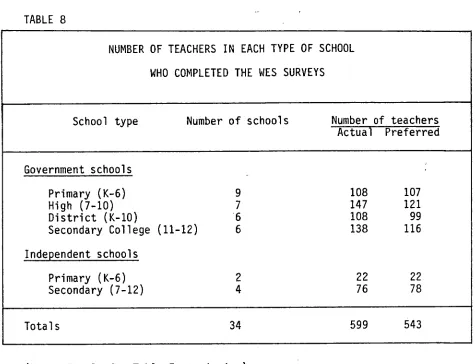
8. Number of teachers in each type of school who completed the WES 138 surveys.
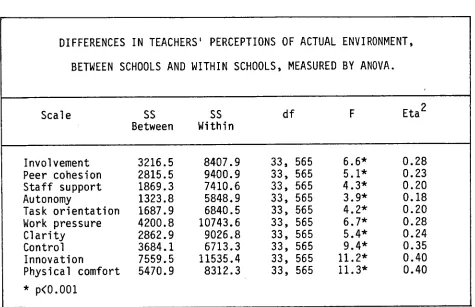
9. Differences in teachers' perceptions of actual environment, between 140 schools and within schools, measured by ANOVA.
10. The RPTIM model - beliefs. 142
11. The RPTIM model - practices. 144
12. Number of teachers in each type of school completing the 147 RPTIM survey.
13. Internal consistency (alpha reliability) and discriminant 148 validity (mean correlation with other scales) for 'what exists'
and 'what should be'.
14. Anova results for school membership differences in teacher 148 perceptions on 'what is' form of RPTIM.
15. WES sub-scale items - range of actual and preferred mean differences 155 between school types.
16. Differences between 'actual' and 'preferred' means as measured 163 by WES for primary and high schools.
17. ANOVA results for school type membership differences in teacher 176 perceptions on 'what is' form of RPTIM.
21. Selected case studies: number of scores equal to or above 'actual mean' by schocl type.
200
22. Dimensions of effective schools and schooling. 247
23. Strategies to improve school climate. 260
FIGURES
Page
1. Stages for evaluation of professional-development practices. 6
2. The professional-development network. 38
3. School effectiveness: a conceptual framework. 57 4. A model for creating an effective school. 58 5. WES - Sub-scale means for school types - 1984 - preferred form. 158 6. WES - Sub-scale means for four high schools - 1984 -
preferred form.
159
7. WES 7 Sub-scale means for school types - 1984 - actual form. 160
8. WES - Sub-scale means for four high schools - 1984 - actual form. 161 9. WES - Actual and preferred sub-scale means for primary schools - 164
1984.
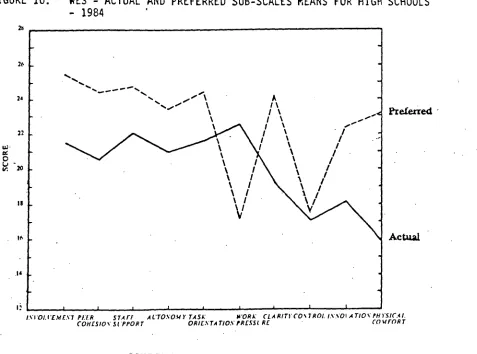
10. WES - Actual and preferred sub-scales means for high schools - 164 1984.
11. WES - Differences between four types of schools. 166 12. WES - Actual sub-scale means for primary and high schools - 1984. 168 13. RPTIM - Mean responses by school type - 'what should be', 1984. 173 14. RPTIM - Mean responses by school type - beliefs - 1984. 174 15. RPTIM - Mean responses by school types - 'what exists' - 1984. 179 16. RPTIM - Mean responses for primary and high schools - 'what exists'
and 'what should be'- 1984.
180
17. RPTIM - Mean responses for three high schools - 'what should be' - 181 1984.
18. RPTIM - Mean responses for three high schools - 'what exists' - 182 1984.
19. WES - Range of 'preferred' and 'actual' means by school type - 191 1984.
20. RPTIM - Range of means by school type for 'what exists' and 'what should be' - 1984.
192
21. WES - Range of school means on actual and preferred forms - nine primary schools.
194
22. WES - Range of school means on actual and preferred forms - seven high schools.
195
23. Degree of association between WES and RPTIM scores. 199
APPENDICES
Page
1. Evaluation proposal. 365
2. Schools involved in case studies - Tasmanian evaluation. 378 3. A summary of findings - Tasmanian evaluation. 379
4. WES - groups of questions in sub-scales. 404
5. WES - actual form of survey. 409
6. WES - actual form - answer sheet. 413
7. Case study interview schedule. 415
CHAPTER 1
INTRODUCTION
1.1
BACKGROUND TO THE STUDY
1.1.1
Purpose of thesis
The purpose of this study is twofold:
1. To investigate the relationship between school climate and staff-development practice in Tasmanian schools.
2. To develop approaches to improving schools using information gained from teachers about their perceptions of school climate and staff-development practices.
The study described in the thesis is an investigation of the relationship between teachers' perceptions of their 'actual' and 'preferred' work environments (school climates) and the relationship between their perceptions of 'actual' and 'preferred' school
staff-development practices. Furthermore, it describes an approach to developing school improvement strategies based on these investigations in Tasmanian schools. The investigation has been carried out in
schools in Tasmania, Australia.
study is included as Chapter 2. This review establishes relationships between the concepts of 'school climate' and 'staff-development
practices'. The characteristics of these terms and the relationships between them are discussed.
The range of literature about 'effective' schools has broadened: originally studies were made of schools whose student achievement scores were above the norms on standardised tests. Then in recent years many researchers moved to study the 'characteristics' of those
schools. During the process a great deal has been written about 'school climate' and 'staff-development practices' which were
traditionally considered to be major process variables. Much of the recent literature about these concepts is associated with effective schools, although both concepts have been researched for longer than effective schools. So that the characteristics associated with the concepts of school climate and staff-development practices can be identified, the literature on school effectiveness will be examined in order to provide linking ideas between these two concepts.
From this review the first part of the thesis is developed: the conceptual framework of the study. References used in the conceptual framework in Chapter 3 are extracted from the literature reviews and
Appendix 3.
practices. In this part, descriptive and validation data are provided for both instruments that hitherto either have not been used, or have only been used in a limited way, in Australian schools. Both
instruments have been used to measure teachers' perceptions of 'actual' and 'preferred' school climates and of staff-development practices. Data for reliability and validity are provided and the Australian results compared with those obtained in America. These data suggest that if the school climate is 'good' then staff-development practices will also be 'good', when measured by these instruments.
Third, after establishing a relationship between the results obtained by the two instruments, questions are raised about ways to enhance school climate and staff-development practices. The literature related to school improvement is briefly compared with the research related to school effectiveness. Emphasis is placed on the
relationship between similar characteristics described by researchers about these two concepts. It will be argued that most of these
characteristics can be altered, and approaches to school improvement will be developed later in the thesis. The reason for studying the characteristics of these two concepts is to examine what schools can do to improve their own effectiveness. As case studies were conducted in workplaces, teachers' reflections prompted action to improve school practices. Content and processes by which school improvement could
occur are discussed.
1.1.2 Questions for research
The study was shaped by the research questions, stated below.
1. What differences exist between actual and preferred approaches to staff development?
2. What differences exist between teachers' perceptions of actual and preferred school climates?
3. What is the relationship between approaches to staff development and the perceived climate in the school?
4. For each of Questions 1-3 above, what differences exist among schools when classified according to type, size and location?
5. What differences exist between actual and preferred staff-development practices and climates in Tasmanian schools?
6. Which policies and procedures distinguish schools according to the quality of school climate and approaches to staff development?
1.2 CONTEXT OF THE STUDY
1.2.1 Evaluation of professional-development practices in Tasmania
The argument of the thesis, that school climate is related to staff-development practices, is based on a large-scale evaluation of professional-development practices in Tasmania between 1983 and 1985. The data for this thesis were obtained to investigate the two purposes outlined for the study and to attempt to answer the research questions posed. Brief details of these studies, undertaken between 1983-86 are described below.
The board of the Centre for Continuing Education of Teachers (CCET) requested that an evaluation of professional development both at the level of the state education system and the school level be
conducted to:
(1) assess the impact of professional-development activities on teachers' and students' learning; and
(2) establish how these activities could be improved.
Subsequently, an evaluation proposal (see Appendix 1) was
developed to examine several aspects of professional development in:
st.
The evaluation outlined in the proposal included surveys by means of questionnaires and case studies of schools. Techniques for policy development and implementation were planned outcomes of the case studies. As originally envisaged, the process was to take place in three stages as shown in Figure 1.
The evaluation proposal was accepted in March 1983 by the Deputy Director-General of Education and supported by the President of the Tasmanian Teachers Federation. Work commenced immediately and data were collected throughout 1983-84. Analysis and interpretation of the
[image:23.557.60.513.372.768.2]information occurred during 1984-85. A report providing full details of the evaluation was prepared as a result of a request from the Director-General of Education in April 1985. The report was presented in December 1985.
FIGURE 1
STAGES FOR EVALUATION OF PROFESSIONAL-DEVELOPMENT PRACTICES
STAGE 1 Examination of year-long CCET courses. Surveys of teachers who completed subjects.
STAGE 2 Case studies conducted in from ten to twenty schools. The case studies would involve descriptive analysis.
STAGE 3 Development of school policy on professional-
This thesis largely concentrates on information obtained from -schools. Thirty-one Tasmanian schools were selected to take part.in .
intensive case studies, evaluating aspects of professional
development. On May 18, 1983, the Deputy Director-General of Education forwarded a letter to schools, outlining the evaluation proposal and inviting principals to participate.
If the school's staff decided to take part, the principal selected a member of staff to complete a number of tasks. These were to
co-ordinate the evaluation within the school, to write the school's case study using instruments such as questionnaires and interviews, to attend group conferences with representatives from other participating schools, and to submit copies of the report to the Centre for
Continuing Education of Teachers and to the school in which the representative was employed.
The response from schools to participate in the evaluation was overwhelming. As a result, selection criteria were imposed that would provide a representative sample of Tasmanian schools. Criteria
outlined in Chapter 4 were applied in order to include primary schools (both small and large), district high schools (grades K-10), high schools (grades 7-10), secondary Colleges (grades 11-12) and
independent schols (grades K-12, K-6 or 7-12) from each of the south, north and north-west regions of the State.
Thirty-three schools were selected to participate in the case studies as listed in Appendix 2. Data were provided from staff in
1.2.2
Evaluation report and subsequent studies
A report of the evaluation (Docker, Fisher and Hughes, 1985) was completed in November 1985. A copy of the recommendations chapter is included as Appendix 3.
The major findings of the evaluation have been incorporated in this thesis. The study described in this thesis was designed and
directed by the author, with advice from Dr D. Fisher (Tasmanian State Institute of Technology) and Professor P. Hughes (Head, Centre for Education, University of Tasmania).
Following the publication of the report, numerous workshops were held for school personnel during 1986 to establish the best processes to be used in schools when attempting to improve school climate and staff-development practices. A number of Tasmanian schools will attempt to improve their school climates during 1986-87.
1.3
DEFINITION OF TERMS USED IN THE THESIS
This thesis examines areas of knowledge where the literature abounds with commonly used terms. Some of these terms are used synonymously and at other times to imply subtle differences of
1.3.1 School Climate
Brookover defines school climate as being:
'The norms of the social system and expectations held for various members as perceived by members of the group and communicated to members of the group.'
(Brookover, 1978:301-18)
Hoy and Miskel define organisational climate as:
'The set of internal characteristics that distinguish one school from another and influence the behaviour of people in
it.' (Hoy and Miskel, 1982:185)
Concepts in these definitions are incorporated in the meaning of school climate as presented in this thesis. Some writers have more recently structured and developed the meaning of school climate but left the meaning similar to that outlined above. For instance, Murphy
et al. suggested that:
'School climate may be divided into academic and social climate. Norms, processes, and structures in the academic climate directly promote quality instruction and improved student performance. Social climate norms, processes, and structures indirectly facilitate learning by making the school and its activities important to individuals.'
(Murphy et al., 1985:366)
Other writers such as Beare (1984), Bennis (1984), Sergiovanni et al. (1984) and Starratt (1986) write about school culture. Sergiovanni describes 'school culture' in the following manner:
'School culture includes values, symbols, beliefs, and shared meanings of parents, students, teachers and others .... the "stuff" of culture includes a school's customs and traditions; historical accounts; stated and unstated understandings; habits, norms, and expectations; common meanings and shared assumptions. The more understood, accepted, and cohesive the culture of a
school, the better able it is to move in concert towards ideals it holds and objectives it wishes to pursue.'
There are overlapping characteristics involved in describing school 'climate', 'ethos' and 'culture'. Purkey and Smith discuss these constituents by stating that successful schools:
'are found to have cultures that produce a climate or "ethos" conducive to teaching and learning (Rutter, Maughan,
Mortimore, Ouston and Smith, 1979). As dynamic social systems (Brookover et al., 1979), school cultures will vary, in part in response to the composition of the staff and student body and to the environment in which the school exists, leaving each school with a unique climate or "personality" (see Haplin and Croft, 1963; Wynne, 1980; also Popkewitz, Tabachick and Wehlage, 1982). Nevertheless, academically effective schools are likely to possess a cluster of similar characteristics that encourage and promote student achievement.'
(Purkey and Smith, 1985:356-7)
It is generally agreed that a school culture determines deep patterns, meanings and beliefs. Depending on a school's culture, its climate at any given time may be good or bad. For example, a newly appointed principal may ignore the school culture, and thus create a bad climate. Put another way, culture is the deep infrastructure of a human organisation; climate is one of its effects. Culture influences climate, but is not the same as it. The school culture, once
established, is an enduring set of relatively stable values, but a climate can be negative or positive at any time.
Generally, most researchers examining school climate would list a set of characteristics which may include:
• a safe and orderly environment;
• uniform discipline procedures among staff; ▪ safe and clean physical conditions;
. adequate work space;
. attractive and pleasant conditions;
. high expectations for learning of all students;
. widespread rewards and recognition for both students and staff;
• low delinquency among students;
• student respect for the property of others; • home-school co-operation and support;
• high levels of cohesiveness and team spirit among students and teachers;
• student and staff support;
• establishment of collaborative organisational processes; • few applications for teacher transfer;
• a co-operative and friendly atmosphere; • trust and open communications;
• a sense of community; • a stable staff;
• faculty taking responsibility for outcomes of educational programs;
• commitment to school goals;
• sharing of teacher materials and talk about curriculum and instruction;
• high morale among teachers;
• teachers checking up on implementation of school policy on aspects such as homework and punctuality.
These characteristics are further examined in Chapters 2 and 3.
In this thesis, the author will be addressing most characteristics of school climate as identified in the literature, but investigating only teachers' perceptions of aspects of their work environment. Thus the research described will include most of the characteristics listed above with the exception of data related to students. Student
perceptions of school climate are not included in this study.
As quotations used in the thesis are taken from a number of
sources,-including England, America and Australia, spellings have been standardised throughout the text. Quotations used have been similarly treated for the purpose of editorial consistency. Preferred spellings are those given first in the Concise Oxford dictionary.
1.3.2 Professional development
Morris (1982) has drawn attention to the large number of terms used to refer to the continuing education of teachers. 'Professional development', 'in-service training' and 'staff development' are frequently used synonymously in the literature. Indeed, in Australia the Commonwealth Schools Commission uses the term 'professional
development', whilst a number of Australian states use the term 'staff development', to describe the same activities. Generally, the term
'professional development' is used in the literature from the United Kingdom and Australia, whilst in America the term 'staff development' is used more specifically to imply training of staff.
In addition, these terms usually include a wide variety of interrelated activities, such as staff development or training, professional development, curriculum development, senior staff
In this thesis, the terms 'professional development' and 'staff development' are used interchangeably, and refer to the variety of interrelated activities mentioned above.
Condensing a number of definitions, Morris commented that:
'To a great degree, the words chosen reflect the writer's view of teaching. Those who aim toward a wider acceptance of
teaching as a profession tend to favour professional
development.' (Morris, 1982:23)
During the conduct of the two-year-long evaluation of staff-development practices in Tasmania, there was much debate about the meaning of 'professional development'. As a result of this discussion within all the schools involved in the case studies, and in many other
forums, it was concluded that Tasmanian teachers preferred a broad meaning for the term 'professional development' and that the meaning
should include personal as well as professional growth. Most teachers believe these two broad aspects are interrelated.
The following statement was adopted for this evaluation and received considerable support in all schools:
'Professional development aims to increase teachers' knowledge of, understanding of, and expertise in their professional work, through activities designed to attain this goal.'
(Docker, Fisher, Hughes, 1985:119)
Through such professional-development activities, teachers should be able to:
evaluate their work and attitudes with their colleagues;
• identify further professional needs, including those arising from the relationship between the school and a changing society; and
• advance their careers.
The statement used in the Tasmanian evaluation was primarily derived from the work of Morant (1981) in the United Kingdom. The statement reflects the similarity between the term 'professional development' as it is used in Australia and in the United Kingdom.
In America, as mentioned earlier, staff development is usually more specifically described, as for example in this definition by Griffin:
'any systematic attempt to alter professional practices, beliefs, and understandings of school persons towards an
articulated end.' (Griffin, 1983:2)
1.4
SIGNIFICANCE OF THIS STUDY
This study is significant for these reasons:
1. Data were gathered in schools in Tasmania. The surveys led teachers in schools to reflect on how to improve their practice, so the study reported in the thesis has had a considerable effect upon practising teachers, school improvement strategies and school policies. The teachers' reflections prompted action to improve school practices.
of these concepts were constantly mentioned in research on school effects and school improvement. While acknowledging in Chapter 2, that much of the research on effectiveness is
flawed, the characteristics of the two concepts are
consistently evident in descriptions of schools considered to be 'effective'. The relationship between the characteristics of these terms and outcomes is further reinforced in the body of literature about school improvement. 'Good' schools as identified in both bodies of literature have a positive school climate and good staff-development practices. This study draws linking ideas from both bodies of literature and then develops a research design that leads for the first time to findings that demonstrate a relationship between school climate and staff development in a representative sample of Tasmanian schools. As such it has worldwide implications and is a substantial contribution to the body of knowledge in these areas.
3. The study forms a contribution to research. It describes traditional, empirical study in the form of case studies that were made in a work setting. Planned outcomes of the case studies were that:
(i) conclusions have implications for schools' policies; and
1.5 OVERVIEW OF THE THESIS
The first part of this thesis is an examination of the literature that leads to the conceptual framework for the study. Chapter 1 has served the following purposes:
defined the purposes of the study and research questions to be examined;
indicated the relationship of this investigation to the
Evaluation of Professional Development Practices In Tasmania 1983-85;
defined the terms used in and the limits of the investigation; and
established the significance of the investigation in a broader context.
In Chapter 2, the author examines the characteristics of the terms 'school climate' and 'staff-development practices' defined in Chapter 1. From an examination of the literature, there has been much good research and many good reasons suggested as to why these two concepts should be related to one another. Flaws in the research about
In Chapter 3, the author tabulates these characteristics and establishes a conceptual framework for the investigation, including a discussion about studying and measuring human environments.
In the second part of the thesis the empirical investigation is discussed in detail and the relationship between school climate and staff-development practices is established.
In Chapter 4, the author discusses the selection of instruments used in the study, provides descriptive analysis and validation data, details about the methods and procedures for data analysis.
In Chapter 5, the author discusses how the WES survey is applied to measuring aspects of the school climate. In Chapter 6, the author discusses how the RPTIM survey is applied to measuring aspects of staff-development practices. In both Chapter 5 and Chapter 6 the
author examines the nature of the results of the surveys, explains the nature of the analysis applied to the results and draws conclusions from these results.
In Chapter 8 of the thesis there is a brief comparison of the literature related to school improvement and school effectiveness. Emphasis is placed on the relationship between similar characteristics described by researchers writing about these two related areas of inquiry. The school improvement literature is basically about empowering people in schools to improve themselves. It is about people working together to solve the problems they face in schools. It is argued that a positive school climate and good staff-development practices are essential to achieve school improvement. Suggestions are made in this chapter about how schools may enhance their school climate and staff-development practices.
‘,.
CHAPTER 2
A LITERATURE REVIEW OF SCHOOL CLIMATE AND STAFF-DEVELOPMENT PRACTICES
The purpose of this chapter is to examine recent research studies and determine what there is in the literature that suggests the
concepts of 'school climate' and 'staff-development practices' should be linked. In addition, the characteristics associated with these concepts and relationships between them are discussed.
The research related to school effectiveness is examined to establish linking ideas between these concepts. While acknowledging these research studies were conducted using a variety of research methodologies, and based on a variety of assumptions about the nature of schooling, they invariably list characteristics associated with school climate and staff development as essential features of
'effective' schools. Improved student learning is also clearly a concern for people studying change and school improvement processes. They take a larger view of student learning than the more test-score orientated researchers in the school effectiveness movement. A literature review of school improvement in Chapter 8 also highlights the importance and interrelated nature of the concepts of school climate and staff development.
The chapter concludes with a unifying 'theory' which may explain the relationship between school climate and staff-development
characteristics and ideas presented in this literature review. It provides a theoretical understanding of what factors appear important in developing a 'good' school and how teachers in schools experience their lives and their work with children. It also suggests why a positive school climate and good staff-development are so crucially important and how these two concepts interact with each other.
2.1
SCHOOL CLIMATE
2.1.1
Definitions
The concept of school climate has been defined by many researchers as noted below.
Rutter et al noted at the beginning of their study that 'research suggests the importance of the school ethos or
atmosphere but, of course, it leaves entirely open the crucial question of what actions by staff (or others) serve to establish particular types of climate.'
(Rutter et al., 1979:18)
Cuban (1983), when arguing that no one knows how to create effective schools, commented that:
'None of the highly detailed, lovingly written descriptions of effective schools can point to a blueprint of what a teacher, principal, or superintendent should do in order to improve
academic achievement. Who knows with predictable precision how to construct a positive, enduring school climate? ... We have signs but no roadmaps.'
(Cuban 1983:695)
how these characteristics can be measured and how a 'roadmap' may be developed to construct a positive and enduring school climate.
Halpin and Croft defined school climate by analogy:
'Personality is to the individual what "climate" is to the organisation.'
(Halpin and Croft, 1963:1)
Definitions have become more complex and are related to the increasing body of empirical evidence which suggests that one of the key features of effective schools is a healthy, positive climate
characterised by supportiveness, open communication, and collaboration (Owens, 1981:226).
Litwin and Stringer defined climate as:
'The perceived subjective efforts of the formal system, the informal "style" of managers, and other important environmental factors on the attitudes, beliefs, values and motivation of people who work in a particular organisation.'
(Litwin and Stringer, 1968:5)
Other definitions of school climate (for example by Hoy and Miskel (1982) and Brookover et al. (1978)) all discuss or imply a set of internal characteristics that define school climate. These
characteristics usually relate to relationships between teachers in a school, their personal traits, or aspects of school maintenance and change. It is the interactions of these characteristics that gives a school a distinctive 'personality' or 'climate'.
of their work environment for teachers and for teaching. It is acknowledged that a school may be identified where the climate for teachers is good but the students' perceptions might be quite negative about the climate for them.
Walberg concluded an extensive review of the literature by linking school climate to students' achievement:
'... teacher perceptions of an educational program that is effective, of constructive principal-teacher relations, of effective community-school interaction and of a strong voice by teachers in the formulation and execution of the educational program, are associated with student achievement'.
(Walberg, 1982:301) It will be argued that many of these areas are related to
characteristics of work environment listed later.
2.1.2 Characteristics and related issues
The concept of school climate, and the characteristics of school climate as described by a range of researchers, follow.
Anderson (1982:369) discussed Tagiuri's taxonomy (1968) which effectively categorises literature about school climate. According to Tagiuri, the dimensions of an environment include:
• ecology (physical and material aspects);
social system (the social dimension concerned with patterned • relationships between people and groups); and
• culture (the social dimension concerned with belief systems, values, cognitive structures and meaning).
Anderson pointed out that Moos (1974), and Insel and Moos (1974), developed a similar taxonomic device for conceptualising human
environments. This delineation of human environments, called social ecology, describes human interactions with physical and social dimensions of the environment. It includes climate and psychosocial characteristics as one of six approaches to the human environment.
Anderson argued that the unifying threads of research about school climate are few and fragile; nevertheless she cited research studies to indicate that some agreement existed between researchers in the areas noted below:
'(a) schools do possess something called climate, unique to each organisation; (Kalis, 1980; Owens, 1970; Sinclair, 1970); (b) such differences, while discernible, are elusive, complex and
difficult to describe and measure; (Cusick, 1973; Rutter et al., 1979; Tye, 1974; Weber, 1971);
(c) climate is influenced by, but not a proxy for, particular dimensions of the school such as student body characteristics
(Bloom, 1966; Farkas, 1974; Snyder and Spreitzer, 1979; New York Department, 1976; Willower and Jones, 1963), or classroom processes (Bidwell, 1972; Cohen, Deal, Meyer and Scott, 1976); (d) climate affects many student outcomes, including cognitive and
affective behaviour (Baker, 1963; Brookover et al., 1978; Duke and Perry, 1978; Weber, 1971) values (Taba, 1955; Vyskocil and Goens, 1979), and personal growth and satisfaction (Bailey, 1979; Coyne, 1975; Cox, 1978; Vyskocil and Goens, 1979); and (e) understanding the influence of climate will improve the
understanding and prediction of student behaviour.'
(Anderson, 1982:368)
that:
'Beyond the problem of what variables to study and how to measure them, school climate research is plagued by the phenomenological debate: the validity of participant perceptions as a measure of school climate. The issue concerns whether participants'
subjective judgments can be as accurate in defining climate as an objective measure.'
(Anderson, 1982:386)
After discussion of this issue, Anderson concluded that perceptual data are usually accepted by researchers as direct indicators of
normative climates. Furthermore, she commented:
'The assumption that Halpin and Croft (1963) made in their
original research has continued to be the guiding light for most climate research: the actual behaviour is less important than perceived behaviour because perception is what controls one's ' responses.'
(Anderson, 1982:386)
Anderson discussed the debate among researchers about what
variables work together to create school climates. Anderson suggested that most researchers agreed that outcomes stem from the combined characteristics of interacting variables. The difficulty came in choosing the variables that best explain climate (Tornatzky, Brookover, Hathaway, Miller, and Passalacqua, 1980). Anderson
suggested that even if variables were sampled from each of the four (Tagiuri) dimensions of the environment then the question arose of
'how many' was enough or too much to be addressed:
'In principle just about everything may make a difference to behaviour, yet to include everything is not useful.'
(Tagiuri, 1968:14)
Following Tagiuris's statements, it is argued here that many
list was developed from the review of research findings about the characteristics of school climate that follows.
Owens (1981) stated that the effectiveness of a school is influenced significantly by the quality and character of the
organisational climate. He based his conclusions on the findings of studies about how organisational performance is related to
organisational climate. Furthermore, he pointed out that schools that emphasise supportiveness, open communication and intellectuality, and that reward achievement and success, out-perform those schools that stress competition, constraint, restrictive rules, standards and operational procedures, and reward conformity. Owens goes on to
describe how a more 'participative' or 'open' climate promotes school effectiveness. This is a climate in which teachers see principals providing direction, support and consideration. Haplin and Croft (1963) point out that such a climate allows teachers to gain
satisfaction from their work, pride in their school and autonomy in solving problems. This contrasts to a 'closed climate' in which group members obtain little satisfaction in either task achievement or
social needs. Whether a school has an 'open' or 'closed' climate is related to how teachers perceive their work environment.
Rutter and his associates commented:
'teachers in more successful schools reported that superordinates knew what was going in their schools, and checked up on the
implementation of school policy on such aspects as homework and punctuality.'
(Cited in Misko, 1985:15)
different individuals at different levels of the organisation. This co-operative approach meant a shared commitment to organisational goals, expectations that students will achieve educationally, and a willingness to trust superordinates with making decisions. This is
indicative of the 'open climate' that has been shown by research to be related positively to students' results.
In both Rutter et al. (1979), and the Phi Delta Kappan study (1980) of eight high-achieving schools, the decoration and care of schools and classrooms were associated with higher achievement by
students.
Thus, school climate, as described by researchers such as Halplin and Croft, Owens, Rutter et al., includes numerous contributing
factors.
Sergiovanni and Starratt related the importance of organisational climate to school effectiveness. They state that:
'Climate was viewed as a combination of enduring characteristics which describe a particular school and distinguish it from other schools, and the feeling which teachers and students have for that school. Accordingly, climate represents a composite of mediating variables which intervene between initiating and
school-effectiveness variables. Supervisors ... can exert direct
influence on school climate through the leadership they provide. Bureaucratic leadership, for example, tends to be associated with relatively closed climate and low performance and satisfaction. Human relations leadership tends to be associated with a warm, supportive, and friendly climate and with low performance but high satisfaction and some innovation. Human resources leadership tends to be associated with a supportive, goal-orientated, climate and high performance, satisfaction, and some innovation.'
(Sergiovanni and Starratt, 1979:96)
'(1) important norms that guide behaviour, for example, high expectations for performance and staff accountability for student performance;
(2) organisational processes that help the school community to carry out important work, for example, shared decision making and open communications; and
(3) structures that reinforce and/or provide the context for quality instruction, for example, discipline procedures and systems for involving students in school activities.'
(Murphy et al., 1985:366)
Furthermore, Murphy et al. stated that:
'School climate may be divided into academic climate and social climate. Norms, processes, and structures in the academic climate directly promote quality instruction and improved student
performance. Social climate norms, processes, and structures indirectly facilitate student learning by making the school and its activities important to individuals.'
(Murphy et al., p. 366)
They also listed the following climate variables:
• opportunities for meaningful student involvement; • widespread rewards and recognition;
. collaborative organisational processes; . high expectations;
• home-school co-operation and support; . safe and orderly environment; and
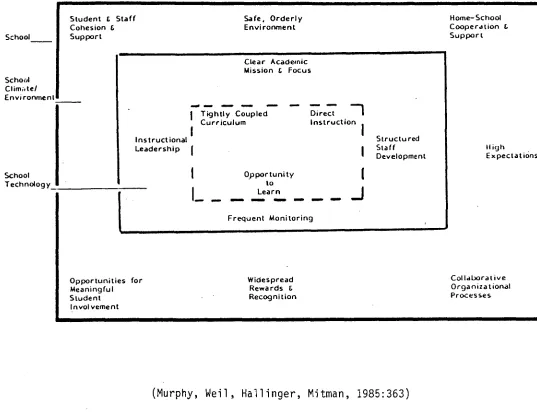
. student and staff cohesion and support.
(Murphy et al., pp. 366-9)
Murphy et al. did not present these variables as a causal model and pointed out that although the climate variables represent
important elements of the effectiveness research, it seems unlikely that they have a substantial impact on students' achievement in and of themselves.
is, there are different ways to develop effective schools. They pointed out that it appeared that some combination of technological and environmental factors was most efficacious for school development (see Figure 3).
In her book,' 'The Good High School', Lightfoot (1983) presented a point of view different from that of most researchers on school
effectiveness. She examined the concept of 'goodness' in six selected high schools. 'Goodness', according to Lightfoot, refers to a
definition of the quality of schools themselves and another dynamic that cannot be measured by elements or indicators of effectiveness. Lightfoot viewed schools as being made up of a complex mixture of people, elements, tangible and intangible indices, such as ethos, that are difficult to examine.
Lightfoot stated that good schools are led by people who see themselves as educational leaders, who provide strong, consistent and inspired leadership. She noted that good schools are characterised by good teachers - at least more good teachers than poor teachers. Such schools usually have high levels of autonomy and independence.
Lightfoot wrote:
'In all six schools, I was struck by the centrality and dominance of teachers and by the careful attention given to their needs.'
(Lightfoot, p. 333)
She continued:
'In all of these schools, therefore, teachers are seen as the central actors in the educational process. ... Each school
schools are ultimately dependent on good teachers - smart and inspired people, people who have something to teach. ...
increasing autonomy, reward, stimulation, and the adult regard of teachers who are generally competent, or even gifted, will enhance their effectiveness as pedagogues and critical members of the school community'.
(Lightfoot, pp. 341-2) Good schools, according to Lightfoot, were also characterised by a fearless and emphatic regard for students. The schools were safe
environments with a feeling of a good school community.
2.1.3 School and classroom environments and other related terms
The concept of school environment or climate has appeared with increasing frequency in the educational literature during the last decade (Anderson, 1982; Deer, 1980). An important distinction can be drawn between school environment and classroom environment (Fraser and Rentoul, 1982; Genn, 1984). Whereas classroom climate might involve relationships between teachers and their students or among students, school climate might involve a teacher's relationship with other
teachers, senior staff and the school principal. Students' perceptions are used frequently to measure classroom environment, but they are seldom used in studies for measuring school climate. Also, school environment must be considered to be further reaching than classroom environment. Furthermore, research about the classroom environment
While different terms such as organisational climate, work environment and school climate are used in the literature, their meanings appear to be similar.
As noted at the beginning of this section, Anderson concluded that 'climate' is conceptually messy and almost defies (in its imprecision) any research study that claims validity and reliability. These
findings this author cannot accept. It has been argued in this review of the literature that a similar set of research based characteristics
(listed in Chapter 1) have been identified and they form the concept of school climate in the minds of a wide range of researchers. As the organisational climate consists of many internal characteristics each of which is subject to change, it is argued here that the school climate can be changed. As a positive organisational climate should encourage constructive change in school, it is also argued that some analysis of the school climate would be necessary before the start of any program involving change.
Furthermore, it will be argued in this thesis that instruments could measure most of these identified characteristics. Field testing of these instruments may then establish relative reliability and validity.
The meaning of climate encompassed in this thesis will include most of the teacher characteristics identified by researchers reviewed
in this chapter.
2.1.4 School culture
Researchers indicate some overlapping of the characteristics between the two concepts school climate and school culture. Sergiovanni defined 'school culture' in the following manner:
'School culture includes values, symbols, beliefs, and shared meanings of parents, students, teachers and others ... the "stuff" of culture includes a school's customs and traditions; historical accounts; stated and unstated understandings; habits, norms, and expectations; common meanings and shared assumptions. The more understood, accepted, and cohesive the culture of a school, the better able it is to move in concert toward ideals it holds and objectives it wishes to pursue.'
(Sergiovanni, 1984:9)
Purkey and Smith reviewed a hundred or so research reports in the context of a model of school culture.
'School culture perspective rejects the view that schools are relatively static constructs of discrete variables. Instead schools are thought to be dynamic social systems made up of interrelated factors ... This mix of interconnected
characteristics is unique to each school and provides each with a definite personality or climate'.
(Purkey and Smith, 1983:83-4)
'are found to have cultures that produce a climate or "ethos" conducive to teaching and learning (Rutter, Maughan, Mortimore, Ouston, and Smith, 1979). As dynamic social systems (Brookover et al., 1979), school cultures will vary, in part in response to the composition of the staff and student body and to the environment in which the school exists, leaving each school with a unique climate or "personality" (see Halpin and Croft 1963; Wynne, 1980; also Popkewitz, Tabachick and Wehlage, 1982). Nevertheless,
academically effective schools are likely to possess a cluster of similar characteristics that encourage and promote student
achievement.'
(Purkey and Smith, 1985:356-7)
School culture determines deep patterns, values symbols and beliefs about a school. The school culture in turn produces a school climate or definite personality of a school. The culture is the deep infrastructure of a human organisation. Climate is one of its effects and may be positive or negative. Some cultures produce a climate more conducive to teaching and learning than others.
This review clearly indicates that a positive school climate is a characteristics of an 'effective' or 'good' school. The characteris-tics of school climate have been identified by numerous researchers so far in this chapter. There is a commonality of these characteristics as outlined in Chapter 1. These recurring characteristics are the
2.2
PROFESSIONAL-DEVELOPMENT PRACTICES IN SCHOOLS
This section has four purposes: to present a discussion of definitions related to professional development; to clarify the
meaning of professional development; to examine the characteristics of successful staff-development activities; and to establish links
between staff development and the literature on school effectiveness.
2.2.1
Definitions
Morris (1982) has drawn attention to the large number of terms' used to refer to the continuing education of teachers. 'In-service education', 'staff development', 'in-service training', 'professional development', 'continuous professional growth' and 'personal renewal' are just some of the terms found in the literature.
Reynolds and Clark (1982) suggested that changes in terminology were linked with changing models of in-service activity. In reviewing the definitions developed over the last few decades, they noted that the change in the early 1970s from in-service 'training' to in-service
'education' was associated with a growing sense of professionalism during this period.
A gradual expansion from the training of individual teachers to the development of the school's environmental resources, has been emphasised in research and practice. Morant (1981) viewed training as
'In-service training is taken to include all those courses and activities in which a serving teacher may participate for the purpose of extending his professional knowledge, interest or skill.'
(Cane, cited in Morant, 1981:2)
The Karmel Report (cited in Reynolds and Clark 1982), the Texas Education Agency (1982) and Morant (1981), emphasised the planned nature of in-service training and.education. Lieberman and Miller stated that:
'Staff development provides the opportunity for imparting
professional learning to teachers and administrators as part of the general improvement program of a school'.
(Lieberman and Miller, 1981:583)
Reynolds and Clark (1982) noticed the change in development of teachers between the 1973 Karmel Report and the June 1985 Report of the Commonwealth Schools Commission. The shift was away from
individuals' needs and towards schools' needs.
Staff development was used to convey this change in emphasis. This meant that a teacher's self-education and needs for development were
not to be considered in isolation, but in the context of the school's needs, as perceived by the staff and perhaps members of the community.
Lieberman conveyed this change in emphasis quite clearly, when she stated that:
'We use the term staff development instead of in-service because it suggests a different approach to improvement, one that
considers the effects of the whole school (the staff) or the individual (the teacher) and the necessity for long-term growth possibilities (development). We reject the idea of giving courses and workshops to individual teachers in isolation from their peers in their school'.
This change in emphasis has implications for the provision of activities for staff development, with staff of schools taking the initiative for conducting their own activities in areas of perceived need.
Sergiovanni and Starratt (1979) made a conceptual distinction between staff development and in-service education. They regarded staff development as growth-oriented, working continually to increase the range of alternatives open to teachers and to improve the quality of teaching. In-service education.was seen as focusing on ideas,
skills, and methods in which teachers were deficient. The emphasis was placed upon keeping teachers up to a standard.
In practice, the terms 'staff development' and 'professional development' are often interchanged and, to some extent, reflect the viewpoints of writers and the definitions that they choose. As
Reynolds and Clark (1982) pointed out, the problem with seeking a definition of professional development, or whatever other term one may use, is in trying to ensure that it is comprehensive enough to satisfy various viewpoints, as well as restrictive enough to be workable. For example, consider the definition suggested by Dull:
'It is the sum of all activities designed for the purpose of improving, expending, and renewing the skills, knowledge, and abilities of staff personnel. It is made up of institutes,
workshops, seminars, personal conferences, and special meetings in and out of school'.
(Dull, 1981:110)
'Staff development is the facilitation of growth. It requires a knowledge of our clients; a talent for scanning the outside world for support; a belief that support and challenge give people the courage to create; an intuitive feel of how much t space to give,. and an impeccable sense of timing'.
(McCarthy, 1982:20)
The latter definition could be considered more comprehensive; the former more workable.
In particular, it was noted in the material cited, that the concept of professional development, as distinct from training, received more emphasis and recognition.
Summarising a number of definitions, Morris commented that:
'To a great degree, the words chosen reflect the writer's view of teaching. Those who aim toward a wider acceptance of teaching as a profession tend to favour professional development'.
(Morris, 1982:23)
The importance of a definition would appear to be in its link to the activities that might be used to achieve the aims of professional development. Morant offered a definition that combined the broader concept of in-service education with the purposeful activities and experiences of in-service education. He stated that:
'... in-service education aims to widen and deepen teachers' knowledge, understanding and expertise (including skills, techniques, and power of judgement) in respect of their
professional work, by means of activities designed primarily to attain this purpose.'
(Morant, 1981:3)
studies, and in many other forums, it was concluded that teachers preferred a broad meaning to the term 'professional development'. The meaning should embrace personal as well as professional growth. Most teachers believed these two broad aspects were closely related.
The statement adopted for this evaluation received considerable support in all schools. The statement is that:
'Professional development aims to increase teachers' knowledge of, understanding of, and expertise in their professional work,
through activities designed to attain this goal.' (Adapted from Morant, 1981)
For the purpose of this thesis, the terms 'professional
development' and 'staff development' will be used interchangeably, due to the mixing of wording in different countries. In the United States, the term 'staff development' may be used with a more restrictive and focused meaning.
2.2.2 The professional-development network
People working in the development and evaluation of curriculum, consultancy, staff development, teacher education in tertiary
institutions, and school-based curriculum and staff development, are working in related and linked areas. None of these areas is
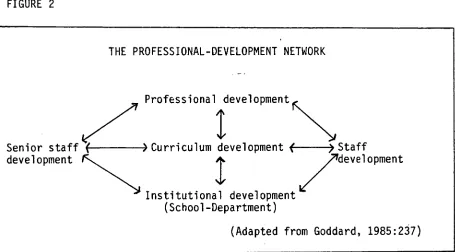
independent of the others. The nature of the interrelationship of these elements is summarised in Figure 2.
THE PROFESSIONAL-DEVELOPMENT NETWORK
Professional development
Senior staff
<
>Curriculum development (---)Staff ddevelopment evelopment
Institutional development (School-Department)
[image:55.557.60.515.74.326.2](Adapted from Goddard, 1985:237) FIGURE 2
process, and only in this way can the needs of all teachers be reasonably met. It is up to each to work out what they can do best, and how to assist the needs expressed by teachers and schools.
It is essential that all parties serving the needs of teachers and schools extend and strengthen the practices at all levels to identify needs and establish communication and links. Schools in turn need to devise strategies, possibly through working parties and committees, to meet whole-school needs. The effective and efficient provision of
support services can only be achieved when the needs are clearly known. Also, within each school all aspects of professional
development are to be considered and acted upon if improvements are to occur within a school. All the factors of the professional-development network are to be considered, to obtain the best improvement for