QLK5-2002-02400
Deliverable D4: Annex 1
National working papers
on
pilot applications (DCPS) in eight European countries
July 2005
Contents
1 Austria ... 1
2 Denmark... 13
3 Germany... 32
4 Italy... 52
5 The Netherlands... 61
6 Poland ... 77
7 Switzerland... 95
1 Austria
National Working Paper
AUSTRIA
Prepared by:
Norbert Gleirscher
Centre for Mountain Agriculture University of Innsbruck
Universitätstrasse 15 6020 Innsbruck Austria
Tel: +43/512-507-5694 Fax: +43/512-507-2817
E-mail: [email protected]
1.1 Fab4minds – BioStockManager® (BSM)
Interview partners: Martin Scharf, Director
Harald Falkner, Software System Architect
Contact details:
f a b 4 m i n d s Informationstechnik GmbH
Eulenbach 32 A-3902 Vitis +43-2841-200300 +43-2841-20030-18 [email protected] www.fab4minds.com
fab4minds Informationtechnology GmbH is a private consulting and information technology company which specialises in developing software systems in the area of traceability and quality assurance for agricultural products. Since its foundation in 2000 fab4minds has developed different traceability and quality assurance systems such as BioStockManger®, FoodRessourceManager® and AgrarCertification-Manager®. The idea behind the different systems is to provide very flexible and easily manageable software tools for market partners along the whole supply chain with the aim of achieving a traceable analysis of the flow of goods as well as quality. Although the company has no specific competence in the collection of statistical data itself (only in the development of software tools for easier data collection), the development of traceability systems implies automatically looking into the use of the collected data for statistical purposes. In this respect the company has developed strong relationships with producers, certification bodies (as the main suppliers of data), administrative offices (Agrarmarkt Austria, Österreichische Agentur für Bio Getreide), depositories, manufacturers and, last but not least, retailers. The data collected at the moment are used for (company) internal documentation and TQM rather than for (publicly available) statistical purposes.
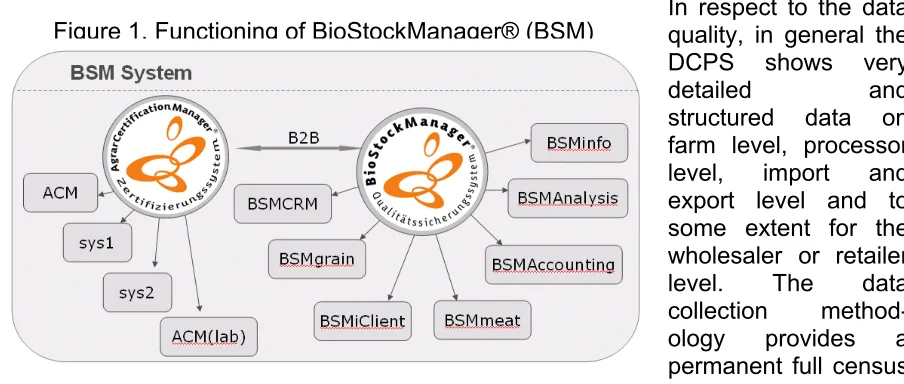
BioStockManger® is a fully web-based traceability system used for the organic grain market in Austria. The system is designed to combine two different data collection approaches, namely traceability data on the one hand and data on quality assurance on the other. The idea behind this is to get a more detailed picture of the flow of goods along the whole supply chain. The system, which has been in use since the year 2000, is fed with information from various market partners along the supply chain, so to say from farm to fork, by using customised software tools for data input and analysis. Over 130,000 tons of organic grain was traded through the system with more than 2500 producers and 100 partners (in Austria, Germany, Italy and Switzerland).
For statistical purposes quality assurance control data (consistent certification process, integration of laboratory results, etc,) are not primarily relevant; the main focus from a statistical perspective is the traceability of the flow of goods from the producer to the consumer.
well as for other authorised institutions. For those inspection bodies, unable to provide an IT interface to the AgrarCertificationManager® (ACM), a B2C solution (low cost version) is available. This B2C solution enables the transmission of the necessary data over the internet. The information fed into the BSM enables automatic calculation of the maximum amount of corn the farmer can sell, which is necessary to prohibit some fraud at the outset. During harvest time the corn is transported to the depository warehouse, where the delivered amount is directly communicated into the BSM system through interfaces with the weighing platforms. Each single delivery (farmer, product group and amount/weight) is exactly allocated to the respective farmer by coding it with a special charge number and an EAN Barcode. After quality analysis in the laboratory the respective charge is released for transport and processing. Stock removal at the warehouse and rolling in at the processors is also documented via EAN Barcodes and automatically communicated to the BSM system. The same procedure is used for every step within the supply chain, up to when the final product reaches the consumer. At the end of the process the consumer (as well as authorised administrative offices or certification bodies) have the opportunity to get a detailed overview of the product along the supply chain. As the first real “traceability” web portal, consumers of “jaNatürlich” products (www.janatuerlich.at) are able to trace back the origin of the product from “farm to fork” by using the EAN Code of the product.
The fundamental new approach to data collection in this system is that data are available exactly from transmission into the system, which means in “real time”. The data collection is also combined and/or integrated with recording which is already necessary and functions almost automatically, which reduces the additional administrative workload for data collection and reporting activities enormously.
For data analysis (on the production and processing level) this means, that collection, processing and publication of data are done at the same time. Therefore, for example, a special website was installed (www.biostockmanager.at), where it is possible to have a look at different corn stocks of various warehouses and processors.
In respect to the data quality, in general the DCPS shows very
detailed and structured data on
[image:7.595.70.522.516.708.2]farm level, processor level, import and export level and to some extent for the wholesaler or retailer level. The data collection method-ology provides a permanent full census in real time via online registration of certification data, delivered quantities, warehouse stocks as well as imports and exports. Although the system at the moment is only in use for the Austrian grain market, in theory it can be made available for other product groups.
The following rough expert estimation of the data quality of the DCPS (as defined by Eurostat 2003) was made by the interviewed partners.
Table 1: Data quality
Relevance Accuracy Timeliness and punctuality Accessibility and clarity Comparability Coherence The DCPS meets the current user needs satisfactory; statistical concepts and methods are sufficient.
Due to the full census methodology data collected show excellent accuracy
Due to “real time”
collection and
processing data quality in this case is excellent.
Accessibility of data is restricted to authorised persons and institutions. As for clarity the DCPS is adequate.
Regarding official
statistics the DCPS has to improve its comparability e.g. in the nomenclature.
So far there is too little experience to make an assessment.
SWOT Analysis
Strengths Weaknesses Facilitation of
data collection and processing
- “Real time” acquisition of data: concurrence of data input and data analysis
- Improvement of an already existing data collection processes not implementation of a new system
- Automatic data input in line with (anyway necessary) administrative recordings
- Standardised data input mask - User-friendliness and simple usability concerning data input
Experience shows, that the harmonisation of certification standards (e.g. nomenclature of products in different countries) is a drawn-out process
Data quality Product Flow Traceability: Data from “farm to fork”
Timeliness and Punctuality: Immediate availability of data
Comparability:
different Nomenclature in relation to (national or international) other DCPS
. Legislative
issues
clearly defined data access rights no clear (legal) conditions for data usage for statistical purposes
Administrative issues
Reduction of (anyway necessary) administrative workload
Simplification through automatic, IT-supported electronic recording of data.
Costs for training of staff
Cooperation with data providers
Active cooperation with administrative offices (Agrarmarkt Austria) and other authorised authorities
At the moment there is no (public) statistical usage of the data.
Cooperation with national / international statistical offices
None
Costs Savings through the reduction of administrative workload exceed additional costs for e.g. software licence and staff training
Costs for data collection processing as well as making data available for statistical purposes have to be covered by the public (respectively public authorities and other users) Opportunities Possibilities to overcome weaknesses identified
Technical solutions for dealing with different nomenclatures; there already exist technical solutions for handling different certification standards in one DCPS although agreement in principle has still to be aimed at by the certification bodies themselves supported by clear legal frameworks.
“Real time” data collection and processing as well as exact assessment of the respective volumes provide excellent accuracy and timeliness of the data
Certification bodies can combine administrative data collection and statistical data collection – reduced costs for data collection What is new in
comparison to systems used so far?
“ real time“ data collection and processing
one system is used for data collection along the whole supply chain (covering different data levels e.g. farm level, processor level, import-expert level
Can the system be used for data harmonisation?
The DCPS is already harmonising data input from certification bodies (farm level, import, export ) as well as from processors, but only for one product group (organic grain).
For national harmonisation of the DCPS all control bodies as well as all processors would have to be integrated, which, without an adequate legal framework seems to be quite difficult.
With reference to the weaknesses identified above, from a technical perspective the system can be used for national and international harmonisation of data.
Relevance / applicability for international implementation
According to the European Action plan for organic farming, where it is clearly stated that the current DCPS on organic farming have to be improved, the case study provides a low cost possibility to combine a Total Quality Management approach with the collection of statistical data.
Threads Identification of
critical points,
problems Publication of data (data security) Costs for implementation
Willingness of market partners to implement a total quality management system (data security, company secrets)
Proposed Solutions
Professional IT infrastructure (powerful database, know how in database optimisation, etc.)
Complete security concept
Awareness of quality assurance and traceability & advantages of DCPS (better risk management, more transparency, etc.)
Relevance / applicability for international implementation
As already mentioned, at the moment the BSM system is in use for the Austrian grain market. However it could be extended to other product groups.
The market calls for quality assurance and traceability data. Thus it makes sense to implement an international DCPS.
1.2 INTACT- E-cert
Detailed description of the case study
E-cert IT GMBH consists of three international certification bodies (Austria Bio Garantie (Austria), bio.inspecta (Switzerland) and Naturland e.V. (Germany) and a private consulting and information technology company (Intact Consult (Austria)) which specialises in developing software systems in the area of traceability and quality assurance for agricultural products. The consortium aims to provide useful software tools which will reduce the administrative workload for the respective certification bodies as well as improve traceability and security of the certification process. The software tools developed can not only be applied to organic production, but also in the certification of conventional standards like e.g. EUREPGAP. The idea behind the e-cert tool is to provide a facility for inspection bodies which enables them (in the best case) to conduct the whole inspection and certification process in a digital and paperless way.
Although the main aim of e-cert IT GMBH is not primarily data collection for statistical purposes, the tool offers good potential for improvement in the data collection process as well as data quality, especially on farm level and to some extent also on the processor level. At the moment the data gathered are not used for any (public) statistical purposes, although they already sent to the respective “supervising” authorities. Besides various contacts with inspection and certification bodies e-cert in Austria also works closely with the Agrar Markt Austria (AMA), which is mainly responsible for the administrative execution of agricultural grants. With regard to professional consultancy, e-cert also has strong ties with the FiBL in Switzerland. Interview partner:
Franz Rauch , Director
Contact details:
e-cert Informationstechik GmbH Parkring 6
A-8403 Lebring Tel: +43-3182-52403 Fax: +43-3182-52403-33
The DCPS – e-cert
The main function of the e-cert system is to facilitate the inspection and certification process by using digital data collection, processing and storage, as well as to improve the traceability of the certification process for actors along the supply chain and for public authorities. The main advantage of the system is its multilingualism (the system can be used in German, English, Spanish, Italian, Hungarian and French simultaneously) and its flexibility with regard to different inspection and certification standards (EU-VO 2092, organic farmers’ associations). Additionally the system fulfils the requirements of EN 45011 as well as ISO 65 for accredited institutions.
In principle the DCPS is based on different modules: e-cert Basic
Administration of master data
The master data management administrates the comprehensive data of farmers, processors, employees, inspectors and certifiers as well as of relevant organisations. Additionally, surface areas and numbers of animals are integrated. The documentation of the data is managed within several worksheets related to the respective classification e.g. person, inspection, field number, animal, organisation etc.
Administration of inspection relevant master data
In this case, data concerning the inspection process in particular are handled. With regard to crop production, the cultivated plants, the area, the exact location of the field (field number) and as well as the expected and (ex post) the real harvest amount are documented. Concerning animal production, the species as well as the respective numbers of animals are recorded.
Portal for inspection and certification:
This is an instrument for inspection and certification bodies to improve their internal organisational structure (and effectiveness) by providing a comprehensive description of the expertise, preferred areas, negative list as well as the performed audits of the inspector. Additionally the digital distribution of audits to the respective inspectors is possible.
e-cert Optional
Documentation Management and Communication
Digital archive for relevant documents (certificates, manuals, records, fax) as well as for communication (e-mails, discussion protocols, etc.)
Time and Cost recording Invoicing
Offline Version
The offline version enables the paperless inspections per laptop or tablet PC on site at the customer’s premises. The data is entered by the inspector in the system and upon returning to the office, or also from any internet workstation, transmitted to the central server system. The synchronisation of the data takes place automatically. In order to avoid version conflicts the data is stored by the inspector on the local hardware [laptop or tablet PC], and write-protected for the other staff. A history management provides information on the altered data.
e-Cert Optional Web Module
Portal for Inspection and Certification
The inspection and certification portal enables the company to pass inspections and certifications to external organisations and inspectors/certifiers. The data is then entered by the external via the web and transmitted to the central data server. This tool is particularly interesting for companies with many field stations and cooperation partners.
Portal for Consumers
This innovative portal gives customers and authorities the opportunity to download the desired data from companies via e-Cert in the most up-to-date version. Customers can enter and update the inspection sheets themselves via the internet and download certificates and test results. Authorities and other authorised institutions have access to defined data.
With regard to data quality, the DCPS shows very detailed data on farm level and to some extent also on processor level. The digital administration of inspection relevant to the master data can be seen especially as the connecting factor for statistical analysis. Data collection is mainly carried out during the inspection process and within a very short period of time (or even on line); data are transferred to a central database for the further certification process. Another way of data input is via the web-portal for consumers, where surface or animal data can be directly updated. For data storage, in principle each inspection/certification body operates its own database on a data server. If cooperation between different partners is needed (or designated), data exchange is done via a joint web server. For data security reasons, only authorised participants have access to confidential and sensitive data.
Table 2: Data quality
Relevance The DCPS meets the current user needs satisfactorily; statistical concepts and methods not a major concern of the DCPS and therefore are not sufficiently applied yet.
Accuracy Due to the full census methodology data collected show excellent accuracy
Timeliness and
punctuality
Due to the fast availability of data, quality in this case is sufficient
and clarity institutions. The clarity of the DCPS is sufficient.
Comparability Regarding official statistics the DCPS has to improve its comparability e.g. in the case of the nomenclature
Coherence So far there is too little experience for an assessment.
[image:13.595.66.556.196.781.2]SWOT Analysis
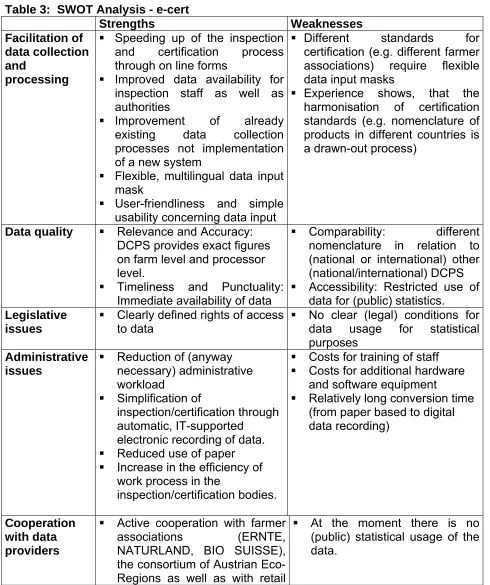
Table 3: SWOT Analysis - e-cert
Strengths Weaknesses
Facilitation of data collection and
processing
Speeding up of the inspection and certification process through on line forms
Improved data availability for inspection staff as well as authorities
Improvement of already existing data collection processes not implementation of a new system
Flexible, multilingual data input mask
User-friendliness and simple usability concerning data input
Different standards for certification (e.g. different farmer associations) require flexible data input masks
Experience shows, that the harmonisation of certification standards (e.g. nomenclature of products in different countries is a drawn-out process)
Data quality Relevance and Accuracy: DCPS provides exact figures on farm level and processor level.
Timeliness and Punctuality: Immediate availability of data
Comparability: different nomenclature in relation to (national or international) other (national/international) DCPS Accessibility: Restricted use of
data for (public) statistics. Legislative
issues
Clearly defined rights of access to data
No clear (legal) conditions for data usage for statistical purposes
Administrative issues
Reduction of (anyway necessary) administrative workload
Simplification of
inspection/certification through automatic, IT-supported
electronic recording of data. Reduced use of paper Increase in the efficiency of
work process in the
inspection/certification bodies.
Costs for training of staff Costs for additional hardware
and software equipment
Relatively long conversion time (from paper based to digital data recording)
Cooperation with data providers
Active cooperation with farmer
associations (ERNTE, NATURLAND, BIO SUISSE),
the consortium of Austrian
chains (HOFER, REWE/BILLA) Cooperation
with national / international statistical offices
Member of IFOAM (although not for statistical purposes)
Costs Savings through the reduction of administrative workload exceed additional costs for e.g. software licence and staff training.
Costs for data collection and processing as well as making data available for statistical purposes have to be covered by the public (respectively public authorities and other users) Opportunities Possibilities to overcome weaknesses identified
Nomenclature: The DCPS provides a flexible technical approach for dealing with different nomenclatures and standards in ONE flexible data input mask.
International Harmonisation: Data collection and processing can be done using different languages simultaneously
Effective and fast data collection and processing as well as exact assessment of the respective volumes (number of animals) provide excellent accuracy of the data.
Certification bodies can combine administrative data collection and statistical data collection – reduced costs for data collection
What is new in comparison to systems used so far?
Range, volume and depth of data International applicability of the DCPS
Networking of certification bodies, consumers and public authorities working with one web based database
Can the system be used for data harmonis-ation?
From a purely technical perspective the system can be used for national and international harmonisation of data. The DCPS is already harmonising data input from three international certification bodies (farm level, partly processor level). Especially on farm level the DCPS provides an effective tool for the collection of high quality and up-to date data. As for national harmonisation all control bodies as well as all processors would have to be integrated into the DCPS, which, without an adequate legal framework seems to be quite difficult.
Relevance / applicability for international implement-ation
Through its multilingualism and its flexible data input masks, the DCPS provides an effective tool for certification bodies to provide harmonised data on the international level. Problems expected in implementation are listed below.
Threads Identification of critical points, barriers, problems
National/International unification of product nomenclature Large and increasing amount of data
Administration of access authority Publication of data (data security) Costs for implementation
Proposed Solutions
Creation of an adequate legal framework for the collection and processing of useful data for inspection/certification bodies with reimbursement/compensation for additional costs/expenses
Assessment of DCPS in regard to recommendations generated in WP2/3 and WP4
General recommendations:
Establish common protocols for data processing and exchange to ensure harmonised quality management and improved timeliness
The DCPS provides technical tools which are already operating for the facilitation of data collection and sharing among various market partners and/or and inspection/certification bodies with the effect of ensuring data quality and timeliness. Regarding BSM, the special feature is that certification data as well as data on quality management provide the basis for statistical analysis. In the case of e-Cert, the DCPS is more focused on the facilitation of data collection and processing using digital recording as well as possibilities for cooperation between inspection/certification bodies. For the international establishment of common protocols, both case studies underline the demand from the experts interviewed for the acceptance of a common definition of organic farming in Europe, which should lead to a common definition of nomenclatures and respective standards. Secondly the case studies show that the participation of the various market actors in such DCPS is more or less on a voluntary basis, which risks the incompleteness of statistical data. In this respect it was seen necessary to establish a system of incentives and/or legal requirements to facilitate participation, although certification bodies in particular seem to be quite critical in this case.
Development of IT solutions to facilitate the recommendation above, including use of on line forms for data collection
Facilitate easy access to and timely/rapid dissemination of available data (especially regarding online access of data)
In principal the tested DCPS show clear approaches to facilitating easy access as well as the dissemination of data. In this context two main problems appeared during the case studies. On one hand, the handling of authorisation and access rights for potential users of the DCPS seems to be very complicated. In the case of extended usage of the tested DCPS it has to be clarified which market actor or which (public) authority gets access rights and to what extent. This seems to be necessary to secure data security of the different market partners. On the other hand, it has to be clarified how the gathered data can or should be made available to a broader public. Supply Chain Level
Compulsory (legal) requirement, with appropriate financial compensation, for certification bodies to supply specified administrative (2092/91) data, based on a common definition of variables, and for Member States to collate and report this data
The case studies showed that the need, mainly from owners, users and processors of data, for a compulsory (legal) regulation of data collection and delivery for certification bodies was viewed sceptically. Certification and inspection bodies fear they will be forced to carry the financial burden of additional and/or harmonised data collection on their own, which in the end would be passed on directly to the producers. Additionally in the context of a common definition of variables it emerged that inspection/certification bodies use quite different systems for product classification or nomenclatures and therefore data collection (even with regard to EU regulation 2092/91) is not harmonised. Although technically and on a voluntary basis the problem could be solved in both the investigated DCPS, there is no evidence for an international approach. Thirdly the responsibility of Member States for collation and reporting of the respective data has to be clarified, and which organisation(s) are authorised for data access and the depth/range in which these data can be used for statistical purposes or publication.
Develop legal enforcement for institutions which are already obliged to collect data (e.g. slaughter houses) to distinguish between conventional and organic products
In this respect the results of the case study signal little support for the legal enforcement of (additional) data collection and reporting on organic farming. Interviewees, in line with the expert opinion in D3, stated that this would mean too much extra (bureaucratic and administrative) burden on businesses only partly engaged in organic markets. If at all, data collection should be done during the inspection process, although also in this case some respondents had some objections in the context of data security.
Integrate data from third country import approvals and certification body data in trade statistics
2 Denmark
National Working Paper
DENMARK
Prepared by:
Lizzie Melby Jespersen
Danish Research Centre for Organic Farming Research Centre Foulum
P.O.Box 50 DK-8830 Tjele Denmark
Phone: +45 89 99 16 85
Foreign trade in organic products, 2003
Detailed description of the case study
The institution, Statistics Denmark (DS):
Statistics Denmark was established as a governmental institution in 1850 and its activities are founded on the Act on Statistics Denmark, adopted in 1966. This Act
gives an independent Board of Governors the responsibility to determine the institution’s work programme, and it allows Statistics Denmark access to data from all public administrative registers in Denmark. Compared to many other countries the production of statistics in Denmark is highly centralised, but there are other national suppliers of statistics than Statistics Denmark, such as municipal authorities and other government departments. However, Statistics Denmark is responsible for ensuring that the overall statistical picture is complete and coherent regardless of the source.
Statistics Denmark takes part in the joint European Statistical programme within the framework of the European Union. It is also involved in other international activities, e.g. in co-operation with the Nordic countries, as well as with the UN and UN organisations. Moreover Statistics Denmark participates in statistical co-operation within other international organisations such as the OECD, IMF, ILO, etc.
Statistics Denmark is organised into four departments: Social Statistics, Business Statistics, Economic Statistics and User Services. The Department of Statistics on Agriculture and Transport is part of Business Statistics.
Statistics Denmark is financed by the government, but specific studies may be funded by other public institutions. The study “Foreign trade in organic products 2003”, which was carried out in 2003/4 was funded by the Directorate for Food, Fisheries and Agri-Business under the Ministry of Food, Agriculture and Fisheries. .
Experience of DS in collecting data on organic farming:
Statistics Denmark has collected information on organic agriculture since 2001. The data collected annually comprise information on
• Number of organic farms according to size and type of production
• Size of organic farming area according to type of plant production and according to regional distribution
• Numbers and types of animal units and livestock farms according to farm size and regional distribution
Interview partners:
Poul Henning Larsen, Head of Section
Contact details: Statistics Denmark
Department of Statistics on Agriculture and Transport
Sejroegade 11
DK-2100 Copenhagen OE Phone: +45-39 17 38 63 Fax: +45-39 17 39 99
e-mail: [email protected]
• Number of dairy farms and amount of milk delivered to dairies
• Number of organic eggs produced for direct consumption
• Operating income of in-conversion farms and organic farms
National/international cooperation of DS on collection of data on organic production
As concerns collection of data on organic farming, processing, consumption and trade, the main collaborators of Statistics Denmark are the following public and private institutions:
• Danish Veterinary and Food Administration (responsible for the inspection of organic processors, wholesalers and retailers) www.fvst.dk
• The Plant Directorate (responsible for the inspection of organic farms and farming input processors and trade companies (feed, seed, fertilisers, etc.) www.pdir.dk
• Danish Research Institute of Food Economics www.foi.dk
• Directorate for Food, Fisheries and Agri-Business www.dffe.dk
• Danish Agricultural Advisory Service www.lr.dk
On the international level, DS co-operates with Eurostat http://epp.eurostat.cec.eu.int on statistics on organic production.
In connection with the Danish survey “Foreign Trade in Organic Products 2003” which he carried out in 2003, Mr. Poul Henning Larsen has prepared a report, partly financed by Eurostat under theme 66: Agri-industrial statistics. The title of this study is “Implementation of Statistics on Products with Distinctive Marks – Foreign trade statistics in organic products with special focus on methodological aspects”. The report is due to be published in June 2005.
The DCPS: Foreign Trade in Organic Products
Background, mode and method of data collection
In the reports from 2003, “Organic Statistics, Needs Assessment and Possibilities for an Enlarged Coverage of the Organic Sector”, Phase 1 and 2 (in Danish) by Poul Henning Larsen, Statistics Denmark, foreign trade in organic products was one of two domains selected for a test survey. (The other was turnover of organic food products in retail shops).
Statistics Denmark collects monthly statistical information on the trade between Denmark and other countries based on two data collection systems, trade with EU Member States and trade with third party countries, but in these surveys there is no discrimination between organic and conventional products.
Sources on foreign trade
The trade statistics for the trade with other EU countries, which have been kept since 1993, are based on the monthly reporting of data from about 10,000 companies in Denmark with a total annual import of minimum 1.5 (0.2) and/or export of minimum 2.5 (0.33) million DKK (€) each.
For each goods transaction (import or export) the following statistical information is collected:
• Product code in accordance with the Combined Nomenclature (NC)
• Partner country (import = country of origin; export = country of destination
• Kind of transaction
• Invoiced value in DKK
• Net weight in kilos and/or supplementary unit, e.g. litre, piece, etc.
The trade between Denmark and third countries is calculated using reports to the Danish Customs and Tax Administration. Every third party country trade transaction must be reported, so the statistics cover all trade with third party countries. The data are collected on a monthly basis. For minor transactions below 7500 DKK ~ 1000 € and 1000 kg, simplified reporting is accepted. For each import/export transaction, the following statistical information is collected:
• Product code in accordance with the EU Combined Nomenclature (CN-8) or TARIC - only for import (Integrated tariff of the European Communities (TARIC), Official Journal C103/1 of 30.04.2003).
• Partner country (import = country of origin; export = country of destination
• Code for procedure
• Statistic value in DKK
• Net weight in kilos and perhaps supplementary unit, e.g. litre, piece, etc.
• Form of transport when passing the frontier.
Sources on enterprises, which may have foreign trade in organic products The Plant Directorate is the only certifier and controller of organic farms, feed companies and other enterprises (fertilisers, seed etc.) dealing with inputs to organic farmers and output other than food products, while the Veterinary and Food Administration is the only certifier and controller of food processors and enterprises packaging and marking organic food products plus wholesalers and retailers (http://www.uk.foedevarestyrelsen.dk/Food/Organic_Foods/forside.htm).
http://www.foedevarestyrelsen.dk/sdata/Oekologikontrollerede.pdf. The list is updated on a weekly basis.
Registration of importers/exporters of organic products
Enterprises must be approved before they can trade in organic products. There is a distinction made between import from EU Member States plus the EFTA countries, Iceland, Norway, Switzerland and Lichtenstein and import from third countries. For imports from EU and EFTA countries, documentation is needed which proves that the vendor is controlled by a certified inspection body in their home country plus an original invoice from the vendor proving the organic status of the lot. The import is not reported to the Plant Directorate, while import of organic food products from the EFTA countries must be reported to the Veterinary and Food Administration. For imports from third countries, all lots of organic products must be reported to the Plant Directorate before being imported into Denmark. Since 2002 the Plant Directorate has kept copies of the export certificates which contain information on product kind and amount. The Food and Veterinary Administration does not collect information on amounts imported from third countries, but registers only the approvals given for import of organic food products directly into Denmark.
Danish enterprises authorised for organic production and/or sale may export their products without reporting anything.
By the end of 2003 about 3400 farms/enterprises (legal units) were registered with the Plant Directorate and almost 500 enterprises (legal units) with the Veterinary and Food Administration. Matching this information with the information in the foreign trade register of Danish Statistics, it turned out that 226 of the enterprises could have been involved in foreign trade in organic products and thus the population for the survey was reduced from 3900 to 226 enterprises.
The 226 enterprises received a questionnaire with the information they had reported to the foreign trade statistics registers and were asked to report the proportion of the turnover in DKK and kg coming from import/export of organic products and which countries had been involved in the transactions. Of the 226 enterprises, 121 had been involved in foreign trade.
The period covered by the questionnaire investigation was 2003. The survey has not been repeated since then.
Dissemination of results:
Quality of the data according to Eurostat, 2003:
Relevance The DCPS is very relevant for market and policy stakeholders, organic certifiers, companies involved in foreign trade in organic products, ministries administrating trade in agricultural products, market researchers and news media as well as for the European Commission and Eurostat, the UN and OECD. Statistics on foreign trade in organic products had not been elaborated before in Denmark.
Accuracy Foreign trade with the other EU-15 Member States is probably underestimated because the statistical data collection only comprises enterprises in Denmark with a total annual product import of a minimum of 1.5 million DKK (0.2 million €) and/or a product export of minimum 2.5 million DKK (0.33 million €). These limits have been set by Denmark in accordance with the Commission Regulation EC no. 1901/2000 dealing with intra-trade statistics. Estimates of the volume of intra-trade below the threshold and non-response are based upon the use of fiscal information. In the survey on foreign trade in organic products the figures have been supplemented with information based on estimates using the VAT return, which covers all transactions of goods between Denmark and the EU countries.
The accuracy of the data on foreign trade with third countries is very high because all transactions are covered unless below 1000 € or 1000 kg. The statistics on third countries are regulated by the Commission Regulation EC no. 1917/2000 on extra-trade statistics. However, the accuracy of the survey on foreign trade in organic products 2003 was subject to considerable uncertainty, as 15 – 20% of the data material was either missing or the quantity of imperfect data was so high that the figures could not be included in the survey. To make up for this, supplementary estimates were made based on VAT figures. Therefore the final total figures are considered very reliable, but the detailed figures are not reliable. It is estimated that the uncertainty with respect to the detailed figures distributed by commodity and country is in the order of approximately 10 % on average, corresponding to the supplement made to the reports from the VAT figures.
Timeliness and
punctuality
According to EC No. 1917/2000 the extra-trade monthly statistics shall be transmitted to the Commission (Eurostat) no later than 6 weeks after the end of the reference period. For intra-trade statistics the production of data takes longer. According to EC No. 1901/2000 the monthly statistics on intra-trade shall be submitted to the Commission (Eurostat) no later than 8 weeks for overall results and no later than 10 weeks for detailed results. It is not necessary to publish data on foreign trade in organic products on a monthly basis - an annual data collection is more realistic. The preliminary results of the annual foreign trade statistics are available in May in the following year. The processing and quality checking of the data reported by the enterprises involved in export/import of organic products takes considerable time. Therefore Statistics Denmark cannot publish the results until October/November of the following year.
Accessibility and clarity
The statistics on foreign trade are published in the monthly publication “Nyt fra Danmarks Statistik” (News from Statistics Denmark), in the monthly series, “Statistiske Efterretninger” (Statistical News), in the quarterly series “Statistiskservice” (Statistics Service) and in the monthly “Konjunkturstatistik” (Main Indicators). These publications are available to the public, but they are not free of charge. Statistics on foreign trade are also available in English
from StatBank Denmark www.statbank.dk free of charge.
Comparability Comparability over time: Any gaps in the time series as a result of changed collection methods etc. is adjusted for by estimation in order to make the foreign trade figures comparable over time. Data comparability does not apply at the most detailed commodity level because the content of many product codes has changed over time.
Comparability with other statistics: The foreign trade figures are comparable with several other sources:
• The partner country’s recording of the same transaction (the mirror
transaction). The comparison is hampered by differences in definitions and in the level of value for the recording of imports and exports.
Payments in connection with foreign trade in products. Different basis of accrual and differences in valuation hinder comparison
• Reports on EU purchases and sales of products on the VAT return.
These statistics are not published but are used in the continuous control of the reports to Intrastat.
The nomenclature used in the survey on foreign trade with organic products 2003 is the combined EU Nomenclature (CN-8). To improve comparability with international statistical surveys the information has been published according to the UN International Trade Classification (SITC)
Coherence Apart from the foreign trade statistics information on external trade can be found in:
• The national accounts
• The business statistics
• The balance of payments
which must all relate to one another.
The share of estimated figures is in the order of 15 – 20 % when the statistics are published for the first time. There are some deviations between the first and the final publication of foreign trade figures for any given month because the inaccurate data are checked and adjusted by means of information from VAT registrations and other sources in the final publication.
For further information on the quality of foreign trade statistics in the EU and Denmark, please consult
• Foreign Trade Statistics – Quality Report: Foreign trade, European Commission
Working Papers and Studies, Theme 6. 2003 edition)
http://epp.eurostat.cec.eu.int/cache/ITY_OFFPUB/KS-AS-03-001/EN/KS-AS-03-001-EN.PDF
• Danish external trade statistics 2003
http://www.dst.dk/asp2xml/external/external.asp?title=Danish%20External%20Trade%2 0Statistics%202003&hreflang=da&path=/Vejviser/Portal/Udenrigshandel/METODE/omu denrigshandelsstatistik.aspx&ancestor=Statistik&file=/upload/danish_external_trade_st atistics_2003.pdf
• The quality of foreign trade figures, prepared by Danish Statistics’ External Trade
Division, July 1, 2001
SWOT Analysis of the DCPS
Strengths Weaknesses
Facilitation of data collection and processing
• It is only necessary to ask the
enterprises certified for foreign trade with organic products (i.e. 3.900 enterprises are reduced to 226 enterprises by matching the foreign trade registers with the registers on enterprises certified for foreign trade in organic products.
• The data on foreign trade in
organic products are already included in the foreign trade statistics. It is just a matter of separating these data from the data on similar conventional products
• The response burden for the
enterprises involved in foreign trade is high due to the monthly reporting to the two foreign trade registers. In 2001 the response burden was 157.1 man years in total in Denmark. The extra response burden for the enterprises involved in foreign trade in organic products is about 0.3 man years.
• It will probably only be possible for
national statistical offices to carry out the collection of data on foreign trade in organic products since it involves the matching of data from several public data registers. Besides, it is mandatory for the enterprises to report the requested data to Statistics Denmark, which is not the case in other EU
countries. Data quality • The data quality of the foreign
trade registers and the registers on enterprises certified for production, processing and trade with organic products is high.
• The foreign trade in organic
products is probably
underestimated due to the fact that many enterprises involved in processing and trade with organic products are relatively small and therefore below the threshold for reporting of EU intra-trade data to Statistics Denmark.
• Many of the enterprises involved in
foreign trade with both
conventional and organic products have difficulties in discriminating between organic and conventional products in their accountancy system.
Legislative issues
• Act on Statistics Denmark makes
it possible for Statistics Denmark to make mandatory requests to private enterprises for reporting of statistical data and to match information from various public data registers.
• Certification and control of farms
and enterprises involved in organic production and trade is carried out by two national institutions and therefore their registers are available to Statistics Denmark (and to the public).
• The Commission (Eurostat) has
• In other EU Member States there
is no similar legislation which makes it possible for the statistical offices to make mandatory
requests for information from private enterprises and organisations.
• In most of the other EU Member
already harmonised the nomenclature for reporting on foreign trade within the EU and with third countries
Administrative issues
• If the organic products are
marked, it will be simple for the enterprises to separate the data on foreign trade in organic
products in the accounts. This will reduce the response burden of the enterprises of 0.3 man years per year considerably.
• If the organic products which are
traded over the frontiers are not marked so they can be
distinguished in the accounts, the response burden and the risk of inaccuracies may be
considerable.
• The processing of the data and
the quality checking by Statistics Denmark is time consuming, about 0.6 man years/year Cooperation
with data providers
• Statistics Denmark co-operates
with the Plant Directorate and the Veterinary and Food
Administration, which are responsible for keeping the registers on enterprises certified for production, processing and trading with organic products updated.
• The collection of data for foreign
trade statistics is carried out by Statistics Denmark.
• The data on foreign trade in
organic products are collected by means of questionnaires directly from the enterprises involved.
• In other countries it may be
necessary to involve several private certification and control bodies to get information on enterprises involved in foreign trade in organic products.
• The private certification and control
bodies may not be interested in giving such information due to the extra workload, and they will have to ask permission from their
customers.
• To avoid counting transactions more
than once, it is necessary for all enterprises have one common code number (business register number or VAT number) which may be used for identification of the enterprises in the registers of the certifiers and in other business, tax and trade registers. This is the case in Denmark but not in most other EU Member States.
Cooperation with national / international statistical offices
• No co-operation with national
/international statistical offices has been necessary
Costs • The total costs to Statistics Denmark for the planning, processing and reporting of the survey is estimated to be 600.000 DKK (~ 80.000 €) /year or 0.6 man years Opportunities Possibilities to overcome weaknesses identified
• One major reason for inaccuracies is the lower threshold limit for reporting
of EU intra-trade, and in Denmark it is the intention to increase this limit even further. The question of where to set the lower limit may be a subject for discussion in Eurostat.
organic products and conventional products in the accounting system. Some enterprises already discriminate between organic and conventional products in their accounting system. If such surveys are carried out on a regular basis, the other enterprises will probably also adjust their
accounting systems to distinguish between organic and conventional products.
• For the enterprises below the threshold a benchmark survey of their foreign
trade in organic products could be carried out every 5 years in order to adjust the results reported on an annual basis.
What is new in comparison to systems used so far?
• It is new to match the registers on enterprises certified for production,
processing and trade with the two foreign statistics registers to find the reduced population of enterprises which may have been involved in foreign trade in organic products.
Can the system be used for data harmonisation?
• The system is already harmonised, as the nomenclature used is the CN-8
and the TARIC nomenclature of the European Commission plus the SITC of the UN International Trade Classification.
Relevance / applicability for international implementation
• The survey is very relevant on an international scale. However, it may be a
challenge to transfer the method of matching the registers on enterprises involved in foreign trade in organic products with the foreign statistics registers of the statistics offices because the certification and control may be carried out by several private companies. Besides, it is not known whether the certifiers easily can identify the enterprises involved in foreign trade in organic products.
Threads Identification of
critical points, barriers, problems
• In other countries, where the reporting of statistical information requested
by the national statistical office is not mandatory, the response burden of the enterprises will probably be the greatest barrier for collection of the data, as they will probably not be interested in participating in such statistical surveys.
• In many countries another barrier may be the private certification system,
partly because there may be many data sources on enterprises certified for foreign trade in organic products, and partly because there may be
unwillingness to report such data due to extra response burden and protection of customers.
Proposed Solutions
• More knowledge is needed about how to make enterprises co-operate in
data collection when reporting is not mandatory.
• More knowledge is needed about how certification systems and registers
are built up in the EU countries to find the best way to collect information on the foreign trade in organic products in each country.
Assessment of DCPS in regard to recommendations generated in WP2/3 and WP4
Note: the following section relates the case study to the recommendations generated in WP2/3 and WP4 which have already been validated by experts. The main question, therefore, is how the results of the investigation here support or conflict with the previous recommendations and how they might contribute to a general improvement in data quality.
General recommendations:
Establish common protocols for data processing and exchange to ensure
A prerequisite for the matching of the information on enterprises involved in foreign trade with enterprises certified for organic trade in Denmark has been the common business enterprise number (CVR), which is also the VAT number.
It is important to use internationally harmonised nomenclatures, so the statistics can be compared with statistics for conventional products or statistics on import/export of organic products from other EU countries
Development of IT solutions to facilitate the recommendation above, including use
of on-line forms for data collection
The questionnaire, which was sent out to the enterprises certified for trade in organic products was made in an Excel spreadsheet on a CD-Rom as well as in a paper version. The questionnaire was sent out together with an introductory letter and guidelines on how to fill it in, a country code list and a copy of the Combined Nomenclature (CN-8).
It turned out that a little more than 50% of the respondents used the paper version to report, while about 25% used the electronic version of the Excel spreadsheet and reported the data via e-mail. If the survey were carried out regularly, electronic reporting would probably be used even more.
Establish mechanisms to facilitate statistical agency, external expert and
stakeholder communication and involvement in data collection and processing, e.g. via specialist expert groups/networks and observatories, with key individuals given responsibility to promote/develop initiatives.
It may be possible to improve the data quality and reduce the response burden by means of stakeholder communication on possibilities for marking of the organic products in the accounting systems and by development of the questionnaires and the electronic tools from Statistics Denmark in co-operation with the enterprises.
Facilitate easy access to and timely/rapid dissemination of available data
(especially regarding online access of data)
The data may be published on the STATBANK webpage, which may be accessed free of charge. However, a 10- or 11-month delay in the publication of the annual statistics on foreign trade in organic products is realistic.
.
Establish common operator identification number to enable linking of
administrative and statistical data.
This has already been done long ago in Denmark, and it has been extremely helpful for the collecting, checking and reporting of statistics.
Supply Chain Level and import/export level
Compulsory (legal) requirement, with appropriate financial compensation, for
If the supply of specific administrative data is a legal requirement, financial compensation for the certification bodies will not be necessary. If there is no legal requirement, it is hardly realistic that the statistics offices or the public authorities will compensate the certification bodies for such work. However, it should be possible for the public authorities supervising the certification bodies according to the EC 2092/91 Regulation to request information on which enterprises have been involved in foreign trade with organic product, without compensating the certification bodies.
The definitions and nomenclatures used on product types in foreign trade statistics are already harmonised.
Integrate data from third country import approvals and certification body data in
trade statistics
The Danish case study showed that the amounts of organic products imported from third countries was very low compared to the EU intra-trade. However, most of the imports from third countries are probably coming indirectly via some of the other EU countries with big ‘organic’ import companies, such as Germany, the Netherlands and Sweden. Therefore it is probably that Danish imports from third countries are considerably underestimated. However, this may not be the case in the countries with big ‘organic’ import companies. In the first place it is therefore advised to concentrate on how to collect and report reliable statistical information on the intra- EU trade. The volume of the direct trade with third countries should be investigated in comparison with indirect trade via other EU countries before a data collection strategy is decided upon.
Make selective adjustments to official nomenclature to achieve appropriate
balance between data requirements and administrative costs.
The discrimination between organic and conventional products should be done in the accountancy systems of the relatively few enterprises involved in foreign trade in organic products.
Conduct regular EU-wide survey of operators and experts (soft data) to meet
specific data requirements.
For Denmark the main operators and amounts of imports are already identified, so surveys like this are not necessary.
Extend the existing data collection on intra- and extra EU-trade to a differentiation
between organic and conventional, which may provide the basis for organic market data, which market actors and policy makers will require.
New DCPS on turn over of organic food products in retail shops
Detailed description of the case study
The institution, Statistics Denmark (DS):
Statistics Denmark was established as a governmental institution in 1850 and its activities are founded on the Act on Statistics Denmark, adopted in 1966. This Act
gives an independent Board of Governors the responsibility to determine the institution’s work programme, and it allows Statistics Denmark access to data from all public administrative registers in Denmark. Compared to many other countries the production of statistics in Denmark is highly centralised, but there are other national suppliers of statistics than Statistics Denmark, such as municipal authorities and other government departments. However, Statistics Denmark is responsible for ensuring that the overall statistical picture is complete and coherent regardless of the source.
Statistics Denmark takes part in the joint European Statistical programme within the framework of the European Union. It is also involved in other international activities, e.g. in co-operation with the Nordic countries, as well as with the UN and UN organisations. Moreover Statistics Denmark participates in statistical co-operation within other international organisations such as the OECD, IMF, ILO etc.
Statistics Denmark is organised into four departments: Social Statistics, Business Statistics, Economic Statistics and User Services. The Department of Statistics on Agriculture and Transport is part of Business Statistics.
Statistics Denmark is financed by the government, but specific studies may be funded by other public institutions. The Study, “Turnover of organic foods in retail shops”, which was carried out in 2003/4 was funded by the Directorate for Food, Fisheries and Agri Business under the Ministry of Food, Agriculture and Fisheries.
Experience of DS in collecting data on organic farming:
Statistics Denmark has collected information on Organic Agriculture since 2001. The annually collected data comprise information on
• Number of organic farms according to size and type of production
• Size of organic farming area according to type of plant production and according to regional distribution
• Numbers and types of animal units and livestock farms according to farm size and regional distribution
• Number of dairy farms and amount of milk delivered to dairies
•
Interview partners:
Poul Henning Larsen, Head of Section
Contact details: Statistics Denmark
Department of Statistics on Agriculture and Transport
Sejroegade 11
DK-2100 Copenhagen OE Phone: +45-39 17 38 63 Fax: +45-39 17 39 99
e-mail: [email protected]
• Operating income of in-conversion farms and organic farms
National/international cooperation of DS on collection of data on organic production
As concerns collection of data on organic farming, processing, consumption and trade, the main collaborators of Statistics Denmark are the following public and private institutions:
• Danish Veterinary and Food Administration (responsible for the inspection of organic processors, wholesalers and retailers) www.fvst.dk
• The Plant Directorate (responsible for the inspection of organic farms and farming input processors and trade companies (feed, seed, fertilisers, etc.) www.pdir.dk
• Danish Research Institute of Food Economics www.foi.dk
• Directorate for Food, Fisheries and Agri Business www.dffe.dk
• Danish Agricultural Advisory Service www.lr.dk
On international level DS co-operates with Eurostat http://epp.eurostat.cec.eu.int on statistics on organic production.
The DCPS: Survey on organic food turnover in retail shops
Background, mode and method of data collection
Since 1939 Statistics Denmark has collected and calculated an index for the turnover in retail shops, and today the index is calculated for 49 product categories. These surveys cover all retailers with an annual turnover of more than 10 million DKK including VAT plus a stratified sample of retailers with an annual turnover of 2.5 – 10 million DKK including VAT. Statistics Denmark estimates that the reporting from the retailers in the group “Foods and other daily commodities” accounts for 85 % of the total turnover in this group. This survey is carried out six times a year but there is no discrimination between organic and conventional products.
According to the OMIaRD report, Analysis of the European Market for Organic Food (2002) about 86 % of the turnover of organic food products in Denmark takes place via three supermarket chains, grouped into seven sub-chains, plus some chains of general stores and independent general stores organised in the Federation of
General Stores (FGS) www.d-s-k.dk . FGS has about 1500 member stores and they get their supply from three wholesalers. This means that it should be possible to collect information on magnitude, composition and price of the turnover of organic foods in retail shops by means of stratified sample collection from a few aggregated data sources (the three supermarket chains and the three wholesalers). However, such data were not collected until Poul Henning Larsen, Danish Statistics, made a test survey in 2003/4.
order to estimate the turnover in the FGS general stores, the wholesale prices have been recalculated into retail prices by means of the price per kilo for the various food product groups, which was estimated on the basis of the total turnover in kg and DKK for this product group in the supermarket chains. This price was then multiplied by the total turnover in kilos reported by each wholesaler. Finally the total turnover of each wholesaler in DKK was compared with the actual turnover in order to check the applicability of the method for all product groups. When in doubt, the wholesaler was contacted by phone.
The period covered by the questionnaire investigation was 2003. In 2004 the survey was repeated, but this time only two wholesalers were included because two of the wholesalers had merged.
Dissemination of results:
The survey on turnover of organic foods in retail shops in 2003 by Poul Henning Larsen, Danish Statistics, has been published (in Danish) in Statistiske Efterretninger 2004:19 of September 14, 2004. The data for 2004 will be published in the first half of 2005 on www.statbank.dk which can be accessed free of charge. The report for 2004 will be published in Statistiske Efterretninger in May 2005.
Quality of the data according to Eurostat, 2003:
Relevance The DCPS is relevant for various market and policy stakeholders in the organic sector as such information has not been open to the public before. GfK has made investigations on turnover of organic food products in Denmark before by means of consumer enquiries of 2000 households. However these surveys do not give a full picture of the sale of organic food products, and they are not available to the public.
AC Nielsen has collected coded scanned-in data (barcodes) from various supermarket chains, which makes it possible to discriminate between organic and conventional products. These surveys should give a reliable estimate of the turnover of organic products in the retail shops, but since 2003 several of the big supermarket chains have declined to participate in these surveys. Accuracy There is a minor inaccuracy due to the conversion of wholesaler sales into
retail sales. However, no measure of accuracy has been calculated.
The survey is estimated to cover about 80% of the retail trade. It is estimated that the retailers buy about 50% of the organic fruit and vegetables from the wholesalers, and for this reason the amounts registered by the wholesalers have been doubled in the survey. Besides, some general stores, which are members of the Federation of General Stores, get their milk products directly from dairies instead of through the wholesalers. Therefore the sales of dairy products may be underestimated.
To calculate the total retail turnover, direct sales of organic food products from farm shops, box subscription schemes and special shops should also be included in the survey, but this would increase the response burden considerably.
Timeliness and punctuality
The survey is published six months after the end of the period which is covered by the data collection. The next publication (for 2004) will be published in May 2005. It is not yet known whether such surveys will be carried out regularly in the future.
Accessibility and clarity
Statistics for 37 DKK ~ 5 €. A 2-page press release has been published (in Danish) in “Nyt fra Danmarks Statistik” No. 391, Subject group: Agriculture, September 14, 2004 and can be downloaded free of charge from
http://www.dst.dk/TilSalg/Boghandel/Publikation.aspx?cid=8247 Comparability The data are comparable with household budget surveys, because the
nomenclature used in the survey, COICOP, is almost identical with the nomenclature used by Danish Statistics in the household budget surveys. Coherence The coherence is good, because the classification is similar to the household
budget surveys.
SWOT Analysis of the DCPS
Strengths Weaknesses
Facilitation of data collection and processing
• Low response burden, (data can
be obtained from the central administration of a small number of supermarket chains and wholesalers instead of many retail shops)
• Organic products can be marked
electronically (bar codes) making it easy to report the data.
• The data are easy to analyse
(Excel spreadsheet).
Not all retail sales of organic food products are covered
Data quality The data quality is high There may be minor inaccuracies due to the conversion of wholesale turnover to retail turnover.
Another inaccuracy is the waste of organic food products in the general stores supplied by the wholesalers, which may give rise to a small overestimate.
Legislative issues
Act on Statistics Denmark makes it mandatory to report statistical information of interest to Statistics Denmark
In the other EU Member States there is no similar legislation.
Administrative issues
In most cases the data are directly available from the bookkeeping, because the organic food products have separate bar codes.
The total administrative burden for the supermarket chains and wholesalers for reporting of the data is estimated to about 0.1 man year.
It is still an extra administrative burden for the bookkeeping departments of the supermarket chains and wholesalers
Cooperation with data providers
User groups have been established by Statistics Denmark on the issue of turnover of organic products in retail shops.
Data are treated as strictly confidential by Statistics Denmark and the results are presented in such a way that the business interests of the data