This is a repository copy of Mean-field interactions among robust dynamic coalitional
games with transferable utilities.
White Rose Research Online URL for this paper:
http://eprints.whiterose.ac.uk/89666/
Proceedings Paper:
Bauso, D. and Basar, T. (2014) Mean-field interactions among robust dynamic coalitional
games with transferable utilities. In: ISCCSP 2014 - 2014 6th International Symposium on
Communications, Control and Signal Processing, Proceedings. 2014 6th International
Symposium on Communications, Control, and Signal Processing (ISCCSP), 21-23 May
2014, Athens, Greece. , 487 - 490. ISBN 9781479928903
https://doi.org/10.1109/ISCCSP.2014.6877919
[email protected] https://eprints.whiterose.ac.uk/ Reuse
Unless indicated otherwise, fulltext items are protected by copyright with all rights reserved. The copyright exception in section 29 of the Copyright, Designs and Patents Act 1988 allows the making of a single copy solely for the purpose of non-commercial research or private study within the limits of fair dealing. The publisher or other rights-holder may allow further reproduction and re-use of this version - refer to the White Rose Research Online record for this item. Where records identify the publisher as the copyright holder, users can verify any specific terms of use on the publisher’s website.
Takedown
If you consider content in White Rose Research Online to be in breach of UK law, please notify us by
MEAN–FIELD INTERACTIONS AMONG ROBUST DYNAMIC COALITIONAL GAMES
WITH TRANSFERABLE UTILITIES
Dario Bauso and Tamer Bas¸ar
DICGIM, Universit`a di Palermo, Italy,
[email protected]
CSL, University of Illinois at Urbana-Champaign, US,
[email protected]
ABSTRACT
This paper considers a large number of homogeneous “small worlds” or games. Each small world involves a set of players and a corresponding set of possible coalitions, and is mod-eled as a dynamic game with transferable utilities (TU), where the characteristic function is a continuous-time stochastic pro-cess. Considering that a dynamic TU game can be modeled as a network control problem, the overall system appears as an assembly of a large number of networks subject to mean-field interactions. As a result of such mean-mean-field interactions among small worlds, in each game, a central planner allo-cates revenues based on the extra reward that a coalition has received up to the current time and the extra reward that the same coalition has received in the other games. We obtain allocation rules that make the grand coalition stable in each game, while guaranteeing consensus on the excesses, in the spirit of inequity aversion. Convergences of allocations and excesses are established via stochastic stability theory.
Index Terms— mean-field games; consensus; multiagent systems; network flow.
1. INTRODUCTION
In this paper we consider infinite copies of a coalitional game with transferable utilities (TU game). For each game, a central planner allocates revenues in order to stabilize the grand coalition, which occurs when the total amount given to the member of any sub-coalition exceeds the value of the sub-coalition itself (see the notion of “core” in [10]). In a continuous-time repeated game, the excess of a coalition is the cumulative discrepancy between the total amount given to the coalition and the value of the coalition up to the cur-rent time. The coalition’s values are unknown but bounded, thus the excesses evolve according to controlled uncertain stochastic differential equations. The objective of the planner
The work of D. Bauso was supported by the 2012 “Research Fellow” Program of the Dipartimento di Matematica, Universit`a di Trento and by PRIN 20103S5RN3 “Robust decision making in markets and organizations, 2013-2016”. The work of T. Bas¸ar was supported in part by the U.S. Air Force Office of Scientific Research (AFOSR) MURI grant FA9550-10-1-0573. D. Bauso is currently academic visitor at the Department of Engi-neering Science, University of Oxford, UK.
is to align the excesses with the average value computed over infinite copies of the same game. Such a phenomenon is known as crowd-seeking behavior in mean-field games.
Main result. For the problem at hand, we provide a mean-field game formulation and conduct a heuristic robust con-trol design based on augmentation and regularization of the state space [6]. The mean-field game involves a macroscopic description based on a classical forward Kolmogorov partial differential equation which generates the distribution of the excesses over the horizon.
Related literature. The theory on mean-field games origi-nated in the work of M.Y. Huang, P. E. Caines and R. Mal-ham´e [7, 8] and independently in that of J. M. Lasry and P.L. Lions [9], where the now standard terminology of Mean Field Game (MFG) was introduced. The problem we analyze in this paper follows in spirit the study on robust dynamical TU coalitional games in [5] with the additional mean-field inter-actions between infinite copies of the same game, which was not present in [5]. Explicit solutions in terms of mean-field equilibria are not common unless the problem has a linear-quadratic structure, see [1]. This justifies our solution ap-proach which approximates the original problem by an aug-mented linear quadratic one.
The rest of the paper is organized as follows. In Section 2, we illustrate the problem and introduce the model. In Sec-tion 3, we present the mean-field game. In SecSec-tion 4, we il-lustrate the solution approach. Finally, in Section 5, we draw some conclusions and discuss future works.
Notation. Given a setN ={1, . . . , n}of players and a func-tionη:S 7→Rdefined for each nonempty coalitionS ⊆N, we write< N, η > to denote the transferable utility (TU) game with players’ setN and characteristic functionη. We letηSbe the valueη(S)of the characteristic functionη asso-ciated with a nonempty coalitionS ⊆N. Given a TU game
< N, η >, we useC(η)to denote the core of the game:
C(η) =nx∈Rn
P
i∈Nxi=ηN, Pi∈Sxi≥ηS for all nonemptyS⊂No.
bydB(t)its infinitesimal increment, i.e.,B(t) = R0tdB(τ), the latter being the It¯o integral. We useB¯(t) = B(tt) to indi-cate the average infinitesimal up to timet. Ifa(t)is the deriva-tive of an almost everywhere differentiable function, the sym-bol˜a(t)denotes the function itself, i.e., ˜a(t) = R0ta(τ)dτ. We also usea¯(t) = ˜a(tt)to indicate the average up to timet.
2. TU GAMES AS NETWORKS
Consider infinite copies of ann-palyer robust dynamical TU game< N, η(t)>, where the characteristic functionη(t)is a diffusion process with drift, whose evolution is described by the stochastic differential equation:
dη(t) =w(t)dt+σdB(t), inRq,
η(0) =η0, (1)
whereq= 2n−1is the number of coalitions. For each game, let a corresponding hypergraphHbe given with vertex setV
and edge setEas:
H:={V, E}, V ={v1, . . . ,vq}, E :={e1, . . . ,en}.
The vertex setV has one vertex per coalition whereas the edge setEhas one edge per player. A generic edgeiis incident on
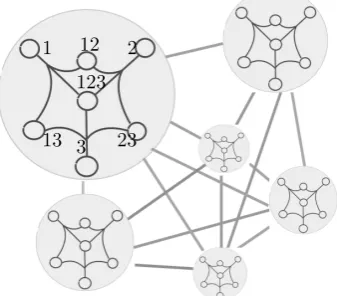
1 12 2
123
3
13 23
Fig. 1. Infinite copies of hypergraph H := {V, E} for a3 -player coalitional game.
a vertexvjif the playeriis in the coalition associated withvj. Thus, incidence relations can described by a matrixBwhose rows are the characteristic vectorscS ∈
Rn. We recall that the components of a characteristic vector arecS
i = 1ifi∈Sand
cS
i = 0ifi /∈S. Figure 1 depicts an example of hypergraph for a 3-player coalitional game on every single grey node. In the same spirit as in [5], we view allocationui(t)as the flow on edgeeiand the coalition valuewS(t)of a generic coalition
Sas the demand in the corresponding vertexvj. In view of this, allocation in thecoreof the gameC(η(t))translates into over-satisfying the demand at the vertices. Specifically,
˜
u(t)∈C(η(t)) ⇔ BHu˜(t)≥η(t), (2)
with the last inequality satisfied as an equality due to the effi-ciency condition of the core, i.e,Pni=1˜ui(t) =ηq(t), where
ηq(t)denotes theqth component ofη(t)and is equal to the grand coalition value ηN(t). Let x(t) ∈ Rq represent the coalition excess, whose time evolution is given by:
dx(t) = (Bu(t)−w(t))dt−σdB(t),
x(0) =x0. (3)
We assume that the control and the disturbance are bounded within polytopes, i.e.,
• u(t)is in the control setU ⊆Rp,p >0,
• w(t)is in the disturbance setW ⊆Rq,q >0.
Given infinite copies of the same game, we can consider a probability density functionm:Rq×[0,+∞[→[0,+∞[, (x, t)7→m(x, t), which satisfiesRRqm(x, t)dx= 1for every
timet. Let us also define the mean distribution at timetas ¯
m(t) :=RRqxm(x, t)dx.
In each game, the designer follows the so-called crowd-seeking law in that it adjusts the current allocation based on the average distribution of the other games.
Then, for each game, consider a running costg : Rq ×
Rq→[0,+∞[,(x,m¯)7→g(x,m¯)of the quadratic form:
g(x,m¯) = 1 2 h
( ¯m−x)TQ( ¯m−x)i, (4)
whereQ >0, that is positive definite.
Also consider a terminal costΨ :Rq×Rq → [0,+∞[, (x,m¯)7→Ψ(x,m¯)of the form
Ψ(x,m¯) =1
2( ¯m−x) T
S( ¯m−x), (5)
whereS > 0. The problem in its generic form is then the following:
Problem 1 Find the closed-loop optimal control and worst-case disturbance for the problem:
infu(·)∈Usupw(·)∈W
n
J(x0, u(·), w(·), m(·))
=Eh R0Tg(x(t),m¯(t))dt+ Ψ(x(T),m¯(T))io, dx(t) = (BHu(t)−w(t))dt−σdB(t),
(6)
whereU andWare the sets of all measurable functionsu(·) andw(·)from[0,+∞[toUandW, respectively, andm(·)as a time-dependent function is the evolution of the distribution under the optimal control and the worst-case disturbance.
3. THE MEAN FIELD GAME
Let us denote byv(x, t)the (upper) value of the robust opti-mization problem under worst-case disturbance starting from timet at statex(which in this case also turns out to be the
[image:3.595.92.261.372.520.2]lower value, and hence thevalue, since Isaacs condition [2] holds–see below). Problem 1 results in the following mean-field game system for the unknown functions v(x, t), and
m(x, t):
∂tv(x, t) + inf u∈Uwsup∈W
n
(Bu−w)T∂xv(x, t)
+g(x,m, u, w¯ )o+σ2
2 T r
∂2 xxv(x, t)
= 0 inRq×[0, T[, v(x, T) = Ψ(x,m¯)∀x∈Rq,
∂tm(x, t) +div(m(x, t)·(Bu−w))
−σ2
2T r(∂ 2
xxm(x, t)) = 0, inRq×[0, T[,
m(0) =m0, d
dtm¯t=Bu¯
∗
t−w¯
∗
t, in[0, T[,
(7)
where u∗
(t, x) and w∗
(t, x) are the optimal time-varying state-feedback controls and disturbances, respectively, ob-tained as
u∗(t, x)∈arg min
u∈U{(Bu−w∗)∂xv(x, t) +g(x,m¯)},
w∗
(t, x)∈arg maxw∈W{(Bu−w)∂xv(x, t) +g(x,m¯)}.
(8)
Note that the minimization and maximization problems above are completely decoupled, and hence in (7) theinf supis the same assup inf (that is, Isaacs condition holds [2]), and fur-thermoreinf andsup can be replaced byminandmax, re-spectively, because of optimization of linear functions over closed and bounded finite-dimensional sets.
The first equation in (7) is the HJBI equation with variable
v(x, t). Given the boundary condition on final state (second equation in (7)), and assuming a given population behavior captured bym(·), the HJBI equation is solved backwards and returns the value function and best-response behavior of the individuals (first equation in (8)) as well as the worst adver-sarial response (second equation in (8)). The HJBI equation is coupled with a second PDE, known as the Fokker-Planck-Kolmogorov (FPK)equation (third equation in (7)), defined on variablem(·). Given the boundary condition on initial dis-tributionm(0) =m0(fourth equation in (7)), and assuming a given individual behavior described byu∗
, the FPK equation is solved forward and returns the population behavior time evolutionm(t). The last equation in (7) is obtained by aver-aging the left and right hand side of the dynamics (3). Any solution of the above system of equations along with (8) is referred to asworst-disturbance feedback mean-field equilib-rium.
4. AUGMENTATION AND REGULARIZATION
This section illustrates a simple heuristic approach toward solving the set of equations (7)), based on state space aug-mentation and regularization [6]. The augmented state space
includes the mean distribution, thus the augmented state vari-ables evolve according to the equations
dx(t)
dm¯(t)
=B
u∗(x, t) ¯
u∗(t)
−
w∗(x, t) ¯
w∗
(t) dt+ σdBt 0 . (9)
For this system we introduce an assumption on the rate of convergence of the statem¯(t).
Assumption 1 There exists a scalarθ >0such that
d
dtm¯(t) =Bu¯
∗
(t)−w¯∗(t)≥ −θm¯t,for allt∈[0, T],
where the inequality is to be interpreted component-wise.
The above assumption implies that there exists a variable ˜
m(t)which approximates the average mean value from below and evolves according to
d
dtm˜(t) =−θm˜(t), for allt∈[0, T], ˜
m0= ¯m0. (10)
By substituting the current mean valuem¯tby its estimatem˜t the augmented problem is
inf
u(·)∈U w(sup·)∈W
Z T
0
1 2 h
( ˜m(t)−x(t))TQ( ˜m(t)−x(t))idt
dx(t)
dm˜(t)
= 0 0
0 −θI
x(t) ˜
m(t) + B 0
u(t)
−
I
0
w(t)dt+
σdB(t) 0
.
Reformulating the problem in terms of the augmented state
X(t) =
x(t) ˜
m(t)
,
and regularizing the solution via quadratic penalty terms on control and disturbance, we have the linear quadratic prob-lem:
inf
u(·)∈U w(sup·)∈W
Z T
0 h1
2(X(t)
TQX˜ (t) +uT(t)Ru(t)
−wT(t)Γw(t))idt+ ˜Ψ(X(T))
dX(t) =F X(t) +Gu(t) +Hw(t)dt+LdBt,
where ˜ Q= Q −Q −Q Q
, L= σI 0 , F = 0 0 0 −θI
, G=
B
0
, H =
−I
0
R >0,Γ>0, andΨ(˜ X) := Ψ(x,m˜).
The idea is therefore to consider a new value function
Vt(x,m˜) (in compact form Vt(X)) in the augmented state space which satisfies
∂tVt(X) +H(X, ∂XVt(X)) +12σ2Tr∂2
xxVt(X) = 0, inR2q×[0, T[,
VT(X) = ˜Ψ(X) inR2q,
whereH(X, ∂XVt(X))is the robust Hamiltonian [4]:
H(X, ∂XVt(X)) = 12 XTQX˜ +∂XVt(X)F X
−1
2 ∂XVt(X)[GR
−1GT−HΓ−1HT](∂
XVt(X))T.
This PDE admits the unique solution given by
Vt(X) = 1 2 X(t)
T
P11(t) P12(t)
P12(t)T P22(t)
| {z }
P(t)
X(t) +1 2 p(t),
where the symmetric matrix P(t) satisfies (is the unique nonnegative-definite solution of) the generalized (game) Ric-cati differential equation
˙
P(t) +P(t)F+FTP(t)
−P(t)(GR−1GT −HΓ−1HT)P(t) + ˜Q= 0,
P(T) =
S −S
−S S
,
(11)
andp(·)is solved from
˙
p(t) +σ2TrP(t), p(T) = 0.
Given upper and lower bounds,u+i andu
−
i respectively, let us introduce thesatfunction as in [3]:
sat[u− i,u
+
i]{ξ}
.
=
u−i if ξ < u
−
i
u+i if ξ > u + i
ξ if u−
i ≤ξ≤u + i
.
Then a sub-optimal control is given by
˜
u(t) =satn−R−1GTP(t)X(t)o
=satn−R−1BT(P
11(t)x(t) +P12(t) ¯m(t)) o
,
and the worst-case disturbance can be approximated by
˜
w(t) =satnΓ−1HTP X(t)o
=satn−Γ−1(P
11(t)x(t) +P12(t) ¯m(t)) o
.
The underlying idea of the approximation above is to consider the solution of the soft-constrained linear quadratic problem when the hard constraints are not active, while saturate ev-ery single component as soon as it reaches its upper or lower bound.
5. CONCLUSIONS AND FUTURE DIRECTIONS
We have provided a mean-field game formulation of infinite copies of “small worlds” each one described as a TU coali-tional game. The problem has connections to recent research on robust dynamic coalitional TU games [5] and robust mean-field games [4, 6]. A quantitative analysis of the approxima-tion error of the soluapproxima-tion presented is left as future work.
6. REFERENCES
[1] M. Bardi, “Explicit solutions of some linear-quadratic mean field games,”Network and Heterogeneous Media, 7, pp. 243–261 (2012).
[2] T. Bas¸ar and G. J. Olsder, Dynamic Noncooperative Game Theory, SIAM Series in Classics in Applied Mathematics, Philadelphia (1999).
[3] D. Bauso, F. Blanchini, and R. Pesenti, “Robust con-trol strategies for multi inventory systems with average flow constraints,”Automatica, vol. 42, pp. 1255–1266 (2006).
[4] D. Bauso, H. Tembine, and T. Bas¸ar, “Robust mean field games with application to production of an exhaustible resource,”Proceedings of 7th IFAC Symposium on Ro-bust Control Design, Aalborg, Denmark (2012).
[5] D. Bauso and P. Viswanadha Reddy and T. Bas¸ar, “Lya-punov stochastic stability and control of robust dynamic coalitional games with transferable utilities,” submitted and under review (2012).
[6] D. Bauso and T. Mylvaganam and A. Astolfi, “Ap-proximate solutions for crowd-averse robust mean-field games,” submitted and under review (2013).
[7] M.Y. Huang, P.E. Caines, and R.P. Malham´e, “Individ-ual and mass behaviour in large population stochastic wireless power control problems: centralized and Nash equilibrium solutions,” Proc. IEEE Conf. on Decision and Control, HI, USA, December, pp. 98–103 (2003).
[8] M.Y. Huang, P.E. Caines, and R.P. Malham´e, “Large population cost-coupled LQG problems with non-uniform agents: individual-mass behaviour and decen-tralized ǫ-Nash equilibria,”IEEE Trans. on Automatic Control, vol. 52. no. 9, pp. 1560–1571 (2007).
[9] J.-M. Lasry and P.-L. Lions, “Mean field games,”Jpn. J. Math., vol. 2, pp. 229–260 (2007).
[10] J. von Neumann, O. Morgenstern, Theory of Games and Economic Behavior, Princeton Univ. Press. (1944).