This is a repository copy of Anion-dependent spin crossover in solution for an iron(ii)
complex of a 1H-pyrazolyl ligand.
White Rose Research Online URL for this paper:
http://eprints.whiterose.ac.uk/83016/
Version: Accepted Version
Article:
Barrett, SA and Halcrow, MA (2014) Anion-dependent spin crossover in solution for an
iron(ii) complex of a 1H-pyrazolyl ligand. RSC Advances, 4 (22). 11240 - 11243.
https://doi.org/10.1039/c4ra00230j
[email protected]
https://eprints.whiterose.ac.uk/
Reuse
Unless indicated otherwise, fulltext items are protected by copyright with all rights reserved. The copyright
exception in section 29 of the Copyright, Designs and Patents Act 1988 allows the making of a single copy
solely for the purpose of non-commercial research or private study within the limits of fair dealing. The
publisher or other rights-holder may allow further reproduction and re-use of this version - refer to the White
Rose Research Online record for this item. Where records identify the publisher as the copyright holder,
users can verify any specific terms of use on the publisher’s website.
Takedown
If you consider content in White Rose Research Online to be in breach of UK law, please notify us by
Anion-Dependent Spin Crossover in Solution for
an Iron(II) Complex of a 1
H
-Pyrazolyl Ligand†
Simon A. Barrett and Malcolm A. Halcrow*
The spin-crossover equilibrium midpoint temperature (T½) in
[Fe(3-bpp)2]X2 (3-bpp = 2,6-di{pyrazol-3-yl}pyridine) varies
from 259 K when X– = BPh4 –
to 277 K when X– = Br–, at 10 mM concentrations in an acetone:water solvent mixture.
Metal-organic spin-crossover (SCO) materials continue to be heavily studied in the solid state,1with particular current interest in their applications in nanoscience.2 However, while ultrafast spectroscopy in solution has elucidated the atomistic mechanism of the spin-transition event,3interest in solution-phase SCO has otherwise developed more slowly.4,5 Individual examples of cooperative SCO switching in micelles,6a spin-state dependent MRI response from an iron complex,7 an SCO complex that binds barbiturate in solution8 and designs of anion-responsive SCO centre,9,10have all been demonstrated. These results imply the UV/vis and paramagnetic NMR changes induced by SCO could be of use for sensor applications, for example.5
The anion-dependent complexes [Fe(H2bip)2L] 2+
(H2bip = 2,2 -bi{1,4,5,6-tetrahydropyrimidine}; L = H2bip, bipy etc) are the best characterised system where SCO is triggered by supramolecular host:guest binding.9The low-spin state of these complexes is favoured in the presence of strongly associating halide anions, which interact with the chelating N–H groups at the periphery of the H2bip ligands. Earlier investigations of
anion-dependent SCO in other compounds had shown negative results,11,12 possibly because those studies were performed in aqueous solution or water-containing solvent mixtures. Water tends to disrupt host:guest interactions to anions, all other things being equal, because of its polarity and strong hydrogen-bonding character.13A contributing factor to the successful observation of anion binding by [Fe(H2bip)2L]
2+
may be that those studies were performed in the less competitive solvent dichloromethane.9
The complex [Fe(3-bpp)2] 2+
(12+; 3-bpp = 2,6-di{pyrazol-3-yl}pyridine) has been important to the development of several aspects of SCO research.14 Its chemistry was originally developed by Goodwin et al.,12,15-17 but it has since been
employed by others in a variety of supramolecular and multi-functional spin-crossover materials.18,19These studies have been facilitated by the unusual stability of 12+ in water,20 which has allowed a large number of salts of this complex to be precipitated and crystallsed. Twenty years ago Goodwin et al. reported solution-phase SCO data for the I–, BF4
–
and PF6 –
salts of12+in an unspecified acetone:water mixture, concluding that “…all three salts show essentially the same behaviour”.12 However, reexamination of their data implies that the SCO midpoint temperature (T½) for [Fe(3-bpp)2]I2(1I2) lies 10 K higher than for
the other two salts (ESI†). That follows the trend expected from the [Fe(H2bip)2L]
2+
system,9 and would be another rare observation of anion-dependent spin-crossover. This result required clarification, however, since SCO in12+in acetone:water is sensitive to the composition of the solvent mixture.20We report here a re-examination of this system which confirms that guest-responsive SCO can be observed in 12+, even in a competitive solvent.
The salts 1X2 (X– = BPh4–, BF4–, CF3SO3–, NO3– and Br–)
were prepared by the literature procedures‡.12,15,19 The BPh4 –
while the other less soluble salts were recrystallised from MeOH/Et2O. While1[BF4]2was isolated as a solvent-free powder
after drying in vacuo, all the other salts contained water or methanol of crystallisation in their purified forms by microanalysis (ESI†; hydrate formation is a common feature of the chemistry of
1X2 salts
14
). Preliminary screening by 1H NMR in CD3CN,
(CD3)2CO and a 9:1 v/v (CD3)2CO:D2O mixture at 293 K
established a small, but consistent dependence of the paramagnetic isotropic shifts from1X2on the anion X–(ESI†). In
both solvents, the contact shifts (and hence the magnetic moment21) of the sample followed the order in X–: BPh4
– ≈ BF4–
> CF3SO3–> NO3– ≈ Br–(1[NO3]2and1Br2were only soluble in the
mixed solvent system). This is the trend expected if the high:low-spin state population of the complex in solution is perturbed by more coordinating anions.22Consistent with that suggestion, all five salts gave identical isotropic shifts within experimental error in the more polar solvent CD3OD, where hydrogen bonding
between12+and X–should be weaker.
These initial observations were quantified by variable temperature Evans method measurements (Fig. 1, Table 1). These were performed in the 9:1 v/v (CD3)2CO:D2O solvent
mixture, corresponding to 31.2 mol % D2O. Addition of water to
the solvent was necessary to afford a medium in which all five salts were sufficiently soluble. The data for1[BF4]2under these
conditions are consistent with those we have reported for that salt in other (CD3)2CO:D2O solvent compositions.20
All five salts exhibit an SCO equilibrium under these conditions, centred just below room temperature (Fig. 1). TheT½
values obtained show the clear trend in X–
: BPh4
– ≈ BF4–
> CF3SO3 –
> NO3 –
> Br–
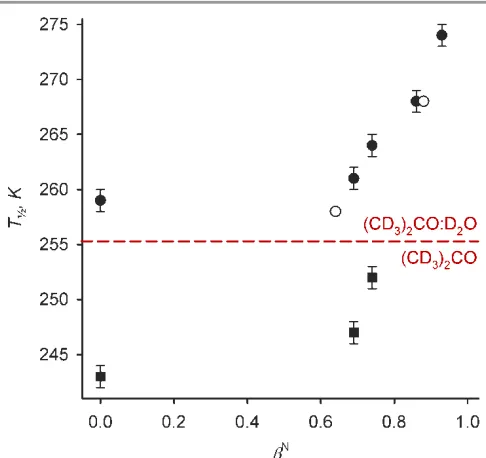
This correlates perfectly with the hydrogen-bonding capability of those anions, as expressed by Lungwitz and Spange’s N parameter (Fig. 2).22 Importantly, Goodwin’s original data for
[image:3.595.305.546.50.228.2]1[PF6]2 and 1I2 in an unspecified (CD3)2CO:D2O solvent
Table 1Spin-crossover parameters for the salts [Fe(3-bpp)2]X2(1X2) in 9:1
v/v (CD3)2CO:D2O and pure (CD3)2CO, measured by Evans method (Figs. 1 and 2) §. See ref. 22 for the definition ofN.
X–
N T
½, Ka H, kJ mol–1
S, J mol–1K–1
1X2, 9:1 v/v (CD3)2CO:D2O
BPh4– 0 259(1) 31.5(4) 121(2)
PF6– a 0.64 258 – –
BF4– 0.69 261(1) 30.6(4) 117(2) CF3SO3– 0.74 264(1) 29.9(4) 113(2) NO3– 0.86 268(1) 33.2(4) 124(2)
I– a 0.88 268 – –
Br– 0.93 274(1) 25.9(4) 95(2)
1X2, (CD3)2CO
BPh4– 0 243(1) 20.3(2) 83(1) BF4– b 0.69 247(1) 24.8(2) 100(1) CF3SO3– 0.74 252(1) 22.0(2) 87(1)
1[BPh4]2+y[NBu4]Br, 9:1 v/v (CD3)2CO:D2O
y= 0 – 259(1) 31.5(4) 121(2)
y= 0.78 – 264(1) 29.7(4) 111(2)
y= 1.71 – 269(1) 25.0(4) 93(2)
aFrom ref. 12. The stoichiometry of the (CD
3)2CO:D2O solvent mixture used in ref. 12 was not specified, but is probably similar to that in this work.20 bFrom ref. 20.
Fig. 1 Variable temperature magnetic susceptibility data for 1X2 in 9:1 v/v
(CD3)2CO:D2O, with X –
= BPh4 –
(black circles), BF4 –
(yellow squares), CF3SO3 –
(red diamonds), NO3
–
(cyan triangles) and Br–(green circles) §.
composition also agree well with these new results (Table 1, Fig. 2).12 The enthalpy and entropy of SCO for four of the salts in Table 1 (from van’T Hoff isochore plots) are similar, and are consistent with previously reported values for 1[BF4]2 in
(CD3)2CO:D2O mixtures.20The exception is1Br2, whose Hand
Svalues are unexpectedly lower, and closer to those shown by salts of 12+ in pure organic solvents including (CD3)2CO (Table
1). A reduction inHandSwas also observed when Br−was titrated into 1[BPh4]2 (see below, Table 1). We suggest that it
may reflect a weaker solvation shell about the 12+ cations induced by the strongly associated Br− anions, which would reduce the rearrangement of the solvent accompanying SCO. That remains to be confirmed, however. Notably nucleophilic displacement of 3-bpp from the iron centre by Br−, which is a potential side-reaction in the high-spin form of the complex, would have the opposite effect of raisingHandS.4
For comparison, the three 1X2 salts that are soluble in pure
(CD3)2CO were also measured in that solvent (Table 1, Fig. 2
and ESI†). The results are consistent with those above in showing a 9 K increase in T½ for 1[CF3SO3]2 compared to
1[BPh4]2, a slightly larger difference than in the more polar
solvent mixture. Lastly, titration of [NBu4]Br into1[BPh4]2 in 9:1
(CD3)2CO:D2O yielded an increase inT½with increasing bromide
concentration, that is consistent with the behaviour of the pure
1[BPh4]2and1Br2 salts (Table 1 and ESI†).
The salts1[BPh4]2,1[BF4]2,1[CF3SO3]2,1[NO3]2and1Br2all
show the same UV/vis metal-to-ligand charge-transfer (MLCT) maximum, atmax= 456 nm (max= 3.6±0.1 x10³dm3mol–1cm–1)
in 9:1 v/v (CH3)2CO:H2O at 293 K (ESI†). The invariance of these
spectra with the anion present is inconsistent with the Evans method data, sincemaxof this MLCT band should increase with
T½ which raises the low-spin fraction of the complex at room
temperature.20
[image:3.595.41.290.494.687.2]Fig. 2Plot of the spin-crossover mid-point temperatureT½of the salts1X2vs.the
hydrogen-bonding power of the X–anion (N 21) in 9:1 v/v (CD
3)2CO:D2O (circles) and pure (CD3)2CO (squares) §. The black data points are from this work, while the white circles are the I–and PF
6–salts measured by Goodwinet al.12The solvent dependence of these data is discussed in ref. 20.
In conclusion, we have demonstrated a dependence between spin-crossover in [Fe(3-bpp)2]
2+
(12+) and the presence of hydrogen bonding anions, in a polar solvent mixture at NMR concentrations (ca.10 mM). As with the [Fe(H2bip)2L]2+system,9
more strongly associating anions favour the low-spin state of the complex and increaseT½. That is noteworthy, because evidence
for the influence of hydrogen-bonding anions onT½in solid SCO
materials has been contradictory up to now.23
The sensitivity of
12+ to hydrogen bonding to anions (and to solvent20) arises
because the hydrogen bond-donor N−H groups in 3-bpp are
directly covalently bonded to the metal-donor N atoms. Hence small perturbations in the electronic character of the ligand, caused by changes in hydrogen bonding, are transmitted effectively to the coordinated iron atom.
Although the response of T½ to different anions in 12+ is
smaller than in [Fe(H2bip)2L]2+ derivatives, this work was
performed in more competitive solvents (including an acetone:water mixture) where hydrogen bonding between 12+
and X–
is expected to be weaker.13
The fact that any correlation between T½ and X– is observed under our conditions is
noteworthy for a monodentate hydrogen bond-donor like12+, and confirms that SCO in12+is sensitive to host:guest interactions. Therefore, the [Fe(3-bpp)2]2+motif is a promising platform for the
development of SCO-based sensor applications. Our current work aims to modify the 3-bpp ligand design, to maximise its host:guest binding capabilities.
This work was funded by the University of Leeds.
Notes and references
School of Chemistry, University of Leeds, Woodhouse Lane, Leeds, UK LS2 9JT. E-mail: [email protected]; Fax: +44 113 343 6565; Tel: +44 113 343 6506.
† Electronic Supplementary Information (ESI) available: Experimental details, elemental microanalysis, NMR, Evans method and UV/vis data. For ESI see DOI: 10.1039/####.
‡ The salt 1[NCS]216 was also investigated in this work. However,
solutions of this compound substantial amounts of uncoordinated 3-bpp by1H NMR (ESI†), which probably reflects competitive displacement of 3-bpp from the metal centre by the nucleophilic NCS– ion.24 For this reason,1[NCS]2was not investigated further during this study. Smaller
amounts (<10 %) of free 3-bpp are also present in solutions of 1[NO3]2
and1Br2by NMR, and ligand displacement equilibria may make a small
contribution toHandSof SCO in those salts.4,20
§ The differing values ofMTat the high- and low-temperature ends of these plots reflect the temperature window of the measurements, which was limited by the liquid range of the solvent. Hence the data do not cover the full the spin-state equilibria, which will span a temperature range ofca.150 K from start to finish.4,5TheT
[image:4.595.45.288.50.279.2]½values in Table 1 and Fig. 2, and the van’T Hoff plots, were calculated assuming that the fully high-spin complex exhibits MT = 3.5±0.1 cm3mol−1 K under all the conditions used. That approximation is supported by our earlier work.20
1 M. A. Halcrow (ed.), Spin-crossover materials - properties and applications, John Wiley & Sons, Chichester, UK, 2013, p. 568. 2 A. Bousseksou, G. Molnár, L. Salmon and W. Nicolazzi,Chem. Soc.
Rev., 2011,40, 3313.
3 A. Cannizzo, C. J. Milne, C. Consani, W. Gawelda, C. Bressler, F. van Mourik and M. Chergui,Coord. Chem. Rev., 2010,254, 2677. 4 N. Hassan, A. B. Koudriavtsev and W. Linert, Pure Appl. Chem.,
2008,80, 1281.
5 M. P. Shores, C. M. Klug and S. R. Fiedler, in Spin-crossover materials - properties and applications, ed. M. A. Halcrow, John Wiley & Sons, Chichester, UK, 2013, ch. 10, pp. 281–301.
6 C. Gandolfi, C. Moitzi, P. Schurtenberger, G. G. Morgan and M. Albrecht,J. Am. Chem. Soc., 2008,130, 14434; P. N. Martinho, Y. Ortin, B. Gildea, C. Gandolfi, G. McKerr, B. O’Hagan, M. Albrecht and G. G. Morgan,Dalton Trans., 2012,41, 7461.
7 J. Hasserodt,New J. Chem.,2012,36, 1707.
8 M. C. Young, E. Liew, J. Ashby, K. E. McCoy and R. J. Hooley,
Chem. Commun.,2013,49, 6331.
9 Z. Ni and M. P. Shores,J. Am. Chem. Soc., 2009,131, 32; Z. Ni and M. P. Shores,Inorg. Chem., 2010,49, 10727; Z. Ni, A. M. McDaniel and M. P. Shores,Chem. Sci., 2010,1, 615; Z. Ni, S. R. Fiedler and M. P. Shores,Dalton Trans., 2011,40, 944.
10 A. M. McDaniel, C. M. Klug and M. P. Shores,Eur. J. Inorg. Chem., 2013, 943.
11 H. L. Chum, J. A. Vanin and M. I. D. Holanda,Inorg. Chem., 1982,
21, 1146; J. W. Turner and F. A. Schultz,Inorg. Chem., 2001,40,
5296.
12 K. H. Sugiyarto, D. C. Craig, A. D. Rae and H. A. Goodwin,Aust. J. Chem., 1994,47, 869.
13 S. Kubik,Chem. Soc. Rev., 2010,39, 3648.
15 K. H. Sugiyarto and H. A. Goodwin,Aust. J. Chem., 1988,41,1645; K. H. Sugiyarto, K. Weitzner, D. C. Craig and H. A. Goodwin,Aust. J. Chem., 1997,50, 869.
16 K. H. Sugiyarto, M. L. Scudder, D. C. Craig and H. A. Goodwin,
Aust. J. Chem., 2000,53, 755.
17 T. Buchen, P. Gütlich and H. A. Goodwin, Inorg. Chem., 1994,33, 4573; T. Buchen, P. Gütlich, K. H. Sugiyarto and H. A. Goodwin,
Chem. Eur. J., 1996,2, 1134; S. Marcén, L. Lecren, L. Capes, H. A. Goodwin and J.-F. Létard, Chem. Phys. Lett., 2002,358, 87; K. H. Sugiyarto, W.-A. McHale, D. C. Craig, A. D. Rae, M. L. Scudder and H. A. Goodwin,Dalton Trans., 2003, 2443.
18 E. Coronado, M. C. Giménez-López, C. Giménez-Saiz and F. M. Romero, CrystEngComm, 2009, 11, 2198; M. Clemente-León, E. Coronado, M. C. Giménez-López, F. M. Romero, S. Asthana, C. Desplanches and J.-F. Létard,Dalton Trans., 2009, 8087; I. A. Gass, S. R. Batten, C. M. Forsyth, B. Moubaraki, C. J. Schneider and K. S. Murray,Coord. Chem. Rev., 2011,255, 2058.
19 P. King, J. J. Henkelis, C. A. Kilner and M. A. Halcrow,Polyhedron, 2013,52, 1449.
20 S. A. Barrett, C. A. Kilner and M. A. Halcrow,Dalton Trans., 2011,
40, 12021.
21 B. Weber and F. A. Walker,Inorg. Chem., 2007,46, 6794. 22 R. Lungwitz and S. Spange,New J. Chem., 2008,32, 392. 23 M. A. Halcrow,Chem. Soc. Rev., 2011,40, 4119 and refs therein. 24 D. Fedaoui, Y. Bouhadja, A. Kaiba, P. Guionneau, J.-F. Létard and P.
![Table 1 Spin-crossover parameters for the salts [Fe(3-bpp)2]X2 (1X2) in 9:1v/v (CD3)2CO:D2O and pure (CD3)2CO, measured by Evans method (Figs](https://thumb-us.123doks.com/thumbv2/123dok_us/7923477.192171/3.595.41.290.494.687/table-spin-crossover-parameters-measured-evans-method-figs.webp)