Doctorate of Philosophy
Computational Investigation of the
Oxygen Evolving Complex of
Photosystem II and Related Models
via
Density Functional Theory
Doctoral Dissertation of:
Prof. Robert Stranger
Advisors:
Prof. Ronald J. Pace
Dr Simon Petrie
Supervisor of the Doctoral Program:
Prof. Gottfried Otting
Declarations
Except where specific reference is made to other sources, the work pre-sented in this dissertation is the work of the author. It has not been submitted, in whole or in part, for any other degree.
Declarations regarding individual publications
The following citations comprising this thesis by compilation are valid and the contributions of the candidate to the research and authorship of each are accurately enumerated in their accompanying introductions.
I. Terrett, R.; Petrie, S., Pace, R.J.; Stranger, R.; What does the Sr-substituted 2.1 Å resolution crystal structure of photosystem II reveal about
the water oxidation mechanism?; Chemical Communications 50 (2014) pp. 3187–3190 doi:10.1039/C3CC49324E(In Press)
II.Terrett, R.; Frankcombe, T., Pace, R.; Stranger, R.;Effect of concomi-tant oxidation and deprotonation of hydrated Mn centres in rationalising the
FTIR difference silence of D1-Asp170 in Photosystem II; Journal of Inorganic
Biochemistry 155 (2016) pp. 101–104 doi:10.1016/j.jinorgbio.2015.11.023
(In Press)
III.Terrett, R.; Petrie, S.; Stranger, R.; Pace, R.J.;What computational chemistry and magnetic resonance reveal concerning the oxygen evolving
centre in Photosystem II; Journal of Inorganic Biochemistry 162 (2016) pp. 178–189; doi:10.1016/j.jinorgbio.2016.04.009(In Press)
IV. Terrett, R.; Stranger, R.; Frankcombe, T.; Pace, R.J.; Vibrational Intensities in the Mobile Block Hessian Approximation; 19 (2017) pp. 6654– 6664; doi:10.1039/C6CP07498G(In Press)
Preface
This thesis consists of a compilation of publications relating to the com-putational investigation of the Mn4CaO5 cofactor of the Photosystem II (PSII) holoenzyme, which is implicated in the light-driven four-electron oxidation of water (2 H2O−−−→4 e–+ O
2+ 4 H+). This reaction constitutes
the first step of photosynthetic metabolism in the chloroplasts of plants and cyanobacteria.
Photosynthetic water oxidation is of great practical interest as it pro-vides a concrete example of facile hydrogen and oxygen production through a photo-assisted process. Whereas approximately 90% of hy-drogen production in the world is presently achieved through catalytic reforming of fossil fuels (with a minority achieved through brine electroly-sis), adapting insights from photosynthetic water oxidation is anticipated to furnish significantly more economic and sustainable routes to the pro-duction of hydrogen. This hydrogen may either be used directly as a fuel or as an intermediate product in the synthesis of value-added products.
diffractometry in the investigation of PSII. Nevertheless, key mechanistic and electronic details of water oxidation still remain highly contentious. Elucidation of these details is complicated by the fact that the active site of Photosystem II exists in four natural metastable oxidation states, as well as putative unnatural forms that are plausibly induced during experimental investigation.
Acknowledgements
This project would have been impossible or at the very least much more onerous in the absence of a number of individuals and organisations who lent technical, financial, and emotional support to this undertaking. In the first instance, my supervisory panel (composed of Prof. Rob Stranger, Prof. Ron Pace and Dr Simon Petrie) have furnished me with expert guidance and supervision, have kept me on track and have demonstrated a considerable degree of perserverence and understanding in accomodating my program, for which they should be well-credited.
My parents (Les and Vikki Terrett) have contributed considerable financial and emotional support without which this endeavour would have been impossible, whilst my girlfriend, Dr Erin Walsh, has been my constant companion and muse throughout this program. Her family (Kathy and Bernard Walsh) have also been a wellspring of hospitality and encouragement. Erin’s coworkers at the Research School of Psychology (Dr Yiyun‘Cloudy’Shou and Prof. Michael Smithson) have further offered stimulating and friendly discussion during my interactions with them.
Withers, and Dr Lasse Noren. Additionally, a number of PhD, honours and undergraduate research students who have passed through and each contributed to the accumulated formal and informal wisdom and camer-aderie of the group should be acknowledged, including but not limited to Dr Gemma Christian, Dr Phillip Gatt, Dr Erandi Kulasekara, Dr Fazira Razak, Dr Jinasena Hewage, Dr Somayeh Rastegar, Mahesh Kodikara, Bernard Baituti, Zöe Buxton, Amy Kendrick, Kassetra von Nessi, and Maki Maeda. I would like to thank the RSC IT department (Dr Christo-pher Delfs, Dr Graeme Lindsell, and Hamish McArthur–Onslow) and members of the RSC front office, including Gavin Perri and Allison Scott, for keeping everything running smoothly. The NCI National Facility staff—particularly Dr Rika Kobayashi—should be commended for their preternatural commitment to the upkeep and uptime of the XE, AC, Vayu and Raijin supercomputers.
I would furthermore like to thank the developers of the Amsterdam Density Functional (ADF) software, who have always been willing to provide expert support for a well-crafted DFT code. Computational chem-istry software is a recherché field, however ADF comports itself with the
Principle of Least Astonishmentmuch more often than many other pack-ages I have used.
ANU PhD Scholarship (furnished by the Australian National University), the Adrien Albert Honours Prize, the RSC Supplementary Scholarship, and the A.S. Sargeson Supplementary Scholarship (furnished by the Aus-tralian National University Research School of Chemistry).
This document was typeset using the PDFLATEX typesetting
sys-tem. It is based on modifications of a template graciously provided
by Federico Maggi, which is in turn based on thememoirclass
cre-ated by Peter Wilson.
The document is typeset using the Johannes Kepler fonts by
Christophe Caignaert.
Illustrations appearing in this document were variously created
using the Inkscape vector graphics suite, the Blender 3D graphics
suite and Cycles rendering engine, the PyMOL chemical
visualisa-tion suite created by Warren DeLano, and the R project for statistical
computing. HDRi maps for illumination of 3D graphics were
gra-ciously provided by Alejo Grigera.
The bibliography of this dissertation is presented in the IEEE
style, using the BibLATEX package. If you are reading a digital edition
of this dissertation, you should be able to click in-text citations to
reach their respective entries in the bibliography, as well as click
digital object identifier (DOI) entries to conveniently access them
Abstract
The first step of photosynthetic metabolism effects the facile oxi-dation of water to dioxygen and hydrogen cations. This is achieved
through an incompletely-understood process of light-driven
four-electron oxidation at the Mn4CaO5cofactor of the Oxygen-Evolving
Complex (OEC) of the Photosystem II (PSII) holoenzymatic complex
in photosynthetic autotrophs. Biomimesis of this reaction—artificial
photosynthesis—may offer energy-efficient routes to industrial hy-drogen generation and value-added derivatives, with implications
for solar energy fixation. This thesis consists of a compilation of
four publications relating to Density Functional Theory (DFT)
stud-ies of structural and spectroscopic aspects of the Oxygen-Evolving
Complex (OEC) of PSII. These publications consist of research
re-solving the basis of structural anomalies in metal-substituted PSII,
combinatoric simulation of difference spectra corresponding to
proton-coupled oxido-reduction scenarios of PSII models,
simu-lation of the hyperfine and superexchange magnetic interactions in
PSII models, and the development of a methodology for obtaining
vibrational intensities in the Mobile Block Hessian (MBH)
approxi-mation, with applications to accelerated modeling of the vibrational
structure of complex models of PSII, as well as other large molecules.
These publications are presented alongside explanatory
photosynthesis research, context for the relevance of this research,
and methodological discussion. Concluding remarks are also
List of Figures xxiv
List of Tables xxviii
Acronyms xxxi
1 Photosynthesis, Natural and Artificial 1
1.1 What is Photosynthesis? . . . 1
1.2 Natural Photosynthesis . . . 3
1.2.1 Photosystem II . . . 3
1.2.2 The Oxygen Evolving Complex . . . 6
1.2.3 The Joliot–Kok Cycle . . . 8
1.2.4 Characterisation of OEC structure . . . 10
1.2.5 Mn4CaO5 cofactor topology . . . 15
1.2.6 Mn4CaO5 cofactor ligation . . . 15
1.2.8 Morphological differences between extant OEC structures . . . 20 1.3 Artificial Photosynthesis . . . 21 1.4 Synthetic Water Oxidation Catalysts with OEC-like Motifs 23
1.4.1 The oxo-manganese heterocubane of Dismukes and coworkers . . . 24 1.4.2 Oxo-Cobalt Cubanes . . . 26 1.5 Integrated Artificial Photosystems . . . 28 1.5.1 Dye-sensitised Solar Cells (DSSCs) / (Grätzel) cells 29 1.5.2 DSSC water photolysis . . . 32 1.5.3 Tandem water-splitting cells . . . 33
2 The Wider Context 35
2.1 Photosynthesis in the Human World . . . 36 2.1.1 Ecological Relevance . . . 36 2.1.2 Economic and Geopolitical Relevance . . . 41 2.1.3 Renewable and Non-Renewable Energy and The
2.4 Speculative modalities . . . 53
2.4.1 Thermolysis . . . 54
2.4.2 Nuclear/Electrochemical Water Splitting . . . 54
2.4.3 Metal oxidation . . . 57
2.5 Conclusion . . . 58
3 Computational Chemistry 59 3.1 Introduction . . . 59
3.2 Practical Computational Considerations . . . 62
3.2.1 Processor Speed and Memory . . . 62
3.2.2 Parallelism . . . 64
3.3 Molecular Mechanics / Molecular Dynamics . . . 65
3.4 Coarse-Grained Dynamics . . . 69
3.5 Electronic Structure Methods . . . 69
3.5.1 The Variational Principle . . . 70
3.5.2 Geometry Optimisation, Transits and Transition State searches . . . 71
3.5.3 Density Functional Theory . . . 71
3.5.4 Born–Oppenheimer Approximation . . . 76
3.5.5 Broken-Symmetry . . . 77
3.5.6 Basis Sets . . . 78
3.5.8 Solvent interactions and the Polarisable Continuum
Model . . . 81
3.6 Reconciliation of QM and MM/MD calculations by multi-level methods . . . 83
3.7 Vibrational Structure . . . 84
3.7.1 Vibrational analysis of molecular regions . . . 85
3.8 Conclusion . . . 85
4 Introduction to Paper I: Strontium substitution of PSII 87 4.1 Citation . . . 88
4.2 Introduction . . . 88
4.3 General Ca2+substitution . . . 89
4.4 Contributions to this work . . . 91
4.4.1 Exploratory calculations . . . 92
4.4.2 Model construction and evaluation . . . 92
4.4.3 Model refinement and identification . . . 93
4.4.4 Contributions to manuscript . . . 93
5.2 Introduction . . . 100 5.3 D1-Asp170 silence in PSII . . . 100 5.4 Rationale for the work . . . 102 5.5 My contribution to this work . . . 106 5.5.1 Preparation of computational models . . . 106 5.5.2 Normal mode analysis . . . 107 5.5.3 Generation of combinatoric difference spectra . . . 107 5.5.4 Spectral integration and optimisation . . . 107 5.5.5 Code parallelism . . . 107 5.5.6 Molecular and spectral visualisation . . . 108 5.5.7 Compilation of manuscript . . . 108 5.6 Opportunities for future research . . . 108
Paper II: Combinatoric investigation of FTIR difference-silence
of D1-Asp170 of PSII 111
6 Introduction to Paper III: EPR studies of PSII 115
6.3.4 Data postprocessing and tensor visualisation . . . 121 6.3.5 Graphic preparation . . . 122 6.3.6 Contributions to manuscript . . . 122
Paper III: EPR studies of PSII 125
7 Introduction to Paper IV: Infrared intensities in the MBH
ap-proximation 137
7.1 Citation . . . 138 7.2 Introduction . . . 138 7.3 My contribution to this work . . . 139 7.3.1 Development of methodology . . . 139 7.3.2 Implementation of software . . . 141 7.3.3 Benchmarking of MBH intensities methodology . . 142 7.3.4 Analysis and discussion . . . 143 7.4 Prospective derivative research . . . 143
Paper IV: Infrared intensities in the MBH approximation 145
8 Conclusion 157
1.1 Dimeric PSII holoenzyme, 300 pm structure of Loll,et al. . . 4 1.2 Schematic representation of the locale of PSII within a plant cell. 5 1.3 Illustration of the OEC and coordinating amino acids in
monomer ‘A’ of PSII. . . 7 1.4 Simplified illustration of the photosynthetic S-state (Joliot–
Kok) cycle. . . 9 1.5 Schematic representation of the OEC Mn4CaO5 cofactor and
conventions used to define orientations of OEC. . . 16 1.6 Crystallographic geometries of the PSII OEC. . . 17 1.7 Schematic representation of OEC ligation network. . . 18 1.8 Representation of the magnetic coupling graph of the PSII OEC. 18 1.9 Schematic representation of contributory Kramers–Anderson
1.11 Representation of oxo-metal cubanes. . . 23 1.12 Schematic representation of a dye-sensitised solar cell. . . 30
2.1 Trends in Australian annual mean temperature anomaly be-tween 1910 and 2015. . . 37 2.2 Trends in global annual mean temperature anomaly between
1910 and 2015. . . 38 2.3 Schematic representation of the greenhouse effect. . . 39 2.4 Trends in historic atmospheric CO2 concentration between
1700 Common Era (CE) to 2015. . . 40 2.5 Deseasonalised trends in oil import and export in the United
States of America between 1972 and February 2017. . . 44 2.6 Prototypical Hubbert curve. . . 47
3.1 Overview of relationships between computational chemistry methods. . . 61 3.2 Peak supercomputer processing power over time. . . 63 3.3 RAM price over time, not adjusted for inflation. . . 64 3.4 A generic 2-node compute cluster. . . 66 3.5 Generic illustration of a periodic potential energy surface. . . 72 3.6 Illustration of approximate hierarchies in density functionals
4.1 Plot of various parameters cogent to metal substitution of Ca2+ in the PSII OEC. . . 90
5.1 Representation of generic small molecule model used in FTIR difference spectroscopy study. . . 103 5.2 FTIR difference intensity scenarios. . . 105 5.3 Abstract representation of locally and globally optimal diff
er-ence paths. . . 109
6.1 Representation of tensor glyph schemes. . . 123
ADF Amsterdam Density Functional. 27, 118, 119, 121, 141
ASIC Application Specific Integrated Circuit. 67
CE Common Era. xxv, 40
CI Configuration Interaction. 72
COSMO Conductor-Like Solvent MOdel. 82
CPU central processing unit. vii, 62, 66, 68
CUDA Compute Unified Device Architecture. 67
DAG directed acyclic graph. 104
DFT Density Functional Theory. vii, xiii, 60, 62, 71–74, 86, 161, 163
DOI digital object identifier. xii
ECP Effective Core Potential. 80
EEZ exclusive economic zone. 44
ENDOR Electron-Nuclear Double Resonance. 27
EPR Electron Paramagnetic Resonance. 10, 13, 14, 27, 116, 119, 121, 122
ESR Electron Spin Resonance. 13
EXAFS Extended X-ray Absorption Fine Structure.
10–12, 25, 164
FEA Finite Element Analysis. 69
FPGA Field Programmable Gate Array. 68
FRET Förster Resonance Energy Transfer. 3
FTIR Fourier transform infrared. 100, 101, 104, 142, 163, 164
GGA Generalised Gradient Approximation. 75, 119
GPGPU General Purpose processing on Graphical
HDvV Heisenberg–Dirac–van-Vleck. 116
HTE High Temperature Electrolysis. 52
IPCC Intergovernmental Panel on Climate Change. 40
LDA Local Density Approximation. 74, 119
LHC Light-Harvesting Complex. 3
MBH Mobile Block Hessian. xiii, 69, 85, 138, 141– 143, 164
MD Molecular Dynamics. 62, 65–68, 86
ML multiline. 14
MM Molecular Mechanics. 65, 67, 86
OEC Oxygen-Evolving Complex. xiii, xvi, xvii, xxiv, 3, 4, 6–20, 22–24, 28, 88, 89, 91–93, 100– 102, 108, 116–119, 142, 143, 159, 161–165
OPV organophotovoltaic. 29, 32
PES potential energy (hyper)surface. 71, 84
PHVA Partial Hessian Vibrational Analysis. 139
PSII Photosystem II. vi, vii, xiii, xxiv, 3–13, 15, 17, 18, 20–24, 33, 52, 88–92, 100–102, 108, 116–119, 142, 143, 159, 161–165
PW plane-wave. 78
QM Quantum Mechanics. 66, 69, 86
SES Solvent-Excluding Surface. 82
STP standard temperature and pressure. 51
VSEPR Valence Shell Electron Pair Repulsion. 66
VTK Visualisation Toolkit. 121
WOC Water-Oxidising Complex. 6
XC eXchange–Correlation. 73
XFEL X-ray Free Electron Laser. vi, 7, 12, 13
Stand a little out of my sunshine
Diogenes of Sinope
1.1
What is Photosynthesis?
on from herbivory of these autotrophs. There are notable exceptions to photosynthesis as an ultimate source of biological energyahowever they are distinguished by their provinciality and transience, whereas stellar evolution is nothing if not ponderous.
The evolution of photosynthetic life on Earth precipitated epochal changes in Earth’s biogeochemistry, including the considerable reconstitu-tion of the ancient atmosphere. [12] It is photosynthesis that is responsible for almost all free dioxygen on the planet, and the generation of this oxy-gen by the emeroxy-gence of photosynthetic organisms approximately 2.4 Ga before present is correlated with considerable changes in the palaeo-geochemical record.bNotably, increasing oxygen concentrations in the atmosphere and oceans precipitated a mass extinction of anaerobic life. This transition in Earth’s palaeobiogeochemical history is termed the
‘oxygen catastrophe’, and was also accompanied by a dramatic drop in the atmospheric concentration of CO2 and H2. [14] Nevertheless, the oxygenation of the atmosphere paved the way for aerobic respiration and the wide variety of complex lifeforms it supports.
aIncluding the symbiotic chemosynthetic ecosystems that have evolved to exploit the
heat and chemistry of underwater volcanic features including so-called‘black smokers’ and recently discovered and quite chemically distinct‘Lost City’-type features. [2], [3] There now exists evidence that reduced hydrocarbons supporting chemosynthetic mi-crobiota at these sites may be in part produced abioticallyviageological serpentinisation and Fischer–Tropsch pathways, and that chemosynthetic microbiota may extend quite some distance into the suboceanic mantle. [4]–[8] Additionally, submarine features involving the percolation of lower temperature hydrocarbons through the seabed such as so-called‘cold seeps’and‘asphalt volcanoes’are known to support ecosystems. [9]–[11] bAlthough see [13] for a recent presentation of evidence of nontrivial atmospheric
1.2
Natural Photosynthesis
1.2.1
Photosystem II
Photosystem II (PSII) is a transmembrane holoenzyme (i.e.a supramo-lecular complex of multiple associated proteins) which transfixes the thylakoid membrane. The thylakoid (from Greek θύλακος,‘sac’ + -oid)
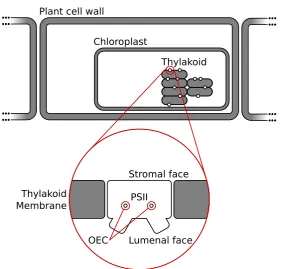
is contained within the chloroplast, which is itself situated inside a photosynthetic cell. The schematic relationship of these components is illustrated in Figure 1.2. PSII is composed of 17 transmembrane sub-units held together by supramolecular interactions, as well as a collection of extrinsic and integrated cofactors. [15] PSII is implicated in the pho-tooxidation of water in plant metabolism. In this process, four oxidising equivalents are accumulated by the oxidation of manganese ions within the Oxygen-Evolving Complex (OEC), a bioinorganic cofactor within PSII. These oxidising equivalents are ultimately generated by a Förster Reso-nance Energy Transfer (FRET) process originating in Light-Harvesting Complex (LHC) proteins which are embedded proximate to PSII in the membrane, potentially supplemented by supramembrane phycobilisomes and other peripheral antenna units supplementing the light-harvesting efficiency of the gross photosynthetic apparatus. [16]
a)
b)
F i g u r e 1 . 1: Dimeric PSII holoenzyme, 300 pm structure of Loll,et al., [17] viewed perpendicular to thylakoid normal.a)Polypeptide structure of PSII. Note the visually distinctive parallelα helices, which interface with and transfix the thylakoid membrane. b) Non-peptide cofactors of PSII, including chlorophylls, carotenoids, and the OEC Mn and Ca ions (represented as spheres) in the center-left and right of the figure. The OECs are related by an approximateC2rotation element, vertically
[image:42.595.103.474.129.621.2]Plant cell wall
Chloroplast
Thylakoid
Stromal face
Lumenal face PSII
OEC Thylakoid
Membrane
F i g u r e 1 . 2: Schematic representation of the locale of PSII within a plant cell. The PSII dimer is a transmembrane protein that transfixes the thylakoid membrane. The thylakoid is located inside the chloroplast, which is in turn located within the plant cell.
to the phospholipid bilayer in which it is embedded. Differential hy-drophobicity of the surface residues of PSII along this axis stabilise the transfixation of PSII to the thyalakoid membrane. Concretely, the holoen-zyme possesses a transverse region exposing a large number of alpha helices perpendicular to the thylakoid surface, which interface with de-tergent cofactors and the membrane.c
In crystallographic structures of PSII, the visually apparent associ-ation of water molecules with the lumenal and stromal surfaces of the
cBlankenship, R.E. Ch. 6 offers a good survey of the gross morphology of PSII and
[image:43.595.163.445.106.375.2]holoenzyme, and absence of peripheral waters in the transmembrane re-gion permits facile identification ofwater channelsin the structure. These water channels are networks of water molecules and associated cofactors which provide a route for diffusive transport of water molecules and protons to and from the active site of PSII, the Oxygen-Evolving Complex (OEC). [15]
1.2.2
The Oxygen Evolving Complex
The Oxygen-Evolving Complex (OEC), also known as the Water-Oxidising Complex (WOC), is a cofactor coordinated by the D1 and CP43 subunits of PSII. It has been identified as the site where storage of four oxidising equivalents and catalytic oxidation of water takes place, effecting the net reaction given in Equation 1.1.
2 H2O−−−→4 e−+ O
2+ 4 H+ (1.1)
The gross morphology of the OEC is characterised as a distorted het-erometallic cubane comprised of three Mn ions (Mn1,2,3) and a calcium ion bound by cappingoxoligands, and a further pendant Mn (Mn4) con-nected to the cubaneviaMn3by a furtherµ2-oxobridge as well as weak interactions with the O5 atom, which is of contentious identity and con-nectivity. A recent crystallographic geometry of the PSII OEC obtained by Umena,et al.is illustrated in Figure 1.3. [15]
The proton concentration gradient generated across the thylakoid membrane by water oxidation powers membrane-transfixing ATPases, representing the first step in the so-called photosynthetic Z-Scheme.d [19]
N Mn1 Mn2
Mn3 Mn4
Ca W4
W3
W2
W1 O
4
O5
O3
O1
O2 D1-Asp342
D1-Glu189
D1-His332
D1-Glu333
D1-Asp170 D1-Ala344
CP43-Glu354
F i g u r e 1 . 3: Illustration of the OEC and coordinating amino acids in monomer ‘A’ of PSII, adapted from the 190 pm-resolution XFEL crystallo-graphic geometry of Umena,et al.Inorganic cofactor has been visually highlighted. (PDB accession code4ub6/a).
1.2.3
The Joliot–Kok Cycle
Studies originating in the 1960s involving short-duration illumination of dark-adapted chloroplasts reveal that PSII water photo-oxidation is a four-photon process which cycles the OEC through four oxidation state configurations, termedS-states. This cycle is known as the Kok or Kok– Joliot cycle, after Pierre Joliot, who experimentally resolved the cycle, and Bessel Kok, who offered a kinetic theory for the periodicity of the cycle. [20], [21] The cycle is illustrated in Figure 1.4. The existence of inter-mediate photoexcited states of the OEC that are built upon by further excitation may be inferred from the Emerson–Arnold experiments [22], [23] which evidenced tuneability in oxygen yieldviadark period duration, and the observation of Allen and Franck that oxygen evolution is sup-pressed in dark-adapted PSII in single-flash scenarios, [24] a phenomenon which is now understood to be the result of regression of the OEC to the
S1state from statesS2−3. The oxidation state distribution within the OEC
3 3 3 4 2 3 3 3
2 3 4 4 S0
2 3 3 4 3 3 3 3
3 3 4 4 S1
3 4 4 4 3 3 3 4
S2
4 4 4 4 3 3 4 4
S3
S4
O2 + 4H+ 2H2O
Low oxidation state paradigm
High oxidation state paradigm
(net reaction)
hν hν hν
hν
F i g u r e 1 . 4: Simplified representation of the two predominant paradigms for oxidation state progression in PSII, based on the work of Krewald,et al.[25]
It was inferred that oxygen evolution occurs only in the transition
S4→S0, though massed chloroplastic PSII rapidly desynchronises due to
double-excitations, missed excitations and spontaneous state regression. [20] Nevertheless, theS0andS1 intermediates are kinetically stable and
theS2 andS3 states have lifetimes on the order of seconds to minutes.
TheS4state spontaneously oxidises water and reverts to theS0 state on
for application of this insight in OEC Electron Paramagnetic Resonance (EPR).)
1.2.4
Characterisation of OEC structure
Characterisation of the PSII OEC by diffractometric methods has been an area of intense interest. Prior to a complete understanding of the general connectivity of the OEC, important diagnostic information on the rela-tionship between metal ions in the OEC was obtainedviaExtended X-ray Absorption Fine Structure (EXAFS) and EPR, and these techniques remain valuable adjuncts in OEC structural and mechanistic characterisation. [31]
1.2.4.1 X-ray absorption methods
X-ray absorption techniques such as Extended X-ray Absorption Fine Structure (EXAFS) spectroscopy can furnish useful information regarding bioinorganic cofactors within proteins. Briefly, EXAFS measures pertur-bations at a core electron absorption edge due to photoelectron resonance with nearby atoms. EXAFS is capable of obtaining indirect geometric information regarding such cofactors, whilst placing few burdens on experimentalists in terms of sample preparation.e [32] As EXAFS only
eAlthough Cinco,et al.cite contamination of samples by exogenous ions of the same
obtains the distances between atoms and nearby photoelectron-scattering nuclei, EXAFS data may be necessarily topologically ambiguous, however the technique can be an important adjunct to other analyses.
Prior to the production of high-resolution X-ray structures capable of identifying the connectivity of the OEC, Cinco,et al.established the presence of a Ca/Mn cluster within the OECviaCa K-edge EXAFS. [31] Concretely, the data indicated a 340 pm Ca· · ·Mn vector. At this point, it was known that Ca was an essential ion for photosynthetic metabolism, however it was not known how Ca related geometrically to Mn. Cinco,
et al.also obtained Sr K-edge spectra consistent with Sr substitution for Ca, establishing the mode of poisoning of photosynthetic activity in Sr-substituted PSII prior to the availability of Sr-Sr-substituted XRD data (see Chapter 4). These data indicated the presence of oxo-bridges of some form between the Mn ions and the heterometal.
1.2.4.2 X-ray photodamage of the OEC
A potential confound in X-ray studies of PSII is the possible photoreduc-tion of the OEC by X-ray irradiaphotoreduc-tion. This was identified by Suga,et al.as a plausible cause of dissimilarities in OEC internuclear distances between their femtosecond X-ray diffraction (§1.2.4.3) and EXAFS data. In this scenario, discrepancies are generated by photoreduction of Mn ions, gen-erating putativeS-states (see §1.2.3) belowS0. [34] Contrariwise, Yano, et al.indicated that EXAFS produces less photodamage than non-pulse XRD due to the lower specific energy of the EXAFS technique. [33]
1.2.4.3 Crystallographic characterisation
In 2011, Umena,et al.produced an X-ray crystal structure based on single-crystal synchrotron irradiation at a resolution of 190 pm, permitting unambiguous identification of the atoms within the OEC and furnishing interatomic distances with a low degree of measurement uncertainty. [15] This structure was supplemented with an improved 195 pm structure by means of X-ray Free Electron Laser (XFEL) irradiation in 2015. [34] This technique uses an ultra-short (t≤10 fs) X-ray pulse of extreme specific brilliance (delivering 1.4 MGy·µm−2per pulsef).
Whilst possessing a lower absolute resolution factor compared to the
fOn the basis of the experimental section of Suga,et al., XFEL pulses in this
precedent 190 pm structure, the 195 pm structure is considered supe-rior to its predecessor structure on the grounds of the mitigation of the presence of photodamage in the structure (see §1.2.4.2). Whilst catas-trophic (and sometimes non-local) damage to the crystal occured in this experiment, the extremely short duration of irradiation produced a non-time-averaged‘snapshot’of the crystal structure. This structure therefore lacks structural relaxation that would occur due to the photoreduction of Mn ions. This principle is termed‘diffraction before destruction’, and has been explored theoretically by Jurek,et al., wherein XFEL irradiation of molecular clusters is seen to produce almost complete ionisation, eliciting isotropic Coulombic explosion over a timeframe of tens of femtoseconds. [35] In practice, Suga,et al.found that XFEL irradiation of prepared PSII crystals produced non-local macroscopic damage in some instances, ne-cessitating careful selection of sufficiently spatially separated irradiation sitesgon multiple crystals. [34] Nevertheless, XFEL diffractometry should be considered the gold-standard of crystallographic characterisation of PSII.
1.2.4.4 Electron Paramagnetic Resonance
Electron Paramagnetic Resonance (EPR)/Electron Spin Resonance (ESR) has proven to be a powerful tool in characterising the OEC, as it permits
the inference of information regarding Mn oxidation state distributions inside the OEC. In cryogenic EPR analysis of theS2state, the OEC
pos-sesses a complex Mn nuclear hyperfine structured feature (commonly referred to as the multiline (ML) signal) centered atg≈1.98, as well as a broad feature atg≈4.1. [36] The presence of the multiline (ML) feature was used to argue for a probable MnIIIMnIV or MnIIMnIII dimer in the OEC before the topology of the OEC was established by XRD. [37] The presence of 4 Mn ions in the OEC had been previously established by stoichiometric studies ([38] and references therein). The observed ML signal is consistent with both the high and low oxidation state paradigms later established, which both contain potential MnIIIMnIVdimers (Figure 1.4).
1.2.5
Mn
4CaO
5cofactor topology
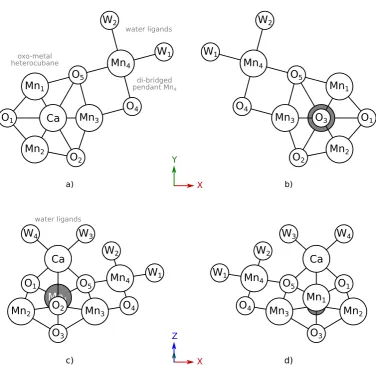
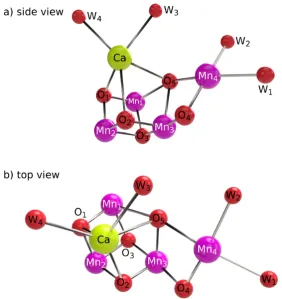
Broadly, current understanding of the OEC oxo-metal cofactor indicates the presence of an oxo-manganese heterocubane, with one metal vertex substituted by a calcium ion and labelled manganese ions Mn1, Mn2 and Mn3 constituting the remaining three vertices. Labelled oxygen atoms O1, O2, O3and O5comprise theµ3-oxovertices of this cubane. The fourth manganese—labelled Mn4—is connected to Mn3 viaputativeµ2-oxo lig-and O4 andviaO5, which is of contentious bridging character, but which is reasonably interpreted as a di-bridged ion pendant to the heterocubane. The geometry of the cluster is illustrated schematically in Figure 1.5, absent coordinating histidyl or carboxylate ligands and interstitial wa-ters. Additionally, four putativeµ-aqualigands labelled W1, W2, W3 and W4 coordinate the complex, with two coordinating Mn4and completing the octahedral coordination environment of this ion, and an additional closely associated with the Ca ion. Crystallographic geometries of the PSII OEC are presented in Figure 1.6, based on the 1.95 Å XFEL structure of Suga,et al.[34]
1.2.6
Mn
4CaO
5cofactor ligation
O2 Mn 2 Mn3 Mn4 Mn1 Ca O1 O3 O5 O4 W1 W2
W3 W4
d) X Z Y X Mn3 O3 O1 Mn1 Mn2 Mn4 O5 O4 O2 Ca W1 W2 Ca
Mn3 O3 O1
Mn1 Mn2 Mn4 O5 O4 O2 W1 W2 a) b) oxo-metal heterocubane di-bridged pendant Mn4
water ligands
Mn2 Mn3
Mn4 Mn1 Ca O2 O1 O3 O5 O4 W1 W2 W3 W4 c) water ligands
F i g u r e 1 . 5: Illustration schematically representing the OEC Mn
4CaO5
[image:54.595.104.481.170.535.2]F i g u r e 1 . 6: Crystallographic geometries of the PSII OEC, based on the X-ray structure provided by Suga,et al.[34]
This coordination is illustrated schematically in Figure 1.7.
1.2.7
Mn
4CaO
5spin network
[image:55.595.161.444.110.410.2]Mn1
Mn2
Mn3
Ca Mn4
Glu189 Asp170
Glu354 Ala344
Asp342
Glu333 His332
CP43 subunit D1 subunit
F i g u r e 1 . 7: Schematic representation of amino acids of D1 and CP43 polypeptides ligating the PSII OEC. All ligation occurs through sidechains except for D1-Ala344, which is the C-terminus of the D1 subunit and ligatesviatheα-carboxylate of the amino acid.
[39] The character and degree of the superexchange-mediated spin-spin interaction is in part dependent on the precise geometry of the bridging ligand with respect to the metal ions, however it is typically several orders of magnitude larger than that which would be predicted for unbridged cations. [40]
Mn3
Mn1
Mn2
Mn4
J12
J23
J13
J14
J34
Mn3
Mn1
Mn2
Mn4
J12
J23
J13
J34
a) b)
F i g u r e 1 . 8: Representation of the magnetic coupling graph of the PSII OEC, subsuming multiple potential superexchange pathways into Jij
Mn3 O3 O1 Mn1 Mn2 Mn4 O5 O4 O2 J12 Mn3 O3 O1 Mn1 Mn2 Mn4 O5 O4 O2 J23 Mn3 O3 O1 Mn1 Mn2 Mn4 O5 O4 O2 J13 Mn3 O3 O1 Mn1 Mn2 Mn4 O5 O4 O2 J34 Mn3 O3 O1 Mn1 Mn2 Mn4 O5 O4 O2 J14
1.2.8
Morphological di
ff
erences between extant OEC
structures
Whilst being broadly consistent in gross structure with the 190 pm struc-ture, the 195 pm PSII structure of Suga,et al.possesses a distinct coordi-nation geometry of O5 with respect to the earlier structure. [34] Suga,et al.note that the O5 position is somewhat biased towards Mn3 and Mn4 compared to the 190 pm structure, wherein O5is more evenly associated with Mn1, Mn3, Mn4 and Ca. The authors interpret this as potentially indicating preferential photoreduction of Mn4 in the 190 pm structure.h The authors suggest that this provides some data on the relative suscepti-bility of the Mn ions to reduction (specifically, Mn1 with respect to Mn4). They indicate that this may be due to the relative solvent accessibility of Mn4(which has two binding sites foraqualigands) with respect to Mn1, which is coordinatively saturated withoxo-caps or peptide termini.
Suga,et al.point out commonality with computational and theoretical results that produce preferential association of O5 with either Mn1 or Mn4. [34]
hThis would suggest that while photodamage may be stochastic(albeit weighted
1.3
Artificial Photosynthesis
Artificial photosynthesis is the replication of key aspects of plant photo-synthesis in artificial systems. This definition usually implies the harvest-ing of solar photons to generate a redox potential catalysharvest-ing a chemical reaction germane to plant physiology, such as the oxidation of water the reduction of protons, or the fixation of carbon dioxide associated with plant respiration.
Artificial photosynthesis systems (artificial photosystems) are typically most appealing if they are chemically simple, robust to photodamage and other forms of degradation (potentially by recourse to self–repairing and self-assembling behaviour) and are manufacturable with cheap, earth-abundant materials. Earth-abundance refers to the abundance and facile provenance of a material at or near the Earth’s surface. These desirable properties of an artificial photosystem are most succinctly embodied in the metaphor of the‘artificial leaf’, a term popularised by Nocera,et al.. [41]
2H2O
4H+
+ O2
sink
red.
ox. 4e–
F i g u r e 1 . 1 0: A generic water splitting catalytic cycle.red.andox. rep-resent reduced and oxidised forms of the catalytic species, related by four-electron oxidation by an electronsinkand four-electron reduction by the oxidation of water. In the case of biological photosynthetic water oxidation, the oxidation of the catalyst occurs in a step-wise rather than concerted process.
framework required to recycle photodamaged subunits; neutron scatter-ing studies [42] provide evidence of systematic conformational flexibility in the PSII framework, indicative of maintenance activity beyond simple immobilisation of the OEC. This would appear to recapitulate the rapid photodamage, ejection, andde novobiosynthesis and reinsertion cycle of the D1 subunit of PSII. [43]
1.4
Synthetic Water Oxidation Catalysts with
OEC-like Motifs
This section will introduce and briefly discuss two exemplary synthetic water oxidation catalysts that possess noted structural similarity with the PSII OEC. In each of the cases discussed, the irreducible water oxidising component appears to be the presence of a redox-active polynuclear oxo-bridged motif.
F i g u r e 1 . 1 1: Representation of Mn and Co oxo-metal cubanes, pro-duced from crystallographic coordinates published by Ruettinger,et al.
and Chakrabarty,et al.[44], [45] The embedded cubane motif has been visually emphasised. a) A prototypical manganese oxo-metal cubane of the form Mn4O4L6. L: η1:η1 bridging ligands, e.g. Ph2POO–. b) A prototypical cobalt oxo-metal cubane of the form Co4O4L4L04. L:η1:η1
[image:61.595.116.491.357.585.2]1.4.1
The oxo-manganese heterocubane of Dismukes
and coworkers
Henceforth referred to as manganese cubium complexes, oxo-manganese complexes of the form Mn4O4(R2PO2)6 bear an oxo-manganese hete-rocubane motif (i.e.a cubane with alternating Mn andµ3-oxocaps.i The coordination sphere of each Mn ion is completed by η1 : η1- bis(aryl)-phosphinatoligation. This complex is known crystallographically in both neutral and cationic forms, and a number of aryl ring functionalisations have been described. [46]
The bis(p-methoxyphenyl)phosphinate-ligated form of this complex is known to photocatalytically oxidise water when immobilised in a porous nanostructured Nafionjsubstrate, at potentials as low as 0.8 V. [46] Whilst strong analogy has been drawn between the oxo-cubane morphology of this species and the OEC of PSII, it is contentious as to whether the complex as crystallographically characterised is the catalytically active form. To wit, Hocking,et al.have advanced the hypothesis—which they support with X-ray scattering evidence—that the complex decomposes into a Birnessite-like phasein situ.
Hocking,et al.note that the electro-oxidation products of both the [Mn4O4L6]+ cubane and the di-µ2-oxo bridged dinuclear OEC model
iThis motif may be considered as interpenetrating Mn
[(bipy)2MnO2Mn(bipy)2]3+generate the same EXAFS spectrum, and that furthermore this spectra is nearly superimposable with the EXAFS spec-tra of birnessite, todorokite, and to a lesser extent other manganese oxides, but is not a good fit with the EXAFS spectrum of the unmodified cubane. They draw parallels between the putativein situcatalyst and the amor-phous cobalt–phosphate (Co−Pi) water oxidation catalyst of Lutterman,
et al.[47], [48]
Hocking,et al.also provide experimental evidence that the apparent water oxidising activity of [MnIII/IV(µ−O)
2(terpy)2(H2O)2]3+is actually a
consequence of a similar decompositionin situ, which has important im-plications with respect to ostensible correlations between heterogeneous structural motifs and catalytic water oxidation. [49]
1.4.2
Oxo-Cobalt Cubanes
Functionalised oxo-cobalt heterocubanes comprised of a Co4O4oxo-metal cubane core coordinated by four bridging carboxylates and four mon-odentate O or N donors (e.g.Figure 1.11b) were identified by the group of Das and coworkers as catalytic oxidants of a wide range of organic species, suchα-pinene,p-xylene, aromatic and aliphatic alcohols, and ethylbenzene. [45], [51]–[55]
Complexes of this form consist of a heterocubane core with alternating Co and O vertices. Four faces of the cubane are bridged by carboxylate ligands coordinating pairs of cobalt ions in an η1 : η1 fashion via the acetate oxygens, whilst the remaining two faces (on opposing sides of the cubane) are capped withµ1-coordinating ligands such as pyridine or methoxide.
quantum efficiencies for the [Ru(bipy)3]3+/2+/[S2O8]2 – photocatalytic cycle wherein thepara-substituent of the bipyridine ligands is replaced with other moieties such as OCH3, CH3,tBu, Br, COOCH3, and CN. [58] It is presumed that the neutral complex has an implicit electron con-figuration of 4×d6 arising from four CoIII ions, which in the low-spin octahedral splitting regime gives rise to an obligateS= 0 electronic con-figuration. One-electron oxidation of the molecule presumably results in ad5,3×d6configuration, whilst the 4-electron reduction of the cubane im-plicitly necessary to dissociate electroneutral dioxygen from the molecule suggests a final d electron configuration of d6,3×d7 and a CoII
3CoIII
valence configuration as the most parsimonious solution.
would appear to account for the lack of crystallographic distortion arising from differential oxidation.
This complex bears a great deal of structural similarity with the aforementioned oxo-manganese complex (§1.4.1), being comprised of an oxo-cobalt cubane with alternating metal andµ3-oxo vertices. McCool,
et al. draw explicit analogy between cubane motifs of the form M4O4 where M is a 3d metal, and the Mn4CaO5 cofactor of the OEC.
1.5
Integrated Artificial Photosystems
1.5.1
Dye-sensitised Solar Cells (DSSCs) / (Grätzel)
cells
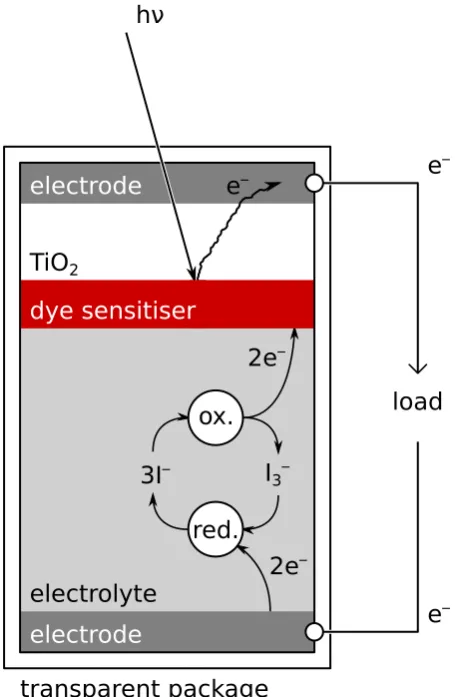
Commonly referred to as Grätzel cells, DSSCs are a subset of organopho-tovoltaic (OPV) cells. Such cells use photoexcitation of dye molecules to promote electrons into the conduction band of supported TiO2 (titania) nanoparticles. [61] These electrons diffuse into a transparent anode that supports an electrical load. Electrons returning from the load are sup-plied to a cathode at the rear of the cell. Electron recombination with the oxidised dye molecules is prevented by competitive reduction via
a net reaction 3 I– −−−→ I –
3 + 2 e–, which is a relatively rapid process.
[62] The process is schematically illustrated in Figure 1.12. A number of alternative redox couples including CoIII(dbbip)2 −−−)−−−* CoII(dbbip)
2
[63] and TEMPO+ −−−)−−−* TEMPO [64] have been developed, whilst the development of viable ionic liquid [65] or solid state hole transport [66], [67] substrates represents an important goal in making DSSC cells more physically robust.
TiO2 electrode
electrode
electrolyte
load hν
e– e
–
e– ox.
3I– I
3–
red.
2e– 2e– dye sensitiser
transparent package
F i g u r e 1 . 1 2: Schematic representation of a dye-sensitised solar cell. In a conventional DSSC, dye molecules are adsorbed to the surfaces of individual TiO2 nanoparticles, contrarily represented here by discrete layers.
of heterogeneous networks of semiconductor phases are anticipated to give rise to new DSSC modalities or dramatically increased solar-electrical conversion efficiency. [68]
[image:68.595.176.404.111.460.2]of direct photoexcitation of semiconductor valence electrons. Electron transport in the plant photosystems is achieved through multiple Chl and carotene units in Van der Waals contact (for which there is evidence of excitonic resonance energy transfer), [69] whereas in dye-sensitised solar cells the dye molecules are directly adsorbed to TiO2 nanoparticles.
The use of a dye sensitiser carries two principal benefits over tradi-tional doped semiconductor solar cells: there is no cut-offilluminance behaviour due to slow recombination dynamics in comparison to the 3 I–/I3– couple (as such, the DSSC cells continue to operate under low light conditions) and the dye absorption may be tuned to cover a much larger effective spectral range than the TiO2(s)semiconductor bandgap (typically 3.2 eV, [68] corresponding to a photon wavelength of≈388 nm) would permit, [70] with research continuing into near-infrared sensitivity.
have the potential to be significantly more cost efficient per Watt.
The use of a dye-sensitised microcrystalline phase as opposed to a continuous amorphous or crystalline semiconductor phase facilitates the construction of flexible DSSCs, as well as continuous fabrication tech-niques. A criterion that may inform the desirability of a light harvesting technology is the ability to manufacture the technology in a continuous fashion, for instance by continuous extrusion or printing onto a sub-strate. This manufacture methodology was pursued by the now defunct Konarka technologies, who were able to achieve ‘roll-to-roll’ manufacture of flexible organic photovoltaic (OPV) solar cells by repurposing existing facilities. [72] The low specific power achieved by these devices is offset by their very low dollar and energy cost of manufacture.
1.5.2
DSSC water photolysis
Water scission may be afforded by replacing the I3– −−−)−−−* 3 I– couple
of a sensitised solar cell with oxidation of water on a suitable dye-adsorbed substrate affording 2 e– per H2O molecule. In the system [73] of Mallouk,et al., the RuII-based sensitiser/linker units connected to TiO2 nanoparticles also covalently bind IrO2·nH
2O nanoparticles that
Whilst demonstrably effective, this method of scission is hampered by very low quantum yield (≈1%) and rapid degradation of the RuIII-bearing oxidised dye in aqueous media (<20 turnovers). [73] Quantum yield is chiefly harmed by connective topology of the two types of nanoparti-cle and linking dye molecule: a dye molecule must bridge both a TiO2 nanoparticle and an IrO2·nH
2O nanoparticle for its excitation to actually
contribute to the photocurrent, whereas a dye molecule is 90–95% more likely to only be bound to IrO2·nH
2O. [73]
1.5.3
Tandem water-splitting cells
Directly inspired by the combined functionality of Photosystems I and II, coupled DSSCs have been augmented to carry out photolytic water scission. In this system, water oxidation occurs at a photoexcited WO3 substrate, wherein valence band holes oxidise water in a process essen-tially analogous to the action of PSII. [70], [74] Conduction band electrons from the WO3 substrate replenish the valence band of a dye-sensitised TiO2(s)substrate, replacing the I3– −−−)−−−*3 I– couple. Finally, conduction
band electrons from TiO2 reduce H+ to H2, catalysing the net reaction 2 H2O−−−→O
2+ 2 H2. Grätzel,et al., have drawn strong analogy between
The idea of the future being
different from the present is so repugnant to our conventional
modes of thought and behavior
that we, most of us, offer a great resistance to acting on it in
practice.
2.1
Photosynthesis in the Human World
2.1.1
Ecological Relevance
It is now uncontentious that global mean temperatures have increased since the industrial revolution, concomitant with the widespread combus-tion of fossil fuels and human activities and land use patterns associated with industrialisation. There now also exists a strong evidentiary and theoretical case for a causal relationship between human greenhouse gas emissions and this increase in temperature. [75] Anthropogenic perturba-tions to the global mean temperature are governed by and govern a richly interconnected set of factors including but not limited to greenhouse gas emissions (§2.1.1.1), planetary albedo, hydrological and cryospheric cycling, atmospheric aerosols and cloud cover modulation, and oceanic pH and dissoved gases. [76]–[82]
weather event patterns. [86]–[89]
The increase in global temperatures over the past hundred years is amply illustrated by the Australian and global mean temperature anoma-lies, depicted in Figures 2.1 and 2.2, respectively. These figures depict the difference (‘anomaly’) in mean annual temperature with respect to a reference mean taken over a particular 30-year period, illustrating a clear (albeit non-monotonic) increase in the annual mean temperature anomaly with respect to their corresponding reference windows. Notably, no part of Australia has exhibited a decrease in mean temperature with respect to a 1910 reference. [90]
−1.5
−0.5
0.5
1.5
Year
T
emper
ature Anomaly (°C)
Reference window
1910 1920 1930 1940 1950 1960 1970 1980 1990 2000 2010
−0.4
0.0
0.4
0.8
Year
T
emper
ature Anomaly (°C)
Reference window
1880 1895 1910 1925 1940 1955 1970 1985 2000 2015
F i g u r e 2 . 2: Trends in global annual mean land/ocean temperature anomaly between 1910 and 2015, inclusive, with respect to reference interval between 1951 and 1980. Plot produced with data provided by the United States National Aeronautic and Space Administration Goddard Institute for Space Studies. [92], [93]
2.1.1.1 The Greenhouse Effect
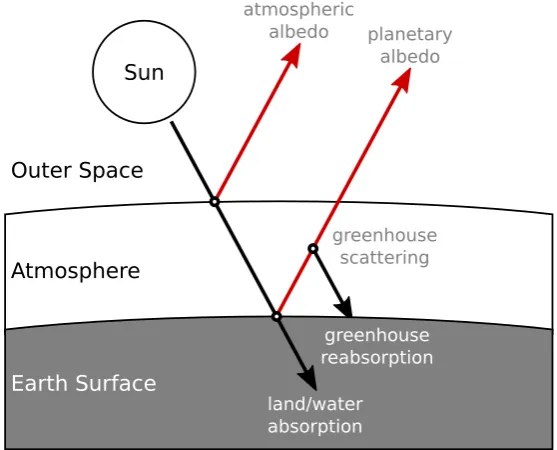
Thegreenhouse effectrefers to the tendency for infrared-active molecules (i.e.molecules possessing a fixed or inducible electric dipole momenta) to absorb and scatter reflected solar radiation. [94] This effect traps some portion of solar radiation that would otherwise be reflected directly back into space, creating a relative increase in temperature (Figure 2.3). Mole-cules that produce positive radiative forcings due to their participation in a greenhouse effect are known as‘greenhouse gases’. While the natural greenhouse effect is responsible for Earth’s ability to support liquid water, it is the case that a runaway greenhouse effect owing to a majority CO2
aThis includes species with permanent dipole moments such as H
atmosphere is also responsible for the intense surface temperature of the planet Venus. [95]
Atmosphere
Earth Surface Sun
Outer Space
atmospheric
albedo planetary albedo
greenhouse scattering
land/water absorption
greenhouse reabsorption
F i g u r e 2 . 3: Schematic representation of the greenhouse effect on radi-ation reflection, absorption, re-emission and scattering. Planetary and atmospheric albedo is strongly dependent on the specific optical prop-erties of regolith, plant life, cloud cover, atmospheric particulates, snow, and other factors. Re-emission of solar radiation can be in the form of prompt reflection as well as thermal re-emission.
Whilst the Earth’s carbon cycle involves large fluxes of carbon dioxide, it is not until recently in Earth’s biogeochemical history that a large source of excess CO2 has appeared in the form of a combustion byproduct of fossil fuels, as well as other anthropogenic ‘process emissions’ such as cement manufacture.b [97] These excesses contribute a large positive
bAlthough see [96] with respect to unintentional sequestration of CO
[image:77.595.163.442.185.410.2]radiative forcing that accounts in climate models for much of the afore-mentioned observed mean temperature increase. Global atmospheric CO2 concentrations, measured historically through ice core data and contem-porarily through direct atmospheric sampling, have increased sharply in the wake of human industrialisation (Figure 2.4). The Intergovernmental Panel on Climate Change (IPCC) nominates the dramatic increase in atmospheric concentration of CO2since the industrial revolution as the largest contributor to radiative forcing. [98]
280
320
360
400
Year
carbon dio
xide concentr
ation (/ppm)
1750 1800 1850 1900 1950 2000
Ice Core
Keeling (Mauna Loa)
F i g u r e 2 . 4: Trends in historic atmospheric CO
2 concentration between
approximately 13 CE to 2015 inclusive, derived from ice core and atmo-spheric sampling. [99], [100] The 280 ppm pre-industrial CO2 level and 400 ppm milestone are indicated in grey. Deseasonalised Keeling curve of
2.1.2
Economic and Geopolitical Relevance
2.1.2.1 Climate and Complex Societies
2.1.2.2 Fossil Fuels and Geopolitical Stability
The price of oil is highly responsive to supply, demand, discovery of economically viable petrochemical deposits, technological development, and sociopolitical contingencies. With this in mind, access to affordable oil is asine qua nonof energy security, and thereby economic prosperity and national security. In Merrigan’s 1975 survey [105] of projections of energy usage in the United States of America for the year 2000, the author pointed out the inherently gloomy prospect of forecasting 25 years into the future, where even the marked nonlinearities of supply, demand and population are clearly subordinated to unknowable geopolitical crises. To illustrate this, Merrigan points out the 1973–74 energy crisis (induced by embargoes on the United States in response to its support for Israel in the aftermath of the 1973 Arab–Israeli war, leading U.S. oil prices to quadruple), [106] however he could not have anticipated the much larger crash in U.S. oil imports in 1979, nor the veritable phase shift in U.S. do-mestic oil production in the mid-2000s, nor the collection of smaller perturbations in oil imports that can be attributed to various wars in the Middle East (Figure 2.5). Regardless of these crises, net petrochemical imports in the United States approximately doubled between 1975 and 2005, representing an average increase in imports of over 87 kL per day.
chicanery, malfeasance and even warfare on the part of many nations in their respective quests for energy security. The case has been made that World War I was in fact substantially a war for control over access to Mesopotamian oil required to power European navies. [107] Energy security has been explicated as acasus belliin U.S. foreign policy. [108] The notion that the 2003 invasion of Iraq by the United States was a‘war for oil’ is too ubiquitous to attribute. Ironically, the 1979 oil crisis was precipitated by the Iranian Revolution, overthrowing a government that was installed by the United States for reasons of oil access. This was done in part to forestall Soviet involvement in the same nation, for the same reasons. [109], [110]
phenomenon and multipolar exclusive economic zone (EEZ) claims in the South China Sea and Timor Sea—driven in large part by suboceanic petro-chemical wealth—represent a continuing source of tension and intrigue. [114]–[116]
It is an uncontroversial and even mundane observation that nations are willing to violate national sovereignty and go to war over access to fossil fuels. Therefore, energy independence takes on an additional moral dimension directly measurable in the destruction of nations.
0
5000
15000
Year
Impor
ts/Expor
ts (thousand barrels per da
y)
1975 1980 1985 1990 1995 2000 2005 2010 2015 Net Imports
Gross Exports Gross Imports
1979 Oil Crisis/Iran−Iraq War
First Gulf War
Global War on Terror
2.1.3
Renewable and Non-Renewable Energy and The
Environmental Burden of Extraction
Oil, coal, and natural gas are considered to be non-renewable resources as they are generated on geological timescales by metamorphism of buried biological matter. Similarly, radionuclides relevant to fission power gener-ation are remnants of supernova nucleosynthesis and daughter isotopes thereof and are therefore not renewable. This stands in contrast with a number of other energy resources which are considered renewable be-cause of their short regeneration timescales (e.g.hydroelectric, biomass, bioethanol), because they are functionally unlimited under current usage patterns (e.g.wave power, geothermal, wind, and speculatively 2H/3H nuclear fusion [118]), or because human activity cannot actually affect supply (solar).c Indeed, oil and coal deposits represent the fixation of ancient solar energy and human industrial activity represents a mas-sive discharge of this stored energy (see for instance the perspective of Schramski,et al.[120]).
The spectre of petrochemical depletion is a source of considerable concern, with Miller and Sorrel suggesting that there exists a ‘growing consensus that the era of cheap oil has passed’[121] Scholarly discussion
cThe Sun will continue to produce solar radiation until well after the Earth is
of the concept now known as‘peak oil’was first undertaken by Hubbert within the context of domestic U.S. oil production, [122] however the dynamic of resource discovery and exploitation that Hubbert describes is generalisable across the globe and with respect to other mineralogical resources, under the assumption that these resources are functionally non-renewable. The trends of progressive resource recovery under the conditions of diminishing returns have a characteristic profile known as the Hubbert curve, represented in Figure 2.6. Localised depletion curves for national oil reserves ([123] and references therein) have approximated the Hubbert trend and it is a reasonable inference that global production will recapitulate historical behaviour.
hard-to-get oil and gas deposits, notably in the United States.d Fracking has been implicated in groundwater contamination and induced seismic-ity. [124], [125] Similarly, the exploitation of oil sands has raised serious environmental and health concerns due to a combination of chemical dis-ruption, intrinsic greenhouse gas emission,eand the ecological footprint of extraction facilities. [126], [127] Concerning expansion of petrochem-ical discovery, interest in Arctic oil and natural gas has sharply spiked in the last decade due to the inference of large, unexplored suboceanic reserves. [128] Development of this region poses serious questions for the regional environment. Antarctica is also known to possess (difficult to obtain) fossil fuel reserves, however it is protected by the Madrid Protocol from development until at least 2048. [129], [130]
Production
Time
Contributory Total
F i g u r e 2 . 6: Prototypical Hubbert curve, comprised of a series of sequen-tial discoveries represented by skew normal distributions, decreasing in size by 20% each time. After Bentley,et al.[123]
dThe United States Environmental Protection Agency nominates approximately
275,000 hydraulically fractured wells drilled between 2000–2013. [124]
eAlthough high uncertainties exist in the total greenhouse impact of oil sand
2.2
Hydrogen Economies
2.3
Inadequacy of contemporary hydrogen
generation methods as bases for a
hydrogen economy
The two principal industrial methods of hydrogen generation are catalytic decomposition of petrochemicals (the steam reforming process) and brine electrolysis. These methods are inadequate for supporting a hydrogen fuel economy within the context presented previously.
2.3.1
Steam reforming
This process [133] uses a heterogeneous, nickel-promoted cycle to pro-duce hydrogen gas from a hydrocarbon (generally methane, however the process is adaptable to a wide variety of olefins) through reaction with steam (Equations 2.1, 2.2). The initial reaction generates H2 and CO, whilst subsequent reaction with steam generates further H2 and oxidises CO to CO2. The reaction requires considerable gage pressure and temperature (≈1025 K to 1075 K, 0.3 MPa to 2.5 MPa) to drive the oxidation.
CH4(g)+ H2O(g)−−−−−→T, P
CO(g)+ H2O(g)−−−−−−−−−−−−(1) 625 K→
(2) 465−485 K H2(g)+ CO2(g) (2.2)
Reforming can also be performed as a partial oxidation with stoichiometrically-controlled O2. This process (Equation 2.3) yields CO which can be
likewise be oxidised via the water-gas shift reaction to yield further CO2 and H2.
2 CH4(g)+ O2(g) −−−→4 H
2(g)+ 2 CO(g) (2.3)
well as for on-demand generation of fuel hydrogen down to microfluidic scales. [138] Despite the very high mass energy density [139] of molecular hydrogen (140 MJ·kg−1 / 280 kJ·mol−1), this is a non-ideal medium for energy storage. Methanol is significantly more convenient to handle than hydrogen as it is a liquid at standard temperature and pressure (STP) and thus does not require cryogenic or high pressure storage. [140] Moreover, molecular hydrogen is known to cause several forms of metal degradation through lattice percolation, further complicating storage and handling. A variety of methods for the storage of molecular H2 are being investi-gated; these include clathration, [141] physisorption onto graphene or fullerenes [142], [143] and adsorption to (or percolation into) a suitable metal matrix.f Additionally, facile release of H2 from hydrides is being explored. [146]
2.3.2
Direct Electrolysis
Whilst direct electrolysis of water represents a relatively minor source of industrial H2, it is noteworthy in that its fundamental electrochemical reactions (Equations 2.4, 2.5) do not evolve CO2. Under mild conditions,
fPalladium is capable of reversibly sequestering large quantities of hydrogen,
this reaction demands a redox potential of≈1.2 V, however the anode re-action (Equation 2.5) proceeds very slowly at this potential. At 573 K the reaction proceeds at 1.0 V, [147] whilst electrolysis of steam at tempera-tures as high as 1273 K has been proposed as a highly efficient electrolysis regime (so called High Temperature Electrolysis (HTE)). In this modality, the water heating source is typically a nuclear reactor, which Yildiz,et al.
indicate‘necessitate materials development and intricate design requirements for integrated plant layouts’. [148] Such technologies are related to the spec-ulative nuclear-assisted generation of hydrogen through chemical cycles at very high temperatures (§2.4.2). Sigurvinsson,et al.also demonstrate a credible hypothetical cycle exploiting geothermal energy in concert with an advanced heat exchanger system. [149]
At potentials above ≈1.9 V, oxidation of chloride becomes a com-petitive reaction. Whilst this is an intended end product of brine elec-trolysis (Eq. 2.6), chlorine may constitute an unwanted environmental pollutant in water scission processes. Conversely, the performance en-velope of PSII is approximately invariant with regards to overpotential (≈1000 kat·mol−1). [150]
4 H+(aq)+ 4 e−−−−→2 H
![Figure 1.1: Dimeric PSII holoenzyme,with and transfix the thylakoid membrane.The OECs are related by an approximate 300 pm structure of Loll, et al.,[17] viewed perpendicular to thylakoid normal](https://thumb-us.123doks.com/thumbv2/123dok_us/8044208.221892/42.595.103.474.129.621/dimeric-holoenzyme-transx-thylakoid-approximate-structure-perpendicular-thylakoid.webp)