COMMISSION OF
THE
EUROPEAN
COMMUNITIES
coM (?5)
rlr
final
Brrlssels,
)th
May L976,PROPOSAL FOR A
MULTIANNUAL REffiARCH PROGRAMI,/E
OF THE
JOINT RESEARCH CENTRE
19?7
-
1980(Sutm:.tted by the Commission
to
tire Council)col,l (76)
lll
final
Includes COM (76) 171/final 3 21 June 1976MULTIAIiINUAL RESEARCH PROGRAMME
OF THE
.'ONiIT RESEARCH CEIfTRE 7977-1 98o
COMMTJNICATTON FROIT' THE COMMISSION To THE coUNcIL
*"r
o""o*t*,
PART I : IMRODUCTION
A. Sumary
B. Main features
of
the next progranmeC. Technical preparation
of
the prograrmrePART II : PROPOSALS FOR Trm NEXT PROGRAMME
A. Guidelines
B. Description
of
the prograrmeI.
Organizationof
the prograrqesII.
ProgrFrnrne Sr:mary1.
Reactor safety2.
Plutonir.rm fuels and actinide research3.
Nuclear materials and radioactive waste management4.
Solar energy5.
Hydrogen6.
conceptual studies on thermonucrear fusion reactors7.
Iligh temperature materials-2-9. Measurements, standards and reference techniques (METRE)
10. Service and support activities
1. Exploitation of the HFR reactor
2. Informatics
3. Training and education
4. Safeguards
5. Technical evah-ntions in support to the Comnission.
C. Resources required and implementation
I. Programne duration, rolling progranme
II. Personnel
III. Financing of programnes and budgetary credits
IV. Implementation
1.
Internal management2.
External relationshipsAPPENDICES
- Opinion of the General Advisory Conmittee
-l-PART ONE ! IMIRODUCTIOi{
A. Sunmary !
1. The rnultiannual programme
of
the Joint Research Centre, carried out atthe four Establishments
at
Geel, Ispra, Karlsruhe and Petten,will
cometo
an end on 31 December 1976,The programme was adopted on 14 May and 18 June 1973 (1) and
its
techni-cal
andscientlfic
contentpartialty
revised'and supplementeci by newactivities
f,or the Petten Establishment on 25 August 1975 (2).2.
on 22 octobet L975, the cornmission transmittedto
the councir an"overarr concept'r f,or the next ,toint Research centre programme (3).
(1)
Official
JournafJ" L
153, 9 Jrrne 19?3 andOfflciallournal
NoL
189, 11July
1923(2) Off,iclal Journal No L 231, 2 September 1975
(3) Doc. col't (75) 529
final,
22 october 1975 or3.
-2-On the basis of a critical analysis of the existing instrument, this
overall concept set out the guidelines for the fuLure role of the
JRC in the context of Community research' as well as the orientation
to be given to its scientific and technical activity and the
appro-priate operational and management procedures.
The Council discussed the rnatter at its meeting on 15 Decedber L975,
together with the "Objective, priorities and methods for a joint
R & D policy" (1), in which the Joint Research centre is naturally
envolved.
In conclusion, after a searching discussion, the Council noted that
the Comrtission would present' at an early date, a draft programme for
the JRC, taking account of the guidelines evolved in the course of
that discussion (2).
Main features of the next programm9
The Conmission has in fact been encouraged to continue its efforts to
rnaintain a well-organized Joint Research Centre with clearly defined
tasks.
To this en<l, the following guiding principles have been identified :
- the role to be played by the centre must be one in whicir primary
consideration is given to Community interests in the field of science
and technology but which also ensures expelt trelp and scientific
and technical advice for the formulation and implementation of sectoral policies in the Community;
- there must be closer links between research projects carried out by
direct and indirect action in order to achieve greatar homogeneity and improved efficiency;
- there has to be a d.rastic concentration of activities on a small
number of programmes comprising specific projects with fixed
objec-tives ans deadlines;
- stress rnust be placed on researCh in the energ'y and environment
sectors- while at the same time encouragement must be given to the
JRC's public service role;
COM (75) 535
final,
29 October 1975 orR/2724/75 (RECH 33), 5 November 1975
Sumrnary
of
the decisions taken by the Councilat its
375th meetinghelcl on 15 Decenber t975
ooc,n/235/?6 (RECH 2)
of
26 January 1976B. 1.
-3-- tlie implementation of a staff policy adapted to research requirements
is of prinary importance, partly in order to facilitate the mobility
of research staff;
- a better balance must be achieved in the ratio of payroll costs to
scientific and technical operating expenses in order to improve the
efficiency of the Centre and increase the opportunities for
coope-ration with European research organizations;
- the structure for the execution and managetrert of projects must be
strengthend and the procedure for the assessment of work and results
tightened up;
- a "rolring plan" must be evolved to enable the programme to be
adapted to changing techniques and needsi
2. The competent departments of the European Parliament have startecl thei.r
own study of the situation and of the prospects for the JRc (1), based
on an analysis of its operation in the past. They have recommended
that in future policy be modelled on the guidelines contained in the
"Overall Concept" and discussed in the Council.
C. Technical preppration of the programme
The preparation of this proposal for the next multiannual rTRC programme
has followed the procedune laid down as part of the measures adopted
by the Council and the Commission with a view to the
reorqani-zation of the Centre Q).
The research and administrative staff at the various JRC Establishments
have been broadly consulted at arl revels on the study and on the
choice and definition of possible fields of activity where necessary
in close liaison with those responsible for the indlrect action proJects.
The research projects were modelled and adjusted in accordance with the
general directives which issued by the Commission to the
Director-General of the JRC and confirmed in the light of the Council
delibe-rations of 15 December L975.
(1) Fourth interim report onrEcessary advances tc be made in the field
of Community research : conditions for the resumption of
Com-munity research at the Joint Research Centre
Prov. ref. : EP 43.O43/rev III, 11 March 1976
(2) Commission decision of 13 January L971 on the reorganization of the JRC
-
4-At the reguest
of
the General Advisory Committe (C"AC), the relevantdrafts were sent
for
ad hoc consultationto
the various AdvisoryCommittees
for
Prograrnme Management (ACPM's) .The entire technical dossier thus conpiled was examined
in detail
bythe General Advisory Comnittee on 16, 17 and 18 March and by the
Scientific
and Technical Committe on2I April.
The opinions expressedby these two Corornittees
-
which are givenin
the annex heretoenabled the
final
proposalsfor
theactivities
concernedto
be-5-PART II : PROPOSALS FOR THE NEXT PROGRAMME
A. Guidelines
When the progralme was being prepared, one of the main concerns was
to select activities which fitted in with the special role to be played
by the Joint Research Centre in the context of Community policy on
science and technology.
What is that role ? There are three different aspects which have to
be borne in mind :
1)
firstly,
the JRC hasto
carry out researchof
a "central"nature.
This can take three forms :a) the establishnoent of a sufficiently broad physical and intellectual
research potential to justify its concentration at corununity level;
b) the execution of tasks which, although not of very wide scope, are
of a nature which calls for centralization and even uniqueness;
c) while at the same time carrying out its olrn researctr activities,
the JRC could act as a focus or as a point of crystallization or
a catalyst for activities to be coord.inated at Corrnunity level. In this connection close ties with the indirect action program'nes
are essential.
secondly, the JRC could develop the Cornmunity public service role by
uraking available to users (official bodies,universities, industry)
its eguipment, know-how, products and specialized services. A signi-ficant factor in this context is the inpartial judqement that the
JRC can brinq to bear in its research owing to the absence of any
j-ndustrial development involving powerful economic interests.
Iastly, the JRC could perform an essential function in providing the Corunission with scientific and technical expertise and support and
thus help in the formulation and implementation of Corulunity sectorial
policies. Here too there must be close liaison with indirect action
projects. It is incumbent upon the JRc to place its research
poten-tial at the disposal of other Cosrnission departments.
These various aspects
of
the 'JRCrsrole,
which are not mutuallyexclu-sive,
have served as a basisfor
the selectionof the
proposedpro-grannes. Ehe other factors which have played a
part in their
selectionlrere :
2l
-6--
the wishto
concentrate research potential on a small nurnber ofprojects i
-
the concernthat
the projects adopted should correspondto
objectivesof
clearly defined content and withdefinite
deadlines;-
the needto
givepriority to
research on energy and the environmentin
viewof
the importanceof
these sectorsin
Comnunity policy;- finally,
the desirefully to exploit
the presentskills of
thecentrer the programne cannot be conceived solely on the basis of
what already
exists,
nor canit
be designed without regardto
the,,
-
l-B. DESCRIPTION OF THE PROGRAMME
r
.
9rgerr=e!:el-g!-!!e-erggrerse:It is
proposedthat
the next multiannual research and training programme (f977-f98O)of
theJoint
Research Centre be broken downinto
ten progf.anmes (the term "programme" correspondsto
a clearlyidentified line of
research,of
which the content and budget are tobe
laid
down by a Council decision). Each progralnme comprises a numberof
projegts,if
necessary subdividedinto
sr:b:projects.The ten programmes are z
-
reactor saf,ety-
plutoniumfuels
and actinide research-
nuclear materials and radioactive \^taste management-
solar energy-
hydrogen-
conceptual studies on thermonuclear fusion reactors-
high temperature materials-
environment and resources-
measurements, standards and reference techniques (METRE)-
service and supportactivities.
The
first
three programmes come under the general headingof
nuclearsafety, the next four
relate to
future energies, whereas theenviron-ment and resources, measurements, standards and reference technigues
and service etnd eupport
activities
constitute individual thernes.rr.
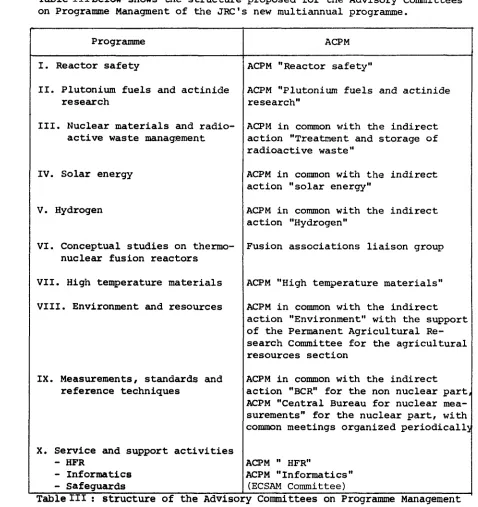
3:ggr3llg-EgggsryEach of the ten progranmes described below is the subject of a tech' nical fiche; .the set of' these fiches is reported, in the Appendix to
the present document; to each fiche is also attached the opinion
issued by the appropriate Advisory Conrnittees on Progranune Management
(ACpM) on propositions for future progralnmes within their competences
in conformity with the wi5he.s expressed by the General Advisory
-8-NUCLEAR SAFETY
The importance
of
Nuclear Safety cannot be over emphasizedin
viewof
theincreased recourse
to
nuclear energyin
the conurunity energy supply, and ofa certain reticence shown by pr.rblic opinion concerning
this
matter.within
this
theme, the JRc proposesto
carry out three research programes :-
the "Reactor Safety'O prograrnme-
the "Plutonium Fuels and Actinide Research" progranme-
the 'jNuclear l"laterials and Radioactive Waste Management" progranune.l.
The "Reactor Safety" progranrunefalls
within the measures taken by theCommunity
to
improve the safetyof
nuclearinstallations
as recalled ina recent Council Resolution
(I).
The actions proposed by the JRC find their comnunity justification :
- in the central character of these activities, particularly those related to out-of-pile, and even more to in-pile installations, concerned with
studies on the effects of depressurization on Light Water Reactorsi
- in the public-service character of most of the actions undertaken. The
work must contribute to the unification of the points of view and working
methods of the different national safety organizations with a view to
arrive at common regulations for safety and. open the way to the required
industrial standardization.
The independance and
neutrality of
the JRC regarding the cosunercialinterests
in
play guarantees the necessaryobjectivity to
the research;-
f1n-ally, behatfof
in
therole of
supportto
the commissionrsactivities
onthe
Community
ropo".aJRCrs
activities
contri-butesto
the maintenanceof
ascientific
and
techni-cal expertise proper
to
the commission. This expe;ai=;-""=tainsthose services entrusted with the promotion
of
greatgrcommunity
cohe-sion
in
the domainsof
the progresslve ha:cmoni.zationof
the r6quirements andcriteria of
safety'andof
the coordination"r "ppii"J-r."."r"n i'
this
area.The proposed
activities logically fall into
oneof
these three types ofstudy :
- overall anal.1sl of safety concepts;
- theoretical and experimentar study of possible accidents;
- prevention of component failure.
The overall analysis of different reactor safety concepts wiII permit the comparison and synthesis of methods of risk evaluation used in the
Corununity as in the USA.
(1) Council Decision on 22 July 1925.
-9-The studies of Light Water Reactor accidents will be essentially centred on
the analysis (theoretical and experj:nental), both out-of-pile and in-piIe, of the consequence of a depressurization accident in a coolan! circuit. The
out-of-pile study, already in progressrwould be complemctted by the
con-struction in ESSOR of a test loop to enable experiinents to be conducted on
fuel elements under representative failure conditions. An i:nportant effort will also be directed to the study of core melt-down and fuel coolant
inter-action.
Studies on Sodium cooled Fast Reactors concern cooling anomalies in assemblies,
fuel, sodium reactions, core meltdown and the mechanical consequences of an
explosive accident.
Finallyl studies on the prevention of component failures are aimed at detecting the birth and development of faults likely to lead to failures.
The "Reactor Safety" progranme consists in six projects :
- Reliability -.and Risk Assessment
- Light Water Reactors Loss of Coolant Accidents; Out-of-Pile and In-pile
Studies;
- Liquid Metal Fast Breeder Subassenbly Thermohydraulics;
- FueI Coolant Interactions and Core Melt-Downt
- Dynamic Structure Loading and. Response;
- Structural Failure Prevention.
1.I. The project :.'Reliability and ' comprises the following activities :
- development and evaluation of codes
of accidents in Liquid Metal Cooled
Reactors, including the whole core
- probability analysis of accident in - setting up an European Data bank of
for the analysis of the mechanism
Fast Reactors and Light Water
accident in a Fast Reactort
Light Water Reactors coresi
reliability data.
1.2. The
project
"Light Water Reactors Lossof
Coolant Accidents; Out-of-Pile@',
for
theout-of-pile part'
concentrates ondepressurization stud,ies
in
a large loop which sj:nulates a four loopprimary
circuit of
a I3OO MW Light Water Reactor. The influenceof
theoperating conditions
of
the coq)onents on the depressurizationphenomenon
witt
be studiedin
functionof
the rupture area and position. Theout-of-pile activites
comprise :-
the cormnissioningof
the loop andits
instrumentation;-
the preliminarycalculations to
orientate depressurization experimentsi-
the executionof
thesixty
experiments foreseenin
the-prograrruneestablished und,er contract witir the German Ministry
of
Research andTecirnology i
-
the executionof
the experimentsfor
the Conmunity progranmei,-
theparallet
developmentof
theoretical studiesto
compare and-10-The "in-pile" part of this project concerns the study of a test loop
in the ESSOR reactor. This project will proceed in several stages
closely followed by approtrxiate consultative bodies (conceptual study'
detail-ed engineering study, study of operating problems). These studies
should allow the Conunission, within the general programme revision
framework, to submit to the Council, as far as it seems necessaryr a
detailed proposal concerning the construction of this loop, its
experimental programme and associations proposed with the national
partners.
1.3. The project "Liquid Metal Fast Breeder Subassenlbly Thermohydraulics"
consists of the following activities :
- theoretical analysis of the consequences of geometrical anomalies in fuel subassemblies under various coolant flow conditions;
- the study of techniques for the early detection of anomalies by
temperature noise analysis, comprising experiments both in water and
sodium;
- the experimental study of boiling phenomena, in a subchannel and in
a subassembly, and the influence of channel blockage on local boiling.
l-.4. The project " ' in Fast
Breeders and light Water Reactors includes the following activities :
- concerning core melt-down : the determination of the physical
properties of the core melts, the study of the behaviour of fuel pins during meltingr the study of heat transfer and those of the
thermal and mechanical loads suffered by core catcher structuresi
- concerning fuel coolant interactions : development of theoretical
models and calculation codes taking into account the different physical phenomena and their corresponding experimental studies.
1.5. The project " ' in Sodium Cooled
Fast Reactors, comprises the following activiti.es :
- development and experimental verification of dynamic loading and
response codes for the behaviour of the primary containment, of the
core interior and other primary circuit components;
- determination of the elasto-plastic characteristics of materials and
structures.
1.6. The project " ' comprises the following activities :
- study of criteria for crack instability and the evaluation of the
effects of embrittlt:nrent in Fast Reactor stxucture8i
- studtr of the l-aws of crack growth and propagation under fatigue and
creepi
- study of microscopic processesi
- development of a probability model for stress corrosion;
- development of the earlf detection of faults by acoustic and
ll
-2.
The unityof
the progralnme 'rPlutonium Fuels and Actinide Research' isbased on the special properties ( ef,
radioactivity
andtoxicity)
ofplutonium and other actinides,
for
which researchactivities
can onlybe conducted
in
very specialized,installations.
The KarlsruheEstablish-ment
of
the JRC has been constructedto
concentrate the Conununityactivities in this field.
Studies carried outat
Karlsruhe furnish ina specific
fieldr
results necessaryfor different
nuclear progranmesin
the Conmunity.The research on Plutonium Fuelg
is for
onepart
concerned with thedeveropment
of F;;mmls
{particutirry
advancedfuels)
and thestudy
of their in-pile
behaviour, especially from the safety angle. Theother
part
concerns specific aspectsof fuel
cycle safety resulting fromthe presence
of
plutonium and the elements derived fromit.
This costlyand dangerous research necessitates the
particular
competences andspecial
installations
availableat
the Karlsruhe establishment.The second side
of
the programme concern s Actinide Research and isessentially long term fundamental research
for
which the TransuraniumInstitute
plays therole of
focal point on an European scale. Here again,it is
the unique capacityof
the Establishnentin
the matter whichjusti-fies its
centralrole in this particular field.
The programme hinges on three projects :
- Utilization
Limitsof
Plutonium Fuels;-
Plutonium and Actinide Aspectsof
the Safetyof
the Nuclear Fuel Cycle;-
Actinide Research.2.I.
The project"Utilization
Limitsof
Plutonium Fuels" comprises thefollowing
activities
:- study of the swelling of advanced. fuels subnitted to high line power
and,/or high burn-up, in particular under power cycling conditions and
taking into account mechanical fuel/cladding interactions and also
chemical interactions;
- study of the compatibility between mixed uraniun-plutonium oxide fuels
and stainless steel cladding material under severe conditions; study
of the corrosion mechanisms;
- study of, the thermalbehaviour of fuel rods under irradiation, utilizing
special devices for direct in-pile measurements under stable and
cycling conditions;
- study of the evaporation of nuclear materials above their nelting
points.
2.2. The project " '
comprises the following activities :
-
measurementof integral
cross sections andfission
yieldsin
fastneutron fluxes especially
for
higher actinides and some importantfission products;
-
studyof
the formation and behaviourof
actinidesin different
fuels;-t2--
developmentof
safe handling techniques and methodsof
producingwell:characterized plutonium products;
-
studyof
certain aspectsof
the head:.end processingof
mixed uranium/plutonium carbide fuels with sodium bonding and stainless steel
cladding.
2.3. The project "Actinide Research" comprises the following activities :
-
the preparationof
samples and monocrystalsof
metals and compoundsand
their
characterization;-
studiesof their structural,
physical, electronical,etc.
properties.3. The programne "Nuclear Materials and Radioactive Waste Management"
constitutes another contribution
to
the Community research on thetechno-logical
safetyof
nuclearinstallations.
Whereas the "Reactor Safety"progra[me deals with problems
relating to
the reactoritself,
theprogranune proposed here
is
concerned with thedifferent
stepsof
the fuelcycle both before and
after
the reactor andis
concentratedin
particularon three sectors :
-
thefirst
sector concerns management methodsof all
materials involvedin
thefuel
cycle;it
answers the growing preoccupation with the safe andefficient
managementof fissile
material overtheir entire
use, inparticular
to
avoid any diversion, unintentionalor
deliberate' ofthese materials.
JRC research
is in
supportof
the Conunissionrs actionsin this
domain;-
the second sector involves the storage and managementof
radioactivewastes. These
activities fall
within the frameof
the Corrnunity actionin
a matter whosenecessi-tyhas been underlinedin
the "Progranmne ofAction
of
the European Communities on the Environment" (declaration of22 November 1973). These
direct
actions support and complenrent theindirect
action programnein
the samefield
(Council Decisionof
26June 1975); the rnaintenance
of
an expertise properto
the Conmissionmust contribute
to
the adoptionof
solutionsof
a Conmunity characterto
the problems raised;-
thethird
sector concerns the decontaminationof
reactor components.This
activity
should be considered as a prolongationof
the technicalsupport provided
to
nuclear povrer stations operatorsi it
answers aneed
clearly
stated by these users.The programme contains both theoretical and exper5:nental studies axed on
four themes :
-thet",
comprises essentially the identification and evaluation of the long term '
safety of the permanent storage of radioactive waste in appropriate
geological formations. A probalistic approach is envisaged;
- the study of the "Chemical,separation and Nuclear Transmutation of
Actinides"; the objective is to obtain a better appreciation of this
new strategy for managing radioactive \,{aste by recycling the isotopes
-13-- the technigues for "FueI Materials Management" i the studies point both
towards the economic exploitation of the fuel cycle and towards a
reduction in the risk of fissile materials diversion, by in particular, setting up methods of analysis and surveillance techniques;
- the "Reactor Component Decontamination Studies" : the water circuit
contamination mechanisms, the nature of the contamined layers and
the action of decontaminating agents both on the surface layers and on
the componen! nurterials, wilt be studied.
3.1. The project "Evaluation of the Long Term Hazard of Rad,ioactive Waste
Dispgjsal" comprises the following activities :
- analysis of the dangers of waste storage and the various options and
strategies open in order to optimize the choice of sites;
- study of long term Qehaviour for medium and high activity waste
conditioned in glass or bitumen;
- research on diffusion of actinides into the environment following
a fault in the geological barrier;
- studies on the methods of detection and measurenent of actinides
contained in solid wastes.
3.2. The project "Qhemical Separation and Nuclear Transmutation of Actinides"
comprises the following activities :
- research on chemical separation of actinid.es;
- evaluation studies on the production and combustion of actinides in
nuclear reactors;
- measurements to improve the knowledge of actinide nuclear cross sections.
3.3. The project 'rFuel Materials Management" comprises the following activities :
- measurement and establishment of reference data on irradiated fuels :
burn-up, isotopic composition, nuclear cross sections;
- theoretical and experimental studies on the correlation between heavy
isotopes and fission products in irradiated fuels, operation of a
data bank;
- development and standardization of non-destructive analytical techniques
for the isotopic composition of samples or fuel pins.
3.4. The project "Studies for Decontamination of Reactor Components" comprises
the following activities :
- contamination mechanisms in high temperature water circuits;
- nature of contaminated surface layers;.
- mechanism of action of decontaminants on surface layers;
- depth of attack by decontaminants on coupled alloys of different
compositions;
- depth of surface attack after repeated contamination/decontamination
-
14-FUTURE ENERGIES
Under
this
themeis
grouped research on new formsof
energy intendedto
com-plement
or
replace present day sources.This research falls within the long term energy policy strateqy for the
Com-munity. On 17 Decernber 1974 the Council approved the objectives of a
Commu-nity Energy Policy for 1985 (doc. COM (74) 1950 final); in this energy
poliey, scientific research and technological development have a fundamental
role to play.
4. In the donain of "Solar Energy", the JRC has attempted to see what
contri-bution it could bring to the global development in Europe of this form of
energy, takinq into account the recent adoption of a (indirect action)
Energy Research and Development Programme (Council Decision of 22 August
1975). This analysis has led to consider essentially a role- of support
to the indirect action progranme, and more specifically actions having a
central character (intercomparison, calibration of products developed
eGewhere, setting-up of standard measuring stations).
The aspect of support to the Commission relating to the aid to developing
countries is also present in this programme.
This prografftre contains three lines :
- research on thermal conversion in housing (centred on problems posed by
solar collectors, heating systems, heat storage and cooling) wj-th a
part of applied research on materials;
- the construction of an European installation to simulate solar radia-tion;
orientative research on advanced applications of solar energy
(essen-tially dealing with direct conversion by means of electrochemical solar
cells and the use of biological conversion)
-4.1. The "Habitatjrnd Thermal Conversion'r project comprises the following
activities
:definition of a standardized pilot-test facility for the determination
of solar collector performances;
R & D studies on high efficiency collectors and the storage and cool-ing subsystemsi
-
experimental studies on combined heating, cooling and storage systems;-
apptied research on materials andin particular
on selectiveabsorp-tion
surfaces;other applications
of
solar collectors :.distil-l-ation
(ethanol, seawater);
technico-economic studies and project
for
a documentation and4.2. rn
the. "IuloP_ean Solarrnadiation Facility"
project a cLosecollabora-tj-on with industry and the devetoprnent ana construction
of
a centraltest
stationis
foreseen.-
15-The station wilr permit accelerated ageing tests, measurements of
system performance, studies of the influence of extreme ambiant
condi-tions, development of standardized test procedures.
4.3. 'rOrientative Studies" will
to the following activities be part of this progranme. They correspond study.of electrochemical solar cells based on
semi-conductor/electro-lyte electrodes;
- study of bioconversion of solar energy.
5. rf the proposed research programme on "Hydrogen" should be considered
primarilyr as in the case of solar ener!fl-E-Grpport to the recently
approved indirect actions, the special role of catalyst and driving force,
played by the JRC in this field, particularly for hydrogen production by
the thermochemical route, should not be forgotten. This central role i-s
confirmed by the function of Project Leader assumed by the Commission
within the International Energy Agency's programme.
The proposed. progranme, despj.te the emphasis placed on the
thermo-chemical route to hydrogen production, nevertheless includes substantial
contributions to generar assessment studies - concerning notably
technicoeconomical comparisons of electrolysis versus thermochemical
methods - and to the coupling of the production process with the heat source.
These elements should contribute to defining the role which hydrogen can
play in the economy of energy.
The progranme hinges on two projects :
- Thermochemical processes for Water Decomposition;
- Heat Source Coup1ing.
5.1. The project "Thermochemical Processes for Water Deconposition,, comprises
the following
- basic research on the thermochemicar decomposition of water
. theoretical studies : identification of new cycles, engineering and
cost analysis of, selected cycles, cycle flow sheets, list of
evaluation criteria, technical design of a fult-size plant, collection of industrial data, problems of interfacing with a
nuclear reactor;
. experimental studies r fundamental research on chemistry and reaction
kinetics, and naterials research;
-16-5.2. The project "Heat Source Coupling" comprises the following activities :.
-
evatuatro"ffie
sotutions;- safety and risk analysis.
6, . Thetrconceptual Studies on Thermonucle€r Fusi-on Reactors are
closely tied to the indirect actions of tshe.Community in the field of controlled thermonuclear fusion and plasma physics; the work of the
JRC is oriented. exclusively towards the conceptual studies of
fusion reactors, studies which were entrusted to it by the
fusion Liaison Group in the framework of the 1973-L976 multiannual
progranme. This contribution of the JRC corresponds with its particular
competences in the field of engineering, technology and nuclear physics. The progranme comprises the following activity :
- participation in the conceptual study of an experimental power reactor
in connection with the Euratom-CNEN association at Frascati. In
parti-cular, blanket neutronics, heat transfer and energy conversion systems,
materials, stress-analysis, safety studies and environmental impact,
plant engineering, cost analysis.
7. The programme "High Temperature Materials" has been included in the
"Future Energies" theme by virtue of the essential role the sinple
avail-ability, or improvement to properties, of these materials plays in the
future development of the energy strategy.
The sectors depending the most on progress to accomplish in the field of materials are :
- the development of chemical processes, particularly for the production
of gas and synthetic fuels (coal and lignite gasification, hydrogen
production by the thermochemical route, methanol production, etc.);
- the industrial utilization of gas turbines;
- the development of new methods of direct conversion, such as
magneto-hydrodynamics.
This progress constitutes an essential element in the introduction of high temperature nuclear reactors on a large scale and from this point of view, the proposed activities should contribute to the increased use of
nuclear energy by enlarging its field of application.
The prograrnme included in the present proposal is essentially the
conti-nuation of the prograrnme decided by the Council in August L975. Since
-17-The Petten JRc Establishment is essentially called on to play a role of
focusing as the pivot point of these activities in the colnnunlty. o:r the
basis of a proper expertise, built upon a certain amount of fundamental and oriented research carried out at the Establishment, the JRC petten is
intended to become the coordinating element, the prace for concertation
of research carried out in European public institutions and industrial
laboratories.
Four projects are proposed in this programme :
- "ivleeting PoinB Pbtten" project : evaluation of industrial need.s for
advanced refractory materials and the corresponding R & D prograrnmes,
pubrication and continual updating of a "while book", orguiL"ition or
meetings, setting up of an information service i
- study of the effect of operational environments on mechanical properties
of materials in high temperature applications;
- the study of faiture modes in high temperature applications;
- the study of the rerationship between structure and properties of
specific high tenperature materials.
8. The progralnme "Environment an4 Resources" falls und.er the heading of
research respon , both at the level of the
competent authorities and of the general public; although it has not. so
far been raised of the sane importance as has energy suppry during the
last few years, this preoccupation remains of essential importance to the
Community.
In the specific field of the environment, JRC activities are pursued in close liaison with the EEcrs environmental research and development pro-granme (indirect action); the two actions - direct and indirect - support
the Comnunity Progranme of Action in this field approved by the Council
on 22 November 1973 following the declaration on this date, on the
object-ives and principles of an environmental policy for the Cornmunity. In conseqluence, the rore of supporting a commissionrs sectoral policy
constitutes the essential motivation for this progranme.
If the nature of the studies on this subject undertaken by the JRC since
1972 has not always allowed the Centre to demonstrate a systematic central role, an ,effort in this direction has actually been .""o*pli"h"d. To this end' the JRc action has been concentrated on a limited number of themes
presenting a collective interest and whose importance justifies an
approach at Community level.
Activities on resources are essentiatly centred on renewable (essentially agricultural) resources and relate to the use of remote sensing techniques.
Here again, the supporting role to the sectoral policies (agricultural
and to a certain extent regional policies) appears to be crear; from the
large participation of national institutes on remote sensing activities, the JRC, focal point of a network of experimenters, and interface with
the space sector of remote sensing projects, sees, in add.ition, its
-
l8-The proposed research on the protection of the environment is build
around themes on pollution of the atmosphere and water, and on noxious
chemical products. These themes - if they already figure in the current
JRC nultiannual progranme - are nodified in their substancei furthermore,
they are most often transformed during the course of the programme by
terminating certain activities to the profit of new ones. In addition, a certain progressive orientation towards subjects relevant to the energy
ecology is foreseen.
In consequence, the programre content shows an evolutionary character.
It is the same for the activities in the resources domain which comprise
the continuation and conclusion of the AGRESTE progranme (stgdy of
agricul-tural resources in certain areas in the south of France and the'north of Italy), at present in progress, and the development of a new activi-ty which
will evaluate, using remote sensinE, the agricultural potential in
under-privileged regions of the Connunity.
8.1.
Atmosphere; Water;
Chbmicals;
Renewable Resources
Th. "s!mosp$3" project comprises the following activities z.
- formation of particles and transport of pollutants (notably physical
and chemj-cal analysis, measurements and fiel-d experiments, laboratory
experiments and also studies on the uptake of SO. by plants and soil,
and setting up of models of urban air guality); z -
-- ILE : the pathway of automotive lead (notably measurement of
atmosphe-re lead, contrj-bution to'absorption in man and the distribution in the ecosystem).
8.2. The "water" project comprises the following activities :
eutrophication : studies in three sectors : biology, sedimentology and hydrodynamics;
Eurasep : investigation of sea and air, pollution in several coasts
and citj.es of European countries in the EEC through the use of
satel-lite data as well as through experimental work, to develop essentially the methodology of analysis, to set-up corresponding models, and to
promote the use of these methods;
ecological effects of chemical and thermal pollution of water (study
of the interaction of these two forms of pollution).
8.3. The "Chemicals" project comprises the following activities :
- ECDIN : information and data network relating to chemical products in the environment. This network, at present in the pilot stage, should
be developed towards the operational phase. It is foreseen to develop
notably the number and nature of data collected, the development of
user network irnd tire improvernent.of tJrd'computer. systent
In this.nerspective, the overall proetrFmme
structured in four proJects :
(Agrieultural).
-
19-- loss of heavy metals by coal-fired electricity generating stations
and ecological and biochemical implications. Study of emission,
transport in air, transfer to sediments, to the soil, the vegetation and the living organisms ; studies of toxicity and development of
cor-responding models;
- prolongation of action COST 64b "Analysis of micropollutants of water".
These studies are based on the reconmendations of the Management Commj.ttee of action COST 64b and must cover notably the development
and improvement of methods and sampling apparatus and also the set-ting up of an automated library. The pathway of petrolium
hydro-carbons C6-Ctg will also be studied. In the framework of the study
of the eventual depletion of ozone by halocarbons, the JRC will
measure and identify the halocarbons present in different atmospheres.
8.4. The project "Renewable (agricultural) Resources" comprises the following activities :
- continuation and completion of the prograrune on the study of agricul-tural resources in certain zones in the south of France and North
Italy (project AGRESTE), using notably data from satellites;
- research on crop stresses and diseases by means of remote sensing
techniques;
- launching a progralnme to evaluate soil humidity and thermal balance
of certain zones of potential interest from an agricultural and
envj-ronmental point of view (project TELLUS) having recourse to
techniques developed in the previous stud,j_es.
9. The programme trMeasurements, Standards and Reference Techniques" (METP€)
regroups both nuclear and non-nuclear activities of this type into one
single framework.
The programmers unity lies essentially in the identical approach to
problems, the recourse to similar research techniques and sometimes to
the sane type of equipment.
The JRC|s activity in the nuclear measurements field, concentrated at the
Community Bureau for Nuclear Measurements (Geel Establishment), answers
the need for nuclear data on a Community scale, a need which can be met
efficiently by a central Establistrment of the Community.
The JRC activity in the field of standards and reference materials falls within the activities of the Community related to "the elimination, as
between Member States, of quantitative restrictions on the import and
export of goods, and of all other measures having equivalent effect" and
to "the approximation of the laws of t{ember States to the extent required
for the proper functioning of the Common Market" (Article 3 of the EEC
-20-This activity is essentially in support to the research progranme of the
EEC for reference materials and methods (Corununity Bureau of Reference)
(indirect action). The participation of the direct action to the indirect
action is beyond doubt deeper than in any other field where both tlpes of action coexist. Whether it is the nuclear part or the non-nuclear part of the prograrnme, aII the different aspects of the role of the JRC in
Conmunity research, are assembled : executing tasks of a central character,
providing support to the Comrnissionrs sectoral policies, and maintaining
available a public service. The Conrnunity justification is thus parti-cularly strong for this progranme.
The programme "Measurements, Standards and Reference Techniques" compri-ses five projects :
- Measurements of Nuclear Data;
- Nuclear Reference Materials and Techniques;
- Non-Nuclear Reference Materials and Technigues;
- Scientific Support to the Services of the Commissioni
- Scientific Support to the Secretariat of the Con:nunity Bureau of Reference.
9.1. The project "Measurements of Nuclear Data" comprises the following
activities ,
- determination of neutron parameters using the two Geel accelerators :
neutron data relative to certain actinides, effective cross sections
of structural materials, capture and resonance cross sections of fission products;
- determination of other nuclear parameters : measurements and
evalua-tion of decay schemes and atomic constants of radionuclides;
measure-ment of effective reaction cross sections for charged particles. 9.2. The project "Nuclear Reference Materials and Techniques" comprises the
following a.t
- preparation and characterization of nuclear reference materials to
support analytical measurements;
- manufacture and characterj-zation of special nuclear sampies and
targets;
- analytical measurements in support of Safeguards.
9.3. The project 'rNon-Nuclear References M.terials and Technigues" comprises
the fotloring
-
establishmentof
chemical references neededto
calibrate measuringapparatus
or to verify
analytical methods,to satisfy
industrial-21
--
determinationof
physical and technological properties:
characteri-zation
of
a referenceoil for viscosity,
thermal parametersmeasure-ments, characterization
of
ultrasonj-c equipment, resiliencecalibra-tions,
tribology.9.4. The project
I'scientific
Supportto
the Servicesof
the Corunission"comprises the following a
-
developmentof
reference analytical methods andtheir
application topesticide residues
in
foodstuffs;- research on the release of toxic elements by ceramics;
- study of analytical reference methods for fertilizers;
- assistance for the administration of the Common Customs Tariff;
- expert assistance and scientific secretariat tasks for the benefit of
different specialized groupe.
9.5. The project "scientific SuPport to the Secretariat of the Conununity
Bureau of Reference" comprises activities of assistance, enguiry ana
Cfor#,tion in the different scientific sectors concerned.
10. The progranme "Service and Support Activities" associates, as its title
indicates, the oint Research Centre, in
function of the competences it acguires by the execution of its research programme, and in conformity with its public service vocation, carries out either for the benefit of other General Directorates or Services of
the Conmission, or to the profit of organizations, public or private, in
the Cornmunity. This particular activity - putting its own competences
to the disposal of outside users - while remaining a modest fraction of the overall JRC activities correspond.s fully to the Community role of
the Centre.
ff this type of activity necessitates the execution of a minimum of its
own research to maintain the scientific and technical competence of its
teams, the main task remains nevertheless to provide the services
appropriate to the needs of the users of the service support.
rn the domain of service activities wilr be found in particular :
- the operation of the reactor IIFR, where the JRC makes available its
competence and installations to European usersi
the services EUROCOPI and ESIS, which disseminate on a wide scale,
information, scientifically established and controlled, on computer
progranmes, on the one hand, and on nuclear shielding techn.i-ques, on
the other hand;
the activlty of education and training which ansrivers the concern to
place the scientific and technical competence acquired during the
-22-Concerning the activities of support to the Commission's services, one
may identify more specifically :
- work on Safeguards aimed at assisting the Corunission's Directorate
competent in these mattersi
- technical evaluations for the Commission where the JRC plays the role
of a specialized Consultant Bureau for the benefit of interested
General Directorates and Services.
- certain inforrnatics research, especially that related to the European
Information Network (COST 11), those related to Software Engineering,
and those related to automatic documentation.
The programme "service and Support Activities" is composed of five
projects :
- the Exploitation of the Reactor HFR;
- Informatics;
- Training and Education;
- Safeguards;
- Technical Evaluations in Support to the Connission.
10.1. The project "HFR" concerns the utilization of the Petten reactor for
customer expeili'ents .
7C .2. The project "Informatics" comprises the following activities :
- participation in the European Informatics Network (COST 11);
- management of the progranme Iibrary EUROCOPI, related to scientific
and technical software;
'management of the ESIS service, relative to reactor shielding;
- development in the field of "Software Engineering" and automatic documentation.
10.3. The project "Training and Education" refers to the organization of
high level courses on subjects related to the JRC's activities.
7O.4. The project "Safeguards" concerns activities in support of the
compe-tent General Directorate. It deals with :
- the conception of control systems;
- measuring methods and techniques;
- surveillance techniques;
- special problems of reprocessing plants.
10.5. The project "Technical Evaluatj-ons in Support to the Conmission"covers
activities ca
Cornmission, in sectors such as energy, raw materials' renewable
-23-C. Resources required and implementation :
r
.
lrggrgsgg-9greligu-r9-rJtlg-p:9sr3ss9
It is proposed that the next JRC multiannual prograrnne should run for
four years (from L.L.1977 to 31.12.1980) like the present programme.
For the renewal of, or later adjustments to the programme, it is
proposed to introduce a rolling system which would operate as follows :
The prograrnme adopted for a period of four years would be submitted
for revision during its third year; at the sarne time a nevr four year prograrune would be adopted by the Council so that the last year of the initial programme would become the first year of the nev,r programme.
The new programme would itself be submitted for revision during its third year at the sane time as a decision would be taken on the
fol-lowing programme. If no decision were taken on a new programme and the
revision of the current progranme, tJre current one would be continued
accord.ing to the Councilrs original decisions.
The three year cycle was chosen by the Commission to allow on one side
for the seemingly irreducible length of time require<l for the progranne
decision-making process and the tollowing budget accompanying
mecha-nism and on the other side, for the necessity to carry on the programme
for a suffj-ciently long period of time, in order to draw enough
experience from it.
Furthermore, this arrangement should ensure that JRC progranxnes are
adapted to research policy trends.
II. Personnel
1. The main concern over personnel expressed by the Council, and also
shared by the Commission, about the mobility of the researchers, can be
satisfactorily resolved by the proposed new regime for the personnel who
are paid from the research and invesbnent budgets (1).
This new regime should facilitate a degree of staff renewal and a level-Iing of social inegualities; in particular the local agents would be
classified as personnel
(1) proposal
for
a Council regulationto
amend Council regulationno 259/68 defining the conditions
of
employmentof staff
ofEuropean Connrrrities and also the conditions applying
to
other agentsof
the Conrrrunltles-
doc COM(75) 545final, of
31 october 1975-24-In
the opinj-onof
the Commission,this
proposal-
whichis still
underexaninatlon by the Council
-
should be adopted as soon as possible,and
in
€rny case, nolater
than the decision on the ne$r progranme.The question has already been treated by the European Parliament
which approved the broad
lines of
the Commissions proposal and votedthe corresponding resolution (1).
2.
The nurnberof
JRC personnelis
keptat
1.888(staff
andlocal
agents).This figure gbrresponds
to
the complement aiecided by the Council on 25August 1975 (2)
and
permitted bl' operating br,rdgetfor
1976.Included
in
the proposed new regime are 471local
agents who are notat
present classed as personnel because they are pai6 from fundsallocated year by. year from the appropriate section
of
the budget.The indicative distribution of personnel between the progratnmes is given
in the table annexed to this document.
As indicated in a foot note of this table, to the number of personnel
required for the various progralnmes one must add 183 agents assigned,
to the ESSOR roactor, Conrmunity installation put at disposition of the
Itallan Government under article 6/c of the Euratom Treaty.
(1) Decision
of
the European Parliamentof
9April
1975fin.
(2)
Official
JournaLL
23tof
2 Septernber 1975.F'I OD
'q+rrt
rJo
oo
Fclc.d
mt
c) c} c) <: <) <: c) c) c)
{3lo
C\, \() (V ql) '\rJ r{i V] (\ |"t'\ (.r,i I d'\
F O\ (l) t,\ f'- r.}\ {?'\ r"l r* €O I c.) rl
r-l fl, Y \0 \9 c'f cr] C) ql Ar i .+
(F, q-+ fn e.4 r{ .r} rit rr, I f-lr)
Cn
"{ '*t o d+l+J!)t) TIhUIH
c,oo
r-{ (9 i\ O{ U tl
'.1
p ., ,vl
l'
I
C)OC)OL}(fc)CrGl{-}I''
C'J \{) Cr:) tI\ C\! (X) r."l (IJ \() trr | (jl t-(.) ci \o $ c.; r6i ,f\ Lr'\ tv* "q1- i a\
,d -i
.s' '.0'tri "; ^i \r ,r, "j i
,r;a/lC{Hr{ru41.1
vl
.fr u ,c
ou
o!il U ndt^qJ
<r
tt-.t O C --4"r c) ."{
r{l|
{J
a a o.3 O O O O (} cr^
co 6 r$ ri'S
(r)q} ri {r dlU
{Y't rr| r,".. r" tQ d a.l <f r\ \c) cn I fir
I
C0 M) U] m ffi r..r ql, tn !n cI I oi ff)4d,.{(!tsrlx
tfl
,.Xll
vFd
.r{ E :1 (J
H
g;IB
tJ b'y o O l-l.c: Q H X'-l
urA
il
f,l
R B
S
8.q I I g
F,slfi
fr LO flt (]3 ql c.t c\ O L) r"rr I rfr
g'.o d.{: "; o'd.n ,0'dl,J
r$l*
I r'l o c G o IQ H (u & w t. O--.C c'l{J !'
---- ---*"1
I
I
I
tg Lr't d r- r'i In !'r L-f) Sl(1)
t4 -r {r.
I I
'{, c,l S ,.j3 c! c{
dCO
OoO
c\j
f.r. l{ tt"1
o ('+r
J).0) $ HUJ+J 5(UlJi Zrl "*r""* I I
Ct\ d t'\ ir'! O G) \9 tn .{ rO I Cg
(Yl (\ 0r m Ln a"| r{ 03 *r I 01
(\lFle{+{e[Or I F{ f[, v o ts
t--i r'!
u)."1m
(Dr\1()t]{ *l*;
!{d{)J dt.n(D Oo\dr.o).t O \o u'l ;\
\a t\ r<
o Ei Ll en {:} TI Ol /.1 .sr 6 i-l LJ (0 tlo
b -"1
r,l U
+J 'J in
uilili
(u rU () ...t
rUOFlirr#
.rl .el h i0 C *.1
ti 'q O Fl {/t rl,
'".! tdfir:;(l-.rr
u $] .p .Fl (J r/, .t.r
C)hl{t1 Q
dUi:o:Jr.rru
, fl O .tJ O Ctn $ ci d u - d dl rjulr
d qr ;:rt, td it r{ {J .-{ U '- rlt tr.r il tr ir
+r .Jt e,
. O r(1 C 'O b ti r,ncf.;
>t qr "d (l,l .t t rt "d rr'
+J (D h E .tJ .rJ ,U .'t-r in
-(u5orlrharlu:4,
r+_.1 \+.1 .tl bt itr l^^r lJ JJ .p rrJ
-ru ..- rg'(|t,i f{ {l * r: r:
nl E Er;o rd A (l) lraid
_ q€ i-! H c 5 El ( g u
!|'d!flgq, (u +r {r (; ofi{t
q qLlS fn tuci+r 0 l-rcit,'
+t ,l 'd qr 4) !r O o} 0 r"l =J ii",-r t) .t-r $ r{ }i rd ! u .-t ,c .,{ tt ,:, > {O F iri U (4rl ,t'1 C ['] tn > Gqr ri
-(l rJ q-F $ O )r Q i5.r' r: o aJ (u
c6 r.k:4Fm lt Lrr].t]i id Sitrm
H l''l H 11r..t }4
l-> t-4 i-.t !4
t"i
;F
*
?5 ,-,']
I .fJ
Ii
0)
.r _l c) F"t N& s F n .A ('''l 1a o l^r iJ d{, $.q H J
+J
OO i3 *J r-t
O[o
|,)0|)f0 (J
l.{
!.{ {)
13 a) Q.r
f\] ii Ol
/rl {
oFn
ts tl.
.tr ./.1 Ci
-i "a
|*- q.r Ui O\Oql$
s{d
"-.>u
ih U Lt'-l fr *o.rJ"tJ {g\0rtdt}
;J fi' J UI
t: O .r.r F{ -'c'
FJ Flotfl3 l-1 ...1 Q"q>.Q
d 0,
{-r .u Fi O
l.l d,S tJ rU.U rd rJ
ru 0r rJ
ll +-l .*l t}r
e, or{icc)
I,l {J '-i Jl
.J r. ar tr d
,0 r-10{Jo
b m fr .''t
lJ v)i +J
C CnJ cl
o 4! $S.)
F{ rU ,f: U}
'U {udkQC+J
a y, c0,
(t, C) 0l cJ:
.ll (n u *J
v:..{ o o
.fr rll l..r o C
fi rt t'r .d
3 tlr.l f O .qd$)x () .rJ (t ,-l -Q
u.d
d mQoo(UL r4 firct
{t-{ ftr-dv4l-r tr.{ .C 04 U
O U)r4 O tt m Ulo, () El
.rr tI, o ci 0, '.1
!{ }r.,-t lj u.r
tr*{ O a
3 (lt ,-l r&t r{ q}
Cl fl.r 4"t {.1 l.|
t:c)Frdcrrj .rl e1 0 {J .rl
an
,b.-r crl +J O
o) r'- c0 Ji 0 f.l
{/)afd |J Ji 5 tr'l l.l .lJ
q, br tr fiJ 14 +{
l{EqQ)O'C) rL.FJ .'r r/i o L'i
x'lf,!5{lj!J{lJ O !, :t 1.. 0.r
*-l r-l Sj X
fJl u il tr.J :l 0
,rr6'lom
fi ,.4 ".-{ (U
p .rrtnn
O "tr +J O .F{ (1,
$oo()&.q 4Gt:u':'r+) d o ..{ +J d a o. F{ d It a |6
, Hl tr.{
:lll{
Fl | 'td
?l
e:41.
a{l E{l o
g E ,d H tt
o'
' !.1
Ol l+{ o ll d E E g ul .^.4^-a r-l N Fl air m
!,*'\/*v
COM
(76)
171
-26-3. A new concept has been introduced
to
determine the ntmberof
personneldirectly
attachedto
a research programae.It is
the "research-staff"concept; which covers not only the personnel
directly
involvedin
theresearch
(until
now described as"first line" staff or
"programmestaff'l
these personnel can include
atl
categories, not only those with academicqualifications) but also the associated technical support
staff
(studygroups, chemistry, electronj-cs and workshops attached
to
divisions).The adoption c.,f
this
conceptis
motivated by a desirefor
greaterclarity in
the internal administrationof
the Centre, a desire whichhas lead
to
a corresponding modificationof
the budgetary structure for1977 onwlrds.
It
nodifies thedistribution of
the personnel' but has noeffect
ontheir
nunber.4. The installation of the JET project at Ispra, mentioned in the "overall
concept" and which has been proposed by the Commission (1) has not been
considered in this document because no decision has yet been taken
on the implementation of the JET project.
At an appropriate date, the irnplications for the progralnme of a
favou-rable decision in this respect, in particular the allocation of 1OO JRC
personnel for the project, will be examined by the Commlssion in
conJunc-tion with the consultative bodies, in particular with the General
Advisory Committee.
I I I
.
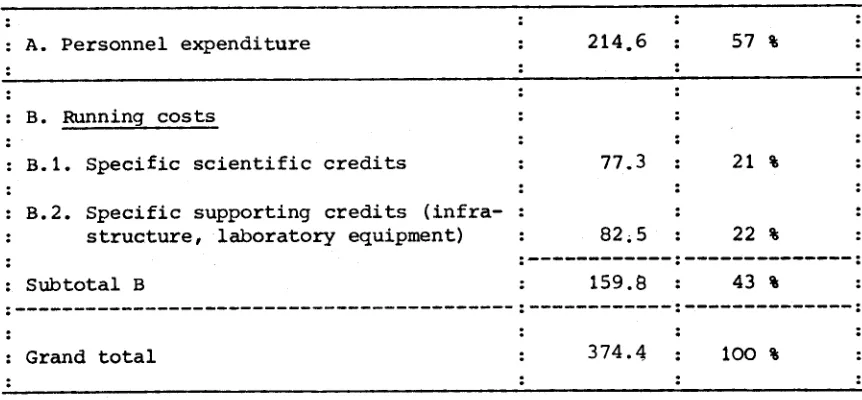
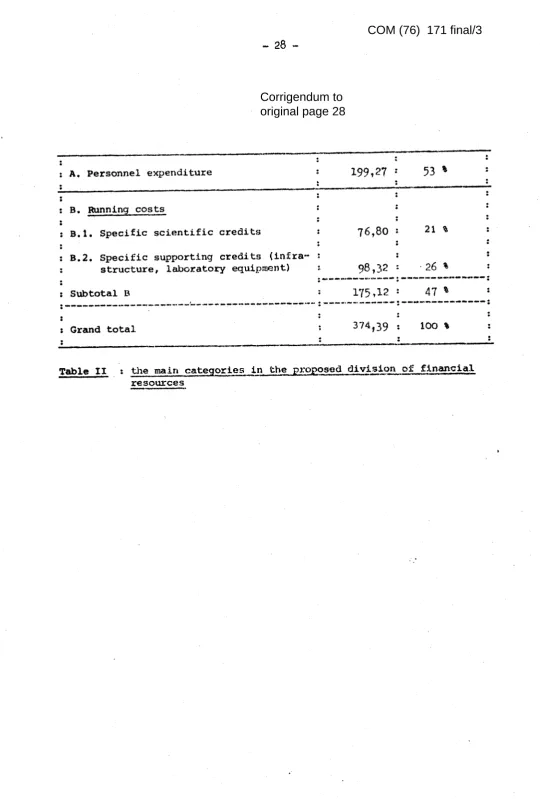
Fin g!gltg-99-pl9g!3ry9:_3lg_!9999!35Y creditsThe overall financial requirements for execution of the proposed
pro-gramme as defined by its technical content and schedule, ate 374.4 MUc
for the four year period. Followinq the line previously presented in the "overall concept" debated with the council on 15 Decernber 1975'
this maximum is expressed in units of account with a value as at
1 January 1977 and on the basis of a technical evaluation of costs
under the economic conditions effective at that date.
(1) communication
doc CoM(76)
I
2.2.t976
of
the Cormission tofinal, of 2l
Januarythe Council on the
site of
"tET-27
-It is
foreseenthat this
sr:mwill
not be dividedinto
equal annualparts
prlnarily
becauseof
the j-nvestment expenditures whichwill
occur only
at
certain pointsin
the progranme;in fact,
theprevi-sions show a decrease
in
the annual budgets between 1977 and 1980.The planned allocations
of
thefinancial
resources and personnelto
the proposed progranmesis
presentedin
tableI
annexed.to
thisdocument (see page
25). In
addit,ion, each technical sheetin
the annexe contains a detailed break-downof
personnel and specificcredit
requirements (major investments, equipment and specificoperational expenses)
of
the progranmein
guestion.2. If
the "researchstaff"
number and the amountof
speci_ficprogranune expenditure are taken together as a measure
of
therelative
importanceof
eachof
the 10 proposed programmes, andif
these prograrnmes are regrouped. under the four themes givenbelow, the
distribution of effort
during the next multiannualprogranme appears as follows :
-
nuclear safety-
new energies-
environment and resources488 12z
108
reference measurements,
service
activities
standards and techniques 17 ?
13 8.
This corresponds to a concentration of 70 t of the total effort in the field of energy and environment, while the
remaining 30 t is mainly devoted to the .fRC's public
ser-vice activities.