Title of Thesis:
E-Banking security and
organisational changes.
An action research study.
Thesis submitted in accordance with the requirements of the University of Liverpool for the degree of Doctor of Business Administration by Steinar Birkeland.
Page 1 of 142
Table of Contents:
List of Figures and tables: ... 5
List of Tables: ... 6
Declaration: ... 7
Copyright statement: ... 7
1. Abstract: ... 8
2. Acknowledgements: ... 9
3. Introduction of the study: ... 10
3.1 The study. ... 12
3.1.1 Information about the results. ... 13
3.2 Background and the importance of the study: ... 14
3.2.1 The Bank, the team and the researcher... 14
3.3 Areas of interest and key constructs. ... 15
3.3.1 Authentication and security in e-banking. ... 15
3.3.2 Potential threats. ... 15
3.3.3 BankX Values and their use. ... 16
3.4 Methodology and progress: ... 16
3.5 Thesis structure. ... 16
4. Critical Literature Review: ... 17
4.1 Introduction: ... 17
4.2 The Literature review: ... 17
4.2.1 Literature search methods: ... 17
4.3 Research Scope: ... 18
4.3.1 How bank values affect security planning: ... 18
4.3.2 Organisational changes: ... 19
4.3.3 Search for concerns, which can affect re-organisational planning:... 22
Page 2 of 142
4.3.5 Changes for members of the AFAC team: ... 25
4.3.6 Trust generating activities in AFAC: ... 26
4.3.7 Security improvement for customers: ... 29
4.3.8 Customer security – what is the personal understanding of being secure? ... 34
4.3.9 Customer needs and understanding of e-banking security and services: ... 35
4.3.10 Connect customer needs to organisation impressions: ... 39
5. The Phenomenon, Methodology and Problematising processes: ... 41
5.1 Descriptions and position of the researcher: ... 41
5.2 The Action: ... 42
5.3 The Phenomenon: ... 43
5.3.1 The research philosophy and the problem: ... 44
5.4 Research methodology: ... 45
5.5 Description of the problem: ... 45
5.6 Research – knowledge gathering: ... 47
5.6.1 Data Collection: ... 48
5.6.2 Storage of the data: ... 49
5.6.3 Sampling and data collection: ... 49
5.6.4 Interviews structure and format: ... 50
5.6.5 Coding: ... 51
6. Analysis structure and methodology: ... 52
6.1 Introduction: ... 52
6.2 The analysis: ... 52
6.3.1 Grouping and distribution of data: ... 59
7. Area of interest: ... 61
7.1 Introduction: ... 61
7.2 Assumptions development: ... 61
Page 3 of 142
7.2.2 Assumptions set two – Search for concerns: ... 64
7.2.3 Assumptions set three – Information about changes: ... 64
7.2.4 Assumptions set four – Security improvement for customers: ... 65
8. Analysis: ... 67
8.1 Introduction: ... 67
8.2 Results: ... 67
8.3 Textual analysis of the data set. ... 68
8.3.1 How do bank values affect security planning: ... 68
8.3.2 Search for concerns, which can affect re-organisational planning:... 69
8.3.3 Information about changes for members of the AFAC team: ... 72
8.3.4 Security improvements for customers: ... 75
8.4 Structural analysis of the data set: ... 82
8.4.1 How the Bank Values is affecting security planning: ... 83
8.4.2 Search for concerns, which can affect re-organisational planning:... 87
8.4.3 Information about changes for members of the AFAC team: ... 88
8.4.4 Security improvement for customers: ... 91
9. Discussion and suggestions for improvements: ... 94
9.1 Introduction: ... 94
9.1.1 Modern Bank – a definition: ... 94
9.1.2 Customer security – leader responsibilities. ... 97
9.1.3 Customer security – employees’ responsibilities: ... 99
9.1.4 How to define security: ... 105
9.1.5 Customer Security Strategies: ... 107
9.1.6 Suggestions for the future solutions by the participants: ... 107
9.2 Assumptions validity from the analysis: ... 109
9.2.1 How the Bank Values is affecting security planning: ... 110
Page 4 of 142
9.2.3 The HY 4 concerns are: ... 112
9.2.4 Business threats recognised: ... 113
9.2.5 Information about changes for members of the AFAC team: ... 114
9.2.6 Security improvements for customers: ... 114
9.3 Assumption summary: ... 115
10. Suggestions for future changes and solutions: ... 117
10.1 Introduction: ... 117
10.2 Results: ... 117
10.2.1 Time perspective: ... 118
11. Further research: ... 120
11.1 Gap in literature: ... 122
12. Reflections and Learning: ... 123
13. Thesis Contribution ... 125
14. Conclusion: ... 126
15. References: ... 130
16. Appendices: ... 141
Page 5 of 142
List of Figures:
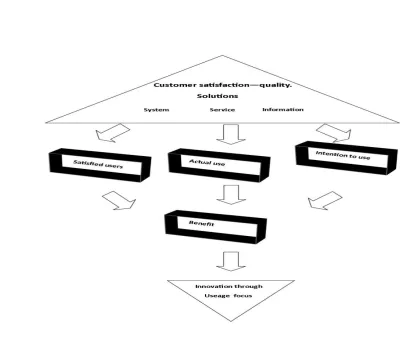
Figure 1: New focus on DeLone and McLean’s (2003) updated IS success model. ... 33
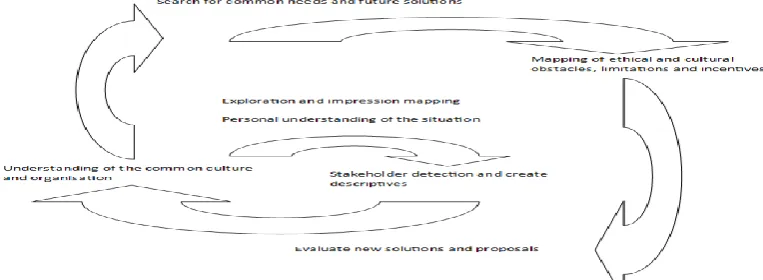
Figure 2: Learning Cycle, core ... 46
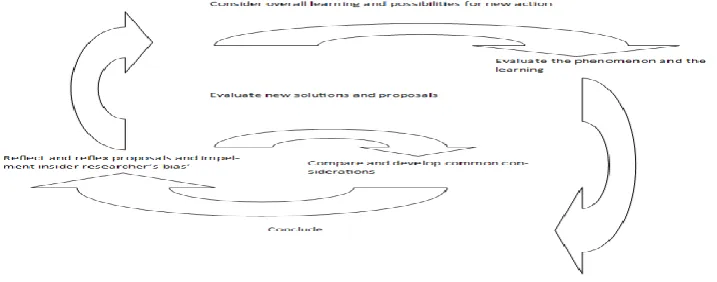
Figure 3 Learning cycle stage 2 ... 47
Figure 4: Relative-frequency distribution ... 50
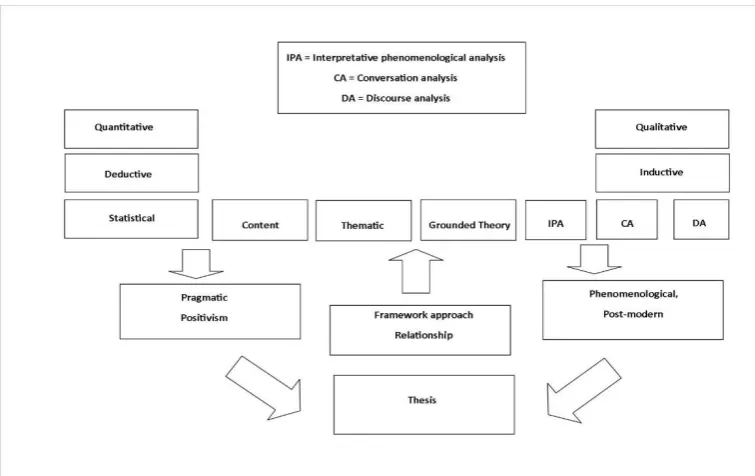
Figure 5: Relationship between qualitative methods and quantitative approaches ... 54
Figure 6: Data analysis model. ... 56
Figure 7: Horizontal data model. ... 56
Figure 8: Initial coding. Questions and participants example. ... 57
Figure 9: Questions coding ... 58
Figure 10: Horizontal coding by the areas of interest ... 58
Figure 11: Nodes compared by number of items coded ... 59
Figure 12: Word map – most frequent words from interviews, ... 60
Figure 13: How should changes be incorporated differently?. ... 73
Figure 14: Values Impression – organisational values. ... 84
Figure 15: Rating of latest re-organisation communication.. ... 89
Figure 16: Include employees in the re-organisation development, ... 91
Figure 17: Interpretation of IBM, (Mäenpää, 2006 in Liza, 2014) ... 95
Figure 18: Source, Graph of participants’ views of internet banking variables, Liza (2014) . 96 Figure 19: Productivity gain as a function of interaction. ... 99
Figure 20: Source - Private and Retail Banking overlap. (Molyneux and Omarini, 2005). . 100
Figure 21: Data from, CWQ quadrant example. (Gonzales, 2004) ... 102
Figure 22: Customer Values sorted, all measures. Metadata from Gonzales (2004) ... 103
Figure 23: Customer Values sorted by most important. Metadata from (Gonzales, 2004) ... 104
Figure 24: Measures and importance level. Metadata from (Gonzales, 2004) ... 104
Figure 25: Customer requirement evaluation. Metadata from (Gonzales, 2004) ... 105
Figure 26: Hypotheses’ assumptions relation and connections ... 109
Figure 27: Internal concerns of AFAC members in relation to the recent re-organisation. . 111
Figure 28: Time perspective for planning. ... 118
Page 6 of 142
List of Tables:
Table 1: Needs and Product solutions for private customers. ... 35
Table 2: Internal concerns. Quotas from the interviews. ... 88
Table 3:AFAC team suggestions for improves for the future. ... 108
Table 4: Concerns and areas of attention for Bank X. ... 112
Table 5: Recognised business threats ... 113
Table 6: Hypothesis’/ assumption summary ... 116
Table 7: Internal, whom - Contribution ... 125
Page 7 of 142
Declaration:
I declare that that no portion of the work referred to in the thesis has been submitted in support of an application for another degree or qualification of this or any other university alternatively, other institute of learning.
Copyright statement:
1. The author of this thesis (including any appendices and/or schedules to this thesis) owns certain copyright or related rights in it (the “Copyright”) and s/he has given The University of Liverpool certain rights to use such Copyright, including for
administrative purposes.
2. Copies of this thesis, either in full or in extracts and whether in hard or electronic copy, may be made only in accordance with the Copyright, Designs and Patents Act 1988 (as amended) and regulations issued under it or, where appropriate, in
accordance with licensing agreements which the University has from time to time. This page must form part of any such copies made.
3. The ownership of certain Copyright, patents, designs, trademarks and other intellectual property (the “Intellectual Property”) and any reproductions of copyright works in the thesis, for example graphs and tables (“Reproductions”), which may be described in this thesis, may not be owned by the author and may be owned by third parties. Such Intellectual Property and Reproductions cannot and must not be made available for use without the prior written permission of the owner(s) of the relevant Intellectual
Property and/or Reproductions.
Page 8 of 142
1.
Abstract:
The thesis considers customer security in a major European bank Bank X. The action research focus is to strengthen the processes and the overall solution for online Bank customers which experience a significant growth and increase in use.
There seem to be a common misperception between the internal staff of the bank and its customers regarding what security is, and the research considers several new security situations in the banking business. Moving from branch-oriented business to a digital orientation within the time space of just a few years has challenged banks to create new solutions for their customers. Such solutions must be secure, but technical security need separation from human security since new approaches as for example social engineering easily can be a source for fraud and losses for customers in a modern digital bank.
Page 9 of 142
2.
Acknowledgements:
Support from my family, friends and my employer has been essential to enabling me to progress all the way through this DBA programme. I would like to thank my wife, Catharina, for being patient and supportive to a man heavily occupied in schoolwork during evenings and weekends for many years. My children Susanne, Andreas and Henrik have been spending less time with their father than desirable, which can be an unfortunate situation, but they have understood the purpose. My other family and friends have been available when needed, to have a chat or just bring my thoughts into other fields of interest.
The actual work with this thesis has taken place under the excellent guidance of my
supervisor, Dr Robin Luo, and his support has been essential in enabling me to complete this research. Dr Luo’s advice during the research process deserves a special notice and I would like to thank him very much for this substantial effort. I would also like to say thank you to my second supervisor, Dr Paul Ellwood for his feedback and support during the final stage of the write-up and his critical review of the material. His contribution resulted in several important improvements and increased the overall quality of the thesis and learning.
Page 10 of 142
3.
Introduction of the study:
The overall focus of this thesis is to determine how a major bank, Bank X, can improve customer security in the new world of digital banking. The sub-focus, which is important to the conclusions of the thesis, is how internal re-organisations in the AFAC (Authentication and Financial Anti-Crime) security team can improve customer security. The research, therefore, examines in combination security and organisational changes. When focusing on security from the business side the thesis eschews consideration of technical discussions and solutions to investigate closely how the human factor plays an important role in the technical world of online banking business. Security management within Bank X is extensive and involves additional teams such as IT Operation, IT security, IT security Architects, and board of Directors/leader group. International standards such as ISO 27002, Standard of Good Practice for Information Security and the Bank X internal Group Information Security
Practice. Application owners have a massive responsibility for the security within Bank X and the ability to relate the application owner role, application development and security standards with business risk evaluation and customers’ needs and usability is a major challenge.
External stakeholders as vendors of security applications, government and legal, domestic and international are other examples of challenges and contributors to banking security.
This research is also a good model for future quantitative studies with an objective attention to the particular situation, aiming to generate improvements to the global situation and the AFAC team.
Bank X is a complex organisation, and its financial strength results from several mergers and acquisitions. The overarching global perspective in the business also depends on local security initiatives in each country, with the AFAC team having responsibility for planning all security solutions within the global market. A key challenge facing the team is managing systems and people across many cultures, each with different perceptions of what a good and secure modern digital bank is. This issue of cultural difference also affects this research since the research participants have different backgrounds and perceptions informed by their own culture and systems. This has the advantage, however, of meaning that the research is a good opportunity to capture global opinions and to evaluate the customers within the same global perspective. All research is therefore concluding global situations, learning and development and local adjustments are circumstances each country must adjust from internal
Page 11 of 142
The research focus is from the customers’ perspective, which also challenges security vs usability solutions. Important challenges are the rapidly expanding use of the Internet and online banking, in particular the trend towards new multi-channel needs for the customers. The traditional banking security experience a replacement by a new attention to smart-phones, tablets, laptops, and other portable devices with a potentially future connection to an online bank or companies providing the customers with payment, digital signing or authentication services.
To increase its focus to the new situation, the bank has performed several re-organisations and attempted to merge online solutions for retail banking with its wholesale and business arms. This requires a different and improved holistic perspective and the scope of the research originates from these changes. The particular organisational change where the phenomena exist is a result where managers from different teams, reassigning to lead several smaller teams with different focuses under the same umbrella of Authentication and Financial Anti-Crime.
The change was a top-down exercise, kept strictly confidential from all team-members until approximately one month before start-up date for the new solution, due to normal Bank X change practise. Few or no tasks where organised prior to the start of the new solution, which has been challenging for the different teams and individuals. The first impression of the staff feedback during the interviews regarding the change and the new functionality, however, was that it was desirable and a change that all persons involved wanted and had asked for. Another impression at the early stage was that Bank X was an open organisation, without any typical cybernetic systems behaviour or common procedures, from the definition of Stacey (2011, pp.66), where self-regulating, negative feedback or equilibrium can exist. The research process continuously evaluate this impression by the researcher.
The staff are very qualified persons, all with higher education within business, leadership, economics or IT technical fields. Leaders have been employed in the bank for several years and are well qualified ‘insiders’, possessing massive knowledge about the organisation. This can be beneficial, but possibly, also a drawback, as previous assumptions can prevent
Page 12 of 142
turnovers have a potential negative effect because of poor hand-over processes of products and a lack of continuity.
When introducing the recent change, the research scope for this thesis came up as a wish from the managers of AFAC (Authentication and Financial Anti-Crime). The research initial aim was to analyse the change process and detect needs for adjustments, improvements and other factors, which can have negative effect on the focus of creating a secure Multi-Channel Bank, which attracts customers with its digital solutions, with the organisational change as a trigger for the phenomena description.
The scope origin and develop from the initial thesis proposal and the researcher’s role ensures good possibilities to encourage interview candidates to contribute. The thesis proposal design was in collaboration with the managers from AFAC and the reason was to ensure that the attention focus were on the human factor as the most important element for a successful organisational change, effective on a long-term basis. The researcher’s role is as an insider, being a member of the AFAC team. The researcher, however, has only been an employee in this role for a short time and therefore it is still possible to perform the research as an insider researcher with a minimum of personal biases, which is essential to the credibility and validity of the thesis.
Investigate any impact of organisational changes and further determine the interaction
between banking security from the mobile/online perspective and the modern customer using the new services was necessary to refine. This focus develop further to main fields of interest, but the compromising elements security vs usability in the development of a modern online bank forms the core research element. Security vs usability can be contradictive and need connections to support each other rather as conflicting elements or impediments for the customers.
3.1 The study.
Page 13 of 142
present affect the future and Bank X’s strategies and changes. This phenomenon also forms the learning cycle and the action research stages, with the definition of main areas of interests as core elements connected to the phenomenon. The interviews also gave input to the thesis in the form of several suggestions and proposals for improvement, which is brought back into the organisation during the action research period.
This study concerns how a major bank can increase customer security through internal re-organisations, but also discuss that re-organisations without focusing on customer contact and communication will not have any direct effect. The long-term effect is however expected to be successful, but a question can be if the changes are optimal due to the increasingly speed of changes in the market.
A security team in a major European bank has one task – to secure the customers assets and protect the overall business, which now mainly acts as a digital, online organisation. There are still branches, but these are decreasing in number and the trend is clearly towards an
increasing focus on e banking as the main channel, (Bank X, internal research, 2015). This trend is significant and a source for near game changing adjustments and a reason for the interest of performing a research of how Bank X can adjust for the future. Changing from physical branches to mobile solutions also changes the security aspect and to be successful in future banking should security vs usability be key development areas. It seems to be the ‘normal’ that the AFAC security team tends to focus on technical solutions rather than the human factor when re-organisations are in planning stages. ‘How can we put together a good team finding the best technical solutions for the future’- is potentially the overarching idea and this idea tends to construct ‘walls’ between security, IT and banking business teams. These walls generate silo-thinking and decrease cross-divisional collaboration and innovation and even if the technical solutions can be good, there is a lack of internal overview in Bank X which prevents re-organisations developing a focus on the customer as a part of the security, not only a user of a solution.
3.1.1 Information about the results.
Page 14 of 142
in having the team members influencing the strategic choices. The reasons can be several, but ‘tradition’ is perhaps the most interesting, demonstrating that a culture only develop itself from the inside, where willingness to change is something the leaders need to handle, not only the employees. Neither leaders nor employees forward customer communication as the most important element for success, but there are indications pointing at such effort as to some level effective. However is there less connection between the internal organisation and how this can improve the security directly. This situation is about to change and recent activities in the AFAC team have strengthened the transaction screening, but there is a direct connection to incidents and market trends. It is interesting to notice that the re-organisation this thesis evaluate also is a direct consequence of an incident, which makes the impression of change activities to be re-active, not pro-active.
3.2 Background and the importance of the study:
Initially is the interest and importance of this study the new situation, escalating from a maturing e-business setting where try and fail methods have resulted in monolithic software, where add-on replaces the previous. This can be particularly important in e-banking where the increasing use of mobile devises the last 2-3 years are resulting in new problems. This is not only valid for e-banking, but probably for all modern business, becoming more and more dependent on technology. Technology is also a matter of the people using it and investigating how the users want the new situation to be will be just as important as the situation itself.
3.2.1 The Bank, the team and the researcher.
The company, which is the focus of this research, is one of the Europe’s largest banks, considered systemically important from a world financial perspective. (GSIFI – Global System Important Financial Institution). The research examines one particular phenomenon within a global team: Authentication and Financial Anti-Crime, (AFAC), which in turn consists of several minor teams with a common goal; to secure and maintain solutions related to all forms for banking security. The sub-teams are Authentication and Online Fraud
Prevention, Anti Money Laundering Solutions and Authentication and Financial Anti-Crime Operations. The AFAC team operates from Scandinavia and the Baltic countries and the team-members and all leaders are located in this region.
The Researcher has a position as a Global Product and Process Manager in the Authentication and Online Fraud Prevention team and is responsible for the Norwegian authentication
Page 15 of 142
3.3 Areas of interest and key constructs.
3.3.1 Authentication and security in e-banking.
Logging into an online bank in Norway involves the use of strong online authentication methods and BankID solutions, with a third-party solution performing a secure check of the users’ credentials. Strong authentication is for example in Norway per definition a
confirmation of a person’s identification in two separate and independent channels,
combining something the user have, (hardware device, mobile), the user are, (biometrics) and the user knows, (username password). All banks can issue BankID access, (Norwegian identification solution), but only after physical identification of the users, which needs a passport to complete a ‘know your customer’ process. When the user is accepted, he/she can use their BankID in all banks’ and other governmental/private web-solutions where BankID exists as the authentication solution. Credit card payment and document signing are other options. The considerations of the Bank X online security solutions concludes the
authentication with BankID to be safe technically, but problems occur due to illegal use or by ID theft or fraud committed by the customer. (Bank X, internal research, 2015). A problem is also the high number of authentication solutions within the bank, which have less security, but are more convenient for the customers.
3.3.2 Potential threats.
Instant payment solutions in a global perspective can increase fraudulent behaviour significantly because of uncertainties of the level of security. Customers want to perform purchases and payments from all sorts of devices and the new trend where mobile phones and tablets are the preferred device for accessing banking services increases the requirements for security and awareness, (Bank X, internal research, 2015). The new and convenient instant payment solutions challenges security because of its ease of use and force the banking
Page 16 of 142 3.3.3 BankX Values and their use.
BankX use company specific values actively in the day-to-day business. The values are One Bank X team; It is all about people and Great Customer Experiences and it is of interest to recognise if these are effective and are a source for strategy and planning, and as a
consideration point for security for the AFAC team. This is also a particular area for literature research – to determine how the bank values affect the security planning.
3.4 Methodology and progress:
Reaching the research goals includes social studies to aim for the inductive with a post-modern philosophy and phenomenology, which can detect the present situation, aiming for the future solutions and suggestions. This methodology need however support from the pragmatic and positivistic mind-set to add the deductive element to the discussion, looking at the past. With this combination, the thesis considers the “what” moving forwards to the “how” in a complete philosophical study where the focus is on people. This methodology is a result of a long-term development of the study, over 2,5 years and the need to create an exploratory study, where a continuous changing organisation requires a similar research format.
3.5 Thesis structure.
Page 17 of 142
4.
Critical Literature Review:
4.1 Introduction:
A critical literature review, (CLR) is the format used within this thesis. This format serves to bring current learning and literature into the framing of the problem statement. The CLR considers leadership, organisational development and change processes, in relation to security problems and how organisational changes can affect e Banking. Areas’ of interest organise the literature search and connect the thesis research and the analysis.
4.2 The Literature review:
The literature review demonstrate that organisational changes have an effect on technical and human issues, both internal and external (customers/users) and if the bank fails in its changes and leadership methods, it can fail security wise as well. The scope in this CLR is also to search for reasons for a re-organisation and elements that need to be included in
organisational strategy development, as well as to uncover the reasons behind changes and how such can become a success or a failure.
4.2.1 Literature search methods:
The literature search followed a systematic approach with a set of areas of specific interest as guidelines to detect the appropriate literature. The four areas are:
How bank values affects security planning:
Concerns which can affect re-organisational planning:
Changes facing members of local and global teams:
Security improvement for customers:
There are several sub-fields for the literature search that fall under these main categories. Examples of these are; leadership styles, organisational changes, cultural and ethical reasons for changes, motivational factors, virtual team development and learning, resistance and unwillingness in organisations, cognitive biases, managerial errors and social dynamics, security in e-banking services, customer needs and understanding of e-banking security and services and connect customer needs to organisation impressions. All of these sub-fields will have impact on any changes or in any organisations, but the four main areas of interest form the core literature search with links to the sub-fields and the information such sub-fields provide to the total analysis of the material. The literature analysis is therefore considering all material as either core information or as sub-information with a potential effect on the
Page 18 of 142
4.3 Research Scope:
The online security situation in Bank X is complex and important due to the high value placed on customer rights and needs in combination with national and international legislation. Recent reorganisation affecting the AFAC team (Authentication and financial Anti-Crime) as this team now having the main responsibility for security issues with a business perspective in addition to develop technical elements. The literature search displays how reorganisations can spring from ideas and assumptions together with strategic thinking, aiming for an overall solution, which places the customer needs in focus.
4.3.1 How bank values affect security planning:
To use organisational visions and missions actively to condition the leaders’ mind-sets
towards the overall company values is one potential approach, but there is also a need to blend leaders’ personal behaviour and leadership styles with the current culture to achieve
continuous innovation routines. Leadership routines are essential in any changes and Bank X employees have experienced several organisational changes across many teams, raising the issue of how to increase security, usability and customer friendly solutions by such changes. Crevani, et.al (2010) in Raelin (2012) point at detaching leadership from personality to focus on social interaction and changes within an organisation. Leadership-as-practice, (LAP), is a term in use, which includes moral, emotions and relational aspects, beyond rationale,
objective and technical terms. (Carroll et.al. 2008). Leadership in activities are more
important due to the authors’ than the leader and its person and the ‘where’, ‘how’ and ‘why’ takes the focus away from the’who’. (Raelin, 2012). Organisational changes through leaderful development under the flag of democratic traditions are contradictive to the ‘normal’ in Bank X, where the leaders’ forms the changes without the employees’ involvement. Since leaders make changes as top-down solutions, the social perspective and communication of the
Page 19 of 142
how the environment shapes, Avshalom, and Rachman-Moore (2004) claim that a policy maker tends to favour formalities, where academics blend formal and informal methods. An ethical code of conduct as an integral part of work environment development is a recent trend in Europe, USA and Australia and this phenomenon is potentially an outcome of changes in leadership behaviour and education among leaders. (Adams et al., 2001; Kaye, 1992; Post et al., 2002; Reynolds, 2000; Somers, 2001). The methodology is a managerial practice that consider internal and external stakeholders in a good way to secure environmental
development on common understanding, which shapes from leadership behaviour. (Paine, 1996, pp. 477–478) with (Murphy, 1988) in Avshalom and Rachman-Moore (2004).
Leadership style will also change during the shifting process of the team. This can lead team-members to become followers or passive subordinates depending on the style. Although Raelin argues that leaders create commitment and continuity of leadership by concurrency, collective focus, collaborative and passionate behaviour (Raelin 2003, pp.14), this can be difficult in a changing environment. Leaders and followers replace ideas depending on the counterpart, which decreases the possibilities of learning the big picture of security. This can in turn affect the e-banking solutions and customer focus, because the big picture is changing from within, by the change of leaders and followers. This will be important to evaluate, because while assumptions can easily be that it is only customers and the market that changes. Organisational values needs foundation to the leaders’ mind-set and become a tool for
changes, not only empty words. Leaders can also use values to encourage employees to participate in any organisational development, but willingness and trust must be present to create in common. Can there be differences and traditions to trust employees’ work tasks, but not participation in organisational strategy development?
There seems to be a gap in the research in respect to how internal circumstances create changed beliefs, politics and ideas in relation to modern e-banking organisations. The reason for this gap can be the rapid development of the mobile world of banking.
4.3.2 Organisational changes:
Page 20 of 142
the organisational objectives are with the individual motivational factors and social-technical approaches of the leaders. It is the researchers impression that the AFAC team is well
connected, but Proenca (2010, pp.339) suggests that informal goals need to derive from informal groups where formal goals, which is measurable, hold the frames. It is also the researcher’s impression that the virtual team situation can prevent this idea, even if video meetings, 2-4 weeks interval and physical meetings occur every 6-8 weeks. This can point at a problem with Proenca’ s description of SMWT’s if the teams are distant in location and culture. If Bank X and the AFAC team then try to have well functional virtual teams across countries and simultaneously attempt to bring together the employees with common missions and vision, goals and work methods, a failure can be the result.
The two-factor theory by Herzberg, (Herzberg, 1964, 1966, 2003), articulated in Hughes, Ginnet and Gurphy (2006, pp. 285), points at motivators and hygiene factors. Recognition of motivators as achievement, recognition, the work itself, responsibility, advancement and growth, should be the basis in any organisation but if virtual teams are the norm, then questions of how the leaders can ensure alignment with the employees’ development and standpoints become appropriate. Participative behaviour by the leaders can generate increased understanding that every person has their own state of personal moral development. Such development also affects cultural, ethical and willingness circumstances, which again can be a basis for resistance to changes or organisational knowledge development. Related to overall security thinking, these elements can affect the results, caused by different cultural and moral attitudes. This potential circumstance can challenge managers and leaders to engage in moral development as explained by Kohlberg’s six stages of Moral Development, (Trevino, 1986). This model open for considerations at the preconventional level as obedience and punishment orientation and instrumental purpose and exchange. The conventional level, where
interpersonal accord, conformity and mutual expectation is sources for new models to the final level, the principled, where social contracting and individual rights together with
Page 21 of 142
split nature of solutions, and any re-organisation of the AFAC team needs to emphasize the issue of how to gain such common solutions from a common culture and organisation. Shah and Siddiqui (2006) fail to include security in their research and this could be a breach by the authors in the suggestion of multi-channel thinking. Security was not a major element within their research scope, but it will be difficult to perform research of e-banking solutions without blending in security as an important factor. It can be possible to ensure the security approach using common solutions without a core system, but as Shah and Siddiqui (2006) explain, is the majority of the literature found of strategic nature. The same authors also recognise a gap in the literature concerning CSF (critical success factor) studies, which is essential in e-banking. This can be important and if the leaders of AFAC can focus on a common basis for security, the team members can develop similar security systems from analyses and customer measure software, detection systems, etc. This then becomes a social exercise where re-organisations spring from a combination of top-down and bottom-up methods aiming to build the organisation for the creation of an online security system, not building the security system for the creation of the organisation. This is where several authors fail to include the social factor, only considering technical and structural circumstances. Enos (2001), Turban et.al (2000), Regan, and Macaluso (2000) in Shah and Siddiqui (2006) are examples of this understanding.
Re-organisations with a top-down approach, as the latest change in AFAC was, are also a question of scope and motive. To be able to determine the scope of reorganisations during research one must visualise the idea behind them, but a question is whether such changes should include a bottom-up setting to ensure that internal knowledge moulded the outcome. This will be particularly important in an organisation where there are problems getting security ownership transferred into the complete business and culture and increasing the security of the bank’s critical applications. Such applications can be the core business system, even if some applications can be outside the regular IT infrastructure. Chris Dunning, CEO of Staples, a major Global Supplier company, expresses this as a major challenge in terms of the protection of data and the banks intellectual properties (Johnson and Goetz, 2007), that will have an effect on the customers’ impression of a secure bank. Johnson and Goetz (2007) also suggest that the empowering of security groups is pivotal to achieving organisational
understanding of the importance of blending operational and security risks with business objectives. An important question is if the AFAC team should have such increased
Page 22 of 142
combined perspective into the top-level management. Focusing on business, security and operations also introduces an increasing need to understand that people and organisational culture is the key to a cross-divisional mind-set based on appropriate communication. The literature demonstrate that the changes Banks’ experience, moving from traditional to e banking needs different attention and research. Social circumstances needs blending together with structural and technical research and practice, which also forms the idea for this thesis and its research.
4.3.3 Search for concerns, which can affect re-organisational planning:
When planning for organisational changes, leaders need to determine employees and customers’ ethical circumstances globally to bring issues together in a common picture. Ethical circumstances can be problematic and arising from conditional bounded moral rationalities, but these rationalities can easily differ from region to region. Calton and Payne (2003). Since ethical values can be different across a global organisation, one important element can be to detect if personal ethical and moral values are in conflict with the company’s statements or the team’s objectives. This can also be a reason for leaders
becoming altruistic in their attempt to satisfy team members, which again can affect security solutions negatively. Altruistic leaders, acting reflexively from individual values, engage in constantly improving any situation, but this does not necessarily give the best results (Trevino, 1986). “The leaders honest motive should originate from a service oriented approach to the situation and be connected to a mediated relationship between
self-transcendence and self-enhancement values, demonstrating and separating intensity and
altruistic behaviour”. (Sosik, Jung, and Dinger 2009).
A major organisational change should emphasise social considerations and determine if the new situation is better capable of performing its business due to the customers and business’ objectives. This can be in contrast with Bowman and Sing’s (1993) claim reported in Quintero (2003, pp.21) that restructuring of an organisation generally is about making changes in the financial and/or organisational form. Through the reorganisation, the bank division
Page 23 of 142
technology acceptance model (TAM); the motivational model (MM); the theory of planned behaviour (TPB); a model that combines the technology acceptance model and the theory of planned behaviour (C-TAM-TPB); a model of PC utilization (MPCU); an innovation
diffusion theory (IDT); and a social cognitive theory (SCT), (Agarwal et.al. 2009). UTAUT is one example and performing an organisational change should include considerations of such models and become a source for potentially developing new understandings of how the end users are attracted to a bank’s online services. This will shape an innovative attitude and increase the cognitive aspect of security to include social factors and end users’ understanding within the AFAC team. Considerations towards constructs as performance and efforts
expectancies, social influence and facilitating conditions will be a result of perceived
usefulness, (Jahangir and Begum 2008), extrinsic motivation, job-fit, relative advantage and outcome expectations focus. Such constructs are essential to determine before selecting a model, for example within the frames of UTAUT, but are these theories sufficient or able to contribute to the development of the constructs? Also important in UTAUT are the effect of the perceived ease of use of the root constructs, their complexity subjective norms, social factors, images, perceived behavioural control, conditions facilitating and compatibility important in UTAUT (Agarwal et.al. 2009), and these should be a part of the AFAC’ organisational planning and changes. It will be essential to recognise the reasons why these are important elements for increasing security in a bank and its services. The successful inclusion of such models depends on the security team’s capability to absorb the extension of the mind-set of the team members and their capability to see security and trust building as a social exercise in addition to a technical one. The UTAUT models are not a part of the research itself and the thesis are not considering what model is correct. This combination or model use can be a source for further researches. In this literature search is the models appearing as potential tools for critical mind setting, and such models are not recognisable within AFAC or Bank X.
4.3.4 Motivational factors within the AFAC team:
Page 24 of 142
(Marquardt and Waddill (2004). Knowledge among the leaders of how to trigger motivators can therefore be essential when communication of changes, aiming to avoid resistance and hidden negative feelings occur. Then it can be possible to avoid mistrust of the motives for the change, even if it is necessary and initially positive for the team. Changing solutions by
employee’s participation will therefore have to be a consideration of action learning
approaches, where the learning occur when action take place. Responsible experience can be a significant motivator, but as a part of the development of a plan which potentially can be a new implementation, depending on the continuous development. (Pedler, 1997, Revans, 1988) in (Marquardt and Waddill (2004). Bank X’s many changes can lead to negative feelings and the reason can be the possibility that initial positivity can lead to a feeling of acceptance of failures during a change process, with explanations being interpreted as ‘just another explanation’ if repeated too many times.
Any organisational change that involves online banking needs measures from which top management can learn how the e-banking security status and strategies can develop. Tools, for example performing or introducing UTAUT models, self-declaration exercises, SWOT or cost/benefit analyses need incorporation at all levels of the bank, not only for the business, but also for the re-organisation itself. Such indicators can display the health of the team and its activities, generate additional reporting strategies and be tools for future changes. Such measures needs connection by action learning to the motivational factors and the organisation must understand why the tools can generate motivation by its results. Motivation within groups, communication, leadership and the organisation itself can generate an identity feeling where motivation origins from organisational identity as a simple for of social identity. (Haslam, 2001) in (Cornelissen, Haslam and Balmer, 2007).
Page 25 of 142 4.3.5 Changes for members of the AFAC team:
The Bank X and the AFAC team operates both local and global, e.g. all members need to communicate with internal and global perspectives and realise that customer security needs separate solutions, depending on the location. This means that AFAC as a virtual team and the new world of online banking also makes customer communication virtual. Koskosas (2012) points out that good communication is such virtual teams is essential in security management procedures and communication of security goals must be trust generating. Inter-organisational trust within an e-commerce context is under evaluation in several studies, (Gefen et.al, 2003; Gefen and Straub, 2004; McKnight et.al. 2002) in Koskosas (2012), and an important element to be able to recognise changes and communicate the changes internally and externally from the overall Bank X’ perspective. The virtual team aspect is in relation trust, found in studies by (Ridings et.al. 2002; Sarker et.al. 2003) in Koskosas (2012), claims virtual environments and trust are global challenges. It makes it complicated to educate, inform and communicate across the organisation as the local groups, through its virtual existence, experience slightly different cultures and ethical constrains from country to country. This also points to the need for cross-cultural communication, but Anawati and Craig (2006) note that such
communication can decrease performance by its form and by the content, which creates a need to consider practical linguistic differences together with technical challenges, even if using English or other common language within the same organisation. Global virtual teams can also have a negative effect on behavioural adaptation (Anawati and Craig, 2006), and it can be difficult to ensure that learning, and knowledge development, are captured correctly. This creates a need to undertake organisational development by introducing complex adaptive thinking. If facilitating the local and global teams is appropriate, it can be an opportunity where possibilities are visualised. This can again create a “change from within” mentality, (Choi et.al. 2001), ensuring flexibility and cross-cultural approaches.
Page 26 of 142
conflicts, and demonstrate concern and well-being for the employees. The leader should ‘join’ the team at the norming stage to ensure independency thinking, but still focusing on the process, (Raelin (2003, pp.106-107). A potential gap can be visible in the Tuckman model, and Raelin’s interpretation of this, is the ability to use it in virtual teams. Building a team and introducing organisational changes using this model has become difficult within the AFAC team, but one reason can be a lack of monitoring of each step and performance levels, to align them with the objectives of the change. Virtual teams need boundaries but O’Neil (1999) display a concern of how to use models as the Tuckman model correct, creating the correct links within the teams’.
4.3.6 Trust generating activities in AFAC:
A global team structure also makes internal problems global and there are different practices worldwide regarding capturing customers’ needs. Team members in one country can develop resistance and an unwillingness to participate in an overall strategy, claiming that the local circumstances do fit in with the global setting. Generating trust will be essential and leaders need trust from their staff to form the correct national and global strategies, but customers also need to demonstrate trust to the bank. Such trust is essential and customers need to be able to rely on any e-banking solution. With the rapid evolution of new mobile devices, smart-phones and applets, new requirements for ease of use lead to a potential breach in the
Page 27 of 142
culture in order to increase technical security is affordable, this author still does not focus directly on human security and customer culture.
Corporate customers are global and dependent on global solutions, but the national needs are still different. E-businesses, such as Online Banking is dependent on trust, from not only its customers and market, but also an overall impression that security is about increasing trust for all involved in operational activities in e-business. Trust must come from ‘within’, which supports the empowerment of a security/business team aiming to group all business under the trust-generating umbrella. Banking has experienced a major change in recent years, moving from merchants to online services and this is also an issue of moving trust from people to technology; but the people are still there, only with different assignments. A bank must ensure its e-business to secure all of Velmurugan (2009) six dimensions: confidentiality, integrity, availability, legitimate use, auditing and non-repudiation, and this is potentially affordable with a distance between the business’ internal culture and its customers and external
stakeholders. This means that the overall corporate security policy should be a management strategy to understand the causal nature of trust, internally and externally (Velmurugan, 2009). The risk of fraud requires an online bank-ensuring customer’s identity, but customers also need to ensure the identity of the banking online service; but even if this is common knowledge, is the organisational attention dualistic as proposed. It should be obvious to all security employees that a bank needs to look into transactions, but this can also generate distrust from customers, who may start to perceive surveillance from banks and authorities as an unwanted activity. Building trust to protect customers is important, according to
Velmurugan (2009), in addition to transparency of the technology and methods; and this is an issue of communication and knowledge development, across organisational, cultural and human borders of professionalism. However, the level of trust is not necessarily a connection to one dimension. The research by Lichstenstein and Williamson (2006) suggests that
customers display significant distrust in respect to banks, but only considering distrust to the staff. For online banking, this was not as important, since the participants’ highlighted
convenience and ease of use. This study is from 2006 and there may since have been changes and challenges to this result, nonetheless, it is an interesting conclusion by Lichstenstein and Williamson (2006) that trust is less important with online solutions than with transactions in bank branches. A successful focus on the Internet, as a medium to communicate trust and security is in the researcher’s opinion essential to achieve.
Page 28 of 142
security and trust are superficial services this can give an impression that the issues ‘just are there’ and the bank misses the opportunity to attract customers by acting beyond what is understandable or interesting to its audience. The AFAC team should create information as well as solutions to demonstrate the bank’s integrity and its concern with ensuring the safety for its customers. Agarwal et al. (2009) highlight the importance of this in changing the focus of customer attraction from creating new services to including a demonstration of security and trust generative information. For an organisational change to be successful in this context, one needs to create measures of what the customers and the employee’s expectations are in
respect to the change. Such expectations need to be the basis of the change and organisational planning, but it is the researcher’s impression that customer communication was out of the scope for the recent change in the AFAC team due to the literature explanations by Agarwal et.al. (2009). If the organisational change is a result of a crisis or an incident there is also a need to investigate the elements of this that the organisation can learn from and act
reflexively. Corbacioglu and Kapucu (2006) demonstrate that learning can originate from organisational, technical and cultural capacities as existing sub-factors to direct learning. These researchers mean that learning should come from organisation and coordination, informational infrastructure and the ability to learn from experience (Corbacioglu and
Kapucu, 2006), and this is also an indication that employees should be part of a change which is a result from an incident, and such action can be a contributor to internal and external trust. The culture should demonstrate the ability to learn and adapt during response operations, but if the culture (employees) do not have any influence on the organisational change this learning would be lost.
A challenge in security groups is potentially a lack of designated staff with a scope to define and align trust and make this issue a part of the overall strategy for the team and the
organisation. Shah and Siddiqui (2006) points out such measures for business purposes, but the development of technical solutions, customer measures and social changes will be important for management at all levels to learn the complete picture. The important element will be to generate understanding of the reasons for re-organisations from an ill-structured or wrong setting to a new model. In a complex and social context such reasons will, be
Page 29 of 142 4.3.7 Security improvement for customers:
Technical security as a solution is not within the scope of this thesis, but the ideas and
thoughts behind the solutions are. Direct and ‘live’fraud attempts are also important for Bank X’s AFAC team. This includes anti-money-laundering checks, with the e-banking
organisation creating continuously development of security needs. New threats, such as vulnerabilities to Trojans (computer virus) and other hacking methods appear as a global problem due to new technology and changes in people’s habits and trends in
device-replacement. This can create a need to discover and prevent new kinds of automated attacks, originating from new technology and new, devices that are more powerful. CAPTCHA’s, an acronym for “Completely Automated Public Turing test to tell Computers and Humans Apart” (Li et.al 2010), is one solution, but an evaluation of the user friendliness of such tools is essential. From the Internal Bank X results in Norway there is an impression that
authentication solutions are now safe, but this can only ever be a temporary state of affairs and will become invalid relatively quickly if updating of systems are not done by users. Personal ID theft seems to be an increasing problem, (internal reporting), which also is a reason for creating new solutions and information in addition to awareness campaigns etc. focused on e-bank customers and security staff. Security tools and systems must be logical for the users. Hertzum et al. (2004) quote Whitten and Tygar’s (1999) definition of e-banking security systems as:
“Security-related software is usable if the people who are expected to use it -
1. Are reliably made aware of the security tasks they need to perform; 2. Are able to figure out how to successfully perform those tasks; 3. Don’t make dangerous errors; and
4. Are sufficiently comfortable with the interface to continue using it.”
This can create a need for evaluation of the total security both as integrated or independent solutions, resulting in an unpredictable security solution where the results vary. Hertzum et al. (2004) make a strong point of this, but a comprehensive and complex system can itself be its own worst enemy.
Page 30 of 142
Methods such as hardware fingerprint captures, security detection scripts and filtering, encryption and biometrics are important within online banking, and a security teams’
approaches to this will have an effect on the total user experience. General internal knowledge in Bank X claim that customers want to be able to log into their bank at all times and from all types of devices, but one question is if the bank should allow this or if internal and strict control is necessary at the existing level. Overlay services, (third party services using the bank systems), can for example be a threat to e-bank security because of lack of control of the third party solution. This is important to AFAC, because of the connections and conflict between the customers’ ease of use and security. Usable security is important as the intention is to match principles and demands, “against user knowledge and motivation”, Hertzum et al. (2004). Customer knowledge is the approach of creating an appropriate combination of automated services and instructions where the customers act secure by knowledge, which provides a deeper understanding, beyond checklists and static instructions (Hertzum et al. 2004). This is important, because new security products, e-banking and modern customers also need modern instructions, in the form of interactive software, chat or active help applications. It is interesting that Dourish and Redmiles (2002) separate theoretical and effective security, and a new concept of perceived security, which takes into account the users’ subjective perception of the potential risks of using e-banking (Jih et al., 2005 in Hertzum et al., 2004). Perceived security can be in relation to perceived usefulness, which is also an element suffering from an internal/external miss-alignment. Re-organising for customer security purposes is only one scope in AFAC, and the Bank X in general. If this is true, all changes are apparently dualistic, where the external impression is to improve for the customers, but the real goal is to make a better business for themselves. AFAC’s perception of customers’ needs and requirements regarding e-banking solutions and security needs to
Page 31 of 142
A key element is that even when customers rate a bank’s security as good, their confidence to the technology was weak (Howcroft et al., 2002, cited in Jahangir and Begum, 2008).
The AFAC team could determine methods to investigate security differently by including qualitative and quantitative elements into the decision-making processes. One method can be to introduce for example the Analytic Hierarchy Process (AHP), which is a multi-criteria decision-making tool using hierarchal methods, including goals, sub-goals, factors and alternatives as the multi criteria decision making tool, (MCDM) introduced by Saaty (1990) and discussed in Syamsuddin and Junseok (2009).
AHP creates distance from opinions and personal agendas through four steps in the decision making process:
“Structure the problem into hierarchy.
Comparing and obtaining the judgment matrix.
Local weights and consistency of comparisons.
Aggregation of weights across various levels to obtain the final weights of alternatives”
(Zahedi, 1986) in Syamsuddin, I. and Junseok, H. (2009).
Attracting customers to e-banking solutions can be an automatic process, and this is becoming a new trend in the market. Pointing at improved security can be one element in this process, but this seem not to be the situation in Norway. To attract customers to one particular e-bank is a competitive approach, potentially dependent on ‘word-of-mouth’, (WOM), which is an “informal mode of communication between private parties concerning evaluation of goods and services” (Sing, 1988, in Ahmad and Hasan, 2011). WOM consider more influential on customers’ judgement of a solution than other written marketing approaches, and this is an element to consider when user-friendliness vs security is under evaluation. This means that customer loyalty, satisfaction and positive market reputations are dependent on the customers’ level of “satisfying accessibility, convenience, security, privacy, content, design, speed, fees and charges” (Ahmad and Hasan, 2011) and needs consideration when security solutions are
designed. This thesis research bring the qualitative elements together to focus on AFACs leaders and employees evaluation of ‘what’s behind the decisions’ and if for example the AHP topics introduced by Saaty (1990) are understandable to the AFAC team and affordable to use to create a better world-view of the security. One future example of action can thereby be that the AFAC team could work more closely with Bank X’s marketing division to ensure compliance with the “crucial characteristics of service intangibility, inseparability,
Page 32 of 142
of title”, (Zeithaml et al., 1985; Harrison, 2000), recognised by marketing scholars (Ahmad
and Hasan, 2011).
Introducing new elements, such as biometrics, for customer authentication, authorisation and identification can be a new challenge, which will be important to test in the market segment. Bank X is investigating several biometrical solutions and with this work comes a requirement to demonstrate how AFAC personnel can recognise which method customers find acceptable. The leaders must define what global position Bank X has for its customers in respect to its banking solutions. The huge number of legal authorities regulating e-banking worldwide (Fatima, 2011) means that finding one common solution can be impossible. This situation is itself a security challenge. If biometrics is a consideration for a global security solution, there is a need to discuss the customer acceptance of its definition. Biometrics is a “measurable physiological and behavioural characteristic that can be captured and subsequently
compared with another instance at the time of verification” (Fatima, 2011). Systems can use fingerprints, iris’ scanning or facial structures as physical measures, in addition to data entry patterns such as keyboard or mouse behaviour in combination in a complete authentication setup. There are five main components available as biometric measures: sensors, feature extractors, template databases, match and decision modules. (Moskovitch et al, 2009, Anil et.al, 2008) in Fatima (2011). This creates a challenge in respect to national legislation, since biometrics is dependent on governmental approval, individually and globally. It will also be challenging for customer acceptance since the nature of the solution, involving storing personal information, can be controversial for some customers.
Such elements are also about trust generating efforts. The customers need to trust that the bank’s solutions are secure and that the bank will only use the information for its intensions. Conversely, the bank needs to trust the customer’s behaviour and attitude, especially keeping their secret login information confidential from others. The definition of trust is explained, (Anderson and Weitz, 1989, cited in Flavian and Guinaliu, 2005) as “…one party’s belief that its needs will be fulfilled in the future by actions undertaken by the other party”, but this must
Page 33 of 142
Trust and satisfaction are two important factors for e-banking customers. A focus on generating trust for customers through business strategies also serves to generate a clear understanding of what trust is. Additional analyses need to design solutions to determine what customers consider their trust factors. DeLone and McLean’s (2003) updated IS (Information Security) success model, is an example of how IS impact at the individual and organisational level, and Lee and Chung (2009) build on the individual constructs of system quality,
[image:34.595.74.482.239.582.2]information quality and interface design quality, and their subsequent impact on trust and customer satisfaction.
Figure 1: New focus on DeLone and McLean’s (2003) updated IS success model.
It is important to recognise that Lee and Chung (2009) clearly recognise a connection between trust for mobile banking and customer satisfaction. There may be a problem with their
hypothesis since the authors briefly consider if trust generation should spring from business or IS, but the impression is that the authors point at IS as the most important stakeholder and contributor for trust generation and customer satisfaction. This may be a source for
Page 34 of 142 4.3.8 Customer security – what is the personal understanding of being secure?
Security is more than a word meaning, ‘the bank and money are safe’. Being secure, feeling secure or acting securely are examples of security-angles, depending on from where a person is using or thinking of the issue. Physical security is less important with fewer branches, but still customers can have a virtual picture of someone ensuring that their money is safe. This means that AFAC needs to understand what makes the bank’s customers feel secure, rather than assuming that all solutions introducing another ‘block’ necessarily increase customers’ feelings of security. Having such strong solutions that customers do not use them may actually decrease security, as long as options for easier systems are available. Critical and social reflections by leaders can help determine which psychological reasons potentially shape defensiveness’ within the team, founded by emotions and threats (Argyris, 1994, pp. 81). Leaders have to create a picture of why the organisation possesses or develops resistance to innovation and thus to form an organisation with the scope to overcome this bias and combine sociological and technical circumstances. Together with a re-organisation it will be necessary to ‘unlearn’ old traditions (Argyris, 1986); introducing new ways of working, but this will be dependent of the leaders’ abilities to be aware of meanings and behaviours, which otherwise might prevent an effective new phase becoming a reality. This means that leaders’ abilities to recognise biases, noise and misinterpretations are crucial to avoiding hidden pitfalls (Raelin, 2010). Cognitive biases need to be connected with problem recognition as a common
procedure, (Keil, Depledge and Rai, 2007), but to take advantage of the discovering of these biases it is necessary to challenge employees’ illusions of control with real awareness. By such awareness, a team can avoid managerial missteps, initiated by a lack of understanding of cognitive biases and other social dynamics; promoting new directions, which eliminate a potentially escalating negative. This focus is also supported by Ford and Ford (2010, pp 26), who supports the idea of different approaches towards organisational changes rather than relying only on technical and convenience motives.
Page 35 of 142 4.3.9 Customer needs and understanding of e-banking security and services:
When planning internally for re-organisations, it is the researcher’s subjective impression that this is more an exercise of convenience rather than one that focuses on acceptance of an important solution for customers. The team-members are aware of how important Internet banking is for many customers. In addition to a drop in transaction cost of 80 per cent, internet banking relations only takes place by e-mail, online searches for information on news/topics, travel, training/education and health, (Calisir and Gummesson, 2008). This fact also indicates that it is a tremendous challenge to understand customers’ perceptions of security as a service. The new organisation can include social factors to its security portfolio to ensure that one outcome of the organisational change is a different mind-set towards how security is understood among its audience.
Security thinking is now normal in a bank, but ongoing organisational changes with a scope to improve the situation can turn out badly if the focus is only on parts of the company’s
worldview. Modern e-banks must be capable of detecting customer needs seen from a total perspective. Security is the overwhelming and overarching element that prevents people in the bank from thinking holistic when focusing on customer needs. Cosma and Gualandri (2012) recognise in their book several customer needs and from the internal researcher’s
observational role it is easy to claim that the focus within the AFAC team is to create a secure online bank. Although the complete picture of customer needs varies and Table 1 below describes a suggestion for this complete picture. The table also indicates the numerous potential customer portfolios, which all need secure and trustworthy online solutions.
Customer Field of interest Bank X’ solutions to Business/private needs
Entrepreneurship Share and hybrid, corporate financing, private equity funds Speculation Hedge funds, derivative instruments, structured products
Investment Investment funds, units and indexes, linked, discretionary asset, management, bonds, debit accounts
Retirement Pension funds
Protection Insurance policies
Liquidity Current accounts, retail financing Philanthropy Not-for-profit organisations